

IEC 60245-1:2003
(Main)Rubber insulated cables - Rated voltages up to and including 450/750 V - Part 1: General requirements
General Information
- Abstract
Applies to rigid and flexible cables with insulation, and sheath if any, based on vulcanized rubber of rated voltages Uo/U up to and including 450/750 V used in power installations of nominal voltage not exceeding 450/750 V a.c. The particular types of cables are specified in IEC 60245-3, IEC 60245-4, etc. The code designations of these types of cables are given in Annex A. The principal change with respect to the previous edition is the replacement of insulation IE 1 with IE 4.
- Status
- Published
- Publication Date
- 29-Jan-2008
- Technical Committee
- TC 20 - Electric cables
- Drafting Committee
- WG 17 - TC 20/WG 17
Buy Documents
IEC 60245-1:2003 - Rubber insulated cables - Rated voltages up to and including 450/750 V - Part 1: General requirements Released:12/19/2003
IEC 60245-1:2003 - Conducteurs et câbles isolés au caoutchouc - Tension assignée au plus égale a 450/750 V - Partie 1: Exigences générales Released:12/19/2003
IEC 60245-1:2003 - Rubber insulated cables - Rated voltages up to and including 450/750 V - Part 1: General requirements Released:12/19/2003
IEC 60245-1:2003+AMD1:2007 CSV - Rubber insulated cables - Rated voltages up to and including 450/750 V - Part 1: General requirements Released:1/30/2008
Overview
IEC 60245-1:2003 - "Rubber insulated cables – Rated voltages up to and including 450/750 V – Part 1: General requirements" defines the general requirements for cables with insulation (and sheath, if any) based on vulcanized rubber for rated voltages Uo/U up to and including 450/750 V a.c.. It covers both rigid and flexible types (including cords), sets marking and identification rules, and establishes the framework for tests and construction requirements referenced in the companion test part and particular-type parts.
Key editorial note: the fourth edition (2003) replaces insulation designation IE 1 with IE 4; Parts 2–8 and relevant IEC documents provide the specific test methods and type-specific requirements.
Key topics and technical requirements
- Scope and applicability: Power installations with nominal voltage ≤ 450/750 V; includes cords, flexible cables, lift cables, welding electrode cables and heat‑resistant types when read alongside Parts 2–8.
- Materials and constructions: Requirements for conductors, vulcanized rubber insulation compounds (PCP, EVA, EPR, XLPVC equivalents), fillers, textile braid and sheaths.
- Marking and identification: Manufacturer identification, durability and legibility of marks, core identification by colour or numbers (per IEC 60173).
- Tests and conformity:
- Type tests (T) to validate new cable designs.
- Sample tests (S) to verify production batches.
- Electrical and non‑electrical test requirements for completed cables (referenced tables for cross‑linked rubber).
- Specific static flexibility tests for lift and arc‑welding electrode cables.
- Documentation and annexes: Code designations in Annex A; sheath thickness calculation method in Annex B; test methods referenced to IEC 60245‑2 and IEC 60811.
Practical applications
IEC 60245-1 is used to ensure safe, reliable performance of rubber‑insulated cables in:
- Low-voltage power distribution and wiring systems (≤ 450/750 V)
- Flexible power cords for appliances, portable tools and machinery
- Lift (elevator) cables and arc-welding electrode cables
- Heat‑resistant rubber cable applications (when combined with Part 3 or Part 7)
The standard guides material selection, manufacturing, testing and labeling to meet safety, durability and interoperability expectations.
Who uses this standard
- Cable manufacturers and compound formulators (product design, type testing)
- Test laboratories and quality control teams (type and sample testing)
- Specifiers, electrical engineers and procurement officers (technical specifications and acceptance criteria)
- Regulators and certification bodies (conformity assessment and compliance checks)
Related standards
- IEC 60245-2 (Test methods)
- IEC 60245-3, -4, -7 (Particular cable types)
- IEC 60332-1 (Fire tests on single cables)
- IEC 60811 series (Material test methods)
- IEC 60228, IEC 60173 (Conductors and core colours)
Keywords: IEC 60245-1, rubber insulated cables, 450/750 V, vulcanized rubber, cable standards, cable testing, flexible cords, insulation, sheath, IEC 60245.
Relations
- Effective Date
- 05-Sep-2023
- Effective Date
- 08-Mar-2024
- Effective Date
- 05-Sep-2023
- Effective Date
- 05-Sep-2023
- Effective Date
- 05-Sep-2023
Buy Documents
IEC 60245-1:2003 - Rubber insulated cables - Rated voltages up to and including 450/750 V - Part 1: General requirements Released:12/19/2003
IEC 60245-1:2003 - Conducteurs et câbles isolés au caoutchouc - Tension assignée au plus égale a 450/750 V - Partie 1: Exigences générales Released:12/19/2003
IEC 60245-1:2003 - Rubber insulated cables - Rated voltages up to and including 450/750 V - Part 1: General requirements Released:12/19/2003
IEC 60245-1:2003+AMD1:2007 CSV - Rubber insulated cables - Rated voltages up to and including 450/750 V - Part 1: General requirements Released:1/30/2008
Get Certified
Connect with accredited certification bodies for this standard

DVS-ZERT GmbH
German welding certification society.

IMQ S.p.A. (Certification)
Italian electrical product certification.

SLG Prüf- und Zertifizierungs GmbH
German testing and certification body.
Sponsored listings
Frequently Asked Questions
IEC 60245-1:2003 is a standard published by the International Electrotechnical Commission (IEC). Its full title is "Rubber insulated cables - Rated voltages up to and including 450/750 V - Part 1: General requirements". This standard covers: Applies to rigid and flexible cables with insulation, and sheath if any, based on vulcanized rubber of rated voltages Uo/U up to and including 450/750 V used in power installations of nominal voltage not exceeding 450/750 V a.c. The particular types of cables are specified in IEC 60245-3, IEC 60245-4, etc. The code designations of these types of cables are given in Annex A. The principal change with respect to the previous edition is the replacement of insulation IE 1 with IE 4.
Applies to rigid and flexible cables with insulation, and sheath if any, based on vulcanized rubber of rated voltages Uo/U up to and including 450/750 V used in power installations of nominal voltage not exceeding 450/750 V a.c. The particular types of cables are specified in IEC 60245-3, IEC 60245-4, etc. The code designations of these types of cables are given in Annex A. The principal change with respect to the previous edition is the replacement of insulation IE 1 with IE 4.
IEC 60245-1:2003 is classified under the following ICS (International Classification for Standards) categories: 01 - GENERALITIES. TERMINOLOGY. STANDARDIZATION. DOCUMENTATION; 25.160.20 - Welding consumables; 29.060.20 - Cables. The ICS classification helps identify the subject area and facilitates finding related standards.
IEC 60245-1:2003 has the following relationships with other standards: It is inter standard links to IEC 60245-1:2003/AMD1:2007, IEC 60245-1:2026, IEC 60245-1:1994, IEC 60245-1:1994/AMD1:1997, IEC 60245-1:1994/AMD2:1997. Understanding these relationships helps ensure you are using the most current and applicable version of the standard.
IEC 60245-1:2003 is available in PDF format for immediate download after purchase. The document can be added to your cart and obtained through the secure checkout process. Digital delivery ensures instant access to the complete standard document.
Standards Content (Sample)
INTERNATIONAL IEC
STANDARD 60245-1
Fourth edition
2003-12
Rubber insulated cables –
Rated voltages up to and including 450/750 V –
Part 1:
General requirements
This English-language version is derived from the original
bilingual publication by leaving out all French-language
pages. Missing page numbers correspond to the French-
language pages.
Reference number
Publication numbering
As from 1 January 1997 all IEC publications are issued with a designation in the
60000 series. For example, IEC 34-1 is now referred to as IEC 60034-1.
Consolidated editions
The IEC is now publishing consolidated versions of its publications. For example,
edition numbers 1.0, 1.1 and 1.2 refer, respectively, to the base publication, the
base publication incorporating amendment 1 and the base publication incorporating
amendments 1 and 2.
Further information on IEC publications
The technical content of IEC publications is kept under constant review by the IEC,
thus ensuring that the content reflects current technology. Information relating to
this publication, including its validity, is available in the IEC Catalogue of
publications (see below) in addition to new editions, amendments and corrigenda.
Information on the subjects under consideration and work in progress undertaken
by the technical committee which has prepared this publication, as well as the list
of publications issued, is also available from the following:
• IEC Web Site (www.iec.ch)
• Catalogue of IEC publications
The on-line catalogue on the IEC web site (www.iec.ch/searchpub) enables you to
search by a variety of criteria including text searches, technical committees
and date of publication. On-line information is also available on recently issued
publications, withdrawn and replaced publications, as well as corrigenda.
• IEC Just Published
This summary of recently issued publications (www.iec.ch/online_news/ justpub)
is also available by email. Please contact the Customer Service Centre (see
below) for further information.
• Customer Service Centre
If you have any questions regarding this publication or need further assistance,
please contact the Customer Service Centre:
Email: custserv@iec.ch
Tel: +41 22 919 02 11
Fax: +41 22 919 03 00
INTERNATIONAL IEC
STANDARD 60245-1
Fourth edition
2003-12
Rubber insulated cables –
Rated voltages up to and including 450/750 V –
Part 1:
General requirements
IEC 2003 Copyright - all rights reserved
No part of this publication may be reproduced or utilized in any form or by any means, electronic or mechanical,
including photocopying and microfilm, without permission in writing from the publisher.
International Electrotechnical Commission, 3, rue de Varembé, PO Box 131, CH-1211 Geneva 20, Switzerland
Telephone: +41 22 919 02 11 Telefax: +41 22 919 03 00 E-mail: inmail@iec.ch Web: www.iec.ch
PRICE CODE
T
Commission Electrotechnique Internationale
International Electrotechnical Commission
МеждународнаяЭлектротехническаяКомиссия
For price, see current catalogue
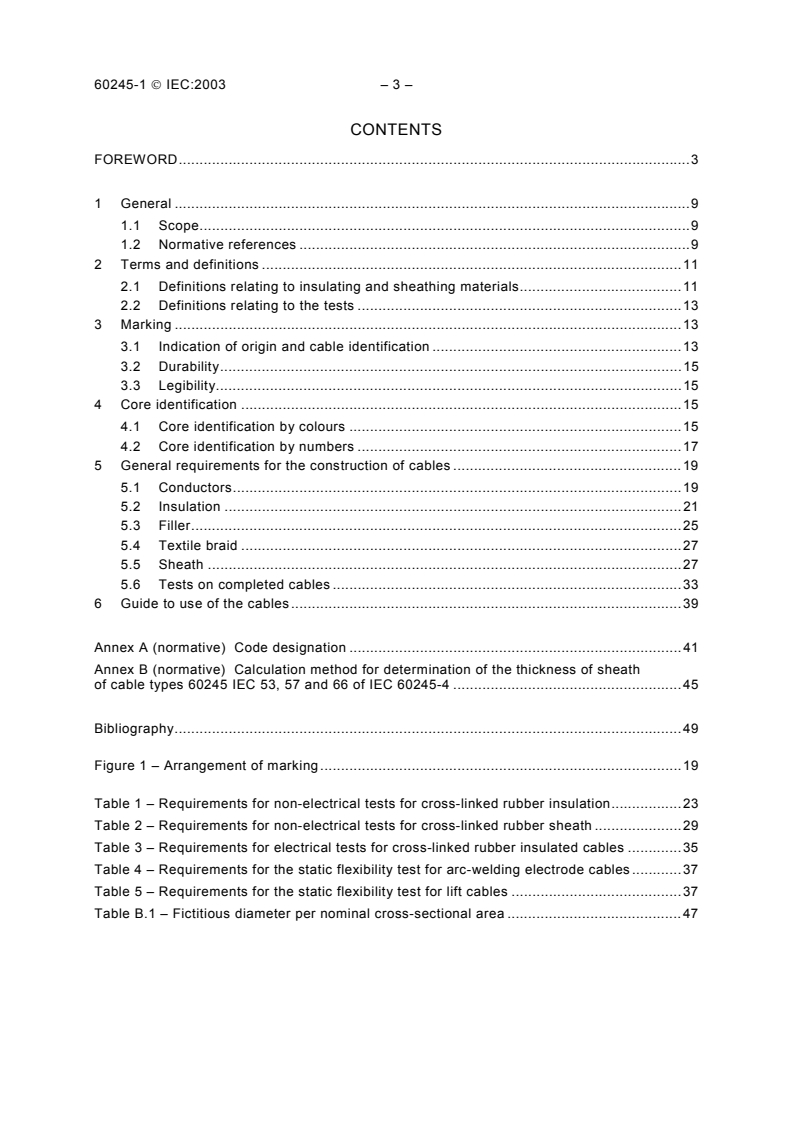
60245-1 IEC:2003 – 3 –
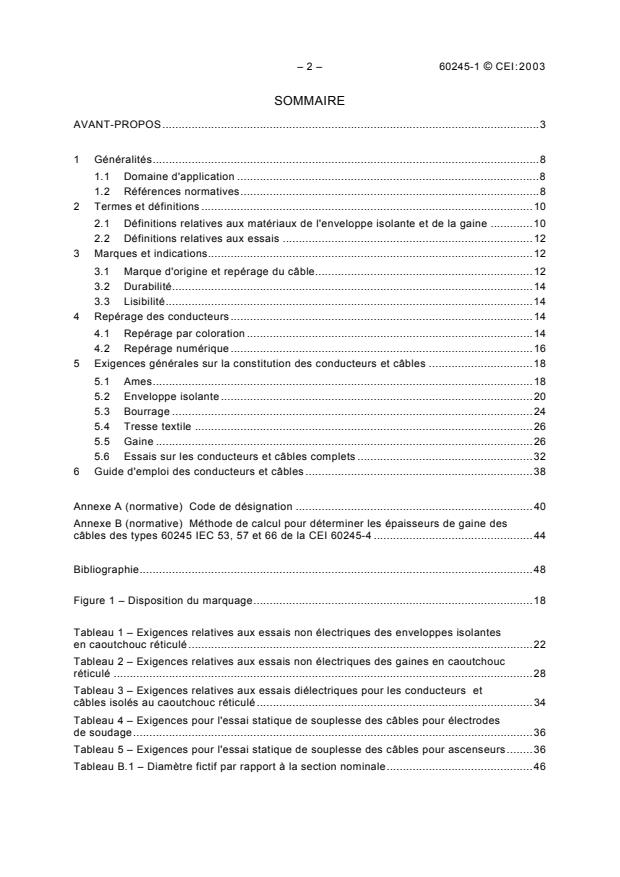
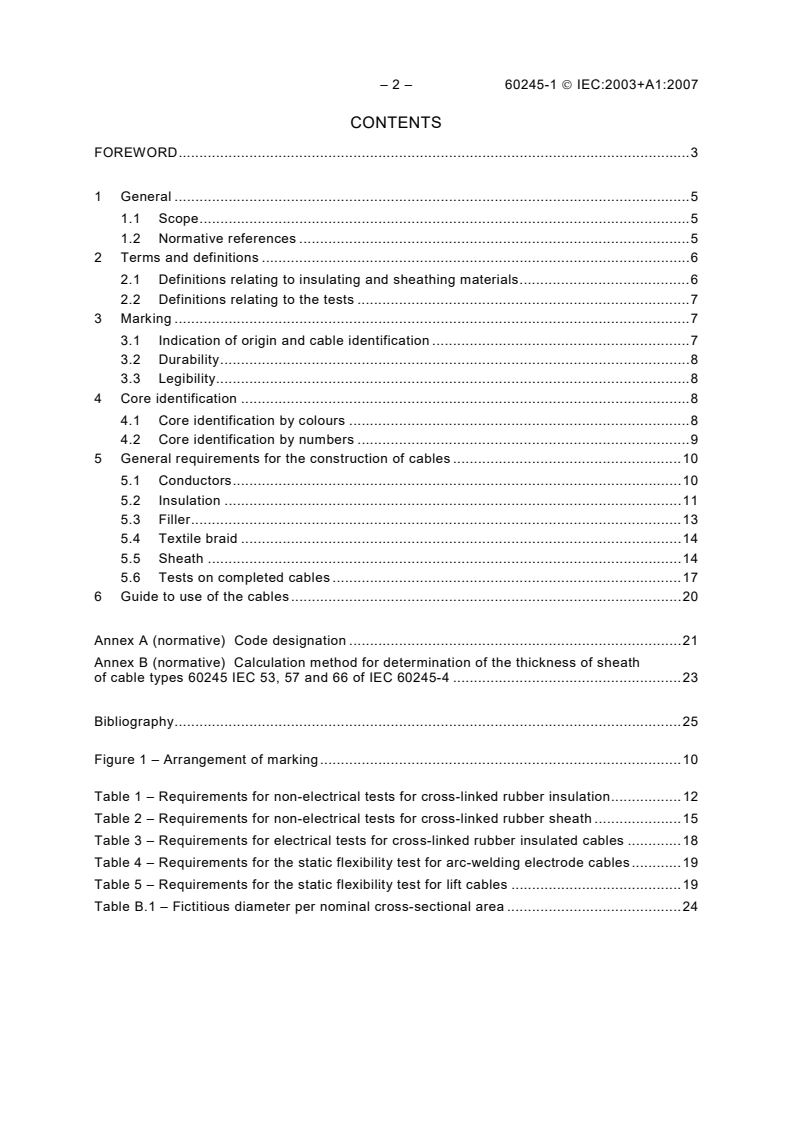
CONTENTS
FOREWORD.3
1 General.9
1.1 Scope.9
1.2 Normative references.9
2 Terms and definitions .11
2.1 Definitions relating to insulating and sheathing materials.11
2.2 Definitions relating to the tests .13
3 Marking.13
3.1 Indication of origin and cable identification .13
3.2 Durability.15
3.3 Legibility.15
4 Core identification.15
4.1 Core identification by colours .15
4.2 Core identification by numbers .17
5 General requirements for the construction of cables .19
5.1 Conductors.19
5.2 Insulation.21
5.3 Filler.25
5.4 Textile braid.27
5.5 Sheath.27
5.6 Tests on completed cables .33
6 Guide to use of the cables.39
Annex A (normative) Code designation .41
Annex B (normative) Calculation method for determination of the thickness of sheath
of cable types 60245 IEC 53, 57 and 66 of IEC 60245-4 .45
Bibliography.49
Figure 1 – Arrangement of marking.19
Table 1 – Requirements for non-electrical tests for cross-linked rubber insulation.23
Table 2 – Requirements for non-electrical tests for cross-linked rubber sheath .29
Table 3 – Requirements for electrical tests for cross-linked rubber insulated cables .35
Table 4 – Requirements for the static flexibility test for arc-welding electrode cables .37
Table 5 – Requirements for the static flexibility test for lift cables .37
Table B.1 – Fictitious diameter per nominal cross-sectional area .47
60245-1 IEC:2003 – 5 –
INTERNATIONAL ELECTROTECHNICAL COMMISSION
___________
RUBBER INSULATED CABLES –
RATED VOLTAGES UP TO AND INCLUDING 450/750 V –
Part 1: General requirements
FOREWORD
1) The International Electrotechnical Commission (IEC) is a worldwide organization for standardization comprising
all national electrotechnical committees (IEC National Committees). The object of IEC is to promote
international co-operation on all questions concerning standardization in the electrical and electronic fields. To
this end and in addition to other activities, IEC publishes International Standards, Technical Specifications,
Technical Reports, Publicly Available Specificatzions (PAS) and Guides (hereafter referred to as “IEC
Publication(s)”). Their preparation is entrusted to technical committees; any IEC National Committee interested
in the subject dealt with may participate in this preparatory work. International, governmental and non-
governmental organizations liaising with the IEC also participate in this preparation. IEC collaborates closely
with the International Organization for Standardization (ISO) in accordance with conditions determined by
agreement between the two organizations.
2) The formal decisions or agreements of IEC on technical matters express, as nearly as possible, an international
consensus of opinion on the relevant subjects since each technical committee has representation from all
interested IEC National Committees.
3) IEC Publications have the form of recommendations for international use and are accepted by IEC National
Committees in that sense. While all reasonable efforts are made to ensure that the technical content of IEC
Publications is accurate, IEC cannot be held responsible for the way in which they are used or for any
misinterpretation by any end user.
4) In order to promote international uniformity, IEC National Committees undertake to apply IEC Publications
transparently to the maximum extent possible in their national and regional publications. Any divergence
between any IEC Publication and the corresponding national or regional publication shall be clearly indicated in
the latter.
5) IEC provides no marking procedure to indicate its approval and cannot be rendered responsible for any
equipment declared to be in conformity with an IEC Publication.
6) All users should ensure that they have the latest edition of this publication.
7) No liability shall attach to IEC or its directors, employees, servants or agents including individual experts and
members of its technical committees and IEC National Committees for any personal injury, property damage or
other damage of any nature whatsoever, whether direct or indirect, or for costs (including legal fees) and
expenses arising out of the publication, use of, or reliance upon, this IEC Publication or any other IEC
Publications.
8) Attention is drawn to the Normative references cited in this publication. Use of the referenced publications is
indispensable for the correct application of this publication.
9) Attention is drawn to the possibility that some of the elements of this IEC Publication may be the subject of
patent rights. IEC shall not be held responsible for identifying any or all such patent rights.
International Standard IEC 60245-1 has been prepared by IEC technical committee 20:
Electric cables.
This fourth edition cancels and replaces the third edition, published in 1994, and its
amendments 1 and 2, both published in 1997.
The principal change with respect to the previous edition is the replacement of insulation IE 1
with IE 4. This fourth edition does not constitute a full technical revision.
60245-1 IEC:2003 – 7 –
The text of this standard is based on the following documents:
FDIS Report on voting
20/659/FDIS 20/679/RVD
Full information on the voting for the approval of this standard can be found in the report on
voting indicated in the above table.
This publication has been drafted in accordance with the ISO/IEC Directives, Part 2.
IEC 60245 consists of the following parts, under the general title Rubber insulated cables –
Rated voltages up to and including 450/750 V:
Part 1: General requirements
Part 2: Test methods
Part 3: Heat resistant silicone insulated cables
Part 4: Cords and flexible cables
Part 5: Lift cables
Part 6: Arc welding electrode cables
Part 7: Heat resistant ethylene-vinyl-acetate rubber insulated cables
Part 8: Cords for applications requiring high flexibility
Parts 3 to 8 are for particular types of cable and should be read in conjunction with Part 1 and
Part 2. Further parts may be added as other types are standardized.
The committee has decided that the contents of this publication will remain unchanged until
2009. At this date, the publication will be
• reconfirmed;
• withdrawn;
• replaced by a revised edition, or
• amended.
60245-1 IEC:2003 – 9 –
RUBBER INSULATED CABLES –
RATED VOLTAGES UP TO AND INCLUDING 450/750 V –
Part 1: General requirements
1 General
1.1 Scope
This part of IEC 60245 applies to rigid and flexible cables with insulation, and sheath if any,
based on vulcanized rubber of rated voltages U /U up to and including 450/750 V used in
o
power installations of nominal voltage not exceeding 450/750 V a.c.
NOTE For some types of flexible cables the term ‘cord’ is used.
The particular types of cables are specified in IEC 60245-3, IEC 60245-4, etc. The code
designations of these types of cables are given in Annex A.
The test methods specified in Parts 1 to 8 are given in IEC 60245-2, IEC 60332-1 and in the
relevant parts of IEC 60811.
1.2 Normative references
The following referenced documents are indispensable for the application of this document.
For dated references, only the edition cited applies. For undated references, the latest edition
of the referenced document (including any amendments) applies.
IEC 60173:1964, Colours of the cores of flexible cables and cords
IEC 60228:1978, Conductors of insulated cables
IEC 60245-2:1994, Rubber insulated cables – Rated voltages up to and including 450/750 V –
Part 2: Test methods
IEC 60245-3:1994, Rubber insulated cables – Rated voltages up to and including 450/750 V –
Part 3: Heat resistant silicone insulated cables
IEC 60245-4:1994, Rubber insulated cables – Rated voltages up to and including 450/750 V –
Part 4: Cords and flexible cables
IEC 60245-7:1994, Rubber insulated cables – Rated voltages up to and including 450/750 V –
Part 7: Heat resistant ethylene-vinyl-acetate rubber insulated cables
IEC 60332-1:1993, Tests on electric cables under fire conditions – Part 1: Test on a single
vertical insulated wire or cable
IEC 60811-1-1:1993, Common test methods for insulating and sheathing materials of electric
cables – Part 1: Methods for general application – Section 1: Measurement of thickness and
overall dimensions – Tests for determining the mechanical properties
60245-1 IEC:2003 – 11 –
IEC 60811-1-2:1985, Common test methods for insulating and sheathing materials of electric
cables – Part 1: Methods for general application – Section Two: Thermal ageing methods
IEC 60811-1-4:1985, Common test methods for insulating and sheathing materials of electric
cables – Part 1: Methods for general application – Section Four: Tests at low temperature
IEC 60811-2-1:1998, Insulating and sheathing materials of electric and optical cables –
Common test methods – Part 2-1: Methods specific to elastomeric compounds – Ozone
resistance, hot set andmineral oil immersion tests
IEC 60811-3-1:1985, Common test methods for insulating and sheathing materials of electric
cables – Part 3: Methods specific to PVC compounds – Section One: Pressure test at high
temperature – Tests for resistance to cracking
2 Terms and definitions
For the purposes of this document, the following terms and definitions apply:
2.1 Definitions relating to insulating and sheathing materials
2.1.1
type of compound
category in which a compound is placed according to its properties, as determined by specific
tests
NOTE The type designation is not directly related to the composition of the compound.
2.1.2
rubber compound
combination of materials suitably selected, proportioned, treated and vulcanized, of which the
characteristic constituent is a rubber and/or synthetic elastomer
NOTE Vulcanization is defined as a post-application treatment taking place after the insulation and/or sheath has
been applied in order to induce permanent cross-linking of the elastomer.
2.1.3
polychloroprene compound (PCP) or other equivalent synthetic elastomer
vulcanized compound in which the elastomer is polychloroprene or other equivalent synthetic
elastomer providing a compound with properties similar to PCP
2.1.4
ethylene-vinyl acetate rubber compound (EVA) or other equivalent synthetic elastomer
cross-linked compound in which the elastomer is ethylene-vinyl acetate or other equivalent
synthetic elastomer providing a compound with properties similar to EVA
2.1.5
ethylene-propylene rubber compound (EPR) or equivalent synthetic elastomer
cross-linked compound in which the elastomer is ethylene-propylene or equivalent synthetic
elastomer providing a compound with properties similar to EPR
60245-1 IEC:2003 – 13 –
2.1.6
cross-linked polyvinyl chloride (XLPVC)
combinations of materials of which polyvinyl chloride is the characteristic constituent,
including adequate cross-linking agents, suitably selected, proportioned and treated which,
when cross-linked, meet the requirements given in the particular specification
2.2 Definitions relating to the tests
2.2.1
type tests
T
tests required to be made before supplying a type of cable covered by this standard on a
general commercial basis, in order to demonstrate satisfactory performance characteristics to
meet the intended application
NOTE These tests are of such a nature that, after they have been made, they need not be repeated, unless
changes have been made in the cable materials or design which might change the performance characteristics.
2.2.2
sample tests
S
tests made on samples of completed cable, or components taken from a completed cable,
adequate to verify that the finished product meets the design specifications
2.3
rated voltage
reference voltage for which the cable is designed, and which serves to define the electrical
tests
NOTE 1 The rated voltage is expressed by the combination of two values: U /U expressed in volts (V):
o
U being the r.m.s. value between any insulated conductor and "earth" (metal covering of the cable or the
o
surrounding medium);
U being the r.m.s. value between any two phase conductors of a multicore cable or of a system of single-core
cables.
In an alternating-current system, the rated voltage of a cable is at least equal to the nominal voltage of the system
for which it is intended.
This condition applies both to the value U and to the value U.
o
In a direct current system, the nominal voltage of the system is not higher than 1,5 times the rated voltage of the
cable.
NOTE 2 The operating voltage of a system may permanently exceed the nominal voltage of such a system by
10 %. A cable can be used at a 10 % higher operating voltage than its rated voltage if the latter is at least equal to
the nominal voltage of the system.
3 Marking
3.1 Indication of origin and cable identification
Cables shall be provided with an indication of the manufacturer, which shall be either an
identification thread or a repetitive marking of the manufacturer's name or trademark.
Marking may be by printing or by reproduction in relief on, or in, the insulation or sheath, or by
printing on a proofed tape or a separate marker tape.
60245-1 IEC:2003 – 15 –
3.1.1 Continuity of marks
Each specified mark shall be regarded as continuous if the distance between the end of the
mark and the beginning of the next identical mark does not exceed
550 mm if the marking is on the outer sheath of the cable,
275 mm if the marking is
– on the insulation of an unsheathed cable, or
– on the insulation of a sheathed cable, or
– on a tape within a sheathed cable.
3.2 Durability
Printed markings shall be durable. Compliance with this requirement shall be checked by the
test given in 1.8 of IEC 60245-2.
3.3 Legibility
All markings shall be legible.
The colours of the identification threads shall be easy to recognize or easily made
recognizable, if necessary, by cleaning with petrol or other suitable solvent.
4 Core identification
Each core shall be identified as follows:
– in cables having up to and including five cores, by colour; see 4.1;
– in cables having more than five cores by colour or by number; see 4.1 and 4.2.
NOTE The colour scheme is under consideration.
4.1 Core identification by colours
4.1.1 General requirements
Identification of the cores of a cable shall be achieved by the use of coloured insulation or
other suitable method.
Each core of a cable shall have only one colour, except the core identified by a combination
of the colours green and yellow.
The colours red, grey, white and, when not in combination, green and yellow, shall not be
used for any multicore cable.
60245-1 IEC:2003 – 17 –
4.1.2 Colour scheme
The preferred colour scheme is as follows:
single-core cable: no preferred colour scheme;
two-core cable: no preferred colour scheme;
three-core cable: either green/yellow, light blue, brown;
or light blue, black, brown
four-core cable: either green/yellow, light blue, black, brown,
or light blue, black, brown, black or brown
five-core cable: either green/yellow, light blue, black, brown, black or brown,
or light blue, black, brown, black or brown, black or brown;
cables having more either in the outer layer one core green/yellow, one core light blue,
than five cores: and the other cores of one and the same colour, however not green,
yellow, light blue or brown; in the other layers one core brown, and
the other cores of one and the same colour, however not green,
yellow, light blue or brown, or in the outer layer one core light blue,
one core brown and the other cores of one and the same colour,
however not green, yellow, light blue or brown; in the other layers
one core brown, and the other cores of one and the same colour,
however not green, yellow, light blue or brown.
The colours shall be clearly identifiable and durable. Durability shall be checked by the test
given in 1.8 of IEC 60245-2.
4.1.3 Colour combination green/yellow
The distribution of the colours for the core coloured green/yellow shall comply with the
following condition (which is in accordance with IEC 60173): for every 15 mm length of core,
one of these colours shall cover at least 30 % and not more than 70 % of the surface of the
core, the other colour covering the remainder.
NOTE Information on the use of the colours green/yellow and light blue.
It is understood that the colours green and yellow, when they are combined as specified above, are recognized
exclusively as a means of identification of the core intended for use as earth connection or similar protection, and
that the colour light blue is intended for the identification of the core intended to be connected to neutral. If,
however, there is no neutral, light blue can be used to identify any core except the earthing or protective
conductor.
4.2 Core identification by numbers
4.2.1 General requirements
The insulation of the cores shall be of the same colour and numbered sequentially, except for
the core coloured green/yellow, if one is included.
The green/yellow core, if any, shall comply with the requirement of 4.1.3 and shall be in the
outer layer.
The numbering shall start with the number “1” in the inner layer.
The numbers shall be printed in arabic numerals on the outer surfaces of the cores. All the
numbers shall be of the same colour, which shall contrast with the colour of the insulation.
The numerals shall be legible.
60245-1 IEC:2003 – 19 –
4.2.2 Preferred arrangement of marking
The numbers shall be repeated at regular intervals along the core, consecutive numbers
being inverted in relation to each other.
When the number is a single numeral, a dash shall be placed underneath it. If the number
consists of two numerals, these shall be positioned one below the other, and a dash
placed below the lower numeral. The spacing d between consecutive numbers shall not
exceed 50 mm.
The arrangement of the marks is shown in Figure 1 below.
d d
IEC 2924/03
Figure 1 – Arrangement of marking by numbers
4.2.3 Durability
Printed numerals shall be durable. Compliance with this requirement shall be checked by the
test given in 1.8 of IEC 60245-2.
5 General requirements for the construction of cables
5.1 Conductors
5.1.1 Material
The conductors shall consist of annealed copper. Unless otherwise specified in the particular
specifications (IEC 60245-3, IEC 60245-4, etc.), the wires of conductors may be plain or
tinned. Tinned wires shall be covered with an effective layer of tin.
5.1.2 Construction
The maximum diameters of the wires of the conductors shall be in accordance with
IEC 60228, unless otherwise specified in the particular cable specifications.
The classes of conductors relevant to the various types of cables are given in the particular
specifications (IEC 60245-3, IEC 60245-4, etc.).
5.1.3 Separator between conductor and insulation
An optional separating tape made of suitable material may be placed between the plain or
tinned conductor a
...
NORME CEI
INTERNATIONALE 60245-1
Quatrième édition
2003-12
Conducteurs et câbles isolés au caoutchouc –
Tension assignée au plus égale à 450/750 V –
Partie 1:
Exigences générales
Cette version française découle de la publication d’origine
bilingue dont les pages anglaises ont été supprimées.
Les numéros de page manquants sont ceux des pages
supprimées.
Numéro de référence
CEI 60245-1:2003(F)
Numérotation des publications
Depuis le 1er janvier 1997, les publications de la CEI sont numérotées à partir de
60000. Ainsi, la CEI 34-1 devient la CEI 60034-1.
Editions consolidées
Les versions consolidées de certaines publications de la CEI incorporant les
amendements sont disponibles. Par exemple, les numéros d’édition 1.0, 1.1 et 1.2
indiquent respectivement la publication de base, la publication de base incorporant
l’amendement 1, et la publication de base incorporant les amendements 1 et 2
Informations supplémentaires sur les publications de la CEI
Le contenu technique des publications de la CEI est constamment revu par la CEI
afin qu'il reflète l'état actuel de la technique. Des renseignements relatifs à cette
publication, y compris sa validité, sont disponibles dans le Catalogue des
publications de la CEI (voir ci-dessous) en plus des nouvelles éditions, amende-
ments et corrigenda. Des informations sur les sujets à l’étude et l’avancement des
travaux entrepris par le comité d’études qui a élaboré cette publication, ainsi que la
liste des publications parues, sont également disponibles par l’intermédiaire de:
• Site web de la CEI (www.iec.ch)
• Catalogue des publications de la CEI
Le catalogue en ligne sur le site web de la CEI (www.iec.ch/searchpub) vous permet
de faire des recherches en utilisant de nombreux critères, comprenant des
recherches textuelles, par comité d’études ou date de publication. Des informations
en ligne sont également disponibles sur les nouvelles publications, les publications
remplacées ou retirées, ainsi que sur les corrigenda.
• IEC Just Published
Ce résumé des dernières publications parues (www.iec.ch/online_news/justpub)
est aussi disponible par courrier électronique. Veuillez prendre contact avec le
Service client (voir ci-dessous) pour plus d’informations.
• Service clients
Si vous avez des questions au sujet de cette publication ou avez besoin de
renseignements supplémentaires, prenez contact avec le Service clients:
Email: custserv@iec.ch
Tél: +41 22 919 02 11
Fax: +41 22 919 03 00
NORME CEI
INTERNATIONALE 60245-1
Quatrième édition
2003-12
Conducteurs et câbles isolés au caoutchouc –
Tension assignée au plus égale à 450/750 V –
Partie 1:
Exigences générales
IEC 2003 Droits de reproduction réservés
Aucune partie de cette publication ne peut être reproduite ni utilisée sous quelque forme que ce soit et par aucun
procédé, électronique ou mécanique, y compris la photocopie et les microfilms, sans l'accord écrit de l'éditeur.
International Electrotechnical Commission, 3, rue de Varembé, PO Box 131, CH-1211 Geneva 20, Switzerland
Telephone: +41 22 919 02 11 Telefax: +41 22 919 03 00 E-mail: inmail@iec.ch Web: www.iec.ch
CODE PRIX
T
Commission Electrotechnique Internationale
International Electrotechnical Commission
МеждународнаяЭлектротехническаяКомиссия
Pour prix, voir catalogue en vigueur
– 2 – 60245-1 © CEI:2003
SOMMAIRE
AVANT-PROPOS.3
1 Généralités.8
1.1 Domaine d'application.8
1.2 Références normatives.8
2 Termes et définitions .10
2.1 Définitions relatives aux matériaux de l'enveloppe isolante et de la gaine .10
2.2 Définitions relatives aux essais .12
3 Marques et indications.12
3.1 Marque d'origine et repérage du câble.12
3.2 Durabilité.14
3.3 Lisibilité.14
4 Repérage des conducteurs.14
4.1 Repérage par coloration.14
4.2 Repérage numérique.16
5 Exigences générales sur la constitution des conducteurs et câbles .18
5.1 Ames.18
5.2 Enveloppe isolante.20
5.3 Bourrage.24
5.4 Tresse textile.26
5.5 Gaine.26
5.6 Essais sur les conducteurs et câbles complets .32
6 Guide d'emploi des conducteurs et câbles .38
Annexe A (normative) Code de désignation .40
Annexe B (normative) Méthode de calcul pour déterminer les épaisseurs de gaine des
câbles des types 60245 IEC 53, 57 et 66 de la CEI 60245-4 .44
Bibliographie.48
Figure 1 – Disposition du marquage.18
Tableau 1 – Exigences relatives aux essais non électriques des enveloppes isolantes
en caoutchouc réticulé .22
Tableau 2 – Exigences relatives aux essais non électriques des gaines en caoutchouc
réticulé .28
Tableau 3 – Exigences relatives aux essais diélectriques pour les conducteurs et
câbles isolés au caoutchouc réticulé.34
Tableau 4 – Exigences pour l'essai statique de souplesse des câbles pour électrodes
de soudage.36
Tableau 5 – Exigences pour l'essai statique de souplesse des câbles pour ascenseurs.36
Tableau B.1 – Diamètre fictif par rapport à la section nominale.46
– 4 – 60245-1 © CEI:2003
COMMISSION ÉLECTROTECHNIQUE INTERNATIONALE
___________
CONDUCTEURS ET CÂBLES ISOLÉS AU CAOUTCHOUC –
TENSION ASSIGNÉE AU PLUS ÉGALE À 450/750 V –
Partie 1: Exigences générales
AVANT-PROPOS
1) La Commission Electrotechnique Internationale (CEI) est une organisation mondiale de normalisation
composée de l'ensemble des comités électrotechniques nationaux (Comités nationaux de la CEI). La CEI a
pour objet de favoriser la coopération internationale pour toutes les questions de normalisation dans les
domaines de l'électricité et de l'électronique. A cet effet, la CEI – entre autres activités – publie des Normes
internationales, des Spécifications techniques, des Rapports techniques, des Spécifications accessibles au
public (PAS) et des Guides (ci-après dénommés "Publication(s) de la CEI"). Leur élaboration est confiée à des
comités d'études, aux travaux desquels tout Comité national intéressé par le sujet traité peut participer. Les
organisations internationales, gouvernementales et non gouvernementales, en liaison avec la CEI, participent
également aux travaux. La CEI collabore étroitement avec l'Organisation Internationale de Normalisation (ISO),
selon des conditions fixées par accord entre les deux organisations.
2) Les décisions ou accords officiels de la CEI concernant les questions techniques représentent, dans la mesure
du possible, un accord international sur les sujets étudiés, étant donné que les Comités nationaux de la CEI
intéressés sont représentés dans chaque comité d’études.
3) Les Publications de la CEI se présentent sous la forme de recommandations internationales et sont agréées
comme telles par les Comités nationaux de la CEI. Tous les efforts raisonnables sont entrepris afin que la CEI
s'assure de l'exactitude du contenu technique de ses publications; la CEI ne peut pas être tenue responsable
de l'éventuelle mauvaise utilisation ou interprétation qui en est faite par un quelconque utilisateur final.
4) Dans le but d'encourager l'uniformité internationale, les Comités nationaux de la CEI s'engagent, dans toute la
mesure possible, à appliquer de façon transparente les Publications de la CEI dans leurs publications
nationales et régionales. Toutes divergences entre toutes Publications de la CEI et toutes publications
nationales ou régionales correspondantes doivent être indiquées en termes clairs dans ces dernières.
5) La CEI n’a prévu aucune procédure de marquage valant indication d’approbation et n'engage pas sa
responsabilité pour les équipements déclarés conformes à une de ses Publications.
6) Tous les utilisateurs doivent s'assurer qu'ils sont en possession de la dernière édition de cette publication.
7) Aucune responsabilité ne doit être imputée à la CEI, à ses administrateurs, employés, auxiliaires ou
mandataires, y compris ses experts particuliers et les membres de ses comités d'études et des Comités
nationaux de la CEI, pour tout préjudice causé en cas de dommages corporels et matériels, ou de tout autre
dommage de quelque nature que ce soit, directe ou indirecte, ou pour supporter les coûts (y compris les frais
de justice) et les dépenses découlant de la publication ou de l'utilisation de cette Publication de la CEI ou de
toute autre Publication de la CEI, ou au crédit qui lui est accordé.
8) L'attention est attirée sur les références normatives citées dans cette publication. L'utilisation de publications
référencées est obligatoire pour une application correcte de la présente publication.
9) L’attention est attirée sur le fait que certains des éléments de la présente Publication de la CEI peuvent faire
l’objet de droits de propriété intellectuelle ou de droits analogues. La CEI ne saurait être tenue pour
responsable de ne pas avoir identifié de tels droits de propriété et de ne pas avoir signalé leur existence.
La Norme internationale CEI 60245-1 a été établie par le comité d’études 20 de la CEI:
Câbles électriques.
Cette quatrième édition annule et remplace la troisième édition parue en 1994 ainsi que
l’amendement 1 (1997) et l’amendement 2 (1997).
Le principal changement par rapport à l’édition précédente est le remplacement de l’isolation
IE 1 par IE 4. Cette quatrième édition ne constitue pas une révision technique complète.
– 6 – 60245-1 © CEI:2003
Le texte de cette norme est issu des documents suivants:
FDIS Rapport de vote
20/659/FDIS 20/679/RVD
Le rapport de vote indiqué dans le tableau ci-dessus donne toute information sur le vote ayant
abouti à l'approbation de cette norme.
Cette publication a été rédigée selon les Directives ISO/CEI, Partie 2.
La CEI 60245 comprend les parties suivantes, présentées sous le titre général Conducteurs
et câbles isolés au caoutchouc – Tension assignée au plus égale à 450/750 V:
Partie 1: Exigences générales
Partie 2: Méthodes d'essais
Partie 3: Conducteurs isolés au silicone, résistant à la chaleur
Partie 4: Câbles souples
Partie 5: Câbles pour ascenseurs
Partie 6: Câbles souples pour électrodes de soudage à l'arc
Partie 7: Câbles isolés à l'éthylène-acétate de vinyle, résistant aux températures élevées
Partie 8: Câbles pour applications nécessitant une flexibilité élevée
Les parties 3 à 8 sont des types particuliers de câbles et il convient de les lire conjointement
avec les Parties 1 et 2. Des parties supplémentaires pourront être ajoutées au fur et à mesure
que d'autres types seront normalisés.
Le comité a décidé que le contenu de cette publication ne sera pas modifié avant 2009.
A cette date, la publication sera
• reconduite;
• supprimée;
• remplacée par une édition révisée, ou
• amendée.
– 8 – 60245-1 © CEI:2003
CONDUCTEURS ET CÂBLES ISOLÉS AU CAOUTCHOUC –
TENSION ASSIGNÉE AU PLUS ÉGALE À 450/750 V –
Partie 1: Exigences générales
1 Généralités
1.1 Domaine d'application
La présente partie de la CEI 60245 s'applique aux conducteurs et câbles souples et rigides
ayant une enveloppe isolante, et éventuellement une gaine, à base de caoutchouc vulcanisé,
de tension assignée U /U au plus égale à 450/750 V, utilisés dans les installations d'énergie
o
d'une tension nominale ne dépassant pas 450/750 V en courant alternatif.
NOTE La note ne s'applique pas au texte français.
Les types particuliers de conducteurs et de câbles sont spécifiés dans la CEI 60245-3, la
CEI 60245-4, etc. Le code de désignation de ces types de câbles est donné dans l'Annexe A.
Les méthodes d'essais spécifiées dans les Parties 1 à 8 sont données dans la CEI 60245-2,
la CEI 60332-1 et dans les parties correspondantes de la CEI 60811.
1.2 Références normatives
Les documents de référence suivants sont indispensables pour l'application du présent
document. Pour les références datées, seule l'édition citée s'applique. Pour les références
non datées, la dernière édition du document de référence s'applique (y compris les éventuels
amendements).
CEI 60173:1964, Couleurs pour les conducteurs des câbles souples
CEI 60228:1978, Ames des câbles isolés
CEI 60245-2:1994, Conducteurs et câbles isolés au caoutchouc – Tension assignée au plus
égale à 450/750 V – Partie 2: Méthodes d'essais
CEI 60245-3:1994, Conducteurs et câbles isolés au caoutchouc – Tension assignée au plus
égale à 450/750 V – Partie 3: Conducteurs isolés au silicone, résistant à la chaleur
CEI 60245-4:1994, Conducteurs et câbles isolés au caoutchouc – Tension assignée au plus
égale à 450/750 V – Partie 4: Câbles souples
CEI 60245-7:1994, Conducteurs et câbles isolés au caoutchouc – Tension assignée au plus
égale à 450/750 V – Partie 7: Câbles isolés à l'éthylène-acétate de vinyle, résistant aux
températures élevées
CEI 60332-1:1993, Essais des câbles électriques soumis au feu – Partie 1: Essai sur un
conducteur ou câble isolé vertical
CEI 60811-1-1:1993, Méthodes d'essais communes pour les matériaux d'isolation et de
gainage des câbles électriques – Partie 1: Méthodes d'application générale – Section 1:
Mesure des épaisseurs et des dimensions extérieures – Détermination des propriétés
mécaniques
– 10 – 60245-1 © CEI:2003
CEI 60811-1-2:1985, Méthodes d'essais communes pour les matériaux d'isolation et de
gainage des câbles électriques – Première partie: Méthodes d'application générale – Section
deux: Méthodes de vieillissement thermique
CEI 60811-1-4:1985, Méthodes d'essais communes pour les matériaux d'isolation et de
gainage des câbles électriques – Première partie: Méthodes d'application générale – Section
quatre: Essais à basse température
CEI 60811-2-1:1998, Matériaux d'isolation et de gainage des câbles électriques et optiques –
Méthodes d’essais communes – Partie 2-1: Méthodes spécifiques pour les mélanges
élastomères – Essais relatifs à la résistance à l'ozone, à l’allongement à chaud et à la
résistance à l'huile
CEI 60811-3-1:1985, Méthodes d'essais communes pour les matériaux d'isolation et de
gainage des câbles électriques – Troisième partie: Méthodes spécifiques pour les mélanges
PVC – Section un: Essai de pression à température élevée – Essais de résistance à la
fissuration
2 Termes et définitions
Pour les besoins du présent document, les termes et définitions suivants s'appliquent:
2.1 Définitions relatives aux matériaux de l'enveloppe isolante et de la gaine
2.1.1
type de mélange
catégorie dans laquelle un mélange est placé selon ses propriétés, telles qu'elles sont
déterminées par les essais spécifiques
NOTE La désignation d'un type n'est pas directement liée à la composition du mélange.
2.1.2
mélange de caoutchouc
ensemble de matériaux convenablement choisis, dosés, traités et vulcanisés dont l'élément
caractéristique est un caoutchouc naturel et/ou un élastomère synthétique
NOTE La vulcanisation est définie comme un traitement effectué après coup sur l'enveloppe isolante et/ou la
gaine une fois mise en place, de façon à provoquer une réticulation permanente de l'élastomère.
2.1.3
mélange de polychloroprène (PCP) ou autre élastomère synthétique équivalent
mélange de caoutchouc vulcanisé dans lequel l'élastomère est du polychloroprène ou un
élastomère synthétique équivalent donnant un mélange ayant des caractéristiques similaires
à celles du PCP
2.1.4
mélange de caoutchouc d'éthylène-acétate de vinyle (EVA) ou autre élastomère
synthétique équivalent
mélange réticulé dans lequel l'élastomère est de l'éthylène-acétate de vinyle ou un autre
élastomère synthétique équivalent fournissant un mélange ayant des propriétés similaires à
celles de l'EVA
2.1.5
mélange de caoutchouc d’éthylène-propylène (EPR) ou autre élastomère synthétique
équivalent
mélange réticulé dans lequel l'élastomère est de l'éthylène-propylène ou un autre élastomère
synthétique équivalent fournissant un mélange ayant des propriétés similaires à celles de
l'EPR
– 12 – 60245-1 © CEI:2003
2.1.6
polychlorure de vinyle réticulé (XLPVC)
combinaisons de matériaux dont le polychlorure de vinyle est le constituant caractéristique,
incluant des agents de réticulations adéquats, convenablement sélectionnés, proportionnés et
traités qui, lorsqu’ils sont réticulés, satisfont aux exigences indiquées dans les spécifications
particulières
2.2 Définitions relatives aux essais
2.2.1
essais de type
T
essais devant être effectués sur un type de conducteur ou de câble couvert dans la présente
norme, avant sa livraison sur une base commerciale, afin de démontrer que ses
caractéristiques répondent aux applications prévues
NOTE Ces essais sont de nature telle qu'après avoir été effectués, il n'est pas nécessaire de les répéter, à moins
de changements effectués dans les matériaux utilisés ou dans la conception du conducteur ou du câble,
susceptibles d'en modifier les caractéristiques.
2.2.2
essais de prélèvement
S
essais effectués sur des échantillons de conducteur ou de câble complet, ou sur leurs
composants, de façon à vérifier que le produit fini réponde aux spécifications qui lui sont
propres
2.3
tension assignée
tension de référence pour laquelle le conducteur ou le câble est prévu et qui sert à définir les
essais électriques
NOTE 1 La tension assignée est exprimée par la combinaison de deux valeurs U /U, exprimées en volts (V):
o
U étant la valeur efficace entre l'âme d'un conducteur isolé quelconque et la «terre» (revêtement métallique du
o
câble au milieu environnant);
U étant la valeur efficace entre les âmes conductrices de deux conducteurs de phase quelconques d'un câble
multiconducteur ou d'un système de câbles monoconducteurs ou de conducteurs.
Dans un système à courant alternatif, la tension assignée d'un conducteur ou d’un câble est au moins égale à la
tension nominale du système pour lequel il est prévu.
Cette condition s'applique à la fois à la valeur U et à la valeur U.
o
Dans un système à courant continu, la tension nominale admise du système n’est pas supérieure à 1,5 fois la
tension assignée du conducteur ou du câble.
NOTE 2 La tension de service d'un système peut en permanence dépasser la tension nominale dudit système de
10 %. Un conducteur ou un câble peut être utilisé à une tension de service supérieure de 10 % à sa tension
assignée si cette dernière est au moins égale à la tension nominale du système.
3 Marques et indications
3.1 Marque d'origine et repérage du câble
Les conducteurs et les câbles doivent être pourvus d'une marque du fabricant consistant soit
en un fil distinctif, soit en une marque reproduite à intervalles réguliers, du nom du fabricant
ou de la marque de fabrique.
L'inscription peut être réalisée par impression ou par marquage en relief ou en creux, sur
l'enveloppe isolante ou la gaine, ou par impression, sur un ruban caoutchouté ou un ruban
d'identification séparé.
– 14 – 60245-1 © CEI:2003
3.1.1 Continuité des marques
Chaque marque spécifiée doit être considérée comme continue si la distance entre la fin
d'une marque et le début de la suivante marque identique ne dépasse pas
550 mm si le marquage est sur la surface extérieure du câble,
275 mm si le marquage est
– sur l'enveloppe isolante d'un câble sans gaine, ou
– sur l'enveloppe isolante d'un câble sous gaine, ou
– sur un ruban à l'intérieur d'un câble sous gaine.
3.2 Durabilité
Un marquage par impression doit être durable. La conformité à cette exigence est vérifiée par
l'essai de 1.8 de la CEI 60245-2.
3.3 Lisibilité
Toutes les inscriptions doivent être lisibles.
Les couleurs des fils distinctifs doivent être faciles à reconnaître ou rendues aisément
reconnaissables, si nécessaire, après nettoyage avec de l'essence ou tout autre solvant
approprié.
4 Repérage des conducteurs
Chaque conducteur doit être identifié:
– par coloration pour les câbles comportant jusqu'à cinq conducteurs; voir 4.1;
– par coloration ou par repérage numérique, pour les câbles comportant plus de cinq
conducteurs; voir 4.1 et 4.2.
NOTE Le code de couleurs est à l'étude.
4.1 Repérage par coloration
4.1.1 Exigences générales
Le repérage des conducteurs constitutifs d'un câble doit être réalisé par l'emploi d'enveloppes
isolantes colorées ou par une autre méthode appropriée.
Chaque conducteur constitutif d'un câble doit être d'une seule couleur, à l'exception du
conducteur repéré par une combinaison des couleurs verte et jaune.
Les couleurs rouge, grise, blanche et, lorsqu'elles ne sont pas employées en combinaison, les
couleurs verte et jaune, ne doivent pas être utilisées pour le repérage des conducteurs des
câbles multiconducteurs.
– 16 – 60245-1 © CEI:2003
4.1.2 Code de couleurs
Le code de couleurs préférentiel est le suivant:
conducteur: pas de code de couleurs préférentiel;
câble à deux conducteurs: pas de code de couleurs préférentiel;
câble à trois conducteurs: soit vert/jaune, bleu clair, brun;
soit bleu clair, noir, brun
câble à quatre conducteurs: soit vert/jaune, bleu clair, noir, brun;
soit bleu clair, noir, brun, noir ou brun
câble à cinq conducteurs: soit vert/jaune, bleu clair, noir, brun, noir ou brun,
soit bleu clair, noir, brun, noir ou brun, noir ou brun;
câble ayant plus de cinq soit dans la couche externe un conducteur vert/jaune, un
conducteurs conducteur bleu clair, et les autres conducteurs d’une seule et
unique couleur, à l’exclusion des couleurs vert, jaune, bleu clair
et brun; dans les autres couches un conducteur brun, et les
autres d’une seule et unique couleur à l’exclusion des couleurs
vert, jaune, bleu clair et brun, soit dans la couche externe un
conducteur bleu clair et un conducteur brun, et les autres
conducteurs d’une seule et unique couleur, à l’exclusion des
couleurs vert, jaune, bleu clair et brun; dans les autres couches
un conducteur brun, et les autres d’une seule et unique couleur
à l’exclusion des couleurs vert, jaune, bleu clair et brun.
Les couleurs doivent être clairement identifiables et durables. La durabilité doit être vérifiée
par l'essai de 1.8 de la CEI 60245-2.
4.1.3 Combinaisons des couleurs verte et jaune
En ce qui concerne le conducteur identifié par la combinaison des couleurs verte et jaune, la
répartition de ces couleurs doit être conforme aux dispositions suivantes (en accord avec la
CEI 60173): sur toute longueur du conducteur de 15 mm, une de ces couleurs doit couvrir au
moins 30 % et au plus 70 % de la surface du conducteur, l'autre couleur couvrant le reste.
NOTE Information sur l'emploi des couleurs vert/jaune et bleu clair.
Il est entendu que les couleurs verte et jaune, lorsqu'elles sont combinées comme il est spécifié ci-dessus, sont
exclusivement reconnues comme un moyen permettant une identification du conducteur constitutif destiné à être
utilisé pour la mise à la terre ou pour une protection analogue, et que la couleur bleu clair est destinée à permettre
l'identification du conducteur constitutif destiné à être relié au neutre. Si, toutefois, il n'y a pas de conducteur
neutre, le bleu clair peut servir pour identifier n'importe quel conducteur, à l'exception du conducteur de terre ou du
conducteur de protection.
4.2 Repérage numérique
4.2.1 Exigences générales
Les enveloppes isolantes des conducteurs d'un câble doivent être de la même couleur et être
numérotées dans l'ordre croissant des nombres entiers, à l'exception du conducteur portant la
combinaison vert/jaune, s'il existe.
Le conducteur vert/jaune, s'il existe, doit satisfaire à l’exigence de 4.1.3 et doit être dans la
couche externe.
Le repérage numérique doit commencer par le nombre « 1 » dans la touche interne.
Les nombres doivent être imprimés en chiffres arabes, sur la surface externe des conduc-
teurs. Tous les motifs numériques doivent avoir la même couleur et cette couleur doit
contraster avec celles des enveloppes isolantes. Les chiffres doivent être lisibles.
– 18 – 60245-1 © CEI:2003
4.2.2 Disposition préférentielle du marquage
Les motifs numériques doivent être répétés à intervalles réguliers tout au long du conducteur,
deux motifs consécutifs étant placés tête-bêche.
Lorsque le motif numérique est constitué par un seul chiffre, un tiret doit être placé au-
dessous. Lorsque le motif numérique est constitué de deux chiffres, ils doivent être disposés
l'un au-dessous de l'autre, et le tiret est placé sous le chiffre des unités le plus petit.
L'intervalle d entre deux motifs consécutifs ne doit pas dépasser 50 mm.
La disposition des motifs est représentée à la Figure 1 ci-dessous.
d d
IEC 2924/03
Figure 1 – Disposition du marquage par les nombres
4.2.3 Durabilité
Les motifs numériques imprimés doivent être durables. La conformité avec cette exigence est
vérifiée par l'essai de 1.8 de la CEI 60245-2.
5 Exigences générales sur la constitution des conducteurs et câbles
5.1 Ames
5.1.1 Métal constitutif
Les âmes doivent être en cuivre recuit. Sauf spécification contraire dans les spécifications
particulières (CEI 60245-3, CEI 60245-4, etc.), les brins des âmes peuvent être nus ou
étamés. Les brins étamés doivent être recouverts d'une couche efficace d'étain.
5.1.2 Constitution
Sauf spécification contraire dans les spécifications particulières, le diamètre maximal
...
NORME CEI
INTERNATIONALE
IEC
60245-1
INTERNATIONAL
Quatrième édition
STANDARD
Fourth edition
2003-12
Conducteurs et câbles isolés au caoutchouc –
Tension assignée au plus égale à 450/750 V –
Partie 1:
Exigences générales
Rubber insulated cables –
Rated voltages up to and including 450/750 V –
Part 1:
General requirements
Numéro de référence
Reference number
CEI/IEC 60245-1:2003
Numérotation des publications Publication numbering
Depuis le 1er janvier 1997, les publications de la CEI As from 1 January 1997 all IEC publications are
sont numérotées à partir de 60000. Ainsi, la CEI 34-1 issued with a designation in the 60000 series. For
devient la CEI 60034-1. example, IEC 34-1 is now referred to as IEC 60034-1.
Editions consolidées Consolidated editions
Les versions consolidées de certaines publications de la The IEC is now publishing consolidated versions of its
CEI incorporant les amendements sont disponibles. Par publications. For example, edition numbers 1.0, 1.1
exemple, les numéros d’édition 1.0, 1.1 et 1.2 indiquent and 1.2 refer, respectively, to the base publication,
respectivement la publication de base, la publication de the base publication incorporating amendment 1 and
base incorporant l’amendement 1, et la publication de the base publication incorporating amendments 1
base incorporant les amendements 1 et 2. and 2.
Informations supplémentaires Further information on IEC publications
sur les publications de la CEI
Le contenu technique des publications de la CEI est The technical content of IEC publications is kept
constamment revu par la CEI afin qu'il reflète l'état under constant review by the IEC, thus ensuring that
actuel de la technique. Des renseignements relatifs à the content reflects current technology. Information
cette publication, y compris sa validité, sont dispo- relating to this publication, including its validity, is
nibles dans le Catalogue des publications de la CEI available in the IEC Catalogue of publications
(voir ci-dessous) en plus des nouvelles éditions, (see below) in addition to new editions, amendments
amendements et corrigenda. Des informations sur les and corrigenda. Information on the subjects under
sujets à l’étude et l’avancement des travaux entrepris consideration and work in progress undertaken by the
par le comité d’études qui a élaboré cette publication, technical committee which has prepared this
ainsi que la liste des publications parues, sont publication, as well as the list of publications issued,
également disponibles par l’intermédiaire de: is also available from the following:
• Site web de la CEI (www.iec.ch) • IEC Web Site (www.iec.ch)
• Catalogue des publications de la CEI • Catalogue of IEC publications
Le catalogue en ligne sur le site web de la CEI The on-line catalogue on the IEC web site
(www.iec.ch/searchpub) vous permet de faire des (www.iec.ch/searchpub) enables you to search by a
recherches en utilisant de nombreux critères, variety of criteria including text searches,
comprenant des recherches textuelles, par comité technical committees and date of publication. On-
d’études ou date de publication. Des informations en line information is also available on recently
ligne sont également disponibles sur les nouvelles issued publications, withdrawn and replaced
publications, les publications remplacées ou retirées, publications, as well as corrigenda.
ainsi que sur les corrigenda.
• IEC Just Published • IEC Just Published
Ce résumé des dernières publications parues This summary of recently issued publications
(www.iec.ch/online_news/justpub) est aussi dispo- (www.iec.ch/online_news/justpub) is also available
nible par courrier électronique. Veuillez prendre by email. Please contact the Customer Service
contact avec le Service client (voir ci-dessous) Centre (see below) for further information.
pour plus d’informations.
• Service clients • Customer Service Centre
Si vous avez des questions au sujet de cette If you have any questions regarding this
publication ou avez besoin de renseignements publication or need further assistance, please
supplémentaires, prenez contact avec le Service contact the Customer Service Centre:
clients:
Email: custserv@iec.ch Email: custserv@iec.ch
Tél: +41 22 919 02 11 Tel: +41 22 919 02 11
Fax: +41 22 919 03 00 Fax: +41 22 919 03 00
.
NORME CEI
INTERNATIONALE
IEC
60245-1
INTERNATIONAL
Quatrième édition
STANDARD
Fourth edition
2003-12
Conducteurs et câbles isolés au caoutchouc –
Tension assignée au plus égale à 450/750 V –
Partie 1:
Exigences générales
Rubber insulated cables –
Rated voltages up to and including 450/750 V –
Part 1:
General requirements
© IEC 2003 Droits de reproduction réservés ⎯ Copyright - all rights reserved
Aucune partie de cette publication ne peut être reproduite ni No part of this publication may be reproduced or utilized in any
utilisée sous quelque forme que ce soit et par aucun procédé, form or by any means, electronic or mechanical, including
électronique ou mécanique, y compris la photocopie et les photocopying and microfilm, without permission in writing from
microfilms, sans l'accord écrit de l'éditeur. the publisher.
International Electrotechnical Commission, 3, rue de Varembé, PO Box 131, CH-1211 Geneva 20, Switzerland
Telephone: +41 22 919 02 11 Telefax: +41 22 919 03 00 E-mail: inmail@iec.ch Web: www.iec.ch
CODE PRIX
T
PRICE CODE
Commission Electrotechnique Internationale
International Electrotechnical Commission
МеждународнаяЭлектротехническаяКомиссия
Pour prix, voir catalogue en vigueur
For price, see current catalogue
– 2 – 60245-1 © CEI:2003
SOMMAIRE
AVANT-PROPOS.3
1 Généralités.8
1.1 Domaine d'application.8
1.2 Références normatives.8
2 Termes et définitions .10
2.1 Définitions relatives aux matériaux de l'enveloppe isolante et de la gaine .10
2.2 Définitions relatives aux essais .12
3 Marques et indications.12
3.1 Marque d'origine et repérage du câble.12
3.2 Durabilité.14
3.3 Lisibilité.14
4 Repérage des conducteurs.14
4.1 Repérage par coloration.14
4.2 Repérage numérique.16
5 Exigences générales sur la constitution des conducteurs et câbles .18
5.1 Ames.18
5.2 Enveloppe isolante.20
5.3 Bourrage.24
5.4 Tresse textile.26
5.5 Gaine.26
5.6 Essais sur les conducteurs et câbles complets .32
6 Guide d'emploi des conducteurs et câbles .38
Annexe A (normative) Code de désignation .40
Annexe B (normative) Méthode de calcul pour déterminer les épaisseurs de gaine des
câbles des types 60245 IEC 53, 57 et 66 de la CEI 60245-4 .44
Bibliographie.48
Figure 1 – Disposition du marquage.18
Tableau 1 – Exigences relatives aux essais non électriques des enveloppes isolantes
en caoutchouc réticulé .22
Tableau 2 – Exigences relatives aux essais non électriques des gaines en caoutchouc
réticulé .28
Tableau 3 – Exigences relatives aux essais diélectriques pour les conducteurs et
câbles isolés au caoutchouc réticulé.34
Tableau 4 – Exigences pour l'essai statique de souplesse des câbles pour électrodes
de soudage.36
Tableau 5 – Exigences pour l'essai statique de souplesse des câbles pour ascenseurs.36
Tableau B.1 – Diamètre fictif par rapport à la section nominale.46
60245-1 © IEC:2003 – 3 –
CONTENTS
FOREWORD.3
1 General.9
1.1 Scope.9
1.2 Normative references.9
2 Terms and definitions .11
2.1 Definitions relating to insulating and sheathing materials.11
2.2 Definitions relating to the tests .13
3 Marking.13
3.1 Indication of origin and cable identification .13
3.2 Durability.15
3.3 Legibility.15
4 Core identification.15
4.1 Core identification by colours .15
4.2 Core identification by numbers .17
5 General requirements for the construction of cables .19
5.1 Conductors.19
5.2 Insulation.21
5.3 Filler.25
5.4 Textile braid.27
5.5 Sheath.27
5.6 Tests on completed cables .33
6 Guide to use of the cables.39
Annex A (normative) Code designation .41
Annex B (normative) Calculation method for determination of the thickness of sheath
of cable types 60245 IEC 53, 57 and 66 of IEC 60245-4 .45
Bibliography.49
Figure 1 – Arrangement of marking.19
Table 1 – Requirements for non-electrical tests for cross-linked rubber insulation.23
Table 2 – Requirements for non-electrical tests for cross-linked rubber sheath .29
Table 3 – Requirements for electrical tests for cross-linked rubber insulated cables .35
Table 4 – Requirements for the static flexibility test for arc-welding electrode cables .37
Table 5 – Requirements for the static flexibility test for lift cables .37
Table B.1 – Fictitious diameter per nominal cross-sectional area .47
– 4 – 60245-1 © CEI:2003
COMMISSION ÉLECTROTECHNIQUE INTERNATIONALE
___________
CONDUCTEURS ET CÂBLES ISOLÉS AU CAOUTCHOUC –
TENSION ASSIGNÉE AU PLUS ÉGALE À 450/750 V –
Partie 1: Exigences générales
AVANT-PROPOS
1) La Commission Electrotechnique Internationale (CEI) est une organisation mondiale de normalisation
composée de l'ensemble des comités électrotechniques nationaux (Comités nationaux de la CEI). La CEI a
pour objet de favoriser la coopération internationale pour toutes les questions de normalisation dans les
domaines de l'électricité et de l'électronique. A cet effet, la CEI – entre autres activités – publie des Normes
internationales, des Spécifications techniques, des Rapports techniques, des Spécifications accessibles au
public (PAS) et des Guides (ci-après dénommés "Publication(s) de la CEI"). Leur élaboration est confiée à des
comités d'études, aux travaux desquels tout Comité national intéressé par le sujet traité peut participer. Les
organisations internationales, gouvernementales et non gouvernementales, en liaison avec la CEI, participent
également aux travaux. La CEI collabore étroitement avec l'Organisation Internationale de Normalisation (ISO),
selon des conditions fixées par accord entre les deux organisations.
2) Les décisions ou accords officiels de la CEI concernant les questions techniques représentent, dans la mesure
du possible, un accord international sur les sujets étudiés, étant donné que les Comités nationaux de la CEI
intéressés sont représentés dans chaque comité d’études.
3) Les Publications de la CEI se présentent sous la forme de recommandations internationales et sont agréées
comme telles par les Comités nationaux de la CEI. Tous les efforts raisonnables sont entrepris afin que la CEI
s'assure de l'exactitude du contenu technique de ses publications; la CEI ne peut pas être tenue responsable
de l'éventuelle mauvaise utilisation ou interprétation qui en est faite par un quelconque utilisateur final.
4) Dans le but d'encourager l'uniformité internationale, les Comités nationaux de la CEI s'engagent, dans toute la
mesure possible, à appliquer de façon transparente les Publications de la CEI dans leurs publications
nationales et régionales. Toutes divergences entre toutes Publications de la CEI et toutes publications
nationales ou régionales correspondantes doivent être indiquées en termes clairs dans ces dernières.
5) La CEI n’a prévu aucune procédure de marquage valant indication d’approbation et n'engage pas sa
responsabilité pour les équipements déclarés conformes à une de ses Publications.
6) Tous les utilisateurs doivent s'assurer qu'ils sont en possession de la dernière édition de cette publication.
7) Aucune responsabilité ne doit être imputée à la CEI, à ses administrateurs, employés, auxiliaires ou
mandataires, y compris ses experts particuliers et les membres de ses comités d'études et des Comités
nationaux de la CEI, pour tout préjudice causé en cas de dommages corporels et matériels, ou de tout autre
dommage de quelque nature que ce soit, directe ou indirecte, ou pour supporter les coûts (y compris les frais
de justice) et les dépenses découlant de la publication ou de l'utilisation de cette Publication de la CEI ou de
toute autre Publication de la CEI, ou au crédit qui lui est accordé.
8) L'attention est attirée sur les références normatives citées dans cette publication. L'utilisation de publications
référencées est obligatoire pour une application correcte de la présente publication.
9) L’attention est attirée sur le fait que certains des éléments de la présente Publication de la CEI peuvent faire
l’objet de droits de propriété intellectuelle ou de droits analogues. La CEI ne saurait être tenue pour
responsable de ne pas avoir identifié de tels droits de propriété et de ne pas avoir signalé leur existence.
La Norme internationale CEI 60245-1 a été établie par le comité d’études 20 de la CEI:
Câbles électriques.
Cette quatrième édition annule et remplace la troisième édition parue en 1994 ainsi que
l’amendement 1 (1997) et l’amendement 2 (1997).
Le principal changement par rapport à l’édition précédente est le remplacement de l’isolation
IE 1 par IE 4. Cette quatrième édition ne constitue pas une révision technique complète.
60245-1 © IEC:2003 – 5 –
INTERNATIONAL ELECTROTECHNICAL COMMISSION
___________
RUBBER INSULATED CABLES –
RATED VOLTAGES UP TO AND INCLUDING 450/750 V –
Part 1: General requirements
FOREWORD
1) The International Electrotechnical Commission (IEC) is a worldwide organization for standardization comprising
all national electrotechnical committees (IEC National Committees). The object of IEC is to promote
international co-operation on all questions concerning standardization in the electrical and electronic fields. To
this end and in addition to other activities, IEC publishes International Standards, Technical Specifications,
Technical Reports, Publicly Available Specificatzions (PAS) and Guides (hereafter referred to as “IEC
Publication(s)”). Their preparation is entrusted to technical committees; any IEC National Committee interested
in the subject dealt with may participate in this preparatory work. International, governmental and non-
governmental organizations liaising with the IEC also participate in this preparation. IEC collaborates closely
with the International Organization for Standardization (ISO) in accordance with conditions determined by
agreement between the two organizations.
2) The formal decisions or agreements of IEC on technical matters express, as nearly as possible, an international
consensus of opinion on the relevant subjects since each technical committee has representation from all
interested IEC National Committees.
3) IEC Publications have the form of recommendations for international use and are accepted by IEC National
Committees in that sense. While all reasonable efforts are made to ensure that the technical content of IEC
Publications is accurate, IEC cannot be held responsible for the way in which they are used or for any
misinterpretation by any end user.
4) In order to promote international uniformity, IEC National Committees undertake to apply IEC Publications
transparently to the maximum extent possible in their national and regional publications. Any divergence
between any IEC Publication and the corresponding national or regional publication shall be clearly indicated in
the latter.
5) IEC provides no marking procedure to indicate its approval and cannot be rendered responsible for any
equipment declared to be in conformity with an IEC Publication.
6) All users should ensure that they have the latest edition of this publication.
7) No liability shall attach to IEC or its directors, employees, servants or agents including individual experts and
members of its technical committees and IEC National Committees for any personal injury, property damage or
other damage of any nature whatsoever, whether direct or indirect, or for costs (including legal fees) and
expenses arising out of the publication, use of, or reliance upon, this IEC Publication or any other IEC
Publications.
8) Attention is drawn to the Normative references cited in this publication. Use of the referenced publications is
indispensable for the correct application of this publication.
9) Attention is drawn to the possibility that some of the elements of this IEC Publication may be the subject of
patent rights. IEC shall not be held responsible for identifying any or all such patent rights.
International Standard IEC 60245-1 has been prepared by IEC technical committee 20:
Electric cables.
This fourth edition cancels and replaces the third edition, published in 1994, and its
amendments 1 and 2, both published in 1997.
The principal change with respect to the previous edition is the replacement of insulation IE 1
with IE 4. This fourth edition does not constitute a full technical revision.
– 6 – 60245-1 © CEI:2003
Le texte de cette norme est issu des documents suivants:
FDIS Rapport de vote
20/659/FDIS 20/679/RVD
Le rapport de vote indiqué dans le tableau ci-dessus donne toute information sur le vote ayant
abouti à l'approbation de cette norme.
Cette publication a été rédigée selon les Directives ISO/CEI, Partie 2.
La CEI 60245 comprend les parties suivantes, présentées sous le titre général Conducteurs
et câbles isolés au caoutchouc – Tension assignée au plus égale à 450/750 V:
Partie 1: Exigences générales
Partie 2: Méthodes d'essais
Partie 3: Conducteurs isolés au silicone, résistant à la chaleur
Partie 4: Câbles souples
Partie 5: Câbles pour ascenseurs
Partie 6: Câbles souples pour électrodes de soudage à l'arc
Partie 7: Câbles isolés à l'éthylène-acétate de vinyle, résistant aux températures élevées
Partie 8: Câbles pour applications nécessitant une flexibilité élevée
Les parties 3 à 8 sont des types particuliers de câbles et il convient de les lire conjointement
avec les Parties 1 et 2. Des parties supplémentaires pourront être ajoutées au fur et à mesure
que d'autres types seront normalisés.
Le comité a décidé que le contenu de cette publication ne sera pas modifié avant 2009.
A cette date, la publication sera
• reconduite;
• supprimée;
• remplacée par une édition révisée, ou
• amendée.
60245-1 © IEC:2003 – 7 –
The text of this standard is based on the following documents:
FDIS Report on voting
20/659/FDIS 20/679/RVD
Full information on the voting for the approval of this standard can be found in the report on
voting indicated in the above table.
This publication has been drafted in accordance with the ISO/IEC Directives, Part 2.
IEC 60245 consists of the following parts, under the general title Rubber insulated cables –
Rated voltages up to and including 450/750 V:
Part 1: General requirements
Part 2: Test methods
Part 3: Heat resistant silicone insulated cables
Part 4: Cords and flexible cables
Part 5: Lift cables
Part 6: Arc welding electrode cables
Part 7: Heat resistant ethylene-vinyl-acetate rubber insulated cables
Part 8: Cords for applications requiring high flexibility
Parts 3 to 8 are for particular types of cable and should be read in conjunction with Part 1 and
Part 2. Further parts may be added as other types are standardized.
The committee has decided that the contents of this publication will remain unchanged until
2009. At this date, the publication will be
• reconfirmed;
• withdrawn;
• replaced by a revised edition, or
• amended.
– 8 – 60245-1 © CEI:2003
CONDUCTEURS ET CÂBLES ISOLÉS AU CAOUTCHOUC –
TENSION ASSIGNÉE AU PLUS ÉGALE À 450/750 V –
Partie 1: Exigences générales
1 Généralités
1.1 Domaine d'application
La présente partie de la CEI 60245 s'applique aux conducteurs et câbles souples et rigides
ayant une enveloppe isolante, et éventuellement une gaine, à base de caoutchouc vulcanisé,
de tension assignée U /U au plus égale à 450/750 V, utilisés dans les installations d'énergie
o
d'une tension nominale ne dépassant pas 450/750 V en courant alternatif.
NOTE La note ne s'applique pas au texte français.
Les types particuliers de conducteurs et de câbles sont spécifiés dans la CEI 60245-3, la
CEI 60245-4, etc. Le code de désignation de ces types de câbles est donné dans l'Annexe A.
Les méthodes d'essais spécifiées dans les Parties 1 à 8 sont données dans la CEI 60245-2,
la CEI 60332-1 et dans les parties correspondantes de la CEI 60811.
1.2 Références normatives
Les documents de référence suivants sont indispensables pour l'application du présent
document. Pour les références datées, seule l'édition citée s'applique. Pour les références
non datées, la dernière édition du document de référence s'applique (y compris les éventuels
amendements).
CEI 60173:1964, Couleurs pour les conducteurs des câbles souples
CEI 60228:1978, Ames des câbles isolés
CEI 60245-2:1994, Conducteurs et câbles isolés au caoutchouc – Tension assignée au plus
égale à 450/750 V – Partie 2: Méthodes d'essais
CEI 60245-3:1994, Conducteurs et câbles isolés au caoutchouc – Tension assignée au plus
égale à 450/750 V – Partie 3: Conducteurs isolés au silicone, résistant à la chaleur
CEI 60245-4:1994, Conducteurs et câbles isolés au caoutchouc – Tension assignée au plus
égale à 450/750 V – Partie 4: Câbles souples
CEI 60245-7:1994, Conducteurs et câbles isolés au caoutchouc – Tension assignée au plus
égale à 450/750 V – Partie 7: Câbles isolés à l'éthylène-acétate de vinyle, résistant aux
températures élevées
CEI 60332-1:1993, Essais des câbles électriques soumis au feu – Partie 1: Essai sur un
conducteur ou câble isolé vertical
CEI 60811-1-1:1993, Méthodes d'essais communes pour les matériaux d'isolation et de
gainage des câbles électriques – Partie 1: Méthodes d'application générale – Section 1:
Mesure des épaisseurs et des dimensions extérieures – Détermination des propriétés
mécaniques
60245-1 © IEC:2003 – 9 –
RUBBER INSULATED CABLES –
RATED VOLTAGES UP TO AND INCLUDING 450/750 V –
Part 1: General requirements
1 General
1.1 Scope
This part of IEC 60245 applies to rigid and flexible cables with insulation, and sheath if any,
based on vulcanized rubber of rated voltages U /U up to and including 450/750 V used in
o
power installations of nominal voltage not exceeding 450/750 V a.c.
NOTE For some types of flexible cables the term ‘cord’ is used.
The particular types of cables are specified in IEC 60245-3, IEC 60245-4, etc. The code
designations of these types of cables are given in Annex A.
The test methods specified in Parts 1 to 8 are given in IEC 60245-2, IEC 60332-1 and in the
relevant parts of IEC 60811.
1.2 Normative references
The following referenced documents are indispensable for the application of this document.
For dated references, only the edition cited applies. For undated references, the latest edition
of the referenced document (including any amendments) applies.
IEC 60173:1964, Colours of the cores of flexible cables and cords
IEC 60228:1978, Conductors of insulated cables
IEC 60245-2:1994, Rubber insulated cables – Rated voltages up to and including 450/750 V –
Part 2: Test methods
IEC 60245-3:1994, Rubber insulated cables – Rated voltages up to and including 450/750 V –
Part 3: Heat resistant silicone insulated cables
IEC 60245-4:1994, Rubber insulated cables – Rated voltages up to and including 450/750 V –
Part 4: Cords and flexible cables
IEC 60245-7:1994, Rubber insulated cables – Rated voltages up to and including 450/750 V –
Part 7: Heat resistant ethylene-vinyl-acetate rubber insulated cables
IEC 60332-1:1993, Tests on electric cables under fire conditions – Part 1: Test on a single
vertical insulated wire or cable
IEC 60811-1-1:1993, Common test methods for insulating and sheathing materials of electric
cables – Part 1: Methods for general application – Section 1: Measurement of thickness and
overall dimensions – Tests for determining the mechanical properties
– 10 – 60245-1 © CEI:2003
CEI 60811-1-2:1985, Méthodes d'essais communes pour les matériaux d'isolation et de
gainage des câbles électriques – Première partie: Méthodes d'application générale – Section
deux: Méthodes de vieillissement thermique
CEI 60811-1-4:1985, Méthodes d'essais communes pour les matériaux d'isolation et de
gainage des câbles électriques – Première partie: Méthodes d'application générale – Section
quatre: Essais à basse température
CEI 60811-2-1:1998, Matériaux d'isolation et de gainage des câbles électriques et optiques –
Méthodes d’essais communes – Partie 2-1: Méthodes spécifiques pour les mélanges
élastomères – Essais relatifs à la résistance à l'ozone, à l’allongement à chaud et à la
résistance à l'huile
CEI 60811-3-1:1985, Méthodes d'essais communes pour les matériaux d'isolation et de
gainage des câbles électriques – Troisième partie: Méthodes spécifiques pour les mélanges
PVC – Section un: Essai de pression à température élevée – Essais de résistance à la
fissuration
2 Termes et définitions
Pour les besoins du présent document, les termes et définitions suivants s'appliquent:
2.1 Définitions relatives aux matériaux de l'enveloppe isolante et de la gaine
2.1.1
type de mélange
catégorie dans laquelle un mélange est placé selon ses propriétés, telles qu'elles sont
déterminées par les essais spécifiques
NOTE La désignation d'un type n'est pas directement liée à la composition du mélange.
2.1.2
mélange de caoutchouc
ensemble de matériaux convenablement choisis, dosés, traités et vulcanisés dont l'élément
caractéristique est un caoutchouc naturel et/ou un élastomère synthétique
NOTE La vulcanisation est définie comme un traitement effectué après coup sur l'enveloppe isolante et/ou la
gaine une fois mise en place, de façon à provoquer une réticulation permanente de l'élastomère.
2.1.3
mélange de polychloroprène (PCP) ou autre élastomère synthétique équivalent
mélange de caoutchouc vulcanisé dans lequel l'élastomère est du polychloroprène ou un
élastomère synthétique équivalent donnant un mélange ayant des caractéristiques similaires
à celles du PCP
2.1.4
mélange de caoutchouc d'éthylène-acétate de vinyle (EVA) ou autre élastomère
synthétique équivalent
mélange réticulé dans lequel l'élastomère est de l'éthylène-acétate de vinyle ou un autre
élastomère synthétique équivalent fournissant un mélange ayant des propriétés similaires à
celles de l'EVA
2.1.5
mélange de caoutchouc d’éthylène-propylène (EPR) ou autre élastomère synthétique
équivalent
mélange réticulé dans lequel l'élastomère est de l'éthylène-propylène ou un autre élastomère
synthétique équivalent fournissant un mélange ayant des propriétés similaires à celles de
l'EPR
60245-1 © IEC:2003 – 11 –
IEC 60811-1-2:1985, Common test methods for insulating and sheathing materials of electric
cables – Part 1: Methods for general application – Section Two: Thermal ageing methods
IEC 60811-1-4:1985, Common test methods for insulating and sheathing materials of electric
cables – Part 1: Methods for general application – Section Four: Tests at low temperature
IEC 60811-2-1:1998, Insulating and sheathing materials of electric and optical cables –
Common test methods – Part 2-1: Methods specific to elastomeric compounds – Ozone
resistance, hot set andmineral oil immersion tests
IEC 60811-3-1:1985, Common test methods for insulating and sheathing materials of electric
cables – Part 3: Methods specific to PVC compounds – Section One: Pressure test at high
temperature – Tests for resistance to cracking
2 Terms and definitions
For the purposes of this document, the following terms and definitions apply:
2.1 Definitions relating to insulating and sheathing materials
2.1.1
type of compound
category in which a compound is placed according to its properties, as determined by specific
tests
NOTE The type designation is not directly related to the composition of the compound.
2.1.2
rubber compound
combination of materials suitably selected, proportioned, treated and vulcanized, of which the
characteristic constituent is a rubber and/or synthetic elastomer
NOTE Vulcanization is defined as a post-application treatment taking place after the insulation and/or sheath has
been applied in order to induce permanent cross-linking of the elastomer.
2.1.3
polychloroprene compound (PCP) or other equivalent synthetic elastomer
vulcanized compound in which the elastomer is polychloroprene or other equivalent synthetic
elastomer providing a compound with properties similar to PCP
2.1.4
ethylene-vinyl acetate rubber compound (EVA) or other equivalent synthetic elastomer
cross-linked compound in which the elastomer is ethylene-vinyl acetate or other equivalent
synthetic elastomer providing a compound with properties similar to EVA
2.1.5
ethylene-propylene rubber compound (EPR) or equivalent synthetic elastomer
cross-linked compound in which the elastomer is ethylene-propylene or equivalent synthetic
elastomer providing a compound with properties similar to EPR
– 12 – 60245-1 © CEI:2003
2.1.6
polychlorure de vinyle réticulé (XLPVC)
combinaisons de matériaux dont le polychlorure de vinyle est le constituant caractéristique,
incluant des agents de réticulations adéquats, convenablement sélectionnés, proportionnés et
traités qui, lorsqu’ils sont réticulés, satisfont aux exigences indiquées dans les spécifications
particulières
2.2 Définitions relatives aux essais
2.2.1
essais de type
T
essais devant être effectués sur un type de conducteur ou de câble couvert dans la présente
norme, avant sa livraison sur une base commerciale, afin de démontrer que ses
caractéristiques répondent aux applications prévues
NOTE Ces essais sont de nature telle qu'après avoir été effectués, il n'est pas nécessaire de les répéter, à moins
de changements effectués dans les matériaux utilisés ou dans la conception du conducteur ou du câble,
susceptibles d'en modifier les caractéristiques.
2.2.2
essais de prélèvement
S
essais effectués sur des échantillons de conducteur ou de câble complet, ou sur leurs
composants, de façon à vérifier que le produit fini réponde aux spécifications qui lui sont
propres
2.3
tension assignée
tension de référence pour laquelle le conducteur ou le câble est prévu et qui sert à définir les
essais électriques
NOTE 1 La tension assignée est exprimée par la combinaison de deux valeurs U /U, exprimées en volts (V):
o
U étant la valeur efficace entre l'âme d'un conducteur isolé quelconque et la «terre» (revêtement métallique du
o
câble au milieu environnant);
U étant la valeur efficace entre les âmes conductrices de deux conducteurs de phase quelconques d'un câble
multiconducteur ou d'un système de câbles monoconducteurs ou de conducteurs.
Dans un système à courant alternatif, la tension assignée d'un conducteur ou d’un câble est au moins égale à la
tension nominale du système pour lequel il est prévu.
Cette condition s'applique à la fois à la valeur U et à la valeur U.
o
Dans un système à courant continu, la tension nominale admise du système n’est pas supérieure à 1,5 fois la
tension assignée du conducteur ou du câble.
NOTE 2 La tension de service d'un système peut en permanence dépasser la tension nominale dudit système de
10 %. Un conducteur ou un câble peut être utilisé à une tension de service supérieure de 10 % à sa tension
assignée si cette dernière est au moins égale à la tension nominale du système.
3 Marques et indications
3.1 Marque d'origine et repérage du câble
Les conducteurs et les câbles doivent être pourvus d'une marque du fabricant consistant soit
en un fil distinctif, soit en une marque reproduite à intervalles réguliers, du nom du fabricant
ou de la marque de fabrique.
L'inscription peut être réalisée par impression ou par marquage en relief ou en creux, sur
l'enveloppe isolante ou la gaine, ou par impression, sur un ruban caoutchouté ou un ruban
d'identification séparé.
60245-1 © IEC:2003 – 13 –
2.1.6
cross-linked polyvinyl chloride (XLPVC)
combinations of materials of which polyvinyl chloride is the characteristic constituent,
including adequate cross-linking agents, suitably selected, proportioned and treated which,
when cross-linked, meet the requirements given in the particular specification
2.2 Definitions relating to the tests
2.2.1
type tests
T
tests required to be made before supplying a type of cable covered by this standard on a
general commercial basis, in order to demonstrate satisfactory performance characteristics to
meet the intended application
NOTE These tests are of such a nature that, after they have been made, they need not be repeated, unless
changes have been made in the cable materials or design which might change the performance characteristics.
2.2.2
sample tests
S
tests made on samples of completed cable, or components taken from a completed cable,
adequate to verify that the finished product meets the design specifications
2.3
rated voltage
reference voltage for which the cable is designed, and which serves to define the electrical
tests
NOTE 1 The rated voltage is expressed by the combination of two values: U /U expressed in volts (V):
o
U being the r.m.s. value between any insulated conductor and "earth" (metal covering of the cable or the
o
surrounding medium);
U being the r.m.s. value between any two phase conductors of a multicore cable or of a system of single-core
cables.
In an alternating-current system, the rated voltage of a cable is at least equal to the nominal voltage of the system
for which it is intended.
This condition applies both to the value U and to the value U.
o
In a direct current system, the nominal voltage of the system is not higher than 1,5 times the rated voltage of the
cable.
NOTE 2 The operating voltage of a system may permanently exceed the nominal voltage of such a system by
10 %. A cable can be used at a 10 % higher operating voltage than its rated voltage if the latter is at least equal to
the nominal voltage of the system.
3 Marking
3.1 Indication of origin and cable identification
Cables shall be provided with an indication of the manufacturer, which shall be either an
identification thread or a repetitive marking of the manufacturer's name or trademark.
Marking may be by printing or by reproduction in relief on, or in, the insulation or sheath, or by
printing on a proofed tape or a separate marker tape.
– 14 – 60245-1 © CEI:2003
3.1.1 Continuité des marques
Chaque marque spécifiée doit être considérée comme continue si la distance entre la fin
d'une marque et le début de la suivante marque identique ne dépasse pas
550 mm si le marquage est sur la surface extérieure du câble,
275 mm si le marquage est
– sur l'enveloppe isolante d'un câble sans gaine, ou
– sur l'enveloppe isolante d'un câble sous gaine, ou
– sur un ruban à l'intérieur d'un câble sous gaine.
3.2 Durabilité
Un marquage par impression doit être durable. La conformité à cette exigence est vérifiée par
l'essai de 1.8 de la CEI 60245-2.
3.3 Lisibilité
Toutes les inscriptions doivent être lisibles.
Les couleurs des fils distinctifs doivent être faciles à reconnaître ou rendues aisément
reconnaissables, si nécessaire, après nettoyage avec de l'essence ou tout autre solvant
approprié.
4 Repérage des conducteurs
Chaque conducteur doit être identifié:
– par coloration pour les câbles comportant jusqu'à cinq conducteurs; voir 4.1;
– par coloration ou par repérage numérique, pour les câbles comportant plus de cinq
conducteurs; voir 4.1 et 4.2.
NOTE Le code de couleurs est à l'étude.
4.1 Repérage par coloration
4.1.1 Exigences générales
Le repérage des conducteurs constitutifs d'un câble doit être réalisé par l'emploi d'enveloppes
isolantes colorées ou par une autre méthode appropriée.
Chaque conducteur constitutif d'un câble doit être d'une seule couleur, à l'exception du
conducteur repéré par une combinaison des couleurs verte et jaune.
Les couleurs rouge, grise, blanche et, lorsqu'elles ne sont pas employées en combinaison, les
couleurs verte et jaune, ne doivent pas être utilisées pour le repérage des conducteurs des
câbles multiconducteurs.
60245-1 © IEC:2003 – 15 –
3.1.1 Continuity of marks
Each specified mark shall be regarded as continuous if the distance between the end of the
mark and the beginning of the next identical mark does not exceed
550 mm if the marking is on the outer sheath of the cable,
275 mm if the marking is
– on the insulation of an unsheathed cable, or
– on the insulation of a sheathed cable, or
– on a tape within a sheathed cable.
3.2 Durability
Printed markings shall be durable. Compliance with this requirement shall be checked by the
test given in 1.8 of IEC 60245-2.
3.3 Legibility
All markings shall be legible.
The colours of the identification threads shall be easy to recognize or easily made
recognizable, if necessary, by cleaning with petrol or other suitable solvent.
4 Core identification
Each core shall be identified as follows:
– in cables having up to and including five cores, by colour; see 4.1;
– in cables having more than five cores by colour or by number; see 4.1 and 4.2.
NOTE The colour scheme is under consideration.
4.1 Core identification by colours
4.1.1 General requirements
Identification of the cores of a cable shall be achieved by the use of coloured insulation or
other suitable method.
Each core of a cable shall have only one colour, except the core identified by a combination
of the colours green and yellow.
The colours red, grey, white and, when not in combination, green and yellow, shall not be
used for any multicore cable.
– 16 – 60245-1 © CEI:2003
4.1.2 Code de couleurs
Le code de couleurs préférentiel est le suivant:
conducteur: pas de code de couleurs préférentiel;
câble à deux conducteurs: pas de code de couleurs préférentiel;
câble à trois conducteurs: soit vert/jaune, bleu clair, brun;
soit bleu clair, noir, brun
câble à quatre conducteurs: soit vert/jaune, bleu clair, noir, brun;
soit bleu clair, noir, brun, noir ou brun
câble à cinq conducteurs: soit vert/jaune, bleu clair, noir, brun, noir ou brun,
soit bleu clair, noir, brun, noir ou brun, noir ou brun;
câble ayant plus de cinq soit dans la couche externe un conducte
...
IEC 60245-1 ®
Edition 4.1 2008-01
CONSOLIDATED VERSION
INTERNATIONAL
STANDARD
NORME
INTERNATIONALE
Rubber insulated cables – Rated voltages up to and including 450/750 V –
Part 1: General requirements
Conducteurs et câbles isolés au caoutchouc – Tension assignée au plus égale
à 450/750 V –
Partie 1: Exigences générales
All rights reserved. Unless otherwise specified, no part of this publication may be reproduced or utilized in any form
or by any means, electronic or mechanical, including photocopying and microfilm, without permission in writing from
either IEC or IEC's member National Committee in the country of the requester. If you have any questions about IEC
copyright or have an enquiry about obtaining additional rights to this publication, please contact the address below or
your local IEC member National Committee for further information.
Droits de reproduction réservés. Sauf indication contraire, aucune partie de cette publication ne peut être reproduite
ni utilisée sous quelque forme que ce soit et par aucun procédé, électronique ou mécanique, y compris la photocopie
et les microfilms, sans l'accord écrit de l'IEC ou du Comité national de l'IEC du pays du demandeur. Si vous avez des
questions sur le copyright de l'IEC ou si vous désirez obtenir des droits supplémentaires sur cette publication, utilisez
les coordonnées ci-après ou contactez le Comité national de l'IEC de votre pays de résidence.
IEC Central Office Tel.: +41 22 919 02 11
3, rue de Varembé Fax: +41 22 919 03 00
CH-1211 Geneva 20 info@iec.ch
Switzerland www.iec.ch
About the IEC
The International Electrotechnical Commission (IEC) is the leading global organization that prepares and publishes
International Standards for all electrical, electronic and related technologies.
About IEC publications
The technical content of IEC publications is kept under constant review by the IEC. Please make sure that you have the
latest edition, a corrigenda or an amendment might have been published.
IEC Catalogue - webstore.iec.ch/catalogue Electropedia - www.electropedia.org
The stand-alone application for consulting the entire The world's leading online dictionary of electronic and
bibliographical information on IEC International Standards, electrical terms containing 20 000 terms and definitions in
Technical Specifications, Technical Reports and other English and French, with equivalent terms in 15 additional
documents. Available for PC, Mac OS, Android Tablets and languages. Also known as the International Electrotechnical
iPad. Vocabulary (IEV) online.
IEC publications search - www.iec.ch/searchpub IEC Glossary - std.iec.ch/glossary
The advanced search enables to find IEC publications by a 65 000 electrotechnical terminology entries in English and
variety of criteria (reference number, text, technical French extracted from the Terms and Definitions clause of
committee,…). It also gives information on projects, replaced IEC publications issued since 2002. Some entries have been
and withdrawn publications. collected from earlier publications of IEC TC 37, 77, 86 and
CISPR.
IEC Just Published - webstore.iec.ch/justpublished
Stay up to date on all new IEC publications. Just Published IEC Customer Service Centre - webstore.iec.ch/csc
details all new publications released. Available online and If you wish to give us your feedback on this publication or
also once a month by email. need further assistance, please contact the Customer Service
Centre: csc@iec.ch.
A propos de l'IEC
La Commission Electrotechnique Internationale (IEC) est la première organisation mondiale qui élabore et publie des
Normes internationales pour tout ce qui a trait à l'électricité, à l'électronique et aux technologies apparentées.
A propos des publications IEC
Le contenu technique des publications IEC est constamment revu. Veuillez vous assurer que vous possédez l’édition la
plus récente, un corrigendum ou amendement peut avoir été publié.
Catalogue IEC - webstore.iec.ch/catalogue Electropedia - www.electropedia.org
Application autonome pour consulter tous les renseignements
Le premier dictionnaire en ligne de termes électroniques et
bibliographiques sur les Normes internationales,
électriques. Il contient 20 000 termes et définitions en anglais
Spécifications techniques, Rapports techniques et autres
et en français, ainsi que les termes équivalents dans 15
documents de l'IEC. Disponible pour PC, Mac OS, tablettes
langues additionnelles. Egalement appelé Vocabulaire
Android et iPad.
Electrotechnique International (IEV) en ligne.
Recherche de publications IEC - www.iec.ch/searchpub
Glossaire IEC - std.iec.ch/glossary
La recherche avancée permet de trouver des publications IEC
65 000 entrées terminologiques électrotechniques, en anglais
en utilisant différents critères (numéro de référence, texte,
et en français, extraites des articles Termes et Définitions des
comité d’études,…). Elle donne aussi des informations sur les
publications IEC parues depuis 2002. Plus certaines entrées
projets et les publications remplacées ou retirées.
antérieures extraites des publications des CE 37, 77, 86 et
CISPR de l'IEC.
IEC Just Published - webstore.iec.ch/justpublished
Restez informé sur les nouvelles publications IEC. Just Service Clients - webstore.iec.ch/csc
Published détaille les nouvelles publications parues. Si vous désirez nous donner des commentaires sur cette
Disponible en ligne et aussi une fois par mois par email. publication ou si vous avez des questions contactez-nous:
csc@iec.ch.
IEC 60245-1 ®
Edition 4.1 2008-01
CONSOLIDATED VERSION
INTERNATIONAL
STANDARD
NORME
INTERNATIONALE
Rubber insulated cables – Rated voltages up to and including 450/750 V –
Part 1: General requirements
Conducteurs et câbles isolés au caoutchouc – Tension assignée au plus égale
à 450/750 V –
Partie 1: Exigences générales
INTERNATIONAL
ELECTROTECHNICAL
COMMISSION
COMMISSION
ELECTROTECHNIQUE
INTERNATIONALE
ICS 25.160.20; 29.060.20 ISBN 2-8318-9450-6
– 2 – 60245-1 © IEC:2003+A1:2007
CONTENTS
FOREWORD.3
1 General.5
1.1 Scope.5
1.2 Normative references.5
2 Terms and definitions .6
2.1 Definitions relating to insulating and sheathing materials.6
2.2 Definitions relating to the tests .7
3 Marking.7
3.1 Indication of origin and cable identification .7
3.2 Durability.8
3.3 Legibility.8
4 Core identification.8
4.1 Core identification by colours .8
4.2 Core identification by numbers .9
5 General requirements for the construction of cables .10
5.1 Conductors.10
5.2 Insulation.11
5.3 Filler.13
5.4 Textile braid.14
5.5 Sheath.14
5.6 Tests on completed cables .17
6 Guide to use of the cables.20
Annex A (normative) Code designation .21
Annex B (normative) Calculation method for determination of the thickness of sheath
of cable types 60245 IEC 53, 57 and 66 of IEC 60245-4 .23
Bibliography.25
Figure 1 – Arrangement of marking.10
Table 1 – Requirements for non-electrical tests for cross-linked rubber insulation.12
Table 2 – Requirements for non-electrical tests for cross-linked rubber sheath .15
Table 3 – Requirements for electrical tests for cross-linked rubber insulated cables .18
Table 4 – Requirements for the static flexibility test for arc-welding electrode cables .19
Table 5 – Requirements for the static flexibility test for lift cables .19
Table B.1 – Fictitious diameter per nominal cross-sectional area .24
60245-1 © IEC:2003+A1:2007 – 3 –
INTERNATIONAL ELECTROTECHNICAL COMMISSION
___________
RUBBER INSULATED CABLES –
RATED VOLTAGES UP TO AND INCLUDING 450/750 V –
Part 1: General requirements
FOREWORD
1) The International Electrotechnical Commission (IEC) is a worldwide organization for standardization comprising
all national electrotechnical committees (IEC National Committees). The object of IEC is to promote
international co-operation on all questions concerning standardization in the electrical and electronic fields. To
this end and in addition to other activities, IEC publishes International Standards, Technical Specifications,
Technical Reports, Publicly Available Specificatzions (PAS) and Guides (hereafter referred to as “IEC
Publication(s)”). Their preparation is entrusted to technical committees; any IEC National Committee interested
in the subject dealt with may participate in this preparatory work. International, governmental and non-
governmental organizations liaising with the IEC also participate in this preparation. IEC collaborates closely
with the International Organization for Standardization (ISO) in accordance with conditions determined by
agreement between the two organizations.
2) The formal decisions or agreements of IEC on technical matters express, as nearly as possible, an international
consensus of opinion on the relevant subjects since each technical committee has representation from all
interested IEC National Committees.
3) IEC Publications have the form of recommendations for international use and are accepted by IEC National
Committees in that sense. While all reasonable efforts are made to ensure that the technical content of IEC
Publications is accurate, IEC cannot be held responsible for the way in which they are used or for any
misinterpretation by any end user.
4) In order to promote international uniformity, IEC National Committees undertake to apply IEC Publications
transparently to the maximum extent possible in their national and regional publications. Any divergence
between any IEC Publication and the corresponding national or regional publication shall be clearly indicated in
the latter.
5) IEC provides no marking procedure to indicate its approval and cannot be rendered responsible for any
equipment declared to be in conformity with an IEC Publication.
6) All users should ensure that they have the latest edition of this publication.
7) No liability shall attach to IEC or its directors, employees, servants or agents including individual experts and
members of its technical committees and IEC National Committees for any personal injury, property damage or
other damage of any nature whatsoever, whether direct or indirect, or for costs (including legal fees) and
expenses arising out of the publication, use of, or reliance upon, this IEC Publication or any other IEC
Publications.
8) Attention is drawn to the Normative references cited in this publication. Use of the referenced publications is
indispensable for the correct application of this publication.
9) Attention is drawn to the possibility that some of the elements of this IEC Publication may be the subject of
patent rights. IEC shall not be held responsible for identifying any or all such patent rights.
This consolidated version of the official IEC Standard and its amendment has been
prepared for user convenience.
IEC 60245-1 edition 4.1 contains the fourth edition (2003-12) [documents 20/659/FDIS
and 20/679/RVD] and its amendment 1 (2007-10) [documents 20/902/FDIS and 20/909/
RVD].
A vertical line in the margin shows where the base publication has been modified by
amendment 1.
International Standard IEC 60245-1 has been prepared by IEC technical committee 20:
Electric cables.
The principal change with respect to the previous edition is the replacement of insulation IE 1
with IE 4. This fourth edition does not constitute a full technical revision.
– 4 – 60245-1 © IEC:2003+A1:2007
This publication has been drafted in accordance with the ISO/IEC Directives, Part 2.
IEC 60245 consists of the following parts, under the general title Rubber insulated cables
– Rated voltages up to and including 450/750 V:
Part 1: General requirements
Part 2: Test methods
Part 3: Heat resistant silicone insulated cables
Part 4: Cords and flexible cables
Part 5: Lift cables
Part 6: Arc welding electrode cables
Part 7: Heat resistant ethylene-vinyl-acetate rubber insulated cables
Part 8: Cords for applications requiring high flexibility
Parts 3 to 8 are for particular types of cable and should be read in conjunction with Part 1
and Part 2. Further parts may be added as other types are standardized.
The committee has decided that the contents of the base publication and its amendments will
remain unchanged until the maintenance result date indicated on the IEC web site
under "http://webstore.iec.ch" in the data related to the specific publication. At this
date, the publication will be
• reconfirmed,
• withdrawn,
• replaced by a revised edition, or
• amended.
60245-1 © IEC:2003+A1:2007 – 5 –
RUBBER INSULATED CABLES –
RATED VOLTAGES UP TO AND INCLUDING 450/750 V –
Part 1: General requirements
1 General
1.1 Scope
This part of IEC 60245 applies to rigid and flexible cables with insulation, and sheath if any,
based on vulcanized rubber of rated voltages U /U up to and including 450/750 V used in
o
power installations of nominal voltage not exceeding 450/750 V a.c.
NOTE For some types of flexible cables the term ‘cord’ is used.
The particular types of cables are specified in IEC 60245-3, IEC 60245-4, etc. The code
designations of these types of cables are given in Annex A.
The test methods specified in Parts 1 to 8 are given in IEC 60245-2, IEC 60332-1 and in the
relevant parts of IEC 60811.
1.2 Normative references
The following referenced documents are indispensable for the application of this document.
For dated references, only the edition cited applies. For undated references, the latest edition
of the referenced document (including any amendments) applies.
IEC 60173:1964, Colours of the cores of flexible cables and cords
IEC 60228:1978, Conductors of insulated cables
IEC 60245-2:1994, Rubber insulated cables – Rated voltages up to and including 450/750 V –
Part 2: Test methods
IEC 60245-3:1994, Rubber insulated cables – Rated voltages up to and including 450/750 V –
Part 3: Heat resistant silicone insulated cables
IEC 60245-4:1994, Rubber insulated cables – Rated voltages up to and including 450/750 V –
Part 4: Cords and flexible cables
IEC 60245-7:1994, Rubber insulated cables – Rated voltages up to and including 450/750 V –
Part 7: Heat resistant ethylene-vinyl-acetate rubber insulated cables
IEC 60332-1:1993, Tests on electric cables under fire conditions – Part 1: Test on a single
vertical insulated wire or cable
IEC 60811-1-1:1993, Common test methods for insulating and sheathing materials of electric
cables – Part 1: Methods for general application – Section 1: Measurement of thickness and
overall dimensions – Tests for determining the mechanical properties
IEC 60811-1-2:1985, Common test methods for insulating and sheathing materials of electric
cables – Part 1: Methods for general application – Section Two: Thermal ageing methods
IEC 60811-1-4:1985, Common test methods for insulating and sheathing materials of electric
cables – Part 1: Methods for general application – Section Four: Tests at low temperature
– 6 – 60245-1 © IEC:2003+A1:2007
IEC 60811-2-1:1998, Insulating and sheathing materials of electric and optical cables –
Common test methods – Part 2-1: Methods specific to elastomeric compounds – Ozone
resistance, hot set andmineral oil immersion tests
IEC 60811-3-1:1985, Common test methods for insulating and sheathing materials of electric
cables – Part 3: Methods specific to PVC compounds – Section One: Pressure test at high
temperature – Tests for resistance to cracking
IEC 62440, Electric cables – Guide to use for cables with a rated voltage not exceeding
450/750V
2 Terms and definitions
For the purposes of this document, the following terms and definitions apply:
2.1 Definitions relating to insulating and sheathing materials
2.1.1
type of compound
category in which a compound is placed according to its properties, as determined by specific
tests
NOTE The type designation is not directly related to the composition of the compound.
2.1.2
rubber compound
combination of materials suitably selected, proportioned, treated and vulcanized, of which the
characteristic constituent is a rubber and/or synthetic elastomer
NOTE Vulcanization is defined as a post-application treatment taking place after the insulation and/or sheath has
been applied in order to induce permanent cross-linking of the elastomer.
2.1.3
polychloroprene compound (PCP) or other equivalent synthetic elastomer
vulcanized compound in which the elastomer is polychloroprene or other equivalent synthetic
elastomer providing a compound with properties similar to PCP
2.1.4
ethylene-vinyl acetate rubber compound (EVA) or other equivalent synthetic elastomer
cross-linked compound in which the elastomer is ethylene-vinyl acetate or other equivalent
synthetic elastomer providing a compound with properties similar to EVA
2.1.5
ethylene-propylene rubber compound (EPR) or equivalent synthetic elastomer
cross-linked compound in which the elastomer is ethylene-propylene or equivalent synthetic
elastomer providing a compound with properties similar to EPR
2.1.6
cross-linked polyvinyl chloride (XLPVC)
combinations of materials of which polyvinyl chloride is the characteristic constituent,
including adequate cross-linking agents, suitably selected, proportioned and treated which,
when cross-linked, meet the requirements given in the particular specification
________
In preparation.
60245-1 © IEC:2003+A1:2007 – 7 –
2.2 Definitions relating to the tests
2.2.1
type tests
T
tests required to be made before supplying a type of cable covered by this standard on a
general commercial basis, in order to demonstrate satisfactory performance characteristics to
meet the intended application
NOTE These tests are of such a nature that, after they have been made, they need not be repeated, unless
changes have been made in the cable materials or design which might change the performance characteristics.
2.2.2
sample tests
S
tests made on samples of completed cable, or components taken from a completed cable,
adequate to verify that the finished product meets the design specifications
2.3
rated voltage
reference voltage for which the cable is designed, and which serves to define the electrical
tests
NOTE 1 The rated voltage is expressed by the combination of two values: U /U expressed in volts (V):
o
U being the r.m.s. value between any insulated conductor and "earth" (metal covering of the cable or the
o
surrounding medium);
U being the r.m.s. value between any two phase conductors of a multicore cable or of a system of single-core
cables.
In an alternating-current system, the rated voltage of a cable is at least equal to the nominal voltage of the system
for which it is intended.
This condition applies both to the value U and to the value U.
o
In a direct current system, the nominal voltage of the system is not higher than 1,5 times the rated voltage of the
cable.
NOTE 2 The operating voltage of a system may permanently exceed the nominal voltage of such a system by
10 %. A cable can be used at a 10 % higher operating voltage than its rated voltage if the latter is at least equal to
the nominal voltage of the system.
3 Marking
3.1 Indication of origin and cable identification
Cables shall be provided with an indication of the manufacturer, which shall be either an
identification thread or a repetitive marking of the manufacturer's name or trademark.
Marking may be by printing or by reproduction in relief on, or in, the insulation or sheath, or by
printing on a proofed tape or a separate marker tape.
3.1.1 Continuity of marks
Each specified mark shall be regarded as continuous if the distance between the end of the
mark and the beginning of the next identical mark does not exceed
550 mm if the marking is on the outer sheath of the cable,
275 mm if the marking is
– on the insulation of an unsheathed cable, or
– on the insulation of a sheathed cable, or
– on a tape within a sheathed cable.
– 8 – 60245-1 © IEC:2003+A1:2007
3.2 Durability
Printed markings shall be durable. Compliance with this requirement shall be checked by the
test given in 1.8 of IEC 60245-2.
3.3 Legibility
All markings shall be legible.
The colours of the identification threads shall be easy to recognize or easily made
recognizable, if necessary, by cleaning with petrol or other suitable solvent.
4 Core identification
Each core shall be identified as follows:
– in cables having up to and including five cores, by colour; see 4.1;
– in cables having more than five cores by colour or by number; see 4.1 and 4.2.
NOTE The colour scheme is under consideration.
4.1 Core identification by colours
4.1.1 General requirements
Identification of the cores of a cable shall be achieved by the use of coloured insulation or
other suitable method.
Each core of a cable shall have only one colour, except the core identified by a combination
of the colours green and yellow.
The colours green and yellow, when not in combination, shall not be used for any multicore
cable.
NOTE The colours red and white should preferably be avoided.
60245-1 © IEC:2003+A1:2007 – 9 –
4.1.2 Colour scheme
The preferred colour scheme is as follows:
single-core cable: no preferred colour scheme;
two-core cable: no preferred colour scheme;
three-core cable: either green-and-yellow, blue, brown,
or brown, black, grey
four-core cable: either green-and-yellow, brown, black, grey,
or blue, brown, black, grey
five-core cable: either green-and-yellow, blue, brown, black, grey,
or blue, brown, black, grey, black.
cables having more either in the outer layer one core green-and-yellow, one core blue,
than five cores: and the other cores of one and the same colour, however not green,
yellow, blue or brown; in the other layers one core brown and the
other cores of one and the same colour, however not green, yellow,
blue or brown;
or in the outer layer one core blue, one core brown and the other
cores of one and the same colour, however not green, yellow, blue
or brown; in the other layers one core brown and the other cores of
one and the same colour, however not green, yellow, blue or brown.
The colours shall be clearly identifiable and durable. Durability shall be checked by the test
given in 1.8 of IEC 60245-2.
4.1.3 Colour combination green/yellow
The distribution of the colours for the core coloured green/yellow shall comply with the
following condition (which is in accordance with IEC 60173): for every 15 mm length of core,
one of these colours shall cover at least 30 % and not more than 70 % of the surface of the
core, the other colour covering the remainder.
NOTE Information on the use of the colours green-and-yellow and blue.
It is understood that the colours green and yellow, when they are combined as specified above, are recognized
exclusively as a means of identification of the core intended for use as earth connection or similar protection, and
that the colour blue is intended for the identification of the core intended to be connected to neutral. If, however,
there is no neutral, blue can be used to identify any core except the earthing or protective conductor.
4.2 Core identification by numbers
4.2.1 General requirements
The insulation of the cores shall be of the same colour and numbered sequentially, except for
the core coloured green/yellow, if one is included.
The green/yellow core, if any, shall comply with the requirement of 4.1.3 and shall be in the
outer layer.
The numbering shall start with the number “1” in the inner layer.
The numbers shall be printed in arabic numerals on the outer surfaces of the cores. All the
numbers shall be of the same colour, which shall contrast with the colour of the insulation.
The numerals shall be legible.
– 10 – 60245-1 © IEC:2003+A1:2007
4.2.2 Preferred arrangement of marking
The numbers shall be repeated at regular intervals along the core, consecutive numbers
being inverted in relation to each other.
When the number is a single numeral, a dash shall be placed underneath it. If the number
consists of two numerals, these shall be positioned one below the other, and a dash
placed below the lower numeral. The spacing d between consecutive numbers shall not
exceed 50 mm.
The arrangement of the marks is shown in Figure 1 below.
d d
IEC 2924/03
Figure 1 – Arrangement of marking by numbers
4.2.3 Durability
Printed numerals shall be durable. Compliance with this requirement shall be checked by the
test given in 1.8 of IEC 60245-2.
5 General requirements for the construction of cables
5.1 Conductors
5.1.1 Material
The conductors shall consist of annealed copper. Unless otherwise specified in the particular
specifications (IEC 60245-3, IEC 60245-4, etc.), the wires of conductors may be plain or
tinned. Tinned wires shall be covered with an effective layer of tin.
5.1.2 Construction
The maximum diameters of the wires of the conductors shall be in accordance with
IEC 60228, unless otherwise specified in the particular cable specifications.
The classes of conductors relevant to the various types of cables are given in the particular
specifications (IEC 60245-3, IEC 60245-4, etc.).
5.1.3 Separator between conductor and insulation
An optional separating tape made of suitable material may be placed between the plain or
tinned conductor and the insulation.
5.1.4 Construction verification
Compliance with the requirements of 5.1.1 and 5.1.2, including the requirements of IEC
60228, shall be checked by inspection and by measurement.
60245-1 © IEC:2003+A1:2007 – 11 –
5.1.5 Electrical resistance
Unless otherwise specified in the particular specifications (IEC 60245-3, IEC 60245-4, etc.),
the resistance of each conductor at 20 °C shall be in accordance with the requirements of
IEC 60228 for the given class of conductor.
Compliance shall be checked by the test given in 2.1 of IEC 60245-2.
5.2 Insulation
5.2.1 Material
The insulation shall be a cross-linked material of the type specified for each type of cable in
the particular specification (IEC 60245-3, IEC 60245-4, etc.).
Type IE 2 in the case of cables insulated with silicone rubber compound.
Type IE 3 in the case of cables insulated with rubber compound based on ethylene vinyl-
acetate or equivalent materials.
Type IE 4 in the case of cables insulated with ordinary ethylene-propylene rubber compound
or equivalent materials.
The test requirements for these compounds are specified in Table 1.
NOTE For some cables belonging to IEC 60245-8, insulation type XP1 is given in that particular specification.
The maximum operating temperatures for cables insulated with any of the above types of
compound and covered by the particular specifications (IEC 60245-3, IEC 60245-4, etc.) are
given in those publications.
5.2.2 Application to the conductor
The insulation shall be closely applied to the conductor or separator. In the particular
specifications (IEC 60245-3, IEC 60245-4, etc.) it is stated, for each type of cable, whether
the insulation shall be applied in a single layer or in a number of layers, and whether it shall
or shall not be covered with a proofed tape. It shall be possible to remove the insulation,
without damage to the insulation itself, to the conductor, or to the tin or metal coating if any.
Compliance shall be checked by inspection and by manual test.
5.2.3 Thickness
The mean value of the thickness of insulation shall be not less than the specified value for
each type and size of cable shown in the tables of the particular specifications (IEC 60245-3,
IEC 60245-4, etc.). However, the thickness at any one place may be less than the specified
value, provided that the difference does not exceed 0,1 mm + 10 % of the specified value.
Compliance shall be checked by the test given in 1.9 of IEC 60245-2.
5.2.4 Mechanical properties before and after ageing
The insulation shall have adequate mechanical strength and elasticity within the temperature
limits to which it may be exposed in normal use.
Compliance shall be checked by carrying out the tests specified in Table 1.
The applicable test methods and the results to be obtained are specified in Table 1.
– 12 – 60245-1 © IEC:2003+A1:2007
Table 1 – Requirements for non-electrical tests for cross-linked rubber insulation
1 2 3 4 5 6 7
Test method
Type of compound
Ref.
described in
Test Unit
No.
IE 2 IE 3 IE 4 IEC Subclause
1 Tensile strength and elongation 60811-1-1 9.1
at break
1.1 Properties in the state as
delivered
1.1.1 Values to be obtained for the
tensile strength:
- median, min. N/mm 5,0 6,5 5,0
1.1.2 Values to be obtained for the
elongation at break:
- median, min. % 150 200 200
1.2 Properties after ageing in air 60811-1-1 9.1
oven
and
60811-1-2 8.1
a, b
1.2.1 Ageing conditions :
- temperature °C 200 ± 2 150 ± 2 100 ± 2
- duration of treatment h
10 × 24 7 × 24 7 × 24
1.2.2 Values to be obtained for the
tensile strength:
- median, min. N/mm 4,0 - 4,2
c
% - ± 30 ± 25
- variation , max.
1.2.3 Values to be obtained for the
elongation-at-break:
- median, min. % 120 - 200
c
% - ± 30 ± 25
- variation , max.
1.3 Spare
1.4 Properties after ageing in an air 60811-1-2 8.2
bomb
a
1.4.1
Ageing conditions :
- temperature °C - 150 ± 3 127 ± 2
- duration of treatment h - 7 × 24 40
1.4.2 Values to be obtained for
the tensile strength:
- median, min. N/mm - 6,0 -
c
% - -
- variation , max. ±30
1.4.3 Values to be obtained for
the elongation-at-break:
c d
- variation , max. % - –30 ±30
60245-1 © IEC:2003+A1:2007 – 13 –
Table 1 (continued)
1 2 3 4 5 6 7
Test method
Type of compound
Ref.
described in
Test Unit
No.
IE 2 IE 3 IE 4 IEC Subclause
2 Hot set test 60811-2-1 Clause 9
2.1 Test conditions:
- temperature °C 200 ± 3 200 ± 3 200 ± 3
- time under load min 15 15 15
- mechanical stress N/mm 0,20 0,20 0,20
2.2 Values to be obtained:
- elongation under load, max. % 175 100 100
- elongation after cooling, max. % 25 25 25
3 Pressure test at high See IEC
60811-3-1 Clause 8
temperature 60811-3-1
3.1 Test conditions:
- force exercised by the blade - 8.1.4 -
- duration of heating under load - 8.1.5 -
- temperature °C - 150 ± 2 -
3.2 Result to be obtained:
- median of the depth of % - 50 -
penetration, max.
4 Ozone resistance test 60811-2-1 Clause 8
4.1 Test conditions
- test temperature °C - -
25 ± 2
- test duration h - - 24
- ozone concentration % - - 0,025 to
0,030
4.2 Result to be obtained No cracks
a
Ageing of Type IE 4 shall be carried out with the conductor in place, or with not more than 30 % of the conductor strands
removed.
b
Unless otherwise specified in the relevant cable specifications, a rotating fan inside the oven is normally permissible when
testing rubber compounds. However, in case of dispute, ageing shall be carried out in an oven which is designed to operate
without a fan rotating inside it.
c
Variation: Difference between the median value after ageing and the median value without ageing, expressed as a
percentage of the latter.
d
No limit for the positive tolerance.
5.3 Filler
5.3.1 Material
Unless otherwise specified in the particular specification (IEC 60245-3, IEC 60245-4, etc.),
the fillers shall be composed of one of the following or of any combination of the following:
– a compound based on cross-linked or uncross-linked rubber, or
– natural or synthetic textiles, or
– paper.
There shall be no harmful interactions between the constituents of the filler and the insulation
and/or the sheath.
– 14 – 60245-1 © IEC:2003+A1:2007
5.3.2 Application
For each type of cable, the particular specifications (IEC 60245-3, IEC 60245-4, etc.), specify
whether the cable includes fillers or whether the sheath may penetrate between the cores
thus forming a filling (see 5.5.2). The fillers shall fill the spaces between the cores, giving the
assembly a practically circular shape. The fillers shall be capable of being removed without
damage to the cores. The assembly of cores and fillers may be held together by a film or
tape.
5.4 Textile braid
5.4.1 Material
The yarns forming the textile braid shall be of the material required for each type of cable by
the particular specification (IEC 60245-3, IEC 60245-4, etc.). Where textile braid is specified
in the particular specification, the yarns may be based on natural material (cotton, treated
cotton, silk) or on synthetic material (rayon, polyamide, etc.) or again may consist of
filaments made of glass fibre or equivalent material.
5.4.2 Application
The braid shall have a uniform texture, without knots or gaps. Braids made of glass-fibre
filament shall be treated with a suitable substance in order to prevent fraying.
5.5 Sheath
5.5.1 Material
The sheath shall be a cross-linked rubber compound of the type specified for each type of
cable in the particular specification (IEC 60245-3, IEC 60245-4, etc.).
Type SE 3 in the case of cables sheathed with rubber compound.
Type SE 4 in the case of cables sheathed with polychloroprene compound or other equivalent
synthetic elastomer.
The test requirements for these compounds are specified in Table 2.
NOTE For some cables belonging to IEC 60245-8, sheath type SX1 is given in that particular specification.
5.5.2 Application
The protective sheath shall consist of either a single layer or of two layers (inner layer or
sheath and outer layer or sheath) as specified for each type of cable in the particular
specification (IEC 60245-3, IEC 60245-4, etc.).
5.5.2.1 Sheath in a single layer
The sheath shall be applied in a single layer:
– to the core, in single-core cables;
– to the assembly of the cores and any filler, in multicore cables.
60245-1 © IEC:2003+A1:2007 – 15 –
In multicore cables, the sheath shall be capable of being removed without damage to the
cores.
A tape or film may be applied under the sheath.
In certain cases, indicated in the particular specifications (IEC 60245-3, IEC 60245-4, etc.),
the sheath may penetrate into the spaces between the cores, thus forming a filling (see
5.3.2).
Table 2 – Requirements for non-electrical tests for cross-linked rubber sheath
1 2 3 4 5 6
Type of compound Test method described in
Ref.
Test Unit
No.
SE 3 SE 4 IEC Subclause
1 Tensile strength and elongation-at-break 60811-1-1 9.2
1.1 Properties in the state as delivered
1.1.1 Values to be obtained for the tensile
strength:
- median, min. N/mm 7,0 10,0
1.1.2 Values to be obtained for the elongation
at-break:
- median, min. % 300 300
1.2 Properties after ageing in an air oven 60811-1-2 8.1.3.1
1.2.1 Ageing conditions:
- temperature °C 70 ± 2 70 ± 2
- duration of treatment h 10 × 24 10 × 24
1.2.2 Values to be obtained for the tensile
strength:
- median, min. N/mm - -
a b
- variation , max. % ± 20 - 15
1.2.3 Values to be obtained for the elongation
at-break:
- median, min. % 250 250
a b
- variation , max. % ± 20 - 25
1.3 Mechanical properties after immersion in 60811-2-1 Clause 10
mineral oil
1.3.1 Test conditions:
- temperature of oil °C - 100 ± 2
- duration of immersion in oil h - 24
1.3.2 Values to be obtained for the tensile
strength:
a
- variation , max. % - ± 40
1.3.3 Values to be obtained for the elongation
at- break:
a
- variation , max. % - ± 40
– 16 – 60245-1 © IEC:2003+A1:2007
Table 2 (continued)
1 2 3 4 5 6
Type of compound Test method described in
Ref.
Test Unit
No.
SE 3 SE 4 IEC Subclause
2 Hot set test 60811-2-1 Clause 9
2.1 Test conditions:
- temperature °C 200 ± 3 200 ± 3
- time under load min 15 15
- mechanical stress N/mm 0,20 0,20
2.2 Values to be obtained:
- elongation under load, max. % 175 175
- elongation after unloading, max. % 25 25
3 Bending test at low temperature 60811-1-4 8.2
3.1 Test conditions:
- temperature °C - –35 ± 2
- period of application of low temperature - See IEC
60811-1-4
8.2.3
3.2 Result to be obtained Absence of
cracks
4 Elongation test at low temperature 60811-1-4 8.4
4.1 Test conditions:
- temperature °C - –35 ± 2
- period of application of low temperature - See IEC
60811-1-4
8.4.4
4.2 Result to be obtained:
- elongation without break, min. % - 30
a
Variation: Difference between the median value after ageing and the median value without ageing, expressed as a
percentage of the latter.
b
No limit for the positive tolerance.
5.5.2.2 Sheath in two layers
Inner layer
The inner sheath shall be applied as specified in 5.5.2.1. A proofed tape or equivalent may be
applied over the inner layer.
The thickness of tape or separator, if any, may be included, for a value not exceeding 0,5 mm,
in the measurement of the thickness of inner sheath, provided that it adheres to the latter.
Outer layer
The outer layer or sheath shall be applied over the inner sheath or over the tape. It may or
may not be bonded to the inner layer or to the tape.
If the outer layer is bonded to the inner layer, it shall be visibly distinguishable from the inner
layer; if it is not bonded, it shall be easily separable from the inner layer.
60245-1 © IEC:2003+A1:2007 – 17 –
5.5.3 Thickness
The mean value of the thickness of the sheath shall be not less than the specified value for
each type and size of cable shown in the tables of the particular specifications (IEC 60245-3,
IEC 60245-4, etc.)
However, the thickness at any one place may be less than the specified value, provided that
the difference does not exceed 0,1 mm + 15 % of the specified value, unless otherwise
specified.
Compliance shall be checked by the test given in 1.10 of IEC 60245-2.
NOTE In Annex B a calculation method is given for determination of the thickness of sheath for cable types 60245
IEC 53, 57 and 66 of IEC 60245-4.
5.5.4 Mechanical properties before and after ageing
The sheath shall have adequate mechanical strength and elasticity within the temperature
limits to which it may be exposed in normal use.
Compliance shall be checked by carrying out the tests specified in Table 2.
The applicable test values and the results to be obtained are specified in Table 2.
5.6 Tests on completed cables
5.6.1 Electrical properties
The cables shall have adequate dielectric strength and insulation resistance.
Compliance shall be checked by carrying out the tests specified in Table 3.
Test methods and the results to be obtained are specified in Table 3.
5.6.2 Overall dimensions
The mean overall dimensions of the cables shall be within the limits specified in the tables in
the particular specifications (IEC 60245-3, IEC 60245-4, etc.).
The difference between any two values of the overall diameter of sheathed circular cables at
the same cross-section (ovality) shall not exceed 15 % of the upper limit specified for the
mean overall diameter.
Compliance shall be checked by the test given in 1.11 of IEC 60245-2.
5.6.3 Mechanical strength of flexible cables
The flexible cables shall be capable of withstanding bending and other mechanical stresses
occurring in normal use.
– 18 – 60245-1 © IEC:2003+A1:2007
Table 3 – Requirements for electrical tests for cross-linked rubber insulated cables
1 2 3 4 5 6 7
Test method
Rated voltage of cables
described in
Ref.
Test Unit
No.
300/ 300/ 450/ 750 IEC Subclause
300 V 500 V V
1 Measurement of the resistance of 60245-2 2.1
conductors
1.1 Values to be obtained max. See IEC 60228 and particular
specifications (IEC 60245-3,
IEC 60245-4, etc.)
2 Voltage test on completed cables 60245-2 2.2
2.1 Test conditions:
10 10
- minimum length of the sample m 10
- minimum period of immersion in
water
1 1 1
h
- temperature of the water °C 20 ± 5 20 ± 5 20 ± 5
2.2 Voltage applied (a.c.) V 2 000 2 000 2 500
2.3 Duration of each application of
voltage, min.
5 5
min 5
2.4 Results to be obtained No breakdown
3 Voltage test on cores 60245-2 2.3
3.1 Test conditions:
- length of sample m 5 5 5
- minimum period of immersion in
h 1 1 1
water
- temperature of the
...