

IEC 60300-3-12:2011
(Main)Dependability management - Part 3-12: Application guide - Integrated logistic support
General Information
- Abstract
IEC 60300-3-12:2011 is an application guide for establishing an integrated logistic support (ILS) management system. It is intended to be used by a wide range of suppliers including large and small companies wishing to offer a competitive and quality item which is optimized for the purchaser and supplier for the complete life cycle of the item. It also includes common practices and logistic data analyses that are related to ILS. This edition includes the following significant technical changes with respect to the previous edition:
- provision of a better overview of the whole ILS process;
- updating of the document to align with associated dependability standards that were introduced after the previous edition.
- Status
- Published
- Publication Date
- 16-Feb-2011
- Technical Committee
- TC 56 - Dependability
- Current Stage
- PPUB - Publication issued
- Start Date
- 17-Feb-2011
- Completion Date
- 28-Feb-2011
Overview
IEC 60300-3-12:2011, titled "Dependability Management – Part 3-12: Application Guide – Integrated Logistic Support (ILS)", is an international standard published by the International Electrotechnical Commission (IEC). This standard provides comprehensive guidance on establishing an effective Integrated Logistic Support management system. Its purpose is to help suppliers of all sizes optimize products for the entire life cycle, ensuring quality, reliability, and supportability that meet purchaser requirements.
This application guide aligns with current dependability standards and offers a holistic view of the ILS process, including best practices and logistic data analyses. It supports organizations in integrating logistic considerations early in the design and product management phases to improve long-term operational dependability and reduce life cycle costs.
Key Topics
The standard covers a broad spectrum of topics crucial to implementing ILS effectively:
ILS Principles and Objectives
Explanation of core objectives such as enhancing product supportability, reliability, maintainability, and availability throughout the life cycle.ILS Structure and Elements
Detailed descriptions of the key elements involved in ILS, including maintenance planning, provisioning spares, technical documentation, personnel training, and facilities management.Planning and Management
Guidance on establishing management structures, responsibilities, and documentation controls to ensure consistent and reviewable ILS activities.Logistic Support Analysis (LSA)
Methods to analyze logistic support requirements and identify maintenance tasks, support equipment, and spare parts to optimize supportability.Customer Constraints and Supportability Factors
Evaluation of customer-specific requirements and operational constraints affecting logistic support designs.Trade-Off Studies and Decision Making
Procedures for conducting trade-off studies balancing design options, maintenance approaches, and logistic concepts to achieve optimal reliability and cost-effectiveness.Verification and Validation
Approaches to verify logistic supportability through acceptance strategies, field data monitoring, and corrective action processes.ILS Outputs and Data Management
Defining outputs such as maintenance plans, personnel qualifications, and provisioning lists, alongside configuration and database management practices.
Applications
Organizations across industries can leverage IEC 60300-3-12:2011 to:
Optimize Product Life Cycle Support
Integrate logistic support considerations early in the product design process, reducing operational failures and maintenance costs.Improve Supply Chain and Maintenance Efficiency
Implement structured processes for support equipment provisioning, spare parts management, and personnel training.Enhance Product Reliability and Availability
Use logistic support analysis to anticipate maintenance needs and improve overall system readiness.Support Compliance with International Standards
Align product development and support processes with globally recognized dependability management practices.Facilitate Collaborative Supplier-Purchaser Relationships
Clearly define responsibilities and expectations for logistic support between manufacturers and customers.
This standard is especially valuable for suppliers aiming to deliver competitive, high-quality products while ensuring cost-effective supportability throughout the product’s operational life.
Related Standards
IEC 60300-3-12 complements and aligns with other dependability and logistic support standards, providing a cohesive framework for overall reliability management:
IEC 60300 Series – Dependability management standards offering guidance on reliability, availability, maintainability, and safety.
ISO 10303 (STEP) – Standards covering product data representation and exchange, useful for logistic data management.
MIL-STD-1388 – Military specification on integrated logistic support, often referenced for defense industry applications.
ISO 9001 – Quality management systems standard, supporting structured processes including logistic support planning.
Organizations should consider integrating IEC 60300-3-12 practices with these standards to develop robust and internationally consistent dependability and logistic support systems.
By adopting IEC 60300-3-12:2011, companies improve their capacity to deliver dependable products supported by efficient, integrated logistic systems aligned with global best practices, benefiting both suppliers and end-users throughout the full product life cycle.
Keywords: Integrated Logistic Support, ILS management system, dependability management, logistic support analysis, maintenance planning, product life cycle optimization, IEC standards, reliability engineering, logistic data analysis, supportability factors.
Relations
- Effective Date
- 05-Sep-2023
Get Certified
Connect with accredited certification bodies for this standard

BSI Group
BSI (British Standards Institution) is the business standards company that helps organizations make excellence a habit.

Bureau Veritas
Bureau Veritas is a world leader in laboratory testing, inspection and certification services.

DNV
DNV is an independent assurance and risk management provider.
Sponsored listings
Frequently Asked Questions
IEC 60300-3-12:2011 is a standard published by the International Electrotechnical Commission (IEC). Its full title is "Dependability management - Part 3-12: Application guide - Integrated logistic support". This standard covers: IEC 60300-3-12:2011 is an application guide for establishing an integrated logistic support (ILS) management system. It is intended to be used by a wide range of suppliers including large and small companies wishing to offer a competitive and quality item which is optimized for the purchaser and supplier for the complete life cycle of the item. It also includes common practices and logistic data analyses that are related to ILS. This edition includes the following significant technical changes with respect to the previous edition: - provision of a better overview of the whole ILS process; - updating of the document to align with associated dependability standards that were introduced after the previous edition.
IEC 60300-3-12:2011 is an application guide for establishing an integrated logistic support (ILS) management system. It is intended to be used by a wide range of suppliers including large and small companies wishing to offer a competitive and quality item which is optimized for the purchaser and supplier for the complete life cycle of the item. It also includes common practices and logistic data analyses that are related to ILS. This edition includes the following significant technical changes with respect to the previous edition: - provision of a better overview of the whole ILS process; - updating of the document to align with associated dependability standards that were introduced after the previous edition.
IEC 60300-3-12:2011 is classified under the following ICS (International Classification for Standards) categories: 03.120.30 - Application of statistical methods; 21.020 - Characteristics and design of machines, apparatus, equipment. The ICS classification helps identify the subject area and facilitates finding related standards.
IEC 60300-3-12:2011 has the following relationships with other standards: It is inter standard links to IEC 60300-3-12:2001. Understanding these relationships helps ensure you are using the most current and applicable version of the standard.
IEC 60300-3-12:2011 is available in PDF format for immediate download after purchase. The document can be added to your cart and obtained through the secure checkout process. Digital delivery ensures instant access to the complete standard document.
Standards Content (Sample)
IEC 60300-3-12 ®
Edition 2.0 2011-02
INTERNATIONAL
STANDARD
NORME
INTERNATIONALE
Dependability management –
Part 3-12: Application guide – Integrated logistic support
Gestion de la sûreté de fonctionnement –
Partie 3-12: Guide d’application – Soutien logistique intégré
All rights reserved. Unless otherwise specified, no part of this publication may be reproduced or utilized in any form or by
any means, electronic or mechanical, including photocopying and microfilm, without permission in writing from either IEC or
IEC's member National Committee in the country of the requester.
If you have any questions about IEC copyright or have an enquiry about obtaining additional rights to this publication,
please contact the address below or your local IEC member National Committee for further information.
Droits de reproduction réservés. Sauf indication contraire, aucune partie de cette publication ne peut être reproduite
ni utilisée sous quelque forme que ce soit et par aucun procédé, électronique ou mécanique, y compris la photocopie
et les microfilms, sans l'accord écrit de la CEI ou du Comité national de la CEI du pays du demandeur.
Si vous avez des questions sur le copyright de la CEI ou si vous désirez obtenir des droits supplémentaires sur cette
publication, utilisez les coordonnées ci-après ou contactez le Comité national de la CEI de votre pays de résidence.
IEC Central Office
3, rue de Varembé
CH-1211 Geneva 20
Switzerland
Email: inmail@iec.ch
Web: www.iec.ch
About the IEC
The International Electrotechnical Commission (IEC) is the leading global organization that prepares and publishes
International Standards for all electrical, electronic and related technologies.
About IEC publications
The technical content of IEC publications is kept under constant review by the IEC. Please make sure that you have the
latest edition, a corrigenda or an amendment might have been published.
Catalogue of IEC publications: www.iec.ch/searchpub
The IEC on-line Catalogue enables you to search by a variety of criteria (reference number, text, technical committee,…).
It also gives information on projects, withdrawn and replaced publications.
IEC Just Published: www.iec.ch/online_news/justpub
Stay up to date on all new IEC publications. Just Published details twice a month all new publications released. Available
on-line and also by email.
Electropedia: www.electropedia.org
The world's leading online dictionary of electronic and electrical terms containing more than 20 000 terms and definitions
in English and French, with equivalent terms in additional languages. Also known as the International Electrotechnical
Vocabulary online.
Customer Service Centre: www.iec.ch/webstore/custserv
If you wish to give us your feedback on this publication or need further assistance, please visit the Customer Service
Centre FAQ or contact us:
Email: csc@iec.ch
Tel.: +41 22 919 02 11
Fax: +41 22 919 03 00
A propos de la CEI
La Commission Electrotechnique Internationale (CEI) est la première organisation mondiale qui élabore et publie des
normes internationales pour tout ce qui a trait à l'électricité, à l'électronique et aux technologies apparentées.
A propos des publications CEI
Le contenu technique des publications de la CEI est constamment revu. Veuillez vous assurer que vous possédez
l’édition la plus récente, un corrigendum ou amendement peut avoir été publié.
Catalogue des publications de la CEI: www.iec.ch/searchpub/cur_fut-f.htm
Le Catalogue en-ligne de la CEI vous permet d’effectuer des recherches en utilisant différents critères (numéro de référence,
texte, comité d’études,…). Il donne aussi des informations sur les projets et les publications retirées ou remplacées.
Just Published CEI: www.iec.ch/online_news/justpub
Restez informé sur les nouvelles publications de la CEI. Just Published détaille deux fois par mois les nouvelles
publications parues. Disponible en-ligne et aussi par email.
Electropedia: www.electropedia.org
Le premier dictionnaire en ligne au monde de termes électroniques et électriques. Il contient plus de 20 000 termes et
définitions en anglais et en français, ainsi que les termes équivalents dans les langues additionnelles. Egalement appelé
Vocabulaire Electrotechnique International en ligne.
Service Clients: www.iec.ch/webstore/custserv/custserv_entry-f.htm
Si vous désirez nous donner des commentaires sur cette publication ou si vous avez des questions, visitez le FAQ du
Service clients ou contactez-nous:
Email: csc@iec.ch
Tél.: +41 22 919 02 11
Fax: +41 22 919 03 00
IEC 60300-3-12 ®
Edition 2.0 2011-02
INTERNATIONAL
STANDARD
NORME
INTERNATIONALE
Dependability management –
Part 3-12: Application guide – Integrated logistic support
Gestion de la sûreté de fonctionnement –
Partie 3-12: Guide d’application – Soutien logistique intégré
INTERNATIONAL
ELECTROTECHNICAL
COMMISSION
COMMISSION
ELECTROTECHNIQUE
PRICE CODE
INTERNATIONALE
CODE PRIX XA
ICS 03.120.30; 21.020 ISBN 978-2-88912-349-0
– – 60300-3-12 IEC:2011
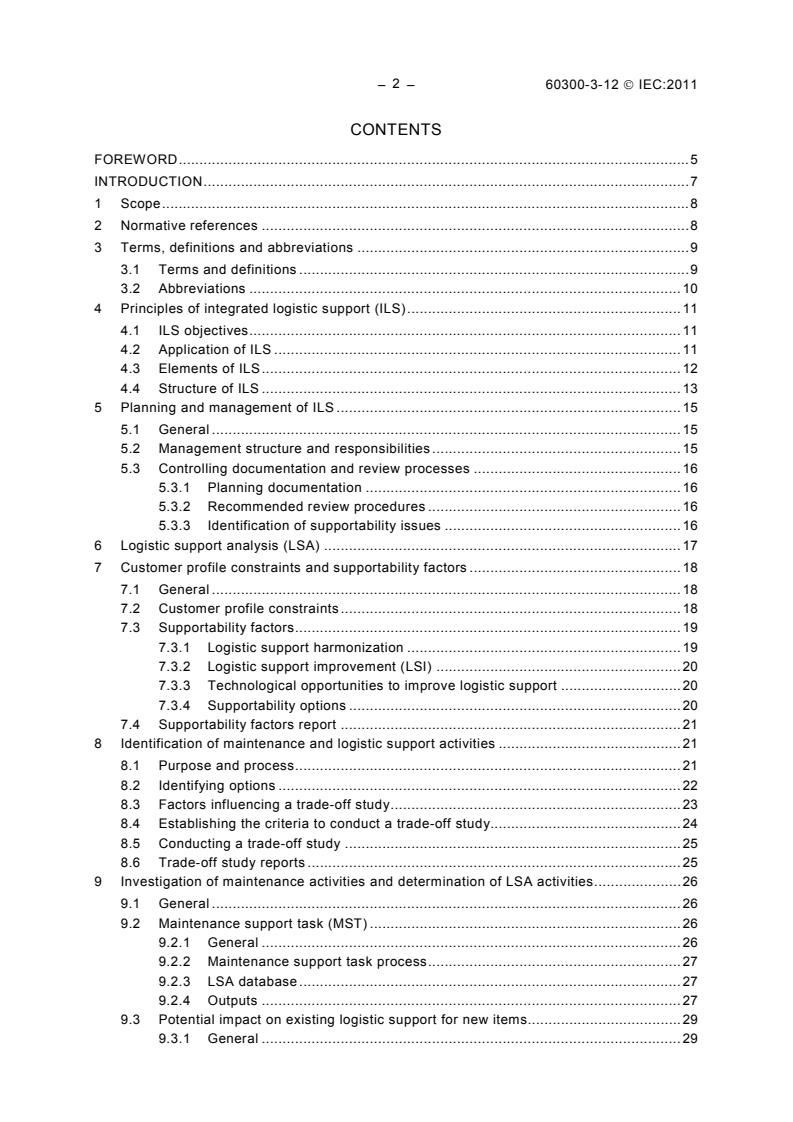
CONTENTS
FOREWORD . 5
INTRODUCTION . 7
1 Scope . 8
2 Normative references . 8
3 Terms, definitions and abbreviations . 9
3.1 Terms and definitions . 9
3.2 Abbreviations . 10
4 Principles of integrated logistic support (ILS) . 11
4.1 ILS objectives . 11
4.2 Application of ILS . 11
4.3 Elements of ILS . 12
4.4 Structure of ILS . 13
5 Planning and management of ILS . 15
5.1 General . 15
5.2 Management structure and responsibilities . 15
5.3 Controlling documentation and review processes . 16
5.3.1 Planning documentation . 16
5.3.2 Recommended review procedures . 16
5.3.3 Identification of supportability issues . 16
6 Logistic support analysis (LSA) . 17
7 Customer profile constraints and supportability factors . 18
7.1 General . 18
7.2 Customer profile constraints . 18
7.3 Supportability factors . 19
7.3.1 Logistic support harmonization . 19
7.3.2 Logistic support improvement (LSI) . 20
7.3.3 Technological opportunities to improve logistic support . 20
7.3.4 Supportability options . 20
7.4 Supportability factors report . 21
8 Identification of maintenance and logistic support activities . 21
8.1 Purpose and process . 21
8.2 Identifying options . 22
8.3 Factors influencing a trade-off study . 23
8.4 Establishing the criteria to conduct a trade-off study. 24
8.5 Conducting a trade-off study . 25
8.6 Trade-off study reports . 25
9 Investigation of maintenance activities and determination of LSA activities . 26
9.1 General . 26
9.2 Maintenance support task (MST) . 26
9.2.1 General . 26
9.2.2 Maintenance support task process . 27
9.2.3 LSA database . 27
9.2.4 Outputs . 27
9.3 Potential impact on existing logistic support for new items. 29
9.3.1 General . 29
60300-3-12 IEC:2011 – 3 –
9.3.2 Activity description . 29
9.4 Post-production support (PPS) . 30
9.4.1 General . 30
9.4.2 Activity description . 30
9.4.3 Post-production support (PPS) plan . 30
10 Verification of logistic supportability . 31
10.1 General . 31
10.2 Logistic support acceptance strategy . 31
10.3 Monitoring of field data . 32
11 ILS outputs . 33
11.1 General . 33
11.2 Outputs used to influence the design process. 34
11.3 Outputs used to identify or provide the logistic support elements . 34
11.3.1 General . 34
11.3.2 Maintenance plan . 34
11.3.3 Personnel . 35
11.3.4 Training and certification . 35
11.3.5 Provisioning of spares . 35
11.3.6 Support equipment . 35
11.3.7 Technical documentation . 36
11.3.8 Facilities. 36
11.3.9 Packaging, handling, storage and transportation (PHS&T) . 36
11.3.10 Software support . 37
12 LSA database . 37
12.1 General . 37
12.2 Interfaces with other databases . 38
12.3 Tailoring of the database . 38
12.4 Format of data . 38
12.5 Configuration management of the LSA database . 38
12.6 Configuration management of the data within the LSA database . 39
Annex A (informative) Illustrative examples of LSA activities. 40
Annex B (informative) Illustrative example of trade-off analysis emanating from the
evaluation of design and logistic support options series of activities . 44
Annex C (informative) Examples of LSA database . 46
Bibliography . 50
Figure 1 – Structure of ILS . 13
Figure 2 – Interrelationship of LSA analyses and other design activities . 14
Figure 3 – Applicability of LSA activities by life cycle phases . 17
Figure 4 – Identification of maintenance and logistic support activities . 22
Figure 5 – Maintenance support task . 27
Figure 6 – Test and evaluation procedure . 32
Table A.1 – Illustrative example of customer profile – Constraints data . 40
Table A.2 – Illustrative example of logistic standardization analysis . 40
Table A.3 – Illustrative example of logistic improvement analysis (photocopier test
cable – H1 as replacement for G1) . 41
– – 60300-3-12 IEC:2011
Table A.4 – Illustrative example of logistic technological opportunity analysis to
improve or reduce logistic requirements . 41
Table A.5 – Illustrative example of logistic support characteristics calculated from
supportability factors analysis . 42
Table A.6 – Illustrative example of initial supportability and logistic support
requirements emanating from the customer profile – Constraints and supportability
factors . 43
Table B.1 – Example of a simple scoring system . 44
Table B.2 – Illustrative example of trade-off analysis . 45
Table C.1 – Selected data element definitions . 47
60300-3-12 IEC:2011 – 5 –
INTERNATIONAL ELECTROTECHNICAL COMMISSION
____________
DEPENDABILITY MANAGEMENT –
Part 3-12: Application guide –
Integrated logistic support
FOREWORD
1) The International Electrotechnical Commission (IEC) is a worldwide organization for standardization comprising
all national electrotechnical committees (IEC National Committees). The object of IEC is to promote
international co-operation on all questions concerning standardization in the electrical and electronic fields. To
this end and in addition to other activities, IEC publishes International Standards, Technical Specifications,
Technical Reports, Publicly Available Specifications (PAS) and Guides (hereafter referred to as “IEC
Publication(s)”). Their preparation is entrusted to technical committees; any IEC National Committee interested
in the subject dealt with may participate in this preparatory work. International, governmental and non-
governmental organizations liaising with the IEC also participate in this preparation. IEC collaborates closely
with the International Organization for Standardization (ISO) in accordance with conditions determined by
agreement between the two organizations.
2) The formal decisions or agreements of IEC on technical matters express, as nearly as possible, an international
consensus of opinion on the relevant subjects since each technical committee has representation from all
interested IEC National Committees.
3) IEC Publications have the form of recommendations for international use and are accepted by IEC National
Committees in that sense. While all reasonable efforts are made to ensure that the technical content of IEC
Publications is accurate, IEC cannot be held responsible for the way in which they are used or for any
misinterpretation by any end user.
4) In order to promote international uniformity, IEC National Committees undertake to apply IEC Publications
transparently to the maximum extent possible in their national and regional publications. Any divergence
between any IEC Publication and the corresponding national or regional publication shall be clearly indicated in
the latter.
5) IEC itself does not provide any attestation of conformity. Independent certification bodies provide conformity
assessment services and, in some areas, access to IEC marks of conformity. IEC is not responsible for any
services carried out by independent certification bodies.
6) All users should ensure that they have the latest edition of this publication.
7) No liability shall attach to IEC or its directors, employees, servants or agents including individual experts and
members of its technical committees and IEC National Committees for any personal injury, property damage or
other damage of any nature whatsoever, whether direct or indirect, or for costs (including legal fees) and
expenses arising out of the publication, use of, or reliance upon, this IEC Publication or any other IEC
Publications.
8) Attention is drawn to the Normative references cited in this publication. Use of the referenced publications is
indispensable for the correct application of this publication.
9) Attention is drawn to the possibility that some of the elements of this IEC Publication may be the subject of
patent rights. IEC shall not be held responsible for identifying any or all such patent rights.
International Standard IEC 60300-3-12 has been prepared by IEC technical committee 56:
Dependability.
This second edition cancels and replaces the first edition published in 2001 and constitutes a
technical revision.
This edition includes the following significant technical changes with respect to the previous
edition:
• provision of a better overview of the whole ILS process;
• updating of the document to align with associated dependability standards that were
introduced after the previous edition.
– – 60300-3-12 IEC:2011
The text of this standard is based on the following documents:
FDIS Report on voting
56/1398/FDIS 56/1410/RVD
Full information on the voting for the approval of this standard can be found in the report on
voting indicated in the above table.
This publication has been drafted in accordance with the ISO/IEC Directives, Part 2.
A list of all the parts in the IEC 60300 series, under the general title, Dependability
management, can be found on the IEC website.
The committee has decided that the contents of this publication will remain unchanged until
the stability date indicated on the IEC web site under "http://webstore.iec.ch" in the data
related to the specific publication. At this date, the publication will be
• reconfirmed,
• withdrawn,
• replaced by a revised edition, or
• amended.
60300-3-12 IEC:2011 – 7 –
INTRODUCTION
The successful operation of an item in service depends to a large extent upon the effective
acquisition and management of logistic support in order to achieve and sustain the required
levels of performance and customer satisfaction over the entire life cycle.
Logistic support encompasses the activities and resources required to permit operation and
maintain an item (hardware and software) in service. Logistic support covers maintenance,
manpower and personnel, training, spares, technical documentation, packaging, handling,
storage and transportation, logistic support resources and disposal. In most cases,
maintenance support is considered to be synonymous with logistic support. Logistic support
may also include operational tasks but the differentiation between operational and
maintenance tasks varies with industry and individual practices.
The cost of logistic support is a major contributor to the life cycle costing (LCC) of an item and
increasingly, customers are making purchase decisions based on life cycle cost rather than
initial purchase price alone. Logistic support considerations may therefore have a major
impact on item sales by ensuring that the item can be operated and supported at an
affordable cost and that all the necessary resources have been provided to fully support the
item so that it meets the customer requirements.
Quantification of logistic support costs allows the manufacturer to define the logistic support
cost elements and evaluate the warranty implications. This provides the opportunity to reduce
risk and allows logistic support costs to be set at competitive rates.
Integrated logistic support (ILS) is a management method by which all the logistic support
services required by a customer can be brought together in a structured way and in harmony
with an item. ILS should be applied to ensure that supportability considerations influence the
concept and design of an item and to ensure that logistic support arrangements are consistent
with the design and each other throughout the item’s life.
The successful application of ILS will result in a number of customer and supplier benefits.
For the customer, these can include increased satisfaction, lower logistic support costs,
greater availability and lower life cycle costs. For the supplier, benefits can include lower
logistic support costs, a better and more saleable item with fewer item modifications due to
supportability deficiencies.
This part of IEC 60300 provides guidance on the minimum activities necessary to implement
an effective ILS management system for a wide range of commercial suppliers.
– – 60300-3-12 IEC:2011
DEPENDABILITY MANAGEMENT –
Part 3-12: Application guide –
Integrated logistic support
1 Scope
This part of IEC 60300 is an application guide for establishing an integrated logistic support
(ILS) management system.
It is intended to be used by a wide range of suppliers including large and small companies
wishing to offer a competitive and quality item which is optimized for the purchaser and
supplier for the complete life cycle of the item.
It also includes common practices and logistic data analyses that are related to ILS.
2 Normative references
The following referenced documents are indispensable for the application of this document.
For dated references, only the edition cited applies. For undated references, the latest edition
of the referenced document (including any amendments) applies.
IEC 60050-191, International Electrotechnical Vocabulary – Chapter 191: Dependability and
quality of service
IEC 60300-3-1, Dependability management – Part 3-1: Application guide – Analysis
techniques for dependability - Guide on methodology
IEC 60300-3-2, Dependability management – Part 3-2: Application guide – Collection of
dependability data from the field
IEC 60300-3-3, Dependability management – Part 3-3: Application guide – Life cycle costing
IEC 60300-3-4 Dependability management – Part 3-4: Application guide – Guide to the
specification of dependability requirements
IEC 60300-3-10, Dependability management – Part 3-10: Application guide – Maintainability
IEC 60300-3-11, Dependability management – Part 3-11: Application guide – Reliability
centred maintenance
IEC 60300-3-14, Dependability management – Part 3-14: Application guide – Maintenance
and maintenance support
IEC 60300-3-16, Dependability management – Part 3-16: Application guide – Guidelines for
specification of maintenance support services
IEC 60706-2, Maintainability of equipment – Part 2: Maintainability requirements and studies
during the design and development phase
IEC 60706-3, Maintainability of equipment – Part 3: Verification and collection, analysis and
presentation of data
60300-3-12 IEC:2011 – 9 –
IEC 60706-5, Maintainability of equipment – Part 5: Testability and diagnostic testing
IEC 60812, Analysis techniques for system reliability – Procedure for failure mode and effects
analysis (FMEA)
IEC 61160, Design review
IEC 62402, Obsolescence management – Application guide
IEC 62508, Guidance on human aspects of dependability
3 Terms, definitions and abbreviations
For the purposes of this document, the terms and definitions given in IEC 60050-191, as well
as the following terms and definitions, apply.
3.1 Terms and definitions
3.1.1
design life
period during which an item is expected to perform according to the technical specifications to
which it was produced
NOTE The specification should define the environment, usage and level of logistic support. The period may be
time related, distance related or number of cycles related.
3.1.2
integrated logistic support
ILS
management method by which all the logistic support services required by a customer can be
brought together in a structured way and in harmony with an item
3.1.3
item
part, component, device, functional unit, equipment, subsystem or system that can be
individually considered
NOTE 1 An item may consist of hardware, software, people or any combination thereof.
NOTE 2 In French the term "individu" is used mainly in statistics.
NOTE 3 A group of items, e.g. a population of items or a sample, may itself be considered as an item.
3.1.4
line replaceable item
LRI
replaceable hardware or software item which can be replaced directly on the equipment.
NOTE LRI is sometimes referred to as line replaceable unit (LRU).
3.1.5
logistic support
all material and resources required to permit the operation and undertake the maintenance of
an item including both hardware and software
3.1.6
logistic support analysis
LSA
selective application of a range of activities undertaken to assist in complying with
supportability and other ILS objectives
– – 60300-3-12 IEC:2011
NOTE 1 Data generated during LSA are normally stored in a dedicated software application for calculating,
determining and optimising the adapted logistic elements which are identified to perform the logistic support for a
system during its life cycle. Such an application is often referred to as an LSA database.
3.1.7
maintenance support
resources required to maintain an item under a given maintenance concept and guided by a
maintenance policy
NOTE Resources include human resources, support equipment, materials and spare parts, maintenance facilities,
documentation, information and maintenance information systems.
3.1.8
provisioning
process of determining and acquiring the range and quantity of spares (consumables or
repairable items) required to operate and maintain the item
3.1.9
supportability
extent to which item design characteristics and planned logistic support resources meet
operational utilization requirements
3.1.10
support concept
recommended support policy and procedure for a particular item, specific to a particular user
or application
3.1.11
trade-off
determination of the optimum balance between item characteristics (cost, performance and
supportability)
3.2 Abbreviations
AR&M Availability, reliability and maintainability
BITE Built-in test equipment
CP&S Customer profile and supportability
EDI Electronic data interchange
FMEA Failure mode and effects analysis
FMECA Failure mode, effects and criticality analysis
FRI Functional requirement identification
ILS Integrated logistic support
LCC Life cycle costing
LORA Level of repair analysis
LRI Line replaceable item
LSA Logistic support analysis
LSI Logistic support improvement
MDT Mean down time
MTBF Mean time between failures
MTTR Mean time to repair
MST Maintenance support task
PHS&T Packaging, handling, storage and transportation
60300-3-12 IEC:2011 – 11 –
PPS Post production support
R&M Reliability and maintainability
RCM Reliability centred maintenance
REACH Registration, evaluation, authorization and restriction of chemicals.
European Directive
RoHS Restriction of hazardous substances. Directive 2002/95/EC
STTE Special tools and test equipment
T&E Test and evaluation
WEEE Waste from electrical and electronic equipment. Directive
2002/96/EC
4 Principles of integrated logistic support (ILS)
4.1 ILS objectives
The integrated logistic support (ILS) should ensure that
– logistic support considerations are integrated into item design at a very early stage in the
design process – preferably at the concept stage,
– logistic support arrangements are developed that are consistently related to design
(including intended use and intended environment of the item) and to each other,
– the necessary logistic support is provided at the beginning and during customer use and
disposal at optimum cost,
– improvements are allowed to be made in the logistic support of an item throughout its life
– and to support necessary modifications; for example, changes required to deal with
obsolescence.
ILS should improve the item (by influencing the design to provide the most economic and
efficient logistic support solution), improve the logistic support system and minimize the life
cycle cost while ensuring that the needs of the customer and business are met.
4.2 Application of ILS
ILS should be applied to the design and development of an item to ensure that all the logistic
implications of introducing the item have been properly considered so that it can be supported
in the most cost effective manner.
ILS is applicable to all items, including very large items (such as a power plant or a paper mill)
and provides a methodology for the identification and optimization of the logistic support
requirements for the individual items that constitute the plant.
The degree of application of ILS and the associated LSA will vary accordingly with regard to
the degree of design freedom, technical complexity, cost of the item and other factors.
A logistic support analysis (LSA), which comprises the selective application of a series of
analysis activities, should be used to assist the design in complying with supportability and
other ILS objectives.
If an item is a completely new development it may be necessary to apply most of the LSA
activities, but where an item is identified as an existing item, it may not be necessary to apply
all the activities. This is referred to as tailoring and addresses the depth of analysis to a cost-
effective level based on maturity and the type of item.
– – 60300-3-12 IEC:2011
ILS results usually have to be modified and updated over the life cycle since changes are
likely to occur due to
– experience gained from failures,
– changes in logistic support resources such as suppliers of spare parts,
– improvements in maintenance technology and procedures,
– changes in failure modes and resultant maintenance tasks as equipment ages,
– modifications incorporated in the items,
– human aspects associated with operation and maintenance activities (IEC 62508),
– changes in operating conditions or environment.
4.3 Elements of ILS
The following elements of logistic support are covered by ILS, and may include, but are not
limited to:
– maintenance planning;
– spares/materials;
– support equipment (including tools and test equipment);
– technical documentation;
– manpower and personnel;
– training;
– packaging, handling, storage and transportation;
– facilities;
– software support.
Key areas that interface with ILS:
– systems and design engineering;
– reliability analysis (IEC 60300-3-1);
– maintainability of equipment (IEC 60300-3-10 , IEC 60706-2 and IEC 60706-3);
– maintenance and maintenance support (IEC 60300-3-14);
– testability and diagnostic testing (IEC 60706-5);
– life cycle costing (LCC) analysis (IEC 60300-3-3);
– reliability centred maintenance (IEC 60300-3-11);
– specification of maintenance support services (IEC 60300-3-16);
– dependability requirements (IEC 60300-3-4).
In addition, ILS interfaces with
– project management,
– risk management,
– safety and hazard analysis,
– human factors analysis,
– trials and acceptance,
– configuration management,
– quality,
– environmental requirements,
– design reviews (IEC 61160) ,
60300-3-12 IEC:2011 – 13 –
– contracting of maintenance support services (IEC 60300-3-16),
and will reflect and contribute to the approach in these areas.
The activities and procedures for these interface areas are covered in other IEC standards.
4.4 Structure of ILS
ILS is structured so that it can assimilate key areas and logistic support elements to optimize
the logistic support required for a system. A simplified diagram illustrating this structure is
shown in Figure 1.
Preliminary Maintenance
System
maintenance concept
breakdown
concept (updated)
Reliability
forecast
Logistic support
Maintenance
Reliability analysis (LSA)
Level of repair
programme
allocation
See Figure 2
analysis
Life-cycle cost
Maintainability
calculation
analyses
Maintainability
Feedback
allocation
IEC 196/11
Figure 1 – Structure of ILS
The initial stages involve the breakdown of the system into LRIs and the identification of LRIs
which require detailed analysis (sometimes referred to as LSA candidates or maintenance
candidates). In some cases, the selected LRI is composed of numerous items and it may be
necessary to conduct further analyses to optimize maintenance.
Figure 2 illustrates at a high level how the LSA activities interrelate with each other and with
the design activities.
– – 60300-3-12 IEC:2011
Design configuration and design related performance data
(including reliability, availability, maintainability, testability and FMEA/FMECA)
LSA
Maintenance plan
Customer profile
constraints
(See Clause 7)
Personnel and training
Provisioning of spares
and consumables
Support equipment
Identification of
LSA
maintenance activities
database
(See Clause 8)
Technical documentation
Facilities
Investigation of
maintenance activities and
PHS & T
determination of logistic
support requirements
(See Clause 9) Software support concept
Customer involvement (reviews/trials/in service data)
IEC 197/11
Figure 2 – Interrelationship of LSA analyses and other design activities
The general logistic support strategy and customer requirements logistic support concept is a
basic description of the maintenance support expected to apply to the item. It is usually
defined within the customer profile and should be provided to both the design and logistic
support team to ensure that the item will be supported in its intended environment. As the
design progresses, the initial logistic support concept will be confirmed and expanded.
The design configuration and design performance data provides basic design and performance
information. The design information is progressively analysed in terms of its logistic support
implications under the LSA in Clause 6. Reliability and maintainability characteristics and
FMEA/FMECA are fundamental inputs to these analyses. The R&M characteristics indicate
the likelihood of item failure and time to restore and hence the maintenance and logistic
support effort and resources required. The FMEA/FMECA indicates the likely causes of failure
of the item and provides feedback to improve the design. For the final design and logistic
support concept, the FMEA/FMECA provides the input for the systematic identification of all
the maintenance and logistic support resources required for the item through the use of
maintenance activities and logistic support activities described in Clause 8.
Evidence gathered during operation (customer involvement), provides feedback to improve
the item. Proving trials are normally conducted on new items to demonstrate stated
performance or fitness for purpose; such trials should include the logistic support
arrangements. The testing of the design and proving of the logistic support arrangements are
covered under verification of logistic supportability (see Clause 10).
Analyses associated with life cycle costs, ensure that cost considerations (throughout the life
of the item) are included when establishing the preferred solution.
General support strategy and customer requirements
Life cycle costing (LCC)
60300-3-12 IEC:2011 – 15 –
Integral with the LSA activities is the LSA database which provides the mechanism and
repository for the LSA and documents the detailed logistic support to be provided as a result
of the logistic support activities enumerated in Clause 6. To maximize the benefit, the outputs
and results of the LSA should be recorded in a controlled and structured LSA database. The
creation of an electronic LSA database is recommended as the most viable means to store
and control the information obtained. Further details covering interfaces, tailoring and
configuration management are discussed in Clause 12.
5 Planning and management of ILS
5.1 General
The planning and management of ILS addresses the programme of work required to carry out
the ILS activities. For a complex item, this is a major factor in the success of the ILS
programme. The planning of ILS should ensure that all ILS and LSA activities, responsibilities
and internal and external interfaces at each phase of the design and ongoing life of the item
are clearly defined. The type of maintenance task (for example, preventive – condition based,
preventive – pre-determined, corrective – immediate, and corrective – deferred) may require
different ILS approaches to be adopted. Examples of the ILS management and planning
activities are listed below:
– determine and agree on ILS responsibilities, including logistic information, and interfaces
with the owners, users, operators, manufacturers, item design teams, suppliers and/or
customers;
– define programme of LSA activities to be undertaken (see Clauses 6, 8 and 11);
– determine method for providing design guidance;
– define maintenance support resources;
– plan and put in place review processes, both informal and formal, to audit the design and
the ILS programme;
– apply operational improvement processes for the maintenance and maintenance support
resources during the operation and maintenance phase;
– produce and maintain ILS planning documentation to control the ILS programme;
– provide input to decisions on trade-offs between functional needs, capability, life cycle
cost and dependability;
– monitor and control the ILS programme of work;
– identify risks associated with the ILS programme and propose actions to address these
risks.
It should be noted that ILS management and planning activities require an understanding of
the legislative requirements. Examples are WEEE, RoHS and REACH . Where a global
service is intended, these requirements may differ across countries.
5.2 Management structure and responsibilities
A single person is normally appointed, usually referred to as the ILS manager, with
responsibility for the overall programme of ILS activities. The responsibilities of the ILS
manager are the ILS management and planning activities defined in 5.1 and other detailed
activities as allocated. The principal activities of the ILS manager are to
– meet the requirements of the ILS/LSA plans,
– develop the logistic support-related technical characteristics of the item,
– coordinate and integrate inputs from the specialist disciplines,
___________
WEEE: Waste electrical and electronic equipment; RoHS: Restriction of hazardous substances; REACH:
Registration, evaluation, authorisation and restriction of chemical substances.
– – 60300-3-12 IEC:2011
– coordinate maintenance support provided by contractors and subcontractors,
– coordinate cost related studies.
The ILS manager, who might have other responsibilities, should report directly to the project
manager and have the same level of authority as the design and manufacturing managers.
This is to ensure that logistic support issues are given equal weight in the design process. For
projects involving lower tier subcontractors and/or suppliers, a similar management structure
should apply. The subcontractor and, where applicable, supplier ILS managers should report
to the overall item contractor ILS manager in a management tier structure. When applicable,
the ILS manager should have authority to achieve effective cooperation with the customer and
with any subcontractors. Establishing an integrated team needs to be considered.
Clear terms of reference and methods of operation should be identified and agreed between
the ILS manager and the designers to ensure that supportability considerations resulting from
the LSA studies can fully influence the design. The ILS manager should understand the
design process, objectives and programme and relate the ILS programme to it. A concurrent
engineering approach is recommended with the design and logistic personnel working closely
together to evolve the design and logistic support arrangements in parallel.
Th
...