

IEC 62068:2013
(Main)Electrical insulating materials and systems - General method of evaluation of electrical endurance under repetitive voltage impulses
General Information
- Abstract
IEC 62068:2013 applies to electrical equipment, regardless of voltage, containing an insulation system, which is:
- connected to an electronic power supply, and
- requires an evaluation of insulation endurance under repetitive voltage impulses. This standard proposes a general test procedure to facilitate screening of electrical insulating materials (EIM) and systems (EIS) and to achieve a relative evaluation of insulation endurance under conditions of repetitive impulses. This first edition of IEC 62068 replaces IEC 62068-1:2003. It has been re-numbered as IEC 62068, as decided at the Plenary Meeting of TC 112 in Prague 2011. The main changes with regard to IEC 62068-1:2003 concern the terms and definitions which are now aligned, in part, on IEC;TS 61934 and IEC;TS 60034-18-42.
- Status
- Published
- Publication Date
- 10-Mar-2013
- Technical Committee
- TC 112 - Evaluation and qualification of electrical insulating materials and systems
- Drafting Committee
- WG 3 - TC 112/WG 3
- Current Stage
- PPUB - Publication issued
- Start Date
- 11-Mar-2013
- Completion Date
- 31-Mar-2013
Overview
IEC 62068:2013 defines a general method for evaluating the electrical endurance of electrical insulating materials (EIM) and electrical insulation systems (EIS) exposed to repetitive voltage impulses. Published by the International Electrotechnical Commission (IEC), this international standard applies to all types of electrical equipment operating at any voltage level, provided they are connected to electronic power supplies and require insulation endurance evaluation under repetitive voltage impulses. The standard establishes procedures for screening and relatively assessing the endurance of insulating materials and systems using standardized testing approaches.
IEC 62068:2013 replaces IEC 62068-1:2003, aligning its definitions with other key IEC technical specifications, and provides crucial guidelines for manufacturers, testing bodies, and quality assurance professionals to ensure robust and safe insulation performance in environments affected by repetitive electrical impulses.
Key Topics
- Scope of Application: Covers electrical equipment containing insulation systems that are subject to voltage impulses, especially those powered by electronic supplies.
- Test Procedures: Outlines general test procedures to:
- Screen electrical insulating materials and systems under impulse stress.
- Evaluate endurance through comparative analysis of time-to-failure or number of impulses to failure.
- Endurance Assessment: Introduces methods to determine the relationship between applied voltage and expected insulation lifespan.
- Statistical Evaluation: Describes the use of statistical models, such as the Weibull distribution, to analyze test results.
- Influencing Factors: Details how temperature, mechanical stress, humidity, voltage magnitude, impulse repetition rate, and polarity affect insulation endurance.
- Measurement Definitions: Standardizes key parameters, such as Repetitive Partial Discharge Inception Voltage (RPDIV) and Repetitive Partial Discharge Extinction Voltage (RPDEV).
- Impulses: Specifies characteristics of test voltage impulses (rise time, repetition rate, duration, polarity) to accurately simulate real-world operation.
Applications
The guidelines in IEC 62068:2013 are highly valuable for numerous industries and applications where the electrical insulation system is exposed to repetitive voltage impulses. These include:
- Electric Motors: Evaluation of stator windings in applications with variable frequency drives.
- Transformers and Power Cables: Ensuring insulation durability under switching conditions and electronic power supply impulses.
- Power Supply and Filter Capacitors: Validating insulation reliability in electronic power conversion contexts.
- Printed Circuit Boards (PCBs): Screening PCB insulation for endurance against repetitive electrical impulses in power electronics.
- Power Module Drives: Assessing insulation performance in modules subjected to high-frequency switching.
Meeting IEC 62068:2013 ensures that selected EIM and EIS can withstand service conditions, reduce premature failures, and improve safety and operational reliability.
Related Standards
To effectively implement IEC 62068:2013, users should consider familiarity with several closely related standards:
- IEC 60505: Evaluation and qualification of electrical insulation systems.
- IEC 62539: Guide for the statistical analysis of electrical insulation breakdown data.
- IEC/TS 61934: Electrical measurements of partial discharges under short rise time and repetitive voltage impulses.
- IEC/TS 60034-18-42: Qualification and acceptance tests for partial discharge resistant insulation systems in rotating machines.
- IEC 60270: High-voltage test techniques for partial discharge measurements.
Integration of these standards supports comprehensive insulation system evaluation, in line with current best practices for electrical endurance testing and safety.
By following IEC 62068:2013, organizations can achieve consistent, reliable assessment of insulation performance, critical for the durability and safety of modern electrical and electronic equipment exposed to repetitive voltage impulses.
Relations
- Effective Date
- 05-Sep-2023
Get Certified
Connect with accredited certification bodies for this standard

IMQ S.p.A. (Certification)
Italian electrical product certification.

SLG Prüf- und Zertifizierungs GmbH
German testing and certification body.

UL Solutions
Global safety science company with testing, inspection and certification.
Sponsored listings
Frequently Asked Questions
IEC 62068:2013 is a standard published by the International Electrotechnical Commission (IEC). Its full title is "Electrical insulating materials and systems - General method of evaluation of electrical endurance under repetitive voltage impulses". This standard covers: IEC 62068:2013 applies to electrical equipment, regardless of voltage, containing an insulation system, which is: - connected to an electronic power supply, and - requires an evaluation of insulation endurance under repetitive voltage impulses. This standard proposes a general test procedure to facilitate screening of electrical insulating materials (EIM) and systems (EIS) and to achieve a relative evaluation of insulation endurance under conditions of repetitive impulses. This first edition of IEC 62068 replaces IEC 62068-1:2003. It has been re-numbered as IEC 62068, as decided at the Plenary Meeting of TC 112 in Prague 2011. The main changes with regard to IEC 62068-1:2003 concern the terms and definitions which are now aligned, in part, on IEC;TS 61934 and IEC;TS 60034-18-42.
IEC 62068:2013 applies to electrical equipment, regardless of voltage, containing an insulation system, which is: - connected to an electronic power supply, and - requires an evaluation of insulation endurance under repetitive voltage impulses. This standard proposes a general test procedure to facilitate screening of electrical insulating materials (EIM) and systems (EIS) and to achieve a relative evaluation of insulation endurance under conditions of repetitive impulses. This first edition of IEC 62068 replaces IEC 62068-1:2003. It has been re-numbered as IEC 62068, as decided at the Plenary Meeting of TC 112 in Prague 2011. The main changes with regard to IEC 62068-1:2003 concern the terms and definitions which are now aligned, in part, on IEC;TS 61934 and IEC;TS 60034-18-42.
IEC 62068:2013 is classified under the following ICS (International Classification for Standards) categories: 29.080.30 - Insulation systems. The ICS classification helps identify the subject area and facilitates finding related standards.
IEC 62068:2013 has the following relationships with other standards: It is inter standard links to IEC 62068-1:2003. Understanding these relationships helps ensure you are using the most current and applicable version of the standard.
IEC 62068:2013 is available in PDF format for immediate download after purchase. The document can be added to your cart and obtained through the secure checkout process. Digital delivery ensures instant access to the complete standard document.
Standards Content (Sample)
IEC 62068 ®
Edition 1.0 2013-03
INTERNATIONAL
STANDARD
NORME
INTERNATIONALE
Electrical insulating materials and systems – General method of evaluation of
electrical endurance under repetitive voltage impulses
Matériaux et systèmes d'isolation électriques – Méthode générale d’évaluation
de l'endurance électrique soumise à des impulsions de tension appliquées
périodiquement
All rights reserved. Unless otherwise specified, no part of this publication may be reproduced or utilized in any form
or by any means, electronic or mechanical, including photocopying and microfilm, without permission in writing from
either IEC or IEC's member National Committee in the country of the requester.
If you have any questions about IEC copyright or have an enquiry about obtaining additional rights to this publication,
please contact the address below or your local IEC member National Committee for further information.
Droits de reproduction réservés. Sauf indication contraire, aucune partie de cette publication ne peut être reproduite ni
utilisée sous quelque forme que ce soit et par aucun procédé, électronique ou mécanique, y compris la photocopie et les
microfilms, sans l'accord écrit de la CEI ou du Comité national de la CEI du pays du demandeur.
Si vous avez des questions sur le copyright de la CEI ou si vous désirez obtenir des droits supplémentaires sur cette
publication, utilisez les coordonnées ci-après ou contactez le Comité national de la CEI de votre pays de résidence.
IEC Central Office Tel.: +41 22 919 02 11
3, rue de Varembé Fax: +41 22 919 03 00
CH-1211 Geneva 20 info@iec.ch
Switzerland www.iec.ch
About the IEC
The International Electrotechnical Commission (IEC) is the leading global organization that prepares and publishes
International Standards for all electrical, electronic and related technologies.
About IEC publications
The technical content of IEC publications is kept under constant review by the IEC. Please make sure that you have the
latest edition, a corrigenda or an amendment might have been published.
Useful links:
IEC publications search - www.iec.ch/searchpub Electropedia - www.electropedia.org
The advanced search enables you to find IEC publications The world's leading online dictionary of electronic and
by a variety of criteria (reference number, text, technical electrical terms containing more than 30 000 terms and
committee,…). definitions in English and French, with equivalent terms in
It also gives information on projects, replaced and additional languages. Also known as the International
withdrawn publications. Electrotechnical Vocabulary (IEV) on-line.
IEC Just Published - webstore.iec.ch/justpublished Customer Service Centre - webstore.iec.ch/csc
Stay up to date on all new IEC publications. Just Published If you wish to give us your feedback on this publication
details all new publications released. Available on-line and or need further assistance, please contact the
also once a month by email. Customer Service Centre: csc@iec.ch.
A propos de la CEI
La Commission Electrotechnique Internationale (CEI) est la première organisation mondiale qui élabore et publie des
Normes internationales pour tout ce qui a trait à l'électricité, à l'électronique et aux technologies apparentées.
A propos des publications CEI
Le contenu technique des publications de la CEI est constamment revu. Veuillez vous assurer que vous possédez
l’édition la plus récente, un corrigendum ou amendement peut avoir été publié.
Liens utiles:
Recherche de publications CEI - www.iec.ch/searchpub Electropedia - www.electropedia.org
La recherche avancée vous permet de trouver des Le premier dictionnaire en ligne au monde de termes
publications CEI en utilisant différents critères (numéro de électroniques et électriques. Il contient plus de 30 000
référence, texte, comité d’études,…). termes et définitions en anglais et en français, ainsi que
Elle donne aussi des informations sur les projets et les les termes équivalents dans les langues additionnelles.
publications remplacées ou retirées. Egalement appelé Vocabulaire Electrotechnique
International (VEI) en ligne.
Just Published CEI - webstore.iec.ch/justpublished
Service Clients - webstore.iec.ch/csc
Restez informé sur les nouvelles publications de la CEI.
Just Published détaille les nouvelles publications parues. Si vous désirez nous donner des commentaires sur
Disponible en ligne et aussi une fois par mois par email. cette publication ou si vous avez des questions
contactez-nous: csc@iec.ch.
IEC 62068 ®
Edition 1.0 2013-03
INTERNATIONAL
STANDARD
NORME
INTERNATIONALE
Electrical insulating materials and systems – General method of evaluation of
electrical endurance under repetitive voltage impulses
Matériaux et systèmes d'isolation électriques – Méthode générale d’évaluation
de l'endurance électrique soumise à des impulsions de tension appliquées
périodiquement
INTERNATIONAL
ELECTROTECHNICAL
COMMISSION
COMMISSION
ELECTROTECHNIQUE
PRICE CODE
INTERNATIONALE
CODE PRIX N
ICS 29.080.30 ISBN 978-2-83220-676-8
– 2 – 62068 © IEC:2013
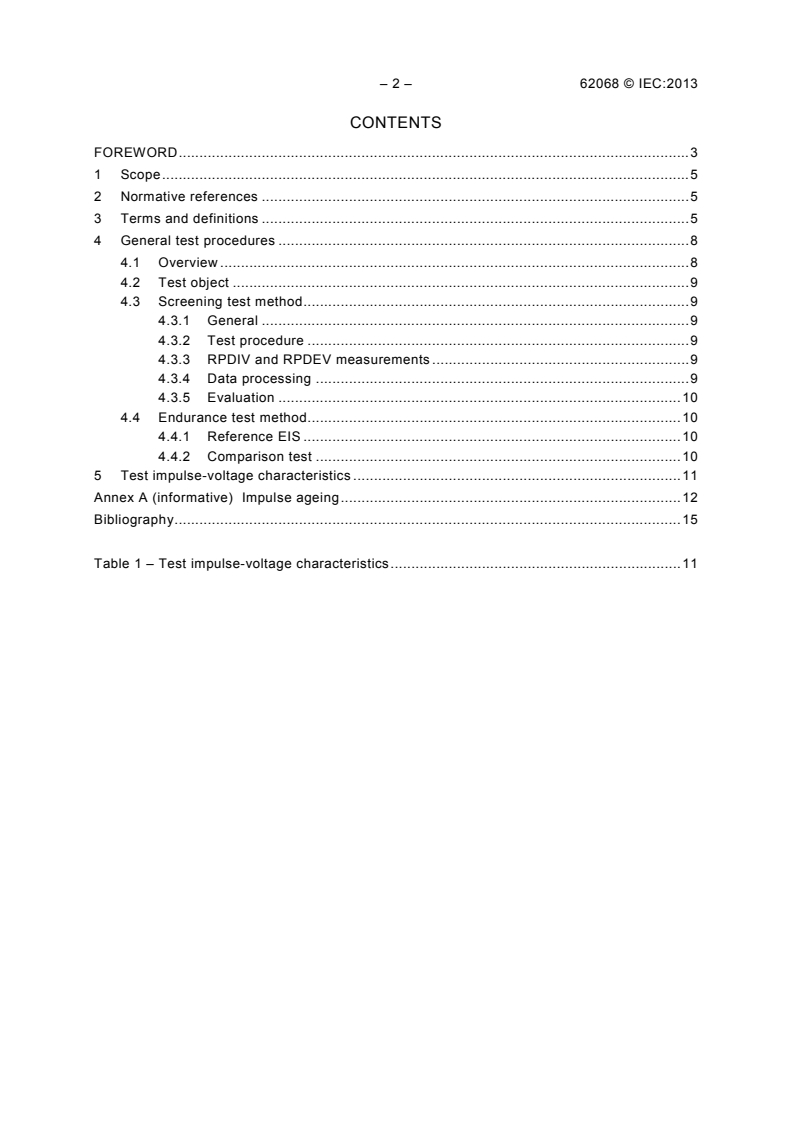
CONTENTS
FOREWORD . 3
1 Scope . 5
2 Normative references . 5
3 Terms and definitions . 5
4 General test procedures . 8
4.1 Overview . 8
4.2 Test object . 9
4.3 Screening test method . 9
4.3.1 General . 9
4.3.2 Test procedure . 9
4.3.3 RPDIV and RPDEV measurements . 9
4.3.4 Data processing . 9
4.3.5 Evaluation . 10
4.4 Endurance test method. 10
4.4.1 Reference EIS . 10
4.4.2 Comparison test . 10
5 Test impulse-voltage characteristics . 11
Annex A (informative) Impulse ageing . 12
Bibliography . 15
Table 1 – Test impulse-voltage characteristics . 11
62068 © IEC:2013 – 3 –
INTERNATIONAL ELECTROTECHNICAL COMMISSION
____________
ELECTRICAL INSULATING MATERIALS AND SYSTEMS –
GENERAL METHOD OF EVALUATION OF ELECTRICAL ENDURANCE
UNDER REPETITIVE VOLTAGE IMPULSES
FOREWORD
1) The International Electrotechnical Commission (IEC) is a worldwide organization for standardization comprising
all national electrotechnical committees (IEC National Committees). The object of IEC is to promote
international co-operation on all questions concerning standardization in the electrical and electronic fields. To
this end and in addition to other activities, IEC publishes International Standards, Technical Specifications,
Technical Reports, Publicly Available Specifications (PAS) and Guides (hereafter referred to as “IEC
Publication(s)”). Their preparation is entrusted to technical committees; any IEC National Committee interested
in the subject dealt with may participate in this preparatory work. International, governmental and non-
governmental organizations liaising with the IEC also participate in this preparation. IEC collaborates closely
with the International Organization for Standardization (ISO) in accordance with conditions determined by
agreement between the two organizations.
2) The formal decisions or agreements of IEC on technical matters express, as nearly as possible, an international
consensus of opinion on the relevant subjects since each technical committee has representation from all
interested IEC National Committees.
3) IEC Publications have the form of recommendations for international use and are accepted by IEC National
Committees in that sense. While all reasonable efforts are made to ensure that the technical content of IEC
Publications is accurate, IEC cannot be held responsible for the way in which they are used or for any
misinterpretation by any end user.
4) In order to promote international uniformity, IEC National Committees undertake to apply IEC Publications
transparently to the maximum extent possible in their national and regional publications. Any divergence
between any IEC Publication and the corresponding national or regional publication shall be clearly indicated in
the latter.
5) IEC itself does not provide any attestation of conformity. Independent certification bodies provide conformity
assessment services and, in some areas, access to IEC marks of conformity. IEC is not responsible for any
services carried out by independent certification bodies.
6) All users should ensure that they have the latest edition of this publication.
7) No liability shall attach to IEC or its directors, employees, servants or agents including individual experts and
members of its technical committees and IEC National Committees for any personal injury, property damage or
other damage of any nature whatsoever, whether direct or indirect, or for costs (including legal fees) and
expenses arising out of the publication, use of, or reliance upon, this IEC Publication or any other IEC
Publications.
8) Attention is drawn to the Normative references cited in this publication. Use of the referenced publications is
indispensable for the correct application of this publication.
9) Attention is drawn to the possibility that some of the elements of this IEC Publication may be the subject of
patent rights. IEC shall not be held responsible for identifying any or all such patent rights.
International Standard IEC 62068 has been prepared by IEC technical committee 112:
Evaluation and qualification of electrical insulating materials and systems.
This first edition of IEC 62068 replaces IEC 62068-1:2003. It has been re-numbered as
IEC 62068, as decided at the Plenary Meeting of TC 112 in Prague 2011.
The main changes with regard to IEC 62068-1:2003 concern the terms and definitions which
are now aligned, in part, on IEC/TS 61934 [1] and IEC/TS 60034-18-42 [2].
___________
Figures in square brackets refer to the bibliography.
– 4 – 62068 © IEC:2013
The text of this standard is based on the following documents:
FDIS Report on voting
112/234/FDIS 112/242/RVD
Full information on the voting for the approval of this standard can be found in the report on
voting indicated in the above table.
This publication has been drafted in accordance with the ISO/IEC Directives, Part 2.
The committee has decided that the contents of this publication will remain unchanged until
the stability date indicated on the IEC web site under "http://webstore.iec.ch" in the data
related to the specific publication. At this date, the publication will be
• reconfirmed,
• withdrawn,
• replaced by a revised edition, or
• amended.
62068 © IEC:2013 – 5 –
ELECTRICAL INSULATING MATERIALS AND SYSTEMS –
GENERAL METHOD OF EVALUATION OF ELECTRICAL ENDURANCE
UNDER REPETITIVE VOLTAGE IMPULSES
1 Scope
This International Standard applies to electrical equipment, regardless of voltage, containing
an insulation system, which is
– connected to an electronic power supply, and
– requires an evaluation of insulation endurance under repetitive voltage impulses.
This standard proposes a general test procedure to facilitate screening of electrical insulating
materials (EIM) and systems (EIS) and to achieve a relative evaluation of insulation
endurance under conditions of repetitive impulses.
2 Normative references
The following documents, in whole or in part, are normatively referenced in this document and
are indispensable for its application. For dated references, only the edition cited applies. For
undated references, the latest edition of the referenced document (including any
amendments) applies.
IEC 62539, Guide for the statistical analysis of electrical insulation breakdown data
3 Terms and definitions
For the purposes of this document, the following terms and definitions apply.
3.1
electrical insulating material
EIM
material with negligibly low electric conductivity, used to separate conducting parts at different
electrical potentials
[SOURCE: IEC 60505:2011, definition 3.1.2 [3]
3.2
electrical insulation system
EIS
insulating structure containing one or more electrical insulating materials (EIM) together with
associated conducting parts employed in an electrotechnical device
[SOURCE: IEC 60505:2011, definition 3.1.1 [2]
3.3
candidate EIS
EIS under evaluation to determine its electrical endurance when exposed to repetitive voltage
impulses
___________
Figures in square brackets refer to the Bibliography.
– 6 – 62068 © IEC:2013
3.4
reference EIS
evaluated and established EIS with either a known service experience or a known
comparative functional evaluation under repetitive voltage impulses
3.5
partial discharge
PD
electric discharge that only partially bridges the insulation between electrical conductors
[SOURCE: IEC 60270:2000, definition 3.1 modified [4] – the word "localized" (electrical
discharge) omitted from source definition, and definition shortened to omit reference to "which
can or can not occur adjacent to a conductor". Also the three NOTES after the term have
been omitted]
3.6
partial discharge pulse
current pulse in an object under test that results from a partial discharge occurring within the
object under test
Note 1 to entry: The pulse is measured using suitable detector circuits, which have been introduced into the test
circuit for the purpose of the test.
Note 2 to entry: A detector in accordance with the provisions of this standard produces a current or a voltage
signal at its output related to the PD pulse at its input.
[SOURCE: IEC/TS 61934:2011, definition 3.3, modified – In Note 2 to entry, "provisions" of
this technical specification" edited to read "of this standard"]
3.7
repetitive partial discharge inception voltage
RPDIV
minimum peak-to-peak impulse voltage at which more than five PD pulses occur on ten
voltage impulses of the same polarity
Note 1 to entry: This is a mean value for the specified test time and a test arrangement where the voltage applied
to the test object is gradually increased from a value at which no partial discharge can be detected.
[SOURCE: IEC/TS 61934:2011, definition 3.4]
3.8
repetitive partial discharge extinction voltage
RPDEV
maximum peak-to-peak impulse voltage at which less than five PD pulses occur on ten
voltage impulses of the same polarity
Note 1 to entry: This is a mean value for the specified test time and a test arrangement where the voltage applied
to the test object is gradually decreased from a value at which PD have been detected.
[SOURCE: IEC/TS 61934:2011, definition 3.5]
3.9
partial discharge inception voltage
PDIV
lowest voltage at which partial discharges are initiated in the test arrangement, when the
voltage applied to the object is gradually increased from a lower value at which no such
discharges are observed
62068 © IEC:2013 – 7 –
3.10
partial discharge extinction voltage
PDEV
highest voltage at which partial discharges are extinguished in the test arrangement, when the
voltage applied to the object is gradually decreased from a higher value at which such
discharges are observed
3.11
unipolar impulse
voltage impulse, the polarity of which is either positive or negative
3.12
bipolar impulse
voltage impulse, the polarity of which alternates from positive to negative or vice versa
3.13
impulse-voltage polarity
polarity of the applied impulse, with respect to earth
3.14
impulse-voltage repetition rate
inverse of the time between two successive impulses when the time intervals are the same,
whether unipolar or bipolar
3.15
impulse rise time
1,25 times the time interval between 10 % and 90 % of the zero-to-peak impulse voltage, on
the leading edge of the impulse
3.16
impulse decay time
time interval between the instants at which the instantaneous value of an impulse decreases
from a specified upper value to a specified lower value
Note 1 to entry: Unless otherwise specified, the upper and lower values are fixed at 90 % and 10 % of the impulse
magnitude.
[SOURCE: IEC/TS 61934:2011, definition 3.11]
3.17
impulse width
interval of time between the first and last instants at which the instantaneous value of an
impulse reaches a specified fraction of impulse magnitude or a specified threshold
[SOURCE: IEC/TS 61934:2011, definition 3.12]
3.18
impulse duty cycle
ratio, for a given time interval,of the impulse width to the total time
[SOURCE: IEC/TS 61934-2011, definition 3.13]
3.19
peak partial discharge magnitude
largest magnitude of any quantity related to PD pulses observed in a test object at a specified
voltage following a specified conditioning and test
– 8 – 62068 © IEC:2013
Note 1 to entry: For impulse voltage tests, the peak magnitude of the PD is the largest repeatedly occurring PD
magnitude.
[SOURCE: IEC/TS 61934:2011, definition 3.14]
3.20
rate of voltage rise
0,8 times the impulse-voltage magnitude divided by the time interval between the 10 % and
90 % magnitude of the zero-to-peak impulse voltage
3.21
voltage endurance coefficient
VEC
exponent of the inverse power model or exponential model, which together with the coefficient
k, describes the relationship between life and voltage
3.22
life
either time or number of impulses to failure
4 General test procedures
4.1 Overview
Clause 4 describes the general procedures for evaluating the ability of an EIS to resist
deterioration due to repetitive impulse voltages. There are two methods, depending on the
desired outcome:
a) A screening test can be carried out at a single test voltage to assess alternative EIMs or
different physical constructions by comparison with the previously evaluated EIS. The
purpose is to find the EIM (or construction) which yields better endurance. In addition, a
single EIS can be evaluated at a single test voltage under variable test conditions, such as
different humidity, different impulse repetition rates, etc. to determine the effect of the
variable.
NOTE IEC/TS 60034-18-42 gives an example of a screening test for stator winding stress grading
coating.
b) An endurance test can be conducted to estimate the relationship between impulse voltage
and life for each EIS to be evaluated. The EIS is evaluated at several voltage levels, with
the other conditions being usually constant. A possible relationship between voltage
endurance and voltage magnitude can be represented by an inverse power law:
– n
L = kU (1)
where
L is the time to failure or number of impulses to failure of the test object (at a given
probability);
U is the applied impulse voltage;
n is the voltage endurance coefficient (VEC);
k is a constant.
Other relationships are also possible. For example, the exponential model is:
– hU
L = Ae (2)
where A and h are constants.
62068 © IEC:2013 – 9 –
The results from an impulse electrical endurance or screening test depend on a large number
of factors in addition to the inherent capability of an EIS. These factors shall be specified and
controlled in any impulse-ageing test. Annex A reviews these factors.
The following subclauses describe the general test procedures for impulse screening and
endurance testing. The design and the number of the test object and the impulse-voltage
characteristics depend on the EIS that is being modelled.
4.2 Test object
The test object includes a conductor separated from the earth conductor by electrical
insulation. A greater number of test objects are needed when greater statistical significance is
required to detect small differences. Where practical, a sample consisting of a minimum 5 test
objects per voltage level should be used for each test procedure, as mentioned in 12.3 of
IEC/TS 60034-18-42:2008.
Overheating at stress grading of test objects may be taken into account during endurance test
when repetition frequency of test voltage impulse increases.
4.3 Screening test method
4.3.1 General
Materials and EIS need to be evaluated prior to being designed into a specific product. In
most cases the final form of the impulse is not known at this stage. The screening test defines
a unique set of test conditions and impulse-voltage characteristics to apply to all materials
being evaluated. It is necessary to have a common set of parameters so that different
materials can be judged on the same basis.
It is also necessary to establish a fixed set of parameters so that evaluation of the effect of
change in parameters can be compared realistically.
4.3.2 Test procedure
A sample of test objects shall be subjected to the specified impulse voltage according to the
voltage endurance procedures of IEC 60727-1 [5]. The use of a trip-current device may be a
suitable means of monitoring specimen failures. In certain types of test objects, other means
of detecting specimen failure may be required. The test conditions selected should take into
account the applicable factors described in Annex A. The impulse-voltage characteristics
should be consistent with those in Clause 5.
The test voltage selected shall be relevant for the failure process being modelled.
4.3.3 RPDIV and RPDEV measurements
The RPDIV and RPDEV shall be measured under impulse voltage, rather than PDIV and
PDEV under power-frequency voltage.
NOTE RPDIV and PPDEV are measured as described in IEC/TS 61934.
As the values of RPDIV and RPDEV may vary significantly depending on the instrument used
to make measurements, the measuring system and the criterion used to establish RPDIV and
RPDEV should be specified.
4.3.4 Data processing
Time-to-failures shall be processed using the two-parameter Weibull probability distribution.
Either complete or singly censored tests can be carried out (providing that at least (n + 1)/2 [if
n is odd] or (n/2) + 1 [if n is even] of the specimens fail). On the basis of the estimates of the
– 10 – 62068 © IEC:2013
scale and shape parameters (the former corresponding to time-to-failure at probability 63,2 %),
the mean and median time-to-failure and number of impulses to failure, as well as failure
percentiles, can be estimated. The maximum likelihood method can be used to estimate scale
and shape parameters. Confidence intervals for the parameters and percentiles can be also
calculated; a probability of 90 % is recommended.
Statistical analysis procedures are described in IEC 62539.
4.3.5 Evaluation
Repeat this screening test for each system to be evaluated or for evaluation of changing a
single parameter. Relative evaluations are then possible by comparing time-to-failure or the
number of impulses to failure at a given probability: the longer time-to-failure or the more
impulses to failure, the better the EIM or EIS performance. This procedure will assist in the
selection of suitable candidates for the design of the equipment EIM or EIS.
4.4 Endurance test method
4.4.1 Reference EIS
Select at least 3 different impulse-voltage levels for performing the test, which are higher than
the expected service stress (for the purpose of test acceleration). The difference between
consecutive voltage levels should be at least 10 %. Referring to Formula (1), if n is known to
be higher than 15, then consecutive voltage levels can be different by less than 10 %. The
voltage levels are selected in order that the failure processes remain the same in the test
voltage range. Failure processes shall not differ from those encountered in operating
conditions by the EIS under test. Different failure processes can be distinguished, for example,
by microscopic examination of the failure sites as well as by a change in the slope of the plot
of log voltage versus log number of impulses to failure (or log time-to-failure) due, for example,
to test voltage levels in part above or below RPDIV.
Perform the endurance test on each test object, at the selected voltages, and determine the
number of impulses to failure or the time-to-failure. Process the number of impulses to failure
or time-to-failure (for complete or censored tests) using the two-parameter Weibull function
(see 4.3.4). Estimate the scale parameter values (either median, mean, or another prescribed
percentile) obtained at each test-voltage level and plot them in a log-log or log-linear (semi-
.
log) coordinate system
4.4.2 Comparison test
After a reference EIS endurance curve has been established, another candidate EIS can be
evaluated using the same test procedure and test voltages.
A comparison of the VEC for each candidate to the reference EIS indicates the relative
degradation caused by the impulse voltage. Furthermore, the time-to-failure or number of
impulses to failure, at a given probability, obtained at the lowest test voltage can be compared.
The greater the difference between the candidate and the reference system, the better is the
expected endurance of the candidate EIM or EIS under operating conditions, assuming the
candidate EIM or EIS requires more impulses to failure. The statistical methods given in
IEC 62539 can be used to assess significant differences. It is recommended that the
___________
Draw a lifeline (calculated by a regression technique) for each examined EIS using a log-log plot according to
Formula (1). If a straight line is not obtained (correlation coefficient <0,85), a semi-log coordinate system can
be used where the log of either the number of impulses or number of minutes to failure is plotted versus voltage.
If a straight line is obtained, then the life model fits the exponential model, Formula (2). If a non-linear
characteristic is still obtained, then it is likely that the failure process has changed at the different voltage levels.
The test sequence may have to be repeated with different test voltages, investigating carefully the RPDIV and
RPDEV values.
62068 © IEC:2013 – 11 –
comparison tests should have enough specimens to detect differences at the 10 %
significance level if indeed there are differences .
5 Test impulse-voltage characteristics
Table 1 shows one example of the range of impulse-voltage characteristics. Any particular
test should have test characteristics that are appropriate for the environment for the type of
equipment used. The impulse-voltage measurement system should have a bandwidth of at
least 10 MHz to record a 40 ns rise-time impulse accurately.
Table 1 – Test impulse-voltage characteristics
Characteristic Range
Rise time (0,04 to 1) μs
Repetition rate (Up to 10 000) Hz
Impulse duration (0,08 to 25) μs
Shape Square or triangular
Polarity Bipolar (preferred) or unipolar
___________
Significant differences can be detected by observing if the confidence levels for each EIS overlap.
– 12 – 62068 © IEC:2013
Annex A
(informative)
Impulse ageing
A.1 General
Equipment circuits may be subject to impulse voltages occurring as the result of lightning or
switching impulses. However, the increasing use of electronic technology and electronic
equipment is imposing repetitive impulse voltages on many electric insulation systems.
Currently, the typical repetition rate of these impulses is in the range of (0,5 – 10) kHz, having
an impulse rise time typically in the range (0,1 – 1) μs and a peak voltage exceeding twice the
nominal value of the supply voltage.
These short-duration, high-repetition impulses can degrade insulation systems differently from
the processes occurring under conventional a.c. power-frequency voltage. The electrical
deterioration can result from one or more of several physical processes:
– partial discharges;
– injection and extraction of space charges in the EIMs;
– electromechanical fatigue due to the current impulses resulting from voltage impulses
applied to high capacitance EIS;
– dielectric heating due to the high-frequency components in the voltage.
Deterioration due to repetitive voltage impulses from electronic power supplies may, for
example, occur in the following types of electrical equipment:
– random-wound motor stator windings;
– medium-voltage, form-wound stator windings;
– power-supply and filter capacitors;
– transformers;
– power cables;
– power-module-drives;
– printed-circuit boards.
A.2 Effect of temperature
Electrical degradation can be greatly altered at elevated temperature. The deterioration rate
may be increased if the dielectric loss of EIMs is increased, which causes a further rise of
local heating where high electric stress is applied. Higher insulation temperature can also
increase the dielectric permittivity of EIMs, which increases electric stress in adjacent air gaps,
decreases the partial discharge inception voltage causing the PD activity to increase. In
confined EIS, increasing the temperature may reduce the size of voids within the EIS,
reducing the PD intensity, and thus the deterioration rate. Thermal cycling can generate or
enlarge existing voids, incepting PD and possibly increasing their amplitude and repetition
rate. Raising the temperature may increase the gas pressure inside a closed void, which may
affect PD activity. Similarly, electric charge trapping and detrapping times may be shorter at
higher temperatures. Thus the temperature of the test object must be clearly specified for any
endurance test.
62068 © IEC:2013 – 13 –
A.3 Effect of mechanical stress
Mechanical stress, both static and dynamic, can enhance electrical degradation significantly
through a synergistic effect described in IEC 60505. Mechanical stress can, in fact, produce
and/or enlarge defects in insulation, where, for example, the electric field associated with
repetitive impulses can more easily give rise to PD, as well as contribute to the damage
caused by the energy released by each impulse, reducing the energy barrier for the
degradation process.
A.4 Effect of humidity and the environment
Humidity in the environment surrounding an EIS may alter the breakdown strength of the air,
and thus the PD activity. Similarly, the humidity in the surrounding air and/or the surface
condition of the EIS may affect the electrical stress distribution and/or the conduction of
electrical charges on the insulation surface, and thus alter the deterioration rate. Therefore,
the humidity and environment during an endurance test must be defined and controlled.
A.5 Effect of voltage magnitude and impulse-voltage characteristics
In some equipment, the voltage distribution can be significantly different under impulse- and
power-frequency voltages. The magnitude and duration of the electric stress occurring
between elements in electric insulation systems due to these impulse-voltage phenomena are
dependent on the physical position of the electric stress relative to the supply voltage
connection (phase-to-phase and phase-to-ground), the electric circuit characteristics, series
and phase-to-ground capacitances, resistances and inductances. Thus, careful design of the
EIS test objects is required to simulate properly the impact of impulse-voltage stresses.
The rise time of the impulse voltage can have several effects on the ageing rate and thus
must be defined in a test. In certain EIS, such as those containing multiturn windings, the
shorter the rise time, the greater the proportion of the voltage that is across some of the
adjacent turns. Thus, shorter rise times could produce a shorter endurance, if partial
discharge is a cause of degradation. In addition, the physical processes of deterioration can
depend on the rise time. Furthermore, the accumulation of charges may be time dependent,
and thus affect the electric field distribution.
The voltage magnitude will have a profound impact on the rate of ageing. In general, the
higher the applied test voltage, the greater the ageing rate. Often an inverse power model or
exponential model can represent the relationship between voltage endurance and voltage
magnitude.
More than one ageing process due to voltage impulses may occur in any particular EIS. For
instance, deterioration may occur in some EIS both due to a space charge injection process
and a partial discharge process. The test voltage must be selected to simulate the desired
deterioration process (generally, the one which is expected to occur in service). For example,
if deterioration due to space charge injection is the only process to be simulated, then the test
voltage should be below the RPDEV.
A.6 Effect of impulse repetition rate
The impulse-voltage repetition rate may have a positive or negative effect on the number of
impulses needed to cause failure. In other words, repetition rate can have nonlinear effect on
life, due to dielectric heating and space charge. The local heating may cause secondary
effects on PD activities such as change of local voltage distribution through the change of
dielectric constant of insulating materials and/or increase of internal gas pressure in voids.
Space charge may have complicated effects on PD activity. These effects can change PDIV,
– 14 – 62068 © IEC:2013
which lead to longer or shorter life time. Consequently, the repetition rate must be specified
for the testing.
A.7 Effect of impulse polarity
Finally, the oscillatory nature of the impulse can affect the deterioration rate. Unipolar
impulses between the conductor and ground generally produce less deterioration per impulse
than bipolar impulses of the same magnitude. Similarly, in test objects having non-uniform
electric fields, the polarity of the applied voltage can affect the endurance. The specific shape
of the impulse (with the exception of rise time) does not seem to have a strong influence on
the endurance. For example, a test object subjected either to a square impulse or a triangular
impulse (with the same peak magnitude, rise time, and repetition rate) could have approxi-
mately the same endurance.
62068 © IEC:2013 – 15 –
Bibliography
[1] IEC/TS 61934:2011, Electrical insulating materials and systems – Electrical
measurements of partial discharges (PD) under short rise time and repetitive voltage
impulses
[2] IEC/TS 60034-18-42:2008, Rotating electrical machines – Part 18-42: Qualification and
acceptance tests for partial discharge resistant electrical insulation system (Type II) used
in rotating electrical machines fed from voltage converters
[3] IEC 60505:2011, Evaluation and qualification of electrical insulation systems
[4] IEC 60270:2000, High-voltage test techniques – Partial discharge measurements
[5] IEC 60727-1, Evaluation of electrical endurance of electrical insulation systems – Part 1:
General considerations and evaluation procedures based on normal distributions
(withdrawn)
___________
– 16 – 62068 © CEI:2013
SOMMAIRE
AVANT-PROPOS . 17
1 Domaine d’application . 19
2 Références normatives . 19
3 Termes et définitions . 19
4 Procédures d'essai générales . 22
4.1 Vue d'ensemble . 22
4.2 Objet à l'essai . 23
4.3 Méthode d'essai de sélection. 23
4.3.1 Généralités . 23
4.3.2 Procédure d’essai . 23
4.3.3 Mesures de la tension d'apparition de décharges partielles répétitives
(RPDIV) et de la tension d'extinction de décharges partielles
répétitives (RPDEV) . 24
4.3.4 Traitement des données . 24
4.3.5 Evaluation . 24
4.4 Méthode d'essai d'endurance . 24
4.4.1 SIE de référence . 24
4.4.2 Essai comparatif . 25
5 Caractéristiques de tension impulsionnelle d'essai . 25
Annexe A (informative) Vieillissement sous tension impulsionnelle . 26
Bibliographie . 29
Tableau 1 – Caractéristiques de tension impulsionnelle d’essai . 25
62068 © CEI:2013 – 17 –
COMMISSION ÉLECTROTECHNIQUE INTERNATIONALE
____________
MATÉRIAUX ET SYSTÈMES D'ISOLATION ÉLECTRIQUES –
MÉTHODE GÉNÉRALE D’ÉVALUATION DE L'ENDURANCE
ÉLECTRIQUE SOUMISE À DES IMPULSIONS DE TENSION
APPLIQUÉES PÉRIODIQUEMENT
AVANT-PROPOS
1) La Commission Electrotechnique Internationale (CEI) est une organisation mondiale de normalisation
composée de l'ensemble des comités électrotechniques nationaux (Comités nationaux de la CEI). La CEI a
pour objet de favoriser la coopération internationale pour toutes les questions de normalisation dans les
domaines de l'électricité et de l'électronique. A cet effet, la CEI – entre autres activités – publie des Normes
internationales, des Spécifications techniques, des Rapports techniques, des Spécifications accessibles au
public (PAS) et des Guides (ci-après dénommés "Publication(s) de la CEI"). Leur élaboration est confiée à des
comités d'études, aux travaux desquels tout Comité national intéressé par le sujet traité peut participer. Les
organisations internationales, gouvernementales et non gouvernementales, en liaison avec la CEI, participent
également aux travaux. La CEI collabore étroitement avec l'Organisation Internationale de Normalisation (ISO),
selon des conditions fixées par accord entre les deux organisations.
2) Les décisions ou accords officiels de la CEI concernant les questions techniques représentent, dans la mesure
du possible, un accord international sur les sujets étudiés, étant donné que les Comités nationaux de la CEI
intéressés sont représentés dans chaque comité d’études.
3) Les Publications de la CEI se présentent sous la forme de recommandations internationales et sont agréées
comme telles par les Comités nationaux de la CEI. Tous les efforts raisonnables sont entrepris afin que la CEI
s'assure de l'exactitude du contenu technique de ses publications; la CEI ne peut pas être tenue responsable
de l'éventuelle mauvaise utilisation ou interprétation qui en est faite par un quelconque utilisateur final.
4) Dans le but d'encourager l'uniformité internationale, les Comités nationaux de la CEI s'engagent, dans toute la
mesure possible, à appliquer de façon transparente les Publications de la CEI dans leurs publications
nationales et régionales. Toutes divergences entre toutes Publications de la CEI et toutes publications
nationales ou régionales correspondantes doivent être indiquées en termes clairs dans ces dernières.
5) La CEI elle-même ne fournit aucune attestation de conformité. Des organismes de certification indépendants
fournissent des services d'évaluation de conformité et, dans certains secteurs, accèdent aux marques de
conformité de la CEI. La CEI n'est responsable d'aucun des services effectués par les organismes de
certification indépendants.
6) Tous les utilisateurs doivent s'assurer qu'ils sont en possession de la dernière édition de cette publication.
7) Aucune responsabilité ne doit être imputée à la CEI, à ses administrateurs, employés, auxiliaires ou
mandataires, y compris ses experts particuliers et les membres de ses comités d'études et des Comités
nationaux de la CEI, pour tout préjudice causé en cas de dommages corporels et matériels, ou de tout autre
dommage de quelque nature que ce soit, directe ou indirecte, ou pour supporter les coûts (y compris les frais
de justice) et les dépenses découlant de la publication ou de l'utilisation de cette Publication de la CEI ou de
toute autre Publication de la CEI, ou au crédit qui lui est accordé.
8) L'attention est attirée sur les références normatives citées dans cette publication. L'utilisation de publications
référencées est obligatoire pour une application correcte de la présente publication.
9) L’attention est attirée sur le fait que certains des éléments de la présente Publication de la CEI peuvent faire
l’objet de droits de brevet. La CEI ne saurait être tenue pour responsable de ne pas avoir identifié de tels droits
de brevets et de ne pas avoir signalé leur existence.
La Norme internationale CEI 62068 a été établie par le comité d'études 112 de la CEI:
Evaluation et qualification des systèmes et matériaux d'isolement électrique.
La première édition de la CEI 62068 remplace la CEI 62068-1:
...