


IEC 62256:2008
(Main)Hydraulic turbines, storage pumps and pump-turbines - Rehabilitation and performance improvement
General Information
- Abstract
Provides assistance in identifying, evaluating and executing rehabilitation and performance improvement projects for hydraulic turbines, storage pumps and pump-turbines of all sizes and of the following types: Francis; Kaplan; Propeller; Pelton (turbines only); Bulb.
- Status
- Published
- Publication Date
- 14-Jan-2008
- Technical Committee
- TC 4 - Hydraulic turbines
- Drafting Committee
- WG 26 - TC 4/WG 26
- Current Stage
- DELPUB - Deleted Publication
- Start Date
- 30-May-2017
- Completion Date
- 28-Aug-2026
Overview
IEC 62256:2008 is an international standard that provides comprehensive guidance for the rehabilitation and performance improvement of hydraulic turbines, storage pumps, and pump-turbines. Developed by the International Electrotechnical Commission (IEC), this standard applies to all sizes of Francis, Kaplan, Propeller, Pelton (turbines only), and Bulb machines. Its primary aim is to help owners, consultants, and suppliers effectively identify, evaluate, and execute projects designed to restore and enhance the reliability, availability, and efficiency of their hydraulic equipment.
Hydropower plant owners routinely invest in equipment upgrades to maintain plant performance, maximize service reliability, and extend the operational life of critical components. IEC 62256 serves as a practical toolkit and decision-making resource for maximizing return on investment in these projects, supporting long-term infrastructure sustainability and compliance with evolving technical and regulatory requirements.
Key Topics
The standard covers a structured approach to the rehabilitation and performance improvement process, including:
Project Identification
Assistance in determining the technical and economic need for rehabilitation or performance upgrades.Scope Definition
Guidance on defining the scope of work, including feasibility studies, detailed assessments, and risk analyses.Rehabilitation Phases
Step-by-step outlining of project stages, from planning and feasibility to execution and performance evaluation.Performance Metrics
Methods to assess improvements in reliability, availability, efficiency, power output, and operational safety.Economic and Risk Analysis
Tools to evaluate costs vs benefits and manage risks related to non-achievement, operational downtime, and financial uncertainties.Specifications and Tendering
Recommendations for preparing technical specifications and managing supplier selection to ensure successful project outcomes.Extended Equipment Assessment
Consideration of related powerhouse equipment and components that may impact or be affected by turbine upgrades.
Applications
IEC 62256:2008 is applicable to a wide range of stakeholders in the hydropower sector, offering benefits such as:
Plant Owners/Operators
Identifying optimal timing for rehabilitation to avoid major failures and unplanned outages. Helps prioritize investment in areas with the highest impact on efficiency and revenue.Consultants/Engineers
Using a consistent methodology for feasibility studies, risk management, and technical assessments in turbine, storage pump, or pump-turbine projects.Equipment Suppliers/Contractors
Aligning tender documents, project plans, and deliverables with recognized international best practices to improve project quality and client satisfaction.Regulatory Compliance
Supporting compliance with environmental, social, and safety regulations associated with hydropower rehabilitation projects.Sustainability Initiatives
Enabling plant owners to extend the useful life of assets, reduce environmental impact from unplanned failures, and improve operational sustainability.
Typical applications include performance upgrades, modernization initiatives, replacement of obsolete technology, and major maintenance planning for hydroelectric facilities.
Related Standards
To ensure best results, IEC 62256:2008 should be used in conjunction with other international standards and technical references, such as:
- IEC/TR 61364: Provides relevant nomenclature for components and concepts discussed in IEC 62256.
- IEC 60041: Field acceptance tests to determine hydraulic performance of hydraulic turbines, storage pumps, and pump-turbines.
- IEC 61094: Guidelines on hydraulic machine testing and assessment procedures.
- Other local or national regulations and industry guidelines concerning safety, maintenance, and environmental performance in hydroelectric projects.
By adhering to IEC 62256 and complementing standards, organizations can ensure efficient, safe, and sustainable rehabilitation of hydraulic turbines and related equipment, optimizing both technical and financial outcomes for hydropower plants.
Relations
- Effective Date
- 05-Sep-2023
Get Certified
Connect with accredited certification bodies for this standard

DNV
DNV is an independent assurance and risk management provider.

Lloyd's Register
Lloyd's Register is a global professional services organisation specialising in engineering and technology.
DNV Energy Systems
Energy and renewable energy certification.
Sponsored listings
Frequently Asked Questions
IEC 62256:2008 is a standard published by the International Electrotechnical Commission (IEC). Its full title is "Hydraulic turbines, storage pumps and pump-turbines - Rehabilitation and performance improvement". This standard covers: Provides assistance in identifying, evaluating and executing rehabilitation and performance improvement projects for hydraulic turbines, storage pumps and pump-turbines of all sizes and of the following types: Francis; Kaplan; Propeller; Pelton (turbines only); Bulb.
Provides assistance in identifying, evaluating and executing rehabilitation and performance improvement projects for hydraulic turbines, storage pumps and pump-turbines of all sizes and of the following types: Francis; Kaplan; Propeller; Pelton (turbines only); Bulb.
IEC 62256:2008 is classified under the following ICS (International Classification for Standards) categories: 27.140 - Hydraulic energy engineering. The ICS classification helps identify the subject area and facilitates finding related standards.
IEC 62256:2008 has the following relationships with other standards: It is inter standard links to IEC 62256:2017. Understanding these relationships helps ensure you are using the most current and applicable version of the standard.
IEC 62256:2008 is available in PDF format for immediate download after purchase. The document can be added to your cart and obtained through the secure checkout process. Digital delivery ensures instant access to the complete standard document.
Standards Content (Sample)
IEC 62256
Edition 1.0 2008-01
INTERNATIONAL
STANDARD
NORME
INTERNATIONALE
Hydraulic turbines, storage pumps and pump-turbines – Rehabilitation and
performance improvement
Turbines hydrauliques, pompes d'accumulation et pompes turbines –
Réhabilitation et amélioration des performances
All rights reserved. Unless otherwise specified, no part of this publication may be reproduced or utilized in any form or by
any means, electronic or mechanical, including photocopying and microfilm, without permission in writing from either IEC or
IEC's member National Committee in the country of the requester.
If you have any questions about IEC copyright or have an enquiry about obtaining additional rights to this publication,
please contact the address below or your local IEC member National Committee for further information.
Droits de reproduction réservés. Sauf indication contraire, aucune partie de cette publication ne peut être reproduite
ni utilisée sous quelque forme que ce soit et par aucun procédé, électronique ou mécanique, y compris la photocopie
et les microfilms, sans l'accord écrit de la CEI ou du Comité national de la CEI du pays du demandeur.
Si vous avez des questions sur le copyright de la CEI ou si vous désirez obtenir des droits supplémentaires sur cette
publication, utilisez les coordonnées ci-après ou contactez le Comité national de la CEI de votre pays de résidence.
IEC Central Office
3, rue de Varembé
CH-1211 Geneva 20
Switzerland
Email: inmail@iec.ch
Web: www.iec.ch
About the IEC
The International Electrotechnical Commission (IEC) is the leading global organization that prepares and publishes
International Standards for all electrical, electronic and related technologies.
About IEC publications
The technical content of IEC publications is kept under constant review by the IEC. Please make sure that you have the
latest edition, a corrigenda or an amendment might have been published.
ƒ Catalogue of IEC publications: www.iec.ch/searchpub
The IEC on-line Catalogue enables you to search by a variety of criteria (reference number, text, technical committee,…).
It also gives information on projects, withdrawn and replaced publications.
ƒ IEC Just Published: www.iec.ch/online_news/justpub
Stay up to date on all new IEC publications. Just Published details twice a month all new publications released. Available
on-line and also by email.
ƒ Electropedia: www.electropedia.org
The world's leading online dictionary of electronic and electrical terms containing more than 20 000 terms and definitions
in English and French, with equivalent terms in additional languages. Also known as the International Electrotechnical
Vocabulary online.
ƒ Customer Service Centre: www.iec.ch/webstore/custserv
If you wish to give us your feedback on this publication or need further assistance, please visit the Customer Service
Centre FAQ or contact us:
Email: csc@iec.ch
Tel.: +41 22 919 02 11
Fax: +41 22 919 03 00
A propos de la CEI
La Commission Electrotechnique Internationale (CEI) est la première organisation mondiale qui élabore et publie des
normes internationales pour tout ce qui a trait à l'électricité, à l'électronique et aux technologies apparentées.
A propos des publications CEI
Le contenu technique des publications de la CEI est constamment revu. Veuillez vous assurer que vous possédez
l’édition la plus récente, un corrigendum ou amendement peut avoir été publié.
ƒ Catalogue des publications de la CEI: www.iec.ch/searchpub/cur_fut-f.htm
Le Catalogue en-ligne de la CEI vous permet d’effectuer des recherches en utilisant différents critères (numéro de référence,
texte, comité d’études,…). Il donne aussi des informations sur les projets et les publications retirées ou remplacées.
ƒ Just Published CEI: www.iec.ch/online_news/justpub
Restez informé sur les nouvelles publications de la CEI. Just Published détaille deux fois par mois les nouvelles
publications parues. Disponible en-ligne et aussi par email.
ƒ Electropedia: www.electropedia.org
Le premier dictionnaire en ligne au monde de termes électroniques et électriques. Il contient plus de 20 000 termes et
définitions en anglais et en français, ainsi que les termes équivalents dans les langues additionnelles. Egalement appelé
Vocabulaire Electrotechnique International en ligne.
ƒ Service Clients: www.iec.ch/webstore/custserv/custserv_entry-f.htm
Si vous désirez nous donner des commentaires sur cette publication ou si vous avez des questions, visitez le FAQ du
Service clients ou contactez-nous:
Email: csc@iec.ch
Tél.: +41 22 919 02 11
Fax: +41 22 919 03 00
IEC 62256
Edition 1.0 2008-01
INTERNATIONAL
STANDARD
NORME
INTERNATIONALE
Hydraulic turbines, storage pumps and pump-turbines – Rehabilitation and
performance improvement
Turbines hydrauliques, pompes d'accumulation et pompes turbines –
Réhabilitation et amélioration des performances
INTERNATIONAL
ELECTROTECHNICAL
COMMISSION
COMMISSION
ELECTROTECHNIQUE
PRICE CODE
INTERNATIONALE
XF
CODE PRIX
ICS 27.140 ISBN 2-8318-9332-1
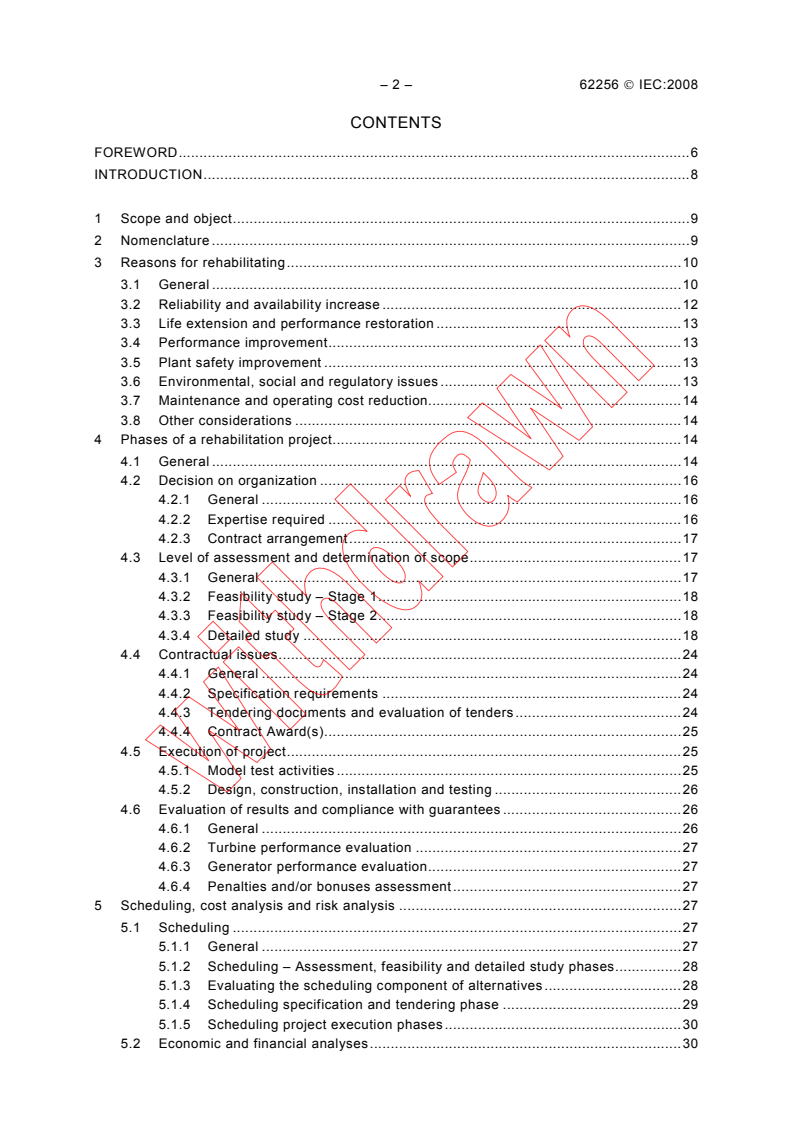
– 2 – 62256 © IEC:2008
CONTENTS
FOREWORD.6
INTRODUCTION.8
1 Scope and object.9
2 Nomenclature .9
3 Reasons for rehabilitating.10
3.1 General .10
3.2 Reliability and availability increase .12
3.3 Life extension and performance restoration .13
3.4 Performance improvement.13
3.5 Plant safety improvement .13
3.6 Environmental, social and regulatory issues .13
3.7 Maintenance and operating cost reduction.14
3.8 Other considerations .14
4 Phases of a rehabilitation project.14
4.1 General .14
4.2 Decision on organization .16
4.2.1 General .16
4.2.2 Expertise required .16
4.2.3 Contract arrangement.17
4.3 Level of assessment and determination of scope.17
4.3.1 General .17
4.3.2 Feasibility study – Stage 1.18
4.3.3 Feasibility study – Stage 2.18
4.3.4 Detailed study .18
4.4 Contractual issues.24
4.4.1 General .24
4.4.2 Specification requirements .24
4.4.3 Tendering documents and evaluation of tenders.24
4.4.4 Contract Award(s).25
4.5 Execution of project.25
4.5.1 Model test activities.25
4.5.2 Design, construction, installation and testing .26
4.6 Evaluation of results and compliance with guarantees .26
4.6.1 General .26
4.6.2 Turbine performance evaluation .27
4.6.3 Generator performance evaluation.27
4.6.4 Penalties and/or bonuses assessment.27
5 Scheduling, cost analysis and risk analysis .27
5.1 Scheduling .27
5.1.1 General .27
5.1.2 Scheduling – Assessment, feasibility and detailed study phases.28
5.1.3 Evaluating the scheduling component of alternatives .28
5.1.4 Scheduling specification and tendering phase .29
5.1.5 Scheduling project execution phases .30
5.2 Economic and financial analyses.30
62256 © IEC:2008 – 3 –
5.2.1 General .30
5.2.2 Benefit-cost analysis .31
5.2.3 Identification of anticipated benefits.32
5.2.4 Identification of anticipated costs and benefits.33
5.2.5 Sensitivity analysis .34
5.2.6 Conclusions.35
5.3 Risk analysis .35
5.3.1 General .35
5.3.2 Non-achievement of performance risk.36
5.3.3 Risk of continued operation without rehabilitation .36
5.3.4 Extension of outage risk .36
5.3.5 Financial risks .37
5.3.6 Project scope risk .37
5.3.7 Other risks.38
6 Assessment and determination of scope of the work.38
6.1 General .38
6.2 Assessment of the site .39
6.2.1 Hydrology .39
6.2.2 Actual energy production .39
6.2.3 Environmental social and regulatory issues .40
6.3 The assessment of the turbine .41
6.3.1 General .41
6.3.2 Turbine integrity assessment .70
6.3.3 Residual life .79
6.3.4 Turbine performance assessment .80
6.4 The assessment of related equipment .102
6.4.1 General .102
6.4.2 Generator and thrust bearing.107
6.4.3 Turbine governor .109
6.4.4 Turbine inlet and outlet valves, pressure relief valve. 109
6.4.5 Auxiliary equipment .109
6.4.6 Equipment for erection, dismantling and maintenance . 110
6.4.7 Penstock and other water passages .110
6.4.8 Consequences of changes in plant specific hydraulic energy (head).111
7 Hydraulic design and performance testing options .111
7.1 General .111
7.2 Computational hydraulic design. 112
7.2.1 General .112
7.2.2 The role of CFD.113
7.2.3 The process of a CFD cycle.113
7.2.4 The accuracy of CFD results .114
7.2.5 How to use CFD for rehabilitation .115
7.2.6 CFD versus model tests .115
7.3 Model tests.116
7.3.1 General .116
7.3.2 Model test similitude.117
7.3.3 Model test content .117
7.3.4 Model test application.118
7.3.5 Model test location .120
– 4 – 62256 © IEC:2008
7.4 Prototype performance test .121
7.4.1 General .121
7.4.2 Prototype performance test accuracy. 122
7.4.3 Prototype performance test types . 123
7.4.4 Evaluation of results .123
8 Specifications .124
8.1 General .124
8.2 Reference standards .124
8.3 Information to be included in the tender documents.125
8.4 Documents to be developed in the course of the project. 127
Bibliography.129
Figure 1 – Flow diagram depicting the logic of the rehabilitation process .15
Figure 2 – Critical zones for cracks “A” and “B” in Pelton runner buckets .78
Figure 3 – Relative efficiency versus relative output – Original and new runners.82
Figure 4 – Relative efficiency versus output – Original and new runners – Outardes 3
generating station .83
Figure 5 – Efficiency and distribution of losses versus specific speed for Francis
turbines (model) in 2005 .84
Figure 6 – Relative efficiency gain following modification of the blades on the
La Grande 3 runner, in Quebec, Canada.86
Figure 7a – Potential efficiency improvement for Francis turbine rehabilitation.91
Figure 7b – Potential efficiency improvement for Kaplan turbine rehabilitation .92
Figure 8 – Cavitation and corrosion-erosion in Francis runner.93
Figure 9 – Back side erosion of the entrance into a Pelton bucket.94
Figure 10 – Leading edge cavitation erosion on a Françis pump-turbine caused by
extended periods of operation at very low loads.95
Figure 11 – Severe particle erosion damage in a Francis runner .97
Table 1 – Expected life of a hydropower plant and its subsystems before major work .12
Table 2 – Assessment of turbine embedded parts – Stay ring .43
Table 3 – Assessment of turbine embedded parts – Spiral or semi-spiral case.44
Table 4 – Assessment of turbine embedded parts – Discharge ring .45
Table 5 – Assessment of turbine embedded parts – Draft tube.46
Table 6 – Assessment of turbine non-embedded, non-rotating parts – Headcover.47
Table 7 – Assessment of turbine non-embedded, non-rotating parts – Intermediate and
inner headcovers .50
Table 8 – Assessment of turbine non embedded, non rotating parts – Bottom ring.51
Table 9 – Assessment of turbine non embedded, non rotating parts – Guide vanes .53
Table 10 – Assessment of turbine non embedded, non rotating parts – Guide vane
operating mechanism.55
Table 11 – Assessment of turbine non embedded, non rotating parts – Operating ring.56
Table 12 – Assessment of turbine non embedded, non rotating parts – Servomotors .57
Table 13 – Assessment of turbine non embedded, non rotating parts – Guide bearings .58
62256 © IEC:2008 – 5 –
Table 14 – Assessment of turbine non embedded, non rotating parts – Turbine shaft
seal (mechanical seal or packing box) .60
Table 15 – Assessment of turbine non embedded, non rotating parts – Thrust bearing
support .60
Table 16 – Assessment of turbine non embedded, non rotating parts – Nozzles .61
Table 17 – Assessment of turbine non embedded, non rotating parts – Deflectors and
energy dissipation.61
Table 18a – Assessment of turbine rotating parts – Runner .62
Table 18b – Assessment of turbine rotating parts – Runner .65
Table 18c – Assessment of turbine rotating parts – Runner .66
Table 19 – Assessment of turbine rotating parts – Turbine shaft .67
Table 20 – Assessment of turbine rotating parts – Oil head and oil distribution pipes.68
Table 21 – Assessment of turbine auxiliaries – Speed and load regulation system
(governor).68
Table 22 – Assessment of turbine auxiliaries – Turbine aeration system .69
Table 23 – Assessment of turbine auxiliaries – Lubrication system (guide vane
mechanism) .70
Table 24 – Francis turbine potential efficiency improvement (%) for runner profile
modifications only .85
Table 25 – Potential impact of design and condition of runner seals on Francis turbine
efficiency with new replacement runner or rehabilitated runner (%).88
Table 26 – Potential total gain in efficiency from the replacement of a Francis turbine
runner including the blade profile improvements, the restoration of surface condition
and the reduction of seal losses.89
Table 27 – Potential Additional Efficiency Improvement by Rehabilitation/Replacement
of Other Water Passage Components on a Francis Turbine (%).89
Table 28 – Assessment of related equipment - Governor .104
Table 29 – Assessment of related equipment – Generator and thrust bearing .105
Table 30 – Assessment of related equipment – Penstock and turbine inlet valves.106
Table 31 – Assessment of related equipment – Civil works .107
Table 32 – Assessment of related equipment – Crane, erection equipment .107
– 6 – 62256 © IEC:2008
INTERNATIONAL ELECTROTECHNICAL COMMISSION
____________
HYDRAULIC TURBINES, STORAGE PUMPS AND PUMP-TURBINES –
REHABILITATION AND PERFORMANCE IMPROVEMENT
FOREWORD
1) The International Electrotechnical Commission (IEC) is a worldwide organization for standardization comprising
all national electrotechnical committees (IEC National Committees). The object of IEC is to promote
international co-operation on all questions concerning standardization in the electrical and electronic fields. To
this end and in addition to other activities, IEC publishes International Standards, Technical Specifications,
Technical Reports, Publicly Available Specifications (PAS) and Guides (hereafter referred to as “IEC
Publication(s)”). Their preparation is entrusted to technical committees; any IEC National Committee interested
in the subject dealt with may participate in this preparatory work. International, governmental and non-
governmental organizations liaising with the IEC also participate in this preparation. IEC collaborates closely
with the International Organization for Standardization (ISO) in accordance with conditions determined by
agreement between the two organizations.
2) The formal decisions or agreements of IEC on technical matters express, as nearly as possible, an international
consensus of opinion on the relevant subjects since each technical committee has representation from all
interested IEC National Committees.
3) IEC Publications have the form of recommendations for international use and are accepted by IEC National
Committees in that sense. While all reasonable efforts are made to ensure that the technical content of IEC
Publications is accurate, IEC cannot be held responsible for the way in which they are used or for any
misinterpretation by any end user.
4) In order to promote international uniformity, IEC National Committees undertake to apply IEC Publications
transparently to the maximum extent possible in their national and regional publications. Any divergence
between any IEC Publication and the corresponding national or regional publication shall be clearly indicated in
the latter.
5) IEC provides no marking procedure to indicate its approval and cannot be rendered responsible for any
equipment declared to be in conformity with an IEC Publication.
6) All users should ensure that they have the latest edition of this publication.
7) No liability shall attach to IEC or its directors, employees, servants or agents including individual experts and
members of its technical committees and IEC National Committees for any personal injury, property damage or
other damage of any nature whatsoever, whether direct or indirect, or for costs (including legal fees) and
expenses arising out of the publication, use of, or reliance upon, this IEC Publication or any other IEC
Publications.
8) Attention is drawn to the Normative references cited in this publication. Use of the referenced publications is
indispensable for the correct application of this publication.
9) Attention is drawn to the possibility that some of the elements of this IEC Publication may be the subject of
patent rights. IEC shall not be held responsible for identifying any or all such patent rights.
International Standard IEC 62256 has been prepared by IEC technical committee 4: Hydraulic
turbines.
The text of this standard is based on the following documents:
FDIS Report on voting
4/231/FDIS 4/234/RVD
Full information on the voting for the approval of this standard can be found in the report on
voting indicated in the above table.
62256 © IEC:2008 – 7 –
This publication has been drafted in accordance with the ISO/IEC Directives, Part 2.
This standard is intended as a guide.
The committee has decided that the contents of this publication will remain unchanged until
the maintenance result date indicated on the IEC web site under "http://webstore.iec.ch" in
the data related to the specific publication. At this date, the publication will be
• reconfirmed,
• withdrawn,
• replaced by a revised edition, or
• amended.
– 8 – 62256 © IEC:2008
INTRODUCTION
Hydro plant owners make significant investments annually in rehabilitating plant equipment
(turbines, generators, transformers, penstocks, gates etc.) and structures in order to improve
the level of service to their customers and to optimize their revenue. In the absence of
guidelines, owners may be spending needlessly, or may be taking unnecessary risks and
thereby achieving results that are less than optimal. This guide is intended to be a tool in the
optimisation and decision process.
IEC TC 4 wishes to thank IEA for providing its document “Guidelines on Methodology for
Hydroelectric Francis Turbine Upgrading by Runner Replacement” as a starting point for the
writing of this document. IEC TC 4 appreciates this contribution and acknowledges that the
IEA document provided a good foundation upon which to build this IEC document.
62256 © IEC:2008 – 9 –
HYDRAULIC TURBINES, STORAGE PUMPS AND PUMP-TURBINES –
REHABILITATION AND PERFORMANCE IMPROVEMENT
1 Scope and object
The scope of this International Standard covers turbines, storage pumps and pump-turbines
of all sizes and of the following types:
• Francis;
• Kaplan;
• propeller;
• Pelton (turbines only);
• Bulb.
Wherever turbines or turbine components are referred to in the text of this guide, they shall be
interpreted also to mean the comparable units or components of storage pumps or pump-
turbines as the case requires.
The Guide also identifies without detailed discussion, other powerhouse equipment that could
affect or be affected by a turbine, storage pump, or pump-turbine rehabilitation.
The object of this guide is to assist in identifying, evaluating and executing rehabilitation and
performance improvement projects for hydraulic turbines, storage pumps and pump-turbines.
This guide can be used by owners, consultants, and suppliers to define:
• needs and economics for rehabilitation and performance improvement;
• scope of work;
• specifications;
• evaluation of results.
The Guide is intended to be:
• an aid in the decision process;
• an extensive source of information on rehabilitation;
• an identification of the key milestones in the rehabilitation process;
• an identification of the points that should be addressed in the decision processes.
The Guide is not intended to be a detailed engineering manual nor a maintenance guide.
2 Nomenclature
For the purpose of this document, the term “rehabilitation” is defined as some combination of:
• restoration of equipment capacity and/or equipment efficiency to near “as-new” levels;
– 10 – 62256 © IEC:2008
• extension of equipment life by re-establishing mechanical integrity.
The term “performance improvement” means the increase of capacity and/or efficiency
beyond those of the original machine and may be included as part of a rehabilitation.
Many other terms are in common use to define the work of “rehabilitation” and “performance
improvement”, however it is suggested to use the above terms. Some of the terms considered
and discarded for their lack of precision or completeness include:
• upgrade or upgrading – restoration of mechanical integrity and efficiency;
• uprating – increase of nameplate capacity (power) which may result in part from efficiency
restoration or improvement;
• overhaul – restoration of mechanical integrity;
• modernization – could mean performance improvement and replacement of obsolete
technologies;
• redevelopment – term frequently used to mean replacement of the powerplant and could
involve changes to the hydraulics and hydrology of the site usually implying a change in
mode of operation of the plant;
• refurbishment – restoration of mechanical integrity usually with restoration of performance
(closely resembles “rehabilitation”, the preferred term);
• replacement – usually refers to specific components but may involve the complete
hydraulic machine in the case of small units.
The nomenclature in this Guide is in accordance with IEC/TR 61364, which provides the
“Nomenclature” in six languages to facilitate easy correlation with the terminology of this
Guide.
3 Reasons for rehabilitating
3.1 General
Hydroelectric generating facilities are among the most robust, reliable, durable structures and
equipment ever produced. The robustness of the equipment permits owners to continue
operating these facilities without major rehabilitation for relatively long periods. The reliable
life for a turbine prior to a major rehabilitation being necessary is typically between 30 and 50
years depending on type of unit, design, quality of manufacturing, severity of service, and
other similar considerations. However, all generating equipment will inevitably suffer reduced
performance, reliability and availability with time, which leads owners to the fundamental
question of what to do with an aging plant. This crucial question cannot be answered easily
since it involves many interrelated issues such as revenue, operating and maintenance cost,
equipment performance, reliability, availability, safety and mission of generating facilities
within the entire system. Ultimately, an owner will have to decide to rehabilitate the plant or
eventually to close it. At some point in time, delaying a major rehabilitation ceases to be an
option. This may come about as the result of a major component failure or as the result of an
economic evaluation. Cessation of commercial operation does not necessarily relieve an
owner of the responsibility for the maintenance of the civil structures, regulation of the flows
and any other issues which have an impact on an owner’s liability for the plant.
The governing reason for rehabilitation is usually to maximize return on investment and
normally includes one or more of the following:
62256 © IEC:2008 – 11 –
• reliability and availability increase;
• life extension and performance restoration;
• performance improvement:
– efficiency;
– power;
– reduction of cavitation erosion;
– enlargement of operating range;
• plant safety improvement;
• environmental, social or regulatory issues;
• maintenance and operating cost reduction;
• other considerations:
– modified governmental regulations;
– political criteria;
– company image criteria;
– modified hydrology conditions;
– modified market conditions.
The opportune time for starting a rehabilitation is prior to the plant being beset with frequent
and severe problems such as for example: generator winding failures, major runner cracking,
cavitation or particle erosion damage, bearing failures and/or equipment alignment problems
due to foundation or substructure movement or distortion. When a generating plant has
reached such a stage, it is obvious that a technical and an economic assessment of the
equipment should have been conducted years before. If the time frame of rehabilitation
studies is too close to the end of the useful life of the plant and its equipment, the owner may
lose the option of evaluating a range of alternatives. Catastrophic failures with potential major
damage and loss of life are, at some stage of the plant life, real risks. If significant
improvements can be made in the revenue generating capabilities of the plant by replacement
of deteriorated equipment with state-of-the-art equipment or components, there may be
justification for performing rehabilitation earlier than the date at which it would be required for
purely reliability or life extension reasons.
Typically, the renewed life of a turbine following rehabilitation would be more than 25 years
with normal maintenance. The residual life of the generating plant is dependent on the
collective residual lives of each individual component group and therefore can be determined
only by assessing all of the component groups including the civil structures.
Rehabilitation should result in a unit which is very close to its “as-new” condition.
– 12 – 62256 © IEC:2008
Table 1 – Expected life of a hydropower plant and its subsystems before major work
Expected
Plant subsystems lifetime Considerations
(years)
Civil works
Dams, canals, tunnels, caverns, 60 to 80 Duration of water rights, quality of work, state
reservoirs, surge chambers of deterioration, safety, loss of water.
Powerhouse structures, water control 40 to 50 General condition, imposed stresses, quality
structures, spillways, sand traps, of material, state-of-the-art, safety, quality of
penstocks, steel linings, roads, bridges steel, corrosion, maintenance.
Mechanical installations
Hydraulic machines
Kaplan and Bulb turbines 25 to 50 Safety of operation, loss of water, cavitation
damage, erosion, corrosion, cracks,
Francis, Pelton and Fixed-blade 30 to 50
deterioration of efficiency, performance
Propeller turbines
improvement.
Pump turbines (all types) 25 to 35
Storage pumps (all types) 25 to 35
Heavy mechanical equipment and
auxiliaries
Flat gates, radial gates, butterfly 25 to 40 Quality of material, operating condition,
valves, spherical valves, cranes, safety considerations, quality of equipment,
auxiliary mechanical equipment imposed stresses, performance improvement.
Electrical installations
Generators, transformers 25 to 40 Winding and iron core condition, cleanliness,
safety of operation, state-of-the-art, general
condition, quality of equipment, maintenance.
High voltage switchgear, auxiliary 20 to 25
electrical equipment, control equipment
Batteries, DC equipment 10 to 20
Energy transmission lines
Steel towers 30 to 50 Right of way, corrosion, safety of operation,
climatic conditions, quality of material, state-
Concrete towers 30 to 40
of-the-art, capacity vs. service conditions.
Wooden poles 20 to 25
Lines and cables 25 to 40
3.2 Reliability and availability increase
A thorough rehabilitation can significantly increase reliability and availability of the units.
Following a thorough and well executed rehabilitation, an availability of approximately 98 %
can be expected. This normally results in less lost revenue associated with having the units
out of service for planned outages and fewer unplanned outages. By their nature, forced
62256 © IEC:2008 – 13 –
outages for unplanned repairs usually cost significantly more than would a similar planned
repair, particularly when the consequential impacts are evaluated.
3.3 Life extension and performance restoration
The useful life of the turbine can be greatly extended by the rehabilitation or replacement of
turbine components. The operating characteristics and the mechanical integrity of the
machine can be restored to nearly “as-new” condition, guaranteeing safe and reliable
operation for a long period.
Performance restoration is generally achieved by restoring the water passage and runner
seals to the new condition although, for the water passage outside the distributor and the
runner, this is not always economically justified, hence the term “nearly new” is often used.
The anticipated life extension of a rehabilitated turbine will depend greatly on the type of
machine involved and on its operating conditions before and after rehabilitation. However, if
major work is done, the owner would normally achieve life extension of 25 years and more.
3.4 Performance improvement
Advancement in turbine design tools, model testing, materials, manufacturing techniques, and
inspection techniques have given rise to opportunities to substantially improve capacity,
efficiency, and cavitation erosion performance. If there is no cavitation erosion problem with
the existing equipment, the replacement equipment of modern design should also be erosion
problem free, even with a significant increase in discharge. If there is a cavitation erosion
problem with the existing equipment, the replacement equipment should reduce or solve the
problem. The extent to which the performance parameters can be improved is, of course, site-
dependent, but in most cases it is found to be economically justified to replace the runner and
sometimes the guide vanes especially if the unit is being disassembled and re-assembled in
any case, for life extension repairs or for reliability reasons.
In a few cases, energy production can also be increased by increasing the specific hydraulic
energy (head) at the site if, of course, the modifications to the water retention structures and
conduits or canals are cost effective. This usually requires that administrative authorization be
obtained for modification of the water management parameters.
In some cases, a change of the speed of rotation of the unit may be justified.
3.5 Plant safety improvement
Without a pro-active maintenance and rehabilitation program, there will be a continual
increase in the risk of a major failure that may involve both major economic and potential civil
liabilities due to loss of life or contingent property damage.
An issue that should not be ignored is the ever-increasing risk of a major failure of one
component that cascades to several other components. An example of such a scenario is a
broken runner blade or guide vane failure due to serious erosion and/or cracking at the stems.
A failed guide vane can interfere with the runner blades, which could result and has been
known to result in a cascade failure of the adjacent components such as runner, discharge
ring, bottom ring, headcover and stay ring. This may seem far-fetched but there are
documented cases of such cascade type failures. Obviously, this type of failure is an extreme
example, but it should serve as a reminder that turbines have a finite life, which can be
extended by executing thorough and rigorous maintenance and ultimately, a rehabilitation
program.
3.6 Environmental, social and regulatory issues
When a hydroelectric generating station is rehabilitated, environmental improvements may be
addressed in some of the following areas without incurring any additional unit outage time:
– 14 – 62256 © IEC:2008
• reduction of contaminants in water;
• minimum flow requirements;
• allowable rate of change of flows (ramping rates);
• fish and wildlife flows;
• reduction of hazardous materials in powerhouse;
• improvement of dissolved gas (oxygen) content of water;
• improvement of fish friendliness;
• provisions for recreational flows;
• provisions for domestic water/irrigation flows;
• reduction of fossil fuel emissions (any increase in hydro power production reduces the
emissions produced by fossil fuel based energy production).
3.7 Maintenance and operating cost reduction
Rehabilitation of the unit can significantly reduce maintenance costs in the form of lower
labour and material costs and often more importantly, can reduce lost revenues from lost
energy production opportunities. Rehabilitation can also provide, an opportunity to address
limitations of the existing turbine design, or changes that have occurred since construction
that cause ongoing maintenance problems such as vibration, cavitation erosion, or pressure
pulsations. The rehabilitation of the turbines can also present an opportunity to automate the
plant and reduce future operating costs.
3.8 Other considerations
There may be one or more other criteria such as those listed below which could have an
impact on the decision to rehabilitate or its timing:
• governmental regulations and their development and modification over time can support or
impose certain rehabilitation activities;
• political criteria are an external consideration which may have no direct relationship to the
physical aspects of the electrical energy generating facility, but which can play an
important part in rehabilitation decisions. Notable among those to be considered is water
management;
• company image criteria may predominate in considering a rehabilitation project
(maintenance or improvement of its image) and take precedence over other criteria;
• hydrology conditions may have changed over time;
• market conditions may have changed over time.
4 Phases of a rehabilitation project
4.1 General
Rehabilitation of a unit or a power station is a complex and iterative p
...