

IEC 62714-3:2017
(Main)Engineering data exchange format for use in industrial automation systems engineering - Automation markup language - Part 3: Geometry and kinematics
General Information
- Abstract
IEC 62714-3:2017 specifies the integration of geometry and kinematics information for the exchange between engineering tools in the plant automation area by means of AML.
- Status
- Published
- Publication Date
- 24-Jan-2017
- Technical Committee
- SC 65E - Devices and integration in enterprise systems
- Drafting Committee
- WG 9 - TC 65/SC 65E/WG 9
- Current Stage
- PPUB - Publication issued
- Start Date
- 25-Jan-2017
- Completion Date
- 24-Jan-2017
Buy Documents
IEC 62714-3:2017 - Engineering data exchange format for use in industrial automation systems engineering - Automation markup language - Part 3: Geometry and kinematics Released:1/25/2017
Overview
IEC 62714-3:2017 is an important international standard published by the International Electrotechnical Commission (IEC) that defines the engineering data exchange format specifically for industrial automation systems engineering. This part, titled "Automation Markup Language - Part 3: Geometry and Kinematics," focuses on how geometry and kinematics information can be integrated and exchanged between engineering tools within plant automation environments using the Automation Markup Language (AML).
This standard addresses a critical need in industrial automation for a unified format that ensures consistency, accuracy, and interoperability when sharing geometric and kinematic data across different systems and engineering tools. The format primarily leverages AML alongside integration with COLLADA documents, enabling detailed representation and manipulation of 3D models, spatial frames, joints, kinematic models, and articulated systems.
Key Topics
Data Exchange in Industrial Automation
IEC 62714-3:2017 provides a robust framework for exchanging detailed geometric and kinematic data, which are essential for designing, simulating, and operating automation systems.Automation Markup Language (AML) Extensions
The standard extends AML libraries by adding new roles, interfaces, and attributes necessary to define and connect geometry and kinematics data, including theAutomationMLBaseRoleClassLibandAutomationMLInterfaceClassLib.Integration with COLLADA
COLLADA is the industry-standard XML format for 3D models. This standard details how to integrate COLLADA documents into AML, allowing the inclusion of complex visual scenes, frames, and kinematic descriptions within the AML data exchange framework.Frame Attribute and Object Attachment
Definition and usage of the Frame attribute enable spatial referencing of objects. Attachment methods specify how different AML objects can be linked or connected spatially, which is key for modeling components like robots, linear units, grippers, and workpieces in an automation system.Kinematic System Modeling
The standard includes informative annexes illustrating how to model entire kinematic systems and their combinations (e.g., robots with linear axes or grippers) in AML, blending CAEX and COLLADA documents for comprehensive automation modelling.Referencing Methods for Geometry and Kinematics
Various referencing techniques are covered, such as explicit and implicit references within AML documents, to handle complex hierarchical and modular engineering data structures effectively.
Applications
IEC 62714-3:2017 applies to a wide range of industrial automation scenarios, including:
Robotics Engineering
Modeling and sharing detailed kinematic chains of robots with accurate geometric data to facilitate offline programming, simulation, and control integration.Plant Automation Design
Enabling seamless data exchange between CAD, simulation tools, and control engineering systems to improve the design of automated manufacturing cells and complete plants.Machine Integration
Defining interfaces and spatial relationships between machine components for automated assembly lines where complex mechanical interactions and movements need precise coordination.Digital Twins and Virtual Commissioning
Supporting the growth of digital twin technology by providing detailed geometry and kinematics data essential for realistic virtual commissioning and predictive maintenance.Interoperability Across Toolchains
Facilitating multi-vendor and cross-disciplinary collaboration by standardizing the way geometry and kinematics data are structured and exchanged in heterogeneous industrial environments.
Related Standards
IEC 62714-1: Automation Markup Language (AML) Part 1 – Base AML specification for data exchange in automation engineering, foundational for Part 3 developments.
COLLADA (ISO/PAS 17506) – The open standard XML schema for 3D assets, widely used for geometry and scene description, key for integration in IEC 62714-3.
IEC 62714-2: Automation Markup Language - Role Class Libraries – Extends AML with domain-specific libraries, relevant for understanding the role classifications used in geometry and kinematics modelling.
IEC 61499 – Function blocks for industrial process measurement and control systems, often integrated with AML for comprehensive automation solutions.
IEC 61512-1: Batch Control Part 1 – Provides process control models and terminology that can benefit from AML-based data exchange for machinery geometry and kinematics.
Adopting IEC 62714-3:2017 ensures standardized, efficient, and reliable exchange of automation engineering data focused on geometry and kinematics, significantly enhancing component integration, system design, and digital transformation in industrial automation. For up-to-date access to IEC standards and supporting materials, visit the IEC Webstore and explore related resources such as Electropedia for electrotechnical terminology.
Buy Documents
IEC 62714-3:2017 - Engineering data exchange format for use in industrial automation systems engineering - Automation markup language - Part 3: Geometry and kinematics Released:1/25/2017
Get Certified
Connect with accredited certification bodies for this standard

BSI Group
BSI (British Standards Institution) is the business standards company that helps organizations make excellence a habit.

DVS-ZERT GmbH
German welding certification society.
CARES (UK Certification Authority for Reinforcing Steels)
UK certification for reinforcing steels and construction.
Sponsored listings
Frequently Asked Questions
IEC 62714-3:2017 is a standard published by the International Electrotechnical Commission (IEC). Its full title is "Engineering data exchange format for use in industrial automation systems engineering - Automation markup language - Part 3: Geometry and kinematics". This standard covers: IEC 62714-3:2017 specifies the integration of geometry and kinematics information for the exchange between engineering tools in the plant automation area by means of AML.
IEC 62714-3:2017 specifies the integration of geometry and kinematics information for the exchange between engineering tools in the plant automation area by means of AML.
IEC 62714-3:2017 is classified under the following ICS (International Classification for Standards) categories: 01.040.01 - Generalities. Terminology. Standardization. Documentation (Vocabularies); 25.040.01 - Industrial automation systems in general; 31.180 - Printed circuits and boards; 35.240.30 - IT applications in information, documentation and publishing. The ICS classification helps identify the subject area and facilitates finding related standards.
IEC 62714-3:2017 is available in PDF format for immediate download after purchase. The document can be added to your cart and obtained through the secure checkout process. Digital delivery ensures instant access to the complete standard document.
Standards Content (Sample)
IEC 62714-3 ®
Edition 1.0 2017-01
INTERNATIONAL
STANDARD
NORME
INTERNATIONALE
colour
inside
Engineering data exchange format for use in industrial automation systems
engineering – Automation markup language –
Part 3: Geometry and kinematics
Format d’échange de données techniques pour une utilisation dans l’ingénierie
des systèmes d'automatisation industrielle – Automation markup language –
Partie 3: Géométrie et cinématique
All rights reserved. Unless otherwise specified, no part of this publication may be reproduced or utilized in any form
or by any means, electronic or mechanical, including photocopying and microfilm, without permission in writing from
either IEC or IEC's member National Committee in the country of the requester. If you have any questions about IEC
copyright or have an enquiry about obtaining additional rights to this publication, please contact the address below or
your local IEC member National Committee for further information.
Droits de reproduction réservés. Sauf indication contraire, aucune partie de cette publication ne peut être reproduite
ni utilisée sous quelque forme que ce soit et par aucun procédé, électronique ou mécanique, y compris la photocopie
et les microfilms, sans l'accord écrit de l'IEC ou du Comité national de l'IEC du pays du demandeur. Si vous avez des
questions sur le copyright de l'IEC ou si vous désirez obtenir des droits supplémentaires sur cette publication, utilisez
les coordonnées ci-après ou contactez le Comité national de l'IEC de votre pays de résidence.
IEC Central Office Tel.: +41 22 919 02 11
3, rue de Varembé Fax: +41 22 919 03 00
CH-1211 Geneva 20 info@iec.ch
Switzerland www.iec.ch
About the IEC
The International Electrotechnical Commission (IEC) is the leading global organization that prepares and publishes
International Standards for all electrical, electronic and related technologies.
About IEC publications
The technical content of IEC publications is kept under constant review by the IEC. Please make sure that you have the
latest edition, a corrigenda or an amendment might have been published.
IEC Catalogue - webstore.iec.ch/catalogue Electropedia - www.electropedia.org
The stand-alone application for consulting the entire The world's leading online dictionary of electronic and
bibliographical information on IEC International Standards, electrical terms containing 20 000 terms and definitions in
Technical Specifications, Technical Reports and other English and French, with equivalent terms in 16 additional
documents. Available for PC, Mac OS, Android Tablets and languages. Also known as the International Electrotechnical
iPad. Vocabulary (IEV) online.
IEC publications search - www.iec.ch/searchpub IEC Glossary - std.iec.ch/glossary
The advanced search enables to find IEC publications by a 65 000 electrotechnical terminology entries in English and
variety of criteria (reference number, text, technical French extracted from the Terms and Definitions clause of
committee,…). It also gives information on projects, replaced IEC publications issued since 2002. Some entries have been
and withdrawn publications. collected from earlier publications of IEC TC 37, 77, 86 and
CISPR.
IEC Just Published - webstore.iec.ch/justpublished
Stay up to date on all new IEC publications. Just Published IEC Customer Service Centre - webstore.iec.ch/csc
details all new publications released. Available online and If you wish to give us your feedback on this publication or
also once a month by email. need further assistance, please contact the Customer Service
Centre: csc@iec.ch.
A propos de l'IEC
La Commission Electrotechnique Internationale (IEC) est la première organisation mondiale qui élabore et publie des
Normes internationales pour tout ce qui a trait à l'électricité, à l'électronique et aux technologies apparentées.
A propos des publications IEC
Le contenu technique des publications IEC est constamment revu. Veuillez vous assurer que vous possédez l’édition la
plus récente, un corrigendum ou amendement peut avoir été publié.
Catalogue IEC - webstore.iec.ch/catalogue Electropedia - www.electropedia.org
Application autonome pour consulter tous les renseignements
Le premier dictionnaire en ligne de termes électroniques et
bibliographiques sur les Normes internationales,
électriques. Il contient 20 000 termes et définitions en anglais
Spécifications techniques, Rapports techniques et autres
et en français, ainsi que les termes équivalents dans 16
documents de l'IEC. Disponible pour PC, Mac OS, tablettes
langues additionnelles. Egalement appelé Vocabulaire
Android et iPad.
Electrotechnique International (IEV) en ligne.
Recherche de publications IEC - www.iec.ch/searchpub
Glossaire IEC - std.iec.ch/glossary
65 000 entrées terminologiques électrotechniques, en anglais
La recherche avancée permet de trouver des publications IEC
en utilisant différents critères (numéro de référence, texte, et en français, extraites des articles Termes et Définitions des
comité d’études,…). Elle donne aussi des informations sur les publications IEC parues depuis 2002. Plus certaines entrées
projets et les publications remplacées ou retirées. antérieures extraites des publications des CE 37, 77, 86 et
CISPR de l'IEC.
IEC Just Published - webstore.iec.ch/justpublished
Service Clients - webstore.iec.ch/csc
Restez informé sur les nouvelles publications IEC. Just
Published détaille les nouvelles publications parues. Si vous désirez nous donner des commentaires sur cette
Disponible en ligne et aussi une fois par mois par email. publication ou si vous avez des questions contactez-nous:
csc@iec.ch.
IEC 62714-3 ®
Edition 1.0 2017-01
INTERNATIONAL
STANDARD
NORME
INTERNATIONALE
colour
inside
Engineering data exchange format for use in industrial automation systems
engineering – Automation markup language –
Part 3: Geometry and kinematics
Format d’échange de données techniques pour une utilisation dans l’ingénierie
des systèmes d'automatisation industrielle – Automation markup language –
Partie 3: Géométrie et cinématique
INTERNATIONAL
ELECTROTECHNICAL
COMMISSION
COMMISSION
ELECTROTECHNIQUE
INTERNATIONALE
ICS 01.040.01; 25.040.01; 35.240.30 ISBN 978-2-8322-3794-6
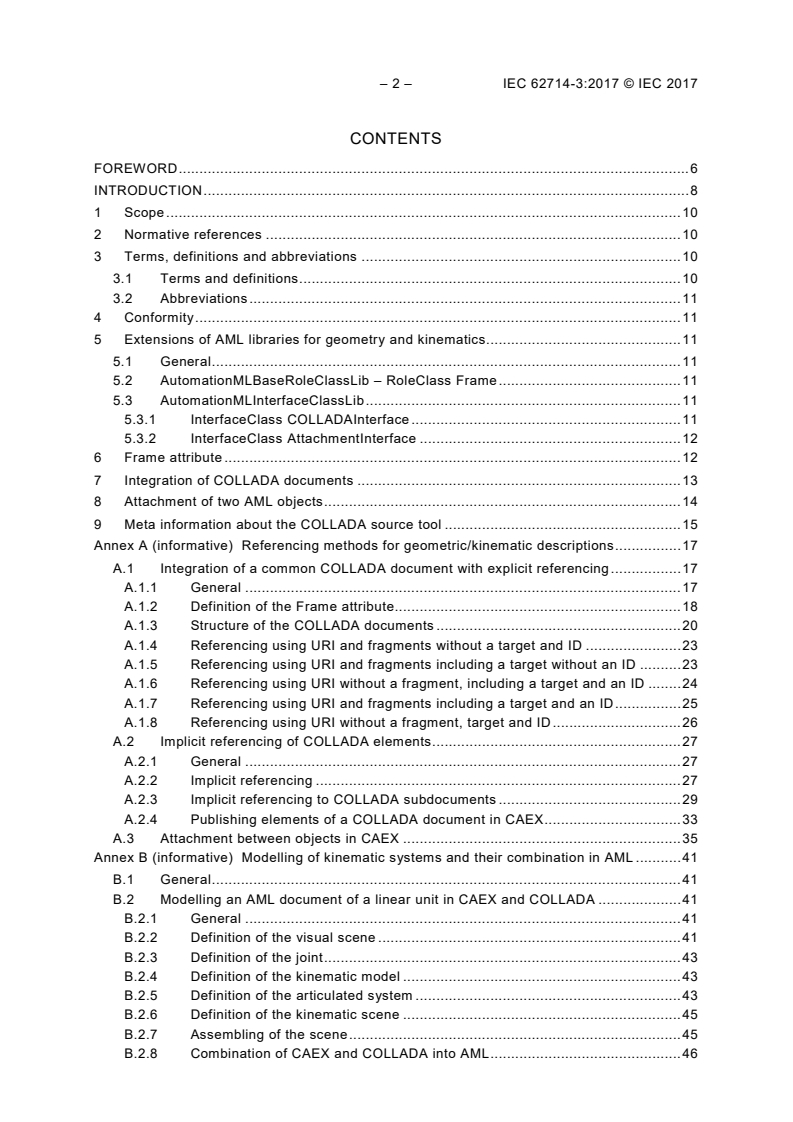
– 2 – IEC 62714-3:2017 © IEC 2017
CONTENTS
FOREWORD . 6
INTRODUCTION . 8
1 Scope . 10
2 Normative references . 10
3 Terms, definitions and abbreviations . 10
3.1 Terms and definitions . 10
3.2 Abbreviations . 11
4 Conformity . 11
5 Extensions of AML libraries for geometry and kinematics. 11
5.1 General . 11
5.2 AutomationMLBaseRoleClassLib – RoleClass Frame . 11
5.3 AutomationMLInterfaceClassLib . 11
5.3.1 InterfaceClass COLLADAInterface . 11
5.3.2 InterfaceClass AttachmentInterface . 12
6 Frame attribute . 12
7 Integration of COLLADA documents . 13
8 Attachment of two AML objects . 14
9 Meta information about the COLLADA source tool . 15
Annex A (informative) Referencing methods for geometric/kinematic descriptions . 17
A.1 Integration of a common COLLADA document with explicit referencing . 17
A.1.1 General . 17
A.1.2 Definition of the Frame attribute. 18
A.1.3 Structure of the COLLADA documents . 20
A.1.4 Referencing using URI and fragments without a target and ID . 23
A.1.5 Referencing using URI and fragments including a target without an ID . 23
A.1.6 Referencing using URI without a fragment, including a target and an ID . 24
A.1.7 Referencing using URI and fragments including a target and an ID . 25
A.1.8 Referencing using URI without a fragment, target and ID . 26
A.2 Implicit referencing of COLLADA elements . 27
A.2.1 General . 27
A.2.2 Implicit referencing . 27
A.2.3 Implicit referencing to COLLADA subdocuments . 29
A.2.4 Publishing elements of a COLLADA document in CAEX . 33
A.3 Attachment between objects in CAEX . 35
Annex B (informative) Modelling of kinematic systems and their combination in AML . 41
B.1 General . 41
B.2 Modelling an AML document of a linear unit in CAEX and COLLADA . 41
B.2.1 General . 41
B.2.2 Definition of the visual scene . 41
B.2.3 Definition of the joint . 43
B.2.4 Definition of the kinematic model . 43
B.2.5 Definition of the articulated system . 43
B.2.6 Definition of the kinematic scene . 45
B.2.7 Assembling of the scene . 45
B.2.8 Combination of CAEX and COLLADA into AML . 46
B.3 Modelling an AML document of a robot in CAEX and COLLADA . 47
B.3.1 General . 47
B.3.2 Definition of the visual scene . 48
B.3.3 Definition of joints . 50
B.3.4 Definition of the kinematic model . 51
B.3.5 Definition of the articulated system . 51
B.3.6 Definition of the kinematic scene . 54
B.3.7 Assembling of the scene . 55
B.3.8 Combination of CAEX and COLLADA into AML . 56
B.4 Modelling an AML document of a combined system including a robot and a
linear axis in CAEX and COLLADA . 58
B.5 Modelling an AML document of a gripper connected to robot in CAEX and
COLLADA . 61
B.5.1 General . 61
B.5.2 Definition of the visual scene . 62
B.5.3 Definition of the kinematic system . 63
B.5.4 Assembling of the scene . 71
B.5.5 Combination of CAEX and COLLADA into AML . 72
B.6 Modelling an AML document of a work piece connected to a gripper in
CAEX and COLLADA . 75
B.6.1 General . 75
B.6.2 Implicit upper boundary . 75
B.6.3 Definition of the work piece . 77
B.6.4 Combination of CAEX and COLLADA into AML . 78
Annex C (informative) XML representation of AML libraries . 82
C.1 AutomationMLBaseRoleClassLib . 82
C.2 AutomationMLInterfaceClassLib . 82
Figure 1 – Overview of the engineering data exchange format AML . 8
Figure 2 – Required XML text in case of ISO/PAS 17506 . 16
Figure 3 – Required XML text in case of COLLADA 1.4.1 . 16
Figure A.1 – Decision tree for different referencing methods . 17
Figure A.2 – Two frames represented in the InstanceHierarchy of an AML document . 18
Figure A.3 – XML representation of the AML document . 18
Figure A.4 – Translation and spatially fixed rotation . 19
Figure A.5 – COLLADA scene used in this example . 20
Figure A.6 – Structure and References . 20
Figure A.7 – Content of the COLLADA document cube.dae . 21
Figure A.8 – Content of the COLLADA document red_blue_cubes.dae. 22
Figure A.9 – “RedCube” – Hierarchy of the AML document . 23
Figure A.10 – XML representation of the AML document . 23
Figure A.11 – Referencing the red cube by ID . 23
Figure A.12 – “BlueCube” – Hierarchy of the AML document . 24
Figure A.13 – XML representation of the AML document . 24
Figure A.14 – Referencing the blue cube . 24
Figure A.15 – Hierarchy of the AML document . 24
Figure A.16 – XML representation of the AML document . 25
– 4 – IEC 62714-3:2017 © IEC 2017
Figure A.17 – Referencing the blue cube starting from the element “subpart” . 25
Figure A.18 – Hierarchy of the AML document . 25
Figure A.19 – XML representation of the AML document . 25
Figure A.20 – Referencing the blue cube . 26
Figure A.21 – Hierarchy of the AML document . 26
Figure A.22 – XML representation of the AML document . 26
Figure A.23 – Referencing the complete COLLADA scene . 27
Figure A.24 – Implicit Referencing: Hierarchy of the AML document . 28
Figure A.25 – XML representation of the AML document . 28
Figure A.26 – Structure and relations of referenced COLLADA subdocuments . 29
Figure A.27 – Content of the modified COLLADA document red_blue_cubes.dae . 30
Figure A.28 – Content of the COLLADA document red_cube.dae . 30
Figure A.29 – Content of the COLLADA document blue_cube.dae . 31
Figure A.31 – XML representation of the AML document . 32
Figure A.33 – Additional frame element in COLLADA document . 33
Figure A.34 – Publishing frames: Hierarchy of the AML document . 34
Figure A.35 – XML representation of the AML document . 35
Figure A.36 – Structure for attachments between objects in CAEX . 36
Figure A.37 – Visualization of yellow cube with additional frame . 36
Figure A.38 – COLLADA document of yellow cube with additional frame . 37
Figure A.39 – Hierarchy of the AML document . 38
Figure A.40 – XML representation of the AML document . 39
Figure A.41 – Attachment between geometric AML objects . 40
Figure A.42 – XML representation of the AML document . 40
Figure B.1 – Visualization of the linear unit . 41
Figure B.2 – Definition of the visual scene . 42
Figure B.3 – Definition of the joint . 43
Figure B.4 – Definition of kinematic model . 43
Figure B.5 – Definition of the articulated system library. 44
Figure B.6 – Definition of the kinematic articulated system. 44
Figure B.7 – Definition of the motion articulated system . 45
Figure B.8 – Definition of the kinematic scene . 45
Figure B.9 – Instantiation of the kinematic scene . 46
Figure B.10 – Hierarchy of the AML document . 46
Figure B.11 – XML representation of the AML document . 47
Figure B.13 – Definition of the visual scene . 50
Figure B.14 – Definition of joints . 50
Figure B.15 – Definition of kinematic model . 51
Figure B.16 – Definition of the articulated system library . 51
Figure B.17 – Definition of the kinematic articulated system . 53
Figure B.18 – Definition of the motion articulated system . 54
Figure B.19 – Definition of the kinematic scene. 55
Figure B.20 – Instantiation of the kinematic scene . 56
Figure B.21 – Hierarchy of the AML document . 57
Figure B.22 – XML representation of the AML document . 57
Figure B.24 – Hierarchy of the AML document . 59
Figure B.25 – XML representation of the AML document . 60
Figure B.26 – XML representation of the AML document . 60
Figure B.27 – Visualization of the robot attached to the linear unit . 61
Figure B.30 – Definition of the visual scene . 63
Figure B.31 – Definition of the kinematics . 64
Figure B.32 – Definition of joints . 64
Figure B.33 – Definition of kinematic model . 65
Figure B.34 – Definition of the articulated system . 66
Figure B.35 – Definition of the articulated system . 67
Figure B.36 – Definition of the kinematic scene. 68
Figure B.37 – Definition of the joint dependency using MathML . 68
Figure B.38 – XML representation of the COLLADA document gripper_kinematics.dae . 71
Figure B.39 – XML representation of the COLLADA document gripper.dae . 72
Figure B.40 – Hierarchy of the AML document . 73
Figure B.41 – XML representation of the AML document . 74
Figure B.42 – XML representation of the AML document . 75
Figure B.43 – Visualization of the robot on a linear unit and attached gripper . 75
Figure B.44 – Example for implicit upper boundary . 76
Figure B.45 – Structure for attachments between objects in CAEX . 76
Figure B.46 – Visualization of the work piece with additional frame . 77
Figure B.48 – Hierarchy of the AML document . 79
Figure B.49 – XML representation of the AML document . 81
Figure B.50 – Attachment between geometric AML objects . 81
Figure B.51 – XML representation of the AML document . 81
Figure C.1 – XML representation of AML libraries AutomationMLBaseRoleClassLib . 82
Figure C.2 – XML representation of AML libraries AutomationMLInterfaceClassLib . 83
Table 1 – Abbreviations . 11
Table 2 – RoleClass Frame . 11
Table 3 – InterfaceClass COLLADAInterface . 12
Table 4 – InterfaceClass AttachmentInterface . 12
Table 5 – Attribute “Frame” . 13
Table 6 – Sub-attributes of the attribute “Frame” . 13
Table 7 – Rules for resolving document and entry point . 14
Table 8 – Meta information about the COLLADA source tool . 16
– 6 – IEC 62714-3:2017 © IEC 2017
INTERNATIONAL ELECTROTECHNICAL COMMISSION
____________
ENGINEERING DATA EXCHANGE FORMAT FOR USE IN
INDUSTRIAL AUTOMATION SYSTEMS ENGINEERING –
AUTOMATION MARKUP LANGUAGE –
Part 3: Geometry and kinematics
FOREWORD
1) The International Electrotechnical Commission (IEC) is a worldwide organization for standardization comprising
all national electrotechnical committees (IEC National Committees). The object of IEC is to promote
international co-operation on all questions concerning standardization in the electrical and electronic fields. To
this end and in addition to other activities, IEC publishes International Standards, Technical Specifications,
Technical Reports, Publicly Available Specifications (PAS) and Guides (hereafter referred to as “IEC
Publication(s)”). Their preparation is entrusted to technical committees; any IEC National Committee interested
in the subject dealt with may participate in this preparatory work. International, governmental and non-
governmental organizations liaising with the IEC also participate in this preparation. IEC collaborates closely
with the International Organization for Standardization (ISO) in accordance with conditions determined by
agreement between the two organizations.
2) The formal decisions or agreements of IEC on technical matters express, as nearly as possible, an international
consensus of opinion on the relevant subjects since each technical committee has representation from all
interested IEC National Committees.
3) IEC Publications have the form of recommendations for international use and are accepted by IEC National
Committees in that sense. While all reasonable efforts are made to ensure that the technical content of IEC
Publications is accurate, IEC cannot be held responsible for the way in which they are used or for any
misinterpretation by any end user.
4) In order to promote international uniformity, IEC National Committees undertake to apply IEC Publications
transparently to the maximum extent possible in their national and regional publications. Any divergence
between any IEC Publication and the corresponding national or regional publication shall be clearly indicated in
the latter.
5) IEC itself does not provide any attestation of conformity. Independent certification bodies provide conformity
assessment services and, in some areas, access to IEC marks of conformity. IEC is not responsible for any
services carried out by independent certification bodies.
6) All users should ensure that they have the latest edition of this publication.
7) No liability shall attach to IEC or its directors, employees, servants or agents including individual experts and
members of its technical committees and IEC National Committees for any personal injury, property damage or
other damage of any nature whatsoever, whether direct or indirect, or for costs (including legal fees) and
expenses arising out of the publication, use of, or reliance upon, this IEC Publication or any other IEC
Publications.
8) Attention is drawn to the Normative references cited in this publication. Use of the referenced publications is
indispensable for the correct application of this publication.
9) Attention is drawn to the possibility that some of the elements of this IEC Publication may be the subject of
patent rights. IEC shall not be held responsible for identifying any or all such patent rights.
International Standard IEC 62714-3 has been prepared by subcommittee 65E: Devices and
integration in enterprise systems, of IEC technical committee 65: Industrial-process
measurement, control and automation.
The text of this standard is based on the following documents:
CDV Report on voting
65E/497/CDV 65E/508/RVC
Full information on the voting for the approval of this International Standard can be found in
the report on voting indicated in the above table.
This publication has been drafted in accordance with the ISO/IEC Directives, Part 2.
A list of all parts in the IEC 62714 series, published under the general title Engineering data
exchange format for use in industrial automation systems engineering – Automation markup
language, can be found on the IEC website.
The committee has decided that the contents of this document will remain unchanged until the
stability date indicated on the IEC website under "http://webstore.iec.ch" in the data related to
the specific document. At this date, the document will be
• reconfirmed,
• withdrawn,
• replaced by a revised edition, or
• amended.
IMPORTANT – The 'colour inside' logo on the cover page of this publication indicates
that it contains colours which are considered to be useful for the correct
understanding of its contents. Users should therefore print this document using a
colour printer.
…
– 8 – IEC 62714-3:2017 © IEC 2017
INTRODUCTION
The data exchange format defined in IEC 62714 (Automation Markup Language, AML) is an
XML schema based data format and has been developed in order to support the data
exchange between engineering tools in a heterogeneous engineering tool landscape.
IEC 62714-1 gives an overview about the format.
The goal of AML is to interconnect engineering tools from the existing heterogeneous tool
landscape in their different disciplines, e.g. mechanical plant engineering, electrical design,
process engineering, process control engineering, HMI development, PLC programming, robot
programming etc.
AML stores engineering information following the object oriented paradigm and allows
modelling of physical and logical plant components as data objects encapsulating different
aspects. An object may consist of other sub-objects and may itself be part of a larger
composition or aggregation. Typical objects in plant automation comprise information on
topology, geometry, kinematics and logic, whereas logic comprises sequencing, behaviour
and control.
AML combines existing industry data formats that are designed for the storage and exchange
of different aspects of engineering information. These data formats are used on “as-is” basis
within their own specifications and are not branched for AML needs.
The core of AML is the top-level data format CAEX that connects the different data formats.
Therefore, AML has an inherent distributed document architecture.
Figure 1 illustrates the basic AML architecture and the distribution of topology, geometry,
kinematic and logic information.
Automation Markup Language
Engineering data
COLLADA
CAEX IEC 62424
Geometry
Top level format
Kinematics
Object A
Plant topology
information Object A
1 InIniitt
PLCopen XML
•Plants
Object A Step 1
•Cells
Behaviour
•Components Sequencing
End
•Attributes
Object A
n
•Interfaces
Further XML Standard format
•Relations
•References
Further aspects of
engineering information
Figure 1 – Overview of the engineering data exchange format AML
Due to the different aspects of AML, IEC 62714 consists of different parts focussing on
different aspects.
• IEC 62714-1: Architecture and general requirements
This part specifies the general AML architecture, the modelling of engineering data,
classes, instances, relations, references, hierarchies, basic AML libraries and extended
AML concepts.
• IEC 62714-2: Role class libraries
This part specifies additional AML libraries.
• IEC 62714-3: Geometry and kinematics
This part specifies the modelling of geometry and kinematics information.
Further parts may be added in the future in order to interconnect further data standards to
AML.
Clause 5 describes the geometry related extensions of the role class libraries.
Clause 6 describes the frame attribute which can be used to represent the geometric position
of an InternalElement, InstanceHierarchy, SystemUnitClass, or SystemUnitClassLibrary with
respect to another CAEX Object.
Clause 7 gives a normative description regarding referencing COLLADA documents.
Clause 8 specifies the normative provisions for the attachment of two geometric AML objects.
Clause 9 defines how to store meta informations about the source tool directly into the
COLLADA document.
Annex A describes the referencing methods for geometric and kinematic models.
Annex B provides an example for modelling of kinematic systems and their combination in
AML.
Annex C gives an informative XML representation of the libraries defined in this part of
IEC 62714.
– 10 – IEC 62714-3:2017 © IEC 2017
ENGINEERING DATA EXCHANGE FORMAT FOR USE IN
INDUSTRIAL AUTOMATION SYSTEMS ENGINEERING –
AUTOMATION MARKUP LANGUAGE –
Part 3: Geometry and kinematics
1 Scope
This part of IEC 62714 specifies the integration of geometry and kinematics information for
the exchange between engineering tools in the plant automation area by means of AML.
It does not define details of the data exchange procedure or implementation requirements for
the import/export tools.
2 Normative references
The following documents are referred to in the text in such a way that some or all of their
content constitutes requirements of this document. For dated references, only the edition
cited applies. For undated references, the latest edition of the referenced document (including
any amendments) applies.
IEC 62714-1:2014, Engineering data exchange format for use in industrial automation
systems engineering – Automation markup language – Part 1: Architecture and general
requirements
IEC 62714-2:2015, Engineering data exchange format for use in industrial automation
systems engineering – Automation markup language – Part 2: Role class libraries
ISO/PAS 17506, Industrial automation systems and integration – COLLADA digital asset
schema specification for 3D visualization of industrial data
COLLADA 1.4.1: March 2008 COLLADA – Digital Asset Schema Release 1.4.1
(available at )
Extensible Markup Language (XML) 1.0:2004, W3C Recommendation
(available at )
3 Terms, definitions and abbreviations
3.1 Terms and definitions
For the purposes of this document, the terms and definitions given in IEC 62714-1:2014 and
of IEC 62714-2:2015 and the following apply.
ISO and IEC maintain terminological databases for use in standardization at the following
addresses:
• IEC Electropedia: available at http://www.electropedia.org/ [access on 26th September
2016]
• ISO Online browsing platform: available at http://www.iso.org/obp [access on 26th
September 2016]
3.1.1
SID path
reference of type sidref_type to an arbitrary element within a COLLADA document according
to ISO/PAS 17506 or COLLADA 1.4.1
3.2 Abbreviations
For the purposes of this document, the abbreviations of IEC 62714-1:2014 and of
IEC 62714-2:2015 apply as well as the abbreviations listed in Table 1.
Table 1 – Abbreviations
SCARA Selective Compliance Assembly Robot Arm
SID Scoped Identifier
4 Conformity
To claim conformity to the present document with respect to the support of AML, the
requirements of Clauses 5, 6, 7, 8 and 9 shall be fulfilled. In the scope of AML, a COLLADA
document shall conform to the specification of ISO/PAS 17506 or COLLADA 1.4.1.
5 Extensions of AML libraries for geometry and kinematics
5.1 General
Clause 5 defines extensions of the standard AML RoleClasses and standard AML
InterfaceClasses. These classes are part of the AML standard libraries and a specific
extension of IEC 62714-1 for this part of IEC 62714. All described attributes are part of the
standard libraries and may be removed in the InstanceHierarchy if not needed.
5.2 AutomationMLBaseRoleClassLib – RoleClass Frame
The RoleClass “Frame” shall be used as specified in Table 2.
Table 2 – RoleClass Frame
Class name Frame
Description This role denotes a Cartesian right handed coordinate system.
Parent class AutomationMLBaseRoleClassLib/AutomationMLBaseRole
Path for element reference AutomationMLBaseRoleClassLib/AutomationMLBaseRole/Frame
NOTE 1 An AML object referencing the RoleClass “Frame” is useable to define reference coordinate systems like
attachment points.
NOTE 2 To define reference coordinate systems like attachment points an AML object referencing the RoleClass
“Frame” is useable.
5.3 AutomationMLInterfaceClassLib
5.3.1 InterfaceClass COLLADAInterface
The InterfaceClass “COLLADAInterface” shall be used as specified in Table 3.
– 12 – IEC 62714-3:2017 © IEC 2017
Table 3 – InterfaceClass COLLADAInterface
Class name COLLADAInterface
The InterfaceClass “COLLADAInterface” shall be used in order to reference external
Description COLLADA documents and to publish interfaces that are defined inside an external
COLLADA document.
Parent class AutomationMLInterfaceClassLib/AutomationMLBaseInterface/ExternalDataConnector
Path for
AutomationMLInterfaceClassLib/AutomationMLBaseInterface/ExternalDataConnector/
element
COLLADAInterface
reference
The attribute “refType” specifies whether the
refType referenced COLLADA document has an explicit or
(AttributeDataType=”xs:string”) implicit character. The allowed values are “explicit”
or “implicit”. The attribute is mandatory.
Attributes
The attribute “target” specifies the SID path of a
target (AttributeDataType=”xs:token”) COLLADA element within the referenced
document. The attribute is optional.
NOTE The InterfaceClass “COLLADAInterface” additionally inherits the attribute “refURI” from the parent
InterfaceClass “ExternalDataConnector”.
5.3.2 InterfaceClass AttachmentInterface
The InterfaceClass “AttachmentInterface” shall be used as specified in Table 4.
Table 4 – InterfaceClass AttachmentInterface
Class name
AttachmentInterface
The InterfaceClass “AttachmentInterface” specifies an interface for geometric or kinematic
Description
links between AML objects with RoleClass Frame.
Parent class AutomationMLInterfaceClassLib/AutomationMLBaseInterface
Path for element AutomationMLInterfaceClassLib/AutomationMLBaseInterface/AttachmentInterface
reference
6 Frame attribute
An InternalElement or a SystemUnitClass may require a frame attribute that represents its
geometric position in relation to other objects. For this, the following provisions apply:
• Each frame shall be based on a three dimensional, orthogonal, right-handed coordinate
system.
• The elements InstanceHierarchy and SystemUnitClassLib specify a three dimensional,
orthogonal, right-handed coordinate system with standard basis. The positive z axis is
considered upward, the positive x direction defines the right axis and the negative y
direction defines the forward axis.
• The relative translations x, y and z as well as the rotations rx, ry and rz shall be specified
as sub-attributes in an AML attribute „Frame“ defined in Table 5 and Table 6. The relative
translations x, y and z shall be given in relation to the parent coordinate System specified
in the previous point. The rotations rx, ry and rz shall be executed in the order rx, ry and rz
with respect to the fixed axes of the parent coordinate System. The origin of the translated
Frame shall retain its position (x, y, z) during the spatially-fixed rotation. The attribute
“Frame” shall affect its containing AML object and all its children.
NOTE This means, that the point of rotation rotates whereas the frame position remains unchanged. This
avoids double changes.
• If the attribute “Frame” is not specified, the default values of x, y, z, rx, ry and rz shall be 0.
• If the attribute “Frame” is specified, all sub-attributes x, y, z, rx, ry and rz shall be listed.
Any unused sub-attribute shall have the default value 0.
The attribute “Frame” shall be used as complex attribute specified in Table 5 and Table 6. An
example is given in A.1.2.
Table 5 – Attribute “Frame”
Attribute AttributeDataType Description
Frame This attribute has no The attribute “Frame” shall be used as structure element for the
AttributeDataType since storage of the sub-attributes specified in Table 6.
attribute has no value.
Table 6 – Sub-attributes of the attribute “Frame”
Attribute AttributeDataType Description
x xs:double The attribute “x” shall be used to specify the relative position in
meters along the x axis of the coordinate system specified by the
parent element. The value of attribute “Unit” of the CAEX element
“Attribute” shall be “m”.
y xs:double The attribute “y” shall be used to specify the relative position in
meters along the y axis of the coordinate system specified by the
parent element. The value of attribute “Unit” of the CAEX element
“Attribute” shall be “m”.
z xs:double The attribute “z” shall be used to specify the relative position in
meters along the z axis of the coordinate system specified by the
parent element. The value of attribute “Unit” of the CAEX element
“Attribute” shall be “m”.
rx xs:double The attribute “rx” shall be used to specify the relative rotation in
degrees around the x axis of the coordinate system specified by
the parent element. The value of attribute “Unit” of the CAEX
element “Attribute” shall be “deg”.
ry xs:double The attribute “ry” shall be used to specify the relative rotation in
degrees around the y axis of the coordinate system specified by
the parent element. The value of attribute “Unit” of the CAEX
element “Attribute” shall be “deg”.
rz xs:double The attribute “rz” shall be used to specify the relative rotation in
degrees around the z axis of the coordinate system s
...