

IEC 60440:2012
(Main)Method of measurement of non-linearity in resistors
General Information
- Abstract
IEC 60440:2012 specifies a method of measurement and associated test conditions to assess the magnitude of non-linear distortion generated in a resistor. This method is applied if prescribed by a relevant component specification, or if agreed between a customer and a manufacturer. This International Standard cancels and replaces the Technical Report IEC/TR 60440, published in 1973. The major changes with regard to the Technical Report are:
- change of the principle parameter's term from "third harmonic attenuation" to "third harmonic ratio";
- addition of advice on the prescription of requirements in a relevant component specification;
- addition of a set of recommended measuring conditions for a specimen with a rated dissipation of less than 100 mW;
- a complete editorial revision.
- Status
- Published
- Publication Date
- 12-Jul-2012
- Technical Committee
- TC 40 - Capacitors and resistors for electronic equipment
- Current Stage
- PPUB - Publication issued
- Start Date
- 13-Jul-2012
- Completion Date
- 15-Aug-2012
Overview
IEC 60440:2012 is an international standard issued by the International Electrotechnical Commission (IEC) that specifies the method of measurement for non-linearity in resistors. This standard details the standardized procedures and associated test conditions to assess the non-linear distortion generated within resistors-an important aspect for ensuring the performance, consistency, and reliability of electronic components. The methodology is especially relevant when required by a component specification or when agreed upon between manufacturers and customers. IEC 60440:2012 supersedes and replaces the earlier IEC/TR 60440 (1973), introducing new terminology, guidance for specifications, and recommended measuring conditions for low-dissipation resistors.
Key Topics
Measurement of Non-Linearity: IEC 60440:2012 outlines practical techniques for evaluating how a resistor's impedance deviates from Ohm's Law, leading to non-linear behavior and the generation of harmonic voltages. The method particularly emphasizes the measurement of the third harmonic ratio, which serves as a key indicator of non-linearity.
Test Conditions and Equipment: The standard defines the recommended measuring frequency (typically 10 kHz fundamental, 30 kHz third harmonic), voltage levels, and circuit configurations. Equipment criteria such as the required accuracy of voltmeters, performance of filters, and environmental test conditions are specified to ensure reliable and repeatable results.
Acceptance Criteria: The results of non-linearity screening are expressed in terms of the third harmonic ratio (in dB), with component specifications required to set acceptable minimum values based on standardized calculations.
Component Specification Guidance: IEC 60440:2012 provides guidance on what information must be included in relevant component specifications, such as test frequencies, environmental conditions, dissipation values, voltage limitations, and acceptance thresholds for non-linearity.
Applications
Quality Control in Resistor Manufacturing: The standard's method is an effective inline screening tool, helping manufacturers detect and eliminate resistors with potential failure modes early in the production process. This is particularly useful for identifying issues caused by material inhomogeneity or contact instability.
Performance Assurance in Electronics: By applying IEC 60440:2012 test procedures, designers and quality engineers can ensure resistors meet stringent linearity requirements, which is critical in precision electronic circuits, measurement systems, and high-reliability applications.
Specification Compliance: The standardized approach enables clear communication between component suppliers and customers regarding non-linearity expectations, fostering transparency and consistency across the industry.
Component Comparison and Selection: Uniform test conditions and evaluation metrics allow for the meaningful comparison of non-linearity across different resistor types, batches, and suppliers.
Related Standards
- IEC 60068-1 - Environmental testing: General guidance on atmospheric conditions for measurement and testing of electronic components.
- IEC 60027 - Letter symbols to be used in electrical technology: Useful for consistent notation in documentation.
- IEC 60617 - Graphical symbols for diagrams: For consistent schematic representation.
- ISO 80000-1 - Quantities and units, Part 1: General: Helpful in ensuring standardized units and reference levels.
By adopting IEC 60440:2012, organizations ensure that resistor non-linearity measurements are consistent, comparable, and reliable, supporting better quality control in the electronics industry and enhanced product reliability for end users. The standard reinforces best practices for both manufacturers and users in establishing and verifying linear performance in resistive components through robust, harmonized testing protocols.
Relations
- Effective Date
- 05-Sep-2023
Frequently Asked Questions
IEC 60440:2012 is a standard published by the International Electrotechnical Commission (IEC). Its full title is "Method of measurement of non-linearity in resistors". This standard covers: IEC 60440:2012 specifies a method of measurement and associated test conditions to assess the magnitude of non-linear distortion generated in a resistor. This method is applied if prescribed by a relevant component specification, or if agreed between a customer and a manufacturer. This International Standard cancels and replaces the Technical Report IEC/TR 60440, published in 1973. The major changes with regard to the Technical Report are: - change of the principle parameter's term from "third harmonic attenuation" to "third harmonic ratio"; - addition of advice on the prescription of requirements in a relevant component specification; - addition of a set of recommended measuring conditions for a specimen with a rated dissipation of less than 100 mW; - a complete editorial revision.
IEC 60440:2012 specifies a method of measurement and associated test conditions to assess the magnitude of non-linear distortion generated in a resistor. This method is applied if prescribed by a relevant component specification, or if agreed between a customer and a manufacturer. This International Standard cancels and replaces the Technical Report IEC/TR 60440, published in 1973. The major changes with regard to the Technical Report are: - change of the principle parameter's term from "third harmonic attenuation" to "third harmonic ratio"; - addition of advice on the prescription of requirements in a relevant component specification; - addition of a set of recommended measuring conditions for a specimen with a rated dissipation of less than 100 mW; - a complete editorial revision.
IEC 60440:2012 is classified under the following ICS (International Classification for Standards) categories: 31.040.01 - Resistors in general. The ICS classification helps identify the subject area and facilitates finding related standards.
IEC 60440:2012 has the following relationships with other standards: It is inter standard links to IEC TR 60440:1973. Understanding these relationships helps ensure you are using the most current and applicable version of the standard.
IEC 60440:2012 is available in PDF format for immediate download after purchase. The document can be added to your cart and obtained through the secure checkout process. Digital delivery ensures instant access to the complete standard document.
Standards Content (Sample)
IEC 60440 ®
Edition 1.0 2012-07
INTERNATIONAL
STANDARD
NORME
INTERNATIONALE
Method of measurement of non-linearity in resistors
Méthode de mesure de la non-linéarite des résistances
All rights reserved. Unless otherwise specified, no part of this publication may be reproduced or utilized in any form
or by any means, electronic or mechanical, including photocopying and microfilm, without permission in writing from
either IEC or IEC's member National Committee in the country of the requester.
If you have any questions about IEC copyright or have an enquiry about obtaining additional rights to this publication,
please contact the address below or your local IEC member National Committee for further information.
Droits de reproduction réservés. Sauf indication contraire, aucune partie de cette publication ne peut être reproduite ni
utilisée sous quelque forme que ce soit et par aucun procédé, électronique ou mécanique, y compris la photocopie et les
microfilms, sans l'accord écrit de la CEI ou du Comité national de la CEI du pays du demandeur.
Si vous avez des questions sur le copyright de la CEI ou si vous désirez obtenir des droits supplémentaires sur cette
publication, utilisez les coordonnées ci-après ou contactez le Comité national de la CEI de votre pays de résidence.
IEC Central Office Tel.: +41 22 919 02 11
3, rue de Varembé Fax: +41 22 919 03 00
CH-1211 Geneva 20 info@iec.ch
Switzerland www.iec.ch
About the IEC
The International Electrotechnical Commission (IEC) is the leading global organization that prepares and publishes
International Standards for all electrical, electronic and related technologies.
About IEC publications
The technical content of IEC publications is kept under constant review by the IEC. Please make sure that you have the
latest edition, a corrigenda or an amendment might have been published.
Useful links:
IEC publications search - www.iec.ch/searchpub Electropedia - www.electropedia.org
The advanced search enables you to find IEC publications The world's leading online dictionary of electronic and
by a variety of criteria (reference number, text, technical electrical terms containing more than 30 000 terms and
committee,…). definitions in English and French, with equivalent terms in
It also gives information on projects, replaced and additional languages. Also known as the International
withdrawn publications. Electrotechnical Vocabulary (IEV) on-line.
IEC Just Published - webstore.iec.ch/justpublished Customer Service Centre - webstore.iec.ch/csc
Stay up to date on all new IEC publications. Just Published If you wish to give us your feedback on this publication
details all new publications released. Available on-line and or need further assistance, please contact the
also once a month by email. Customer Service Centre: csc@iec.ch.
A propos de la CEI
La Commission Electrotechnique Internationale (CEI) est la première organisation mondiale qui élabore et publie des
Normes internationales pour tout ce qui a trait à l'électricité, à l'électronique et aux technologies apparentées.
A propos des publications CEI
Le contenu technique des publications de la CEI est constamment revu. Veuillez vous assurer que vous possédez
l’édition la plus récente, un corrigendum ou amendement peut avoir été publié.
Liens utiles:
Recherche de publications CEI - www.iec.ch/searchpub Electropedia - www.electropedia.org
La recherche avancée vous permet de trouver des Le premier dictionnaire en ligne au monde de termes
publications CEI en utilisant différents critères (numéro de électroniques et électriques. Il contient plus de 30 000
référence, texte, comité d’études,…). termes et définitions en anglais et en français, ainsi que
Elle donne aussi des informations sur les projets et les les termes équivalents dans les langues additionnelles.
publications remplacées ou retirées. Egalement appelé Vocabulaire Electrotechnique
International (VEI) en ligne.
Just Published CEI - webstore.iec.ch/justpublished
Service Clients - webstore.iec.ch/csc
Restez informé sur les nouvelles publications de la CEI.
Just Published détaille les nouvelles publications parues. Si vous désirez nous donner des commentaires sur
Disponible en ligne et aussi une fois par mois par email. cette publication ou si vous avez des questions
contactez-nous: csc@iec.ch.
IEC 60440 ®
Edition 1.0 2012-07
INTERNATIONAL
STANDARD
NORME
INTERNATIONALE
Method of measurement of non-linearity in resistors
Méthode de mesure de la non-linéarite des résistances
INTERNATIONAL
ELECTROTECHNICAL
COMMISSION
COMMISSION
ELECTROTECHNIQUE
PRICE CODE
INTERNATIONALE
CODE PRIX Q
ICS 31.040 ISBN 978-2-83220-228-9
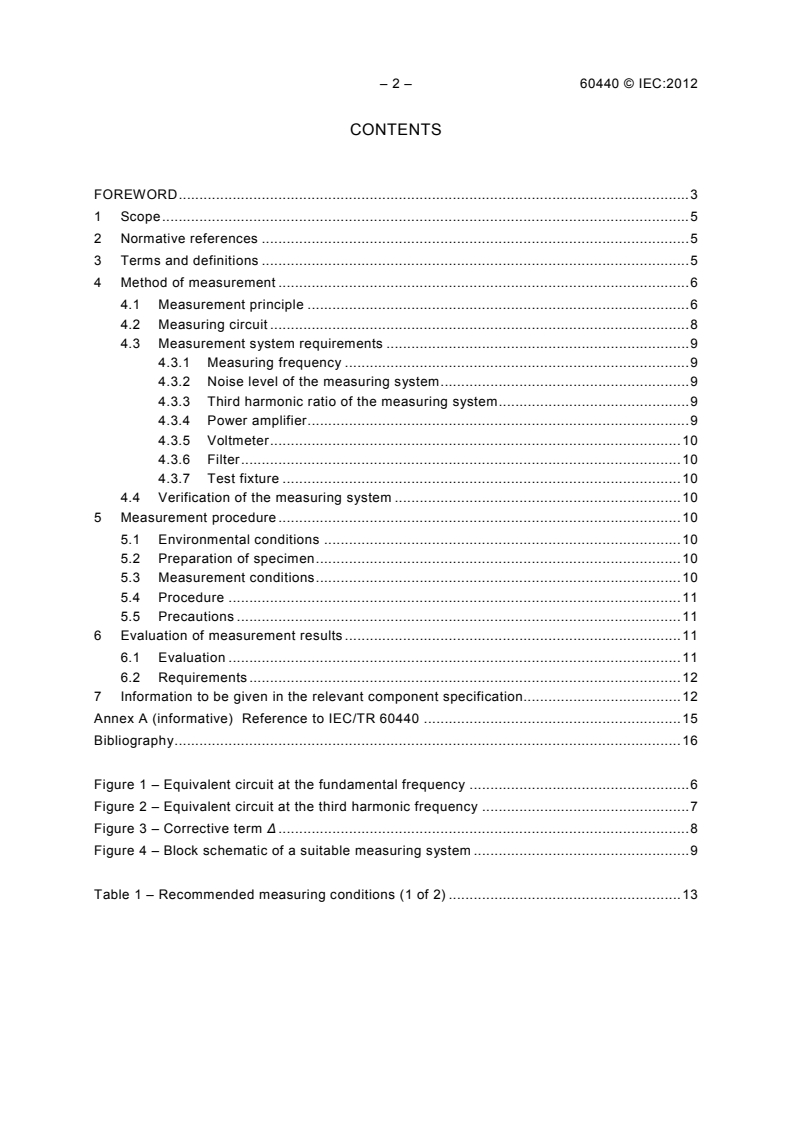
– 2 – 60440 © IEC:2012
CONTENTS
FOREWORD . 3
1 Scope . 5
2 Normative references . 5
3 Terms and definitions . 5
4 Method of measurement . 6
4.1 Measurement principle . 6
4.2 Measuring circuit . 8
4.3 Measurement system requirements . 9
4.3.1 Measuring frequency . 9
4.3.2 Noise level of the measuring system . 9
4.3.3 Third harmonic ratio of the measuring system . 9
4.3.4 Power amplifier . 9
4.3.5 Voltmeter . 10
4.3.6 Filter . 10
4.3.7 Test fixture . 10
4.4 Verification of the measuring system . 10
5 Measurement procedure . 10
5.1 Environmental conditions . 10
5.2 Preparation of specimen . 10
5.3 Measurement conditions . 10
5.4 Procedure . 11
5.5 Precautions . 11
6 Evaluation of measurement results . 11
6.1 Evaluation . 11
6.2 Requirements . 12
7 Information to be given in the relevant component specification. 12
Annex A (informative) Reference to IEC/TR 60440 . 15
Bibliography . 16
Figure 1 – Equivalent circuit at the fundamental frequency . 6
Figure 2 – Equivalent circuit at the third harmonic frequency . 7
Figure 3 – Corrective term Δ . 8
Figure 4 – Block schematic of a suitable measuring system . 9
Table 1 – Recommended measuring conditions (1 of 2) . 13
60440 © IEC:2012 – 3 –
INTERNATIONAL ELECTROTECHNICAL COMMISSION
____________
METHOD OF MEASUREMENT OF NON-LINEARITY IN RESISTORS
FOREWORD
1) The International Electrotechnical Commission (IEC) is a worldwide organization for standardization comprising
all national electrotechnical committees (IEC National Committees). The object of IEC is to promote
international co-operation on all questions concerning standardization in the electrical and electronic fields. To
this end and in addition to other activities, IEC publishes International Standards, Technical Specifications,
Technical Reports, Publicly Available Specifications (PAS) and Guides (hereafter referred to as “IEC
Publication(s)”). Their preparation is entrusted to technical committees; any IEC National Committee interested
in the subject dealt with may participate in this preparatory work. International, governmental and non-
governmental organizations liaising with the IEC also participate in this preparation. IEC collaborates closely
with the International Organization for Standardization (ISO) in accordance with conditions determined by
agreement between the two organizations.
2) The formal decisions or agreements of IEC on technical matters express, as nearly as possible, an international
consensus of opinion on the relevant subjects since each technical committee has representation from all
interested IEC National Committees.
3) IEC Publications have the form of recommendations for international use and are accepted by IEC National
Committees in that sense. While all reasonable efforts are made to ensure that the technical content of IEC
Publications is accurate, IEC cannot be held responsible for the way in which they are used or for any
misinterpretation by any end user.
4) In order to promote international uniformity, IEC National Committees undertake to apply IEC Publications
transparently to the maximum extent possible in their national and regional publications. Any divergence
between any IEC Publication and the corresponding national or regional publication shall be clearly indicated in
the latter.
5) IEC itself does not provide any attestation of conformity. Independent certification bodies provide conformity
assessment services and, in some areas, access to IEC marks of conformity. IEC is not responsible for any
services carried out by independent certification bodies.
6) All users should ensure that they have the latest edition of this publication.
7) No liability shall attach to IEC or its directors, employees, servants or agents including individual experts and
members of its technical committees and IEC National Committees for any personal injury, property damage or
other damage of any nature whatsoever, whether direct or indirect, or for costs (including legal fees) and
expenses arising out of the publication, use of, or reliance upon, this IEC Publication or any other IEC
Publications.
8) Attention is drawn to the Normative references cited in this publication. Use of the referenced publications is
indispensable for the correct application of this publication.
9) Attention is drawn to the possibility that some of the elements of this IEC Publication may be the subject of
patent rights. IEC shall not be held responsible for identifying any or all such patent rights.
International Standard IEC 60440 has been prepared by committee 40: Capacitors and
resistors for electronic equipment.
This International Standard cancels and replaces the Technical Report IEC/TR 60440,
published in 1973.
The major changes with regard to the Technical Report are:
– change of the principle parameter’s term from “third harmonic attenuation” to “third
harmonic ratio”;
– addition of advice on the prescription of requirements in a relevant component
specification;
– addition of a set of recommended measuring conditions for a specimen with a rated
dissipation of less than 100 mW;
– a complete editorial revision.
– 4 – 60440 © IEC:2012
The text of this standard is based on the following documents:
FDIS Report on voting
40/2155/FDIS 40/2167/RVD
Full information on the voting for the approval of this standard can be found in the report on
voting indicated in the above table.
This publication has been drafted in accordance with the ISO/IEC Directives, Part 2.
The committee has decided that the contents of this publication will remain unchanged until
the stability date indicated on the IEC web site under "http://webstore.iec.ch" in the data
related to the specific publication. At this date, the publication will be
• reconfirmed,
• withdrawn,
• replaced by a revised edition, or
• amended.
60440 © IEC:2012 – 5 –
METHOD OF MEASUREMENT OF NON-LINEARITY IN RESISTORS
1 Scope
Non-linearity testing is a method to evaluate the integrity of a resistive element. It may be
applied as an effective inline screening method suitable to detect and eliminate potential
infant mortality failures in passive components. The method is fairly rapid, convenient, and the
associated equipment is relatively inexpensive.
Typical effects causing non-linearity on resistors are e.g. inhomogeneous spots within a
resistive film, traces of film left in the spiraling grooves, or contact instability between a
connecting lead or termination and the resistive element.
This International Standard specifies a method of measurement and associated test
conditions to assess the magnitude of non-linear distortion generated in a resistor. This
method is applied if prescribed by a relevant component specification, or if agreed between a
customer and a manufacturer.
2 Normative references
The following documents, in whole or in part, are normatively referenced in this document and
are indispensable for its application. For dated references, only the edition cited applies. For
undated references, the latest edition of the referenced document (including any
amendments) applies.
IEC 60068-1, Environmental testing – Part 1: General and guidance
3 Terms and definitions
For the puposes of this document the following terms and definitions apply.
3.1
electromotive force
e.m.f.
difference in potential that tends to give rise to an electric current
3.2
non-linearity
deviation of a component’s impedance from Ohm’s law, resulting in voltage of harmonic
frequencies when subjected to sinusoidal current
3.3
third harmonic ratio
A
ratio of the fundamental voltage over the e.m.f. of the third harmonic
Note 1 to entry: The third harmonic ratio is expressed in dB.
Note 2 to entry: The third harmonic ratio has been addressed before as third harmonic attenuation. This historic
convention is misleading as it wrongly suggests harmonic frequencies originating from the test equipment being
attenuated or filtered by the components under test. The misleading term should therefore be avoided.
– 6 – 60440 © IEC:2012
4 Method of measurement
4.1 Measurement principle
A pure sinusoidal current is passed through the component under test. If the impedance of the
component is not perfectly linear, the voltage across the component will be distorted and
contain harmonics. One or more of these harmonics can be measured and the magnitude of
these distortions is a measure of the non-linearity in the component. It is recommended to
measure the third harmonic, as it is the dominant one.
The third harmonic voltage appearing across a component needs to be separated from the
fundamental voltage and from any other harmonic voltage for the measurement. This is
accomplished by a filter circuit letting the harmonic voltage pass through while featuring very
high impedance at the fundamental frequency. Also, the generator of the fundamental
frequency needs to feature very high impedance at the third harmonic frequency so as not to
act as a load to the generated distortions.
Hence, the equivalent circuit of the generator part operating at the fundamental frequency is
quite simple, as shown in Figure 1.
I
U R
T
IEC 1432/12
Key
I Sinusoidal current
U Fundamental voltage across the resistor under test
R Impedance of the resistor under test at the fundamental frequency
T
Figure 1 – Equivalent circuit at the fundamental frequency
The equivalent circuit for the third harmonic frequency is built around the test specimen
represented by a linear impedance with a zero-impedance harmonic generator in series. This
signal source loads the measuring system represented by its impedance as seen from the test
terminals, see Figure 2.
60440 © IEC:2012 – 7 –
R
T3
U
R
3 3
E
IEC 1433/12
Key
E e.m.f. of the third harmonic
R Impedance of the resistor under test at the third harmonic frequency
T3
R Impedance of the measuring circuit at the third harmonic frequency, seen from the test terminals
U Third harmonic voltage
Figure 2 – Equivalent circuit at the third harmonic frequency
In this circuit the e.m.f. of the third harmonic E is divided into the measurable third harmonic
voltage U
R
U = ⋅E (1)
3 3
R + R
3 T3
Hence, the e.m.f. of the third harmonic E in the component can be determined by
R
T3
E = 1+ ⋅U (2)
3 3
R
3
The corrective term ∆ for the reduction of U to the origin E is
3 3
R
T3
Δ = 20 ⋅log 1+ (3)
R
3
In many cases it can be shown for a range of resistors under test that the impedance R at
T3
the third harmonic frequency is equal or very close to the impedance R at the fundamental
T
frequency. Then the corrective term ∆ in decibels is
R
T
Δ = 20 ⋅log 1+ (4)
R
NOTE 1 For fixed film resistors this equality of R and R can generally be assumed with sufficient accuracy.
T3 T
Numeric values for the corrective term ∆ can be obtained from Figure 3 or for specific sets of
impedance R and specimen resistance R from Table 1.
3 T
– 8 – 60440 © IEC:2012
0,1 1 10 100
R /R
T 3
IEC 1434/12
Figure 3 – Corrective term Δ
A suitable range for the fundamental frequency f for measurements on resistors is between
10 kHz and 40 kHz. This frequency range enables the test circuit to be set up without too
much difficulty.
NOTE 2 Another method is using a bridge which is balanced at the fundamental frequency, where the harmonics
appear across the bridge diagonal. This method requires individual balancing of the bridge for each specimen,
which may be suitable for occasional use in a laboratory environment.
4.2 Measuring circuit
Figure 4 shows a block schematic of a suitable measuring circuit.
A distortion-free impedance matching device may be used to switch R in order to achieve
good matching to the test specimen R . Examples of suitable values of R are 10 Ω; 100 Ω;
T 3
1 kΩ; 10 kΩ and 100 kΩ; these values are used for specifying the test conditions in Table 1.
The suitability of the measuring circuit for measurements on resistors with resistance values
covering a wide range depends on the lowest and highest available impedance R of the
circuit. The range of values for R proposed above grants suitability for measurements on
specimen R with their resistance being in the range of 1 Ω to at least 10 MΩ.
T
However, there is an overriding influence of the correcting term ∆ depending on the ratio of
resistance under test R over impedance R , see Table 1 and Figure 3.
T 3
∆ (dB)
60440 © IEC:2012 – 9 –
S
U U
G V
1 V 3
VA A LP BP
R
R
T
IEC 1435/12
Key
G Oscillator, at the fundamental frequency f
S Switch for applying the test signal to the test specimen
VA Variable attenuator
A Power amplifier
LP Low-pass filter
U r.m.s. voltage at the fundamental frequency f
1 1
BP Band-pass filter
U r.m.s. voltage at the third harmonic frequency f
3 3
R Resistor under test
T
R Impedance of the measuring circuit at the third harmonic frequency f , seen from the test terminals.
3 3
Figure 4 – Block schematic of a suitable measuring system
4.3 Measurement system requirements
4.3.1 Measuring frequency
The fundamental frequency f shall be 10 kHz and thus the third harmonic frequency f shall
1 3
be 30 kHz, unless otherwise specified in the relevant component specification.
4.3.2 Noise level of the measuring system
The noise level referred to the test terminals shall not be higher than 0,2 µV at R = 1 kΩ.
4.3.3 Third harmonic ratio of the measuring system
The third harmonic ratio 20 ⋅ log (U E ) shall be higher than 140 dB for most of the
10 1 3
impedance range when the required dissipation P is applied to a virtually linear component.
The required dissipation is 0,25 VA, as given in Table 1, or a value prescribed by the relevant
component specification, e.g with reference to the rated dissipation.
4.3.4 Power amplifier
The power amplifier shall be capable of delivering an apparent power of four times the
required dissipation into a resistive component under test, in order to ensure sufficient
linearity.
Hence, the power amplifier shall be capable of delivering an apparent power of 1 VA if the
required dissipation is 0,25 VA as given in Table 1.
– 10 – 60440 © IEC:2012
4.3.5 Voltmeter
The error of the voltmeter for measurement of the voltage U at the fundamental frequency
shall be less than 5 % of its full scale deflection.
The error of the voltmeter for measurement of the voltage U at the third harmonic frequency
shall be less than 10 % of its full scale deflection.
4.3.6 Filter
The cut-off frequency of the low-pass filter shall be immediately above the fundamental
freuqency f .
The band-pass filter shall permit the third-harmonic frequency f to pass through, while it shall
provide very high attenuation at the fundamental frequency f .
Precautions shall be taken to avoid non-linear distortion from the components near the test
specimen in the low-pass and band-pass filters. The filter inductors for instance shall not
contain cores of magnetic material.
4.3.7 Test fixture
The test fixture for the specimen R shall be capable of providing safe electrical connection.
T
4.4 Verification of the measuring system
Reference resistors with known non-linearity shall be used to verify the integrity of the
measuring system.
5 Measurement procedure
5.1 Environmental conditions
Unless otherwise specified, all tests shall be carried out under standard atmospheric
conditions for measurement and tests as specified in IEC 60068-1.
5.2 Preparation of specimen
The specimen shall be kept for at least 2 h in the environmental conditions prescribed in 5.1.
5.3 Measurement conditions
The choice of system impedances R is determined by the properties of the actual
measurement system. Table 1 is based on examples of suitable values for R .
The fundamental test voltage U shall be chosen from Table 1, unless otherwise specified in
the relevant component specification, e.g. relative to the rated dissipation.
Analysis shows that the third harmonic ratio depends significantly on the choice of the
fundamental voltage as the readings of the third harmonic voltage U show an exponential
relationship over the ratio of applied fundamental voltages. Comparison of the non-linearity of
different products should therefore always be based on identical prescriptions for dissipation
and voltage limitation in order to define an identical fundamental voltage for each resistance
value.
The application of the fundamental voltage results in a dissipation, and thus in a temperature
rise within the specimen. Depending on its temperature coefficient of resistance (TCR), the
60440 © IEC:2012 – 11 –
specimen resistance will change, which will change the actual applied fundamental voltage.
Depending on the respective temperature rise and TCR, this effect may be insignificant or not.
Limiting the duration of the application of the fundamental voltage may be a suitable way out
of this problem, if set below the thermal time constant of the specimen.
The relevant component specification shall state respective requirements, if applicable.
5.4 Procedure
The specimen shall be inserted into the test fixture and properly connected to the test
terminals.
The system impedance R shall be selected in order to achieve the best possible impedance
matching.
The fundamental voltage shall be applied, e.g. by closing the switch S in a system according
to Figure 4, and adjusted to the prescribed value.
The third harmonic voltage U shall be read.
The application of the fundamental voltage shall not exceed the prescribed duration, if
applicable.
5.5 Precautions
Ferromagnetic materials give rise to harmonic distortion and care shall be taken to avoid
influence from e.g. iron in the immediate vicinity of the component which can mask component
non-linearities especially at high currents.
6 Evaluation of measurement results
6.1 Evaluation
The reading of the third harmonic voltage U shall be used to calculate the third harmonic
ratio.
The third harmonic ratio A in decibels is
U
A = 20 ⋅ log
3 10
E
U E
1 3
= 20 ⋅ log − 20 ⋅ log (5)
10 10
U U
ref ref
U U R
1 3 T3
= 20 ⋅ log − 20 ⋅ log − 20 ⋅ log 1+
10 10 10
U U R
ref ref 3
where
U is the fundamental voltage across the resistor under test
U is the basis for voltage ratios, arbitrarily set
ref
E is the e.m.f. of the third harmonic in the component
U is the measured third harmonic voltage
R is the impedance of the resistor under test at the third harmonic frequency
T3
R is the impedance of the measuring circuit at the third harmonic frequency, seen from the
test terminals (source impedance)
– 12 – 60440 © IEC:2012
In Equation (5), the logarithmic term describing the fundamental voltage may be abbreviated
as D with
U
D = 20 ⋅ log (6)
U
ref
NOTE The calculation of the third harmonic ratio requires a common U for all used logarithms of voltage ratios;
ref
throughout this standard, U = 1 V is used for the 0 dB reference level.
ref
The abbreviation of a logarithmic expression 20·log (U/U ) to 20·log U is mathematically incorrect and
10 ref
particularly bears the risk of confusion when the used reference voltage is no longer considered. Hence the
abbreviated form is not an appropriate expression.
With the above definitions of D in Equation (6) and of ∆ in 4.1, Equation (5) can be simplified
to
U
A =D −20 ⋅log −Δ (7)
3 10
U
ref
6.2 Requirements
Acceptance criteria for non-linearity of tested products shall be given with reference to a
required minimum third harmonic ratio A in the relevant component specification.
Such acceptance criteria should be stated through a fixed minimum value, typically given as a
function of the specimen resistance.
Superior selectivity of non-linearity screening is achievable through the use of a dynamic
minimum value relative to the statistical distribution of non-linearity within an analyzed batch
in addition to a fixed minimum value. Such dynamic requirement should be referenced to a
batch’s mean value and a multiple of its standard deviation, e.g. like ≥ A − 3σ .
7 Information to be given in the relevant component specification
When this test is included in a relevant component specification, the following details shall be
given as far as they are applicable:
Subclause
a) the fundamental frequency
4.2
b) the environmental condition for this measurement
5.1
c) the dissipation to be provided through the fundamental voltage
5.3, Table 1
d) a limitation to the fundamental voltage, if applicable
5.3, Table 1
e) a limitation to the duration of application of the fundamental voltage,
if applicable
5.3
The relevant component specification shall specify for its own purpose:
Subclause
f) acceptance criteria to the third harmonic ratio A
6.2
60440 © IEC:2012 – 13 –
R , for the
Table 1 gives the values for the recommended impedance of the measuring circuit
corresponding corrective term ∆ and for the fundamental voltage U of the recommended
measuring conditions for specimen R with a resistance in the range of 1 Ω to 22 MΩ.
T
Table 1 – Recommended measuring conditions (1 of 2)
Specimen’s rated dissipation P
r
a
b
P ≥ 0,25 W 0,25 W > P ≥ 0,1 W 0,1 W > P
R R ∆
r r r
3 T
c d c d c d
Ω Ω dB
U D P U D P U D P
1 1 1
V dB mW V dB mW V dB mW
1,0 0,8 0,50 −6,0 250 0,32 −10,0 100 0,22 −13,0 50
1,2 1,0 0,55 −5,2 250 0,35 −9,2 100 0,24 −12,2 50
1,5 1,2 0,61 −4,3 250 0,39 −8,2 100 0,27 −11,2 50
1,8 1,4 0,67 −3,5 250 0,42 −7,4 100 0,30 −10,5 50
2,2 1,7 0,74 −2,6 250 0,47 −6,6 100 0,33 −9,6 50
2,7 2,1 0,82 −1,7 250 0,52 −5,7 100 0,37 −8,7 50
3,3 2,5 0,91 −0,8 250 0,57 −4,8 100 0,41 −7,8 50
3,9 2,9 0,99 −0,1 250 0,62 −4,1 100 0,44 −7,1 50
4,7 3,3 1,08 0,7 250 0,69 −3,3 100 0,48 −6,3 50
5,6 3,9 1,18 1,5 250 0,75 −2,5 100 0,53 −5,5 50
6,8 4,5 1,30 2,3 250 0,82 −1,7 100 0,58 −4,7 50
8,2 5,2 1,43 3,1 250 0,91 −0,9 100 0,64 −3,9 50
10 6,0 1,58 4,0 250 1,00 0,0 100 0,71 −3,0 50
12 6,8 1,73 4,8 250 1,10 0,8 100 0,77 −2,2 50
15 8,0 1,94 5,7 250 1,22 1,8 100 0,87 −1,2 50
18 8,9 2,12 6,5 250 1,34 2,6 100 0,95 −0,5 50
22 10,1 2,35 7,4 250 1,48 3,4 100 1,05 0,4 50
27 11,4 2,60 8,3 250 1,64 4,3 100 1,16 1,3 50
33 2,5 2,87 9,2 250 1,82 5,2 100 1,28 2,2 50
39 2,9 3,12 9,9 250 1,97 5,9 100 1,40 2,9 50
47 3,3 3,43 10,7 250 2,17 6,7 100 1,53 3,7 50
56 3,9 3,74 11,5 250 2,37 7,5 100 1,67 4,5 50
68 4,5 4,12 12,3 250 2,61 8,3 100 1,84 5,3 50
82 5,2 4,53 13,1 250 2,86 9,1 100 2,02 6,1 50
100 6,0 5,00 14,0 250 3,16 10,0 100 2,24 7,0 50
120 6,8 5,48 14,8 250 3,46 10,8 100 2,45 7,8 50
150 8,0 6,12 15,7 250 3,87 11,8 100 2,74 8,8 50
180 8,9 6,71 16,5 250 4,24 12,6 100 3,00 9,5 50
220 10,1 7,42 17,4 250 4,69 13,4 100 3,32 10,4 50
270 11,4 8,22 18,3 250 5,20 14,3 100 3,67 11,3 50
330 2,5 9,08 19,2 250 5,74 15,2 100 4,06 12,2 50
390 2,9 9,87 19,9 250 6,24 15,9 100 4,42 12,9 50
470 3,3 10,8 20,7 250 6,86 16,7 100 4,85 13,7 50
560 3,9 11,8 21,5 250 7,48 17,5 100 5,29 14,5 50
680 4,5 13,0 22,3 250 8,25 18,3 100 5,83 15,3 50
820 5,2 14,3 23,1 250 9,06 19,1 100 6,40 16,1 50
1 k
1,0 k 6,0 15,8 24,0 250 10,0 20,0 100 7,07 17,0 50
1,2 k 6,8 17,3 24,8 250 11,0 20,8 100 7,75 17,8 50
1,5 k 8,0 19,4 25,7 250 12,2 21,8 100 8,66 18,8 50
1,8 k 8,9 21,2 26,5 250 13,4 22,6 100 9,49 19,5 50
2,2 k 10,1 23,5 27,4 250 14,8 23,4 100 10,5 20,4 50
2,7 k 11,4 26,0 28,3 250 16,4 24,3 100 11,6 21,3 50
3,3 k 2,5 28,7 29,2 250 18,2 25,2 100 12,8 22,2 50
3,9 k 2,9 31,2 29,9 250 19,7 25,9 100 14,0 22,9 50
4,7 k 3,3 34,3 30,7 250 21,7 26,7 100 15,3 23,7 50
10 k
5,6 k 3,9 37,4 31,5 250 23,7 27,5 100 16,7 24,5 50
6,8 k 4,5 41,2 32,3 250 26,1 28,3 100 18,4 25,3 50
8,2 k 5,2 45,3 33,1 250 28,6 29,1 100 20,2 26,1 50
– 14 – 60440 © IEC:2012
Table 1 (2 of 2)
Specimen’s rated dissipation P
r
a
b
P ≥ 0,25 W 0,25 W > P ≥ 0,1 W 0,1 W > P
R R ∆
r r r
3 T
c d c d c d
dB
Ω Ω
U D P U D P U D P
1 1 1
V dB mW V dB mW V dB mW
10 k 6,0 50,0 34,0 250 31,6 30,0 100 22,4 27,0 50
12 k 6,8 54,8 34,8 250 34,6 30,8 100 24,5 27,8 50
15 k 8,0 61,2 35,7 250 38,7 31,8 100 27,4 28,8 50
10 k
18 k 8,9 67,1 36,5 250 42,4 32,6 100 30,0 29,5 50
22 k 10,1 74,2 37,4 250 46,9 33,4 100 33,2 30,4 50
27 k 11,4 82,2 38,3 250 52,0 34,3 100 36,7 31,3 50
33 k 2,5 90,8 39,2 250 57,4 35,2 100 40,6 32,2 50
39 k 2,9 98,7 39,9 250 62,4 35,9 100 44,2 32,9 50
47 k 3,3 108 40,7 250 68,6 36,7 100 48,5 33,7 50
56 k 3,9 118 41,5 250 74,8 37,5 100 52,9 34,5 50
68 k 4,5 130 42,3 250 82,5 38,3 100 58,3 35,3 50
82 k 5,2 143 43,1 250 90,6 39,1 100 64,0 36,1 50
100 k 6,0 158 44,0 250 100 40,0 100 70,7 37,0 50
120 k 6,8 173 44,8 250 110 40,8 100 77,5 37,8 50
150 k 8,0 194 45,7 250 122 41,8 100 86,6 38,8 50
180 k 8,9 212 46,5 250 134 42,6 100 94,9 39,5 50
220 k 10,1 235 47,4 250 148 43,4 100 105 40,4 50
270 k 11,4 260 48,3 250 164 44,3 100 116 41,3 50
330 k 12,7 287 49,2 250 182 45,2 100 128 42,2 50
390 k 13,8 312 49,9 250 197 45,9 100 140 42,9 50
470 k 15,1 343 50,7 250 217 46,7 100 153 43,7 50
560 k 16,4 374 51,5 250 237 47,5 100 167 44,5 50
680 k 17,8 412 52,3 250 261 48,3 100 184 45,3 50
100 k 820 k 19,3 453 53,1 250 286 49,1 100 202 46,1 50
1,0 M 20,8 500 54,0 250 316 50,0 100 224 47,0 50
1,2 M 22,3 548 54,8 250 346 50,8 100 245 47,8 50
1,5 M 24,1 612 55,7 250 387 51,8 100 274 48,8 50
1,8 M 25,6 671 56,5 250 424 52,6 100 300 49,5 50
2,2 M 27,2 742 57,4 250 469 53,4 100 332 50,4 50
2,7 M 28,9 822 58,3 250 520 54,3 100 367 51,3 50
3,3 M 30,6 908 59,2 250 574 55,2 100 406 52,2 50
3,9 M 32,0 987 59,9 250 624 55,9 100 442 52,9 50
4,7 M 33,6 1 084 60,7 250 686 56,7 100 485 53,7 50
5,6 M 35,1 1 183 61,5 250 748 57,5 100 529 54,5 50
6,8 M 36,8 1 304 62,3 250 825 58,3 100 583 55,3 50
8,2 M 38,4 1 432 63,1 250 906 59,1 100 640 56,1 50
10 M 40,1 1 581 64,0 250 1 000 60,0 100 707 57,0 50
12 M 41,7 1 732 64,8 250 1 095 60,8 100 775 57,8 50
15 M 43,6 1 936 65,7 250 1 225 61,8 100 866 58,8 50
18 M 45,2 2 121 66,5 250 1 342 62,6 100 949 59,5 50
22 M 46,9 2 345 67,4 250 1 483 63,4 100 1 049 60,4 50
a
The parameters for other values of R than those shown here shall be calculated using the resistance R ,
T T
the dissipation P and, if applicable, a limitation to the fundamental voltage U .
b
The given figures for the correction term ∆ only apply if the measuring circuit uses the source impedances
R shown here.
c
A limitation may apply to the voltage at fundamental frequency, thereby limiting the value D and the
actual dissipation P.
d
The decibel ratio D of the fundamental voltage is based upon U = 1 V for the 0 dB reference level.
ref
60440 © IEC:2012 – 15 –
Annex A
(informative)
Reference to IEC/TR 60440
The drafting of this standard has resulted in a new structure. The following table indicates the
new clause and subclause numbers with respect to the Technical Report, published in 1973.
a
IEC/TR 60440 IEC 60440:2012 Notes
st
1 edition
Clause/Subclause Clause/Subclause
1 Scope and object are merged into one
— 2 New clause
— 3 New clause
4.1 —
4.0
4.1
4.2 —
4.2
4.3
4.1 —
4.4
4.5 4.3 Divided into subclauses
4.6 5.1 —
4.7 4.3.7 —
5 5 Divided into subclauses
— 6 New clause
a
See Bibliography.
– 16 – 60440 © IEC:2012
Bibliography
IEC 60027 (all parts), Letter symbols to be used in electrical technology
IEC/TR 60440:1973, Method of measurement of non-linearity in resistors
IEC 60617, Graphical symbols for diagrams
ISO 80000-1, Quantities and units – Part 1: General
Danbridge A/S, “Reliability Testing of Nominally Linear Components by Measuring Third
Harmonic Distortion”, Application Note, 2002
Kühl, R.W. and Ewell, G.J., “Third Harmonic Testing: Current Resistor Applications”,
th
Proceedings, 15 European Passive Components Symposium CARTS-EUROPE 2001,
Copenhagen, Denmark, 2001, pp. 85 - 93.
Kuehl, R.W., “Reliability of thin-film resistors: Impact of third harmonic screening”,
Microelectronics Reliability 42 (2002), pp. 807
____________
– 18 – 60440 © CEI:2012
SOMMAIRE
AVANT-PROPOS . 19
1 Domaine d’application . 21
2 Références normatives . 21
3 Termes et définitions . 21
4 Méthode de mesure . 22
4.1 Principe de mesure . 22
4.2 Circuit de mesure . 24
4.3 Exigences relatives au système de mesure . 25
4.3.1 Fréquence de mesure . 25
4.3.2 Niveau de bruit du système de mesure . 25
4.3.3 Rapport de troisième harmonique du système de mesure . 25
4.3.4 Amplificateur de puissance . 25
4.3.5 Voltmètre . 26
4.3.6 Filtre . 26
4.3.7 Dispositif d'essai . 26
4.4 Vérification du système de mesure . 26
5 Procédure de mesure . 26
5.1 Conditions environnementales . 26
5.2 Préparation du spécimen . 26
5.3 Conditions de mesure . 26
5.4 Procédure . 27
5.5 Précautions . 27
6 Evaluation des résultats de mesure . 27
6.1 Evaluation . 27
6.2 Exigences . 28
7 Informations à fournir dans la spécification applicable au composant . 28
Annexe A (informative) Référence à la CEI/TR 60440 . 32
Bibliographie . 33
Figure 1 – Circuit équivalent à la fréquence fondamentale . 22
Figure 2 – Circuit équivalent à la fréquence de troisième harmonique . 23
Figure 3 – Terme correctif Δ . 24
Figure 4 – Schéma de principe d'un système de mesure adapté . 25
Tableau 1 – Conditions de mesure recommandées (1 de 2) . 30
60440 © CEI:2012 – 19 –
COMMISSION ÉLECTROTECHNIQUE INTERNATIONALE
____________
MÉTHODE DE MESURE DE LA NON-LINÉARITE DES RÉSISTANCES
AVANT-PROPOS
1) La Commission Electrotechnique Internationale (CEI) est une organisation mondiale de normalisation
composée de l'ensemble des comités électrotechniques nationaux (Comités nationaux de la CEI). La CEI a
pour objet de favoriser la coopération internationale pour toutes les questions de normalisation dans les
domaines de l'électricité et de l'électronique. A cet effet, la CEI – entre autres activités – publie des Normes
internationales, des Spécifications techniques, des Rapports techniques, des Spécifications accessibles au
public (PAS) et des Guides (ci-après dénommés "Publication(s) de la CEI"). Leur élaboration est confiée à des
comités d'études, aux travaux desquels tout Comité national intéressé par le sujet traité peut participer. Les
organisations internationales, gouvernementales et non gouvernementales, en liaison avec la CEI, participent
également aux travaux. La CEI collabore étroitement avec l'Organisation Internationale de Normalisation (ISO),
selon des conditions fixées par accord entre les deux organisations.
2) Les décisions ou accords officiels de la CEI concernant les questions techniques représentent, dans la mesure
du possible, un accord international sur les sujets étudiés, étant donné que les Comités nationaux de la CEI
intéressés sont représentés dans chaque comité d’études.
3) Les Publications de la CEI se présentent sous la forme de recommandations internationales et sont agréées
comme telles par les Comités nationaux de la CEI. Tous les efforts raisonnables sont entrepris afin que la CEI
s'assure de l'exactitude du contenu technique de ses publications; la CEI ne peut pas être tenue responsable
de l'éventuelle mauvaise utilisation ou interprétation qui en est faite par un quelconque utilisateur final.
4) Dans le but d'encourager l'uniformité internationale, les Comités nationaux de la CEI s'engagent, dans toute la
mesure possible, à appliquer de façon transparente les Publications de la CEI dans leurs publications
nationales et régionales. Toutes divergences entre toutes Publications de la CEI et toutes publications
nationales ou régionales correspondantes doivent être indiquées en termes clairs dans ces dernières.
5) La CEI elle-même ne fournit aucune attestation de conformité. Des organismes de certification indépendants
fournissent des services d'évaluation de conformité et, dans certains secteurs, accèdent aux marques de
conformité de la CEI. La CEI n'est responsable d'aucun des services effectués par les organismes de
certification indépendants.
6) Tous les utilisateurs doivent s'assurer qu'ils sont en possession de la dernière édition de cette publication.
7) Aucune responsabilité ne doit être imputée à la CEI, à ses administrateurs, employés, auxiliaires ou
mandataires, y compris ses experts particuliers et les membres de ses comités d'études et des Comités
nationaux de la CEI, pour tout préjudice causé en cas de dommages corporels et matériels, ou de tout autre
dommage de quelque nature que ce soit, directe ou indirecte, ou pour supporter les coûts (y compris les frais
de justice) et les dépenses découlant de la publication ou de l'utilisation de cette Publication de la CEI ou de
toute autre Publication de la CEI, ou au crédit qui lui est accordé.
8) L'attention est attirée sur les références normatives citées dans cett
...