

IEC 62467-1:2009
(Main)Medical electrical equipment - Dosimetric instruments as used in brachytherapy - Part 1: Instruments based on well-type ionization chambers
General Information
- Abstract
IEC 62467-1:2009 specifies the performance and some related constructional requirements of well-type ionization chambers and associated measurement apparatus, intended for the determination of a quantity, such as air kerma strength or reference air kerma rate in photon radiation fields or absorbed dose to water at a depth, in photon and beta radiation fields used in brachytherapy, after appropriate calibration for a given type of source. IEC 62467-1:2009 covers the techniques for the quantification of the quantity appropriate for the brachytherapy source under consideration. This quantity may be air kerma strength or reference air kerma rate at 1 m, or absorbed dose to water at a depth (e.g. 2 mm or 5 mm). Measurement of these quantities may be accomplished by a variety of well-type ionization chambers or systems currently available for this purpose. This standard applies to products intended for low dose rate, high dose rate, intravascular, both photon and beta, brachytherapy measurements. It does not apply to instruments for nuclear medicine applications. The application of the standard is limited to instruments that incorporate well-type ionization chambers as detectors. The intended use is the measurement of the output of radioactive, encapsulated sources for intracavitary (insertion into body cavities) or interstitial (insertion into body tissue) applications. The object of IEC 62467-1:2009 is
a) to establish requirements for a satisfactory level of performance for well-type chamber systems, and
b) to standardize the methods for the determination of compliance with this level of performance.
IEC 62467-1:2009 is not concerned with the safety aspects of well-type chamber systems. The well-type chamber systems covered by this standard are not intended for use in patient environment. The electrical safety of well-type chamber systems is covered in IEC 61010-1. The operation of the electrometer measuring system is covered in IEC 60731.
- Status
- Published
- Publication Date
- 08-Jun-2009
- Drafting Committee
- WG 3 - TC 62/SC 62C/WG 3
- Current Stage
- PPUB - Publication issued
- Start Date
- 09-Jun-2009
- Completion Date
- 30-Jun-2009
Overview
IEC 62467-1:2009 is an international standard published by the International Electrotechnical Commission (IEC) that specifies the performance and constructional requirements for dosimetric instruments used in brachytherapy. This standard focuses on well-type ionization chambers and their associated measurement apparatus designed to determine critical radiation dosimetry quantities such as air kerma strength, reference air kerma rate, or absorbed dose to water in photon and beta radiation fields.
This standard applies specifically to instruments intended for low dose rate (LDR), high dose rate (HDR), and intravascular brachytherapy sources. It excludes devices meant for nuclear medicine and concentrates on instruments incorporating well-type ionization chambers as detectors. The standard aims to ensure consistent performance for measuring the output of encapsulated radioactive sources used in intracavitary (body cavities) or interstitial (tissue) brachytherapy treatments.
Key Topics
- Performance Requirements: Defines satisfactory performance levels for well-type ionization chamber systems, verifying parameters like stability, reproducibility, and sensitivity.
- Measurement Quantities: Details measurement of air kerma strength, reference air kerma rate at 1 meter, and absorbed dose to water at specified depths such as 2 mm or 5 mm.
- Constructional Requirements: Covers aspects related to chamber components, inserts, displays, and electrical operation to optimize dosimetric accuracy.
- Standard Test Conditions: Establishes reference conditions including temperature, pressure, calibration environment, and source positioning to ensure accuracy and repeatability.
- Limits of Variation: Specifies allowable variances in influence quantities like air pressure, temperature, recombination losses, electromagnetic immunity, and battery conditions impacting measurement outcomes.
- Marking and Documentation: Guidelines for labeling the devices and supplying comprehensive user documentation to support proper operation.
- Exclusions: Clarifies the standard does not address safety aspects of chamber systems which are governed by IEC 61010-1 and IEC 60731.
Applications
IEC 62467-1:2009 serves as a crucial framework for:
- Manufacturers of well-type ionization chambers ensuring their devices meet international performance and quality standards for brachytherapy dosimetry.
- Medical Physicists and Technicians conducting source calibrations for photon and beta radiation fields in LDR and HDR brachytherapy, facilitating accurate dose delivery.
- Clinical Radiation Therapy Centers adopting standardized measurement instruments to enhance treatment safety and effectiveness.
- Regulatory Authorities and Certification Bodies evaluating compliance of brachytherapy dosimetric systems for medical device approvals.
The standard's emphasis on calibration and measurement uniformity helps reduce discrepancies in dosimetry, supporting consistent radiation dose administration crucial to patient safety and therapeutic efficacy in brachytherapy.
Related Standards
- IEC 61010-1: Safety requirements for electrical equipment, including well-type ionization chambers.
- IEC 60731: Specifications for electrometer measuring systems employed in radiotherapy and dosimetry.
- IEC 62467 Series: Other parts covering dosimetric instruments in brachytherapy beyond well-type ionization chambers.
- ISO/IEC Directives, Part 2: Guidelines for the development and drafting of international standards.
Conclusion
IEC 62467-1:2009 provides vital guidelines and requirements for dosimetric instruments based on well-type ionization chambers used in brachytherapy. Its standardization of measurement techniques and performance criteria promotes accurate dosage assessments for both photon and beta radiation sources. This precision is essential in clinical settings to ensure radiation treatments are delivered safely and effectively, benefiting healthcare providers, patients, and manufacturers alike. Adopting IEC 62467-1 supports global harmonization in brachytherapy dosimetry and upholds international quality benchmarks in medical electrical equipment.
Get Certified
Connect with accredited certification bodies for this standard

BSI Group
BSI (British Standards Institution) is the business standards company that helps organizations make excellence a habit.

TÜV Rheinland
TÜV Rheinland is a leading international provider of technical services.

TÜV SÜD
TÜV SÜD is a trusted partner of choice for safety, security and sustainability solutions.
Sponsored listings
Frequently Asked Questions
IEC 62467-1:2009 is a standard published by the International Electrotechnical Commission (IEC). Its full title is "Medical electrical equipment - Dosimetric instruments as used in brachytherapy - Part 1: Instruments based on well-type ionization chambers". This standard covers: IEC 62467-1:2009 specifies the performance and some related constructional requirements of well-type ionization chambers and associated measurement apparatus, intended for the determination of a quantity, such as air kerma strength or reference air kerma rate in photon radiation fields or absorbed dose to water at a depth, in photon and beta radiation fields used in brachytherapy, after appropriate calibration for a given type of source. IEC 62467-1:2009 covers the techniques for the quantification of the quantity appropriate for the brachytherapy source under consideration. This quantity may be air kerma strength or reference air kerma rate at 1 m, or absorbed dose to water at a depth (e.g. 2 mm or 5 mm). Measurement of these quantities may be accomplished by a variety of well-type ionization chambers or systems currently available for this purpose. This standard applies to products intended for low dose rate, high dose rate, intravascular, both photon and beta, brachytherapy measurements. It does not apply to instruments for nuclear medicine applications. The application of the standard is limited to instruments that incorporate well-type ionization chambers as detectors. The intended use is the measurement of the output of radioactive, encapsulated sources for intracavitary (insertion into body cavities) or interstitial (insertion into body tissue) applications. The object of IEC 62467-1:2009 is a) to establish requirements for a satisfactory level of performance for well-type chamber systems, and b) to standardize the methods for the determination of compliance with this level of performance. IEC 62467-1:2009 is not concerned with the safety aspects of well-type chamber systems. The well-type chamber systems covered by this standard are not intended for use in patient environment. The electrical safety of well-type chamber systems is covered in IEC 61010-1. The operation of the electrometer measuring system is covered in IEC 60731.
IEC 62467-1:2009 specifies the performance and some related constructional requirements of well-type ionization chambers and associated measurement apparatus, intended for the determination of a quantity, such as air kerma strength or reference air kerma rate in photon radiation fields or absorbed dose to water at a depth, in photon and beta radiation fields used in brachytherapy, after appropriate calibration for a given type of source. IEC 62467-1:2009 covers the techniques for the quantification of the quantity appropriate for the brachytherapy source under consideration. This quantity may be air kerma strength or reference air kerma rate at 1 m, or absorbed dose to water at a depth (e.g. 2 mm or 5 mm). Measurement of these quantities may be accomplished by a variety of well-type ionization chambers or systems currently available for this purpose. This standard applies to products intended for low dose rate, high dose rate, intravascular, both photon and beta, brachytherapy measurements. It does not apply to instruments for nuclear medicine applications. The application of the standard is limited to instruments that incorporate well-type ionization chambers as detectors. The intended use is the measurement of the output of radioactive, encapsulated sources for intracavitary (insertion into body cavities) or interstitial (insertion into body tissue) applications. The object of IEC 62467-1:2009 is a) to establish requirements for a satisfactory level of performance for well-type chamber systems, and b) to standardize the methods for the determination of compliance with this level of performance. IEC 62467-1:2009 is not concerned with the safety aspects of well-type chamber systems. The well-type chamber systems covered by this standard are not intended for use in patient environment. The electrical safety of well-type chamber systems is covered in IEC 61010-1. The operation of the electrometer measuring system is covered in IEC 60731.
IEC 62467-1:2009 is classified under the following ICS (International Classification for Standards) categories: 11.040.50 - Radiographic equipment; 11.040.60 - Therapy equipment. The ICS classification helps identify the subject area and facilitates finding related standards.
IEC 62467-1:2009 is available in PDF format for immediate download after purchase. The document can be added to your cart and obtained through the secure checkout process. Digital delivery ensures instant access to the complete standard document.
Standards Content (Sample)
IEC 62467-1 ®
Edition 1.0 2009-06
INTERNATIONAL
STANDARD
NORME
INTERNATIONALE
Medical electrical equipment – Dosimetric instruments as used in
brachytherapy –
Part 1: Instruments based on well-type ionization chambers
Appareils électromédicaux – Instruments de dosimétrie utilisés en
curiethérapie –
Partie 1: Instruments conçus pour les chambres d’ionisation à puits
All rights reserved. Unless otherwise specified, no part of this publication may be reproduced or utilized in any form or by
any means, electronic or mechanical, including photocopying and microfilm, without permission in writing from either IEC or
IEC's member National Committee in the country of the requester.
If you have any questions about IEC copyright or have an enquiry about obtaining additional rights to this publication,
please contact the address below or your local IEC member National Committee for further information.
Droits de reproduction réservés. Sauf indication contraire, aucune partie de cette publication ne peut être reproduite
ni utilisée sous quelque forme que ce soit et par aucun procédé, électronique ou mécanique, y compris la photocopie
et les microfilms, sans l'accord écrit de la CEI ou du Comité national de la CEI du pays du demandeur.
Si vous avez des questions sur le copyright de la CEI ou si vous désirez obtenir des droits supplémentaires sur cette
publication, utilisez les coordonnées ci-après ou contactez le Comité national de la CEI de votre pays de résidence.
IEC Central Office
3, rue de Varembé
CH-1211 Geneva 20
Switzerland
Email: inmail@iec.ch
Web: www.iec.ch
About the IEC
The International Electrotechnical Commission (IEC) is the leading global organization that prepares and publishes
International Standards for all electrical, electronic and related technologies.
About IEC publications
The technical content of IEC publications is kept under constant review by the IEC. Please make sure that you have the
latest edition, a corrigenda or an amendment might have been published.
ƒ Catalogue of IEC publications: www.iec.ch/searchpub
The IEC on-line Catalogue enables you to search by a variety of criteria (reference number, text, technical committee,…).
It also gives information on projects, withdrawn and replaced publications.
ƒ IEC Just Published: www.iec.ch/online_news/justpub
Stay up to date on all new IEC publications. Just Published details twice a month all new publications released. Available
on-line and also by email.
ƒ Electropedia: www.electropedia.org
The world's leading online dictionary of electronic and electrical terms containing more than 20 000 terms and definitions
in English and French, with equivalent terms in additional languages. Also known as the International Electrotechnical
Vocabulary online.
ƒ Customer Service Centre: www.iec.ch/webstore/custserv
If you wish to give us your feedback on this publication or need further assistance, please visit the Customer Service
Centre FAQ or contact us:
Email: csc@iec.ch
Tel.: +41 22 919 02 11
Fax: +41 22 919 03 00
A propos de la CEI
La Commission Electrotechnique Internationale (CEI) est la première organisation mondiale qui élabore et publie des
normes internationales pour tout ce qui a trait à l'électricité, à l'électronique et aux technologies apparentées.
A propos des publications CEI
Le contenu technique des publications de la CEI est constamment revu. Veuillez vous assurer que vous possédez
l’édition la plus récente, un corrigendum ou amendement peut avoir été publié.
ƒ Catalogue des publications de la CEI: www.iec.ch/searchpub/cur_fut-f.htm
Le Catalogue en-ligne de la CEI vous permet d’effectuer des recherches en utilisant différents critères (numéro de référence,
texte, comité d’études,…). Il donne aussi des informations sur les projets et les publications retirées ou remplacées.
ƒ Just Published CEI: www.iec.ch/online_news/justpub
Restez informé sur les nouvelles publications de la CEI. Just Published détaille deux fois par mois les nouvelles
publications parues. Disponible en-ligne et aussi par email.
ƒ Electropedia: www.electropedia.org
Le premier dictionnaire en ligne au monde de termes électroniques et électriques. Il contient plus de 20 000 termes et
définitions en anglais et en français, ainsi que les termes équivalents dans les langues additionnelles. Egalement appelé
Vocabulaire Electrotechnique International en ligne.
ƒ Service Clients: www.iec.ch/webstore/custserv/custserv_entry-f.htm
Si vous désirez nous donner des commentaires sur cette publication ou si vous avez des questions, visitez le FAQ du
Service clients ou contactez-nous:
Email: csc@iec.ch
Tél.: +41 22 919 02 11
Fax: +41 22 919 03 00
IEC 62467-1 ®
Edition 1.0 2009-06
INTERNATIONAL
STANDARD
NORME
INTERNATIONALE
Medical electrical equipment – Dosimetric instruments as used in
brachytherapy –
Part 1: Instruments based on well-type ionization chambers
Appareils électromedicaux – Instruments de dosimétrie utilisés en
curiethérapie –
Partie 1: Instruments conçus pour les chambres d’ionisation à puits
INTERNATIONAL
ELECTROTECHNICAL
COMMISSION
COMMISSION
ELECTROTECHNIQUE
PRICE CODE
INTERNATIONALE
T
CODE PRIX
ICS 11.040.50; 11.040.60 ISBN 978-2-88910-735-3
– 2 – 62467-1 © IEC:2009
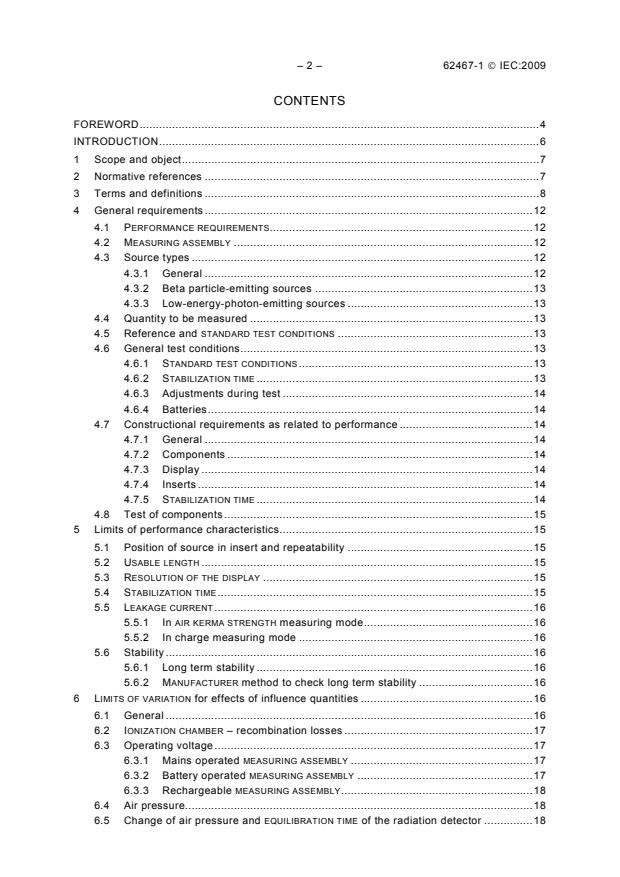
CONTENTS
FOREWORD.4
INTRODUCTION.6
1 Scope and object.7
2 Normative references .7
3 Terms and definitions .8
4 General requirements .12
4.1 PERFORMANCE REQUIREMENTS.12
4.2 MEASURING ASSEMBLY .12
4.3 Source types .12
4.3.1 General .12
4.3.2 Beta particle-emitting sources .13
4.3.3 Low-energy-photon-emitting sources .13
4.4 Quantity to be measured .13
4.5 Reference and STANDARD TEST CONDITIONS .13
4.6 General test conditions.13
4.6.1 STANDARD TEST CONDITIONS.13
4.6.2 STABILIZATION TIME .13
4.6.3 Adjustments during test .14
4.6.4 Batteries.14
4.7 Constructional requirements as related to performance .14
4.7.1 General .14
4.7.2 Components .14
4.7.3 Display .14
4.7.4 Inserts .14
4.7.5 STABILIZATION TIME .14
4.8 Test of components.15
5 Limits of performance characteristics.15
5.1 Position of source in insert and repeatability .15
5.2 USABLE LENGTH .15
5.3 RESOLUTION OF THE DISPLAY .15
5.4 STABILIZATION TIME.15
5.5 LEAKAGE CURRENT.16
5.5.1 In AIR KERMA STRENGTH measuring mode.16
5.5.2 In charge measuring mode .16
5.6 Stability .16
5.6.1 Long term stability .16
5.6.2 MANUFACTURER method to check long term stability .16
6 LIMITS OF VARIATION for effects of influence quantities .16
6.1 General .16
6.2 IONIZATION CHAMBER – recombination losses .17
6.3 Operating voltage.17
6.3.1 Mains operated MEASURING ASSEMBLY .17
6.3.2 Battery operated MEASURING ASSEMBLY .17
6.3.3 Rechargeable MEASURING ASSEMBLY.18
6.4 Air pressure.18
6.5 Change of air pressure and EQUILIBRATION TIME of the radiation detector .18
62467-1 © IEC:2009 – 3 –
6.5.1 VENTED WELL TYPE IONIZATION CHAMBERS .18
6.5.2 SEALED WELL TYPE IONIZATION CHAMBERS.19
6.6 Temperature and humidity.19
6.7 Length RESPONSE .19
6.8 Electromagnetic immunity.20
7 Marking .20
7.1 WELL-TYPE IONIZATION CHAMBER ASSEMBLY.20
7.2 MEASURING ASSEMBLY .20
8 ACCOMPANYING DOCUMENTS.20
8.1 General .20
8.2 Use of the instrument .20
8.3 Documentation .21
Bibliography.22
Index of defined terms .23
Table 1 – REFERENCE and STANDARD TEST CONDITIONS.13
Table 2 – LIMITS OF VARIATION for the effects of INFLUENCE QUANTITIES.17
– 4 – 62467-1 © IEC:2009
INTERNATIONAL ELECTROTECHNICAL COMMISSION
____________
MEDICAL ELECTRICAL EQUIPMENT –
DOSIMETRIC INSTRUMENTS AS USED IN BRACHYTHERAPY –
Part 1: Instruments based on well-type ionization chambers
FOREWORD
1) The International Electrotechnical Commission (IEC) is a worldwide organization for standardization comprising
all national electrotechnical committees (IEC National Committees). The object of IEC is to promote
international co-operation on all questions concerning standardization in the electrical and electronic fields. To
this end and in addition to other activities, IEC publishes International Standards, Technical Specifications,
Technical Reports, Publicly Available Specifications (PAS) and Guides (hereafter referred to as “IEC
Publication(s)”). Their preparation is entrusted to technical committees; any IEC National Committee interested
in the subject dealt with may participate in this preparatory work. International, governmental and non-
governmental organizations liaising with the IEC also participate in this preparation. IEC collaborates closely
with the International Organization for Standardization (ISO) in accordance with conditions determined by
agreement between the two organizations.
2) The formal decisions or agreements of IEC on technical matters express, as nearly as possible, an international
consensus of opinion on the relevant subjects since each technical committee has representation from all
interested IEC National Committees.
3) IEC Publications have the form of recommendations for international use and are accepted by IEC National
Committees in that sense. While all reasonable efforts are made to ensure that the technical content of IEC
Publications is accurate, IEC cannot be held responsible for the way in which they are used or for any
misinterpretation by any end user.
4) In order to promote international uniformity, IEC National Committees undertake to apply IEC Publications
transparently to the maximum extent possible in their national and regional publications. Any divergence
between any IEC Publication and the corresponding national or regional publication shall be clearly indicated in
the latter.
5) IEC provides no marking procedure to indicate its approval and cannot be rendered responsible for any
equipment declared to be in conformity with an IEC Publication.
6) All users should ensure that they have the latest edition of this publication.
7) No liability shall attach to IEC or its directors, employees, servants or agents including individual experts and
members of its technical committees and IEC National Committees for any personal injury, property damage or
other damage of any nature whatsoever, whether direct or indirect, or for costs (including legal fees) and
expenses arising out of the publication, use of, or reliance upon, this IEC Publication or any other IEC
Publications.
8) Attention is drawn to the Normative references cited in this publication. Use of the referenced publications is
indispensable for the correct application of this publication.
9) Attention is drawn to the possibility that some of the elements of this IEC Publication may be the subject of
patent rights. IEC shall not be held responsible for identifying any or all such patent rights.
International Standard IEC 62467-1 has been prepared by subcommittee 62C, Equipment for
radiotherapy, nuclear medicine and radiation dosimetry, of IEC technical committee 62,
Electrical equipment in medical practice.
The text of this standard is based on the following documents:
FDIS Report on voting
62C/460/FDIS 62C/468/RVD
Full information on the voting for the approval of this standard can be found in the report on
voting indicated in the above table.
This publication has been drafted in accordance with the ISO/IEC Directives, Part 2.
62467-1 © IEC:2009 – 5 –
A list of all parts of the IEC 62467 series, published under the general title Medical electrical
equipment – Dosimetric instruments as used in brachytherapy, can be found on the IEC
website.
In this standard the following print types are used: Requirements, compliance with which can
be tested, and definitions: in roman type;
– notes, explanations, advice, general statements and exceptions: in small roman type;
– test specifications: in italic type;
− TERMS USED THROUGHOUT THIS STANDARD THAT HAVE BEEN DEFINED IN CLAUSE 3 OR IN THE
PUBLICATIONS INDICATED IN THE INDEX OF DEFINED TERMS: IN SMALL CAPITALS.
The committee has decided that the contents of this publication will remain unchanged until
the maintenance result date indicated on the IEC web site under "http://webstore.iec.ch" in
the data related to the specific publication. At this date, the publication will be
• reconfirmed,
• withdrawn,
• replaced by a revised edition, or
• amended.
– 6 – 62467-1 © IEC:2009
INTRODUCTION
The wide range of WELL-TYPE IONIZATION CHAMBER instruments currently being used for
BRACHYTHERAPY sources indicates the need for a standard for uniformity in measurement and
test techniques for WELL-TYPE IONIZATION CHAMBER instruments. Measurements of the output of
BRACHYTHERAPY sources have distinct requirements that differ from the assay of sources used
in diagnostic nuclear medicine. This translates into the requirements for the measurement
devices. Many times similar instrumentation is used for both applications; however, there are
tighter requirements for those instruments used for BRACHYTHERAPY sources. Such devices
are composite systems consisting of an IONIZATION CHAMBER, either integrally coupled or
connected to appropriate electronic circuitry that converts the ionization current to a readout,
which can be converted to a quantity appropriate to the source being measured. The
ionization current produced can be either read directly or as accumulated charge (current
integrated over time) and then converted manually to the appropriate quantity, AIR KERMA
STRENGTH (REFERENCE AIR KERMA RATE) or ABSORBED DOSE TO WATER. The principles of
operation of the IONIZATION CHAMBER are well known and are not repeated here. In addition,
the readout device many times also has application to therapy uses and is well known.
Although this standard is written using the quantity AIR KERMA STRENGTH, the principles are the
same for other quantities such as REFERENCE AIR KERMA RATE.
In principle the quantity measured is the dose volume integral from which under specified
conditions the dose quantities AIR KERMA STRENGTH, REFERENCE AIR KERMA RATE, or ABSORBED
DOSE TO WATER at a depth can be deduced. The signal produced by the chamber is the
electrical current or charge, which is to be measured with an electrometer meeting criteria
according to IEC 60731. The current or charge is converted to the dosimetric quantity of
interest by means of a source type specific CALIBRATION FACTOR.
62467-1 © IEC:2009 – 7 –
MEDICAL ELECTRICAL EQUIPMENT –
DOSIMETRIC INSTRUMENTS AS USED IN BRACHYTHERAPY –
Part 1: Instruments based on well-type ionization chambers
1 Scope and object
This part of IEC 62467 specifies the performance and some related constructional
WELL-TYPE IONIZATION CHAMBERS and associated measurement apparatus, as
requirements of
defined in Clause 3, intended for the determination of a quantity, such as AIR KERMA STRENGTH
or REFERENCE AIR KERMA RATE in photon radiation fields or ABSORBED DOSE TO WATER at a
depth, in photon and beta radiation fields used in BRACHYTHERAPY, after appropriate
calibration for a given type of source.
This International Standard covers the techniques for the quantification of the quantity
BRACHYTHERAPY source under consideration. This quantity may be AIR
appropriate for the
KERMA STRENGTH or REFERENCE AIR KERMA RATE at 1 m, or ABSORBED DOSE TO WATER at a depth
(e.g. 2 mm or 5 mm). Measurement of these quantities may be accomplished by a variety of
WELL-TYPE IONIZATION CHAMBERS or systems currently available for this purpose. This standard
applies to products intended for low dose rate, high dose rate, intravascular, both photon and
beta, BRACHYTHERAPY measurements. It does not apply to instruments for nuclear medicine
WELL-
applications. The application of the standard is limited to instruments that incorporate
TYPE IONIZATION CHAMBERS as detectors.
The intended use is the measurement of the output of radioactive, encapsulated sources for
intracavitary (insertion into body cavities) or interstitial (insertion into body tissue)
applications.
The object of this standard is
a) to establish requirements for a satisfactory level of performance for WELL-TYPE CHAMBER
SYSTEMS, and
b) to standardize the methods for the determination of compliance with this level of
performance.
This standard is not concerned with the safety aspects of WELL-TYPE CHAMBER SYSTEMS. The
WELL-TYPE CHAMBER SYSTEMS covered by this standard are not intended for use in patient
environment. The electrical safety of WELL-TYPE CHAMBER SYSTEMS is covered in IEC 61010-1.
The operation of the electrometer measuring system is covered in IEC 60731.
2 Normative references
The following referenced documents are indispensable for the application of this document.
For dated references, only the edition cited applies. For undated references, the latest edition
of the referenced document (including any amendments) applies.
IEC 60050-393:2003, International Electrotechnical Vocabulary – Part 393: Nuclear
instrumentation – Physical phenomena and basic concepts
IEC 60417, Graphical symbols for use on equipment
IEC 60580:2003, Medical electrical equipment – Dose area product meters
– 8 – 62467-1 © IEC:2009
IEC 60601-1:2005, Medical electrical equipment – Part 1: General requirements for basic
safety and essential performance
IEC 60731:1997, Medical electrical equipment – Dosimeters with ionization chambers as used
in radiotherapy
IEC/TR 60788:2004, Medical electrical equipment – Glossary of defined terms
IEC 61187, Electrical and electronic measuring equipment – Documentation
IEC 61674:1997, Medical electrical equipment – Dosimeters with ionization chambers and/or
semi-conductor detectors as used in X-ray diagnostic imaging
ISO/IEC Guide 99, International vocabulary of metrology – Basic and general concepts and
associated terms (VIM)
3 Terms and definitions
For the purposes of this document the following definitions apply.
The definitions given in this standard are generally in agreement with those in IEC/TR 60788
and ISO/IEC Guide 99 (IVM). Any term not defined in this clause or in the relevant
publications cited in the Index of defined terms has the meaning defined in IEC/TR 60788 and
ISO/IEC Guide 99 or is assumed to be in general scientific usage.
3.1
absorbed dose to water
D
quotient of d ε by dm where d ε is the mean energy imparted by IONIZING RADIATION to water of
mass dm
–1
NOTE 1 The unit of ABSORBED DOSE TO WATER is Gy (where 1 Gy = 1 J·kg ).
NOTE 2 This definition is derived from the definition in C.4 of ICRU 33 (see Bibliography).
[IEC 60731:1997, definition 3.26]
3.2
air kerma strength
product of AIR KERMA RATE in free space (in vacuo) due to photons greater than a low energy
cut off and the square of the distance of the calibration point from the source centre along the
perpendicular bisector
NOTE 1 Energy cut-off is generally 5 keV.
NOTE 2 The unit is Gy m /s.
NOTE 3 In practice the unit μGy m /h is used frequently.
3.3
chamber assembly leakage current
leakage current
any current in the signal path arising in the CHAMBER ASSEMBLY which is not produced by
ionization in the measuring volume
NOTE It is distinguished from ZERO DRIFT or ZERO SHIFT which arises in the MEASURING ASSEMBLY.
62467-1 © IEC:2009 – 9 –
3.4
correction factor
dimensionless multiplier which corrects the INDICATED VALUE of an instrument from its value
when operated under particular conditions to its value when operated under stated REFERENCE
CONDITIONS
[IEC 60731:1997, definition 3.6]
3.5
effective range
effective range of indicated values
range of INDICATED VALUES for which an instrument complies with a stated performance
NOTE 1 The maximum (minimum) EFFECTIVE INDICATED VALUE is the highest (lowest) in this range.
NOTE 2 The concept of EFFECTIVE RANGE may, for example, also be applied to scale readings and to related
quantities not directly indicated by the instrument e.g. input current.
[IEC 60731:1997, definition 3.15]
3.6
equilibration time
time taken for a scale reading to reach and remain within a specified deviation from its final
steady value after a sudden change in an INFLUENCE QUANTITY has been applied to the
instrument
[IEC 60731:1997, definition 3.12.3]
3.7
error of measurement
difference remaining between the MEASURED VALUE of a quantity and the TRUE VALUE of that
quantity
[IEC 60731:1997, definition 3.5.1]
3.8
indicated value
value of a quantity derived from the scale reading of an instrument together with any scale
factors indicated on the control panel of the instrument
[IEC 60731:1997, definition 3.2]
3.9
influence quantity
any external quantity that may affect the performance of an instrument
[IEC 60731:1997, definition 3.7]
NOTE E.g. ambient temperature, radiation quality etc.
3.10
instrument parameter
any internal property of an instrument that may affect the performance of this instrument
[IEC 60731:1997, definition 3.8]
– 10 – 62467-1 © IEC:2009
3.11
measured value
best estimate of the TRUE VALUE of a quantity, being derived from the INDICATED VALUE of an
instrument together with the application of all relevant CORRECTION FACTORS and the
CALIBRATION FACTOR
[IEC 60731:1997, definition 3.5]
3.12
measuring assembly
device to measure the charge (or current) from the WELL-
TYPE IONIZATION CHAMBER and possibly convert it into a form suitable for the quantity to be
measured
3.13
overall uncertainty
uncertainty associated with the MEASURED VALUE
NOTE 1 I.e. representing the bounds within which the ERROR OF MEASUREMENT is estimated to lie.
[IEC 60731:1997, definition 3.5.2, modified]
NOTE 2 See also Clause 5.
3.14
reference air kerma rate
AIR KERMA RATE in free space (in vacuo) due to photons greater than a low energy cut off at
the distance of 1 m
NOTE 1 Energy cut-off is generally 5 keV.
NOTE 2 The unit is Gy/s.
NOTE 3 In practice the unit μGy/h is used frequently.
NOTE 4 The AIR KERMA STRENGTH is numerically identical to the REFERENCE AIR KERMA RATE.
3.15
reference conditions
conditions under which all influence quantities and INSTRUMENT PARAMETERS have their
REFERENCE VALUES
[IEC 60731:1997, definition 3.9.1]
3.16
reference point of a well-type chamber
point of maximum signal for a specified point source along the measuring length of a WELL-
TYPE IONIZATION CHAMBER
NOTE The term reference point is often referred to as "sweet spot".
3.17
reference value
particular value of an INFLUENCE QUANTITY or INSTRUMENT PARAMETER chosen for the purpose
of reference
[IEC 60731:1997, definition 3.9, modified]
NOTE I.e. the value of an INFLUENCE QUANTITY (or INSTRUMENT PARAMETER) at which the CORRECTION FACTOR for
dependence on that INFLUENCE QUANTITY (or INSTRUMENT PARAMETER) is unity.
62467-1 © IEC:2009 – 11 –
3.18
response
quotient of the INDICATED VALUE divided by the
CONVENTIONAL TRUE VALUE of the REFERENCE AIR KERMA RATE (in 1 m distance from the source)
3.19
sealed well-type ionization chamber
a WELL-TYPE IONIZATION CHAMBER constructed in such a way as to restrict the pathway between
the air inside the measuring volume and the atmosphere to insure that the RESPONSE of the
chamber is independent of changes in ambient conditions over a period of time stated by the
MANUFACTURER
3.20
stabilization time
time taken for a stated PERFORMANCE CHARACTERISTIC to reach and remain within a specified
deviation from its final steady value after the MEASURING ASSEMBLY has been switched on and
the polarizing voltage has been applied to the IONIZATION CHAMBER
[IEC 60731:1997, definition 3.12.5]
3.21
standard test conditions
conditions under which all INFLUENCE QUANTITIES and INSTRUMENT PARAMETERS have their
STANDARD TEST VALUES
[IEC 60731:1997, definition 3.10.1]
3.22
standard test value
value, values, or range of values of an INFLUENCE QUANTITY or INSTRUMENT PARAMETER, which
are permitted when carrying out calibrations or tests on another INFLUENCE QUANTITY or
INSTRUMENT PARAMETER
[IEC 60731:1997, definition 3.10]
3.23
stray radiation
for IONIZING RADIATION, all radiation except that of the specified RADIATION BEAM under
consideration, but including its RESIDUAL RADIATION
[IEC 60601-1-3:2008, 3.75]
3.24
true value
value of the physical quantity to be measured by an instrument
[IEC 60731:1997, definition 3.3]
3.25
usable length
length along the axis of a WELL-TYPE IONIZATION CHAMBER between the two points at which the
signal for a specified point source has fallen to a specified portion of the signal at the
REFERENCE POINT OF A WELL-TYPE CHAMBER
NOTE The term USABLE LENGTH is often referred to as "sweet length".
– 12 – 62467-1 © IEC:2009
3.26
vented well-type ionization chamber
a WELL-TYPE IONIZATION CHAMBER constructed in such a way as to allow the air inside the
measuring volume to communicate freely with the atmosphere such that corrections to the
RESPONSE for changes in air density need to be made
3.27
well-type chamber system
combined WELL-TYPE IONIZATION CHAMBER and MEASURING ASSEMBLY to obtain the reading
which can be converted to the quantity to be measured
3.28
well-type ionization chamber
detector in which the BRACHYTHERAPY source is inserted into the IONIZATION CHAMBER
NOTE The solid angle over which a WELL-TYPE IONIZATION CHAMBER is sensitive to radiation should be of the order
of 4 π, where the exact value of the solid angle is not relevant.
4 General requirements
4.1 PERFORMANCE REQUIREMENTS
Each of the components of a WELL-TYPE CHAMBER SYSTEM shall comply with the individual
requirements in the appropriate clauses or subclauses in addition to the general
requirements. The instruments shall be installed and operated in accordance with the
MANUFACTURER’s instructions.
In Clauses 5 and 6, the performance requirements are stated for a complete WELL-TYPE
CHAMBER SYSTEM including both the WELL-TYPE IONIZATION CHAMBER and MEASURING ASSEMBLY.
For a MEASURING ASSEMBLY designed to operate with one or more WELL-TYPE IONIZATION
CHAMBERS, each combination of the WELL-TYPE CHAMBER SYSTEM shall comply with the
requirements in 4.4, and in Clauses 5 and 6 relevant to this combination.
During the immunity tests for electromagnetic compatibility (see IEC 60731) BASIC SAFETY and
ESSENTIAL PERFORMANCE shall be guaranteed.
ESSENTIAL PERFORMANCE is guaranteed if the limits listed in Table 2 are not exceeded during
the immunity tests. ESSENTIAL PERFORMANCE is also ensured if during the immunity tests the
reading of the MEASURING ASSEMBLY, or the data output, are clearly characterized as invalid,
e.g. by means of a warning message or in case of a latch-up.
NOTE Examples for warning messages for invalid readings are high voltage error or overload messages.
4.2 MEASURING ASSEMBLY
The MEASURING ASSEMBLY shall conform to field class instruments of IEC 60731, unless stated
otherwise.
4.3 Source types
4.3.1 General
The BRACHYTHERAPY source determines the insert used in the WELL-TYPE IONIZATION CHAMBER.
For each BRACHYTHERAPY source type, the MANUFACTURER of the WELL-TYPE IONIZATION
CHAMBER shall specify the insert type to be used. The tests below shall be made with the
insert type specified by the MANUFACTURER of the WELL-TYPE IONIZATION CHAMBER.
62467-1 © IEC:2009 – 13 –
4.3.2 Beta particle-emitting sources
Measurements on beta particle-emitting sources of the same radionuclide and activity will
vary greatly with insert composition (for example glass versus plastic) and wall thickness.
Some inserts depend on a measure of BREMSSTRAHLUNG produced by the deceleration of the
beta particles in the insert material; other inserts are designed to measure the betas directly.
Reproducible measurements depend upon consistent insert selection and consistency in the
manner in which the instrument is used.
4.3.3 Low-energy-photon-emitting sources
The wall thickness of the insert plus the thickness of the interior wall of the WELL-TYPE
IONIZATION CHAMBER may cause a significant attenuation for low-energy photons. Wide
variations in wall materials and source materials may result in variations in RESPONSE.
4.4 Quantity to be measured
The following quantities are used: AIR KERMA STRENGTH in units of Gy m /s, ABSORBED DOSE
RATE TO WATER at a specified distance from the source in units of Gy/s, REFERENCE AIR KERMA
RATE in units of Gy/s.
NOTE In practice the units Gy m /h and Gy/h are used frequently.
4.5 Reference and STANDARD TEST CONDITIONS
The values of the reference and STANDARD TEST CONDITIONS are given in Table 1.
Table 1 – REFERENCE and STANDARD TEST CONDITIONS
INFLUENCE QUANTITY REFERENCE VALUES STANDARD TEST VALUES
Temperature +20 °C +15 °C to +25 °C
Relative humidity 50 % 30 % to 75 %
Air pressure 101,3 kPa Atmospheric pressure
STABILIZATION TIME 15 min after switch-on ≥ 15 min after switch-on
Polarizing voltage Stated by MANUFACTURER
REFERENCE VALUE ±5 %
STRAY RADIATION Zero As small as possible
Saturation losses Full saturation ≤ 1 % saturation loss
Electromagnetic fields Zero Insignificant
4.6 General test conditions
4.6.1 STANDARD TEST CONDITIONS
The STANDARD TEST CONDITIONS listed in Table 1 shall be met during the test procedure except
a) for the INFLUENCE QUANTITY under investigation;
b) where local conditions of temperature and relative humidity are outside the STANDARD TEST
CONDITIONS. In this case the tester shall demonstrate the validity of the test results.
TABILIZATION TIME
4.6.2 S
Before the start of the compliance test, the instrument under test shall be switched on for at
least the STABILIZATION TIME.
– 14 – 62467-1 © IEC:2009
In addition, the WELL-TYPE IONIZATION CHAMBER should be allowed to attain thermal equilibrium
with the environment and should have the polarizing voltage applied for a period of time equal
to or greater than the specified STABILIZATION TIME.
4.6.3 Adjustments during test
Compliance tests shall be performed with the instrument under test ready for use, after the
STABILIZATION TIME and after making any necessary preliminary adjustments. During the tests,
adjustments may be repeated at intervals as long as they do not interfere with the effect to be
verified. For example, zero setting is not permitted during tests for measuring the LEAKAGE
CURRENT.
4.6.4 Batteries
Battery-operated instruments under test shall be equipped with fully charged batteries, of the
type specified by the MANUFACTURER, unless operating on an external power source.
4.7 Constructional requirements as related to performance
4.7.1 General
Compliance with the constructional requirement on components shall be checked by
inspection.
4.7.2 Components
If a MEASURING ASSEMBLY has several ranges or scales, all ranges, scales and components
shall be unmistakably and unambiguously identified.
4.7.3 Display
4.7.3.1 Quantities of measurement
The indicated unit shall be that of the measuring quantity: AIR KERMA STRENGTH, ABSORBED
DOSE TO WATER, REFERENCE AIR KERMA RATE, amperes (which can be converted to AIR KERMA
STRENGTH) i.e. Gy m /h, or A respectively, with SI prefix e.g. m or µ.
4.7.3.2 Indication of battery condition
Battery-operated MEASURING ASSEMBLIES shall be provided with a low battery indication for any
battery voltage below the RATED RANGE.
4.7.3.3 Indication of polarizing voltage failure
MEASURING ASSEMBLIES intended for use with WELL-TYPE IONIZATION CHAMBERS shall be
provided with a means of indicating if the polarizing voltage does not meet the
MANUFACTURER'S requirement for satisfactory operation.
4.7.4 Inserts
The MANUFACTURER shall supply inserts for the type of sources for which the WELL-TYPE
IONIZATION CHAMBER is to be used. The inserts shall be constructed in a way that the source
can be located at the REFERENCE POINT OF A WELL-TYPE IONIZATION CHAMBER to within ±1 mm.
The MANUFACTURER shall specify for which types of sources a given insert may be used.
NOTE In some calibrations, the insert is an integral part of the calibration arrangement. Use of an alternative
insert voids the calibration.
4.7.5 STABILIZATION TIME
The STABILIZATION TIME shall not be greater than 15 min.
62467-1 © IEC:2009 – 15 –
4.8 Test of components
The preferred procedure for verifying that the performance requirements are met is to test the
components separately, in which case:
a) tests on the MEASURING ASSEMBLY shall be carried out using a current or charge source of
sufficient characteristics to meet the objective of the test;
b) tests on the WELL-TYPE IONIZATION CHAMBER shall be performed using a MEASURING
ASSEMBLY with sufficient characteristics to meet the objective of the test.
Some tests should be carried out using the complete WELL-TYPE CHAMBER SYSTEM. In
particular, this is the preferred method for investigating the effects of radio-frequency
electromagnetic fields and electrostatic discharges on a cable-connected WELL-TYPE
IONIZATION CHAMBER supplied with a MEASURING ASSEMBLY as a system. Some tests performed
with the whole system cannot give information as to whether the origin of a VARIATION lies in
the CHAMBER ASSEMBLY or in the MEASURING ASSEMBLY (e.g. LEAKAGE CURRENT and ZERO DRIFT).
If a complete system is tested and the relevant INFLUENCE QUANTITY affects both parts, the
quadrate sum of the separate LIMITS OF VARIATION may be taken as an overall LIMIT OF
VARIATION.
When a WELL-TYPE IONIZATION CHAMBER and a MEASURING ASSEMBLY are tested separately, but
supplied as a system, the two components shall be connected and the combined equipment
shall have a measured overall RESPONSE within ±0,5 % of the overall RESPONSE calculated
from the RESPONSES of the separate assemblies.
5 Limits of performance characteristics
5.1 Position of source in insert and repeatability
Repetitive positioning of the source at the REFERENCE POINT OF A WELL-TYPE CHAMBER shall
give a standard deviation of the readings of 1 % or less.
Compliance shall be checked by inserting the source repeatedly at least ten times and
determining the standard deviation of the readings. The test shall be conducted with a source
in which the radioactive material remains in a stable position, e.g. a Ir-source.
5.2 USABLE LENGTH
The USABLE LENGTH shall be considered to be the length where the relative RESPONSE falls to
97 % of the maximum.
Compliance shall be checked by stepping a small source 5 mm or less, using the centre of the
source as the point of reference) through the axis of the chamber and determining the relative
RESPONSE.
5.3 RESOLUTION OF THE DISPLAY
Within the whole EFFECTIVE RANGE of INDICATED VALUES the RESOLUTION OF THE DISPLAY shall
be equal to or better than 0,5 % of the reading.
Compliance with this performance requirement shall be checked by inspection.
5.4 STABILIZATION TIME
After the STABILIZATION TIME, the LIMITS OF VARIATION of RESPONSE shall be within ±0,5 % of the
steady state value of the RESPONSE.
– 16 – 62467-1 © IEC:2009
Compliance with this performance requirement shall be checked by determining the RESPONSE
of the instrument under the same conditions as at calibration, after the STABILIZATION TIME and
30 min, 45 min and 1 h after the MEASURING ASSEMBLY has been switched on.
5.5 LEAKAGE CURRENT
5.5.1 In AIR KERMA STRENGTH measuring mode
On all AIR KERMA STRENGTH ranges, the LEAKAGE CURRENT of a WELL-TYPE CHAMBER SYSTEM
shall not exceed 1,0 % of the current corresponding to the minimum AIR KERMA STRENGTH of
the range in use for at least 1 min, after any compensation adjustment has been made.
Compliance with this performance requirement shall be checked for each allowable
combination of AIR KERMA STRENGTH range and CHAMBER ASSEMBLY, by measuring the LEAKAGE
CURRENT in the "measure" condition with the relevant WELL-TYPE IONIZATION CHAMBER
connected.
5.5.2 In charge measuring mode
On all charge measuring ranges, when the MEASURING ASSEMBLY is left in the "measure"
condition after being exposed to greater than 75 % of full scale, the INDICATED VALUE shall not
change by more than 0,5 % per minute.
Compliance with this performance requirement shall be checked for each allowable
combination of AIR KERMA STRENGTH range and DETECTOR ASSEMBLY, by exposing the well-
type chamber detector until the display reads just below the stated full scale, then observing
the rate of change of scale reading whilst keeping the MEASURING ASSEMBLY in the "measure"
condition. (This is for charge measuring mode, add req. that current reading has to go down
to 1,0 % of minimum AIR KERMA STRENGTH range, see 5.6.1.)
5.6 Stability
5.6.1 Long term stability
The VARIATION of RESPONSE when the WELL-TYPE IONIZATION CHAMBER is irradiated under
REFERENCE CONDITIONS shall not be greater than ±1,0 % per year (chamber alone).
Compliance with this performance requirement shall be verified by retaining a representative
MEASURING ASSEMBLY and CHAMBER ASSEMBLY(IES), stored under STANDARD TEST CONDITIONS,
and investigating their combined long-term stability by making measurements under
REFERENCE CONDITIONS at one month intervals over a period of not less than six months and
then using regression analysis to extrapolate these readings to obtain the change in
RESPONSE over one full year. It is permissible to perform the tests on the MEASURING and
CHAMBER ASSEMBLIES separately. (Sealed chamber should be kept at a pressure different from
137 60
that in the interior by at least a factor of two.)The same source shall be used. Cs or Co is
recommended for the source.
5.6.2 MANUFACTURER method to check long term stability
The MANUFACTURER shall provide a test method as a means to check long term stability.
6 LIMITS OF VARIATION for effects of influence quantities
6.1 General
The LIMITS OF VARIATION ±L due to the effects of INFLUENCE QUANTITIES are summarized in
Table 2. For any change of an INFLUENCE QUANTITY within its RATED RANGE the change of the
MEASURING ASSEMBLIES RESPONSE shall not be greater than the values in column 4 of Table 2.
62467-1 © IEC:2009 – 17 –
Table 2 – LIMITS OF VARIATION for the effects of INFLUENCE QUANTITIES
LIMITS OF Sub-
INFLUENCE QUANTITY Minimum RATED RANGE REFERENCE CONDITIONS
VARIATION L clause
Operating voltage –15 % to +10 % Nominal voltage ±0,5 % 6.3
mains as stated by the
batteries MANUFACTURER
a)
Air pressure, temperature, 80,0 to 106,0 kPa 101,3 kPa 6.
...