

IEC 62305-3:2006
(Main)Protection against lightning - Part 3: Physical damage to structures and life hazard
General Information
- Abstract
Provides the requirements for protection of a structure against physical damage by means of a lightning protection system (LPS), and for protection against injury to living beings due to touch and step voltages in the vicinity of an LPS (see IEC 62305-1). This standard is applicable to: a) design, installation, inspection and maintenance of an LPS for structures without limitation of their height; b) establishment of measures for protection against injury to living beings due to touch and step voltages.
- Status
- Published
- Publication Date
- 16-Jan-2006
- Technical Committee
- TC 81 - Lightning protection
- Current Stage
- DELPUB - Deleted Publication
- Start Date
- 09-Dec-2010
- Completion Date
- 28-Aug-2026
Buy Documents
IEC 62305-3:2006 - Protection against lightning - Part 3: Physical damage to structures and life hazard Released:1/17/2006
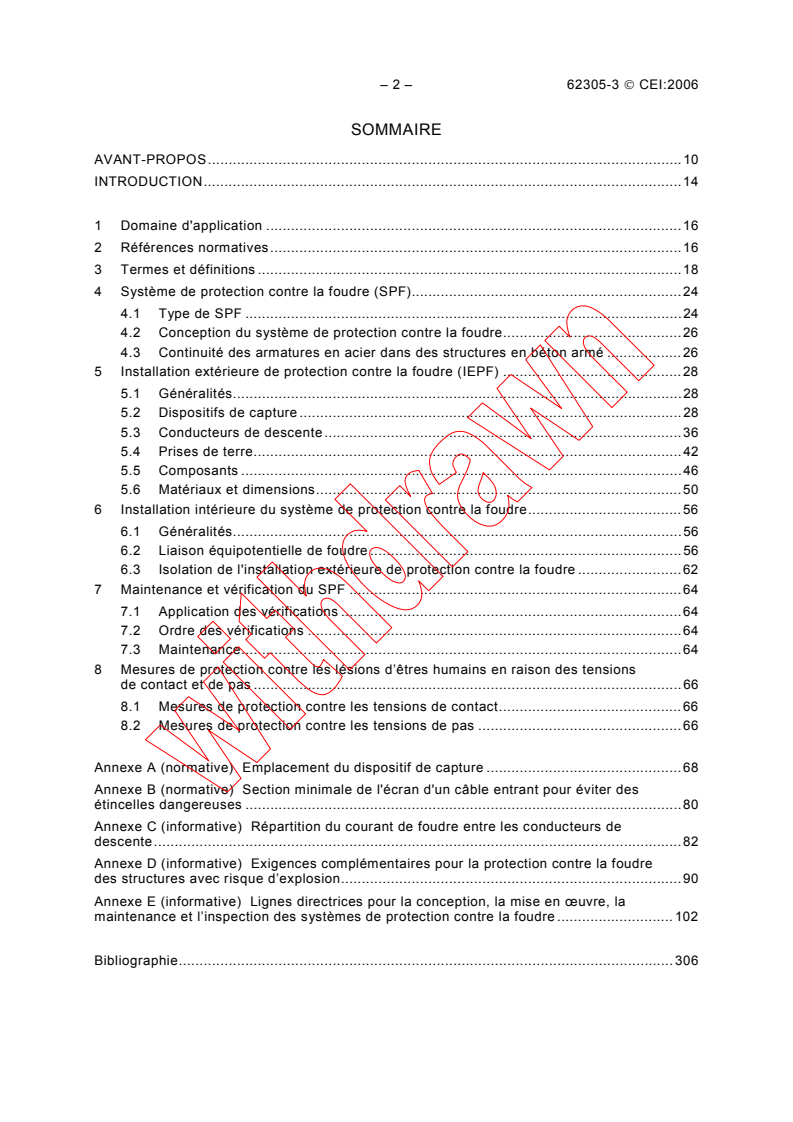
IEC 62305-3:2006 - Protection contre la foudre - Partie 3: Dommages physiques sur les structures et risques humains Released:1/17/2006
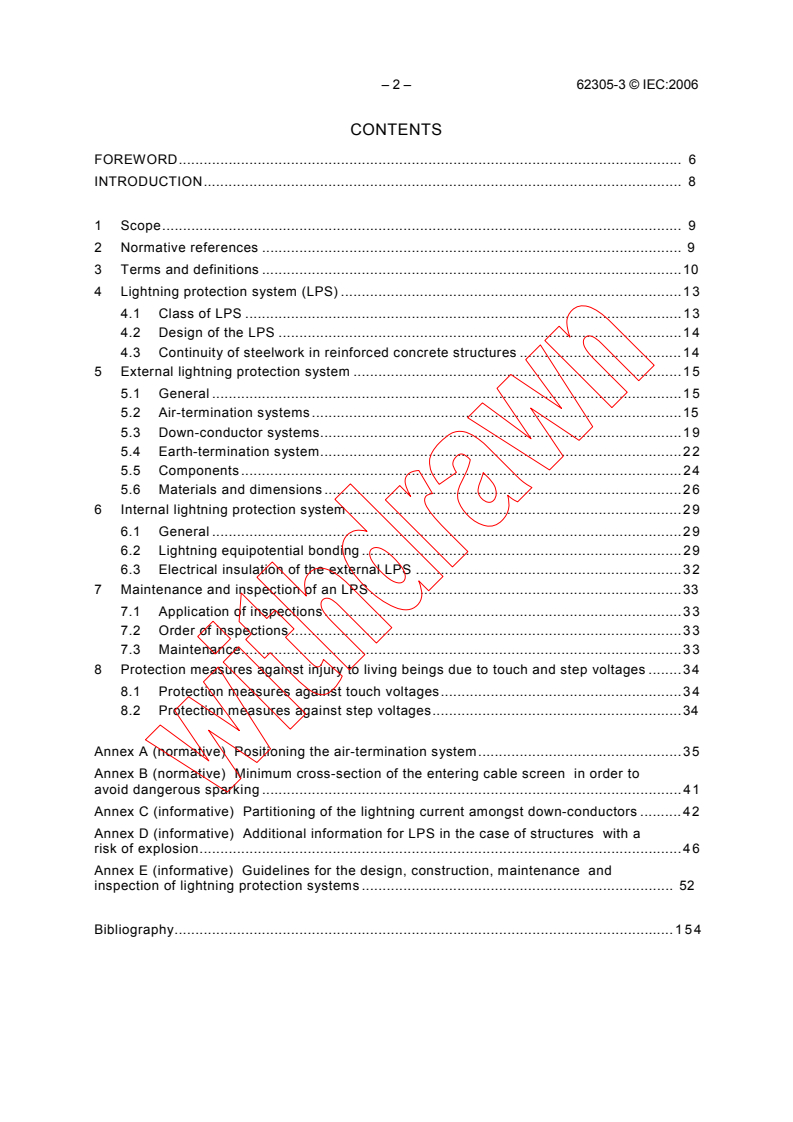
IEC 62305-3:2006 - Protection against lightning - Part 3: Physical damage to structures and life hazard Released:1/17/2006
Overview
IEC 62305-3:2006 - Protection against lightning, Part 3: Physical damage to structures and life hazard defines requirements for designing, installing, inspecting and maintaining a lightning protection system (LPS) to prevent physical damage to structures and reduce life hazard from touch and step voltages. Part 3 complements IEC 62305-1 (risk management) and applies to structures of any height, and to measures protecting living beings in the vicinity of an LPS.
Key topics and technical requirements
The standard covers both external and internal aspects of lightning protection and includes normative and informative guidance:
- LPS classes and design: relationship between lightning protection level (LPL) and LPS class; selection criteria for protection concept.
- Air-termination systems: methods for intercepting lightning (protective angle, rolling sphere, mesh methods) and positioning of rods, wires and meshes.
- Down-conductors: routing, continuity, loops and separation to minimise side flashes and induced currents.
- Earth-termination systems: electrode types, layout and connection to dissipate lightning current safely to ground.
- Internal protection: lightning equipotential bonding, separation distances and insulation to protect internal installations and avoid hazardous potentials.
- Protection against touch and step voltages: measures to limit dangerous voltages for people near the LPS.
- Materials, components and dimensions: minimum cross-sections, material selection and construction details for conductors and electrodes.
- Inspection and maintenance: procedures and intervals for verifying continuity, corrosion and system integrity.
- Annex guidance: normative annexes for air-termination positioning and cable-screening; informative annexes with design examples, partitioning of lightning current, and special guidance for explosive-risk structures.
Practical applications and who uses it
IEC 62305-3 is essential for:
- Electrical, civil and structural engineers designing buildings and industrial plants
- Lightning protection designers and installers specifying LPS, air-termination and earthing systems
- Facility managers and safety officers responsible for inspection, maintenance and regulatory compliance
- Consultants assessing life-safety risks from touch and step voltages
- Project teams integrating lightning protection with power and communications earthing and bonding
Use this standard when specifying an LPS, preparing technical drawings and procurement documents, or establishing inspection and maintenance regimes.
Related standards
- IEC 62305-1 (general principles and risk management)
- Other parts of the IEC 62305 series covering surge protection, structural fire protection and additional implementation details
Keywords: IEC 62305-3:2006, lightning protection, LPS, air-termination, down-conductor, earth-termination, equipotential bonding, touch and step voltages, rolling sphere method.
Relations
- Effective Date
- 05-Sep-2023
- Effective Date
- 05-Sep-2023
- Effective Date
- 05-Sep-2023
Buy Documents
IEC 62305-3:2006 - Protection against lightning - Part 3: Physical damage to structures and life hazard Released:1/17/2006
IEC 62305-3:2006 - Protection contre la foudre - Partie 3: Dommages physiques sur les structures et risques humains Released:1/17/2006
IEC 62305-3:2006 - Protection against lightning - Part 3: Physical damage to structures and life hazard Released:1/17/2006
Get Certified
Connect with accredited certification bodies for this standard

DIBt (Deutsches Institut für Bautechnik)
German Institute for Building Technology.
DIN CERTCO
DIN Group product certification.

IMQ S.p.A. (Certification)
Italian electrical product certification.
Sponsored listings
Frequently Asked Questions
IEC 62305-3:2006 is a standard published by the International Electrotechnical Commission (IEC). Its full title is "Protection against lightning - Part 3: Physical damage to structures and life hazard". This standard covers: Provides the requirements for protection of a structure against physical damage by means of a lightning protection system (LPS), and for protection against injury to living beings due to touch and step voltages in the vicinity of an LPS (see IEC 62305-1). This standard is applicable to: a) design, installation, inspection and maintenance of an LPS for structures without limitation of their height; b) establishment of measures for protection against injury to living beings due to touch and step voltages.
Provides the requirements for protection of a structure against physical damage by means of a lightning protection system (LPS), and for protection against injury to living beings due to touch and step voltages in the vicinity of an LPS (see IEC 62305-1). This standard is applicable to: a) design, installation, inspection and maintenance of an LPS for structures without limitation of their height; b) establishment of measures for protection against injury to living beings due to touch and step voltages.
IEC 62305-3:2006 is classified under the following ICS (International Classification for Standards) categories: 29.020 - Electrical engineering in general; 91.120.40 - Lightning protection. The ICS classification helps identify the subject area and facilitates finding related standards.
IEC 62305-3:2006 has the following relationships with other standards: It is inter standard links to IEC 61024-1-2:1998, IEC 61024-1:1990, IEC 62305-3:2010. Understanding these relationships helps ensure you are using the most current and applicable version of the standard.
IEC 62305-3:2006 is available in PDF format for immediate download after purchase. The document can be added to your cart and obtained through the secure checkout process. Digital delivery ensures instant access to the complete standard document.
Standards Content (Sample)
INTERNATIONAL IEC
STANDARD 62305-3
First edition
2006-01
Protection against lightning –
Part 3:
Physical damage to structures
and life hazard
This English-language version is derived from the original
bilingual publication by leaving out all French-language
pages. Missing page numbers correspond to the French-
language pages.
Reference number
Publication numbering
As from 1 January 1997 all IEC publications are issued with a designation in the
60000 series. For example, IEC 34-1 is now referred to as IEC 60034-1.
Consolidated editions
The IEC is now publishing consolidated versions of its publications. For example,
edition numbers 1.0, 1.1 and 1.2 refer, respectively, to the base publication, the
base publication incorporating amendment 1 and the base publication incorporating
amendments 1 and 2.
Further information on IEC publications
The technical content of IEC publications is kept under constant review by the IEC,
thus ensuring that the content reflects current technology. Information relating to
this publication, including its validity, is available in the IEC Catalogue of
publications (see below) in addition to new editions, amendments and corrigenda.
Information on the subjects under consideration and work in progress undertaken
by the technical committee which has prepared this publication, as well as the list
of publications issued, is also available from the following:
• IEC Web Site (www.iec.ch)
• Catalogue of IEC publications
The on-line catalogue on the IEC web site (www.iec.ch/searchpub) enables you to
search by a variety of criteria including text searches, technical committees
and date of publication. On-line information is also available on recently issued
publications, withdrawn and replaced publications, as well as corrigenda.
• IEC Just Published
This summary of recently issued publications (www.iec.ch/online_news/ justpub)
is also available by email. Please contact the Customer Service Centre (see
below) for further information.
• Customer Service Centre
If you have any questions regarding this publication or need further assistance,
please contact the Customer Service Centre:
Email: custserv@iec.ch
Tel: +41 22 919 02 11
Fax: +41 22 919 03 00
INTERNATIONAL IEC
STANDARD 62305-3
First edition
2006-01
Protection against lightning –
Part 3:
Physical damage to structures
and life hazard
© IEC 2006 Copyright - all rights reserved
No part of this publication may be reproduced or utilized in any form or by any means, electronic or mechanical,
including photocopying and microfilm, without permission in writing from the publisher.
International Electrotechnical Commission, 3, rue de Varembé, PO Box 131, CH-1211 Geneva 20, Switzerland
Telephone: +41 22 919 02 11 Telefax: +41 22 919 03 00 E-mail: inmail@iec.ch Web: www.iec.ch
PRICE CODE
XG
Commission Electrotechnique Internationale
International Electrotechnical Commission
МеждународнаяЭлектротехническаяКомиссия
For price, see current catalogue
62305-3 © IEC:2006 – 3 –
CONTENTS
FOREWORD.11
INTRODUCTION.15
1 Scope.17
2 Normative references .17
3 Terms and definitions .19
4 Lightning protection system (LPS) .25
4.1 Class of LPS .25
4.2 Design of the LPS .27
4.3 Continuity of steelwork in reinforced concrete structures .27
5 External lightning protection system .29
5.1 General .29
5.2 Air-termination systems.29
5.3 Down-conductor systems.37
5.4 Earth-termination system.43
5.5 Components .47
5.6 Materials and dimensions .51
6 Internal lightning protection system .57
6.1 General .57
6.2 Lightning equipotential bonding .57
6.3 Electrical insulation of the external LPS .63
7 Maintenance and inspection of an LPS .65
7.1 Application of inspections.65
7.2 Order of inspections .65
7.3 Maintenance.65
8 Protection measures against injury to living beings due to touch and step voltages .67
8.1 Protection measures against touch voltages.67
8.2 Protection measures against step voltages.67
Annex A (normative) Positioning the air-termination system.69
Annex B (normative) Minimum cross-section of the entering cable screen in order to
avoid dangerous sparking .81
Annex C (informative) Partitioning of the lightning current amongst down-conductors .83
Annex D (informative) Additional information for LPS in the case of structures with a
risk of explosion.91
Annex E (informative) Guidelines for the design, construction, maintenance and
inspection of lightning protection systems .103
Bibliography.307
62305-3 © IEC:2006 – 5 –
Figure 1 – Loop in a down-conductor .39
Figure 2 – Minimum length l of each earth electrode according to the class of LPS.43
Figure A.1 – Volume protected by a vertical air-termination rod .69
Figure A.2 – Volume protected by a vertical air-termination rod .71
Figure A.3 – Volume protected by a wire air-termination system .71
Figure A.4 – Volume protected by isolated wires combined in a mesh according to the
protective angle method and rolling sphere method .73
Figure A.5 – Volume protected by non-isolated wires combined in a mesh according to
the mesh method and the protective angle method .75
Figure A.6 – Design of an air-termination system according to the rolling sphere
method .77
Figure C.1 – Values of coefficient k in the case of a wire air-termination system and a
c
type B earth-termination system.85
Figure C.2 – Values of coefficient k in the case of a mesh air-termination system and
c
type B earth-termination system.87
Figure C.3 – Examples of calculation of the separation distance in the case of a
meshed air-termination system, an interconnecting ring of the down-conductors at
each level and a type B earth-termination system .89
Figure E.1 – LPS design flow diagram .107
Figure E.2 – Values of coefficient k in case of a sloped roof with air-termination on
c
the ridge and a type B earthing system .121
Figure E.3 – LPS design for a cantilevered part of a structure.123
Figure E.4 – Equipotential bonding in a structure with a steel reinforcement .127
Figure E.5 – Welded joints of reinforcing rods in reinforced concrete, if permitted.129
Figure E.6 – Example of clamps used as joints between reinforcing rods and
conductors.131
Figure E.7 – Examples for connection points to the reinforcement in a reinforced
concrete wall .133
Figure E.8 – Use of metallic facade as natural down-conductor system and connection
of facade supports .141
Figure E.9 – Connection of the continuous strip windows to a metal façade covering.143
Figure E.10 – Internal down-conductors in industrial structures.149
Figure E.11– Installation of bonding conductors in reinforced concrete structures and
flexible bonds between two reinforced concrete parts .153
Figure E.12 – Protective angle method air-termination design for different heights
according to Table 2 .161
Figure E.13 – Isolated external LPS using two isolated air-termination masts designed
according to the protective angle air-termination design method .163
Figure E.14 – Isolated external LPS using two isolated air-termination masts,
interconnected by horizontal catenary wire .165
Figure E.15 – Example of design of an air-termination of a non-isolated LPS by air-
termination rods.167
Figure E.16 – Example of design of an air-termination of a non isolated LPS by a
horizontal wire according to the protective angle air-termination design method .169
Figure E.17 – Protected volume of an air- termination rod or mast on a sloped surface.171
62305-3 © IEC:2006 – 7 –
Figure E.18 – Design of an LPS air-termination according to the rolling sphere method,
protective angle method, mesh method and general arrangement of air-termination
elements.175
Figure E.19 – Design of an LPS air-termination conductor network on a structure with
complicated shape.177
Figure E.20 – Space protected by two parallel air-termination horizontal wires or two
air-termination rods (r > h ).179
t
Figure E.21 – Points at which lightning will strike a building.183
Figure E.22 – Example of design of non-isolated LPS air-termination according to the
mesh method air-termination design .191
Figure E.23 – Some examples of details of an LPS on a structure with sloped tiled roofs.197
Figure E.24 – Construction of an LPS using natural components on the roof of the
structure .201
Figure E.25 – Positioning of the external LPS on a structure made of insulating
material e.g. wood or bricks with a height up to 60 m with flat roof and with roof fixtures .203
Figure E.26 – Construction of air-termination network on a roof with conductive
covering where puncturing of the covering is not acceptable.205
Figure E.27 – Construction of external LPS on a structure of steel-reinforced concrete
using the reinforcement of the outer walls as natural components.207
Figure E.28 – Example of an air-termination stud used on car park roofs .209
Figure E.29 – Air-termination rod used for protection of a metallic roof fixture with
electric power installations which are not bonded to the air-termination system .211
Figure E.30 – Method of achieving electrical continuity on metallic parapet cladding .213
Figure E.31 – Metallic roof fixture protected against direct lightning interception,
connected to air-termination system.219
Figure E.32 – Example of construction of lightning protection of a house with a TV
antenna using the mast as an air-termination rod.223
Figure E.33 – Installation of lightning protection of metallic equipment on a roof against
a direct lightning flash.225
Figure E.34 – Connection of natural air-termination rod to air-termination conductor.229
Figure E.35 – Construction of the bridging between the segments of the metallic
façade plates .231
Figure E.36 – Installation of external LPS on a structure of isolating material with
different roof levels .235
Figure E.37 – Examples of geometry of LPS conductors .237
Figure E.38 – Construction of an LPS using only two down-conductors and foundation
earth electrodes.239
Figure E.39 – Examples of connection of earth termination to the LPS of structures
using natural down-conductors (girders) and detail of a test joint .247
Figure E.40 – Construction of foundation earth ring for structures of different
foundation design .255
Figure E.41 – Examples of two vertical electrodes in type A earthing arrangement .259
Figure E.42 – Meshed earth termination system of a plant .267
62305-3 © IEC:2006 – 9 –
Figure E.43 – Examples of separation distance between the LPS and metal
installations .279
Figure E.44 – Directions for calculations of the separation distance s for a worst case
lightning interception point at a distance l from the reference point according to 6.3 .281
Figure E.45 – Example of an equipotential bonding arrangement .287
Figure E.46 – Example of bonding arrangement in a structure with multiple point
entries of external conductive parts using a ring electrode for interconnection of
bonding bars.289
Figure E.47 – Example of bonding in the case of multiple point entries of external
conductive parts and an electric power or communication line using an internal ring
conductor for interconnection of the bonding bars .291
Figure E.48 – Example of bonding arrangement in a structure with multiple point
entries of external conductive parts entering the structure above ground level .293
Table 1 – Relation between lightning protection levels (LPL) and class of LPS (see
IEC 62305-1) .25
Table 2 – Maximum values of rolling sphere radius, mesh size and protection angle
corresponding to the class of LPS.31
Table 3 – Minimum thickness of metal sheets or metal pipes in air-termination systems .35
Table 4 – Typical values of the distance between down-conductors and between ring
conductors according to the class of LPS.39
Table 5 – LPS materials and conditions of use.49
Table 6 – Material, configuration and minimum cross-sectional area of air-termination
conductors, air-termination rods and down-conductors.53
Table 7 – Material, configuration and minimum dimensions of earth electrodes.55
Table 8 – Minimum dimensions of conductors connecting different bonding bars or
connecting bonding bars to the earth-termination system.59
Table 9 – Minimum dimensions of conductors connecting internal metal installations to
the bonding bar.59
Table 10 – Isolation of external LPS – Values of coefficient k .63
i
Table 11 – Isolation of external LPS – Values of coefficient k .63
c
Table 12 – Isolation of external LPS – Values of coefficient k .65
m
Table B.1 – Cable length to be considered according to the condition of the screen.81
Table C.1 – Values of coefficient k .83
c
Table E.1 – Suggested fixing centres.193
Table E.2 – Maximum period between inspections of an LPS.297
62305-3 © IEC:2006 – 11 –
INTERNATIONAL ELECTROTECHNICAL COMMISSION
___________
PROTECTION AGAINST LIGHTNING –
Part 3: Physical damage to structures and life hazard
FOREWORD
1) The International Electrotechnical Commission (IEC) is a worldwide organization for standardization comprising
all national electrotechnical committees (IEC national committees). The object of the IEC is to promote
international cooperation on all questions concerning standardization in the electrical and electronic fields. To
this end and in addition to other activities, the IEC publishes international standards, technical specifications,
technical reports, publicly available specifications (PAS) and guides (hereafter referred to as “IEC
publication(s)”). Their preparation is entrusted to technical committees; any IEC national committee interested
in the subject dealt with may participate in this preparatory work. International, governmental and non-
governmental organizations liaising with the IEC also participate in this preparation. The IEC collaborates
closely with the International Organization for Standardization (ISO) in accordance with conditions determined
by agreement between the two organizations.
2) The formal decisions or agreements of the IEC on technical matters express, as nearly as possible, an
international consensus of opinion on the relevant subjects since each technical committee has representation
from all interested IEC national committees.
3) IEC publications have the form of recommendations for international use and are accepted by IEC national
committees in that sense. While all reasonable efforts are made to ensure that the technical content of IEC
publications is accurate, the IEC cannot be held responsible for the way in which they are used or for any
misinterpretation by any end user.
4) In order to promote international uniformity, IEC national committees undertake to apply IEC publications
transparently to the maximum extent possible in their national and regional publications. Any divergence
between any IEC publication and the corresponding national or regional publication shall be clearly indicated in
the latter.
5) The IEC provides no marking procedure to indicate its approval and cannot be rendered responsible for any
equipment declared to be in conformity with an IEC publication.
6) All users should ensure that they have the latest edition of this publication.
7) No liability shall attach to the IEC or its directors, employees, servants or agents including individual experts
and members of its technical committees and IEC national committees for any personal injury, property damage
or other damage of any nature whatsoever, whether direct or indirect, or for costs (including legal fees) and
expenses arising out of the publication, use of, or reliance upon, this IEC publication or any other IEC
publications.
8) Attention is drawn to the normative references cited in this publication. Use of the referenced publications is
indispensable for the correct application of this publication.
9) Attention is drawn to the possibility that some of the elements of this IEC publication may be the subject of
patent rights. The IEC shall not be held responsible for identifying any or all such patent rights.
International standard IEC 62305-3 has been prepared by IEC technical committee 81:
Lightning protection.
The IEC 62305 series (Parts 1 to 5), is produced in accordance with the new Publications`
Plan, approved by National Committees (81/171/RQ (2001-06-29)), which restructures in a
more simple and rational form and updates the Publications of the IEC 61024 series, the IEC
61312 series and the IEC 61663 series.
The text of this first edition of IEC 62305-3 is compiled from and replaces
– IEC 61024-1, first edition (1990).
– IEC 61024-1-2, first edition (1998).
62305-3 © IEC:2006 – 13 –
The text of this standard is based on the following documents:
FDIS Report on voting
81/264/FDIS 81/269/RVD
Full information on the voting for the approval of this standard can be found in the report on
voting indicated in the above Table.
This publication has been drafted, as close as possible, in accordance with the ISO/IEC
Directives, Part 2.
IEC 62305 consists of the following parts, under the general title Protection against lightning:
Part 1: General principles
Part 2: Risk management
Part 3: Physical damage to structures and life hazard
Part 4: Electrical and electronic systems within structures
Part 5: Services
The committee has decided that the contents of this publication will remain unchanged until
the maintenance result date indicated on the IEC website "http://webstore.iec.ch" in the data
related to the specific publication. At this date, the publication will be:
• reconfirmed;
• withdrawn;
• replaced by a revised edition; or
• amended.
In the United States, based on the requirements of NFPA 780: Standard for the Installation of Lightning Protection
Systems 2004 Edition and practical experience in the use of horizontal earth electrodes, the minimum length of
horizontal earth electrodes is not required to be twice that required for vertical electrodes.
In France, Portugal and Spain:
– natural components cannot substitute as lightning protection components but may be used to
complete/enhance the LPS;
– aluminium solid round diameters should be extended from 8 mm to 10 mm;
– stranded conductors cannot be used as down-conductors;
– diameter of solid round conductors should be extended from 16 mm to 18 mm;
– hot dip galvanized steel solid tape thickness should be extended from 2 mm to 3,5 mm.
———————
To be published
62305-3 © IEC:2006 – 15 –
INTRODUCTION
This part of IEC 62305 deals with the protection, in and around a structure, against physical
damage and injury to living beings due to touch and step voltages.
The main and most effective measure for protection of structures against physical damage is
considered to be the lightning protection system (LPS). It usually consists of both external
and internal lightning protection systems.
An external LPS is intended to:
a) intercept a lightning flash to the structure (with an air-termination system);
b) conduct the lightning current safely towards earth (using a down-conductor system);
c) disperse the lightning current into the earth (using an earth-termination system).
An internal LPS prevents dangerous sparking within the structure using either equipotential
bonding or a separation distance (and hence electrical insulation) between the external LPS
(as defined in 3.2) components and other electrically conducting elements internal to the
structure.
Main protection measures against injury to living beings due to touch and step voltages are
intended to:
1) reduce the dangerous current flowing through bodies by insulating exposed conductive
parts, and/or by increasing the surface soil resistivity;
2) reduce the occurrence of dangerous touch and step voltages by physical restrictions
and/or warning notices.
The type and location of an LPS should be carefully considered in the initial design of a new
structure, thereby enabling maximum advantage to be taken of the electrically conductive
parts of the structure. By doing so, design and construction of an integrated installation is
made easier, the overall aesthetic aspects can be improved, and the effectiveness of the LPS
can be increased at minimum cost and effort.
Access to the ground and the proper use of foundation steelwork for the purpose of forming
an effective earth termination may well be impossible once construction work on a site has
commenced. Therefore, soil resistivity and the nature of the earth should be considered at the
earliest possible stage of a project. This information is fundamental to the design of an earth-
termination system and may influence the foundation design work for the structure.
Regular consultation between LPS designers and installers, architects and builders is
essential in order to achieve the best result at minimum cost.
If lightning protection is to be added to an existing structure, every effort should be made to
ensure that it conforms to the principles of this standard. The design of the type and location
of an LPS should take into account the features of the existing structure.
62305-3 © IEC:2006 – 17 –
PROTECTION AGAINST LIGHTNING –
Part 3: Physical damage to structures and life hazard
1 Scope
This part of IEC 62305 provides the requirements for protection of a structure against physical
damage by means of a lightning protection system (LPS), and for protection against injury to
living beings due to touch and step voltages in the vicinity of an LPS (see IEC 62305-1).
This standard is applicable to:
a) design, installation, inspection and maintenance of an LPS for structures without limitation
of their height;
b) establishment of measures for protection against injury to living beings due to touch and
step voltages.
NOTE 1 Specific requirements for an LPS in structures dangerous to their surroundings due to the risk of explosion are
under consideration. Additional information is provided in Annex D for use in the interim.
NOTE 2 This part of IEC 62305 is not intended to provide protection against failures of electrical and electronic
systems due to overvoltages. Specific requirements for such cases are provided in IEC 62305-4.
2 Normative references
The following referenced documents are indispensable for the application of this document.
For dated references, only the edition cited applies. For undated references, the latest edition
of the referenced document (including any amendments) applies.
IEC 60079-10:2002, Electrical apparatus for explosive gas atmospheres – Part 10:
Classification of hazardous areas
IEC 60079-14:2002, Electrical apparatus for explosive gas atmospheres – Part 14: Electrical
installations in hazardous areas (other than mines)
IEC 61241-10:2004, Electrical apparatus for use in the presence of combustible dust –
Part 10: Classification of areas where combustible dusts are or may be present
IEC 61241-14:2004, Electrical apparatus for use in the presence of combustible dust –
Part 14: Selection and installation
IEC 61643-12:2002, Low-voltage surge protective devices – Part 12: Surge protective devices
connected to low voltage power distribution systems – Selection and application principles
IEC 62305-1, Protection against lightning – Part 1: General principles
IEC 62305-2, Protection against lightning – Part 2: Risk management
IEC 62305-4, Protection against lightning – Part 4: Electrical and electronic systems within
structures
62305-3 © IEC:2006 – 19 –
IEC 62305-5, Protection against lightning – Part 5: Services
ISO 3864-1, Graphical symbols – Safety colours and safety signs – Part 1: Design principles
for safety signs in workplaces and public areas
3 Terms and definitions
For the purposes of this document, the following terms and definitions, some of which have
already been cited in Part 1 but are repeated here for ease of reference, as well as those
given in other parts of IEC 62305, apply.
3.1
lightning protection system
LPS
complete system used to reduce physical damage due to lightning flashes to a structure
NOTE It consists of both external and internal lightning protection systems.
3.2
external lightning protection system
part of the LPS consisting of an air-termination system, a down-conductor system and an
earth-termination system
3.3
external LPS isolated from the structure to be protected
LPS with an air-termination system and down-conductor system positioned in such a way that
the path of the lightning current has no contact with the structure to be protected
NOTE In an isolated LPS, dangerous sparks between the LPS and the structure are avoided.
3.4
external LPS not isolated from the structure to be protected
LPS with an air-termination system and down-conductor system positioned in such a way that
the path of the lightning current can be in contact with the structure to be protected
3.5
internal lightning protection system
part of the LPS consisting of lightning equipotential bonding and/or electrical insulation of
external LPS
3.6
air-termination system
part of an external LPS using metallic elements such as rods, mesh conductors or catenary
wires intended to intercept lightning flashes
3.7
down-conductor system
part of an external LPS intended to conduct lightning current from the air-termination system
to the earth-termination system
———————
To be published
62305-3 © IEC:2006 – 21 –
3.8
ring conductor
conductor forming a loop around the structure and interconnecting the down-conductors for
distribution of lightning current among them
3.9
earth-termination system
part of an external LPS which is intended to conduct and disperse lightning current into the
earth
3.10
earthing electrode
part or a group of parts of the earth-termination system which provides direct electrical
contact with the earth and disperses the lightning current into the earth
3.11
ring earthing electrode
earthing electrode forming a closed loop around the structure below or on the surface of the
earth
3.12
foundation earthing electrode
reinforcing steel of foundation or additional conductor embedded in the concrete foundation of
a structure and used as an earthing electrode
3.13
conventional earth impedance
ratio of the peak values of the earth-termination voltage and the earth-termination current
which, in general, do not occur simultaneously
3.14
earth-termination voltage
potential difference between the earth-termination system and the remote earth
3.15
natural component of LPS
conductive component installed not specifically for lightning protection which can be used in
addition to the LPS or in some cases could provide the function of one or more parts of the
LPS
NOTE Examples of the use of this term include:
– natural air-termination;
– natural down-conductor;
– natural earthing electrode.
3.16
connecting component
part of an external LPS which is used for the connection of conductors to each other or to
metallic installations
3.17
fixing component
part of an external LPS which is used to fix the elements of the LPS to the structure to be
protected
62305-3 © IEC:2006 – 23 –
3.18
metal installations
extended metal items in the structure to be protected which may form a path for lightning
current, such as pipework, staircases, elevator guide rails, ventilation, heating and air-
conditioning ducts, and interconnected reinforcing steel
3.19
external conductive parts
extended metal items entering or leaving the structure to be protected such as pipework,
metallic cable elements, metal ducts, etc. which may carry a part of the lightning current
3.20
electrical system
system incorporating low voltage power supply components and possibly electronic
components
3.21
electronic system
system incorporating sensitive electronic components such as communication equipment,
computer, control and instrumentation systems, radio systems, power electronic installations
3.22
internal systems
electrical and electronic systems within a structure
3.23
lightning equipotential bonding
EB
bonding to the LPS of separated conductive parts, by direct connections or via surge
protective devices, to reduce potential differences caused by lightning current
3.24
bonding bar
metal bar on which metal installations, external conductive parts, electric power and tele-
communication lines, and other cables can be bonded to an LPS
3.25
bonding conductor
conductor connecting separated conductive parts to LPS
3.26
interconnected reinforcing steel
steelwork within a concrete structure which is considered electrically continuous
3.27
dangerous sparking
electrical discharge due to lightning which causes physical damage in the structure to be
protected
3.28
separation distance
distance between two conductive parts at which no dangerous sparking can occur
62305-3 © IEC:2006 – 25 –
3.29
surge protective device
SPD
device that is intended to limit transient overvoltages and divert surge currents. It contains at
least one non-linear component
3.30
test joint
joint designed to facilitate electrical testing and measurement of LPS components
3.31
class of LPS
number denoting the classification of an LPS according to the lightning protection level for
which it is designed
3.32
lightning protection designer
specialist competent and skilled in the design of the LPS
3.33
lightning protection installer
person competent and skilled in the installation of the LPS
3.34
structures with risk of explosion
structures containing solid explosives materials or hazardous zones as determined in
accordance with IEC 60079-10 and IEC 61241-10
4 Lightning protection system (LPS)
4.1 Class of LPS
The characteristics of an LPS are determined by the characteristics of the structure to be
protected and by the considered lightning protection level.
Four classes of LPS (I to IV) are defined in this standard corresponding to lightning protection
levels defined in IEC 62305-1 (see Table 1).
Table 1 – Relation between lightning protection levels (LPL)
and class of LPS (see IEC 62305-1)
LPL Class of LPS
I I
II II
III III
IV IV
Each class of LPS is characterized by the following.
a) Data dependent upon the class of LPS:
– lightning parameters (see Tables 3 and 4 in IEC 62305-1);
– rolling sphere radius, mesh size and protection angle (see 5.2.2);
– typical distances between down-conductors and between ring conductors (see 5.3.3);
– separation distance against dangerous sparking (see 6.3);
– minimum length of earth electrodes (see 5.4.2).
62305-3 © IEC:2006 – 27 –
b) Data not dependent upon the class of LPS:
– lightning equipotential bonding (see 6.2);
– minimum thickness of metal sheets or metal pipes in air-termination systems (see
5.2.5);
– LPS materials and conditions of use (see 5.5);
– material, configuration and minimum dimensions for air-terminations, down-conductors
and earth-terminations (see 5.6);
– minimum dimensions of connecting conductors (see 6.2.2).
Performance of each class of LPS is given in Annex B of IEC 62305-2.
The class of required LPS shall be selected on the basis of a risk assessment (see IEC 62305-2).
4.2 Design of the LPS
A technically and economically optimized design of an LPS is possible especially if the steps
in the design and construction of the LPS are coordinated with the steps in the design and
construction of the structure to be protected. In particular, the design of the structure itself
should utilize the metal parts of the structure as parts of the LPS.
The design of the class and location of the LPS for existing structures shall take into account
the constraints of the existing situation.
The design documentation of an LPS shall contain all the information necessary to ensure
correct and complete installation. For detailed information, see Annex E.
4.3 Continuity of steelwork in reinforced concrete structures
Steelwork within reinforced concrete structures is considered to be electrically continuous
provided that the major part of interconnections of vertical and horizontal bars are welded or
otherwise securely connected. Connections of vertical bars shall be welded, clamped or
overlapped a minimum of 20 times their diameters and bound or otherwise securely
connected. For new structures, the connections between reinforcement elements shall be
specified by the designer or installer, in cooperation with the builder and the civil engineer.
For structures utilizing steel reinforced concrete (including pre-cast, pre-stressed reinforced
units), the electrical continuity of the reinforcing bars shall be determined by electrical testing
between the uppermost part and ground level. The overall electrical resistance should not be
greater than 0,2 Ω, measured using test equipment suitable for this purpose. If this value is
not achieved, or it is not practical to conduct such testing, the reinforcing steel shall not be
used as a natural down-conductor as discussed in 5.3.5. In this case it is recommended that
an external down-conductor be installed: In the case of structures of pre-cast reinforced
concrete, the electrical continuity of the reinforcing steel shall be established between
individual adjacent pre-cast concrete units.
NOTE 1 For further information on the continuity of steelwork in reinforced concrete structures, see Annex E.
NOTE 2 In several countries, the use of reinforced concrete as a part of the LPS is not allowed.
62305-3 © IEC:2006 – 29 –
5 External lightning protection system
5.1 General
5.1.1 Application of an external LPS
The external LPS is intended to intercept direct lightning flashes to the structure, including
flashes to the side of the structure, and conduct the lightning current from the point of strike to
ground. The external LPS is also intended to disperse this current into the earth without
causing thermal or mechanical damage, nor dangerous sparking which may trigger fire or
explosions.
5.1.2 Choice of external LPS
In most cases, the external LPS may be attached to the structure to be protected.
An isolated external LPS should be considered when the thermal and explosive effects at the
point of strike, or on the conductors carrying the lightning current, may cause damage to the
structure or to the contents (see Annex E). Typical examples include structures with
combustible covering, structures with combustible walls and areas at risk of explosion and
fire.
NOTE The use of an isolated LPS may be convenient where it is predicted that changes in the structure, its
contents or its use will require modifications to the LPS.
An isolated external LPS may also be considered when the susceptibility of the contents
warrants the reduction of the radiated electromagnetic field associated with the lightning
current pulse in the down-conductor.
5.1.3 Use of natural components
Natural components made of conductive materials, which will always remain in/on the
structure and will not be modified (e.g. interconnected reinforced steel, metal framework of
the structure, etc.) may be used as parts of an LPS.
Other natural components should be considered as being additional to an LPS.
NOTE For further information, see Annex E.
5.2 Air-termination systems
5.2.1 General
The probability of structure penetration by a lightning current is considerably decreased by
the presence of a properly designed air-termination system.
Air-termination systems can be composed of any combination of the following elements:
a) rods (including free-standing masts);
b) catenary wires;
c) meshed conductors.
To conform to this standard, all types of air-termination systems shall be positioned in
accordance with 5.2.2, 5.2.3 and Annex A.
62305-3 © IEC:2006 – 31 –
The individual air-termination rods should be connected together at roof level to ensure
curre
...
NORME CEI
INTERNATIONALE 62305-3
Première édition
2006-01
Protection contre la foudre –
Partie 3:
Dommages physiques sur les structures
et risques humains
Cette version française découle de la publication d’origine
bilingue dont les pages anglaises ont été supprimées.
Les numéros de page manquants sont ceux des pages
supprimées.
Numéro de référence
CEI 62305-3:2006(F)
Numérotation des publications
Depuis le 1er janvier 1997, les publications de la CEI sont numérotées à partir de
60000. Ainsi, la CEI 34-1 devient la CEI 60034-1.
Editions consolidées
Les versions consolidées de certaines publications de la CEI incorporant les
amendements sont disponibles. Par exemple, les numéros d’édition 1.0, 1.1 et 1.2
indiquent respectivement la publication de base, la publication de base incorporant
l’amendement 1, et la publication de base incorporant les amendements 1 et 2
Informations supplémentaires sur les publications de la CEI
Le contenu technique des publications de la CEI est constamment revu par la CEI
afin qu'il reflète l'état actuel de la technique. Des renseignements relatifs à cette
publication, y compris sa validité, sont disponibles dans le Catalogue des
publications de la CEI (voir ci-dessous) en plus des nouvelles éditions, amende-
ments et corrigenda. Des informations sur les sujets à l’étude et l’avancement des
travaux entrepris par le comité d’études qui a élaboré cette publication, ainsi que la
liste des publications parues, sont également disponibles par l’intermédiaire de:
• Site web de la CEI (www.iec.ch)
• Catalogue des publications de la CEI
Le catalogue en ligne sur le site web de la CEI (www.iec.ch/searchpub) vous permet
de faire des recherches en utilisant de nombreux critères, comprenant des
recherches textuelles, par comité d’études ou date de publication. Des informations
en ligne sont également disponibles sur les nouvelles publications, les publications
remplacées ou retirées, ainsi que sur les corrigenda.
• IEC Just Published
Ce résumé des dernières publications parues (www.iec.ch/online_news/justpub)
est aussi disponible par courrier électronique. Veuillez prendre contact avec le
Service client (voir ci-dessous) pour plus d’informations.
• Service clients
Si vous avez des questions au sujet de cette publication ou avez besoin de
renseignements supplémentaires, prenez contact avec le Service clients:
Email: custserv@iec.ch
Tél: +41 22 919 02 11
Fax: +41 22 919 03 00
NORME CEI
INTERNATIONALE 62305-3
Première édition
2006-01
Protection contre la foudre –
Partie 3:
Dommages physiques sur les structures
et risques humains
© IEC 2006 Droits de reproduction réservés
Aucune partie de cette publication ne peut être reproduite ni utilisée sous quelque forme que ce soit et par aucun
procédé, électronique ou mécanique, y compris la photocopie et les microfilms, sans l'accord écrit de l'éditeur.
International Electrotechnical Commission, 3, rue de Varembé, PO Box 131, CH-1211 Geneva 20, Switzerland
Telephone: +41 22 919 02 11 Telefax: +41 22 919 03 00 E-mail: inmail@iec.ch Web: www.iec.ch
CODE PRIX
XG
Commission Electrotechnique Internationale
International Electrotechnical Commission
МеждународнаяЭлектротехническаяКомиссия
Pour prix, voir catalogue en vigueur
– 2 – 62305-3 © CEI:2006
SOMMAIRE
AVANT-PROPOS.10
INTRODUCTION.14
1 Domaine d'application .16
2 Références normatives.16
3 Termes et définitions .18
4 Système de protection contre la foudre (SPF).24
4.1 Type de SPF .24
4.2 Conception du système de protection contre la foudre.26
4.3 Continuité des armatures en acier dans des structures en béton armé .26
5 Installation extérieure de protection contre la foudre (IEPF) .28
5.1 Généralités.28
5.2 Dispositifs de capture.28
5.3 Conducteurs de descente.36
5.4 Prises de terre.42
5.5 Composants .46
5.6 Matériaux et dimensions.50
6 Installation intérieure du système de protection contre la foudre.56
6.1 Généralités.56
6.2 Liaison équipotentielle de foudre .56
6.3 Isolation de l'installation extérieure de protection contre la foudre .62
7 Maintenance et vérification du SPF .64
7.1 Application des vérifications .64
7.2 Ordre des vérifications .64
7.3 Maintenance.64
8 Mesures de protection contre les lésions d’êtres humains en raison des tensions
de contact et de pas .66
8.1 Mesures de protection contre les tensions de contact.66
8.2 Mesures de protection contre les tensions de pas .66
Annexe A (normative) Emplacement du dispositif de capture .68
Annexe B (normative) Section minimale de l'écran d'un câble entrant pour éviter des
étincelles dangereuses .80
Annexe C (informative) Répartition du courant de foudre entre les conducteurs de
descente.82
Annexe D (informative) Exigences complémentaires pour la protection contre la foudre
des structures avec risque d’explosion.90
Annexe E (informative) Lignes directrices pour la conception, la mise en œuvre, la
maintenance et l’inspection des systèmes de protection contre la foudre .102
Bibliographie.306
– 4 – 62305-3 © CEI:2006
Figure 1 – Boucle d’un conducteur de descente.38
Figure 2 – Longueur minimale l de chaque prise de terre, en fonction des niveaux de
SPF .42
Figure A.1 – Volume protégé par une tige de capture verticale .68
Figure A.2 – Volume protégé par une tige de capture verticale .70
NOTE Voir Figure A.1 pour légende.70
Figure A.3 – Volume protégé par fils tendus .70
Figure A.4 – Volume protégé par conducteurs maillés isolés selon la méthode de
l’angle de protection et la méthode de la sphère fictive .72
Figure A.5 – Volume protégé par conducteurs maillés non isolés selon la méthode de
maillage et la méthode de l’angle de protection .74
Figure A.6 – Conception du dispositif de capture selon la méthode de la sphère fictive .76
Figure C.1 – Valeurs du coefficient k dans le cas d’un dispositif de capture aérien et
c
d’une prise de terre de type B.84
Figure C.2 – Valeurs du coefficient k dans le cas d’un maillage de capture et d’une
c
prise de terre de type B .86
Figure C.3 – Exemples de calcul de distance de séparation dans le cas de dispositif de
capture maillé avec ceinturage des conducteurs de descente à chaque niveau et une
disposition de terre de type B .88
Figure E.1 – Schéma de conception d’un SPF .106
Figure E.2 – Valeurs du coefficient k dans le cas d’une toiture en pente avec un
c
dispositif de capture sur l’arête et une prise de terre de type B .120
Figure E.3 – Conception d’un système de protection pour un encorbellement .122
Figure E.4 – Equipotentialité dans une structure avec armature en acier .126
Figure E.5 – Jonctions soudées d’armatures dans le béton armé, si admis .128
Figure E.6 – Exemples de fixations utilisées pour une fixation entre les tiges de renfort
et les conducteurs .130
Figure E.7 – Exemples de points de connexion à l’armature d’une paroi en béton armé.132
Figure E.8 – Utilisation d’une façade métallique comme conducteur naturel de
descente et connexion des supports de façade.140
Figure E.9 – Connexion du bandeau continu de baies vitrées à un revêtement
métallique de façade.142
Figure E.10 – Conducteurs intérieurs de descente dans une structure industrielle .148
Figure E.11 – Installation de conducteurs d’équipotentialité dans les structures en
béton armé et de conducteurs souples d’équipotentialité entre deux panneaux en
béton armé .152
Figure E.12 – Conception d’un dispositif de capture selon la méthode de l’angle de
protection pour diverses hauteurs du Tableau 2.160
Figure E.13 – Système de protection isolé extérieur utilisant deux mâts de capture
isolés, conçu selon la méthode de l’angle de protection.162
Figure E.14 – Système de protection isolé avec deux mâts de capture isolés,
interconnectés par un conducteur horizontal de capture .164
Figure E.15 – Exemple de conception d’un dispositif de capture non isolé par tiges.166
Figure E.16 – Exemple de conception d’un dispositif de capture d’un SPF non isolé
constitué par un fil horizontal conformément à la méthode de l’angle de protection.168
Figure E.17 – Volume protégé par une tige ou un mât de capture sur une surface en
pente .170
– 6 – 62305-3 © CEI:2006
Figure E.18 – Conception d’un dispositif de capture d’un SPF conformément à la
méthode de la sphère fictive, à la méthode de l’angle de protection et des dispositions
générales du dispositif de capture.174
Figure E.19 – Conception d’un réseau de dispositifs de capture sur une forme
complexe .176
Figure E.20 – Volume protégé par deux fils tendus parallèles et horizontaux ou par
deux tiges de capture (r > h ) .178
t
Figure E.21 – Points d’impact de la foudre sur un bâtiment.182
Figure E.22 – Exemple de conception de dispositifs de capture non isolés conforme à
la méthode des mailles .190
Figure E.23 – Détails d’un système de protection d’une structure avec toiture en pente
recouverte de tuiles .196
Figure E.24 – installation d’un système de protection utilisant les composants naturels
du toit de la structure .200
Figure E.25 – Disposition du système de protection extérieure pour une structure de
matériel isolant, exemple: bois ou briques, d’une hauteur maximale de 60 m avec
toiture en terrasse et fixations de toiture .202
Figure E.26 – Installation d’un dispositif de capture sur une toiture isolante où le
percement de la couverture n’est pas permis .204
Figure E.27 – Installation d’un SPF extérieur sur une structure en béton armé utilisant
les armatures des parois extérieures comme composants naturels .206
Figure E.28 – Exemple de dispositif de capture par goujon utilisé sur une toiture de
parking de voitures .208
Figure E.29 – Tige de capture utilisée pour la protection d’une fixation métallique de
toiture comportant des installations électriques non reliées à l’équipotentialité du
dispositif de capture.210
Figure E.30 – Méthode de réalisation d’une continuité électrique sur un revêtement de
parapet métallique .212
Figure E.31 – Fixation métallique de toiture protégée contre les impacts directs,
connectée au dispositif de capture.218
Figure E.32 – Exemple d’installation d’un système de protection contre la foudre avec
antenne TV sur la tige de capture .222
Figure E.33 – Installation d’un système de protection d’un équipement métallique de
toiture contre les impacts directs .224
Figure E.34 – Connexion d’une tige naturelle de capture au conducteur de capture.228
Figure E.35 – Réalisation d’un pontage entre dalles métalliques de façade plates .230
Figure E.36 – Installation d’un SPF extérieur sur une structure isolée avec plusieurs
niveaux de toiture .234
Figure E.37 – Exemples de géométrie des conducteurs des SPF.236
Figure E.38 – Installation d’un LPS avec seulement deux conducteurs de descente et
prise de terre à fond de fouille .238
Figure E.39 – Exemples de connexion de la prise de terre au système de protection
contre la foudre utilisant des conducteurs naturels de descente (armatures) et détail
de borne d’essai .246
Figure E.40 – Réalisation d’une prise de terre à fond de fouille pour diverses
conceptions de fondation .254
Figure E.41 – Exemples de deux piquets de terre verticaux dans une disposition de
mise à la terre de type A.258
Figure E.42 – Réseau maillé de terre d’une implantation .266
– 8 – 62305-3 © CEI:2006
Figure E.43 – Exemples de distance de séparation entre SPF et les installations
métalliques .278
Figure E.44 – Indications pour le calcul de la distance de séparation s pour le cas le
plus défavorable d’impact de foudre à une distance l du point de référence selon 6.3.280
Figure E.45 – Exemple d’équipotentialité .286
Figure E.46 – Exemple d’une disposition d’équipotentialité d’une structure avec
plusieurs entrées d’éléments conducteurs extérieurs utilisant une prise de terre en
boucle pour l’interconnexion des barres d’équipotentialité .288
Figure E.47 – Exemple d’équipotentialité dans le cas de plusieurs entrées d’éléments
conducteurs et d’une alimentation de puissance ou de communication utilisant un
ceinturage intérieur pour l’interconnexion des barres d’équipotentialité.290
Figure E.48 – Exemple d’équipotentialité d’une structure à multiples points d’entrée
d’éléments conducteurs extérieurs dans la structure au-dessus du niveau du sol .292
Tableau 1 – Correspondance entre les niveaux de protection et les types de SPF (voir
la CEI 62305-1) .24
Tableau 2 – Rayon de la sphère fictive, taille des mailles et angle de protection
correspondant au type de SPF.30
Tableau 3 – Epaisseur minimale des tôles ou canalisations métalliques du dispositif de
capture .34
Tableau 4 – Distances habituelles entre descentes et entre ceinturages en fonction du
type de SPF.38
Tableau 5 – Matériaux des SPF et conditions d'utilisation.48
Tableau 6 – Matériau, configuration et section minimale des conducteurs de capture,
des tiges et des conducteurs de descente .52
Tableau 7 – Matériau, configuration et dimensions minimales des électrodes de terre .54
Tableau 8 – Dimensions minimales des conducteurs connectés à différentes barres
d’équipotentialité ou entre les barres d’équipotentialité et la terre.58
Tableau 9 – Dimensions minimales des conducteurs d’interconnexion entre les
éléments métalliques internes et la borne d’équipotentialité.58
Tableau 10 – Isolation d’un SPF extérieur – Valeurs du coefficient k .62
i
Tableau 11 – Isolation d’un SPF extérieur – Valeurs du coefficient k .62
c
Tableau 12 – Isolation d’un SPF extérieur – Valeurs du coefficient k .64
m
Tableau B.1 – Longueur de câble à considérer selon les conditions de l'écran.80
Tableau C.1 – Valeurs du coefficient k .82
c
Tableau E.1 – Points de fixation suggérés .192
Tableau E.2 – Intervalles maximaux entre inspections d’un SPF.296
– 10 – 62305-3 © CEI:2006
COMMISSION ÉLECTROTECHNIQUE INTERNATIONALE
____________
PROTECTION CONTRE LA FOUDRE –
Partie 3: Dommages physiques sur les structures
et risques humains
AVANT-PROPOS
1) La Commission Electrotechnique Internationale (CEI) est une organisation mondiale de normalisation
composée de l'ensemble des comités électrotechniques nationaux (Comités nationaux de la CEI). La CEI a
pour objet de favoriser la coopération internationale pour toutes les questions de normalisation dans les
domaines de l'électricité et de l'électronique. A cet effet, la CEI – entre autres activités – publie des Normes
internationales, des Spécifications techniques, des Rapports techniques, des Spécifications accessibles au
public (PAS) et des Guides (ci-après dénommés "Publication(s) de la CEI"). Leur élaboration est confiée à des
comités d'études, aux travaux desquels tout Comité national intéressé par le sujet traité peut participer. Les
organisations internationales, gouvernementales et non gouvernementales, en liaison avec la CEI, participent
également aux travaux. La CEI collabore étroitement avec l'Organisation Internationale de Normalisation (ISO),
selon des conditions fixées par accord entre les deux organisations.
2) Les décisions ou accords officiels de la CEI concernant les questions techniques représentent, dans la mesure
du possible, un accord international sur les sujets étudiés, étant donné que les Comités nationaux de la CEI
intéressés sont représentés dans chaque comité d’études.
3) Les Publications de la CEI se présentent sous la forme de recommandations internationales et sont agréées
comme telles par les Comités nationaux de la CEI. Tous les efforts raisonnables sont entrepris afin que la CEI
s'assure de l'exactitude du contenu technique de ses publications; la CEI ne peut pas être tenue responsable
de l'éventuelle mauvaise utilisation ou interprétation qui en est faite par un quelconque utilisateur final.
4) Dans le but d'encourager l'uniformité internationale, les Comités nationaux de la CEI s'engagent, dans toute la
mesure possible, à appliquer de façon transparente les Publications de la CEI dans leurs publications
nationales et régionales. Toutes divergences entre toutes Publications de la CEI et toutes publications
nationales ou régionales correspondantes doivent être indiquées en termes clairs dans ces dernières.
5) La CEI n’a prévu aucune procédure de marquage valant indication d’approbation et n'engage pas sa
responsabilité pour les équipements déclarés conformes à une de ses Publications.
6) Tous les utilisateurs doivent s'assurer qu'ils sont en possession de la dernière édition de cette publication.
7) Aucune responsabilité ne doit être imputée à la CEI, à ses administrateurs, employés, auxiliaires ou
mandataires, y compris ses experts particuliers et les membres de ses comités d'études et des Comités
nationaux de la CEI, pour tout préjudice causé en cas de dommages corporels et matériels, ou de tout autre
dommage de quelque nature que ce soit, directe ou indirecte, ou pour supporter les coûts (y compris les frais
de justice) et les dépenses découlant de la publication ou de l'utilisation de cette Publication de la CEI ou de
toute autre Publication de la CEI, ou au crédit qui lui est accordé.
8) L'attention est attirée sur les références normatives citées dans cette publication. L'utilisation de publications
référencées est obligatoire pour une application correcte de la présente publication.
9) L’attention est attirée sur le fait que certains des éléments de la présente Publication de la CEI peuvent faire
l’objet de droits de propriété intellectuelle ou de droits analogues. La CEI ne saurait être tenue pour
responsable de ne pas avoir identifié de tels droits de propriété et de ne pas avoir signalé leur existence.
La Norme internationale CEI 62305-3 a été établie par le comité d'études 81 de la CEI:
Protection contre la foudre.
La série CEI 62305 (Parties 1 à 5), a été établie conformément au Nouveau Plan de
Publications, approuvé par les Comités nationaux (81/171/RQ (2001-06-29)). Ce plan
restructure et met à jour, sous une forme simple et rationnelle, les publications de la série
CEI 61024, de la série CEI 61312 et de la série CEI 61663.
Le texte de cette première édition de la CEI 62305-3 est élaboré à partir des normes
suivantes et les remplace:
– CEI 61024-1, première édition (1990).
– CEI 61024-1-2, première édition (1998).
– 12 – 62305-3 © CEI:2006
Le texte de cette norme est issu des documents suivants:
FDIS Rapport de vote
81/264/FDIS 81/269/RVD
Le rapport de vote indiqué dans le tableau ci-dessus donne toute information sur le vote ayant
abouti à l'approbation de cette norme.
Cette publication a été rédigée, aussi fidèlement que possible, selon les Directives ISO/CEI,
Partie 2.
La CEI 62305 comprend les parties suivantes, sous le titre général Protection contre la foudre
Partie 1: Principes généraux
Partie 2: Evaluation du risque
Partie 3: Dommages physiques sur les structures et risques humains
Partie 4: Réseaux de puissance et de communication dans les structures
Partie 5: Services
Le comité a décidé que le contenu de cette publication ne sera pas modifié avant la date de
maintenance indiquée sur le site web de la CEI sous "http://webstore.iec.ch" dans les
données relatives à la publication recherchée. A cette date, la publication sera
• reconduite;
• supprimée;
• remplacée par une édition révisée, ou
• amendée.
Aux Etats-Unis, sur la base des prescriptions de la NFPA 780: Norme pour l’installation de systèmes de protection
contre la foudre, édition 2004 et sur l’expérience pratique de l’utilisation de prises de terre horizontales, une
longueur minimale double de celle de prises de terre verticales n’est pas exigée.
En France, au Portugal et en Espagne:
- les composants naturels ne peuvent se substituer aux composants de protection contre la foudre, mais peuvent
être utilisés pour compléter ou améliorer le SPF;
- le diamètre plein en aluminium passe de 8 mm à 10 mm;
- des conducteurs en brins ne peuvent pas être utilisés comme conducteurs de descente;
- le diamètre des conducteurs pleins passe de 16 mm à 18 mm;
- l’épaisseur des bandes galvanisées à chaud passe de 2 mm à 3,5 mm.
———————
A publier
– 14 – 62305-3 © CEI:2006
INTRODUCTION
La présente partie de la CEI 62305 traite de la protection, à l’intérieur d’une structure, contre
les dommages physiques et contre les lésions d’êtres vivants dues aux tensions de contact et
de pas.
La mesure de protection essentielle et la plus fiable pour la protection des structures contre
les dommages physiques est considérée être le système de protection contre la foudre (SPF).
Il comprend généralement un système de protection extérieure et un système de protection
intérieure.
Un système de protection extérieure est destiné à:
a) intercepter un coup de foudre sur une structure (par un dispositif de capture);
b) écouler de manière sûre le courant de foudre vers la terre (par des conducteurs de
descente);
c) à disperser le courant de foudre dans la terre (par un réseau de prises de terre).
Un système de protection intérieure est mis en œuvre pour prévenir des étincelles
dangereuses dans la structure en utilisant des liaisons équipotentielles ou des distances de
séparation (donc une isolation électrique renforcée) entre le système de protection extérieure
(comme défini en 3.2) et les éléments conducteurs internes de la structure.
Les mesures de protection essentielles contre les lésions d’êtres vivants dues à des tensions
de contact ou de pas sont destinées à:
1) réduire les courants dangereux s’écoulant dans le corps humain par isolation des masses
et/ou en augmentant la résistivité de surface du sol;
2) réduire l’apparition de tensions de contact et de pas par des restrictions physiques et/ou
par des pancartes d’avertissement.
Il est recommandé d’étudier avec soin le type et l'emplacement de l'installation de protection
contre la foudre dès le stade de la conception d'une nouvelle structure, afin de pouvoir tirer
un parti maximal des éléments conducteurs de la structure. Cela facilitera l'étude et la
réalisation d'une installation intégrée, permettra d'en améliorer l'aspect esthétique, d'accroître
l'efficacité de l'installation de protection et d'en minimiser le coût et le travail de réalisation.
L'accès à la terre et une utilisation appropriée des armatures de la fouille pour la réalisation
d'une prise de terre appropriée risquent de ne plus être possibles après le début des travaux
de construction. Il convient que la résistivité et la nature du sol soient prises en compte aussi
tôt que possible dès le stade initial du projet. Ces informations sont essentielles pour l'étude
des prises de terre, qui peuvent influencer les travaux de conception des fondations effectués
par les architectes.
Il est primordial que les concepteurs de l'installation de protection contre la foudre, les
architectes et les entrepreneurs se consultent régulièrement afin d’obtenir les meilleurs
résultats au moindre coût.
Si une installation de protection contre la foudre est mise en œuvre sur des structures
existantes, il est recommandé de s’assurer que les principes de la présente norme soient
suivis. Il convient que la conception pour le type et l’emplacement du système de protection
contre la foudre prennent en compte les caractéristiques de la structure existante.
– 16 – 62305-3 © CEI:2006
PROTECTION CONTRE LA FOUDRE –
Partie 3: Dommages physiques sur les structures
et risques humains
1 Domaine d'application
La présente partie de la CEI 62305 donne des exigences pour la protection des structures
contre les dommages physiques par un système de protection contre la foudre (SPF) et pour
la protection contre les lésions d’êtres vivants en raison des tensions de contact et de pas à
proximité du SPF, à l’extérieur des structures (voir la CEI 62305-1).
La présente norme est applicable:
a) à la conception, à l’installation, à l’inspection et à la maintenance des SPF des structures,
sans limitation de hauteur;
b) à la mise en œuvre de mesures pour la protection contre les lésions d’êtres vivants en
raison de tensions de contact et de pas.
NOTE 1 Les règles particulières pour les SPF de structures dangereuses pour leur environnement par explosion
sont à l’étude. Dans l’attente, les informations données dans l’Annexe D peuvent être appropriées.
NOTE 2 La présente partie de la CEI 62305 n’est pas destinée à la protection contre les défaillances dues à des
surtensions dans des systèmes électriques et électroniques dans la structure. Dans ce cas, des spécifications
particulières sont données dans la CEI 62305-4.
2 Références normatives
Les documents de référence suivants sont indispensables pour l'application du présent
document. Pour les références datées, seule l'édition citée s'applique. Pour les références
non datées, la dernière édition du document de référence s'applique (y compris les éventuels
amendements).
CEI 60079-10:2002, Matériel électrique pour atmosphères explosives gazeuses – Partie 10:
Classement des emplacements dangereux
CEI 60079-14:2002, Matériel électrique pour atmosphères explosives gazeuses – Partie 14:
Installations électriques dans les emplacements dangereux (autres que les mines)
CEI 61241-10:2004, Matériels électriques pour utilisation en présence de poussières
combustibles – Partie 10: Classification des emplacements où des poussières combustibles
sont ou peuvent être présentes
CEI 61241-14:2004, Matériels électriques pour utilisation en présence de poussières
combustibles – Partie 14: Sélection et installation
CEI 61643-12:2002, Parafoudres basse tension – Partie 12: Parafoudres connectés aux
réseaux de distribution à basse tension –Principes de choix et d'application
CEI 62305-1, Protection contre la foudre – Partie 1: Principes généraux
CEI 62305-2, Protection contre la foudre – Partie 2: Evaluation du risque
CEI 62305-4, Protection contre la foudre – Partie 4: Réseaux de puissance et de
communication dans les structures
– 18 – 62305-3 © CEI:2006
CEI 62305-5, Protection contre la foudre – Partie 5: Services
ISO 3864-1, Symboles graphiques – Couleurs de sécurité et signaux de sécurité – Partie 1:
Principes de conception pour les signaux de sécurité sur les lieux de travail et dans les lieux
publics
3 Termes et définitions
Pour les besoins du présent document, les termes et définitions suivants dont certains ont
déjà été cités dans la Partie 1, mais sont répétés ci-dessous pour faciliter la lecture, ainsi que
ceux donnés dans les autres parties de la CEI 62305, s'appliquent.
3.1
système de protection contre la foudre
SPF
installation complète utilisée pour réduire les dangers de dommages physiques dus aux coups
de foudre directs sur une structure
NOTE Elle comprend à la fois une installation extérieure et une installation intérieure de protection contre la
foudre.
3.2
installation extérieure du système de protection contre la foudre
IEPF
partie de système de protection contre la foudre comprenant un dispositif de capture, des
conducteurs de descente et une prise de terre
3.3
installation extérieure du SPF isolée de la structure à protéger
système de protection contre la foudre dont le dispositif de capture et les descentes sont
placés de manière que le trajet du courant de décharge atmosphérique n'ait aucun contact
avec la structure à protéger
NOTE Dans un SPF isolé, des étincelles dangereuses entre le SPF et la structure sont évitées.
3.4
installation extérieure du SPF non isolée de la structure à protéger
système de protection contre la foudre dont le dispositif de capture et les descentes sont
placés de manière que le trajet du courant de décharge atmosphérique puisse être en contact
avec la structure à protéger
3.5
installation intérieure du SPF
partie du SPF comprenant les liaisons équipotentielles de foudre, et/ou l’isolation électrique
d’un SPF extérieur
3.6
dispositif de capture
partie de l'installation extérieure utilisant des éléments métalliques tels que tiges, mailles ou
fils tendus, destinée à intercepter la foudre
3.7
conducteur de descente
partie de l'installation extérieure destinée à conduire le courant de foudre du dispositif de
capture à la prise de terre
———————
A publier
– 20 – 62305-3 © CEI:2006
3.8
conducteur de ceinturage
conducteur constituant une boucle autour de la structure et réalisant les interconnexions des
conducteurs de descente pour la répartition du courant de foudre
3.9
prise de terre
partie de l'installation extérieure destinée à conduire et à dissiper le courant de décharge
atmosphérique à la terre
3.10
électrode de terre
élément ou ensemble d'éléments de la prise de terre assurant un contact électrique direct
avec la terre et dissipant le courant de décharge atmosphérique dans cette dernière
3.11
prise de terre en boucle
électrode de terre formant une boucle fermée autour de la structure, au-dessous ou sur la
surface du sol
3.12
prise de terre à fond de fouille
armure en acier de la fondation ou conducteur complémentaire noyé dans les fondations en
béton de la structure, utilisé comme électrode de terre
3.13
impédance conventionnelle de terre
rapport entre les valeurs de crête de la tension et du courant dans la prise de terre qui, en
général, n'apparaissent pas simultanément
3.14
potentiel de la prise de terre
différence de potentiel entre la prise de terre et la terre lointaine
3.15
composant "naturel" de l'installation de protection contre la foudre
composant non installé spécifiquement à cet effet, mais pouvant être utilisé en complément à
la mise en œuvre du SPF et pouvant parfois remplir la fonction d’une ou de plusieurs parties
du SPF
NOTE Des exemples d'utilisation sont:
– des capteurs "naturels";
– des descentes "naturelles";
– des prises de terre "naturelles".
3.16
composant de connexion
partie d’un SPF extérieur utilisée pour l’interconnexion des conducteurs ou pour la connexion
aux installations métalliques
3.17
composant de fixation
partie d’un SPF extérieur utilisée pour la fixation des éléments du SPF à la structure à
protéger
– 22 – 62305-3 © CEI:2006
3.18
installations métalliques
éléments métalliques étendus qui sont présents dans la structure à protéger, pouvant écouler
une partie du courant de décharge atmosphérique tels que canalisations, guides d'ascenseur,
conduits de ventilation, de chauffage et d'air conditionné, armatures d'acier interconnectées
3.19
éléments conducteurs extérieurs
parties métalliques pénétrant dans ou quittant la structure à protéger telles que canalisations,
écrans de câbles, etc. pouvant écouler une partie du courant de foudre
3.20
réseau de puissance
réseau comprenant des composants de l’alimentation de puissance basse tension et
éventuellement des composants électroniques
3.21
réseau de communication
réseau comprenant des composants électroniques sensibles tel que matériels de
communication, systèmes d’ordinateurs, de commande et d’instrumentation, systèmes radio
et installations d’électronique de puissance
3.22
réseau interne
réseaux de puissance et de communication à l’intérieur d’une structure
3.23
liaison équipotentielle de foudre
interconnexion du SPF aux parties conductrices d’une installation par des connexions
directes ou par des parafoudres réduisant les différences de potentiel engendrées par le
courant de foudre
3.24
barre d'équipotentialité
barre sur laquelle peuvent être reliés les installations métalliques, les éléments conducteurs
extérieurs, les masses, les lignes de puissance et de communication et d'autres câbles
3.25
conducteur d'équipotentialité
conducteur de connexion aux parties conductrices séparées du SPF
3.26
armatures d'acier interconnectées
armatures d'acier à l'intérieur d'une structure, considérées comme assurant une continuité
électrique
3.27
étincelle dangereuse
décharge électrique engendrée par la foudre qui provoque des dommages physiques à
l'intérieur de la structure à protéger
3.28
distance de séparation
distance entre deux parties conductrices telle qu’aucune étincelle dangereuse ne puisse
apparaître
– 24 – 62305-3 © CEI:2006
3.29
parafoudre
dispositif conçu pour limiter les surtensions transitoires et évacuer les courants de choc.
Il comporte au moins un composant non linéaire
3.30
joint de contrôle
dispositif conçu et placé de manière à faciliter les essais et mesures électriques des éléments
du système de protection contre la foudre
3.31
type de SPF
chiffre caractérisant la classification d’un SPF conformément au niveau de protection choisi
3.32
concepteur de protection contre la foudre
spécialiste compétent et formé pour la conception d’un SPF
3.33
installateur de protection contre la foudre
personne compétente et qualifiée pour l’installation de SPF
3.34
structure à risque d’explosion
structure contenant des matériaux solides explosifs ou des zones dangereuses déterminées
conformément à la CEI 60079-10 et à la CEI 61241-10
4 Système de protection contre la foudre (SPF)
4.1 Type de SPF
Les caractéristiques d’un SPF sont déterminées par les caractéristiques de la structure à
protéger et par les niveaux de protection à prendre en compte.
Quatre types de SPF (I à IV) sont définis dans la norme correspondant aux niveaux de
protection définis dans la CEI 62305-1 (voir Tableau 1).
Tableau 1 – Correspondance entre les niveaux de protection
et les types de SPF (voir la CEI 62305-1)
Niveaux de protection Types de SPF
I I
II II
III III
IV IV
Chaque type de SPF est caractérisé par:
a) Les données relatives au type de SPF:
– les paramètres de la foudre (voir Tableaux 3 et 4 de la CEI 62305-1);
– le rayon de la sphère fictive, la taille des mailles et l’angle de protection (voir 5.2.2);
– les distances typiques entre les conducteurs de descente et entre les conducteurs de
ceinturage (voir 5.3.3);
– les distances de séparation pour éviter les étincelles dangereuses (voir 6.3);
– les longueurs minimales des prises de terre (voir 5.4.2).
– 26 – 62305-3 © CEI:2006
b) Les données indépendantes du type de SPF:
– les liaisons équipotentielles de foudre (voir 6.2);
– l’épaisseur minimale des tôles et des canalisations des dispositifs de capture (voir 5.2.5);
– les matériaux des SPF et les conditions d’utilisation (voir 5.5);
– les matériaux, configurations et dimensions minimales des dispositifs de capture, des
conducteurs de descente et des prises de terre (voir 5.6);
– les dimensions minimales des conducteurs de connexion (voir 6.2.2).
Les performances de chaque type de SPF sont données dans la CEI 62305-2, Annexe B.
Le type de SPF prescrit doit être choisi selon la méthode d’analyse du risque (voir la
CEI 62305-2).
4.2 Conception du système de protection contre la foudre
Une conception optimale technique et économique d'un système de protection contre la
foudre n'est possible que si les stades de sa conception sont corrélés avec ceux de la réali-
sation et la construction de la structure à protéger. En particulier, il est recommandé que
l'utilisation possible de parties métalliques de la structure comme parties du système de
protection contre la foudre soit prévue lors de la conception de la structure.
La conception du type de SPF et son positionnement pour des structures existantes doivent
prendre en compte les contraintes de la situation présente.
La documentation de la conception du SPF doit contenir toutes les informations nécessaires
pour assurer une mise en œuvre complète et correcte. Pour des informations complé-
mentaires, voir l’Annexe E.
4.3 Continuité des armatures en acier dans des structures en béton armé
Les armatures en acier de structures en béton armé sont considérées comme électriquement
continues si la majorité des barres verticales et horizontales d’interconnexion est soudée ou
...
IEC 62305-3
Edition 1.0 2006-01
INTERNATIONAL
STANDARD
NORME
INTERNATIONALE
Protection against lightning –
Part 3: Physical damage to structures and life hazard
Protection contre la foudre –
Partie 3: Dommages physiques sur les structures et risques humains
All rights reserved. Unless otherwise specified, no part of this publication may be reproduced or utilized in any form or by
any means, electronic or mechanical, including photocopying and microfilm, without permission in writing from either IEC or
IEC's member National Committee in the country of the requester.
If you have any questions about IEC copyright or have an enquiry about obtaining additional rights to this publication,
please contact the address below or your local IEC member National Committee for further information.
Droits de reproduction réservés. Sauf indication contraire, aucune partie de cette publication ne peut être reproduite
ni utilisée sous quelque forme que ce soit et par aucun procédé, électronique ou mécanique, y compris la photocopie
et les microfilms, sans l'accord écrit de la CEI ou du Comité national de la CEI du pays du demandeur.
Si vous avez des questions sur le copyright de la CEI ou si vous désirez obtenir des droits supplémentaires sur cette
publication, utilisez les coordonnées ci-après ou contactez le Comité national de la CEI de votre pays de résidence.
IEC Central Office
3, rue de Varembé
CH-1211 Geneva 20
Switzerland
Email: inmail@iec.ch
Web: www.iec.ch
About the IEC
The International Electrotechnical Commission (IEC) is the leading global organization that prepares and publishes
International Standards for all electrical, electronic and related technologies.
About IEC publications
The technical content of IEC publications is kept under constant review by the IEC. Please make sure that you have the
latest edition, a corrigenda or an amendment might have been published.
ƒ Catalogue of IEC publications: www.iec.ch/searchpub
The IEC on-line Catalogue enables you to search by a variety of criteria (reference number, text, technical committee,…).
It also gives information on projects, withdrawn and replaced publications.
ƒ IEC Just Published: www.iec.ch/online_news/justpub
Stay up to date on all new IEC publications. Just Published details twice a month all new publications released. Available
on-line and also by email.
ƒ Electropedia: www.electropedia.org
The world's leading online dictionary of electronic and electrical terms containing more than 20 000 terms and definitions
in English and French, with equivalent terms in additional languages. Also known as the International Electrotechnical
Vocabulary online.
ƒ Customer Service Centre: www.iec.ch/webstore/custserv
If you wish to give us your feedback on this publication or need further assistance, please visit the Customer Service
Centre FAQ or contact us:
Email: csc@iec.ch
Tel.: +41 22 919 02 11
Fax: +41 22 919 03 00
A propos de la CEI
La Commission Electrotechnique Internationale (CEI) est la première organisation mondiale qui élabore et publie des
normes internationales pour tout ce qui a trait à l'électricité, à l'électronique et aux technologies apparentées.
A propos des publications CEI
Le contenu technique des publications de la CEI est constamment revu. Veuillez vous assurer que vous possédez
l’édition la plus récente, un corrigendum ou amendement peut avoir été publié.
ƒ Catalogue des publications de la CEI: www.iec.ch/searchpub/cur_fut-f.htm
Le Catalogue en-ligne de la CEI vous permet d’effectuer des recherches en utilisant différents critères (numéro de référence,
texte, comité d’études,…). Il donne aussi des informations sur les projets et les publications retirées ou remplacées.
ƒ Just Published CEI: www.iec.ch/online_news/justpub
Restez informé sur les nouvelles publications de la CEI. Just Published détaille deux fois par mois les nouvelles
publications parues. Disponible en-ligne et aussi par email.
ƒ Electropedia: www.electropedia.org
Le premier dictionnaire en ligne au monde de termes électroniques et électriques. Il contient plus de 20 000 termes et
définitions en anglais et en français, ainsi que les termes équivalents dans les langues additionnelles. Egalement appelé
Vocabulaire Electrotechnique International en ligne.
ƒ Service Clients: www.iec.ch/webstore/custserv/custserv_entry-f.htm
Si vous désirez nous donner des commentaires sur cette publication ou si vous avez des questions, visitez le FAQ du
Service clients ou contactez-nous:
Email: csc@iec.ch
Tél.: +41 22 919 02 11
Fax: +41 22 919 03 00
IEC 62305-3
Edition 1.0 2006-01
INTERNATIONAL
STANDARD
NORME
INTERNATIONALE
Protection against lightning –
Part 3: Physical damage to structures and life hazard
Protection contre la foudre –
Partie 3: Dommages physiques sur les structures et risques humains
INTERNATIONAL
ELECTROTECHNICAL
COMMISSION
COMMISSION
ELECTROTECHNIQUE
PRICE CODE
INTERNATIONALE
XG
CODE PRIX
ICS 29.020; 91.120.40 ISBN 2-8318-8366-0
62305-3 © IEC:2006 – 3 – – 2 – 62305-3 © IEC:2006
CONTENTS
FOREWORD. 6
INTRODUCTION. 8
1 Scope. 9
2 Normative references . 9
3 Terms and definitions .10
4 Lightning protection system (LPS) .13
4.1 Class of LPS .13
4.2 Design of the LPS .14
4.3 Continuity of steelwork in reinforced concrete structures .14
5 External lightning protection system .15
5.1 General .15
5.2 Air-termination systems.15
5.3 Down-conductor systems.19
5.4 Earth-termination system.22
5.5 Components .24
5.6 Materials and dimensions .26
6 Internal lightning protection system .29
6.1 General .29
6.2 Lightning equipotential bonding .29
6.3 Electrical insulation of the external LPS .32
7 Maintenance and inspection of an LPS .33
7.1 Application of inspections.33
7.2 Order of inspections .33
7.3 Maintenance.33
8 Protection measures against injury to living beings due to touch and step voltages .34
8.1 Protection measures against touch voltages.34
8.2 Protection measures against step voltages.34
Annex A (normative) Positioning the air-termination system.35
Annex B (normative) Minimum cross-section of the entering cable screen in order to
avoid dangerous sparking .41
Annex C (informative) Partitioning of the lightning current amongst down-conductors .42
Annex D (informative) Additional information for LPS in the case of structures with a
risk of explosion.46
Annex E (informative) Guidelines for the design, construction, maintenance and
inspection of lightning protection systems . 52
Bibliography.154
62305-3 © IEC:200662305-3 © IEC:2006 – 5 – – 3 –
Figure 1 – Loop in a down-conductor .20
Figure 2 – Minimum length l of each earth electrode according to the class of LPS.22
Figure A.1 – Volume protected by a vertical air-termination rod .35
Figure A.2 – Volume protected by a vertical air-termination rod .36
Figure A.3 – Volume protected by a wire air-termination system .36
Figure A.4 – Volume protected by isolated wires combined in a mesh according to the
protective angle method and rolling sphere method .37
Figure A.5 – Volume protected by non-isolated wires combined in a mesh according to
the mesh method and the protective angle method .38
Figure A.6 – Design of an air-termination system according to the rolling sphere
method .39
Figure C.1 – Values of coefficient k in the case of a wire air-termination system and a
c
type B earth-termination system.43
Figure C.2 – Values of coefficient k in the case of a mesh air-termination system and
c
type B earth-termination system.44
Figure C.3 – Examples of calculation of the separation distance in the case of a
meshed air-termination system, an interconnecting ring of the down-conductors at
each level and a type B earth-termination system .45
Figure E.1 – LPS design flow diagram . 54
Figure E.2 – Values of coefficient k in case of a sloped roof with air-termination on
c
the ridge and a type B earthing system . 61
Figure E.3 – LPS design for a cantilevered part of a structure. 62
Figure E.4 – Equipotential bonding in a structure with a steel reinforcement . 64
Figure E.5 – Welded joints of reinforcing rods in reinforced concrete, if permitted. 65
Figure E.6 – Example of clamps used as joints between reinforcing rods and
conductors. 66
Figure E.7 – Examples for connection points to the reinforcement in a reinforced
concrete wall . 67
Figure E.8 – Use of metallic facade as natural down-conductor system and connection
of facade supports . 70
Figure E.9 – Connection of the continuous strip windows to a metal façade covering. 72
Figure E.10 – Internal down-conductors in industrial structures. 75
Figure E.11– Installation of bonding conductors in reinforced concrete structures and
flexible bonds between two reinforced concrete parts . 77
Figure E.12 – Protective angle method air-termination design for different heights
according to Table 2 . 81
Figure E.13 – Isolated external LPS using two isolated air-termination masts designed
according to the protective angle air-termination design method . 82
Figure E.14 – Isolated external LPS using two isolated air-termination masts,
interconnected by horizontal catenary wire . 83
Figure E.15 – Example of design of an air-termination of a non-isolated LPS by air-
termination rods. 84
Figure E.16 – Example of design of an air-termination of a non isolated LPS by a
horizontal wire according to the protective angle air-termination design method . 85
Figure E.17 – Protected volume of an air- termination rod or mast on a sloped surface. 86
62305-3 © IEC:2006 – 7 – – 4 – 62305-3 © IEC:2006
Figure E.18 – Design of an LPS air-termination according to the rolling sphere method,
protective angle method, mesh method and general arrangement of air-termination
elements. 88
Figure E.19 – Design of an LPS air-termination conductor network on a structure with
complicated shape. 89
Figure E.20 – Space protected by two parallel air-termination horizontal wires or two
air-termination rods (r > h ). 90
t
Figure E.21 – Points at which lightning will strike a building. 92
Figure E.22 – Example of design of non-isolated LPS air-termination according to the
mesh method air-termination design . 96
Figure E.23 – Some examples of details of an LPS on a structure with sloped tiled roofs. 99
Figure E.24 – Construction of an LPS using natural components on the roof of the
structure .101
Figure E.25 – Positioning of the external LPS on a structure made of insulating
material e.g. wood or bricks with a height up to 60 m with flat roof and with roof fixtures .102
Figure E.26 – Construction of air-termination network on a roof with conductive
covering where puncturing of the covering is not acceptable.103
Figure E.27 – Construction of external LPS on a structure of steel-reinforced concrete
using the reinforcement of the outer walls as natural components.104
Figure E.28 – Example of an air-termination stud used on car park roofs .105
Figure E.29 – Air-termination rod used for protection of a metallic roof fixture with
electric power installations which are not bonded to the air-termination system .106
Figure E.30 – Method of achieving electrical continuity on metallic parapet cladding .107
Figure E.31 – Metallic roof fixture protected against direct lightning interception,
connected to air-termination system.110
Figure E.32 – Example of construction of lightning protection of a house with a TV
antenna using the mast as an air-termination rod.112
Figure E.33 – Installation of lightning protection of metallic equipment on a roof against
a direct lightning flash.113
Figure E.34 – Connection of natural air-termination rod to air-termination conductor.115
Figure E.35 – Construction of the bridging between the segments of the metallic
façade plates .116
Figure E.36 – Installation of external LPS on a structure of isolating material with
different roof levels .118
Figure E.37 – Examples of geometry of LPS conductors .119
Figure E.38 – Construction of an LPS using only two down-conductors and foundation
earth electrodes.120
Figure E.39 – Examples of connection of earth termination to the LPS of structures
using natural down-conductors (girders) and detail of a test joint .124
Figure E.40 – Construction of foundation earth ring for structures of different
foundation design .128
Figure E.41 – Examples of two vertical electrodes in type A earthing arrangement .130
Figure E.42 – Meshed earth termination system of a plant .134
62305-3 © IEC:200662305-3 © IEC:2006 – 9 – – 5 –
Figure E.43 – Examples of separation distance between the LPS and metal
installations .140
Figure E.44 – Directions for calculations of the separation distance s for a worst case
lightning interception point at a distance l from the reference point according to 6.3 .141
Figure E.45 – Example of an equipotential bonding arrangement .144
Figure E.46 – Example of bonding arrangement in a structure with multiple point
entries of external conductive parts using a ring electrode for interconnection of
bonding bars.145
Figure E.47 – Example of bonding in the case of multiple point entries of external
conductive parts and an electric power or communication line using an internal ring
conductor for interconnection of the bonding bars .146
Figure E.48 – Example of bonding arrangement in a structure with multiple point
entries of external conductive parts entering the structure above ground level .147
Table 1 – Relation between lightning protection levels (LPL) and class of LPS (see
IEC 62305-1) .13
Table 2 – Maximum values of rolling sphere radius, mesh size and protection angle
corresponding to the class of LPS.16
Table 3 – Minimum thickness of metal sheets or metal pipes in air-termination systems .18
Table 4 – Typical values of the distance between down-conductors and between ring
conductors according to the class of LPS.20
Table 5 – LPS materials and conditions of use.25
Table 6 – Material, configuration and minimum cross-sectional area of air-termination
conductors, air-termination rods and down-conductors.27
Table 7 – Material, configuration and minimum dimensions of earth electrodes.28
Table 8 – Minimum dimensions of conductors connecting different bonding bars or
connecting bonding bars to the earth-termination system.30
Table 9 – Minimum dimensions of conductors connecting internal metal installations to
the bonding bar.30
Table 10 – Isolation of external LPS – Values of coefficient k .32
i
Table 11 – Isolation of external LPS – Values of coefficient k .32
c
Table 12 – Isolation of external LPS – Values of coefficient k .33
m
Table B.1 – Cable length to be considered according to the condition of the screen.41
Table C.1 – Values of coefficient k .42
c
Table E.1 – Suggested fixing centres. 97
Table E.2 – Maximum period between inspections of an LPS.149
62305-3 © IEC:2006 –– 6 – 11 – 62305-3 © IEC:2006
INTERNATIONAL ELECTROTECHNICAL COMMISSION
___________
PROTECTION AGAINST LIGHTNING –
Part 3: Physical damage to structures and life hazard
FOREWORD
1) The International Electrotechnical Commission (IEC) is a worldwide organization for standardization comprising
all national electrotechnical committees (IEC national committees). The object of the IEC is to promote
international cooperation on all questions concerning standardization in the electrical and electronic fields. To
this end and in addition to other activities, the IEC publishes international standards, technical specifications,
technical reports, publicly available specifications (PAS) and guides (hereafter referred to as “IEC
publication(s)”). Their preparation is entrusted to technical committees; any IEC national committee interested
in the subject dealt with may participate in this preparatory work. International, governmental and non-
governmental organizations liaising with the IEC also participate in this preparation. The IEC collaborates
closely with the International Organization for Standardization (ISO) in accordance with conditions determined
by agreement between the two organizations.
2) The formal decisions or agreements of the IEC on technical matters express, as nearly as possible, an
international consensus of opinion on the relevant subjects since each technical committee has representation
from all interested IEC national committees.
3) IEC publications have the form of recommendations for international use and are accepted by IEC national
committees in that sense. While all reasonable efforts are made to ensure that the technical content of IEC
publications is accurate, the IEC cannot be held responsible for the way in which they are used or for any
misinterpretation by any end user.
4) In order to promote international uniformity, IEC national committees undertake to apply IEC publications
transparently to the maximum extent possible in their national and regional publications. Any divergence
between any IEC publication and the corresponding national or regional publication shall be clearly indicated in
the latter.
5) The IEC provides no marking procedure to indicate its approval and cannot be rendered responsible for any
equipment declared to be in conformity with an IEC publication.
6) All users should ensure that they have the latest edition of this publication.
7) No liability shall attach to the IEC or its directors, employees, servants or agents including individual experts
and members of its technical committees and IEC national committees for any personal injury, property damage
or other damage of any nature whatsoever, whether direct or indirect, or for costs (including legal fees) and
expenses arising out of the publication, use of, or reliance upon, this IEC publication or any other IEC
publications.
8) Attention is drawn to the normative references cited in this publication. Use of the referenced publications is
indispensable for the correct application of this publication.
9) Attention is drawn to the possibility that some of the elements of this IEC publication may be the subject of
patent rights. The IEC shall not be held responsible for identifying any or all such patent rights.
International standard IEC 62305-3 has been prepared by IEC technical committee 81:
Lightning protection.
The IEC 62305 series (Parts 1 to 5), is produced in accordance with the new Publications`
Plan, approved by National Committees (81/171/RQ (2001-06-29)), which restructures in a
more simple and rational form and updates the Publications of the IEC 61024 series, the IEC
61312 series and the IEC 61663 series.
The text of this first edition of IEC 62305-3 is compiled from and replaces
– IEC 61024-1, first edition (1990).
– IEC 61024-1-2, first edition (1998).
62305-3 © IEC:200662305-3 © IEC:2006 –– 7 – 13 –
The text of this standard is based on the following documents:
FDIS Report on voting
81/264/FDIS 81/269/RVD
Full information on the voting for the approval of this standard can be found in the report on
voting indicated in the above Table.
This publication has been drafted, as close as possible, in accordance with the ISO/IEC
Directives, Part 2.
IEC 62305 consists of the following parts, under the general title Protection against lightning:
Part 1: General principles
Part 2: Risk management
Part 3: Physical damage to structures and life hazard
Part 4: Electrical and electronic systems within structures
Part 5: Services
The committee has decided that the contents of this publication will remain unchanged until
the maintenance result date indicated on the IEC website "http://webstore.iec.ch" in the data
related to the specific publication. At this date, the publication will be:
• reconfirmed;
• withdrawn;
• replaced by a revised edition; or
• amended.
In the United States, based on the requirements of NFPA 780: Standard for the Installation of Lightning Protection
Systems 2004 Edition and practical experience in the use of horizontal earth electrodes, the minimum length of
horizontal earth electrodes is not required to be twice that required for vertical electrodes.
In France, Portugal and Spain:
– natural components cannot substitute as lightning protection components but may be used to
complete/enhance the LPS;
– aluminium solid round diameters should be extended from 8 mm to 10 mm;
– stranded conductors cannot be used as down-conductors;
– diameter of solid round conductors should be extended from 16 mm to 18 mm;
– hot dip galvanized steel solid tape thickness should be extended from 2 mm to 3,5 mm.
———————
To be published
62305-3 © IEC:2006 –– 8 – 15 – 62305-3 © IEC:2006
INTRODUCTION
This part of IEC 62305 deals with the protection, in and around a structure, against physical
damage and injury to living beings due to touch and step voltages.
The main and most effective measure for protection of structures against physical damage is
considered to be the lightning protection system (LPS). It usually consists of both external
and internal lightning protection systems.
An external LPS is intended to:
a) intercept a lightning flash to the structure (with an air-termination system);
b) conduct the lightning current safely towards earth (using a down-conductor system);
c) disperse the lightning current into the earth (using an earth-termination system).
An internal LPS prevents dangerous sparking within the structure using either equipotential
bonding or a separation distance (and hence electrical insulation) between the external LPS
(as defined in 3.2) components and other electrically conducting elements internal to the
structure.
Main protection measures against injury to living beings due to touch and step voltages are
intended to:
1) reduce the dangerous current flowing through bodies by insulating exposed conductive
parts, and/or by increasing the surface soil resistivity;
2) reduce the occurrence of dangerous touch and step voltages by physical restrictions
and/or warning notices.
The type and location of an LPS should be carefully considered in the initial design of a new
structure, thereby enabling maximum advantage to be taken of the electrically conductive
parts of the structure. By doing so, design and construction of an integrated installation is
made easier, the overall aesthetic aspects can be improved, and the effectiveness of the LPS
can be increased at minimum cost and effort.
Access to the ground and the proper use of foundation steelwork for the purpose of forming
an effective earth termination may well be impossible once construction work on a site has
commenced. Therefore, soil resistivity and the nature of the earth should be considered at the
earliest possible stage of a project. This information is fundamental to the design of an earth-
termination system and may influence the foundation design work for the structure.
Regular consultation between LPS designers and installers, architects and builders is
essential in order to achieve the best result at minimum cost.
If lightning protection is to be added to an existing structure, every effort should be made to
ensure that it conforms to the principles of this standard. The design of the type and location
of an LPS should take into account the features of the existing structure.
62305-3 © IEC:200662305-3 © IEC:2006 –– 9 – 17 –
PROTECTION AGAINST LIGHTNING –
Part 3: Physical damage to structures and life hazard
1 Scope
This part of IEC 62305 provides the requirements for protection of a structure against physical
damage by means of a lightning protection system (LPS), and for protection against injury to
living beings due to touch and step voltages in the vicinity of an LPS (see IEC 62305-1).
This standard is applicable to:
a) design, installation, inspection and maintenance of an LPS for structures without limitation
of their height;
b) establishment of measures for protection against injury to living beings due to touch and
step voltages.
NOTE 1 Specific requirements for an LPS in structures dangerous to their surroundings due to the risk of explosion are
under consideration. Additional information is provided in Annex D for use in the interim.
NOTE 2 This part of IEC 62305 is not intended to provide protection against failures of electrical and electronic
systems due to overvoltages. Specific requirements for such cases are provided in IEC 62305-4.
2 Normative references
The following referenced documents are indispensable for the application of this document.
For dated references, only the edition cited applies. For undated references, the latest edition
of the referenced document (including any amendments) applies.
IEC 60079-10:2002, Electrical apparatus for explosive gas atmospheres – Part 10:
Classification of hazardous areas
IEC 60079-14:2002, Electrical apparatus for explosive gas atmospheres – Part 14: Electrical
installations in hazardous areas (other than mines)
IEC 61241-10:2004, Electrical apparatus for use in the presence of combustible dust –
Part 10: Classification of areas where combustible dusts are or may be present
IEC 61241-14:2004, Electrical apparatus for use in the presence of combustible dust –
Part 14: Selection and installation
IEC 61643-12:2002, Low-voltage surge protective devices – Part 12: Surge protective devices
connected to low voltage power distribution systems – Selection and application principles
IEC 62305-1, Protection against lightning – Part 1: General principles
IEC 62305-2, Protection against lightning – Part 2: Risk management
IEC 62305-4, Protection against lightning – Part 4: Electrical and electronic systems within
structures
62305-3 © IEC:2006 –– 10 – 19 – 62305-3 © IEC:2006
IEC 62305-5, Protection against lightning – Part 5: Services
ISO 3864-1, Graphical symbols – Safety colours and safety signs – Part 1: Design principles
for safety signs in workplaces and public areas
3 Terms and definitions
For the purposes of this document, the following terms and definitions, some of which have
already been cited in Part 1 but are repeated here for ease of reference, as well as those
given in other parts of IEC 62305, apply.
3.1
lightning protection system
LPS
complete system used to reduce physical damage due to lightning flashes to a structure
NOTE It consists of both external and internal lightning protection systems.
3.2
external lightning protection system
part of the LPS consisting of an air-termination system, a down-conductor system and an
earth-termination system
3.3
external LPS isolated from the structure to be protected
LPS with an air-termination system and down-conductor system positioned in such a way that
the path of the lightning current has no contact with the structure to be protected
NOTE In an isolated LPS, dangerous sparks between the LPS and the structure are avoided.
3.4
external LPS not isolated from the structure to be protected
LPS with an air-termination system and down-conductor system positioned in such a way that
the path of the lightning current can be in contact with the structure to be protected
3.5
internal lightning protection system
part of the LPS consisting of lightning equipotential bonding and/or electrical insulation of
external LPS
3.6
air-termination system
part of an external LPS using metallic elements such as rods, mesh conductors or catenary
wires intended to intercept lightning flashes
3.7
down-conductor system
part of an external LPS intended to conduct lightning current from the air-termination system
to the earth-termination system
———————
To be published
62305-3 © IEC:200662305-3 © IEC:2006 –– 11 – 21 –
3.8
ring conductor
conductor forming a loop around the structure and interconnecting the down-conductors for
distribution of lightning current among them
3.9
earth-termination system
part of an external LPS which is intended to conduct and disperse lightning current into the
earth
3.10
earthing electrode
part or a group of parts of the earth-termination system which provides direct electrical
contact with the earth and disperses the lightning current into the earth
3.11
ring earthing electrode
earthing electrode forming a closed loop around the structure below or on the surface of the
earth
3.12
foundation earthing electrode
reinforcing steel of foundation or additional conductor embedded in the concrete foundation of
a structure and used as an earthing electrode
3.13
conventional earth impedance
ratio of the peak values of the earth-termination voltage and the earth-termination current
which, in general, do not occur simultaneously
3.14
earth-termination voltage
potential difference between the earth-termination system and the remote earth
3.15
natural component of LPS
conductive component installed not specifically for lightning protection which can be used in
addition to the LPS or in some cases could provide the function of one or more parts of the
LPS
NOTE Examples of the use of this term include:
– natural air-termination;
– natural down-conductor;
– natural earthing electrode.
3.16
connecting component
part of an external LPS which is used for the connection of conductors to each other or to
metallic installations
3.17
fixing component
part of an external LPS which is used to fix the elements of the LPS to the structure to be
protected
62305-3 © IEC:2006 –– 12 – 23 – 62305-3 © IEC:2006
3.18
metal installations
extended metal items in the structure to be protected which may form a path for lightning
current, such as pipework, staircases, elevator guide rails, ventilation, heating and air-
conditioning ducts, and interconnected reinforcing steel
3.19
external conductive parts
extended metal items entering or leaving the structure to be protected such as pipework,
metallic cable elements, metal ducts, etc. which may carry a part of the lightning current
3.20
electrical system
system incorporating low voltage power supply components and possibly electronic
components
3.21
electronic system
system incorporating sensitive electronic components such as communication equipment,
computer, control and instrumentation systems, radio systems, power electronic installations
3.22
internal systems
electrical and electronic systems within a structure
3.23
lightning equipotential bonding
EB
bonding to the LPS of separated conductive parts, by direct connections or via surge
protective devices, to reduce potential differences caused by lightning current
3.24
bonding bar
metal bar on which metal installations, external conductive parts, electric power and tele-
communication lines, and other cables can be bonded to an LPS
3.25
bonding conductor
conductor connecting separated conductive parts to LPS
3.26
interconnected reinforcing steel
steelwork within a concrete structure which is considered electrically continuous
3.27
dangerous sparking
electrical discharge due to lightning which causes physical damage in the structure to be
protected
3.28
separation distance
distance between two conductive parts at which no dangerous sparking can occur
62305-3 © IEC:200662305-3 © IEC:2006 –– 13 – 25 –
3.29
surge protective device
SPD
device that is intended to limit transient overvoltages and divert surge currents. It contains at
least one non-linear component
3.30
test joint
joint designed to facilitate electrical testing and measurement of LPS components
3.31
class of LPS
number denoting the classification of an LPS according to the lightning protection level for
which it is designed
3.32
lightning protection designer
specialist competent and skilled in the design of the LPS
3.33
lightning protection installer
person competent and skilled in the installation of the LPS
3.34
structures with risk of explosion
structures containing solid explosives materials or hazardous zones as determined in
accordance with IEC 60079-10 and IEC 61241-10
4 Lightning protection system (LPS)
4.1 Class of LPS
The characteristics of an LPS are determined by the characteristics of the structure to be
protected and by the considered lightning protection level.
Four classes of LPS (I to IV) are defined in this standard corresponding to lightning protection
levels defined in IEC 62305-1 (see Table 1).
Table 1 – Relation between lightning protection levels (LPL)
and class of LPS (see IEC 62305-1)
LPL Class of LPS
I I
II II
III III
IV IV
Each class of LPS is characterized by the following.
a) Data dependent upon the class of LPS:
– lightning parameters (see Tables 3 and 4 in IEC 62305-1);
– rolling sphere radius, mesh size and protection angle (see 5.2.2);
– typical distances between down-conductors and between ring conductors (see 5.3.3);
– separation distance against dangerous sparking (see 6.3);
– minimum length of earth electrodes (see 5.4.2).
62305-3 © IEC:2006 –– 14 – 27 – 62305-3 © IEC:2006
b) Data not dependent upon the class of LPS:
– lightning equipotential bonding (see 6.2);
– minimum thickness of metal sheets or metal pipes in air-termination systems (see
5.2.5);
– LPS materials and conditions of use (see 5.5);
– material, configuration and minimum dimensions for air-terminations, down-conductors
and earth-terminations (see 5.6);
– minimum dimensions of connecting conductors (see 6.2.2).
Performance of each class of LPS is given in Annex B of IEC 62305-2.
The class of required LPS shall be selected on the basis of a risk assessment (see IEC 62305-2).
4.2 Design of the LPS
A technically and economically optimized design of an LPS is possible especially if the steps
in the design and construction of the LPS are coordinated with the steps in the design and
construction of the structure to be protected. In particular, the design of the structure itself
should utilize the metal parts of the structure as parts of the LPS.
The design of the class and location of the LPS for existing structures shall take into account
the constraints of the existing situation.
The design documentation of an LPS shall contain all the information necessary to ensure
correct and complete installation. For detailed information, see Annex E.
4.3 Continuity of steelwork in reinforced concrete structures
Steelwork within reinforced concrete structures is considered to be electrically continuous
provided that the major part of interconnections of vertical and horizontal bars are welded or
otherwise securely connected. Connections of vertical bars shall be welded, clamped or
overlapped a minimum of 20 times their diameters and bound or otherwise securely
connected. For new structures, the connections between reinforcement elements shall be
specified by the designer or installer, in cooperation with the builder and the civil engineer.
For structures utilizing steel reinforced concrete (including pre-cast, pre-stressed reinforced
units), the electrical continuity of the reinforcing bars shall be determined by electrical testing
between the uppermost part and ground level. The overall electrical resistance should not be
greater than 0,2 Ω, measured using test equipment suitable for this purpose. If this value is
not achieved, or it is not practical to conduct such testing, the reinforcing steel shall not be
used as a natural down-conductor as discussed in 5.3.5. In this case it is recommended that
an external down-conductor be installed: In the case of structures of pre-cast reinforced
concrete, the electrical continuity of the reinforcing steel shall be established between
individual adjacent pre-cast concrete units.
NOTE 1 For further information on the continuity of steelwork in reinforced concrete structures, see Annex E.
NOTE 2 In several countries, the use of reinforced concrete as a part of the LPS is not allowed.
62305-3 © IEC:200662305-3 © IEC:2006 –– 15 – 29 –
5 External l
...