

IEC 61952-1:2019
(Main)Insulators for overhead lines - Composite line post insulators for AC systems with a nominal voltage greater than 1 000 V - Part 1: definitions, end fittings and designations
General Information
- Abstract
IEC 61952-1:2019 is applicable to composite line post insulators for AC overhead lines with a nominal voltage greater than 1 000 V and a frequency not greater than 100 Hz. It also applies to line post insulators of similar design used in substations or on electric traction lines.
This document applies to line post insulators of composite type, generally with metallic couplings, with and without a base plate. It also applies to such insulators when used in complex structures. It does not apply to hollow insulators adapted for use as line post insulators
The object of this document is to specify the main dimensions of the couplings to be used on the composite line post insulators in order to permit the assembly of insulators or fittings supplied by different manufacturers and to allow, whenever practical, interchangeability with existing installations. It also specifies a standard designation system for composite line post insulators.
- Status
- Published
- Publication Date
- 03-Apr-2019
- Technical Committee
- TC 36 - Insulators
- Drafting Committee
- PT 61952-1 - TC 36/PT 61952-1
- Current Stage
- PPUB - Publication issued
- Start Date
- 04-Apr-2019
- Completion Date
- 22-Feb-2019
Buy Documents
IEC 61952-1:2019 - Insulators for overhead lines - Composite line post insulators for AC systems with a nominal voltage greater than 1 000 V - Part 1: definitions, end fittings and designations Released:4/4/2019
IEC 61952-1:2019 - Insulators for overhead lines - Composite line post insulators for AC systems with a nominal voltage greater than 1 000 V - Part 1: definitions, end fittings and designations Released:4/16/2020
Overview - IEC 61952-1:2019 (Composite line post insulators)
IEC 61952-1:2019 specifies definitions, end fittings and a standard designation system for composite line post insulators used on AC overhead lines with a nominal voltage greater than 1 000 V (frequency ≤ 100 Hz). The standard covers composite (non‑hollow) line post insulators, usually fitted with metallic couplings, with or without base plates, and when used in complex structures, substations or electric traction lines. Its primary objective is to define the main coupling dimensions and a uniform designation system to permit assembly and interchangeability of insulators and fittings from different manufacturers.
Key topics and technical requirements
- Scope limits: Composite line post insulators only; excludes hollow insulators; nominal voltage > 1 000 V and frequency ≤ 100 Hz.
- Mechanical characteristics: Definition and use of Maximum Design Cantilever Load (MDCL), Specified Cantilever Load (SCL) and manufacturer’s recommended working load (RCL).
- Electrical characteristics: Minimum lightning impulse withstand voltage (BIL) classes (standard values from 60 kV up to 2 700 kV are listed in the standard).
- Standard coupling codes and dimensions: Defined coupling types (e.g., A tapped flange, B stud/pedestal, C clevis, D square flange, I/J/K integrated bases/clamps/trunnions) with typical dimensional ranges to ensure interchangeability.
- Base-plate codes and marking: Standard base-plate designations and marking/identification rules for traceability.
- Dimensional basis: All dimensions in millimetres; typical core diameters (e.g., 37, 40, 45, 51, 63, 76, 88, 102, 120, 130 mm) are referenced where relevant.
- Interchangeability focus: Main coupling dimensions are specified to allow assembly of components from different suppliers and compatibility with existing installations.
Applications and practical value
- Ensures mechanical and electrical compatibility of composite line post insulators used on high‑voltage overhead lines, substations and traction systems.
- Helps utilities, design engineers and procurement teams specify insulators that are interchangeable and compatible across vendors.
- Guides manufacturers and testing labs on required coupling dimensions, marking and essential characteristics for product acceptance and supply.
- Supports maintenance and retrofit projects by standardizing end fittings to reduce custom adapters and downtime.
Who should use this standard
- Transmission and distribution utilities, substation designers, traction system engineers, insulator manufacturers, procurement/specification writers, testing and certification laboratories.
Related standards
- IEC 61952:2008 (definitions, test methods and acceptance criteria for composite line post insulators)
- IEC 60071-1 (insulation coordination - definitions and rules)
- IEC 60050-471 (electrotechnical vocabulary - insulators)
Keywords: IEC 61952-1:2019, composite line post insulators, overhead lines, couplings, MDCL, BIL, insulator designation, interchangeability.
Buy Documents
IEC 61952-1:2019 - Insulators for overhead lines - Composite line post insulators for AC systems with a nominal voltage greater than 1 000 V - Part 1: definitions, end fittings and designations Released:4/4/2019
IEC 61952-1:2019 - Insulators for overhead lines - Composite line post insulators for AC systems with a nominal voltage greater than 1 000 V - Part 1: definitions, end fittings and designations Released:4/16/2020
Get Certified
Connect with accredited certification bodies for this standard

IMQ S.p.A. (Certification)
Italian electrical product certification.

SLG Prüf- und Zertifizierungs GmbH
German testing and certification body.

UL Solutions
Global safety science company with testing, inspection and certification.
Sponsored listings
Frequently Asked Questions
IEC 61952-1:2019 is a standard published by the International Electrotechnical Commission (IEC). Its full title is "Insulators for overhead lines - Composite line post insulators for AC systems with a nominal voltage greater than 1 000 V - Part 1: definitions, end fittings and designations". This standard covers: IEC 61952-1:2019 is applicable to composite line post insulators for AC overhead lines with a nominal voltage greater than 1 000 V and a frequency not greater than 100 Hz. It also applies to line post insulators of similar design used in substations or on electric traction lines. This document applies to line post insulators of composite type, generally with metallic couplings, with and without a base plate. It also applies to such insulators when used in complex structures. It does not apply to hollow insulators adapted for use as line post insulators The object of this document is to specify the main dimensions of the couplings to be used on the composite line post insulators in order to permit the assembly of insulators or fittings supplied by different manufacturers and to allow, whenever practical, interchangeability with existing installations. It also specifies a standard designation system for composite line post insulators.
IEC 61952-1:2019 is applicable to composite line post insulators for AC overhead lines with a nominal voltage greater than 1 000 V and a frequency not greater than 100 Hz. It also applies to line post insulators of similar design used in substations or on electric traction lines. This document applies to line post insulators of composite type, generally with metallic couplings, with and without a base plate. It also applies to such insulators when used in complex structures. It does not apply to hollow insulators adapted for use as line post insulators The object of this document is to specify the main dimensions of the couplings to be used on the composite line post insulators in order to permit the assembly of insulators or fittings supplied by different manufacturers and to allow, whenever practical, interchangeability with existing installations. It also specifies a standard designation system for composite line post insulators.
IEC 61952-1:2019 is classified under the following ICS (International Classification for Standards) categories: 29.080.10 - Insulators; 29.240.20 - Power transmission and distribution lines. The ICS classification helps identify the subject area and facilitates finding related standards.
IEC 61952-1:2019 is available in PDF format for immediate download after purchase. The document can be added to your cart and obtained through the secure checkout process. Digital delivery ensures instant access to the complete standard document.
Standards Content (Sample)
IEC 61952-1 ®
Edition 1.0 2019-04
INTERNATIONAL
STANDARD
Insulators for overhead lines – Composite line post insulators for AC systems
with a nominal voltage greater than 1 000 V –
Part 1: definitions, end fittings and designations
All rights reserved. Unless otherwise specified, no part of this publication may be reproduced or utilized in any form
or by any means, electronic or mechanical, including photocopying and microfilm, without permission in writing from
either IEC or IEC's member National Committee in the country of the requester. If you have any questions about IEC
copyright or have an enquiry about obtaining additional rights to this publication, please contact the address below or
your local IEC member National Committee for further information.
IEC Central Office Tel.: +41 22 919 02 11
3, rue de Varembé info@iec.ch
CH-1211 Geneva 20 www.iec.ch
Switzerland
About the IEC
The International Electrotechnical Commission (IEC) is the leading global organization that prepares and publishes
International Standards for all electrical, electronic and related technologies.
About IEC publications
The technical content of IEC publications is kept under constant review by the IEC. Please make sure that you have the
latest edition, a corrigendum or an amendment might have been published.
IEC publications search - webstore.iec.ch/advsearchform Electropedia - www.electropedia.org
The advanced search enables to find IEC publications by a The world's leading online dictionary on electrotechnology,
variety of criteria (reference number, text, technical containing more than 22 000 terminological entries in English
committee,…). It also gives information on projects, replaced and French, with equivalent terms in 16 additional languages.
and withdrawn publications. Also known as the International Electrotechnical Vocabulary
(IEV) online.
IEC Just Published - webstore.iec.ch/justpublished
Stay up to date on all new IEC publications. Just Published IEC Glossary - std.iec.ch/glossary
details all new publications released. Available online and 67 000 electrotechnical terminology entries in English and
once a month by email. French extracted from the Terms and Definitions clause of
IEC publications issued since 2002. Some entries have been
IEC Customer Service Centre - webstore.iec.ch/csc collected from earlier publications of IEC TC 37, 77, 86 and
If you wish to give us your feedback on this publication or CISPR.
need further assistance, please contact the Customer Service
Centre: sales@iec.ch.
IEC 61952-1 ®
Edition 1.0 2019-04
INTERNATIONAL
STANDARD
Insulators for overhead lines – Composite line post insulators for AC systems
with a nominal voltage greater than 1 000 V –
Part 1: definitions, end fittings and designations
INTERNATIONAL
ELECTROTECHNICAL
COMMISSION
ICS 29.080.10; 29.240.20 ISBN 978-2-8322-6511-6
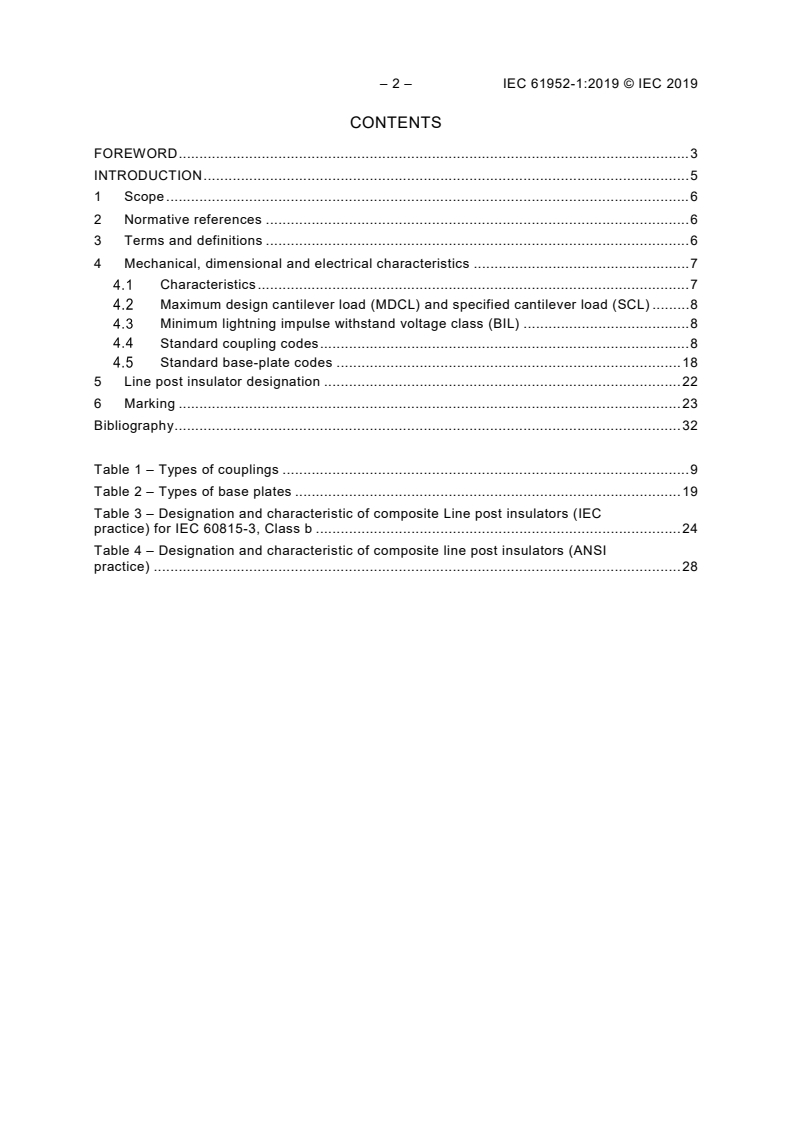
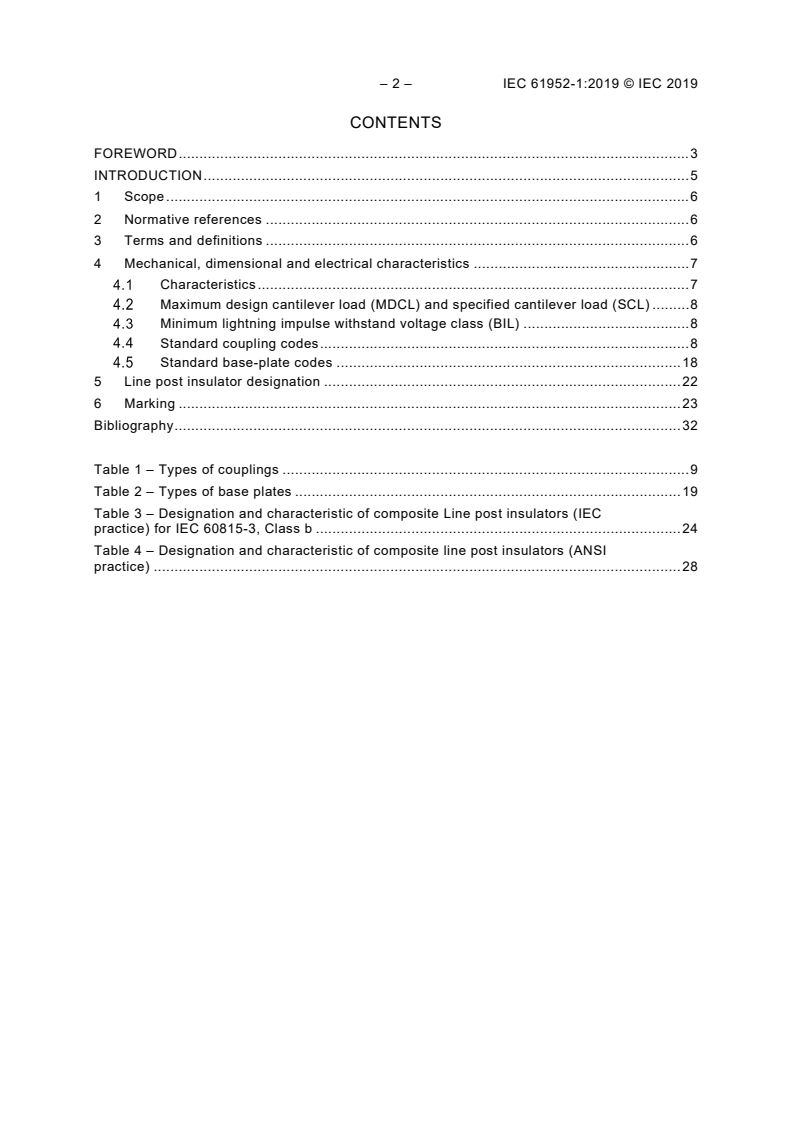
– 2 – IEC 61952-1:2019 © IEC 2019
CONTENTS
FOREWORD . 3
INTRODUCTION . 5
1 Scope . 6
2 Normative references . 6
3 Terms and definitions . 6
4 Mechanical, dimensional and electrical characteristics . 7
Characteristics . 7
Maximum design cantilever load (MDCL) and specified cantilever load (SCL) . 8
Minimum lightning impulse withstand voltage class (BIL) . 8
Standard coupling codes . 8
Standard base-plate codes . 18
5 Line post insulator designation . 22
6 Marking . 23
Bibliography . 32
Table 1 – Types of couplings . 9
Table 2 – Types of base plates . 19
Table 3 – Designation and characteristic of composite Line post insulators (IEC
practice) for IEC 60815-3, Class b . 24
Table 4 – Designation and characteristic of composite line post insulators (ANSI
practice) . 28
INTERNATIONAL ELECTROTECHNICAL COMMISSION
____________
INSULATORS FOR OVERHEAD LINES – COMPOSITE LINE
POST INSULATORS FOR AC SYSTEMS WITH A NOMINAL
VOLTAGE GREATER THAN 1 000 V –
Part 1: Definitions, end fittings and designations
FOREWORD
1) The International Electrotechnical Commission (IEC) is a worldwide organization for standardization comprising
all national electrotechnical committees (IEC National Committees). The object of IEC is to promote international
co-operation on all questions concerning standardization in the electrical and electronic fields. To this end and
in addition to other activities, IEC publishes International Standards, Technical Specifications, Technical Reports,
Publicly Available Specifications (PAS) and Guides (hereafter referred to as “IEC Publication(s)”). Their
preparation is entrusted to technical committees; any IEC National Committee interested in the subject dealt with
may participate in this preparatory work. International, governmental and non-governmental organizations liaising
with the IEC also participate in this preparation. IEC collaborates closely with the International Organization for
Standardization (ISO) in accordance with conditions determined by agreement between the two organizations.
2) The formal decisions or agreements of IEC on technical matters express, as nearly as possible, an international
consensus of opinion on the relevant subjects since each technical committee has representation from all
interested IEC National Committees.
3) IEC Publications have the form of recommendations for international use and are accepted by IEC National
Committees in that sense. While all reasonable efforts are made to ensure that the technical content of IEC
Publications is accurate, IEC cannot be held responsible for the way in which they are used or for any
misinterpretation by any end user.
4) In order to promote international uniformity, IEC National Committees undertake to apply IEC Publications
transparently to the maximum extent possible in their national and regional publications. Any divergence between
any IEC Publication and the corresponding national or regional publication shall be clearly indicated in the latter.
5) IEC itself does not provide any attestation of conformity. Independent certification bodies provide conformity
assessment services and, in some areas, access to IEC marks of conformity. IEC is not responsible for any
services carried out by independent certification bodies.
6) All users should ensure that they have the latest edition of this publication.
7) No liability shall attach to IEC or its directors, employees, servants or agents including individual experts and
members of its technical committees and IEC National Committees for any personal injury, property damage or
other damage of any nature whatsoever, whether direct or indirect, or for costs (including legal fees) and
expenses arising out of the publication, use of, or reliance upon, this IEC Publication or any other IEC Publications.
8) Attention is drawn to the Normative references cited in this publication. Use of the referenced publications is
indispensable for the correct application of this publication.
9) Attention is drawn to the possibility that some of the elements of this IEC Publication may be the subject of patent
rights. IEC shall not be held responsible for identifying any or all such patent rights.
International Standard IEC 61952-1 has been prepared by IEC technical committee 36:
Insulators.
The text of this standard is based on the following documents:
FDIS Report on voting
36/435/FDIS 36/441/RVD
Full information on the voting for the approval of this International Standard can be found in the
report on voting indicated in the above table.
This document has been drafted in accordance with the ISO/IEC Directives, Part 2.
A list of all parts in the IEC 61952 series, published under the general title Insulators for
overhead lines – Composite line post insulators for AC systems with a nominal voltage greater
than 1 000 V, can be found on the IEC website.
– 4 – IEC 61952-1:2019 © IEC 2019
The committee has decided that the contents of this document will remain unchanged until the
stability date indicated on the IEC website under "http://webstore.iec.ch" in the data related to
the specific document. At this date, the document will be
• reconfirmed,
• withdrawn,
• replaced by a revised edition, or
• amended.
A bilingual version of this publication may be issued at a later date.
INTRODUCTION
This part of IEC 61952 is intended to give the main mechanical and dimensional characteristics
of composite line post insulators and their fittings in order to ensure their interchangeability.
Since line post insulators are usually subjected to combined loads (for example vertical due to
the conductor plus compressive and lateral due to the pole being at a line corner or turn), only
the MDCL is given as a specified characteristic for the mechanical strength of the insulator.
Furthermore, composite line post insulators are often used in a braced configuration for higher
voltages and mechanical loads. In these configurations the overall strength depends on the
components and geometry of the whole assembly – including notably the buckling strength of
the line post component which depends more on the core dimensions and flexibility than on
ultimate flexural strength.
In order to address the matter of the strength of composite line post insulators under combined
or complex loads some information is already given in Annex B of IEC 61952:2008 and by the
IEEE [2] . It is intended to expand on this information in a second part of IEC 61952 which will
give application guidelines and examples for common line post usage scenarios.
____________
Numbers in square brackets refer to the bibliography.
– 6 – IEC 61952-1:2019 © IEC 2019
INSULATORS FOR OVERHEAD LINES – COMPOSITE LINE
POST INSULATORS FOR AC SYSTEMS WITH A NOMINAL
VOLTAGE GREATER THAN 1 000 V –
Part 1: Definitions, end fittings and designations
1 Scope
This part of IEC 61952 is applicable to composite line post insulators for AC overhead lines with
a nominal voltage greater than 1 000 V and a frequency not greater than 100 Hz.
It also applies to line post insulators of similar design used in substations or on electric traction
lines.
This document applies to line post insulators of composite type, generally with metallic
couplings, with and without a base plate. It also applies to such insulators when used in complex
structures. It does not apply to hollow insulators adapted for use as line post insulators.
The object of this document is to specify the main dimensions of the couplings to be used on
the composite line post insulators in order to permit the assembly of insulators or fittings
supplied by different manufacturers and to allow, whenever practical, interchangeability with
existing installations.
It also specifies a standard designation system for composite line post insulators.
2 Normative references
The following documents are referred to in the text in such a way that some or all of their content
constitutes requirements of this document. For dated references, only the edition cited applies.
For undated references, the latest edition of the referenced document (including any
amendments) applies.
IEC 60050-471, International Electrotechnical Vocabulary – Part 471: Insulators
IEC 60071-1, Insulation co-ordination – Part 1: Definitions, principles and rules
IEC 61952:2008, Insulators for overhead lines – Composite line post insulators for A.C. systems
with a nominal voltage greater than 1 000 V – Definitions, test methods and acceptance criteria
3 Terms and definitions
For the purposes of this document, the terms and definitions given in IEC 60050-471 and
IEC 61952 and the following apply.
ISO and IEC maintain terminological databases for use in standardization at the following
addresses:
• IEC Electropedia: available at http://www.electropedia.org/
• ISO Online browsing platform: available at http://www.iso.org/obp
3.1
coupling
part of the end fitting designed for attachment of the composite line post insulator to line
equipment, supporting structures, base plates or other insulators
3.2
core diameter
nominal diameter of the load-bearing core of the insulator
3.3
line end fitting
fitting at the end of the line post insulator to which the conductor or other live equipment is to
be attached
Note 1 to entry: Line end fitting can be from metal or insulating material.
3.4
base end fitting
fitting at the end intended to be attached to the supporting structure, either directly or by an
intermediate base or plate
3.5
base
intermediate hardware to allow attachment of the line post insulator to the supporting structure
3.6
reference cantilever load
RCL
North American practise for defining maximum admissible working load
3.7
maximum design cantilever load
MDCL
load level above which damage to the core begins to occur and which is the ultimate limit for
service loads. This value and direction of the load are specified by the manufacturer
3.8
minimum lightning impulse withstand voltage
BIL
impulse voltage having a front time of 1,2 µs and a time to half-value of 50 µs
4 Mechanical, dimensional and electrical characteristics
4.1 Characteristics
Composite line post insulators are standardised by the following specified characteristics:
• maximum design cantilever load (MDCL);
• minimum lightning impulse withstand voltage (BIL);
• standard coupling codes;
• standard base plate code (if applicable).
Additional mechanical characteristics may be required for some applications (e.g. tensile
strength, torsion strength). These characteristics do not form part of this document.
– 8 – IEC 61952-1:2019 © IEC 2019
Core diameter does not form part of the specified characteristics of composite line post
insulators; however some fitting dimensions depend on the core diameter. Common nominal
core diameters (in mm) are as follows: 37, 40, 45, 51, 63, 76, 88, 102, 120, 130.
Creepage distance does not form part of the specified characteristics of composite line post
insulators; however it may be included in the insulator designation.
All dimensions are expressed in millimetres. The dimensions apply to the finished product after
any surface treatment.
4.2 Maximum design cantilever load (MDCL) and specified cantilever load (SCL)
Each insulator is characterised by the MDCL and SCL as defined in IEC 61952.
The manufacturer’s recommended working cantilever load may be listed as the MDCL or the
reference cantilever load (RCL) and may be as much as 50 % of the SCL.
4.3 Minimum lightning impulse withstand voltage class (BIL)
Composite line post insulators are divided into classes according to their standard rated
lightning impulse withstand voltage according to IEC 60071-1. For convenience, the standard
values (in kV) are reproduced as follows:
60, 75, 95, 125, 145, 170, 200, 250, 325, 380, 450, 550, 650, 750, 850, 950, 1 050,
1 175, 1 300, 1 425, 1 550, 1 675, 1 800, 1 950, 2 100, 2 550, 2 700.
NOTE Intermediate values are permitted and given in Tables 3 and 4.
Each class includes insulators of increasing length up to the next lightning impulse withstand
voltage class.
4.4 Standard coupling codes
The couplings on composite line post insulators are designated by the codes given in Table 1.
The typical major dimensions defining each size are indicated.
Unless otherwise specified, dimensions given in Table 1 are nominal and subject to the typical
tolerances applicable to the type (threads, metric thread pitch – standard, cast elements, etc.).
Metric bolts and tapping may be replaced by their UNC equivalent; this shall be clearly marked
on all drawings. All dimensions are expressed in millimetres.
Table 1 – Types of couplings
DESIGNATION TYPE OF Examples Usual
COUPLING practice
(non preferred values in brackets)
Line Base
End end
A Tapped X X
flange
IEC
A B C
100 M12 x 16
∅ 76
160 M16 x 20
∅ 127
160 ∅ 127 M16 x 24
165 M16 x 20
∅ 127
165 M20 x 24
∅ 127
165 ∅ 127 M24 x 30
165 ∅ 178 M24 x 30
Oversized thread
– 10 – IEC 61952-1:2019 © IEC 2019
DESIGNATION TYPE OF Examples Usual
COUPLING practice
(non preferred values in brackets)
Line Base
End end
B Stud X
pedestal
A B
7 M16 x 20
10 M20 x 24
12 M22 x 25
10 M24 x 30
IEC
C Clevis X X
Often used
with swivel
base “S”,
IEC
A B C
14 20 min.
∅ 24
16 20 min.
∅ 20
16 20 min. ∅ 24
DESIGNATION TYPE OF Examples Usual
COUPLING practice
(non preferred values in brackets)
Line Base
End end
D Square X X
flange
IEC
A B C D
165 200 23 ∅ 18
I Integrated X
base(s)
IEC
A B C D
357 249 61
∅ 22
355 254 50 ∅ 22
NOTE The base can be curved or flat.
– 12 – IEC 61952-1:2019 © IEC 2019
DESIGNATION TYPE OF Examples Usual
COUPLING practice
(non preferred values in brackets)
Line Base
End end
J Integrated X
clamp
IEC
A B C
100 – 1750 40 – 160
∅ 7 – 38
K Horizontal X
trunnion
fitting
IEC
A B C
100 – 103 25,4 min ∅ 17,5 – 21
NOTE Details of gauges for the K fitting are given in
IEC 60720.
DESIGNATION TYPE OF Examples Usual
COUPLING practice
(non preferred values in brackets)
Line Base
End end
L Tongue (or X
blade)
IEC
R B
25,4 16
25,4 19
25,4 25
NOTE Other dimensions are not given since they are
variable
M MK neck X
IEC
A B C R D E
26 25 51 12,5 ∅ 76 ∅ 21
34 28 64 16
∅ 76 ∅ 31
– 14 – IEC 61952-1:2019 © IEC 2019
DESIGNATION TYPE OF Examples Usual
COUPLING practice
(non preferred values in brackets)
Line Base
End end
N “tie-top”
IEC
A B R1 D R2
57 44±3 13-18 13-18
73 57±3 25 18±4 25
79 50±3 13-18 25
100 73±3 25 17±3 25
102 78±2 25 14
124 73±3 20 18±4 20
124 84±3 25,4 25,4
140 120±4 25 24 16
It is also permissible to have a hole for the fixing wire with
different diameters.
DESIGNATION TYPE OF Examples Usual
COUPLING practice
(non preferred values in brackets)
Line Base
End end
P Through
X X
holes flange
IEC
A B C1 C2
100 16 ∅ 76
160 16
∅ 127
160 20
∅ 127 ∅18
160 18 ∅ 127
165 20 ∅ 127
230 20
∅ 178 ∅ 18 – 22
250 20
∅ 190 ∅ 18 – 22
260 17
20 ∅ 225 ∅ 18
312 25
∅ 254 ∅ 18-26
312 25
∅ 275 ∅ 18
360 25 ∅ 300 ∅ 26
NOTE Numbe
...
IEC 61952-1 ®
Edition 1.0 2019-04
INTERNATIONAL
STANDARD
NORME
INTERNATIONALE
Insulators for overhead lines – Composite line post insulators for AC systems
with a nominal voltage greater than 1 000 V –
Part 1: definitions, end fittings and designations
Isolateurs pour lignes aériennes – Isolateurs composites rigides à socle
pour systèmes à courant alternatif de tension nominale supérieure à 1 000 V –
Partie 1: Définitions, armatures d’extrémité et désignations
IEC 61952-1:-2019-04(en-fr)
All rights reserved. Unless otherwise specified, no part of this publication may be reproduced or utilized in any form
or by any means, electronic or mechanical, including photocopying and microfilm, without permission in writing from
either IEC or IEC's member National Committee in the country of the requester. If you have any questions about IEC
copyright or have an enquiry about obtaining additional rights to this publication, please contact the address below or
your local IEC member National Committee for further information.
Droits de reproduction réservés. Sauf indication contraire, aucune partie de cette publication ne peut être reproduite
ni utilisée sous quelque forme que ce soit et par aucun procédé, électronique ou mécanique, y compris la photocopie
et les microfilms, sans l'accord écrit de l'IEC ou du Comité national de l'IEC du pays du demandeur. Si vous avez des
questions sur le copyright de l'IEC ou si vous désirez obtenir des droits supplémentaires sur cette publication, utilisez
les coordonnées ci-après ou contactez le Comité national de l'IEC de votre pays de résidence.
IEC Central Office Tel.: +41 22 919 02 11
3, rue de Varembé info@iec.ch
CH-1211 Geneva 20 www.iec.ch
Switzerland
About the IEC
The International Electrotechnical Commission (IEC) is the leading global organization that prepares and publishes
International Standards for all electrical, electronic and related technologies.
About IEC publications
The technical content of IEC publications is kept under constant review by the IEC. Please make sure that you have the
latest edition, a corrigendum or an amendment might have been published.
IEC publications search - webstore.iec.ch/advsearchform Electropedia - www.electropedia.org
The advanced search enables to find IEC publications by a The world's leading online dictionary on electrotechnology,
variety of criteria (reference number, text, technical containing more than 22 000 terminological entries in English
committee,…). It also gives information on projects, replaced and French, with equivalent terms in 16 additional languages.
and withdrawn publications. Also known as the International Electrotechnical Vocabulary
(IEV) online.
IEC Just Published - webstore.iec.ch/justpublished
Stay up to date on all new IEC publications. Just Published IEC Glossary - std.iec.ch/glossary
details all new publications released. Available online and 67 000 electrotechnical terminology entries in English and
once a month by email. French extracted from the Terms and Definitions clause of
IEC publications issued since 2002. Some entries have been
IEC Customer Service Centre - webstore.iec.ch/csc collected from earlier publications of IEC TC 37, 77, 86 and
If you wish to give us your feedback on this publication or CISPR.
need further assistance, please contact the Customer Service
Centre: sales@iec.ch.
A propos de l'IEC
La Commission Electrotechnique Internationale (IEC) est la première organisation mondiale qui élabore et publie des
Normes internationales pour tout ce qui a trait à l'électricité, à l'électronique et aux technologies apparentées.
A propos des publications IEC
Le contenu technique des publications IEC est constamment revu. Veuillez vous assurer que vous possédez l’édition la
plus récente, un corrigendum ou amendement peut avoir été publié.
Recherche de publications IEC - Electropedia - www.electropedia.org
webstore.iec.ch/advsearchform Le premier dictionnaire d'électrotechnologie en ligne au
La recherche avancée permet de trouver des publications IEC monde, avec plus de 22 000 articles terminologiques en
en utilisant différents critères (numéro de référence, texte, anglais et en français, ainsi que les termes équivalents dans
comité d’études,…). Elle donne aussi des informations sur les 16 langues additionnelles. Egalement appelé Vocabulaire
projets et les publications remplacées ou retirées. Electrotechnique International (IEV) en ligne.
IEC Just Published - webstore.iec.ch/justpublished Glossaire IEC - std.iec.ch/glossary
Restez informé sur les nouvelles publications IEC. Just 67 000 entrées terminologiques électrotechniques, en anglais
Published détaille les nouvelles publications parues. et en français, extraites des articles Termes et Définitions des
Disponible en ligne et une fois par mois par email. publications IEC parues depuis 2002. Plus certaines entrées
antérieures extraites des publications des CE 37, 77, 86 et
Service Clients - webstore.iec.ch/csc CISPR de l'IEC.
Si vous désirez nous donner des commentaires sur cette
publication ou si vous avez des questions contactez-nous:
sales@iec.ch.
IEC 61952-1 ®
Edition 1.0 2019-04
INTERNATIONAL
STANDARD
NORME
INTERNATIONALE
Insulators for overhead lines – Composite line post insulators for AC systems
with a nominal voltage greater than 1 000 V –
Part 1: definitions, end fittings and designations
Isolateurs pour lignes aériennes – Isolateurs composites rigides à socle
pour systèmes à courant alternatif de tension nominale supérieure à 1 000 V –
Partie 1: Définitions, armatures d’extrémité et désignations
INTERNATIONAL
ELECTROTECHNICAL
COMMISSION
COMMISSION
ELECTROTECHNIQUE
INTERNATIONALE
ICS 29.080.10; 29.240.20 ISBN 978-2-8322-7993-9
– 2 – IEC 61952-1:2019 © IEC 2019
CONTENTS
FOREWORD . 3
INTRODUCTION . 5
1 Scope . 6
2 Normative references . 6
3 Terms and definitions . 6
4 Mechanical, dimensional and electrical characteristics . 7
Characteristics . 7
Maximum design cantilever load (MDCL) and specified cantilever load (SCL) . 8
Minimum lightning impulse withstand voltage class (BIL) . 8
Standard coupling codes . 8
Standard base-plate codes . 18
5 Line post insulator designation . 22
6 Marking . 23
Bibliography . 32
Table 1 – Types of couplings . 9
Table 2 – Types of base plates . 19
Table 3 – Designation and characteristic of composite Line post insulators (IEC
practice) for IEC 60815-3, Class b . 24
Table 4 – Designation and characteristic of composite line post insulators (ANSI
practice) . 28
INTERNATIONAL ELECTROTECHNICAL COMMISSION
____________
INSULATORS FOR OVERHEAD LINES – COMPOSITE LINE
POST INSULATORS FOR AC SYSTEMS WITH A NOMINAL
VOLTAGE GREATER THAN 1 000 V –
Part 1: Definitions, end fittings and designations
FOREWORD
1) The International Electrotechnical Commission (IEC) is a worldwide organization for standardization comprising
all national electrotechnical committees (IEC National Committees). The object of IEC is to promote international
co-operation on all questions concerning standardization in the electrical and electronic fields. To this end and
in addition to other activities, IEC publishes International Standards, Technical Specifications, Technical Reports,
Publicly Available Specifications (PAS) and Guides (hereafter referred to as “IEC Publication(s)”). Their
preparation is entrusted to technical committees; any IEC National Committee interested in the subject dealt with
may participate in this preparatory work. International, governmental and non-governmental organizations liaising
with the IEC also participate in this preparation. IEC collaborates closely with the International Organization for
Standardization (ISO) in accordance with conditions determined by agreement between the two organizations.
2) The formal decisions or agreements of IEC on technical matters express, as nearly as possible, an international
consensus of opinion on the relevant subjects since each technical committee has representation from all
interested IEC National Committees.
3) IEC Publications have the form of recommendations for international use and are accepted by IEC National
Committees in that sense. While all reasonable efforts are made to ensure that the technical content of IEC
Publications is accurate, IEC cannot be held responsible for the way in which they are used or for any
misinterpretation by any end user.
4) In order to promote international uniformity, IEC National Committees undertake to apply IEC Publications
transparently to the maximum extent possible in their national and regional publications. Any divergence between
any IEC Publication and the corresponding national or regional publication shall be clearly indicated in the latter.
5) IEC itself does not provide any attestation of conformity. Independent certification bodies provide conformity
assessment services and, in some areas, access to IEC marks of conformity. IEC is not responsible for any
services carried out by independent certification bodies.
6) All users should ensure that they have the latest edition of this publication.
7) No liability shall attach to IEC or its directors, employees, servants or agents including individual experts and
members of its technical committees and IEC National Committees for any personal injury, property damage or
other damage of any nature whatsoever, whether direct or indirect, or for costs (including legal fees) and
expenses arising out of the publication, use of, or reliance upon, this IEC Publication or any other IEC Publications.
8) Attention is drawn to the Normative references cited in this publication. Use of the referenced publications is
indispensable for the correct application of this publication.
9) Attention is drawn to the possibility that some of the elements of this IEC Publication may be the subject of patent
rights. IEC shall not be held responsible for identifying any or all such patent rights.
International Standard IEC 61952-1 has been prepared by IEC technical committee 36:
Insulators.
This bilingual version (2020-04) corresponds to the monolingual English version, published in
2019-04.
The text of this standard is based on the following documents:
FDIS Report on voting
36/435/FDIS 36/441/RVD
Full information on the voting for the approval of this International Standard can be found in the
report on voting indicated in the above table.
The French version of this standard has not been voted upon.
– 4 – IEC 61952-1:2019 © IEC 2019
This document has been drafted in accordance with the ISO/IEC Directives, Part 2.
A list of all parts in the IEC 61952 series, published under the general title Insulators for
overhead lines – Composite line post insulators for AC systems with a nominal voltage greater
than 1 000 V, can be found on the IEC website.
The committee has decided that the contents of this document will remain unchanged until the
stability date indicated on the IEC website under "http://webstore.iec.ch" in the data related to
the specific document. At this date, the document will be
• reconfirmed,
• withdrawn,
• replaced by a revised edition, or
• amended.
INTRODUCTION
This part of IEC 61952 is intended to give the main mechanical and dimensional characteristics
of composite line post insulators and their fittings in order to ensure their interchangeability.
Since line post insulators are usually subjected to combined loads (for example vertical due to
the conductor plus compressive and lateral due to the pole being at a line corner or turn), only
the MDCL is given as a specified characteristic for the mechanical strength of the insulator.
Furthermore, composite line post insulators are often used in a braced configuration for higher
voltages and mechanical loads. In these configurations the overall strength depends on the
components and geometry of the whole assembly – including notably the buckling strength of
the line post component which depends more on the core dimensions and flexibility than on
ultimate flexural strength.
In order to address the matter of the strength of composite line post insulators under combined
or complex loads some information is already given in Annex B of IEC 61952:2008 and by the
IEEE [2] . It is intended to expand on this information in a second part of IEC 61952 which will
give application guidelines and examples for common line post usage scenarios.
____________
Numbers in square brackets refer to the bibliography.
– 6 – IEC 61952-1:2019 © IEC 2019
INSULATORS FOR OVERHEAD LINES – COMPOSITE LINE
POST INSULATORS FOR AC SYSTEMS WITH A NOMINAL
VOLTAGE GREATER THAN 1 000 V –
Part 1: Definitions, end fittings and designations
1 Scope
This part of IEC 61952 is applicable to composite line post insulators for AC overhead lines with
a nominal voltage greater than 1 000 V and a frequency not greater than 100 Hz.
It also applies to line post insulators of similar design used in substations or on electric traction
lines.
This document applies to line post insulators of composite type, generally with metallic
couplings, with and without a base plate. It also applies to such insulators when used in complex
structures. It does not apply to hollow insulators adapted for use as line post insulators.
The object of this document is to specify the main dimensions of the couplings to be used on
the composite line post insulators in order to permit the assembly of insulators or fittings
supplied by different manufacturers and to allow, whenever practical, interchangeability with
existing installations.
It also specifies a standard designation system for composite line post insulators.
2 Normative references
The following documents are referred to in the text in such a way that some or all of their content
constitutes requirements of this document. For dated references, only the edition cited applies.
For undated references, the latest edition of the referenced document (including any
amendments) applies.
IEC 60050-471, International Electrotechnical Vocabulary – Part 471: Insulators
IEC 60071-1, Insulation co-ordination – Part 1: Definitions, principles and rules
IEC 61952:2008, Insulators for overhead lines – Composite line post insulators for A.C. systems
with a nominal voltage greater than 1 000 V – Definitions, test methods and acceptance criteria
3 Terms and definitions
For the purposes of this document, the terms and definitions given in IEC 60050-471 and
IEC 61952 and the following apply.
ISO and IEC maintain terminological databases for use in standardization at the following
addresses:
• IEC Electropedia: available at http://www.electropedia.org/
• ISO Online browsing platform: available at http://www.iso.org/obp
3.1
coupling
part of the end fitting designed for attachment of the composite line post insulator to line
equipment, supporting structures, base plates or other insulators
3.2
core diameter
nominal diameter of the load-bearing core of the insulator
3.3
line end fitting
fitting at the end of the line post insulator to which the conductor or other live equipment is to
be attached
Note 1 to entry: Line end fitting can be from metal or insulating material.
3.4
base end fitting
fitting at the end intended to be attached to the supporting structure, either directly or by an
intermediate base or plate
3.5
base
intermediate hardware to allow attachment of the line post insulator to the supporting structure
3.6
reference cantilever load
RCL
North American practise for defining maximum admissible working load
3.7
maximum design cantilever load
MDCL
load level above which damage to the core begins to occur and which is the ultimate limit for
service loads. This value and direction of the load are specified by the manufacturer
3.8
minimum lightning impulse withstand voltage
BIL
impulse voltage having a front time of 1,2 µs and a time to half-value of 50 µs
4 Mechanical, dimensional and electrical characteristics
4.1 Characteristics
Composite line post insulators are standardised by the following specified characteristics:
• maximum design cantilever load (MDCL);
• minimum lightning impulse withstand voltage (BIL);
• standard coupling codes;
• standard base plate code (if applicable).
Additional mechanical characteristics may be required for some applications (e.g. tensile
strength, torsion strength). These characteristics do not form part of this document.
– 8 – IEC 61952-1:2019 © IEC 2019
Core diameter does not form part of the specified characteristics of composite line post
insulators; however some fitting dimensions depend on the core diameter. Common nominal
core diameters (in mm) are as follows: 37, 40, 45, 51, 63, 76, 88, 102, 120, 130.
Creepage distance does not form part of the specified characteristics of composite line post
insulators; however it may be included in the insulator designation.
All dimensions are expressed in millimetres. The dimensions apply to the finished product after
any surface treatment.
4.2 Maximum design cantilever load (MDCL) and specified cantilever load (SCL)
Each insulator is characterised by the MDCL and SCL as defined in IEC 61952.
The manufacturer’s recommended working cantilever load may be listed as the MDCL or the
reference cantilever load (RCL) and may be as much as 50 % of the SCL.
4.3 Minimum lightning impulse withstand voltage class (BIL)
Composite line post insulators are divided into classes according to their standard rated
lightning impulse withstand voltage according to IEC 60071-1. For convenience, the standard
values (in kV) are reproduced as follows:
60, 75, 95, 125, 145, 170, 200, 250, 325, 380, 450, 550, 650, 750, 850, 950, 1 050,
1 175, 1 300, 1 425, 1 550, 1 675, 1 800, 1 950, 2 100, 2 550, 2 700.
NOTE Intermediate values are permitted and given in Tables 3 and 4.
Each class includes insulators of increasing length up to the next lightning impulse withstand
voltage class.
4.4 Standard coupling codes
The couplings on composite line post insulators are designated by the codes given in Table 1.
The typical major dimensions defining each size are indicated.
Unless otherwise specified, dimensions given in Table 1 are nominal and subject to the typical
tolerances applicable to the type (threads, metric thread pitch – standard, cast elements, etc.).
Metric bolts and tapping may be replaced by their UNC equivalent; this shall be clearly marked
on all drawings. All dimensions are expressed in millimetres.
Table 1 – Types of couplings
DESIGNATION TYPE OF Examples Usual
COUPLING practice
(non preferred values in brackets)
Line Base
End end
A Tapped X X
flange
IEC
A B C
100 M12 x 16
∅ 76
160 M16 x 20
∅ 127
160 ∅ 127 M16 x 24
165 M16 x 20
∅ 127
165 M20 x 24
∅ 127
165 ∅ 127 M24 x 30
165 ∅ 178 M24 x 30
Oversized thread
– 10 – IEC 61952-1:2019 © IEC 2019
DESIGNATION TYPE OF Examples Usual
COUPLING practice
(non preferred values in brackets)
Line Base
End end
B Stud X
pedestal
A B
7 M16 x 20
10 M20 x 24
12 M22 x 25
10 M24 x 30
IEC
C Clevis X X
Often used
with swivel
base “S”,
IEC
A B C
14 20 min.
∅ 24
16 20 min.
∅ 20
16 20 min. ∅ 24
DESIGNATION TYPE OF Examples Usual
COUPLING practice
(non preferred values in brackets)
Line Base
End end
D Square X X
flange
IEC
A B C D
165 200 23 ∅ 18
I Integrated X
base(s)
IEC
A B C D
357 249 61
∅ 22
355 254 50 ∅ 22
NOTE The base can be curved or flat.
– 12 – IEC 61952-1:2019 © IEC 2019
DESIGNATION TYPE OF Examples Usual
COUPLING practice
(non preferred values in brackets)
Line Base
End end
J Integrated X
clamp
IEC
A B C
100 – 1750 40 – 160
∅ 7 – 38
K Horizontal X
trunnion
fitting
IEC
A B C
100 – 103 25,4 min ∅ 17,5 – 21
NOTE Details of gauges for the K fitting are given in
IEC 60720.
DESIGNATION TYPE OF Examples Usual
COUPLING practice
(non preferred values in brackets)
Line Base
End end
L Tongue (or X
blade)
IEC
R B
25,4 16
25,4 19
25,4 25
NOTE Other dimensions are not given since they are
variable
M MK neck X
IEC
A B C R D E
26 25 51 12,5 ∅ 76 ∅ 21
34 28 64 16
∅ 76 ∅ 31
– 14 – IEC 61952-1:2019 © IEC 2019
DESIGNATION TYPE OF Examples Usual
COUPLING practice
(non preferred values in brackets)
Line Base
End end
N “tie-top”
IEC
A B R1 D R2
57 44±3 13-18 13-18
73 57±3 25 18±4 25
79 50±3 13-18 25
100 73±3 25 17±3 25
102 78±2 25 14
124 73±3 20 18±4 20
124 84±3 25,4 25,4
140 120±4 25 24 16
It is also permissible to have a hole for the fixing wire with
different diameters.
DESIGNATION TYPE OF Examples Usual
COUPLING practice
(non preferred values in brackets)
Line Base
End end
P Through
X X
holes flange
IEC
A B C1 C2
100 16 ∅ 76
160 16
∅ 127
160 20
∅ 127 ∅18
160 18 ∅ 127
165 20 ∅ 127
230 20
∅ 178 ∅ 18 – 22
250 20
∅ 190 ∅ 18 – 22
260 17
20 ∅ 225 ∅ 18
312 25
∅ 254 ∅ 18-26
312 25
∅ 275 ∅ 18
360 25 ∅ 300 ∅ 26
NOTE Number of fixing holes can vary between 4 to 8.
Q Anchor, X
square base
(Usually
used in a
bendable
base)
IEC
NOTE Dimensions are not given since they are variable
and are determined by the base into which the fitting is
mounted.
– 16 – IEC 61952-1:2019 © IEC 2019
DESIGNATION TYPE OF Examples Usual
COUPLING practice
(non preferred values in brackets)
Line Base
End end
R Stud X
IEC
A
M12 x 16
M16 x 20
M20 x 24
M24 x 30
M33 x 40
DESIGNATION TYPE OF Examples Usual
COUPLING practice
(non preferred values in brackets)
Line Base
End end
S Slotted or
X
drop hole
tongue
IEC
A B
25,4 x 38 16
25,4 x 38 19
25,4 x 38 25
Reference ANSI C29.17 for dimensional details.
NOTE Radii are not given since they are variable.
T Single hole X X
tongue
IEC
A B
19,5 max. ∅ 20
19,5 max. ∅ 24
– 18 – IEC 61952-1:2019 © IEC 2019
DESIGNATION TYPE OF Examples Usual
COUPLING practice
(non preferred values in brackets)
Line Base
End end
U Universal
X X
trunnion
fitting
IEC
Typical conductor diameter range “A” is 7,0 mm to 38 mm.
V Vertical X
trunnion
fitting
IEC
A B
100 – 103 25,4 min
NOTE Details of gauges for the V fitting are given in
IEC 60720.
Z Non- N/A X X
standard
coupling
4.5 Standard base-plate codes
Composite line post insulators may be supplied with an integral or fitted base plate. Table 2
gives the designations of common base plates.
Table 2 – Types of base plates
DESIGNATION TYPE OF Examples Appli
COUPLING cable
(non preferred values in brackets)
base
end
fittings
N No base N/A
plate
B Flat Q
Bendable
base
IEC
α = 0° – 17°
A B C D1 D2
(for slotted versions)
254 A+51 (155) 203 D1
∅ 21 – 25.4
330 A+51 229 ∅ (22) 24 D1
356 A+51 229 D1
∅ 24 – 28
381 A+51 254 ∅ 24 – 32 D1
F Flat fixed
A, P
base plate
IEC
A B C D1 D2 E
254 305 203 ∅ 21 – 24 or slot D1 ∅ 127
– 20 – IEC 61952-1:2019 © IEC 2019
DESIGNATION TYPE OF Examples Appli
COUPLING cable
(non preferred values in brackets)
base
end
fittings
G Curved/ A, P, B
Gain fixed
base plate
IEC
A C1 C2 Pole dia
(D1 – D2)
254 -
∅ 21 or 22 ∅ 172 – ∅ 254
(305)
305 ∅ 24 C1 x 38(32) 172 – ∅ 254
DESIGNATION TYPE OF Examples Appli
COUPLING cable
(non preferred values in brackets)
base
end
fittings
H Gain Q
Bendable
base
IEC
α = 0° – 17°
A D1 S1 Typical pole
diameter range
254 (21) 24(25.4) D1 x 38 (32)
∅ 178 – 356
280 (24) 27 D1 x 38 ∅ 178 – 356
305 24 – 27 D1 x 38 ∅ 178 – 356
356 (24) 27 D1 x 38
∅ 178 – 356
356 27 x 38 D1 ∅ 178 – 356
S Swivel C, L
IEC
NOTE Dimensions are not given since they are variable.
– 22 – IEC 61952-1:2019 © IEC 2019
DESIGNATION TYPE OF Examples Appli
COUPLING cable
(non preferred values in brackets)
base
end
fittings
V Vertical Q
Bendable
IEC
A B
356-1219 203-4
Z Non- N/A
standard
base plate
NOTE Metric Conversions:
1 inch = 25,4 mm, rounded off to the nearest whole number for dimensions greater than or equal to 1 inch. For
dimensions, less than 1 inch, round off to the nearest tenth.
3-inch bolt circle – 4 tapped holes,1/2 inch – 13 unified from special pitch diameter 0,4715-0,4650, Length of
engagement, 0,50 (tap after hot dip galvanizing).
5-inch bolt circle – 4 tapped holes, 5/8 inch – 11 unified from special pitch diameter 0,5882-0,5810, Length of
engagement, 0,625 (tap after hot dip galvanizing).
5 Line post insulator designation
Line post insulators are designated by letters CLP followed by a number indicating the MDCL
of the insulator, expressed in kN. This designation is then followed by the minimum lightning
impulse withstand voltage separated by a dash. The next letter T, P, etc. specifies the type of
line end fitting coupling, as shown in Table 1, this is followed by the base end fitting code and
then by the base plate code according to Table 2. This is then followed by the creepage distance
separated by a dash.
If the insulator is designed for inverted mounting (e.g. jumper support insulators) this may be
noted by adding the code “INV” to the end of the designation.
EXAMPLE:
CLP6.5-550TPG-2350 is a Composite Line Post insulator with an MDCL of 6,5 kN, a minimum lightning impulse
withstand voltage (BIL) of 550 kV. It has Tongue fitting at the line end and a flange (P) fitting at the base end and is
mounted on a Gain fixed base. It has a creepage distance of 2 350 mm.
The major types of Composite Line Post insulators are listed in Table 3 (IEC practice) and
Table 4 (ANSI practice).
NOTE If the composite line post insulator has an asymmetric core (e.g. rectangular or multiple cores) the MDCL
will not be the same in all directions. In this case, it is suggested to give the minimum and maximum MDCL separated
by a slash, e.g. 06.5/08.5.
6 Marking
Each composite line post insulator shall be clearly and indelibly marked with the name or
trademark of the manufacturer, the year of manufacture, the maximum design cantilever load
(MDCL) or the standard designation and a means permitting identification of each of the
component parts (for example an internal designation).
NOTE Since the MDCL depends on the insulator length and on the type of base plate (if used) and given the number
of possible fitting combinations, it is generally not practical to include the designation or MDCL as a forged or cast
marking on the fittings.
– 24 – IEC 61952-1 © IEC 2019
Table 3 – Designation and characteristic of composite Line post insulators (IEC practice) for IEC 60815-3, Class b
Maximum Specified Metal fitting type Highest voltage
Dry lightning Wet power Insulator Minimum Maximum
impulse frequency overall creepage diameter of design cantilever for equipment
Line end Base end Base end
withstand withstand height with distance insulating cantilever load based on
fitting fitting plate
voltage voltage fittings h1 part load 27,8 mm/kV
Designation
USCD
kV kV mm mm mm kN kN kV
(BIL)
CLP3.9-125MRN-540 125 50 445 540 160 3,9 9,75 M R N 24
CLP2.8-125RRN-500 125 50 326 500 191 2,82 7,05 R R N 24
CLP8.0-170PPN-615 170 70 505 615 130 8,0 20,0 P P N 36
CLP3.2-170MRN-1145 250 95 570 1 145 160 3,2 8,0 M R N 52
CLP3.0-550PDN-3900 550 230 1 215 3 900 178 3,0 7,5 P D N 123
CLP2.5-550PPN-3075 550 230 1 490 3 075 179 2,5 6,25 P P N 123
CLP2.5-550PPN-2460 550 230 1 490 2 400 179 2,5 6,25 P P N 123
CLP1.31-650PPN-2500 650 275 1 490 2 500 179 1,31 3,28 P P N 145
CLP5.0-750PPN-3650 750 325 1 500 3 650 178 5,0 12,5 P P N 170
CLP2.5-1050PPN-6125 1 050 460 2 300 6 125 191 2,5 6,25 P P N 245
CLP2.5-1050PPN-4900 1 050 460 2 300 4 900 191 2,5 6,25 P P N 245
CLP5.0-1425PPN-10500 1 425 - 3 350 10 500 258 5,0 12,5 P P N 420
CLP5.0-1425PPN-8400 1 425 - 3 350 8 400 258 5,0 12,5 P P N 420
CLP3.5-1425PPN-10600 1 425 - 3 350 10 600 258 3,5 8,75 P P N 420
CLP3.5-1425PPN-8480 1 425 - 3 350 8 480 258 3,5 8,75 P P N 420
CLP7.5-170JRN-691 170 90 320 ± 5 691 120 7,5 15,0 J R N 36
CLP7.5-170JRN-803 170 93 320 ± 5 803 120 7,5 15,0 J R N 36
CLP6.25-200JRN-1190 200 106 365 ± 5 1190 140 6,25 12,5 J R N 72,5
CLP7.5-170JRN-670 170 90 305 ± 5 670 120 7,5 15,0 J R N 36
CLP7.5-170JRN-782 170 93 305 ± 5 782 120 7,5 15,0 J R N 36
CLP7.5-200JRN-1230 200 106 340 ± 5 1 230 140 7,5 15,0 J R N 72,5
IEC 61952-1 © IEC 2019 – 25 –
Dry lightning Wet power Insulator Minimum Maximum Maximum Specified Metal fitting type Highest voltage
impulse frequency overall creepage diameter of design cantilever for equipment
Line end Base end Base end
withstand withstand height with distance insulating cantilever load based on
fitting fitting plate
voltage voltage fittings h1 part load 27,8 mm/kV
Designation
USCD
kV kV mm mm mm kN kN kV
(BIL)
CLP7.5-170NRN-543 170 90 285 ± 5 543 120 7,5 15,0 N R N 24
CLP7.5-170NRN-670 170 93 285 ± 5 670 120 7,5 15,0 N R N 36
CLP7.5-200NRN-1150 200 106 330 ± 5 1 150 140 7,5 15,0 N R N 52
CLP6.25-155NRN-561 155 70 295 ± 5 561 120 6,25 12,5 N R N 24
CLP6.25-155NRN-688 155 75 295 ± 5 688 120 6,25 12,5 N R N 36
CLP6.25-180NRN-1168 180 90 345 ± 5 1 168 140 6,25 12,5 N R N 72,5
CLP6.25-150NRN-580 150 50 286 ± 5 580 125 6,25 12,5 N R N 36
CLP6.25-170NRN-776 170 70 286 ± 5 776 125 6,25 12,5 N R N 36
CLP6.25-170JRN-630 170 70 315 ± 5 630 125 6,25 12,5 J R N 36
CLP6.25-190JRN-835 190 80 315 ± 5 835 125 6,25 12,5 J R N 52
CLP5.0-95MRN-420 95 30 310 420 140 5,0 12,5 M R N 24
CLP5.0-100MRN-380 100 30 255 380 132 5,0 12,0 M R N 12
CLP5.0-125MRN-670 125 50 405 670 140 5,0 12,5 M R N 36
CLP5.0-125ZRN-670 125 50 405 670 140 5,0 12,5 Z R N 36
CLP2.8-125RRN-500 125 50 326 500 191 2,82 7,0 R R N 24
CLP3.9-125MRN-540 125 50 445 540 160 3,9 12,0 M R N 24
CLP4.0-125ZRN-580 125 50 280 580 150 4,0 10,0 Z R N 36
CLP5.0-125MRN-580 125 50 340 580 150 5,0 12,5 M R N 36
CLP5.0-140MRN-600 140 50 343 600 146 5,0 12,5 M R N 36
CLP5.0-140VRN-600 140 50 334 600 146 5,0 12,5 V R N 36
CLP8.0-170PPN-615 170 70 505 615 130 8,0 20,0 P P N 36
CLP3.2-170MRN-1145 170 70 570 1 145 160 3,2 10,0 M R N 52
CLP5.0-170MRN-910 170 70 405 910 140 5,0 12,5 M R N 52
– 26 – IEC 61952-1 © IEC 2019
Dry lightning Wet power Insulator Minimum Maximum Maximum Specified Metal fitting type Highest voltage
impulse frequency overall creepage diameter of design cantilever for equipment
Line end Base end Base end
withstand withstand height with distance insulating cantilever load based on
fitting fitting plate
voltage voltage fittings h1 part load 27,8 mm/kV
Designation
USCD
kV kV mm mm mm kN kN kV
(BIL)
CLP5.0-190MRN-820 190 80 415 820 146 5,0 12,5 M R N 36
CLP6.0-190VRN-773 190 85 351 773 145 6,0 12,5 V R N 36
CLP6.0-194MRN-773 194 88 Approx. 325 773 145 6,0 12,5 M R N 36
CLP5.0-250MRN-1118 250 112 Approx. 415 1 118 150 5,0 12,5 M R N 52
CLP4.0-550PDN-3875 550 230 1 215 3 875 178 4,0 10,0 P D N 170
CLP5.0-650PPN-3650 650 275 1 500 3 650 178 5,0 12,5 P P N 170
CLP1.3-715PPN-2500 715 355 1 490 2 500 179 1,31 2,6 P P N 145
CLP3.5-1730PPN-10600 1 730 740/1205* 3 350 10 600 258 3,5 8,4 P P N 550
CLP3.5-730PPN-8480 1 730 740/1205* 3 350 8 480 258 3,5 8,4 P P N 420
CLP4.1-325SIN-1599 325 140 718 1 599 152 4,1 8,2 S I N 72,5
CLP5.0-325SBN-1599 325 140 727 1 599 152 5,0 10,0 S B N 72,5
CLP12.6-325PPN-1529 325 140 800 1 529 209 12,6 25,2 P P N 72,5
CLP22.9-325AAN-1529 325 140 808 1 529 179 22,9 45,8 A A N 72,5
CLP36.7-325AAN-1529 325 140 833 1 529 191 36,7 73,4 A A N 72,5
CLP10.0-450PPN-2155 450 185 1 025 2 155 209 10,0 20,0 P P N 123
CLP16.7-450AAN-2313 450 185 1 070 2 313 179 16,7 33,4 A A N 123
CLP26.0-450AAN-2313 450 185 1 095 2 313 191 26,0 52,0 A A N 123
CLP8.2-550PPN-2680 550 230 1 213 2 680 209 8,2 16,4 P P N 145
CLP14.2-550AAN-2875 550 230 1 258 2 875 179 14,2 28,4 A A N 170
CLP21.6-550AAN-2875 550 230 1 283 2 875 191 21,6 43,2 A A N 170
CLP7.0-650PPN-3205 650 275 1 400 3 205 209 7,0 14,0 P P N 170
CLP12.1-650AAN-3400 650 275 1 445 3 400 179 12,1 24,2 A A N 170
CLP18.4-650AAN-3400 650 275 1 470 3 400 191 18,4 36,8 A A N 170
IEC 61952-1 © IEC 2019 – 27 –
Dry lightning Wet power Insulator Minimum Maximum Maximum Specified Metal fitting type Highest voltage
impulse frequency overall creepage diameter of design cantilever for equipment
Line end Base end Base end
withstand withstand height with distance insulating cantilever load based on
fitting fitting plate
voltage voltage fittings h1 part load 27,8 mm/kV
Designation
USCD
kV kV mm mm mm kN kN kV
(BIL)
CLP5.7-750PPN-3835 750 325 1 695 3 835 209 5,7 11,4 P P N 170
CLP9.8-750AAN-4113 750 325 1 750 4 113 179 9,8 19,6 A A N 245
CLP14.7-750AAN-4113 750 325 1 790 4 113 191 14,7 29,4 A A N 245
CLP4.5-850PPN-4990 850 360 2 108 4 990 209 4,5 9,0 P P N 300
CLP8.3-850AAN-5013 850 360 2 050 5 013 179 8,3 16,6 A A N 300
CLP12.4-850AAN-5013 850 360 2 090 5 013 191 12,4 24,8 A A N 300
CLP4.5-950PPN-4990 950 395 2 108 4 990 209 4,5 9,0 P P N 300
CLP7.9-950AAN-5238 950 395 2 125 5 238 179 7,9 15,8 A A N 300
CLP11.9-950AAN-5238 950 395 2 165 5 238 191 11,9 23,8 A A N 300
CLP4.1-1050PPN-5515 1 050 460 2 295 5 515 209 4,1 8,2 P P N 300
CLP7.1-1050AAN-5913 1 050 460 2 350 5 913 179 7,1 14,2 A A N 362
CLP10.7-1050AAN-5913 1 050 460 2 390 5 913 191 10,7 21,4 A A N 362
CLP3.2-1050PPN-7300 1 050 850 2 933 7 300 209 3,2 6,4 P P N 420
CLP5.5-1050AAN-7825 1 050 850 2 988 7 825 179 5,5 11,0 A A N 420
CLP8.3-1050AAN-7825 1 050 850 3 028 7 825 191 8,3 16,6 A A N 420
CLP2.7-1175PPN-8560 1 175 950 3 383 8 560 209 2,7 5,4 P P N 420
CLP4.7-1175AAN-9175 1 175 950 3 438 9 175 179 4,7 9,4 A A N 550
CLP7.2-1175AAN-9175 1 175 950 3 478 9 175 191 7,2 14,4 A A N 550
– 28 – IEC 61952-1 © IEC 2019
Table 4 – Designation and characteristic of composite line post insulators (ANSI practice)
Dry lightning Wet power Insulator Minimum Maximum Maximum Specified Metal fitting type Highest voltage
impulse frequency overall creepage diameter of design cantilever for equipment
Line end Base end Base end
withstand withstand height with distance insulating cantilever load based on
fitting fitting plate
voltage voltage fittings h1 part load 27,8 mm/kV
Designation
USCD
kV kV Inches Inches Inches Lbf Lbf
kV
(BIL)
CLP5.3-80NBN-254 80 25 11,8 10 - 1 200 2 400 N B N 12
80 25 11,8 10 - 1 200 2 400 V B N 12
CLP5.3-80VBN-254
80 25 11,8 10 - 1 200 2 400 K B N 12
CLP5.3-80KBN-254
CLP5.3-80KIN-254 80 25 14,8 10 - 1 200 2 400 K I N 12
100 40 14,7 14 - 1 200 2 400 N B N 18
CLP5.3-100NBN-355
100 40 14,7 14 - 1 200 2 400 V B N 18
CLP5.3-100VBN-355
CLP5.3-100KBN-355 100 40 14,7 14 - 1 200 2 400 K B N 18
CLP5.3-100KIN-355 100 40 17,7 14 - 1 200 2 400 K I N 18
135 55 15,7 22 - 1 200 2 400 N B N 24
CLP5.3-135NBN-558
CLP5.3-135VBN-558 135 55 15,7 22 - 1 200 2 400 V B N 24
CLP5.3-135KBN-558 135 55 15,7 22 - 1 200 2 400 K B N 24
135 55 18,7 22 - 1 200 2 400 K I N 24
CLP5.3-135KIN-558
CLP4.98-170NBN-736 170 75 18,1 29 - 1 120 2 240 N B N 36
CLP4.98-170VBN-736 170 75 18,1 29 - 1 120 2 240 V B N 36
170 75 18,1 29 - 1 120 2 240 K B N 36
CLP4.98-170KBN-736
170 75 21 29 - 1 120 2 240 K I N 36
CLP4.98-170KIN-736
CLP5,3-225VBN-1066 225 105 22,8 42 - 1 200 2 400 V B N 52
CLP5.3-225KBN-1066 225 105 22,8 42 - 1 200 2 400 K B N 52
225 105 25,8 42 - 1 200 2 400 K I N 52
CLP5.3-225KIN-1066
CLP5.3-255VBN-1295 255 120 25,9 51 - 1 200 2 400 V B N 72,5
CLP5.3-255KBN-1295 255 120 25,9 51 - 1 200 2 400 K B N - 72,5
255 120 28,1 51 - 1 200 2 400 K I N 72,5
CLP5.3-255KIN-1295
IEC 61952-1 © IEC 2019 – 29 –
Dry lightning Wet power Insulator Minimum Maximum Maximum Specified Metal fitting type Highest voltage
impulse frequency overall creepage diameter of design cantilever for equipment
Line end Base end Base end
withstand withstand height with distance insulating cantilever load based on
fitting fitting plate
voltage voltage fittings h1 part load 27,8 mm/kV
Designation
USCD
kV kV Inches Inches Inches Lbf Lbf
kV
(BIL)
405 205 41-47 100 - 1 900 3 800 S P N 145
CLP8.45-405SPN-2540
CLP7.34-465SPN-2921 465 245 47-54 115 - 1 650 3 300 S P N 170
CLP6.34-550SPN-3302 550 290 54-60 130 - 1 425 2 850 S P N 170
645 320 60-66 140 - 1 325 2 650 S P N 170
CLP5.89-645SPN-3556
CLP5.12-720SPN-3937 720 370 66-75 155 - 1 150 2 300 S P N 245
CLP4.45-780SPN-4445 780 415 75-85 175 - 1 000 2 000 S P N 245
935 480 85-95 200 - 875 1 750 S P N 300
CLP3.89-935SPN-5080
1 085 540 95-105 230 - 800 1 600 S P N 362
CLP3.56-1085SPN-5842
CLP2.89-1230SPN-6477 1 230 595 105-115 255 - 650 1 300 S P N 362
170 90 12,6±0,2 27,2 4,7 1 686 3 372 J R N 36
CLP7.5-170JRN-691
170 93 12,6±0,2 31,6 4,7 1 686 3 372 J R N 36
CLP7.5-170JRN-803
CLP6.25-200JRN-1190 200 106 13,4±0,2 46,9 5,5 1 405 2 810 J R N 72,5
CLP7.5-170JRN-670 170 90 12,0±0,2 26,4 4,7 1 686 3 372 J R N 36
170 93 12,6±0,2 30,8 4,7 1 686 3 372 J R N 36
CLP7.5-170JRN-782
CLP7.5-200JRN-1230 200 106 13,4±0,2 48,8 5,5 1 686 3 372 J R N 72,5
CLP7.5-170NRN-543 170 90 11,2±0,2 21,4 4,7 1 686 3 372 N R N 24
170 93 11,2±0,2 26,4 4,7 1 686 3 372 N R N 36
CLP7.5-170NRN-670
CLP7.5-200NRN-1150 200 106 13,0±0,2 45,3 5,5 1 686 3 372 N R N 52
CLP6.25-155NRN-561 155 70 11,0±0,2 22,1 4,7 1 405 2 810 N R N 24
155 75 11,0±0,2 27,1 4,7 1 405 2 810 N R N 36
CLP6.25-155NRN-688
180 90 13,5±0,2 46,0 5,5 1 405 2 810 N R N 72,5
CLP6.25-180NRN-1168
CLP6.25-150NRN-580 150 50 11,3±0,2 22,8 4,9 1 405 2 810 N R N 36
CLP6.25-170NRN-776 170 70 11,3±0,2 30,6 4,9 1 405 2 810 N R N 36
170 70 12,4±0,2 24,8 4,9 1 405 2 810 J R N 36
CLP6.25-170JRN-630
– 30 – IEC 61952-1 © IEC 2019
Dry lightning Wet power Insulator Minimum Maximum Maximum Specified Metal fitting type Highest voltage
impulse frequency overall creepage diameter of design cantilever for equipment
Line end Base end Base end
withstand withstand height with distance insulating cantilever load based on
fitting fitting plate
voltage voltage fittings h1 part load 27,8 mm/kV
Designation
USCD
kV kV Inches Inches Inches Lbf Lbf
kV
(BIL)
190 80 12,4±0,2 32,9 4,9 1 405 2 810 J R N 52
CLP6.25-190JRN-835
CLP4.1-325SIN-1599 325 140 28,3 62,9 6,0 930 1 860 S I N 72,5
CLP5.0-325SBN-1599 325 140 28,6 62,9 6,0 1 120 2 240 S B N 72,5
325 140 31,5 60,2 8,3 2 840 5 680 P P N 72,5
CLP12.6-325PPN-1529
CLP22.9-325AAN-1529 325 140 31,8 60,2 7,1 5 155 10 310 A A N 72,5
CLP36.7-325AAN-1529 325 140 32,8 60,2 7,6 8 240 16 480 A A N 72,5
450 185 40,4 84,8 8,3 2245 4 490 P P N 123
CLP10.0-450PPN-2155
450 185 42,1 91,0 7,1 3 760 7 520 A A N 123
CLP16.7-450AAN-2313
CLP26.0-450AAN-2313 450 185 43,1 91,0 7,6 5 855 11 710 A A N 123
550 230 47,7 105,5 8,3 1 850 3 700 P P N 145
CLP8.2-550PPN-2680
550 230 49,5 113,1 7,1 3 200 6 400 A A N 170
CLP14.2-550AAN-2875
CLP21.6-550AAN-2875 550 230 50,5 113,1 7,6 4 850 9 700 A A N 170
CLP7.0-650PPN-3205 650 275 55,1 126,1 8,3 1 575 3 150 P P N 170
650 275 56,9 133,8 7,1 2 730 5 460 A A N 170
CLP12.1-650AAN-3400
CLP18.4-650AAN-3400 650 275 57,9 133,8 7,6 4 145 8 290 A A N 170
CLP5.7-750PPN-3835 750 325 66,7 150,9 8,3 1 275 2 550 P P N 170
750 325 68,9 161,9 7,1 2 205 4 410 A A N 245
CLP9.8-750AAN-4113
CLP14.7-750AAN-4113 750 325 70,5 161,9 7,6 3 315 6 630 A A N 245
CLP4.5-850PPN-4990 850 360 83,0 196,4 8,3 1 010 2 020 P P N 300
850 360 80,7 197,3 7,1 1 855 3 710 A A N 300
CLP8.3-850AAN-5013
850 360 82,3 197,3 7,6 2 790 5 580 A A N 300
CLP12.4-850AAN-5013
CLP4.5-950PPN-4990 950 395 83,0 196,4 8,3 1 010 2 020 P P N 300
CLP7.9-950AAN-5238 950 395 83,7 206,2 7,1 1 785 3 570 A A N 300
950 395 85,2 206,2 7,6 2 685 5 370 A A N 300
CLP11.9-950AAN-5238
IEC 61952-1 © IEC 2019 – 31 –
Dry lightning Wet power Insulator Minimum Maximum Maximum Specified Metal fitting type Highest voltage
impulse frequency overall creepage diameter of design cantilever for equipment
Line end Base end Base end
withstand withstand height with distance insulating cantilever load based on
fitting fitting plate
voltage voltage fittings h1 part load 27,8 mm/kV
Designation
USCD
kV kV Inches Inches Inches Lbf Lbf
kV
(BIL)
1 050 460 90,4 217,1 8,3 920 1 840 P P N 300
CLP4.1-1050PPN-5515
CLP7.1-1050AAN-5913 1 050 460 92,5 232,8 7,1 1 600 3 200 A A N 362
CLP10.7-1050AAN-5913 1 050 460 94,1 232,8 7,6 2 410 4 820 A A N 362
...