

IEC 61000-2-2:2002
(Main)Electromagnetic compatibility (EMC) - Part 2-2: Environment - Compatibility levels for low-frequency conducted disturbances and signalling in public low-voltage power supply systems
General Information
- Abstract
This standard is concerned with conducted disturbances in the frequency range from 0 kHz to 9 kHz, with an extension up to 148,5 kHz specifically for mains signalling systems. It gives compatibility levels for public low voltage a.c. distribution systems having a nominal voltage up to 420 V, single-phase or 690 V, three-phase and a nominal frequency of 50 Hz or 60 Hz. Compatibility levels are specified for electromagnetic disturbances of the types which can be expected in public low voltage power supply systems, for guidance in: - the limits to be set for disturbance emission into public power supply systems; - the immunity limits to be set by product committees and others for the equipment exposed to the conducted disturbances present in public power supply systems.
- Status
- Published
- Publication Date
- 08-May-2018
- Technical Committee
- SC 77A - EMC - Low frequency phenomena
- Drafting Committee
- WG 8 - TC 77/SC 77A/WG 8
- Current Stage
- PPUB - Publication issued
- Start Date
- 28-Mar-2002
- Completion Date
- 15-May-2002
Buy Documents
IEC 61000-2-2:2002 - Electromagnetic compatibility (EMC) - Part 2-2: Environment - Compatibility levels for low-frequency conducted disturbances and signalling in public low-voltage power supply systems Released:3/28/2002

IEC 61000-2-2:2002+AMD1:2017 CSV - Electromagnetic compatibility (EMC) - Part 2-2: Environment - Compatibility levels for low-frequency conducted disturbances and signalling in public low-voltage power supply systems Released:6/27/2017

IEC 61000-2-2:2002+AMD1:2017+AMD2:2018 CSV - Electromagnetic compatibility (EMC) - Environment - Compatibility levels for low-frequency conducted disturbances and signalling in public low-voltage power supply systems Released:5/9/2018
Overview
IEC 61000-2-2:2002 is an international standard developed by the International Electrotechnical Commission (IEC) addressing electromagnetic compatibility (EMC) specifically for low-frequency conducted disturbances and signalling in public low-voltage power supply systems. The standard defines compatibility levels for electromagnetic disturbances in frequency ranges from 0 kHz to 9 kHz, extending up to 148.5 kHz for mains signalling.
This standard applies to public low-voltage AC distribution systems with nominal voltages up to 420 V for single-phase and 690 V for three-phase networks, operating at frequencies of 50 Hz or 60 Hz. It provides essential guidelines for controlling conducted disturbances and ensuring reliable operation of devices connected to public low-voltage power supplies.
Key Topics
Conducted Disturbances Scope
Covers disturbances from 0 kHz up to 9 kHz and extends compatibility considerations for mains signalling signals up to 148.5 kHz.Compatibility Levels
Specifies limit values for various disturbance types, including:- Voltage fluctuations and flicker
- Harmonics and interharmonics
- Voltage dips and short interruptions
- Voltage unbalance and transient overvoltages
- Temporary frequency variations
- DC components
- Mains signalling systems (ripple control, power-line carrier systems, mains-mark systems)
Application to Public Low-Voltage Systems
Addresses nominal voltages typical of residential and commercial power supply networks, facilitating harmonized EMC performance.Disturbance Emission and Immunity Guidance
Assists product committees and planners in setting emission limits and immunity requirements to minimize electromagnetic interference in public networks.Detailed Phenomena Analysis
Includes informational annexes explaining disturbance phenomena such as interharmonics, flicker effects, transient overvoltages, and rationale for compatibility levels.
Applications
IEC 61000-2-2:2002 is vital for stakeholders involved in the design, installation, and regulation of equipment connected to public low-voltage power systems, including:
Electrical Equipment Manufacturers
To design products with appropriate immunity against low-frequency conducted disturbances in public power lines.Power Utilities and Network Operators
For setting disturbance emission limits and maintaining power quality within compatibility levels.Regulatory Bodies and Standards Organizations
To establish consistent EMC requirements across industries and regions.Consultants and Engineers in Power Quality
To evaluate and mitigate electromagnetic disturbances impacting sensitive devices and infrastructure.Smart Grid and Mains Signalling Systems
To ensure communication signals are compatible with the power supply environment without causing or experiencing excessive disturbances.
Related Standards
IEC 61000 Series
Comprehensive standards on electromagnetic compatibility covering measurement methods, immunity requirements, and disturbance limits beyond the low-frequency conducted scope.IEC 61000-2-1
Focuses on compatibility levels for low-frequency conducted disturbances in industrial environments.IEC 61000-4 Series
Defines testing and measurement techniques for EMC, including immunity and emission testing relevant to equipment exposed to low-voltage networks.CISPR Standards
Address electromagnetic interference in radio communication relevant to power-line carriers and signalling systems.National and Regional EMC Standards
Many incorporate IEC 61000-2-2 as a foundational reference for setting mandatory power quality and EMC limits in public low-voltage networks.
By applying IEC 61000-2-2:2002, industries benefit from enhanced power system reliability, reduced electromagnetic interference, and improved safety in low-voltage public power distribution. This standard serves as a critical reference for managing low-frequency disturbances and maintaining electromagnetic compatibility in modern electrical networks.
Relations
- Effective Date
- 09-Feb-2026
- Effective Date
- 09-Feb-2026
- Effective Date
- 09-Feb-2026
- Effective Date
- 05-Sep-2023
- Effective Date
- 05-Sep-2023
Buy Documents
IEC 61000-2-2:2002 - Electromagnetic compatibility (EMC) - Part 2-2: Environment - Compatibility levels for low-frequency conducted disturbances and signalling in public low-voltage power supply systems Released:3/28/2002
IEC 61000-2-2:2002+AMD1:2017 CSV - Electromagnetic compatibility (EMC) - Part 2-2: Environment - Compatibility levels for low-frequency conducted disturbances and signalling in public low-voltage power supply systems Released:6/27/2017
IEC 61000-2-2:2002+AMD1:2017+AMD2:2018 CSV - Electromagnetic compatibility (EMC) - Environment - Compatibility levels for low-frequency conducted disturbances and signalling in public low-voltage power supply systems Released:5/9/2018
Get Certified
Connect with accredited certification bodies for this standard

ANCE
Mexican certification and testing association.

Intertek Slovenia
Intertek testing, inspection, and certification services in Slovenia.

LNE (Laboratoire National de Métrologie et d'Essais)
French national laboratory for metrology and testing.
Sponsored listings
Frequently Asked Questions
IEC 61000-2-2:2002 is a standard published by the International Electrotechnical Commission (IEC). Its full title is "Electromagnetic compatibility (EMC) - Part 2-2: Environment - Compatibility levels for low-frequency conducted disturbances and signalling in public low-voltage power supply systems". This standard covers: This standard is concerned with conducted disturbances in the frequency range from 0 kHz to 9 kHz, with an extension up to 148,5 kHz specifically for mains signalling systems. It gives compatibility levels for public low voltage a.c. distribution systems having a nominal voltage up to 420 V, single-phase or 690 V, three-phase and a nominal frequency of 50 Hz or 60 Hz. Compatibility levels are specified for electromagnetic disturbances of the types which can be expected in public low voltage power supply systems, for guidance in: - the limits to be set for disturbance emission into public power supply systems; - the immunity limits to be set by product committees and others for the equipment exposed to the conducted disturbances present in public power supply systems.
This standard is concerned with conducted disturbances in the frequency range from 0 kHz to 9 kHz, with an extension up to 148,5 kHz specifically for mains signalling systems. It gives compatibility levels for public low voltage a.c. distribution systems having a nominal voltage up to 420 V, single-phase or 690 V, three-phase and a nominal frequency of 50 Hz or 60 Hz. Compatibility levels are specified for electromagnetic disturbances of the types which can be expected in public low voltage power supply systems, for guidance in: - the limits to be set for disturbance emission into public power supply systems; - the immunity limits to be set by product committees and others for the equipment exposed to the conducted disturbances present in public power supply systems.
IEC 61000-2-2:2002 is classified under the following ICS (International Classification for Standards) categories: 33.100.01 - Electromagnetic compatibility in general. The ICS classification helps identify the subject area and facilitates finding related standards.
IEC 61000-2-2:2002 has the following relationships with other standards: It is inter standard links to EN ISO 4064-2:2025, EN ISO 4064-2:2014, EN ISO 4064-2:2017, IEC 61000-2-2:2002/AMD2:2018, IEC 61000-2-2:2002/AMD1:2017. Understanding these relationships helps ensure you are using the most current and applicable version of the standard.
IEC 61000-2-2:2002 is available in PDF format for immediate download after purchase. The document can be added to your cart and obtained through the secure checkout process. Digital delivery ensures instant access to the complete standard document.
Standards Content (Sample)
NORME CEI
INTERNATIONALE IEC
61000-2-2
INTERNATIONAL
Deuxième édition
STANDARD
Second edition
2002-03
PUBLICATION FONDAMENTALE EN CEM
BASIC EMC PUBLICATION
Compatibilité électromagnétique (CEM) –
Partie 2-2:
Environnement – Niveaux de compatibilité
pour les perturbations conduites à basse
fréquence et la transmission des signaux
sur les réseaux publics d'alimentation
basse tension
Electromagnetic compatibility (EMC) –
Part 2-2:
Environment – Compatibility levels for low-
frequency conducted disturbances and signalling
in public low-voltage power supply systems
Numéro de référence
Reference number
CEI/IEC 61000-2-2:2002
Numérotation des publications Publication numbering
Depuis le 1er janvier 1997, les publications de la CEI As from 1 January 1997 all IEC publications are
sont numérotées à partir de 60000. Ainsi, la CEI 34-1 issued with a designation in the 60000 series. For
devient la CEI 60034-1. example, IEC 34-1 is now referred to as IEC 60034-1.
Editions consolidées Consolidated editions
Les versions consolidées de certaines publications de la The IEC is now publishing consolidated versions of its
CEI incorporant les amendements sont disponibles. Par publications. For example, edition numbers 1.0, 1.1
exemple, les numéros d’édition 1.0, 1.1 et 1.2 indiquent and 1.2 refer, respectively, to the base publication,
respectivement la publication de base, la publication de the base publication incorporating amendment 1 and
base incorporant l’amendement 1, et la publication de the base publication incorporating amendments 1
base incorporant les amendements 1 et 2. and 2.
Informations supplémentaires Further information on IEC publications
sur les publications de la CEI
Le contenu technique des publications de la CEI est The technical content of IEC publications is kept
constamment revu par la CEI afin qu'il reflète l'état under constant review by the IEC, thus ensuring that
actuel de la technique. Des renseignements relatifs à the content reflects current technology. Information
cette publication, y compris sa validité, sont dispo- relating to this publication, including its validity, is
nibles dans le Catalogue des publications de la CEI available in the IEC Catalogue of publications
(voir ci-dessous) en plus des nouvelles éditions, (see below) in addition to new editions, amendments
amendements et corrigenda. Des informations sur les and corrigenda. Information on the subjects under
sujets à l’étude et l’avancement des travaux entrepris consideration and work in progress undertaken by the
par le comité d’études qui a élaboré cette publication, technical committee which has prepared this
ainsi que la liste des publications parues, sont publication, as well as the list of publications issued,
également disponibles par l’intermédiaire de: is also available from the following:
• Site web de la CEI (www.iec.ch) • IEC Web Site (www.iec.ch)
• Catalogue des publications de la CEI • Catalogue of IEC publications
Le catalogue en ligne sur le site web de la CEI The on-line catalogue on the IEC web site
(www.iec.ch/catlg-f.htm) vous permet de faire des (www.iec.ch/catlg-e.htm) enables you to search
recherches en utilisant de nombreux critères, by a variety of criteria including text searches,
comprenant des recherches textuelles, par comité technical committees and date of publication. On-
d’études ou date de publication. Des informations line information is also available on recently
en ligne sont également disponibles sur les issued publications, withdrawn and replaced
nouvelles publications, les publications rempla- publications, as well as corrigenda.
cées ou retirées, ainsi que sur les corrigenda.
• IEC Just Published
• IEC Just Published
Ce résumé des dernières publications parues
This summary of recently issued publications
(www.iec.ch/JP.htm) est aussi disponible par
(www.iec.ch/JP.htm) is also available by email.
courrier électronique. Veuillez prendre contact
Please contact the Customer Service Centre (see
avec le Service client (voir ci-dessous) pour plus
below) for further information.
d’informations.
• Service clients
• Customer Service Centre
Si vous avez des questions au sujet de cette
If you have any questions regarding this
publication ou avez besoin de renseignements
publication or need further assistance, please
supplémentaires, prenez contact avec le Service
contact the Customer Service Centre:
clients:
Email: custserv@iec.ch
Email: custserv@iec.ch
Tél: +41 22 919 02 11
Tel: +41 22 919 02 11
Fax: +41 22 919 03 00
Fax: +41 22 919 03 00
.
NORME CEI
INTERNATIONALE IEC
61000-2-2
INTERNATIONAL
Deuxième édition
STANDARD
Second edition
2002-03
PUBLICATION FONDAMENTALE EN CEM
BASIC EMC PUBLICATION
Compatibilité électromagnétique (CEM) –
Partie 2-2:
Environnement – Niveaux de compatibilité
pour les perturbations conduites à basse
fréquence et la transmission des signaux
sur les réseaux publics d'alimentation
basse tension
Electromagnetic compatibility (EMC) –
Part 2-2:
Environment – Compatibility levels for low-
frequency conducted disturbances and signalling
in public low-voltage power supply systems
IEC 2002 Droits de reproduction réservés Copyright - all rights reserved
Aucune partie de cette publication ne peut être reproduite ni No part of this publication may be reproduced or utilized in any
utilisée sous quelque forme que ce soit et par aucun procédé, form or by any means, electronic or mechanical, including
électronique ou mécanique, y compris la photocopie et les photocopying and microfilm, without permission in writing from
microfilms, sans l'accord écrit de l'éditeur. the publisher.
International Electrotechnical Commission, 3, rue de Varembé, PO Box 131, CH-1211 Geneva 20, Switzerland
Telephone: +41 22 919 02 11 Telefax: +41 22 919 03 00 E-mail: inmail@iec.ch Web: www.iec.ch
CODE PRIX
U
PRICE CODE
Commission Electrotechnique Internationale
International Electrotechnical Commission
Международная Электротехническая Комиссия
Pour prix, voir catalogue en vigueur
For price, see current catalogue
– 2 – 61000-2-2 CEI:2002
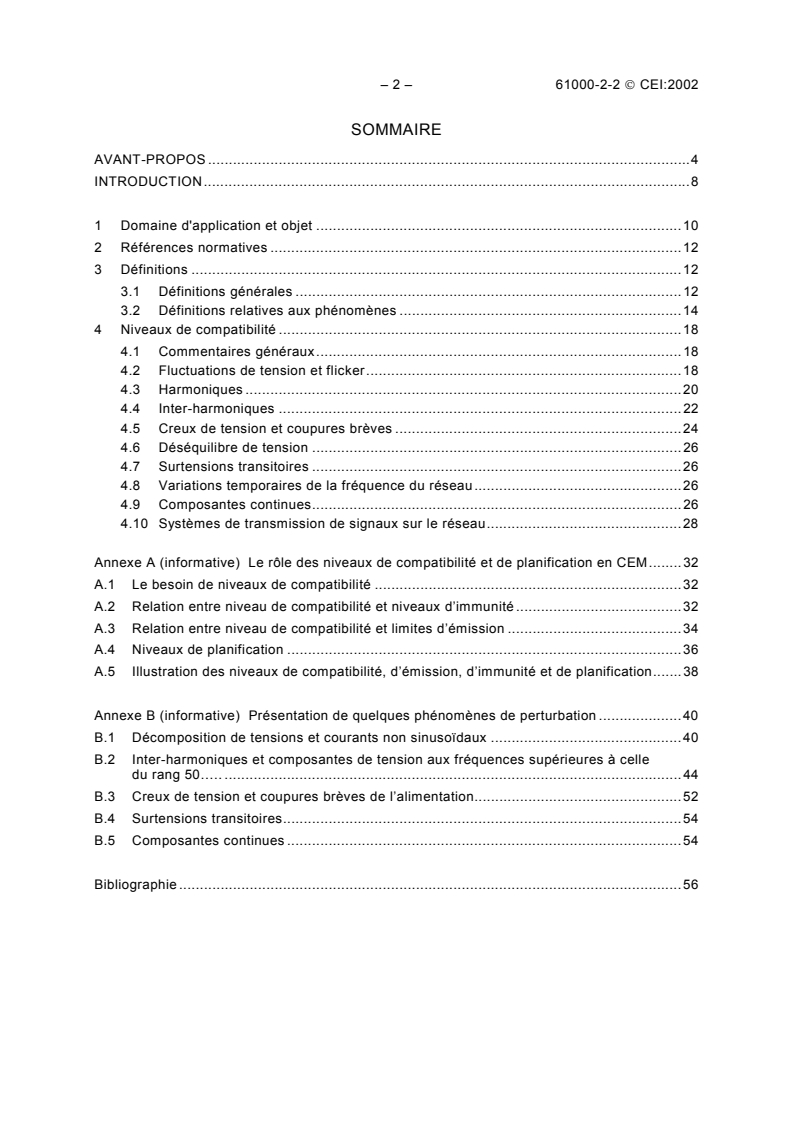
SOMMAIRE
AVANT-PROPOS .4
INTRODUCTION.8
1 Domaine d'application et objet .10
2 Références normatives .12
3 Définitions .12
3.1 Définitions générales .12
3.2 Définitions relatives aux phénomènes .14
4 Niveaux de compatibilité .18
4.1 Commentaires généraux.18
4.2 Fluctuations de tension et flicker.18
4.3 Harmoniques .20
4.4 Inter-harmoniques .22
4.5 Creux de tension et coupures brèves .24
4.6 Déséquilibre de tension .26
4.7 Surtensions transitoires .26
4.8 Variations temporaires de la fréquence du réseau.26
4.9 Composantes continues.26
4.10 Systèmes de transmission de signaux sur le réseau.28
Annexe A (informative) Le rôle des niveaux de compatibilité et de planification en CEM.32
A.1 Le besoin de niveaux de compatibilité .32
A.2 Relation entre niveau de compatibilité et niveaux d’immunité .32
A.3 Relation entre niveau de compatibilité et limites d’émission .34
A.4 Niveaux de planification .36
A.5 Illustration des niveaux de compatibilité, d’émission, d’immunité et de planification.38
Annexe B (informative) Présentation de quelques phénomènes de perturbation .40
B.1 Décomposition de tensions et courants non sinusoïdaux .40
B.2 Inter-harmoniques et composantes de tension aux fréquences supérieures à celle
du rang 50…. .44
B.3 Creux de tension et coupures brèves de l’alimentation.52
B.4 Surtensions transitoires.54
B.5 Composantes continues .54
Bibliographie .56
61000-2-2 © IEC:2002 – 3 –
CONTENTS
FOREWORD.5
INTRODUCTION.9
1 Scope and object .11
2 Normative references.13
3 Definitions .13
3.1 General definitions.13
3.2 Phenomena related definitions .15
4 Compatibility levels .19
4.1 General comment .19
4.2 Voltage fluctuations and flicker .19
4.3 Harmonics .21
4.4 Interharmonics.23
4.5 Voltage dips and short supply interruptions .25
4.6 Voltage unbalance .27
4.7 Transient overvoltages.27
4.8 Temporary power frequency variation.27
4.9 DC component.27
4.10 Mains signalling.29
Annex A (Informative) The function of compatibility levels and planning levels in EMC .33
A.1 The need for compatibility levels.33
A.2 Relation between compatibility level and immunity levels .33
A.3 Relation between compatibility level and emission limits .35
A.4 Planning levels.37
A.5 Illustration of compatibility, emission, immunity and planning levels.39
Annex B (informative) Discussion of some disturbance phenomena .41
B.1 Resolution of non-sinusoidal voltages and currents.41
th
B.2 Interharmonics and voltage components at frequencies above that of the 50 harmonic.45
B.3 Voltage dips and short supply interruptions.53
B.4 Transient overvoltages .55
B.5 DC component .55
Bibliography .57
– 4 – 61000-2-2 CEI:2002
COMMISSION ÉLECTROTECHNIQUE INTERNATIONALE
__________
COMPATIBILITÉ ÉLECTROMAGNÉTIQUE (CEM) –
Partie 2-2: Environnement – Niveaux de compatibilité
pour les perturbations conduites à basse fréquence et la transmission
des signaux sur les réseaux publics d’alimentation basse tension
AVANT-PROPOS
1) La CEI (Commission Électrotechnique Internationale) est une organisation mondiale de normalisation composée
de l'ensemble des comités électrotechniques nationaux (Comités nationaux de la CEI). La CEI a pour objet de
favoriser la coopération internationale pour toutes les questions de normalisation dans les domaines de
l'électricité et de l'électronique. A cet effet, la CEI, entre autres activités, publie des Normes internationales.
Leur élaboration est confiée à des comités d'études, aux travaux desquels tout Comité national intéressé par le
sujet traité peut participer. Les organisations internationales, gouvernementales et non gouvernementales, en
liaison avec la CEI, participent également aux travaux. La CEI collabore étroitement avec l'Organisation
Internationale de Normalisation (ISO), selon des conditions fixées par accord entre les deux organisations.
2) Les décisions ou accords officiels de la CEI en ce qui concerne les questions techniques, préparés par les
comités d'études où sont représentés tous les Comités nationaux s'intéressant à ces questions, expriment dans
la plus grande mesure possible un accord international sur les sujets examinés.
3) Ces décisions constituent des recommandations internationales publiées sous forme de normes, de rapports
techniques ou de guides et agréées comme telles par les Comités nationaux.
4) Dans le but d'encourager l'unification internationale, les Comités nationaux de la CEI s'engagent à appliquer de
façon transparente, dans toute la mesure possible, les Normes internationales de la CEI dans leurs normes
nationales et régionales. Toute divergence entre la norme de la CEI et la norme nationale ou régionale
correspondante doit être indiquée en termes clairs dans cette dernière.
5) La CEI n’a fixé aucune procédure concernant le marquage comme indication d’approbation et sa responsabilité
n’est pas engagée quand un matériel est déclaré conforme à l’une de ses normes.
6) L’attention est attirée sur le fait que certains des éléments de la présente Norme internationale peuvent faire
l’objet de droits de propriété intellectuelle ou de droits analogues. La CEI ne saurait être tenue pour
responsable de ne pas avoir identifié de tels droits de propriété et de ne pas avoir signalé leur existence.
La Norme internationale CEI 61000-2-2 a été établie par le sous-comité 77A: Phénomènes
basse fréquence, du comité d'études 77 de la CEI: Compatibilité électromagnétique. Elle a le
statut de publication fondamentale en CEM conformément au guide 107 de la CEI.
Cette deuxième édition annule et remplace la première édition, parue en 1990. Cette deuxième
édition constitue une révision technique.
Le texte de cette norme est issu des documents suivants:
FDIS Rapport de vote
77A/367/FDIS 77A/376/RVD
Le rapport de vote indiqué dans le tableau ci-dessus donne toute information sur le vote ayant
abouti à l'approbation de cette norme.
Cette publication a été rédigée selon les Directives ISO/CEI, Partie 3.
Les annexes A et B sont données uniquement à titre d’information.
61000-2-2 © IEC:2002 – 5 –
INTERNATIONAL ELECTROTECHNICAL COMMISSION
____________
ELECTROMAGNETIC COMPATIBILITY (EMC) –
Part 2-2: Environment – Compatibility levels for low-frequency conducted
disturbances and signalling in public low-voltage power supply systems
FOREWORD
1) The IEC (International Electrotechnical Commission) is a worldwide organization for standardization comprising
all national electrotechnical committees (IEC National Committees). The object of the IEC is to promote
international co-operation on all questions concerning standardization in the electrical and electronic fields. To
this end and in addition to other activities, the IEC publishes International Standards. Their preparation is
entrusted to technical committees; any IEC National Committee interested in the subject dealt with may
participate in this preparatory work. International, governmental and non-governmental organizations liaising
with the IEC also participate in this preparation. The IEC collaborates closely with the International Organization
for Standardization (ISO) in accordance with conditions determined by agreement between the two
organizations.
2) The formal decisions or agreements of the IEC on technical matters express, as nearly as possible, an
international consensus of opinion on the relevant subjects since each technical committee has representation
from all interested National Committees.
3) The documents produced have the form of recommendations for international use and are published in the form
of standards, technical specifications, technical reports or guides and they are accepted by the National
Committees in that sense.
4) In order to promote international unification, IEC National Committees undertake to apply IEC International
Standards transparently to the maximum extent possible in their national and regional standards. Any
divergence between the IEC Standard and the corresponding national or regional standard shall be clearly
indicated in the latter.
5) The IEC provides no marking procedure to indicate its approval and cannot be rendered responsible for any
equipment declared to be in conformity with one of its standards.
6) Attention is drawn to the possibility that some of the elements of this International Standard may be the subject
of patent rights. The IEC shall not be held responsible for identifying any or all such patent rights.
International Standard IEC 61000-2-2 has been prepared by subcommittee 77A: Low frequency
phenomena, of IEC technical committee 77: Electromagnetic compatibility. It has the status of
a basic EMC publication in accordance with IEC guide 107.
This second edition cancels and replaces the first edition, published in 1990. This second
edition constitutes a technical revision.
The text of this standard is based on the following documents:
FDIS Report on voting
77A/367/FDIS 77A/376/RVD
Full information on the voting for the approval of this standard can be found in the report on
voting indicated in the above table.
This publication has been drafted in accordance with the ISO/IEC Directives, Part 3.
Annexes A and B are for information only.
– 6 – 61000-2-2 CEI:2002
Le comité a décidé que le contenu de cette publication ne sera pas modifié avant 2012. A cette
date, la publication sera
• reconduite;
• supprimée;
• remplacée par une édition révisée, ou
• amendée.
61000-2-2 © IEC:2002 – 7 –
The committee has decided that the contents of this publication will remain unchanged until
2012. At this date, the publication will be
• reconfirmed;
• withdrawn;
• replaced by a revised edition, or
• amended.
– 8 – 61000-2-2 CEI:2002
INTRODUCTION
La CEI 61000 est publiée sous forme de plusieurs parties conformément à la structure
suivante:
Partie 1: Généralités
Considérations générales (introduction, principes fondamentaux)
Définitions, terminologie
Partie 2: Environnement
Description de l'environnement
Classification de l'environnement
Niveaux de compatibilité
Partie 3: Limites
Limites d'émission
Limites d'immunité (dans la mesure où elles ne relèvent pas des comités de produits)
Partie 4: Techniques d'essais et de mesure
Techniques de mesure
Techniques d'essai
Partie 5: Guides d'installation et d'atténuation
Guides d'installation
Méthodes et dispositifs d'atténuation
Partie 6: Normes génériques
Partie 9: Divers
Chaque partie est à son tour subdivisée en plusieurs parties, publiées soit comme Normes
internationales, soit comme spécifications techniques ou rapports techniques, dont certaines
ont déjà été publiées en tant que sections. D’autres seront publiées sous le numéro de la
partie, suivi d’un tiret et complété d’un second chiffre identifiant la subdivision (exemple:
61000-6-1).
Des informations détaillées sur les différents types de perturbations que l'on peut s'attendre à
trouver sur les réseaux publics d'alimentation électrique figurent dans la CEI 61000-2-1.
61000-2-2 © IEC:2002 – 9 –
INTRODUCTION
IEC 61000 is published in separate parts according to the following structure:
Part 1: General
General considerations (introduction, fundamental principles)
Definitions, terminology
Part 2: Environment
Description of the environment
Classification of the environment
Compatibility levels
Part 3: Limits
Emission limits
Immunity limits (in so far as they do not fall under the responsibility of the product
committees)
Part 4: Testing and measurement techniques
Part 5: Installation and mitigation guidelines
Installation guidelines
Mitigation methods and devices
Part 6: Generic standards
Part 9: Miscellaneous
Each part is further subdivided into several parts, published either as International Standards
or as technical specifications or technical reports, some of which have already been published
as sections. Others will be published with the part number followed by a dash and completed
by a second number identifying the subdivision (example: 61000-6-1).
Detailed information on the various types of disturbances that can be expected on public power
supply systems can be found in IEC 61000-2-1.
– 10 – 61000-2-2 CEI:2002
COMPATIBILITÉ ÉLECTROMAGNÉTIQUE (CEM) –
Partie 2-2: Environnement – Niveaux de compatibilité
pour les perturbations conduites à basse fréquence et la transmission
des signaux sur les réseaux publics d’alimentation basse tension
1 Domaine d'application et objet
La présente norme est relative aux perturbations conduites dans le domaine de fréquences de
0 kHz à 9 kHz, avec une extension jusqu’à 148,5 kHz pour les systèmes de transmission de
signaux sur le réseau. Elle fournit les valeurs numériques des niveaux de compatibilité pour les
réseaux de distribution publics alternatifs basse tension, avec une tension nominale maximale
de 420 V en monophasé, ou 690 V en triphasé, et une fréquence nominale de 50 Hz ou 60 Hz.
Les niveaux de compatibilité spécifiés dans cette norme s’appliquent au point de couplage
commun. Aux bornes d’un matériel alimenté par les réseaux décrits ci-dessus, la sévérité des
perturbations peut, dans la plupart des cas, être considérée comme égale à celle au point de
couplage commun. Il en va différemment dans certaines situations, notamment dans le cas
d’une longue ligne dédiée à l’alimentation d’une installation définie, ou dans le cas d’une
perturbation générée ou amplifiée dans l’installation dont l’équipement fait partie.
Les niveaux de compatibilité sont donnés pour les perturbations électromagnétiques
auxquelles on peut s’attendre sur les réseaux de distribution publics basse tension, dans le but
d’aider à définir:
– les limites devant être établies pour les émissions perturbatrices sur les réseaux publics de
distribution d’énergie (comprenant les niveaux de planification tels qu’ils sont définis
en 3.1.5);
– les limites d’immunité devant être établies par les comités de produits ou autres concernant
les équipements soumis aux perturbations conduites par les réseaux publics de distribution
d’énergie.
Les phénomènes perturbateurs considérés sont:
– les fluctuations de tension et le flicker;
– les harmoniques jusques et y compris le rang 50;
– les inter-harmoniques jusqu’au rang 50;
– les distorsions de tension aux fréquences supérieures (au-dessus du rang 50);
– les creux de tension et les coupures brèves;
– le déséquilibre de tension;
– les surtensions transitoires;
– les variations de fréquence fondamentale;
– les composantes continues;
– les systèmes de transmission de signaux sur le réseau.
La plupart des ces phénomènes sont décrits dans la CEI 61000-2-1. Au cas où il n’est pas
possible maintenant d’établir des niveaux de compatibilité, quelques informations sont fournies.
61000-2-2 © IEC:2002 – 11 –
ELECTROMAGNETIC COMPATIBILITY (EMC) –
Part 2-2 : Environment – Compatibility levels for low-frequency conducted
disturbances and signalling in public low-voltage power supply systems
1 Scope and object
This standard is concerned with conducted disturbances in the frequency range from 0 kHz to
9 kHz, with an extension up to 148,5 kHz specifically for mains signalling systems. It gives
compatibility levels for public low voltage a.c. distribution systems having a nominal voltage up
to 420 V, single-phase or 690 V, three-phase and a nominal frequency of 50 Hz or 60 Hz.
The compatibility levels specified in this standard apply at the point of common coupling. At the
power input terminals of equipment receiving its supply from the above systems the severity
levels of the disturbances can, for the most part, be taken to be the same as the levels at the
point of common coupling. In some situations this is not so, particularly in the case of a long
line dedicated to the supply of a particular installation, or in the case of a disturbance
generated or amplified within the installation of which the equipment forms a part.
Compatibility levels are specified for electromagnetic disturbances of the types which can be
expected in public low voltage power supply systems, for guidance in:
– the limits to be set for disturbance emission into public power supply systems (including the
planning levels defined in 3.1.5).
– the immunity limits to be set by product committees and others for the equipment exposed
to the conducted disturbances present in public power supply systems.
The disturbance phenomena considered are:
– voltage fluctuations and flicker;
– harmonics up to and including order 50;
th
– inter-harmonics up to the 50 harmonic;
th
– voltage distortions at higher frequencies (above the 50 harmonic);
– voltage dips and short supply interruptions;
– voltage unbalance;
– transient overvoltages;
– power frequency variation;
– d.c. components;
– mains signalling.
Most of these phenomena are described in IEC 61000-2-1. In cases where it is not yet possible
to establish compatibility levels, some information is provided.
– 12 – 61000-2-2 CEI:2002
2 Références normatives
Les documents de référence suivants sont indispensables pour l'application du présent
document. Pour les références datées, seule l'édition citée s'applique. Pour les références non
datées, la dernière édition du document de référence s'applique (y compris les éventuels
amendements).
CEI 60050-101, Vocabulaire Électrotechnique International (VEI) – Chapitre 101:
Mathématiques
CEI 60050-161, Vocabulaire Électrotechnique International (VEI) – Chapitre 161: Compatibilité
électromagnétique
CEI 60664-1, Coordination de l’isolement des matériels dans les systèmes (réseaux) à basse
tension – Partie 1: Principes, prescriptions et essais
CEI/TR3 61000-2-1, Compatibilité électromagnétique (CEM) – Partie 2: Environnement –
Section 1: Description de l’environnement – Environnement électromagnétique pour les
perturbations conduites basse fréquence et la transmission de signaux sur les réseaux publics
d’alimentation
CEI 61000-3-3, Compatibilité électromagnétique (CEM) – Partie 3: Limites – Section 3:
Limitation des fluctuations de tension et du flicker dans les réseaux basse tension pour les
équipements ayant un courant appelé ≤ 16 A
CEI 61000-4-7, Compatibilité électromagnétique (CEM) – Partie 4: Techniques d’essai et de
mesure – Section 7: Guide général relatif aux mesures d’harmoniques et d’interharmoniques,
ainsi qu’à l’appareillage de mesure, applicable aux réseaux d’alimentation et aux appareils qui
y sont raccordés
CEI 61000-4-15, Compatibilité électromagnétique (CEM) – Partie 4: Techniques d’essai et de
mesure – Section 15: Flickermètre – Spécifications fonctionnelles et de conception
3 Définitions
Pour les besoins de la présente partie de la CEI 61000, les définitions données dans la
CEI 60050-101, la CEI 60050-161 et ses amendements 1 et 2 ainsi que les suivantes
s’appliquent.
3.1 Définitions générales
3.1.1
perturbation (électromagnétique)
tout phénomène électromagnétique qui, de par sa présence dans l’environnement
électromagnétique, peut faire dévier un équipement électrique de sa performance attendue
[VEI 161-01-05, modifiée]
3.1.2
niveau de perturbation
amplitude d’une perturbation électromagnétique, mesurée et évaluée au moyen d’une méthode
spécifiée
[VEI 161-03-01, modifiée]
61000-2-2 © IEC:2002 – 13 –
2 Normative references
The following referenced documents are indispensable for the application of this document. For
dated references, only the edition cited applies. For undated references, the latest edition of
the referenced document (including any amendments) applies.
IEC 60050-101, International Electrotechnical Vocabulary (IEV) – Part 101: Mathematics
IEC 60050-161, International Electrotechnical Vocabulary (IEV) – Part 161: Electromagnetic
compatibility
IEC 60664-1, Insulation coordination for equipment within low-voltage systems – Part 1:
Principles, requirements and tests
IEC/TR3 61000-2-1, Electromagnetic compatibility (EMC) – Part 2: Environment – Section 1:
Description of the environment – Electromagnetic environment for low-frequency conducted
disturbances and signalling in public power supply systems
IEC 61000-3-3, Electromagnetic compatibility (EMC) – Part 3: Limits – Section 3: Limitation
of voltage fluctuations and flicker in low-voltage supply systems for equipment with rated
current ≤ 16 A
IEC 61000-4-7, Electromagnetic compatibility (EMC) – Part 4: Testing and measurement
techniques – Section 7: General guide on harmonics and interharmonics measurements and
instrumentation, for power supply systems and equipment connected thereto
IEC 61000-4-15, Electromagnetic compatibility (EMC) – Part 4: Testing and measurement
techniques – Section 15: Flickermeter – Functional and design specifications
3 Definitions
For the purposes of this part of IEC 61000, the definitions given in IEC 60050-101,
IEC 60050-161 and its amendments 1 and 2, as well as the following, apply.
3.1 General definitions
3.1.1
(electromagnetic) disturbance
any electromagnetic phenomenon which, by being present in the electromagnetic environment,
can cause electrical equipment to depart from its intended performance
[IEV 161-01-05, modified]
3.1.2
disturbance level
the amount or magnitude of an electromagnetic disturbance, measured and evaluated in a
specified way
[IEV 161-03-01, modified]
– 14 – 61000-2-2 CEI:2002
3.1.3
compatibilité électromagnétique, CEM (abréviation)
aptitude d'un appareil ou d'un système à fonctionner dans son environnement électromagné-
tique de façon satisfaisante et sans produire lui-même des perturbations électromagnétiques
intolérables pour tout ce qui se trouve dans cet environnement
NOTE 1 La compatibilité électromagnétique est une condition de l’environnement électromagnétique telle que,
pour chaque phénomène, le niveau d’émission perturbateur est suffisamment bas et les niveaux d’immunité sont
suffisamment élevés pour que tous les matériels, équipements et systèmes fonctionnent comme prévu.
NOTE 2 La compatibilité électromagnétique n’est assurée que si les niveaux d’émission et d’immunité sont
contrôlés de telle sorte que les niveaux d’immunité des matériels, équipements et systèmes, en n’importe quel
point, ne sont pas dépassés par le niveau de perturbation en cet endroit, résultant de l’émission cumulée de toutes
les sources et d’autres facteurs, tels que l’impédance des circuits. Conventionnellement, on dit qu’il y a
compatibilité électromagnétique si la probabilité d’écart par rapport à la performance attendue, ou d’apparition d’un
comportement perturbé est suffisamment basse. Voir article 4 de la CEI 61000-2-1.
NOTE 3 Lorsque le contexte le rend nécessaire, la compatibilité électromagnétique peut être prise en référence à
une seule perturbation ou à une classe de perturbations.
NOTE 4 La compatibilité électromagnétique est un terme également utilisé pour décrire le champ d’investigations
relatif aux comportements perturbés que les matériels, équipements ou systèmes subissent du fait d’autres
matériels, équipements ou systèmes, ou du fait de phénomènes électromagnétiques.
[VEI 161-01-07, modifiée]
3.1.4
niveau de compatibilité (électromagnétique)
niveau de perturbation électromagnétique spécifié utilisé en tant que niveau de référence dans
un environnement spécifié pour la coordination des limites d’émission et d’immunité
NOTE Le niveau de compatibilité électromagnétique est, par convention, choisi de telle sorte que la probabilité de
dépassement de ce niveau par les perturbations réelles soit très faible.
[VEI 161-03-10, modifiée]
3.1.5
niveau de planification
niveau affecté à une perturbation donnée dans un environnement donné, adopté comme
référence pour déterminer les limites d’émission applicables aux charges de grande puissance
et aux installations, dans le but de coordonner ces limites avec toutes les autres limites
adoptées pour les équipements destinés à être raccordés au réseau de distribution d’énergie
NOTE Le niveau de planification est spécifique du lieu où on l’applique, et il est utilisé par les responsables de la
planification et de l'exploitation du réseau de distribution d’énergie de l’endroit considéré. D’autres explications sont
données à l’annexe A.
3.1.6
point de couplage commun
PCC (abréviation)
point électriquement le plus proche d’une charge particulière, situé sur le réseau public de
distribution d’énergie, auquel d’autres charges sont raccordées ou sont susceptibles de l’être
[VEI 161-07-15, modifiée]
3.2 Définitions relatives aux phénomènes
Les définitions ci-dessous, relatives aux harmoniques, sont fondées sur l’analyse des
systèmes de tensions ou des systèmes de courants au moyen de la transformée de Fourier
discrète (DFT). Il s’agit de l’application pratique de la transformée de Fourier telle qu’elle est
définie dans le VEI 101-13-09. Voir annexe B.
NOTE La transformée de Fourier appliquée à une fonction du temps, qu’elle soit périodique ou non, est une
fonction dans le domaine fréquentiel appelée spectre fréquentiel de la fonction du temps, ou plus simplement
spectre. Si la fonction du temps est périodique, le spectre est constitué de raies distinctes (ou composantes). Si la
fonction du temps n’est pas périodique, le spectre est une fonction continue, qui présente des composantes à
toutes les fréquences.
D’autres définitions relatives aux harmoniques ou inter-harmoniques sont données dans le VEI
et dans d’autres normes. Certaines de ces autres définitions, bien qu’elles ne soient pas
utilisées dans la présente norme, sont présentées à l’annexe B.
61000-2-2 © IEC:2002 – 15 –
3.1.3
electromagnetic compatibility
EMC (abbreviation)
the ability of an equipment or system to function satisfactorily in its electromagnetic environ-
ment without introducing intolerable electromagnetic disturbances to anything in that
environment
NOTE 1 Electromagnetic compatibility is a condition of the electromagnetic environment such that, for every
phenomenon, the disturbance emission level is sufficiently low and immunity levels are sufficiently high so that all
devices, equipment and systems operate as intended.
NOTE 2 Electromagnetic compatibility is achieved only if emission and immunity levels are controlled such that
the immunity levels of the devices equipment and systems at any location are not exceeded by the disturbance
level at that location resulting from the cumulative emissions of all sources and other factors such as circuit
impedances. Conventionally, compatibility is said to exist if the probability of the departure from intended
performance is sufficiently low. See 61000-2-1 clause 4.
NOTE 3 Where the context requires it, compatibility may be understood to refer to a single disturbance or class of
disturbances.
NOTE 4 Electromagnetic compatibility is a term used also to describe the field of study of the adverse
electromagnetic effects which devices, equipment and systems undergo from each other or from electromagnetic
phenomena.
[IEV 161-01-07, modified]
3.1.4
(electromagnetic) compatibility level
the specified electromagnetic disturbance level used as a reference level in a specified
environment for co-ordination in the setting of emission and immunity limits
NOTE By convention, the compatibility level is chosen so that there is only a small probability that it will be
exceeded by the actual disturbance level.
[IEV 161-03-10, modified]
3.1.5
planning level
a level of a particular disturbance in a particular environment, adopted as a reference value for
the limits to be set for the emissions from large loads and installations, in order to co-ordinate
those limits with all the limits adopted for equipment intended to be connected to the power
supply system
NOTE The planning level is locally specific, and is adopted by those responsible for planning and operating the
power supply network in the relevant area. For further information, see Annex A.
3.1.6
point of common coupling
PCC (abbreviation)
the point on a public power supply network, electrically nearest to a particular load, at which
other loads are, or could be, connected
[IEV 161-07-15 modified]
3.2 Phenomena related definitions
The definitions below that relate to harmonics are based on the analysis of system voltages or
currents by the discrete Fourier transform method (DFT). This is the practical application of the
Fourier transform as defined in IEV 101-13-09. See annex B.
NOTE The Fourier transform of a function of time, whether periodic or non-periodic, is a function in the frequency
domain and is referred to as the frequency spectrum of the time function, or simply spectrum. If the time function is
periodic, the spectrum is constituted of discrete lines (or components). If the time function is not periodic, the
spectrum is a continuous function, indicating components at all frequencies.
Other definitions related to harmonics or interharmonics are given in the IEV and other
standards. Some of those other definitions, although not used in this standard, are discussed in
annex B.
– 16 – 61000-2-2 CEI:2002
3.2.1
fréquence fondamentale
fréquence, dans le spectre obtenu au moyen de la transformée de Fourier, d’une fonction du
temps, à laquelle toutes les fréquences du spectre sont référencées. Pour les besoins de cette
norme, la fréquence fondamentale est la même que la fréquence du réseau de distribution
d’énergie
[VEI 101-14-50, modifiée]
NOTE 1 Dans le cas d’une fonction périodique, la fréquence fondamentale est généralement égale à celle de la
fonction elle-même. (Voir B.1).
NOTE 2 Dans le cas où il subsisterait un risque d’ambiguïté, il est recommandé que la fréquence du réseau de
distribution d’énergie soit définie en référence à la polarité et à la vitesse de rotation du ou des alternateurs
synchrones alimentant le système.
3.2.2
composante fondamentale
composante dont la fréquence est la fréquence fondamentale
3.2.3
fréquence harmonique
fréquence qui est un multiple entier de la fréquence fondamentale. Le rapport de la fréquence
harmonique à la fréquence fondamentale est nommé rang harmonique (notation recom-
mandée: h)
3.2.4
composante harmonique
n’importe laquelle des composantes ayant une fréquence harmonique. Sa valeur est normale-
ment exprimée en valeur efficace
De façon concise, une telle composante peut être simplement dénommée «harmonique».
3.2.5
fréquence inter-harmonique
toute fréquence qui n'est pas un multiple entier de la fréquence fondamentale
NOTE 1 Par extension du rang harmonique, le rang inter-harmonique est le rapport de la fréquence inter-
harmonique à la fréquence fondamentale. Ce rapport n'est pas un entier (notation recommandée: m).
NOTE 2 Dans le cas où m < 1, le terme fréquence sous-harmonique peut être également utilisé.
3.2.6
composante inter-harmonique
composante dont la fréquence est à une fréquence inter-harmonique. Sa valeur est
normalement exprimée en valeur efficace
De façon concise, une telle composante peut être simplement dénommée «inter-harmonique».
NOTE Pour les besoins de la présente norme, et comme décrit dans la CEI 61000-4-7, la fenêtre temporelle a une
largeur de 10 (réseaux à 50 Hz) ou de 12 (réseaux à 60 Hz) périodes fondamentales, c'est-à-dire environ 200 ms.
L’intervalle de fréquence entre deux composantes inter-harmoniques consécutives est donc d’environ 5 Hz.
3.2.7
taux de distorsion harmonique total
THD
rapport de la valeur efficace de la somme des composantes harmoniques à la valeur efficace
de la composante fondamentale. La sommation est limitée à un rang défini (notation
recommandée «H»).
h =H
Q
h
THD =
∑
Q
1
h =2
61000-2-2 © IEC:2002 – 17 –
3.2.1
fundamental frequency
a frequency in the spectrum obtained from a Fourier transform of a time function, to which all
the frequencies of the spectrum are referred. For the purpose of this standard, the fundamental
frequency is the same as the power supply frequency
[IEV 101-14-50, modified]
NOTE 1 In the case of a periodic function, the fundamental frequency is generally equal to the frequency of the
function itself. (See B.1).
NOTE 2 In case of any remaining risk of ambiguity, the power supply frequency should be referred to the polarity
and speed of rotation of the synchronous generator(s) feeding the system.
3.2.2
fundamental component
the component whose frequency is the fundamental frequency
3.2.3
harmonic frequency
a frequency which is an integer multiple of the fundamental frequency. The ratio of the
harmonic frequency to the fundamental frequency is the harmonic order (recommended
notation: h)
3.2.4
harmonic component
any of the components having a harmonic frequency. Its value is normally expressed as an
r.m.s. value
For brevity, such a component may be referred to simply as an harmonic.
3.2.5
interharmonic frequency
any frequency which is not an integer multiple of the fundamental frequency
NOTE 1 By extension from harmonic order, the interharmonic order is the ratio of an interharmonic frequency to
the fundamental frequency. This ratio is not an integer. (Recommended notation : m)
NOTE 2 In the case where m < 1 the term subharmonic frequency may be used.
3.2.6
interharmonic component
a component having an interharmonic frequency. Its value is normally expressed as an r.m.s.
value
For brevity, such a
...
IEC 61000-2-2 ®
Edition 2.1 2017-06
CONSOLIDATED VERSION
INTERNATIONAL
STANDARD
NORME
INTERNATIONALE
colour
inside
BASIC EMC PUBLICATION
PUBLICATION FONDAMENTALE EN CEM
Electromagnetic compatibility (EMC) –
Part 2-2: Environment – Compatibility levels for low-frequency conducted
disturbances and signalling in public low-voltage power supply systems
Compatibilité électromagnétique (CEM) –
Partie 2-2: Environnement – Niveaux de compatibilité pour les perturbations
conduites à basse fréquence et la transmission des signaux sur les réseaux
publics d’alimentation basse tension
All rights reserved. Unless otherwise specified, no part of this publication may be reproduced or utilized in any form
or by any means, electronic or mechanical, including photocopying and microfilm, without permission in writing from
either IEC or IEC's member National Committee in the country of the requester. If you have any questions about IEC
copyright or have an enquiry about obtaining additional rights to this publication, please contact the address below or
your local IEC member National Committee for further information.
Droits de reproduction réservés. Sauf indication contraire, aucune partie de cette publication ne peut être reproduite
ni utilisée sous quelque forme que ce soit et par aucun procédé, électronique ou mécanique, y compris la photocopie
et les microfilms, sans l'accord écrit de l'IEC ou du Comité national de l'IEC du pays du demandeur. Si vous avez des
questions sur le copyright de l'IEC ou si vous désirez obtenir des droits supplémentaires sur cette publication, utilisez
les coordonnées ci-après ou contactez le Comité national de l'IEC de votre pays de résidence.
IEC Central Office Tel.: +41 22 919 02 11
3, rue de Varembé Fax: +41 22 919 03 00
CH-1211 Geneva 20 info@iec.ch
Switzerland www.iec.ch
About the IEC
The International Electrotechnical Commission (IEC) is the leading global organization that prepares and publishes
International Standards for all electrical, electronic and related technologies.
About IEC publications
The technical content of IEC publications is kept under constant review by the IEC. Please make sure that you have the
latest edition, a corrigenda or an amendment might have been published.
IEC Catalogue - webstore.iec.ch/catalogue Electropedia - www.electropedia.org
The stand-alone application for consulting the entire The world's leading online dictionary of electronic and
bibliographical information on IEC International Standards, electrical terms containing 20 000 terms and definitions in
Technical Specifications, Technical Reports and other English and French, with equivalent terms in 16 additional
documents. Available for PC, Mac OS, Android Tablets and languages. Also known as the International Electrotechnical
iPad. Vocabulary (IEV) online.
IEC publications search - www.iec.ch/searchpub IEC Glossary - std.iec.ch/glossary
The advanced search enables to find IEC publications by a 65 000 electrotechnical terminology entries in English and
variety of criteria (reference number, text, technical French extracted from the Terms and Definitions clause of
committee,…). It also gives information on projects, replaced IEC publications issued since 2002. Some entries have been
and withdrawn publications. collected from earlier publications of IEC TC 37, 77, 86 and
CISPR.
IEC Just Published - webstore.iec.ch/justpublished
Stay up to date on all new IEC publications. Just Published IEC Customer Service Centre - webstore.iec.ch/csc
details all new publications released. Available online and If you wish to give us your feedback on this publication or
also once a month by email. need further assistance, please contact the Customer Service
Centre: csc@iec.ch.
A propos de l'IEC
La Commission Electrotechnique Internationale (IEC) est la première organisation mondiale qui élabore et publie des
Normes internationales pour tout ce qui a trait à l'électricité, à l'électronique et aux technologies apparentées.
A propos des publications IEC
Le contenu technique des publications IEC est constamment revu. Veuillez vous assurer que vous possédez l’édition la
plus récente, un corrigendum ou amendement peut avoir été publié.
Catalogue IEC - webstore.iec.ch/catalogue Electropedia - www.electropedia.org
Application autonome pour consulter tous les renseignements
Le premier dictionnaire en ligne de termes électroniques et
bibliographiques sur les Normes internationales,
électriques. Il contient 20 000 termes et définitions en anglais
Spécifications techniques, Rapports techniques et autres
et en français, ainsi que les termes équivalents dans 16
documents de l'IEC. Disponible pour PC, Mac OS, tablettes
langues additionnelles. Egalement appelé Vocabulaire
Android et iPad.
Electrotechnique International (IEV) en ligne.
Recherche de publications IEC - www.iec.ch/searchpub
Glossaire IEC - std.iec.ch/glossary
La recherche avancée permet de trouver des publications IEC
65 000 entrées terminologiques électrotechniques, en anglais
en utilisant différents critères (numéro de référence, texte,
et en français, extraites des articles Termes et Définitions des
comité d’études,…). Elle donne aussi des informations sur les
publications IEC parues depuis 2002. Plus certaines entrées
projets et les publications remplacées ou retirées.
antérieures extraites des publications des CE 37, 77, 86 et
CISPR de l'IEC.
IEC Just Published - webstore.iec.ch/justpublished
Restez informé sur les nouvelles publications IEC. Just Service Clients - webstore.iec.ch/csc
Published détaille les nouvelles publications parues. Si vous désirez nous donner des commentaires sur cette
Disponible en ligne et aussi une fois par mois par email. publication ou si vous avez des questions contactez-nous:
csc@iec.ch.
IEC 61000-2-2 ®
Edition 2.1 2017-06
CONSOLIDATED VERSION
INTERNATIONAL
STANDARD
NORME
INTERNATIONALE
colour
inside
BASIC EMC PUBLICATION
PUBLICATION FONDAMENTALE EN CEM
Electromagnetic compatibility (EMC) –
Part 2-2: Environment – Compatibility levels for low-frequency conducted
disturbances and signalling in public low-voltage power supply systems
Compatibilité électromagnétique (CEM) –
Partie 2-2: Environnement – Niveaux de compatibilité pour les perturbations
conduites à basse fréquence et la transmission des signaux sur les réseaux
publics d’alimentation basse tension
INTERNATIONAL
ELECTROTECHNICAL
COMMISSION
COMMISSION
ELECTROTECHNIQUE
INTERNATIONALE
ICS 33.100.01 ISBN 978-2-8322-4525-5
IEC 61000-2-2 ®
Edition 2.1 2017-06
CONSOLIDATED VERSION
REDLINE VERSION
VERSION REDLINE
colour
inside
BASIC EMC PUBLICATION
PUBLICATION FONDAMENTALE EN CEM
Electromagnetic compatibility (EMC) –
Part 2-2: Environment – Compatibility levels for low-frequency conducted
disturbances and signalling in public low-voltage power supply systems
Compatibilité électromagnétique (CEM) –
Partie 2-2: Environnement – Niveaux de compatibilité pour les perturbations
conduites à basse fréquence et la transmission des signaux sur les réseaux
publics d’alimentation basse tension
– 2 – IEC 61000-2-2:2002+AMD1:2017 CSV
© IEC 2017
CONTENTS
FOREWORD . 4
INTRODUCTION . 6
INTRODUCTION to Amendment 1 . 7
1 Scope and object . 8
2 Normative references . 9
3 Definitions . 9
3.1 General definitions . 9
3.2 Phenomena related definitions . 11
4 Compatibility levels . 13
4.1 General comment . 13
4.2 Voltage fluctuations and flicker . 13
4.3 Harmonics . 14
4.4 Interharmonics . 15
4.5 Voltage dips and short supply interruptions . 18
4.6 Voltage unbalance . 18
4.7 Transient overvoltages . 19
4.8 Temporary power frequency variation . 19
4.9 DC component . 19
4.10 Signals from mains signalling communicating systems up to 150 kHz . 19
4.10.1 General . 19
4.10.2 Ripple control systems (110 Hz to 3 000 Hz) . 20
4.10.3 Medium-frequency power-line carrier systems (3 kHz to 20 kHz)
Mains communicating systems (band 3 kHz up to 9 kHz) . 21
4.10.4 Radio-frequency power-line carrier systems (20 kHz to 148,5 kHz)
Mains communicating systems (band 9 kHz up to 95 kHz) . 22
4.10.5 Mains-mark systems
Mains communicating systems (band 95 kHz up to 150 kHz) . 22
4.11 Voltage distortion in differential mode above the 40th harmonic up to 9 kHz . 16
4.12 Voltage distortion in differential mode from 9 kHz to 150 kHz . 17
4.12.1 General . 17
4.12.2 Frequency range from 9 kHz to 30 kHz . 18
4.12.3 Frequency range from 30 kHz to 150 kHz . 18
Annex A (informative) The function of compatibility levels and planning levels in EMC . 23
A.1 The need for compatibility levels . 23
A.2 Relation between compatibility level and immunity levels . 23
A.3 Relation between compatibility level and emission limits . 24
A.4 Planning levels . 25
A.5 Illustration of compatibility, emission, immunity and planning levels . 26
Annex B (informative) Discussion of some disturbance phenomena . 27
B.1 Resolution of non-sinusoidal voltages and currents . 27
th
B.2 Interharmonics and voltage components at frequencies above that of the 50
harmonic . 29
B.3 Voltage dips and short supply interruptions . 32
B.4 Transient overvoltages . 33
B.5 DC component . 33
© IEC 2017
Annex C (informative) Rationale for the compatibility levels for voltage distortion in
th
differential mode above the 40 harmonic up to 30 kHz . 34
C.1 Effects of voltage components at frequencies above the 40th harmonic
frequency . 34
C.2 Compatibility level curves above the 40th harmonic up to 30 kHz . 34
Bibliography . 36
Figure 1 – Flicker - Curve of equal severity (P = 1) for rectangular voltage changes on
st
LV power supply systems. . 14
Figure 2 – Compatibility level for interharmonic voltages relating to flicker (beat effect) . 16
Figure 3 – Meister curve for ripple control systems in public networks
(100 110 Hz to 3 000 Hz). 21
Figure A.1 – Relation between compatibility, immunity, planning and emission levels . 26
Figure C.1 – Compatibility levels for voltage distortion in differential mode above the
40th harmonic up to 9 kHz . 34
Figure C.2 – Compatibility levels for voltage distortion in differential mode from 9 kHz to
30 kHz . 35
Table 1 – Compatibility levels for individual harmonic voltages in low voltage networks
(r.m.s. values as percent of r.m.s. value of the fundamental component) . 15
Table 2 – Compatibility levels for voltage distortion in differential mode u above the
b,F
th
40 harmonic up to 9 kHz . 17
Table 3 – Compatibility levels for voltage distortion in differential mode from 9 kHz to
30 kHz . 18
Table B.1 – Indicative values of interharmonic voltage in low voltage networks
corresponding to the compatibility level with respect to the flicker effect. 30
– 4 – IEC 61000-2-2:2002+AMD1:2017 CSV
© IEC 2017
INTERNATIONAL ELECTROTECHNICAL COMMISSION
____________
ELECTROMAGNETIC COMPATIBILITY (EMC) –
Part 2-2: Environment – Compatibility levels for low-frequency conducted
disturbances and signalling in public low-voltage power supply systems
FOREWORD
1) The International Electrotechnical Commission (IEC) is a worldwide organization for standardization comprising
all national electrotechnical committees (IEC National Committees). The object of IEC is to promote
international co-operation on all questions concerning standardization in the electrical and electronic fields. To
this end and in addition to other activities, IEC publishes International Standards, Technical Specifications,
Technical Reports, Publicly Available Specifications (PAS) and Guides (hereafter referred to as “IEC
Publication(s)”). Their preparation is entrusted to technical committees; any IEC National Committee interested
in the subject dealt with may participate in this preparatory work. International, governmental and non-
governmental organizations liaising with the IEC also participate in this preparation. IEC collaborates closely
with the International Organization for Standardization (ISO) in accordance with conditions determined by
agreement between the two organizations.
2) The formal decisions or agreements of IEC on technical matters express, as nearly as possible, an international
consensus of opinion on the relevant subjects since each technical committee has representation from all
interested IEC National Committees.
3) IEC Publications have the form of recommendations for international use and are accepted by IEC National
Committees in that sense. While all reasonable efforts are made to ensure that the technical content of IEC
Publications is accurate, IEC cannot be held responsible for the way in which they are used or for any
misinterpretation by any end user.
4) In order to promote international uniformity, IEC National Committees undertake to apply IEC Publications
transparently to the maximum extent possible in their national and regional publications. Any divergence
between any IEC Publication and the corresponding national or regional publication shall be clearly indicated in
the latter.
5) IEC itself does not provide any attestation of conformity. Independent certification bodies provide conformity
assessment services and, in some areas, access to IEC marks of conformity. IEC is not responsible for any
services carried out by independent certification bodies.
6) All users should ensure that they have the latest edition of this publication.
7) No liability shall attach to IEC or its directors, employees, servants or agents including individual experts and
members of its technical committees and IEC National Committees for any personal injury, property damage or
other damage of any nature whatsoever, whether direct or indirect, or for costs (including legal fees) and
expenses arising out of the publication, use of, or reliance upon, this IEC Publication or any other IEC
Publications.
8) Attention is drawn to the Normative references cited in this publication. Use of the referenced publications is
indispensable for the correct application of this publication.
9) Attention is drawn to the possibility that some of the elements of this IEC Publication may be the subject of
patent rights. IEC shall not be held responsible for identifying any or all such patent rights.
This consolidated version of the official IEC Standard and its amendment has been prepared
for user convenience.
IEC 61000-2-2 edition 2.1 contains the second edition (2002-03) [documents 77A/367/FDIS and
77A/376/RVD] and its amendment 1 (2017-06) [documents 77A/958/FDIS and 77A/962/RVD].
In this Redline version, a vertical line in the margin shows where the technical content is
modified by amendment 1. Additions are in green text, deletions are in strikethrough red text. A
separate Final version with all changes accepted is available in this publication.
© IEC 2017
International Standard IEC 61000-2-2 has been prepared by subcommittee 77A: Low frequency
phenomena, of IEC technical committee 77: Electromagnetic compatibility. It has the status of
a basic EMC publication in accordance with IEC guide 107.
This second edition constitutes a technical revision.
This publication has been drafted in accordance with the ISO/IEC Directives, Part 3.
Annexes A and B are for information only.
The committee has decided that the contents of the base publication and its amendment will
remain unchanged until the stability date indicated on the IEC web site under
"http://webstore.iec.ch" in the data related to the specific publication. At this date, the
publication will be
• reconfirmed,
• withdrawn,
• replaced by a revised edition, or
• amended.
IMPORTANT – The 'colour inside' logo on the cover page of this publication indicates
that it contains colours which are considered to be useful for the correct understanding
of its contents. Users should therefore print this document using a colour printer.
– 6 – IEC 61000-2-2:2002+AMD1:2017 CSV
© IEC 2017
INTRODUCTION
IEC 61000 is published in separate parts according to the following structure:
Part 1: General
General considerations (introduction, fundamental principles)
Definitions, terminology
Part 2: Environment
Description of the environment
Classification of the environment
Compatibility levels
Part 3: Limits
Emission limits
Immunity limits (in so far as they do not fall under the responsibility of the product
committees)
Part 4: Testing and measurement techniques
Part 5: Installation and mitigation guidelines
Installation guidelines
Mitigation methods and devices
Part 6: Generic standards
Part 9: Miscellaneous
Each part is further subdivided into several parts, published either as International Standards
or as technical specifications or technical reports, some of which have already been published
as sections. Others will be published with the part number followed by a dash and completed
by a second number identifying the subdivision (example: 61000-6-1).
Detailed information on the various types of disturbances that can be expected on public power
supply systems can be found in IEC 61000-2-1.
© IEC 2017
INTRODUCTION to Amendment 1
This amendment is related to compatibility levels in the frequency range from 2 kHz to
150 kHz. It contains:
– compatibility levels for signals from mains communicating systems up to 150 kHz;
– compatibility levels for non-intentional emissions between 2 kHz and 30 kHz.
A second amendment is expected soon, containing:
– compatibility levels for non-intentional emissions between 30 kHz and 150 kHz.
– 8 – IEC 61000-2-2:2002+AMD1:2017 CSV
© IEC 2017
ELECTROMAGNETIC COMPATIBILITY (EMC) –
Part 2-2 : Environment – Compatibility levels for low-frequency conducted
disturbances and signalling in public low-voltage power supply systems
1 Scope and object
This standard part of IEC 61000 is concerned with conducted electromagnetic phenomena
(disturbances and signals from mains communicating systems) in the frequency range from 0
kHz to 9 150 kHz, with an extension up to 148,5 kHz specifically for mains signalling systems.
It gives compatibility levels for public low voltage a.c. distribution systems having a nominal
voltage up to 420 V, single-phase, or 690 V, three-phase, and a nominal frequency of 50 Hz or
60 Hz.
The compatibility levels specified in this standard document apply at the point of common
coupling. At the power input terminals of equipment receiving its supply from the above
systems the severity levels of the conducted electromagnetic disturbances can, for the most
part, be taken to be the same as the levels at the point of common coupling. In some situations
this is not so, particularly in the case of a long line dedicated to the supply of a particular
installation, or in the case of a disturbance an electromagnetic phenomenon generated or
amplified within the installation of which the equipment forms a part.
Compatibility levels are specified for conducted electromagnetic disturbances phenomena of
the types which can be expected in public low voltage power supply systems, for guidance in
the definition of:
– the limits to be set for disturbance conducted emissions into public power supply systems
(including the planning levels defined in 3.1.5).
– the immunity limits to be set by product committees and others for the equipment exposed
to the conducted disturbances electromagnetic phenomena present in public power supply
systems.
NOTE More information on compatibility levels and other main basic EMC concepts is given in IEC TR 61000-1-1.
The disturbance electromagnetic phenomena considered are:
– voltage fluctuations and flicker;
– harmonics up to and including order 50 40;
th
– interharmonics up to the 50 40 harmonic;
th
– voltage distortions in differential mode at higher frequencies (above the 50 40 harmonic up
to 150 kHz);
– voltage dips and short supply interruptions;
– voltage unbalance;
– transient overvoltages;
– power frequency variation;
– d.c. components;
– signals from mains signalling communicating systems (MCS).
Most of these phenomena are described in IEC TR 61000-2-1. In cases where it is not yet
possible to establish compatibility levels, some information is provided in Annex B.
© IEC 2017
2 Normative references
The following referenced documents are indispensable for the application of this document. For
dated references, only the edition cited applies. For undated references, the latest edition of
the referenced document (including any amendments) applies.
IEC 60050-101, International Electrotechnical Vocabulary (IEV) – Part 101: Mathematics
IEC 60050-161, International Electrotechnical Vocabulary (IEV) – Part 161: Electromagnetic
compatibility
IEC 60664-1, Insulation coordination for equipment within low-voltage systems – Part 1:
Principles, requirements and tests
IEC/TR3 61000-2-1, Electromagnetic compatibility (EMC) – Part 2: Environment – Section 1:
Description of the environment – Electromagnetic environment for low-frequency conducted
disturbances and signalling in public power supply systems
IEC 61000-3-3, Electromagnetic compatibility (EMC) – Part 3: Limits – Section 3: Limitation
of voltage fluctuations and flicker in low-voltage supply systems for equipment with rated
current ≤ 16 A
IEC 61000-3-8, Electromagnetic compatibility (EMC) – Part 3: Limits – Section 8: Signalling on
low-voltage electrical installations – Emission levels, frequency bands and electromagnetic
disturbance levels
IEC 61000-4-7, Electromagnetic compatibility (EMC) – Part 4: Testing and measurement
techniques – Section 7: General guide on harmonics and interharmonics measurements and
instrumentation, for power supply systems and equipment connected thereto
IEC 61000-4-15, Electromagnetic compatibility (EMC) – Part 4: Testing and measurement
techniques – Section 15: Flickermeter – Functional and design specifications
CISPR 16-1-1, Specification for radio disturbance and immunity measuring apparatus and
methods – Part 1-1: Radio disturbance and immunity measuring apparatus – Measuring
apparatus
CISPR 16-2-1, Specification for radio disturbance and immunity measuring apparatus and
methods – Part 2-1: Methods of measurement of disturbances and immunity – Conducted
disturbance measurements
3 Definitions
For the purposes of this part of IEC 61000, the definitions given in IEC 60050-101,
IEC 60050-161 and its amendments 1 and 2, as well as the following, apply.
3.1 General definitions
3.1.1
(electromagnetic) disturbance
any electromagnetic phenomenon which, by being present in the electromagnetic environment,
can cause electrical equipment to depart from its intended performance
[IEV 161-01-05, modified]
– 10 – IEC 61000-2-2:2002+AMD1:2017 CSV
© IEC 2017
3.1.2
disturbance level
the amount or magnitude of an electromagnetic disturbance, measured and evaluated in a
specified way
[IEV 161-03-01, modified]
3.1.3
electromagnetic compatibility
EMC (abbreviation)
the ability of an equipment or system to function satisfactorily in its electromagnetic environ-
ment without introducing intolerable electromagnetic disturbances to anything in that
environment
NOTE 1 Electromagnetic compatibility is a condition of the electromagnetic environment such that, for every
phenomenon, the disturbance emission level is sufficiently low and immunity levels are sufficiently high so that all
devices, equipment and systems operate as intended.
NOTE 2 Electromagnetic compatibility is achieved only if emission and immunity levels are controlled such that
the immunity levels of the devices equipment and systems at any location are not exceeded by the disturbance
level at that location resulting from the cumulative emissions of all sources and other factors such as circuit
impedances. Conventionally, compatibility is said to exist if the probability of the departure from intended
performance is sufficiently low. See 61000-2-1 clause 4.
NOTE 3 Where the context requires it, compatibility may be understood to refer to a single disturbance or class of
disturbances.
NOTE 4 Electromagnetic compatibility is a term used also to describe the field of study of the adverse
electromagnetic effects which devices, equipment and systems undergo from each other or from electromagnetic
phenomena.
[IEV 161-01-07, modified]
3.1.4
(electromagnetic) compatibility level
the specified electromagnetic disturbance level used as a reference level in a specified
environment for co-ordination in the setting of emission and immunity limits
NOTE By convention, the compatibility level is chosen so that there is only a small probability that it will be
exceeded by the actual disturbance level.
[IEV 161-03-10, modified]
3.1.5
planning level
a level of a particular disturbance in a particular environment, adopted as a reference value for
the limits to be set for the emissions from large loads and installations, in order to co-ordinate
those limits with all the limits adopted for equipment intended to be connected to the power
supply system
NOTE The planning level is locally specific, and is adopted by those responsible for planning and operating the
power supply network in the relevant area. For further information, see Annex A.
3.1.6
point of common coupling
PCC (abbreviation)
the point on a public power supply network, electrically nearest to a particular load, at which
other loads are, or could be, connected
[IEV 161-07-15 modified]
© IEC 2017
3.1.7
non-intentional emission
conducted emission which is not intended for communication purposes
Note 1 to entry: For the purposes of this document, non-intentional emissions only refer to conducted phenomena.
3.1.8
mains communicating system
MCS
electrical system using mains power lines to transmit information signals, either on the public
electricity distribution network or within installations of network users
3.1.9
differential mode voltage
voltage in differential mode
voltage between any two phase conductors or between any phase conductor and the neutral
conductor
Note 1 to entry: The voltage distortion in differential mode is the distortion of the voltage in differential mode.
3.1.10
unsymmetrical voltage
voltage between any mains conductor (phase or neutral) and the earth
3.2 Phenomena related definitions
The definitions below that relate to harmonics are based on the analysis of system voltages or
currents by the discrete Fourier transform method (DFT). This is the practical application of the
Fourier transform as defined in IEV 101-13-09. See annex B.
NOTE The Fourier transform of a function of time, whether periodic or non-periodic, is a function in the frequency
domain and is referred to as the frequency spectrum of the time function, or simply spectrum. If the time function is
periodic, the spectrum is constituted of discrete lines (or components). If the time function is not periodic, the
spectrum is a continuous function, indicating components at all frequencies.
Other definitions related to harmonics or interharmonics are given in the IEV and other
standards. Some of those other definitions, although not used in this standard, are discussed in
annex B.
3.2.1
fundamental frequency
a frequency in the spectrum obtained from a Fourier transform of a time function, to which all
the frequencies of the spectrum are referred. For the purpose of this standard, the fundamental
frequency is the same as the power supply frequency
[IEV 101-14-50, modified]
NOTE 1 In the case of a periodic function, the fundamental frequency is generally equal to the frequency of the
function itself. (See B.1).
NOTE 2 In case of any remaining risk of ambiguity, the power supply frequency should be referred to the polarity
and speed of rotation of the synchronous generator(s) feeding the system.
3.2.2
fundamental component
the component whose frequency is the fundamental frequency
– 12 – IEC 61000-2-2:2002+AMD1:2017 CSV
© IEC 2017
3.2.3
harmonic frequency
a frequency which is an integer multiple of the fundamental frequency. The ratio of the
harmonic frequency to the fundamental frequency is the harmonic order (recommended
notation: h)
3.2.4
harmonic component
any of the components having a harmonic frequency. Its value is normally expressed as an
r.m.s. value
For brevity, such a component may be referred to simply as an harmonic.
3.2.5
interharmonic frequency
any frequency which is not an integer multiple of the fundamental frequency
NOTE 1 By extension from harmonic order, the interharmonic order is the ratio of an interharmonic frequency to
the fundamental frequency. This ratio is not an integer. (Recommended notation : m)
NOTE 2 In the case where m < 1 the term subharmonic frequency may be used.
3.2.6
interharmonic component
a component having an interharmonic frequency. Its value is normally expressed as an r.m.s.
value
For brevity, such a component may be referred to simply as an “interharmonic”.
NOTE For the purpose of this standard and as stated in IEC 61000-4-7, the time window has a width of 10
fundamental periods (50 Hz systems) or 12 fundamental periods (60 Hz systems), i.e. approximately 200 ms. The
frequency interval between two consecutive interharmonic components is, therefore, approximately 5 Hz.
3.2.7
total harmonic distortion
(THD)
the ratio of the r.m.s. value of the sum of all the harmonic components up to a specified order
(recommended notation: H) to the r.m.s. value of the fundamental component
h=H
Q
h
THD=
∑
Q
h=2
where
Q represents either current or voltage
Q is the r.m.s. value of the fundamental component
h is the harmonic order
Q is the r.m.s. value of the harmonic component of order h
h
H is generally equal to 50 40, but equal to 25 when the risk of resonance at higher orders is
low.
NOTE THD takes account of harmonics only. In the case where interharmonics are to be included, see B.1.2.1.
© IEC 2017
3.2.8
voltage unbalance (imbalance)
a condition in a polyphase system in which the r.m.s. values of the line-to-line voltages
(fundamental component), or the phase angles between consecutive line voltages, are not all
equal. The degree of the inequality is usually expressed as the ratios of the negative and zero
sequence components to the positive sequence component
[IEV 161-08-09 modified]
NOTE 1 In this standard, voltage unbalance is considered in relation to three-phase systems and negative phase
sequence only.
NOTE 2 Several approximations give reasonably accurate results for the levels of unbalance normally encountered
(ratio of negative to positive sequence components), e.g.:
2 2 2
6× (U + U + U )
12 23 31
voltage unbalance= − 2
(U + U + U )
12 23 31
Where U , U and U are the three line-to-line voltages.
12 23 31
4 Compatibility levels
4.1 General comment
The following subclauses set down compatibility levels for the various disturbances on an
individual basis only. However, the electromagnetic environment usually contains several
disturbances simultaneously, and the performance of some equipment can be degraded by
particular combinations of disturbances. See Annex A.
4.2 Voltage fluctuations and flicker
Voltage fluctuations on low voltage networks are produced by fluctuating loads, operation of
transformer tap changers and other operational adjustments of the supply system or equipment
connected to it.
In normal circumstances the value of rapid voltage changes is limited to 3 % of nominal supply
voltage. However step voltage changes exceeding 3 % can occur infrequently on the public
supply network.
Furthermore, following exceptional load changes or switching operations, voltage excursions
outside the normal operational tolerances (for example ±10 % of the declared supply voltage)
are possible for a few tens of seconds until on-load tap-changers on the high voltage-medium
voltage transformers have operated.
Voltage fluctuations in low voltage networks can cause flicker. Flicker severity is measured in
accordance with IEC 61000-4-15 and assessed in accordance with IEC 61000-3-3. Flicker
severity is calculated with respect to both short and long term effects.
, is determined for a 10-minute period. Figure 1
The short term severity level, denoted by P
st
shows the threshold curve of permissible flicker for standard lamps, arising from rectangular
voltage changes at different repetition rates. This curve corresponds to P = 1.
st
The severity of flicker resulting from non-rectangular voltage fluctuations may be found either
by measurement with a flickermeter or by the application of correction factors, as indicated in
IEC standard 61000-3-3.
The long-term severity level, denoted by P , is calculated for a two-hour period. It is derived as
lt
follows from the values of P for 12 consecutive 10-minute periods.
st
– 14 – IEC 61000-2-2:2002+AMD1:2017 CSV
© IEC 2017
P = × P
lt ∑
sti
i=1
where P (i = 1, 2 .12) are 12 consecutive values of P (See IEC 61000-4-15)
sti st
Compatibility levels are as follows:
short-term: P = 1;
st
long-term: P = 0,8.
lt
10,0
230 V lamp
120 V lamp
1,0
0,1
0,1 1 10 100 1 000 10 000
Number of voltage changes (rectangular) per minute
IEC 812/02
Figure 1 – Flicker - Curve of equal severity (P = 1) for rectangular voltage changes
st
on LV power supply systems.
4.3 Harmonics
In specifying compatibility levels for harmonics, two facts must be considered. One is the
increase of the number of harmonic sources. The other is the decrease of the proportion of
purely resistive loads (heating loads), which function as damping elements, in relation to the
overall load. Therefore increasing harmonic levels are to be expected in power supply systems
until the sources of harmonic emissions are brought under effective limits.
The compatibility levels in this standard shall be understood to relate to quasi-stationary or
steady-state harmonics, and are given as reference values for both long-term effects and very
short-term effects.
– The long-term effects relate mainly to thermal effects on cables, transformers, motors,
capacitors, etc. They arise from harmonic levels that are sustained for 10 min or more.
– Very short-term effects relate mainly to disturbing effects on electronic devices that may be
susceptible to harmonic levels sustained for 3 seconds or less. Transients are not included.
With reference to long-term effects the compatibility levels for individual harmonic components
of the voltage are given in Table 1. The corresponding compatibility level for the total harmonic
distortion is THD = 8 %.
Relative voltage change %
© IEC 2017
Table 1 – Compatibility levels for individual harmonic voltages in low voltage networks
(r.m.s. values as percent of r.m.s. value of the fundamental component)
Odd harmonics Odd harmonics Even harmonics
a
non-multiple of 3
multiple of 3
Harmonic Harmonic Harmonic Harmonic Harmonic Harmonic
Order Voltage Order Voltage Order Voltage
h % h % h %
5 6 3 5 2 2
7 5 9 1,5 4 1
11 3,5 15 0,4 6 0,5
13 3 21 0,3 8 0,5
0,2
17≤ h ≤ 49 37 2,27 × (17/h) – 0,27 21 < h ≤ 45 39 10 ≤ h ≤ 50 40 0,25 × (10/h) + 0,25
a
The levels given for odd harmonics that are multiples of three apply to zero sequence harmonics. Also, on
a three-phase network without a neutral conductor or without load connected between line and ground,
the values of the 3rd and 9th harmonics may be much lower than the compatibility levels, depending on
the unbalance of the system.
With reference to very short-term effects, the compatibility levels for individual harmonic
components of the voltage are the values given in table 1, multiplied by a factor k, where k is
calculated as follows:
0,7
k= 1,3+ ×(h− 5)
The corresponding compatibility level for the total harmonic distortion is THD = 11 %.
NOTE Commutation notches, in so far as they contribute to harmonic levels in the supply voltage, are covered by
the compatibility levels given above. In relation to their other effects, however, including their influence on the
commutation of other converters and their effects on other equipment involving the higher order harmonic
components, a time-domain description is required , see the relevant product standard.
4.4 Interharmonics
Knowledge of the electromagnetic disturbance involved in interharmonic voltages is still
developing. See annex B for further discussion.
In this standard compatibility levels are given only for the case of an interharmonic voltage
occurring at a frequency close to the fundamental frequency (50 Hz or 60 Hz), resulting in
amplitude modulation of the supply voltage.
In these conditions certain loads that are sensitive to the square of the voltage, especially
lighting devices, exhibit a beat effect, resulting in flicker (see 4.2). The beat frequency is the
difference between the frequencies of the two coincident voltages, i.e. between the
interharmonic and fundamental frequencies.
The compatibility level for a single interharmonic voltage in the above case, expressed as the
ratio of its amplitude to that of the fundamental, is shown in figure 2 as a function of the beat
frequency. As in 4.2, it is based on a flicker level of P = 1 for lamps operated at 120 V and
st
230 V. (Measurements often show several interharmonics to be present).
– 16 – IEC 61000-2-2:2002+AMD1:2017 CSV
© IEC 2017
10,0
120 V lamp
230 V lamp
1,0
0,1
0,1 1 10 100
Beat frequency Hz (difference between the two combining frequencies)
IEC 813/02
Figure 2 – Compatibility level for interharmonic voltages relating to flicker (beat effect)
NOTE 1 A similar situation is possible when there is an appreciable level of voltage at a harmonic frequency
(particularly of order 3 or 5) coincident with an interharmonic voltage at a nearby frequency. In this case the effect
should also be assessed in accordance with figure 2, with the amplitude given by the product of the relative
amplitudes of the harmonic and interharmonic voltages giving rise to the beat frequency. The result is rarely
significant.
NOTE 2 Below interharmonic order 0,2 compatibility levels are determined by similar flicker requirements. For this
purpose the flicker severity should be calculated in accordance with annex A of IEC 61000-3-7 using the shape
factor given for periodic and sinusoidal voltage fluctuations. The conservative value of the shape factor is 0,8 for
0,04 < m ≤ 0,2, and 0,4 for m ≤ 0,04.
4.11 Voltage distortion in differential mode above the 40th harmonic up to 9 kHz
th
In this document, voltage distortion above the 40 harmonic up to 9 kHz is considered in
relation to long-term effects, i.e. for a duration of 10 min or longer.
th
In the case of voltage distortion at frequenci
...
IEC 61000-2-2 ®
Edition 2.2 2018-05
CONSOLIDATED VERSION
INTERNATIONAL
STANDARD
NORME
INTERNATIONALE
colour
inside
BASIC EMC PUBLICATION
PUBLICATION FONDAMENTALE EN CEM
Electromagnetic compatibility (EMC) –
Part 2-2: Environment – Compatibility levels for lowfrequency conducted
disturbances and signalling in public low-voltage power supply systems
Compatibilité électromagnétique (CEM) –
Partie 2-2: Environnement – Niveaux de compatibilité pour les perturbations
conduites à basse fréquence et la transmission des signaux sur les réseaux
publics d’alimentation basse tension
All rights reserved. Unless otherwise specified, no part of this publication may be reproduced or utilized in any form
or by any means, electronic or mechanical, including photocopying and microfilm, without permission in writing from
either IEC or IEC's member National Committee in the country of the requester. If you have any questions about IEC
copyright or have an enquiry about obtaining additional rights to this publication, please contact the address below or
your local IEC member National Committee for further information.
Droits de reproduction réservés. Sauf indication contraire, aucune partie de cette publication ne peut être reproduite
ni utilisée sous quelque forme que ce soit et par aucun procédé, électronique ou mécanique, y compris la photocopie
et les microfilms, sans l'accord écrit de l'IEC ou du Comité national de l'IEC du pays du demandeur. Si vous avez des
questions sur le copyright de l'IEC ou si vous désirez obtenir des droits supplémentaires sur cette publication, utilisez
les coordonnées ci-après ou contactez le Comité national de l'IEC de votre pays de résidence.
IEC Central Office Tel.: +41 22 919 02 11
3, rue de Varembé info@iec.ch
CH-1211 Geneva 20 www.iec.ch
Switzerland
About the IEC
The International Electrotechnical Commission (IEC) is the leading global organization that prepares and publishes
International Standards for all electrical, electronic and related technologies.
About IEC publications
The technical content of IEC publications is kept under constant review by the IEC. Please make sure that you have the
latest edition, a corrigenda or an amendment might have been published.
IEC Catalogue - webstore.iec.ch/catalogue Electropedia - www.electropedia.org
The stand-alone application for consulting the entire The world's leading online dictionary of electronic and
bibliographical information on IEC International Standards, electrical terms containing 21 000 terms and definitions in
Technical Specifications, Technical Reports and other English and French, with equivalent terms in 16 additional
documents. Available for PC, Mac OS, Android Tablets and languages. Also known as the International Electrotechnical
iPad. Vocabulary (IEV) online.
IEC publications search - webstore.iec.ch/advsearchform IEC Glossary - std.iec.ch/glossary
The advanced search enables to find IEC publications by a 67 000 electrotechnical terminology entries in English and
variety of criteria (reference number, text, technical French extracted from the Terms and Definitions clause of
committee,…). It also gives information on projects, replaced IEC publications issued since 2002. Some entries have been
and withdrawn publications. collected from earlier publications of IEC TC 37, 77, 86 and
CISPR.
IEC Just Published - webstore.iec.ch/justpublished
Stay up to date on all new IEC publications. Just Published IEC Customer Service Centre - webstore.iec.ch/csc
details all new publications released. Available online and If you wish to give us your feedback on this publication or
also once a month by email. need further assistance, please contact the Customer Service
Centre: sales@iec.ch.
A propos de l'IEC
La Commission Electrotechnique Internationale (IEC) est la première organisation mondiale qui élabore et publie des
Normes internationales pour tout ce qui a trait à l'électricité, à l'électronique et aux technologies apparentées.
A propos des publications IEC
Le contenu technique des publications IEC est constamment revu. Veuillez vous assurer que vous possédez l’édition la
plus récente, un corrigendum ou amendement peut avoir été publié.
Catalogue IEC - webstore.iec.ch/catalogue Electropedia - www.electropedia.org
Application autonome pour consulter tous les renseignements
Le premier dictionnaire en ligne de termes électroniques et
bibliographiques sur les Normes internationales,
électriques. Il contient 21 000 termes et définitions en anglais
Spécifications techniques, Rapports techniques et autres
et en français, ainsi que les termes équivalents dans 16
documents de l'IEC. Disponible pour PC, Mac OS, tablettes
langues additionnelles. Egalement appelé Vocabulaire
Android et iPad.
Electrotechnique International (IEV) en ligne.
Recherche de publications IEC -
Glossaire IEC - std.iec.ch/glossary
webstore.iec.ch/advsearchform
67 000 entrées terminologiques électrotechniques, en anglais
La recherche avancée permet de trouver des publications IEC et en français, extraites des articles Termes et Définitions des
en utilisant différents critères (numéro de référence, texte, publications IEC parues depuis 2002. Plus certaines entrées
comité d’études,…). Elle donne aussi des informations sur les antérieures extraites des publications des CE 37, 77, 86 et
projets et les publications remplacées ou retirées. CISPR de l'IEC.
IEC Just Published - webstore.iec.ch/justpublished Service Clients - webstore.iec.ch/csc
Restez informé sur les nouvelles publications IEC. Just Si vous désirez nous donner des commentaires sur cette
Published détaille les nouvelles publications parues. publication ou si vous avez des questions contactez-nous:
Disponible en ligne et aussi une fois par mois par email. sales@iec.ch.
IEC 61000-2-2 ®
Edition 2.2 2018-05
CONSOLIDATED VERSION
INTERNATIONAL
STANDARD
NORME
INTERNATIONALE
colour
inside
BASIC EMC PUBLICATION
PUBLICATION FONDAMENTALE EN CEM
Electromagnetic compatibility (EMC) –
Part 2-2: Environment – Compatibility levels for lowfrequency conducted
disturbances and signalling in public low-voltage power supply systems
Compatibilité électromagnétique (CEM) –
Partie 2-2: Environnement – Niveaux de compatibilité pour les perturbations
conduites à basse fréquence et la transmission des signaux sur les réseaux
publics d’alimentation basse tension
INTERNATIONAL
ELECTROTECHNICAL
COMMISSION
COMMISSION
ELECTROTECHNIQUE
INTERNATIONALE
ICS 33.100.01 ISBN 978-2-8322-5722-7
IEC 61000-2-2 ®
Edition 2.2 2018-05
CONSOLIDATED VERSION
REDLINE VERSION
VERSION REDLINE
colour
inside
BASIC EMC PUBLICATION
PUBLICATION FONDAMENTALE EN CEM
Electromagnetic compatibility (EMC) –
Part 2-2: Environment – Compatibility levels for lowfrequency conducted
disturbances and signalling in public low-voltage power supply systems
Compatibilité électromagnétique (CEM) –
Partie 2-2: Environnement – Niveaux de compatibilité pour les perturbations
conduites à basse fréquence et la transmission des signaux sur les réseaux
publics d’alimentation basse tension
– 2 – IEC 61000-2-2:2002+AMD1:2017
+AMD2:2018 CSV © IEC 2018
CONTENTS
FOREWORD . 4
INTRODUCTION . 6
INTRODUCTION to Amendment 1 . 7
1 Scope and object . 8
2 Normative references . 9
3 Definitions . 9
3.1 General definitions . 9
3.2 Phenomena related definitions . 11
4 Compatibility levels . 13
4.1 General comment . 13
4.2 Voltage fluctuations and flicker . 13
4.3 Harmonics . 14
4.4 Interharmonics . 15
4.5 Voltage dips and short supply interruptions . 19
4.6 Voltage unbalance . 19
4.7 Transient overvoltages . 19
4.8 Temporary power frequency variation . 19
4.9 DC component . 20
4.10 Signals from mains signalling communicating systems up to 150 kHz . 20
4.10.1 General . 20
4.10.2 Ripple control systems (110 Hz to 3 000 Hz) . 21
4.10.3 Medium-frequency power-line carrier systems (3 kHz to 20 kHz) Mains
communicating systems (band 3 kHz up to 9 kHz) . 22
4.10.4 Radio-frequency power-line carrier systems (20 kHz to 148,5 kHz) Mains
communicating systems (band 9 kHz up to 95 kHz) . 22
4.10.5 Mains-mark systems Mains communicating systems (band 95 kHz up to
150 kHz) . 23
4.11 Voltage distortion in differential mode above the 40th harmonic up to 9 kHz . 16
4.12 Voltage distortion in differential mode from 9 kHz to 150 kHz . 17
4.12.1 General . 17
4.12.2 Frequency range from 9 kHz to 30 kHz . 18
4.12.3 Frequency range from 30 kHz to 150 kHz . 18
Annex A (informative) The function of compatibility levels and planning levels in EMC . 24
A.1 The need for compatibility levels . 24
A.2 Relation between compatibility level and immunity levels . 24
A.3 Relation between compatibility level and emission limits . 25
A.4 Planning levels . 26
A.5 Illustration of compatibility, emission, immunity and planning levels . 27
Annex B (informative) Discussion of some disturbance phenomena . 28
B.1 Resolution of non-sinusoidal voltages and currents . 28
B.1.1 Time varying phenomena . 29
B.1.2 Definitions of additional terms . 29
B.2 Interharmonics and voltage components at frequencies above that of the 50th
harmonic . 30
B.2.1 Sources of interharmonic currents and voltages . 30
B.2.2 Effects of the interharmonic voltages . 31
+AMD2:2018 CSV © IEC 2018
B.2.3 Need for compatibility levels for the interharmonic voltages . 32
B.3 Voltage dips and short supply interruptions . 33
B.4 Transient overvoltages . 34
B.5 DC component . 34
Annex C (informative) Rationale for the compatibility levels for voltage distortion in
th
differential mode above the 40 harmonic up to 30 kHz . 35
C.1 Effects of voltage components at frequencies above the 40th harmonic
frequency . 35
C.2 Compatibility level curves above the 40th harmonic up to 30 kHz . 35
Annex D (informative) Basis for the definition of the compatibility levels for voltage
distortion in differential mode from 30 kHz to 150 kHz . 37
D.1 General . 37
D.2 Compatibility levels . 37
Annex E (normative) Numerical values corresponding to Figure 1 . 38
Bibliography . 39
Figure 1 – Flicker - Curve of equal severity (P = 1) for rectangular voltage changes on
st
LV power supply systems. . 14
Figure 2 – Compatibility level for interharmonic voltages relating to flicker (beat effect) . 16
Figure 3 – Meister curve for ripple control systems in public networks
(100 110 Hz to 3 000 Hz). 22
Figure A.1 – Relation between compatibility, immunity, planning and emission levels . 27
Figure C.1 – Compatibility levels for voltage distortion in differential mode above the
th
40 harmonic up to 9 kHz . 35
Figure C.2 – Compatibility levels for voltage distortion in differential mode from 9 kHz to
30 kHz . 36
Table 1 – Compatibility levels for individual harmonic voltages in low voltage networks
(r.m.s. values as percent of r.m.s. value of the fundamental component) . 15
Table 2 – Compatibility levels for voltage distortion in differential mode u above the
b,F
th
40 harmonic up to 9 kHz . 17
Table 3 – Compatibility levels for voltage distortion in differential mode from 9 kHz to
a
30 kHz . 18
Table 4 – Compatibility levels for voltage distortion in differential mode from 30 kHz to
a
150 kHz . 19
Table B.1 – Indicative values of interharmonic voltage in low voltage networks
corresponding to the compatibility level with respect to the flicker effect. 31
Table E.1 – Relative voltage fluctuation ∆V/V for P = 1,0 corresponding to Figure 1 . 38
st
– 4 – IEC 61000-2-2:2002+AMD1:2017
+AMD2:2018 CSV © IEC 2018
INTERNATIONAL ELECTROTECHNICAL COMMISSION
____________
ELECTROMAGNETIC COMPATIBILITY (EMC) –
Part 2-2: Environment – Compatibility levels for low-frequency conducted
disturbances and signalling in public low-voltage power supply systems
FOREWORD
1) The International Electrotechnical Commission (IEC) is a worldwide organization for standardization comprising
all national electrotechnical committees (IEC National Committees). The object of IEC is to promote
international co-operation on all questions concerning standardization in the electrical and electronic fields. To
this end and in addition to other activities, IEC publishes International Standards, Technical Specifications,
Technical Reports, Publicly Available Specifications (PAS) and Guides (hereafter referred to as “IEC
Publication(s)”). Their preparation is entrusted to technical committees; any IEC National Committee interested
in the subject dealt with may participate in this preparatory work. International, governmental and non-
governmental organizations liaising with the IEC also participate in this preparation. IEC collaborates closely
with the International Organization for Standardization (ISO) in accordance with conditions determined by
agreement between the two organizations.
2) The formal decisions or agreements of IEC on technical matters express, as nearly as possible, an international
consensus of opinion on the relevant subjects since each technical committee has representation from all
interested IEC National Committees.
3) IEC Publications have the form of recommendations for international use and are accepted by IEC National
Committees in that sense. While all reasonable efforts are made to ensure that the technical content of IEC
Publications is accurate, IEC cannot be held responsible for the way in which they are used or for any
misinterpretation by any end user.
4) In order to promote international uniformity, IEC National Committees undertake to apply IEC Publications
transparently to the maximum extent possible in their national and regional publications. Any divergence
between any IEC Publication and the corresponding national or regional publication shall be clearly indicated in
the latter.
5) IEC itself does not provide any attestation of conformity. Independent certification bodies provide conformity
assessment services and, in some areas, access to IEC marks of conformity. IEC is not responsible for any
services carried out by independent certification bodies.
6) All users should ensure that they have the latest edition of this publication.
7) No liability shall attach to IEC or its directors, employees, servants or agents including individual experts and
members of its technical committees and IEC National Committees for any personal injury, property damage or
other damage of any nature whatsoever, whether direct or indirect, or for costs (including legal fees) and
expenses arising out of the publication, use of, or reliance upon, this IEC Publication or any other IEC
Publications.
8) Attention is drawn to the Normative references cited in this publication. Use of the referenced publications is
indispensable for the correct application of this publication.
9) Attention is drawn to the possibility that some of the elements of this IEC Publication may be the subject of
patent rights. IEC shall not be held responsible for identifying any or all such patent rights.
This consolidated version of the official IEC Standard and its amendments has been prepared
for user convenience.
IEC 61000-2-2 edition 2.2 contains the second edition (2002-03) [documents 77A/367/FDIS and
77A/376/RVD], itsamendment 1 (2017-06) [documents 77A/958/FDIS and 77A/962/RVD] and its
amendment 2 (2018-05) [documents 77A/980/CDV and 77A/992/RVC].
In this Redline version, a vertical line in the margin shows where the technical content is
modified by amendments 1 and 2. Additions are in green text, deletions are in strikethrough red
text. A separate Final version with all changes accepted is available in this publication.
+AMD2:2018 CSV © IEC 2018
International Standard IEC 61000-2-2 has been prepared by subcommittee 77A: Low frequency
phenomena, of IEC technical committee 77: Electromagnetic compatibility. It has the status of
a basic EMC publication in accordance with IEC guide 107.
This second edition constitutes a technical revision.
This publication has been drafted in accordance with the ISO/IEC Directives, Part 3.
Annexes A and B are for information only.
The committee has decided that the contents of the base publication and its amendments will
remain unchanged until the stability date indicated on the IEC web site under
"http://webstore.iec.ch" in the data related to the specific publication. At this date, the
publication will be
• reconfirmed,
• withdrawn,
• replaced by a revised edition, or
• amended.
IMPORTANT – The 'colour inside' logo on the cover page of this publication indicates
that it contains colours which are considered to be useful for the correct understanding
of its contents. Users should therefore print this document using a colour printer.
– 6 – IEC 61000-2-2:2002+AMD1:2017
+AMD2:2018 CSV © IEC 2018
INTRODUCTION
IEC 61000 is published in separate parts according to the following structure:
Part 1: General
General considerations (introduction, fundamental principles)
Definitions, terminology
Part 2: Environment
Description of the environment
Classification of the environment
Compatibility levels
Part 3: Limits
Emission limits
Immunity limits (in so far as they do not fall under the responsibility of the product
committees)
Part 4: Testing and measurement techniques
Part 5: Installation and mitigation guidelines
Installation guidelines
Mitigation methods and devices
Part 6: Generic standards
Part 9: Miscellaneous
Each part is further subdivided into several parts, published either as International Standards
or as technical specifications or technical reports, some of which have already been published
as sections. Others will be published with the part number followed by a dash and completed
by a second number identifying the subdivision (example: 61000-6-1).
Detailed information on the various types of disturbances that can be expected on public power
supply systems can be found in IEC 61000-2-1.
+AMD2:2018 CSV © IEC 2018
INTRODUCTION to Amendment 1
This amendment is related to compatibility levels in the frequency range from 2 kHz to
150 kHz. It contains:
– compatibility levels for signals from mains communicating systems up to 150 kHz;
– compatibility levels for non-intentional emissions between 2 kHz and 30 kHz.
A second amendment is expected soon, containing:
– compatibility levels for non-intentional emissions between 30 kHz and 150 kHz.
– 8 – IEC 61000-2-2:2002+AMD1:2017
+AMD2:2018 CSV © IEC 2018
ELECTROMAGNETIC COMPATIBILITY (EMC) –
Part 2-2 : Environment – Compatibility levels for low-frequency conducted
disturbances and signalling in public low-voltage power supply systems
1 Scope and object
This standard part of IEC 61000 is concerned with conducted electromagnetic phenomena
(disturbances and signals from mains communicating systems) in the frequency range from 0
kHz to 9 150 kHz, with an extension up to 148,5 kHz specifically for mains signalling systems.
It gives compatibility levels for public low voltage a.c. distribution systems having a nominal
voltage up to 420 V, single-phase, or 690 V, three-phase, and a nominal frequency of 50 Hz or
60 Hz.
The compatibility levels specified in this standard document apply at the point of common
coupling. At the power input terminals of equipment receiving its supply from the above
systems the severity levels of the conducted electromagnetic disturbances can, for the most
part, be taken to be the same as the levels at the point of common coupling. In some situations
this is not so, particularly in the case of a long line dedicated to the supply of a particular
installation, or in the case of a disturbance an electromagnetic phenomenon generated or
amplified within the installation of which the equipment forms a part.
Compatibility levels are specified for conducted electromagnetic disturbances phenomena of
the types which can be expected in public low voltage power supply systems, for guidance in
the definition of:
– the limits to be set for disturbance conducted emissions into public power supply systems
(including the planning levels defined in 3.1.5).
– the immunity limits to be set by product committees and others for the equipment exposed
to the conducted disturbances electromagnetic phenomena present in public power supply
systems.
NOTE 1 More information on compatibility levels and other main basic EMC concepts is given in
IEC TR 61000-1-1.
NOTE 2 The measurement methods of disturbance levels are outside the scope of this document.
The disturbance electromagnetic phenomena considered are:
– voltage fluctuations and flicker;
– harmonics up to and including order 50 40;
th
– interharmonics up to the 50 40 harmonic;
th
– voltage distortions in differential mode at higher frequencies (above the 50 40 harmonic up
to 150 kHz);
– voltage dips and short supply interruptions;
– voltage unbalance;
– transient overvoltages;
– power frequency variation;
– d.c. components;
– signals from mains signalling communicating systems (MCS).
Most of these phenomena are described in IEC TR 61000-2-1. In cases where it is not yet
possible to establish compatibility levels, some information is provided in Annex B.
+AMD2:2018 CSV © IEC 2018
2 Normative references
The following referenced documents are indispensable for the application of this document. For
dated references, only the edition cited applies. For undated references, the latest edition of
the referenced document (including any amendments) applies.
IEC 60050-101, International Electrotechnical Vocabulary (IEV) – Part 101: Mathematics
IEC 60050-161, International Electrotechnical Vocabulary (IEV) – Part 161: Electromagnetic
compatibility
IEC 60664-1, Insulation coordination for equipment within low-voltage systems – Part 1:
Principles, requirements and tests
IEC/TR3 61000-2-1, Electromagnetic compatibility (EMC) – Part 2: Environment – Section 1:
Description of the environment – Electromagnetic environment for low-frequency conducted
disturbances and signalling in public power supply systems
IEC 61000-3-3, Electromagnetic compatibility (EMC) – Part 3: Limits – Section 3: Limitation
of voltage fluctuations and flicker in low-voltage supply systems for equipment with rated
current ≤ 16 A
IEC 61000-3-8, Electromagnetic compatibility (EMC) – Part 3: Limits – Section 8: Signalling on
low-voltage electrical installations – Emission levels, frequency bands and electromagnetic
disturbance levels
IEC 61000-4-7, Electromagnetic compatibility (EMC) – Part 4: Testing and measurement
techniques – Section 7: General guide on harmonics and interharmonics measurements and
instrumentation, for power supply systems and equipment connected thereto
IEC 61000-4-15, Electromagnetic compatibility (EMC) – Part 4: Testing and measurement
techniques – Section 15: Flickermeter – Functional and design specifications
CISPR 16-1-1, Specification for radio disturbance and immunity measuring apparatus and
methods – Part 1-1: Radio disturbance and immunity measuring apparatus – Measuring
apparatus
CISPR 16-2-1, Specification for radio disturbance and immunity measuring apparatus and
methods – Part 2-1: Methods of measurement of disturbances and immunity – Conducted
disturbance measurements
3 Definitions
For the purposes of this part of IEC 61000, the definitions given in IEC 60050-101,
IEC 60050-161 and its amendments 1 and 2, as well as the following, apply.
3.1 General definitions
3.1.1
(electromagnetic) disturbance
any electromagnetic phenomenon which, by being present in the electromagnetic environment,
can cause electrical equipment to depart from its intended performance
[IEV 161-01-05, modified]
– 10 – IEC 61000-2-2:2002+AMD1:2017
+AMD2:2018 CSV © IEC 2018
3.1.2
disturbance level
the amount or magnitude of an electromagnetic disturbance, measured and evaluated in a
specified way
[IEV 161-03-01, modified]
3.1.3
electromagnetic compatibility
EMC (abbreviation)
the ability of an equipment or system to function satisfactorily in its electromagnetic environ-
ment without introducing intolerable electromagnetic disturbances to anything in that
environment
NOTE 1 Electromagnetic compatibility is a condition of the electromagnetic environment such that, for every
phenomenon, the disturbance emission level is sufficiently low and immunity levels are sufficiently high so that all
devices, equipment and systems operate as intended.
NOTE 2 Electromagnetic compatibility is achieved only if emission and immunity levels are controlled such that
the immunity levels of the devices equipment and systems at any location are not exceeded by the disturbance
level at that location resulting from the cumulative emissions of all sources and other factors such as circuit
impedances. Conventionally, compatibility is said to exist if the probability of the departure from intended
performance is sufficiently low. See 61000-2-1 clause 4.
NOTE 3 Where the context requires it, compatibility may be understood to refer to a single disturbance or class of
disturbances.
NOTE 4 Electromagnetic compatibility is a term used also to describe the field of study of the adverse
electromagnetic effects which devices, equipment and systems undergo from each other or from electromagnetic
phenomena.
[IEV 161-01-07, modified]
3.1.4
(electromagnetic) compatibility level
the specified electromagnetic disturbance level used as a reference level in a specified
environment for co-ordination in the setting of emission and immunity limits
NOTE By convention, the compatibility level is chosen so that there is only a small probability that it will be
exceeded by the actual disturbance level.
[IEV 161-03-10, modified]
3.1.5
planning level
a level of a particular disturbance in a particular environment, adopted as a reference value for
the limits to be set for the emissions from large loads and installations, in order to co-ordinate
those limits with all the limits adopted for equipment intended to be connected to the power
supply system
NOTE The planning level is locally specific, and is adopted by those responsible for planning and operating the
power supply network in the relevant area. For further information, see Annex A.
3.1.6
point of common coupling
PCC (abbreviation)
the point on a public power supply network, electrically nearest to a particular load, at which
other loads are, or could be, connected
[IEV 161-07-15 modified]
3.1.7
non-intentional emission
conducted emission which is not intended for communication purposes
+AMD2:2018 CSV © IEC 2018
Note 1 to entry: For the purposes of this document, non-intentional emissions only refer to conducted phenomena.
3.1.8
mains communicating system
MCS
electrical system using mains power lines to transmit information signals, either on the public
electricity distribution network or within installations of network users
3.1.9
differential mode voltage
voltage in differential mode
voltage between any two phase conductors or between any phase conductor and the neutral
conductor
Note 1 to entry: The voltage distortion in differential mode is the distortion of the voltage in differential mode.
3.1.10
unsymmetrical voltage
voltage between any mains conductor (phase or neutral) and the earth
3.2 Phenomena related definitions
The definitions below that relate to harmonics are based on the analysis of system voltages or
currents by the discrete Fourier transform method (DFT). This is the practical application of the
Fourier transform as defined in IEV 101-13-09. See annex B.
NOTE The Fourier transform of a function of time, whether periodic or non-periodic, is a function in the frequency
domain and is referred to as the frequency spectrum of the time function, or simply spectrum. If the time function is
periodic, the spectrum is constituted of discrete lines (or components). If the time function is not periodic, the
spectrum is a continuous function, indicating components at all frequencies.
Other definitions related to harmonics or interharmonics are given in the IEV and other
standards. Some of those other definitions, although not used in this standard, are discussed in
annex B.
3.2.1
fundamental frequency
a frequency in the spectrum obtained from a Fourier transform of a time function, to which all
the frequencies of the spectrum are referred. For the purpose of this standard, the fundamental
frequency is the same as the power supply frequency
[IEV 101-14-50, modified]
NOTE 1 In the case of a periodic function, the fundamental frequency is generally equal to the frequency of the
function itself. (See B.1).
NOTE 2 In case of any remaining risk of ambiguity, the power supply frequency should be referred to the polarity
and speed of rotation of the synchronous generator(s) feeding the system.
3.2.2
fundamental component
the component whose frequency is the fundamental frequency
3.2.3
harmonic frequency
a frequency which is an integer multiple of the fundamental frequency. The ratio of the
harmonic frequency to the fundamental frequency is the harmonic order (recommended
notation: h)
– 12 – IEC 61000-2-2:2002+AMD1:2017
+AMD2:2018 CSV © IEC 2018
3.2.4
harmonic component
any of the components having a harmonic frequency. Its value is normally expressed as an
r.m.s. value
For brevity, such a component may be referred to simply as an harmonic.
3.2.5
interharmonic frequency
any frequency which is not an integer multiple of the fundamental frequency
NOTE 1 By extension from harmonic order, the interharmonic order is the ratio of an interharmonic frequency to
the fundamental frequency. This ratio is not an integer. (Recommended notation : m)
NOTE 2 In the case where m < 1 the term subharmonic frequency may be used.
3.2.6
interharmonic component
a component having an interharmonic frequency. Its value is normally expressed as an r.m.s.
value
For brevity, such a component may be referred to simply as an “interharmonic”.
NOTE For the purpose of this standard and as stated in IEC 61000-4-7, the time window has a width of 10
fundamental periods (50 Hz systems) or 12 fundamental periods (60 Hz systems), i.e. approximately 200 ms. The
frequency interval between two consecutive interharmonic components is, therefore, approximately 5 Hz.
3.2.7
total harmonic distortion
(THD)
the ratio of the r.m.s. value of the sum of all the harmonic components up to a specified order
(recommended notation: H) to the r.m.s. value of the fundamental component
h=H
Q
h
THD=
∑
Q
h=2
where
Q represents either current or voltage
Q is the r.m.s. value of the fundamental component
h is the harmonic order
Q is the r.m.s. value of the harmonic component of order h
h
H is generally equal to 50 40, but equal to 25 when the risk of resonance at higher orders is
low.
NOTE THD takes account of harmonics only. In the case where interharmonics are to be included, see B.1.2.1.
3.2.8
voltage unbalance (imbalance)
a condition in a polyphase system in which the r.m.s. values of the line-to-line voltages
(fundamental component), or the phase angles between consecutive line voltages, are not all
equal. The degree of the inequality is usually expressed as the ratios of the negative and zero
sequence components to the positive sequence component
[IEV 161-08-09 modified]
+AMD2:2018 CSV © IEC 2018
NOTE 1 In this standard, voltage unbalance is considered in relation to three-phase systems and negative phase
sequence only.
NOTE 2 Several approximations give reasonably accurate results for the levels of unbalance normally encountered
(ratio of negative to positive sequence components), e.g.:
2 2 2
6× (U + U + U )
12 23 31
voltage unbalance= − 2
(U + U + U )
12 23 31
Where U , U and U are the three line-to-line voltages.
12 23 31
4 Compatibility levels
4.1 General comment
The following subclauses set down compatibility levels for the various disturbances on an
individual basis only. However, the electromagnetic environment usually contains several
disturbances simultaneously, and the performance of some equipment can be degraded by
particular combinations of disturbances. See Annex A.
4.2 Voltage fluctuations and flicker
Voltage fluctuations on low voltage networks are produced by fluctuating loads, operation of
transformer tap changers and other operational adjustments of the supply system or equipment
connected to it.
In normal circumstances the value of rapid voltage changes is limited to 3 % of nominal supply
voltage. However step voltage changes exceeding 3 % can occur infrequently on the public
supply network.
Furthermore, following exceptional load changes or switching operations, voltage excursions
outside the normal operational tolerances (for example ±10 % of the declared supply voltage)
are possible for a few tens of seconds until on-load tap-changers on the high voltage-medium
voltage transformers have operated.
Voltage fluctuations in low voltage networks can cause flicker. Flicker severity is measured in
accordance with IEC 61000-4-15 and assessed in accordance with IEC 61000-3-3. Flicker
severity is calculated with respect to both short and long term effects.
The short term severity level, denoted by P , is determined for a 10-minute period. Figure 1
st
shows the threshold curve of permissible flicker for standard lamps, arising from rectangular
voltage changes at different repetition rates. This curve corresponds to P = 1.
st
The severity of flicker resulting from non-rectangular voltage fluctuations may be found either
by measurement with a flickermeter or by the application of correction factors, as indicated in
IEC standard 61000-3-3.
The long-term severity level, denoted by P , is calculated for a two-hour period. It is derived as
lt
follows from the values of P for 12 consecutive 10-minute periods.
st
P = 3 × P
∑
lt
sti
i=1
(i = 1, 2 .12) are 12 consecutive values of P (See IEC 61000-4-15)
where P
sti st
Compatibility levels are as follows:
– 14 – IEC 61000-2-2:2002+AMD1:2017
+AMD2:2018 CSV © IEC 2018
short-term: P = 1;
st
long-term: P = 0,8.
lt
10,0
230 V lamp
120 V lamp
1,0
0,1
0,1 1 10 100 1 000 10 000
Number of voltage changes (rectangular) per minute
IEC 812/02
Figure 1 – Flicker - Curve of equal severity (P = 1) for rectangular voltage changes
st
on LV power supply systems.
In some cases, it is necessary to use the numerical values for points on the curves in Figure 1.
These values are given in Table E.1.
4.3 Harmonics
In specifying compatibility levels for harmonics, two facts must be considered. One is the
increase of the number of harmonic sources. The other is the decrease of the proportion of
purely resistive loads (heating loads), which function as damping elements, in relation to the
overall load. Therefore increasing harmonic levels are to be expected in power supply systems
until the sources of harmonic emissions are brought under effective limits.
The compatibility levels in this standard shall be understood to relate to quasi-stationary or
steady-state harmonics, and are given as reference values for both long-term effects and very
short-term effects.
– The long-term effects relate mainly to thermal effects on cables, transformers, motors,
capacitors, etc. They arise from harmonic levels that are sustained for 10 min or more.
– Very short-term effects relate mainly to disturbing effects on electronic devices that may be
susceptible to harmonic levels sustained for 3 seconds or less. Transients are not included.
With reference to long-term effects the compatibility levels for individual harmonic components
of the voltage are given in Table 1. The corresponding compatibility level for the total harmonic
distortion is THD = 8 %.
Relative voltage change %
+AMD2:2018 CSV © IEC 2018
Table 1 – Compatibility levels for individual harmonic voltages in low voltage networks
(r.m.s. values as percent of r.m.s. value of the fundamental component)
Odd harmonics Odd harmonics Even harmonics
a
non-multiple of 3
multiple of 3
Harmonic Harmonic Harmonic Harmonic Harmonic Harmonic
Order Voltage Order Voltage Order Voltage
h % h % h %
5 6 3 5 2 2
7 5 9 1,5 4 1
11 3,5 15 0,4 6 0,5
13 3 21 0,3 8 0,5
0,2
17≤ h ≤ 49 37 2,27 × (17/h) – 0,27 21 < h ≤ 45 39 10 ≤ h ≤ 50 40 0,25 × (10/h) + 0,25
a
The levels given for odd harmonics that are multiples of three apply to zero sequence harmonics. Also, on
a three-phase network without a neutral conductor or without load connected between line and ground,
the values of the 3rd and 9th harmonics may be much lower than the compatibility levels, depending on
the unbalance of the system.
With reference to very short-term effects, the compatibility levels for individual harmonic
components of the voltage are the values given in table 1, multiplied by a factor k, where k is
calculated as follows:
0,7
k= 1,3+ ×(h− 5)
The corresponding compatibility level for the total harmonic distortion is THD = 11 %.
NOTE Commutation notches, in so far as they contribute to harmonic levels in the supply voltage, are covered by
the compatibility levels given above. In relation to their other effects, however, including their influence on the
commutation of other converters and their effects on other equipment involving the higher order harmonic
components, a time-domain description is required , see the relevant product standard.
4.4 Interharmonics
Knowledge of the electromagnetic disturbance involved in interharmonic voltages is still
developing. See annex B for further discussion.
In this standard compatibility levels are given only for the case of an interharmonic voltage
occurring at a frequency close to the fundamental frequency (50 Hz or 60 Hz), resulting in
amplitude modulation of the supply voltage.
In these conditions certain loads that are sensitive to the square of the voltage, especially
lighting devices, exhibit a beat effect, resulting in
...