

IEC 60038:2009
(Main)IEC standard voltages
General Information
- Abstract
IEC 60038:2009 specifies standard voltage values which are intended to serve as preferential values for the nominal voltage of electrical supply systems, and as reference values for equipment and system design. This seventh edition supersedes the sixth edition (1993), its Amendment 1 (1994) and its Amendment 2 (1997). It constitutes a technical revision. The significant technical changes are:
- the addition of the values of 230 V (50 Hz) and 230/400 V (60 Hz) to Table 1;
- the replacement of the utilization voltage range at LV by a reference to the relevant standard and an informative annex;
- the addition of the value of 30 kV to Table 3;
- the replacement of the value of 1 050 kV by 1 100 kV in Table 5.
It has the status of a horizontal standard in accordance with IEC Guide 108
- Status
- Published
- Publication Date
- 14-Dec-2021
- Technical Committee
- TC 8 - System aspects of electrical energy supply
- Drafting Committee
- MT 1 - TC 8/MT 1
- Current Stage
- PPUB - Publication issued
- Start Date
- 17-Jun-2009
- Completion Date
- 15-Jul-2009
Buy Documents
IEC 60038:2009 - IEC standard voltages Released:6/17/2009

IEC 60038:2009+AMD1:2021 CSV - IEC standard voltages Released:12/15/2021
Overview
IEC 60038:2009 – IEC Standard Voltages establishes internationally recognized standard voltage values to be used as preferential nominal voltages for electrical supply systems. Developed by the International Electrotechnical Commission (IEC), this standard aims to harmonize voltage references for system designers, manufacturers, and operators worldwide. The scope covers AC transmission, distribution, and utilization systems (at both 50 Hz and 60 Hz), traction systems (both AC and DC), and equipment with nominal voltages below 120 V AC or 750 V DC. IEC 60038 holds the status of a horizontal standard, enabling cross-sector consistency in voltage designation and measurement.
Understanding and adopting uniform voltage values are crucial for compatibility, efficiency, and safety in power system operations and equipment manufacturing. IEC 60038:2009 supersedes previous editions and amendments, reflecting technical updates and alignment with evolving industry needs.
Key Topics
Standardized Nominal Voltages
IEC 60038 lists preferred voltage values for a range of AC and DC systems, including:- Low Voltage (LV): AC and DC nominal voltages for equipment and supply systems, typically up to 1,000 V AC or 1,500 V DC.
- Medium/High Voltage: Standard system voltages above 1 kV, vital for transmission and distribution networks.
- Traction Systems: Recognized voltage values for railway and transit applications, reflecting international practices.
System and Equipment Design
The standard supports the co-ordination of voltage values for supply systems and utilization equipment, serving as a foundation for both new designs and updates to existing infrastructure.Voltage Ranges and Reference Values
IEC 60038 defines not only nominal values, but also maximum and minimum reference voltages to ensure safe and reliable operation under typical conditions. This includes ranges at supply terminals and consideration of voltage drops within installations.Technical Updates in Latest Edition
- Introduction of 230 V (50 Hz) and 230/400 V (60 Hz) as new standard values.
- Addition of 30 kV and update to 1,100 kV for extra high voltage systems.
- Removal of certain references, supporting cleaner alignment with other IEC standards.
- Enhanced guidance for single wire earth return (SWER) systems for remote areas.
Applications
IEC 60038:2009 is a key standard for numerous practical applications:
Electric Power System Design:
Ensures that transmission, distribution, and utilization networks are built using harmonized voltage levels, facilitating international interoperability and enhancing safety.Product Specification and Testing:
Provides benchmark voltage values for manufacturers and test engineers, ensuring equipment compatibility by referencing globally accepted voltages.Infrastructure Modernization:
Guides upgrades and replacements of legacy systems, supporting migration to international voltage values and reducing long-term operational risk.Building and Industrial Installations:
Assists in specifying wiring, switchgear, and protection equipment according to recognized voltage standards, improving both performance and regulatory compliance.
Related Standards
When implementing IEC 60038, consider these associated IEC standards for a comprehensive approach to electrical system design and equipment selection:
- IEC 60364-5-52 – Low-voltage electrical installations – Selection and erection of wiring systems
- IEC 60071 Series – Insulation co-ordination
- IEC 60335-1 – Safety requirements for household and similar electrical appliances
- IEC 61000 Series – Electromagnetic compatibility (EMC) standards
- IEC 60850 – Railway applications – Supply voltages of traction systems
- IEC 60050 Series (IEV) – International Electrotechnical Vocabulary
By following IEC 60038:2009, organizations benefit from internationally harmonized voltage standards, supporting safe, efficient, and globally compatible electrical power and equipment solutions.
Relations
- Effective Date
- 13-May-2026
- Effective Date
- 10-Feb-2026
- Effective Date
- 05-Sep-2023
- Effective Date
- 05-Sep-2023
- Effective Date
- 05-Sep-2023
- Effective Date
- 05-Sep-2023
Buy Documents
IEC 60038:2009 - IEC standard voltages Released:6/17/2009
IEC 60038:2009+AMD1:2021 CSV - IEC standard voltages Released:12/15/2021
Get Certified
Connect with accredited certification bodies for this standard

IMQ S.p.A. (Certification)
Italian electrical product certification.

SLG Prüf- und Zertifizierungs GmbH
German testing and certification body.

UL Solutions
Global safety science company with testing, inspection and certification.
Sponsored listings
Frequently Asked Questions
IEC 60038:2009 is a standard published by the International Electrotechnical Commission (IEC). Its full title is "IEC standard voltages". This standard covers: IEC 60038:2009 specifies standard voltage values which are intended to serve as preferential values for the nominal voltage of electrical supply systems, and as reference values for equipment and system design. This seventh edition supersedes the sixth edition (1993), its Amendment 1 (1994) and its Amendment 2 (1997). It constitutes a technical revision. The significant technical changes are: - the addition of the values of 230 V (50 Hz) and 230/400 V (60 Hz) to Table 1; - the replacement of the utilization voltage range at LV by a reference to the relevant standard and an informative annex; - the addition of the value of 30 kV to Table 3; - the replacement of the value of 1 050 kV by 1 100 kV in Table 5. It has the status of a horizontal standard in accordance with IEC Guide 108
IEC 60038:2009 specifies standard voltage values which are intended to serve as preferential values for the nominal voltage of electrical supply systems, and as reference values for equipment and system design. This seventh edition supersedes the sixth edition (1993), its Amendment 1 (1994) and its Amendment 2 (1997). It constitutes a technical revision. The significant technical changes are: - the addition of the values of 230 V (50 Hz) and 230/400 V (60 Hz) to Table 1; - the replacement of the utilization voltage range at LV by a reference to the relevant standard and an informative annex; - the addition of the value of 30 kV to Table 3; - the replacement of the value of 1 050 kV by 1 100 kV in Table 5. It has the status of a horizontal standard in accordance with IEC Guide 108
IEC 60038:2009 is classified under the following ICS (International Classification for Standards) categories: 29.020 - Electrical engineering in general. The ICS classification helps identify the subject area and facilitates finding related standards.
IEC 60038:2009 has the following relationships with other standards: It is inter standard links to EN ISO 17409:2020, EN 50598-2:2014, IEC 60038:2009/AMD1:2021, IEC 60038:1983, IEC 60038:1983/AMD2:1997, IEC 60038:1983/AMD1:1994. Understanding these relationships helps ensure you are using the most current and applicable version of the standard.
IEC 60038:2009 is available in PDF format for immediate download after purchase. The document can be added to your cart and obtained through the secure checkout process. Digital delivery ensures instant access to the complete standard document.
Standards Content (Sample)
IEC 60038 ®
Edition 7.0 2009-06
INTERNATIONAL
STANDARD
NORME
INTERNATIONALE
HORIZONTAL STANDARD
NORME HORIZONTALE
IEC standard voltages
Tensions normales de la CEI
All rights reserved. Unless otherwise specified, no part of this publication may be reproduced or utilized in any form or by
any means, electronic or mechanical, including photocopying and microfilm, without permission in writing from either IEC or
IEC's member National Committee in the country of the requester.
If you have any questions about IEC copyright or have an enquiry about obtaining additional rights to this publication,
please contact the address below or your local IEC member National Committee for further information.
Droits de reproduction réservés. Sauf indication contraire, aucune partie de cette publication ne peut être reproduite
ni utilisée sous quelque forme que ce soit et par aucun procédé, électronique ou mécanique, y compris la photocopie
et les microfilms, sans l'accord écrit de la CEI ou du Comité national de la CEI du pays du demandeur.
Si vous avez des questions sur le copyright de la CEI ou si vous désirez obtenir des droits supplémentaires sur cette
publication, utilisez les coordonnées ci-après ou contactez le Comité national de la CEI de votre pays de résidence.
IEC Central Office
3, rue de Varembé
CH-1211 Geneva 20
Switzerland
Email: 0Hinmail@iec.ch
Web: 1Hwww.iec.ch
About the IEC
The International Electrotechnical Commission (IEC) is the leading global organization that prepares and publishes
International Standards for all electrical, electronic and related technologies.
About IEC publications
The technical content of IEC publications is kept under constant review by the IEC. Please make sure that you have the
latest edition, a corrigenda or an amendment might have been published.
ƒ Catalogue of IEC publications: 2Hwww.iec.ch/searchpub
The IEC on-line Catalogue enables you to search by a variety of criteria (reference number, text, technical committee,…).
It also gives information on projects, withdrawn and replaced publications.
ƒ IEC Just Published: 3Hwww.iec.ch/online_news/justpub
Stay up to date on all new IEC publications. Just Published details twice a month all new publications released. Available
on-line and also by email.
ƒ Electropedia: 4Hwww.electropedia.org
The world's leading online dictionary of electronic and electrical terms containing more than 20 000 terms and definitions
in English and French, with equivalent terms in additional languages. Also known as the International Electrotechnical
Vocabulary online.
ƒ Customer Service Centre: 5Hwww.iec.ch/webstore/custserv
If you wish to give us your feedback on this publication or need further assistance, please visit the Customer Service
Centre FAQ or contact us:
Email: 6Hcsc@iec.ch
Tel.: +41 22 919 02 11
Fax: +41 22 919 03 00
A propos de la CEI
La Commission Electrotechnique Internationale (CEI) est la première organisation mondiale qui élabore et publie des
normes internationales pour tout ce qui a trait à l'électricité, à l'électronique et aux technologies apparentées.
A propos des publications CEI
Le contenu technique des publications de la CEI est constamment revu. Veuillez vous assurer que vous possédez
l’édition la plus récente, un corrigendum ou amendement peut avoir été publié.
ƒ Catalogue des publications de la CEI: 7Hwww.iec.ch/searchpub/cur_fut-f.htm
Le Catalogue en-ligne de la CEI vous permet d’effectuer des recherches en utilisant différents critères (numéro de référence,
texte, comité d’études,…). Il donne aussi des informations sur les projets et les publications retirées ou remplacées.
ƒ Just Published CEI: 8Hwww.iec.ch/online_news/justpub
Restez informé sur les nouvelles publications de la CEI. Just Published détaille deux fois par mois les nouvelles
publications parues. Disponible en-ligne et aussi par email.
ƒ Electropedia: 9Hwww.electropedia.org
Le premier dictionnaire en ligne au monde de termes électroniques et électriques. Il contient plus de 20 000 termes et
définitions en anglais et en français, ainsi que les termes équivalents dans les langues additionnelles. Egalement appelé
Vocabulaire Electrotechnique International en ligne.
ƒ Service Clients: 10Hwww.iec.ch/webstore/custserv/custserv_entry-f.htm
Si vous désirez nous donner des commentaires sur cette publication ou si vous avez des questions, visitez le FAQ du
Service clients ou contactez-nous:
Email: 11Hcsc@iec.ch
Tél.: +41 22 919 02 11
Fax: +41 22 919 03 00
IEC 60038 ®
Edition 7.0 2009-06
INTERNATIONAL
STANDARD
NORME
INTERNATIONALE
HORIZONTAL STANDARD
NORME HORIZONTALE
IEC standard voltages
Tensions normales de la CEI
INTERNATIONAL
ELECTROTECHNICAL
COMMISSION
COMMISSION
ELECTROTECHNIQUE
PRICE CODE
INTERNATIONALE
M
CODE PRIX
ICS 29.020 ISBN 978-2-88910-024-8
– 2 – 60038 © IEC:2009
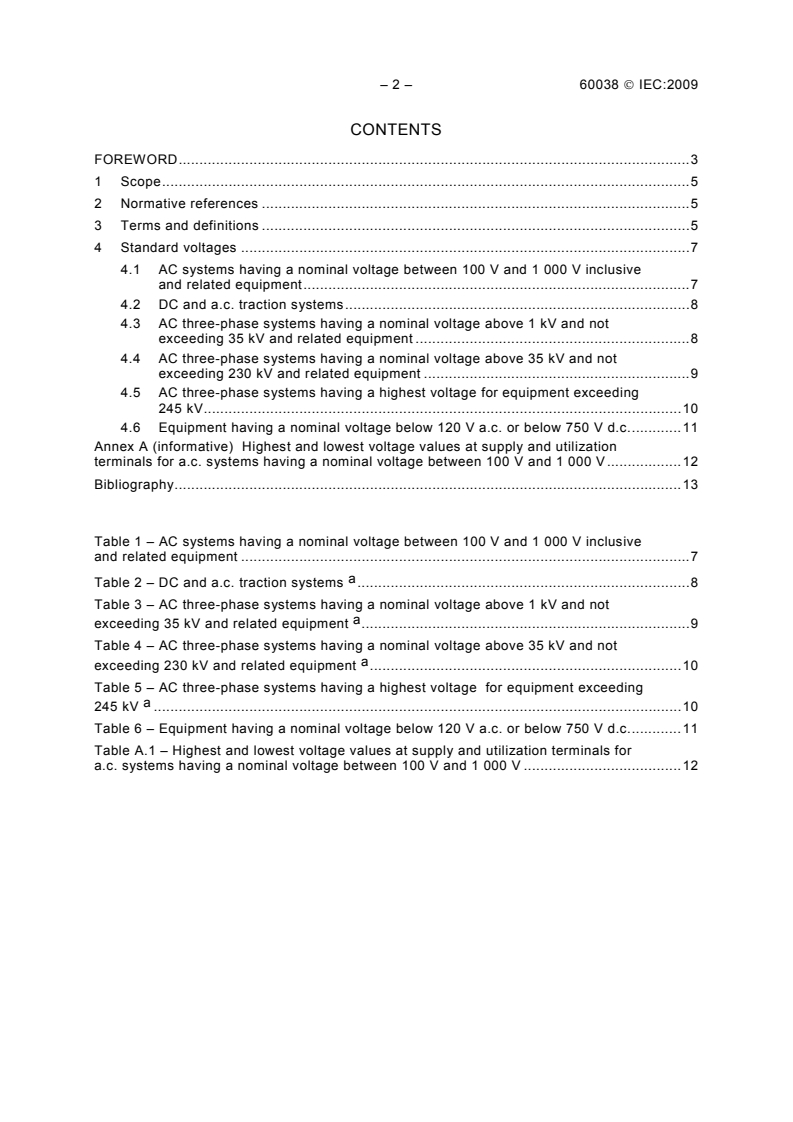
CONTENTS
FOREWORD.0H3
1 Scope.1H5
2 Normative references .2H5
3 Terms and definitions .3H5
4 Standard voltages .4H7
4.1 AC systems having a nominal voltage between 100 V and 1 000 V inclusive
and related equipment.5H7
4.2 DC and a.c. traction systems.6H8
4.3 AC three-phase systems having a nominal voltage above 1 kV and not
exceeding 35 kV and related equipment .7H8
4.4 AC three-phase systems having a nominal voltage above 35 kV and not
exceeding 230 kV and related equipment .8H9
4.5 AC three-phase systems having a highest voltage for equipment exceeding
245 kV.9H10
4.6 Equipment having a nominal voltage below 120 V a.c. or below 750 V d.c.10H11
Annex A (informative) Highest and lowest voltage values at supply and utilization
terminals for a.c. systems having a nominal voltage between 100 V and 1 000 V.11H12
Bibliography.12H13
Table 1 – AC systems having a nominal voltage between 100 V and 1 000 V inclusive
and related equipment .13H7
a
Table 2 – DC and a.c. traction systems .14H8
Table 3 – AC three-phase systems having a nominal voltage above 1 kV and not
a
exceeding 35 kV and related equipment .15H9
Table 4 – AC three-phase systems having a nominal voltage above 35 kV and not
a
exceeding 230 kV and related equipment .16H10
Table 5 – AC three-phase systems having a highest voltage for equipment exceeding
a
245 kV .17H10
Table 6 – Equipment having a nominal voltage below 120 V a.c. or below 750 V d.c.18H11
Table A.1 – Highest and lowest voltage values at supply and utilization terminals for
a.c. systems having a nominal voltage between 100 V and 1 000 V .19H12
60038 © IEC:2009 – 3 –
INTERNATIONAL ELECTROTECHNICAL COMMISSION
____________
IEC STANDARD VOLTAGES
FOREWORD
1) The International Electrotechnical Commission (IEC) is a worldwide organization for standardization comprising
all national electrotechnical committees (IEC National Committees). The object of IEC is to promote
international co-operation on all questions concerning standardization in the electrical and electronic fields. To
this end and in addition to other activities, IEC publishes International Standards, Technical Specifications,
Technical Reports, Publicly Available Specifications (PAS) and Guides (hereafter referred to as “IEC
Publication(s)”). Their preparation is entrusted to technical committees; any IEC National Committee interested
in the subject dealt with may participate in this preparatory work. International, governmental and non-
governmental organizations liaising with the IEC also participate in this preparation. IEC collaborates closely
with the International Organization for Standardization (ISO) in accordance with conditions determined by
agreement between the two organizations.
2) The formal decisions or agreements of IEC on technical matters express, as nearly as possible, an international
consensus of opinion on the relevant subjects since each technical committee has representation from all
interested IEC National Committees.
3) IEC Publications have the form of recommendations for international use and are accepted by IEC National
Committees in that sense. While all reasonable efforts are made to ensure that the technical content of IEC
Publications is accurate, IEC cannot be held responsible for the way in which they are used or for any
misinterpretation by any end user.
4) In order to promote international uniformity, IEC National Committees undertake to apply IEC Publications
transparently to the maximum extent possible in their national and regional publications. Any divergence
between any IEC Publication and the corresponding national or regional publication shall be clearly indicated in
the latter.
5) IEC provides no marking procedure to indicate its approval and cannot be rendered responsible for any
equipment declared to be in conformity with an IEC Publication.
6) All users should ensure that they have the latest edition of this publication.
7) No liability shall attach to IEC or its directors, employees, servants or agents including individual experts and
members of its technical committees and IEC National Committees for any personal injury, property damage or
other damage of any nature whatsoever, whether direct or indirect, or for costs (including legal fees) and
expenses arising out of the publication, use of, or reliance upon, this IEC Publication or any other IEC
Publications.
8) Attention is drawn to the Normative references cited in this publication. Use of the referenced publications is
indispensable for the correct application of this publication.
9) Attention is drawn to the possibility that some of the elements of this IEC Publication may be the subject of
patent rights. IEC shall not be held responsible for identifying any or all such patent rights.
International Standard IEC 60038 has been prepared by IEC technical committee 8: System
aspects for electrical energy supply.
This seventh edition supersedes the sixth edition (1993), its Amendment 1 (1994) and its
Amendment 2 (1997). It constitutes a technical revision. The significant technical changes
are:
– a clarification of the scope;
– the addition of the values of 230 V (50 Hz) and 230/400 V (60 Hz) to Table1;
– the update of Table 1 to take into account the end of the transition period for the values of
230/400 V and 400/690 V;
– the replacement of the utilization voltage range at LV by a reference to the relevant
standard and an informative annex;
– the addition of the value of 30 kV to Table 3;
– the replacement of the value of 1 050 kV by 1 100 kV in Table 5.
– 4 – 60038 © IEC:2009
The text of this standard is based on the following documents:
FDIS Report on voting
8/1260/FDIS 8/1264/RVD
Full information on the voting for the approval of this standard can be found in the report on
voting indicated in the above table.
It has the status of a horizontal standard in accordance with IEC Guide 108.
This publication has been drafted in accordance with the ISO/IEC Directives, Part 2.
The committee has decided that the contents of this publication will remain unchanged until
the maintenance result date indicated on the IEC web site under "http://webstore.iec.ch" in
the data related to the specific publication. At this date, the publication will be
• reconfirmed,
• withdrawn,
• replaced by a revised edition, or
• amended.
60038 © IEC:2009 – 5 –
IEC STANDARD VOLTAGES
1 Scope
This publication applies to
– a.c. transmission, distribution and utilization systems and equipment for use in such systems
with standard frequencies 50 Hz and 60 Hz having a nominal voltage above 100 V;
– a.c. and d.c. traction systems;
– a.c. and d.c. equipment having nominal voltages below 120 V a.c. or below 750 V d.c.,
the a.c. voltages being intended (but not exclusively) for 50 Hz and 60 Hz applications;
such equipment covers batteries (from primary or secondary cells), other power supply
devices (a.c. or d.c.), electrical equipment (including industrial and communication),
and appliances.
This publication does not apply to voltages representing or transmitting signals or measured
values.
This publication does not apply to standard voltages of components and parts used within
electrical devices or items of equipment.
This publication specifies standard voltage values which are intended to serve
− as preferential values for the nominal voltage of electrical supply systems, and
− as reference values for equipment and system design.
NOTE 1 Two main reasons have led to the values specified in this standard:
The values of nominal voltage (or highest voltage for equipment) specified in this standard are mainly based on the
historical development of electrical supply systems throughout the world, since these values turned out to be the
most common ones, and have achieved worldwide recognition;
The voltage ranges mentioned in this standard have been recognized to be the most appropriate ones as a basis
for design and testing of electrical equipment and systems.
NOTE 2 It is nevertheless the task of system and product standards to define appropriate testing values, testing
conditions and acceptance criteria.
2 Normative references
The following referenced documents are indispensable for the application of this document.
For dated references, only the edition cited applies. For undated references, the latest edition
of the referenced document (including any amendments) applies.
IEC 60364-5-52: Electrical installations of buildings – Part 5-52: Selection and erection of
electrical equipment – Wiring systems
3 Terms and definitions
For the purposes of this document, the following terms and definitions apply.
For alternating voltages, the voltages stated below are r.m.s. values.
– 6 – 60038 © IEC:2009
3.1
nominal system voltage
a suitable approximate value of voltage used to designate or identify a system
[IEV 601-01-21, modified]
3.2
highest voltage of a system
(excluding transient or abnormal conditions)
the highest value of operating voltage which occurs under normal operating conditions at any
time and at any point on the system
NOTE It excludes transient overvoltages, such as those due to switching operations, and temporary variations of
voltage.
[IEV 601-01-23, modified]
3.3
lowest voltage of a system
(excluding transient or abnormal conditions)
the lowest value of operating voltage which occurs under normal operating conditions at any
time and at any point on the system
NOTE It excludes transient voltages, such as those due to switching operations, and temporary variations of
voltage.
[IEV 601-01-24, modified]
3.4
supply terminals
point in a transmission or distribution network designated as such and contractually fixed, at
which electrical energy is exchanged between contractual partners
3.5
supply voltage
the phase-to-phase or phase-to-neutral voltage at the supply terminals
NOTE An equivalent definition is: the line-to-line or line-to-neutral voltage at the supply terminals.
3.6
supply voltage range
the voltage range at the supply terminals
3.7
utilization voltage
the phase-to-phase or phase-to-neutral voltage at the outlets or at the points where
utilisation equipment is intended to be connected to the fixed installation
NOTE An equivalent definition is: the line-to-line or line-to-neutral voltage at the outlets or at the points where
utilisation equipment is intended to be connected to the fixed installation.
3.8
utilization voltage range
the voltage range at the outlets or at the points where utilisation equipment is intended to be
connected to the fixed installation
NOTE Attention is drawn to the fact that in some equipment standards (for example, IEC 60335-1 and
IEC 60071), the term "voltage range" has a different meaning.
60038 © IEC:2009 – 7 –
3.9
highest voltage for equipment
highest voltage for which the equipment is specified regarding:
a) the insulation;
b) other characteristics which may be linked to this highest voltage in the relevant equipment
recommendations.
NOTE Equipment may only be used on systems having a highest system voltage less than or equal to its highest
voltage for equipment.
4 Standard voltages
4.1 AC systems having a nominal voltage between 100 V and 1 000 V inclusive and
related equipment
The nominal voltage of an a.c. system in the range from 100 V to 1 000 V should be selected
from the values given in Table 1.
Table 1 – AC systems having a nominal voltage between
100 V and 1 000 V inclusive and related equipment
Three-phase four-wire or three-wire systems Single-phase three-wire systems
Nominal voltage Nominal voltage
V V
50 Hz 60 Hz 60 Hz
d
– 120/208 120/240
c c
230 240 –
a a
230/400 230/400 –
– 277/480 –
– 480 –
– 347/600 –
– 600 –
b
– –
400/690
1 000 – –
a
The value of 230/400 V is the result of the evolution of 220/380 V and 240/415 V systems which has been
completed in Europe and many other countries. However, 220/380 V and 240/415 V systems still exist.
b
The value of 400/690 V is the result of the evolution of 380/660 V systems which has been completed in
Europe and many other countries. However, 380/660 V systems still exist.
c
The value of 200 V or 220 V is also used in some countries.
d
The values of 100/200 V are also used in some countries on 50 Hz or 60 Hz systems.
In Table 1, the three-phase four-wire systems and single-phase three-wire systems include
single-phase circuits (extensions, services, etc.) connected to these systems.
The lower values in the first and second columns are voltages to neutral and the higher
values are voltages between phases. When one value only is indicated, it refers to three-wire
systems and specifies the voltage between phases. The lower value in the third column is the
voltage to neutral and the higher value is the voltage between lines.
Voltages in excess of 230/400 V are intended for heavy industrial applications and large
commercial premises.
Concerning supply voltage range, under normal operating conditions, the supply voltage
should not differ from the nominal voltage of the system by more than ±10 %.
– 8 – 60038 © IEC:2009
For the utilization voltage range, in addition to the voltage variations at the supply terminals,
voltage drops may occur within the consumer's installations. For more information, see
IEC 60364-5-52. This utilization voltage range should be taken into account by product
committees.
NOTE The highest and lowest voltage values at supply terminals and at utilization terminals, as they can be
derived from the above and from IEC 60364-5-52:2001, are provided for information in 20H A nne x A .
4.2 DC and a.c. traction systems
The voltages of a d.c. or a.c. traction system should be selected from the values given in
Table 2.
a
Table 2 – DC and a.c. traction systems
Voltage
Nominal frequency
of a.c. systems
Lowest Nominal Highest
V V V Hz
DC systems (400) (600) (720)
500 750 900
1 000 1 500 1 800
b
2 000 3 000 3 600
AC single-phase systems (4 750) (6 250) (6 900) 50 or 60
12 000 15 000 17 250 16 /3
19 000 25 000 27 500 50 or 60
a The values indicated in parentheses should be considered as non-preferred values. It is recommended
that these values should not be used for new systems to be constructed in future. In particular for a.c.
single-phase systems, the nominal voltage 6 250 V should be used only when local conditions make it
impossible to adopt the nominal voltage 25 000 V.
The values indicated in the table above are the values agreed by the international mixed committee on
electric traction equipment (C.M.T.) and by IEC technical committee 9, Electrical equipment and systems
for railways.
b In certain European countries, this voltage may reach 4 000 V. The electrical equipment of vehicles
operating international services in these countries shall be capable of withstanding this absolute maximal
voltage for brief periods of up to 5 min.
4.3 AC three-phase systems having a nominal voltage above 1 kV and not exceeding
35 kV and related equipment
The voltages for an a.c. three-phase system having a nominal voltage above 1 kV and not
exceeding 35 kV should be selected from the values given in Table 3.
60038 © IEC:2009 – 9 –
Table 3 – AC three-phase systems having a nominal voltage above 1 kV
a
and not exceeding 35 kV and related equipment
Series I Series II
Highest voltage Nominal system Highest voltage Nominal system
for equipment voltage for equipment voltage
kV kV kV kV
b b b b b
3,6 3,3 3 4,40 4,16
b b b
7,2 6,6 6 – –
12 11 10 – –
c c
– – – 13,2 12,47
c c
– – –
13,97 13,2
b b
– – – 14,52 13,8
(17,5) – (15) – –
24 22 20 – –
c,e c,e
– – –
26,4 24,94
d d d
36 33 30 – –
c c
– – – 36,5 34,5
d d
– – –
40,5 35
NOTE 1 It is recommended that in any one country, the ratio between two adjacent nominal voltages should
be not less than two.
NOTE 2 In a normal system of series I, the highest voltage and the lowest voltage do not differ by more than
approximately ±10 % from the nominal voltage of the system. In a normal system of series II, the highest
voltage does not differ by more than +5 % and the lowest voltage by more than –10 % from the nominal
voltage of the system.
a
These systems are generally three-wire systems, unless otherwise indicated. The values indicated are
voltages between phases.
The values indicated in parentheses should be considered as non-preferred values. It is recommended
that these values should not be used for new systems to be constructed in future.
b
These values should not be used for new public distribution systems.
c
These systems are generally four-wire systems and the values indicated are voltages between phases.
The voltage to neutral is equal to the indicated value divided by 1,73.
d
The unification of these values is under consideration.
e
The values of 22,9 kV for nominal voltage and 24,2 kV or 25,8 kV for highest voltage for equipment are
also used in some countries.
Two series of highest voltages for equipment are given above, one for 50 Hz and 60 Hz
systems (series I), the other for 60 Hz systems (series II – North American practice). It is
recommended that only one of the series should be used in any one country.
It is also recommended that only one of the two series of nominal voltages given for series I
should be used in any one country.
4.4 AC three-phase systems having a nominal voltage above 35 kV and not exceeding
230 kV and related equipment
The voltages for an a.c. three-phase system having a nominal voltage above 35 kV and not
exceeding 230 kV should be selected from the values given in Table 4.
– 10 – 60038 © IEC:2009
Table 4 – AC three-phase systems having a nominal voltage above 35 kV
a
and not exceeding 230 kV and related equipment
Highest voltage Nominal system
for equipment voltage
kV kV
(52) (45) –
72,5 66 69
123 110 115
145 132 138
(170) (150) (154)
245 220 230
a
The values indicated in parentheses should be considered as
non-preferred values. It is recommended that these values
should not be used for new systems to be constructed in
future. The values are voltages between phases.
Two series of nominal system voltages are given above. It is recommended that only one of
the two series should be used in any one country.
It is recommended that in any one country only one value in the following groups should be
used for the highest voltage for equipment:
• 123 kV or 145 kV;
• 245 kV or 300 kV (see Table 5) or 362 kV (see Table 5).
4.5 AC three-phase systems having a highest voltage for equipment exceeding
245 kV
The highest voltage for equipment for an a.c. three-phase system exceeding 245 kV should
be selected from the values given in Table 5.
Table 5 – AC three-phase systems having a highest voltage
a
for equipment exceeding 245 kV
Highest voltage for equipment
kV
(300)
b
c
1 100
1 200
a
The values indicated in parentheses should be considered as non-preferred values. It is recommended
that these values should not be used for new systems to be constructed in future. The values are voltages
between phases.
b
The value 525 kV is also used.
c
The value 765 kV is also used; the test values for equipment should be the same as defined by the IEC
for 765 kV.
It is recommended that in any one geographical area, only one value in the following groups
should be used for the highest voltage for equipment:
• 245 kV (see Table 4) or 300 kV or 362 kV;
60038 © IEC:2009 – 11 –
• 362 kV or 420 kV;
• 420 kV or 550 kV;
• 1 100 kV or 1 200 kV.
NOTE In the above sentence, the term "geographical area" may indicate a single country, a group of countries
which agree to adopt the same voltage level, or a part of a very large country.
4.6 Equipment having a nominal voltage below 120 V a.c. or below 750 V d.c.
The nominal voltage for equipment below 120 V a.c. or below 750 V d.c. should be selected
from the values given in Table 6.
Table 6 – Equipment having a nominal voltage
below 120 V a.c. or below 750 V d.c.
DC AC
Nominal values Nominal values
Preferred Supplementary Preferred Supplementary
V V V V
2,4
4,5
5 5
6 6
7,5
12 12
15 15
24 24
36 36
48 48
60 60
110 110
NOTE 1 Because the voltage of the primary and secondary cells is below 2,4 V, and the choice
of the type of cell to be used in various applications will be based on properties other than the
voltage, these values are not included in the table. The relevant IEC technical committees may
specify types of cells and related voltages for specific applications.
NOTE 2 It is recognized that for technical and economic reasons, additional voltages may be
required for certain specific fields of application.
– 12 – 60038 © IEC:2009
Annex A
(informative)
Highest and lowest voltage values at supply and utilization terminals for
a.c. systems having a nominal voltage between 100 V and 1 000 V
Table A.1 gives the highest and lowest voltage values at supply terminals and at utilization
terminals, as they can be derived from the text related to Table 1 in Clause 4, and from the
indications provided by IEC 60364-5-52:2001.
NOTE Values in Table A.1 are based on the note in IEC 60364-5-52:2001, Clause 525, which indicates that "In
the absence of other considerations, it is recommended that in practice the voltage drop between the origin of
consumer's installation and the equipment should not be greater than 4 % of the nominal voltage of the
installation".
Clause 525 of IEC 60364-5 is presently under consideration. Values for lowest utilization voltages should be
modified in future in accordance with revisions of IEC 60364-5-52.
Table A.1 – Highest and lowest voltage values at supply and utilization terminals for
a.c. systems having a nominal voltage between 100 V and 1 000 V
Voltage
Systems Highest Nominal Lowest Lowest
Nominal frequency
supply or voltage supply utilization
utilization voltage voltage
voltage
Hz V V V V
c
Three-phase 50 253 230 207 198
four-wire
a
253/440 230/400 207/360 198/344
or three-wire
systems
b
440/759 400/690 360/621 344/593
1 100 1 000 900 860
60 132/229 120/208 108/187 103/179
c
264 240 216 206
a
253/440 230/400 207/360 198/344
305/528 277/480 249/432 238/413
528 480 432 413
382/660 347/600 312/540 298/516
660 600 540 516
d
Single-phase 108/216 103/206
60 132/264 120/240
three-wire systems
a)
The value of 230/400 V is the result of the evolution of 220/380 V and 240/415 V systems which has been
completed in Europe and many other countries. However, 220/380 V and 240/415 V systems still exist.
b)
The value of 400/690 V is the result of the evolution of 380/660 V systems which has been completed in
Europe and many other countries. However, 380/660 V systems still exist.
c)
The value of 200 V or 220 V is also used in some countries.
d)
The values of 100/200 V are also used in
...
IEC 60038 ®
Edition 7.1 2021-12
CONSOLIDATED VERSION
INTERNATIONAL
STANDARD
NORME
INTERNATIONALE
colour
inside
HORIZONTAL PUBLICATION
PUBLICATION HORIZONTALE
IEC standard voltages
Tensions normales de l’IEC
All rights reserved. Unless otherwise specified, no part of this publication may be reproduced or utilized in any form
or by any means, electronic or mechanical, including photocopying and microfilm, without permission in writing from
either IEC or IEC's member National Committee in the country of the requester. If you have any questions about IEC
copyright or have an enquiry about obtaining additional rights to this publication, please contact the address below or
your local IEC member National Committee for further information.
Droits de reproduction réservés. Sauf indication contraire, aucune partie de cette publication ne peut être reproduite
ni utilisée sous quelque forme que ce soit et par aucun procédé, électronique ou mécanique, y compris la photocopie
et les microfilms, sans l'accord écrit de l'IEC ou du Comité national de l'IEC du pays du demandeur. Si vous avez des
questions sur le copyright de l'IEC ou si vous désirez obtenir des droits supplémentaires sur cette publication, utilisez
les coordonnées ci-après ou contactez le Comité national de l'IEC de votre pays de résidence.
IEC Central Office Tel.: +41 22 919 02 11
3, rue de Varembé info@iec.ch
CH-1211 Geneva 20 www.iec.ch
Switzerland
About the IEC
The International Electrotechnical Commission (IEC) is the leading global organization that prepares and publishes
International Standards for all electrical, electronic and related technologies.
About IEC publications
The technical content of IEC publications is kept under constant review by the IEC. Please make sure that you have the
latest edition, a corrigendum or an amendment might have been published.
IEC publications search - webstore.iec.ch/advsearchform IEC online collection - oc.iec.ch
The advanced search enables to find IEC publications by a Discover our powerful search engine and read freely all the
variety of criteria (reference number, text, technical publications previews. With a subscription you will always
committee, …). It also gives information on projects, replaced have access to up to date content tailored to your needs.
and withdrawn publications.
Electropedia - www.electropedia.org
IEC Just Published - webstore.iec.ch/justpublished
The world's leading online dictionary on electrotechnology,
Stay up to date on all new IEC publications. Just Published
containing more than 22 000 terminological entries in English
details all new publications released. Available online and
and French, with equivalent terms in 18 additional languages.
once a month by email.
Also known as the International Electrotechnical Vocabulary
(IEV) online.
IEC Customer Service Centre - webstore.iec.ch/csc
If you wish to give us your feedback on this publication or
need further assistance, please contact the Customer Service
Centre: sales@iec.ch.
A propos de l'IEC
La Commission Electrotechnique Internationale (IEC) est la première organisation mondiale qui élabore et publie des
Normes internationales pour tout ce qui a trait à l'électricité, à l'électronique et aux technologies apparentées.
A propos des publications IEC
Le contenu technique des publications IEC est constamment revu. Veuillez vous assurer que vous possédez l’édition la
plus récente, un corrigendum ou amendement peut avoir été publié.
IEC online collection - oc.iec.ch
Recherche de publications IEC -
webstore.iec.ch/advsearchform Découvrez notre puissant moteur de recherche et consultez
La recherche avancée permet de trouver des publications IEC gratuitement tous les aperçus des publications. Avec un
en utilisant différents critères (numéro de référence, texte, abonnement, vous aurez toujours accès à un contenu à jour
comité d’études, …). Elle donne aussi des informations sur adapté à vos besoins.
les projets et les publications remplacées ou retirées.
Electropedia - www.electropedia.org
IEC Just Published - webstore.iec.ch/justpublished
Le premier dictionnaire d'électrotechnologie en ligne au
Restez informé sur les nouvelles publications IEC. Just
monde, avec plus de 22 000 articles terminologiques en
Published détaille les nouvelles publications parues.
anglais et en français, ainsi que les termes équivalents dans
Disponible en ligne et une fois par mois par email.
16 langues additionnelles. Egalement appelé Vocabulaire
Electrotechnique International (IEV) en ligne.
Service Clients - webstore.iec.ch/csc
Si vous désirez nous donner des commentaires sur cette
publication ou si vous avez des questions contactez-nous:
sales@iec.ch.
IEC 60038 ®
Edition 7.1 2021-12
CONSOLIDATED VERSION
INTERNATIONAL
STANDARD
NORME
INTERNATIONALE
colour
inside
HORIZONTAL PUBLICATION
PUBLICATION HORIZONTALE
IEC standard voltages
Tensions normales de l’IEC
INTERNATIONAL
ELECTROTECHNICAL
COMMISSION
COMMISSION
ELECTROTECHNIQUE
INTERNATIONALE
ICS 29.020 ISBN 978-2-8322-4028-1
IEC 60038 ®
Edition 7.1 2021-12
CONSOLIDATED VERSION
REDLINE VERSION
VERSION REDLINE
colour
inside
HORIZONTAL PUBLICATION
PUBLICATION HORIZONTALE
IEC standard voltages
Tensions normales de l’IEC
– 2 – IEC 60038:2009+AMD1:2021 CSV
IEC 2021
CONTENTS
FOREWORD . 3
INTRODUCTION . 5
1 Scope . 6
2 Normative references . 6
3 Terms and definitions . 7
4 Standard voltages . 9
4.1 AC systems having a nominal voltage between 100 V and 1 000 V inclusive
and related equipment . 9
4.2 DC and a.c. AC traction systems . 10
4.3 AC three-phase systems having a nominal voltage above 1 kV and not
exceeding 35 kV and related equipment . 10
4.4 AC three-phase systems having a nominal voltage above 35 kV and not
exceeding 230 kV and related equipment . 12
4.5 AC three-phase systems having a highest voltage for equipment exceeding
245 kV . 12
4.6 Equipment having a nominal voltage below 120 V a.c. AC or below 750 V
d.c. DC . 13
Annex A (informative) Highest and lowest voltage values at supply and utilization
terminals for a.c. AC systems having a nominal voltage between 100 V and 1 000 V . 14
Bibliography . 16
Table 1 – AC systems having a nominal voltage between 100 V and 1 000 V inclusive
and related equipment . 9
a
Table 2 – DC and a.c. AC traction systems . 10
Table 3 – AC three-phase systems having a nominal voltage above 1 kV and not
a
exceeding 35 kV and related equipment . 11
Table 4 – AC three-phase systems having a nominal voltage above 35 kV and not
a
exceeding 230 kV and related equipment . 12
Table 5 – AC three-phase systems having a highest voltage for equipment exceeding
a
245 kV . 12
Table 6 – Equipment having a nominal voltage below 120 V a.c. AC or below 750 V
d.c. DC . 13
Table 7 – AC single wire earth return (SWER) systems . 11
Table A.1 – Highest and lowest voltage values at supply and utilization terminals for
a.c. AC systems having a nominal voltage between 100 V and 1 000 V . 14
IEC 2021
INTERNATIONAL ELECTROTECHNICAL COMMISSION
____________
IEC STANDARD VOLTAGES
FOREWORD
1) The International Electrotechnical Commission (IEC) is a worldwide organization for standardization comprising
all national electrotechnical committees (IEC National Committees). The object of IEC is to promote
international co-operation on all questions concerning standardization in the electrical and electronic fields. To
this end and in addition to other activities, IEC publishes International Standards, Technical Specifications,
Technical Reports, Publicly Available Specifications (PAS) and Guides (hereafter referred to as “IEC
Publication(s)”). Their preparation is entrusted to technical committees; any IEC National Committee interested
in the subject dealt with may participate in this preparatory work. International, governmental and non-
governmental organizations liaising with the IEC also participate in this preparation. IEC collaborates closely
with the International Organization for Standardization (ISO) in accordance with conditions determined by
agreement between the two organizations.
2) The formal decisions or agreements of IEC on technical matters express, as nearly as possible, an international
consensus of opinion on the relevant subjects since each technical committee has representation from all
interested IEC National Committees.
3) IEC Publications have the form of recommendations for international use and are accepted by IEC National
Committees in that sense. While all reasonable efforts are made to ensure that the technical content of IEC
Publications is accurate, IEC cannot be held responsible for the way in which they are used or for any
misinterpretation by any end user.
4) In order to promote international uniformity, IEC National Committees undertake to apply IEC Publications
transparently to the maximum extent possible in their national and regional publications. Any divergence
between any IEC Publication and the corresponding national or regional publication shall be clearly indicated in
the latter.
5) IEC provides no marking procedure to indicate its approval and cannot be rendered responsible for any
equipment declared to be in conformity with an IEC Publication.
6) All users should ensure that they have the latest edition of this publication.
7) No liability shall attach to IEC or its directors, employees, servants or agents including individual experts and
members of its technical committees and IEC National Committees for any personal injury, property damage or
other damage of any nature whatsoever, whether direct or indirect, or for costs (including legal fees) and
expenses arising out of the publication, use of, or reliance upon, this IEC Publication or any other IEC
Publications.
8) Attention is drawn to the Normative references cited in this publication. Use of the referenced publications is
indispensable for the correct application of this publication.
9) Attention is drawn to the possibility that some of the elements of this IEC Publication may be the subject of
patent rights. IEC shall not be held responsible for identifying any or all such patent rights.
This consolidated version of the official IEC Standard and its amendment has been
prepared for user convenience.
IEC 60038 edition 7.1 contains the seventh edition (2009-06) [documents 8/1260/FDIS
and 8/1264/RVD] and its amendment 1 (2021-12) [documents 8/1600/FDIS and
8/1603/RVD].
In this Redline version, a vertical line in the margin shows where the technical content
is modified by amendment 1. Additions are in green text, deletions are in strikethrough
red text. A separate Final version with all changes accepted is available in this
publication.
– 4 – IEC 60038:2009+AMD1:2021 CSV
IEC 2021
International Standard IEC 60038 has been prepared by IEC technical committee 8: System
aspects for electrical energy supply.
This seventh edition constitutes a technical revision. The significant technical changes are:
– a clarification of the scope;
– the addition of the values of 230 V (50 Hz) and 230/400 V (60 Hz) to Table1;
– the update of Table 1 to take into account the end of the transition period for the values of
230/400 V and 400/690 V;
– the replacement of the utilization voltage range at LV by a reference to the relevant
standard and an informative annex;
– the addition of the value of 30 kV to Table 3;
– the replacement of the value of 1 050 kV by 1 100 kV in Table 5.
– co-ordination of Table 1 of IEC 60850:2014 and Table 2 of IEC 60038;
– co-ordination of 60 Hz highest and lowest values with major national 60 Hz standards;
– co-ordination of Annex A with IEC 60364-5-52:2009;
– a new table covering single wire earth return systems for remote areas.
It has the status of a horizontal standard in accordance with IEC Guide 108.
This publication has been drafted in accordance with the ISO/IEC Directives, Part 2.
The committee has decided that the contents of the base publication and its amendment will
remain unchanged until the stability date indicated on the IEC web site under webstore.iec.ch
in the data related to the specific publication. At this date, the publication will be
• reconfirmed,
• withdrawn,
• replaced by a revised edition, or
• amended.
IMPORTANT – The 'colour inside' logo on the cover page of this publication indicates
that it contains colours which are considered to be useful for the correct
understanding of its contents. Users should therefore print this document using a
colour printer.
IEC 2021
INTRODUCTION
This publication has been prepared by TC 8, whose scope is to prepare and coordinate, in co-
operation with other TC/SCs, the development of international standards and other
deliverables with an emphasis on overall system aspects of electricity supply systems and an
acceptable balance between the cost and quality for the users of electrical energy. The
electricity supply system encompasses transmission and distribution networks and connected
user installations (generators and loads including traction systems) with their network
interfaces.
– 6 – IEC 60038:2009+AMD1:2021 CSV
IEC 2021
IEC STANDARD VOLTAGES
1 Scope
This publication applies to
– a.c. AC transmission, distribution and utilization systems and equipment for use in such
systems with standard frequencies 50 Hz and 60 Hz having a nominal voltage above 100 V;
– a.c. AC and d.c. DC traction systems;
– a.c. AC and d.c. DC equipment having nominal voltages below 120 V a.c. AC or below
750 V d.c. DC, the a.c. AC voltages being intended (but not exclusively) for 50 Hz and
60 Hz applications; such equipment covers batteries (from primary or secondary cells),
other power supply devices (a.c. AC or d.c. DC), electrical equipment (including industrial
and communication), and appliances.
This publication does not apply to voltages representing or transmitting signals or measured
values.
This publication does not apply to standard voltages of components and parts used within
electrical devices or items of equipment.
This publication has the status of a horizontal standard in accordance with IEC Guide 108. As
such, this publication specifies standard voltage values which are intended to serve
− as preferential values for the nominal voltage of electrical supply and utilization
systems, and
− as maximum, nominal and minimum reference values for both equipment and system
design power supply in both electricity supply and utilization systems so that product
and power system committees can co-ordinate their documents.
NOTE 1 Two main reasons have led to the values specified in this standard:
The values of nominal voltage (or highest voltage for equipment) specified in this standard are mainly based on the
historical development of electrical supply systems throughout the world, since these values turned out to be the
most common ones, and have achieved worldwide recognition;
The voltage ranges mentioned in this standard have been recognized to be the most appropriate ones as a basis
for design and testing of electrical equipment and systems.
NOTE 2 It is nevertheless the task of system and product standards to define appropriate testing values, testing
conditions and acceptance criteria.
NOTE 3 National Committees and individual systems can set values that differ from, but still comply with, the
reference values in this document provided the values they set lie between the highest voltage for equipment and
the lowest supply or utilization voltages in this document. Such variations can be required due to legacy or rating
issues.
NOTE 4 To comply with this documentneither the lowest supply or utilization voltage can be lower than the lowest
voltage for equipment.
NOTE 5 Some National committees set different nominal values for supply and utilization.
2 Normative references
The following referenced documents are indispensable for the application of this document.
For dated references, only the edition cited applies. For undated references, the latest edition
of the referenced document (including any amendments) applies.
IEC 2021
IEC 60364-5-52: Electrical installations of buildings – Part 5-52: Selection and erection of
electrical equipment – Wiring systems
3 Terms and definitions
For the purposes of this document, the following terms and definitions apply.
For alternating voltages, the voltages stated below are r.m.s. RMS values.
3.1
nominal system voltage
a suitable approximate value of voltage used to designate or identify a system
[IEV 601-01-21, modified]
3.2
highest voltage of a system
(excluding transient or abnormal conditions)
the highest value of operating voltage which occurs under normal operating conditions at any
time and at any point on the system
NOTE It excludes transient overvoltages, such as those due to switching operations, and temporary variations of
voltage.
[IEV 601-01-23, modified]
3.3
lowest voltage of a system
(excluding transient or abnormal conditions)
the lowest value of operating voltage which occurs under normal operating conditions at any
time and at any point on the system
NOTE It excludes transient voltages, such as those due to switching operations, and temporary variations of
voltage.
[IEV 601-01-24, modified]
3.4
supply terminals
point in a transmission or distribution network designated as such and contractually fixed, at
which electrical energy is exchanged between contractual partners
3.5
supply voltage
the phase-to-phase or phase-to-neutral voltage at the supply terminals
NOTE An equivalent definition is: the line-to-line or line-to-neutral voltage at the supply terminals.
3.6
supply voltage range
the voltage range at the supply terminals
3.7
utilization voltage
the phase-to-phase or phase-to-neutral voltage at the outlets or at the points where
utilisation equipment is intended to be connected to the fixed installation
NOTE An equivalent definition is: the line-to-line or line-to-neutral voltage at the outlets or at the points where
utilisation equipment is intended to be connected to the fixed installation.
– 8 – IEC 60038:2009+AMD1:2021 CSV
IEC 2021
3.8
utilization voltage range
the voltage range at the outlets or at the points where utilisation equipment is intended to be
connected to the fixed installation
NOTE Attention is drawn to the fact that in some equipment standards (for example, IEC 60335-1 and
IEC 60071), the term "voltage range" has a different meaning.
3.9
highest voltage for equipment
highest voltage for which the equipment is specified regarding:
a) the insulation;
b) other characteristics which may be linked to this highest voltage in the relevant equipment
recommendations.
NOTE Equipment may only be used on systems having a highest system voltage less than or equal to its highest
voltage for equipment.
3.10
electric power system
electricity supply system (in a broad sense)
all installations and plant provided for the purpose of generating, transmitting and distributing
electricity
[SOURCE: IEV 601-01-01]
3.11
lowest voltage for equipment
lowest voltage for which the equipment is specified regarding characteristics which may be
linked to this lowest voltage in the relevant equipment recommendations
Note 1 to entry: Equipment should only be used on systems having a lowest supply or utilization voltage greater
than or equal to its lowest voltage for equipment.
3.12
low voltage
LV
1) a set of voltage levels used for the distribution of electricity where the nominal voltage is
generally accepted to be up to 1 000 V for alternating current and 1 500 V for direct
current
2) the lowest of two or more voltages in an apparatus or installation
[SOURCE: IEV 601-01-26, modified and IEV 151-15-04]
3.13
high voltage
HV
1) in a general sense, the set of voltage levels in excess of low voltage
2) in a restrictive sense, the set of upper voltage levels used in power systems for bulk
transmission of electricity
3) the highest of two or more voltages in an apparatus or installation
[SOURCE: IEV 601-01-27 and IEV 151-15-06]
IEC 2021
4 Standard voltages
4.1 AC systems having a nominal voltage between 100 V and 1 000 V inclusive and
related equipment
The nominal voltage of an a.c. AC system in the range from 100 V to 1 000 V should be
selected from the values given in Table 1.
Table 1 – AC systems having a nominal voltage between
100 V and 1 000 V inclusive and related equipment
Three-phase four-wire or three-wire systems Single-phase three-wire systems
Nominal voltage Nominal voltage
V V
50 Hz 60 Hz 60 Hz
d
– 120/208 120/240
c c
230 240 –
a a
230/400 230/400 –
– 277/480 –
– 480 –
– 347/600 –
– 600 –
b
400/690 – –
1 000 – –
a
The value of 230/400 V is the result of the evolution of 220/380 V and 240/415 V systems which has been
completed in Europe and many other countries. However, 220/380 V and 240/415 V systems still exist.
b
The value of 400/690 V is the result of the evolution of 380/660 V systems which has been completed in
Europe and many other countries. However, 380/660 V systems still exist.
c
The value of 200 V or 220 V is also used in some countries.
d
The values of 100/200 V are also used in some countries on 50 Hz or 60 Hz systems.
In Table 1, the three-phase four-wire systems and single-phase three-wire systems include
single-phase circuits (extensions, services, etc.) connected to these systems.
The lower values in the first and second columns are voltages to neutral and the higher
values are voltages between phases. When one value only is indicated, it refers to three-wire
systems and specifies the voltage between phases. The lower value in the third column is the
voltage to neutral and the higher value is the voltage between lines.
Voltages in excess of 230/400 V are intended for heavy industrial applications and large
commercial premises.
Concerning supply voltage range, under normal operating conditions, the supply voltage
should not differ from the nominal voltage of the system by more than ±10 %.
For the utilization voltage range, in addition to the voltage variations at the supply terminals,
voltage drops may occur within the consumer's installations. For more information, see
IEC 60364-5-52. This utilization voltage range should be taken into account by product
committees.
NOTE The highest and lowest voltage values at supply terminals and at utilization terminals, as they can be
derived from the above and from IEC 60364-5-52:20012009, are provided for information in Annex A.
– 10 – IEC 60038:2009+AMD1:2021 CSV
IEC 2021
4.2 DC and a.c. AC traction systems
The voltages of a d.c. DC or a.c. AC traction system should be selected from the values given
in Table 2.
a
Table 2 – DC and a.c. AC traction systems
Voltage
Nominal frequency
of a.c. systems
Lowest Nominal Highest
V V V Hz
DC systems (400) (600) (720)
500 750 900
1 000 1 500 1 800
b
2 000 3 000 3 600
AC single-phase systems (4 750) (6 250) (6 900) 50 or 60
12 000 15 000 17 250 16 /3
19 000 25 000 27 500 50 or 60
a The values indicated in parentheses should be considered as non-preferred values. It is recommended
that these values should not be used for new systems to be constructed in future. In particular for a.c.
single-phase systems, the nominal voltage 6 250 V should be used only when local conditions make it
impossible to adopt the nominal voltage 25 000 V.
The values indicated in the table above are the values agreed by the international mixed committee on
electric traction equipment (C.M.T.) and by IEC technical committee 9, Electrical equipment and systems
for railways.
b In certain European countries, this voltage may reach 4 000 V. The electrical equipment of vehicles
operating international services in these countries shall be capable of withstanding this absolute maximal
voltage for brief periods of up to 5 min.
Voltage Nominal frequency of AC
systems
Lowest Nominal Highest
Hz
V V V
DC systems 500 750 900
1 000 1 500 1 800
2 000 3 000 3 600
AC single-phase systems 12 000 15 000 17 250 16 2/3
19 000 25 000 27 500 50 or 60
a
The values indicated in the table are the values agreed by IEC technical committee 9, Electrical equipment and
systems for railways. See IEC 60850:2014, Table 1 and Table B.1 for duration details.
4.3 AC three-phase systems having a nominal voltage above 1 kV and not exceeding
35 kV and related equipment
The voltages for an a.c. AC three-phase system having a nominal voltage above 1 kV and not
exceeding 35 kV should be selected from the values given in Table 3.
IEC 2021
Table 3 – AC three-phase systems having a nominal voltage above 1 kV
a
and not exceeding 35 kV and related equipment
Series I Series II
Highest voltage Nominal system Highest voltage Nominal system
for equipment voltage for equipment voltage
kV kV kV kV
b b b b b
3,6 3,3 3 4,40 4,16
b b b
7,2 6,6 6 – –
12 11 10 – –
c c
– – –
13,2 12,47
c c
– – – 13,97 13,2
b b
– – – 14,52 13,8
(17,5) – (15) – –
24 22 20 – –
c,e c,e
– – – 26,4 24,94
d d d
36 33 30 – –
c c
– – – 36,5 34,5
d d
40,5 – 35 – –
NOTE 1 It is recommended that in any one country, the ratio between two adjacent nominal voltages should
be not less than two.
NOTE 2 In a normal system of series I, the highest voltage and the lowest voltage do not differ by more than
approximately ±10 % from the nominal voltage of the system. In a normal system of series II, the highest
voltage does not differ by more than +5 % and the lowest voltage by more than –10 % from the nominal
voltage of the system.
a
These systems are generally three-wire systems, unless otherwise indicated. The values indicated are
voltages between phases.
The values indicated in parentheses should be considered as non-preferred values. It is recommended
that these values should not be used for new systems to be constructed in future.
b
These values should not be used for new public distribution systems.
c
These systems are generally four-wire systems and the values indicated are voltages between phases.
The voltage to neutral is equal to the indicated value divided by 1,73.
d
The unification of these values is under consideration.
e
The values of 22,9 kV for nominal voltage and 24,2 kV or 25,8 kV for highest voltage for equipment are
also used in some countries.
Two series of highest voltages for equipment are given above, one for 50 Hz and 60 Hz
systems (series I), the other for 60 Hz systems (series II – North American practice). It is
recommended that only one of the series should be used in any one country.
It is also recommended that only one of the two series of nominal voltages given for series I
should be used in any one country.
The voltages in Table 7 have been derived from three-phase highest voltage for equipment
voltages of 24 kV and 36 kV respectively. The highest voltage of the system and nominal
voltages are based on the three-phase systems that supply 50 Hz SWER systems.
Table 7 – AC single wire earth return (SWER) systems
Highest voltage for Highest voltage of Nominal voltage of
equipment system system
kV kV kV
24 13,9 12,7
36 20,8 19,1
– 12 – IEC 60038:2009+AMD1:2021 CSV
IEC 2021
4.4 AC three-phase systems having a nominal voltage above 35 kV and not exceeding
230 kV and related equipment
The voltages for an a.c. AC three-phase system having a nominal voltage above 35 kV and
not exceeding 230 kV should be selected from the values given in Table 4.
Table 4 – AC three-phase systems having a nominal voltage above 35 kV
a
and not exceeding 230 kV and related equipment
Highest voltage Nominal system
for equipment voltage
kV kV
(52) (45) –
72,5 66 69
123 110 115
145 132 138
(170) (150) (154)
245 220 230
a
The values indicated in parentheses should be considered as
non-preferred values. It is recommended that these values
should not be used for new systems to be constructed in
future. The values are voltages between phases.
Two series of nominal system voltages are given above. It is recommended that only one of
the two series should be used in any one country.
It is recommended that in any one country only one value in the following groups should be
used for the highest voltage for equipment:
• 123 kV or 145 kV;
• 245 kV or 300 kV (see Table 5) or 362 kV (see Table 5).
4.5 AC three-phase systems having a highest voltage for equipment exceeding
245 kV
The highest voltage for equipment for an a.c. AC three-phase system exceeding 245 kV
should be selected from the values given in Table 5.
Table 5 – AC three-phase systems having a highest voltage
a
for equipment exceeding 245 kV
Highest voltage for equipment
kV
(300)
b
c
1 100
1 200
a
The values indicated in parentheses should be considered as non-preferred values. It is recommended
that these values should not be used for new systems to be constructed in future. The values are voltages
between phases.
b
The value 525 kV is also used.
c
The value 765 kV is also used; the test values for equipment should be the same as defined by the IEC
for 765 kV.
IEC 2021
It is recommended that in any one geographical area, only one value in the following groups
should be used for the highest voltage for equipment:
• 245 kV (see Table 4) or 300 kV or 362 kV;
• 362 kV or 420 kV;
• 420 kV or 550 kV;
• 1 100 kV or 1 200 kV.
NOTE In the above sentence, the term "geographical area" may indicate a single country, a group of countries
which agree to adopt the same voltage level, or a part of a very large country.
4.6 Equipment having a nominal voltage below 120 V a.c. AC or below 750 V d.c. DC
The nominal voltage for equipment below 120 V a.c. AC or below 750 V d.c. DC should be
selected from the values given in Table 6.
Table 6 – Equipment having a nominal voltage
below 120 V a.c. AC or below 750 V d.c. DC
DC AC
Nominal values Nominal values
Preferred Supplementary Preferred Supplementary
V V V V
2,4
4,5
5 5
6 6
7,5
12 12
15 15
24 24
36 36
48 48
60 60
110 110
NOTE 1 Because the voltage of the primary and secondary cells is below 2,4 V, and the choice
of the type of cell to be used in various applications will be based on properties other than the
voltage, these values are not included in the table. The relevant IEC technical committees may
specify types of cells and related voltages for specific applications.
NOTE 2 It is recognized that for technical and economic reasons, additional voltages may be
required for certain specific fields of application.
– 14 – IEC 60038:2009+AMD1:2021 CSV
IEC 2021
Annex A
(informative)
Highest and lowest voltage values at supply and utilization terminals for
a.c. AC systems having a nominal voltage between 100 V and 1 000 V
Table A.1 gives the highest and lowest voltage values at supply terminals and at utilization
terminals, as they can be derived from the text related to Table 1 in Clause 4, and from the
indications provided by IEC 60364-5-52:2001.
NOTE Values in Table A.1 are based on the note in IEC 60364-5-52:2001, Clause 525, which indicates that "In
the absence of other considerations, it is recommended that in practice the voltage drop between the origin of
consumer's installation and the equipment should not be greater than 4 % of the nominal voltage of the
installation".
Clause 525 of IEC 60364-5 is presently under consideration. Values for lowest utilization voltages should be
modified in future in accordance with revisions of IEC 60364-5-52.
Table A.1 gives the highest, nominal and lowest reference voltage values at supply terminals
and at utilization terminals for 50 Hz and 60 Hz AC systems having a nominal voltage
between 100 V and 1 000 V.
The values are derived from Table 1 in Clause 4, and from IEC 60364-5-52:2009.
NOTE Values in Table A.1 are based on 3 % (lighting) and 5 % (other) voltage drops in the consumer’s premises
(IEC 60364- 5-52:2009) and a ±10 % supply voltage range at 50 Hz on three-phase systems calculations. 60 Hz
three-phase values are based on a supply voltage range of +6 % to −14 %, except for 230/400 V which is ±10 %.
Calculation of single-phase extreme values use the phase-phase value over √3 in order to maintain the √3 ratio
after rounding.
Table A.1 – Highest and lowest voltage values at supply and utilization terminals for
a.c. AC systems having a nominal voltage between 100 V and 1 000 V
Voltage
Systems Highest Nominal Lowest Lowest
Nominal frequency
supply or voltage supply utilization
utilization voltage voltage
voltage
Hz V V V V
c
Three-phase 50 253 230 207 198
four-wire
a
253/440 230/400 207/360 198/344
or three-wire
systems
b
440/759 400/690 360/621 344/593
1 100 1 000 900 860
60 132/229 120/208 108/187 103/179
c
264 240 216 206
a
253/440 230/400 207/360 198/344
305/528 277/480 249/432 238/413
528 480 432 413
382/660 347/600 312/540 298/516
660 600 540 516
d
Single-phase 60 132/264 120/240 108/216 103/206
three-wire systems
IEC 2021
a)
The value of 230/400 V is the result of the evolution of 220/380 V and 240/415 V systems which has been
completed in Europe and many other countries. However, 220/380 V and 240/415 V systems still exist.
b)
The value of 400/690 V is the result of the evolution of 380/660 V systems which has been completed in
Europe and many other countries. However, 380/660 V systems still exist.
c)
The value of 200 V or 220 V is also used in some countries.
d)
The values of 100/200 V are also used in some countries on 50 Hz or 60 Hz systems.
Systems Rated Voltage
frequency
V
Hz
Highest Nominal Lowest supply Lowest utilization voltage
voltage for voltage of voltage
Lighting Other
equipment system
(supply or
utilization
voltage)
c
Three-phase 50 254 207 200 196
four-wire, three-
a
254/440 207/360 200/348 196/340
wire or single- 230/400
phase two-wire
b
440/759 360/621 348/600 340/587
400/690
systems
1 100 1 000 900 870 850
60 127/220 120/208 103/179 100/173 97/168
c
254 206 199 194
a
254/440 207/360 200/348 196/340
230/400
294/509 277/480 238/413 230/398 224/391
509 480 413 398 389
368/636 347/600 298/516 288/498 281/486
636 600 516 498 486
d
Single-phase 60 127/254 103/206 100/199 97/194
120/240
three-wire
systems
a
The value of 230/400 V is the result of the evolution of 220/380 V and 240/415 V systems which has been
completed in Europe and many other countries. In some countries, 220/380 V and 240/415 V systems still
exist.
b
The value of 400/690 V is the result of the evolution of 380/660 V systems which has been completed in
Europe and many other countries. In some countries, 380/660 V systems still exist.
c
The value of 200 V or 220 V is also used in some countries.
d
The values of 100/200 V are also used in some countries on 50 Hz or 60 Hz systems.
– 16 – IEC 60038:2009+AMD1:2021 CSV
IEC 2021
Bibliography
IEC 60050-151:2001, International Electrotechnical Vocabulary (IEV) − Part 151: Electrical
and magnetic devices
IEC 60050-601:1985, International Electrotechnical Vocabulary – Chapter 601: Generation,
transmission and distribution of electricity – General
IEC 60071 (all parts), Insulation co-ordination
IEC 60335-1, Household and similar electrical appliances – Safety – Part 1: General
requirements
IEC 60364-5-52:20012009, Electrical installations of buildings Low-voltage electrical
installations – Part 5-52: Selection and erection of electrical equipment – Wiring systems
IEC 60850:2014, Railway applications − Supply voltages of traction systems
IEC GUIDE 108:2019, Guidelines for ensuring the coherence of IEC publications – Horizontal
functions, horizontal publications and their application
___________
– 18 – IEC 60038:2009+AMD1:2021 CSV
IEC 2021
SOMMAIRE
AVANT-PROPOS . 19
INTRODUCTION . 21
1 Domaine d'application . 22
2 Références normatives . 23
3 Termes et définitions . 23
4 Tensions normalisées . 25
4.1 Réseaux à courant alternatif dont la tension nominale est comprise entre
100 V et 1 000 V inclus et matériel associé . 25
4.2 Réseaux de traction à courant continu et à courant alternatif. 26
4.3 Réseaux triphasés à courant alternatif dont la tension nominale est
supérieure à 1 kV et ne dépasse pas 35 kV et matériel associé . 27
4.4 Réseaux triphasés à courant alternatif dont la tension nominale est
supérieure à 35 kV et ne dépasse pas 230 kV et matériel associé . 28
4.5 Réseaux triphasés à courant alternatif dont la tension la plus élevée pour le
matériel est strictement supérieure à 245 kV . 28
4.6 Matériel dont la tension nominale est inférieure à 120 V en courant alternatif
ou à 750 V en courant continu . 29
Annexe A (informative) Valeurs les plus élevées et les plus basses de la tension aux
points de livraison et d'utilisation pour les réseaux à courant alternatif dont la tension
nominale est comprise entre 100 V et 1 000 V . 31
Bibliographie . 33
Tableau 1 – Réseaux à courant alternatif dont la tension nominale est comprise entre
100 V et 1 000 V inclus et matériel associé . 25
a
Tableau 2 – Réseaux de traction à courant continu et à courant alternatif . 26
Tableau 3 – Réseaux triphasés à courant alternatif dont la tension nominale est
a
supérieure à 1 kV et ne dépasse pas 35 kV et matériel associé . 27
Tableau 4 – Réseaux triphasés à courant alternatif dont la tension nominale est
a
supérieure à 35 kV et ne dépasse pas 230 kV et matériel associé . 28
Tableau 5 – Réseaux triphasés à courant alternatif dont la tension la plus élevée pour
a
le matériel est strictement supérieure à 245 kV . 29
Tableau 6 – Matériel dont la tension nominale est inférieure à 120 V en courant
alternatif ou à 750 V en courant continu . 30
Tableau 7 – Systèmes avec retour par la terre unifilaire (SWER, single wire earth
return) à courant alternatif . 28
Tableau A.1 – Valeurs les plus élevées et les plus basses de la tension aux points de
livraison et d'utilisation pour les réseaux à courant alternatif dont la tension nominale
est comprise entre 100 V et 1000 V . 31
IEC 2021
COMMISSION ÉLECTROTECHNIQUE INTERNATIONALE
____________
TENSIONS NORMALES DE L’IEC
AVANT-PROPOS
1) La Commission Electrotechnique Internationale (IEC) est une organisation mondiale de normalisation
composée de l'ensemble des comités électrotechniques nationaux (Comités nationaux de l’IEC). L’IEC a pour
objet de favoriser la coopération internationale pour toutes les questions de normalisation dans les domaines
de l'électricité et de l'électronique. À cet effet, l’IEC – entre autres activités – publie des Normes
internationales, des Spécifications techniques, des Rapports techniques, des Spécifications accessibles au
public (PAS) et des Guides (ci-après dénommés "Publication(s) de l’IEC"). Leur élaboration est confiée à des
comités d'études, aux travaux desque
...