

IEC 62714-1:2014
(Main)Engineering data exchange format for use in industrial automation systems engineering - Automation markup language - Part 1: Architecture and general requirements
General Information
- Abstract
IEC 62714-1:2014 is a solution for data exchange focusing on the domain of automation engineering. The data exchange format defined in the IEC 62714 series (Automation Markup Language, AML) is an XML schema based data format and has been developed in order to support the data exchange in a heterogeneous engineering tools landscape. The goal of AML is to interconnect engineering tools in their different disciplines, e.g. mechanical plant engineering, electrical design, process engineering, process control engineering, HMI development, PLC programming, robot programming, etc.
- Status
- Published
- Publication Date
- 25-Jun-2014
- Technical Committee
- SC 65E - Devices and integration in enterprise systems
- Drafting Committee
- WG 9 - TC 65/SC 65E/WG 9
- Current Stage
- DELPUB - Deleted Publication
- Start Date
- 30-Apr-2018
- Completion Date
- 28-Aug-2026
Buy Documents
IEC 62714-1:2014 - Engineering data exchange format for use in industrial automation systems engineering - Automation markup language - Part 1: Architecture and general requirements Released:6/26/2014
Overview
IEC 62714-1:2014 defines a standardized data exchange format specifically designed for industrial automation systems engineering. This foundational part of the Automation Markup Language (AML) series establishes the architecture and general requirements for creating a cohesive, interoperable data format. AML is an XML schema-based solution developed to facilitate seamless data exchange across heterogeneous engineering tool landscapes within automation domains. It enables effective communication and interoperability among diverse disciplines such as mechanical plant engineering, electrical design, process control, HMI development, PLC programming, and robotics.
The primary objective of IEC 62714-1 is to interconnect engineering tools from different fields, promoting consistency, efficiency, and collaborative system development in industrial automation.
Key Topics
AML Architecture and Design Principles
The standard outlines a comprehensive architecture for AML documents, including version control, meta-information about source tools, and structured object identification to maintain data integrity.Relations and Hierarchies
IEC 62714-1 details several relation types such as parent-child relationships between objects and classes, inheritance, and instance relations to model complex engineering systems accurately.Data Referencing and Integration
The format supports referencing external documents, including COLLADA for geometry and PLCopen XML for control logic, enabling rich integration of engineering data.Base Libraries Specification
AML includes core interface and role class libraries, such as AutomationMLInterfaceClassLib and AutomationMLBaseRoleClassLib, which provide foundational classes and roles essential for modeling automation components.User-Defined Extensions
The standard allows modeling of custom user-defined attributes, interface classes, role classes, system unit classes, and instance hierarchies to cater to specific engineering needs beyond the base libraries.Advanced Modeling Concepts
It introduces extended concepts including Port objects, Facet objects, Groups, PropertySets, and supports multiple roles, allowing flexible and detailed representation of automation systems.Internationalization and Versioning
Guidelines are provided for AML object versioning and internationalization to ensure long-term usability and adaptability of engineering data.
Applications
IEC 62714-1:2014 is instrumental in industries requiring interoperable automation system design and engineering data exchange, including but not limited to:
Mechanical and Electrical Plant Engineering
Enabling exchange of mechanical layouts and electrical designs using consistent data formats to streamline design collaboration.Process and Control Engineering
Facilitating integration of process parameters, control logic, and automation sequences across different engineering tools.HMI Development and PLC Programming
Supporting the transfer of interface designs and control programs between system components and programming environments.Robotics Programming and System Integration
Allowing detailed modeling of robotic components and their integration into broader automation systems.Cross-Disciplinary Engineering Collaboration
AML’s standardized approach enriches collaboration among varied engineering disciplines by ensuring consistent data flow and reducing duplication or translation errors.
By adopting IEC 62714-1, organizations gain improved interoperability, reduced engineering effort, fewer errors, and enhanced automation system lifecycle management.
Related Standards
IEC 62714-2 and Subsequent Parts
While Part 1 focuses on the architecture and general requirements, other parts detail specific AML syntax, libraries, and best practices relevant for particular application scenarios.COLLADA (Collaborative Design Activity)
A widely used XML schema for representing 3D geometry and animation referenced within AML documents.PLCopen XML
A standard for representing IEC 61131-3 programming languages, integrated within AML for logic and control descriptions.IEC 61131 Series
The baseline for programmable controller programming languages and related system requirements.Other IEC Electrotechnical Standards
Complementary standards that define terminology and practices for various electrical and automation systems help maintain alignment with IEC 62714-1 implementations.
Keywords: IEC 62714-1, Automation Markup Language, AML, industrial automation, data exchange format, engineering data interoperability, XML schema, automation systems engineering, engineering tool integration, plant engineering, process control, PLC programming, robotics programming, heterogeneous engineering landscape, industrial standards.
Relations
- Effective Date
- 05-Sep-2023
Buy Documents
IEC 62714-1:2014 - Engineering data exchange format for use in industrial automation systems engineering - Automation markup language - Part 1: Architecture and general requirements Released:6/26/2014
Get Certified
Connect with accredited certification bodies for this standard

BSI Group
BSI (British Standards Institution) is the business standards company that helps organizations make excellence a habit.

DVS-ZERT GmbH
German welding certification society.
CARES (UK Certification Authority for Reinforcing Steels)
UK certification for reinforcing steels and construction.
Sponsored listings
Frequently Asked Questions
IEC 62714-1:2014 is a standard published by the International Electrotechnical Commission (IEC). Its full title is "Engineering data exchange format for use in industrial automation systems engineering - Automation markup language - Part 1: Architecture and general requirements". This standard covers: IEC 62714-1:2014 is a solution for data exchange focusing on the domain of automation engineering. The data exchange format defined in the IEC 62714 series (Automation Markup Language, AML) is an XML schema based data format and has been developed in order to support the data exchange in a heterogeneous engineering tools landscape. The goal of AML is to interconnect engineering tools in their different disciplines, e.g. mechanical plant engineering, electrical design, process engineering, process control engineering, HMI development, PLC programming, robot programming, etc.
IEC 62714-1:2014 is a solution for data exchange focusing on the domain of automation engineering. The data exchange format defined in the IEC 62714 series (Automation Markup Language, AML) is an XML schema based data format and has been developed in order to support the data exchange in a heterogeneous engineering tools landscape. The goal of AML is to interconnect engineering tools in their different disciplines, e.g. mechanical plant engineering, electrical design, process engineering, process control engineering, HMI development, PLC programming, robot programming, etc.
IEC 62714-1:2014 is classified under the following ICS (International Classification for Standards) categories: 25.040.40 - Industrial process measurement and control; 35.060 - Languages used in information technology; 35.240.50 - IT applications in industry. The ICS classification helps identify the subject area and facilitates finding related standards.
IEC 62714-1:2014 has the following relationships with other standards: It is inter standard links to IEC 62714-1:2018. Understanding these relationships helps ensure you are using the most current and applicable version of the standard.
IEC 62714-1:2014 is available in PDF format for immediate download after purchase. The document can be added to your cart and obtained through the secure checkout process. Digital delivery ensures instant access to the complete standard document.
Standards Content (Sample)
IEC 62714-1 ®
Edition 1.0 2014-06
INTERNATIONAL
STANDARD
NORME
INTERNATIONALE
colour
inside
Engineering data exchange format for use in industrial automation systems
engineering – Automation markup language –
Part 1: Architecture and general requirements
Format d’échange de données techniques pour une utilisation dans l’ingénierie
des systèmes d'automatisation industrielle – Automation markup language –
Partie 1: Architecture et exigences générales
All rights reserved. Unless otherwise specified, no part of this publication may be reproduced or utilized in any form
or by any means, electronic or mechanical, including photocopying and microfilm, without permission in writing from
either IEC or IEC's member National Committee in the country of the requester. If you have any questions about IEC
copyright or have an enquiry about obtaining additional rights to this publication, please contact the address below or
your local IEC member National Committee for further information.
Droits de reproduction réservés. Sauf indication contraire, aucune partie de cette publication ne peut être reproduite
ni utilisée sous quelque forme que ce soit et par aucun procédé, électronique ou mécanique, y compris la photocopie
et les microfilms, sans l'accord écrit de l'IEC ou du Comité national de l'IEC du pays du demandeur. Si vous avez des
questions sur le copyright de l'IEC ou si vous désirez obtenir des droits supplémentaires sur cette publication, utilisez
les coordonnées ci-après ou contactez le Comité national de l'IEC de votre pays de résidence.
IEC Central Office Tel.: +41 22 919 02 11
3, rue de Varembé Fax: +41 22 919 03 00
CH-1211 Geneva 20 info@iec.ch
Switzerland www.iec.ch
About the IEC
The International Electrotechnical Commission (IEC) is the leading global organization that prepares and publishes
International Standards for all electrical, electronic and related technologies.
About IEC publications
The technical content of IEC publications is kept under constant review by the IEC. Please make sure that you have the
latest edition, a corrigenda or an amendment might have been published.
IEC Catalogue - webstore.iec.ch/catalogue Electropedia - www.electropedia.org
The stand-alone application for consulting the entire The world's leading online dictionary of electronic and
bibliographical information on IEC International Standards, electrical terms containing more than 30 000 terms and
Technical Specifications, Technical Reports and other definitions in English and French, with equivalent terms in 14
documents. Available for PC, Mac OS, Android Tablets and additional languages. Also known as the International
iPad. Electrotechnical Vocabulary (IEV) online.
IEC publications search - www.iec.ch/searchpub IEC Glossary - std.iec.ch/glossary
The advanced search enables to find IEC publications by a More than 55 000 electrotechnical terminology entries in
variety of criteria (reference number, text, technical English and French extracted from the Terms and Definitions
committee,…). It also gives information on projects, replaced clause of IEC publications issued since 2002. Some entries
and withdrawn publications. have been collected from earlier publications of IEC TC 37,
77, 86 and CISPR.
IEC Just Published - webstore.iec.ch/justpublished
Stay up to date on all new IEC publications. Just Published IEC Customer Service Centre - webstore.iec.ch/csc
details all new publications released. Available online and If you wish to give us your feedback on this publication or
also once a month by email. need further assistance, please contact the Customer Service
Centre: csc@iec.ch.
A propos de l'IEC
La Commission Electrotechnique Internationale (IEC) est la première organisation mondiale qui élabore et publie des
Normes internationales pour tout ce qui a trait à l'électricité, à l'électronique et aux technologies apparentées.
A propos des publications IEC
Le contenu technique des publications IEC est constamment revu. Veuillez vous assurer que vous possédez l’édition la
plus récente, un corrigendum ou amendement peut avoir été publié.
Catalogue IEC - webstore.iec.ch/catalogue Electropedia - www.electropedia.org
Application autonome pour consulter tous les renseignements
Le premier dictionnaire en ligne de termes électroniques et
bibliographiques sur les Normes internationales,
électriques. Il contient plus de 30 000 termes et définitions en
Spécifications techniques, Rapports techniques et autres
anglais et en français, ainsi que les termes équivalents dans
documents de l'IEC. Disponible pour PC, Mac OS, tablettes
14 langues additionnelles. Egalement appelé Vocabulaire
Android et iPad.
Electrotechnique International (IEV) en ligne.
Recherche de publications IEC - www.iec.ch/searchpub
Glossaire IEC - std.iec.ch/glossary
Plus de 55 000 entrées terminologiques électrotechniques, en
La recherche avancée permet de trouver des publications IEC
en utilisant différents critères (numéro de référence, texte, anglais et en français, extraites des articles Termes et
comité d’études,…). Elle donne aussi des informations sur les Définitions des publications IEC parues depuis 2002. Plus
projets et les publications remplacées ou retirées. certaines entrées antérieures extraites des publications des
CE 37, 77, 86 et CISPR de l'IEC.
IEC Just Published - webstore.iec.ch/justpublished
Service Clients - webstore.iec.ch/csc
Restez informé sur les nouvelles publications IEC. Just
Published détaille les nouvelles publications parues. Si vous désirez nous donner des commentaires sur cette
Disponible en ligne et aussi une fois par mois par email. publication ou si vous avez des questions contactez-nous:
csc@iec.ch.
IEC 62714-1 ®
Edition 1.0 2014-06
INTERNATIONAL
STANDARD
NORME
INTERNATIONALE
colour
inside
Engineering data exchange format for use in industrial automation systems
engineering – Automation markup language –
Part 1: Architecture and general requirements
Format d’échange de données techniques pour une utilisation dans l’ingénierie
des systèmes d'automatisation industrielle – Automation markup language –
Partie 1: Architecture et exigences générales
INTERNATIONAL
ELECTROTECHNICAL
COMMISSION
COMMISSION
ELECTROTECHNIQUE
PRICE CODE
INTERNATIONALE
CODE PRIX XC
ICS 25.040.40; 35.06; 35.240.50 ISBN 978-2-8322-1554-8
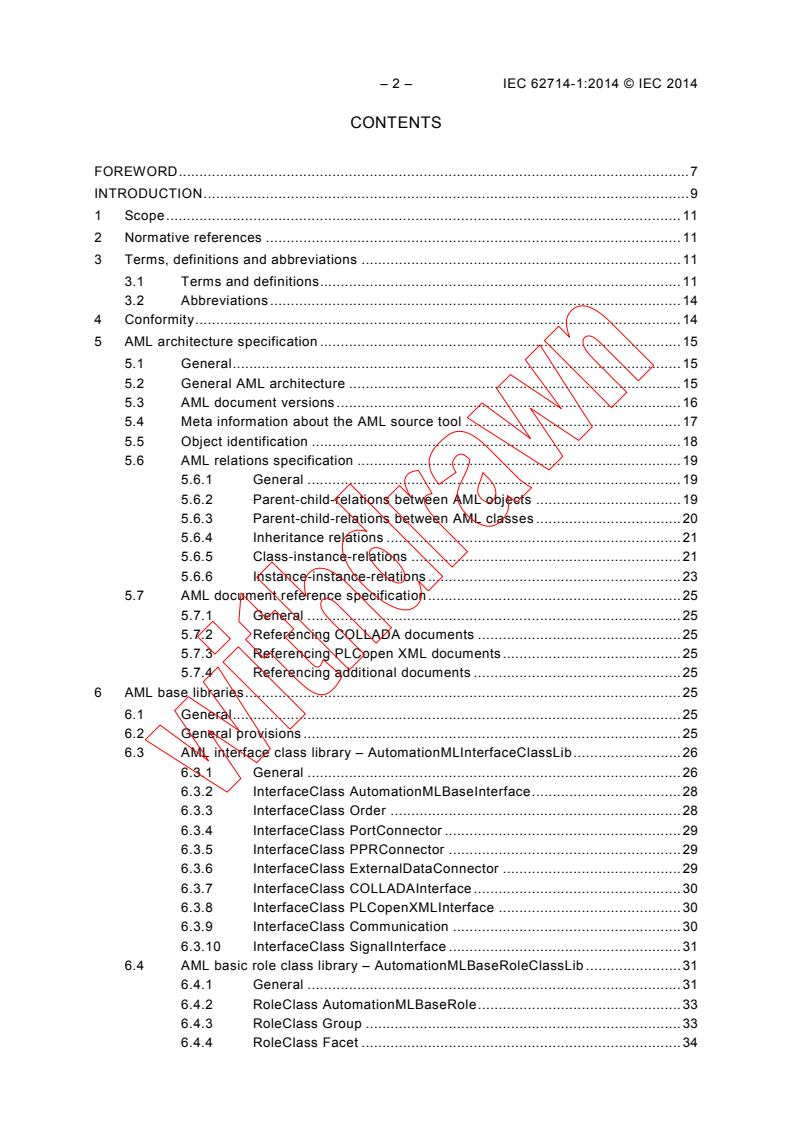
– 2 – IEC 62714-1:2014 © IEC 2014
CONTENTS
FOREWORD . 7
INTRODUCTION . 9
1 Scope . 11
2 Normative references . 11
3 Terms, definitions and abbreviations . 11
3.1 Terms and definitions . 11
3.2 Abbreviations . 14
4 Conformity . 14
5 AML architecture specification . 15
5.1 General . 15
5.2 General AML architecture . 15
5.3 AML document versions . 16
5.4 Meta information about the AML source tool . 17
5.5 Object identification . 18
5.6 AML relations specification . 19
5.6.1 General . 19
5.6.2 Parent-child-relations between AML objects . 19
5.6.3 Parent-child-relations between AML classes . 20
5.6.4 Inheritance relations . 21
5.6.5 Class-instance-relations . 21
5.6.6 Instance-instance-relations . 23
5.7 AML document reference specification . 25
5.7.1 General . 25
5.7.2 Referencing COLLADA documents . 25
5.7.3 Referencing PLCopen XML documents . 25
5.7.4 Referencing additional documents . 25
6 AML base libraries . 25
6.1 General . 25
6.2 General provisions . 25
6.3 AML interface class library – AutomationMLInterfaceClassLib . 26
6.3.1 General . 26
6.3.2 InterfaceClass AutomationMLBaseInterface . 28
6.3.3 InterfaceClass Order . 28
6.3.4 InterfaceClass PortConnector . 29
6.3.5 InterfaceClass PPRConnector . 29
6.3.6 InterfaceClass ExternalDataConnector . 29
6.3.7 InterfaceClass COLLADAInterface . 30
6.3.8 InterfaceClass PLCopenXMLInterface . 30
6.3.9 InterfaceClass Communication . 30
6.3.10 InterfaceClass SignalInterface . 31
6.4 AML basic role class library – AutomationMLBaseRoleClassLib . 31
6.4.1 General . 31
6.4.2 RoleClass AutomationMLBaseRole . 33
6.4.3 RoleClass Group . 33
6.4.4 RoleClass Facet . 34
6.4.5 RoleClass Port . 34
6.4.6 RoleClass Resource . 36
6.4.7 RoleClass Product . 36
6.4.8 RoleClass Process . 37
6.4.9 RoleClass Structure . 37
6.4.10 RoleClass ProductStructure . 37
6.4.11 RoleClass ProcessStructure . 38
6.4.12 RoleClass ResourceStructure . 38
6.4.13 RoleClass PropertySet. 38
7 Modelling of user-defined data . 39
7.1 General . 39
7.2 User-defined attributes. 39
7.3 User-defined InterfaceClasses . 39
7.4 User-defined RoleClasses . 40
7.5 User-defined SystemUnitClasses . 41
7.6 User-defined InstanceHierarchies . 41
8 Extended AML concepts . 42
8.1 General overview . 42
8.2 AML Port object . 42
8.3 AML Facet object . 43
8.4 AML Group object . 43
8.5 AML PropertySet . 44
8.6 Support of multiple roles . 46
8.7 Splitting of AML top-level data into different documents . 47
8.8 Internationalization . 47
8.9 Version information of AML objects . 47
Annex A (informative) General introduction into the Automation Markup Language . 48
A.1 General Automation Markup Language concepts . 48
A.1.1 The Automation Markup Language architecture . 48
A.1.2 Modelling of plant topology information . 50
A.1.3 Referencing geometry and kinematics information . 51
A.1.4 Referencing logic information . 51
A.1.5 Modelling of relations. 52
A.2 Extended AML concepts and examples . 55
A.2.1 General overview . 55
A.2.2 AML Port concept . 55
A.2.3 AML Facet concept . 59
A.2.4 AML Group concept . 61
A.2.5 PropertySet concept . 65
A.2.6 Process-Product-Resource concept . 68
A.2.7 Support of multiple roles . 76
Annex B (informative) XML Representation of AML Libraries . 80
B.1 AutomationMLBaseRoleClassLib . 80
B.2 AutomationMLInterfaceClassLib . 81
Bibliography . 82
Figure 1 – Overview of the engineering data exchange format AML . 9
Figure 2 – AML document version information . 16
– 4 – IEC 62714-1:2014 © IEC 2014
Figure 3 – XML text of the AML source tool information . 18
Figure 4 – Object identification example of an AML class . 19
Figure 5 – Object identification example of an AML object instance . 19
Figure 6 – Example of a parent-child-relation between AML objects . 20
Figure 7 – Example of a parent-child-relation between classes . 20
Figure 8 – Example of an inheritance relation between two classes . 21
Figure 9 – Example of a class-instance-relation . 22
Figure 10 – Example of a relation as block diagram and as object tree . 23
Figure 11 – Example relation between the objects “PLC1” and “Rob1” . 24
Figure 12 – AML basic interface class library . 27
Figure 13 – XML description of the AML basic interface class library . 28
Figure 14 – AML basic role class library . 32
Figure 15 – AutomationMLBaseRoleClassLib . 32
Figure 16 – XML text of the AutomationMLBaseRoleClassLib . 33
Figure 17 – Example of a user-defined attribute . 39
Figure 18 – Example of a user-defined InterfaceClass in a user-defined
InterfaceClassLib . 40
Figure 19 – Example of a user-defined RoleClass in a user-defined RoleClassLib . 41
Figure 20 – Examples for different user-defined SystemUnitClasses . 41
Figure 21 – Example of a user-defined InstanceHierarchy. 42
Figure 22 – AML representation of a user-defined InstanceHierarchy . 42
Figure 23 – Example illustrating the PropertySet concept . 45
Figure 24 – XML text of the PropertySet example . 46
Figure A.1 – AML general architecture . 48
Figure A.2 – Plant topology with AML . 50
Figure A.3 – Reference from CAEX to a COLLADA document . 51
Figure A.4 – Reference from a CAEX to a PLCopen XML document . 52
Figure A.5 – Relations in AML. 53
Figure A.6 – XML description of the relations example . 54
Figure A.7 – XML text of the SystemUnitClassLib of the relations example . 54
Figure A.8 – XML text of the InstanceHierarchy of the relations example . 54
Figure A.9 – Port concept . 55
Figure A.10 – Example describing the AML Port concept . 56
Figure A.11 – XML description of the AML Port concept . 57
Figure A.12 – XML text describing the AML Port concept . 58
Figure A.13 – Definition of a user-defined AML Port class “myPortClass” . 58
Figure A.14 – AML Facet example . 60
Figure A.15 – XML text of the AML Facet example . 60
Figure A.16 – AML Group example . 61
Figure A.17 – XML text for the AML Group example . 62
Figure A.18 – Combination of the Facet and Group concept. 63
Figure A.19 – XML text view for the combined Facet-Group example . 64
Figure A.20 – Generic HMI template “B” visualizing a process variable “Y” of a
conveyor . 65
Figure A.21 – Generated HMI result “B” visualizing both conveyors with individual
process variables . 65
Figure A.22 – PropertySet example. 66
Figure A.23 – PropertySet example. 66
Figure A.24 – XML text for the instance hierarchy . 67
Figure A.25 – PropertySet example AML library as XML code . 68
Figure A.26 – Base elements of the Product-Process-Resource concept . 69
Figure A.27 – PPRConnector interface . 70
Figure A.28 – Example for the Product-Process-Resource concept . 70
Figure A.29 – AML roles required for the Process-Product-Resource concept . 71
Figure A.30 – Elements of the example . 71
Figure A.31 – Links within the example . 72
Figure A.32 – Links of the resource centric view on the example . 73
Figure A.33 – InstanceHierarchy of the example in AML . 74
Figure A.34 – InternalElements of the example . 75
Figure A.35 – InternalLinks of the example . 75
Figure A.36 – InstanceHierarchy of the example in XML . 76
Figure A.37 – Example of a user-defined instance supporting multiple roles . 77
Figure A.38 – XML text of the AML representation of multiple role support . 78
Figure A.39 – AML Role class library corresponding to the multiple role definition
example . 78
Figure A.40 – XML text of the AML role class library . 79
Table 1 – Abbreviations . 14
Table 2 – Meta information about the AML source tool . 17
Table 3 – Interface classes of the AutomationMLInterfaceClassLib . 26
Table 4 – InterfaceClass AutomationMLBaseInterface . 28
Table 5 – InterfaceClass Order . 28
Table 6 – InterfaceClass PortConnector . 29
Table 7 – InterfaceClass PPRConnector . 29
Table 8 – InterfaceClass ExternalDataConnector . 29
Table 9 – InterfaceClass COLLADAInterface . 30
Table 10 – InterfaceClass PLCopenXMLInterface . 30
Table 11 – InterfaceClass Communication . 31
Table 12 – InterfaceClass SignalInterface . 31
Table 13 – RoleClass AutomationMLBaseRole . 33
Table 14 – RoleClass Group . 34
Table 15 – RoleClass Facet . 34
Table 16 – Optional attributes for AML Port objects . 35
Table 17 – Sub-attributes of the attribute “Cardinality” . 35
Table 18 – Interface of the AML Port class . 36
Table 19 – RoleClass Resource . 36
Table 20 – RoleClass Product . 36
Table 21 – RoleClass Process . 37
– 6 – IEC 62714-1:2014 © IEC 2014
Table 22 – RoleClass Structure . 37
Table 23 – RoleClass ProductStructure . 37
Table 24 – RoleClass ProcessStructure . 38
Table 25 – RoleClass ResourceStructure . 38
Table 26 – RoleClass PropertySet . 38
Table A.1 – Overview of major extended AML concepts . 55
INTERNATIONAL ELECTROTECHNICAL COMMISSION
____________
ENGINEERING DATA EXCHANGE FORMAT FOR USE
IN INDUSTRIAL AUTOMATION SYSTEMS ENGINEERING –
AUTOMATION MARKUP LANGUAGE –
Part 1: Architecture and general requirements
FOREWORD
1) The International Electrotechnical Commission (IEC) is a worldwide organization for standardization comprising
all national electrotechnical committees (IEC National Committees). The object of IEC is to promote
international co-operation on all questions concerning standardization in the electrical and electronic fields. To
this end and in addition to other activities, IEC publishes International Standards, Technical Specifications,
Technical Reports, Publicly Available Specifications (PAS) and Guides (hereafter referred to as “IEC
Publication(s)”). Their preparation is entrusted to technical committees; any IEC National Committee interested
in the subject dealt with may participate in this preparatory work. International, governmental and non-
governmental organizations liaising with the IEC also participate in this preparation. IEC collaborates closely
with the International Organization for Standardization (ISO) in accordance with conditions determined by
agreement between the two organizations.
2) The formal decisions or agreements of IEC on technical matters express, as nearly as possible, an international
consensus of opinion on the relevant subjects since each technical committee has representation from all
interested IEC National Committees.
3) IEC Publications have the form of recommendations for international use and are accepted by IEC National
Committees in that sense. While all reasonable efforts are made to ensure that the technical content of IEC
Publications is accurate, IEC cannot be held responsible for the way in which they are used or for any
misinterpretation by any end user.
4) In order to promote international uniformity, IEC National Committees undertake to apply IEC Publications
transparently to the maximum extent possible in their national and regional publications. Any divergence
between any IEC Publication and the corresponding national or regional publication shall be clearly indicated in
the latter.
5) IEC itself does not provide any attestation of conformity. Independent certification bodies provide conformity
assessment services and, in some areas, access to IEC marks of conformity. IEC is not responsible for any
services carried out by independent certification bodies.
6) All users should ensure that they have the latest edition of this publication.
7) No liability shall attach to IEC or its directors, employees, servants or agents including individual experts and
members of its technical committees and IEC National Committees for any personal injury, property damage or
other damage of any nature whatsoever, whether direct or indirect, or for costs (including legal fees) and
expenses arising out of the publication, use of, or reliance upon, this IEC Publication or any other IEC
Publications.
8) Attention is drawn to the Normative references cited in this publication. Use of the referenced publications is
indispensable for the correct application of this publication.
9) Attention is drawn to the possibility that some of the elements of this IEC Publication may be the subject of
patent rights. IEC shall not be held responsible for identifying any or all such patent rights.
International Standard IEC 62714-1 has been prepared by subcommittee 65E: Devices and
integration in enterprise systems, of IEC technical committee 65: Industrial-process meas-
urement, control and automation.
The text of this standard is based on the following documents:
FDIS Report on voting
65E/385/FDIS 65E/396/RVD
Full information on the voting for the approval of this standard can be found in the report on
voting indicated in the above table.
This publication has been drafted in accordance with the ISO/IEC Directives, Part 2.
– 8 – IEC 62714-1:2014 © IEC 2014
A list of all parts in the IEC 62714 series, published under the general title Engineering data
exchange format for use in industrial automation systems engineering – Automation Markup
Language, can be found on the IEC website.
The committee has decided that the contents of this publication will remain unchanged until
the stability date indicated on the IEC web site under "http://webstore.iec.ch" in the data re-
lated to the specific publication. At this date, the publication will be
• reconfirmed,
• withdrawn,
• replaced by a revised edition, or
• amended.
IMPORTANT – The 'colour inside' logo on the cover page of this publication indicates
that it contains colours which are considered to be useful for the correct
understanding of its contents. Users should therefore print this document using a
colour printer.
INTRODUCTION
IEC 62714 is a solution for data exchange focusing on the domain of automation engineering.
The data exchange format defined in the IEC 62714 series (Automation Markup Language,
AML) is an XML schema based data format and has been developed in order to support the
data exchange in a heterogeneous engineering tools landscape.
The goal of AML is to interconnect engineering tools in their different disciplines, e.g. me-
chanical plant engineering, electrical design, process engineering, process control engineer-
ing, HMI development, PLC programming, robot programming, etc.
AML stores engineering information following the object oriented paradigm and allows model-
ling of physical and logical plant components as data objects encapsulating different aspects.
An object may consist of other sub-objects, and may itself be part of a larger composition or
aggregation. Typical objects in plant automation comprise information on topology, geometry,
kinematics and logic, whereas logic comprises sequencing, behaviour and control. Therefore,
an important focus in the data exchange in engineering is the exchange of object oriented
data structures, geometry, kinematics and logic.
AML combines existing industry data formats that are designed for the storage and exchange
of different aspects of engineering information. These data formats are used on an “as-is”
basis within their own specifications and are not branched for AML needs.
The core of AML is the top-level data format CAEX that connects the different data formats.
Therefore, AML has an inherent distributed document architecture.
Figure 1 illustrates the basic AML architecture and the distribution of topology, geometry,
kinematics and logic information.
Figure 1 – Overview of the engineering data exchange format AML
Due to the different aspects of AML, the IEC 62714 series consists of different parts focussing
on different aspects:
• IEC 62714-1: Architecture and general requirements
This part specifies the general AML architecture, the modelling of engineering data, clas-
ses, instances, relations, references, hierarchies, basic AML libraries and extended AML
concepts. It is the basis of all future parts, and it provides mechanisms to reference other
sub formats.
– 10 – IEC 62714-1:2014 © IEC 2014
• IEC 62714-2: Role class libraries
This part is intended to specify additional AML libraries.
• IEC 62714-3: Geometry and kinematics
This part is intended to specify the modelling of geometry and kinematics information.
• IEC 62714-4: Logic
This part is intended to specify the modelling of logics, sequencing, behaviour and control
related information.
Further parts may be added in the future in order to interconnect further data standards to
AML.
As long as no further parts describe the integration of further standards, it is important to
focus on a limited set of sub data formats. Otherwise it would open up the usage of any data
format and data exchange would not work.
Annex A gives an informative introduction, use cases and examples regarding AML.
Annex B gives an informative XML representation of the libraries defined in this part of
IEC 62714.
ENGINEERING DATA EXCHANGE FORMAT FOR USE
IN INDUSTRIAL AUTOMATION SYSTEMS ENGINEERING –
AUTOMATION MARKUP LANGUAGE –
Part 1: Architecture and general requirements
1 Scope
This part of IEC 62714 specifies general requirements and the architecture of AML for the
modelling of engineering information which is exchanged between engineering tools for
industrial automation and control systems. Its provisions apply to the export/import
applications of related tools.
This part of IEC 62714 does not define details of the data exchange procedure or
implementation requirements for the import/export tools.
2 Normative references
The following documents, in whole or in part, are normatively referenced in this document and
are indispensable for its application. For dated references, only the edition cited applies. For
undated references, the latest edition of the referenced document (including any
amendments) applies.
IEC 62424:2008, Representation of process control engineering – Requests in P&I diagrams
and data exchange between P&ID tools and PCE-CAE tools
IEC 62714 (all parts), Engineering data exchange format for use in industrial automation
systems engineering – Automation Markup Language
ISO/IEC 9834-8, Information technology – Open Systems Interconnection – Procedures for
the operation of OSI Registration Authorities: Generation and registration of Universally
Unique Identifiers (UUIDs) and their use as ASN.1 Object Identifier components
ISO/PAS 17506, Industrial automation systems and integration — COLLADA digital asset
schema specification for 3D visualization of industrial data
COLLADA 1.4.1:March 2008, COLLADA – Digital Asset Schema Release 1.4.1
(available at )
Extensible Markup Language (XML) 1.0 1.0:2004, W3C Recommendation
(available at )
PLCopen XML 2.0:December 3rd 2008 and PLCopen XML 2.0.1:May 8th 2009, XML formats
for IEC 61131-3
(available at /)
3 Terms, definitions and abbreviations
3.1 Terms and definitions
For the purposes of this document, the following terms and definitions apply.
– 12 – IEC 62714-1:2014 © IEC 2014
3.1.1
AML
XML based data exchange format for plant engineering data following IEC 62714
3.1.2
automation object
physical or logical entity in the automated system
Note 1 to entry: An example of an automation object is an automation component, a valve or a signal.
3.1.3
AML object
data representation of an automation object with a relation to an AML role class
Note 1 to entry: The AML objects are the core elements of AML. They represent instances and may contain
administration items, attributes, interfaces, relations and references.
3.1.4
AML class
predefined AML object type
Note 1 to entry: AML classes are stored within AML libraries.
Note 2 to entry: AML classes define reusable sample solutions, characterized by attributes, interfaces and
aggregated objects.
Note 3 to entry: AML classes can be used for multiple instantiations.
3.1.5
AML attribute
property which belongs to an AML object
Note 1 to entry: AML attributes are described as an XML element corresponding to IEC 62424:2008, A.2.4.
3.1.6
AML document
certain CAEX document following IEC 62714 including all referenced sub documents
Note 1 to entry: AML documents may be stored as files, but also e.g. as string or data streams.
3.1.7
AML file
certain CAEX file following IEC 62714-1 with the extension .aml excluding all referenced
sub files
3.1.8
AML interface
single connection point that belongs to an AML object and can be linked with another inter-
face
Note 1 to entry: Interfaces allow the description of relations between objects by the definition of CAEX Internal-
Links. Examples are a signal interface, a device interface or a power interface.
3.1.9
AML library
library containing AML classes
3.1.10
AML Port
AML object that represents a container for a group of interfaces characterized by additional
properties
Note 1 to entry: Ports belong to a parent AML object and describe complex interfaces of this object. Ports can be
connected to each other on a higher abstraction level.
3.1.11
AML Group
AML object providing a certain view on AML objects
3.1.12
AML Facet
AML object providing a certain view on AML attributes or interfaces of one AML object
3.1.13
CAEX
neutral XML based data format
Note 1 to entry: CAEX is a neutral data format according to IEC 62424:2008, Clause 7, Annex A and Annex C
3.1.14
copy-instance-relation
relation between the instance and the corresponding class where the instance is created by
copying the class data structures
Note 1 to entry: The instance receives a copy of all features and properties of the source AML class.
Modifications of the class do not lead to modifications of the instance. Within the instance, class properties are
individualized. Further copies are possible due to the knowledge of the source AML class.
3.1.15
universal unique identifier
UUID
unique identifier for AML objects
Note 1 to entry: This note applies to the French language only.
3.1.16
global unique identifier
GUID
implementation of a UUID
Note 1 to entry: Real GUID example: “{AC76BA86-7AD7-1033-7B44-A70000000000}”.
Note 2 to entry: In IEC 62714, GUIDs are also presented in a short form such as “GUID1”, “GUID2” etc. This serves
the readability and acts as a real GUID.
Note 3 to entry: This note applies to the French language only.
3.1.17
inheritance relation
relation between two AML classes
Note 1 to entry: The derived class inherits all attributes and features of the parent class.
3.1.18
instance
data representation of an individual physical or logical item
Note 1 to entry: Instances can be extended, e.g. by aggregated objects or attributes.
3.1.19
PropertySet
AML standard role class containing a set of semantically predefined attributes
– 14 – IEC 62714-1:2014 © IEC 2014
3.1.20
topology
hierarchical structure of a system, visualizable as object tree
Note 1 to entry: Multiple hierarchies, crossed structures and object networks are included.
3.1.21
plant topology
hierarchical structure of a plant, visualizable as object tree
3.1.22
publish, verb
to model a data structure of an external document for usage within CAEX
Note 1 to entry: This allows definition of relations between data structures of independent external documents.
3.1.23
relation
association between CAEX objects
Note 1 to entry: Examples for relations are parent-child-relations and class-instance-relations.
3.1.24
link
connection between objects of type CAEX ExternalInterface
Note 1 to entry: A link is modelled by means of CAEX InternalLink.
3.1.25
reference
association between a CAEX InternalElement and externally stored information
3.2 Abbreviations
Table 1 – Abbreviations
AML Automation Markup Language
CAE Computer Aided Engineering
CAEX Computer Aided Engineering eXchange
COLLADA Collaborative design activity
GUID Global unique identifier
HMI Human machine interface
ID Identifier
MES Manufacturing execution system
PLC Programmable logic controller
URL Uniform resource locator
URI Uniform resource identifier
UUID Universal unique identifier
XML Extensible Markup Language
4 Conformity
To claim conformity to this part of IEC 62714 with respect to the support of AML, the require-
ments of Clauses 5, 6, 7 and 8 shall be fulfilled.
----------------------
...