

IEC 61158-3-4:2014
(Main)Industrial communication networks - Fieldbus specifications - Part 3-4: Data-link layer service definition - Type 4 elements
General Information
- Abstract
IEC 61158-3-4:2014 defines the services provided to the Type 4 fieldbus application layer at the boundary between the application and data-link layers of the fieldbus reference model and systems management at the boundary between the data-link layer and systems management of the fieldbus reference model. This second edition cancels and replaces the first edition published in 2007. It constitutes a minor technical revision. The main changes are: editorial improvements and editorial corrections.
- Status
- Published
- Publication Date
- 12-Aug-2014
- Technical Committee
- SC 65C - Industrial networks
- Current Stage
- DELPUB - Deleted Publication
- Start Date
- 24-Apr-2019
- Completion Date
- 28-Aug-2026
Overview
IEC 61158-3-4:2014 is an international standard published by the International Electrotechnical Commission (IEC) that defines the data-link layer service for Type 4 elements of industrial fieldbus networks. Specifically, it outlines the abstract services provided to the Type 4 fieldbus application layer at the boundary between the application and data-link layers, as well as systems management at the boundary between the data-link layer and systems management. This standard is a key part of the IEC 61158 series, focused on industrial communication networks and fieldbus specifications.
As an essential protocol definition, IEC 61158-3-4:2014 supports time-critical messaging communications in automation systems, ensuring actions are performed within defined time windows to maintain operational safety and efficiency. This 2014 edition is a minor technical revision of the original 2007 edition, mainly comprising editorial improvements and corrections.
Key Topics
- Data-Link Layer Services: Defines the set of primitive actions (requests, indications, responses, confirmations) and events that facilitate communication between devices at the data-link layer for Type 4 fieldbus networks.
- Connectionless Mode Communication: Details the connectionless-mode services enabling efficient and timely data transfer without dedicated logical connections, suitable for real-time industrial automation.
- Service Primitives and Parameters: Specifies the syntax and semantics of the service primitives and the parameters they carry, such as unitdata transfer, management requests (Set, Get, Action), and event notifications.
- Protocol and Service Model: Explains the interaction between physical entities, data-link entities, and data-link service users, establishing how data flows and management commands are exchanged.
- Management Services: Defines systems management interfaces at the data-link level, including constraints, primitive sequences, and error handling to support configuration and operational control.
- Time-Critical Messaging: Focuses on providing communication services that meet strict timing requirements necessary for industrial process and control automation, ensuring predictable and reliable data exchange.
- Standards Compliance and Conformance: Describes how implementations should conform to the abstract service model and adhere to sequences and constraints to maintain interoperability.
Applications
IEC 61158-3-4:2014 serves as a foundational standard for industrial automation systems that rely on fieldbus communication networks. Its practical applications include:
- Factory Automation: Enables robust, real-time communication between control devices, sensors, and actuators essential for manufacturing process control.
- Process Control Systems: Supports high-reliability data exchange in industries such as chemical, oil and gas, and power generation, where timing and safety are critical.
- Safety-Critical Systems: Ensures the timely completion of communication actions required to maintain safety in environments with risks to equipment and human life.
- Network Device Design: Guides manufacturers of fieldbus devices, network cards, and software stacks in implementing the data-link layer correctly to ensure interoperability.
- Systems Management: Facilitates configuration, monitoring, and diagnostics of network devices through defined management services at the data-link layer.
- Industrial Internet of Things (IIoT): Provides reliable communication protocols that can be integrated into modern industrial systems, ensuring legacy and new devices can coexist.
Related Standards
IEC 61158-3-4:2014 is part of the broader IEC 61158 fieldbus series. Related standards include:
- IEC 61158-1: The fieldbus reference model defining the three-layer architecture (application, data-link, and physical layers) utilized by this standard.
- IEC 61158-3-x (other parts): Define data-link layer service definitions for other fieldbus types (Types 1 to 10), enabling multi-protocol interoperability.
- IEC 61784-1 and IEC 61784-2: Specify protocol combinations and communication profiles for industrial fieldbus networks, supporting integration and compatibility.
- IEC 61158 Physical Layer Parts: Detail the physical layer specifications that work in tandem with data-link layer definitions for comprehensive fieldbus communication solutions.
Practical Value
Adopting IEC 61158-3-4:2014 ensures that industrial communication networks:
- Deliver secure, reliable, and real-time communication services essential for automation and process control.
- Maintain compatibility and interoperability across devices and manufacturers by adhering to internationally recognized service definitions.
- Provide a firm foundation for building scalable and maintainable automation systems with clear abstraction between application and data-link layers.
- Support efficient network management and diagnostics, enhancing uptime and reducing maintenance costs.
- Comply with stringent safety and performance requirements critical in industrial environments.
For engineers, system architects, device manufacturers, and industrial network designers, IEC 61158-3-4:2014 is an indispensable resource for implementing and managing fieldbus protocols that meet modern industrial automation demands.
Relations
- Effective Date
- 05-Sep-2023
- Effective Date
- 05-Sep-2023
Get Certified
Connect with accredited certification bodies for this standard

BSI Group
BSI (British Standards Institution) is the business standards company that helps organizations make excellence a habit.

DVS-ZERT GmbH
German welding certification society.
CARES (UK Certification Authority for Reinforcing Steels)
UK certification for reinforcing steels and construction.
Sponsored listings
Frequently Asked Questions
IEC 61158-3-4:2014 is a standard published by the International Electrotechnical Commission (IEC). Its full title is "Industrial communication networks - Fieldbus specifications - Part 3-4: Data-link layer service definition - Type 4 elements". This standard covers: IEC 61158-3-4:2014 defines the services provided to the Type 4 fieldbus application layer at the boundary between the application and data-link layers of the fieldbus reference model and systems management at the boundary between the data-link layer and systems management of the fieldbus reference model. This second edition cancels and replaces the first edition published in 2007. It constitutes a minor technical revision. The main changes are: editorial improvements and editorial corrections.
IEC 61158-3-4:2014 defines the services provided to the Type 4 fieldbus application layer at the boundary between the application and data-link layers of the fieldbus reference model and systems management at the boundary between the data-link layer and systems management of the fieldbus reference model. This second edition cancels and replaces the first edition published in 2007. It constitutes a minor technical revision. The main changes are: editorial improvements and editorial corrections.
IEC 61158-3-4:2014 is classified under the following ICS (International Classification for Standards) categories: 25.040.40 - Industrial process measurement and control; 35.100.20 - Data link layer; 35.110 - Networking. The ICS classification helps identify the subject area and facilitates finding related standards.
IEC 61158-3-4:2014 has the following relationships with other standards: It is inter standard links to IEC 61158-3-4:2007, IEC 61158-3-4:2019. Understanding these relationships helps ensure you are using the most current and applicable version of the standard.
IEC 61158-3-4:2014 is available in PDF format for immediate download after purchase. The document can be added to your cart and obtained through the secure checkout process. Digital delivery ensures instant access to the complete standard document.
Standards Content (Sample)
IEC 61158-3-4 ®
Edition 2.0 2014-08
INTERNATIONAL
STANDARD
NORME
INTERNATIONALE
Industrial communication networks – Fieldbus specifications –
Part 3-4: Data-link layer service definition – Type 4 elements
Réseaux de communication industriels – Spécifications des bus de terrain –
Partie 3-4: Définition des services de la couche liaison de données – Eléments
de type 4
All rights reserved. Unless otherwise specified, no part of this publication may be reproduced or utilized in any form
or by any means, electronic or mechanical, including photocopying and microfilm, without permission in writing from
either IEC or IEC's member National Committee in the country of the requester. If you have any questions about IEC
copyright or have an enquiry about obtaining additional rights to this publication, please contact the address below or
your local IEC member National Committee for further information.
Droits de reproduction réservés. Sauf indication contraire, aucune partie de cette publication ne peut être reproduite
ni utilisée sous quelque forme que ce soit et par aucun procédé, électronique ou mécanique, y compris la photocopie
et les microfilms, sans l'accord écrit de l'IEC ou du Comité national de l'IEC du pays du demandeur. Si vous avez des
questions sur le copyright de l'IEC ou si vous désirez obtenir des droits supplémentaires sur cette publication, utilisez
les coordonnées ci-après ou contactez le Comité national de l'IEC de votre pays de résidence.
IEC Central Office Tel.: +41 22 919 02 11
3, rue de Varembé Fax: +41 22 919 03 00
CH-1211 Geneva 20 info@iec.ch
Switzerland www.iec.ch
About the IEC
The International Electrotechnical Commission (IEC) is the leading global organization that prepares and publishes
International Standards for all electrical, electronic and related technologies.
About IEC publications
The technical content of IEC publications is kept under constant review by the IEC. Please make sure that you have the
latest edition, a corrigenda or an amendment might have been published.
IEC Catalogue - webstore.iec.ch/catalogue Electropedia - www.electropedia.org
The stand-alone application for consulting the entire The world's leading online dictionary of electronic and
bibliographical information on IEC International Standards, electrical terms containing more than 30 000 terms and
Technical Specifications, Technical Reports and other definitions in English and French, with equivalent terms in 14
documents. Available for PC, Mac OS, Android Tablets and additional languages. Also known as the International
iPad. Electrotechnical Vocabulary (IEV) online.
IEC publications search - www.iec.ch/searchpub IEC Glossary - std.iec.ch/glossary
The advanced search enables to find IEC publications by a More than 55 000 electrotechnical terminology entries in
variety of criteria (reference number, text, technical English and French extracted from the Terms and Definitions
committee,…). It also gives information on projects, replaced clause of IEC publications issued since 2002. Some entries
and withdrawn publications. have been collected from earlier publications of IEC TC 37,
77, 86 and CISPR.
IEC Just Published - webstore.iec.ch/justpublished
Stay up to date on all new IEC publications. Just Published IEC Customer Service Centre - webstore.iec.ch/csc
details all new publications released. Available online and If you wish to give us your feedback on this publication or
also once a month by email. need further assistance, please contact the Customer Service
Centre: csc@iec.ch.
A propos de l'IEC
La Commission Electrotechnique Internationale (IEC) est la première organisation mondiale qui élabore et publie des
Normes internationales pour tout ce qui a trait à l'électricité, à l'électronique et aux technologies apparentées.
A propos des publications IEC
Le contenu technique des publications IEC est constamment revu. Veuillez vous assurer que vous possédez l’édition la
plus récente, un corrigendum ou amendement peut avoir été publié.
Catalogue IEC - webstore.iec.ch/catalogue Electropedia - www.electropedia.org
Application autonome pour consulter tous les renseignements
Le premier dictionnaire en ligne de termes électroniques et
bibliographiques sur les Normes internationales,
électriques. Il contient plus de 30 000 termes et définitions en
Spécifications techniques, Rapports techniques et autres
anglais et en français, ainsi que les termes équivalents dans
documents de l'IEC. Disponible pour PC, Mac OS, tablettes
14 langues additionnelles. Egalement appelé Vocabulaire
Android et iPad.
Electrotechnique International (IEV) en ligne.
Recherche de publications IEC - www.iec.ch/searchpub
Glossaire IEC - std.iec.ch/glossary
Plus de 55 000 entrées terminologiques électrotechniques, en
La recherche avancée permet de trouver des publications IEC
en utilisant différents critères (numéro de référence, texte, anglais et en français, extraites des articles Termes et
comité d’études,…). Elle donne aussi des informations sur les Définitions des publications IEC parues depuis 2002. Plus
projets et les publications remplacées ou retirées. certaines entrées antérieures extraites des publications des
CE 37, 77, 86 et CISPR de l'IEC.
IEC Just Published - webstore.iec.ch/justpublished
Service Clients - webstore.iec.ch/csc
Restez informé sur les nouvelles publications IEC. Just
Published détaille les nouvelles publications parues. Si vous désirez nous donner des commentaires sur cette
Disponible en ligne et aussi une fois par mois par email. publication ou si vous avez des questions contactez-nous:
csc@iec.ch.
IEC 61158-3-4 ®
Edition 2.0 2014-08
INTERNATIONAL
STANDARD
NORME
INTERNATIONALE
Industrial communication networks – Fieldbus specifications –
Part 3-4: Data-link layer service definition – Type 4 elements
Réseaux de communication industriels – Spécifications des bus de terrain –
Partie 3-4: Définition des services de la couche liaison de données – Eléments
de type 4
INTERNATIONAL
ELECTROTECHNICAL
COMMISSION
COMMISSION
ELECTROTECHNIQUE
PRICE CODE
INTERNATIONALE
CODE PRIX U
ICS 25.040.40; 35.100.20; 35.110 ISBN 978-2-8322-1712-2
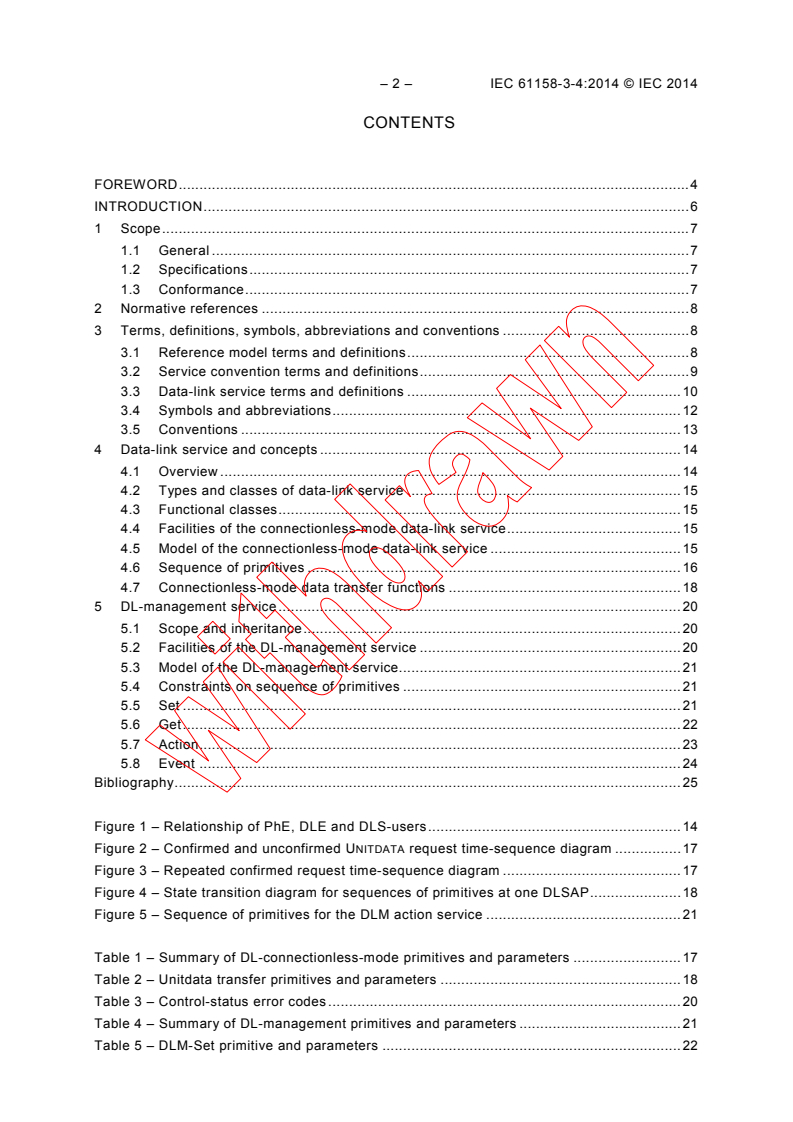
– 2 – IEC 61158-3-4:2014 © IEC 2014
CONTENTS
FOREWORD . 4
INTRODUCTION . 6
1 Scope . 7
1.1 General . 7
1.2 Specifications . 7
1.3 Conformance . 7
2 Normative references . 8
3 Terms, definitions, symbols, abbreviations and conventions . 8
3.1 Reference model terms and definitions . 8
3.2 Service convention terms and definitions . 9
3.3 Data-link service terms and definitions . 10
3.4 Symbols and abbreviations . 12
3.5 Conventions . 13
4 Data-link service and concepts . 14
4.1 Overview . 14
4.2 Types and classes of data-link service . 15
4.3 Functional classes . 15
4.4 Facilities of the connectionless-mode data-link service . 15
4.5 Model of the connectionless-mode data-link service . 15
4.6 Sequence of primitives . 16
4.7 Connectionless-mode data transfer functions . 18
5 DL-management service . 20
5.1 Scope and inheritance . 20
5.2 Facilities of the DL-management service . 20
5.3 Model of the DL-management service. 21
5.4 Constraints on sequence of primitives . 21
5.5 Set . 21
5.6 Get . 22
5.7 Action . 23
5.8 Event . 24
Bibliography . 25
Figure 1 – Relationship of PhE, DLE and DLS-users . 14
Figure 2 – Confirmed and unconfirmed UNITDATA request time-sequence diagram . 17
Figure 3 – Repeated confirmed request time-sequence diagram . 17
Figure 4 – State transition diagram for sequences of primitives at one DLSAP . 18
Figure 5 – Sequence of primitives for the DLM action service . 21
Table 1 – Summary of DL-connectionless-mode primitives and parameters . 17
Table 2 – Unitdata transfer primitives and parameters . 18
Table 3 – Control-status error codes . 20
Table 4 – Summary of DL-management primitives and parameters . 21
Table 5 – DLM-Set primitive and parameters . 22
Table 6 – DLM-Get primitive and parameters . 22
Table 7 – DLM-Action primitive and parameters . 23
Table 8 – DLM-Event primitive and parameters . 24
– 4 – IEC 61158-3-4:2014 © IEC 2014
INTERNATIONAL ELECTROTECHNICAL COMMISSION
____________
INDUSTRIAL COMMUNICATION NETWORKS –
FIELDBUS SPECIFICATIONS –
Part 3-4: Data-link layer service definition –
Type 4 elements
FOREWORD
1) The International Electrotechnical Commission (IEC) is a worldwide organization for standardization comprising
all national electrotechnical committees (IEC National Committees). The object of IEC is to promote
international co-operation on all questions concerning standardization in the electrical and electronic fields. To
this end and in addition to other activities, IEC publishes International Standards, Technical Specifications,
Technical Reports, Publicly Available Specifications (PAS) and Guides (hereafter referred to as “IEC
Publication(s)”). Their preparation is entrusted to technical committees; any IEC National Committee interested
in the subject dealt with may participate in this preparatory work. International, governmental and non-
governmental organizations liaising with the IEC also participate in this preparation. IEC collaborates closely
with the International Organization for Standardization (ISO) in accordance with conditions determined by
agreement between the two organizations.
2) The formal decisions or agreements of IEC on technical matters express, as nearly as possible, an international
consensus of opinion on the relevant subjects since each technical committee has representation from all
interested IEC National Committees.
3) IEC Publications have the form of recommendations for international use and are accepted by IEC National
Committees in that sense. While all reasonable efforts are made to ensure that the technical content of IEC
Publications is accurate, IEC cannot be held responsible for the way in which they are used or for any
misinterpretation by any end user.
4) In order to promote international uniformity, IEC National Committees undertake to apply IEC Publications
transparently to the maximum extent possible in their national and regional publications. Any divergence
between any IEC Publication and the corresponding national or regional publication shall be clearly indicated in
the latter.
5) IEC itself does not provide any attestation of conformity. Independent certification bodies provide conformity
assessment services and, in some areas, access to IEC marks of conformity. IEC is not responsible for any
services carried out by independent certification bodies.
6) All users should ensure that they have the latest edition of this publication.
7) No liability shall attach to IEC or its directors, employees, servants or agents including individual experts and
members of its technical committees and IEC National Committees for any personal injury, property damage or
other damage of any nature whatsoever, whether direct or indirect, or for costs (including legal fees) and
expenses arising out of the publication, use of, or reliance upon, this IEC Publication or any other IEC
Publications.
8) Attention is drawn to the Normative references cited in this publication. Use of the referenced publications is
indispensable for the correct application of this publication.
9) Attention is drawn to the possibility that some of the elements of this IEC Publication may be the subject of
patent rights. IEC shall not be held responsible for identifying any or all such patent rights.
Attention is drawn to the fact that the use of the associated protocol type is restricted by its
intellectual-property-right holders. In all cases, the commitment to limited release of
intellectual-property-rights made by the holders of those rights permits a layer protocol type to
be used with other layer protocols of the same type, or in other type combinations explicitly
authorized by its intellectual-property-right holders.
NOTE Combinations of protocol Types are specified in IEC 61784-1 and IEC 61784-2.
International Standard IEC 61158-3-4 has been prepared by subcommittee 65C: Industrial
networks, of IEC technical committee 65: Industrial-process measurement, control and
automation.
This second edition cancels and replaces the first edition published in 2007. This edition
constitutes an editorial revision with only minor editorial changes.
This edition includes the following significant changes with respect to the previous edition:
a) editorial improvements;
b) editorial corrections.
The text of this standard is based on the following documents:
FDIS Report on voting
65C/759/FDIS 65C/769/RVD
Full information on the voting for the approval of this standard can be found in the report on
voting indicated in the above table.
This publication has been drafted in accordance with ISO/IEC Directives, Part 2.
A list of all the parts of the IEC 61158 series, under the general title Industrial communication
networks – Fieldbus specifications, can be found on the IEC web site.
The committee has decided that the contents of this publication will remain unchanged until
the stability date indicated on the IEC web site under http://webstore.iec.ch in the data related
to the specific publication. At this date, the publication will be:
• reconfirmed;
• withdrawn;
• replaced by a revised edition, or
• amended.
– 6 – IEC 61158-3-4:2014 © IEC 2014
INTRODUCTION
This part of IEC 61158 is one of a series produced to facilitate the interconnection of
automation system components. It is related to other standards in the set as defined by the
“three-layer” fieldbus reference model described in IEC 61158-1.
Throughout the set of fieldbus standards, the term “service” refers to the abstract capability
provided by one layer of the OSI Basic Reference Model to the layer immediately above.
Thus, the data-link layer service defined in this standard is a conceptual architectural service,
independent of administrative and implementation divisions.
INDUSTRIAL COMMUNICATION NETWORKS –
FIELDBUS SPECIFICATIONS –
Part 3-4: Data-link layer service definition –
Type 4 elements
1 Scope
1.1 General
This part of IEC 61158 provides common elements for basic time-critical messaging
communications between devices in an automation environment. The term “time-critical” is
used to represent the presence of a time-window, within which one or more specified actions
are required to be completed with some defined level of certainty. Failure to complete
specified actions within the time window risks failure of the applications requesting the
actions, with attendant risk to equipment, plant and possibly human life.
This standard defines in an abstract way the externally visible services provided by the Type
4 fieldbus data-link layer in terms of
a) the primitive actions and events of the services;
b) the parameters associated with each primitive action and event, and the form which they
take; and
c) the interrelationship between these actions and events, and their valid sequences.
The purpose of this standard is to define the services provided to
• the Type 4 fieldbus application layer at the boundary between the application and data-link
layers of the fieldbus reference model;
• systems management at the boundary between the data-link layer and systems
management of the fieldbus reference model.
1.2 Specifications
The principal objective of this standard is to specify the characteristics of conceptual data-link
layer services suitable for time-critical communications, and thus supplement the OSI Basic
Reference Model in guiding the development of data-link protocols for time-critical
communications. A secondary objective is to provide migration paths from previously-existing
industrial communications protocols.
This specification may be used as the basis for formal DL-Programming-Interfaces.
Nevertheless, it is not a formal programming interface, and any such interface will need to
address implementation issues not covered by this specification, including
a) the sizes and octet ordering of various multi-octet service parameters;
b) the correlation of paired request and confirm, or indication and response, primitives.
1.3 Conformance
This standard does not specify individual implementations or products, nor does it constrain
the implementations of data-link entities within industrial automation systems.
There is no conformance of equipment to this data-link layer service definition standard.
Instead, conformance is achieved through implementation of the corresponding data-link
protocol that fulfills the Type 1 data-link layer services defined in this standard.
– 8 – IEC 61158-3-4:2014 © IEC 2014
2 Normative references
The following documents, in whole or in part, are normatively referenced in this document and
are indispensable for its application. For dated references, only the edition cited applies. For
undated references, the latest edition of the referenced document (including any
amendments) applies.
NOTE All parts of the IEC 61158 series, as well as IEC 61784-1 and IEC 61784-2 are maintained simultaneously.
Cross-references to these documents within the text therefore refer to the editions as dated in this list of normative
references.
ISO/IEC 7498-1, Information technology – Open Systems Interconnection – Basic Reference
Model: The Basic Model
ISO/IEC 7498-3, Information technology – Open Systems Interconnection – Basic Reference
Model: Naming and addressing
ISO/IEC 10731:1994, Information technology – Open Systems Interconnection – Basic
Reference Model – Conventions for the definition of OSI services
3 Terms, definitions, symbols, abbreviations and conventions
For the purposes of this document, the following terms, definitions, symbols, abbreviations
and conventions apply.
3.1 Reference model terms and definitions
This standard is based in part on the concepts developed in ISO/IEC 7498-1 and
ISO/IEC 7498-3, and makes use of the following terms defined therein.
3.1.1 DL-address [7498-3]
3.1.2 DL-address-mapping [7498-1]
3.1.3 called-DL-address [7498-3]
3.1.4 calling-DL-address [7498-3]
3.1.5 centralized multi-end-point-connection [7498-1]
3.1.6 DL-connection [7498-1]
3.1.7 DL-connection-end-point [7498-1]
3.1.8 DL-connection-end-point-identifier [7498-1]
3.1.9 DL-connection-mode transmission [7498-1]
3.1.10 DL-connectionless-mode transmission [7498-1]
3.1.11 correspondent (N)-entities [7498-1]
correspondent DL-entities (N=2)
correspondent Ph-entities (N=1)
3.1.12 DL-duplex-transmission [7498-1]
3.1.13 (N)-entity [7498-1]
DL-entity (N=2)
Ph-entity (N=1)
3.1.14 DL-facility [7498-1]
3.1.15 flow control [7498-1]
3.1.16 (N)-layer [7498-1]
DL-layer (N=2)
Ph-layer (N=1)
3.1.17 layer-management [7498-1]
3.1.18 DL-local-view [7498-3]
3.1.19 DL-name [7498-3]
3.1.20 naming-(addressing)-domain [7498-3]
3.1.21 primitive name [7498-3]
3.1.22 DL-protocol [7498-1]
3.1.23 DL-protocol-connection-identifier [7498-1]
3.1.24 DL-protocol-data-unit [7498-1]
3.1.25 DL-relay [7498-1]
3.1.26 reset [7498-1]
3.1.27 responding-DL-address [7498-3]
3.1.28 routing [7498-1]
3.1.29 segmenting [7498-1]
3.1.30 (N)-service [7498-1]
DL-service (N=2)
Ph-service (N=1)
3.1.31 (N)-service-access-point
[7498-1]
DL-service-access-point (N=2)
Ph-service-access-point (N=1)
3.1.32 DL-service-access-point-address [7498-3]
3.1.33 DL-service-connection-identifier
[7498-1]
3.1.34 DL-service-data-unit [7498-1]
3.1.35 DL-simplex-transmission [7498-1]
3.1.36 DL-subsystem [7498-1]
3.1.37 systems-management [7498-1]
3.1.38 DLS-user-data [7498-1]
3.2 Service convention terms and definitions
This standard also makes use of the following terms defined in ISO/IEC 10731 as they apply
to the data-link layer:
3.2.1 acceptor
– 10 – IEC 61158-3-4:2014 © IEC 2014
3.2.2 confirm (primitive);
requestor.deliver (primitive)
3.2.3 deliver (primitive)
3.2.4 DL-confirmed-facility
3.2.5 DL-facility
3.2.6 DL-local-view
3.2.7 DL-mandatory-facility
3.2.8 DL-non-confirmed-facility
3.2.9 DL-service-primitive;
primitive
3.2.10 DL-service-provider
3.2.11 DL-service-user
3.2.12 DLS-user-optional-facility
3.2.13 indication (primitive);
acceptor.deliver (primitive)
3.2.14 request (primitive);
requestor.submit (primitive)
3.2.15 requestor
3.2.16 response (primitive);
acceptor.submit (primitive)
3.2.17 submit (primitive)
3.3 Data-link service terms and definitions
For the purposes of this document, the following terms and definitions apply.
3.3.1
broadcast-node-address
address used to designate all DLEs on a link
Note 1 to entry: All DLEs on a link receive all DLPDUs where the first node-address is equal to the broadcast-
node-address. Such DLPDUs are always unconfirmed, and their receipt is never acknowledged. The value of the
broadcast-node-address is 126.
3.3.2
destination-DL-route
sequence of DL-route-elements, describing the complete route to the destination
Note 1 to entry: This includes both the destination DLSAP and a local component meaningful to the destination
DLS-user.
3.3.3
DL-route-element
octet holding a node DL-address or an address used by the DLS-user
3.3.4
DLSAP
distinctive point at which DL-services are provided by a single DL-entity to a single higher-
layer entity
3.3.5
DL(SAP)-address
individual DLSAP-address, designating a single DLSAP of a single DLS-user
3.3.6
DLS-user address
uniquely identifies a DLS-user locally
3.3.7
frame
denigrated synonym for DLPDU
3.3.8
full DL-route
combination of a destination-DL-route and a source-DL-route
3.3.9
Local link
single DL-subnetwork in which any of the connected DLEs may communicate directly, without
any intervening DL-relaying, whenever all of those DLEs that are participating in an instance
of communication are simultaneously attentive to the DL-subnetwork during the period(s) of
attempted communication
3.3.10
maximum-indication-delay
indicates to the DLS-user the maximum time interval for the DLS-user to prepare a response
after receiving an indication requiring a response
Note 1 to entry: If the DLS-user is unable to prepare a response within maximum-indication-delay, the DLS-user is
required to issue a DL-UNITDATA request with a DLSDU type indicating ACKNOWLEDGE. As a result the DLE will
transmit an acknowledging DLPDU on the link.
3.3.11
maximum-retry-time
indicates to the DLE for how long time retransmission of the request may be performed, as a
result of Wait acknowledges from the remote DLE or DLS-user
3.3.12
no-confirm-node-address
indicates that a request or response is unconfirmed
Note 1 to entry: The value of the no-confirm-node-address is 0
3.3.13
node
single DL-entity as it appears on one local link
3.3.14
node-address
uniquely identifies a DLE on a link
Note 1 to entry: The value of a Node-address is in the range of 0-127. The values 0, 126 and 127 are reserved for
special purposes
3.3.15
normal class device
device which replies to requests from other normal class devices, and initiates transmissions
Note 1 to entry: Such a device can act as a server (responder) and as a client (requestor) – this is also called a
peer.
– 12 – IEC 61158-3-4:2014 © IEC 2014
3.3.16
receiving DLS-user
DL-service user that acts as a recipient of DLS-user-data
Note 1 to entry: A DL-service user can be concurrently both a sending and receiving DLS-user.
3.3.17
sending DLS-user
DL-service user that acts as a source of DLS-user-data
3.3.18
service-node-address
an address reserved for service purposes only
Note 1 to entry: All DLEs on a link receive all DLPDUs where the first Node-address is equal to the service-node-
address. Such DLPDUs can be Confirmed or Unconfirmed, and their receipt may or may not be acknowledged. The
service-node-address can be used on links with only two DLEs – the requesting Normal class DLE and the
responding simple-class or normal-class DLE. The value of the service-node-address is 127.
3.3.19
simple-class device
device which replies to requests from normal class devices
Note 1 to entry: Such a device can act as a server or responder only.
3.3.20
source-DL-route
holds a sequence of DL-route-elements, describing the complete route back to the source
3.4 Symbols and abbreviations
NOTE Many symbols and abbreviations are common to more than one protocol Type; they are not necessarily
used by all protocol Types.
3.4.1 DL- Data-link layer (as a prefix)
3.4.2 DLC DL-connection
3.4.3 DLCEP
DL-connection-end-point
3.4.4 DLE DL-entity (the local active instance of the data-link layer)
3.4.5 DLL
DL-layer
3.4.6 DLPCI DL-protocol-control-information
3.4.7 DLPDU DL-protocol-data-unit
3.4.8 DLM DL-management
3.4.9 DLME
DL-management Entity (the local active instance of
DL-management)
3.4.10 DLMS DL-management Service
3.4.11 DLS DL-service
3.4.12 DLSAP
DL-service-access-point
3.4.13 DLSDU DL-service-data-unit
3.4.14 FIFO
First-in first-out (queuing method)
3.4.15 OSI Open systems interconnection
3.4.16 Ph- Physical layer (as a prefix)
3.4.17 PhE Ph-entity (the local active instance of the physical layer)
3.4.18 PhL Ph-layer
3.4.19 QoS Quality of service
3.5 Conventions
This standard uses the descriptive conventions given in ISO/IEC 10731.
The service model, service primitives, and time-sequence diagrams used are entirely abstract
descriptions; they do not represent a specification for implementation.
Service primitives, used to represent service user/service provider interactions (see
ISO/IEC 10731), convey parameters that indicate information available in the user/provider
interaction.
This standard uses a tabular format to describe the component parameters of the DLS
primitives. The parameters that apply to each group of DLS primitives are set out in tables
throughout the remainder of this standard. Each table consists of up to six columns,
containing the name of the service parameter, and a column each for those primitives and
parameter-transfer directions used by the DLS:
– the request primitive’s input parameters;
– the request primitive’s output parameters;
– the indication primitive’s output parameters;
– the response primitive’s input parameters; and
– the confirm primitive’s output parameters.
NOTE The request, indication, response and confirm primitives are also known as requestor.submit,
acceptor.deliver, acceptor.submit, and requestor.deliver primitives, respectively (see ISO/IEC 10731).
One parameter (or part of it) is listed in each row of each table. Under the appropriate service
primitive columns, a code is used to specify the type of usage of the parameter on the
primitive and parameter direction specified in the column:
M — parameter is mandatory for the primitive.
U — parameter is a User option, and may or may not be provided depending on the dynamic
usage of the DLS-user. When not provided, a default value for the parameter is assumed.
C — parameter is conditional upon other parameters or upon the environment of the DLS-
user.
(blank) — parameter is never present.
Items in brackets further qualify some entries. These may be
a) a parameter-specific constraint
(=) indicates that the parameter is semantically equivalent to the parameter in the service
primitive to its immediate left in the table.
b) an indication that some note applies to the entry
(n) indicates that the following note n contains additional information pertaining to the
parameter and its use.
In any particular interface, not all parameters need be explicitly stated. Some may be
implicitly associated with the DLSAP at which the primitive is issued.
– 14 – IEC 61158-3-4:2014 © IEC 2014
In the diagrams that illustrate these interfaces, dashed lines indicate cause-and-effect or time-
sequence relationships, and wavy lines indicate that events are roughly contemporaneous.
4 Data-link service and concepts
4.1 Overview
4.1.1 General
The DLS provides for the transparent transfer of data between DLS-users. It makes the way
that supporting communications resources are utilized invisible to these DLS-users.
In particular, the DLS provides for the following:
a) Transparency of transferred information. The DLS provides for the transparent transfer of
DLS-user-data. It does not restrict the content, format or coding of the DLSDUs, nor does
it interpret the structure or meaning of that information. It may, however, restrict the
amount of information that can be transferred as an indivisible unit.
NOTE It is possible for a DLS-user to segment arbitrary-length data into limited-length DLSDUs before
making DLS requests, and afterwards reassemble received DLSDUs into these larger data units.
b) Reliable transfer of data. The DLS relieves the DLS-user from concerns regarding
insertion, corruption, loss or duplication of data.
c) Prioritized data transfer. The DLS provides DLS-users with a means to prioritize requests.
d) Queue. The DLS provides the requesting DLS-user with a prioritized FIFO queue, where
each queue item can hold a single DLSDU.
4.1.2 Overview of DL-naming (addressing)
A DLE is implicitly connected to a single PhE, and (separately) to a single DLSAP and
associated DLS-user. A DLE always delivers received DLSDUs at the same DLSAP, and
hence to the same DLS-user. This concept is illustrated in Figure 1.
Application
Layer
DLS-user DLS-user
DLSAP DLSAP
Data Link
DLE DLE
Layer
Physical
PhE PhE
Layer
Figure 1 – Relationship of PhE, DLE and DLS-users
Each DLE has a node DL-address. Node DL-addresses uniquely identify DLEs within the local
Link.
A DL-route-element is an octet, which can hold either a node DL-address or a higher-layer
address used by the DLS-user.
A destination-DL-route holds a sequence of DL-route-elements, describing the complete route
to the destination DLSAP plus a local component meaningful to the destination DLS-user.
A source-DL-route holds a sequence of DL-route-elements, describing the complete route
back to the source DLSAP plus a local component meaningful to the source DLS-user.
A full DL-route is defined as a destination-DL-route and a source-DL-route.
4.2 Types and classes of data-link service
There are two types of DLS as follows:
– a connectionless-mode data transfer service, providing confirmed and unconfirmed data
transfer (defined in 4.5.2 and 4.5.3);
– a management service. The Type 4 management service provides services for reading
and writing managed objects (DLM-SET and DLM-GET requests), as defined in Clause 5.
4.3 Functional classes
The functional class of a DLE determines its capabilities, and thus the complexity of
conforming implementations. Two functional classes are defined as follows:
a) simple-class, including only responder functionality (server);
b) normal-class, including initiator and responder functionality (client and server, also called
peer).
4.4 Facilities of the connectionless-mode data-link service
The DLS provides a means of transferring DLSDUs of limited length from one source DLS-
user to one or more destination DLS-users. The transfer of DLSDUs is transparent, in that the
boundaries of DLSDUs and the contents of DLSDUs are preserved unchanged by the DLS,
and there are no constraints on the DLSDU (other than limited length) imposed by the DLS.
4.5 Model of the connectionless-mode data-link service
4.5.1 General
A defining characteristic of data-link connectionless-mode unitdata transmission is the
independent nature of each invocation of the DLS.
Only one type of object, the unitdata object, can be submitted to the DLS-provider for
transmission.
The DLS-user issuing a request primitive specifies whether the request is to be confirmed by
the remote DLS-user, or not. This is specified in the destination-DL-route and source-DL-route
parameters of the DL-UNITDATA request primitive. If the remote DLS-user confirms a request,
it does this by issuing a new, independent DL-UNITDATA request primitive.
4.5.2 Unconfirmed request
The DLE of the requesting DLS-user forms a DLPDU, which includes the submitted DLSDU
and sends the DLPDU to the receiving DLE. The receiving DLE delivers the received DLSDU
– 16 – IEC 61158-3-4:2014 © IEC 2014
to the DLS-user by a DL-UNITDATA indication primitive. The value of the confirmation-expected
parameter of this indication is FALSE.
4.5.3 Confirmed request
The DLE of the requesting DLS-user forms a DLPDU, which includes the submitted DLSDU
and sends the DLPDU to the receiving DLE. The receiving DLE delivers the received DLSDU
to the DLS-user by a DL-UNITDATA indication primitive. The value of the confirmation-expected
parameter of this indication is TRUE.
If the receiving DLS-user is unable to handle the indication immediately, the receiving DLS-
user should issue a DL-UNITDATA response primitive within the time specified by maximum-
indication-delay.
If the receiving DLS-user either
a) does not reply with a DL-UNITDATA response primitive or a DL-UNITDATA request primitive
within the interval maximum-indication-delay from receipt of the triggering DL-UNITDATA
indication primitive, or
b) does reply with a DL-UNITDATA response primitive within the interval maximum-indication-
delay from receipt of the triggering DL-UNITDATA indication primitive
then the receiving DLE transmits an acknowledging DLPDU to the original requesting DLE.
The following actions depend on whether the replying DLE is of simple-class or normal-class.
1) If the replying DLE is of simple-class, the acknowledge DLPDU from the replying DLE
specifies “WAIT”. In this case, the original requesting DLE requeues the original request
DLPDU at the lowest possible priority for retransmission at the next opportunity. When the
replying DLS-user has prepared the response, it should await the repeated request from
the original requesting DLE, and this time reply by issuing a DL-UNITDATA request primitive
within the time interval maximum-indication-delay.
The action in the original requesting DLE of requeuing the original request for
retransmission is repeated as long as the replying DLE keeps responding with “WAIT”
acknowledges, or until retransmission has been attempted for the time interval specified in
the maximum-retry-time configuration parameter.
2) If the replying DLE is of Normal class, the acknowledge DLPDU from the replying DLE
specifies “RESPONSE COMES LATER / ACKNOWLEDGE”. In this case, the original requesting
DLE does nothing further. When the DLS-user at the replying DLE has prepared the
response, it should reply by issuing a DL-UNITDATA request primitive. The replying DLE
forms an appropriate DLPDU and queues it for transmission at the first opportunity.
4.6 Sequence of primitives
4.6.1 Constraints on sequence of primitives
Subclause 4.6.1 defines the constraints on the sequence in which the primitives defined in
4.6.2 and Table 1 may occur. The constraints determine the order in which primitives occur,
but do not fully specify when they may occur.
Table 1 – Summary of DL-connectionless-mode primitives and parameters
Service Service subtype Primitive Parameter
Data Transfer Unitdata DL-UNITDATA request (in Destination-DL-route,
Source-DL-route,
Priority,
Maximum-retry-time,
Control status,
Data field format,
DLSDU)
DL-UNITDATA indication (out Destination-DL-route,
Source-DL-route,
Confirmation-expected,
Control status,
Data field format,
DLSDU)
DL-UNITDATA response (in Destination-DL-route,
Source-DL-route)
4.6.2 Relation of primitives at the end-points of connectionless service
4.6.2.1 General
A request primitive issued at one DLSAP will have consequences at one or more other
DLSAPs. These relations are summarized in Figure 2 and Figure 3.
4.6.2.2 Confirmed and unconfirmed UNITDATA request
Initiator Responder
DL-UNITDATA request
DL-UNITDATA indication
NITDATA request time-sequence diagram
Figure 2 – Confirmed and unconfirmed U
4.6.2.3 Repeated confirmed UNITDATA request
Initiator Responder
DL-UNITDATA request
DL-UNITDATA indication
DL-UNITDATA response
DL-UNITDATA indication
Figure 3 – Repeated confirmed request time-sequence diagram
– 18 – IEC 61158-3-4:2014 © IEC 2014
4.6.3 Sequence of primitives at one DLSAP
The possible overall sequences of primitives at one DLSAP are defined in the state transition
diagram of Figure 4.
NOTE Since there is no conformance to this standard, the use of a state transition diagram to describe the
allowable sequences of service primitives does not impose any requirements or constraints on the internal
organization of any implementation of the service.
Idle
DL-UNITDATA request, response or indication
Figure 4 – State transition diagram for sequences of primitives at one DLSAP
4.7 Connectionless-mode data transfer functions
4.7.1 General
DL-connectionless-mode unitdata service primitives are used to transmit independent
DLSDUs from one DLS-user to one or more other DLS-users. Each DLSDU is transmitted in a
single DLPDU. The DLSDU is independent in the sense that it bears no relationship to any
other DLSDU transmitted through another invocation of the DL-service by the same DLS-user.
The DLSDU is self-contained in that all the information required to deliver the DLSDU is
presented to the DL-provider, together with the user data to be transmitted, in a single service
access.
4.7.2 Types of primitives and parameters
4.7.2.1 General
Table 2 indicates the types of primitives and the parameters needed for the
DL-connectionless-mode unitdata service.
Table 2 – Unitdata transfer primitives and parameters
DL-UNITDATA Request Indication Response
Parameter name input output input
Destination-DL-route M M M
Source-DL-route M M M
Priority U
Maximum-retry-time U
Confirmation-expected M
Control-status M M(=)
Data-field-format M M(=)
Data unit (DLSDU) M M(=)
4.7.2.2 Request primitive
This primitive causes the DLE to create a DLPDU and append it to the transmit queue for
transmission at the first opportunity, after all preceding higher-priority DLPDUs in the queue.
If the transmission fails, the DLE delivers error information to the requesting DLS-user by a
DL-UNITDATA indication primitive, provided that the requesting DLS-user expects a
confirmation. The control-status parameter of this indication specifies the reason for failure.
The DLSDU parameter of this indication is null.
4.7.2.3 Indication primitive
This primitive is used by a receiving DLE to deliver a received DLSDU to the addressed DLS-
user.
4.7.2.4 Response primitive
This primitive is used by a receiving DLS-user which
a) is not able to g
...