

IEC 62673:2013
(Main)Methodology for communication network dependability assessment and assurance
General Information
- Abstract
IEC 62673:2013 describes a generic methodology for dependability assessment and assurance of communication networks from a network life cycle perspective. It presents the network dependability assessment strategies and methodology for analysis of network topology, evaluation of dependability of service paths, and optimization of network configurations in order to achieve network dependability performance and dependability of service. It also addresses the network dependability assurance strategies and methodology for application of network health check, network outage control and test case management to enhance and sustain dependability performance in network service operation. This standard is applicable to network service providers, network designers and developers, and network maintainers and operators for assurance of network dependability performance and assessment of dependability of service. Keywords: methodology for dependability assessment and assurance of communication networks
- Status
- Published
- Publication Date
- 17-Jun-2013
- Technical Committee
- TC 56 - Dependability
- Current Stage
- PPUB - Publication issued
- Start Date
- 18-Jun-2013
- Completion Date
- 15-Jul-2013

Overview
IEC 62673:2013 establishes a comprehensive methodology for the assessment and assurance of communication network dependability throughout the network life cycle. Published by the International Electrotechnical Commission (IEC), this international standard provides a structured approach to analyzing network topology, evaluating the dependability of service paths, and optimizing network configurations to achieve reliable and high-performing network services. Furthermore, IEC 62673:2013 details network dependability assurance strategies, including health checks, outage control, and test case management, all aimed at enhancing and maintaining dependable network operations.
Network dependability is a critical concern for service providers, designers, developers, maintainers, and network operators. Ensuring consistent and resilient operation of communication networks not only supports user satisfaction but also underpins the business sustainability of network providers.
Key Topics
- Network Dependability Assessment: Strategies for assessing dependability by analyzing network topology, service path reliability, and configuration optimization.
- Service Path Evaluation: Techniques to evaluate and improve the dependability and resilience of data transmission between communication nodes.
- Dependability Assurance: Methodologies for maintaining network performance, such as regular health checks, managing network outages, and systematic test management.
- Life Cycle Perspective: Integration of dependability practices across all network life cycle stages, from concept definition to operation, enhancement, and retirement.
- Performance and Quality of Service (QoS): Emphasis on achieving and maintaining high network availability, reliability, maintainability, and service integrity.
- Service Scenarios: Consideration of both end-to-end (E2E) and full-end network service scenarios to meet the needs of both end users and service providers.
Applications
IEC 62673:2013 is particularly relevant for a broad range of practical applications within the communications industry, including:
- Network Design and Development: Utilized by network architects and engineers to ensure robust design and optimized topology, supporting long-term dependability requirements.
- Service Providers: Enables telecom and data service providers to assess and assure their service reliability, directly benefitting customer satisfaction and operational excellence.
- Operations and Maintenance: Assists network operators and maintainers in implementing systematic health checks, outage management, and corrective actions to minimize service interruptions.
- Performance Evaluation: Provides methodologies to collect, analyze, and act on network performance metrics and feedback, leading to continuous improvement in network dependability.
- Risk and Scenario Analysis: Supports risk assessment and scenario-based evaluations, allowing for informed decision-making prior to network modifications or expansions.
By applying this standard, organizations can ensure their networks operate with high levels of availability and resilience, directly contributing to service quality and customer trust.
Related Standards
To effectively implement the methodology described in IEC 62673:2013, the following international standards are frequently referenced or applied in conjunction:
- IEC 60050-191: International Electrotechnical Vocabulary (IEV) – Dependability and quality of service terminology.
- IEC 60300-3-15: Dependability management – Application guide for engineering system dependability.
- IEC 61907: Communication network dependability engineering – foundational for dependability practices in communication systems.
- ITU-T Recommendations: Various recommendations from the International Telecommunication Union, particularly concerning network dependability and quality of service (QoS).
Practical Value
Implementing IEC 62673:2013 enables organizations to:
- Systematically measure, evaluate, and assure the dependability of complex communication networks.
- Enhance network resilience against failures, mitigating the impact of outages and performance degradations.
- Support business continuity, regulatory compliance, and competitive differentiation by delivering dependable services.
- Foster continuous improvement in network operations through structured feedback and performance management.
By adopting this standard, communication networks are better equipped to deliver dependable service, meet evolving user expectations, and navigate the challenges of modern network operations.
Keywords: dependability assessment, network dependability, communication network assurance, network performance, network reliability, service path evaluation, network health check, IEC 62673.
Get Certified
Connect with accredited certification bodies for this standard

BSI Group
BSI (British Standards Institution) is the business standards company that helps organizations make excellence a habit.

Bureau Veritas
Bureau Veritas is a world leader in laboratory testing, inspection and certification services.

DNV
DNV is an independent assurance and risk management provider.
Sponsored listings
Frequently Asked Questions
IEC 62673:2013 is a standard published by the International Electrotechnical Commission (IEC). Its full title is "Methodology for communication network dependability assessment and assurance". This standard covers: IEC 62673:2013 describes a generic methodology for dependability assessment and assurance of communication networks from a network life cycle perspective. It presents the network dependability assessment strategies and methodology for analysis of network topology, evaluation of dependability of service paths, and optimization of network configurations in order to achieve network dependability performance and dependability of service. It also addresses the network dependability assurance strategies and methodology for application of network health check, network outage control and test case management to enhance and sustain dependability performance in network service operation. This standard is applicable to network service providers, network designers and developers, and network maintainers and operators for assurance of network dependability performance and assessment of dependability of service. Keywords: methodology for dependability assessment and assurance of communication networks
IEC 62673:2013 describes a generic methodology for dependability assessment and assurance of communication networks from a network life cycle perspective. It presents the network dependability assessment strategies and methodology for analysis of network topology, evaluation of dependability of service paths, and optimization of network configurations in order to achieve network dependability performance and dependability of service. It also addresses the network dependability assurance strategies and methodology for application of network health check, network outage control and test case management to enhance and sustain dependability performance in network service operation. This standard is applicable to network service providers, network designers and developers, and network maintainers and operators for assurance of network dependability performance and assessment of dependability of service. Keywords: methodology for dependability assessment and assurance of communication networks
IEC 62673:2013 is classified under the following ICS (International Classification for Standards) categories: 03.120.01 - Quality in general. The ICS classification helps identify the subject area and facilitates finding related standards.
IEC 62673:2013 is available in PDF format for immediate download after purchase. The document can be added to your cart and obtained through the secure checkout process. Digital delivery ensures instant access to the complete standard document.
Standards Content (Sample)
IEC 62673 ®
Edition 1.0 2013-06
INTERNATIONAL
STANDARD
NORME
INTERNATIONALE
colour
inside
Methodology for communication network dependability assessment and
assurance
Méthodologie pour l'évaluation et l'assurance de la sûreté de fonctionnement
d'un réseau de communication
All rights reserved. Unless otherwise specified, no part of this publication may be reproduced or utilized in any form
or by any means, electronic or mechanical, including photocopying and microfilm, without permission in writing from
either IEC or IEC's member National Committee in the country of the requester.
If you have any questions about IEC copyright or have an enquiry about obtaining additional rights to this publication,
please contact the address below or your local IEC member National Committee for further information.
Droits de reproduction réservés. Sauf indication contraire, aucune partie de cette publication ne peut être reproduite ni
utilisée sous quelque forme que ce soit et par aucun procédé, électronique ou mécanique, y compris la photocopie et les
microfilms, sans l'accord écrit de la CEI ou du Comité national de la CEI du pays du demandeur.
Si vous avez des questions sur le copyright de la CEI ou si vous désirez obtenir des droits supplémentaires sur cette
publication, utilisez les coordonnées ci-après ou contactez le Comité national de la CEI de votre pays de résidence.
IEC Central Office Tel.: +41 22 919 02 11
3, rue de Varembé Fax: +41 22 919 03 00
CH-1211 Geneva 20 info@iec.ch
Switzerland www.iec.ch
About the IEC
The International Electrotechnical Commission (IEC) is the leading global organization that prepares and publishes
International Standards for all electrical, electronic and related technologies.
About IEC publications
The technical content of IEC publications is kept under constant review by the IEC. Please make sure that you have the
latest edition, a corrigenda or an amendment might have been published.
Useful links:
IEC publications search - www.iec.ch/searchpub Electropedia - www.electropedia.org
The advanced search enables you to find IEC publications The world's leading online dictionary of electronic and
by a variety of criteria (reference number, text, technical electrical terms containing more than 30 000 terms and
committee,…). definitions in English and French, with equivalent terms in
It also gives information on projects, replaced and additional languages. Also known as the International
withdrawn publications. Electrotechnical Vocabulary (IEV) on-line.
IEC Just Published - webstore.iec.ch/justpublished Customer Service Centre - webstore.iec.ch/csc
Stay up to date on all new IEC publications. Just Published If you wish to give us your feedback on this publication
details all new publications released. Available on-line and or need further assistance, please contact the
also once a month by email. Customer Service Centre: csc@iec.ch.
A propos de la CEI
La Commission Electrotechnique Internationale (CEI) est la première organisation mondiale qui élabore et publie des
Normes internationales pour tout ce qui a trait à l'électricité, à l'électronique et aux technologies apparentées.
A propos des publications CEI
Le contenu technique des publications de la CEI est constamment revu. Veuillez vous assurer que vous possédez
l’édition la plus récente, un corrigendum ou amendement peut avoir été publié.
Liens utiles:
Recherche de publications CEI - www.iec.ch/searchpub Electropedia - www.electropedia.org
La recherche avancée vous permet de trouver des Le premier dictionnaire en ligne au monde de termes
publications CEI en utilisant différents critères (numéro de électroniques et électriques. Il contient plus de 30 000
référence, texte, comité d’études,…). termes et définitions en anglais et en français, ainsi que
Elle donne aussi des informations sur les projets et les les termes équivalents dans les langues additionnelles.
publications remplacées ou retirées. Egalement appelé Vocabulaire Electrotechnique
International (VEI) en ligne.
Just Published CEI - webstore.iec.ch/justpublished
Service Clients - webstore.iec.ch/csc
Restez informé sur les nouvelles publications de la CEI.
Just Published détaille les nouvelles publications parues. Si vous désirez nous donner des commentaires sur
Disponible en ligne et aussi une fois par mois par email. cette publication ou si vous avez des questions
contactez-nous: csc@iec.ch.
IEC 62673 ®
Edition 1.0 2013-06
INTERNATIONAL
STANDARD
NORME
INTERNATIONALE
colour
inside
Methodology for communication network dependability assessment and
assurance
Méthodologie pour l'évaluation et l'assurance de la sûreté de fonctionnement
d'un réseau de communication
INTERNATIONAL
ELECTROTECHNICAL
COMMISSION
COMMISSION
ELECTROTECHNIQUE
PRICE CODE
INTERNATIONALE
CODE PRIX W
ICS 03.120.01 ISBN 978-2-83220-871-7
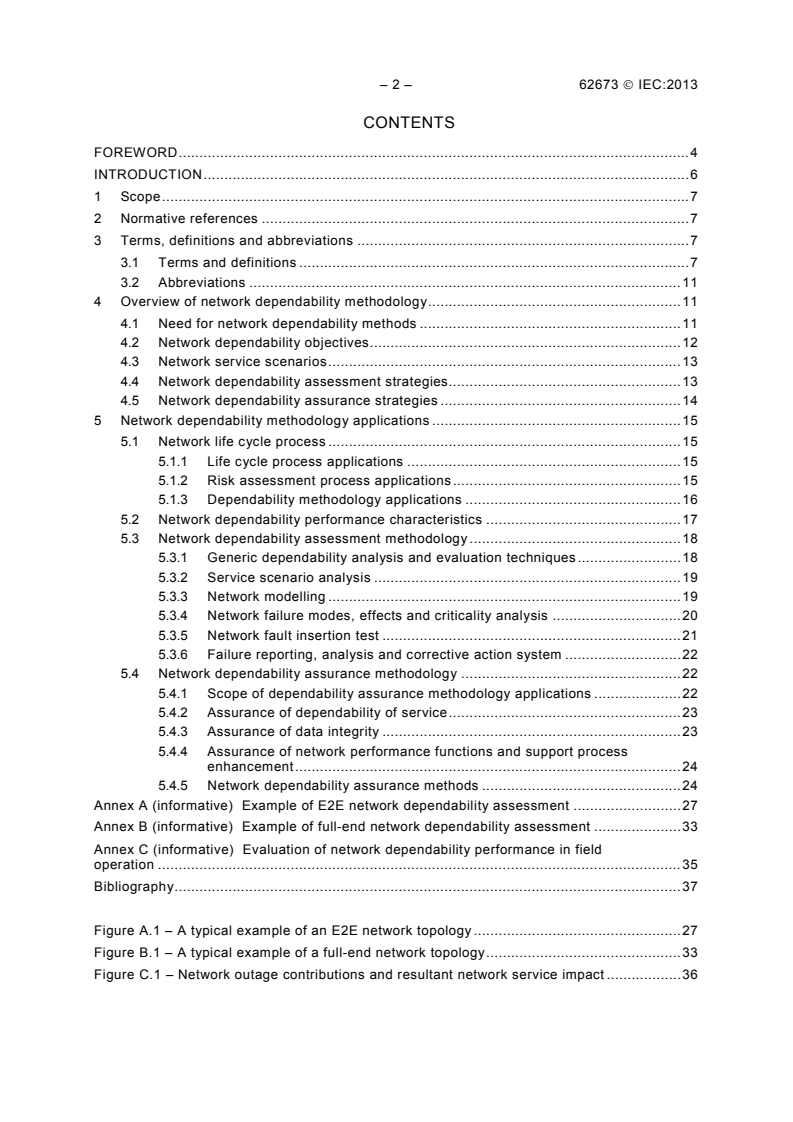
– 2 – 62673 IEC:2013
CONTENTS
FOREWORD . 4
INTRODUCTION . 6
1 Scope . 7
2 Normative references . 7
3 Terms, definitions and abbreviations . 7
3.1 Terms and definitions . 7
3.2 Abbreviations . 11
4 Overview of network dependability methodology . 11
4.1 Need for network dependability methods . 11
4.2 Network dependability objectives . 12
4.3 Network service scenarios . 13
4.4 Network dependability assessment strategies . 13
4.5 Network dependability assurance strategies . 14
5 Network dependability methodology applications . 15
5.1 Network life cycle process . 15
5.1.1 Life cycle process applications . 15
5.1.2 Risk assessment process applications . 15
5.1.3 Dependability methodology applications . 16
5.2 Network dependability performance characteristics . 17
5.3 Network dependability assessment methodology . 18
5.3.1 Generic dependability analysis and evaluation techniques . 18
5.3.2 Service scenario analysis . 19
5.3.3 Network modelling . 19
5.3.4 Network failure modes, effects and criticality analysis . 20
5.3.5 Network fault insertion test . 21
5.3.6 Failure reporting, analysis and corrective action system . 22
5.4 Network dependability assurance methodology . 22
5.4.1 Scope of dependability assurance methodology applications . 22
5.4.2 Assurance of dependability of service . 23
5.4.3 Assurance of data integrity . 23
5.4.4 Assurance of network performance functions and support process
enhancement . 24
5.4.5 Network dependability assurance methods . 24
Annex A (informative) Example of E2E network dependability assessment . 27
Annex B (informative) Example of full-end network dependability assessment . 33
Annex C (informative) Evaluation of network dependability performance in field
operation . 35
Bibliography . 37
Figure A.1 – A typical example of an E2E network topology . 27
Figure B.1 – A typical example of a full-end network topology . 33
Figure C.1 – Network outage contributions and resultant network service impact . 36
62673 IEC:2013 – 3 –
Table 1 – Summary of network dependability activities and application methods . 17
Table 2 – Summary of network dependability parameters. 18
Table C.1 – Summary of network failure data of a nation-wide public switched
telephone network . 35
– 4 – 62673 IEC:2013
INTERNATIONAL ELECTROTECHNICAL COMMISSION
____________
METHODOLOGY FOR COMMUNICATION NETWORK
DEPENDABILITY ASSESSMENT AND ASSURANCE
FOREWORD
1) The International Electrotechnical Commission (IEC) is a worldwide organization for standardization comprising
all national electrotechnical committees (IEC National Committees). The object of IEC is to promote
international co-operation on all questions concerning standardization in the electrical and electronic fields. To
this end and in addition to other activities, IEC publishes International Standards, Technical Specifications,
Technical Reports, Publicly Available Specifications (PAS) and Guides (hereafter referred to as “IEC
Publication(s)”). Their preparation is entrusted to technical committees; any IEC National Committee interested
in the subject dealt with may participate in this preparatory work. International, governmental and non-
governmental organizations liaising with the IEC also participate in this preparation. IEC collaborates closely
with the International Organization for Standardization (ISO) in accordance with conditions determined by
agreement between the two organizations.
2) The formal decisions or agreements of IEC on technical matters express, as nearly as possible, an international
consensus of opinion on the relevant subjects since each technical committee has representation from all
interested IEC National Committees.
3) IEC Publications have the form of recommendations for international use and are accepted by IEC National
Committees in that sense. While all reasonable efforts are made to ensure that the technical content of IEC
Publications is accurate, IEC cannot be held responsible for the way in which they are used or for any
misinterpretation by any end user.
4) In order to promote international uniformity, IEC National Committees undertake to apply IEC Publications
transparently to the maximum extent possible in their national and regional publications. Any divergence
between any IEC Publication and the corresponding national or regional publication shall be clearly indicated in
the latter.
5) IEC itself does not provide any attestation of conformity. Independent certification bodies provide conformity
assessment services and, in some areas, access to IEC marks of conformity. IEC is not responsible for any
services carried out by independent certification bodies.
6) All users should ensure that they have the latest edition of this publication.
7) No liability shall attach to IEC or its directors, employees, servants or agents including individual experts and
members of its technical committees and IEC National Committees for any personal injury, property damage or
other damage of any nature whatsoever, whether direct or indirect, or for costs (including legal fees) and
expenses arising out of the publication, use of, or reliance upon, this IEC Publication or any other IEC
Publications.
8) Attention is drawn to the Normative references cited in this publication. Use of the referenced publications is
indispensable for the correct application of this publication.
9) Attention is drawn to the possibility that some of the elements of this IEC Publication may be the subject of
patent rights. IEC shall not be held responsible for identifying any or all such patent rights.
International Standard IEC 62673 has been prepared by IEC technical committee 56:
Dependability.
The text of this standard is based on the following documents:
FDIS Report on voting
56/1507/FDIS 56/1514/RVD
Full information on the voting for the approval of this standard can be found in the report on
voting indicated in the above table.
This publication has been drafted in accordance with the ISO/IEC Directives, Part 2.
62673 IEC:2013 – 5 –
The committee has decided that the contents of this publication will remain unchanged until
the stability date indicated on the IEC web site under "http://webstore.iec.ch" in the data
related to the specific publication. At this date, the publication will be
• reconfirmed,
• withdrawn,
• replaced by a revised edition, or
• amended.
IMPORTANT – The 'colour inside' logo on the cover page of this publication indicates
that it contains colours which are considered to be useful for the correct
understanding of its contents. Users should therefore print this document using a
colour printer.
– 6 – 62673 IEC:2013
INTRODUCTION
Communication network dependability is highly influenced by the design and implementation
of the network service functions, which aim to achieve user satisfaction in service
performance.
Network evolution, service growth and functional renewal in communications have long been
challenges to the providers of network services, not just for the broad range of services now
in existence, but also for those service-related activities experienced by the end-users.
To sustain viable business in network services, it is prudent for the communications industry
to provide the
– needed network service functions,
– adequate network capacity and performance capability,
– security of service,
– quality of service, and
– dependability of service.
This International Standard addresses one of the most important issues concerning the
assessment and delivery of dependability of service to ensure network service performance. It
also addresses the network dependability assurance strategies and methodology applications
for enhancing and sustaining network operation.
This International Standard describes a generic methodology for dependability assessment
and assurance of communication networks. It also provides relevant assessment and
assurance methods to support communication networks for dependability engineering
application, such as those conforming to IEC 61907 and ITU-T Recommendations
concerning dependability.
It presents an approach for network dependability analysis and evaluation that ensures
dependable network design for effective implementation.
The objective of this standard is to achieve a cost-effective solution for realizing the network
dependability performance and to assure the benefits from the network dependability of
service operation.
______________
ITU-T: International Telecommunications Union – Telecommunications.
62673 IEC:2013 – 7 –
METHODOLOGY FOR COMMUNICATION NETWORK
DEPENDABILITY ASSESSMENT AND ASSURANCE
1 Scope
This International Standard describes a generic methodology for dependability assessment
and assurance of communication networks from a network life cycle perspective. It presents
the network dependability assessment strategies and methodology for analysis of network
topology, evaluation of dependability of service paths, and optimization of network
configurations in order to achieve network dependability performance and dependability of
service. It also addresses the network dependability assurance strategies and methodology
for application of network health check, network outage control and test case management to
enhance and sustain dependability performance in network service operation.
This standard is applicable to network service providers, network designers and developers,
and network maintainers and operators for assurance of network dependability performance
and assessment of dependability of service.
2 Normative references
The following documents, in whole or in part, are normatively referenced in this document and
are indispensable for its application. For dated references, only the edition cited applies. For
undated references, the latest edition of the referenced document (including any
amendments) applies.
IEC 60050-191, International Electrotechnical Vocabulary (IEV) – Chapter 191: Dependability
and quality of service
IEC 60300-3-15, Dependability management – Part 3-15: Application guide – Engineering of
system dependability
IEC 61907, Communication network dependability engineering
3 Terms, definitions and abbreviations
3.1 Terms and definitions
For the purposes of this document, the terms and definitions given in IEC 60050-191 and
IEC 61907, as well as the following, apply.
3.1.1
communication network
system of communication nodes and links that provides transmission of analogue and digital
signals
EXAMPLES Telecommunications networks, Internet, intranet, extranet, Wide Area Networks (WAN), Local Area
Networks (LAN) and computer networking utilizing information technology.
Note 1 to entry: A network has its boundary. All nodes at the network boundary are called ends. In some
applications, the term “node” is used instead of “end” as a communication access point to the network, as well as
for interconnections between the transmission links.
Note 2 to entry: A “backbone” communication network consists of core network and high-speed transmission lines
(national or international), connecting between major switching network nodes (interconnection of transmission
lines) at various locations in a country or region.
– 8 – 62673 IEC:2013
3.1.2
dependability
network dependability
ability to perform as and when required to meet specified communication and operational
requirements
3.1.3
availability
network availability
ability to be in a state to perform as required
Note 1 to entry: Availability depends upon the combined characteristics of the reliability, recoverability and
maintainability of the network and on the maintenance support performance.
Note 2 to entry: Availability may be quantified using appropriate performance measures.
3.1.4
reliability
network reliability
ability to perform as required, without failure, for a given time interval, under given conditions
Note 1 to entry: The time interval duration may be expressed in units appropriate to the network concerned.
Note 2 to entry: Reliability of a network depends upon the combined characteristics of the reliability, recoverability,
maintainability and maintenance support performance of the constituent network elements.
Note 3 to entry: Given conditions include aspects that affect reliability, such as: mode of operation, stress levels,
environmental conditions, and maintenance.
Note 4 to entry: Reliability may be quantified using appropriate performance measures.
3.1.5
maintainability
network maintainability
ability to be retained in, or restored to a state to perform as required under given conditions of
use and maintenance
Note 1 to entry: Given conditions include aspects that affect maintainability, such as: location for maintenance,
accessibility, maintenance procedures and maintenance resources.
Note 2 to entry: Maintainability may be quantified using appropriate performance measures.
3.1.6
maintenance support
network maintenance support
provision of resources to maintain a network
Note 1 to entry: Resources include human resources, support equipment, materials and spare parts, maintenance
facilities, documentation, information and maintenance information systems.
3.1.7
maintenance support performance
network maintenance support performance
effectiveness of an organization in respect of maintenance support for the network
Note 1 to entry: Maintenance support performance may be quantified using appropriate measures.
3.1.8
recoverability
network recoverability
ability to recover from a failure, without corrective maintenance
Note 1 to entry: The ability to recover may or may not require external actions.
62673 IEC:2013 – 9 –
Note 2 to entry: Recoverability may be quantified using such measures as the probability of recovery within a
specified time interval.
3.1.9
element
network element
subsystem or component of a communication network
EXAMPLES Terminals, nodes and switches.
Note 1 to entry: A network element may involve human input to perform its service function.
Note 2 to entry: Network elements are connected by network links.
3.1.10
link
network link
electrical, wireless or optical connection between network nodes
3.1.11
performance
network performance
ability to provide the service functions related to communications between users
[SOURCE: ITU-T Recommendation I.350:1988][1]
3.1.12
management
network management
application of organized processes and resources to manage the performance, configuration,
accounting, fault, and security activities
3.1.13
service function
network service function
program or application that interacts with the network users or within the network
infrastructure to transmit or exchange data and information in the network
Note 1 to entry: A network service function may consist of hardware and software elements, and may involve
human interactions for realizing a specific function.
3.1.14
network services
provision of network service functions and communication services to the network users
Note 1 to entry: Communication services are the network services subscribed by the end-users.
Note 2 to entry: A bearer service is a communication service function that allows transmission of user-information
signals between user-network interfaces.
3.1.15
quality of service
collective effect of service performance that determines the degree of satisfaction of a user of
the service
3.1.16
network failure
loss of ability of a network to perform as required
______________
References in square brackets refer to the Bibliography.
– 10 – 62673 IEC:2013
Note 1 to entry: The network failure may be due to, for example, equipment failure, natural disasters or human-
caused disturbance.
3.1.17
network fault
state of inability of a network to perform as required, for internal reason
Note 1 to entry: In the context of network operation, a fault may be natural due to an abnormal condition, or
malfunction resulting from a network element failure, or induced by external means such as fault injection.
Note 2 to entry: A degraded state in network performance is a situation where one or more performance
characteristics do not conform to requirements.
3.1.18
service provider
organization that provides communication network services
EXAMPLES Telephone companies, data carriers, mobile service providers, Internet service providers and cable
television operators.
Note 1 to entry: A network carrier or common carrier is an organization that transports a product or service using
its facilities or those of other carriers, and offers services to the general public. The term communication carrier
refers to various telephone companies that provide local, long distance or value added services.
3.1.19
user
party that employs the services of a service provider for direct network access
Note 1 to entry: A user may be a source or recipient of user information, or both.
Note 2 to entry: In some circumstances, a user of a communication service is also known as a subscriber.
3.1.20
integrity
network integrity
ability to ensure that the data contents are not contaminated, corrupted, lost or altered
between transmission and reception
Note 1 to entry: Throughput is the rate of successful message delivery over a communication channel of a network
service.
3.1.21
dependability performance
network dependability performance
ability to provide or demonstrate the performance characteristics of dependability in network
operation to achieve network service objectives
Note 1 to entry: In the context of this standard, network dependability performance refers to the provision of full-
end network services.
Note 2 to entry: A full-end network service is the provision of service connectivity established for all transmission
and reception ends of a communication network.
3.1.22
dependability of service
network dependability of service
effect of providing the required dependability performance for user communications services
Note 1 to entry: In the context of this standard, network dependability of service refers to the provision of end-to-
end (E2E) network services.
Note 2 to entry: An end-to-end network service is the provision of service connectivity established between the
transmission and reception ends of a communication network.
62673 IEC:2013 – 11 –
3.1.23
security of service
network security of service
effect of providing the required security for user communications services
3.1.24
service path
network service path
connecting path by network links and nodes to establish user communications services
3.1.25
service flow
network service flow
flow of information and data through the service path
3.1.26
service scenario
operational situation in communication network for provision of network service functions and
user service applications
3.1.27
network outage
state of the network being unable to perform its primary function
3.2 Abbreviations
E2E End-to-End
FRACAS Failure Reporting, Analysis, Corrective Action System
FRU Field Return Unit
HAZOP Hazard and operability studies
MTTR Mean Time to Restoration of Node/link
ND Network Dependability
NFIT Network Fault Insertion Test
NFMECA Network Failure Modes, Effects and Criticality Analysis
OAMP Operations, Administration, Maintenance, and Provisioning
OSI Open System Interconnection
QoS Quality of Service
RBD Reliability Block Diagram
SLB Service Logic Block
4 Overview of network dependability methodology
4.1 Need for network dependability methods
A communication network is a system of systems that interacts with other networks to achieve
multiple service performance objectives. A communication network is complex and its
constituent systems are constantly changing and evolving. Appropriate methodology and
technical approaches are needed for dependability assessment and assurance of the network.
From a network dependability assessment perspective, the classical dependability techniques
for analysis and evaluation have a limited scope in network application. Existing dependability
methods are often unsuitable for modelling complex network topology and difficult for analysis
of multiple network configurations and network service paths to provide confidence in the
evaluation results. Selective methods such as SLB, NFMECA, and network simulation suitable
for network dependability analysis and evaluation can provide effective network solutions.
– 12 – 62673 IEC:2013
They have become the essential processes to ensure sustainable network services and
dependability performance.
A common approach for assurance of network dependability performance and dependability of
service is to construct reliable network structure, establish effective routing schemes, provide
efficient fault management and network maintenance support, and gather performance data
and user feedback for network service evaluation and improvement. The process involves
analysis of network service functions for cost-effective implementation, and evaluates value-
added network service features for dependability of service enhancement. This approach,
though adequate for system life cycle assessment of hardware and software network
elements to ascertain dependability performance, is inadequate to deal with routing
connectivity of user services in network operation. The traditional assurance approach lacks
the responsiveness to react to the market dynamics of adaptive network configurations. This
affects the network service objectives to ensure network dependability performance and to
guarantee dependability of service in a highly competitive global network business.
There are many dependability methods developed over the years but only a selective few
provide efficient methodology appropriate for effective network dependability performance and
dependability of service applications. This observation is noted due to the complex nature of
network evolution; the innovative topology for development of advanced network service
functions, and the unique techniques required for practical dependability methodology
applications. Whereas there are many factors that could influence the dependability
performance in the network life cycle, the most significant impact would be during the early
stages in concept/definition, design/development, and realization/integration. New additions to
the existing network would involve scenario analysis of the legacy system during the
concept/definition stage prior to investments in subsequent design/development and
realization/integration stages. The extent of operation/maintenance, enhancement/renewal
and retirement needs should be included in the scenario analysis of the legacy system.
Network dependability performance and dependability of service should be continuously
monitored, analysed and evaluated for optimization of network operations and provision of
revenue generating network services. The network dependability assurance strategies and
methodology applications are key contributing factors to enhance and sustain continued
provision of network services from a viable business perspective.
4.2 Network dependability objectives
The capability of a network to provide users’ communication for continual and uninterrupted
service operation is highly dependent on its dependability performance. Dependability implies
that the provision of network service functions is trustworthy and capable of performing the
desirable service upon demand. To achieve network performance and assure network
dependability of service, it is essential to utilize relevant methods for assessment of network
dependability. This standard supports the engineering requirements for network design and
process implementation, and provides relevant dependability methodology for analysis and
evaluation of communication networks. The technical framework of IEC 60300-3-15 on system
aspects of dependability and the requirements of IEC 61907 on network dependability
engineering apply to this standard. Terms related to communications quality of service are
referenced in ITU-T Recommendation G.1000 [2].
In the development and implementation of communication networks, there are several
important influencing factors that concern the network operators and service providers to
sustain a viable business. They include:
• network service functions to satisfy user needs;
• network performance capability to meet service demands;
• security of service;
• quality of service (QoS) [3];
• dependability of service.
In the assessment and assurance of network dependability, it should be noted that
62673 IEC:2013 – 13 –
a) the network functional parameters such as transmission capacity and performance
connectivity will degrade with time due to failures and this will affect network dependability;
b) the robustness of the network to resist service performance violation due to external
intrusion and outage interruption will affect critical network infrastructure protection.
4.3 Network service scenarios
There are two network service scenarios of interest to network dependability.
a) Dependability of service of the end-users’ connections for end-to-end (E2E) network
services (see Clause A.2) – the objective is to determine the network dependability
performance characteristics on E2E network services from the perspective of network
end-users. The E2E network service is an essential service to meet end-user needs based
on the performance capability of a full-end network in service operation. In the E2E
network service scenario, the dependability of service is reliant on the routing schemes
and the capability of the network performance associated with the specific service paths
selected for the E2E connections. Dependability of service is experienced by the end-
users and reflects customer demands and user satisfaction.
b) Dependability performance of the entire network for full-end network services (see Clause
B.2) – the objective is to determine the network dependability performance characteristics
of the entire network from the network operator or the network service provider
perspective. A full-end network can operate in a service scenario where the service
provider has full control of a private network and has the responsibility to provide network
dependability performance adequate for the network services. The full-end network can
also operate in a service scenario with multiple service providers each controlling a
designated segment of the entire network as in a public switching network. The network
operator is responsible for the overall network service performance. Individual service
providers are responsible for their contributions of network service performance under the
network service level agreements with the network operator in provision of QoS.
The two network service scenarios associated with E2E and full-end network service
operations are interdependent and complementary. It should be noted that without
dependability performance capability, adequate user services could not be achieved or
guaranteed; and without user satisfaction of dependability of service, the service provider
would experience difficulty in sustaining user service demands and could lose subscriptions;
hence affecting network service revenue generation. Relevant network user feedback
information gathered and network performance data analysed from these two network service
scenarios would facilitate resource planning and control of QoS provision to subscribers or
users and maintain dependability of overall network services.
Network dependability performance and dependability of service reflect the network service
scenarios and operation environments in doing business. This is achieved by means of
dependability assessment to ensure dependability performance during network development
and dependability assurance to sustain dependability of service during network operation.
The strategies for network dependability assessment and dependability assurance are
outlined in 4.4 and 4.5. The dependability methodology and methods for network applications
are provided in Clause 5.
4.4 Network dependability assessment strategies
Dependability assessment is an appraisal process to determine the status of network
performance for delivery of dependability of service. The following describes the network
dependability assessment strategies relevant to the network service scenarios.
a) E2E network dependability assessment strategy
The E2E network dependability is influenced by the network topology, the routing schemes
and the selection of service paths to achieve user service connections. To assess E2E
network dependability, the routing service paths associated with the service scenarios
should be analysed. All the equipment and links of each service path should be evaluated
– 14 – 62673 IEC:2013
for achievement and delivery of dependability of service. The E2E network dependability
assessment covers various network service scenarios in public and private networks.
The assessment strategy for E2E network should consider a technical approach for
evaluation of dependability of service. This is due to the multiple service paths that need
to be analysed for optimization of dependability of service. The complex nature of the
network configuration demands a unique modelling technique and methodology consisting
of Service Logic Block (SLB) diagrams (see Clause A.3) to facilitate E2E network
dependability of service evaluation.
b) Full-end network dependability assessment strategy
A full-end network operating in a service scenario consists of numerous interacting
networks offering various service functions by multiple service providers. Provision of
network dependability performance is the collaborative efforts of these service providers
under service level agreements for delivery of QoS. The service function reliability of the
full-end network can be modelled by the RBD [4] or similar methods. Full-end network
dependability assessment can only be practically ascertained after network service
implementation by means of field performance survey and customer satisfaction feedback
to obtain relevant network performance data. This is due to the complex nature of network
evolution where new service functions are continuously being added for performance
enhancement and termination of obsolete or unprofitable network services. The public
switching network is an example where network dependability performance can be
assessed by analysis and evaluation of the reported frequency of user service outages
and the outage duration and customer complaints on service impact. The assessment
outputs include the categorization of network outages associated with the identified failure
causes and their resulting service impact to the network subscribers or users.
A full-end network can be a private network and owned by a single network operator who
has full control for provision of the network services. A secured data network consisting of
automated teller machines to provide distributed banking services is an example of a
private network. To assess the dependability performance of the full-end private network,
all the network elements and their relationships should be determined and all relevant
dependability performance characteristics evaluated for conformance to established
network service performance criteria. The technical processes for network dependability
assessment are analysed and evaluated as a system with boundary conditions. For new
network development, the network life cycle process should be followed and the
dependability engineering activities conducted according to the recommended guidelines
from IEC 61907. For network enhancement and renewal projects, it is essential to take
into consideration the legacy issues of existing network configurations to optimize
renewed network performance. Network performance statistics from field operation should
be collected and analysed to validate performance adequacy in meeting network service
objectives.
4.5 Network dependability assurance strategies
The network dependability assurance strategies are planned activities engaging systematic
processes to ensure achievement of network dependability in performance and delivery of
customer focused dependability of service. The network dependability assurance strategies
reflect the relevant technical domains in network specific applications. They collaborate with
network performance management and the routine network maintenance and support
activities by providing specific dependability engineering effort. The network specific
dependability assurance strategies are summarized from a network operation viewpoint.
a) Delivery of dependability of service to end-users
There are two separate strategic issues concerning the delivery of dependability of service:
one is concerning the service contributions from the delivery mechanism of network
equipment functions and interoperability in service operation; the other relates to
the service delivery of data information as throughput by utilizing the delivery mechanism
of the network configuration. The application specific strategies focus on the delivery
mechanism and the data integrity.
b) Ensuring data integrity
62673 IEC:2013 – 15 –
The data integrity is the foundation for credible information generation and data
transmission through the network service paths that represent the delivery mechanism of
the network configuration. The data specific strategy is focused on the network
dependability performance and the ability to prevent data loss, corruption or security
exposure.
c) Enhancement of network performance functions and support processes
The network performance functions and support processes would tend to degrade if not
adequately maintained and regularly updated. This would result in gradual degradation in
network performance leading to frequent network outages and increased service downtime
durations; hence affecting network operation and QoS. The network maintenance support
strategy for dependability assurance is to promote continuous improvement to optimize
network functions and simplify procedures for network support processes. The technical
focus is to enhance critical network performance related dependability characteristics such
as recoverability, availability, reliability, maintainability, and maintenance support.
Continuous network improvement is essential to sustain viable network service operations
and to ensure the satisfaction of end users. The assurance strategy provides corrective
and preventive measures to avoid recurrence of network operation problems.
5 Network dependability methodology applications
5.1 Network life cycle process
5.1.1 Life cycle process applications
The applications of network life cycle process involve a series of dependability activities to
achieve its performance objectives. The network life cycle stages include concept/definition,
design/development, realization/integration, operation/maintenance, enhancement/renewal,
and retirement. The relevant application methods for network dependability analysis and
evaluation are identified. The objective is to ensure that network dependability requirements
are met through judicious applications of relevant methods for assurance of network
dependability performance to a
...