

IEC 61689:2013
(Main)Ultrasonics - Physiotherapy systems - Field specifications and methods of measurement in the frequency range 0,5 MHz to 5 MHz
General Information
- Abstract
IEC 61689:2013 is applicable to ultrasonic equipment designed for physiotherapy containing an ultrasonic transducer generating continuous or quasi-continuous wave ultrasound in the frequency range 0,5 MHz to 5 MHz. This standard only relates to ultrasonic physiotherapy equipment employing a single plane non-focusing circular transducer per treatment head, producing static beams perpendicular to the face of the treatment head. This standard specifies:
- methods of measurement and characterization of the output of ultrasonic physiotherapy equipment based on reference testing methods;
- characteristics to be specified by manufacturers of ultrasonic physiotherapy equipment based on reference testing methods;
- guidelines for safety of the ultrasonic field generated by ultrasonic physiotherapy equipment;
- methods of measurement and characterization of the output of ultrasonic physiotherapy equipment based on routine testing methods;
- and acceptance criteria for aspects of the output of ultrasonic physiotherapy equipment based on routine testing methods. Therapeutic value and methods of use of ultrasonic physiotherapy equipment are not covered by the scope of this standard. This third edition cancels and replaces the second edition published in 2007. It constitutes a technical revision which includes the following significant technical changes with respect to the previous edition:
- restriction introduced of 0,2 W/cm2 effective intensity during hydrophone measurements for treatment heads with ka≤20, to limit the likelihood of cavitation;
- change in the factor Fac, to determine the effective radiating area, from 1,354 to 1,333;
- and change to SI units for terms and definitions.
This publication is to be read in conjunction with IEC 60601-2-5:2009.
- Status
- Published
- Publication Date
- 25-Feb-2013
- Technical Committee
- TC 87 - Ultrasonics
- Drafting Committee
- WG 8 - TC 87/WG 8
- Current Stage
- DELPUB - Deleted Publication
- Start Date
- 08-Mar-2022
- Completion Date
- 31-Aug-2020
Overview
IEC 61689:2013 is an international standard published by the International Electrotechnical Commission (IEC) that specifies field requirements and methods for measuring ultrasonic physiotherapy systems operating within the frequency range of 0.5 MHz to 5 MHz. This standard applies specifically to ultrasonic equipment designed for physiotherapy treatment using a single-plane, non-focusing circular transducer per treatment head that produces static beams perpendicular to the treatment head’s face.
The third edition of IEC 61689 updates procedures to enhance accuracy and safety during ultrasonic field measurement and characterization. It is intended for manufacturers, testing laboratories, and regulatory bodies involved in the development, testing, and certification of physiotherapy ultrasound equipment to ensure consistent quality and safety.
Key Topics
- Measurement Methods: IEC 61689:2013 defines both reference type testing and routine testing methods for the ultrasonic output. It covers hydrophone measurements, radiating area assessment, and beam characterization.
- Field Specifications: The standard sets detailed specifications for ultrasonic fields generated by physiotherapy equipment, including effective radiating area, power output, and beam non-uniformity ratio for accurate and reproducible performance.
- Safety Guidelines: Safety considerations focus on limiting cavitation risk and ensuring output intensity remains within safe thresholds. The standard introduces a maximum effective intensity of 0.2 W/cm² during hydrophone measurements for treatment heads with ka ≤ 20.
- Technical Updates: Technical changes include updating the conversion factor for effective radiating area from 1.354 to 1.333 and adopting SI units for clarity and international consistency.
- Test Equipment Conditions: Guidance on test vessels, hydrophones, signal measurement techniques, and uncertainty determination ensure reliable testing environments and repeatable results.
- Acceptance Criteria: Clear acceptance criteria for both reference and routine tests assist manufacturers and testers in determining equipment compliance with performance and safety requirements.
Applications
- Physiotherapy Device Manufacturing: Provides manufacturers with standardized procedures for output characterization, enabling design validation and quality control during production.
- Metrological Testing: Test laboratories use IEC 61689 to perform calibrations, routine inspections, and acceptance testing of ultrasonic physiotherapy systems to assure regulatory compliance and maintain high-quality therapeutic devices.
- Regulatory Compliance: Supports national and international regulatory authorities in assessing physiotherapy ultrasound equipment safety and performance, facilitating market approval processes.
- Equipment Calibration and Maintenance: Offers standardized test protocols to healthcare providers and service engineers for periodic equipment checks, ensuring reliable operation and patient safety.
Related Standards
- IEC 60601-2-5:2009: Medical electrical equipment – Part 2-5: Particular requirements for the safety of ultrasonic physiotherapy equipment. IEC 61689 is intended to be read in conjunction with this safety-focused standard.
- IEC 62127 Series: Ultrasonics – Hydrophones – The updated terminologies and definitions in IEC 61689 align more closely with these standards, which cover hydrophone calibration and measurement methods in ultrasonic fields.
- IEC 61161: Ultrasonics – Power measurement in medical applications, referenced for specific measurements related to radiation force balance techniques.
- National and Regional Medical Device Regulations: IEC 61689 supports compliance with broader regulatory frameworks governing therapeutic ultrasound devices through standardized field output characterization.
IEC 61689:2013 plays a critical role in ensuring the accuracy, safety, and consistency of ultrasonic physiotherapy equipment by establishing internationally recognized test methods and performance criteria. Manufacturers, testing agencies, and regulatory bodies rely on this standard to support the development and verification of safe, effective physiotherapy ultrasound systems within the key ultrasonic frequency range of 0.5 to 5 MHz.
Relations
- Effective Date
- 05-Sep-2023
- Effective Date
- 05-Sep-2023
Get Certified
Connect with accredited certification bodies for this standard

BSI Group
BSI (British Standards Institution) is the business standards company that helps organizations make excellence a habit.

TÜV Rheinland
TÜV Rheinland is a leading international provider of technical services.

TÜV SÜD
TÜV SÜD is a trusted partner of choice for safety, security and sustainability solutions.
Sponsored listings
Frequently Asked Questions
IEC 61689:2013 is a standard published by the International Electrotechnical Commission (IEC). Its full title is "Ultrasonics - Physiotherapy systems - Field specifications and methods of measurement in the frequency range 0,5 MHz to 5 MHz". This standard covers: IEC 61689:2013 is applicable to ultrasonic equipment designed for physiotherapy containing an ultrasonic transducer generating continuous or quasi-continuous wave ultrasound in the frequency range 0,5 MHz to 5 MHz. This standard only relates to ultrasonic physiotherapy equipment employing a single plane non-focusing circular transducer per treatment head, producing static beams perpendicular to the face of the treatment head. This standard specifies: - methods of measurement and characterization of the output of ultrasonic physiotherapy equipment based on reference testing methods; - characteristics to be specified by manufacturers of ultrasonic physiotherapy equipment based on reference testing methods; - guidelines for safety of the ultrasonic field generated by ultrasonic physiotherapy equipment; - methods of measurement and characterization of the output of ultrasonic physiotherapy equipment based on routine testing methods; - and acceptance criteria for aspects of the output of ultrasonic physiotherapy equipment based on routine testing methods. Therapeutic value and methods of use of ultrasonic physiotherapy equipment are not covered by the scope of this standard. This third edition cancels and replaces the second edition published in 2007. It constitutes a technical revision which includes the following significant technical changes with respect to the previous edition: - restriction introduced of 0,2 W/cm2 effective intensity during hydrophone measurements for treatment heads with ka≤20, to limit the likelihood of cavitation; - change in the factor Fac, to determine the effective radiating area, from 1,354 to 1,333; - and change to SI units for terms and definitions. This publication is to be read in conjunction with IEC 60601-2-5:2009.
IEC 61689:2013 is applicable to ultrasonic equipment designed for physiotherapy containing an ultrasonic transducer generating continuous or quasi-continuous wave ultrasound in the frequency range 0,5 MHz to 5 MHz. This standard only relates to ultrasonic physiotherapy equipment employing a single plane non-focusing circular transducer per treatment head, producing static beams perpendicular to the face of the treatment head. This standard specifies: - methods of measurement and characterization of the output of ultrasonic physiotherapy equipment based on reference testing methods; - characteristics to be specified by manufacturers of ultrasonic physiotherapy equipment based on reference testing methods; - guidelines for safety of the ultrasonic field generated by ultrasonic physiotherapy equipment; - methods of measurement and characterization of the output of ultrasonic physiotherapy equipment based on routine testing methods; - and acceptance criteria for aspects of the output of ultrasonic physiotherapy equipment based on routine testing methods. Therapeutic value and methods of use of ultrasonic physiotherapy equipment are not covered by the scope of this standard. This third edition cancels and replaces the second edition published in 2007. It constitutes a technical revision which includes the following significant technical changes with respect to the previous edition: - restriction introduced of 0,2 W/cm2 effective intensity during hydrophone measurements for treatment heads with ka≤20, to limit the likelihood of cavitation; - change in the factor Fac, to determine the effective radiating area, from 1,354 to 1,333; - and change to SI units for terms and definitions. This publication is to be read in conjunction with IEC 60601-2-5:2009.
IEC 61689:2013 is classified under the following ICS (International Classification for Standards) categories: 11.040.60 - Therapy equipment; 31.040.10 - Fixed resistors. The ICS classification helps identify the subject area and facilitates finding related standards.
IEC 61689:2013 has the following relationships with other standards: It is inter standard links to IEC 61689:2022, IEC 61689:2007. Understanding these relationships helps ensure you are using the most current and applicable version of the standard.
IEC 61689:2013 is available in PDF format for immediate download after purchase. The document can be added to your cart and obtained through the secure checkout process. Digital delivery ensures instant access to the complete standard document.
Standards Content (Sample)
IEC 61689 ®
Edition 3.0 2013-02
INTERNATIONAL
STANDARD
NORME
INTERNATIONALE
Ultrasonics – Physiotherapy systems – Field specifications and methods of
measurement in the frequency range 0,5 MHz to 5 MHz
Ultrasons – Systèmes de physiothérapie – Spécifications des champs et
méthodes de mesure dans la gamme de fréquences de 0,5 MHz à 5 MHz
All rights reserved. Unless otherwise specified, no part of this publication may be reproduced or utilized in any form
or by any means, electronic or mechanical, including photocopying and microfilm, without permission in writing from
either IEC or IEC's member National Committee in the country of the requester.
If you have any questions about IEC copyright or have an enquiry about obtaining additional rights to this publication,
please contact the address below or your local IEC member National Committee for further information.
Droits de reproduction réservés. Sauf indication contraire, aucune partie de cette publication ne peut être reproduite ni
utilisée sous quelque forme que ce soit et par aucun procédé, électronique ou mécanique, y compris la photocopie et les
microfilms, sans l'accord écrit de la CEI ou du Comité national de la CEI du pays du demandeur.
Si vous avez des questions sur le copyright de la CEI ou si vous désirez obtenir des droits supplémentaires sur cette
publication, utilisez les coordonnées ci-après ou contactez le Comité national de la CEI de votre pays de résidence.
IEC Central Office Tel.: +41 22 919 02 11
3, rue de Varembé Fax: +41 22 919 03 00
CH-1211 Geneva 20 info@iec.ch
Switzerland www.iec.ch
About the IEC
The International Electrotechnical Commission (IEC) is the leading global organization that prepares and publishes
International Standards for all electrical, electronic and related technologies.
About IEC publications
The technical content of IEC publications is kept under constant review by the IEC. Please make sure that you have the
latest edition, a corrigenda or an amendment might have been published.
Useful links:
IEC publications search - www.iec.ch/searchpub Electropedia - www.electropedia.org
The advanced search enables you to find IEC publications The world's leading online dictionary of electronic and
by a variety of criteria (reference number, text, technical electrical terms containing more than 30 000 terms and
committee,…). definitions in English and French, with equivalent terms in
It also gives information on projects, replaced and additional languages. Also known as the International
withdrawn publications. Electrotechnical Vocabulary (IEV) on-line.
IEC Just Published - webstore.iec.ch/justpublished Customer Service Centre - webstore.iec.ch/csc
Stay up to date on all new IEC publications. Just Published If you wish to give us your feedback on this publication
details all new publications released. Available on-line and or need further assistance, please contact the
also once a month by email. Customer Service Centre: csc@iec.ch.
A propos de la CEI
La Commission Electrotechnique Internationale (CEI) est la première organisation mondiale qui élabore et publie des
Normes internationales pour tout ce qui a trait à l'électricité, à l'électronique et aux technologies apparentées.
A propos des publications CEI
Le contenu technique des publications de la CEI est constamment revu. Veuillez vous assurer que vous possédez
l’édition la plus récente, un corrigendum ou amendement peut avoir été publié.
Liens utiles:
Recherche de publications CEI - www.iec.ch/searchpub Electropedia - www.electropedia.org
La recherche avancée vous permet de trouver des Le premier dictionnaire en ligne au monde de termes
publications CEI en utilisant différents critères (numéro de électroniques et électriques. Il contient plus de 30 000
référence, texte, comité d’études,…). termes et définitions en anglais et en français, ainsi que
Elle donne aussi des informations sur les projets et les les termes équivalents dans les langues additionnelles.
publications remplacées ou retirées. Egalement appelé Vocabulaire Electrotechnique
International (VEI) en ligne.
Just Published CEI - webstore.iec.ch/justpublished
Service Clients - webstore.iec.ch/csc
Restez informé sur les nouvelles publications de la CEI.
Just Published détaille les nouvelles publications parues. Si vous désirez nous donner des commentaires sur
Disponible en ligne et aussi une fois par mois par email. cette publication ou si vous avez des questions
contactez-nous: csc@iec.ch.
IEC 61689 ®
Edition 3.0 2013-02
INTERNATIONAL
STANDARD
NORME
INTERNATIONALE
Ultrasonics – Physiotherapy systems – Field specifications and methods of
measurement in the frequency range 0,5 MHz to 5 MHz
Ultrasons – Systèmes de physiothérapie – Spécifications des champs et
méthodes de mesure dans la gamme de fréquences de 0,5 MHz à 5 MHz
INTERNATIONAL
ELECTROTECHNICAL
COMMISSION
COMMISSION
ELECTROTECHNIQUE
PRICE CODE
INTERNATIONALE
CODE PRIX XB
ICS 11.040.60 ISBN 978-2-83220-657-7
– 2 – 61689 © IEC:2013
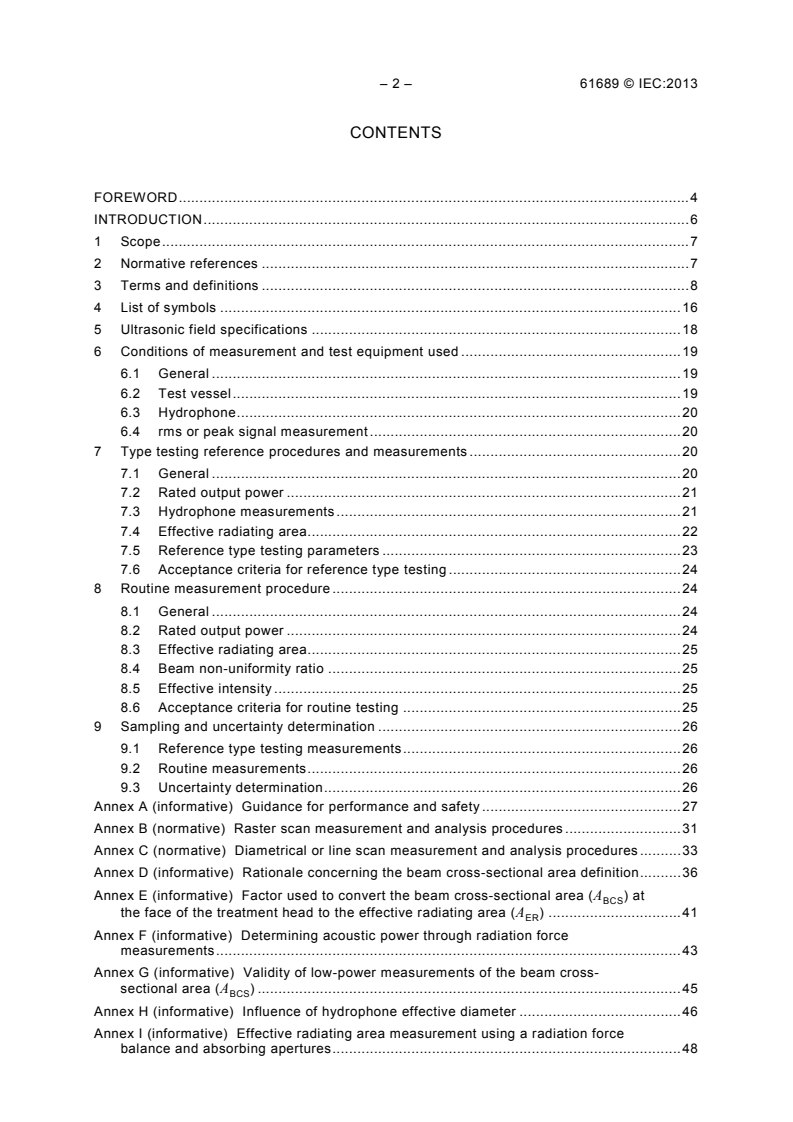
CONTENTS
FOREWORD . 4
INTRODUCTION . 6
1 Scope . 7
2 Normative references . 7
3 Terms and definitions . 8
4 List of symbols . 16
5 Ultrasonic field specifications . 18
6 Conditions of measurement and test equipment used . 19
6.1 General . 19
6.2 Test vessel . 19
6.3 Hydrophone . 20
6.4 rms or peak signal measurement . 20
7 Type testing reference procedures and measurements . 20
7.1 General . 20
7.2 Rated output power . 21
7.3 Hydrophone measurements . 21
7.4 Effective radiating area. 22
7.5 Reference type testing parameters . 23
7.6 Acceptance criteria for reference type testing . 24
8 Routine measurement procedure . 24
8.1 General . 24
8.2 Rated output power . 24
8.3 Effective radiating area. 25
8.4 Beam non-uniformity ratio . 25
8.5 Effective intensity . 25
8.6 Acceptance criteria for routine testing . 25
9 Sampling and uncertainty determination . 26
9.1 Reference type testing measurements . 26
9.2 Routine measurements . 26
9.3 Uncertainty determination . 26
Annex A (informative) Guidance for performance and safety . 27
Annex B (normative) Raster scan measurement and analysis procedures . 31
Annex C (normative) Diametrical or line scan measurement and analysis procedures . 33
Annex D (informative) Rationale concerning the beam cross-sectional area definition . 36
Annex E (informative) Factor used to convert the beam cross-sectional area (A ) at
BCS
the face of the treatment head to the effective radiating area (A ) . 41
ER
Annex F (informative) Determining acoustic power through radiation force
measurements . 43
Annex G (informative) Validity of low-power measurements of the beam cross-
sectional area (A ) . 45
BCS
Annex H (informative) Influence of hydrophone effective diameter . 46
Annex I (informative) Effective radiating area measurement using a radiation force
balance and absorbing apertures . 48
61689 © IEC:2013 – 3 –
Annex J (informative) Guidance on uncertainty determination . 58
Bibliography . 60
Figure A.1 – Normalized, time-averaged values of acoustic intensity (unbroken line)
and of one of its plane-wave approximations (broken line), existing on the axis of a
circular piston source of ka = 30, versus the normalized distance s , where s = λz/a . 30
n n
Figure A.2 – Histogram of R values for 37 treatment heads of various diameter and
BN
frequency . 30
Figure D.1 – Iso-pressure lines of a typical physiotherapy treatment head of small
geometrical area (ka = 17) . 38
Figure D.2 – Plot of beam cross-sectional area against different limit values for a
small range of values in distance along the beam alignment axis, z . 38
Figure D.3 – Normalized values of beam cross-sectional area for IEC and FDA limit
values for five transducers of different ka values . 39
Figure D.4 – Range of values of the beam cross-sectional area (A ) with distance
BCS
from the face of the treatment head . 40
Figure D.5 – Range of values of the normalized beam cross-sectional area (A ) with
BCS
transducer ka . 40
Figure E.1 – Conversion factor F as a function of the ka product for ka product
ac
between 40 and 160 . 42
Figure I.1 – Schematic representation of aperture measurement set-up . 49
Figure I.2 – Measured power as a function of aperture diameter for commercially-
available 1 MHz physiotherapy treatment heads . 53
Figure I.3 – Cumulative sum of annular power contributions, previously sorted in
descending order of intensity contribution, plotted against the cumulative sum of their
respective annular areas . 56
Table C.1 – Constitution of the transformed array [B] used for the analysis of half-line
scans . 34
Table F.1 – Necessary target size, expressed as the minimum target radius b, as a
function of the ultrasonic frequency, f, the effective radius of the treatment head, a ,
and the target distance, z, calculated according to A.5.3 of IEC 61161: 2013 (see [6]) . 44
Table G.1 – Variation of the beam cross-sectional area (A (z)) with the indicated
BCS
output power from two transducers . 45
Table H.1 – Comparison of measurements of the beam cross-sectional area (A (z))
BCS
made using hydrophones of geometrical active element radii 0,3 mm, 0,5 mm and
2,0 mm . 47
Table I.1 – Aperture measurement check sheet . 52
Table I.2 – Annular power contributions . 54
Table I.3 – Annular intensity contributions. 54
Table I.4 – Annular intensity contributions, sorted in descending order . 55
Table I.5 – Annular power contributions, sorted in descending order of intensity
contribution . 55
Table I.6 – Cumulative sum of annular power contributions, previously sorted in
descending order of intensity contribution, and the cumulative sum of their respective
annular areas . 56
– 4 – 61689 © IEC:2013
INTERNATIONAL ELECTROTECHNICAL COMMISSION
____________
ULTRASONICS –
PHYSIOTHERAPY SYSTEMS –
FIELD SPECIFICATIONS AND METHODS OF MEASUREMENT
IN THE FREQUENCY RANGE 0,5 MHz TO 5 MHz
FOREWORD
1) The International Electrotechnical Commission (IEC) is a worldwide organization for standardization comprising
all national electrotechnical committees (IEC National Committees). The object of IEC is to promote
international co-operation on all questions concerning standardization in the electrical and electronic fields. To
this end and in addition to other activities, IEC publishes International Standards, Technical Specifications,
Technical Reports, Publicly Available Specifications (PAS) and Guides (hereafter referred to as “IEC
Publication(s)”). Their preparation is entrusted to technical committees; any IEC National Committee interested
in the subject dealt with may participate in this preparatory work. International, governmental and non-
governmental organizations liaising with the IEC also participate in this preparation. IEC collaborates closely
with the International Organization for Standardization (ISO) in accordance with conditions determined by
agreement between the two organizations.
2) The formal decisions or agreements of IEC on technical matters express, as nearly as possible, an international
consensus of opinion on the relevant subjects since each technical committee has representation from all
interested IEC National Committees.
3) IEC Publications have the form of recommendations for international use and are accepted by IEC National
Committees in that sense. While all reasonable efforts are made to ensure that the technical content of IEC
Publications is accurate, IEC cannot be held responsible for the way in which they are used or for any
misinterpretation by any end user.
4) In order to promote international uniformity, IEC National Committees undertake to apply IEC Publications
transparently to the maximum extent possible in their national and regional publications. Any divergence
between any IEC Publication and the corresponding national or regional publication shall be clearly indicated in
the latter.
5) IEC itself does not provide any attestation of conformity. Independent certification bodies provide conformity
assessment services and, in some areas, access to IEC marks of conformity. IEC is not responsible for any
services carried out by independent certification bodies.
6) All users should ensure that they have the latest edition of this publication.
7) No liability shall attach to IEC or its directors, employees, servants or agents including individual experts and
members of its technical committees and IEC National Committees for any personal injury, property damage or
other damage of any nature whatsoever, whether direct or indirect, or for costs (including legal fees) and
expenses arising out of the publication, use of, or reliance upon, this IEC Publication or any other IEC
Publications.
8) Attention is drawn to the Normative references cited in this publication. Use of the referenced publications is
indispensable for the correct application of this publication.
9) Attention is drawn to the possibility that some of the elements of this IEC Publication may be the subject of
patent rights. IEC shall not be held responsible for identifying any or all such patent rights.
International Standard IEC 61689 has been prepared by IEC technical committee 87:
Ultrasonics.
This third edition cancels and replaces the second edition published in 2007. It constitutes a
technical revision.
This edition includes the following significant technical changes with respect to the previous
edition:
effective intensity during hydrophone measurements
• restriction introduced of 0,2 W/cm
for treatment heads with ka ≤ 20, to limit the likelihood of cavitation;
• a change in the factor F , to determine the effective radiating area, from 1,354 to 1,333;
ac
• change to SI units for terms and definitions;
• closer alignment and re-ordered, updated definitions in line with standards in IEC 62127
series;
61689 © IEC:2013 – 5 –
• minor arithmetical errors corrected in data analysis;
• inconsistencies and errors in symbol usage removed throughout;
• large number of editorial and formal corrections made;
• changes introduced to references in the bibliography.
This standard should be read in conjunction with IEC 60601-2-5, which, as indicated in its
preface, will itself be revised in order to be compatible with this standard.
The text of this standard is based on the following documents:
FDIS Report on voting
87/522/FDIS 87/529/RVD
Full information on the voting for the approval of this standard can be found in the report on
voting indicated in the above table. This publication has been drafted in accordance with the
ISO/IEC Directives, Part 2.
NOTE The following print types are used:
• Requirements: in Arial 10 point
• Notes: in Arial 8 point
• Words in bold in the text are defined in Clause 3
• Symbols and formulae: Times New Roman + Italic
• Compliance clauses : in Arial Italic
The committee has decided that the contents of this publication will remain unchanged until
the stability date indicated on the IEC web site under "http://webstore.iec.ch" in the data
related to the specific publication. At this date, the publication will be
• reconfirmed,
• withdrawn,
• replaced by a revised edition, or
• amended.
– 6 – 61689 © IEC:2013
INTRODUCTION
Ultrasound at low megahertz frequencies is widely used in medicine for the purposes of
physiotherapy. Such equipment consists of a generator of high frequency electrical energy
and usually a hand-held treatment head, often referred to as an applicator. The treatment
head contains a transducer, usually a disk of piezoelectric material, for converting the
electrical energy to ultrasound and is often designed for contact with the human body.
61689 © IEC:2013 – 7 –
ULTRASONICS –
PHYSIOTHERAPY SYSTEMS –
FIELD SPECIFICATIONS AND METHODS OF MEASUREMENT
IN THE FREQUENCY RANGE 0,5 MHz TO 5 MHz
1 Scope
This International Standard is applicable to ultrasonic equipment designed for physiotherapy
containing an ultrasonic transducer generating continuous or quasi-continuous wave
ultrasound in the frequency range 0,5 MHz to 5 MHz.
This standard only relates to ultrasonic physiotherapy equipment employing a single plane
non-focusing circular transducer per treatment head, producing static beams perpendicular
to the face of the treatment head.
This standard specifies:
• methods of measurement and characterization of the output of ultrasonic physiotherapy
equipment based on reference testing methods;
• characteristics to be specified by manufacturers of ultrasonic physiotherapy equipment
based on reference testing methods;
• guidelines for safety of the ultrasonic field generated by ultrasonic physiotherapy
equipment;
• methods of measurement and characterization of the output of ultrasonic physiotherapy
equipment based on routine testing methods;
• acceptance criteria for aspects of the output of ultrasonic physiotherapy equipment
based on routine testing methods.
Therapeutic value and methods of use of ultrasonic physiotherapy equipment are not
covered by the scope of this standard.
2 Normative references
The following documents, in whole or in part, are normatively referenced in this document and
are indispensable for its application. For dated references, only the edition cited applies. For
undated references, the latest edition of the referenced document (including any
amendments) applies.
IEC 60601-1, Medical electrical equipment – Part 1: General requirements for basic safety
and essential performance
IEC 60601-2-5, Medical electrical equipment – Part 2-5: Particular requirements for the basic
safety and essential performance of ultrasonic physiotherapy equipment
IEC 61161: 2013, Ultrasonics – Power measurement – Radiation force balances and
performance requirements
IEC 62127-1: 2007, Ultrasonics – Hydrophones – Part 1: Measurement and characterization
of medical ultrasonic fields up to 40 MHz
Amendment 1: 2013
– 8 – 61689 © IEC:2013
3 Terms and definitions
For the purposes of this document, the following terms and definitions apply.
NOTE SI units (see ISO/IEC Directives – Part 2:2011, Annex I b) are used in the Notes to entry below certain
parameter definitions for defining certain parameters, such as beam areas and intensities. It may be convenient to
use decimal multiples or submultiples in practice but care should be taken in using decimal prefixes in combination
with units when using and calculating numerical data. For example, beam area may be specified in cm and
2 2
intensities in W/cm or mW/cm .
3.1
absolute maximum rated output power
sum of the rated output power, the 95 % confidence overall uncertainty in the rated output
power, and the maximum increase in the rated output power for a ± 10 % variation in the
rated value of the mains voltage
Note 1 to entry: The possibility of variation in the rated output power resulting from ± 10 % variation in the rated
value of the mains voltage should be checked by using a variable output transformer between the mains voltage
supply and the ultrasonic physiotherapy equipment. See Clause A.2 for further guidance.
Note 2 to entry: Absolute maximum rated output power is expressed in watt (W).
3.2
active area coefficient
Q
quotient of the active area gradient, m, and the beam cross-sectional area at 0,3 cm from
the face of the treatment head, A (0,3)
BCS
–1
Note 1 to entry: Active area coefficient is expressed in per metre (m ).
3.3
active area gradient
m
gradient of the line connecting the beam cross-sectional area at 0,3 cm from the face of the
treatment head, A (0,3), and the beam cross-sectional area at the position of the last
BCS
axial maximum acoustic pressure, A (z ), versus distance
BCS N
Note 1 to entry: Active area gradient is expressed in metre (m).
3.4
absolute maximum beam non-uniformity ratio
beam non-uniformity ratio plus the 95 % confidence overall uncertainty in the beam non-
uniformity ratio
3.5
absolute maximum effective intensity
value of the effective intensity corresponding to the absolute maximum rated output
power and the absolute minimum effective radiating area from the equipment
3.6
absolute minimum effective radiating area
effective radiating area minus the 95 % confidence overall uncertainty in the effective
radiating area
3.7
acoustic frequency
acoustic-working frequency
f
awf
frequency of an acoustic signal based on the observation of the output of a hydrophone
placed in an acoustic field at the position corresponding to the spatial-peak temporal-peak
acoustic pressure
61689 © IEC:2013 – 9 –
Note 1 to entry: The signal is analysed using either the zero-crossing acoustic-working frequency technique or
a spectrum analysis method. Acoustic-working frequencies are defined in 3.7.1 and 3.7.2.
Note 2 to entry: In a number of cases the present definition is not very helpful or convenient, especially for
broadband transducers. In that case a full description of the frequency spectrum should be given in order to
enable any frequency-dependent correction to the signal.
Note 3 to entry: Acoustic frequency is expressed in hertz (Hz).
[SOURCE: IEC 62127-1:2007 Amendment 1:2013, definition 3.3]
3.7.1
arithmetic-mean acoustic-working frequency
f
awf
arithmetic mean of the most widely separated frequencies f and f , within the range of three
1 2
times f , at which the magnitude of the acoustic pressure spectrum is 3 dB below the peak
magnitude
Note 1 to entry: This frequency is intended for pulse-wave systems only.
Note 2 to entry: It is assumed that f < f .
1 2
Note 3 to entry: If f is not found within the range < 3f , f is to be understood as the lowest frequency above this
2 1 2
range at which the spectrum magnitude is 3 dB below the peak magnitude.
[SOURCE: IEC 62127-1:2007 Amendment 1:2013 definition 3.3.2, modified – Note 3 to entry
has been added]
3.7.2
zero-crossing acoustic-working frequency
f
awf
number, n, of consecutive half-cycles (irrespective of polarity) divided by twice the time
between the commencement of the first half-cycle and the end of the n-th half-cycle
Note 1 to entry: None of the n consecutive half-cycles should show evidence of phase change.
Note 2 to entry: The measurement should be performed at terminals in the receiver, that are as close as possible
to the receiving transducer (hydrophone) and, in all cases, before rectification.
Note 3 to entry: This frequency is determined according to the procedure specified in IEC/TR 60854.
Note 4 to entry: This frequency is intended for continuous-wave systems only.
[SOURCE: IEC 62127-1:2007 Amendment 1:2013 to, definition 3.3.1,]
3.8
acoustic pulse waveform
temporal waveform of the instantaneous acoustic pressure at a specified position in an
acoustic field and displayed over a period sufficiently long to include all significant acoustic
information in a single pulse or tone-burst, or one or more cycles in a continuous wave
Note 1 to entry: Temporal waveform is a representation (e.g. oscilloscope presentation or equation) of the
instantaneous acoustic pressure.
[SOURCE: IEC 62127-1:2007 Amendment 1:2013, definition 3.1, modified – deletion of NOTE
2]
3.9
acoustic repetition period
arp
pulse repetition period equal to the time interval between corresponding points of
consecutive cycles for continuous wave systems
Note 1 to entry: Acoustic repetition period is expressed in second (s).
– 10 – 61689 © IEC:2013
[SOURCE: IEC 62127-1:2007 Amendment 1:2013, definition 3.2, modified – the definition
cited above is more specific for non-scanning systems]
3.10
amplitude modulated wave
wave in which the ratio p / √2p at any point in the far field on the beam alignment axis is
p rms
greater than 1,05, where p is the temporal-peak acoustic pressure and p is the rms
p rms
acoustic pressure
3.11
attachment head
accessory intended to be attached to the treatment head for the purpose of modifying the
ultrasonic beam characteristics
[SOURCE: IEC 60601-2-5:2009, definition 201-3-202]
3.12
beam alignment axis
straight line joining two points of spatial-peak temporal-peak acoustic pressure on two
plane surfaces parallel to the faces of the treatment head. One plane is at a distance of
approximately A /(πλ) where A is the nominal value of the effective radiating area of
ERN ERN
the treatment head and λ is the wavelength of the ultrasound corresponding to the nominal
value of the acoustic-working frequency. The second plane surface is at a distance of either
2A /(πλ) or A /(3πλ), whichever is the more appropriate. For the purposes of alignment,
ERN ERN
this line may be projected to the face of the treatment head
Note 1 to entry: If the nominal value of the effective radiating area is unknown, then another suitable area may
be used to define the beam alignment axis such as the area of the active element of the ultrasonic transducer.
Note 2 to entry: As the beam alignment axis is used purely for the purposes of alignment, the definitions of
specific distances may be relaxed slightly to reflect the constraints of the measurement system employed. For
example, some treatment heads will have A /(πλ) considerably greater than 12 cm, in which case a maximum
ERN
distance of 12 cm may be used to define the first plane. General guidelines for determining the beam alignment
axis are given in 7.3.
3.13
beam cross-sectional area
A
BCS
minimum area in a specified plane perpendicular to the beam alignment axis for which the
sum of the mean square acoustic pressure is 75 % of the total mean square acoustic
pressure
Note 1 to entry: Beam cross-sectional area is expressed in square metre (m ).
Note 2 to entry: The rationale supporting the definition is described in Annex D.
3.14
beam maximum intensity
product of the beam non-uniformity ratio and effective intensity
Note 1 to entry: Beam maximum intensity is expressed in watt per square metre (W/m ).
3.15
beam non-uniformity ratio
R
BN
ratio of the square of the maximum rms acoustic pressure to the spatial average of the
square of the rms acoustic pressure, where the spatial average is taken over the effective
radiating area. Beam non-uniformity ratio is given by:
p A
max ER
R = (1)
BN
pms A
t o
61689 © IEC:2013 – 11 –
where
p is the maximum r.m.s. acoustic pressure;
max
A is the effective radiating area;
ER
pms is the total mean square acoustic pressure;
t
A is the unit area for the raster scan.
o
3.16
beam type
descriptive classification for the ultrasonic beam in one of three types: collimated,
convergent or divergent
3.17
continuous wave
wave in which the ratio p /√2p , at any point in the far field on the beam alignment axis, is
p rms
less than or equal to 1,05, where p is the temporal-peak acoustic pressure and p is the
p rms
rms acoustic pressure
3.18
collimated
beam for which the active area coefficient, Q, obeys the following inequality:
-1 -1
– 0,05 cm ≤ Q ≤ 0,1 cm
3.19
convergent
beam for which the active area coefficient, Q, obeys the following inequality:
-1
Q < – 0,05 cm
3.20
divergent
beam for which the active area coefficient, Q, obeys the following inequality:
-1
Q > 0,1 cm
3.21
duty factor
ratio of the pulse duration to the pulse repetition period
3.22
effective intensity
I
e
intensity given by I = P/A where P is the output power and A is the effective radiating
e ER ER
area
Note 1 to entry: Effective intensity is expressed in watt per square metre (W/m ).
3.23
effective radiating area
A
ER
beam cross-sectional area determined at a distance of 0,3 cm from the front of the
treatment head, A (0,3), multiplied by a dimensionless factor, F , given by:
BCS ac
– 12 – 61689 © IEC:2013
(2)
F = 1,333
ac
Note 1 to entry: The conversion factor F is used here in order to derive the area close to the treatment head
ac
which contains 100 % of the total mean square acoustic pressure. The origin of the value of F is described in
ac
Annex E, in references [1] and [2] in Annex K.
Note 2 to entry: Effective radiating area is expressed in square metre (m ).
3.24
end-of-cable loaded sensitivity
end-of-cable loaded sensitivity of a hydrophone
end-of-cable loaded sensitivity of a hydrophone-assembly
M (f)
L
ratio of the instantaneous voltage at the end of any integral cable or output connector of a
hydrophone or hydrophone-assembly, when connected to a specified electric load
impedance, to the instantaneous acoustic pressure in the undisturbed free field of a plane
wave in the position of the reference centre of the hydrophone if the hydrophone were
removed
Note 1 to entry: End-of-cable loaded sensitivity is expressed in volt per pascal (V/Pa).
[SOURCE: IEC 62127-3:2007, definition 3.5]
3.25
far field
region of the field where z>z aligned along the beam axis for planar non-focusing
T
transducers
Note 1 to entry: In the far field, the sound pressure appears to be spherically divergent from a point on or near
the radiating surface. Hence the pressure produced by the sound source is approximately inversely proportional to
the distance from the source.
Note 2 to entry: The term "far field" is used in this standard only in connection with non-focusing source
transducers. For focusing transducers a different terminology for the various parts of the transmitted field applies
(see IEC 61828).
Note 3 to entry: For the purposes of this standard, the far field starts at a distance where z = A /(πλ) where
T ERN
A is the nominal value of the effective radiating area of the treatment head and λ is the wavelength of the
ERN
ultrasound corresponding to the acoustic working frequency. This differs from the NOTE in IEC 62127-1
Amendment 1:2013.
[SOURCE: IEC 62127-1:2007 Amendment 1:2013, definition 3.28, modified – The above
definition has replaced the Note 3 to entry]
3.26
hydrophone
transducer that produces electrical signals in response to waterborne acoustic signals
[SOURCE: IEC 60050-801:1994, definition 801-32-26]
3.27
instantaneous acoustic pressure
p(t)
pressure minus the ambient pressure at a particular instant in time and at a particular point in
an acoustic field
Note 1 to entry: Instantaneous acoustic pressure is expressed in pascal (Pa).
[SOURCE: IEC 60050-802:2011, definition 802-01-03, modified – only grammatical, plus
addition of the Note 1 to entry
—————————
Numbers in square brackets refer to the Bibliography.
61689 © IEC:2013 – 13 –
3.28
maximum rms acoustic pressure
p
max
maximum value of the rms acoustic pressure detected by a hydrophone over the entire
acoustic field
Note 1 to entry: Maximum rms acoustic pressure is expressed in pascal (Pa).
3.29
mean square acoustic pressure
mean square of the instantaneous acoustic pressure at a particular point in the acoustic
field. The mean is taken over an integral number of acoustic repetition periods
Note 1 to entry: In practice, the mean value is often derived from rms measurements.
Note 2 to entry: Mean square acoustic pressure is expressed in pascal squared (Pa ).
3.30
modulation waveform
temporal envelope waveform of the amplitude modulated wave at the point of peak rms
acoustic pressure on the beam alignment axis and displayed over a period sufficiently long
to include all significant acoustic information in the amplitude modulated wave
3.31
output power
P
time-average ultrasonic power emitted by a treatment head of ultrasonic physiotherapy
equipment into an approximately free field under specified conditions in a specified medium,
preferably in water
Note 1 to entry: Output power is expressed in watt (W).
[IEC 61161: 2013, definition 3.3, modified – treatment head of ultrasonic physiotherapy
equipment instead of ultrasonic transducer]
3.32
peak rms acoustic pressure
maximum value of the rms acoustic pressure over a specified region, line or plane in an
acoustic field
Note 1 to entry: Peak rms acoustic pressure is expressed in pascal (Pa).
3.33
pulse duration
time interval beginning at the first time the pressure amplitude exceeds a reference value and
ending at the last time the pressure amplitude returns to that value. The reference value is
equal to the sum of the minimum value of the pressure amplitude and 10 % of the difference
between the maximum and minimum value of the pressure amplitude
Note 1 to entry: This definition differs from that in IEC 62127-1 Amendment 1:2013, from which it is derived, to
account for incomplete modulation.
Note 2 to entry: Pulse duration is expressed in second (s).
3.34
pulse repetition period
prp
time interval between equivalent points on successive pulses or tone-bursts
Note 1 to entry: Pulse repetition period is expressed in second (s).
– 14 – 61689 © IEC:2013
[SOURCE: IEC 62127-1:2007 Amendment 1:2013, definition 3.51, modified – NOTE 1 from
IEC 62127-1 Amendment 1:2013 not copied]
3.35
pulse repetition rate
prr
reciprocal of the pulse repetition period
Note 1 to entry: The pulse repetition rate is equal to the repetition frequency of the modulated waveform.
Note 2 to entry: The pulse repetition rate is expressed in hertz (Hz).
[SOURCE: IEC 62127-1:2007 Amendment 1:2013, definition 3.52, modified – Note 1 to entry
differs to the original NOTE 1]
3.36
rated output power
maximum output power of the ultrasonic physiotherapy equipment at the rated value of
the mains voltage, with control settings configured to deliver maximum output power
Note 1 to entry: Rated output power is expressed in watt (W)
3.37
rms acoustic pressure
p
rms
root-mean-square (rms) of the instantaneous acoustic pressure at a particular point in an
acoustic field
Note 1 to entry: The mean should be taken over an integral number of acoustic repetition periods unless
otherwise specified.
Note 2 to entry: rms acoustic pressure is expressed in pascal (Pa).
[SOURCE: IEC 62127-1:2007 Amendment 1:2013, definition 3.53]
3.38
spatial-peak temporal-peak acoustic pressure
p
sptp
larger of the peak-compressional acoustic pressure or the peak-rarefactional acoustic
pressure
Note 1 to entry: Spatial-peak temporal-peak acoustic pressure is expressed in pascal (Pa).
[SOURCE: IEC 62127-1:2007 Amendment 1:2013, definition 3.63]
3.39
temporal-maximum output power
P
tm
in the case of an amplitude modulated wave, the temporal-maximum output power is
given by:
p
p
= P (3)
P
tm
2 p
rms
where
P is the actual output power under amplitude modulated wave conditions;
p is the temporal-peak acoustic pressure;
p
p is the true rms acoustic pressure.
rms
61689 © IEC:2013 – 15 –
Both p and p are measured under amplitude modulated wave conditions and at a
p rms
specified point on the beam alignment axis.
Note 1 to entry: Temporal-maximum output power is expressed in watt (W).
3.40
total mean square acoustic pressure
pms
t
sum of the mean square acoustic pressure values, each with a specified incremental area,
in a specified plane over specified limits of summation
Note 1 to entry: Total mean square acoustic pressure is expressed in pascal squared (Pa ).
3.41
temporal-maximum intensity
I
m
in the case of an amplitude modulated wave, the temporal-maximum intensity is given by:
P
tm
= (4)
I
m
A
ER
where
P is the temporal-maximum output power;
tm
A is the effective radiating area.
ER
Note 1 to entry: Temporal-maximum intensity is expressed in watt per square metre (W/m ).
3.42
temporal-peak acoustic pressure
p
tp
maximum value of the modulus of the instantaneous acoustic pressure at a particular point
in an acoustic field
Note 1 to entry: Temporal-peak acoustic pressure is expressed in pascal (Pa).
[SOURCE: IEC 62127-1:2007 Amendment 1:2013, definition 3.67]
3.43
treatment head
assembly comprising one ultrasonic transducer and associated parts for local application of
ultrasound to the patient
[SOURCE: IEC 60601-2-5:2009, definition 201.3.214, modified – The NOTE has not been
included]
3.44
ultrasonic transducer
device capable of converting electrical energy to mechanical energy within the ultrasonic
frequency range and/or reciprocally of converting mechanical energy to electrical energy
[SOURCE: IEC 62127-1:2007 Amendment 1:2013, definition 3.73]
3.45
ultrasound
acoustic oscillation whose frequency is above the high-frequency limit of audible sound (about
20 kHz)
[SOURCE: IEC 60050-802:2011, definition 802-01-01]
– 16 – 61689 © IEC:2013
3.46
ultrasonic physiotherapy equipment
equipment
equipment for the generation and application of ultrasound to a patient for therapeutic
purposes
[SOURCE: IEC 60601-2-5:2009, definition 201.3.216, modified – The NOTE has been
omitted]
4 List of symbols
a geometrical radius of the active element of a treatment head
A beam cross-sectional area
BCS
beam cross-sectional area evaluated at 0,3 cm from the front face of the
A (0,3)
BCS
treatment head
beam cross-sectional area evaluated at the position of the last axial maximum,
A (z )
BCS N
z
N
A effective radiating area of a treatment head
ER
A nominal value of the effective radiating area of a treatment head
ERN
a geometrical radius of the active element of a hydrophone
g
A geometrical area of the face of a treatment head
g
a maximum hydrophone effective radius defined by IEC 62127-3
max
A unit area for a raster scan
o
arp acoustic repetition period
b minimum radius of a target for a radiation force balance
c speed of sound in water
ERD echo reduction
f acoustic working frequency
awf
F conversion factor to convert A (0,3) to A
ac BCS ER
I effective intensity
e
I temporal maximum intensity
m
k (= 2π/λ) circular wave number
61689 © IEC:2013 – 17 –
m active area gradient
end-of-cable loaded sensitivity of a hydrophone
M
L
output power of a treatment head
P
P temporal-maximum output power
tm
temporal-peak acoustic pressure
p
p
p spatial-peak temporal-peak acoustic pressure
sptp
p maximum rms acoustic pressure
max
rms acoustic pressure
p
rms
pms total mean square acoustic pressure
t
...