

IEC 62271-112:2013
(Main)High-voltage switchgear and controlgear - Part 112: Alternating current high-speed earthing switches for secondary arc extinction on transmission lines
General Information
- Abstract
IEC 62271-112:2013 applies to a.c. high-speed earthing switches designed for indoor and outdoor installation and for operation at service frequencies of 50 Hz and 60 Hz on systems having voltages of 550 kV and above. High-speed earthing switches described in this standard are intended to extinguish the secondary arc remaining after clearing faults on transmission lines by the circuit-breakers.
This publication is to be read in conjunction with IEC 62271-1:2007.
- Status
- Published
- Publication Date
- 05-Aug-2013
- Technical Committee
- SC 17A - Switching devices
- Drafting Committee
- WG 48 - TC 17/SC 17A/WG 48
- Current Stage
- DELPUB - Deleted Publication
- Start Date
- 13-Jul-2021
- Completion Date
- 23-Jan-2020
Buy Documents
IEC 62271-112:2013 - High-voltage switchgear and controlgear - Part 112: Alternating current high-speed earthing switches for secondary arc extinction on transmission lines Released:8/6/2013
Overview
IEC 62271-112:2013 sets international requirements for high-voltage switchgear, specifically focusing on alternating current high-speed earthing switches (HSES) used for secondary arc extinction on transmission lines. This standard applies to equipment designed for both indoor and outdoor installation, operating at service frequencies of 50 Hz and 60 Hz, and is applicable to systems with voltages of 550 kV and above. The primary purpose of high-speed earthing switches, as defined in this standard, is to extinguish the residual “secondary arc” that remains after circuit-breakers have cleared faults on high-voltage transmission lines.
Adhering to IEC 62271-112 helps operators and manufacturers ensure safe, reliable operation of power transmission systems and compliance with leading global electrical standards.
Key Topics
- Scope and Definitions: Covers high-speed earthing switches for high-voltage AC transmission systems (≥550 kV), including definitions related to secondary arcs, operating sequences, and system configurations.
- Design and Construction: Specifies construction requirements, including anti-pumping mechanisms, nameplate markings, and operational endurance classes (M0 and M1).
- Type and Routine Testing: Outlines test procedures and acceptance criteria for dielectric performance, mechanical endurance, and making/breaking induced currents, ensuring robust operation under typical and severe service conditions.
- Operating Sequences: Details rated operating sequences for HSES (e.g., C–t–O–t–C–t–O), coordinated with transmission line circuit-breakers and system stability requirements.
- Secondary Arc Extinction: Focuses on the mechanisms by which HSES extinguish secondary arcs, affected by factors such as electromagnetic and electrostatic coupling between conductors, line configuration, and earthing switch capabilities.
- Selection Guidance: Provides criteria to assist utilities and engineers in selecting appropriate HSES based on site conditions, system configuration, and operating requirements.
Applications
The main application of IEC 62271-112:2013 is in the design, installation, and maintenance of high-speed earthing switches within extra high-voltage (EHV) and ultra-high-voltage (UHV) transmission networks. Practical uses include:
- Fault Management on Transmission Lines: HSES are vital for ensuring quick extinction of secondary arcs after circuit-breaker operations, enabling rapid auto-reclosing and minimizing outage times.
- System Stability and Safety: By facilitating fast earthing and arc extinction, these switches help maintain system stability, particularly in multi-phase or complex circuit arrangements.
- Compliance in Utility Sector: Power utilities, system integrators, and switchgear manufacturers use this standard to meet stringent safety and performance requirements in global transmission projects.
Key operational benefits provided by compliant HSES include the ability to bypass and break induced currents, withstand specified recovery voltages, and operate reliably under different service conditions-including severe weather (such as ice) and high switching demands due to frequent lightning activity.
Related Standards
IEC 62271-112:2013 is part of the broader IEC 62271 series, which defines specifications for high-voltage switchgear and controlgear:
- IEC 62271-1: General specifications for high-voltage switchgear and controlgear, providing foundational requirements.
- IEC 62271-100: Covers requirements for high-voltage AC circuit-breakers.
- IEC 62271-102: Specifies standards for disconnectors and earthing switches.
- IEC 62271-203: Pertains to gas-insulated metal-enclosed switchgear for rated voltages above 52 kV.
Adopting IEC 62271-112 in conjunction with these related standards ensures interoperability, safety, and efficiency within high-voltage power transmission and distribution systems worldwide.
Keywords: IEC 62271-112:2013, high-voltage switchgear, controlgear, high-speed earthing switch, secondary arc extinction, transmission lines, circuit-breakers, AC switchgear, international standard, arc suppression, power transmission reliability.
Relations
- Effective Date
- 05-Sep-2023
Buy Documents
IEC 62271-112:2013 - High-voltage switchgear and controlgear - Part 112: Alternating current high-speed earthing switches for secondary arc extinction on transmission lines Released:8/6/2013
Get Certified
Connect with accredited certification bodies for this standard

IMQ S.p.A. (Certification)
Italian electrical product certification.

SLG Prüf- und Zertifizierungs GmbH
German testing and certification body.

UL Solutions
Global safety science company with testing, inspection and certification.
Sponsored listings
Frequently Asked Questions
IEC 62271-112:2013 is a standard published by the International Electrotechnical Commission (IEC). Its full title is "High-voltage switchgear and controlgear - Part 112: Alternating current high-speed earthing switches for secondary arc extinction on transmission lines". This standard covers: IEC 62271-112:2013 applies to a.c. high-speed earthing switches designed for indoor and outdoor installation and for operation at service frequencies of 50 Hz and 60 Hz on systems having voltages of 550 kV and above. High-speed earthing switches described in this standard are intended to extinguish the secondary arc remaining after clearing faults on transmission lines by the circuit-breakers. This publication is to be read in conjunction with IEC 62271-1:2007.
IEC 62271-112:2013 applies to a.c. high-speed earthing switches designed for indoor and outdoor installation and for operation at service frequencies of 50 Hz and 60 Hz on systems having voltages of 550 kV and above. High-speed earthing switches described in this standard are intended to extinguish the secondary arc remaining after clearing faults on transmission lines by the circuit-breakers. This publication is to be read in conjunction with IEC 62271-1:2007.
IEC 62271-112:2013 is classified under the following ICS (International Classification for Standards) categories: 29.130.10 - High voltage switchgear and controlgear; 29.130.99 - Other switchgear and controlgear. The ICS classification helps identify the subject area and facilitates finding related standards.
IEC 62271-112:2013 has the following relationships with other standards: It is inter standard links to IEC 62271-112:2021. Understanding these relationships helps ensure you are using the most current and applicable version of the standard.
IEC 62271-112:2013 is available in PDF format for immediate download after purchase. The document can be added to your cart and obtained through the secure checkout process. Digital delivery ensures instant access to the complete standard document.
Standards Content (Sample)
IEC 62271-112 ®
Edition 1.0 2013-08
INTERNATIONAL
STANDARD
NORME
INTERNATIONALE
colour
inside
High-voltage switchgear and controlgear –
Part 112: Alternating current high-speed earthing switches for secondary arc
extinction on transmission lines
Appareillage à haute tension –
Partie 112: Sectionneurs de terre rapides à courant alternatif pour l’extinction de
l’arc secondaire sur les lignes de transport
All rights reserved. Unless otherwise specified, no part of this publication may be reproduced or utilized in any form
or by any means, electronic or mechanical, including photocopying and microfilm, without permission in writing from
either IEC or IEC's member National Committee in the country of the requester.
If you have any questions about IEC copyright or have an enquiry about obtaining additional rights to this publication,
please contact the address below or your local IEC member National Committee for further information.
Droits de reproduction réservés. Sauf indication contraire, aucune partie de cette publication ne peut être reproduite ni
utilisée sous quelque forme que ce soit et par aucun procédé, électronique ou mécanique, y compris la photocopie et les
microfilms, sans l'accord écrit de la CEI ou du Comité national de la CEI du pays du demandeur.
Si vous avez des questions sur le copyright de la CEI ou si vous désirez obtenir des droits supplémentaires sur cette
publication, utilisez les coordonnées ci-après ou contactez le Comité national de la CEI de votre pays de résidence.
IEC Central Office Tel.: +41 22 919 02 11
3, rue de Varembé Fax: +41 22 919 03 00
CH-1211 Geneva 20 info@iec.ch
Switzerland www.iec.ch
About the IEC
The International Electrotechnical Commission (IEC) is the leading global organization that prepares and publishes
International Standards for all electrical, electronic and related technologies.
About IEC publications
The technical content of IEC publications is kept under constant review by the IEC. Please make sure that you have the
latest edition, a corrigenda or an amendment might have been published.
Useful links:
IEC publications search - www.iec.ch/searchpub Electropedia - www.electropedia.org
The advanced search enables you to find IEC publications The world's leading online dictionary of electronic and
by a variety of criteria (reference number, text, technical electrical terms containing more than 30 000 terms and
committee,…). definitions in English and French, with equivalent terms in
It also gives information on projects, replaced and additional languages. Also known as the International
withdrawn publications. Electrotechnical Vocabulary (IEV) on-line.
IEC Just Published - webstore.iec.ch/justpublished Customer Service Centre - webstore.iec.ch/csc
Stay up to date on all new IEC publications. Just Published If you wish to give us your feedback on this publication
details all new publications released. Available on-line and or need further assistance, please contact the
also once a month by email. Customer Service Centre: csc@iec.ch.
A propos de la CEI
La Commission Electrotechnique Internationale (CEI) est la première organisation mondiale qui élabore et publie des
Normes internationales pour tout ce qui a trait à l'électricité, à l'électronique et aux technologies apparentées.
A propos des publications CEI
Le contenu technique des publications de la CEI est constamment revu. Veuillez vous assurer que vous possédez
l’édition la plus récente, un corrigendum ou amendement peut avoir été publié.
Liens utiles:
Recherche de publications CEI - www.iec.ch/searchpub Electropedia - www.electropedia.org
La recherche avancée vous permet de trouver des Le premier dictionnaire en ligne au monde de termes
publications CEI en utilisant différents critères (numéro de électroniques et électriques. Il contient plus de 30 000
référence, texte, comité d’études,…). termes et définitions en anglais et en français, ainsi que
Elle donne aussi des informations sur les projets et les les termes équivalents dans les langues additionnelles.
publications remplacées ou retirées. Egalement appelé Vocabulaire Electrotechnique
International (VEI) en ligne.
Just Published CEI - webstore.iec.ch/justpublished
Service Clients - webstore.iec.ch/csc
Restez informé sur les nouvelles publications de la CEI.
Just Published détaille les nouvelles publications parues. Si vous désirez nous donner des commentaires sur
Disponible en ligne et aussi une fois par mois par email. cette publication ou si vous avez des questions
contactez-nous: csc@iec.ch.
IEC 62271-112 ®
Edition 1.0 2013-08
INTERNATIONAL
STANDARD
NORME
INTERNATIONALE
colour
inside
High-voltage switchgear and controlgear –
Part 112: Alternating current high-speed earthing switches for secondary arc
extinction on transmission lines
Appareillage à haute tension –
Partie 112: Sectionneurs de terre rapides à courant alternatif pour l’extinction de
l’arc secondaire sur les lignes de transport
INTERNATIONAL
ELECTROTECHNICAL
COMMISSION
COMMISSION
ELECTROTECHNIQUE
PRICE CODE
INTERNATIONALE
CODE PRIX U
ICS 29.130.10; 29.130.99 ISBN 978-2-8322-1009-3
– 2 – 62271-112 © IEC:2013
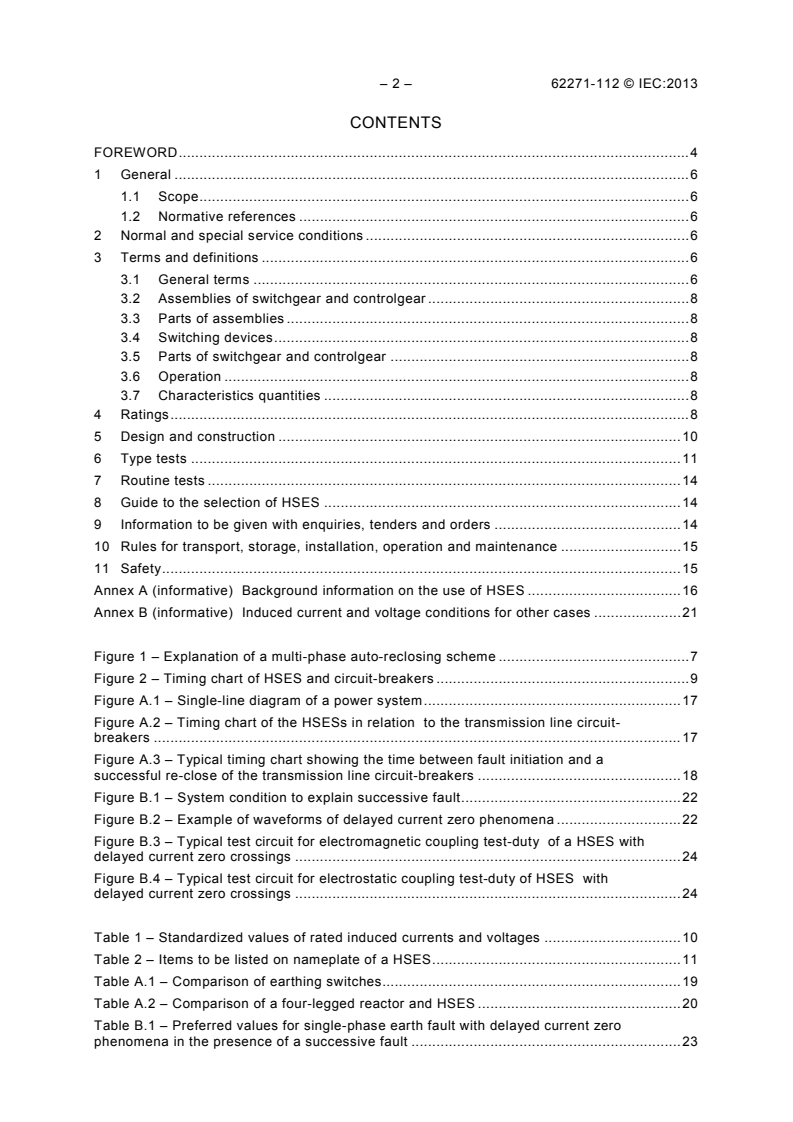
CONTENTS
FOREWORD . 4
1 General . 6
1.1 Scope . 6
1.2 Normative references . 6
2 Normal and special service conditions . 6
3 Terms and definitions . 6
3.1 General terms . 6
3.2 Assemblies of switchgear and controlgear . 8
3.3 Parts of assemblies . 8
3.4 Switching devices . 8
3.5 Parts of switchgear and controlgear . 8
3.6 Operation . 8
3.7 Characteristics quantities . 8
4 Ratings . 8
5 Design and construction . 10
6 Type tests . 11
7 Routine tests . 14
8 Guide to the selection of HSES . 14
9 Information to be given with enquiries, tenders and orders . 14
10 Rules for transport, storage, installation, operation and maintenance . 15
11 Safety . 15
Annex A (informative) Background information on the use of HSES . 16
Annex B (informative) Induced current and voltage conditions for other cases . 21
Figure 1 – Explanation of a multi-phase auto-reclosing scheme . 7
Figure 2 – Timing chart of HSES and circuit-breakers . 9
Figure A.1 – Single-line diagram of a power system . 17
Figure A.2 – Timing chart of the HSESs in relation to the transmission line circuit-
breakers . 17
Figure A.3 – Typical timing chart showing the time between fault initiation and a
successful re-close of the transmission line circuit-breakers . 18
Figure B.1 – System condition to explain successive fault . 22
Figure B.2 – Example of waveforms of delayed current zero phenomena . 22
Figure B.3 – Typical test circuit for electromagnetic coupling test-duty of a HSES with
delayed current zero crossings . 24
Figure B.4 – Typical test circuit for electrostatic coupling test-duty of HSES with
delayed current zero crossings . 24
Table 1 – Standardized values of rated induced currents and voltages . 10
Table 2 – Items to be listed on nameplate of a HSES . 11
Table A.1 – Comparison of earthing switches . 19
Table A.2 – Comparison of a four-legged reactor and HSES . 20
Table B.1 – Preferred values for single-phase earth fault with delayed current zero
phenomena in the presence of a successive fault . 23
62271-112 © IEC:2013 – 3 –
Table B.2 – Preferred values for multi-phase earth faults in a double-circuit system . 25
Table B.3 – Preferred values for covering the cases of categories 0 and 1 . 25
– 4 – 62271-112 © IEC:2013
INTERNATIONAL ELECTROTECHNICAL COMMISSION
____________
HIGH-VOLTAGE SWITCHGEAR AND CONTROLGEAR –
Part 112: Alternating current high-speed earthing switches
for secondary arc extinction on transmission lines
FOREWORD
1) The International Electrotechnical Commission (IEC) is a worldwide organization for standardization comprising
all national electrotechnical committees (IEC National Committees). The object of IEC is to promote
international co-operation on all questions concerning standardization in the electrical and electronic fields. To
this end and in addition to other activities, IEC publishes International Standards, Technical Specifications,
Technical Reports, Publicly Available Specifications (PAS) and Guides (hereafter referred to as “IEC
Publication(s)”). Their preparation is entrusted to technical committees; any IEC National Committee interested
in the subject dealt with may participate in this preparatory work. International, governmental and non-
governmental organizations liaising with the IEC also participate in this preparation. IEC collaborates closely
with the International Organization for Standardization (ISO) in accordance with conditions determined by
agreement between the two organizations.
2) The formal decisions or agreements of IEC on technical matters express, as nearly as possible, an international
consensus of opinion on the relevant subjects since each technical committee has representation from all
interested IEC National Committees.
3) IEC Publications have the form of recommendations for international use and are accepted by IEC National
Committees in that sense. While all reasonable efforts are made to ensure that the technical content of IEC
Publications is accurate, IEC cannot be held responsible for the way in which they are used or for any
misinterpretation by any end user.
4) In order to promote international uniformity, IEC National Committees undertake to apply IEC Publications
transparently to the maximum extent possible in their national and regional publications. Any divergence
between any IEC Publication and the corresponding national or regional publication shall be clearly indicated in
the latter.
5) IEC itself does not provide any attestation of conformity. Independent certification bodies provide conformity
assessment services and, in some areas, access to IEC marks of conformity. IEC is not responsible for any
services carried out by independent certification bodies.
6) All users should ensure that they have the latest edition of this publication.
7) No liability shall attach to IEC or its directors, employees, servants or agents including individual experts and
members of its technical committees and IEC National Committees for any personal injury, property damage or
other damage of any nature whatsoever, whether direct or indirect, or for costs (including legal fees) and
expenses arising out of the publication, use of, or reliance upon, this IEC Publication or any other IEC
Publications.
8) Attention is drawn to the Normative references cited in this publication. Use of the referenced publications is
indispensable for the correct application of this publication.
9) Attention is drawn to the possibility that some of the elements of this IEC Publication may be the subject of
patent rights. IEC shall not be held responsible for identifying any or all such patent rights.
International Standard IEC 62271-112 has been prepared by subcommittee 17A: High-voltage
switchgear and controlgear, of IEC technical committee 17: Switchgear and controlgear.
The text of this standard is based on the following documents:
FDIS Report on voting
17A/1042/FDIS 17A/1050/RVD
Full information on the voting for the approval of this standard can be found in the report on
voting indicated in the above table.
This publication has been drafted in accordance with the ISO/IEC Directives, Part 2.
This International Standard should be read in conjunction with IEC 62271-1:2007, to which it
refers and which is applicable unless otherwise specified. In order to simplify the indication of
62271-112 © IEC:2013 – 5 –
corresponding requirements, the same numbering of clauses and subclauses is used as in
IEC 62271-1. Amendments to these clauses and subclauses are given under the same
numbering, whilst additional subclauses, are numbered from 101.
A list of all parts in the IEC 62271, published under the general title High-voltage switchgear
and controlgear, can be found on the IEC website.
The committee has decided that the contents of this publication will remain unchanged until
the stability date indicated on the IEC web site under "http://webstore.iec.ch" in the data
related to the specific publication. At this date, the publication will be
• reconfirmed,
• withdrawn,
• replaced by a revised edition, or
• amended.
IMPORTANT – The 'colour inside' logo on the cover page of this publication indicates
that it contains colours which are considered to be useful for the correct
understanding of its contents. Users should therefore print this document using a
colour printer.
– 6 – 62271-112 © IEC:2013
HIGH-VOLTAGE SWITCHGEAR AND CONTROLGEAR –
Part 112: Alternating current high-speed earthing switches
for secondary arc extinction on transmission lines
1 General
1.1 Scope
This part of IEC 62271 applies to a.c. high-speed earthing switches designed for indoor and
outdoor installation and for operation at service frequencies of 50 Hz and 60 Hz on systems
having voltages of 550 kV and above.
High-speed earthing switches described in this standard are intended to extinguish the
secondary arc remaining after clearing faults on transmission lines by the circuit-breakers.
1.2 Normative references
The following documents, in whole or in part, are normatively referenced in this document and
are indispensable for its application. For dated references, only the edition cited applies. For
undated references, the latest edition of the referenced document (including any
amendments) applies.
IEC 62271-1:2007, High-voltage switchgear and controlgear – Part 1: Common specifications
IEC 62271-100:2008, High-voltage switchgear and controlgear – Part 100: Alternating-current
circuit-breakers
IEC 62271-102:2001, High-voltage switchgear and controlgear – Part 102: Alternating current
disconnectors and earthing switches
IEC 62271-203:2011, High-voltage switchgear and controlgear – Part 203: Gas-insulated
metal-enclosed switchgear for rated voltages above 52 kV
2 Normal and special service conditions
Clause 2 of IEC 62271-1:2007 is applicable.
3 Terms and definitions
For the purposes of this document, the terms and definitions given in Clause 3 of
IEC 62271-1:2011, as well as the following apply.
3.1 General terms
3.1.101
secondary arc
arc that remains at the faulted point after interruption of the short-circuit current fed by the
network
Note 1 to entry: This secondary arc is supplied by electrostatic or electromagnetic induction from the adjacent
healthy phases.
62271-112 © IEC:2013 – 7 –
3.1.102
single-phase auto-reclosing scheme
auto-reclosing scheme in which a faulted phase circuit is opened and automatically re-closed
independently from the other phases
3.1.103
multi-phase auto-reclosing scheme
auto-reclosing scheme applied to double circuit overhead lines in which all faulted phase
circuits are opened and re-closed independently provided that at least two different phases
remain un-faulted
Note 1 to entry: An example of multi-phase auto-reclosing scheme is indicated in Figure 1.
A
B
Line 1
C
1)
a
b
Line 2
c
A
B
Line 1
C
2)
a
b
Line 2
c
A
B
Line 1
C
3)
a
b
Line 2
c
IEC 1895/13
Key
1) Up to 4 phases have a fault Closed circuit-breaker
2) Only the faulted phases have been tripped Open circuit-breaker
3) All circuit-breakers at both ends re-closed Re-closed circuit-breaker
Figure 1 – Explanation of a multi-phase auto-reclosing scheme
– 8 – 62271-112 © IEC:2013
Note 2 to entry: Other than the scheme described in 3.1.102 and 3.1.103, a three-phase auto-reclosing scheme is
commonly applied. In this scheme, all three phases are tripped and re-closed at both ends even if a fault occurred
in one phase. So far high-speed earthing switches are rarely applied with this scheme.
3.1.104
successive fault
additional earth fault that occurs in the adjacent phase circuit(s) during the time interval
between a single-phase earth fault and the opening of the high-speed earthing switch(es)
3.2 Assemblies of switchgear and controlgear
No particular definitions.
3.3 Parts of assemblies
No particular definitions.
3.4 Switching devices
3.4.101
high-speed earthing switch
HSES
earthing switch that has the capability to:
– make, carry and interrupt the induced current;
– withstand the recovery voltage caused by electromagnetic and/or by electrostatic
couplings prior to circuit re-closure;
– make and carry the rated short-circuit current
Note 1 to entry: The high-speed operation applies normally to both closing and opening.
Note 2 to entry: A high-speed earthing switch is not intended to be used as a maintenance earthing switch.
3.4.103.1
high-speed earthing switch class M0
high-speed earthing switch having a normal mechanical endurance of 1 000 operation cycles
3.4.103.2
high-speed earthing switch class M1
high-speed earthing switch having an extended mechanical endurance of 2 000 operation
cycles for special requirements
3.5 Parts of switchgear and controlgear
No particular definitions.
3.6 Operation
No particular definitions.
3.7 Characteristics quantities
No particular definitions.
4 Ratings
Clause 4 of IEC 62271-1:2007 is applicable with the following additions.
62271-112 © IEC:2013 – 9 –
4.4 Rated normal current and temperature rise
Subclause 4.4 of IEC 62271-1:2007 is not applicable.
4.101 Rated short-circuit making current
Subclause 4.101 of IEC 62271-102:2001 is applicable.
4.102 Rated operating sequence
The rated characteristics of the HSES are referred to the rated operating sequence.
a) C – t – O
i1
or
b) C – t – O – t – C – t – O
i1 i2 i1
where
– t is a time that is longer than the time required for secondary arc extinction and for
i1
dielectric recovery of air insulation at the faulted point. t is determined by users
i1
considering system stability. The preferred value of t is 0,15 s;
i1
is the intermediate time that is given by the system protection. t includes the closing
– t
i2 i2
time of the circuit-breakers after the HSESs open, the duration of a new line fault and the
breaking time of the circuit-breakers. Following this t time, the HSES can be reclosed.
i2
The preferred value of t is 0,5 s;
i2
In this case the HSES shall be able to operate without intentional time delay.
Figure 2 shows the time chart for the rated operating sequence of C – t – O – t – C – t –
i1 i2 i1
O.
Closed
Circuit-breaker
Open
Closed
Open
HSES
Current flow in HSES Current flow in HSES
t t t
i1 i2 i1
time
1 2 3 4 5 6 7 1 3 4 5 6
IEC 1896/13
Key
Circuit- Transmission line circuit-breakers that 3 Contact touch of HSESs
breaker interrupt the fault
HSES High-speed earthing switches 4 Energizing of the opening release of the HSESs
1 Energizing of the closing circuit of the 5 Contact separation of HSESs
HSESs
2 Current start in HSESs 6 Arc extinction in HSESs
t , t Times defined in 4.102 7 Fully open position of HSESs
i1 i2
NOTE 1 A common value for the re-closing time of the circuit-breaker is 1 s to guarantee system stability.
NOTE 2 t is normally within the range of 0,15 s to 0,5 s.
i1
NOTE 3 t is normally within the range of 0,5 s to 1 s.
i2
NOTE 4 The operating sequence b) is for system stability requirements to cover cases where another fault occurs
on the same phase.
NOTE 5 The HSES closing time is normally less than 0,2 s
Figure 2 – Timing chart of HSES and circuit-breakers
– 10 – 62271-112 © IEC:2013
4.103 Standard values for interruption
Standard values for HSES are given in Table 1.
Table 1 – Standardized values of rated induced currents and voltages
Rated Electromagnetic coupling Electrostatic coupling
voltage U
r
Rated Rated First TRV Time to first Rated induced Rated induced
induced power peak peak current voltage
current frequency
+10 +10 +10 +10
% ( % ) ( % ) ( % )
recovery
+10 -0 -0 -0 -0
( )
( % )
voltage
-0
+10
( % )
-0
kV A (rms) kV (rms) kV ms A (rms) kV (rms)
550 6 800 240 580 0,6 120 115
800 6 800 240 580 0,6 170 170
1 100 to 6 800 240 580 0,6 230 235
1 200
NOTE 1 For Table 1 the rated induced voltages by electrostatic recovery voltage have a 1-cos wave shape.
NOTE 2 For networks with up to two faults (category 0 and 1 as described in B.2) the corresponding values are
presented in Table B.3.
For networks with delayed current zero crossing occurrence (category 3 as described in B.2),
the corresponding values are presented in Table B.1.
For networks with multi-phase faults (category 4 as described in B.2) the corresponding
values are presented in Table B.2.
5 Design and construction
Clause 5 of IEC 62271-1:2007 is applicable with the following modifications.
5.5 Dependent power operation
Subclause 5.5 of IEC 62271-1:2007 is not applicable.
5.7 Independent manual operation power operation (independent unlatched
operation)
Subclause 5.7 of IEC 62271-1:2007 is not applicable.
5.10 Nameplates
The designation of the equipment is specified as HSES.
Items to be indicated on the nameplate are listed in Table 2.
62271-112 © IEC:2013 – 11 –
Table 2 – Items to be listed on nameplate of a HSES
Item
Manufacturer
Designation of type
Serial number
Year of manufacture
Rated voltage
Rated lightning impulse withstand voltage
Rated switching impulse withstand voltage
Rated power-frequency withstand voltage
Rated short-time withstand and peak withstand current
Rated duration of short-circuit
Rated filling pressure for insulation and /or operation
Rated supply voltage of auxiliary circuit
Rated frequency
Mechanical endurance class
Mass (including fluid)
Operating sequence
5.11 Interlocking devices
Subclause 5.11 of IEC 62271-1:2007 is not applicable.
5.101 Anti-pumping device
Anti-pumping device shall be provided for pneumatic and hydraulic operating mechanism.
5.102 Special requirements for HSES
A HSES shall be able to earth transmission lines and re-open to achieve their full voltage
withstand within the dead time of the auto-reclosing duty cycle of the transmission line circuit-
breakers. The dead time is defined by system stability and is normally set around 1 s enabling
dielectric recovery of insulation capability at the fault location. Fast operating capability for
both making and breaking is required.
The HSES shall have a capability to by-pass secondary arc current on the transmission lines.
The HSES shall have a capability to break induced current by electromagnetic and/or
electrostatic coupling on transmission lines with a recovery voltage specified in Table 1.
The HSES shall have a capability to withstand transient recovery voltage after interruption
and rated power frequency voltage to earth (U /√3) in open position.
r
The HSES shall be single-pole operated unless otherwise specified.
6 Type tests
Clause 6 of IEC 62271-1:2007 is applicable with the following additions.
– 12 – 62271-112 © IEC:2013
The dielectric performance shall be verified for phase-to-earth in the open position only in
accordance with IEC 62271-1:2007.
6.1.1 Grouping of tests
Subclause 6.1.1 of IEC 62271-1:2007 is not applicable.
6.3 Radio interference voltage (r.i.v.) test
Subclause 6.3 of 62271-1:2007 is applicable.
In case of metal enclosed type, 6.3 of CEI 62271-203:2011 is applicable.
6.5 Temperature-rise tests
Subclause 6.5 of IEC62271-1:2007 is not applicable.
6.101 Tests to prove the short-circuit making performance
Subclause 6.101 of IEC 62271-102:2001 is applicable.
6.102 Operating and mechanical endurance tests
Subclause 6.102 of IEC 62271-102:2001 is applicable.
The rated operating sequence shall be verified during mechanical operation.
The mechanical operating sequence for class M0 shall be one of the following:
a) A HSES with a specified duty cycle required C – t – O:
i1
– 1 000 C – t – O operations
i1
b) A HSES with a specified duty cycle C – t – O – t – C – t – O
i1 i2 i1
– 500 C – t – O operations, plus
i1
– 250 C – t – O – t – C – t – O operations.
i1 i2 i1
For class M1 the number of operations shall be twice the sequence specified.
Mechanical travel characteristics shall be recorded and acceptance criteria are referred to
6.101.1.1 of IEC 62271-100:2008 with the modification of the total tolerance to 20 % (for
+20 +10 +0
example % , % or % ).
-0 -10 -20
6.103 Operation under severe ice condition
Subclause 6.103 of 62271-102:2001 is applicable.
6.104 Operation at the temperature limits
Subclause 6.104 of 62271-102:2001 is applicable.
6.105 Tests to prove the making and breaking performance of HSES
6.105.1 General test conditions
Tests shall be performed in accordance with the condition specified in Table 1.
Subclause C.6.105 of IEC 62271-102:2001 is applicable with the following additions and
modifications.
62271-112 © IEC:2013 – 13 –
Number of tests:
– 10 times C and O
Measurement of travel characteristics shall be in accordance with subclause 6.101.1.1 of
IEC 62271-100:2008.
Test circuits are those shown in Figures C.1 and C.2 of IEC 62271-102:2001.
For electrostatic induced current test independent of the rated voltage of the HSES, the test
circuit parameters shall be:
– capacitance value C = 1,56 µF;
– surge impedance: 245 Ω;
– line length 200 km.
The HSES shall preferably be tested at rated frequency; however, for convenience of testing,
tests at 50 Hz covers the requirement for 60 Hz and vice versa.
These tests cover the classes of A and B described in Annex C of IEC 62271-102:2001.
6.105.2 Induced current switching details
Type tests for HSES having a rated induced current making and breaking capability shall
include tests to prove the electromagnetically and/or electrostatically induced current making
and breaking capability.
+10
The test currents shall be within a tolerance of ( %) of the rated induced currents as
-0
shown in Table 1.
For convenience of testing, the control voltage of the HSES can be either the rated or
maximum of the auxiliary supply voltage if the control voltage does not affect the making and
breaking capability of HSES. This condition is considered to be satisfied if the travel
+5
characteristics of that condition are within a range of ( % ) of those obtained with a minimum
-5
control voltage.
Induced current making and breaking tests shall be conducted without maintenance.
6.105.3 Arrangement of HSES before the test
The HSES under test shall be completely mounted on its own support or on a mechanically
equivalent test support. Its operating device shall be operated in the manner prescribed and,
in particular, if it is electrically, hydraulically or pneumatically operated, it shall be operated
either at the minimum supply voltage or at the minimum functional pressure for operation,
respectively.
Before commencing making and breaking tests, no-load operations shall be made and details
of the operating characteristics of the HSES, such as travel characteristics, closing time and
opening time, shall be recorded.
If applicable, tests shall be performed at the minimum functional pressure for interruption and
insulation.
6.105.4 Behaviour of HSES during the test
The HSES shall perform successfully without undue mechanical or electrical distress.
– 14 – 62271-112 © IEC:2013
During tests, HSES shall not
– show signs of distress;
– show harmful interaction with adjacent laboratory equipment;
– exhibit behaviour which could endanger an operator.
Outward emission of gases, flames or metallic particles from the switch during operation is
permitted, if this does not impair the insulation level of the earthing switch or prove to be
harmful to an operator or other person in the vicinity.
6.105.5 Condition after the test
Comparison of mechanical characteristics before and after the test shall be done according to
subclause 6.102.
Subclause C.6.105.9 of IEC 62271-102:2001 is applicable.
7 Routine tests
Clause 7 of IEC 62271-1:2007 is applicable with the following additions.
Mechanical operating test is to refer to subclause 7.101 of IEC 62271-100:2008.
Mechanical travel characteristics shall be recorded and acceptance criteria are referred to
subclause 6.101.1.1 of IEC 62271-100:2008 with the modification of the tolerance to 20 % (for
+20 +10 +0
example % or % or % ).
-0 -10 -20
Timing test of close and open with rated and minimum conditions of auxiliary supply shall be
verified.
8 Guide to the selection of HSES
For the selection of HSES described in Table 1 and also Tables B.1 and B.2 if necessary, the
following conditions and requirements at site shall be considered:
– existing fault conditions;
– number of circuits;
– auto-reclosing scheme (single or multi auto-reclosing scheme);
– required operating sequence;
– the operating sequence is linked to circuit-breaker operating sequence;
– consideration on successive faults and other special conditions such as delayed current
zero phenomena during HSES operations;
– required operational performance (mechanical endurance);
– switching requirements (fault making capability);
– class M1 is mainly for applications where the high-speed earthing switch is operated in
special requirement where frequent lightning strokes occur;
9 Information to be given with enquiries, tenders and orders
Clause 9 of IEC 62271-1:2007 is applicable.
62271-112 © IEC:2013 – 15 –
10 Rules for transport, storage, installation, operation and maintenance
Clause 10 of IEC 62271-1:2007 is applicable.
11 Safety
Clause 11 of IEC 62271-1:2007 is applicable.
– 16 – 62271-112 © IEC:2013
Annex A
(informative)
Background information on the use of HSES
A.1 General
Single-phase or multi-phase auto-reclosing schemes are generally applied for high-voltage
transmission systems to enhance system reliability. When on an overhead line a fault
involving earth occurs, circuit-breakers located at both ends of the line open to clear the fault.
In case of high-voltage overhead lines (especially for system voltages equal to or higher than
550 kV), where the conductors are located in the vicinity of each other and transmission
systems are single phase operated, a lower current may remain at the fault point after
interruption of the short-circuit current. This current is called secondary arc current and is
caused by the electrostatic or electromagnetic coupling with the other adjacent live
conductors, and this secondary arc current is difficult to self-extinguish in a short time. From a
system stability point of view it is preferable to apply auto-reclosing scheme with a reclosing
time in the order of 1 s maximum. To achieve auto-reclosing in due time some means are
necessary to extinguish the secondary arc before re-closing circuit-breakers.
Especially for short distance lines without shunt reactors or for double circuit systems with
multi-phase auto-reclosing scheme, where 4 legged reactors are not suitable, one of the
useful and important means is to apply a special earthing switch for the purpose of secondary
arc extinction. This earthing switch is generally designed for high-speed operation to ensure
that the required switching performance is met, and is called high-speed earthing switch
(acronym HSES).
The secondary arc extinction performance will be influenced by the recovery voltage and
secondary arc current at the fault location, both of which will be influenced by the following:
– tower configuration, e.g. single or double circuit lines (i.e. several circuits mounted on one
tower), distance between phases and circuits, height of lines above ground level, etc.;
– transposition of the transmission lines (untransposed or transposed);
– occurrence of successive earth faults on the other line.
Therefore the time duration between the duty cycles is specified by the user.
NOTE This HSES is distinguished from a fast acting earthing switch. Refer to Table A.1.
The operating sequence of a HSES is determined by the time to maintain system stability,
high-speed auto reclosing sequence of the circuit-breaker, dielectric recovery characteristics
of fault point on the transmission line and time coordination with protection relays including
the time for confirming the condition of e.g. open/close condition of circuit-breaker and HSES.
A.2 Typical operating sequence
Figure A.1 shows a single line diagram of a power system. A fault has occurred on one phase
of the transmission line.
62271-112 © IEC:2013 – 17 –
CB CB
1 2
HSES HSES
IEC 1897/13
Key
CB , CB Transmission line circuit-breakers
1 2
HSES , HSES High-speed earthing switches
1 2
Figure A.1 – Single-line diagram of a power system
The circuit-breakers at the both ends of the line open in order to interrupt the fault current.
0,2 s after completion of the interruption by the circuit-breaker, the HSESs will close and
remain in the closed position for several hundred milliseconds. In this period secondary arc
current shall be extinguished and the insulation re-established. Opening of the HSESs takes
typically 0,1 s after initiation of opening signal to the HSESs. The preceding interrupting
HSES will interrupt electromagnetic induced current and the later interrupting HSES will
interrupt electrostatic induced current. The circuit-breaker will re-close after completion of the
opening operation of the HSESs.
A typical timing chart of the relationship between the transmission line circuit-breakers that
interrupt the fault and the HSESs is shown in Figure A.2. This figure shows the first O – C
operation of the circuit-breakers and the first C – O operation of the HSESs.
Closed
Circuit-breaker
Open
Closed
Open
HSES
Current flow in HSES
time
1 2 3 4 5 6
IEC 1898/13
Key
Circuit- Transmission line circuit-breakers that 3 Contact touch of HSESs
breaker interrupt the fault
HSES High-speed earthing switches 4 Energizing of the opening release of the HSESs
1 Energizing of the closing circuit of the 5 Contact separation of HSESs
HSESs
2 Current start in HSESs 6 Arc extinction in HSESs
Figure A.2 – Timing chart of the HSESs in relation
to the transmission line circuit-breakers
– 18 – 62271-112 © IEC:2013
Time 0 100 200 300 400 500 600 700 800 900 1 000
(ms)
First
fault
Circuit
breaker
Protection
relay
5 6
HSES
Successive
fault occurs
A
in the
B
adjacent
Phase/lines
C
IEC 1899/13
Key
A There may be successive faults. However these successive faults do not affect on the HSESs interruption
since the successive faults on the other phases/ lines will have been cleared by CBs prior to the HSESs
opening.
B Successive fault may affect on HSESs interruption. Common value of break time is up to 100 ms.
C Arcing time may be longer in case delayed current zero phenomena occurs.
1 CB , CB open 9 HSES , HSES arcing time
1 2 1 2
2 Confirmation of CB and CB in open position 10 HSES , HSES open
1 2
1 2
3 Main relay function recovery 11 Confirmation of HSES , HSES in open position
1 2
4 Confirmation of re-close condition 12 Confirmation of CB ,CB re-close condition
1 2
5 HSES , HSES close command 13 CB , CB close command
1 2 1 2
6 HSES , HSES close 14 CB , CB re-close at 1 s
1 2 1 2
7 HSES , HSES open command 15 CB , CB remain open
1 2 1 2
8 HSES , HSES opening time 16 HSES , HSES remain close
1 2 1 2
CB , CB , HSES and HSES are explained in Figure A.1.
1 2 1 2
Figure A.3 – Typical timing chart showing the time between fault initiation and a
successful re-close of the transmission line circuit-breakers
Figure A.3 shows typical values of an operating sequence assuming the time interval from the
initiation of a fault to the completion of reclosing of the circuit-breakers at both ends of 1 s.
The time duration between the duty cycles is specified by the user.
There are several necessary conditions which need to be fulfilled for successful application of
HSES:
– the HSESs need automatic sequential control for each phase such as fault detection –
circuit-breakers open – HSESs close – HSESs open – circuit-breakers close;
62271-112 © IEC:2013 – 19 –
– the HSESs need a high reliable control system since a mal-operation will lead to an earth
fault;
– the HSESs should be able to interrupt the induced current and to withstand a TRV caused
by electromagnetic and/or electrostatic coupling effects;
– the fault is cleared by the circuit-breakers at both ends of lines.
A.3 Additional information about HSES
A HSES is commonly used to short-circuit, commutate and clear the induced fault current. A
detailed description is provided here.
The following main differences exist between the different earthing switches.
Table A.1 indicates a typical example of earthing switches design.
Table A.1 – Comparison of earthing switches
Requirement Earthing switch class Earthing switch with High speed earthing
E0 short-circuit current switch for secondary
making capability arc extinction (HSES)
class E1 (and E2)
Closing Low speed, hand or motor Fast (high-speed) closing Fast (high-speed) closing
operated operation operation, controlled
Opening Low speed, hand or motor Low speed, may be hand Fast opening, controlled
operated operated
Short circuit current Yes Yes Yes
carrying capability
Making capability None Yes Yes
Interrupting capability None If specified Shall be able to interrupt
induced current and to
withstand the associated
TRV
Operating cycle None Close Close- open
Electrical endurance Withstand capability 2 closings against full 2 closings against full
against full short circuit short circuit current short circuit current
current
Summary:
The HSES needs to be operated in a well defined operating cycle. It needs a clearing
capability for the defined induced currents together with a defined TRV withstand capability.
While an earthing switch as well as a fast acting earthing switch require the capability
to withstand the full short circuit current, the function of a HSES is to short-circuit and
thereafter to clear the induced current and to withstand the related TRV.
A.4 Comparison between the use of four-legged reactor and HSES
Table A.2 shows comparison of a four-legged reactor and HSES.
– 20 – 62271-112 © IEC:2013
Table A.2 – Comparison of a four-legged reactor and HSES
Four-legged reactor HSES
Secondary arc – Effective especially for single-phase faults Quick extinction for all fault modes
extinction that hold the majority of the faults
– Difficult to choose a reactance value of
reactors that effectively reduce the
secondary arc current for all fault modes
for double circuit system
Flexibility to the In case a substation is constructed in the No effect on the existing substation
network middle of a line, it might be required to equipment
modification substitute an existing reactor
Control Protection Special control is not required for secondary Automatic sequential control such as
arc extinction “fault detection →CBs open →HSESs
close → HSESs open → CBs close” is
necessary in each phase, and it can be
easily realized
Economy A four-legged reactor is appropriate for transmission lines which require shunt reactors for
voltage control, while HSES would be economical for the lines without shunt reactors
Concern Detailed analysis is necessary so as not to Highly reliable control system is required
cause resonance between the shunt reactor since a mal-function leads to a ground
inductance and line capacitance not only for a fault
power frequency of 50/60 Hz but also in the
high frequency band
62271-112 © IEC:2013 – 21 –
Annex B
(informative)
Induced current and voltage conditions for other cases
B.1 General
This annex describes categories corresponding to the fault modes and the situations which
are not covered by Table 1, corresponds to categories 3 and 4 introduced in this Annex.
B.2 Categories of fault conditions
B.2.1 Category 0
This is the basic category. One single-line earth fault occurs within the transmission circuits.
Category 0 is covered by Table B.3.
B.2.2 Category 1
Up to one single-phase earth fault occurs within
...