

IEC 61280-2-2:2012
(Main)Fibre optic communication subsystem test procedures - Part 2-2: Digital systems - Optical eye pattern, waveform and extinction ratio measurement
General Information
- Abstract
IEC 61280-2-2:2012 describes a test procedure to verify compliance with a predetermined waveform mask and to measure the eye pattern and waveform parameters such as rise time, fall time, modulation amplitude and extinction ratio. This fourth edition cancels and replaces the third edition published in 2008 and constitutes a technical revision .This edition includes the following significant technical changes with respect to the previous edition: additional definitions; clarification of test procedures. Keywords: optical eye pattern, waveform, modulation amplitude, extinction ratio The contents of the corrigendum of February 2015 have been included in this copy.
- Status
- Published
- Publication Date
- 24-Oct-2012
- Technical Committee
- SC 86C - Fibre optic systems, sensing and active devices
- Drafting Committee
- WG 1 - TC 86/SC 86C/WG 1
- Current Stage
- PPUB - Publication issued
- Start Date
- 25-Oct-2012
- Completion Date
- 31-Jan-2013
Buy Documents
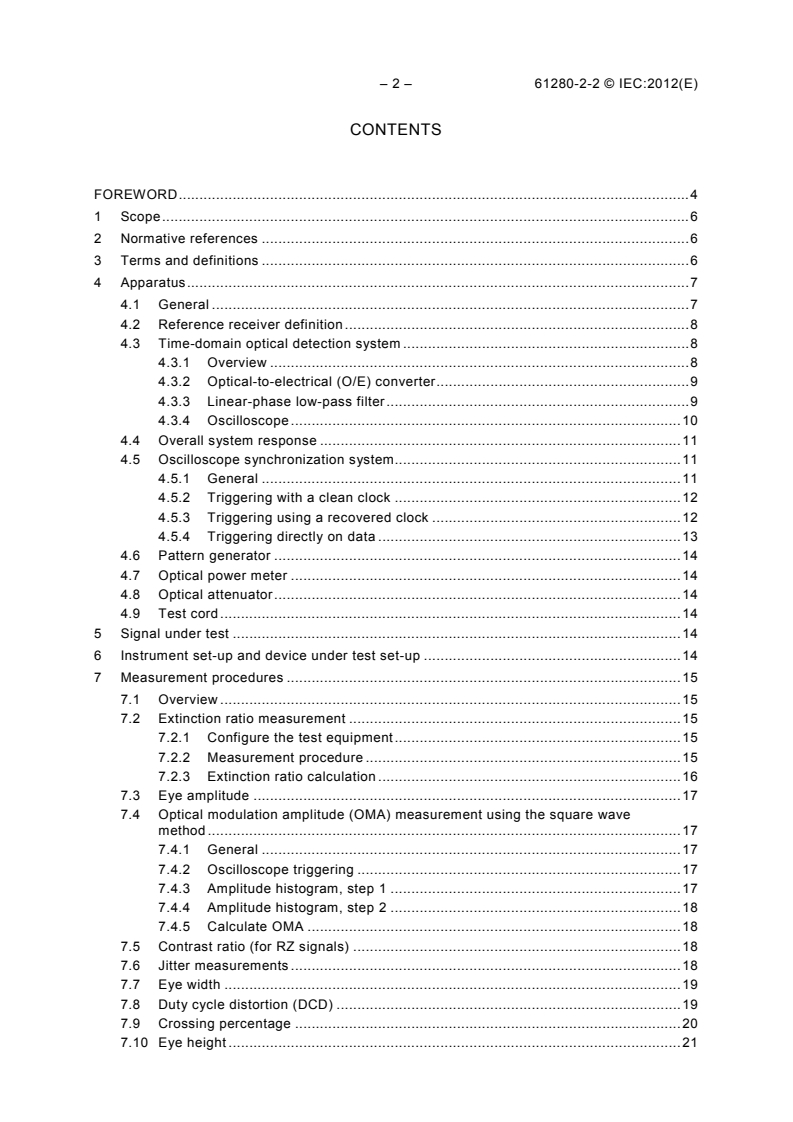
IEC 61280-2-2:2012 - Fibre optic communication subsystem test procedures - Part 2-2: Digital systems - Optical eye pattern, waveform and extinction ratio measurement Released:10/25/2012

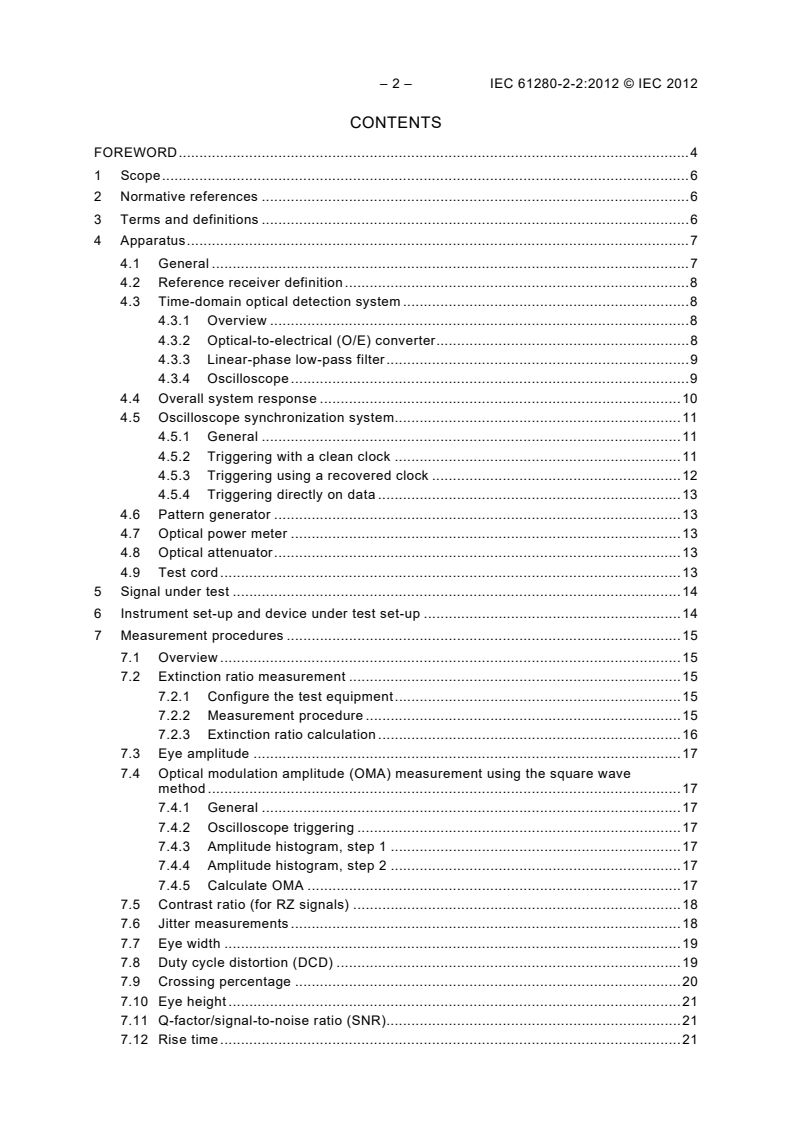
IEC 61280-2-2:2012 - Fibre optic communication subsystem test procedures - Part 2-2: Digital systems - Optical eye pattern, waveform and extinction ratio measurement Released:10/25/2012
Overview
IEC 61280-2-2:2012 (Edition 4.0) is an international test procedure for fibre optic digital systems focused on optical eye pattern, waveform and extinction ratio measurement. This edition (2012, with the February 2015 corrigendum included) cancels and replaces the 2008 edition and provides clarified procedures and additional definitions. The standard describes how to verify compliance with a predetermined waveform mask and how to measure eye-diagram and time-domain waveform parameters such as rise time, fall time, modulation amplitude (OMA) and extinction ratio.
Key topics and technical requirements
The standard specifies apparatus, setup and step‑by‑step measurement procedures. Major technical topics covered include:
- Instrument and reference receiver definitions: O/E converter, linear‑phase low‑pass filters, and oscilloscope characteristics needed for reliable optical eye and waveform capture.
- Time‑domain optical detection system: requirements for system bandwidth, overall response and synchronization (triggering with clean clock, recovered clock or directly on data).
- Signal under test & device setup: pattern generator, optical power meter, attenuator and test cords required for repeatable measurements.
- Detailed measurement procedures for:
- Extinction ratio and eye amplitude
- Optical Modulation Amplitude (OMA) using the square‑wave method
- Contrast ratio for RZ signals
- Jitter, eye width, eye height, Q‑factor / SNR
- Duty cycle distortion (DCD), crossing percentage
- Rise time and fall time
- Eye‑mask testing: two techniques - the “no hits” method and the “hit‑ratio” method to assess compliance with predetermined masks.
- Test reporting: required and available information to document results and conformance.
Practical applications and who uses this standard
IEC 61280-2-2 is intended for:
- Transmitter and subsystem manufacturers verifying optical output waveform quality.
- Test laboratories and QA teams performing compliance and production testing.
- Component and subsystem designers validating bandwidth, OMA and jitter performance.
- Network operators and integrators assessing link performance and troubleshooting physical‑layer impairments.
Practical benefits include consistent, repeatable measurements of eye quality and extinction ratio, standardized mask tests for interoperability, and guidance for choosing proper measurement equipment and triggering methods.
Related standards
- IEC 61280-2-3: Fibre optic communication subsystem test procedures – Part 2-3: Digital systems – Jitter and wander measurements (normatively referenced).
- Other parts of the IEC 61280 series cover complementary optical subsystem test procedures.
Keywords: optical eye pattern, waveform, modulation amplitude, extinction ratio, fibre optic communication subsystem test procedures, eye mask, OMA, rise time, fall time.
Relations
- Effective Date
- 05-Sep-2023
- Effective Date
- 05-Sep-2023
Buy Documents
IEC 61280-2-2:2012 - Fibre optic communication subsystem test procedures - Part 2-2: Digital systems - Optical eye pattern, waveform and extinction ratio measurement Released:10/25/2012
IEC 61280-2-2:2012 - Fibre optic communication subsystem test procedures - Part 2-2: Digital systems - Optical eye pattern, waveform and extinction ratio measurement Released:10/25/2012
Get Certified
Connect with accredited certification bodies for this standard

ANCE
Mexican certification and testing association.

Intertek Slovenia
Intertek testing, inspection, and certification services in Slovenia.

LNE (Laboratoire National de Métrologie et d'Essais)
French national laboratory for metrology and testing.
Sponsored listings
Frequently Asked Questions
IEC 61280-2-2:2012 is a standard published by the International Electrotechnical Commission (IEC). Its full title is "Fibre optic communication subsystem test procedures - Part 2-2: Digital systems - Optical eye pattern, waveform and extinction ratio measurement". This standard covers: IEC 61280-2-2:2012 describes a test procedure to verify compliance with a predetermined waveform mask and to measure the eye pattern and waveform parameters such as rise time, fall time, modulation amplitude and extinction ratio. This fourth edition cancels and replaces the third edition published in 2008 and constitutes a technical revision .This edition includes the following significant technical changes with respect to the previous edition: additional definitions; clarification of test procedures. Keywords: optical eye pattern, waveform, modulation amplitude, extinction ratio The contents of the corrigendum of February 2015 have been included in this copy.
IEC 61280-2-2:2012 describes a test procedure to verify compliance with a predetermined waveform mask and to measure the eye pattern and waveform parameters such as rise time, fall time, modulation amplitude and extinction ratio. This fourth edition cancels and replaces the third edition published in 2008 and constitutes a technical revision .This edition includes the following significant technical changes with respect to the previous edition: additional definitions; clarification of test procedures. Keywords: optical eye pattern, waveform, modulation amplitude, extinction ratio The contents of the corrigendum of February 2015 have been included in this copy.
IEC 61280-2-2:2012 is classified under the following ICS (International Classification for Standards) categories: 01 - GENERALITIES. TERMINOLOGY. STANDARDIZATION. DOCUMENTATION; 33.180.01 - Fibre optic systems in general. The ICS classification helps identify the subject area and facilitates finding related standards.
IEC 61280-2-2:2012 has the following relationships with other standards: It is inter standard links to IEC 61280-2-2:2012/COR1:2015, IEC 61280-2-2:2008. Understanding these relationships helps ensure you are using the most current and applicable version of the standard.
IEC 61280-2-2:2012 is available in PDF format for immediate download after purchase. The document can be added to your cart and obtained through the secure checkout process. Digital delivery ensures instant access to the complete standard document.
Standards Content (Sample)
IEC 61280-2-2 ®
Edition 4.0 2012-10
INTERNATIONAL
STANDARD
colour
inside
Fibre optic communication subsystem test procedures –
Part 2-2: Digital systems – Optical eye pattern, waveform and extinction ratio
measurement
All rights reserved. Unless otherwise specified, no part of this publication may be reproduced or utilized in any form
or by any means, electronic or mechanical, including photocopying and microfilm, without permission in writing from
either IEC or IEC's member National Committee in the country of the requester.
If you have any questions about IEC copyright or have an enquiry about obtaining additional rights to this publication,
please contact the address below or your local IEC member National Committee for further information.
IEC Central Office Tel.: +41 22 919 02 11
3, rue de Varembé Fax: +41 22 919 03 00
CH-1211 Geneva 20 info@iec.ch
Switzerland www.iec.ch
About the IEC
The International Electrotechnical Commission (IEC) is the leading global organization that prepares and publishes
International Standards for all electrical, electronic and related technologies.
About IEC publications
The technical content of IEC publications is kept under constant review by the IEC. Please make sure that you have the
latest edition, a corrigenda or an amendment might have been published.
Useful links:
IEC publications search - www.iec.ch/searchpub Electropedia - www.electropedia.org
The advanced search enables you to find IEC publications The world's leading online dictionary of electronic and
by a variety of criteria (reference number, text, technical electrical terms containing more than 30 000 terms and
committee,…). definitions in English and French, with equivalent terms in
It also gives information on projects, replaced and additional languages. Also known as the International
withdrawn publications. Electrotechnical Vocabulary (IEV) on-line.
IEC Just Published - webstore.iec.ch/justpublished Customer Service Centre - webstore.iec.ch/csc
Stay up to date on all new IEC publications. Just Published If you wish to give us your feedback on this publication
details all new publications released. Available on-line and or need further assistance, please contact the
also once a month by email. Customer Service Centre: csc@iec.ch.
IEC 61280-2-2 ®
Edition 4.0 2012-10
INTERNATIONAL
STANDARD
colour
inside
Fibre optic communication subsystem test procedures –
Part 2-2: Digital systems – Optical eye pattern, waveform and extinction ratio
measurement
INTERNATIONAL
ELECTROTECHNICAL
COMMISSION
PRICE CODE
U
ICS 33.180.01 ISBN 978-2-83220-420-7
– 2 – 61280-2-2 © IEC:2012(E)
CONTENTS
FOREWORD . 4
1 Scope . 6
2 Normative references . 6
3 Terms and definitions . 6
4 Apparatus . 7
4.1 General . 7
4.2 Reference receiver definition . 8
4.3 Time-domain optical detection system . 8
4.3.1 Overview . 8
4.3.2 Optical-to-electrical (O/E) converter . 9
4.3.3 Linear-phase low-pass filter . 9
4.3.4 Oscilloscope . 10
4.4 Overall system response . 11
4.5 Oscilloscope synchronization system. 11
4.5.1 General . 11
4.5.2 Triggering with a clean clock . 12
4.5.3 Triggering using a recovered clock . 12
4.5.4 Triggering directly on data . 13
4.6 Pattern generator . 14
4.7 Optical power meter . 14
4.8 Optical attenuator . 14
4.9 Test cord . 14
5 Signal under test . 14
6 Instrument set-up and device under test set-up . 14
7 Measurement procedures . 15
7.1 Overview . 15
7.2 Extinction ratio measurement . 15
7.2.1 Configure the test equipment . 15
7.2.2 Measurement procedure . 15
7.2.3 Extinction ratio calculation . 16
7.3 Eye amplitude . 17
7.4 Optical modulation amplitude (OMA) measurement using the square wave
method . 17
7.4.1 General . 17
7.4.2 Oscilloscope triggering . 17
7.4.3 Amplitude histogram, step 1 . 17
7.4.4 Amplitude histogram, step 2 . 18
7.4.5 Calculate OMA . 18
7.5 Contrast ratio (for RZ signals) . 18
7.6 Jitter measurements . 18
7.7 Eye width . 19
7.8 Duty cycle distortion (DCD) . 19
7.9 Crossing percentage . 20
7.10 Eye height . 21
61280-2-2 © IEC:2012(E) – 3 –
7.11 Q-factor/signal-to-noise ratio (SNR). 21
7.12 Rise time . 21
7.13 Fall time . 22
8 Eye-diagram analysis using a mask . 23
8.1 Eye mask testing using the ‘no hits’ technique . 23
8.2 Eye mask testing using the ‘hit-ratio’ technique . 24
9 Test result . 26
9.1 Required information . 26
9.2 Available information . 26
9.3 Specification information . 26
Bibliography . 27
Figure 1 – Optical eye pattern, waveform and extinction ratio measurement
configuration . 8
Figure 2 – Oscilloscope bandwidths commonly used in eye pattern measurements . 10
Figure 3 – PLL jitter transfer function and resulting observed jitter transfer function . 13
Figure 4 – Histograms centred in the central 20 % of the eye used to determine the
mean logic one and 0 levels, b and b . 16
1 0
Figure 5 – OMA measurement using the square wave method . 18
Figure 6 – Construction of the duty cycle distortion measurement . 20
Figure 7 – Construction of the crossing percentage measurement . 21
Figure 8 – Construction of the risetime measurement with no reference receiver
filtering . 22
Figure 9 – Illustrations of several RZ eye-diagram parameters . 23
Figure 10 – Basic eye mask and coordinate system . 24
Figure 11 – Mask margins at different sample population sizes . 26
Table 1 – Frequency response characteristics . 11
– 4 – 61280-2-2 © IEC:2012(E)
INTERNATIONAL ELECTROTECHNICAL COMMISSION
____________
FIBRE OPTIC COMMUNICATION SUBSYSTEM
TEST PROCEDURES –
Part 2-2: Digital systems – Optical eye pattern,
waveform and extinction ratio measurement
FOREWORD
1) The International Electrotechnical Commission (IEC) is a worldwide organization for standardization comprising
all national electrotechnical committees (IEC National Committees). The object of IEC is to promote
international co-operation on all questions concerning standardization in the electrical and electronic fields. To
this end and in addition to other activities, IEC publishes International Standards, Technical Specifications,
Technical Reports, Publicly Available Specifications (PAS) and Guides (hereafter referred to as “IEC
Publication(s)”). Their preparation is entrusted to technical committees; any IEC National Committee interested
in the subject dealt with may participate in this preparatory work. International, governmental and non-
governmental organizations liaising with the IEC also participate in this preparation. IEC collaborates closely
with the International Organization for Standardization (ISO) in accordance with conditions determined by
agreement between the two organizations.
2) The formal decisions or agreements of IEC on technical matters express, as nearly as possible, an international
consensus of opinion on the relevant subjects since each technical committee has representation from all
interested IEC National Committees.
3) IEC Publications have the form of recommendations for international use and are accepted by IEC National
Committees in that sense. While all reasonable efforts are made to ensure that the technical content of IEC
Publications is accurate, IEC cannot be held responsible for the way in which they are used or for any
misinterpretation by any end user.
4) In order to promote international uniformity, IEC National Committees undertake to apply IEC Publications
transparently to the maximum extent possible in their national and regional publications. Any divergence
between any IEC Publication and the corresponding national or regional publication shall be clearly indicated in
the latter.
5) IEC itself does not provide any attestation of conformity. Independent certification bodies provide conformity
assessment services and, in some areas, access to IEC marks of conformity. IEC is not responsible for any
services carried out by independent certification bodies.
6) All users should ensure that they have the latest edition of this publication.
7) No liability shall attach to IEC or its directors, employees, servants or agents including individual experts and
members of its technical committees and IEC National Committees for any personal injury, property damage or
other damage of any nature whatsoever, whether direct or indirect, or for costs (including legal fees) and
expenses arising out of the publication, use of, or reliance upon, this IEC Publication or any other IEC
Publications.
8) Attention is drawn to the Normative references cited in this publication. Use of the referenced publications is
indispensable for the correct application of this publication.
9) Attention is drawn to the possibility that some of the elements of this IEC Publication may be the subject of
patent rights. IEC shall not be held responsible for identifying any or all such patent rights.
International Standard IEC 61280-2-2 has been prepared by subcommittee 86C: Fibre optic
systems and active devices, of IEC technical committee 86: Fibre optics.
This fourth edition cancels and replaces the third edition published in 2008 and constitutes a
technical revision.
This edition includes the following significant technical changes with respect to the previous
edition:
a) additional definitions;
b) clarification of test procedures.
61280-2-2 © IEC:2012(E) – 5 –
The text of this standard is based on the following documents:
CDV Report on voting
86C/1043/CDV 86C/1074/RVC
Full information on the voting for the approval of this standard can be found in the report on
voting indicated in the above table.
This publication has been drafted in accordance with the ISO/IEC Directives, Part 2.
A list of all parts in the IEC 61280 series, published under the general title Fibre optic
communication subsystem test procedures, can be found on the IEC website.
The committee has decided that the contents of this publication will remain unchanged until
the stability date indicated on the IEC web site under "http://webstore.iec.ch" in the data
related to the specific publication. At this date, the publication will be
• reconfirmed,
• withdrawn,
• replaced by a revised edition, or
• amended.
A bilingual version of this publication may be issued at a later date.
The contents of the corrigendum of February 2015 have been included in this copy.
IMPORTANT – The 'colour inside' logo on the cover page of this publication indicates
that it contains colours which are considered to be useful for the correct
understanding of its contents. Users should therefore print this document using a
colour printer.
– 6 – 61280-2-2 © IEC:2012(E)
FIBRE OPTIC COMMUNICATION SUBSYSTEM
TEST PROCEDURES –
Part 2-2: Digital systems – Optical eye pattern,
waveform and extinction ratio measurement
1 Scope
The purpose of this part of IEC 61280 is to describe a test procedure to verify compliance with
a predetermined waveform mask and to measure the eye pattern and waveform parameters
such as rise time, fall time, modulation amplitude and extinction ratio.
2 Normative references
The following documents, in whole or in part, are normatively referenced in this document and
are indispensable for its application. For dated references, only the edition cited applies. For
undated references, the latest edition of the referenced document (including any
amendments) applies.
IEC 61280-2-3, Fibre optic communication subsystem test procedures – Part 2-3: Digital
systems – Jitter and wander measurements
3 Terms and definitions
For the purposes of this document, the following terms and definitions apply.
3.1
amplitude histogram
graphical means to display the power or voltage population distribution of a waveform
3.2
contrast ratio
ratio of the nominal peak amplitude to the nominal minimum amplitude of two adjacent logical
‘1’s when using return-to-zero transmission
3.3
duty cycle distortion
DCD
measure of the balance of the time width of a logical 1 bit to the width of a logical 0 bit,
indicated by the time between the eye diagram nominal rising edge at the average or 50 %
level and the eye diagram nominal falling edge at the average or 50 % level
3.4
extinction ratio
ratio of the nominal 1 level to the nominal 0 level of the eye diagram
3.5
eye diagram
type of waveform display that exhibits the overall performance of a digital signal by
superimposing all the acquired samples on a common time axis one unit interval in width
61280-2-2 © IEC:2012(E) – 7 –
3.6
eye height
difference between the 1 level, measured three standard deviation below the nominal 1 level
of the eye diagram, and 0 level, measured three standard deviations above the nominal 0
level of the eye diagram
3.7
eye mask
constellation of polygon shapes that define regions where the eye diagram may not exist,
thereby effectively defining the allowable shape of the transmitter waveform
3.8
eye width
time difference between the spread of the two crossing points of an eye diagram, each
measured three standard deviations toward the centre of the eye from their nominal positions
3.9
jitter
deviation of the logical transitions of a digital signal from their ideal positions in time
manifested in the eye diagram as the time width or spread of the crossing point
3.10
observed jitter transfer function
OJTF
ratio of the displayed or measured jitter relative to actual jitter, versus jitter frequency, when a
test system is synchronized with a clock derived from the signal being measured
3.11
reference receiver
description of the frequency and phase response of a test system, typically a fourth-order
Bessel-Thomson low-pass, used to analyze transmitter waveforms with the intent of achieving
consistent results whenever the test system complies with this expected response
3.12
signal-to-noise ratio
SNR
similar to Q-factor, the ratio of the difference of the nominal 1 and 0 level of the eye diagram
to the sum of the standard deviation of both the 1 level and the 0 level of the eye diagram
3.13
unit interval
for the NRZ signal, the unit interval is one bit period or the inverse of the signalling rate
4 Apparatus
4.1 General
The primary components of the measurement system are a photodetector, a low-pass filter,
an oscilloscope, and an optical power meter, as shown in Figure 1. Many transmitter
characteristics are derived from analysis of the transmitter time-domain waveform.
Transmitter waveform characteristics can vary depending on the frequency response and
bandwidth of the test system. To achieve consistent results, the concept of a reference
receiver is used. The reference receiver definition defines the combined frequency and phase
response of the optical-to-electrical converter, any filtering, and the oscilloscope. The
reference receiver frequency response is typically a low pass filter design and is discussed in
detail in 4.2. At high signalling rates, reference receiver frequency response can be difficult to
achieve when configured using individual components. It is common to integrate the reference
receiver within the oscilloscope system to achieve reference receiver specifications. Use of a
– 8 – 61280-2-2 © IEC:2012(E)
low-pass filter which alone achieves reference receiver specifications often will not result in a
test system that achieves the required frequency response.
4.2 Reference receiver definition
A reference receiver typically follows a fourth-order low-pass Bessel response. A well-defined
low-pass frequency response will yield consistent results across all test systems that conform
to the specification. A low-pass response reduces test system noise and approaches the
bandwidth of the actual receiver that the transmitter will be paired with in an actual
communications system. As signal transients such as overshoot and ringing, which can lead
to eye mask failures, are usually suppressed by the reduced bandwidth of the system
receiver, it is appropriate to use a similar bandwidth in a transmitter test system. The Bessel
phase response yields near constant group delay in the passband, which in turn results in
minimal phase distortion of the time domain optical waveform. The bandwidth of the frequency
response typically is set to 0,75 (75 %) of the signalling rate. For example, the reference
receiver for a 10,0 GBd signal would have a –3 dB bandwidth of 7,5 GHz. For non-return to
zero (NRZ) signals, this response has the smallest bandwidth that does not result in vertical
or horizontal eye closure (inter-symbol interference). When the entire test system achieves
the fourth-order Bessel low-pass response with a bandwidth of 75 % of the baud rate, this is
referred to as a Bessel-Thomson reference receiver. Return-to-zero (RZ) signals require a
larger bandwidth reference receiver, but which has not been specified in any standards
committees.
IEC 1897/12
Figure 1 – Optical eye pattern, waveform
and extinction ratio measurement configuration
4.3 Time-domain optical detection system
4.3.1 Overview
The time-domain optical detection system displays the power of the optical waveform as a
function of time. The optical detection system is comprised primarily of a linear optical-to-
electrical (O/E) converter, a linear-phase low-pass filter and an electrical oscilloscope. The
output current of the linear photodetector must be directly proportional to the input optical
power. When the three elements are combined within an instrument, it becomes an optical
oscilloscope and can be calibrated to display optical power rather than voltage, as a function
of time. More complete descriptions of the equipment are listed in 4.3.2 to 4.3.4.
61280-2-2 © IEC:2012(E) – 9 –
4.3.2 Optical-to-electrical (O/E) converter
The O/E converter is typically a high-speed photodiode. The O/E converter is equipped with
an appropriate optical connector to allow connection to the optical interface point, either
directly or via an optical test cord. When low power signals are to be measured, the
photodetector may be followed by electrical amplification. The frequency response of the
amplification must be considered as it may impact the overall frequency response of the test
system.
Precise specifications are precluded by the large variety of possible implementations, but
general guidelines are as follows:
a) acceptable input wavelength range, adequate to cover the intended application;
b) input optical reflectance, low enough to avoid excessive back-reflection into the
transmitter being measured;
c) responsivity and low noise, adequate to produce an accurately measureable display on
the oscilloscope. The photodetector responsivity influences the magnitude of the
displayed signal. The photodetector and oscilloscope electronics generate noise. The
noise of the test system must be small compared to the observed signal. If the noise is
significant relative to the detected optical waveform, some measurements such as eye-
mask margin can be degraded. When the photodetector is integrated within the test
system oscilloscope, noise performance is specified directly as an RMS optical power
level (e.g. 5 mW). The responsivity of the photodetector is used to calibrate the vertical
scale of the instrument. Further discussion on the impact of noise is found in 6.1;
d) lower cut-off (–3 dB) frequency, 0 Hz;
e) DC coupling is necessary for two reasons. First, extinction ratio measurements cannot
otherwise be performed. Second, if AC-coupling is used, low-frequency spectral
components of the measured signal (below the lower cut-off frequency of the O/E
converter) may cause significant distortion of the detected waveform;
f) upper cut-off (–3 dB) frequency, greater than the bandwidth required to achieve the
desired reference receiver response. Note that –3dB represents a voltage level within the
oscilloscope that is 0,707 of the level seen in the filter passband;
g) transient response, overshoot, undershoot and other waveform aberrations so minor as
not to interfere with the measurement;
h) output electrical return loss, high enough that reflections from the low-pass filter following
the O/E converter are adequately suppressed from 0 Hz to a frequency significantly
greater than the bandwidth of the low-pass filter.
4.3.3 Linear-phase low-pass filter
A reference receiver is commonly implemented by placing a low-pass filter of known
characteristics in the signal path prior to the oscilloscope sampling electronics. The bandwidth
and transfer function characteristics of the low-pass filter are designed so that the combined
response of the entire signal path including the O/E converter and oscilloscope meets
reference receiver specification.
Some measurements of optical waveform parameters are best made without an intentionally
reduced bandwidth. Measurements of risetime, falltime, overshoot etc. may be improved with
removal of the low-pass filter (see 4.3.4 and 7.11). This may be achieved with electronic
switching. The –3 dB bandwidth of the measurement system in this case shall be high enough
to allow verification of minimum rise and fall times (for example, one-third of a unit interval),
but low enough to eliminate unimportant high-frequency waveform details. For NRZ signals, a
bandwidth of 300 % of the signalling rate is a typical compromise value for this type of
measurement. RZ signals can require a bandwidth of 500 % of the signalling rate as a typical
compromise.
– 10 – 61280-2-2 © IEC:2012(E)
4.3.4 Oscilloscope
The oscilloscope which displays the optical eye pattern typically will have a bandwidth well in
excess of the bandwidth of the low-pass filter, so that the oscilloscope is not the bandwidth-
limiting item of the measurement system. As signalling rates become very high, the
oscilloscope bandwidth may become a more significant contributor to the overall reference
receiver response.
The oscilloscope is triggered either from a local clock signal which is synchronous with the
optical eye pattern or from a synchronization signal derived from the optical waveform itself
(see 4.5).
Figure 2 illustrates oscilloscope bandwidths that are commonly used in eye pattern
measurements. Figure 2(a) displays a 10 GBd waveform when the measurement system filter
is switched out and the bandwidth exceeds 20 GHz. Figure 2B shows the same signal when
measured with the 10 GBd reference receiver in place (~7,5 GHz bandwidth). Note how rise
and fall times and eye shape are dependent on measurement system bandwidth.
IEC 1898/12
Figure 2(a) – 10 GBd signal measured without filtering
IEC 1899/12
Figure 2(b) – 10 GBd signal measured with a 10 GBd reference receiver
Figure 2 – Oscilloscope bandwidths commonly used in eye pattern measurements
61280-2-2 © IEC:2012(E) – 11 –
4.4 Overall system response
Regardless of the type of eye pattern measurement, the system should have a linear phase
response at frequencies up to and somewhat beyond the –3 dB bandwidth. If the phase
response is linear (the group delay is constant) up to frequencies of high attenuation, slight
variations in frequency response should not significantly affect the displayed waveform and
subsequent measurements.
Table 1 shows example reference receiver specifications for a 0,75/T response, where T is the
time of one unit interval (exact specifications are typically found within the communication
standard defining transmitter performance, with this example showing typical attenuation
tolerances for a 10 GBd test system). Reference receiver bandwidth and design for RZ
signalling is for further study:
• –3 dB bandwidth: 0,75/T, Hz;
• filter response type: fourth-order Bessel-Thomson.
Table 1 – Frequency response characteristics
Frequency divided Nominal attenuation Attenuation tolerance Maximum group
by signalling rate delay distortion
dB dB s
0,15 0,1 0,85 –
0,30 0,4 0,85 –
0,45 1,0 0,85 –
0,60 1,9 0,85 0,002 T
0,75 3,0 0,85 0,008 T
0,90 4,5 1,68 0,025 T
1,00 5,7 2,16 0,044 T
1,05 6,4 2,38 0,055 T
1,20 8,5 2,99 0,100 T
1,35 10,9 3,52 0,140 T
0,190 T
1,50 13,4 4
2,00 21,5 5,7 0,300 T
Intermediate attenuation values beyond the –3 dB frequency should be interpreted linearly on
a logarithmic frequency scale.
It is common to define the 0 dB amplitude of a low-pass filter response at DC. However, a
frequency response measurement of an optical receiver at DC is impractical. Thus the 0 dB
level can be associated with the response at a very low frequency such as 3 % of the
signalling rate. All other attenuation levels are then relative to the response at 0,03/T. If the
frequency response of the reference receiver is accurately known, deviation from ideal can be
compensated using port-processing techniques.
4.5 Oscilloscope synchronization system
4.5.1 General
Measurements of optical transmitters are typically performed using equivalent time digitising
oscilloscopes commonly referred to as sampling oscilloscopes. This class of oscilloscope
requires a triggering signal that is synchronous to the signal being observed. All timing
information derived from the waveform will be relative to this trigger signal.
– 12 – 61280-2-2 © IEC:2012(E)
4.5.2 Triggering with a clean clock
The most common trigger signal is a system clock and can be used if allowed by governing
standards. Ideally, this is the same clock used to generate the data stream being observed
(see Figure 1). Synchronous subrate clocks are also valid except when testing repeating
patterns where the ratio of the data pattern length to the clock divide ratio is an integer other
than 1. Integer pattern-to- clock divide ratios result in incomplete eye diagrams in which
specific bits of the test pattern will systematically not be observed. For example, if the pattern
length is 128 bits, clock divide ratios such as 4, 8 and 32 should be avoided. However, these
divide ratios are appropriate if the pattern length is 127 bits.
4.5.3 Triggering using a recovered clock
It is common for governing standards to require the synchronizing clock signal to be
generated from the signal under test through clock recovery. Clock recovery systems are
typically achieved with some form of phase-locked loop (PLL) which synchronizes itself to a
tapped portion of the transmitter signal. Triggering the oscilloscope with a clock that has been
derived from the signal being observed creates some important measurement issues. If the
transmitter signal suffers from significant timing instability (jitter), this would be important to
observe. However, if the timing reference (trigger) for the oscilloscope has been derived from
the transmitter signal, it will include some of the same jitter properties. The displayed jitter
c
...
IEC 61280-2-2 ®
Edition 4.0 2012-10
INTERNATIONAL
STANDARD
NORME
INTERNATIONALE
colour
inside
Fibre optic communication subsystem test procedures –
Part 2-2: Digital systems – Optical eye pattern, waveform and extinction ratio
measurement
Procédures d’éssai des sous-systèmes de télécommunication fibroniques –
Partie 2-2: Systèmes numériques – Mesure du diagramme de l’œil optique,
de la forme d’onde et du taux d’extinction
All rights reserved. Unless otherwise specified, no part of this publication may be reproduced or utilized in any form
or by any means, electronic or mechanical, including photocopying and microfilm, without permission in writing from
either IEC or IEC's member National Committee in the country of the requester. If you have any questions about IEC
copyright or have an enquiry about obtaining additional rights to this publication, please contact the address below or
your local IEC member National Committee for further information.
Droits de reproduction réservés. Sauf indication contraire, aucune partie de cette publication ne peut être reproduite ni
utilisée sous quelque forme que ce soit et par aucun procédé, électronique ou mécanique, y compris la photocopie et
les microfilms, sans l'accord écrit de l'IEC ou du Comité national de l'IEC du pays du demandeur. Si vous avez des
questions sur le copyright de l'IEC ou si vous désirez obtenir des droits supplémentaires sur cette publication, utilisez
les coordonnées ci-après ou contactez le Comité national de l'IEC de votre pays de résidence.
IEC Central Office Tel.: +41 22 919 02 11
3, rue de Varembé info@iec.ch
CH-1211 Geneva 20 www.iec.ch
Switzerland
About the IEC
The International Electrotechnical Commission (IEC) is the leading global organization that prepares and publishes
International Standards for all electrical, electronic and related technologies.
About IEC publications
The technical content of IEC publications is kept under constant review by the IEC. Please make sure that you have the
latest edition, a corrigendum or an amendment might have been published.
IEC publications search - webstore.iec.ch/advsearchform Electropedia - www.electropedia.org
The advanced search enables to find IEC publications by a The world's leading online dictionary on electrotechnology,
variety of criteria (reference number, text, technical containing more than 22 000 terminological entries in English
committee,…). It also gives information on projects, replaced and French, with equivalent terms in 16 additional languages.
and withdrawn publications. Also known as the International Electrotechnical Vocabulary
(IEV) online.
IEC Just Published - webstore.iec.ch/justpublished
Stay up to date on all new IEC publications. Just Published IEC Glossary - std.iec.ch/glossary
details all new publications released. Available online and once 67 000 electrotechnical terminology entries in English and
a month by email. French extracted from the Terms and Definitions clause of IEC
publications issued since 2002. Some entries have been
IEC Customer Service Centre - webstore.iec.ch/csc collected from earlier publications of IEC TC 37, 77, 86 and
If you wish to give us your feedback on this publication or need CISPR.
further assistance, please contact the Customer Service
Centre: sales@iec.ch.
A propos de l'IEC
La Commission Electrotechnique Internationale (IEC) est la première organisation mondiale qui élabore et publie des
Normes internationales pour tout ce qui a trait à l'électricité, à l'électronique et aux technologies apparentées.
A propos des publications IEC
Le contenu technique des publications IEC est constamment revu. Veuillez vous assurer que vous possédez l’édition la
plus récente, un corrigendum ou amendement peut avoir été publié.
Recherche de publications IEC - Le premier dictionnaire d'électrotechnologie en ligne au monde,
webstore.iec.ch/advsearchform avec plus de 22 000 articles terminologiques en anglais et en
La recherche avancée permet de trouver des publications IEC français, ainsi que les termes équivalents dans 16 langues
en utilisant différents critères (numéro de référence, texte, additionnelles. Egalement appelé Vocabulaire
comité d’études,…). Elle donne aussi des informations sur les Electrotechnique International (IEV) en ligne.
projets et les publications remplacées ou retirées.
Glossaire IEC - std.iec.ch/glossary
IEC Just Published - webstore.iec.ch/justpublished 67 000 entrées terminologiques électrotechniques, en anglais
Restez informé sur les nouvelles publications IEC. Just et en français, extraites des articles Termes et Définitions des
Published détaille les nouvelles publications parues. publications IEC parues depuis 2002. Plus certaines entrées
Disponible en ligne et une fois par mois par email. antérieures extraites des publications des CE 37, 77, 86 et
CISPR de l'IEC.
Service Clients - webstore.iec.ch/csc
Si vous désirez nous donner des commentaires sur cette
publication ou si vous avez des questions contactez-nous:
sales@iec.ch.
Electropedia - www.electropedia.org
IEC 61280-2-2 ®
Edition 4.0 2012-10
INTERNATIONAL
STANDARD
NORME
INTERNATIONALE
colour
inside
Fibre optic communication subsystem test procedures –
Part 2-2: Digital systems – Optical eye pattern, waveform and extinction ratio
measurement
Procédures d’éssai des sous-systèmes de télécommunication fibroniques –
Partie 2-2: Systèmes numériques – Mesure du diagramme de l’œil optique,
de la forme d’onde et du taux d’extinction
INTERNATIONAL
ELECTROTECHNICAL
COMMISSION
COMMISSION
ELECTROTECHNIQUE
INTERNATIONALE
ICS 33.180.01 ISBN 978-2-8322-8794-1
– 2 – IEC 61280-2-2:2012 © IEC 2012
CONTENTS
FOREWORD . 4
1 Scope . 6
2 Normative references . 6
3 Terms and definitions . 6
4 Apparatus . 7
4.1 General . 7
4.2 Reference receiver definition . 8
4.3 Time-domain optical detection system . 8
4.3.1 Overview . 8
4.3.2 Optical-to-electrical (O/E) converter . 8
4.3.3 Linear-phase low-pass filter . 9
4.3.4 Oscilloscope . 9
4.4 Overall system response . 10
4.5 Oscilloscope synchronization system. 11
4.5.1 General . 11
4.5.2 Triggering with a clean clock . 11
4.5.3 Triggering using a recovered clock . 12
4.5.4 Triggering directly on data . 13
4.6 Pattern generator . 13
4.7 Optical power meter . 13
4.8 Optical attenuator . 13
4.9 Test cord . 13
5 Signal under test . 14
6 Instrument set-up and device under test set-up . 14
7 Measurement procedures . 15
7.1 Overview . 15
7.2 Extinction ratio measurement . 15
7.2.1 Configure the test equipment . 15
7.2.2 Measurement procedure . 15
7.2.3 Extinction ratio calculation . 16
7.3 Eye amplitude . 17
7.4 Optical modulation amplitude (OMA) measurement using the square wave
method . 17
7.4.1 General . 17
7.4.2 Oscilloscope triggering . 17
7.4.3 Amplitude histogram, step 1 . 17
7.4.4 Amplitude histogram, step 2 . 17
7.4.5 Calculate OMA . 17
7.5 Contrast ratio (for RZ signals) . 18
7.6 Jitter measurements . 18
7.7 Eye width . 19
7.8 Duty cycle distortion (DCD) . 19
7.9 Crossing percentage . 20
7.10 Eye height . 21
7.11 Q-factor/signal-to-noise ratio (SNR). 21
7.12 Rise time . 21
7.13 Fall time . 22
8 Eye-diagram analysis using a mask . 23
8.1 Eye mask testing using the ‘no hits’ technique . 23
8.2 Eye mask testing using the ‘hit-ratio’ technique . 24
9 Test result . 26
9.1 Required information . 26
9.2 Available information . 26
9.3 Specification information . 26
Bibliography . 27
Figure 1 – Optical eye pattern, waveform and extinction ratio measurement
configuration . 8
Figure 2 – Oscilloscope bandwidths commonly used in eye pattern measurements . 10
Figure 3 – PLL jitter transfer function and resulting observed jitter transfer function . 12
Figure 4 – Histograms centred in the central 20 % of the eye used to determine the
mean logic one and 0 levels, b and b . 16
1 0
Figure 5 – OMA measurement using the square wave method . 18
Figure 6 – Construction of the duty cycle distortion measurement . 20
Figure 7 – Construction of the crossing percentage measurement . 21
Figure 8 – Construction of the risetime measurement with no reference receiver
filtering . 22
Figure 9 – Illustrations of several RZ eye-diagram parameters . 23
Figure 10 – Basic eye mask and coordinate system . 24
Figure 11 – Mask margins at different sample population sizes . 26
Table 1 – Frequency response characteristics . 11
– 4 – IEC 61280-2-2:2012 © IEC 2012
INTERNATIONAL ELECTROTECHNICAL COMMISSION
____________
FIBRE OPTIC COMMUNICATION SUBSYSTEM
TEST PROCEDURES –
Part 2-2: Digital systems – Optical eye pattern,
waveform and extinction ratio measurement
FOREWORD
1) The International Electrotechnical Commission (IEC) is a worldwide organization for standardization comprising
all national electrotechnical committees (IEC National Committees). The object of IEC is to promote international
co-operation on all questions concerning standardization in the electrical and electronic fields. To this end and
in addition to other activities, IEC publishes International Standards, Technical Specifications, Technical Reports,
Publicly Available Specifications (PAS) and Guides (hereafter referred to as “IEC Publication(s)”). Their
preparation is entrusted to technical committees; any IEC National Committee interested in the subject dealt with
may participate in this preparatory work. International, governmental and non-governmental organizations liaising
with the IEC also participate in this preparation. IEC collaborates closely with the International Organization for
Standardization (ISO) in accordance with conditions determined by agreement between the two organizations.
2) The formal decisions or agreements of IEC on technical matters express, as nearly as possible, an international
consensus of opinion on the relevant subjects since each technical committee has representation from all
interested IEC National Committees.
3) IEC Publications have the form of recommendations for international use and are accepted by IEC National
Committees in that sense. While all reasonable efforts are made to ensure that the technical content of IEC
Publications is accurate, IEC cannot be held responsible for the way in which they are used or for any
misinterpretation by any end user.
4) In order to promote international uniformity, IEC National Committees undertake to apply IEC Publications
transparently to the maximum extent possible in their national and regional publications. Any divergence between
any IEC Publication and the corresponding national or regional publication shall be clearly indicated in the latter.
5) IEC itself does not provide any attestation of conformity. Independent certification bodies provide conformity
assessment services and, in some areas, access to IEC marks of conformity. IEC is not responsible for any
services carried out by independent certification bodies.
6) All users should ensure that they have the latest edition of this publication.
7) No liability shall attach to IEC or its directors, employees, servants or agents including individual experts and
members of its technical committees and IEC National Committees for any personal injury, property damage or
other damage of any nature whatsoever, whether direct or indirect, or for costs (including legal fees) and
expenses arising out of the publication, use of, or reliance upon, this IEC Publication or any other IEC
Publications.
8) Attention is drawn to the Normative references cited in this publication. Use of the referenced publications is
indispensable for the correct application of this publication.
9) Attention is drawn to the possibility that some of the elements of this IEC Publication may be the subject of patent
rights. IEC shall not be held responsible for identifying any or all such patent rights.
International Standard IEC 61280-2-2 has been prepared by subcommittee 86C: Fibre optic
systems and active devices, of IEC technical committee 86: Fibre optics.
This fourth edition cancels and replaces the third edition published in 2008 and constitutes a
technical revision.
This edition includes the following significant technical changes with respect to the previous
edition:
a) additional definitions;
b) clarification of test procedures.
The text of this standard is based on the following documents:
CDV Report on voting
86C/1043/CDV 86C/1074/RVC
Full information on the voting for the approval of this standard can be found in the report on
voting indicated in the above table.
This publication has been drafted in accordance with the ISO/IEC Directives, Part 2.
A list of all parts in the IEC 61280 series, published under the general title Fibre optic
communication subsystem test procedures, can be found on the IEC website.
The committee has decided that the contents of this publication will remain unchanged until the
stability date indicated on the IEC web site under "http://webstore.iec.ch" in the data related to
the specific publication. At this date, the publication will be
• reconfirmed,
• withdrawn,
• replaced by a revised edition, or
• amended.
The contents of the corrigendum of February 2015 have been included in this copy.
IMPORTANT – The 'colour inside' logo on the cover page of this publication indicates
that it contains colours which are considered to be useful for the correct understanding
of its contents. Users should therefore print this document using a colour printer.
– 6 – IEC 61280-2-2:2012 © IEC 2012
FIBRE OPTIC COMMUNICATION SUBSYSTEM
TEST PROCEDURES –
Part 2-2: Digital systems – Optical eye pattern,
waveform and extinction ratio measurement
1 Scope
The purpose of this part of IEC 61280 is to describe a test procedure to verify compliance with
a predetermined waveform mask and to measure the eye pattern and waveform parameters
such as rise time, fall time, modulation amplitude and extinction ratio.
2 Normative references
The following documents, in whole or in part, are normatively referenced in this document and
are indispensable for its application. For dated references, only the edition cited applies. For
undated references, the latest edition of the referenced document (including any amendments)
applies.
IEC 61280-2-3, Fibre optic communication subsystem test procedures – Part 2-3: Digital
systems – Jitter and wander measurements
3 Terms and definitions
For the purposes of this document, the following terms and definitions apply.
amplitude histogram
graphical means to display the power or voltage population distribution of a waveform
contrast ratio
ratio of the nominal peak amplitude to the nominal minimum amplitude of two adjacent logical
‘1’s when using return-to-zero transmission
duty cycle distortion
DCD
measure of the balance of the time width of a logical 1 bit to the width of a logical 0 bit, indicated
by the time between the eye diagram nominal rising edge at the average or 50 % level and the
eye diagram nominal falling edge at the average or 50 % level
extinction ratio
ratio of the nominal 1 level to the nominal 0 level of the eye diagram
eye diagram
type of waveform display that exhibits the overall performance of a digital signal by
superimposing all the acquired samples on a common time axis one unit interval in width
eye height
difference between the 1 level, measured three standard deviation below the nominal 1 level of
the eye diagram, and 0 level, measured three standard deviations above the nominal 0 level of
the eye diagram
eye mask
constellation of polygon shapes that define regions where the eye diagram may not exist,
thereby effectively defining the allowable shape of the transmitter waveform
eye width
time difference between the spread of the two crossing points of an eye diagram, each
measured three standard deviations toward the centre of the eye from their nominal positions
jitter
deviation of the logical transitions of a digital signal from their ideal positions in time manifested
in the eye diagram as the time width or spread of the crossing point
observed jitter transfer function
OJTF
ratio of the displayed or measured jitter relative to actual jitter, versus jitter frequency, when a
test system is synchronized with a clock derived from the signal being measured
reference receiver
description of the frequency and phase response of a test system, typically a fourth-order
Bessel-Thomson low-pass, used to analyze transmitter waveforms with the intent of achieving
consistent results whenever the test system complies with this expected response
signal-to-noise ratio
SNR
similar to Q-factor, the ratio of the difference of the nominal 1 and 0 level of the eye diagram to
the sum of the standard deviation of both the 1 level and the 0 level of the eye diagram
unit interval
for the NRZ signal, the unit interval is one bit period or the inverse of the signalling rate
4 Apparatus
General
The primary components of the measurement system are a photodetector, a low-pass filter, an
oscilloscope, and an optical power meter, as shown in Figure 1. Many transmitter characteristics
are derived from analysis of the transmitter time-domain waveform. Transmitter waveform
characteristics can vary depending on the frequency response and bandwidth of the test
system. To achieve consistent results, the concept of a reference receiver is used. The
reference receiver definition defines the combined frequency and phase response of the optical-
to-electrical converter, any filtering, and the oscilloscope. The reference receiver frequency
response is typically a low pass filter design and is discussed in detail in 4.2. At high signalling
rates, reference receiver frequency response can be difficult to achieve when configured using
individual components. It is common to integrate the reference receiver within the oscilloscope
system to achieve reference receiver specifications. Use of a low-pass filter which alone
– 8 – IEC 61280-2-2:2012 © IEC 2012
achieves reference receiver specifications often will not result in a test system that achieves
the required frequency response.
Reference receiver definition
A reference receiver typically follows a fourth-order low-pass Bessel response. A well-defined
low-pass frequency response will yield consistent results across all test systems that conform
to the specification. A low-pass response reduces test system noise and approaches the
bandwidth of the actual receiver that the transmitter will be paired with in an actual
communications system. As signal transients such as overshoot and ringing, which can lead to
eye mask failures, are usually suppressed by the reduced bandwidth of the system receiver, it
is appropriate to use a similar bandwidth in a transmitter test system. The Bessel phase
response yields near constant group delay in the passband, which in turn results in minimal
phase distortion of the time domain optical waveform. The bandwidth of the frequency response
typically is set to 0,75 (75 %) of the signalling rate. For example, the reference receiver for a
10,0 GBd signal would have a –3 dB bandwidth of 7,5 GHz. For non-return to zero (NRZ)
signals, this response has the smallest bandwidth that does not result in vertical or horizontal
eye closure (inter-symbol interference). When the entire test system achieves the fourth-order
Bessel low-pass response with a bandwidth of 75 % of the baud rate, this is referred to as a
Bessel-Thomson reference receiver. Return-to-zero (RZ) signals require a larger bandwidth
reference receiver, but which has not been specified in any standards committees.
IEC 1897/12
Figure 1 – Optical eye pattern, waveform
and extinction ratio measurement configuration
Time-domain optical detection system
Overview
The time-domain optical detection system displays the power of the optical waveform as a
function of time. The optical detection system is comprised primarily of a linear optical-to-
electrical (O/E) converter, a linear-phase low-pass filter and an electrical oscilloscope. The
output current of the linear photodetector must be directly proportional to the input optical
power. When the three elements are combined within an instrument, it becomes an optical
oscilloscope and can be calibrated to display optical power rather than voltage, as a function of
time. More complete descriptions of the equipment are listed in 4.3.2 to 4.3.4.
Optical-to-electrical (O/E) converter
The O/E converter is typically a high-speed photodiode. The O/E converter is equipped with an
appropriate optical connector to allow connection to the optical interface point, either directly
or via an optical test cord. When low power signals are to be measured, the photodetector may
be followed by electrical amplification. The frequency response of the amplification must be
considered as it may impact the overall frequency response of the test system.
Precise specifications are precluded by the large variety of possible implementations, but
general guidelines are as follows:
a) acceptable input wavelength range, adequate to cover the intended application;
b) input optical reflectance, low enough to avoid excessive back-reflection into the transmitter
being measured;
c) responsivity and low noise, adequate to produce an accurately measureable display on the
oscilloscope. The photodetector responsivity influences the magnitude of the displayed
signal. The photodetector and oscilloscope electronics generate noise. The noise of the test
system must be small compared to the observed signal. If the noise is significant relative to
the detected optical waveform, some measurements such as eye-mask margin can be
degraded. When the photodetector is integrated within the test system oscilloscope, noise
performance is specified directly as an RMS optical power level (e.g. 5 mW). The
responsivity of the photodetector is used to calibrate the vertical scale of the instrument.
Further discussion on the impact of noise is found in 6.1;
d) lower cut-off (–3 dB) frequency, 0 Hz;
e) DC coupling is necessary for two reasons. First, extinction ratio measurements cannot
otherwise be performed. Second, if AC-coupling is used, low-frequency spectral
components of the measured signal (below the lower cut-off frequency of the O/E converter)
may cause significant distortion of the detected waveform;
f) upper cut-off (–3 dB) frequency, greater than the bandwidth required to achieve the desired
reference receiver response. Note that –3dB represents a voltage level within the
oscilloscope that is 0,707 of the level seen in the filter passband;
g) transient response, overshoot, undershoot and other waveform aberrations so minor as not
to interfere with the measurement;
h) output electrical return loss, high enough that reflections from the low-pass filter following
the O/E converter are adequately suppressed from 0 Hz to a frequency significantly greater
than the bandwidth of the low-pass filter.
Linear-phase low-pass filter
A reference receiver is commonly implemented by placing a low-pass filter of known
characteristics in the signal path prior to the oscilloscope sampling electronics. The bandwidth
and transfer function characteristics of the low-pass filter are designed so that the combined
response of the entire signal path including the O/E converter and oscilloscope meets reference
receiver specification.
Some measurements of optical waveform parameters are best made without an intentionally
reduced bandwidth. Measurements of risetime, falltime, overshoot etc. may be improved with
removal of the low-pass filter (see 4.3.4 and 7.11). This may be achieved with electronic
switching. The –3 dB bandwidth of the measurement system in this case shall be high enough
to allow verification of minimum rise and fall times (for example, one-third of a unit interval), but
low enough to eliminate unimportant high-frequency waveform details. For NRZ signals, a
bandwidth of 300 % of the signalling rate is a typical compromise value for this type of
measurement. RZ signals can require a bandwidth of 500 % of the signalling rate as a typical
compromise.
Oscilloscope
The oscilloscope which displays the optical eye pattern typically will have a bandwidth well in
excess of the bandwidth of the low-pass filter, so that the oscilloscope is not the bandwidth-
limiting item of the measurement system. As signalling rates become very high, the oscilloscope
bandwidth may become a more significant contributor to the overall reference receiver
response.
– 10 – IEC 61280-2-2:2012 © IEC 2012
The oscilloscope is triggered either from a local clock signal which is synchronous with the
optical eye pattern or from a synchronization signal derived from the optical waveform itself
(see 4.5).
Figure 2 illustrates oscilloscope bandwidths that are commonly used in eye pattern
measurements. Figure 2(a) displays a 10 GBd waveform when the measurement system filter
is switched out and the bandwidth exceeds 20 GHz. Figure 2B shows the same signal when
measured with the 10 GBd reference receiver in place (~7,5 GHz bandwidth). Note how rise
and fall times and eye shape are dependent on measurement system bandwidth.
IEC 1898/12
Figure 2(a) – 10 GBd signal measured without filtering
IEC 1899/12
Figure 2(b) – 10 GBd signal measured with a 10 GBd reference receiver
Figure 2 – Oscilloscope bandwidths commonly used in eye pattern measurements
Overall system response
Regardless of the type of eye pattern measurement, the system should have a linear phase
response at frequencies up to and somewhat beyond the –3 dB bandwidth. If the phase
response is linear (the group delay is constant) up to frequencies of high attenuation, slight
variations in frequency response should not significantly affect the displayed waveform and
subsequent measurements.
Table 1 shows example reference receiver specifications for a 0,75/T response, where T is the
time of one unit interval (exact specifications are typically found within the communication
standard defining transmitter performance, with this example showing typical attenuation
tolerances for a 10 GBd test system). Reference receiver bandwidth and design for RZ
signalling is for further study:
• –3 dB bandwidth: 0,75/T, Hz;
• filter response type: fourth-order Bessel-Thomson.
Table 1 – Frequency response characteristics
Frequency divided Nominal attenuation Attenuation tolerance Maximum group
by signalling rate delay distortion
dB dB s
0,15 0,1 0,85 –
0,30 0,4 0,85 –
0,45 1,0 0,85 –
0,60 1,9 0,85 0,002 T
0,75 3,0 0,85 0,008 T
0,90 4,5 1,68 0,025 T
1,00 5,7 2,16 0,044 T
1,05 6,4 2,38 0,055 T
1,20 8,5 2,99 0,100 T
1,35 10,9 3,52 0,140 T
1,50 13,4 4 0,190 T
2,00 21,5 5,7 0,300 T
Intermediate attenuation values beyond the –3 dB frequency should be interpreted linearly on
a logarithmic frequency scale.
It is common to define the 0 dB amplitude of a low-pass filter response at DC. However, a
frequency response measurement of an optical receiver at DC is impractical. Thus the 0 dB
level can be associated with the response at a very low frequency such as 3 % of the signalling
rate. All other attenuation levels are then relative to the response at 0,03/T. If the frequency
response of the reference receiver is accurately known, deviation from ideal can be
compensated using port-processing techniques.
Oscilloscope synchronization system
General
Measurements of optical transmitters are typically performed using equivalent time digitising
oscilloscopes commonly referred to as sampling oscilloscopes. This class of oscilloscope
requires a triggering signal that is synchronous to the signal being observed. All timing
information derived from the waveform will be relative to this trigger signal.
Triggering with a clean clock
The most common trigger signal is a system clock and can be used if allowed by governing
standards. Ideally, this is the same clock used to generate the data stream being observed (see
Figure 1). Synchronous subrate clocks are also valid except when testing repeating patterns
where the ratio of the data pattern length to the clock divide ratio is an integer other than 1.
Integer pattern-to- clock divide ratios result in incomplete eye diagrams in which specific bits of
the test pattern will systematically not be observed. For example, if the pattern length is 128
bits, clock divide ratios such as 4, 8 and 32 should be avoided. However, these divide ratios
are appropriate if the pattern length is 127 bits.
– 12 – IEC 61280-2-2:2012 © IEC 2012
Triggering using a recovered clock
It is common for governing standards to require the synchronizing clock signal to be generated
from the signal under test through clock recovery. Clock recovery systems are typically
achieved with some form of phase-locked loop (PLL) which synchronizes itself to a tapped
portion of the transmitter signal. Triggering the oscilloscope with a clock that has been derived
from the signal being observed creates some important measurement issues. If the transmitter
signal suffers from significant timing instability (jitter), this would be important to observe.
However, if the timing reference (trigger) for the oscilloscope has been derived from the
transmitter signal, it will include some of the same jitter properties. The displayed jitter can be
dramatically reduced as the jitter is common to both the trigger and the signal being observed.
The amount of jitter present on the extracted clock trigger is dependent on the loop bandwidth
of the PLL within the clock recovery system. If the loop bandwidth is narrow, only very low
frequency jitter will be transferred to the recovered clock, which is then used to trigger the
oscilloscope. If the loop bandwidth is wide, both low and high frequency jitter is transferred to
the recovered clock trigger. This is described by the jitter transfer function (JTF) which is the
ratio of the jitter on the recovered clock to the jitter on the signal under test. JTF is typically
characterized as a function of jitter frequency and follows a low-pass filter response (see Figure
3).
Jitter common to both the trigger and the test signal will not be displayed on the oscilloscope.
If the clock recovery loop bandwidth is narrow, low frequency jitter will be suppressed from the
displayed eye, but high frequency jitter will be displayed. If the loop bandwidth is wide, both low
and high frequency jitter will be suppressed. This leads to the concept of the observed jitter
transfer function (OJTF). OJTF is mathematically the complement of the clock recovery JTF
(see Figure 3). In effect, triggering with a recovered clock results in a high-pass filtering of
displayed jitter. The filter bandwidth is approximated by the bandwidth of the PLL. The actual
OJTF response is a complex function of frequency and depends on both the PLL design and
any trigger-to-sample delay in the test system.
Loop response and OJTF
1,2
1,0
0,8
0,6
0,4
0,2
1 10 100 1 000 10 000 100 000
Frequency (KHz)
IEC 190 0/ 12
Figure 3 – PLL jitter transfer function and resulting observed jitter transfer function
Jitter multiplier
The OJTF phenomenon can be used strategically. In a communications system a transmitter is
paired with a receiver that has its own clock recovery system to time its decision circuit. Such
a receiver can track and thus tolerate jitter within its loop bandwidth and may be present on the
incoming signal. Thus if low frequency jitter is present on the signal, it will not degrade system
level communications. If this jitter remained on the observed signal during test, it would result
in eye diagram closure and a viable transmitter could appear unusable. A test system that uses
a clock recovery process that has a loop bandwidth similar to the communications system
receiver will suppress the display of unimportant low frequency jitter. Communications
standards typically define the observed jitter transfer bandwidth for receivers in use and for eye
and waveform measurement. Acceptable signals are defined by the relevant communications
standards and should consider both the JTF and OJTF concept when specifying allowable
transmitter jitter.
Triggering directly on data
A sampling oscilloscope can be triggered by splitting the test signal after the photodetector and
routing some signal to the trigger input. A data trigger is problematic. For any two bit sequence,
only one of the possible four combinations will generate the edge required to be a valid trigger
event. Thus, approximately 75 % of typical test patterns are systematically not observed on any
single eye diagram. As discussed above, jitter will be common to both the data and the trigger.
Observed jitter is reduced by the removal of the transmitters’ clock jitter. There is no control
over the OJTF of the transmitter’s clock jitter, much of it increased by the signals’ high frequency
jitter. This method is not recommended except for OMA measurements (see 7.4).
Some oscilloscopes acquire data and derive an effective trigger through a post-processing
‘software’ clock recovery. Algorithms must consider the same issues that exist with hardware
triggering and clock recovery.
Pattern generator
The pattern generator shall be capable of providing bit sequences and programmable word
patterns to the system consistent with the signal format (pulse shape, amplitude, etc.) required
at the system input electrical interface of the transmitter device and as defined by the
appropriate communications standard.
Optical power meter
The optical power meter shall be used which has a resolution better than 0,1 dB and which has
been calibrated for the wavelength of operation for the equipment to be tested. Optical power
meters can also be integrated within an optical reference receiver through monitoring the DC
component of the photodetector output current.
Optical attenuator
The attenuator shall be capable of attenuation in steps less than or equal to 0,1 dB and should
be able to adjust the input level to suit the acceptable range of the O/E converter.
The attenuator should not alter the mode structure of the signal under test. The total attenuation
of the attenuator must be accounted for in any measurements that require absolute amplitude
information. Care should be taken to avoid back reflection into the transmitter.
Test cord
Unless otherwise specified, the test cords shall have physical and optical properties normally
equal to those of the cable plant with which the equipment is intended to operate. The test cords
can be 2 m to 5 m long. Appropriate connectors shall be used. Single-mode test cords shall be
deployed with two 90 mm diameter loops. If the equipment is intended for multimode operation
and the intended cable plant is unknown, the fibre size shall be 62,5 µm/125 µm.
– 14 – IEC 61280-2-2:2012 © IEC 2012
5 Signal under test
The test sample shall be a specified fibre optic transmitter. The system inputs and outputs shall
be those normally seen by the user of the system. The test transmitter shall be installed in the
measurement configuration as shown in Figure 1.
6 Instrument set-up and device under test set-up
Unless otherwise specified, standard operating conditions apply. The ambient or reference
point temperature and humidity shall be recorded. A filtered response using the appropriate
reference receiver described in 4.2 is used except where noted. Allow sufficient warm-up time
for the test instrumentation. Perform any instrument calibrations recommended by the
manufacturer. Of particular importance to eye-diagram extinction ratio testing is a “dark cal” or
dark level calibration. Any residual signal present within the oscilloscope when there is no
optical signal present at the input is known as the dark level. Measuring and removing the dark
level ‘b ’ will enhance the accuracy of the extinction ratio measurement. Dark levels are
dark
determined by placing a vertical histogram about the signal trace observed on the oscilloscope
when absolutely no signal is present at the oscilloscope input. ‘b ’ is the mean level of the
dark
histogram. For best accuracy, dark calibrations should be performed at the oscilloscope vertical
scale and offset setting at which extinction ratio measurements are made. Thus, a dark cal may
need to be repeated after the transmitter signal levels have been observed. Apply appropriate
terminal input voltage/power to the system under test. Follow appropriate operating conditions.
Allow sufficient time for the terminal or transmitter under test to reach steady-state temperature
and performance conditions.
As part of standard operating conditions, all transmitter inputs are fully loaded with a signal
at the full signalling rate and with a pattern that has spectral content representative of actual
operation. Acceptable signals are defined by the relevant communications standards, otherwise
this is often achieved with pseudo-random data (typically 2 –1). Test patterns can be
constructed that represent actual communications signals, yet are much shorter than pseudo-
random 2 –1 sequences. These can be appropriate for test scenarios where extremely long
test patterns are problematic for some oscilloscope architectures.
Use appropriate optical fibre cables; if necessa
...