

IEC 62054-21:2004
(Main)Electricity metering (a.c.) - Tariff and load control - Part 21: Particular requirements for time switches
- Abstract
IEC 62054-21:2004 Specifies particular requirements for the type test of newly manufactured indoor time switches with operation reserve that are used to control electrical loads, multi-tariff registers and maximum demand devices of electricity metering equipment.
This publication is of high relevance for Smart Grid.
- Status
- Published
- Publication Date
- 29-Jan-2017
- Technical Committee
- TC 13 - Electrical energy measurement and control
- Drafting Committee
- WG 11 - TC 13/WG 11
- Current Stage
- PPUB - Publication issued
- Start Date
- 18-May-2004
- Completion Date
- 30-Sep-2004
Buy Documents
IEC 62054-21:2004 - Electricity metering (a.c.) - Tariff and load control - Part 21: Particular requirements for time switches Released:5/18/2004
IEC 62054-21:2004 - Electricity metering (a.c.) - Tariff and load control - Part 21: Particular requirements for time switches Released:5/18/2004

IEC 62054-21:2004+AMD1:2017 CSV - Electricity metering (AC) - Tariff and load control - Part 21: Particular requirements for time switches Released:1/30/2017
Overview
IEC 62054-21:2004 - Electricity metering (a.c.) - Tariff and load control - Part 21 - specifies particular requirements for the type test of newly manufactured indoor time switches with operation reserve. It covers devices used to control electrical loads, multi‑tariff registers and maximum‑demand devices in electricity metering systems. The standard applies to time switches that keep real time (and optionally date, leap years, daylight saving and synchronization), and that use analogue mechanical dials or electronic digital displays (synchronous or crystal‑controlled). IEC 62054-21 is intended to be used alongside IEC 62052-21; where overlap occurs, its requirements take precedence.
Key Topics and Requirements
- Scope and device types: Indoor time switches for tariff switching, load control, multi‑tariff and maximum‑demand equipment; integrated functionality in meters is covered where applicable.
- Type tests: Defines type test requirements for newly manufactured units; includes mechanical, climatic and electrical type tests.
- Mechanical & display requirements:
- Analogue dials: readable to the nearest minute, direction of rotation marked, indelible markings.
- Digital displays: legible, each displayed value identifiable (codes/indicators), display time of at least 6 s.
- Time setting & programming:
- Mechanical dials: day‑dial setting accuracy better than ±7.5 min, programming resolution ≤15 min (week and year dials have coarser resolutions).
- Digital devices: time/date settable with 5 s accuracy; programming resolution down to 1 minute.
- Time‑keeping & operation reserve:
- Requirements for operation reserve (back‑up) and time‑keeping accuracy (e.g., synchronous devices specified to maintain accuracy under normal conditions).
- On supply restoration outputs must assume the program‑determined position quickly (outputs to position within 5 s; program execution to resume within 6 h after prolonged interruption unless otherwise agreed).
- Electrical, EMC and interference tests: Supply voltage/frequency ranges, immunity to voltage dips/interruptions, electromagnetic compatibility and radio‑interference suppression tests are specified or referenced.
- Tests & annex: Test conditions, type‑test procedures and an informative Annex A with example acceptance tests are included.
Applications & Who Uses It
- Utilities and grid operators for tariff switching, peak‑load shedding and demand management in Smart Grid deployments.
- Electricity meter and time‑switch manufacturers for product design and type compliance.
- Test laboratories and certification bodies performing type testing and conformity assessment.
- Meter integrators, DER aggregators and building energy managers implementing scheduled controls tied to tariffs or load profiles.
Related Standards
- IEC 62052-21 (general requirements, tests and conditions for tariff/load control equipment) - use in conjunction.
- IEC 62054-11 (electronic ripple control receivers).
- IEC 62059 series (dependability and reliability of metering equipment).
- Replaces IEC 61038 (particular requirements for time switches).
Keywords: IEC 62054-21, time switches, electricity metering, tariff switching, load control, operation reserve, time‑keeping accuracy, Smart Grid, type test, EMC.
Relations
- Effective Date
- 05-Sep-2023
- Effective Date
- 05-Sep-2023
- Effective Date
- 05-Sep-2023
Buy Documents
IEC 62054-21:2004 - Electricity metering (a.c.) - Tariff and load control - Part 21: Particular requirements for time switches Released:5/18/2004
IEC 62054-21:2004 - Electricity metering (a.c.) - Tariff and load control - Part 21: Particular requirements for time switches Released:5/18/2004
IEC 62054-21:2004+AMD1:2017 CSV - Electricity metering (AC) - Tariff and load control - Part 21: Particular requirements for time switches Released:1/30/2017
Get Certified
Connect with accredited certification bodies for this standard

DIBt (Deutsches Institut für Bautechnik)
German Institute for Building Technology.
DIN CERTCO
DIN Group product certification.

Aboma Certification B.V.
Specialized in construction, metal, and transport sectors.
Sponsored listings
Frequently Asked Questions
IEC 62054-21:2004 is a standard published by the International Electrotechnical Commission (IEC). Its full title is "Electricity metering (a.c.) - Tariff and load control - Part 21: Particular requirements for time switches". This standard covers: IEC 62054-21:2004 Specifies particular requirements for the type test of newly manufactured indoor time switches with operation reserve that are used to control electrical loads, multi-tariff registers and maximum demand devices of electricity metering equipment. This publication is of high relevance for Smart Grid.
IEC 62054-21:2004 Specifies particular requirements for the type test of newly manufactured indoor time switches with operation reserve that are used to control electrical loads, multi-tariff registers and maximum demand devices of electricity metering equipment. This publication is of high relevance for Smart Grid.
IEC 62054-21:2004 is classified under the following ICS (International Classification for Standards) categories: 91.140.50 - Electricity supply systems. The ICS classification helps identify the subject area and facilitates finding related standards.
IEC 62054-21:2004 has the following relationships with other standards: It is inter standard links to IEC 61038:1990/AMD2:1998, IEC 61038:1990, IEC 62054-21:2004/AMD1:2017. Understanding these relationships helps ensure you are using the most current and applicable version of the standard.
IEC 62054-21:2004 is available in PDF format for immediate download after purchase. The document can be added to your cart and obtained through the secure checkout process. Digital delivery ensures instant access to the complete standard document.
Standards Content (Sample)
INTERNATIONAL IEC
STANDARD 62054-21
First edition
2004-05
Electricity metering (a.c.) –
Tariff and load control –
Part 21:
Particular requirements for time switches
Reference number
Publication numbering
As from 1 January 1997 all IEC publications are issued with a designation in the
60000 series. For example, IEC 34-1 is now referred to as IEC 60034-1.
Consolidated editions
The IEC is now publishing consolidated versions of its publications. For example,
edition numbers 1.0, 1.1 and 1.2 refer, respectively, to the base publication, the
base publication incorporating amendment 1 and the base publication incorporating
amendments 1 and 2.
Further information on IEC publications
The technical content of IEC publications is kept under constant review by the IEC,
thus ensuring that the content reflects current technology. Information relating to
this publication, including its validity, is available in the IEC Catalogue of
publications (see below) in addition to new editions, amendments and corrigenda.
Information on the subjects under consideration and work in progress undertaken
by the technical committee which has prepared this publication, as well as the list
of publications issued, is also available from the following:
• IEC Web Site (www.iec.ch)
• Catalogue of IEC publications
The on-line catalogue on the IEC web site (www.iec.ch/searchpub) enables you to
search by a variety of criteria including text searches, technical committees
and date of publication. On-line information is also available on recently issued
publications, withdrawn and replaced publications, as well as corrigenda.
• IEC Just Published
This summary of recently issued publications (www.iec.ch/online_news/ justpub)
is also available by email. Please contact the Customer Service Centre (see
below) for further information.
• Customer Service Centre
If you have any questions regarding this publication or need further assistance,
please contact the Customer Service Centre:
Email: custserv@iec.ch
Tel: +41 22 919 02 11
Fax: +41 22 919 03 00
INTERNATIONAL IEC
STANDARD 62054-21
First edition
2004-05
Electricity metering (a.c.) –
Tariff and load control –
Part 21:
Particular requirements for time switches
IEC 2004 Copyright - all rights reserved
No part of this publication may be reproduced or utilized in any form or by any means, electronic or
mechanical, including photocopying and microfilm, without permission in writing from the publisher.
International Electrotechnical Commission, 3, rue de Varembé, PO Box 131, CH-1211 Geneva 20, Switzerland
Telephone: +41 22 919 02 11 Telefax: +41 22 919 03 00 E-mail: inmail@iec.ch Web: www.iec.ch
PRICE CODE
Commission Electrotechnique Internationale P
International Electrotechnical Commission
МеждународнаяЭлектротехническаяКомиссия
For price, see current catalogue
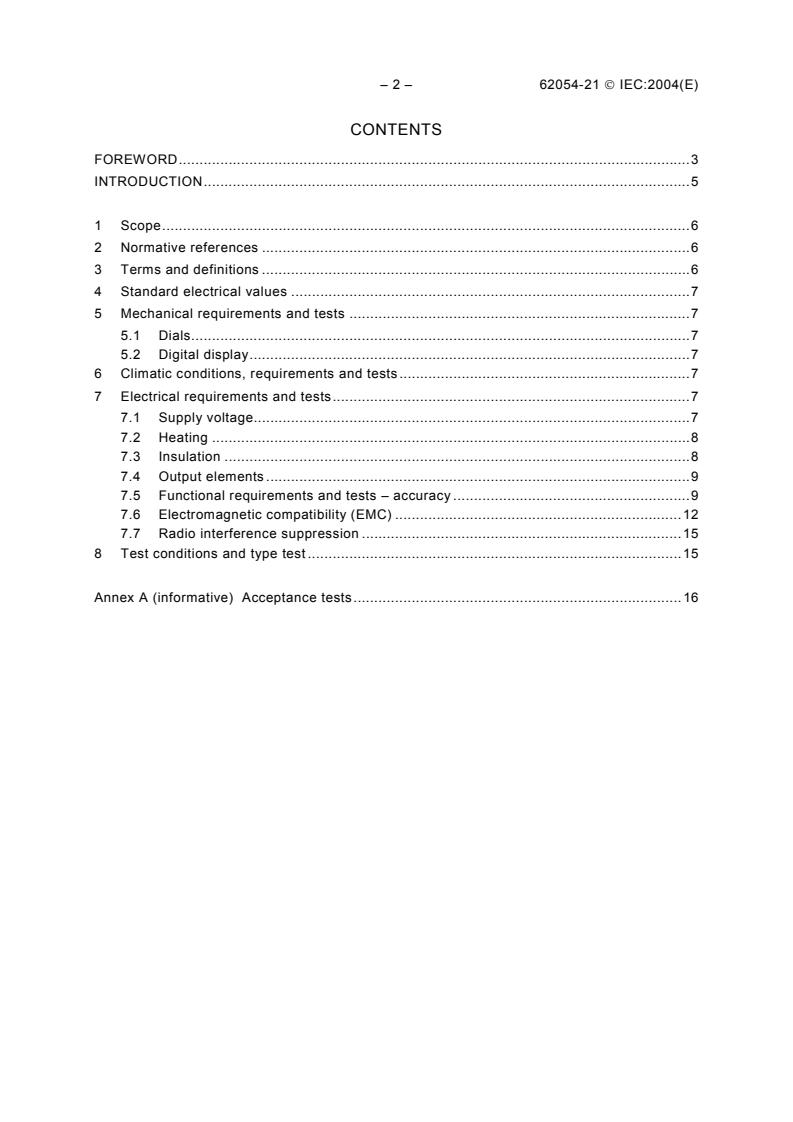
– 2 – 62054-21 IEC:2004(E)
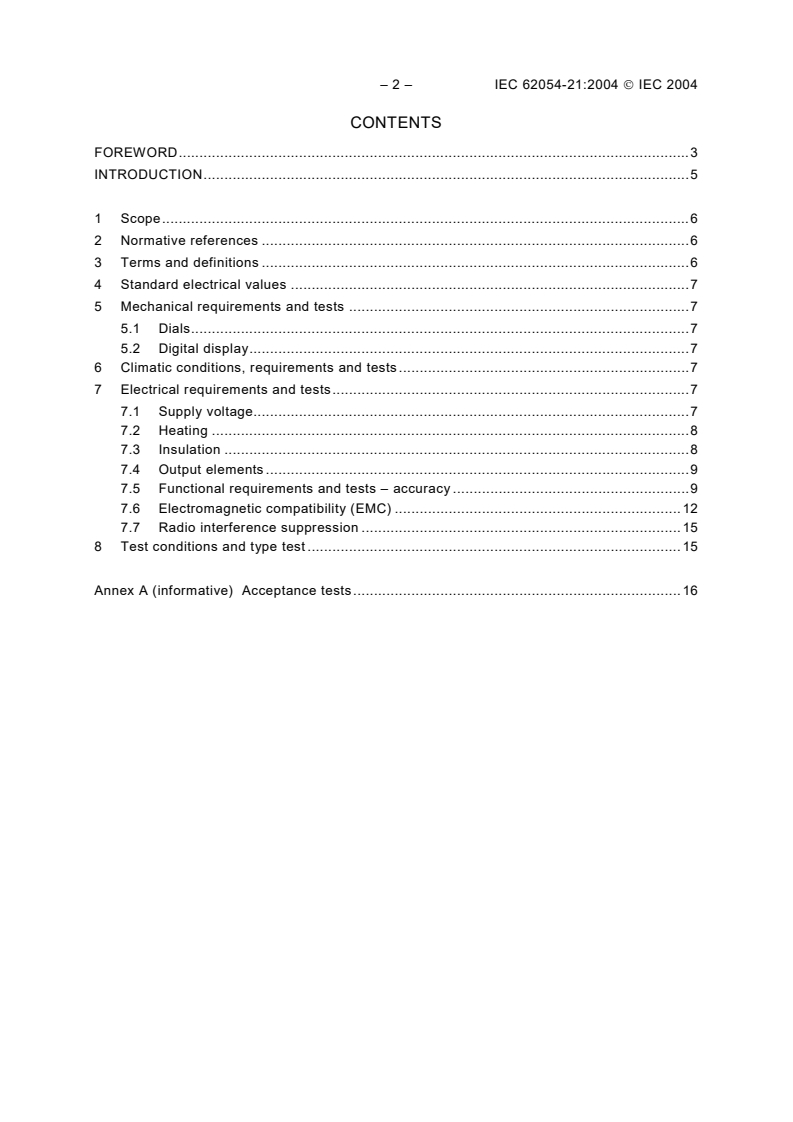
CONTENTS
FOREWORD.3
INTRODUCTION.5
1 Scope.6
2 Normative references .6
3 Terms and definitions .6
4 Standard electrical values .7
5 Mechanical requirements and tests .7
5.1 Dials.7
5.2 Digital display.7
6 Climatic conditions, requirements and tests.7
7 Electrical requirements and tests.7
7.1 Supply voltage.7
7.2 Heating .8
7.3 Insulation .8
7.4 Output elements .9
7.5 Functional requirements and tests – accuracy .9
7.6 Electromagnetic compatibility (EMC) .12
7.7 Radio interference suppression .15
8 Test conditions and type test .15
Annex A (informative) Acceptance tests.16
62054-21 IEC:2004(E) – 3 –
INTERNATIONAL ELECTROTECHNICAL COMMISSION
____________
ELECTRICITY METERING (AC) –
TARIFF AND LOAD CONTROL –
Part 21: Particular requirements for time switches
FOREWORD
1) The International Electrotechnical Commission (IEC) is a worldwide organization for standardization comprising
all national electrotechnical committees (IEC National Committees). The object of IEC is to promote
international co-operation on all questions concerning standardization in the electrical and electronic fields. To
this end and in addition to other activities, IEC publishes International Standards, Technical Specifications,
Technical Reports, Publicly Available Specifications (PAS) and Guides (hereafter referred to as “IEC
Publication(s)”). Their preparation is entrusted to technical committees; any IEC National Committee interested
in the subject dealt with may participate in this preparatory work. International, governmental and non-
governmental organizations liaising with the IEC also participate in this preparation. IEC collaborates closely
with the International Organization for Standardization (ISO) in accordance with conditions determined by
agreement between the two organizations.
2) The formal decisions or agreements of IEC on technical matters express, as nearly as possible, an international
consensus of opinion on the relevant subjects since each technical committee has representation from all
interested IEC National Committees.
3) IEC Publications have the form of recommendations for international use and are accepted by IEC National
Committees in that sense. While all reasonable efforts are made to ensure that the technical content of IEC
Publications is accurate, IEC cannot be held responsible for the way in which they are used or for any
misinterpretation by any end user.
4) In order to promote international uniformity, IEC National Committees undertake to apply IEC Publications
transparently to the maximum extent possible in their national and regional publications. Any divergence
between any IEC Publication and the corresponding national or regional publication shall be clearly indicated in
the latter.
5) IEC provides no marking procedure to indicate its approval and cannot be rendered responsible for any
equipment declared to be in conformity with an IEC Publication.
6) All users should ensure that they have the latest edition of this publication.
7) No liability shall attach to IEC or its directors, employees, servants or agents including individual experts and
members of its technical committees and IEC National Committees for any personal injury, property damage or
other damage of any nature whatsoever, whether direct or indirect, or for costs (including legal fees) and
expenses arising out of the publication, use of, or reliance upon, this IEC Publication or any other IEC
Publications.
8) Attention is drawn to the Normative references cited in this publication. Use of the referenced publications is
indispensable for the correct application of this publication.
9) Attention is drawn to the possibility that some of the elements of this IEC Publication may be the subject of
patent rights. IEC shall not be held responsible for identifying any or all such patent rights.
International Standard IEC 62054-21 has been prepared by IEC technical committee 13:
Equipment for electrical energy measurement and load control.
This standard, in conjunction with IEC 62052-21, cancels and replaces IEC 61038:1990,
Electricity metering – Tariff and load control – Particular requirements for time switches and
all amendments. .
This standard is to be used in conjunction with IEC 62052-21 and the relevant parts of the IEC
62059 series.
– 4 – 62054-21 IEC:2004(E)
The text of this standard is based on the following documents:
FDIS Report on voting
13/1308/FDIS 13/1317/RVD
Full information on the voting for the approval of this standard can be found in the report on
voting indicated in the above table.
This publication has been drafted in accordance with the ISO/IEC Directives, Part 2.
IEC 62054 consists of the following parts, under the general title: Electricity metering (a.c.)
Tariff and load control:
IEC 62054-11: Particular requirements for electronic ripple control receivers
(Replaces the particular requirements of IEC 61037.)
IEC 62054-21: Particular requirements for time switches
(Replaces the particular requirements of IEC 61038.)
The committee has decided that the contents of this publication will remain unchanged until
2013. At this date, the publication will be
• reconfirmed;
• withdrawn;
• replaced by a revised edition, or
• amended.
A bilingual version of this standard may be issued at a later date.
62054-21 IEC:2004(E) – 5 –
INTRODUCTION
This standard distinguishes between protective class I and protective class II equipment
The test levels are regarded as minimum values to guarantee the proper functioning of the
equipment under normal working conditions. For special application, other test levels might be
necessary and should be agreed on between the user and the manufacturer.
For information, the relevant parts of IEC 62052, IEC 62054 and IEC 62059 are listed below.
IEC 62052-21 Electricity metering equipment (a.c.) – General requirements, tests and test
conditions − Part 21: Tariff and load control equipment
(Replaces the general requirements of IEC 61037 and IEC 61038.)
IEC 62054-11 Electricity metering (a.c.) − Tariff and load control − Part 11: Particular
requirements for electronic ripple control receivers
(Replaces the particular requirements of IEC 61037.)
IEC 62054-21 Electricity metering (a.c.) − Tariff and load control − Part 21: Particular
requirements for time switches
(Replaces the particular requirements of IEC 61038.)
IEC 62059-11 Electricity metering equipment − Dependability − Part 11: General concepts
IEC 62059-21 Electricity metering equipment – Dependability − Part 21: Collection of meter
dependability data from the field
IEC 62059-41 Electricity metering equipment − Dependability − Part 41: Reliability
prediction
———————
To be published.
– 6 – 62054-21 IEC:2004(E)
ELECTRICITY METERING (AC)–
TARIFF AND LOAD CONTROL –
Part 21: Particular requirements for time switches
1 Scope
This part of IEC 62054 specifies particular requirements for the type test of newly
manufactured indoor time switches with operation reserve that are used to control electrical
loads, multi-tariff registers and maximum demand devices of electricity metering equipment.
The time switch keeps the real time, it may keep the date, it may be capable of handling leap
years, it may support daylight saving, i.e. it modifies the deviation of local time to GMT
according to the relevant regulations. The time switch may have a synchronization capability.
The time switch also holds a schedule of switching actions, which may be specified in terms
of time, day of the week, date within a month or a year. The time switch controls the output
elements depending on the time and the schedule of switching actions stored.
This standard gives no requirements for constructional details internal to the time switch.
In the case where time switch functionality is integrated into multifunction electricity metering
equipment, the relevant parts of this standard apply.
This standard covers time switches with analogue mechanical dials or electronic digital
displays that are
– synchronous; or
– crystal-controlled.
This standard does not cover the acceptance tests and the conformity tests. Nevertheless, an
example of what could be an acceptance test is given in Annex A .
The dependability aspect is covered by the documents of the IEC 62059 series.
When using this standard in conjunction with IEC 62052-21, the requirements of this standard
take precedence over those of IEC 62052-21 with regard to any item already covered in it.
2 Normative references
The following referenced documents are indispensable for the application of this document.
For dated references, only the edition cited applies. For undated references, the latest edition
of the referenced document (including any amendments) applies.
IEC 62052-21:200X Electricity metering equipment (a.c.) – General requirements, tests and
test conditions – Part 21: Tariff and load control equipment
3 Terms and definitions
For the purposes of this document, the definitions of IEC 62052-21 apply.
———————
To be published.
62054-21 IEC:2004(E) – 7 –
4 Standard electrical values
The values given in IEC 62052-21 apply.
5 Mechanical requirements and tests
The requirements and tests specified in IEC 62052-21 and the following apply.
5.1 Dials
For time switches with analogue mechanical dials:
– the direction of rotation of the dials shall be marked by an arrow;
– the hour dial (if any) shall be capable of being read to the nearest minute;
– when required, the hours on the day dial and the days on the week dial should be marked
in a different colour;
– all markings shall be indelible and easy to read.
5.2 Digital display
For time switches with electronic digital display:
– the display shall be easy to read. If the same display is used for displaying different
values, then a code or other indication shall be displayed to enable each value to be
identified;
– the display time of each displayed value shall be at least 6 s.
6 Climatic conditions, requirements and tests
The conditions, requirements and tests specified in IEC 62052-21 apply.
7 Electrical requirements and tests
7.1 Supply voltage
7.1.1 Supply voltage range
The values specified in IEC 62052-21 apply.
7.1.2 Supply frequency range
IEC 62052-21 applies.
7.1.3 Power consumption
IEC 62052-21 applies.
7.1.4 Voltage dips and short interruptions
See 7.6.8.
– 8 – 62054-21 IEC:2004(E)
7.1.5 Long interruptions of supply voltage
7.1.5.1 Requirements
During an interruption of the supply voltage not exceeding the operation reserve, the time
switch shall keep the time within the prescribed accuracy (see 7.5.2).
The output elements shall take up the position determined by the time switch programme
within 5 s after the restoration of the nominal supply voltage.
If the length of the interruption of the supply voltage exceeds the operation reserve, the time
may need to be re-adjusted. The time switch shall begin to execute the time switch
programme within 6 h following the restoration of the supply. However, the user and the
supplier may agree that, after a prolonged interruption of the supply voltage, the time switch
does not restart, the outputs take up a pre-determined position and the time switch displays a
special flag.
7.1.5.2 Test of effect of a long interruption of the supply voltage
For testing the time-keeping accuracy on operation reserve, see 7.5.2.3.
The test of the behaviour of the output elements consists of verifying that, after interrupting
the supply voltage for an agreed length of time and when the supply is restored to the time
switch, the output elements take up the position as determined by the time-switch programme,
according to the indicated time.
This test shall be carried out for all possible positions of the output element(s).
The restoration of the supply voltage shall be made with the switching device free from
bounce.
7.1.6 Operation reserve
7.1.6.1 Requirements
IEC 62052-21 applies.
7.1.6.2 Tests
For the test of time-keeping accuracy, see 7.5.2.
For the test of required behaviour of the output elements, see 7.1.5.2.
7.1.7 Life of back-up power supply
IEC 62052-21 applies.
7.1.8 Back-up power supply replacement
IEC 62052-21 applies.
7.2 Heating
IEC 62052-21 applies.
7.3 Insulation
IEC 62052-21 applies.
62054-21 IEC:2004(E) – 9 –
7.4 Output elements
IEC 62052-21 applies.
7.5 Functional requirements and tests – accuracy
7.5.1 Time setting and programming
7.5.1.1 Time switches with mechanical analogue dials
On a day dial, it shall be possible to set the time with an accuracy better than ±7,5 min.
It shall be possible to programme the switching operations with a resolution of 15 min or
smaller and it shall be possible to programme a minimum of two successive switching
operations at least within 60 min.
On a week dial, it shall be possible to set the day of the week and the time with an accuracy
better than 1 h. It shall be possible to programme the switching operations with a resolution of
2 h or smaller and it shall be possible to programme a minimum of 2 successive switching
operations at least within 8 h.
On a year dial, it shall be possible to set the date and time with an accuracy better than
2 days. It shall be possible to programme the switching operations with a resolution of 4 days
or smaller and it shall be possible to programme a minimum of 2 successive swi
...
IEC 62054-21 ®
Edition 1.0 2004-05
INTERNATIONAL
STANDARD
NORME
INTERNATIONALE
Electricity metering (AC) – Tariff and load control –
Part 21: Particular requirements for time switches
Équipement de comptage d’électricité (C.A.) – Tarification et contrôle
de charge –
Partie 21: Exigences particulières pour les horloges de tarification
All rights reserved. Unless otherwise specified, no part of this publication may be reproduced or utilized in any form
or by any means, electronic or mechanical, including photocopying and microfilm, without permission in writing from
either IEC or IEC's member National Committee in the country of the requester. If you have any questions about IEC
copyright or have an enquiry about obtaining additional rights to this publication, please contact the address below or
your local IEC member National Committee for further information.
Droits de reproduction réservés. Sauf indication contraire, aucune partie de cette publication ne peut être reproduite
ni utilisée sous quelque forme que ce soit et par aucun procédé, électronique ou mécanique, y compris la photocopie
et les microfilms, sans l'accord écrit de l'IEC ou du Comité national de l'IEC du pays du demandeur. Si vous avez des
questions sur le copyright de l'IEC ou si vous désirez obtenir des droits supplémentaires sur cette publication, utilisez
les coordonnées ci-après ou contactez le Comité national de l'IEC de votre pays de résidence.
IEC Central Office Tel.: +41 22 919 02 11
3, rue de Varembé Fax: +41 22 919 03 00
CH-1211 Geneva 20 info@iec.ch
Switzerland www.iec.ch
About the IEC
The International Electrotechnical Commission (IEC) is the leading global organization that prepares and publishes
International Standards for all electrical, electronic and related technologies.
About IEC publications
The technical content of IEC publications is kept under constant review by the IEC. Please make sure that you have the
latest edition, a corrigenda or an amendment might have been published.
IEC Catalogue - webstore.iec.ch/catalogue Electropedia - www.electropedia.org
The stand-alone application for consulting the entire The world's leading online dictionary of electronic and
bibliographical information on IEC International Standards, electrical terms containing 20 000 terms and definitions in
Technical Specifications, Technical Reports and other English and French, with equivalent terms in 15 additional
documents. Available for PC, Mac OS, Android Tablets and languages. Also known as the International Electrotechnical
iPad. Vocabulary (IEV) online.
IEC publications search - www.iec.ch/searchpub IEC Glossary - std.iec.ch/glossary
The advanced search enables to find IEC publications by a 65 000 electrotechnical terminology entries in English and
variety of criteria (reference number, text, technical French extracted from the Terms and Definitions clause of
committee,…). It also gives information on projects, replaced IEC publications issued since 2002. Some entries have been
and withdrawn publications. collected from earlier publications of IEC TC 37, 77, 86 and
CISPR.
IEC Just Published - webstore.iec.ch/justpublished
Stay up to date on all new IEC publications. Just Published IEC Customer Service Centre - webstore.iec.ch/csc
details all new publications released. Available online and If you wish to give us your feedback on this publication or
also once a month by email. need further assistance, please contact the Customer Service
Centre: csc@iec.ch.
A propos de l'IEC
La Commission Electrotechnique Internationale (IEC) est la première organisation mondiale qui élabore et publie des
Normes internationales pour tout ce qui a trait à l'électricité, à l'électronique et aux technologies apparentées.
A propos des publications IEC
Le contenu technique des publications IEC est constamment revu. Veuillez vous assurer que vous possédez l’édition la
plus récente, un corrigendum ou amendement peut avoir été publié.
Catalogue IEC - webstore.iec.ch/catalogue Electropedia - www.electropedia.org
Application autonome pour consulter tous les renseignements
Le premier dictionnaire en ligne de termes électroniques et
bibliographiques sur les Normes internationales,
électriques. Il contient 20 000 termes et définitions en anglais
Spécifications techniques, Rapports techniques et autres
et en français, ainsi que les termes équivalents dans 15
documents de l'IEC. Disponible pour PC, Mac OS, tablettes
langues additionnelles. Egalement appelé Vocabulaire
Android et iPad.
Electrotechnique International (IEV) en ligne.
Recherche de publications IEC - www.iec.ch/searchpub
Glossaire IEC - std.iec.ch/glossary
65 000 entrées terminologiques électrotechniques, en anglais
La recherche avancée permet de trouver des publications IEC
en utilisant différents critères (numéro de référence, texte, et en français, extraites des articles Termes et Définitions des
comité d’études,…). Elle donne aussi des informations sur les publications IEC parues depuis 2002. Plus certaines entrées
projets et les publications remplacées ou retirées. antérieures extraites des publications des CE 37, 77, 86 et
CISPR de l'IEC.
IEC Just Published - webstore.iec.ch/justpublished
Service Clients - webstore.iec.ch/csc
Restez informé sur les nouvelles publications IEC. Just
Published détaille les nouvelles publications parues. Si vous désirez nous donner des commentaires sur cette
Disponible en ligne et aussi une fois par mois par email. publication ou si vous avez des questions contactez-nous:
csc@iec.ch.
IEC 62054-21 ®
Edition 1.0 2004-05
INTERNATIONAL
STANDARD
NORME
INTERNATIONALE
Electricity metering (AC) – Tariff and load control –
Part 21: Particular requirements for time switches
Équipement de comptage d’électricité (C.A.) – Tarification et contrôle
de charge –
Partie 21: Exigences particulières pour les horloges de tarification
INTERNATIONAL
ELECTROTECHNICAL
COMMISSION
COMMISSION
ELECTROTECHNIQUE
INTERNATIONALE
ICS 91.140.50 ISBN 978-2-8322-3789-2
– 2 – IEC 62054-21:2004 IEC 2004
CONTENTS
FOREWORD . 3
INTRODUCTION . 5
1 Scope . 6
2 Normative references . 6
3 Terms and definitions . 6
4 Standard electrical values . 7
5 Mechanical requirements and tests . 7
5.1 Dials . 7
5.2 Digital display . 7
6 Climatic conditions, requirements and tests . 7
7 Electrical requirements and tests . 7
7.1 Supply voltage. 7
7.2 Heating . 8
7.3 Insulation . 8
7.4 Output elements . 9
7.5 Functional requirements and tests – accuracy . 9
7.6 Electromagnetic compatibility (EMC) . 12
7.7 Radio interference suppression . 15
8 Test conditions and type test . 15
Annex A (informative) Acceptance tests . 16
INTERNATIONAL ELECTROTECHNICAL COMMISSION
____________
ELECTRICITY METERING (AC) –
TARIFF AND LOAD CONTROL –
Part 21: Particular requirements for time switches
FOREWORD
1) The International Electrotechnical Commission (IEC) is a worldwide organization for standardization comprising
all national electrotechnical committees (IEC National Committees). The object of IEC is to promote
international co-operation on all questions concerning standardization in the electrical and electronic fields. To
this end and in addition to other activities, IEC publishes International Standards, Technical Specifications,
Technical Reports, Publicly Available Specifications (PAS) and Guides (hereafter referred to as “IEC
Publication(s)”). Their preparation is entrusted to technical committees; any IEC National Committee interested
in the subject dealt with may participate in this preparatory work. International, governmental and non-
governmental organizations liaising with the IEC also participate in this preparation. IEC collaborates closely
with the International Organization for Standardization (ISO) in accordance with conditions determined by
agreement between the two organizations.
2) The formal decisions or agreements of IEC on technical matters express, as nearly as possible, an international
consensus of opinion on the relevant subjects since each technical committee has representation from all
interested IEC National Committees.
3) IEC Publications have the form of recommendations for international use and are accepted by IEC National
Committees in that sense. While all reasonable efforts are made to ensure that the technical content of IEC
Publications is accurate, IEC cannot be held responsible for the way in which they are used or for any
misinterpretation by any end user.
4) In order to promote international uniformity, IEC National Committees undertake to apply IEC Publications
transparently to the maximum extent possible in their national and regional publications. Any divergence
between any IEC Publication and the corresponding national or regional publication shall be clearly indicated in
the latter.
5) IEC provides no marking procedure to indicate its approval and cannot be rendered responsible for any
equipment declared to be in conformity with an IEC Publication.
6) All users should ensure that they have the latest edition of this publication.
7) No liability shall attach to IEC or its directors, employees, servants or agents including individual experts and
members of its technical committees and IEC National Committees for any personal injury, property damage or
other damage of any nature whatsoever, whether direct or indirect, or for costs (including legal fees) and
expenses arising out of the publication, use of, or reliance upon, this IEC Publication or any other IEC
Publications.
8) Attention is drawn to the Normative references cited in this publication. Use of the referenced publications is
indispensable for the correct application of this publication.
9) Attention is drawn to the possibility that some of the elements of this IEC Publication may be the subject of
patent rights. IEC shall not be held responsible for identifying any or all such patent rights.
International Standard IEC 62054-21 has been prepared by IEC technical committee 13:
Equipment for electrical energy measurement and load control.
This bilingual version (2016-12) corresponds to the monolingual English version, published in
2004-05.
This standard, in conjunction with IEC 62052-21, cancels and replaces IEC 61038:1990,
Electricity metering – Tariff and load control – Particular requirements for time switches and
all amendments. .
This standard is to be used in conjunction with IEC 62052-21 and the relevant parts of the IEC
62059 series.
– 4 – IEC 62054-21:2004 IEC 2004
The text of this standard is based on the following documents:
FDIS Report on voting
13/1308/FDIS 13/1317/RVD
Full information on the voting for the approval of this standard can be found in the report on
voting indicated in the above table.
The French version of this standard has not been voted upon.
This publication has been drafted in accordance with the ISO/IEC Directives, Part 2.
IEC 62054 consists of the following parts, under the general title: Electricity metering (a.c.)
Tariff and load control:
IEC 62054-11: Particular requirements for electronic ripple control receivers
(Replaces the particular requirements of IEC 61037.)
IEC 62054-21: Particular requirements for time switches
(Replaces the particular requirements of IEC 61038.)
The committee has decided that the contents of this publication will remain unchanged until
2013. At this date, the publication will be
• reconfirmed;
• withdrawn;
• replaced by a revised edition, or
• amended.
INTRODUCTION
This standard distinguishes between protective class I and protective class II equipment
The test levels are regarded as minimum values to guarantee the proper functioning of the
equipment under normal working conditions. For special application, other test levels might be
necessary and should be agreed on between the user and the manufacturer.
For information, the relevant parts of IEC 62052, IEC 62054 and IEC 62059 are listed below.
IEC 62052-21 Electricity metering equipment (a.c.) – General requirements, tests and test
conditions − Part 21: Tariff and load control equipment
(Replaces the general requirements of IEC 61037 and IEC 61038.)
IEC 62054-11 Electricity metering (a.c.) − Tariff and load control − Part 11: Particular
requirements for electronic ripple control receivers
(Replaces the particular requirements of IEC 61037.)
IEC 62054-21 Electricity metering (a.c.) − Tariff and load control − Part 21: Particular
requirements for time switches
(Replaces the particular requirements of IEC 61038.)
IEC 62059-11 Electricity metering equipment − Dependability − Part 11: General concepts
IEC 62059-21 Electricity metering equipment – Dependability − Part 21: Collection of meter
dependability data from the field
IEC 62059-41 Electricity metering equipment − Dependability − Part 41: Reliability
prediction
———————
To be published.
– 6 – IEC 62054-21:2004 IEC 2004
ELECTRICITY METERING (AC) –
TARIFF AND LOAD CONTROL –
Part 21: Particular requirements for time switches
1 Scope
This part of IEC 62054 specifies particular requirements for the type test of newly
manufactured indoor time switches with operation reserve that are used to control electrical
loads, multi-tariff registers and maximum demand devices of electricity metering equipment.
The time switch keeps the real time, it may keep the date, it may be capable of handling leap
years, it may support daylight saving, i.e. it modifies the deviation of local time to GMT
according to the relevant regulations. The time switch may have a synchronization capability.
The time switch also holds a schedule of switching actions, which may be specified in terms
of time, day of the week, date within a month or a year. The time switch controls the output
elements depending on the time and the schedule of switching actions stored.
This standard gives no requirements for constructional details internal to the time switch.
In the case where time switch functionality is integrated into multifunction electricity metering
equipment, the relevant parts of this standard apply.
This standard covers time switches with analogue mechanical dials or electronic digital
displays that are
– synchronous; or
– crystal-controlled.
This standard does not cover the acceptance tests and the conformity tests. Nevertheless, an
example of what could be an acceptance test is given in Annex A .
The dependability aspect is covered by the documents of the IEC 62059 series.
When using this standard in conjunction with IEC 62052-21, the requirements of this standard
take precedence over those of IEC 62052-21 with regard to any item already covered in it.
2 Normative references
The following referenced documents are indispensable for the application of this document.
For dated references, only the edition cited applies. For undated references, the latest edition
of the referenced document (including any amendments) applies.
IEC 62052-21:200X Electricity metering equipment (a.c.) – General requirements, tests and
test conditions – Part 21: Tariff and load control equipment
3 Terms and definitions
For the purposes of this document, the definitions of IEC 62052-21 apply.
———————
To be published.
4 Standard electrical values
The values given in IEC 62052-21 apply.
5 Mechanical requirements and tests
The requirements and tests specified in IEC 62052-21 and the following apply.
5.1 Dials
For time switches with analogue mechanical dials:
– the direction of rotation of the dials shall be marked by an arrow;
– the hour dial (if any) shall be capable of being read to the nearest minute;
– when required, the hours on the day dial and the days on the week dial should be marked
in a different colour;
– all markings shall be indelible and easy to read.
5.2 Digital display
For time switches with electronic digital display:
– the display shall be easy to read. If the same display is used for displaying different
values, then a code or other indication shall be displayed to enable each value to be
identified;
– the display time of each displayed value shall be at least 6 s.
6 Climatic conditions, requirements and tests
The conditions, requirements and tests specified in IEC 62052-21 apply.
7 Electrical requirements and tests
7.1 Supply voltage
7.1.1 Supply voltage range
The values specified in IEC 62052-21 apply.
7.1.2 Supply frequency range
IEC 62052-21 applies.
7.1.3 Power consumption
IEC 62052-21 applies.
7.1.4 Voltage dips and short interruptions
See 7.6.8.
– 8 – IEC 62054-21:2004 IEC 2004
7.1.5 Long interruptions of supply voltage
7.1.5.1 Requirements
During an interruption of the supply voltage not exceeding the operation reserve, the time
switch shall keep the time within the prescribed accuracy (see 7.5.2).
The output elements shall take up the position determined by the time switch programme
within 5 s after the restoration of the nominal supply voltage.
If the length of the interruption of the supply voltage exceeds the operation reserve, the time
may need to be re-adjusted. The time switch shall begin to execute the time switch
programme within 6 h following the restoration of the supply. However, the user and the
supplier may agree that, after a prolonged interruption of the supply voltage, the time switch
does not restart, the outputs take up a pre-determined position and the time switch displays a
special flag.
7.1.5.2 Test of effect of a long interruption of the supply voltage
For testing the time-keeping accuracy on operation reserve, see 7.5.2.3.
The test of the behaviour of the output elements consists of verifying that, after interrupting
the supply voltage for an agreed length of time and when the supply is restored to the time
switch, the output elements take up the position as determined by the time-switch programme,
according to the indicated time.
This test shall be carried out for all possible positions of the output element(s).
The restoration of the supply voltage shall be made with the switching device free from
bounce.
7.1.6 Operation reserve
7.1.6.1 Requirements
IEC 62052-21 applies.
7.1.6.2 Tests
For the test of time-keeping accuracy, see 7.5.2.
For the test of required behaviour of the output elements, see 7.1.5.2.
7.1.7 Life of back-up power supply
IEC 62052-21 applies.
7.1.8 Back-up power supply replacement
IEC 62052-21 applies.
7.2 Heating
IEC 62052-21 applies.
7.3 Insulation
IEC 62052-21 applies.
7.4 Output elements
IEC 62052-21 applies.
7.5 Functional requirements and tests – accuracy
7.5.1 Time setting and programming
7.5.1.1 Time switches with mechanical analogue dials
On a day dial, it shall be possible to set the time with an accuracy better than ±7,5 min.
It shall be possible to programme the switching operations with a resolution of 15 min or
smaller and it shall be possible to programme a minimum of two successive switching
operations at least within 60 min.
On a week dial, it shall be possible to set the day of the week and the time with an accuracy
better than 1 h. It shall be possible to programme the switching operations with a resolution of
2 h or smaller and it shall be possible to programme a minimum of 2 successive switching
operations at least within 8 h.
On a year dial, it shall be possible to set the date and time with an accuracy better than
2 days. It shall be possible to programme the switching operations with a resolution of 4 days
or smaller and it shall be possible to programme a minimum of 2 successive switching
operations at least within 16 days.
7.5.1.2 Time switches with digital displays
It shall be possible to set the date and time (day, month, year, hours and minutes) with an
accuracy of 5 s. The setting of the time shall reset the seconds to zero. If setting of the
seconds is also available, then the setting of the time shall not reset the seconds to zero, but
to the intended value.
NOTE In this case, it is preferable to display also the seconds.
If a daylight saving function is available, the time switch shall display the official time
according to the regulations.
It shall be possible to set the switching operations with a resolution of 1 minute, 1 hour, 1 day,
1 month and 1 year.
7.5.2 Time-keeping accuracy
7.5.2.1 Requirements for synchronous time switches
Synchronous time switches shall have a time-keeping accuracy under normal operating
conditions better than ±5 s/30 days assuming that the supply frequency keeps its average on
the nominal value.
On operation reserve, at reference temperature, the time-keeping accuracy shall be better
than ±120 s/day, if operation reserve is provided by a spring and better than ±1 s/day if
operation reserve is provided by a supercapacitor, rechargeable battery or primary cell.
7.5.2.2 Requirements for crystal controlled time switches
At reference voltage and reference temperature, crystal-controlled time switches shall have a
time-keeping accuracy better than ±0,5 s/day. The variation of the time-keeping accuracy with
the temperature shall be less than (±0,15 s/°C/24 h).
– 10 – IEC 62054-21:2004 IEC 2004
On operation reserve, at reference temperature, the time-keeping accuracy shall be better
than ±1 s /day.
NOTE In applications where the time switch is used as part of a system providing time synchronization, the
manufacturer and the purchaser may agree on relaxed time-keeping accuracy specifications for the time switch
when it is operating in stand-alone mode. In this case, the system time is maintained by the time switch and the
synchronization performed at the necessary intervals.
7.5.2.3 Test of time-keeping accuracy
7.5.2.3.1 General test conditions
Place the time switch under test in its normal operating position and, if necessary, in a
climatic chamber, and supply it from an apparatus free of voltage dips and short interruptions.
Unless otherwise indicated, the reference conditions shown in Annex B of IEC 62052-21 shall
be maintained.
NOTE The manufacturer should provide a suitable means for testing the time-keeping accuracy. This could be, for
example, an electrical or optical output, or, in the case of capacitor calibrated crystal-controlled time switches, an
electromagnetic coupling picking up the signal from the crystal could be used.
7.5.2.3.2 Test of synchronous time switches
7.5.2.3.2.1 Test of synchronous time switches supplied by mains
The time switch under test is supplied together with and synchronised to a reference mains-
controlled clock. After a testing period of 30 days, the time indication discrepancy between
the reference clock and the time switch under test must be less than ±5 s.
7.5.2.3.2.2 Test of synchronous time switches on operation reserve
The time switch to be tested is supplied together with, and synchronized to, a reference clock.
Before the test, the time switch shall be powered for a suitable length of time, so that the
operation reserve is fully available.
NOTE The manufacturer should specify the time necessary for keeping the time switch powered up before the
test of operation reserve may commence.
The power supply of the time switch under test is switched off for 36 h. When the power
supply is restored, the time-indication discrepancy between the reference clock and the time
switch under test shall not be more than that calculated from the time-keeping accuracy on
operation reserve multiplied by the length of the operating reserve.
NOTE Consequently, the time indication discrepancy should be less than
– ± 180 s for a spring reserve operated synchronous time switch;
– ± 1,5 s for a battery, a primary cell or a supercapacitor reserve operated synchronous time switch.
The restoration of the voltage shall be made with the switching device free from bounce.
7.5.2.3.3 Test of crystal-controlled time switches
7.5.2.3.3.1 Test of crystal-controlled time switches supplied by mains
The time switch under test is supplied together with, and synchronized to, a reference crystal-
controlled clock. After a testing period of 30 days, the time-indication discrepancy between
the reference clock and the time switch under test must be less than ±15 s.
7.5.2.3.3.2 Test of crystal-controlled time switches on operation reserve
The time switch to be tested is powered together with a reference clock. Before the test, the
time switch shall be powered for a suitable length of time, so that the operation reserve is fully
available.
NOTE The manufacturer should specify the time necessary for keeping the time switch powered up before the
test of operation reserve may commence.
The power supply of the time switch under test is switched off for 36 h. When the power
supply is restored, the time-indication discrepancy between the reference clock and the time
switch under test shall not be more than that calculated from the time-keeping accuracy on
operation reserve multiplied by the length of the operating reserve.
NOTE Consequently, the time indication discrepancy should be less than ±1,5 s.
The restoration of the voltage shall be made with the switching device free from bounce.
7.5.2.3.3.3 Test of time-keeping accuracy of crystal-controlled time switches with
temperature
The time switch is placed in a climatic chamber and its time base is measured at +23 °C.
The temperature is set at +45 °C. After thermal equilibrium is obtained, the time-keeping
accuracy shall be better than ±3,3 s/24 h plus the time-keeping accuracy measured at
reference temperature (max. +0,5 s/24 h).
–6
NOTE The accuracy of the time base should not differ from the 23 °C measurement by more than ±38 × 10 .
The temperature is then set at –10 °C. After thermal equilibrium is obtained the time-keeping
accuracy shall be better than ±4,95 s/24 h plus the time-keeping accuracy measured at
reference temperature (max. +0,5 s/24 h).
–6
NOTE The accuracy of the time base should not differ from the 23 °C measurement by more than ±57 × 10 .
7.5.3 Switching accuracy
7.5.3.1 Time switches with dials
7.5.3.1.1 Requirements
On a day dial, the actual switching times shall not differ from the set times by more than
±7,5 min. The length of a full 24 h daily programme shall be 24 h ± the time-keeping accuracy.
On a week dial, the actual switching times shall not differ from the set times by more than
±60 min. The length of a full 168 h weekly programme shall be 168 h ± the time-keeping
accuracy.
On a year dial, the actual switching times shall not differ from the set times by more than
±2 days. The length of a full 365 days yearly programme shall be 365 days ± the time-keeping
accuracy.
NOTE A non-cumulative variation of the length of the switching cycle resulting from the mechanical operation is
acceptable.
The initial point of operation of a maximum demand indicator switch shall be manually
adjustable, unless it is set automatically by the day dial.
7.5.3.1.2 Test
For testing the daily programme switching time accuracy, programme the time switch for a
daily programme with at least 4 switching operations. Observe that, during the execution of
the programme, the difference between the actual switching time and the set time is less than
± 7,5 min for each operation and that the length of the complete daily programme is 24 h ± the
maximum time-keeping accuracy.
– 12 – IEC 62054-21:2004 IEC 2004
For testing the weekly programme switching time accuracy, programme the time switch for a
weekly programme with at least 4 switching operations. Observe that, during the execution of
the programme, the difference between the actual switching time and the set time is less than
±60 min for each operation and that the length of the complete weekly programme is 168 h ±
the maximum time-keeping accuracy.
For testing the yearly programme switching time accuracy, programme the time switch for a
yearly programme with at least 4 switching operations. Advance the time and date to 2 days
before the switching time. Observe that, during the execution of the programme, the
difference between the actual switching time and the set time is less than ±2 days for each
operation.
7.5.3.2 Time switches with digital displays
7.5.3.2.1 Requirements
The actual switching time shall not differ from the set times by more than ±1 s.
If the time switch has a maximum demand indicator or load profile recorder control function,
the start of the integration period shall be synchronized to an integer number of hours
displayed.
7.5.3.2.2 Test
For testing the daily programme switching time accuracy, programme the time switch for a
daily programme with at least 4 switching operations. Observe that, during the execution of
the programme, the difference between the actual switching time and the set time is less than
±5 s for each operation and that the length of the complete daily programme is 24 h ± the
maximum time-keeping accuracy.
For testing the weekly programme switching time accuracy, programme the time switch for a
weekly programme with at least 4 switching operations. Observe that, during the execution of
the programme, the difference between the actual switching time and the set time is less than
±5 s for each operation and that the length of the complete weekly programme is 168 h ± the
maximum time-keeping accuracy.
For testing the yearly programme switching time accuracy, programme the time switch for a
yearly programme with at least 4 switching operations. Advance the time and date to 1 h
before the switching time. Observe that, during the execution of the programme, the
difference between the actual switching time and the set time is less than ±5 s for each
operation.
7.5.4 Synchronization
If an external synchronization function is available, it shall be possible to synchronize the time
switch to a system time with a maximum deviation of 5 s.
NOTE 1 Synchronization may be to the minute, to the integration period, or to a pre-set time. The synchronization
may occur immediately or gradually, evenly spread during several integration periods.
NOTE 2 For testing, the manufacturer should provide a suitable test method.
7.6 Electromagnetic compatibility (EMC)
The requirements and values defined in IEC 62052-21 and the following apply.
7.6.1 Immunity to electromagnetic disturbances
IEC 62052-21 applies.
7.6.2 General test conditions
IEC 62052-21 applies.
7.6.3 Test of immunity to electrostatic discharges
In addition to IEC 62052-21, the following applies.
The application of the electrostatic discharge shall not produce any change in the time-
indication discrepancy or in the position of the switch contact(s). It shall be verified that after
the application of the static discharges, the programmed operations are correctly executed.
During the test, a temporary degradation or loss of function or performance is acceptable.
7.6.4 Test of immunity to electromagnetic r.f. fields
In addition to IEC 62052-21 the following applies.
• Field strength of the unmodulated signal 10 V/m
The application of the electromagnetic r.f. field shall not produce any change in the time
displayed or in the position of the switch contact(s). The switching operations during the
application of the electromagnetic r.f. field shall be performed correctly.
• Field strength of the unmodulated signal 30 V/m
During the test, a temporary degradation or loss of function or performance is acceptable.
This could be a blinking display, unavailability of the setting controls, or a temporary
change in accuracy. It can be also accepted that the switching operations do not occur
during the disturbance. The time and the position of the outputs must be preserved.
It shall be verified that after the application and removal of the electromagnetic r.f. field, the
programmed operations are correctly executed.
7.6.5 Fast transient burst test
In addition to IEC 62052-21, the following applies.
During the test, a temporary degradation or loss of function or performance is acceptable.
This could be a blinking display, unavailability of the setting controls, or a temporary change
in accuracy. It can be also accepted that the switching operations do not occur during the
disturbance.
The time-indication discrepancy and the position of the outputs must be preserved. It shall be
verified that after the test, the programmed operations are correctly executed.
7.6.6 Test of immunity to conducted disturbances, induced by r.f. fields
In addition to IEC 62052-21, the following applies.
The application of the conducted r.f. disturbances shall not produce any change in the time
displayed or in the position of the switch contact(s). The switching operations during the
application of the conducted r.f. disturbances shall be performed correctly. It shall be verified
that after the removal of the conducted r.f. disturbances, the programmed operations are
correctly executed.
– 14 – IEC 62054-21:2004 IEC 2004
7.6.7 Surge immunity test
In addition to IEC 62052-21, the following applies.
The application of the surges shall not produce any change in the time displayed or in the
position of the switch contact(s).
During the test, a temporary degradation or loss of function or performance is acceptable.
This could be a blinking display, unavailability of the setting controls, or a temporary change
in accuracy. It can be also accepted that the switching operations do not occur during the
disturbance.
The time-indication discrepancy and the position of the outputs must be preserved. It shall be
verified that, after the test, the programmed operations are correctly executed.
7.6.8 Test of immunity to voltage dips and short interruptions
7.6.8.1 Test of the effects of short interruptions and voltage dips
For these tests, the time switch is supplied together with and synchronized to a reference
clock. A special equipment is inserted in the mains line of the time switch which will be able to
submit the equipment under test to programmable short-supply interruptions and voltage dips
without any bounce.
NOTE The manufacturer should provide a suitable means for testing the time-keeping accuracy. This could be,for
example, an electrical or optical output or, in the case of capacitor calibrated crystal-controlled time switches, an
electromagnetic coupling picking up the signal from the crystal could be used.
7.6.8.2 Effect of short-supply interruptions on synchronous time switches
The time switch under test is submitted to a sequence of 20 successive supply interruptions
with at least 5 s intervals between these interruptions. The value of interruptions to be applied
shall be 20 ms, 50 ms, 100 ms, 200 ms, 500 ms, 1 s and 2 s.
After each test, the time indication discrepancy between the time switch under test and the
reference clock shall be less than the value shown in Table 1.
Table 1 – Maximum inaccuracies
Supply interruption length 20 ms 50 ms 100 ms 200 ms 500 ms 1 s 2 s
Maximum time indication discrepancy 400 ms 1 s 2 s 4 s 10 s 10 s 10 s
7.6.8.3 Effect of voltage dips on synchronous time switches
The time switch under test is powered by a supply voltage of 50 % of its rated value for 1 min.
After the test, the time-indication discrepancy between the time switch under test and the
reference clock shall be less than 500 ms plus the inaccuracy due to working on operation
reserve (±1 ms for time switches with operation reserve provided by a primary cell, a
supercapacitor or a battery and ±125 ms for time switches with operation reserve provided by
a spring).
7.6.8.4 Effect of short-supply interruptions on crystal-controlled time switches
The time switch under test is submitted to the same sequences of supply interruptions as
described in 7.6.8.2. After each test, the time-indication discrepancy between the time switch
under test and the reference clock shall be less than 400 ms.
7.6.8.5 Effect of voltage dips on crystal-controlled time switches
The time switch under test is powered as in 7.6.8.3. After the test the time-indication
discrepancy between the time switch under test and the reference clock shall be less than
20 ms plus the inaccuracy due to working on operation reserve (1 ms).
7.6.9 Test of immunity to d.c. magnetic fields
In addition to IEC 62052-21, the following applies.
During the test the time switch must retain its operational capacities.
7.6.10 Test of immunity to a.c. magnetic fields
In addition to IEC 62052-21, the following applies.
During the test the time switch must retain its operational capacities.
7.6.11 Test of influence of harmonics
The time switch is supplied together with, and synchronized to, a reference clock. Ten per
cent of the third harmonic is added to the power supply voltage of the time switch under test.
The test is carried out over 30 days. At the end of the test, the time-indication discrepancy
between the time switch under test and the reference clock shall be less than ±7 s for
synchronous time switches and less than ±17 s for crystal-controlled time switches.
7.6.12 Test of immunity to interharmonics
This clause is not relevant for time switches.
7.6.13 Test of immunity to disturbing pulses
This clause is not relevant for time switches.
7.7 Radio interference suppression
IEC 62052-21 applies.
8 Test conditions and type test
IEC 62052-21 applies.
– 16 – IEC 62054-21:2004 IEC 2004
Annex A
(informative)
Acceptance tests
The procedure described in IEC 62052-21 and the following apply.
Acceptance tests shall comprise
a) a time-keeping accuracy test: rated supply voltage U , rated supply frequency f and at
n n
the reference values of the other influencing quantities (see Annex B of IEC 62052-21);
b) a test of setting accuracy;
c) a test of synchronization (if available).
___________
– 18 – IEC 62054-21:2004 IEC 2004
SOMMAIRE
AVANT-PROPOS . 19
INTRODUCTION . 21
1 Domaine d'application . 22
2 Références normatives . 22
3 Termes et définitions . 23
4 Valeurs électriques normalisées . 23
5 Exigences mécaniques et essais . 23
5.1 Cadrans . 23
5.2 Affichage digital . 23
6 Conditions climatiques, exigences et essais . 23
7 Exigences électriques et essais . 23
7.1 Tension d’alimentation . 23
7.2 Echauffements . 25
7.3 Isolement . 25
7.4 Eléments de sortie . 25
7.5 Spécifications fonctionnelles et essais – précision . 25
7.6 Compatibilité électromagnétique (CEM) . 29
7.7 Suppression des perturbations radioélectriques . 32
8 Conditions d’essai et essai de type . 32
Annexe A (informative) Essais d’acceptation . 33
COMMISSION ÉLECTROTECHNIQUE INTERNATIONALE
____________
ÉQUIPEMENT DE COMPTAGE D’ÉLECTRICITÉ (C.A.) –
TARIFICATION ET CONTRÔLE DE CHARGE –
Partie 21: Exigences particulières pour les horloges de tarification
AVANT-PROPOS
1) La Commission Electrotechnique Internationale (IEC) est une organisation mondiale de normalisation
composée de l'ensemble des comités électrotechniques nationaux (Comités nationaux de l’IEC). L’IEC a pour
objet de favoriser la coopération internationale pour to
...
IEC 62054-21 ®
Edition 1.1 2017-01
CONSOLIDATED VERSION
INTERNATIONAL
STANDARD
NORME
INTERNATIONALE
colour
inside
Electricity metering (AC) – Tariff and load control –
Part 21: Particular requirements for time switches
Équipement de comptage d’électricité (C.A.) – Tarification et contrôle
de charge –
Partie 21: Exigences particulières pour les horloges de tarification
All rights reserved. Unless otherwise specified, no part of this publication may be reproduced or utilized in any form
or by any means, electronic or mechanical, including photocopying and microfilm, without permission in writing from
either IEC or IEC's member National Committee in the country of the requester. If you have any questions about IEC
copyright or have an enquiry about obtaining additional rights to this publication, please contact the address below or
your local IEC member National Committee for further information.
Droits de reproduction réservés. Sauf indication contraire, aucune partie de cette publication ne peut être reproduite
ni utilisée sous quelque forme que ce soit et par aucun procédé, électronique ou mécanique, y compris la photocopie
et les microfilms, sans l'accord écrit de l'IEC ou du Comité national de l'IEC du pays du demandeur. Si vous avez des
questions sur le copyright de l'IEC ou si vous désirez obtenir des droits supplémentaires sur cette publication, utilisez
les coordonnées ci-après ou contactez le Comité national de l'IEC de votre pays de résidence.
IEC Central Office Tel.: +41 22 919 02 11
3, rue de Varembé Fax: +41 22 919 03 00
CH-1211 Geneva 20 info@iec.ch
Switzerland www.iec.ch
About the IEC
The International Electrotechnical Commission (IEC) is the leading global organization that prepares and publishes
International Standards for all electrical, electronic and related technologies.
About IEC publications
The technical content of IEC publications is kept under constant review by the IEC. Please make sure that you have the
latest edition, a corrigenda or an amendment might have been published.
IEC Catalogue - webstore.iec.ch/catalogue Electropedia - www.electropedia.org
The stand-alone application for consulting the entire The world's leading online dictionary of electronic and
bibliographical information on IEC International Standards, electrical terms containing 20 000 terms and definitions in
Technical Specifications, Technical Reports and other English and French, with equivalent terms in 16 additional
documents. Available for PC, Mac OS, Android Tablets and languages. Also known as the International Electrotechnical
iPad. Vocabulary (IEV) online.
IEC publications search - www.iec.ch/searchpub IEC Glossary - std.iec.ch/glossary
The advanced search enables to find IEC publications by a 65 000 electrotechnical terminology entries in English and
variety of criteria (reference number, text, technical French extracted from the Terms and Definitions clause of
committee,…). It also gives information on projects, replaced IEC publications issued since 2002. Some entries have been
and withdrawn publications. collected from earlier publications of IEC TC 37, 77, 86 and
CISPR.
IEC Just Published - webstore.iec.ch/justpublished
Stay up to date on all new IEC publications. Just Published IEC Customer Service Centre - webstore.iec.ch/csc
details all new publications released. Available online and If you wish to give us your feedback on this publication or
also once a month by email. need further assistance, please contact the Customer Service
Centre: csc@iec.ch.
A propos de l'IEC
La Commission Electrotechnique Internationale (IEC) est la première organisation mondiale qui élabore et publie des
Normes internationales pour tout ce qui a trait à l'électricité, à l'électronique et aux technologies apparentées.
A propos des publications IEC
Le contenu technique des publications IEC est constamment revu. Veuillez vous assurer que vous possédez l’édition la
plus récente, un corrigendum ou amendement peut avoir été publié.
Catalogue IEC - webstore.iec.ch/catalogue Electropedia - www.electropedia.org
Application autonome pour consulter tous les renseignements
Le premier dictionnaire en ligne de termes électroniques et
bibliographiques sur les Normes internationales,
électriques. Il contient 20 000 termes et définitions en anglais
Spécifications techniques, Rapports techniques et autres
et en français, ainsi que les termes équivalents dans 16
documents de l'IEC. Disponible pour PC, Mac OS, tablettes
langues additionnelles. Egalement appelé Vocabulaire
Android et iPad.
Electrotechnique International (IEV) en ligne.
Recherche de publications IEC - www.iec.ch/searchpub
Glossaire IEC - std.iec.ch/glossary
La recherche avancée permet de trouver des publications IEC
65 000 entrées terminologiques électrotechniques, en anglais
en utilisant différents critères (numéro de référence, texte,
et en français, extraites des articles Termes et Définitions des
comité d’études,…). Elle donne aussi des informations sur les
publications IEC parues depuis 2002. Plus certaines entrées
projets et les publications remplacées ou retirées.
antérieures extraites des publications des CE 37, 77, 86 et
CISPR de l'IEC.
IEC Just Published - webstore.iec.ch/justpublished
Restez informé sur les nouvelles publications IEC. Just Service Clients - webstore.iec.ch/csc
Published détaille les nouvelles publications parues. Si vous désirez nous donner des commentaires sur cette
Disponible en ligne et aussi une fois par mois par email. publication ou si vous avez des questions contactez-nous:
csc@iec.ch.
IEC 62054-21 ®
Edition 1.1 2017-01
CONSOLIDATED VERSION
INTERNATIONAL
STANDARD
NORME
INTERNATIONALE
colour
inside
Electricity metering (AC) – Tariff and load control –
Part 21: Particular requirements for time switches
Équipement de comptage d’électricité (C.A.) – Tarification et contrôle
de charge –
Partie 21: Exigences particulières pour les horloges de tarification
INTERNATIONAL
ELECTROTECHNICAL
COMMISSION
COMMISSION
ELECTROTECHNIQUE
INTERNATIONALE
ICS 91.140.50 ISBN 978-2-8322-3917-9
IEC 62054-21 ®
Edition 1.1 2017-01
CONSOLIDATED VERSION
REDLINE VERSION
VERSION REDLINE
colour
inside
Electricity metering (AC) – Tariff and load control –
Part 21: Particular requirements for time switches
Équipement de comptage d’électricité (C.A.) – Tarification et contrôle
de charge –
Partie 21: Exigences particulières pour les horloges de tarification
– 2 – IEC 62054-21:2004+AMD1:2017 CSV
IEC 2017
CONTENTS
FOREWORD . 3
INTRODUCTION . 5
INTRODUCTION TO AMENDMENT 1 . 5
1 Scope . 6
2 Normative references . 6
3 Terms and definitions . 7
4 Standard electrical values . 7
5 Mechanical requirements and tests . 7
5.1 Dials . 7
5.2 Digital display . 7
6 Climatic conditions, requirements and tests . 7
7 Electrical requirements and tests . 7
7.1 Supply voltage. 7
7.2 Heating . 8
7.3 Insulation . 9
7.4 Output elements . 9
7.5 Functional requirements and tests – accuracy . 9
7.6 Electromagnetic compatibility (EMC) . 12
7.7 Radio interference suppression . 15
8 Test conditions and type test . 15
Annex A (informative) Acceptance tests . 16
IEC 2017
INTERNATIONAL ELECTROTECHNICAL COMMISSION
____________
ELECTRICITY METERING (AC) –
TARIFF AND LOAD CONTROL –
Part 21: Particular requirements for time switches
FOREWORD
1) The International Electrotechnical Commission (IEC) is a worldwide organization for standardization comprising
all national electrotechnical committees (IEC National Committees). The object of IEC is to promote
international co-operation on all questions concerning standardization in the electrical and electronic fields. To
this end and in addition to other activities, IEC publishes International Standards, Technical Specifications,
Technical Reports, Publicly Available Specifications (PAS) and Guides (hereafter referred to as “IEC
Publication(s)”). Their preparation is entrusted to technical committees; any IEC National Committee interested
in the subject dealt with may participate in this preparatory work. International, governmental and non-
governmental organizations liaising with the IEC also participate in this preparation. IEC collaborates closely
with the International Organization for Standardization (ISO) in accordance with conditions determined by
agreement between the two organizations.
2) The formal decisions or agreements of IEC on technical matters express, as nearly as possible, an international
consensus of opinion on the relevant subjects since each technical committee has representation from all
interested IEC National Committees.
3) IEC Publications have the form of recommendations for international use and are accepted by IEC National
Committees in that sense. While all reasonable efforts are made to ensure that the technical content of IEC
Publications is accurate, IEC cannot be held responsible for the way in which they are used or for any
misinterpretation by any end user.
4) In order to promote international uniformity, IEC National Committees undertake to apply IEC Publications
transparently to the maximum extent possible in their national and regional publications. Any divergence
between any IEC Publication and the corresponding national or regional publication shall be clearly indicated in
the latter.
5) IEC provides no marking procedure to indicate its approval and cannot be rendered responsible for any
equipment declared to be in conformity with an IEC Publication.
6) All users should ensure that they have the latest edition of this publication.
7) No liability shall attach to IEC or its directors, employees, servants or agents including individual experts and
members of its technical committees and IEC National Committees for any personal injury, property damage or
other damage of any nature whatsoever, whether direct or indirect, or for costs (including legal fees) and
expenses arising out of the publication, use of, or reliance upon, this IEC Publication or any other IEC
Publications.
8) Attention is drawn to the Normative references cited in this publication. Use of the referenced publications is
indispensable for the correct application of this publication.
9) Attention is drawn to the possibility that some of the elements of this IEC Publication may be the subject of
patent rights. IEC shall not be held responsible for identifying any or all such patent rights.
This consolidated version of the official IEC Standard and its amendment has been prepared
for user convenience.
IEC 62054-21 edition 1.1 contains the first edition (2004-05) [documents 13/1308/FDIS and
13/1317/RVD] and its amendment 1 (2017-01) [documents 13/1705A/FDIS and 13/1728/RVD].
In this Redline version, a vertical line in the margin shows where the technical content is
modified by amendment 1. Additions are in green text, deletions are in strikethrough red text.
A separate Final version with all changes accepted is available in this publication.
– 4 – IEC 62054-21:2004+AMD1:2017 CSV
© IEC 2017
International Standard IEC 62054-21 has been prepared by IEC technical committee 13:
Equipment for electrical energy measurement and load control.
This standard, in conjunction with IEC 62052-21, cancels and replaces IEC 61038:1990,
Electricity metering – Tariff and load control – Particular requirements for time switches and
all amendments. .
This standard is to be used in conjunction with IEC 62052-21 and the relevant parts of the IEC
62059 series.
The French version of this standard has not been voted upon.
This publication has been drafted in accordance with the ISO/IEC Directives, Part 2.
IEC 62054 consists of the following parts, under the general title: Electricity metering (a.c.)
Tariff and load control:
IEC 62054-11: Particular requirements for electronic ripple control receivers
(Replaces the particular requirements of IEC 61037.)
IEC 62054-21: Particular requirements for time switches
(Replaces the particular requirements of IEC 61038.)
The committee has decided that the contents of the base publication and its amendment will
remain unchanged until the stability date indicated on the IEC web site under
"http://webstore.iec.ch" in the data related to the specific publication. At this date, the
publication will be
• reconfirmed,
• withdrawn,
• replaced by a revised edition, or
• amended.
NOTE The attention of National Committees is drawn to the fact that equipment manufacturers and testing
organizations may need a transitional period following publication of a new, amended or revised IEC publication in
which to make products in accordance with the new requirements and to equip themselves for conducting new or
revised tests.
It is the recommendation of the committee that the content of this publication be adopted for implementation
nationally not earlier than 4 years from the date of publication.
The contents of the corrigendum of March 2018 have been included in this copy.
IMPORTANT – The 'colour inside' logo on the cover page of this publication indicates
that it contains colours which are considered to be useful for the correct
understanding of its contents. Users should therefore print this document using a
colour printer.
IEC 2017
INTRODUCTION
This standard distinguishes between protective class I and protective class II equipment
The test levels are regarded as minimum values to guarantee the proper functioning of the
equipment under normal working conditions. For special application, other test levels might be
necessary and should be agreed on between the user and the manufacturer.
For information, the relevant parts of IEC 62052, IEC 62054 and IEC 62059 are listed below.
IEC 62052-21:2004, Electricity metering equipment (a.c.) – General requirements, tests and
test conditions − Part 21: Tariff and load control equipment
Amendment 1 (2016)
(Replaces the general requirements of IEC 61037 and IEC 61038.)
IEC 62052-31:2015, Electricity metering equipment (AC) – General requirements, tests and
test conditions –Part 31: Product safety requirements and tests
IEC 62054-11 Electricity metering (a.c.) − Tariff and load control − Part 11: Particular
requirements for electronic ripple control receivers
(Replaces the particular requirements of IEC 61037.)
IEC 62054-21 Electricity metering (a.c.) − Tariff and load control − Part 21: Particular
requirements for time switches
(Replaces the particular requirements of IEC 61038.)
IEC 62059-11 Electricity metering equipment − Dependability − Part 11: General concepts
IEC 62059-21 Electricity metering equipment – Dependability − Part 21: Collection of meter
dependability data from the field
IEC 62059-41 Electricity metering equipment − Dependability − Part 41: Reliability prediction
INTRODUCTION TO AMENDMENT 1
The purpose of this amendment is to identify and remove all safety related requirements and
tests of IEC 62054-21:2004 that are replaced and extended by the complete set of
requirements and tests in IEC 62052-31:2015.
———————
To be published.
– 6 – IEC 62054-21:2004+AMD1:2017 CSV
IEC 2017
ELECTRICITY METERING (AC) –
TARIFF AND LOAD CONTROL –
Part 21: Particular requirements for time switches
1 Scope
This part of IEC 62054 specifies particular requirements for the type test of newly
manufactured indoor time switches with operation reserve that are used to control electrical
loads, multi-tariff registers and maximum demand devices of electricity metering equipment.
The time switch keeps the real time, it may keep the date, it may be capable of handling leap
years, it may support daylight saving, i.e. it modifies the deviation of local time to GMT
according to the relevant regulations. The time switch may have a synchronization capability.
The time switch also holds a schedule of switching actions, which may be specified in terms
of time, day of the week, date within a month or a year. The time switch controls the output
elements depending on the time and the schedule of switching actions stored.
This standard gives no requirements for constructional details internal to the time switch.
In the case where time switch functionality is integrated into multifunction electricity metering
equipment, the relevant parts of this standard apply.
This standard covers time switches with analogue mechanical dials or electronic digital
displays that are
– synchronous; or
– crystal-controlled.
This standard does not cover the acceptance tests and the conformity tests. Nevertheless, an
example of what could be an acceptance test is given in Annex A .
The dependability aspect is covered by the documents of the IEC 62059 series.
The safety aspect is covered by IEC 62052-31:2015.
When using this standard in conjunction with IEC 62052-21, the requirements of this standard
take precedence over those of IEC 62052-21 with regard to any item already covered in it.
2 Normative references
The following referenced documents are indispensable for the application of this document.
For dated references, only the edition cited applies. For undated references, the latest edition
of the referenced document (including any amendments) applies.
IEC 62052-21:2004 Electricity metering equipment (a.c.) – General requirements, tests and
test conditions – Part 21: Tariff and load control equipment
Amendment 1 (2016)
———————
To be published.
IEC 2017
IEC 62052-31:2015, Electricity metering equipment (AC) – General requirements, tests and
test conditions – Part 31: Product safety requirements and tests
3 Terms and definitions
For the purposes of this document, the definitions of IEC 62052-21 apply.
4 Standard electrical values
The values given in IEC 62052-21 apply.
5 Mechanical requirements and tests
The requirements and tests specified in IEC 62052-21 and the following apply.
5.1 Dials
For time switches with analogue mechanical dials:
– the direction of rotation of the dials shall be marked by an arrow;
– the hour dial (if any) shall be capable of being read to the nearest minute;
– when required, the hours on the day dial and the days on the week dial should be marked
in a different colour;
– all markings shall be indelible and easy to read.
5.2 Digital display
For time switches with electronic digital display:
– the display shall be easy to read. If the same display is used for displaying different
values, then a code or other indication shall be displayed to enable each value to be
identified;
– the display time of each displayed value shall be at least 6 s.
6 Climatic conditions, requirements and tests
The conditions, requirements and tests specified in IEC 62052-21 apply.
7 Electrical requirements and tests
7.1 Supply voltage
7.1.1 Supply voltage range
The values specified in IEC 62052-21 apply.
7.1.2 Supply frequency range
IEC 62052-21 applies.
7.1.3 Power consumption
IEC 62052-21 applies.
– 8 – IEC 62054-21:2004+AMD1:2017 CSV
IEC 2017
7.1.4 Voltage dips and short interruptions
See 7.6.8.
7.1.5 Long interruptions of supply voltage
7.1.5.1 Requirements
During an interruption of the supply voltage not exceeding the operation reserve, the time
switch shall keep the time within the prescribed accuracy (see 7.5.2).
The output elements shall take up the position determined by the time switch programme
within 5 s after the restoration of the nominal supply voltage.
If the length of the interruption of the supply voltage exceeds the operation reserve, the time
may need to be re-adjusted. The time switch shall begin to execute the time switch
programme within 6 h following the restoration of the supply. However, the user and the
supplier may agree that, after a prolonged interruption of the supply voltage, the time switch
does not restart, the outputs take up a pre-determined position and the time switch displays a
special flag.
7.1.5.2 Test of effect of a long interruption of the supply voltage
For testing the time-keeping accuracy on operation reserve, see 7.5.2.3.
The test of the behaviour of the output elements consists of verifying that, after interrupting
the supply voltage for an agreed length of time and when the supply is restored to the time
switch, the output elements take up the position as determined by the time-switch programme,
according to the indicated time.
This test shall be carried out for all possible positions of the output element(s).
The restoration of the supply voltage shall be made with the switching device free from
bounce.
7.1.6 Operation reserve
7.1.6.1 Requirements
IEC 62052-21 applies.
7.1.6.2 Tests
For the test of time-keeping accuracy, see 7.5.2.
For the test of required behaviour of the output elements, see 7.1.5.2.
7.1.7 Life of back-up power supply
IEC 62052-21 applies.
7.1.8 Back-up power supply replacement
IEC 62052-21 applies.
7.2 Heating
IEC 62052-21 applies.
IEC 2017
7.3 Insulation
IEC 62052-21 applies.
7.4 Output elements
IEC 62052-21 applies.
7.5 Functional requirements and tests – accuracy
7.5.1 Time setting and programming
7.5.1.1 Time switches with mechanical analogue dials
On a day dial, it shall be possible to set the time with an accuracy better than ±7,5 min.
It shall be possible to programme the switching operations with a resolution of 15 min or
smaller and it shall be possible to programme a minimum of two successive switching
operations at least within 60 min.
On a week dial, it shall be possible to set the day of the week and the time with an accuracy
better than 1 h. It shall be possible to programme the switching operations with a resolution of
2 h or smaller and it shall be possible to programme a minimum of 2 successive switching
operations at least within 8 h.
On a year dial, it shall be possible to set the date and time with an accuracy better than
2 days. It shall be possible to programme the switching operations with a resolution of 4 days
or smaller and it shall be possible to programme a minimum of 2 successive switching
operations at least within 16 days.
7.5.1.2 Time switches with digital displays
It shall be possible to set the date and time (day, month, year, hours and minutes) with an
accuracy of 5 s. The setting of the time shall reset the seconds to zero. If setting of the
seconds is also available, then the setting of the time shall not reset the seconds to zero, but
to the intended value.
NOTE In this case, it is preferable to display also the seconds.
If a daylight saving function is available, the time switch shall display the official time
according to the regulations.
It shall be possible to set the switching operations with a resolution of 1 minute, 1 hour, 1 day,
1 month and 1 year.
7.5.2 Time-keeping accuracy
7.5.2.1 Requirements for synchronous time switches
Synchronous time switches shall have a time-keeping accuracy under normal operating
conditions better than ±5 s/30 days assuming that the supply frequency keeps its average on
the nominal value.
On operation reserve, at reference temperature, the time-keeping accuracy shall be better
than ±120 s/day, if operation reserve is provided by a spring and better than ±1 s/day if
operation reserve is provided by a supercapacitor, rechargeable battery or primary cell.
– 10 – IEC 62054-21:2004+AMD1:2017 CSV
IEC 2017
7.5.2.2 Requirements for crystal controlled time switches
At reference voltage and reference temperature, crystal-controlled time switches shall have a
time-keeping accuracy better than ±0,5 s/day. The variation of the time-keeping accuracy with
the temperature shall be less than (±0,15 s/°C/24 h).
On operation reserve, at reference temperature, the time-keeping accuracy shall be better
than ±1 s /day.
NOTE In applications where the time switch is used as part of a system providing time synchronization, the
manufacturer and the purchaser may agree on relaxed time-keeping accuracy specifications for the time switch
when it is operating in stand-alone mode. In this case, the system time is maintained by the time switch and the
synchronization performed at the necessary intervals.
7.5.2.3 Test of time-keeping accuracy
7.5.2.3.1 General test conditions
Place the time switch under test in its normal operating position and, if necessary, in a
climatic chamber, and supply it from an apparatus free of voltage dips and short interruptions.
Unless otherwise indicated, the reference conditions shown in Annex B of IEC 62052-21 shall
be maintained.
NOTE The manufacturer should provide a suitable means for testing the time-keeping accuracy. This could be, for
example, an electrical or optical output, or, in the case of capacitor calibrated crystal-controlled time switches, an
electromagnetic coupling picking up the signal from the crystal could be used.
7.5.2.3.2 Test of synchronous time switches
7.5.2.3.2.1 Test of synchronous time switches supplied by mains
The time switch under test is supplied together with and synchronised to a reference mains-
controlled clock. After a testing period of 30 days, the time indication discrepancy between
the reference clock and the time switch under test must be less than ±5 s.
7.5.2.3.2.2 Test of synchronous time switches on operation reserve
The time switch to be tested is supplied together with, and synchronized to, a reference clock.
Before the test, the time switch shall be powered for a suitable length of time, so that the
operation reserve is fully available.
NOTE The manufacturer should specify the time necessary for keeping the time switch powered up before the
test of operation reserve may commence.
The power supply of the time switch under test is switched off for 36 h. When the power
supply is restored, the time-indication discrepancy between the reference clock and the time
switch under test shall not be more than that calculated from the time-keeping accuracy on
operation reserve multiplied by the length of the operating reserve.
NOTE Consequently, the time indication discrepancy should be less than
– ± 180 s for a spring reserve operated synchronous time switch;
– ± 1,5 s for a battery, a primary cell or a supercapacitor reserve operated synchronous time switch.
The restoration of the voltage shall be made with the switching device free from bounce.
7.5.2.3.3 Test of crystal-controlled time switches
7.5.2.3.3.1 Test of crystal-controlled time switches supplied by mains
The time switch under test is supplied together with, and synchronized to, a reference crystal-
controlled clock. After a testing period of 30 days, the time-indication discrepancy between
the reference clock and the time switch under test must be less than ±15 s.
IEC 2017
7.5.2.3.3.2 Test of crystal-controlled time switches on operation reserve
The time switch to be tested is powered together with a reference clock. Before the test, the
time switch shall be powered for a suitable length of time, so that the operation reserve is fully
available.
NOTE The manufacturer should specify the time necessary for keeping the time switch powered up before the
test of operation reserve may commence.
The power supply of the time switch under test is switched off for 36 h. When the power
supply is restored, the time-indication discrepancy between the reference clock and the time
switch under test shall not be more than that calculated from the time-keeping accuracy on
operation reserve multiplied by the length of the operating reserve.
NOTE Consequently, the time indication discrepancy should be less than ±1,5 s.
The restoration of the voltage shall be made with the switching device free from bounce.
7.5.2.3.3.3 Test of time-keeping accuracy of crystal-controlled time switches with
temperature
The time switch is placed in a climatic chamber and its time base is measured at +23 °C.
The temperature is set at +45 °C. After thermal equilibrium is obtained, the time-keeping
accuracy shall be better than ±3,3 s/24 h plus the time-keeping accuracy measured at
reference temperature (max. +0,5 s/24 h).
–6
NOTE The accuracy of the time base should not differ from the 23 °C measurement by more than ±38 × 10 .
The temperature is then set at –10 °C. After thermal equilibrium is obtained the time-keeping
accuracy shall be better than ±4,95 s/24 h plus the time-keeping accuracy measured at
reference temperature (max. +0,5 s/24 h).
–6
NOTE The accuracy of the time base should not differ from the 23 °C measurement by more than ±57 × 10 .
7.5.3 Switching accuracy
7.5.3.1 Time switches with dials
7.5.3.1.1 Requirements
On a day dial, the actual switching times shall not differ from the set times by more than
±7,5 min. The length of a full 24 h daily programme shall be 24 h ± the time-keeping accuracy.
On a week dial, the actual switching times shall not differ from the set times by more than
±60 min. The length of a full 168 h weekly programme shall be 168 h ± the time-keeping
accuracy.
On a year dial, the actual switching times shall not differ from the set times by more than
±2 days. The length of a full 365 days yearly programme shall be 365 days ± the time-keeping
accuracy.
NOTE A non-cumulative variation of the length of the switching cycle resulting from the mechanical operation is
acceptable.
The initial point of operation of a maximum demand indicator switch shall be manually
adjustable, unless it is set automatically by the day dial.
7.5.3.1.2 Test
For testing the daily programme switching time accuracy, programme the time switch for a
daily programme with at least 4 switching operations. Observe that, during the execution of
the programme, the difference between the actual switching time and the set time is less than
– 12 – IEC 62054-21:2004+AMD1:2017 CSV
IEC 2017
± 7,5 min for each operation and that the length of the complete daily programme is 24 h ± the
maximum time-keeping accuracy.
For testing the weekly programme switching time accuracy, programme the time switch for a
weekly programme with at least 4 switching operations. Observe that, during the execution of
the programme, the difference between the actual switching time and the set time is less than
±60 min for each operation and that the length of the complete weekly programme is 168 h ±
the maximum time-keeping accuracy.
For testing the yearly programme switching time accuracy, programme the time switch for a
yearly programme with at least 4 switching operations. Advance the time and date to 2 days
before the switching time. Observe that, during the execution of the programme, the
difference between the actual switching time and the set time is less than ±2 days for each
operation.
7.5.3.2 Time switches with digital displays
7.5.3.2.1 Requirements
The actual switching time shall not differ from the set times by more than ±1 s.
If the time switch has a maximum demand indicator or load profile recorder control function,
the start of the integration period shall be synchronized to an integer number of hours
displayed.
7.5.3.2.2 Test
For testing the daily programme switching time accuracy, programme the time switch for a
daily programme with at least 4 switching operations. Observe that, during the execution of
the programme, the difference between the actual switching time and the set time is less than
±5 s for each operation and that the length of the complete daily programme is 24 h ± the
maximum time-keeping accuracy.
For testing the weekly programme switching time accuracy, programme the time switch for a
weekly programme with at least 4 switching operations. Observe that, during the execution of
the programme, the difference between the actual switching time and the set time is less than
±5 s for each operation and that the length of the complete weekly programme is 168 h ± the
maximum time-keeping accuracy.
For testing the yearly programme switching time accuracy, programme the time switch for a
yearly programme with at least 4 switching operations. Advance the time and date to 1 h
before the switching time. Observe that, during the execution of the programme, the
difference between the actual switching time and the set time is less than ±5 s for each
operation.
7.5.4 Synchronization
If an external synchronization function is available, it shall be possible to synchronize the time
switch to a system time with a maximum deviation of 5 s.
NOTE 1 Synchronization may be to the minute, to the integration period, or to a pre-set time. The synchronization
may occur immediately or gradually, evenly spread during several integration periods.
NOTE 2 For testing, the manufacturer should provide a suitable test method.
7.6 Electromagnetic compatibility (EMC)
The requirements and values defined in IEC 62052-21 and the following apply.
IEC 2017
7.6.1 Immunity to electromagnetic disturbances
IEC 62052-21 applies.
7.6.2 General test conditions
IEC 62052-21 applies.
7.6.3 Test of immunity to electrostatic discharges
In addition to IEC 62052-21, the following applies.
The application of the electrostatic discharge shall not produce any change in the time-
indication discrepancy or in the position of the switch contact(s). It shall be verified that after
the application of the static discharges, the programmed operations are correctly executed.
During the test, a temporary degradation or loss of function or performance is acceptable.
7.6.4 Test of immunity to electromagnetic r.f. fields
In addition to IEC 62052-21 the following applies.
• Field strength of the unmodulated signal 10 V/m
The application of the electromagnetic r.f. field shall not produce any change in the time
displayed or in the position of the switch contact(s). The switching operations during the
application of the electromagnetic r.f. field shall be performed correctly.
• Field strength of the unmodulated signal 30 V/m
During the test, a temporary degradation or loss of function or performance is acceptable.
This could be a blinking display, unavailability of the setting controls, or a temporary
change in accuracy. It can be also accepted that the switching operations do not occur
during the disturbance. The time and the position of the outputs must be preserved.
It shall be verified that after the application and removal of the electromagnetic r.f. field, the
programmed operations are correctly executed.
7.6.5 Fast transient burst test
In addition to IEC 62052-21, the following applies.
During the test, a temporary degradation or loss of function or performance is acceptable.
This could be a blinking display, unavailability of the setting controls, or a temporary change
in accuracy. It can be also accepted that the switching operations do not occur during the
disturbance.
The time-indication discrepancy and the position of the outputs must be preserved. It shall be
verified that after the test, the programmed operations are correctly executed.
7.6.6 Test of immunity to conducted disturbances, induced by r.f. fields
In addition to IEC 62052-21, the following applies.
The application of the conducted r.f. disturbances shall not produce any change in the time
displayed or in the position of the switch contact(s). The switching operations during the
application of the conducted r.f. disturbances shall be performed correctly. It shall be verified
that after the removal of the conducted r.f. disturbances, the programmed operations are
correctly executed.
– 14 – IEC 62054-21:2004+AMD1:2017 CSV
IEC 2017
7.6.7 Surge immunity test
In addition to IEC 62052-21, the following applies.
The application of the surges shall not produce any change in the time displayed or in the
position of the switch contact(s).
During the test, a temporary degradation or loss of function or performance is acceptable.
This could be a blinking display, unavailability of the setting controls, or a temporary change
in accuracy. It can be also accepted that the switching operations do not occur during the
disturbance.
The time-indication discrepancy and the position of the outputs must be preserved. It shall be
verified that, after the test, the programmed operations are correctly executed.
7.6.8 Test of immunity to voltage dips and short interruptions
7.6.8.1 Test of the effects of short interruptions and voltage dips
For these tests, the time switch is supplied together with and synchronized to a reference
clock. A special equipment is inserted in the mains line of the time switch which will be able to
submit the equipment under test to programmable short-supply interruptions and voltage dips
without any bounce.
NOTE The manufacturer should provide a suitable means for testing the time-keeping accuracy. This could be,for
example, an electrical or optical output or, in the case of capacitor calibrated crystal-controlled time switches, an
electromagnetic coupling picking up the signal from the crystal could be used.
7.6.8.2 Effect of short-supply interruptions on synchronous time switches
The time switch under test is submitted to a sequence of 20 successive supply interruptions
with at least 5 s intervals between these interruptions. The value of interruptions to be applied
shall be 20 ms, 50 ms, 100 ms, 200 ms, 500 ms, 1 s and 2 s.
After each test, the time indication discrepancy between the time switch under test and the
reference clock shall be less than the value shown in Table 1.
Table 1 – Maximum inaccuracies
Supply interruption length 20 ms 50 ms 100 ms 200 ms 500 ms 1 s 2 s
Maximum time indication discrepancy 400 ms 1 s 2 s 4 s 10 s 10 s 10 s
7.6.8.3 Effect of voltage dips on synchronous time switches
The time switch under test is powered by a supply voltage of 50 % of its rated value for 1 min.
After the test, the time-indication discrepancy between the time switch under test and the
reference clock shall be less than 500 ms plus the inaccuracy due to working on operation
reserve (±1 ms for time switches with operation reserve provided by a primary cell, a
supercapacitor or a battery and ±125 ms for time switches with operation reserve provided by
a spring).
7.6.8.4 Effect of short-supply interruptions on crystal-controlled time switches
The time switch under test is submitted to the same sequences of supply interruptions as
described in 7.6.8.2. After each test, the time-indication discrepancy between the time switch
under test and the reference clock shall be less than 400 ms.
IEC 2017
7.6.8.5 Effect of voltage dips on crystal-controlled time switches
The time switch under test is powered as in 7.6.8.3. After the test the time-indication
discrepancy between the time switch under test and the reference clock shall be less than
20 ms plus the inaccuracy due to working on operation reserve (1 ms).
7.6.9 Test of immunity to d.c. magnetic fields
In addition to IEC 62052-21, the following applies.
During the test the time switch must retain its operational capacities.
7.6.10 Test of immunity to a.c. magnetic fields
In addition to IEC 62052-21, the following applies.
During the test the time switch must retain its operational capacities.
7.6.11 Test of influence of harmonics
The time switch is supplied together with, and synchronized to, a reference clock. Ten per
cent of the third harmonic is added to the power supply voltage of the time switch under test.
The test is carried out over 30 days. At the end of the test, the time-indication discrepancy
between the time switch under test and the reference clock shall be less than ±7 s for
synchronous time switches and less than ±17 s for crystal-controlled time switches.
7.6.12 Test of immunity to interharmonics
This clause is not relevant for time switches.
7.6.13 Test of immunity to disturbing pulses
This clause is not relevant for time switches.
7.7 Radio interference suppression
IEC 62052-21 applies.
8 Test conditions and type test
IEC 62052-21 applies.
– 16 – IEC 62054-21:2004+AMD1:2017 CSV
IEC 2017
Annex A
(informative)
Acceptance tests
The procedure described in IEC 62052-21 and the following apply.
Acceptance tests shall comprise
a) a time-keeping accuracy test: rated supply voltage U , rated supply frequency f and at
n n
the reference values of the other influencing quantities (see Annex B of IEC 62052-21);
b) a test of setting accuracy;
c) a test of synchronization (if available).
___________
– 18 – IEC 62054-21:2004+AMD1:2017 CSV
IEC 2017
SOMMAIRE
AVANT-PROPOS . 19
INTRODUCTION .
...