

IEC 62026-2:2008
(Main)Low-voltage switchgear and controlgear - Controller-device interfaces (CDIs) - Part 2: Actuator sensor interface (AS-i)
General Information
- Abstract
IEC 62026-2:2008 specifies a method for communication between a single control device and switching elements, and establishes a system for the interoperability of components with the specified communication interfaces. The complete system is called "Actuator Sensor interface (AS-i)". This second edition of IEC 62026-2 cancels and replaces the first edition published in 2000. It constitutes a technical revision. The main changes with respect to the previous edition are listed below:
- doubling the number of slaves from 31 to 62 by introduction of sub-addresses;
- introduction of AS-I safety system.
- Status
- Published
- Publication Date
- 09-Jul-2019
- Technical Committee
- SC 121A - Low-voltage switchgear and controlgear
- Drafting Committee
- WG 3 - TC 121/SC 121A/WG 3
- Current Stage
- PPUB - Publication issued
- Start Date
- 29-Jan-2008
- Completion Date
- 15-Jan-2008
Buy Documents
IEC 62026-2:2008 - Low-voltage switchgear and controlgear - Controller-device interfaces (CDIs) - Part 2: Actuator sensor interface (AS-i) Released:1/29/2008

IEC 62026-2:2008+AMD1:2019 CSV - Low-voltage switchgear and controlgear - Controller-device interfaces (CDIs) - Part 2: Actuator sensor interface (AS-i) Released:7/10/2019
IEC 62026-2:2008 - Low-voltage switchgear and controlgear - Controller-device interfaces (CDIs) - Part 2: Actuator sensor interface (AS-i) Released:1/29/2008
Overview
IEC 62026-2:2008 - "Low-voltage switchgear and controlgear - Controller-device interfaces (CDIs) - Part 2: Actuator Sensor Interface (AS‑i)" defines the communication method and interoperability rules for a single control device (master) and its switching elements (slaves). This 2008 second edition updates the 2000 edition and introduces two major changes: doubling the number of slaves from 31 to 62 by using sub‑addresses, and the introduction of the AS‑i safety system. IEC 62026-2 is part of the IEC 62026 series for controller‑device interfaces (CDIs) used in industrial automation.
Key topics and requirements
The standard contains detailed technical requirements and test procedures covering:
- Communication and transactions
- Master/slave request‑response structures, single and combined transactions, addressing modes (standard/extended), and error detection.
- Signal characteristics and transmission
- Physical signal definitions, coding, timing diagrams and topology models for the AS‑i bus.
- Power and data distribution
- AS‑i power supply, cabling (field and cabinet), repeaters and decoupling circuits.
- Topology and components
- System architecture, master, slave and repeater roles, interface definitions and connector/cable guidance.
- Slave and master requirements
- Functional behaviour, state machines, I/O mapping and profiles (Annex A/B contain slave and master profiles).
- Safety and diagnostics
- Introduction of the AS‑i safety system and requirements for diagnosis and status reporting.
- Electromagnetic compatibility (EMC)
- EMC requirements and impedance/symmetry tests to ensure reliable field operation.
- Testing and conformity
- Extensive test methods, test circuits and procedures for interoperability, performance, symmetry, noise emission and component validation.
Applications
IEC 62026-2 (AS‑i) is widely used in industrial and machine‑level automation where simple, robust, low‑cost I/O networks are required. Typical applications include:
- Sensor and actuator networks on production lines
- Discrete manufacturing machines and conveyor systems
- Machine builders and OEMs integrating distributed I/O
- Safety‑related applications using the AS‑i safety extension for emergency stop and safety sensors
- Retrofit and modular systems where interoperability between vendors is essential
Who should use this standard
- Control engineers and system integrators specifying AS‑i networks
- Component manufacturers (masters, slaves, repeaters, power supplies) for product design and compliance
- Test labs and certification bodies validating EMC and interoperability
- Maintenance and commissioning teams implementing wiring, diagnostics and troubleshooting
Related standards
- Part of the IEC 62026 CDI series (controller‑device interfaces). Users should refer to other parts of the series and related IEC standards for complementary guidance on low‑voltage switchgear, safety and system integration.
Keywords: IEC 62026-2, AS‑i, Actuator Sensor Interface, controller-device interfaces, CDIs, low-voltage switchgear, industrial automation, AS‑i safety, master/slave, interoperability.
Relations
- Effective Date
- 05-Sep-2023
- Effective Date
- 05-Sep-2023
Buy Documents
IEC 62026-2:2008 - Low-voltage switchgear and controlgear - Controller-device interfaces (CDIs) - Part 2: Actuator sensor interface (AS-i) Released:1/29/2008
IEC 62026-2:2008+AMD1:2019 CSV - Low-voltage switchgear and controlgear - Controller-device interfaces (CDIs) - Part 2: Actuator sensor interface (AS-i) Released:7/10/2019
IEC 62026-2:2008 - Low-voltage switchgear and controlgear - Controller-device interfaces (CDIs) - Part 2: Actuator sensor interface (AS-i) Released:1/29/2008
Get Certified
Connect with accredited certification bodies for this standard

IMQ S.p.A. (Certification)
Italian electrical product certification.

SLG Prüf- und Zertifizierungs GmbH
German testing and certification body.

UL Solutions
Global safety science company with testing, inspection and certification.
Sponsored listings
Frequently Asked Questions
IEC 62026-2:2008 is a standard published by the International Electrotechnical Commission (IEC). Its full title is "Low-voltage switchgear and controlgear - Controller-device interfaces (CDIs) - Part 2: Actuator sensor interface (AS-i)". This standard covers: IEC 62026-2:2008 specifies a method for communication between a single control device and switching elements, and establishes a system for the interoperability of components with the specified communication interfaces. The complete system is called "Actuator Sensor interface (AS-i)". This second edition of IEC 62026-2 cancels and replaces the first edition published in 2000. It constitutes a technical revision. The main changes with respect to the previous edition are listed below: - doubling the number of slaves from 31 to 62 by introduction of sub-addresses; - introduction of AS-I safety system.
IEC 62026-2:2008 specifies a method for communication between a single control device and switching elements, and establishes a system for the interoperability of components with the specified communication interfaces. The complete system is called "Actuator Sensor interface (AS-i)". This second edition of IEC 62026-2 cancels and replaces the first edition published in 2000. It constitutes a technical revision. The main changes with respect to the previous edition are listed below: - doubling the number of slaves from 31 to 62 by introduction of sub-addresses; - introduction of AS-I safety system.
IEC 62026-2:2008 is classified under the following ICS (International Classification for Standards) categories: 29.130.20 - Low voltage switchgear and controlgear. The ICS classification helps identify the subject area and facilitates finding related standards.
IEC 62026-2:2008 has the following relationships with other standards: It is inter standard links to IEC 62026-2:2008/AMD1:2019, IEC 62026-2:2000. Understanding these relationships helps ensure you are using the most current and applicable version of the standard.
IEC 62026-2:2008 is available in PDF format for immediate download after purchase. The document can be added to your cart and obtained through the secure checkout process. Digital delivery ensures instant access to the complete standard document.
Standards Content (Sample)
IEC 62026-2
Edition 2.0 2008-01
INTERNATIONAL
STANDARD
Low-voltage switchgear and controlgear – Controller-device interfaces (CDIs) –
Part 2: Actuator sensor interface (AS-i)
All rights reserved. Unless otherwise specified, no part of this publication may be reproduced or utilized in any form
or by any means, electronic or mechanical, including photocopying and microfilm, without permission in writing from
either IEC or IEC's member National Committee in the country of the requester.
If you have any questions about IEC copyright or have an enquiry about obtaining additional rights to this publication,
please contact the address below or your local IEC member National Committee for further information.
IEC Central Office
3, rue de Varembé
CH-1211 Geneva 20
Switzerland
Email: inmail@iec.ch
Web: www.iec.ch
About the IEC
The International Electrotechnical Commission (IEC) is the leading global organization that prepares and publishes
International Standards for all electrical, electronic and related technologies.
About IEC publications
The technical content of IEC publications is kept under constant review by the IEC. Please make sure that you have the
latest edition, a corrigenda or an amendment might have been published.
ƒ Catalogue of IEC publications: www.iec.ch/searchpub
The IEC on-line Catalogue enables you to search by a variety of criteria (reference number, text, technical committee,…).
It also gives information on projects, withdrawn and replaced publications.
ƒ IEC Just Published: www.iec.ch/online_news/justpub
Stay up to date on all new IEC publications. Just Published details twice a month all new publications released. Available
on-line and also by email.
ƒ Electropedia: www.electropedia.org
The world's leading online dictionary of electronic and electrical terms containing more than 20 000 terms and definitions
in English and French, with equivalent terms in additional languages. Also known as the International Electrotechnical
Vocabulary online.
ƒ Customer Service Centre: www.iec.ch/webstore/custserv
If you wish to give us your feedback on this publication or need further assistance, please visit the Customer Service
Centre FAQ or contact us:
Email: csc@iec.ch
Tel.: +41 22 919 02 11
Fax: +41 22 919 03 00
IEC 62026-2
Edition 2.0 2008-01
INTERNATIONAL
STANDARD
Low-voltage switchgear and controlgear – Controller-device interfaces (CDIs) –
Part 2: Actuator sensor interface (AS-i)
INTERNATIONAL
ELECTROTECHNICAL
COMMISSION
PRICE CODE
XH
ICS 29.130.20 ISBN 2-8318-9512-X
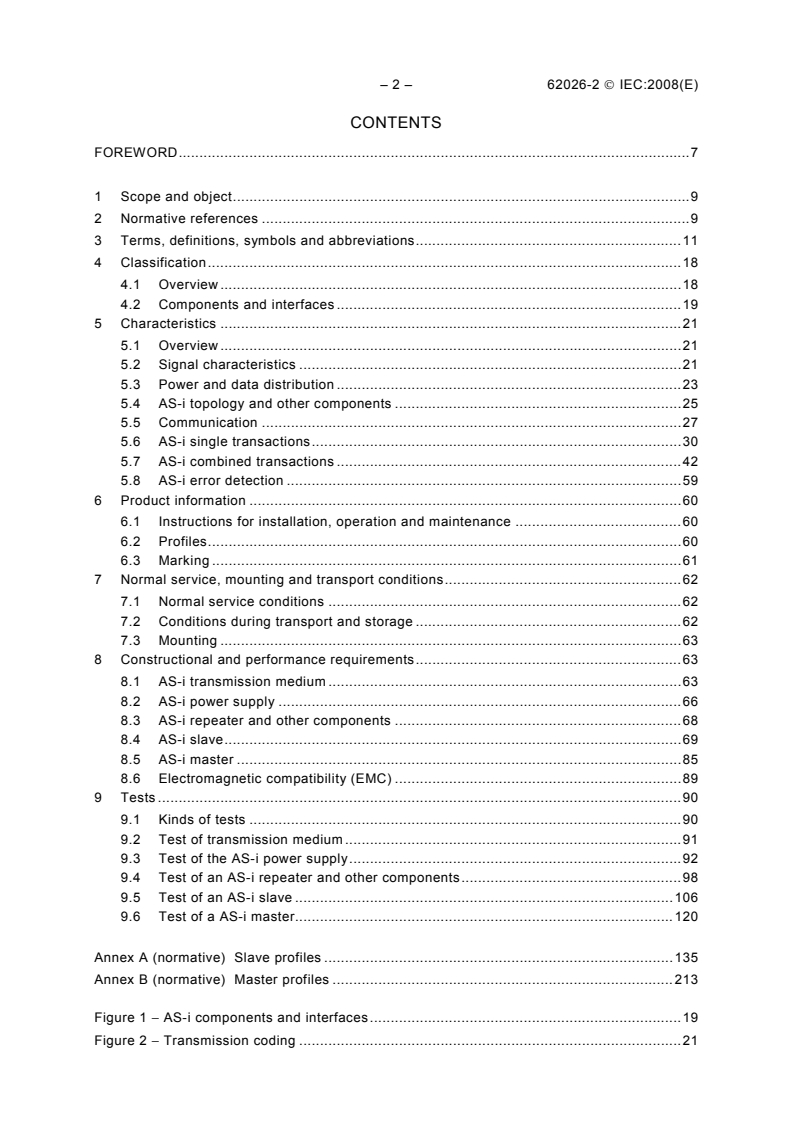
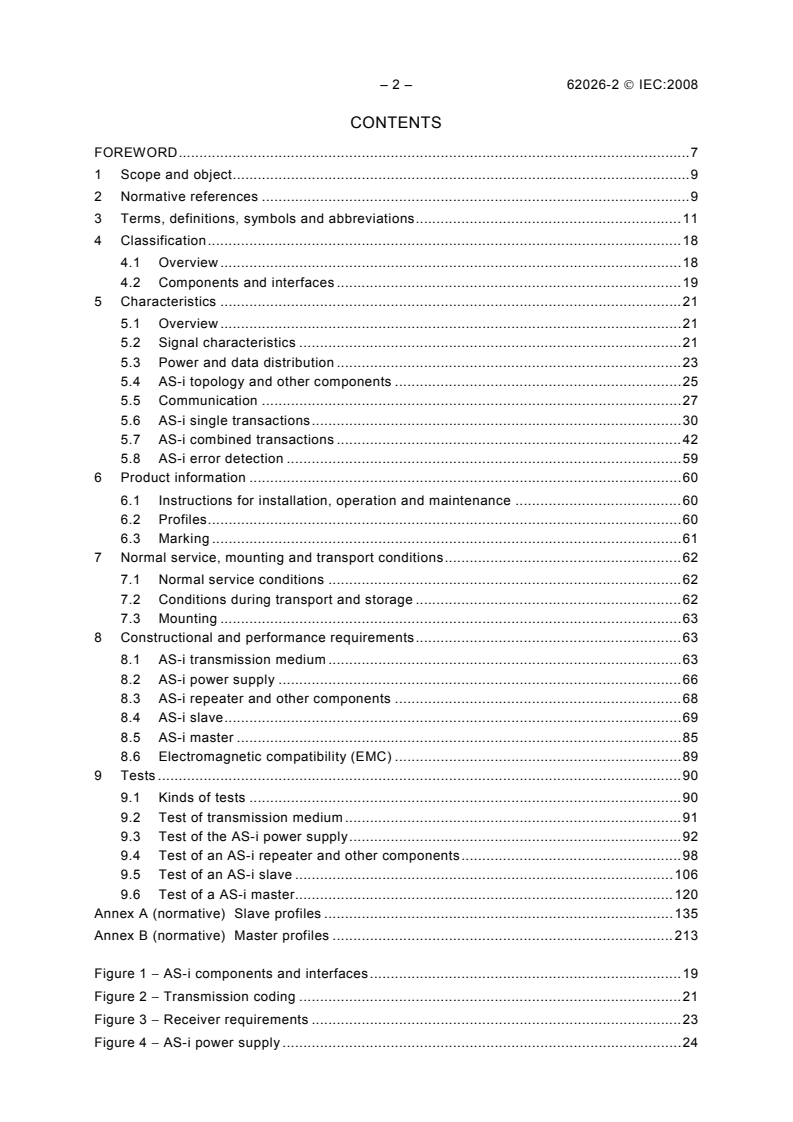
– 2 – 62026-2 © IEC:2008(E)
CONTENTS
FOREWORD.7
1 Scope and object.9
2 Normative references.9
3 Terms, definitions, symbols and abbreviations.11
4 Classification.18
4.1 Overview.18
4.2 Components and interfaces .19
5 Characteristics.21
5.1 Overview.21
5.2 Signal characteristics .21
5.3 Power and data distribution .23
5.4 AS-i topology and other components .25
5.5 Communication.27
5.6 AS-i single transactions.30
5.7 AS-i combined transactions .42
5.8 AS-i error detection .59
6 Product information .60
6.1 Instructions for installation, operation and maintenance .60
6.2 Profiles.60
6.3 Marking.61
7 Normal service, mounting and transport conditions.62
7.1 Normal service conditions .62
7.2 Conditions during transport and storage .62
7.3 Mounting.63
8 Constructional and performance requirements.63
8.1 AS-i transmission medium.63
8.2 AS-i power supply.66
8.3 AS-i repeater and other components .68
8.4 AS-i slave.69
8.5 AS-i master.85
8.6 Electromagnetic compatibility (EMC) .89
9 Tests.90
9.1 Kinds of tests.90
9.2 Test of transmission medium .91
9.3 Test of the AS-i power supply.92
9.4 Test of an AS-i repeater and other components.98
9.5 Test of an AS-i slave .106
9.6 Test of a AS-i master.120
Annex A (normative) Slave profiles .135
Annex B (normative) Master profiles .213
Figure 1 − AS-i components and interfaces.19
Figure 2 − Transmission coding .21
62026-2 © IEC:2008(E) – 3 –
Figure 3 − Receiver requirements .23
Figure 4 − AS-i power supply .24
Figure 5 − Equivalent schematic of symmetrization and decoupling circuit .25
Figure 6 − Model of the AS-i transmission medium.26
Figure 7 − Transactions .28
Figure 8 − Master and slave pause as viewed from master/slave point of view.28
Figure 9 − Representation of the master pause.29
Figure 10 − Structure of a master request .31
Figure 11 − Structure of a slave response.34
Figure 12 − Structure of a data exchange request (top: standard address mode;
bottom: extended address mode) .34
Figure 13 − Structure of the slave response (Data_Exchange) .35
Figure 14 − Structure of the Write_Parameter request (top: standard addressing mode;
bottom: extended addressing mode) .35
Figure 15 − Structure of the slave response (Write_Parameter) .35
Figure 16 − Structure of the Address_Assignment request .36
Figure 17 − Structure of the slave response (Address_Assignment).36
Figure 18 − Structure of the Write_Extended_ID-Code_1 request .36
Figure 19 − Structure of the slave response (Write_Extended_ID-Code_1) .36
Figure 20 − Structure of the Reset_Slave request (top: standard addressing mode;
bottom: extended addressing mode) .37
Figure 21 − Structure of the slave response (Reset_Slave).37
Figure 22 − Structure of the Delete_Address request (top: standard addressing mode;
bottom: extended addressing mode) .37
Figure 23 − Structure of the slave response (Delete_Address).37
Figure 24 – Structure of the Read_I/O_Configuration request top: standard addressing
mode; bottom: extended addressing mode).38
Figure 25 – Structure of the slave response (Read_I/O_Configuration) .38
Figure 26 – Structure of Read_Identification_Code request (top: standard addressing
mode; bottom: extended addressing mode).39
Figure 27 – Structure of the slave response (Read_Identification_Code) .39
Figure 28 – Structure of Read_Extended_ID-Code_1/2 Request (top: standard
addressing mode; bottom: extended addressing mode).
Figure 29 – Structure of the slave response Read_Extended_ID-Code_1/2.40
Figure 30 − Structure of Read_Status request (top: standard addressing mode;
bottom: extended addressing mode) .41
Figure 31 − Structure of the slave response (Read_Status) .41
Figure 32 − Structure of R1 request (top: standard addressing mode; bottom:
extended addressing mode).41
Figure 33 − Structure of the slave response (R1) .41
Figure 34 – Structure of the Broadcast (Reset) request.42
Figure 35 – Definition of the I/O data bits in combined transaction type 1 .43
Figure 36 – Definition of the parameter bits in combined transaction type 1 .43
Figure 37 – Function sequence to Read ID, Read Diagnosis, Read Parameter in
combined transaction type 1 .
– 4 – 62026-2 © IEC:2008(E)
Figure 38 – Function sequence to Write Parameter in combined transaction type 1 .47
Figure 39 – Behaviour of the slave receiving a complete parameter string from the
master in combined transaction type 1.48
Figure 40 – Definition of the I/O data bits in combined transaction type 2 .49
Figure 41 – Typical combined transaction type 2 signals as viewed by an oscilloscope
(both data channels run idle) .50
Figure 42 – Typical combined transaction type 2 signals (the master transmits the byte
10101011 , the slave transmits 01110101 ):.51
Bin Bin
Figure 43 – Definition of the I/O data bits in combined transaction type 3 (4I/4O) .52
Figure 44 – Definition and state diagram of the slave for combined transaction type 3 .53
Figure 45 – Definition of the I/O data bits in combined transaction type 4 .55
Figure 46– AS-i standard cable for field installation .63
Figure 47 − AS-i cabinet cable .64
Figure 48 – Equivalent schematic of decoupling circuit .68
Figure 49 – Decoupling circuit using a transformer .68
Figure 50 – Typical timing diagram for bidirectional input/outputs (D1, . D3 = voltage
level at respective data port).
Figure 51 – Main state diagram of an AS-i slave .73
Figure 52 – Equivalent circuit of a slave for frequencies in the range of 50 kHz to
300 kHz .81
Figure 53 – A slave with C3 to compensate for Z1 = Z2 .82
Figure 54 – Status indication on slaves.84
Figure 55 – Structure of an AS-i master .86
Figure 56 – Impedances of the master .87
Figure 57 – Equivalent circuit of a master for frequencies in the range of 50 kHz to
300 kHz .87
Figure 58 – Transmission control state machine .88
Figure 59 – AS-i interfaces .91
Figure 60 – Test circuit for impedance measurement .92
Figure 61 – Adjustable current sink (test circuit: NT_MODSENKE).93
Figure 62 – Indicator (test circuit NT_IMPSYM) .93
Figure 63 – Display (part of test circuit NT_IMPSYM) .94
Figure 64 – Test set-up for symmetry measurement.94
Figure 65 – Test circuit for noise emission .96
Figure 66 – Filter A (low-pass filter 0 Hz to 10 kHz) .96
Figure 67 – Filter B (bandpass filter 10 kHz to 500 kHz) .96
Figure 68 – Test circuit for start-up behaviour.97
Figure 69 − Measurement set-up for impedance measurement .99
Figure 70 – Test circuit for symmetry measurement .101
Figure 71 – Test circuit (detail 1) .102
Figure 72 – Test circuit (detail 2) .102
Figure 73 – Bandpass (10 kHz . 500 kHz) .102
Figure 74 – Procedure for symmetry test .103
Figure 75 – Test circuit for interoperability in AS-i networks.104
Figure 76 – Additional test circuit 1 for repeater.105
62026-2 © IEC:2008(E) – 5 –
Figure 77 – Additional test circuit 2 for repeater.105
Figure 78 – Test circuit .106
Figure 79 – Test circuit decoupling network .107
Figure 80 – Test circuit .108
Figure 81 – Test circuit decoupling network .108
Figure 82 – Test circuit (equivalent of 10 m AS-i line) .108
Figure 83 – Test circuit (bandpass 10 kHz to 500 kHz) .109
Figure 84 – Test circuit .110
Figure 85 – Constant current source .110
Figure 86 − Test circuit .112
Figure 87 – Test circuit .114
Figure 88 – Test circuit (detail 1) .114
Figure 89 – Test circuit (detail 2) .115
Figure 90 – Procedure for symmetry test .116
Figure 91 – Test circuit AS-i network .117
Figure 92 – Test circuit for safety related slaves .118
Figure 93 – Test circuit for current consumption test.120
Figure 94 – Decoupling network, ammeter and power supply.120
Figure 95 – Test circuit noise emission AS-i master .121
Figure 96 – Decoupling network.122
Figure 97 – Bandpass 10 kHz to 500 kHz .122
Figure 98 – Equivalent circuit of the 10 m AS-i line .122
Figure 99 – Test circuit impedance measurement . 125
Figure 100 – Master connection for symmetry measurement. 126
Figure 101 – Test circuit symmetry measurement of the AS-i master .127
Figure 102 – Bandpass 10 kHz to 500 kHz.127
Figure 103 – Procedure for symmetry test.128
Figure 104 – Test circuit – On-delay .129
Figure 105 – Oscillogram on-delay (example) .129
Figure 106 – Block circuit diagram current consumption measurement of the AS-i
master .
Figure 107 – Constant current source with trigger output (KONST_I) . 130
Figure 108 – Oscillogram current consumption (example) .130
Figure 109 – Test circuit for checking start-up operation .131
Figure 110 – Test circuit for checking normal operation .132
Figure 111 – Test circuit .134
Figure A.1 − Definition of the extended ID2 code bits for S-7.3 .180
Figure A.2 − Definition of the extended ID2 code bits for S-7.4 .184
Figure A.3 − Data structure of the ID string (S-7.4) .189
Figure A.4 − Data structure of the diagnostic string (S-7.4) .193
Figure A.5 − Data structure of the parameter string (S-7.4) .194
Figure A.6 − Definition of the extended ID1 code bits for S-7.A.8 and S-7.A.9.204
Figure A.7 – Connection of mechanical switches . 211
– 6 – 62026-2 © IEC:2008(E)
Table 1 − AS-i power supply specifications .24
Table 2 − Symmetrization and decoupling circuit specifications .25
Table 3 − Bit strings of the master requests .31
Table 4 − Master requests (standard addressing mode) .32
Table 5 − Master requests in the extended addressing mode .33
Table 6 − Bit strings of the slave responses .34
Table 7 − I/O Codes (IN = Input; OUT = Output; TRI = Tristate; I/O = Input/Output or
Bidirectional (B)).39
Table 8 – List of combined transaction types .42
Table 9 – Data transfer from slave to master in combined transaction type 1 .44
Table 10 – Data transfer from master to slave in combined transaction type 1 .44
Table 11 – Definition of serial clock and data in combined transaction type 2 .50
Table 12 – Data transfer in combined transaction type 2.50
Table 13 – Definition of the ID2 code in combined transaction type 5.56
Table 14 – Input states of safety related input slaves.59
Table 15 – Connection and wiring identification .61
Table 16 – AS-i power supply marking .62
Table 17 − Environmental conditions (minimum conditions) .66
Table 18 – General requirements for an AS-i power supply.67
Table 19 – Physical and logical ports of an AS-i slave .70
Table 20 – Limits for R, L and C of the equivalent circuit of a slave .82
Table 21 – Limits for R, L and C of the equivalent circuit of a master .87
Table A.1 – Overview of existing slave profiles for standard slaves.137
Table A.2 – List of existing profiles for standard slaves.137
Table A.3 – Overview of existing slave profiles with extended address . 138
Table A.4 − List of existing profiles for slaves in extended address mode (ID=A) .138
Table A.5 − Profile catalogue of S-7.D profiles.158
Table A.6 – Overview of data of S-7.D profiles.158
Table A.7 – Profile catalogueue of S-7.E profile.163
Table A.8 – Overview of data of S-7.E profiles.163
Table A.9 – Commands for combined transaction type 2.197
Table A.10 – Acyclic write service request (Type 2) .198
Table A.11 − Acyclic read service request (Type 2). 198
Table A.12 − Acyclic write service response (Type 2) . 198
Table A.13 − Acyclic read service response (Type 2) . 198
Table A.14 – List of index 0 (mandatory): ID object (R) .199
Table A.15 − List of index 1 (mandatory): diagnosis object (R).199
62026-2 © IEC:2008(E) – 7 –
INTERNATIONAL ELECTROTECHNICAL COMMISSION
____________
LOW-VOLTAGE SWITCHGEAR AND CONTROLGEAR –
CONTROLLER-DEVICE INTERFACES (CDIs) –
Part 2: Actuator sensor interface (AS-i)
FOREWORD
1) The International Electrotechnical Commission (IEC) is a worldwide organization for standardization comprising
all national electrotechnical committees (IEC National Committees). The object of IEC is to promote
international co-operation on all questions concerning standardization in the electrical and electronic fields. To
this end and in addition to other activities, IEC publishes International Standards, Technical Specifications,
Technical Reports, Publicly Available Specifications (PAS) and Guides (hereafter referred to as “IEC
Publication(s)”). Their preparation is entrusted to technical committees; any IEC National Committee interested
in the subject dealt with may participate in this preparatory work. International, governmental and non-
governmental organizations liaising with the IEC also participate in this preparation. IEC collaborates closely
with the International Organization for Standardization (ISO) in accordance with conditions determined by
agreement between the two organizations.
2) The formal decisions or agreements of IEC on technical matters express, as nearly as possible, an international
consensus of opinion on the relevant subjects since each technical committee has representation from all
interested IEC National Committees.
3) IEC Publications have the form of recommendations for international use and are accepted by IEC National
Committees in that sense. While all reasonable efforts are made to ensure that the technical content of IEC
Publications is accurate, IEC cannot be held responsible for the way in which they are used or for any
misinterpretation by any end user.
4) In order to promote international uniformity, IEC National Committees undertake to apply IEC Publications
transparently to the maximum extent possible in their national and regional publications. Any divergence
between any IEC Publication and the corresponding national or regional publication shall be clearly indicated in
the latter.
5) IEC provides no marking procedure to indicate its approval and cannot be rendered responsible for any
equipment declared to be in conformity with an IEC Publication.
6) All users should ensure that they have the latest edition of this publication.
7) No liability shall attach to IEC or its directors, employees, servants or agents including individual experts and
members of its technical committees and IEC National Committees for any personal injury, property damage or
other damage of any nature whatsoever, whether direct or indirect, or for costs (including legal fees) and
expenses arising out of the publication, use of, or reliance upon, this IEC Publication or any other IEC
Publications.
8) Attention is drawn to the Normative references cited in this publication. Use of the referenced publications is
indispensable for the correct application of this publication.
9) Attention is drawn to the possibility that some of the elements of this IEC Publication may be the subject of
patent rights. IEC shall not be held responsible for identifying any or all such patent rights.
International Standard IEC 62026-2 has been prepared by subcommittee 17B: Low-voltage
switchgear and controlgear, of IEC technical committee 17: Switchgear and controlgear.
This second edition of IEC 62026-2 cancels and replaces the first edition published in 2000.
This second edition constitutes a technical revision.
The main changes with respect to the previous edition are listed below:
• doubling the number of slaves from 31 to 62 by introduction of sub-addresses;
• introduction of AS-I safety system.
The text of this standard is based on the third edition and the following documents:
FDIS Report on voting
17B/1579/FDIS 17B/1584/RVD
Full information on the voting for the approval of this standard can be found in the report on
voting indicated in the above table.
– 8 – 62026-2 © IEC:2008(E)
This publication has been drafted in accordance with the ISO/IEC Directives, Part 2.
A list of all parts in the IEC 62026 series, under the general title Low-voltage switchgear and
controlgear – Controller-device interfaces (CDIs), can be found on the IEC website.
The committee has decided that the contents of this publication will remain unchanged until the
maintenance result date indicated on the IEC web site under “http://webstore.iec.ch” in the data
related to the specific publication. At this date, the publication will be
• reconfirmed;
• withdrawn;
• replaced by a revised edition, or
• amended.
A bilingual version of this publication may be issued at a later date.
62026-2 © IEC:2008(E) – 9 –
LOW-VOLTAGE SWITCHGEAR AND CONTROLGEAR –
CONTROLLER-DEVICE INTERFACES (CDIs) –
Part 2: Actuator sensor interface (AS-i)
1 Scope and object
This part of IEC 62026 specifies a method for communication between a single control device
and switching elements, and establishes a system for the interoperability of components with
the specified communication interfaces. The complete system is called “Actuator Sensor
interface (AS-i)”.
This standard describes a method for connecting switching elements, such as low-voltage
switchgear and controlgear, standardized within IEC 60947, and controlling devices. The
method may also be applied for connecting other devices and elements.
Where inputs and outputs I/O are described in this standard, their meaning is regarding the
master, the meaning regarding the application is the opposite.
The object of this standard is to specify the following requirements for control circuit devices
and switching elements:
− requirements for a transmission system and for interfaces between a slave, a master and
electromechanical structures;
− requirements for a complete interoperability of different devices within any network, when
meeting this standard;
− requirements for an interchangeability of devices within a network, when fulfilling the
profiles of this standard;
− normal service conditions for the slaves, electromechanical devices and master;
− constructional and performance requirements;
− tests to verify conformance to requirements.
2 Normative references
The following referenced documents are indispensable for the application of this document.
For dated references, only the edition cited applies. For undated references, the latest edition
of the referenced document (including any amendments) applies.
IEC 60068-2-6:1995, Environmental testing − Part 2-6: Tests − Test Fc: Vibration (sinusoidal)
IEC 60068-2-27:1987, Environmental testing − Part 2-27: Tests − Test Ea and guidance:
Shock
IEC 60204-1:2005, Safety of machinery – Electrical equipment of machines – Part 1: General
requirements
IEC 60227-2:1997, Polyvinyl chloride insulated cables of rated voltages up to and including
450/750 V – Part 2: Test methods
Amendment 1 (2003)
IEC 60228:2004, Conductors of insulated cables
– 10 – 62026-2 © IEC:2008(E)
IEC 60304:1982, Standard colours for insulation for low-frequency cables and wires
IEC 60352-6:1997, Solderless connections − Part 6: Insulation piercing connections – General
requirements, test methods and practical guidance
IEC 60364-4-41:2005, Low-voltage electrical installations − Part 4-41: Protection for safety −
Protection against electric shock
IEC 60529:1989, Degrees of protection provided by enclosures (IP code)
Amendment 1 (1999)
− Part 1: General rules
IEC 60947-1:2007, Low-voltage switchgear and controlgear
IEC 60947-4-1:2000, Low-voltage switchgear and controlgear − Part 4-1: Contactors and
motor-starters − Electromechanical contactors and motor-starters
Amendment 1 (2002)
Amendment 2 (2005)
IEC 60947-4-2:1999, Low-voltage switchgear and controlgear − Part 4-2: Contactors and
motor-starters − AC semiconductor motor controllers and starters
Amendment 1 (2001)
Amendment 2 (2006)
IEC 60947-5-2:1997, Low-voltage switchgear and controlgear − Part 5-2: Control circuit
devices and switching elements − Proximity switches
Amendment 1 (1999)
Amendment 2 (2003)
IEC 61000-4-2:1995 Electromagnetic compatibility (EMC) – Part 4-2: Testing and
measurement techniques – Electrostatic discharge immunity test
Amendment 1 (1998)
Amendment 2 (2000)
IEC 61000-4-3:2006, Electromagnetic compatibility (EMC) – Part 4-3: Testing and
measurement techniques – Radiated, radio-frequency, electromagnetic field immunity test
IEC 61000-4-4:2004, Electromagnetic compatibility (EMC) – Part 4-4: Testing and
measurement techniques – Electrical fast transient/burst immunity test
IEC 61131-2:2007, Programmable controllers – Part 2: Equipment requirements and tests
IEC 61140:2001, Protection against electric shock – Common aspects for installation and
equipment
Amendment 1 (2004)
IEC 61508 (all parts), Functional safety of electrical/electronic/programmable electronic
safety-related systems
IEC 61800-2:1998, Adjustable speed electrical power drive systems – Part 2: General
requirements – Rating specifications for low-voltage adjustable frequency a.c. power drive
systems
IEC/TS 61915:2003, Low-voltage switchgear and controlgear – Principles for the development
of device profiles for networked industrial devices
62026-2 © IEC:2008(E) – 11 –
IEC 62026-1:2007, Low-voltage switchgear and controlgear – Controller-device interfaces
(CDIs) – Part 1: General rules
CISPR 11:2003, Industrial, scientific and medical (ISM) radio-frequency equipment –
Electromagnetic disturbance characteristics – Limits and methods of measurement
Amendment 1 (2004)
Amendment 2 (2006)
3 Terms, definitions, symbols and abbreviations
For the purposes of this document, the terms, definitions, symbols and abbreviations given in
IEC 62026-1 as well as the following apply.
3.1 Terms and definitions
Alphabetical index of definitions
Reference
A
Active slave .3.1.1
Actuator Sensor interface (AS-i) .3.1.2
Address .3.1.3
Address assignment .3.1.4
Analogue input data image (AIDI) .3.1.5
Analogue output data image (AODI).3.1.6
AS-i cycle .3.1.7
AS-i input.3.1.8
AS-i line.3.1.9
AS-i master. 3.1.10
AS-i network . 3.1.11
AS-i output. 3.1.12
AS-i power supply. 3.1.13
AS-i slave . 3.1.14
B
Bit time (effective). 3.1.15
C
Configuration data (CD) . 3.1.16
Configuration data image (CDI). 3.1.17
Controller. 3.1.18
Controller interface . 3.1.19
D
Data exchange phase . 3.1.20
Decoupling circuit . 3.1.21
Detection phase. 3.1.22
E
Earth fault detector . 3.1.23
Execution control . 3.1.24
Extended addressing mode. 3.1.25
F
Field devices . 3.1.26
I
I/O configuration (I/O code). 3.1.27
Identification code (ID code) . 3.1.28
Input data image (IDI) . 3.1.29
– 12 – 62026-2 © IEC:2008(E)
L
List of activated slaves (LAS). 3.1.30
List of detected slaves (LDS) . 3.1.31
List of peripheral faults (LPF . 3.1.32
List of projected slaves (LPS) . 3.1.33
M
Master . 3.1.34
Master pause. 3.1.35
Master request. 3.1.36
N
Non-volatile stored data. 3.1.37
O
Operation address . 3.1.38
Output current limit . 3.1.39
Output data image (ODI). 3.1.40
P
Parameter image (PI).3.1.41
P-fault.3.1.42
R
Repeater.3.1.43
S
Select bit . 3.1.44
Send pause . 3.1.45
Slave . 3.1.46
Slave pause. 3.1.47
Slave response . 3.1.48
Symmetrizing circuit. 3.1.49
T
Transaction. 3.1.50
Transmission control.
...
IEC 62026-2 ®
Edition 2.1 2019-07
CONSOLIDATED VERSION
INTERNATIONAL
STANDARD
NORME
INTERNATIONALE
colour
inside
Low-voltage switchgear and controlgear – Controller-device interfaces (CDIs) –
Part 2: Actuator sensor interface (AS-i)
Appareillage à basse tension – Interfaces appareil de commande-appareil (CDI) –
Partie 2: Interface capteur-actionneur (AS-i)
All rights reserved. Unless otherwise specified, no part of this publication may be reproduced or utilized in any form
or by any means, electronic or mechanical, including photocopying and microfilm, without permission in writing from
either IEC or IEC's member National Committee in the country of the requester. If you have any questions about IEC
copyright or have an enquiry about obtaining additional rights to this publication, please contact the address below or
your local IEC member National Committee for further information.
Droits de reproduction réservés. Sauf indication contraire, aucune partie de cette publication ne peut être reproduite
ni utilisée sous quelque forme que ce soit et par aucun procédé, électronique ou mécanique, y compris la photocopie
et les microfilms, sans l'accord écrit de l'IEC ou du Comité national de l'IEC du pays du demandeur. Si vous avez des
questions sur le copyright de l'IEC ou si vous désirez obtenir des droits supplémentaires sur cette publication, utilisez
les coordonnées ci-après ou contactez le Comité national de l'IEC de votre pays de résidence.
IEC Central Office Tel.: +41 22 919 02 11
3, rue de Varembé info@iec.ch
CH-1211 Geneva 20 www.iec.ch
Switzerland
About the IEC
The International Electrotechnical Commission (IEC) is the leading global organization that prepares and publishes
International Standards for all electrical, electronic and related technologies.
About IEC publications
The technical content of IEC publications is kept under constant review by the IEC. Please make sure that you have the
latest edition, a corrigendum or an amendment might have been published.
IEC publications search - webstore.iec.ch/advsearchform Electropedia - www.electropedia.org
The advanced search enables to find IEC publications by a The world's leading online dictionary on electrotechnology,
variety of criteria (reference number, text, technical containing more than 22 000 terminological entries in English
committee,…). It also gives information on projects, replaced and French, with equivalent terms in 16 additional languages.
and withdrawn publications. Also known as the International Electrotechnical Vocabulary
(IEV) online.
IEC Just Published - webstore.iec.ch/justpublished
Stay up to date on all new IEC publications. Just Published IEC Glossary - std.iec.ch/glossary
details all new publications released. Available online and 67 000 electrotechnical terminology entries in English and
once a month by email. French extracted from the Terms and Definitions clause of
IEC publications issued since 2002. Some entries have been
IEC Customer Service Centre - webstore.iec.ch/csc collected from earlier publications of IEC TC 37, 77, 86 and
If you wish to give us your feedback on this publication or CISPR.
need further assistance, please contact the Customer Service
Centre: sales@iec.ch.
A propos de l'IEC
La Commission Electrotechnique Internationale (IEC) est la première organisation mondiale qui élabore et publie des
Normes internationales pour tout ce qui a trait à l'électricité, à l'électronique et aux technologies apparentées.
A propos des publications IEC
Le contenu technique des publications IEC est constamment revu. Veuillez vous assurer que vous possédez l’édition la
plus récente, un corrigendum ou amendement peut avoir été publié.
Recherche de publications IEC - Electropedia - www.electropedia.org
webstore.iec.ch/advsearchform Le premier dictionnaire d'électrotechnologie en ligne au
La recherche avancée permet de trouver des publications IEC monde, avec plus de 22 000 articles terminologiques en
en utilisant différents critères (numéro de référence, texte, anglais et en français, ainsi que les termes équivalents dans
comité d’études,…). Elle donne aussi des informations sur les 16 langues additionnelles. Egalement appelé Vocabulaire
projets et les publications remplacées ou retirées. Electrotechnique International (IEV) en ligne.
IEC Just Published - webstore.iec.ch/justpublished Glossaire IEC - std.iec.ch/glossary
Restez informé sur les nouvelles publications IEC. Just 67 000 entrées terminologiques électrotechniques, en anglais
Published détaille les nouvelles publications parues. et en français, extraites des articles Termes et Définitions des
Disponible en ligne et une fois par mois par email. publications IEC parues depuis 2002. Plus certaines entrées
antérieures extraites des publications des CE 37, 77, 86 et
Service Clients - webstore.iec.ch/csc CISPR de l'IEC.
Si vous désirez nous donner des commentaires sur cette
publication ou si vous avez des questions contactez-nous:
sales@iec.ch.
IEC 62026-2 ®
Edition 2.1 2019-07
CONSOLIDATED VERSION
INTERNATIONAL
STANDARD
NORME
INTERNATIONALE
colour
inside
Low-voltage switchgear and controlgear – Controller-device interfaces (CDIs) –
Part 2: Actuator sensor interface (AS-i)
Appareillage à basse tension – Interfaces appareil de commande-appareil (CDI) –
Partie 2: Interface capteur-actionneur (AS-i)
INTERNATIONAL
ELECTROTECHNICAL
COMMISSION
COMMISSION
ELECTROTECHNIQUE
INTERNATIONALE
ICS 29.130.20 ISBN 978-2-8322-7176-6
IEC 62026-2 ®
Edition 2.1 2019-07
CONSOLIDATED VERSION
REDLINE VERSION
VERSION REDLINE
colour
inside
Low-voltage switchgear and controlgear – Controller-device interfaces (CDIs) –
Part 2: Actuator sensor interface (AS-i)
Appareillage à basse tension – Interfaces appareil de commande-appareil (CDI) –
Partie 2: Interface capteur-actionneur (AS-i)
– 2 – IEC 62026-2:2008+AMD1:2019 CSV
IEC 2019
CONTENTS
FOREWORD . 7
1 Scope and object . 9
2 Normative references . 9
3 Terms, definitions, symbols and abbreviations . 11
4 Classification . 18
5 Characteristics . 21
6 Product information . 60
7 Normal service, mounting and transport conditions . 62
8 Constructional and performance requirements . 63
9 Tests . 90
Annex A (normative) Slave profiles . 135
Annex B (normative) Master profiles . 213
Figure 1 − AS-i components and interfaces . 19
Figure 2 − Transmission coding . 21
Figure 3 − Receiver requirements . 23
Figure 4 − AS-i power supply . 24
Figure 5 − Equivalent schematic of symmetrization and decoupling circuit . 25
Figure 6 − Model of the AS-i transmission medium . 26
Figure 7 − Transactions . 28
Figure 8 − Master and slave pause as viewed from master/slave point of view . 28
Figure 9 − Representation of the master pause . 29
Figure 10 − Structure of a master request . 31
Figure 11 − Structure of a slave response . 34
Figure 12 − Structure of a data exchange request (top: standard address mode;
bottom: extended address mode) . 34
Figure 13 − Structure of the slave response (Data_Exchange) . 35
Figure 14 − Structure of the Write_Parameter request (top: standard addressing mode;
bottom: extended addressing mode) . 35
Figure 15 − Structure of the slave response (Write_Parameter) . 35
Figure 16 − Structure of the Address_Assignment request . 36
Figure 17 − Structure of the slave response (Address_Assignment) . 36
Figure 18 − Structure of the Write_Extended_ID-Code_1 request . 36
Figure 19 − Structure of the slave response (Write_Extended_ID-Code_1) . 36
Figure 20 − Structure of the Reset_Slave request (top: standard addressing mode;
bottom: extended addressing mode) . 37
Figure 21 − Structure of the slave response (Reset_Slave) . 37
Figure 22 − Structure of the Delete_Address request (top: standard addressing mode;
bottom: extended addressing mode) . 37
Figure 23 − Structure of the slave response (Delete_Address) . 37
Figure 24 – Structure of the Read_I/O_Configuration request (top: standard
addressing mode; bottom: extended addressing mode) . 38
IEC 2019
Figure 25 – Structure of the slave response (Read_I/O_Configuration) . 38
Figure 26 – Structure of Read_Identification_Code request (top: standard addressing
mode; bottom: extended addressing mode) . 39
Figure 27 – Structure of the slave response (Read_Identification_Code) . 39
Figure 28 – Structure of Read_Extended_ID-Code_1/2 Request (top: standard
addressing mode; bottom: extended addressing mode) . 40
Figure 29 – Structure of the slave response Read_Extended_ID-Code_1/2 . 40
Figure 30 − Structure of Read_Status request (top: standard addressing mode;
bottom: extended addressing mode) . 41
Figure 31 − Structure of the slave response (Read_Status) . 41
Figure 32 − Structure of R1 request (top: standard addressing mode; bottom:
extended addressing mode) . 41
Figure 33 − Structure of the slave response (R1) . 41
Figure 34 – Structure of the Broadcast (Reset) request . 42
Figure 35 – Definition of the I/O data bits in combined transaction type 1 . 43
Figure 36 – Definition of the parameter bits in combined transaction type 1 . 43
Figure 37 – Function sequence to Read ID, Read Diagnosis, Read Parameter in
combined transaction type 1 . 46
Figure 38 – Function sequence to Write Parameter in combined transaction type 1 . 47
Figure 39 – Behaviour of the slave receiving a complete parameter string from the
master in combined transaction type 1 . 48
Figure 40 – Definition of the I/O data bits in combined transaction type 2 . 49
Figure 41 – Typical combined transaction type 2 signals as viewed by an oscilloscope
(both data channels run idle) . 50
Figure 42 – Typical combined transaction type 2 signals (the master transmits the byte
10101011 , the slave transmits 01110101 ): . 51
Bin Bin
Figure 43 – Definition of the I/O data bits in combined transaction type 3 (4I/4O) . 52
Figure 44 – Definition and state diagram of the slave for combined transaction type 3 . 53
Figure 45 – Definition of the I/O data bits in combined transaction type 4 . 55
Figure 46 – AS-i standard cable for field installation . 63
Figure 47 − AS-i cabinet cable . 64
Figure 48 – Equivalent schematic of decoupling circuit . 68
Figure 49 – Decoupling circuit using a transformer . 68
Figure 50 – Typical timing diagram for bidirectional input/outputs (D1, . D3 = voltage
level at respective data port) . 70
Figure 51 – Main state diagram of an AS-i slave . 73
Figure 52 – Equivalent circuit of a slave for frequencies in the range of 50 kHz to
300 kHz . 81
Figure 53 – A slave with C3 to compensate for Z1 = Z2 . 82
Figure 54 – Status indication on slaves . 84
Figure 55 – Structure of an AS-i master . 86
Figure 56 – Impedances of the master . 87
Figure 57 – Equivalent circuit of a master for frequencies in the range of 50 kHz to
300 kHz . 87
Figure 58 – Transmission control state machine . 88
Figure 59 – AS-i interfaces . 91
– 4 – IEC 62026-2:2008+AMD1:2019 CSV
IEC 2019
Figure 60 – Test circuit for impedance measurement . 92
Figure 61 – Adjustable current sink (test circuit: NT_MODSENKE). 93
Figure 62 – Indicator (test circuit NT_IMPSYM) . 93
Figure 63 – Display (part of test circuit NT_IMPSYM) . 94
Figure 64 – Test set-up for symmetry measurement . 94
Figure 65 – Test circuit for noise emission . 96
Figure 66 – Filter A (low-pass filter 0 Hz to 10 kHz) . 96
Figure 67 – Filter B (bandpass filter 10 kHz to 500 kHz) . 96
Figure 68 – Test circuit for start-up behaviour . 97
Figure 69 − Measurement set-up for impedance measurement . 99
Figure 70 – Test circuit for symmetry measurement . 101
Figure 71 – Test circuit (detail 1) . 102
Figure 72 – Test circuit (detail 2) . 102
Figure 73 – Bandpass (10 kHz . 500 kHz) . 102
Figure 74 – Procedure for symmetry test . 103
Figure 75 – Test circuit for interoperability in AS-i networks . 104
Figure 76 – Additional test circuit 1 for repeater . 105
Figure 77 – Additional test circuit 2 for repeater . 105
Figure 78 – Test circuit . 106
Figure 79 – Test circuit decoupling network . 107
Figure 80 – Test circuit . 108
Figure 81 – Test circuit decoupling network . 108
Figure 82 – Test circuit (equivalent of 10 m AS-i line) . 108
Figure 83 – Test circuit (bandpass 10 kHz to 500 kHz) . 109
Figure 84 – Test circuit . 110
Figure 85 – Constant current source . 110
Figure 86 − Test circuit . 112
Figure 87 – Test circuit . 114
Figure 88 – Test circuit (detail 1) . 114
Figure 89 – Test circuit (detail 2) . 115
Figure 90 – Procedure for symmetry test . 116
Figure 91 – Test circuit AS-i network . 117
Figure 92 – Test circuit for safety related slaves . 118
Figure 93 – Test circuit for current consumption test . 120
Figure 94 – Decoupling network, ammeter and power supply . 121
Figure 95 – Test circuit noise emission AS-i master . 122
Figure 96 – Decoupling network . 122
Figure 97 – Bandpass 10 kHz to 500 kHz . 122
Figure 98 – Equivalent circuit of the 10 m AS-i line . 122
Figure 99 – Test circuit impedance measurement . 125
Figure 100 – Master connection for symmetry measurement . 126
Figure 101 – Test circuit symmetry measurement of the AS-i master . 127
Figure 102 – Bandpass 10 kHz to 500 kHz . 127
IEC 2019
Figure 103 – Procedure for symmetry test. 128
Figure 104 – Test circuit – On-delay . 129
Figure 105 – Oscillogram on-delay (example) . 129
Figure 106 – Block circuit diagram current consumption measurement of the AS-i
master . 130
Figure 107 – Constant current source with trigger output (KONST_I) . 130
Figure 108 – Oscillogram current consumption (example) . 130
Figure 109 – Test circuit for checking start-up operation . 131
Figure 110 – Test circuit for checking normal operation . 132
Figure 111 – Test circuit . 134
Figure A.1 − Definition of the extended ID2 code bits for S-7.3 . 180
Figure A.2 − Definition of the extended ID2 code bits for S-7.4 . 184
Figure A.3 − Data structure of the ID string (S-7.4) . 189
Figure A.4 − Data structure of the diagnostic string (S-7.4) . 193
Figure A.5 − Data structure of the parameter string (S-7.4) . 194
Figure A.6 − Definition of the extended ID1 code bits for S-7.A.8 and S-7.A.9 . 204
Figure A.7 – Connection of mechanical switches . 211
Table 1 − AS-i power supply specifications . 24
Table 2 − Symmetrization and decoupling circuit specifications . 25
Table 3 − Bit strings of the master requests . 31
Table 4 − Master requests (standard addressing mode) . 32
Table 5 − Master requests in the extended addressing mode . 33
Table 6 − Bit strings of the slave responses . 34
Table 7 − I/O Codes (IN = Input; OUT = Output; TRI = Tristate; I/O = Input/Output or
Bidirectional (B)) . 39
Table 8 – List of combined transaction types . 42
Table 9 – Data transfer from slave to master in combined transaction type 1 . 44
Table 10 – Data transfer from master to slave in combined transaction type 1 . 44
Table 11 – Definition of serial clock and data in combined transaction type 2 . 50
Table 12 – Data transfer in combined transaction type 2 . 50
Table 13 – Definition of the ID2 code in combined transaction type 5 . 56
Table 14 – Input states of safety related input slaves . 59
Table 15 – Connection and wiring identification . 61
Table 16 – AS-i power supply marking . 62
Table 17 − Environmental conditions (minimum conditions) . 66
Table 18 – General requirements for an AS-i power supply . 67
Table 19 – Physical and logical ports of an AS-i slave . 70
Table 20 – Limits for R, L and C of the equivalent circuit of a slave . 82
Table 21 – Limits for R, L and C of the equivalent circuit of a master . 87
Table A.1 – Overview of existing slave profiles for standard slaves . 137
Table A.2 – List of existing profiles for standard slaves . 137
Table A.3 – Overview of existing slave profiles with extended address . 138
– 6 – IEC 62026-2:2008+AMD1:2019 CSV
IEC 2019
Table A.4 − List of existing profiles for slaves in extended address mode (ID=A) . 138
Table A.5 − Profile catalogue of S-7.D profiles . 158
Table A.6 – Overview of data of S-7.D profiles . 158
Table A.7 – Profile catalogueue of S-7.E profile . 163
Table A.8 – Overview of data of S-7.E profiles . 163
Table A.9 – Commands for combined transaction type 2 . 197
Table A.10 – Acyclic write service request (Type 2) . 198
Table A.11 − Acyclic read service request (Type 2) . 198
Table A.12 − Acyclic write service response (Type 2) . 198
Table A.13 − Acyclic read service response (Type 2) . 198
Table A.14 – List of index 0 (mandatory): ID object (R) . 199
Table A.15 − List of index 1 (mandatory): diagnosis object (R) . 199
IEC 2019
INTERNATIONAL ELECTROTECHNICAL COMMISSION
______________
LOW-VOLTAGE SWITCHGEAR AND CONTROLGEAR –
CONTROLLER-DEVICE INTERFACES (CDIs) –
Part 2: Actuator sensor interface (AS-i)
FOREWORD
1) The International Electrotechnical Commission (IEC) is a worldwide organization for standardization comprising
all national electrotechnical committees (IEC National Committees). The object of IEC is to promote
international co-operation on all questions concerning standardization in the electrical and electronic fields. To
this end and in addition to other activities, IEC publishes International Standards, Technical Specifications,
Technical Reports, Publicly Available Specifications (PAS) and Guides (hereafter referred to as “IEC
Publication(s)”). Their preparation is entrusted to technical committees; any IEC National Committee interested
in the subject dealt with may participate in this preparatory work. International, governmental and non-
governmental organizations liaising with the IEC also participate in this preparation. IEC collaborates closely
with the International Organization for Standardization (ISO) in accordance with conditions determined by
agreement between the two organizations.
2) The formal decisions or agreements of IEC on technical matters express, as nearly as possible, an international
consensus of opinion on the relevant subjects since each technical committee has representation from all
interested IEC National Committees.
3) IEC Publications have the form of recommendations for international use and are accepted by IEC National
Committees in that sense. While all reasonable efforts are made to ensure that the technical content of IEC
Publications is accurate, IEC cannot be held responsible for the way in which they are used or for any
misinterpretation by any end user.
4) In order to promote international uniformity, IEC National Committees undertake to apply IEC Publications
transparently to the maximum extent possible in their national and regional publications. Any divergence
between any IEC Publication and the corresponding national or regional publication shall be clearly indicated in
the latter.
5) IEC itself does not provide any attestation of conformity. Independent certification bodies provide conformity
assessment services and, in some areas, access to IEC marks of conformity. IEC is not responsible for any
services carried out by independent certification bodies.
6) All users should ensure that they have the latest edition of this publication.
7) No liability shall attach to IEC or its directors, employees, servants or agents including individual experts and
members of its technical committees and IEC National Committees for any personal injury, property damage or
other damage of any nature whatsoever, whether direct or indirect, or for costs (including legal fees) and
expenses arising out of the publication, use of, or reliance upon, this IEC Publication or any other IEC
Publications.
8) Attention is drawn to the Normative references cited in this publication. Use of the referenced publications is
indispensable for the correct application of this publication.
9) Attention is drawn to the possibility that some of the elements of this IEC Publication may be the subject of
patent rights. IEC shall not be held responsible for identifying any or all such patent rights.
This consolidated version of the official IEC Standard and its amendment has been
prepared for user convenience.
IEC 62026-2 edition 2.1 contains the second edition (2008-01) [documents 17B/1579/FDIS
and 17B/1584/RVD] and its amendment 1 (2019-07) [documents 121A/297/FDIS and
121A/304/RVD].
In this Redline version, a vertical line in the margin shows where the technical content
is modified by amendment 1. Additions are in green text, deletions are in strikethrough
red text. A separate Final version with all changes accepted is available in this
publication.
– 8 – IEC 62026-2:2008+AMD1:2019 CSV
IEC 2019
International Standard IEC 62026-2 has been prepared by subcommittee 17B: Low-voltage
switchgear and controlgear, of IEC technical committee 17: Switchgear and controlgear.
This second edition constitutes a technical revision.
The main changes with respect to the previous edition are listed below:
• doubling the number of slaves from 31 to 62 by introduction of sub-addresses;
• introduction of AS-I safety system.
This publication has been drafted in accordance with the ISO/IEC Directives, Part 2.
A list of all parts in the IEC 62026 series, under the general title Low-voltage switchgear and
controlgear – Controller-device interfaces (CDIs), can be found on the IEC website.
The committee has decided that the contents of the base publication and its amendment will
remain unchanged until the stability date indicated on the IEC web site under
"http://webstore.iec.ch" in the data related to the specific publication. At this date, the
publication will be
• reconfirmed,
• withdrawn,
• replaced by a revised edition, or
• amended.
IMPORTANT – The 'colour inside' logo on the cover page of this publication indicates
that it contains colours which are considered to be useful for the correct
understanding of its contents. Users should therefore print this document using a
colour printer.
IEC 2019
LOW-VOLTAGE SWITCHGEAR AND CONTROLGEAR –
CONTROLLER-DEVICE INTERFACES (CDIs) –
Part 2: Actuator sensor interface (AS-i)
1 Scope and object
This part of IEC 62026 specifies a method for communication between a single control device
and switching elements, and establishes a system for the interoperability of components with
the specified communication interfaces. The complete system is called “Actuator Sensor
interface (AS-i)”.
This standard describes a method for connecting switching elements, such as low-voltage
switchgear and controlgear, standardized within IEC 60947, and controlling devices. The
method may also be applied for connecting other devices and elements.
Where inputs and outputs I/O are described in this standard, their meaning is regarding the
master, the meaning regarding the application is the opposite.
The object of this standard is to specify the following requirements for control circuit devices
and switching elements:
− requirements for a transmission system and for interfaces between a slave, a master and
electromechanical structures;
− requirements for a complete interoperability of different devices within any network, when
meeting this standard;
− requirements for an interchangeability of devices within a network, when fulfilling the
profiles of this standard;
− normal service conditions for the slaves, electromechanical devices and master;
− constructional and performance requirements;
− tests to verify conformance to requirements.
2 Normative references
The following referenced documents are indispensable for the application of this document.
For dated references, only the edition cited applies. For undated references, the latest edition
of the referenced document (including any amendments) applies.
IEC 60068-2-6:1995, Environmental testing − Part 2-6: Tests − Test Fc: Vibration (sinusoidal)
IEC 60068-2-27:1987, Environmental testing − Part 2-27: Tests − Test Ea and guidance:
Shock
IEC 60204-1:20052016, Safety of machinery – Electrical equipment of machines – Part 1:
General requirements
IEC 60227-2:1997, Polyvinyl chloride insulated cables of rated voltages up to and including
450/750 V – Part 2: Test methods
Amendment 1 (2003)
IEC 60228:2004, Conductors of insulated cables
– 10 – IEC 62026-2:2008+AMD1:2019 CSV
IEC 2019
IEC 60304:1982, Standard colours for insulation for low-frequency cables and wires
IEC 60352-6:1997, Solderless connections − Part 6: Insulation piercing connections – General
requirements, test methods and practical guidance
IEC 60364-4-41:2005, Low-voltage electrical installations − Part 4-41: Protection for safety −
Protection against electric shock
IEC 60529:1989, Degrees of protection provided by enclosures (IP code)
Amendment 1 (1999)
IEC 60947-1:2007, Low-voltage switchgear and controlgear − Part 1: General rules
IEC 60947-1:2007/AMD1:2010
IEC 60947-4-1:20002018, Low-voltage switchgear and controlgear − Part 4-1: Contactors and
motor-starters − Electromechanical contactors and motor-starters
Amendment 1 (2002)
Amendment 2 (2005)
IEC 60947-4-2:19992011, Low-voltage switchgear and controlgear − Part 4-2: Contactors and
motor-starters − AC semiconductor motor controllers and starters
Amendment 1 (2001)
Amendment 2 (2006)
IEC 60947-5-2:19972007, Low-voltage switchgear and controlgear − Part 5-2: Control circuit
devices and switching elements − Proximity switches
Amendment 1 (1999)
Amendment 2 (2003)
IEC 60947-5-2:2007/AMD1:2012
IEC 61000-4-2:19952008, Electromagnetic compatibility (EMC) – Part 4-2: Testing and
measurement techniques – Electrostatic discharge immunity test
Amendment 1 (1998)
Amendment 2 (2000)
IEC 61000-4-3:2006, Electromagnetic compatibility (EMC) – Part 4-3: Testing and
measurement techniques – Radiated, radio-frequency, electromagnetic field immunity test
IEC 61000-4-3:2006/AMD1:2007
IEC 61000-4-3:2006/AMD2:2010
IEC 61000-4-4:20042012, Electromagnetic compatibility (EMC) – Part 4-4: Testing and
measurement techniques – Electrical fast transient/burst immunity test
IEC 61000-4-6:2013, Electromagnetic compatibility (EMC) – Part 4-6: Testing and
measurement techniques – Immunity to conducted disturbances, induced by radio-frequency
fields
IEC 61131-2:2007, Industrial-process measurement and control – Programmable controllers –
Part 2: Equipment requirements and tests
IEC 61140:2001, Protection against electric shock – Common aspects for installation and
equipment
Amendment 1 (2004)
IEC 61508 (all parts), Functional safety of electrical/electronic/programmable electronic
safety-related systems
IEC 2019
IEC 61800-2:1998, Adjustable speed electrical power drive systems – Part 2: General
requirements – Rating specifications for low -voltage adjustable frequency speed a.c. power
drive systems
IEC/TS 61915:2003, Low-voltage switchgear and controlgear – Principles for the development
of device profiles for networked industrial devices
IEC 61915 (all parts), Low-voltage switchgear and controlgear – Device profiles for networked
industrial devices
IEC 62026-1:2007, Low-voltage switchgear and controlgear – Controller-device interfaces
(CDIs) – Part 1: General rules
CISPR 11:2003, Industrial, scientific and medical (ISM) radio-frequency equipment –
Electromagnetic disturbance characteristics – Limits and methods of measurement
Amendment 1 (2004)
Amendment 2 (2006)
CISPR 11:2015, Industrial, scientific and medical (ISM) equipment – Radio-frequency
disturbance characteristics – Limits and methods of measurement
CISPR 11:2015/AMD1:2016
3 Terms, definitions, symbols and abbreviations
For the purposes of this document, the terms, definitions, symbols and abbreviations given in
IEC 62026-1 as well as the following apply.
3.1 Terms and definitions
Alphabetical index of definitions
Reference
A
Active slave . 3.1.1
Actuator Sensor interface (AS-i) . 3.1.2
Address . 3.1.3
Address assignment . 3.1.4
Analogue input data image (AIDI) . 3.1.5
Analogue output data image (AODI) . 3.1.6
AS-i cycle . 3.1.7
AS-i input . 3.1.8
AS-i line . 3.1.9
AS-i master . 3.1.10
AS-i network . 3.1.11
AS-i output. 3.1.12
AS-i power supply . 3.1.13
AS-i slave . 3.1.14
B
Bit time (effective) . 3.1.15
C
Configuration data (CD) . 3.1.16
Configuration data image (CDI) . 3.1.17
Controller . 3.1.18
Controller interface . 3.1.19
D
Data exchange phase . 3.1.20
Decoupling circuit . 3.1.21
Detection phase . 3.1.22
– 12 – IEC 62026-2:2008+AMD1:2019 CSV
IEC 2019
E
Earth fault detector . 3.1.23
Execution control . 3.1.24
Extended addressing mode . 3.1.25
F
Field devices . 3.1.26
I
I/O configuration (I/O code). 3.1.27
Identification code (ID code) . 3.1.28
Input data image (IDI) . 3.1.29
L
List of activated slaves (LAS) . 3.1.30
List of detected slaves (LDS) . 3.1.31
List of peripheral faults (LPF . 3.1.32
List of projected slaves (LPS) . 3.1.33
M
Master . 3.1.34
Master pause .
...
IEC 62026-2 ®
Edition 2.0 2008-01
INTERNATIONAL
STANDARD
NORME
INTERNATIONALE
Low-voltage switchgear and controlgear – Controller-device interfaces (CDIs) –
Part 2: Actuator sensor interface (AS-i)
Appareillage à basse tension – Interfaces appareil de commande-appareil (CDI) –
Partie 2: Interface capteur-actionneur (AS-i)
All rights reserved. Unless otherwise specified, no part of this publication may be reproduced or utilized in any form or by
any means, electronic or mechanical, including photocopying and microfilm, without permission in writing from either IEC or
IEC's member National Committee in the country of the requester.
If you have any questions about IEC copyright or have an enquiry about obtaining additional rights to this publication,
please contact the address below or your local IEC member National Committee for further information.
Droits de reproduction réservés. Sauf indication contraire, aucune partie de cette publication ne peut être reproduite
ni utilisée sous quelque forme que ce soit et par aucun procédé, électronique ou mécanique, y compris la photocopie
et les microfilms, sans l'accord écrit de la CEI ou du Comité national de la CEI du pays du demandeur.
Si vous avez des questions sur le copyright de la CEI ou si vous désirez obtenir des droits supplémentaires sur cette
publication, utilisez les coordonnées ci-après ou contactez le Comité national de la CEI de votre pays de résidence.
IEC Central Office
3, rue de Varembé
CH-1211 Geneva 20
Switzerland
Email: inmail@iec.ch
Web: www.iec.ch
About the IEC
The International Electrotechnical Commission (IEC) is the leading global organization that prepares and publishes
International Standards for all electrical, electronic and related technologies.
About IEC publications
The technical content of IEC publications is kept under constant review by the IEC. Please make sure that you have the
latest edition, a corrigenda or an amendment might have been published.
ƒ Catalogue of IEC publications: www.iec.ch/searchpub
The IEC on-line Catalogue enables you to search by a variety of criteria (reference number, text, technical committee,…).
It also gives information on projects, withdrawn and replaced publications.
ƒ IEC Just Published: www.iec.ch/online_news/justpub
Stay up to date on all new IEC publications. Just Published details twice a month all new publications released. Available
on-line and also by email.
ƒ Electropedia: www.electropedia.org
The world's leading online dictionary of electronic and electrical terms containing more than 20 000 terms and definitions
in English and French, with equivalent terms in additional languages. Also known as the International Electrotechnical
Vocabulary online.
ƒ Customer Service Centre: www.iec.ch/webstore/custserv
If you wish to give us your feedback on this publication or need further assistance, please visit the Customer Service
Centre FAQ or contact us:
Email: csc@iec.ch
Tel.: +41 22 919 02 11
Fax: +41 22 919 03 00
A propos de la CEI
La Commission Electrotechnique Internationale (CEI) est la première organisation mondiale qui élabore et publie des
normes internationales pour tout ce qui a trait à l'électricité, à l'électronique et aux technologies apparentées.
A propos des publications CEI
Le contenu technique des publications de la CEI est constamment revu. Veuillez vous assurer que vous possédez
l’édition la plus récente, un corrigendum ou amendement peut avoir été publié.
ƒ Catalogue des publications de la CEI: www.iec.ch/searchpub/cur_fut-f.htm
Le Catalogue en-ligne de la CEI vous permet d’effectuer des recherches en utilisant différents critères (numéro de référence,
texte, comité d’études,…). Il donne aussi des informations sur les projets et les publications retirées ou remplacées.
ƒ Just Published CEI: www.iec.ch/online_news/justpub
Restez informé sur les nouvelles publications de la CEI. Just Published détaille deux fois par mois les nouvelles
publications parues. Disponible en-ligne et aussi par email.
ƒ Electropedia: www.electropedia.org
Le premier dictionnaire en ligne au monde de termes électroniques et électriques. Il contient plus de 20 000 termes et
définitions en anglais et en français, ainsi que les termes équivalents dans les langues additionnelles. Egalement appelé
Vocabulaire Electrotechnique International en ligne.
ƒ Service Clients: www.iec.ch/webstore/custserv/custserv_entry-f.htm
Si vous désirez nous donner des commentaires sur cette publication ou si vous avez des questions, visitez le FAQ du
Service clients ou contactez-nous:
Email: csc@iec.ch
Tél.: +41 22 919 02 11
Fax: +41 22 919 03 00
IEC 62026-2 ®
Edition 2.0 2008-01
INTERNATIONAL
STANDARD
NORME
INTERNATIONALE
Low-voltage switchgear and controlgear – Controller-device interfaces (CDIs) –
Part 2: Actuator sensor interface (AS-i)
Appareillage à basse tension – Interfaces appareil de commande-appareil (CDI) –
Partie 2: Interface capteur-actionneur (AS-i)
INTERNATIONAL
ELECTROTECHNICAL
COMMISSION
COMMISSION
ELECTROTECHNIQUE
PRICE CODE
INTERNATIONALE
XH
CODE PRIX
ICS 29.130.20 ISBN 978-2-88910-609-7
– 2 – 62026-2 © IEC:2008
CONTENTS
FOREWORD.7
1 Scope and object.9
2 Normative references.9
3 Terms, definitions, symbols and abbreviations.11
4 Classification.18
4.1 Overview.18
4.2 Components and interfaces .19
5 Characteristics.21
5.1 Overview.21
5.2 Signal characteristics .21
5.3 Power and data distribution .23
5.4 AS-i topology and other components .25
5.5 Communication.27
5.6 AS-i single transactions.30
5.7 AS-i combined transactions .42
5.8 AS-i error detection .59
6 Product information .60
6.1 Instructions for installation, operation and maintenance .60
6.2 Profiles.60
6.3 Marking.61
7 Normal service, mounting and transport conditions.62
7.1 Normal service conditions .62
7.2 Conditions during transport and storage .62
7.3 Mounting.63
8 Constructional and performance requirements.63
8.1 AS-i transmission medium.63
8.2 AS-i power supply.66
8.3 AS-i repeater and other components .68
8.4 AS-i slave.69
8.5 AS-i master.85
8.6 Electromagnetic compatibility (EMC) .89
9 Tests.90
9.1 Kinds of tests.90
9.2 Test of transmission medium .91
9.3 Test of the AS-i power supply.92
9.4 Test of an AS-i repeater and other components.98
9.5 Test of an AS-i slave .106
9.6 Test of a AS-i master.120
Annex A (normative) Slave profiles .135
Annex B (normative) Master profiles .213
Figure 1 − AS-i components and interfaces.19
Figure 2 − Transmission coding .21
Figure 3 − Receiver requirements .23
Figure 4 − AS-i power supply .24
62026-2 © IEC:2008 – 3 –
Figure 5 − Equivalent schematic of symmetrization and decoupling circuit .25
Figure 6 − Model of the AS-i transmission medium.26
Figure 7 − Transactions .28
Figure 8 − Master and slave pause as viewed from master/slave point of view.28
Figure 9 − Representation of the master pause.29
Figure 10 − Structure of a master request .31
Figure 11 − Structure of a slave response.34
Figure 12 − Structure of a data exchange request (top: standard address mode;
bottom: extended address mode) .34
Figure 13 − Structure of the slave response (Data_Exchange) .35
Figure 14 − Structure of the Write_Parameter request (top: standard addressing mode;
bottom: extended addressing mode) .35
Figure 15 − Structure of the slave response (Write_Parameter) .35
Figure 16 − Structure of the Address_Assignment request .36
Figure 17 − Structure of the slave response (Address_Assignment).36
Figure 18 − Structure of the Write_Extended_ID-Code_1 request .36
Figure 19 − Structure of the slave response (Write_Extended_ID-Code_1) .36
Figure 20 − Structure of the Reset_Slave request (top: standard addressing mode;
bottom: extended addressing mode) .37
Figure 21 − Structure of the slave response (Reset_Slave).37
Figure 22 − Structure of the Delete_Address request (top: standard addressing mode;
bottom: extended addressing mode) .37
Figure 23 − Structure of the slave response (Delete_Address).37
Figure 24 – Structure of the Read_I/O_Configuration request (top: standard
addressing mode; bottom: extended addressing mode).38
Figure 25 – Structure of the slave response (Read_I/O_Configuration) .38
Figure 26 – Structure of Read_Identification_Code request (top: standard addressing
mode; bottom: extended addressing mode).39
Figure 27 – Structure of the slave response (Read_Identification_Code) .39
Figure 28 – Structure of Read_Extended_ID-Code_1/2 Request (top: standard
addressing mode; bottom: extended addressing mode).40
Figure 29 – Structure of the slave response Read_Extended_ID-Code_1/2.40
Figure 30 − Structure of Read_Status request (top: standard addressing mode;
bottom: extended addressing mode) .41
Figure 31 − Structure of the slave response (Read_Status) .41
Figure 32 − Structure of R1 request (top: standard addressing mode; bottom:
extended addressing mode).41
Figure 33 − Structure of the slave response (R1) .41
Figure 34 – Structure of the Broadcast (Reset) request.42
Figure 35 – Definition of the I/O data bits in combined transaction type 1 .43
Figure 36 – Definition of the parameter bits in combined transaction type 1 .43
Figure 37 – Function sequence to Read ID, Read Diagnosis, Read Parameter in
combined transaction type 1 .46
Figure 38 – Function sequence to Write Parameter in combined transaction type 1 .47
– 4 – 62026-2 © IEC:2008
Figure 39 – Behaviour of the slave receiving a complete parameter string from the
master in combined transaction type 1.48
Figure 40 – Definition of the I/O data bits in combined transaction type 2 .49
Figure 41 – Typical combined transaction type 2 signals as viewed by an oscilloscope
(both data channels run idle) .50
Figure 42 – Typical combined transaction type 2 signals (the master transmits the byte
10101011 , the slave transmits 01110101 ):.51
Bin Bin
Figure 43 – Definition of the I/O data bits in combined transaction type 3 (4I/4O) .52
Figure 44 – Definition and state diagram of the slave for combined transaction type 3 .53
Figure 45 – Definition of the I/O data bits in combined transaction type 4 .55
Figure 46 – AS-i standard cable for field installation .63
Figure 47 − AS-i cabinet cable .64
Figure 48 – Equivalent schematic of decoupling circuit .68
Figure 49 – Decoupling circuit using a transformer .68
Figure 50 – Typical timing diagram for bidirectional input/outputs (D1, . D3 = voltage
level at respective data port).70
Figure 51 – Main state diagram of an AS-i slave .73
Figure 52 – Equivalent circuit of a slave for frequencies in the range of 50 kHz to
300 kHz .81
Figure 53 – A slave with C3 to compensate for Z = Z .82
1 2
Figure 54 – Status indication on slaves.84
Figure 55 – Structure of an AS-i master .86
Figure 56 – Impedances of the master .87
Figure 57 – Equivalent circuit of a master for frequencies in the range of 50 kHz to
300 kHz .87
Figure 58 – Transmission control state machine .88
Figure 59 – AS-i interfaces .91
Figure 60 – Test circuit for impedance measurement .92
Figure 61 – Adjustable current sink (test circuit: NT_MODSENKE).93
Figure 62 – Indicator (test circuit NT_IMPSYM) .93
Figure 63 – Display (part of test circuit NT_IMPSYM) .94
Figure 64 – Test set-up for symmetry measurement.94
Figure 65 – Test circuit for noise emission .96
Figure 66 – Filter A (low-pass filter 0 Hz to 10 kHz) .96
Figure 67 – Filter B (bandpass filter 10 kHz to 500 kHz) .96
Figure 68 – Test circuit for start-up behaviour.97
Figure 69 − Measurement set-up for impedance measurement .99
Figure 70 – Test circuit for symmetry measurement .101
Figure 71 – Test circuit (detail 1) .102
Figure 72 – Test circuit (detail 2) .102
Figure 73 – Bandpass (10 kHz . 500 kHz) .102
Figure 74 – Procedure for symmetry test .103
Figure 75 – Test circuit for interoperability in AS-i networks.104
Figure 76 – Additional test circuit 1 for repeater.105
Figure 77 – Additional test circuit 2 for repeater.105
62026-2 © IEC:2008 – 5 –
Figure 78 – Test circuit .106
Figure 79 – Test circuit decoupling network .107
Figure 80 – Test circuit .108
Figure 81 – Test circuit decoupling network .108
Figure 82 – Test circuit (equivalent of 10 m AS-i line) .108
Figure 83 – Test circuit (bandpass 10 kHz to 500 kHz) .109
Figure 84 – Test circuit .110
Figure 85 – Constant current source .110
Figure 86 − Test circuit .112
Figure 87 – Test circuit .114
Figure 88 – Test circuit (detail 1) .114
Figure 89 – Test circuit (detail 2) .115
Figure 90 – Procedure for symmetry test .116
Figure 91 – Test circuit AS-i network .117
Figure 92 – Test circuit for safety related slaves .118
Figure 93 – Test circuit for current consumption test.120
Figure 94 – Decoupling network, ammeter and power supply.120
Figure 95 – Test circuit noise emission AS-i master .121
Figure 96 – Decoupling network.122
Figure 97 – Bandpass 10 kHz to 500 kHz .122
Figure 98 – Equivalent circuit of the 10 m AS-i line .122
Figure 99 – Test circuit impedance measurement . 125
Figure 100 – Master connection for symmetry measurement. 126
Figure 101 – Test circuit symmetry measurement of the AS-i master .127
Figure 102 – Bandpass 10 kHz to 500 kHz.127
Figure 103 – Procedure for symmetry test.128
Figure 104 – Test circuit – On-delay .129
Figure 105 – Oscillogram on-delay (example) .129
Figure 106 – Block circuit diagram current consumption measurement of the AS-i
master .130
Figure 107 – Constant current source with trigger output (KONST_I) . 130
Figure 108 – Oscillogram current consumption (example) .130
Figure 109 – Test circuit for checking start-up operation .131
Figure 110 – Test circuit for checking normal operation .132
Figure 111 – Test circuit .134
Figure A.1 − Definition of the extended ID2 code bits for S-7.3 .180
Figure A.2 − Definition of the extended ID2 code bits for S-7.4 .184
Figure A.3 − Data structure of the ID string (S-7.4) .189
Figure A.4 − Data structure of the diagnostic string (S-7.4) .193
Figure A.5 − Data structure of the parameter string (S-7.4) .194
Figure A.6 − Definition of the extended ID1 code bits for S-7.A.8 and S-7.A.9.204
Figure A.7 – Connection of mechanical switches . 211
– 6 – 62026-2 © IEC:2008
Table 1 − AS-i power supply specifications .24
Table 2 − Symmetrization and decoupling circuit specifications .25
Table 3 − Bit strings of the master requests .31
Table 4 − Master requests (standard addressing mode) .32
Table 5 − Master requests in the extended addressing mode .33
Table 6 − Bit strings of the slave responses .34
Table 7 − I/O Codes (IN = Input; OUT = Output; TRI = Tristate; I/O = Input/Output or
Bidirectional (B)).39
Table 8 – List of combined transaction types .42
Table 9 – Data transfer from slave to master in combined transaction type 1 .44
Table 10 – Data transfer from master to slave in combined transaction type 1 .44
Table 11 – Definition of serial clock and data in combined transaction type 2 .50
Table 12 – Data transfer in combined transaction type 2.50
Table 13 – Definition of the ID2 code in combined transaction type 5.56
Table 14 – Input states of safety related input slaves.59
Table 15 – Connection and wiring identification .61
Table 16 – AS-i power supply marking .62
Table 17 − Environmental conditions (minimum conditions) .66
Table 18 – General requirements for an AS-i power supply.67
Table 19 – Physical and logical ports of an AS-i slave .70
Table 20 – Limits for R, L and C of the equivalent circuit of a slave .82
Table 21 – Limits for R, L and C of the equivalent circuit of a master .87
Table A.1 – Overview of existing slave profiles for standard slaves.137
Table A.2 – List of existing profiles for standard slaves.137
Table A.3 – Overview of existing slave profiles with extended address . 138
Table A.4 − List of existing profiles for slaves in extended address mode (ID=A) .138
Table A.5 − Profile catalogue of S-7.D profiles.158
Table A.6 – Overview of data of S-7.D profiles.158
Table A.7 – Profile catalogueue of S-7.E profile.163
Table A.8 – Overview of data of S-7.E profiles.163
Table A.9 – Commands for combined transaction type 2.197
Table A.10 – Acyclic write service request (Type 2) .198
Table A.11 − Acyclic read service request (Type 2). 198
Table A.12 − Acyclic write service response (Type 2) . 198
Table A.13 − Acyclic read service response (Type 2) . 198
Table A.14 – List of index 0 (mandatory): ID object (R) .199
Table A.15 − List of index 1 (mandatory): diagnosis object (R).199
62026-2 © IEC:2008 – 7 –
INTERNATIONAL ELECTROTECHNICAL COMMISSION
______________
LOW-VOLTAGE SWITCHGEAR AND CONTROLGEAR –
CONTROLLER-DEVICE INTERFACES (CDIs) –
Part 2: Actuator sensor interface (AS-i)
FOREWORD
1) The International Electrotechnical Commission (IEC) is a worldwide organization for standardization comprising
all national electrotechnical committees (IEC National Committees). The object of IEC is to promote
international co-operation on all questions concerning standardization in the electrical and electronic fields. To
this end and in addition to other activities, IEC publishes International Standards, Technical Specifications,
Technical Reports, Publicly Available Specifications (PAS) and Guides (hereafter referred to as “IEC
Publication(s)”). Their preparation is entrusted to technical committees; any IEC National Committee interested
in the subject dealt with may participate in this preparatory work. International, governmental and non-
governmental organizations liaising with the IEC also participate in this preparation. IEC collaborates closely
with the International Organization for Standardization (ISO) in accordance with conditions determined by
agreement between the two organizations.
2) The formal decisions or agreements of IEC on technical matters express, as nearly as possible, an international
consensus of opinion on the relevant subjects since each technical committee has representation from all
interested IEC National Committees.
3) IEC Publications have the form of recommendations for international use and are accepted by IEC National
Committees in that sense. While all reasonable efforts are made to ensure that the technical content of IEC
Publications is accurate, IEC cannot be held responsible for the way in which they are used or for any
misinterpretation by any end user.
4) In order to promote international uniformity, IEC National Committees undertake to apply IEC Publications
transparently to the maximum extent possible in their national and regional publications. Any divergence
between any IEC Publication and the corresponding national or regional publication shall be clearly indicated in
the latter.
5) IEC itself does not provide any attestation of conformity. Independent certification bodies provide conformity
assessment services and, in some areas, access to IEC marks of conformity. IEC is not responsible for any
services carried out by independent certification bodies.
6) All users should ensure that they have the latest edition of this publication.
7) No liability shall attach to IEC or its directors, employees, servants or agents including individual experts and
members of its technical committees and IEC National Committees for any personal injury, property damage or
other damage of any nature whatsoever, whether direct or indirect, or for costs (including legal fees) and
expenses arising out of the publication, use of, or reliance upon, this IEC Publication or any other IEC
Publications.
8) Attention is drawn to the Normative references cited in this publication. Use of the referenced publications is
indispensable for the correct application of this publication.
9) Attention is drawn to the possibility that some of the elements of this IEC Publication may be the subject of
patent rights. IEC shall not be held responsible for identifying any or all such patent rights.
International Standard IEC 62026-2 has been prepared by subcommittee 17B: Low-voltage
switchgear and controlgear, of IEC technical committee 17: Switchgear and controlgear.
This second edition of IEC 62026-2 cancels and replaces the first edition published in 2000.
This second edition constitutes a technical revision.
The main changes with respect to the previous edition are listed below:
• doubling the number of slaves from 31 to 62 by introduction of sub-addresses;
• introduction of AS-I safety system.
This bilingual version, published in 2009-11, corresponds to the English version.
– 8 – 62026-2 © IEC:2008
The text of this standard is based on the third edition and the following documents:
FDIS Report on voting
17B/1579/FDIS 17B/1584/RVD
Full information on the voting for the approval of this standard can be found in the report on
voting indicated in the above table.
The French version of this standard has not been voted upon.
This publication has been drafted in accordance with the ISO/IEC Directives, Part 2.
A list of all parts in the IEC 62026 series, under the general title Low-voltage switchgear and
controlgear – Controller-device interfaces (CDIs), can be found on the IEC website.
The committee has decided that the contents of this publication will remain unchanged until the
maintenance result date indicated on the IEC web site under “http://webstore.iec.ch” in the data
related to the specific publication. At this date, the publication will be
• reconfirmed;
• withdrawn;
• replaced by a revised edition, or
• amended.
62026-2 © IEC:2008 – 9 –
LOW-VOLTAGE SWITCHGEAR AND CONTROLGEAR –
CONTROLLER-DEVICE INTERFACES (CDIs) –
Part 2: Actuator sensor interface (AS-i)
1 Scope and object
This part of IEC 62026 specifies a method for communication between a single control device
and switching elements, and establishes a system for the interoperability of components with
the specified communication interfaces. The complete system is called “Actuator Sensor
interface (AS-i)”.
This standard describes a method for connecting switching elements, such as low-voltage
switchgear and controlgear, standardized within IEC 60947, and controlling devices. The
method may also be applied for connecting other devices and elements.
Where inputs and outputs I/O are described in this standard, their meaning is regarding the
master, the meaning regarding the application is the opposite.
The object of this standard is to specify the following requirements for control circuit devices
and switching elements:
− requirements for a transmission system and for interfaces between a slave, a master and
electromechanical structures;
− requirements for a complete interoperability of different devices within any network, when
meeting this standard;
− requirements for an interchangeability of devices within a network, when fulfilling the
profiles of this standard;
− normal service conditions for the slaves, electromechanical devices and master;
− constructional and performance requirements;
− tests to verify conformance to requirements.
2 Normative references
The following referenced documents are indispensable for the application of this document.
For dated references, only the edition cited applies. For undated references, the latest edition
of the referenced document (including any amendments) applies.
IEC 60068-2-6:1995, Environmental testing − Part 2-6: Tests − Test Fc: Vibration (sinusoidal)
IEC 60068-2-27:1987, Environmental testing − Part 2-27: Tests − Test Ea and guidance:
Shock
IEC 60204-1:2005, Safety of machinery – Electrical equipment of machines – Part 1: General
requirements
IEC 60227-2:1997, Polyvinyl chloride insulated cables of rated voltages up to and including
450/750 V – Part 2: Test methods
Amendment 1 (2003)
IEC 60228:2004, Conductors of insulated cables
– 10 – 62026-2 © IEC:2008
IEC 60304:1982, Standard colours for insulation for low-frequency cables and wires
IEC 60352-6:1997, Solderless connections − Part 6: Insulation piercing connections – General
requirements, test methods and practical guidance
IEC 60364-4-41:2005, Low-voltage electrical installations − Part 4-41: Protection for safety −
Protection against electric shock
IEC 60529:1989, Degrees of protection provided by enclosures (IP code)
Amendment 1 (1999)
− Part 1: General rules
IEC 60947-1:2007, Low-voltage switchgear and controlgear
IEC 60947-4-1:2000, Low-voltage switchgear and controlgear − Part 4-1: Contactors and
motor-starters − Electromechanical contactors and motor-starters
Amendment 1 (2002)
Amendment 2 (2005)
IEC 60947-4-2:1999, Low-voltage switchgear and controlgear − Part 4-2: Contactors and
motor-starters − AC semiconductor motor controllers and starters
Amendment 1 (2001)
Amendment 2 (2006)
IEC 60947-5-2:1997, Low-voltage switchgear and controlgear − Part 5-2: Control circuit
devices and switching elements − Proximity switches
Amendment 1 (1999)
Amendment 2 (2003)
IEC 61000-4-2:1995 Electromagnetic compatibility (EMC) – Part 4-2: Testing and
measurement techniques – Electrostatic discharge immunity test
Amendment 1 (1998)
Amendment 2 (2000)
IEC 61000-4-3:2006, Electromagnetic compatibility (EMC) – Part 4-3: Testing and
measurement techniques – Radiated, radio-frequency, electromagnetic field immunity test
IEC 61000-4-4:2004, Electromagnetic compatibility (EMC) – Part 4-4: Testing and
measurement techniques – Electrical fast transient/burst immunity test
IEC 61131-2:2007, Programmable controllers – Part 2: Equipment requirements and tests
IEC 61140:2001, Protection against electric shock – Common aspects for installation and
equipment
Amendment 1 (2004)
IEC 61508 (all parts), Functional safety of electrical/electronic/programmable electronic
safety-related systems
IEC 61800-2:1998, Adjustable speed electrical power drive systems – Part 2: General
requirements – Rating specifications for low-voltage adjustable frequency a.c. power drive
systems
IEC/TS 61915:2003, Low-voltage switchgear and controlgear – Principles for the development
of device profiles for networked industrial devices
62026-2 © IEC:2008 – 11 –
IEC 62026-1:2007, Low-voltage switchgear and controlgear – Controller-device interfaces
(CDIs) – Part 1: General rules
CISPR 11:2003, Industrial, scientific and medical (ISM) radio-frequency equipment –
Electromagnetic disturbance characteristics – Limits and methods of measurement
Amendment 1 (2004)
Amendment 2 (2006)
3 Terms, definitions, symbols and abbreviations
For the purposes of this document, the terms, definitions, symbols and abbreviations given in
IEC 62026-1 as well as the following apply.
3.1 Terms and definitions
Alphabetical index of definitions
Reference
A
Active slave .3.1.1
Actuator Sensor interface (AS-i) .3.1.2
Address .3.1.3
Address assignment .3.1.4
Analogue input data image (AIDI) .3.1.5
Analogue output data image (AODI).3.1.6
AS-i cycle .3.1.7
AS-i input.3.1.8
AS-i line.3.1.9
AS-i master. 3.1.10
AS-i network . 3.1.11
AS-i output. 3.1.12
AS-i power supply. 3.1.13
AS-i slave . 3.1.14
B
Bit time (effective). 3.1.15
C
Configuration data (CD) . 3.1.16
Configuration data image (CDI). 3.1.17
Controller. 3.1.18
Controller interface . 3.1.19
D
Data exchange phase . 3.1.20
Decoupling circuit . 3.1.21
Detection phase. 3.1.22
E
Earth fault detector . 3.1.23
Execution control . 3.1.24
Extended addressing mode. 3.1.25
F
Field devices . 3.1.26
I
I/O configuration (I/O code). 3.1.27
Identification code (ID code) . 3.1.28
Input data image (IDI) . 3.1.29
– 12 – 62026-2 © IEC:2008
L
List of activated slaves (LAS).
...