

IEC TR 63036:2016
(Main)Electrical interface specification for phase-cut dimmer in phase-cut dimmed lighting systems
General Information
- Abstract
IEC TR 63036:2016(E) specifies the electrical interface and test procedures for the control by mains voltage phase-cut dimming of the brightness of mains operated electronic lighting equipment intended to be controlled by mains voltage phase-cut dimmers, such as LED integrated lamps, and light sources with external control gear. Electronic switches that use a comparable circuitry to a phase-cut dimmer but do not contain means for the adjustability of the phase-cut angle should fulfill the same requirements as a phase-cut dimmer. Safety requirements are not covered by this document, but by respective product standards.
- Status
- Published
- Publication Date
- 15-Aug-2016
- Technical Committee
- SC 23B - Plugs, socket-outlets and switches
- Drafting Committee
- MT 6 - TC 23/SC 23B/MT 6
- Current Stage
- PPUB - Publication issued
- Start Date
- 16-Aug-2016
- Completion Date
- 15-Nov-2016
Overview
IEC TR 63036:2016 provides important guidelines for the electrical interface specification of phase-cut dimmers used in phase-cut dimmed lighting systems. Developed by the International Electrotechnical Commission (IEC), this technical report focuses on the electrical parameters and test procedures needed for reliable control of the brightness of mains-operated electronic lighting equipment, such as LED integrated lamps and light sources with external control gear.
Phase-cut dimming works by altering the voltage waveform delivered to lighting devices using either leading-edge or trailing-edge dimming methods. This technical report defines the necessary compatibility requirements between phase-cut dimmers and controlgear, ensuring consistent performance in both two-wire and three-wire installation systems. It is important to note that safety requirements are addressed separately in relevant product standards, not within this document.
Key Topics
- Phase-cut dimmer types: Leading-edge, trailing-edge, and universal dimmers capable of switching between dimming methods.
- Electrical interface and parameters: Defines voltage ratings (100 V, 120 V, 200 V, 230 V, 277 V), frequency ratings (50 Hz or 60 Hz), and essential electrical characteristics for on, off, and transitioning states.
- System compatibility: Ensures interoperability between dimmers and a range of electronic lighting equipment, including control gear and self-ballasted lamps.
- Test procedures: Outlines comprehensive test methods for verifying the performance of phase-cut dimmers under various operating conditions.
- Dimming performance: Establishes minimum and maximum current-carrying capabilities, impedance values, and slew rates to support stable and synchronized dimming.
Applications
IEC TR 63036:2016 is intended to facilitate reliable phase-cut dimming in various lighting systems. Its primary applications include:
- Residential and commercial lighting: For controlling the brightness of LED luminaires and other types of electronic lighting by altering the input voltage waveform through phase-cut technology.
- Product development: Provides a clear framework for manufacturers designing phase-cut dimmers or compatible control gear, supporting the development of interoperable devices.
- Installation planning: Offers guidance to planners and electricians for correctly wiring and configuring dimmed lighting systems, ensuring compatibility between phase-cut dimmers and different lamp types.
- Quality assurance and compliance: Supports testing organizations and quality managers in evaluating dimming products for conformity with international interface requirements.
By applying these specifications, practitioners can minimize issues such as flicker, poor dimming range, or synchronization failures in modern lighting installations.
Related Standards
Several other IEC standards and technical reports complement IEC TR 63036:2016 for a complete approach to dimmed lighting systems:
- IEC TR 63037: Covers technical requirements and testing methods for control gear and self-ballasted lamps used with phase-cut dimmers.
- IEC 60038: Specifies IEC standard voltages relevant to the mains voltage systems covered.
- IEC 60364 (all parts): Outlines general requirements for low-voltage electrical installations.
- IEC 62504: Provides terminology for general lighting, including LED products and related equipment.
- IEC 60050-845: The International Electrotechnical Vocabulary for lighting, available at electropedia.org.
Practical Value
IEC TR 63036:2016 is a crucial reference for engineers, lighting manufacturers, system integrators, and electrical installers aiming for robust, compatible, and energy-efficient lighting systems. By following these electrical interface specifications, the industry can support a wider adoption of energy-saving lighting technologies, especially LEDs, and ensure seamless integration of dimming controls across diverse infrastructure and regions.
Keywords: IEC TR 63036, phase-cut dimmer, phase-cut dimming, dimmed lighting systems, electrical interface, LED dimming, lighting control, control gear compatibility, IEC standards, dimmer test procedures.
Get Certified
Connect with accredited certification bodies for this standard

IMQ S.p.A. (Certification)
Italian electrical product certification.

SLG Prüf- und Zertifizierungs GmbH
German testing and certification body.

UL Solutions
Global safety science company with testing, inspection and certification.
Sponsored listings
Frequently Asked Questions
IEC TR 63036:2016 is a technical report published by the International Electrotechnical Commission (IEC). Its full title is "Electrical interface specification for phase-cut dimmer in phase-cut dimmed lighting systems". This standard covers: IEC TR 63036:2016(E) specifies the electrical interface and test procedures for the control by mains voltage phase-cut dimming of the brightness of mains operated electronic lighting equipment intended to be controlled by mains voltage phase-cut dimmers, such as LED integrated lamps, and light sources with external control gear. Electronic switches that use a comparable circuitry to a phase-cut dimmer but do not contain means for the adjustability of the phase-cut angle should fulfill the same requirements as a phase-cut dimmer. Safety requirements are not covered by this document, but by respective product standards.
IEC TR 63036:2016(E) specifies the electrical interface and test procedures for the control by mains voltage phase-cut dimming of the brightness of mains operated electronic lighting equipment intended to be controlled by mains voltage phase-cut dimmers, such as LED integrated lamps, and light sources with external control gear. Electronic switches that use a comparable circuitry to a phase-cut dimmer but do not contain means for the adjustability of the phase-cut angle should fulfill the same requirements as a phase-cut dimmer. Safety requirements are not covered by this document, but by respective product standards.
IEC TR 63036:2016 is classified under the following ICS (International Classification for Standards) categories: 29.020 - Electrical engineering in general. The ICS classification helps identify the subject area and facilitates finding related standards.
IEC TR 63036:2016 is available in PDF format for immediate download after purchase. The document can be added to your cart and obtained through the secure checkout process. Digital delivery ensures instant access to the complete standard document.
Standards Content (Sample)
IEC TR 63036 ®
Edition 1.0 2016-08
TECHNICAL
REPORT
Electrical interface specification for phase-cut dimmer in phase-cut dimmed
lighting systems
All rights reserved. Unless otherwise specified, no part of this publication may be reproduced or utilized in any form
or by any means, electronic or mechanical, including photocopying and microfilm, without permission in writing from
either IEC or IEC's member National Committee in the country of the requester. If you have any questions about IEC
copyright or have an enquiry about obtaining additional rights to this publication, please contact the address below or
your local IEC member National Committee for further information.
IEC Central Office Tel.: +41 22 919 02 11
3, rue de Varembé Fax: +41 22 919 03 00
CH-1211 Geneva 20 info@iec.ch
Switzerland www.iec.ch
About the IEC
The International Electrotechnical Commission (IEC) is the leading global organization that prepares and publishes
International Standards for all electrical, electronic and related technologies.
About IEC publications
The technical content of IEC publications is kept under constant review by the IEC. Please make sure that you have the
latest edition, a corrigenda or an amendment might have been published.
IEC Catalogue - webstore.iec.ch/catalogue Electropedia - www.electropedia.org
The stand-alone application for consulting the entire The world's leading online dictionary of electronic and
bibliographical information on IEC International Standards, electrical terms containing 20 000 terms and definitions in
Technical Specifications, Technical Reports and other English and French, with equivalent terms in 15 additional
documents. Available for PC, Mac OS, Android Tablets and languages. Also known as the International Electrotechnical
iPad. Vocabulary (IEV) online.
IEC publications search - www.iec.ch/searchpub IEC Glossary - std.iec.ch/glossary
The advanced search enables to find IEC publications by a 65 000 electrotechnical terminology entries in English and
variety of criteria (reference number, text, technical French extracted from the Terms and Definitions clause of
committee,…). It also gives information on projects, replaced IEC publications issued since 2002. Some entries have been
and withdrawn publications. collected from earlier publications of IEC TC 37, 77, 86 and
CISPR.
IEC Just Published - webstore.iec.ch/justpublished
Stay up to date on all new IEC publications. Just Published IEC Customer Service Centre - webstore.iec.ch/csc
details all new publications released. Available online and If you wish to give us your feedback on this publication or
also once a month by email. need further assistance, please contact the Customer Service
Centre: csc@iec.ch.
IEC TR 63036 ®
Edition 1.0 2016-08
TECHNICAL
REPORT
Electrical interface specification for phase-cut dimmer in phase-cut dimmed
lighting systems
INTERNATIONAL
ELECTROTECHNICAL
COMMISSION
ICS 29.020 ISBN 978-2-8322-3551-5
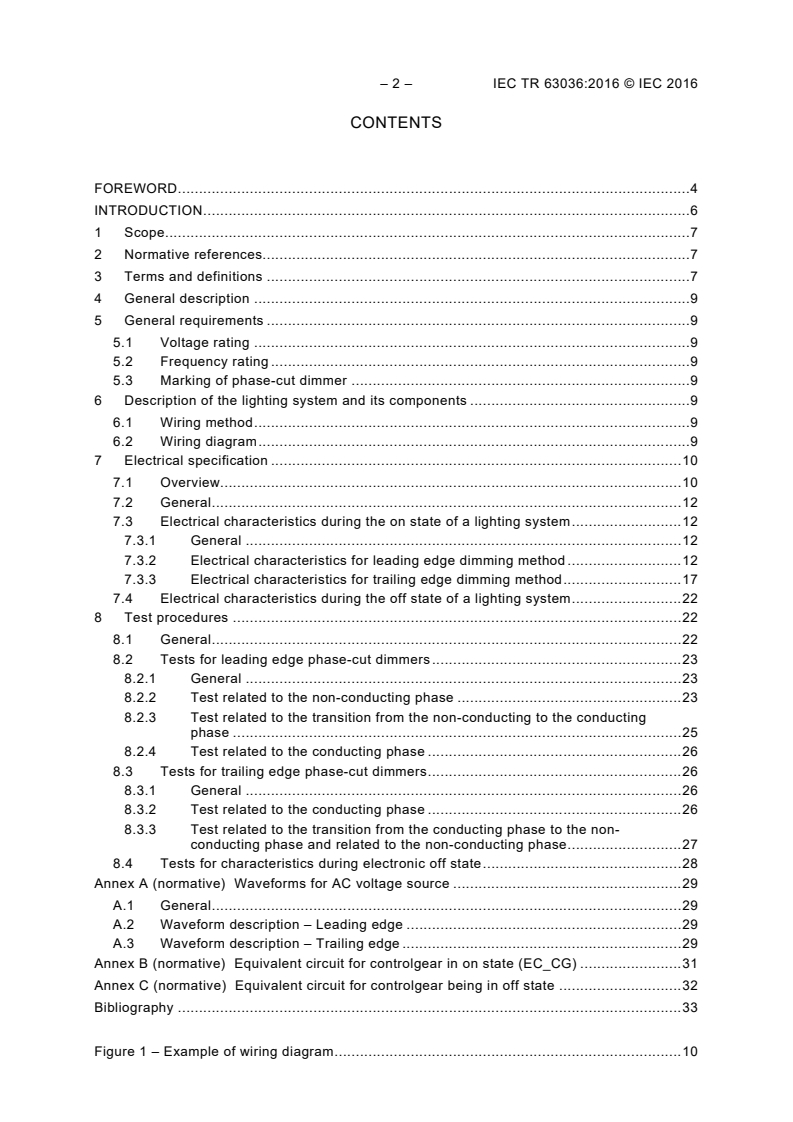
– 2 – IEC TR 63036:2016 © IEC 2016
CONTENTS
FOREWORD . 4
INTRODUCTION . 6
1 Scope . 7
2 Normative references. 7
3 Terms and definitions . 7
4 General description . 9
5 General requirements . 9
5.1 Voltage rating . 9
5.2 Frequency rating . 9
5.3 Marking of phase-cut dimmer . 9
6 Description of the lighting system and its components . 9
6.1 Wiring method . 9
6.2 Wiring diagram . 9
7 Electrical specification . 10
7.1 Overview. 10
7.2 General . 12
7.3 Electrical characteristics during the on state of a lighting system . 12
7.3.1 General . 12
7.3.2 Electrical characteristics for leading edge dimming method . 12
7.3.3 Electrical characteristics for trailing edge dimming method . 17
7.4 Electrical characteristics during the off state of a lighting system . 22
8 Test procedures . 22
8.1 General . 22
8.2 Tests for leading edge phase-cut dimmers . 23
8.2.1 General . 23
8.2.2 Test related to the non-conducting phase . 23
8.2.3 Test related to the transition from the non-conducting to the conducting
phase . 25
8.2.4 Test related to the conducting phase . 26
8.3 Tests for trailing edge phase-cut dimmers . 26
8.3.1 General . 26
8.3.2 Test related to the conducting phase . 26
8.3.3 Test related to the transition from the conducting phase to the non-
conducting phase and related to the non-conducting phase . 27
8.4 Tests for characteristics during electronic off state . 28
Annex A (normative) Waveforms for AC voltage source . 29
A.1 General . 29
A.2 Waveform description – Leading edge . 29
A.3 Waveform description – Trailing edge . 29
Annex B (normative) Equivalent circuit for controlgear in on state (EC_CG) . 31
Annex C (normative) Equivalent circuit for controlgear being in off state . 32
Bibliography . 33
Figure 1 – Example of wiring diagram . 10
Figure 2 – Timing leading edge dimming method . 13
Figure 3 – Timing trailing edge dimming method . 18
Figure 4 – Circuit to test the properties of the phase-cut dimmer during the non-
conducting phase (Method 1) . 24
Figure 5 – Circuit to test the properties of the phase-cut dimmer during the non-
conducting phase (Method 2) . 25
Figure 6 – Circuit to test the properties of the phase-cut dimmer during the transition
from the non-conducting to the conducting phase . 26
Figure 7 – Circuit to test the properties of the phase-cut dimmer during the electronic
off-state . 28
Figure A.1 – Waveform of AC voltage source – Leading edge . 29
Figure A.2 – Waveform of AC voltage source – Trailing edge . 30
Figure B.1 – Equivalent circuit for controlgear in the on state to be used during dimmer
tests . 31
Figure C.1 – Equivalent circuit for controlgear being in off state . 32
Table 1 – Nominal mains voltage 100 V – Frequency 50 Hz or 60 Hz . 14
Table 2 – Nominal mains voltage 120 V – Frequency 50 Hz or 60 Hz . 14
Table 3 – Nominal mains voltage 200 V – Frequency 50 Hz or 60 Hz . 14
Table 4 – Nominal mains voltage 230 V – Frequency 50 Hz or 60 Hz . 14
Table 5 – Nominal mains voltage 277 V – Frequency 50 Hz or 60 Hz . 15
Table 6 – Slew rate for voltage decrease across the phase-cut dimmer . 15
Table 7 – Nominal mains voltage 100 V – Frequency 50 Hz or 60 Hz . 16
Table 8 – Nominal mains voltage 120 V – Frequency 50 Hz or 60 Hz . 16
Table 9 – Nominal mains voltage 200 V – Frequency 50 Hz or 60 Hz . 16
Table 10 – Nominal mains voltage 230 V – Frequency 50 Hz or 60 Hz . 17
Table 11 – Nominal mains voltage 277 V – Frequency 50 Hz or 60 Hz . 17
Table 12 – Nominal mains voltage from100 to 277 V – Frequency 50 Hz or 60 Hz . 19
Table 13 – Nominal mains voltage 100 V – Frequency 50 Hz or 60 Hz . 20
Table 14 – Nominal mains voltage 120 V – Frequency 50 Hz or 60 Hz . 20
Table 15 – Nominal mains voltage 200 V – Frequency 50 Hz or 60 Hz . 20
Table 16 – Nominal mains voltage 230 V – Frequency 50 Hz or 60 Hz . 21
Table 17 – Nominal mains voltage 277 V – Frequency 50 Hz or 60 Hz . 21
Table 18 – Currents and voltages for controlgear during the electronic off state . 22
Table 19 – Parameters for testing purposes . 23
– 4 – IEC TR 63036:2016 © IEC 2016
INTERNATIONAL ELECTROTECHNICAL COMMISSION
____________
ELECTRICAL INTERFACE SPECIFICATION FOR PHASE-CUT
DIMMER IN PHASE-CUT DIMMED LIGHTING SYSTEMS
FOREWORD
1) The International Electrotechnical Commission (IEC) is a worldwide organization for standardization comprising
all national electrotechnical committees (IEC National Committees). The object of IEC is to promote
international co-operation on all questions concerning standardization in the electrical and electronic fields. To
this end and in addition to other activities, IEC publishes International Standards, Technical Specifications,
Technical Reports, Publicly Available Specifications (PAS) and Guides (hereafter referred to as “IEC
Publication(s)”). Their preparation is entrusted to technical committees; any IEC National Committee interested
in the subject dealt with may participate in this preparatory work. International, governmental and non-
governmental organizations liaising with the IEC also participate in this preparation. IEC collaborates closely
with the International Organization for Standardization (ISO) in accordance with conditions determined by
agreement between the two organizations.
2) The formal decisions or agreements of IEC on technical matters express, as nearly as possible, an international
consensus of opinion on the relevant subjects since each technical committee has representation from all
interested IEC National Committees.
3) IEC Publications have the form of recommendations for international use and are accepted by IEC National
Committees in that sense. While all reasonable efforts are made to ensure that the technical content of IEC
Publications is accurate, IEC cannot be held responsible for the way in which they are used or for any
misinterpretation by any end user.
4) In order to promote international uniformity, IEC National Committees undertake to apply IEC Publications
transparently to the maximum extent possible in their national and regional publications. Any divergence
between any IEC Publication and the corresponding national or regional publication shall be clearly indicated in
the latter.
5) IEC itself does not provide any attestation of conformity. Independent certification bodies provide conformity
assessment services and, in some areas, access to IEC marks of conformity. IEC is not responsible for any
services carried out by independent certification bodies.
6) All users should ensure that they have the latest edition of this publication.
7) No liability shall attach to IEC or its directors, employees, servants or agents including individual experts and
members of its technical committees and IEC National Committees for any personal injury, property damage or
other damage of any nature whatsoever, whether direct or indirect, or for costs (including legal fees) and
expenses arising out of the publication, use of, or reliance upon, this IEC Publication or any other IEC
Publications.
8) Attention is drawn to the Normative references cited in this publication. Use of the referenced publications is
indispensable for the correct application of this publication.
9) Attention is drawn to the possibility that some of the elements of this IEC Publication may be the subject of
patent rights. IEC shall not be held responsible for identifying any or all such patent rights.
The main task of IEC technical committees is to prepare International Standards. However, a
technical committee may propose the publication of a technical report when it has collected
data of a different kind from that which is normally published as an International Standard, for
example "state of the art".
IEC TR 63036, which is a technical report, has been prepared by subcommittee 23B: Plugs,
socket-outlets and switches, of IEC technical committee 23: Electrical accessories.
The text of this technical report is based on the following documents:
Enquiry draft Report on voting
23B/1201/DTR 23B/1214/RVC
Full information on the voting for the approval of this technical report can be found in the
report on voting indicated in the above table.
This publication has been drafted in accordance with the ISO/IEC Directives, Part 2.
The committee has decided that the contents of this publication will remain unchanged until
the stability date indicated on the IEC website under "http://webstore.iec.ch" in the data
related to the specific publication. At this date, the publication will be
• reconfirmed,
• withdrawn,
• replaced by a revised edition, or
• amended.
A bilingual version of this publication may be issued at a later date.
– 6 – IEC TR 63036:2016 © IEC 2016
INTRODUCTION
This document describes the technical requirements for phase-cut dimmers to work with
controlgear and self ballasted lamps. For a complete picture of the technical requirements the
reader should also refer to IEC TR 63037 that contains technical requirements and testing
methods for controlgear and self ballasted lamps.
ELECTRICAL INTERFACE SPECIFICATION FOR PHASE-CUT
DIMMER IN PHASE-CUT DIMMED LIGHTING SYSTEMS
1 Scope
This technical report specifies the electrical interface and test procedures for the control by
mains voltage phase-cut dimming of the brightness of mains operated electronic lighting
equipment intended to be controlled by mains voltage phase-cut dimmers, such as LED
integrated lamps, and light sources with external control gear.
Electronic switches that use a comparable circuitry to a phase-cut dimmer but do not contain
means for the adjustability of the phase-cut angle should fulfill the same requirements as a
phase-cut dimmer.
Safety requirements are not covered by this document, but by respective product standards.
2 Normative references
The following documents are referred to in the text in such a way that some or all of their
content constitutes requirements of this document. For dated references, only the edition
cited applies. For undated references, the latest edition of the referenced document (including
any amendments) applies.
IEC 60038, IEC standard voltages
IEC 60050-845, International Electrotechnical Vocabulary (IEV) – Part 845: Lighting (available
at www.electropedia.org)
IEC 60364 (all parts), Low-voltage electrical installations
IEC 62504, General lighting – Light emitting diode (LED) products and related equipment –
Terms and definitions
3 Terms and definitions
For the purposes of this document, the terms and definitions given in IEC 62504 and
IEC 60050-845 as well as the following apply.
3.1
lighting system
combination of a phase-cut dimmer and one or more controlgear and light sources
3.2
off state
state of a lighting system when no light is emitted
3.3
on state
state of a lighting system when light is emitted
– 8 – IEC TR 63036:2016 © IEC 2016
3.4
electrical interface
electrical parameters for supplying power and making the exchange of information between
the phase-cut dimmer and controlgear possible
3.5
phase-cut dimmer
electronic switch that is connected in series with a load and changes the supply voltage
waveform applied to the load from the pure mains voltage waveform to a leading edge
(forward phase) or a trailing edge (reverse phase) AC voltage waveform or is capable of
switching between both waveforms
Note 1 to entry: The output voltage waveform of a phase-cut dimmer is applied to one or more loads.
Note 2 to entry: The conduction angle of the voltage waveform is adjustable.
Note 3 to entry: Within this document, where the term “dimmer” is used the term “phase-cut dimmer” is meant.
3.6
two-wire phase-cut dimmer
phase-cut dimmer that is connected in series with the load and has no connection to neutral
3.7
three-wire phase-cut dimmer
phase-cut dimmer that is connected in series with the load and has in addition a connection to
neutral
3.8
controlgear
device between the phase-cut dimmer and one or more lamps which may serve to transform
the AC mains power, limit the current of the lamp(s) to the required value, provide starting
voltage and preheating current, prevent cold starting, correct power factor or reduce radio
interference
Note 1 to entry: Lamps may have integrated controlgear such as an integrated LED lamp. Any references to
controlgear will include any such integrated lamps.
3.9
load side
wire from the output of the phase-cut dimmer to the supply input of one or more controlgear
3.10
conducting period
time period during which the phase-cut dimmer supplies power to a controlgear
3.11
non-conducting period
time period during which the phase-cut dimmer does not supply power to a controlgear
3.12
half wave
positive or negative 180° of an AC sine wave starting and ending at the zero crossing point
3.13
phase angle
position within a half wave expressed in degree, being in the range of 0° to 180°, in reference
to the beginning of the half wave
4 General description
A phase-cut dimmer either cuts the mains voltage immediately after the zero crossing of the
mains (leading edge) or towards the next projected zero crossing of the mains (trailing edge).
The functionality of both methods may be implemented in one device (universal dimmers).
This document describes requirements for phase-cut dimmers during the on state of a lighting
system. Specifications are provided dependent on the dimming method for the conducting
period and the non-conducting period of the phase-cut dimmer and the transitions between
conducting and non-conducting period.
In addition, this document describes requirements for phase-cut dimmers during the off state
of a lighting system. Specifications are provided independently from the dimming method.
5 General requirements
5.1 Voltage rating
This document applies to one or more of the following mains voltages:
100 V, 120 V, 200 V, 230 V, 277 V, according to IEC 60038.
5.2 Frequency rating
This document applies to one or more of the following mains frequencies:
50 Hz or 60 Hz, according to IEC 60038.
5.3 Marking of phase-cut dimmer
The following information should be provided by the manufacturer on the product or in the
accompanying instruction sheets.
Phase-cut dimmers requiring more than one controlgear to function properly should be
marked with the required minimum number of connected controlgear.
Phase-cut dimmers requiring a minimum load should be marked with the required minimum
load.
Phase-cut dimmers should be marked with the following indication:
DIM
6 Description of the lighting system and its components
6.1 Wiring method
The wiring of the devices is in accordance with the installation rules given in the IEC 60364
series and also with the national wiring rules applicable in the country where the devices are
installed.
6.2 Wiring diagram
The wiring of the lighting system uses the traditional method of connecting the phase-cut
dimmer to the mains and to the controlgear. Figure 1 is an example of a lighting system with
one phase-cut dimmer and one or two controlgear(s).
– 10 – IEC TR 63036:2016 © IEC 2016
Regarding the connections of the phase-cut dimmer shown in Figure 1, the drawn lines
represent a two-wire installation and the dashed line represents the direct connection of the
phase-cut dimmer to the mains which is used in three-wire installations.
The direct connection of the phase-cut dimmer to neutral (dashed line in Figure 1) will have
consequences on the power supply requirements and synchronization to the phase-cut
dimmer.
This document defines requirements that enable compatibility between phase-cut dimmers
and controlgear in two-wire installations. However, all predications are also valid for three-
wire phase-cut dimmers to ensure proper operation of controlgear.
L
N
I
D
V V
V
CG CG
D
I
I
CG
CG
Controlgear Controlgear
Dimmer
IEC
Figure 1 – Example of wiring diagram
7 Electrical specification
7.1 Overview
To describe the electrical characteristics of the electrical interface, the following abbreviations
are used:
α Angle where the test voltage starts rising with the given slew rate SR as shown in
x
Figure A.1
β Angle where the test voltage starts falling with the given slew rate SR as shown in
x
Figure A.2
C Filter capacitor to reduce high frequency disturbances
f
EC_CG Equivalent circuit that represents a controlgear for phase-cut dimmer testing
purposes
EC_D Equivalent circuit that represents a phase-cut dimmer for controlgear testing
purposes
I Current through the input terminals of the controlgear (see Figure 1)
CG
I Repetitive peak current of the controlgear in leading edge mode
CG_pk
I Current-carrying capability of the controlgear with V ≤ V in leading edge mode
CG_SL CG SW
I Current -carrying capability of the controlgear with V ≤ V in trailing edge mode
CG_STH CG SW
I Current-carrying capability of the controlgear with V > V in trailing edge mode
CG_STL CG SW
I Current through the load side terminal of the phase-cut dimmer (see Figure 1)
D
I Maximum current through the phase-cut dimmer during the non-conducting period,
D_nc
limited by the phase-cut dimmer
I Minimum current carrying capability of the controlgear during the electronic off state
PO
I Current sourced by the phase-cut dimmer during the transition from the conducting to
trans
the non-conducting state in trailing edge mode
n Required minimum number of controlgear connected with one phase-cut dimmer
(named in phase-cut dimmer installation sheet)
P Rated input power of the controlgear (as marked)
CG
P Maximum permissible nominal load of phase-cut dimmer (according to the installation
max
sheet)
Minimum nominal load required by phase-cut dimmer (according to the installation
P
min
sheet)
R Resistance value of ohmic load R in relation to the relevant mains voltage according
R
to Tables 7 to 11, representing the maximum permissible load of phase-cut dimmer
P
max
SR Absolute value of the slew rate of the decrease of the voltage across the input
terminals of a controlgear in trailing edge dimming mode when the phase-cut dimmer
switches off at time t (see Figure 3)
s1
SR Absolute value of the slew rate of the increase of the voltage across the input
L
terminals of a controlgear in leading edge dimming mode when the phase-cut dimmer
under test switches on (according to Clause 8)
SR Absolute value of the slew rate of the decrease of the voltage across the input
T
terminals of a controlgear in trailing edge dimming mode when the phase-cut dimmer
under test switches off (according to Clause 8)
t Time related to previous zero crossing of the mains to the subsequent zero crossing
HW
of the mains (duration of a half wave)
t Time related to previous zero crossing of the mains when leading edge phase-cut
s
dimmer reduces its impedance towards zero by activating its power switch
t Time related to previous zero crossing of the mains when trailing edge phase-cut
s1
dimmer increases its impedance towards infinite by deactivating its power switch
t Time related to previous zero crossing of the mains when the voltage V falls below
s2 CG
V in trailing edge method
SW
t Time related to previous zero crossing of the mains when the transition from the
s3
conducting period to the non-conducting period is finished
t Time related to previous zero crossing of the mains when voltage V crosses V
SW CG SW
t Transition time for trailing edge mode, equals t – t
t s2 s1
V Voltage across the input terminals of the controlgear (see Figure 1)
CG
V Voltage between the line side (L) and load side terminal of the phase-cut dimmer
D
(see Figure 1)
V Mains voltage (rated nominal value)
M
V Phase-cut voltage for testing purposes, sinusoidal part of the waveform (α to t , 0
ME 1 HW
to β) equivalent to mains voltage
V Lower limit for voltage across the input terminals of the controlgear to provide a
PO
current carrying capability I during the electronic off state
PO
V Voltage across the input terminals of the controlgear at the time that leads to
SW
disabling (V (t) > V ) or enabling (V (t) < V ) a current path having a current
M SW M SW
carrying capability of I or I
CG_SL CG_STH
V Value of test voltage (according to 8.3 of IEC TR 63037:–)
test
xx(t) Instantaneous values of current or voltage xx
Z Impedance across the input terminals of the controlgear
CG
Z Impedance between the line side (L) and the load side terminals of the phase-cut
D
dimmer
Z Maximum impedance between the line side (L) and load side terminal of the phase-
D_max
cut dimmer, defined by the technical properties of the phase-cut dimmer
– 12 – IEC TR 63036:2016 © IEC 2016
Z Minimum impedance between the line side (L) and the load side terminal of the
D_min
phase-cut dimmer, defined by the power properties of the phase-cut dimmer
7.2 General
All information given in this document is related to a half wave of the mains. Due to the
polarity change between subsequent half waves, all values have to be regarded as absolute
values.
The lighting system is either in on state or in off state. In on state, light sources controlled by
controlgear being part of the lighting system emit light. In off state, light sources controlled by
controlgear being part of the lighting system do not emit light.
The off state may be realized as mechanical off state by opening the current loop of the
lighting system with mechanical means, for example a switch. For this case, no requirements
need to be fixed.
Alternatively, the off state may be realized as electronic off state. In this case, the phase-cut
dimmer increases its impedance (i.e. stops producing phase-cut) while continuing its
operation, for example to keep its control interface activated. In this case, the connected
controlgear is not energized sufficiently to operate a light source, but provides a current path
that allows the phase-cut dimmer to draw current continuously from the mains.
NOTE Applications that provide a connection to neutral allow the use of a three-wire device, enabling the usage
of lamps that do not provide a current carrying capability according to 7.3 and 7.4.
During the on state and the electronic off state, it should be ensured that the phase-cut
dimmer is supplied sufficiently with power and that the synchronization of phase-cut dimmer
and controlgear with the mains is ensured.
7.3 Electrical characteristics during the on state of a lighting system
7.3.1 General
For the on state of a lighting system, specifications are dependent on the dimming method,
leading edge or trailing edge.
Each half wave is divided into two periods, the conducting period and the non-conducting
period of the phase-cut dimmer.
During the conducting period of the phase-cut dimmer, the mains voltage is applied to the
controlgear. During the non-conducting period, the voltage between terminals of the phase-cut
dimmer is almost equal to the mains voltage (V ≈ V ).
D M
7.3.2 Electrical characteristics for leading edge dimming method
7.3.2.1 General
Starting from the mains zero crossing, the phase-cut dimmer remains in a non-conducting
state until its timing element activates the power switch at t . Afterwards, the phase-cut
s
dimmer supplies power to the load for the entire remaining part of the mains half wave
(see Figure 2).
To achieve synchronization with the mains and to control the phase-cut angle correctly,
leading edge phase-cut dimmers need to draw a current also during the non-c
...