

IEC TS 61201:2007
(Main)Use of conventional touch voltage limits - Application guide
General Information
- Abstract
Provides guidance on the use of conventional touch voltage limits with reference to thresholds given in IEC 60479-5. Consideration is given to different physiological effects, environmental conditions, contact conditions, etc. This specification only discusses voltages for sinusoidal a.c. at 50/60 Hz and pure d.c. having no significant a.c. component. This specification does not consider immersion of body parts or medical applications. Touch voltage limits are for use by technical committees as guidance for the determination of their own specific limits. This basic safety publication is primarily intended for use by technical committees in the preparation of standards in accordance with the principles laid down in IEC Guide 104 and ISO/IEC Guide 51. It is not intended for use by manufacturers or certification bodies One of the responsibilities of a technical committee is, wherever applicable, to make use of basic safety publications in the preparation of its publications. The requirements, test methods or test conditions of this basic safety publication will not apply unless specifically referred to or included in the relevant publications. This second edition cancels and replaces the first edition which was issued as a technical report in 1992. It constitutes a technical revision and now has the status of a technical specification. The main changes with respect to the previous edition are listed below: - proposal of maximum contact areas for various conventional touch voltage limit; - introduction of different current pathways through the human body for the selection of conventional touch voltage limit; - introduction of conventional touch voltage limit corresponding to the startle reaction current threshold, the inability of let-go current threshold and the ventricular fibrillation current threshold; - possibility of interpolation on contact area for other conventional touch voltage limits. It has the status of a basic safety publication in accordance with IEC Guide 104 and ISO/IEC Guide 51.
- Status
- Published
- Publication Date
- 29-Aug-2007
- Technical Committee
- TC 64 - Electrical installations and protection against electric shock
- Drafting Committee
- PT 61201 - TC 64/PT 61201
- Current Stage
- PPUB - Publication issued
- Start Date
- 30-Aug-2007
- Completion Date
- 15-Nov-2007


Overview
IEC TS 61201:2007 is an international technical specification published by the International Electrotechnical Commission (IEC) that provides essential guidance on the use of conventional touch voltage limits. These limits relate directly to safety thresholds for electric shock hazards based on physiological effects, environmental factors, and contact conditions. The document focuses primarily on sinusoidal alternating current (a.c.) voltages at 50/60 Hz and pure direct current (d.c.) voltages without significant alternating components.
The guidance is particularly designed for IEC technical committees to harmonize and establish safety standards concerning electric shock protection. This technical specification is classified as a Basic Safety Publication, intended exclusively for standardization work rather than direct application by manufacturers or certification bodies.
Key Topics
1. Touch Voltage Limits and Physiological Effects
IEC TS 61201 references threshold values from IEC 60479-5, correlating touch voltages with known physiological responses such as:
- Startle reaction current threshold
- Inability to let-go threshold
- Ventricular fibrillation threshold
Understanding these thresholds is crucial in setting safe limits to prevent electric shock injuries.
2. Contact Conditions and Environmental Influences
The specification considers various contact scenarios including:
- Dry skin
- Wet conditions (water-wet and saltwater-wet)
- Contact area size and current pathways through the human body
These factors influence the impedance of the body and affect the permissible touch voltage limits.
3. Voltage Types Covered
- Sinusoidal a.c. voltages at 50/60 Hz
- Pure d.c. voltages without significant a.c. components
Higher frequency voltages, body immersion, and medical applications are explicitly excluded from this document's scope due to complexity and specialized considerations.
4. Application by IEC Technical Committees
The specification serves as a framework for technical committees to develop their own safety standards consistent with IEC Guide 104 and ISO/IEC Guide 51 principles. It highlights:
- Use as guidance, not prescribing mandatory test methods or limits
- The importance of adopting harmonized touch voltage thresholds consistent with the physiological effects and current pathways evaluated
Applications
The IEC TS 61201:2007 technical specification is primarily applied in the development of international safety standards that address protection against electric shock in electrical installations and equipment. Key practical uses include:
- Assisting standardization bodies in setting voltage safety limits that consider human physiological thresholds
- Guiding electrical engineering safety practices in industrial, commercial, and residential electrical systems
- Supporting the evaluation and harmonization of safety requirements for electrical devices within the IEC framework
- Designing protective measures in electrical installations where touch voltage scenarios may occur
By applying these conventional touch voltage limits, stakeholders can enhance the safety of electrical systems, reduce injury risks, and ensure compliance with international electrotechnical safety standards.
Related Standards
IEC TS 61201:2007 is closely linked with several other IEC publications that define the broader framework for electrical safety and current effects on humans, including:
IEC 60479 series: Defines the effects of current on humans and livestock, providing the underlying current and touch voltage thresholds for physiological effects.
- IEC/TS 60479-1: General aspects of current effects
- IEC/TS 60479-2: Special aspects of current effects
- IEC/TR 60479-5: Touch voltage threshold values for physiological effects
IEC Guide 104: Provides principles for developing safety publications and the proper use of basic safety publications like TS 61201.
ISO/IEC Guide 51: Offers guidelines for the integration of safety aspects in standardization processes.
These related standards work in tandem to form a comprehensive set of guidelines that inform safe electrical system design and evaluation worldwide.
Keywords: IEC TS 61201, conventional touch voltage limits, electric shock safety, IEC 60479-5, physiological effects, touch voltage thresholds, electrical safety standards, 50/60 Hz a.c. voltage, direct current safety, electrical installations, IEC Guide 104, ISO/IEC Guide 51, human body current pathways, electrical hazard prevention.
Relations
- Referred By
EN 61140:2016 - Protection against electric shock - Common aspects for installation and equipment - Effective Date
- 10-Feb-2026
- Referred By
EN 61439-1:2011 - Low-voltage switchgear and controlgear assemblies - Part 1: General rules - Effective Date
- 10-Feb-2026
- Referred By
EN 61439-1:2009 - Low-voltage switchgear and controlgear assemblies - Part 1: General rules - Effective Date
- 10-Feb-2026
Get Certified
Connect with accredited certification bodies for this standard

DIBt (Deutsches Institut für Bautechnik)
German Institute for Building Technology.
DIN CERTCO
DIN Group product certification.

IMQ S.p.A. (Certification)
Italian electrical product certification.
Sponsored listings
Frequently Asked Questions
IEC TS 61201:2007 is a technical specification published by the International Electrotechnical Commission (IEC). Its full title is "Use of conventional touch voltage limits - Application guide". This standard covers: Provides guidance on the use of conventional touch voltage limits with reference to thresholds given in IEC 60479-5. Consideration is given to different physiological effects, environmental conditions, contact conditions, etc. This specification only discusses voltages for sinusoidal a.c. at 50/60 Hz and pure d.c. having no significant a.c. component. This specification does not consider immersion of body parts or medical applications. Touch voltage limits are for use by technical committees as guidance for the determination of their own specific limits. This basic safety publication is primarily intended for use by technical committees in the preparation of standards in accordance with the principles laid down in IEC Guide 104 and ISO/IEC Guide 51. It is not intended for use by manufacturers or certification bodies One of the responsibilities of a technical committee is, wherever applicable, to make use of basic safety publications in the preparation of its publications. The requirements, test methods or test conditions of this basic safety publication will not apply unless specifically referred to or included in the relevant publications. This second edition cancels and replaces the first edition which was issued as a technical report in 1992. It constitutes a technical revision and now has the status of a technical specification. The main changes with respect to the previous edition are listed below: - proposal of maximum contact areas for various conventional touch voltage limit; - introduction of different current pathways through the human body for the selection of conventional touch voltage limit; - introduction of conventional touch voltage limit corresponding to the startle reaction current threshold, the inability of let-go current threshold and the ventricular fibrillation current threshold; - possibility of interpolation on contact area for other conventional touch voltage limits. It has the status of a basic safety publication in accordance with IEC Guide 104 and ISO/IEC Guide 51.
Provides guidance on the use of conventional touch voltage limits with reference to thresholds given in IEC 60479-5. Consideration is given to different physiological effects, environmental conditions, contact conditions, etc. This specification only discusses voltages for sinusoidal a.c. at 50/60 Hz and pure d.c. having no significant a.c. component. This specification does not consider immersion of body parts or medical applications. Touch voltage limits are for use by technical committees as guidance for the determination of their own specific limits. This basic safety publication is primarily intended for use by technical committees in the preparation of standards in accordance with the principles laid down in IEC Guide 104 and ISO/IEC Guide 51. It is not intended for use by manufacturers or certification bodies One of the responsibilities of a technical committee is, wherever applicable, to make use of basic safety publications in the preparation of its publications. The requirements, test methods or test conditions of this basic safety publication will not apply unless specifically referred to or included in the relevant publications. This second edition cancels and replaces the first edition which was issued as a technical report in 1992. It constitutes a technical revision and now has the status of a technical specification. The main changes with respect to the previous edition are listed below: - proposal of maximum contact areas for various conventional touch voltage limit; - introduction of different current pathways through the human body for the selection of conventional touch voltage limit; - introduction of conventional touch voltage limit corresponding to the startle reaction current threshold, the inability of let-go current threshold and the ventricular fibrillation current threshold; - possibility of interpolation on contact area for other conventional touch voltage limits. It has the status of a basic safety publication in accordance with IEC Guide 104 and ISO/IEC Guide 51.
IEC TS 61201:2007 is classified under the following ICS (International Classification for Standards) categories: 13.260 - Protection against electric shock. Live working; 29.020 - Electrical engineering in general; 91.140.50 - Electricity supply systems. The ICS classification helps identify the subject area and facilitates finding related standards.
IEC TS 61201:2007 has the following relationships with other standards: It is inter standard links to EN 61140:2016, EN 61439-1:2011, EN 61439-1:2009. Understanding these relationships helps ensure you are using the most current and applicable version of the standard.
IEC TS 61201:2007 is available in PDF format for immediate download after purchase. The document can be added to your cart and obtained through the secure checkout process. Digital delivery ensures instant access to the complete standard document.
Standards Content (Sample)
IEC/TS 61201
Edition 2.0 2007-08
TECHNICAL
SPECIFICATION
SPÉCIFICATION
TECHNIQUE
BASIC SAFETY PUBLICATION
PUBLICATION FONDAMENTALE DE SÉCURITÉ
Use of conventional touch voltage limits – Application guide
Utilisation des tensions limites conventionnelles de contact – Guide
d’application
IEC/TS 61201:2007
All rights reserved. Unless otherwise specified, no part of this publication may be reproduced or utilized in any form or by
any means, electronic or mechanical, including photocopying and microfilm, without permission in writing from either IEC or
IEC's member National Committee in the country of the requester.
If you have any questions about IEC copyright or have an enquiry about obtaining additional rights to this publication,
please contact the address below or your local IEC member National Committee for further information.
Droits de reproduction réservés. Sauf indication contraire, aucune partie de cette publication ne peut être reproduite
ni utilisée sous quelque forme que ce soit et par aucun procédé, électronique ou mécanique, y compris la photocopie
et les microfilms, sans l'accord écrit de la CEI ou du Comité national de la CEI du pays du demandeur.
Si vous avez des questions sur le copyright de la CEI ou si vous désirez obtenir des droits supplémentaires sur cette
publication, utilisez les coordonnées ci-après ou contactez le Comité national de la CEI de votre pays de résidence.
IEC Central Office
3, rue de Varembé
CH-1211 Geneva 20
Switzerland
Email: inmail@iec.ch
Web: www.iec.ch
About the IEC
The International Electrotechnical Commission (IEC) is the leading global organization that prepares and publishes
International Standards for all electrical, electronic and related technologies.
About IEC publications
The technical content of IEC publications is kept under constant review by the IEC. Please make sure that you have the
latest edition, a corrigenda or an amendment might have been published.
ƒ Catalogue of IEC publications: www.iec.ch/searchpub
The IEC on-line Catalogue enables you to search by a variety of criteria (reference number, text, technical committee,…).
It also gives information on projects, withdrawn and replaced publications.
ƒ IEC Just Published: www.iec.ch/online_news/justpub
Stay up to date on all new IEC publications. Just Published details twice a month all new publications released. Available
on-line and also by email.
ƒ Electropedia: www.electropedia.org
The world's leading online dictionary of electronic and electrical terms containing more than 20 000 terms and definitions
in English and French, with equivalent terms in additional languages. Also known as the International Electrotechnical
Vocabulary online.
ƒ Customer Service Centre: www.iec.ch/webstore/custserv
If you wish to give us your feedback on this publication or need further assistance, please visit the Customer Service
Centre FAQ or contact us:
Email: csc@iec.ch
Tel.: +41 22 919 02 11
Fax: +41 22 919 03 00
A propos de la CEI
La Commission Electrotechnique Internationale (CEI) est la première organisation mondiale qui élabore et publie des
normes internationales pour tout ce qui a trait à l'électricité, à l'électronique et aux technologies apparentées.
A propos des publications CEI
Le contenu technique des publications de la CEI est constamment revu. Veuillez vous assurer que vous possédez
l’édition la plus récente, un corrigendum ou amendement peut avoir été publié.
ƒ Catalogue des publications de la CEI: www.iec.ch/searchpub/cur_fut-f.htm
Le Catalogue en-ligne de la CEI vous permet d’effectuer des recherches en utilisant différents critères (numéro de référence,
texte, comité d’études,…). Il donne aussi des informations sur les projets et les publications retirées ou remplacées.
ƒ Just Published CEI: www.iec.ch/online_news/justpub
Restez informé sur les nouvelles publications de la CEI. Just Published détaille deux fois par mois les nouvelles
publications parues. Disponible en-ligne et aussi par email.
ƒ Electropedia: www.electropedia.org
Le premier dictionnaire en ligne au monde de termes électroniques et électriques. Il contient plus de 20 000 termes et
définitions en anglais et en français, ainsi que les termes équivalents dans les langues additionnelles. Egalement appelé
Vocabulaire Electrotechnique International en ligne.
ƒ Service Clients: www.iec.ch/webstore/custserv/custserv_entry-f.htm
Si vous désirez nous donner des commentaires sur cette publication ou si vous avez des questions, visitez le FAQ du
Service clients ou contactez-nous:
Email: csc@iec.ch
Tél.: +41 22 919 02 11
Fax: +41 22 919 03 00
IEC/TS 61201
Edition 2.0 2007-08
TECHNICAL
SPECIFICATION
SPÉCIFICATION
TECHNIQUE
BASIC SAFETY PUBLICATION
PUBLICATION FONDAMENTALE DE SÉCURITÉ
Use of conventional touch voltage limits – Application guide
Utilisation des tensions limites conventionnelles de contact – Guide
d’application
INTERNATIONAL
ELECTROTECHNICAL
COMMISSION
COMMISSION
ELECTROTECHNIQUE
PRICE CODE
INTERNATIONALE
Q
CODE PRIX
ICS 13.260; 29.020; 91.140.50 ISBN 2-8318-9291-0
– 2 – TS 61201 © IEC:2007
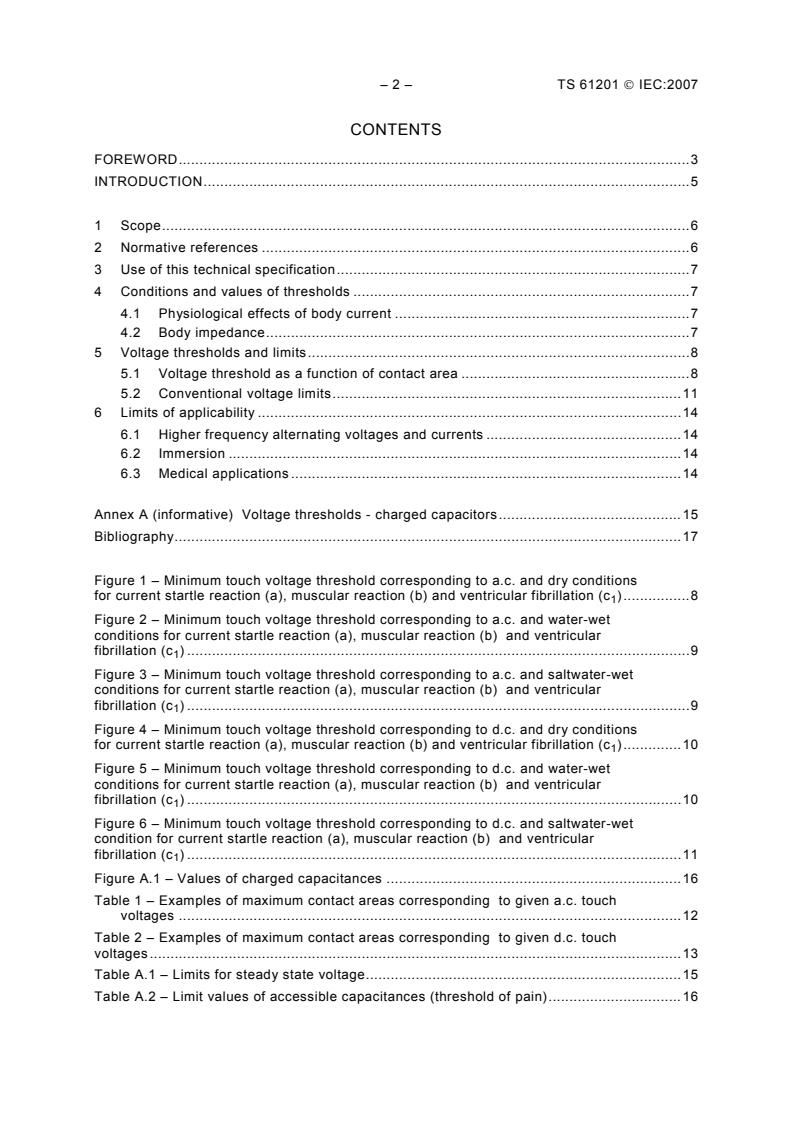
CONTENTS
FOREWORD.3
INTRODUCTION.5
1 Scope.6
2 Normative references .6
3 Use of this technical specification.7
4 Conditions and values of thresholds .7
4.1 Physiological effects of body current .7
4.2 Body impedance.7
5 Voltage thresholds and limits.8
5.1 Voltage threshold as a function of contact area .8
5.2 Conventional voltage limits.11
6 Limits of applicability .14
6.1 Higher frequency alternating voltages and currents .14
6.2 Immersion .14
6.3 Medical applications .14
Annex A (informative) Voltage thresholds - charged capacitors.15
Bibliography.17
Figure 1 – Minimum touch voltage threshold corresponding to a.c. and dry conditions
for current startle reaction (a), muscular reaction (b) and ventricular fibrillation (c ).8
Figure 2 – Minimum touch voltage threshold corresponding to a.c. and water-wet
conditions for current startle reaction (a), muscular reaction (b) and ventricular
fibrillation (c ) .9
Figure 3 – Minimum touch voltage threshold corresponding to a.c. and saltwater-wet
conditions for current startle reaction (a), muscular reaction (b) and ventricular
fibrillation (c ) .9
Figure 4 – Minimum touch voltage threshold corresponding to d.c. and dry conditions
for current startle reaction (a), muscular reaction (b) and ventricular fibrillation (c ).10
Figure 5 – Minimum touch voltage threshold corresponding to d.c. and water-wet
conditions for current startle reaction (a), muscular reaction (b) and ventricular
fibrillation (c ) .10
Figure 6 – Minimum touch voltage threshold corresponding to d.c. and saltwater-wet
condition for current startle reaction (a), muscular reaction (b) and ventricular
fibrillation (c ) .11
Figure A.1 – Values of charged capacitances .16
Table 1 – Examples of maximum contact areas corresponding to given a.c. touch
voltages .12
Table 2 – Examples of maximum contact areas corresponding to given d.c. touch
voltages.13
Table A.1 – Limits for steady state voltage.15
Table A.2 – Limit values of accessible capacitances (threshold of pain).16
TS 61201 © IEC:2007 – 3 –
INTERNATIONAL ELECTROTECHNICAL COMMISSION
____________
USE OF CONVENTIONAL TOUCH VOLTAGE LIMITS –
APPLICATION GUIDE
FOREWORD
1) The International Electrotechnical Commission (IEC) is a worldwide organization for standardization comprising
all national electrotechnical committees (IEC National Committees). The object of IEC is to promote
international co-operation on all questions concerning standardization in the electrical and electronic fields. To
this end and in addition to other activities, IEC publishes International Standards, Technical Specifications,
Technical Reports, Publicly Available Specifications (PAS) and Guides (hereafter referred to as “IEC
Publication(s)”). Their preparation is entrusted to technical committees; any IEC National Committee interested
in the subject dealt with may participate in this preparatory work. International, governmental and non-
governmental organizations liaising with the IEC also participate in this preparation. IEC collaborates closely
with the International Organization for Standardization (ISO) in accordance with conditions determined by
agreement between the two organizations.
2) The formal decisions or agreements of IEC on technical matters express, as nearly as possible, an international
consensus of opinion on the relevant subjects since each technical committee has representation from all
interested IEC National Committees.
3) IEC Publications have the form of recommendations for international use and are accepted by IEC National
Committees in that sense. While all reasonable efforts are made to ensure that the technical content of IEC
Publications is accurate, IEC cannot be held responsible for the way in which they are used or for any
misinterpretation by any end user.
4) In order to promote international uniformity, IEC National Committees undertake to apply IEC Publications
transparently to the maximum extent possible in their national and regional publications. Any divergence
between any IEC Publication and the corresponding national or regional publication shall be clearly indicated in
the latter.
5) IEC provides no marking procedure to indicate its approval and cannot be rendered responsible for any
equipment declared to be in conformity with an IEC Publication.
6) All users should ensure that they have the latest edition of this publication.
7) No liability shall attach to IEC or its directors, employees, servants or agents including individual experts and
members of its technical committees and IEC National Committees for any personal injury, property damage or
other damage of any nature whatsoever, whether direct or indirect, or for costs (including legal fees) and
expenses arising out of the publication, use of, or reliance upon, this IEC Publication or any other IEC
Publications.
8) Attention is drawn to the normative references cited in this publication. Use of the referenced publications is
indispensable for the correct application of this publication.
9) Attention is drawn to the possibility that some of the elements of this IEC Publication may be the subject of
patent rights. IEC shall not be held responsible for identifying any or all such patent rights.
The main task of IEC technical committees is to prepare International Standards. In
exceptional circumstances, a technical committee may propose the publication of a technical
specification when
• the required support cannot be obtained for the publication of an International Standard,
despite repeated efforts, or
• the subject is still under technical development or where, for any other reason, there is the
future but no immediate possibility of an agreement on an International Standard.
Technical specifications are subject to review within three years of publication to decide
whether they can be transformed into International Standards.
IEC/TS 61201, which is a technical specification, has been prepared by IEC technical
committee 64: Electrical installations and protection against electrical shock.
This second edition cancels and replaces the first edition which was issued as a technical
report in 1992. It constitutes a technical revision and now has the status of a technical
specification.
– 4 – TS 61201 © IEC:2007
The main changes with respect to the previous edition are listed below:
– proposal of maximum contact areas for various conventional touch voltage limit;
– introduction of different current pathways through the human body for the selection of
conventional touch voltage limit;
– introduction of conventional touch voltage limit corresponding to the startle reaction current
threshold, the inability of let-go current threshold and the ventricular fibrillation current threshold;
– possibility of interpolation on contact area for other conventional touch voltage limits.
It has the status of a basic safety publication in accordance with IEC Guide 104 and ISO/IEC
Guide 51.
The text of this technical specification is based on the following documents:
Enquiry draft Report on voting
64/1584/DTS 64/1605/RVC
Full information on the voting for the approval of this technical specification can be found in
the report on voting indicated in the above table.
This publication has been drafted in accordance with the ISO/IEC Directives, Part 2.
The committee has decided that the contents of this publication will remain unchanged until
the maintenance result date indicated on the IEC web site under "http://webstore.iec.ch" in
the data related to the specific publication. At this date, the publication will be
• transformed into an International standard,
• reconfirmed,
• withdrawn,
• replaced by a revised edition, or
• amended.
TS 61201 © IEC:2007 – 5 –
INTRODUCTION
This technical specification replaces the first edition of IEC/TR 61201 and provides voltage
limits which are intended to be used by IEC technical committees as conventional touch
voltage limits with regard to protection against electric shock. Its purpose is to facilitate
harmonization and consistency among different IEC publications.
The values proposed in this specification are derived from IEC/TS 60479-5. IEC 60479-5
gives the methodology used for the determination of touch voltage from the application of the
Ohm’s law between different current thresholds corresponding to different physiological
effects and body impedances corresponding to various current paths through the human body,
contact areas, skin moisture at this contact area and on the type of current. Current
thresholds and body impedances are provided by IEC/TS 60479-1.
This specification discusses 50/60 Hz sinusoidal alternating voltage and pure direct voltage
having no significant alternating component. Higher frequency alternating voltage is not
included in this type of analysis as this would require a more complex body impedance model
and would require the use of frequency factors for the current thresholds for the unwanted
physiological effects. As this technical specification does not cover frequencies higher than
50/60 Hz, technical committees are requested to inform IEC/TC 64 about experience gained
on this subject. Suggestions for modifications and additions to the technical specification
should be submitted to IEC/TC 64.
– 6 – TS 61201 © IEC:2007
USE OF CONVENTIONAL TOUCH VOLTAGE LIMITS –
APPLICATION GUIDE
1 Scope
IEC/TS 61201, which is a technical specification, provides guidance on the use of
conventional touch voltage limits with reference to thresholds given in IEC 60479-5.
Consideration is given to different physiological effects, environmental conditions, contact
conditions, etc.
This specification only discusses voltages for sinusoidal a.c. at 50/60 Hz and pure d.c. having
no significant a.c. component.
This specification does not consider immersion of body parts or medical applications.
Touch voltage limits are for use by technical committees as guidance for the determination of
their own specific limits.
This basic safety publication is primarily intended for use by technical committees in the
preparation of standards in accordance with the principles laid down in IEC Guide 104 and
ISO/IEC Guide 51. It is not intended for use by manufacturers or certification bodies.
One of the responsibilities of a technical committee is, wherever applicable, to make use of
basic safety publications in the preparation of its publications. The requirements, test
methods or test conditions of this basic safety publication will not apply unless specifically
referred to or included in the relevant publications.
2 Normative references
The following referenced documents are indispensable for the application of this document.
For dated references, only the edition cited applies. For undated references, the latest edition
of the referenced document (including any amendments) applies.
IEC/TS 60479-1:2005, Effects of current on human beings and livestock – Part 1: General
aspects
IEC/TS 60479-2:2007, Effects of current on human beings and livestock – Part 2: Special
aspects
IEC/TR 60479-5, Effects of current on human beings and livestock – Part 5: Touch voltage
threshold values for physiological effects
IEC Guide 104:1997, The preparation of safety publications and the use of basic safety
publications and group safety publications
ISO/IEC Guide 51:1999, Safety aspects – Guidelines for their inclusion in standards
TS 61201 © IEC:2007 – 7 –
3 Use of this technical specification
As voltage thresholds of IEC/TR 60479-5 are fully derived from current thresholds of IEC/TS
60479-1, differences between normal conditions and fault conditions are not considered in
this specification.
Technical committees may use these voltage values in conjunction with appropriate risk
factors to set their own voltage limits in their product standards. Such risk factors will consider
other aspects such as probability of faults, probability of contact with live or faulty parts, ratio
between touch voltage and fault voltage, etc.
Product committees should carry out risk assessment for their products based on the
information in this specification. For example, product committees may specify the maximum
touch area. Where touch areas are unknown, conservative figures need to be used.
4 Conditions and values of thresholds
4.1 Physiological effects of body current
Thresholds for the physiological effects associated with electric current through a human body
are reported in IEC/TS 60479-1.
This specification addresses the following physiological effects:
– startle reaction from current;
– strong involuntary muscular reaction (such as inability to let-go from an electrode for a.c.);
– ventricular fibrillation.
Other effects, such as perception, might be important for some applications but are not
addressed in this specification.
For the purposes of this specification, the values corresponding to physiological effects of
greatest interest are curves a, b and c as described in IEC/TS 60479-1.
4.2 Body impedance
Touch voltage limit is a function of the body impedances as described in IEC/TS 60479-1. The
appropriate value of body impedance to use is a function of many factors. The selection of the
proper value should include consideration of the following:
− the type of power source (a.c. or d.c.); and
− the magnitude of the touch voltage; and
− the pathway of the current through the body (hand-to-hand, or both-hands-to-both feet or
one-hand-to-seat);
NOTE These different pathways have been selected for their characteristics. The reason comes from the
body impedance model described in Annex A of IEC/TR 60479-5. The voltage thresholds determined for the
current path both-hands-to-feet may be generally considered conservative compared to the current path one-
hand-to-both-feet.
and
− the area of contact with the skin; and
− the condition of the skin contact area (saltwater-wet, water-wet, dry).
– 8 – TS 61201 © IEC:2007
5 Voltage thresholds and limits
5.1 Voltage threshold as a function of contact area
The following figures (Figures 1 to 6) show threshold touch voltage versus contact area. It is
assumed that since the plotted points are close to being in line when plotted on a log-log
scale, the best fit curve to represent points between those actually calculated will be on a line
joining the calculated points on the log-log scale.
These threshold figures are intended to document the effect of contact area which might be
used in products as a key design parameter for limiting the effect of touch voltage. It should
be noted that contact area may be affected by contact with other conductive parts such as
tools or interconnected equipment.
NOTE 1 Tables 1 and 2 illustrate examples of maximum contact areas for traditional accessible voltages.
1 000
Hand-to-hand Both-hands-to-feet Hand-to-seat
c
b
a
c
b 1
c
a
a
b
1 10 100
Contact area (cm )
IEC 1660/07
Figure 1 – Minimum touch voltage threshold corresponding to a.c. and dry conditions
for current startle reaction (a), muscular reaction (b) and ventricular fibrillation (c )
Touch voltage (V)
TS 61201 © IEC:2007 – 9 –
1 000
Hand-to-hand Both-hands-to-feet Hand-to-seat
100 c
c
b
c
a
b
a
10 a b
0,1
1 10 100
Contact area (cm )
IEC 1661/07
Figure 2 – Minimum touch voltage threshold corresponding to a.c. and water-wet
conditions for current startle reaction (a), muscular reaction (b)
and ventricular fibrillation (c )
1 000
Hand-to-hand Both-hands-to-feet Hand-to-seat
c
c
c
b
b
a b
a
a
0,1
1 10 100
Contact area (cm )
IEC 1662/07
Figure 3 – Minimum touch voltage threshold corresponding to a.c. and saltwater-wet
conditions for current startle reaction (a), muscular reaction (b)
and ventricular fibrillation (c )
Touch voltage (V)
Touch voltage (V)
– 10 – TS 61201 © IEC:2007
1 000
Hand-to-hand Both-hands-to-feet Hand-to-seat
c
100 c
b
a
c
a
b
a
b
0,1
1 10 100
Contact area (cm )
IEC 1663/07
Figure 4 – Minimum touch voltage threshold corresponding to d.c. and dry conditions
for current startle reaction (a), muscular reaction (b) and ventricular fibrillation (c )
1 000
Hand-to-hand Both-hands-to-feet Hand-to-seat
c
c
b
c
a
b 1
a
b
a
0,1
1 10 100
Contact area (cm )
IEC 1664/07
Figure 5 – Minimum touch voltage threshold corresponding to d.c. and water-wet
conditions for current startle reaction (a), muscular reaction (b)
and ventricular fibrillation (c )
Touch voltage (V)
Touch voltage (V)
TS 61201 © IEC:2007 – 11 –
1 000
Hand-to-hand Both-hands-to-feet Hand-to-seat
c
c
c
b
b
b
a
a
a
0,1
1 10 100
Contact area (cm )
IEC 1665/07
Figure 6 – Minimum touch voltage threshold corresponding to d.c. and saltwater-wet
condition for current startle reaction (a), muscular reaction (b)
and ventricular fibrillation (c )
NOTE 2 Complete description of curves "a", "b" and "c " is provided in Table 11 of IEC/TS 60479-1 for a.c. and
in Table 13 of IEC 60479-1 for d.c.
5.2 Conventional voltage limits
Some conventional voltage limits have been identified from common practice and from various
standards such as IEC 61140.
Conventional voltage limits based on these voltage thresholds are generally acceptable in
practice because external factors have reduced the risk such as:
– small contact area (finger rather than full hand contact),
– additional resistance in series (any clothing),
– non-conductive accessible surfaces.
Tables 1 and 2 illustrate maximum contact areas corresponding to given touch voltages that,
in turn, relate to commonly used voltage limits. These values directly result from Figures 1 to
6. For example, in water-wet condition, for a hands-to-feet current path, a voltage limit for
muscular reaction of 25 V a.c. corresponds to 12 cm² (see Figure 2 and Table 1). In order to
prevent ventricular fibrillation, the contact area must never be greater than 80 cm².
Safety factors should be applied in the selection of limits by users of this specification leading
to smaller maximum allowable contact areas.
Touch voltage (V)
– 12 – TS 61201 © IEC:2007
Table 1 – Examples of maximum contact areas corresponding
to given a.c. touch voltages
Max contact Max contact Max contact
Touch
area for touch area for touch area for touch
voltage
voltage voltage voltage
Moisture Pathway of body
threshold * for threshold * for threshold * for
condition current
startle reaction muscular ventricular
V
current ** reaction ** fibrillation **
a.c. r.m.s.
2 2 2
cm cm cm
Hand-to-hand 1 26 >100
15 Water-wet Both-hands-to-feet <1 26 >100
Hand-to-seat <1 9 >100
Hand-to-hand <1 3 >100
Saltwater-
15 Both-hands-to-feet <1 3 >100
wet
Hand-to-seat <1 <1 >100
Hand-to-hand <2 25 >100
16 Water-wet Both-hands-to-feet <1 25 >100
Hand-to-seat <1 8 >100
Hand-to-hand <1 12 >100
25 Water-wet Both-hands-to-feet <1 12 80
Hand-to-seat <1 3 >100
Hand-to-hand <1 1 >100
Saltwater-
25 Both-hands-to-feet <1 1 40
wet
Hand-to-seat <1 <1 100
Hand-to-hand 1 20 >100
30 Dry Both-hands-to-feet <1 20 90
Hand-to-seat <1 4 >100
Hand-to-hand <1 7 >100
33 Water-wet Both-hands-to-feet <1 7 45
Hand-to-seat <1 <2 60
Hand-to-hand <2 16 >100
33 Dry Both-hands-to-feet 1 16 80
Hand-to-seat <1 <4 85
Hand-to-hand <1 8 >100
50 V Dry Both-hands-to-feet <1 8 35
Hand-to-seat <1 1 30
Hand-to-hand <1 6 >100
55 V Dry Both-hands-to-feet <1
6 30
Hand-to-seat <1 <1 25
* The maximum tolerable contact area is for each single contact with conductive surfaces. For hand-to-hand,
the area is per hand. For both-hands-to-feet, the area is per hand and per foot. For hand-to-seat, the area is
the hand contact alone. The seat contact is assumed to be very large, independent of the hand contact.
** In Tables 1 and 2 reference is made to:
– startle reaction current which corresponds to the “a” curve of Figures 20 and 22 of IEC/TS 60479-1;
– muscular reaction current corresponds to the “b” curve of Figures 20 and 22 of IEC/TS 60479-1;
– ventricular fibrillation current which corresponds to the “c ” curve of Figures 20 and 22 of IECT/S 60479-1.
TS 61201 © IEC:2007 – 13 –
Table 2 – Examples of maximum contact areas corresponding
to given d.c. touch voltages
Max contact Max contact Max contact
Touch
area for touch area for touch area for touch
voltage
voltage voltage voltage
Moisture Pathway of body
threshold * for threshold * for threshold * for
condition current
startle reaction muscular ventricular
V
current * reaction * fibrillation **
d.c.
2 2 2
cm cm cm
>100
Hand-to-hand 3 80
30 Water-wet Both-hands-to-feet 1 30 >100
Hand-to-seat 1 22 >100
Hand-to-hand <1 40 >100
30 Saltwater-wet Both-hands-to-feet <1 6 >100
Hand-to-seat <1 5 >100
Hand-to-hand <2 60 >100
35 Water-wet Both-hands-to-feet <1 25 >100
Hand-to-seat <1 18 >100
Hand-to-hand 1 25 >100
60 Water-wet Both-hands-to-feet <1 9 >100
Hand-to-seat <1 3 >100
Hand-to-hand <1 5 >100
60 Saltwater-wet Both-hands-to-feet <1 1 >100
Hand-to-seat <1 1 >100
Hand-to-hand 1 35 >100
60 Dry Both-hands-to-feet 1 15 >100
Hand-to-seat <1 3 >100
Hand-to-hand <1 19 90
70 Water-wet Both-hands-to-feet <1 6 >100
Hand-to-seat <1 <2 >100
Hand-to-hand <1 25 >100
70 Dry Both-hands-to-feet <1 10 >100
Hand-to-seat <1 <1 >100
Hand-to-hand <1 2 >100
120 Dry Both-hands-to-feet <1 1 20
Hand-to-seat <1 <1 12
Hand-to-hand <1 2 >100
140 Dry Both-hands-to-feet <1
1 10
Hand-to-seat <1 <1 8
* The maximum tolerable contact area is for each contact with conductive surfaces. For hand-to-hand, the
area is per hand. For both-hands-to-feet, the area is per hand and per foot. For hand-to-seat, the area is the
hand contact alone. The seat contact is assumed to be very large, independent of the hand contact.
** In Tables 1 and 2 references are made to:
– startle reaction current which corresponds to the “a” curve of Figures 20 and 22 of IEC/TS 61479-1;
– muscular reaction current corresponds to the “b” curve of Figures 20 and 22 of IEC/TS 61479-1;
– ventricular fibrillation current which corresponds to the “c ” curve of Figures 20 and 22 of IEC/TS 61479-1.
– 14 – TS 61201 © IEC:2007
6 Limits of applicability
6.1 Higher frequency alternating voltages and currents
Higher frequency alternating voltage, including complex mixed frequency sources and
composite a.c. and d.c. is not covered in this specification.
6.2 Immersion
As IEC/TR 60479-5 does not address the case of immersed bodies, this specification does not
cover this particular case.
6.3 Medical applications
As special consideration needs to be given to medical environments, this specification does
not cover medical applications.
TS 61201 © IEC:2007 – 15 –
Annex A
(informative)
Voltage thresholds – Charged capacitors
(under consideration)
NOTE This Annex A reproduces material from the first edition of IEC/TS 61201 to assist in the determination of
voltages on charged capacitors not covered elsewhere in this specification. The methodology used is not
necessarily consistent with the rest of this edition.
Voltage limits given are conservative for contact areas up to 80 cm².
Figure A.1 gives limits for voltages on accessible charged capacitors of various capacitances
values. The lower cut-off voltages 1, 2, 3 and 4 represent the steady-state limit values of
Table A.1.
Table A.1 – Limits for steady state voltage
Moisture No fault Single fault
condition V a.c. V a.c.
Water-wet 16 33
condition
35 70
a a
Dry condition 33 55
b b
70 140
a
For a non-gripable part with a contact area less than 1 cm , limits are
66 V and 80 V respectively.
b
For charging a battery, limits are 75 V and 150 V.
The upper curve applies under single-fault conditions. It is derived from the “no-fibrillation”
curve of IEC/TS 60479-2 which is described by the equation:
6 −1,354
C = 13,38×10 × U nF
The curve for the threshold of pain is represented by Table A.2. Technical committees may
wish to use other limit values depending on discharge arrangements, likelihood of contact and
other conditions.
– 16 – TS 61201 © IEC:2007
Table A.2 – Limit values of accessible capacitances (threshold of pain)
U C U C
V µF kV nF
70 42,4 1 8,0
78 10,0 2 4,0
80 3,8 5
...