

IEC 60404-3:2022
(Main)Magnetic materials - Part 3: Methods of measurement of the magnetic properties of electrical steel strip and sheet by means of a single sheet tester
General Information
- Abstract
IEC 60404-3:2022 is applicable to grain-oriented and non-oriented electrical steel strip and sheet for measurement of AC magnetic properties at power frequencies. The object of this document is to define the general principles and the technical details of the measurement of the magnetic properties of electrical steel strip and sheet by means of a single sheet tester (SST). This edition includes the following significant technical changes with respect to the previous edition:
- Annex A was revised. The method of determining the yokes’ lamination resistance was added to Annex A;
- Annex B of the consolidated version of 2010 referred to calibration of the SST using the Epstein method. It was cancelled;
- Annex B (new), Annex C and Annex D were revised, they are for information only;
- Annex C was modified taking account of the new situation regarding P and R grades;
- Annex D was amended by addition of Clause D.4 on the numerical air flux compensation.
- Status
- Published
- Publication Date
- 07-Nov-2022
- Technical Committee
- TC 68 - Magnetic alloys and steels
- Drafting Committee
- WG 2 - TC 68/WG 2
- Current Stage
- PPUB - Publication issued
- Start Date
- 08-Nov-2022
- Completion Date
- 29-Nov-2022
Buy Documents
IEC 60404-3:2022 RLV - Magnetic materials - Part 3: Methods of measurement of the magnetic properties of electrical steel strip and sheet by means of a single sheet tester Released:11/8/2022
IEC 60404-3:2022 - Magnetic materials - Part 3: Methods of measurement of the magnetic properties of electrical steel strip and sheet by means of a single sheet tester Released:11/8/2022
Overview
IEC 60404-3:2022 - Magnetic materials - Part 3 - specifies the methods for measuring the AC magnetic properties of electrical steel strip and sheet using a single sheet tester (SST). It applies to both grain‑oriented (GO) and non‑oriented (NO) electrical steels at power frequencies and defines general principles, test apparatus, measurement procedures and reporting requirements for properties such as specific total loss, specific apparent power, magnetic polarization (J), and magnetic field strength (H).
This 2022 edition revises annexes and measurement details (notably adding a method to determine yoke lamination resistance, canceling the previous Epstein‑based calibration annex, and introducing numerical air flux compensation in Annex D).
Key topics and technical requirements
- Single Sheet Tester (SST) principle: Defines the SST measurement concept, coil arrangements and how specimens are mounted between yokes for AC testing.
- Test apparatus requirements: Specifications and manufacturing requirements for yokes, windings and power supply arrangements to ensure reproducible SST measurements.
- Measurement procedures:
- Determination of specific total loss (P) and associated measurement circuits and instrumentation (voltage, frequency, power measurement).
- Determination of magnetic field strength (H), peak magnetic polarization (J), excitation current (r.m.s. and peak) and specific apparent power (S).
- Preparation, source adjustment and reproducibility checks described to ensure comparable results.
- Air flux compensation: Methods for compensating stray/air flux in the SST; Annex D includes digital sampling methods and a new clause on numerical air flux compensation.
- Yoke characteristics: Annex A updated to include determination of the yokes’ lamination resistance, important for accurate loss separation.
- Calibration and reference relations: Annexes provide informative material on SST performance checks and the Epstein-to-SST relationship (Annex C) for grain‑oriented steels; the Epstein‑based calibration annex from the consolidated 2010 version was cancelled and replaced with revised informative guidance.
Applications and who uses it
IEC 60404-3:2022 is intended for:
- Manufacturers of electrical steel (quality control, production acceptance)
- Independent testing and calibration laboratories
- R&D teams developing magnetic materials and processing routes
- Designers and specifiers of transformers, inductors and electric machines who require standardized loss and magnetic‑property data
- Standards bodies and certification organizations verifying measurement conformity
Practical outcomes include standardized, comparable measurements of AC losses and magnetic characteristics used for material selection, process optimization and performance prediction in power‑frequency magnetic devices.
Related standards and keywords
- Related IEC 60404 series parts (magnetic materials)
- Keywords: IEC 60404-3:2022, single sheet tester, electrical steel, magnetic properties, specific total loss, specific apparent power, grain‑oriented, non‑oriented, yoke lamination resistance, air flux compensation, Epstein conversion, numerical air flux compensation.
Relations
- Effective Date
- 05-Sep-2023
- Effective Date
- 05-Sep-2023
- Effective Date
- 05-Sep-2023
- Effective Date
- 05-Sep-2023
Buy Documents
IEC 60404-3:2022 RLV - Magnetic materials - Part 3: Methods of measurement of the magnetic properties of electrical steel strip and sheet by means of a single sheet tester Released:11/8/2022
IEC 60404-3:2022 - Magnetic materials - Part 3: Methods of measurement of the magnetic properties of electrical steel strip and sheet by means of a single sheet tester Released:11/8/2022
Get Certified
Connect with accredited certification bodies for this standard

IMQ S.p.A. (Certification)
Italian electrical product certification.

SLG Prüf- und Zertifizierungs GmbH
German testing and certification body.

UL Solutions
Global safety science company with testing, inspection and certification.
Sponsored listings
Frequently Asked Questions
IEC 60404-3:2022 is a standard published by the International Electrotechnical Commission (IEC). Its full title is "Magnetic materials - Part 3: Methods of measurement of the magnetic properties of electrical steel strip and sheet by means of a single sheet tester". This standard covers: IEC 60404-3:2022 is applicable to grain-oriented and non-oriented electrical steel strip and sheet for measurement of AC magnetic properties at power frequencies. The object of this document is to define the general principles and the technical details of the measurement of the magnetic properties of electrical steel strip and sheet by means of a single sheet tester (SST). This edition includes the following significant technical changes with respect to the previous edition: - Annex A was revised. The method of determining the yokes’ lamination resistance was added to Annex A; - Annex B of the consolidated version of 2010 referred to calibration of the SST using the Epstein method. It was cancelled; - Annex B (new), Annex C and Annex D were revised, they are for information only; - Annex C was modified taking account of the new situation regarding P and R grades; - Annex D was amended by addition of Clause D.4 on the numerical air flux compensation.
IEC 60404-3:2022 is applicable to grain-oriented and non-oriented electrical steel strip and sheet for measurement of AC magnetic properties at power frequencies. The object of this document is to define the general principles and the technical details of the measurement of the magnetic properties of electrical steel strip and sheet by means of a single sheet tester (SST). This edition includes the following significant technical changes with respect to the previous edition: - Annex A was revised. The method of determining the yokes’ lamination resistance was added to Annex A; - Annex B of the consolidated version of 2010 referred to calibration of the SST using the Epstein method. It was cancelled; - Annex B (new), Annex C and Annex D were revised, they are for information only; - Annex C was modified taking account of the new situation regarding P and R grades; - Annex D was amended by addition of Clause D.4 on the numerical air flux compensation.
IEC 60404-3:2022 is classified under the following ICS (International Classification for Standards) categories: 17.220.20 - Measurement of electrical and magnetic quantities; 29.030 - Magnetic materials. The ICS classification helps identify the subject area and facilitates finding related standards.
IEC 60404-3:2022 has the following relationships with other standards: It is inter standard links to IEC 60404-3:1992, IEC 60404-3:1992/AMD2:2009, IEC 60404-3:1992/AMD1:2002, IEC 60404-3:1992/AMD2:2009/COR1:2009. Understanding these relationships helps ensure you are using the most current and applicable version of the standard.
IEC 60404-3:2022 is available in PDF format for immediate download after purchase. The document can be added to your cart and obtained through the secure checkout process. Digital delivery ensures instant access to the complete standard document.
Standards Content (Sample)
IEC 60404-3 ®
Edition 3.0 2022-11
REDLINE VERSION
INTERNATIONAL
STANDARD
colour
inside
Magnetic materials –
Part 3: Methods of measurement of the magnetic properties of electrical steel
strip and sheet by means of a single sheet tester
All rights reserved. Unless otherwise specified, no part of this publication may be reproduced or utilized in any form
or by any means, electronic or mechanical, including photocopying and microfilm, without permission in writing from
either IEC or IEC's member National Committee in the country of the requester. If you have any questions about IEC
copyright or have an enquiry about obtaining additional rights to this publication, please contact the address below or
your local IEC member National Committee for further information.
IEC Secretariat Tel.: +41 22 919 02 11
3, rue de Varembé info@iec.ch
CH-1211 Geneva 20 www.iec.ch
Switzerland
About the IEC
The International Electrotechnical Commission (IEC) is the leading global organization that prepares and publishes
International Standards for all electrical, electronic and related technologies.
About IEC publications
The technical content of IEC publications is kept under constant review by the IEC. Please make sure that you have the
latest edition, a corrigendum or an amendment might have been published.
IEC publications search - webstore.iec.ch/advsearchform IEC Products & Services Portal - products.iec.ch
The advanced search enables to find IEC publications by a Discover our powerful search engine and read freely all the
variety of criteria (reference number, text, technical publications previews. With a subscription you will always
committee, …). It also gives information on projects, replaced have access to up to date content tailored to your needs.
and withdrawn publications.
Electropedia - www.electropedia.org
IEC Just Published - webstore.iec.ch/justpublished
The world's leading online dictionary on electrotechnology,
Stay up to date on all new IEC publications. Just Published
containing more than 22 300 terminological entries in English
details all new publications released. Available online and
and French, with equivalent terms in 19 additional languages.
once a month by email.
Also known as the International Electrotechnical Vocabulary
(IEV) online.
IEC Customer Service Centre - webstore.iec.ch/csc
If you wish to give us your feedback on this publication or
need further assistance, please contact the Customer Service
Centre: sales@iec.ch.
IEC 60404-3 ®
Edition 3.0 2022-11
REDLINE VERSION
INTERNATIONAL
STANDARD
colour
inside
Magnetic materials –
Part 3: Methods of measurement of the magnetic properties of electrical steel
strip and sheet by means of a single sheet tester
INTERNATIONAL
ELECTROTECHNICAL
COMMISSION
ICS 17.220.20; 29.030 ISBN 978-2-8322-6049-4
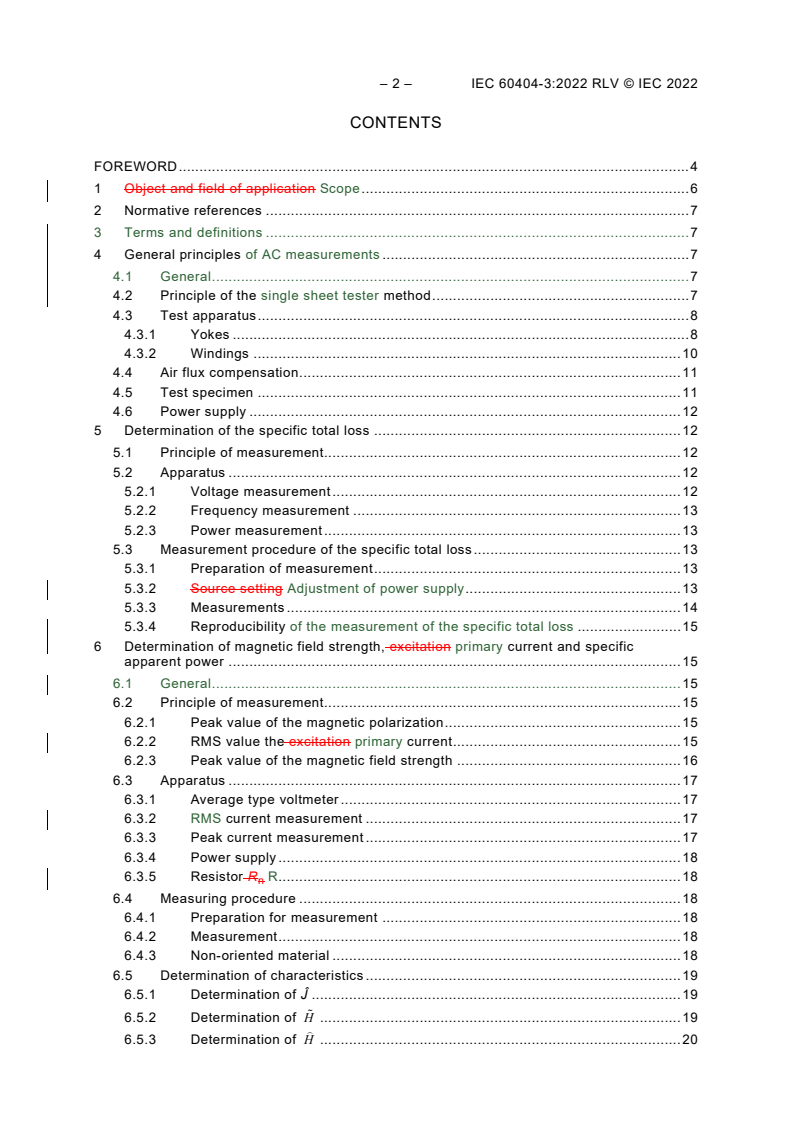
– 2 – IEC 60404-3:2022 RLV © IEC 2022
CONTENTS
FOREWORD . 4
1 Object and field of application Scope . 6
2 Normative references . 7
3 Terms and definitions . 7
4 General principles of AC measurements . 7
4.1 General . 7
4.2 Principle of the single sheet tester method . 7
4.3 Test apparatus . 8
4.3.1 Yokes . 8
4.3.2 Windings . 10
4.4 Air flux compensation . 11
4.5 Test specimen . 11
4.6 Power supply . 12
5 Determination of the specific total loss . 12
5.1 Principle of measurement. 12
5.2 Apparatus . 12
5.2.1 Voltage measurement . 12
5.2.2 Frequency measurement . 13
5.2.3 Power measurement . 13
5.3 Measurement procedure of the specific total loss . 13
5.3.1 Preparation of measurement . 13
5.3.2 Source setting Adjustment of power supply . 13
5.3.3 Measurements . 14
5.3.4 Reproducibility of the measurement of the specific total loss . 15
6 Determination of magnetic field strength, excitation primary current and specific
apparent power . 15
6.1 General . 15
6.2 Principle of measurement. 15
6.2.1 Peak value of the magnetic polarization . 15
6.2.2 RMS value the excitation primary current . 15
6.2.3 Peak value of the magnetic field strength . 16
6.3 Apparatus . 17
6.3.1 Average type voltmeter . 17
6.3.2 RMS current measurement . 17
6.3.3 Peak current measurement . 17
6.3.4 Power supply . 18
6.3.5 Resistor R R . 18
n
6.4 Measuring procedure . 18
6.4.1 Preparation for measurement . 18
6.4.2 Measurement . 18
6.4.3 Non-oriented material . 18
6.5 Determination of characteristics . 19
6.5.1 Determination of Ĵ . 19
6.5.2 Determination of H . 19
6.5.3 Determination of H . 20
6.5.4 Determination of S . 20
s
6.5.5 Reproducibility of the measurement of the specific apparent power . 21
7 Test report . 21
Annex A (normative) Requirements concerning the manufacture of yokes . 22
Annex B (informative) Calibration of the test apparatus with respect to the Epstein
frame .
Annex B (informative) Check and verification of reliable performance of the SST set-
up by the use of reference samples and impact of the loss dissipated in the yokes . 25
Annex C (informative) Epstein to SST relationship for grain-oriented steel sheet . 28
Annex D (informative) Digital sampling methods for the determination of the magnetic
properties and numerical air flux compensation . 32
D.1 General . 32
D.2 Technical details and requirements . 32
D.3 Calibration aspects . 34
D.4 Numerical air flux compensation . 35
Bibliography . 36
Figure 1 – Schematic diagrammes of the test apparatus . 9
Figure 2 – Yoke dimensions . 10
Figure 3 – Diagram of the connections of the five coils of the primary winding . 10
Figure 4 – Circuit for the determination of the specific total loss. 11
Figure 5 – Circuit for measuring the RMS value of the excitation primary current . 16
Figure 6 – Circuit for measuring the peak value of the magnetic field strength . 17
Figure B.1 – Specific total loss vs. peak flux density (after J.Sievert [3] and
1.85
G. Bertotti [4]); straight line: P ∝ B approximation (after C.Ragusa). . 26
S
Figure C.1 – Epstein-SST conversion factor δP SST-Epstein relative difference δP for
conventional grain-oriented material versus magnetic polarization J Ĵ . 30
Figure C.2 – Epstein-SST conversion factor δHS SST-Epstein relative difference δHS
for conventional grain-oriented material versus magnetic polarization J Ĵ . 31
Table B.1 – Loss dissipated by the yokes of a standard SST, determined from the loss
curves measured on 3 yoke pairs as shown in Figure B.1, and relevant quantities
including the relative yokes' contribution, p ; exemplified using 5 standard grades . 27
Y
Table C.1 – Epstein-SST conversion factors δP and δHS SST-Epstein relative
differences δP and δHS and the conversion factor F for conventional grain-oriented
C
material in the polarization range 1,0 T to 1,8 T . 30
– 4 – IEC 60404-3:2022 RLV © IEC 2022
INTERNATIONAL ELECTROTECHNICAL COMMISSION
____________
MAGNETIC MATERIALS –
Part 3: Methods of measurement of the magnetic properties of
electrical steel strip and sheet by means of a single sheet tester
FOREWORD
1) The International Electrotechnical Commission (IEC) is a worldwide organization for standardization comprising
all national electrotechnical committees (IEC National Committees). The object of IEC is to promote international
co-operation on all questions concerning standardization in the electrical and electronic fields. To this end and
in addition to other activities, IEC publishes International Standards, Technical Specifications, Technical Reports,
Publicly Available Specifications (PAS) and Guides (hereafter referred to as “IEC Publication(s)”). Their
preparation is entrusted to technical committees; any IEC National Committee interested in the subject dealt with
may participate in this preparatory work. International, governmental and non-governmental organizations liaising
with the IEC also participate in this preparation. IEC collaborates closely with the International Organization for
Standardization (ISO) in accordance with conditions determined by agreement between the two organizations.
2) The formal decisions or agreements of IEC on technical matters express, as nearly as possible, an international
consensus of opinion on the relevant subjects since each technical committee has representation from all
interested IEC National Committees.
3) IEC Publications have the form of recommendations for international use and are accepted by IEC National
Committees in that sense. While all reasonable efforts are made to ensure that the technical content of IEC
Publications is accurate, IEC cannot be held responsible for the way in which they are used or for any
misinterpretation by any end user.
4) In order to promote international uniformity, IEC National Committees undertake to apply IEC Publications
transparently to the maximum extent possible in their national and regional publications. Any divergence between
any IEC Publication and the corresponding national or regional publication shall be clearly indicated in the latter.
5) IEC itself does not provide any attestation of conformity. Independent certification bodies provide conformity
assessment services and, in some areas, access to IEC marks of conformity. IEC is not responsible for any
services carried out by independent certification bodies.
6) All users should ensure that they have the latest edition of this publication.
7) No liability shall attach to IEC or its directors, employees, servants or agents including individual experts and
members of its technical committees and IEC National Committees for any personal injury, property damage or
other damage of any nature whatsoever, whether direct or indirect, or for costs (including legal fees) and
expenses arising out of the publication, use of, or reliance upon, this IEC Publication or any other IEC
Publications.
8) Attention is drawn to the Normative references cited in this publication. Use of the referenced publications is
indispensable for the correct application of this publication.
9) Attention is drawn to the possibility that some of the elements of this IEC Publication may be the subject of patent
rights. IEC shall not be held responsible for identifying any or all such patent rights.
This redline version of the official IEC Standard allows the user to identify the changes made to
the previous edition IEC 60404-3:1992+AMD1:2002+AMD2:2009 CSV. A vertical bar appears in
the margin wherever a change has been made. Additions are in green text, deletions are in
strikethrough red text.
IEC 60404-3 has been prepared by IEC technical committee 68: Magnetic alloys and steels. It
is an International Standard.
This third edition cancels and replaces the second edition published in 1992, Amendment
1:2002 and Amendment 2:2009. This edition constitutes a technical revision.
This edition includes the following significant technical changes with respect to the previous
edition:
a) Annex A was revised. The method of determining the yokes’ lamination resistance was
added to Annex A;
b) Annex B of the consolidated version of 2010 referred to calibration of the SST using the
Epstein method. It was cancelled;
c) Annex B (new), Annex C and Annex D were revised, they are for information only;
d) Annex C was modified taking account of the new situation regarding P and R grades;
e) Annex D was amended by addition of Clause D.4 on the numerical air flux compensation.
The text of this International Standard is based on the following documents:
Draft Report on voting
68/699/CDV 68/710/RVC
Full information on the voting for its approval can be found in the report on voting indicated in
the above table.
The language used for the development of this International Standard is English.
This document was drafted in accordance with ISO/IEC Directives, Part 2, and developed in
accordance with ISO/IEC Directives, Part 1 and ISO/IEC Directives, IEC Supplement, available
at www.iec.ch/members_experts/refdocs. The main document types developed by IEC are
described in greater detail at www.iec.ch/publications.
A list of all parts in the IEC 60404 series, published under the general title Magnetic materials,
can be found on the IEC website.
The committee has decided that the contents of this document will remain unchanged until the
stability date indicated on the IEC website under webstore.iec.ch in the data related to the
specific document. At this date, the document will be
• reconfirmed,
• withdrawn,
• replaced by a revised edition, or
• amended.
IMPORTANT – The "colour inside" logo on the cover page of this document indicates that it
understanding of its
contains colours which are considered to be useful for the correct
contents. Users should therefore print this document using a colour printer.
– 6 – IEC 60404-3:2022 RLV © IEC 2022
MAGNETIC MATERIALS –
Part 3: Methods of measurement of the magnetic properties of
electrical steel strip and sheet by means of a single sheet tester
1 Object and field of application Scope
This part of IEC 60404 is applicable to grain-oriented and non-oriented electrical steel strip and
sheet for measurement of AC magnetic properties at power frequencies.
The object of this document is to define the general principles and the technical details of the
measurement of the magnetic properties of magnetic sheets electrical steel strip and sheet by
means of a single sheet tester (SST).
This part of IEC 60404 is applicable at power frequencies to:
a) grain oriented magnetic sheet and strip:
for the measurement between 1,0 T and 1,8 T of:
– specific total loss;
– specific apparent power;
– r.m.s. value of the magnetic field strength;
for the measurement up to peak values of magnetic field strength of 1 000 A/m of:
– peak value of the magnetic polarization;
– peak value of the magnetic field strength.
b) non-oriented magnetic sheet and strip:
for the measurement between 0,8 T and 1,5 T of:
– specific total loss;
– specific apparent power;
– r.m.s. value of excitation current;
for the measurement up to peak values of magnetic field strength of 10 000 A/m of:
– peak value of the magnetic polarization;
– peak value of the magnetic field strength.
The single sheet tester is applicable to test specimens obtained from magnetic sheets and strips
of any quality electrical steel strips and sheets of any grade. The AC magnetic characteristics
are determined for sinusoidal induced voltages, for specified peak values of the magnetic
polarization, for specific peak values of the magnetic field strength and for a specified
frequency.
The measurements are made at an ambient temperature of (23±5)°C on test specimens which
have first been demagnetized.
NOTE Throughout this document, the quantity "magnetic polarization" is used as defined in IEC 60050(901)
IEC 60050-221. In some standards of the IEC 60404 series, the quantity "magnetic flux density" was used.
In order to support the long-term reliability of the performance of this set up and to understand
better the relationship between the Epstein method and the SST method, the informative
Annexes B and C, respectively, have been included.
2 Normative references
The following documents are referred to in the text in such a way that some or all of their content
constitutes requirements of this document. For dated references, only the edition cited applies.
For undated references, the latest edition of the referenced document (including any
amendments) applies.
IEC 60050-121, International Electrotechnical Vocabulary – Part 121: Electromagnetism
IEC 60050-221, International Electrotechnical Vocabulary – Part 221: Magnetic materials and
components
IEC 60404-2, Magnetic materials – Part 2: Methods of measurement of the magnetic
properties of electrical steel strip and sheet by means of an Epstein frame
IEC 60404-13, Magnetic materials – Part 13: Methods of measurement of resistivity, density
and stacking factor of electrical steel strip and sheet
3 Terms and definitions
For the purposes of this document, the terms and definitions given in IEC 60050-121 and
IEC 60050-221 apply.
ISO and IEC maintain terminological databases for use in standardization at the following
addresses:
• IEC Electropedia: available at https://www.electropedia.org/
• ISO Online browsing platform: available at https://www.iso.org/obp
4 General principles of AC measurements
4.1 General
Clause 4 specifies the general conditions for the determination of AC magnetic properties of
electrical steel strip and sheet at power frequencies by means of a single sheet tester.
4.2 Principle of the single sheet tester method
The test specimen comprises a sample of magnetic electrical steel sheet and is placed inside
in the center of two concentric windings:
– an exterior primary winding (magnetizing winding);
– an interior secondary winding (voltage winding).
The flux closure is made by a magnetic circuit consisting of two identical yokes, the cross-
section of which is very large compared with that of the test specimen (see Figure 1).
To minimize the effects of pressure on the test specimen, the upper yoke shall be provided with
a means of suspension which allows part of its weight to be counterbalanced in accordance
with 3.2.1.
Care shall be taken to ensure that The temperature changes of the specimen are shall be kept
below a level likely to produce stress in the test specimen due to thermal expansion or
contraction.
– 8 – IEC 60404-3:2022 RLV © IEC 2022
4.3 Test apparatus
4.3.1 Yokes
Each yoke is in the form of a U made up of insulated sheets of grain-oriented silicon electrical
steel or nickel iron alloy. It shall have a low reluctance and a low specific total loss not greater
than 1,0 W/kg at 1,5 T and 50 Hz in the low magnetic polarization region below 0,2 T (see
Annex A). It shall be manufactured in accordance with the requirements of Annex A.
In order to reduce the effect of eddy currents and give a more homogeneous distribution of the
flux over the inside of the yokes, the latter yokes shall be made of a pair of wound cut C-cores
or a glued stack of laminations in which case the corners shall have staggered butt joints (see
Figure 1).
The yoke shall have pole faces having a width of 25 mm ± 1 mm.
The two pole faces of each yoke shall be coplanar to within 0,5 mm and the gap between the
opposite pole faces of the yokes shall not exceed 0,005 mm at any point. Also, the yokes shall
be rigid in order to avoid creating mechanical stresses such as twisting, tensioning and
compression in the test specimen.
The height of each yoke shall be between 90 mm and 150 mm. Each yoke shall have a width
+5
mm and an inside length of 450 mm ± 1 mm (see Figure 2).
of 500
−0
NOTE It is recognized that other yoke dimensions can be used provided that the comparability of the results can
be demonstrated.
There shall be a non-conducting, non-magnetic support on which the test specimen is placed,
between the vertical limbs of the bottom yokes. This support shall be centered and located in
the same plane as the bottom yoke pole faces so that the test specimen is in direct contact with
the pole faces without any gap. Care shall be taken that in no case the upper surface of the
support is positioned higher than the plane of the pole faces of the bottom yoke.
a) Cross-section of the SST
b) Schematic view of the corner of a yoke with stacked lamination
Figure 1 – Schematic diagrammes of the test apparatus
The upper yoke shall be movable upwards to permit insertion of the test specimen. After
insertion the upper yoke shall be realigned accurately with the bottom yoke. After insertion of
the test specimen, the upper yoke shall be lowered to close the magnetic circuit and,
simultaneously, the pole faces of the bottom and upper yokes shall be aligned accurately. To
minimize the effects of pressure on the test specimen, the upper yoke shall be provided with a
means of suspension. The suspension of the upper yoke shall allow part of its weight to be
counterbalanced so as to give a force on the test specimen of between 100 N and 200 N.
NOTE The square shape configuration of the yoke has been chosen in order to have only one test specimen for
non-oriented material. By rotating the test specimen through 90°, it is possible to determine the characteristics in the
rolling direction and perpendicular to the rolling direction.
– 10 – IEC 60404-3:2022 RLV © IEC 2022
Dimensions in millimetres
Figure 2 – Yoke dimensions
4.3.2 Windings
The coil system inside the yokes shall have two windings:
– a primary winding, on the outside (magnetizing winding);
– a secondary winding, on the inside (voltage winding);
The primary (outer) and secondary (inner) windings shall be at least 440 mm in length and shall
be wound uniformly on a non-conducting, non-magnetic and rectangular former. The
dimensions of the former shall be as follows:
– length: 445 mm ± 2 mm;
– internal width: 510 mm ± 1 mm;
– internal height: 5 mm;
−2
– height: ≤ 15 mm.
The primary winding can be made up of:
– either five or more coils having identical dimensions and the same number of turns
connected in parallel and taking up the whole length (see Figure 3). For example, with five
coils, each coil can be made up of 400 turns of copper wire 1 mm in diameter, wound in five
layers;
– or a single continuous and uniform winding taking up the whole length. For example, this
winding can be made up of 400 turns of copper wire 1 mm in diameter, wound in one or
more layers layer.
Figure 3 – Diagram of the connections of the five coils of the primary winding
The number of turns on the secondary winding will depend on the characteristics of the
measuring instruments. In any case, the determination of the number of turns of the primary
and secondary windings shall be made with greatest reliability because a mistake would mean
a permanent error.
4.4 Air flux compensation
Compensation shall be made for the effect of air flux. This can be achieved, for example, by a
mutual inductor M (see Figure 4). The primary winding of the mutual inductor is connected in
series with the primary winding of the test apparatus, while the secondary winding of the mutual
inductor is connected to the secondary winding of the test apparatus in series opposition.
Key
V is the voltmeter that measures the average rectified voltage;
V is the voltmeter that measures the RMS voltage;
A is the ammeter that measures the RMS value of the primary current;
Hz that measures the frequency;
W that measures the power;
M is the mutual inductor;
T is the test frame.
Figure 4 – Circuit for the determination of the specific total loss
The adjustment of the value of the mutual inductance shall be made so that when passing an
alternating current through the primary windings in the absence of the test specimen in the test
apparatus, the voltage measured between the non-common terminals of the secondary
windings shall be no more than 0,1 % of the voltage appearing across the secondary winding
of the test apparatus alone. Thus, the average value of the rectified voltage induced in the
combined secondary windings is proportional to the peak value of the magnetic polarization in
the test specimen.
NOTE 1 Alternatively, the air flux compensation can be executed by the numerical method (for details, see Annex D,
Clause D.4).
NOTE 2 In the rest of this document, the term “compensated secondary voltage” is used to mean “voltage induced
in the secondary winding compensated for the effect of air flux”.
4.5 Test specimen
The length of the test specimen shall be not less than 500 mm. Although the part of the test
specimen situated outside the pole faces has no great influence on the measurement, this part
shall not be longer than is necessary to facilitate insertion and removal of the test specimen.
The width of the test specimen shall be as large as possible and at its maximum equal to
the width of the yokes.
For maximum optimum accuracy, the minimum width shall be not less than 60 % of the width of
the yokes.
– 12 – IEC 60404-3:2022 RLV © IEC 2022
NOTE 1 Specific restrictions of the dimensions of the test specimens can be defined for special material grades in
the respective product standards for magnetic materials.
NOTE 2 Information about application of the SST to strip samples of 50 mm to 250 mm width: Grain-oriented
electrical steel used for distribution transformer (DT) cores is merchandized in the form of slit coils of 50 mm to
250 mm width cut from the as produced steel strips (parent coils) at the different positions across the original strips.
The slit coils reflect the considerable variation of the material properties corresponding to the position on the original
strip, where they have been cut from. These small strip specimens can be measured using this SST placing them
side by side or with distributed gaps in the SST. In order to obtain a relevant measurement result, a minimum of 60 %
of the 500 mm wide sample space needs to be filled with strips. The test strip samples can be taken successively
from the start or the end of a slit coil. When preparing them taking care would avoid any damage which could influence
the test result. Due to the cutting of the sheet into the small strips, the measured loss of narrow strips will be slightly
increased compared to the original 500 mm.
The test specimen shall be cut without the formation of excessive burrs or mechanical distortion.
The test specimen shall be plane. When a test specimen is cut, the edge of the parent strip coil
is taken as the reference direction. The following tolerances are allowed for The angle between
the direction of rolling and that of cutting shall not exceed:
±1° for grain oriented steel sheet;
±5° for non-oriented steel sheet.
For non-oriented steel sheet, two specimens shall be cut, one parallel to the direction of rolling
and the other perpendicular unless the test specimen is square, in which case one test
specimen only is necessary.
4.6 Power supply
The power supply shall be of low internal impedance and shall be highly stable in terms
of voltage and frequency. During the measurement, the voltage and the frequency shall be
maintained constant within ±0,2 %.
In addition, the waveform of the compensated secondary induced voltage shall be maintained
as sinusoidal as possible. It is preferable to maintain The form factor of the compensated
secondary voltage shall be maintained to within ±1 % of 1,111. This can be achieved by various
means, for example by using an electronic feedback amplifier or by a computational digital
feedback system.
5 Determination of the specific total loss
5.1 Principle of measurement
The single sheet tester test apparatus with the inserted test specimen represents an unloaded
transformer the total loss of which is measured by the circuit shown in Figure 4.
5.2 Apparatus
5.2.1 Voltage measurement
NOTE For the application of digital sampling methods, see Annex D.
5.2.1.1 Average type voltmeter
The secondary rectified voltage of the test apparatus The average rectified value of the
compensated secondary voltage shall be measured by an average type voltmeter. The preferred
instrument is a digital voltmeter having an accuracy uncertainty of ±0,2 % or better.
NOTE 1 Instruments of this type are usually graduated in average rectified value multiplied by 1,111.
The load on the secondary circuit shall be as small as possible. Consequently, the internal
resistance of the average type voltmeter should be at least 1 000 Ω/V.
NOTE 2 For the application of digital sampling methods, see Annex D.
5.2.1.2 RMS voltmeter
A voltmeter responsive to RMS values shall be used. The preferred instrument is a digital
voltmeter having an accuracy uncertainty of ±0,2 % or better.
NOTE For the application of digital sampling methods, see Annex D.
5.2.2 Frequency measurement
A frequency meter having an accuracy uncertainty of ±0,1 % or better shall be used.
NOTE For the application of digital sampling methods, see Annex D.
5.2.3 Power measurement
The power shall be measured by a wattmeter having an accuracy uncertainty of ±0,5 % or better
at the actual power factor and crest factor.
NOTE For the application of digital sampling methods, see Annex D.
The ohmic resistance of the voltage circuit of the wattmeter shall be at least 100 Ω/V for all
ranges. If necessary, the losses in the secondary circuit shall be subtracted from the indicated
loss value, see Formula (3) in 5.3.3.1.
The ohmic resistance of the voltage circuit of the wattmeter shall be at least 5 000 times its
reactance, unless the wattmeter is compensated for its reactance.
If a current measuring device is included in the circuit, it shall be short-circuited when the
secondary voltage is adjusted and the loss is measured.
NOTE For the application of digital sampling methods, see Annex D.
5.3 Measurement procedure of the specific total loss
5.3.1 Preparation of measurement
The length of the test specimen shall be measured with an accuracy uncertainty of ±0,1 % or
better and its mass determined within ±0,1 %. The test specimen shall be loaded and centred
on the longitudinal and transverse axes of the test coil windings, and the partly counterbalanced
upper yoke shall be lowered.
Before the measurement, the test specimen shall be demagnetized by slowly decreasing an
alternating magnetic field starting from well above the value to be measured knee of the
magnetization curve of the test specimen material.
5.3.2 Source setting Adjustment of power supply
The source power supply output shall be adjusted so that slowly increased until the average
rectified value of the compensated secondary rectified voltage, U has reached the required
value. This value is calculated from the desired value of the magnetic polarization by means of:
R
i
U = 4 fN AJ
(1)
RR+
i t
where
is the average value of the secondary rectified voltage, in volts;
U
– 14 – IEC 60404-3:2022 RLV © IEC 2022
f is the frequency, in hertz;
R is the combined resistance of instruments in the secondary circuit, in ohms;
i
R is the series resistance of the secondary windings of the test apparatus and the mutual
t
inductor, in ohms;
N is the number of turns of the secondary winding;
A is the cross-sectional area of the test specimen, in square metres;
Ĵ is the peak value of the magnetic polarization, in teslas.
The cross-sectional area A of the test specimen is given by the formula:
m
A=
(2)
lρ
m
where
m is the mass of the test specimen, in kilograms;
l is the length of the test specimen, in metres;
ρ
is the conventional density of the test material, or the value determined in accordance
m
with IEC 60404-13, in kilograms per cubic metre.
5.3.3 Measurements
5.3.3.1 The ammeter, if any, in the primary circuit shall be observed to ensure that the current
circuit of the wattmeter is not overloaded. The ammeter shall then be short-circuited and the
secondary voltage readjusted. The primary current shall be checked to ensure that the current
circuit of the wattmeter is not overloaded. If a current-measuring device is included in the circuit,
it shall be short-circuited when the secondary voltage is adjusted and the loss is measured.
After checking that the waveform of the compensated secondary voltage stands within the
required tolerances, the wattmeter shall be read. The value of the specific total power loss shall
then be calculated from the formula:
2 (3)
(1,111 U )
N l
P = P −
s
N R m l
2 i m
U
( )
N l
1
PP −
(3)
s
N R ml
2 im
Where P
s
U
is the average RMS value of the compensated secondary rectified voltage, in volts;
P is the specific total power loss of the test specimen, in watts per kilogram;
s
P is the power measured by the wattmeter, in watts;
m is the mass of the test specimen, in kilograms;
l is the conventional magnetic path length, in metres (l = 0,45 m);
m m
l is the length of the test specimen, in metres;
=
N is the number of turns of the primary winding;
N is the number of turns of the secondary winding;
R is the combined resistance of instruments in the secondary circuit, in ohms.
i
NOTE 1 Studies have shown that the inside length between the vertical inner faces of the limbs of the yokes is an
appropriate mean value for the effective magnetic path length l for different various materials under test and
m
polarization values [1] .
NOTE 2 A long established practice in a few countries is to calibrate the test apparatus by determination of the
effective magnetic path length based on specific total power loss measurements made in an Epstein frame.
The details of the calibration procedure are described in annex B. This practice is permitted only for the evaluation
of magnetic sheet and strip intended for consumption in those countries.
5.3.3.2 In the case of non-oriented material electrical steel, for values of the specific total loss
specified in the product standards for magnetic materials, the reported value of the specific total
loss shall be calculated as the average of the two measurement results obtained for the
directions parallel and perpendicular to the direction of rolling. For other purposes, the values
of the specific total loss parallel and perpendicular to the direction of rolling shall be reported
separately.
5.3.4 Reproducibility of the measurement of the specific total loss
The reproducibility of this method using the test apparatus defined above is characterized by a
relative standard deviation of 1 % (for detailed information on the source of this number see
[2]) for grain-oriented electrical steel sheet and 2 % for non-oriented electrical steel sheet.
6 Determination of magnetic field strength, excitation primary current
and specific apparent power
6.1 General
This Clause 6 describes measuring methods for the determination of the following
characteristics:
– peak value of the magnetic polarization Ĵ;
– RMS value of the primary current Ĩ ;
�
– peak value of the magnetic field strength 𝐻𝐻;
– specific apparent power S .
s
NOTE For the application of digital sampling methods, see Annex D.
6.2 Principle of measurement
6.2.1 Peak value of the magnetic polarization
The peak value of the magnetic polarization shall be derived from the average rectified value
of the rectified compensated secondary voltage measured as described in 5.2.1.1.
6.2.2 RMS value of the excitation primary current
The RMS value of the excitation primary current shall be measured by an RMS ammeter in the
circuit of Figure 5.
________
Numbers in square brackets refer to the Bibliography.
– 16 – IEC 60404-3:2022 RLV © IEC 2022
Key
V is the voltmeter that measures the average rectified voltage;
A is the ammeter that measures the RMS value of the primary current;
M is the mutual inductor;
T is the test frame.
Figure 5 – Circuit for measuring the RMS value of the excitation primary current
6.2.3 Peak value of the magnetic field strength
The peak value of the magnetic field strength shall be obtained from the peak value Î of the
primary current. This shall be determined by measuring the voltage drop across a known
precision resistor R R as described in 6.3.5 using a peak an electronic voltmeter of high
n
sensitivity indicating the peak value as shown as V in Figure 6.
Key
V is the voltmeter that measures the average rectified value of the compensated secondary voltage;
V is the voltmeter that measures the peak value (or the RMS value, see 6.3.2) of the voltage drop across the non-
inductive precision resistor;
R is the non-inductive precision resistor;
M is the mutual inductor;
T is the test frame.
Figure 6 – Circuit for measuring the peak value of the magnetic field strength
6.3 Apparatus
6.3.1 Average type voltmeter
The secondary rectified voltage of the test apparatus shall be measured by an average type
voltmeter. The preferred instrument is a digital voltmeter having an accuracy of ±0,2 %.
NOTE Instruments of this type are usually graduated in average rectified value multiplied by 1,111.
The load on the secondary circuit shall be as small as possible. Consequently, the internal
resistance of The average type voltmeter should be at least 1 000 Ω/V.
The average type voltmeter shall be in accordance with 5.2.1.1.
6.3.2 RMS current measurement
The RMS value of the primary current shall be measured either by means of an RMS ammeter
of low impedance of class 0,5 or better (see Figure 5), or by using a precision resistor and an
RMS electronic voltmeter described in 5.2.1.2 (see Figure 6, in this case the peak voltmeter is
to be replaced by an RMS voltmeter).
6.3.3 Peak current measurement
The measurement of the peak voltage across the resistor R R (see Figure 6) shall be achieved
n
either by means of an electronic voltmeter of high sensitivity indicating the peak value, or by
means of a calibrated oscilloscope.
– 18 – IEC 60404-3:2022 RLV © IEC 2022
The full scale error of the device used shall be ±3 % or better.
A peak voltmeter having an uncertainty of ±0,5 % or better shall be used.
6.3.4 Power supply
The power supply shall be in accordance with 4.6.
6.3.5 Resistor R R
n
The method shown in Figure 6 requires a precision non-inductive resistor R of a value known
to within ±0,5 0,1 %.
The resistance value to be chosen depends upon the sensitivity of the peak voltmeter. It shall
not exceed 1 Ω in order to minimize the distortion of the induced voltage waveform.
The resistance value of the resistor R shall not exceed 1 Ω in order to minimize the distortion
of the magnetizing voltage and, thus, to facilitate the sinusoidal waveform of the induced
secondary voltage.
6.4 Measuring procedure
6.4.1 Preparation for measurement
The length of the test specimen shall be measured with an accuracy uncertainty of ±0,1 % or
better and its mass shall be
...
IEC 60404-3 ®
Edition 3.0 2022-11
INTERNATIONAL
STANDARD
NORME
INTERNATIONALE
colour
inside
Magnetic materials –
Part 3: Methods of measurement of the magnetic properties of electrical steel
strip and sheet by means of a single sheet tester
Matériaux magnétiques –
Partie 3: Méthodes de mesure des caractéristiques magnétiques des bandes et
tôles magnétiques en acier à l'aide de l'essai sur tôle unique
All rights reserved. Unless otherwise specified, no part of this publication may be reproduced or utilized in any form
or by any means, electronic or mechanical, including photocopying and microfilm, without permission in writing from
either IEC or IEC's member National Committee in the country of the requester. If you have any questions about IEC
copyright or have an enquiry about obtaining additional rights to this publication, please contact the address below or
your local IEC member National Committee for further information.
Droits de reproduction réservés. Sauf indication contraire, aucune partie de cette publication ne peut être reproduite
ni utilisée sous quelque forme que ce soit et par aucun procédé, électronique ou mécanique, y compris la photocopie
et les microfilms, sans l'accord écrit de l'IEC ou du Comité national de l'IEC du pays du demandeur. Si vous avez des
questions sur le copyright de l'IEC ou si vous désirez obtenir des droits supplémentaires sur cette publication, utilisez
les coordonnées ci-après ou contactez le Comité national de l'IEC de votre pays de résidence.
IEC Secretariat Tel.: +41 22 919 02 11
3, rue de Varembé info@iec.ch
CH-1211 Geneva 20 www.iec.ch
Switzerland
About the IEC
The International Electrotechnical Commission (IEC) is the leading global organization that prepares and publishes
International Standards for all electrical, electronic and related technologies.
About IEC publications
The technical content of IEC publications is kept under constant review by the IEC. Please make sure that you have the
latest edition, a corrigendum or an amendment might have been published.
IEC publications search - webstore.iec.ch/advsearchform IEC Products & Services Portal - products.iec.ch
The advanced search enables to find IEC publications by a Discover our powerful search engine and read freely all the
variety of criteria (reference number, text, technical publications previews. With a subscription you will always
committee, …). It also gives information on projects, replaced have access to up to date content tailored to your needs.
and withdrawn publications.
Electropedia - www.electropedia.org
IEC Just Published - webstore.iec.ch/justpublished
The world's leading online dictionary on electrotechnology,
Stay up to date on all new IEC publications. Just Published
containing more than 22 300 terminological entries in English
details all new publications released. Available online and
and French, with equivalent terms in 19 additional languages.
once a month by email.
Also known as the International Electrotechnical Vocabulary
(IEV) online.
IEC Customer Service Centre - webstore.iec.ch/csc
If you wish to give us your feedback on this publication or
need further assistance, please contact the Customer Service
Centre: sales@iec.ch.
A propos de l'IEC
La Commission Electrotechnique Internationale (IEC) est la première organisation mondiale qui élabore et publie des
Normes internationales pour tout ce qui a trait à l'électricité, à l'électronique et aux technologies apparentées.
A propos des publications IEC
Le contenu technique des publications IEC est constamment revu. Veuillez vous assurer que vous possédez l’édition la
plus récente, un corrigendum ou amendement peut avoir été publié.
Recherche de publications IEC - IEC Products & Services Portal - products.iec.ch
webstore.iec.ch/advsearchform Découvrez notre puissant moteur de recherche et consultez
La recherche avancée permet de trouver des publications IEC gratuitement tous les aperçus des publications. Avec un
en utilisant différents critères (numéro de référence, texte, abonnement, vous aurez toujours accès à un contenu à jour
comité d’études, …). Elle donne aussi des informations sur adapté à vos besoins.
les projets et les publications remplacées ou retirées.
Electropedia - www.electropedia.org
IEC Just Published - webstore.iec.ch/justpublished
Le premier dictionnaire d'électrotechnologie en ligne au
Restez informé sur les nouvelles publications IEC. Just
monde, avec plus de 22 300 articles terminologiques en
Published détaille les nouvelles publications parues.
anglais et en français, ainsi que les termes équivalents dans
Disponible en ligne et une fois par mois par email.
19 langues additionnelles. Egalement appelé Vocabulaire
Electrotechnique International (IEV) en ligne.
Service Clients - webstore.iec.ch/csc
Si vous désirez nous donner des commentaires sur cette
publication ou si vous avez des questions contactez-nous:
sales@iec.ch.
IEC 60404-3 ®
Edition 3.0 2022-11
INTERNATIONAL
STANDARD
NORME
INTERNATIONALE
colour
inside
Magnetic materials –
Part 3: Methods of measurement of the magnetic properties of electrical steel
strip and sheet by means of a single sheet tester
Matériaux magnétiques –
Partie 3: Méthodes de mesure des caractéristiques magnétiques des bandes et
tôles magnétiques en acier à l'aide de l'essai sur tôle unique
INTERNATIONAL
ELECTROTECHNICAL
COMMISSION
COMMISSION
ELECTROTECHNIQUE
INTERNATIONALE
ICS 17.220.20; 29.030 ISBN 978-2-8322-5961-0
– 2 – IEC 60404-3:2022 © IEC 2022
CONTENTS
FOREWORD . 4
1 Scope . 6
2 Normative references . 6
3 Terms and definitions . 6
4 General principles of AC measurements . 7
4.1 General . 7
4.2 Principle of the single sheet tester method . 7
4.3 Test apparatus . 7
4.3.1 Yokes . 7
4.3.2 Windings . 9
4.4 Air flux compensation . 10
4.5 Test specimen . 10
4.6 Power supply . 11
5 Determination of the specific total loss . 11
5.1 Principle of measurement. 11
5.2 Apparatus . 11
5.2.1 Voltage measurement . 11
5.2.2 Frequency measurement . 12
5.2.3 Power measurement . 12
5.3 Measurement procedure of the specific total loss . 12
5.3.1 Preparation of measurement . 12
5.3.2 Adjustment of power supply . 12
5.3.3 Measurements . 13
5.3.4 Reproducibility of the measurement of the specific total loss . 14
6 Determination of magnetic field strength, primary current and specific apparent
power . 14
6.1 General . 14
6.2 Principle of measurement. 14
6.2.1 Peak value of the magnetic polarization . 14
6.2.2 RMS value of the primary current. 14
6.2.3 Peak value of the magnetic field strength . 15
6.3 Apparatus . 15
6.3.1 Average type voltmeter . 15
6.3.2 RMS current measurement . 16
6.3.3 Peak current measurement . 16
6.3.4 Power supply . 16
6.3.5 Resistor R . 16
6.4 Measuring procedure . 16
6.4.1 Preparation for measurement . 16
6.4.2 Measurement . 16
6.4.3 Non-oriented material . 17
6.5 Determination of characteristics . 17
6.5.1 Determination of Ĵ . 17
6.5.2 Determination of H . 17
6.5.3 Determination of . 18
H
6.5.4 Determination of S . 18
s
6.5.5 Reproducibility of the measurement of the specific apparent power . 19
7 Test report . 19
Annex A (normative) Requirements concerning the manufacture of yokes . 20
Annex B (informative) Check and verification of reliable performance of the SST set-
up by the use of reference samples and impact of the loss dissipated in the yokes . 22
Annex C (informative) Epstein to SST relationship for grain-oriented steel sheet . 25
Annex D (informative) Digital sampling methods for the determination of the magnetic
properties and numerical air flux compensation . 28
D.1 General . 28
D.2 Technical details and requirements . 28
D.3 Calibration aspects . 30
D.4 Numerical air flux compensation . 30
Bibliography . 32
Figure 1 – Schematic diagrammes of the test apparatus . 8
Figure 2 – Yoke dimensions . 9
Figure 3 – Diagram of the connections of the five coils of the primary winding . 9
Figure 4 – Circuit for the determination of the specific total loss. 10
Figure 5 – Circuit for measuring the RMS value of the primary current . 15
Figure 6 – Circuit for measuring the peak value of the magnetic field strength . 15
Figure B.1 – Specific total loss vs. peak flux density (after J.Sievert [3] and
1.85
G. Bertotti [4]); straight line: P ∝ B approximation (after C.Ragusa). . 23
S
Figure C.1 – SST-Epstein relative difference δP for conventional grain-oriented
material versus magnetic polarization Ĵ . 27
Figure C.2 – SST-Epstein relative difference δHS for conventional grain-oriented
material versus magnetic polarization Ĵ . 27
Table B.1 – Loss dissipated by the yokes of a standard SST, determined from the loss
curves measured on 3 yoke pairs as shown in Figure B.1, and relevant quantities
including the relative yokes' contribution, p ; exemplified using 5 standard grades . 24
Y
Table C.1 – SST-Epstein relative differences δP and δHS and the conversion factor F
C
for conventional grain-oriented material in the polarization range 1,0 T to 1,8 T . 26
– 4 – IEC 60404-3:2022 © IEC 2022
INTERNATIONAL ELECTROTECHNICAL COMMISSION
____________
MAGNETIC MATERIALS –
Part 3: Methods of measurement of the magnetic properties of
electrical steel strip and sheet by means of a single sheet tester
FOREWORD
1) The International Electrotechnical Commission (IEC) is a worldwide organization for standardization comprising
all national electrotechnical committees (IEC National Committees). The object of IEC is to promote international
co-operation on all questions concerning standardization in the electrical and electronic fields. To this end and
in addition to other activities, IEC publishes International Standards, Technical Specifications, Technical Reports,
Publicly Available Specifications (PAS) and Guides (hereafter referred to as “IEC Publication(s)”). Their
preparation is entrusted to technical committees; any IEC National Committee interested in the subject dealt with
may participate in this preparatory work. International, governmental and non-governmental organizations liaising
with the IEC also participate in this preparation. IEC collaborates closely with the International Organization for
Standardization (ISO) in accordance with conditions determined by agreement between the two organizations.
2) The formal decisions or agreements of IEC on technical matters express, as nearly as possible, an international
consensus of opinion on the relevant subjects since each technical committee has representation from all
interested IEC National Committees.
3) IEC Publications have the form of recommendations for international use and are accepted by IEC National
Committees in that sense. While all reasonable efforts are made to ensure that the technical content of IEC
Publications is accurate, IEC cannot be held responsible for the way in which they are used or for any
misinterpretation by any end user.
4) In order to promote international uniformity, IEC National Committees undertake to apply IEC Publications
transparently to the maximum extent possible in their national and regional publications. Any divergence between
any IEC Publication and the corresponding national or regional publication shall be clearly indicated in the latter.
5) IEC itself does not provide any attestation of conformity. Independent certification bodies provide conformity
assessment services and, in some areas, access to IEC marks of conformity. IEC is not responsible for any
services carried out by independent certification bodies.
6) All users should ensure that they have the latest edition of this publication.
7) No liability shall attach to IEC or its directors, employees, servants or agents including individual experts and
members of its technical committees and IEC National Committees for any personal injury, property damage or
other damage of any nature whatsoever, whether direct or indirect, or for costs (including legal fees) and
expenses arising out of the publication, use of, or reliance upon, this IEC Publication or any other IEC
Publications.
8) Attention is drawn to the Normative references cited in this publication. Use of the referenced publications is
indispensable for the correct application of this publication.
9) Attention is drawn to the possibility that some of the elements of this IEC Publication may be the subject of patent
rights. IEC shall not be held responsible for identifying any or all such patent rights.
IEC 60404-3 has been prepared by IEC technical committee 68: Magnetic alloys and steels. It
is an International Standard.
This third edition cancels and replaces the second edition published in 1992, Amendment
1:2002 and Amendment 2:2009. This edition constitutes a technical revision.
This edition includes the following significant technical changes with respect to the previous
edition:
a) Annex A was revised. The method of determining the yokes’ lamination resistance was
added to Annex A;
b) Annex B of the consolidated version of 2010 referred to calibration of the SST using the
Epstein method. It was cancelled;
c) Annex B (new), Annex C and Annex D were revised, they are for information only;
d) Annex C was modified taking account of the new situation regarding P and R grades;
e) Annex D was amended by addition of Clause D.4 on the numerical air flux compensation.
The text of this International Standard is based on the following documents:
Draft Report on voting
68/699/CDV 68/710/RVC
Full information on the voting for its approval can be found in the report on voting indicated in
the above table.
The language used for the development of this International Standard is English.
This document was drafted in accordance with ISO/IEC Directives, Part 2, and developed in
accordance with ISO/IEC Directives, Part 1 and ISO/IEC Directives, IEC Supplement, available
at www.iec.ch/members_experts/refdocs. The main document types developed by IEC are
described in greater detail at www.iec.ch/publications.
A list of all parts in the IEC 60404 series, published under the general title Magnetic materials,
can be found on the IEC website.
The committee has decided that the contents of this document will remain unchanged until the
stability date indicated on the IEC website under webstore.iec.ch in the data related to the
specific document. At this date, the document will be
• reconfirmed,
• withdrawn,
• replaced by a revised edition, or
• amended.
IMPORTANT – The "colour inside" logo on the cover page of this document indicates that it
contains colours which are considered to be useful for the correct understanding of its
contents. Users should therefore print this document using a colour printer.
– 6 – IEC 60404-3:2022 © IEC 2022
MAGNETIC MATERIALS –
Part 3: Methods of measurement of the magnetic properties of
electrical steel strip and sheet by means of a single sheet tester
1 Scope
This part of IEC 60404 is applicable to grain-oriented and non-oriented electrical steel strip and
sheet for measurement of AC magnetic properties at power frequencies.
The object of this document is to define the general principles and the technical details of the
measurement of the magnetic properties of electrical steel strip and sheet by means of a single
sheet tester (SST).
The single sheet tester is applicable to test specimens obtained from electrical steel strips and
sheets of any grade. The AC magnetic characteristics are determined for sinusoidal induced
voltages, for specified peak values of the magnetic polarization, for specific peak values of the
magnetic field strength and for a specified frequency.
The measurements are made at an ambient temperature of (23±5)°C on test specimens which
have first been demagnetized.
NOTE Throughout this document, the quantity "magnetic polarization" is used as defined in IEC 60050-221. In some
standards of the IEC 60404 series, the quantity "magnetic flux density" was used.
In order to support the long-term reliability of the performance of this set up and to understand
better the relationship between the Epstein method and the SST method, the informative
Annexes B and C, respectively, have been included.
2 Normative references
The following documents are referred to in the text in such a way that some or all of their content
constitutes requirements of this document. For dated references, only the edition cited applies.
For undated references, the latest edition of the referenced document (including any
amendments) applies.
IEC 60050-121, International Electrotechnical Vocabulary – Part 121: Electromagnetism
IEC 60050-221, International Electrotechnical Vocabulary – Part 221: Magnetic materials and
components
IEC 60404-13, Magnetic materials – Part 13: Methods of measurement of resistivity, density
and stacking factor of electrical steel strip and sheet
3 Terms and definitions
For the purposes of this document, the terms and definitions given in IEC 60050-121 and
IEC 60050-221 apply.
ISO and IEC maintain terminological databases for use in standardization at the following
addresses:
• IEC Electropedia: available at https://www.electropedia.org/
• ISO Online browsing platform: available at https://www.iso.org/obp
4 General principles of AC measurements
4.1 General
Clause 4 specifies the general conditions for the determination of AC magnetic properties of
electrical steel strip and sheet at power frequencies by means of a single sheet tester.
4.2 Principle of the single sheet tester method
The test specimen comprises a sample of electrical steel sheet and is placed in the center of
two concentric windings:
– an exterior primary winding (magnetizing winding);
– an interior secondary winding (voltage winding).
The flux closure is made by a magnetic circuit consisting of two identical yokes, the cross-
section of which is very large compared with that of the test specimen (see Figure 1).
The temperature changes of the specimen shall be kept below a level likely to produce stress
in the test specimen due to thermal expansion or contraction.
4.3 Test apparatus
4.3.1 Yokes
Each yoke is in the form of a U made up of insulated sheets of grain-oriented electrical steel. It
shall have a low reluctance and a low specific total loss in the low magnetic polarization region
below 0,2 T (see Annex A). It shall be manufactured in accordance with the requirements of
Annex A.
In order to reduce the effect of eddy currents and give a more homogeneous distribution of the
flux over the inside of the yokes, the yokes shall be made of a pair of wound cut C-cores or a
glued stack of laminations in which case the corners shall have staggered butt joints (see
Figure 1).
The yoke shall have pole faces having a width of 25 mm ± 1 mm.
The two pole faces of each yoke shall be coplanar to within 0,5 mm and the gap between the
opposite pole faces of the yokes shall not exceed 0,005 mm at any point. Also, the yokes shall
be rigid in order to avoid creating mechanical stresses such as twisting, tensioning and
compression in the test specimen.
The height of each yoke shall be between 90 mm and 150 mm. Each yoke shall have a width
+5
of 500 mm and an inside length of 450 mm ± 1 mm (see Figure 2).
−0
There shall be a non-conducting, non-magnetic support on which the test specimen is placed,
between the vertical limbs of the bottom yokes. This support shall be centered and located in
the same plane as the bottom yoke pole faces so that the test specimen is in direct contact with
the pole faces without any gap. Care shall be taken that in no case the upper surface of the
support is positioned higher than the plane of the pole faces of the bottom yoke.
– 8 – IEC 60404-3:2022 © IEC 2022
a) Cross-section of the SST
b) Schematic view of the corner of a yoke with stacked lamination
Figure 1 – Schematic diagrammes of the test apparatus
The upper yoke shall be movable upwards to permit insertion of the test specimen. After
insertion of the test specimen, the upper yoke shall be lowered to close the magnetic circuit
and, simultaneously, the pole faces of the bottom and upper yokes shall be aligned accurately.
To minimize the effects of pressure on the test specimen, the upper yoke shall be provided with
a means of suspension. The suspension of the upper yoke shall allow part of its weight to be
counterbalanced so as to give a force on the test specimen of between 100 N and 200 N.
NOTE The square configuration of the yoke has been chosen in order to have only one test specimen for non-
oriented material. By rotating the test specimen through 90°, it is possible to determine the characteristics in the
rolling direction and perpendicular to the rolling direction.
Dimensions in millimetres
Figure 2 – Yoke dimensions
4.3.2 Windings
The coil system inside the yokes shall have two windings:
– a primary winding, on the outside (magnetizing winding);
– a secondary winding, on the inside (voltage winding);
The primary (outer) and secondary (inner) windings shall be at least 440 mm in length and shall
be wound uniformly on a non-conducting, non-magnetic and rectangular former. The
dimensions of the former shall be as follows:
– length: 445 mm ± 2 mm;
– internal width: 510 mm ± 1 mm;
– internal height: 5 mm;
−2
– height: ≤ 15 mm.
The primary winding can be made up of:
– either five or more coils having identical dimensions and the same number of turns
connected in parallel and taking up the whole length (see Figure 3). For example, with five
coils, each coil can be made up of 400 turns of copper wire 1 mm in diameter, wound in five
layers;
– or a single continuous and uniform winding taking up the whole length. For example, this
winding can be made up of 400 turns of copper wire 1 mm in diameter, wound in one layer.
Figure 3 – Diagram of the connections of the five coils of the primary winding
The number of turns on the secondary winding will depend on the characteristics of the
measuring instruments. In any case, the determination of the number of turns of the primary
and secondary windings shall be made with greatest reliability because a mistake would mean
a permanent error.
– 10 – IEC 60404-3:2022 © IEC 2022
4.4 Air flux compensation
Compensation shall be made for the effect of air flux. This can be achieved, for example, by a
mutual inductor M (see Figure 4). The primary winding of the mutual inductor is connected in
series with the primary winding of the test apparatus, while the secondary winding of the mutual
inductor is connected to the secondary winding of the test apparatus in series opposition.
Key
V is the voltmeter that measures the average rectified voltage;
V is the voltmeter that measures the RMS voltage;
A is the ammeter that measures the RMS value of the primary current;
Hz that measures the frequency;
W that measures the power;
M is the mutual inductor;
T is the test frame.
Figure 4 – Circuit for the determination of the specific total loss
The adjustment of the value of the mutual inductance shall be made so that when passing an
alternating current through the primary windings in the absence of the test specimen in the test
apparatus, the voltage measured between the non-common terminals of the secondary
windings shall be no more than 0,1 % of the voltage appearing across the secondary winding
of the test apparatus alone. Thus, the average value of the rectified voltage induced in the
combined secondary windings is proportional to the peak value of the magnetic polarization in
the test specimen.
NOTE 1 Alternatively, the air flux compensation can be executed by the numerical method (for details, see Annex D,
Clause D.4).
NOTE 2 In the rest of this document, the term “compensated secondary voltage” is used to mean “voltage induced
in the secondary winding compensated for the effect of air flux”.
4.5 Test specimen
The length of the test specimen shall be not less than 500 mm. Although the part of the test
specimen situated outside the pole faces has no great influence on the measurement, this part
shall not be longer than is necessary to facilitate insertion and removal of the test specimen.
The width of the test specimen shall be as large as possible and at its maximum equal to
the width of the yokes.
For optimum accuracy, the minimum width shall be not less than 60 % of the width of the yokes.
NOTE 1 Specific restrictions of the dimensions of the test specimens can be defined for special material grades in
the respective product standards for magnetic materials.
NOTE 2 Information about application of the SST to strip samples of 50 mm to 250 mm width: Grain-oriented
electrical steel used for distribution transformer (DT) cores is merchandized in the form of slit coils of 50 mm to
250 mm width cut from the as produced steel strips (parent coils) at the different positions across the original strips.
The slit coils reflect the considerable variation of the material properties corresponding to the position on the original
strip, where they have been cut from. These small strip specimens can be measured using this SST placing them
side by side or with distributed gaps in the SST. In order to obtain a relevant measurement result, a minimum of 60 %
of the 500 mm wide sample space needs to be filled with strips. The test strip samples can be taken successively
from the start or the end of a slit coil. When preparing them taking care would avoid any damage which could influence
the test result. Due to the cutting of the sheet into the small strips, the measured loss of narrow strips will be slightly
increased compared to the original 500 mm.
The test specimen shall be cut without the formation of excessive burrs or mechanical distortion.
The test specimen shall be plane. When a test specimen is cut, the edge of the parent coil is
taken as the reference direction. The angle between the direction of rolling and that of cutting
shall not exceed:
±1° for grain oriented steel sheet;
±5° for non-oriented steel sheet.
For non-oriented steel sheet, two specimens shall be cut, one parallel to the direction of rolling
and the other perpendicular unless the test specimen is square, in which case one test
specimen only is necessary.
4.6 Power supply
The power supply shall be of low internal impedance and shall be highly stable in terms
of voltage and frequency. During the measurement, the voltage and the frequency shall be
maintained constant within ±0,2 %.
In addition, the waveform of the compensated secondary voltage shall be maintained as
sinusoidal as possible. The form factor of the compensated secondary voltage shall be
maintained to within ±1 % of 1,111. This can be achieved by various means, for example by
using an electronic feedback amplifier or by a computational digital feedback system.
5 Determination of the specific total loss
5.1 Principle of measurement
The test apparatus with the inserted test specimen represents an unloaded transformer the total
loss of which is measured by the circuit shown in Figure 4.
5.2 Apparatus
5.2.1 Voltage measurement
5.2.1.1 Average type voltmeter
The average rectified value of the compensated secondary voltage shall be measured by an
average type voltmeter. The preferred instrument is a digital voltmeter having an uncertainty of
±0,2 % or better.
NOTE 1 Instruments of this type are usually graduated in average rectified value multiplied by 1,111.
The load on the secondary circuit shall be as small as possible. Consequently, the internal
resistance of the average type voltmeter should be at least 1 000 Ω/V.
NOTE 2 For the application of digital sampling methods, see Annex D.
– 12 – IEC 60404-3:2022 © IEC 2022
5.2.1.2 RMS voltmeter
A voltmeter responsive to RMS values shall be used. The preferred instrument is a digital
voltmeter having an uncertainty of ±0,2 % or better.
NOTE For the application of digital sampling methods, see Annex D.
5.2.2 Frequency measurement
A frequency meter having an uncertainty of ±0,1 % or better shall be used.
NOTE For the application of digital sampling methods, see Annex D.
5.2.3 Power measurement
The power shall be measured by a wattmeter having an uncertainty of ±0,5 % or better at the
actual power factor and crest factor.
The ohmic resistance of the voltage circuit of the wattmeter shall be at least 100 Ω/V for all
ranges. If necessary, the losses in the secondary circuit shall be subtracted from the indicated
loss value, see Formula (3) in 5.3.3.1.
The ohmic resistance of the voltage circuit of the wattmeter shall be at least 5 000 times its
reactance, unless the wattmeter is compensated for its reactance.
If a current measuring device is included in the circuit, it shall be short-circuited when the
secondary voltage is adjusted and the loss is measured.
NOTE For the application of digital sampling methods, see Annex D.
5.3 Measurement procedure of the specific total loss
5.3.1 Preparation of measurement
The length of the test specimen shall be measured with an uncertainty of ±0,1 % or better and
its mass determined within ±0,1 %. The test specimen shall be loaded and centred on the
longitudinal and transverse axes of the windings, and the partly counterbalanced upper yoke
shall be lowered.
Before the measurement, the test specimen shall be demagnetized by slowly decreasing an
alternating magnetic field starting from well above the knee of the magnetization curve of the
test specimen material.
5.3.2 Adjustment of power supply
The power supply output shall be slowly increased until the average rectified value of the
compensated secondary voltage, U has reached the required value. This value is calculated
from the desired value of the magnetic polarization by means of:
R
i
U = 4 fN AJ
(1)
RR+
i t
where
U is the average value of the secondary rectified voltage, in volts;
f is the frequency, in hertz;
R is the combined resistance of instruments in the secondary circuit, in ohms;
i
R is the series resistance of the secondary windings of the test apparatus and the mutual
t
inductor, in ohms;
N is the number of turns of the secondary winding;
A is the cross-sectional area of the test specimen, in square metres;
Ĵ is the peak value of the magnetic polarization, in teslas.
The cross-sectional area A of the test specimen is given by the formula:
m
A=
(2)
lρ
m
where
m is the mass of the test specimen, in kilograms;
l is the length of the test specimen, in metres;
ρ is the conventional density of the test material, or the value determined in accordance
m
with IEC 60404-13, in kilograms per cubic metre.
5.3.3 Measurements
5.3.3.1 The primary current shall be checked to ensure that the current circuit of the wattmeter
is not overloaded. If a current-measuring device is included in the circuit, it shall be short-
circuited when the secondary voltage is adjusted and the loss is measured.
After checking that the waveform of the compensated secondary voltage stands within the
required tolerances, the wattmeter shall be read. The value of the specific total loss shall then
be calculated from the formula:
U
N ( )
2 l
1
PP−
(3)
s
N R ml
2 im
Where P
s
U
is the RMS value of the compensated secondary voltage, in volts;
P is the specific total loss of the test specimen, in watts per kilogram;
s
P is the power measured by the wattmeter, in watts;
m is the mass of the test specimen, in kilograms;
is the conventional magnetic path length, in metres (l = 0,45 m);
l
m m
l is the length of the test specimen, in metres;
N is the number of turns of the primary winding;
N is the number of turns of the secondary winding;
R is the combined resistance of instruments in the secondary circuit, in ohms.
i
=
– 14 – IEC 60404-3:2022 © IEC 2022
NOTE Studies have shown that the inside length between the vertical inner faces of the limbs of the yokes is an
appropriate mean value for the effective magnetic path length l for various materials under test and polarization
m
values [1] .
5.3.3.2 In the case of non-oriented electrical steel, for values of the specific total loss specified
in the product standards for magnetic materials, the reported value of the specific total loss
shall be calculated as the average of the two measurement results obtained for the directions
parallel and perpendicular to the direction of rolling. For other purposes, the values of the
specific total loss parallel and perpendicular to the direction of rolling shall be reported
separately.
5.3.4 Reproducibility of the measurement of the specific total loss
The reproducibility of this method using the test apparatus defined above is characterized by a
relative standard deviation of 1 % (for detailed information on the source of this number see
[2]) for grain-oriented electrical steel sheet and 2 % for non-oriented electrical steel sheet.
6 Determination of magnetic field strength, primary current
and specific apparent power
6.1 General
This Clause 6 describes measuring methods for the determination of the following
characteristics:
– peak value of the magnetic polarization Ĵ;
– RMS value of the primary current Ĩ ;
�
– peak value of the magnetic field strength 𝐻𝐻;
– specific apparent power S .
s
NOTE For the application of digital sampling methods, see Annex D.
6.2 Principle of measurement
6.2.1 Peak value of the magnetic polarization
The peak value of the magnetic polarization shall be derived from the average rectified value
of the compensated secondary voltage measured as described in 5.2.1.1.
6.2.2 RMS value of the primary current
The RMS value of the primary current shall be measured by an RMS ammeter in the circuit of
Figure 5.
________
Numbers in square brackets refer to the Bibliography.
Key
V is the voltmeter that measures the average rectified voltage;
A is the ammeter that measures the RMS value of the primary current;
M is the mutual inductor;
T is the test frame.
Figure 5 – Circuit for measuring the RMS value of the primary current
6.2.3 Peak value of the magnetic field strength
The peak value of the magnetic field strength shall be obtained from the peak value Î of the
primary current. This shall be determined by measuring the voltage drop across a known
precision resistor R as described in 6.3.5 using an electronic voltmeter of high sensitivity
indicating the peak value as shown as V in Figure 6.
Key
V is the voltmeter that measures the average rectified value of the compensated secondary voltage;
V is the voltmeter that measures the peak value (or the RMS value, see 6.3.2) of the voltage drop across the non-
inductive precision resistor;
R is the non-inductive precision resistor;
M is the mutual inductor;
T is the test frame.
Figure 6 – Circuit for measuring the peak value of the magnetic field strength
6.3 Apparatus
6.3.1 Average type voltmeter
The average type voltmeter shall be in accordance with 5.2.1.1.
– 16 – IEC 60404-3:2022 © IEC 2022
6.3.2 RMS current measurement
The RMS value of the primary current shall be measured either by means of an RMS ammeter
of low impedance of class 0,5 or better (see Figure 5), or by using a precision resistor and an
RMS voltmeter described in 5.2.1.2 (see Figure 6, in this case the peak voltmeter is to be
replaced by an RMS voltmeter).
6.3.3 Peak current measurement
The measurement of the peak voltage across the resistor R (see Figure 6) shall be achieved
either by means of an electronic voltmeter of high sensitivity indicating the peak value, or by
means of a calibrated oscilloscope.
A peak voltmeter having an uncertainty of ±0,5 % or better shall be used.
6.3.4 Power supply
The power supply shall be in accordance with 4.6.
6.3.5 Resistor R
The method shown in Figure 6 requires a precision non-inductive resistor R of a value known
to within ±0,1 %.
The resistance value of the resistor R shall not exceed 1 Ω in order to minimize the distortion
of the magnetizing voltage and, thus, to facilitate the sinusoidal waveform of the induced
secondary voltage.
6.4 Measuring procedure
6.4.1 Preparation for measurement
The length of the test specimen shall be measured with an uncertainty of ±0,1 % or better and
its mass shall be determined with an uncertainty of ±0,1 % or better. The test specimen shall
be loaded and centered on the longitudinal and transverse axes of the windings coil. The partly
counterbalanced upper yoke shall then be lowered.
Before the measurement, the test specimen shall be demagnetized by slowly decreasing an
alternating magnetic field starting from well above the knee of the magnetization curve of the
test specimen material.
6.4.2 Measurement
In practice, single values or groups of peak values of the magnetic polarization Ĵ and the
� �
magnetic field strength (𝐻𝐻 or 𝐻𝐻) are determined.
If the peak value of the magnetic field strength is specified and the peak value of the magnetic
polarization is to be determined, the primary current shall be set to give the relevant magnetic
field strength (see below). Then the compensated secondary voltage of the test apparatus shall
be read on the average type voltmeter (see 5.2.1.1).
Again, if the peak vale of the magnetic polarization is specified and the peak value of the
magnetic field strength is to be determined, the secondary voltage shall be set to its specified
value as described in 5.3.2.
�
For the determination of 𝐻𝐻, the RMS value of the primary current shall be read on the RMS
ammeter according to the circuit of Figure 5 or on the RMS voltmeter according to the circuit of
Figure 6.
...