

IEC 60879:2019
(Main)Comfort fans and regulators for household and similar purposes - Methods for measuring performance
General Information
- Abstract
IEC 60879:2019 specifies the performance-measuring methods of comfort fans and regulators for household and similar purposes, including conventional fans, tower fans and bladeless fans, their rated voltage being not more than 250 V for single-phase fans and 480 V for other fans, and their rated power input being less than 125 W.
According to the testing method, the comfort fans are classified into two groups:
– pedestal fans, table fans, wall fans, louvre fans, tower fans, bladeless fans;
– ceiling fans.
Wherever applicable, the term "fan" used in this document includes its associated regulator, if any.
This document does not apply to:
– safety of electric fans for household and similar purposes (IEC 60335-2-80);
– performance of ventilating fans (IEC 60665);
– electromagnetic compatibility of fans (CISPR 14-1 and CISPR 14-2, IEC 61000-3-2, IEC 61000-3-3).
This second edition cancels and replaces the first edition published in 1986. This edition constitutes a technical revision.
This edition includes the following significant technical changes with respect to the previous edition:
a) the definitions of fans have been revised;
b) the test methods for the different types of fans have been revised to allow modern test instrumentation to be used;
c) acoustic noise measurement and standby power measurement methods have been introduced.
- Status
- Published
- Publication Date
- 16-Mar-2025
- Technical Committee
- SC 59L - Small household appliances
- Drafting Committee
- MT 4 - TC 59/SC 59L/MT 4
- Current Stage
- PPUB - Publication issued
- Start Date
- 22-May-2019
- Completion Date
- 21-Jun-2019
Buy Documents
IEC 60879:2019+AMD1:2025 CSV - Comfort fans and regulators for household and similar purposes - Methods for measuring performance Released:3/17/2025
IEC 60879:2019 - Comfort fans and regulators for household and similar purposes - Methods for measuring performance Released:5/22/2019
Overview
IEC 60879:2019 specifies standardized methods for measuring the performance of comfort fans and their regulators for household and similar purposes. It covers conventional propeller fans, pedestal/table/wall/louvre fans, tower fans and bladeless fans, and ceiling fans. The standard applies to fans with rated voltages up to 250 V (single‑phase) or 480 V (other) and a rated power input of less than 125 W. This edition updates fan definitions, enables modern test instrumentation, and adds acoustic noise and standby power measurement methods.
Key topics and requirements
- Classification: Two testing groups - (1) pedestal, table, wall, louvre, tower and bladeless fans; (2) ceiling fans. Wherever applicable, “fan” includes associated regulators.
- Performance measurements:
- Maximum fan flow rate (measured at the outlet with oscillation/louvres off).
- Fan power input at maximum flow rate (excluding auxiliary functions like lighting).
- Service value (ratio of calculated maximum flow rate to measured fan power input).
- Regulator performance (measurement of regulation ratio for fans and bladeless designs).
- Sound power level (A‑weighted, per IEC 60704-2-7).
- Standby power measurement (per IEC 62301).
- Test conditions and procedures: General conditions (atmospheric conditions, conditioning, voltage/frequency, running‑in, operation modes), specific test setups for ceiling vs. other fans, and methods for bladeless/tower fan airflow measurement.
- Documentation requirements: Manufacturers must provide in instructions - rated fan flow rate (m3/min), service value (m3/min)/W, standby power (W), and sound power level (dB(A)).
- Supporting material: Annexes detail anemometer positioning, typical vane anemometer dimensions/accuracy, and tower fan orientation for testing; test chamber and measurement configuration figures are included.
Applications and who uses it
- Manufacturers and product designers - to validate and optimize fan performance, efficiency (service value), noise, and standby consumption during development.
- Test laboratories and certification bodies - for reproducible, internationally harmonized measurement methods and reporting.
- Regulatory agencies and retailers - to compare products against declared values and regulatory labeling requirements.
- Quality assurance teams - to ensure consistent production performance and compliance.
Related standards
- Normative references used: IEC 60704-2-7 (fan acoustics) and IEC 62301 (standby power).
- IEC 60879 does not cover electrical safety (see IEC 60335-2-80), ventilating fan performance (IEC 60665), or electromagnetic compatibility (CISPR 14‑1/14‑2, IEC 61000‑3‑2, IEC 61000‑3‑3).
Keywords: IEC 60879, comfort fans, performance measurement, bladeless fans, tower fans, fan flow rate, service value, fan sound power level, standby power.
Relations
- Effective Date
- 05-Sep-2023
- Effective Date
- 05-Sep-2023
Buy Documents
IEC 60879:2019+AMD1:2025 CSV - Comfort fans and regulators for household and similar purposes - Methods for measuring performance Released:3/17/2025
IEC 60879:2019 - Comfort fans and regulators for household and similar purposes - Methods for measuring performance Released:5/22/2019
Get Certified
Connect with accredited certification bodies for this standard

Institut za varilstvo d.o.o. (Welding Institute)
Slovenia's leading welding institute since 1952. ISO 3834, EN 1090, pressure equipment certification, NDT personnel, welder qualification. Only IIW Au
Sponsored listings
Frequently Asked Questions
IEC 60879:2019 is a standard published by the International Electrotechnical Commission (IEC). Its full title is "Comfort fans and regulators for household and similar purposes - Methods for measuring performance". This standard covers: IEC 60879:2019 specifies the performance-measuring methods of comfort fans and regulators for household and similar purposes, including conventional fans, tower fans and bladeless fans, their rated voltage being not more than 250 V for single-phase fans and 480 V for other fans, and their rated power input being less than 125 W. According to the testing method, the comfort fans are classified into two groups: – pedestal fans, table fans, wall fans, louvre fans, tower fans, bladeless fans; – ceiling fans. Wherever applicable, the term "fan" used in this document includes its associated regulator, if any. This document does not apply to: – safety of electric fans for household and similar purposes (IEC 60335-2-80); – performance of ventilating fans (IEC 60665); – electromagnetic compatibility of fans (CISPR 14-1 and CISPR 14-2, IEC 61000-3-2, IEC 61000-3-3). This second edition cancels and replaces the first edition published in 1986. This edition constitutes a technical revision. This edition includes the following significant technical changes with respect to the previous edition: a) the definitions of fans have been revised; b) the test methods for the different types of fans have been revised to allow modern test instrumentation to be used; c) acoustic noise measurement and standby power measurement methods have been introduced.
IEC 60879:2019 specifies the performance-measuring methods of comfort fans and regulators for household and similar purposes, including conventional fans, tower fans and bladeless fans, their rated voltage being not more than 250 V for single-phase fans and 480 V for other fans, and their rated power input being less than 125 W. According to the testing method, the comfort fans are classified into two groups: – pedestal fans, table fans, wall fans, louvre fans, tower fans, bladeless fans; – ceiling fans. Wherever applicable, the term "fan" used in this document includes its associated regulator, if any. This document does not apply to: – safety of electric fans for household and similar purposes (IEC 60335-2-80); – performance of ventilating fans (IEC 60665); – electromagnetic compatibility of fans (CISPR 14-1 and CISPR 14-2, IEC 61000-3-2, IEC 61000-3-3). This second edition cancels and replaces the first edition published in 1986. This edition constitutes a technical revision. This edition includes the following significant technical changes with respect to the previous edition: a) the definitions of fans have been revised; b) the test methods for the different types of fans have been revised to allow modern test instrumentation to be used; c) acoustic noise measurement and standby power measurement methods have been introduced.
IEC 60879:2019 is classified under the following ICS (International Classification for Standards) categories: 23.120 - Ventilators. Fans. Air-conditioners. The ICS classification helps identify the subject area and facilitates finding related standards.
IEC 60879:2019 has the following relationships with other standards: It is inter standard links to IEC 60879:2019/AMD1:2025, IEC 60879:1986. Understanding these relationships helps ensure you are using the most current and applicable version of the standard.
IEC 60879:2019 is available in PDF format for immediate download after purchase. The document can be added to your cart and obtained through the secure checkout process. Digital delivery ensures instant access to the complete standard document.
Standards Content (Sample)
IEC 60879 ®
Edition 2.1 2025-03
CONSOLIDATED VERSION
INTERNATIONAL
STANDARD
Comfort fans and regulators for household and similar purposes –
Methods for measuring performance
All rights reserved. Unless otherwise specified, no part of this publication may be reproduced or utilized in any form
or by any means, electronic or mechanical, including photocopying and microfilm, without permission in writing from
either IEC or IEC's member National Committee in the country of the requester. If you have any questions about IEC
copyright or have an enquiry about obtaining additional rights to this publication, please contact the address below or
your local IEC member National Committee for further information.
IEC Secretariat Tel.: +41 22 919 02 11
3, rue de Varembé info@iec.ch
CH-1211 Geneva 20 www.iec.ch
Switzerland
About the IEC
The International Electrotechnical Commission (IEC) is the leading global organization that prepares and publishes
International Standards for all electrical, electronic and related technologies.
About IEC publications
The technical content of IEC publications is kept under constant review by the IEC. Please make sure that you have the
latest edition, a corrigendum or an amendment might have been published.
IEC publications search - webstore.iec.ch/advsearchform IEC Products & Services Portal - products.iec.ch
The advanced search enables to find IEC publications by a Discover our powerful search engine and read freely all the
variety of criteria (reference number, text, technical publications previews, graphical symbols and the glossary.
committee, …). It also gives information on projects, replaced With a subscription you will always have access to up to date
and withdrawn publications. content tailored to your needs.
IEC Just Published - webstore.iec.ch/justpublished
Electropedia - www.electropedia.org
Stay up to date on all new IEC publications. Just Published
The world's leading online dictionary on electrotechnology,
details all new publications released. Available online and once
containing more than 22 500 terminological entries in English
a month by email.
and French, with equivalent terms in 25 additional languages.
Also known as the International Electrotechnical Vocabulary
IEC Customer Service Centre - webstore.iec.ch/csc
(IEV) online.
If you wish to give us your feedback on this publication or need
further assistance, please contact the Customer Service
Centre: sales@iec.ch.
IEC 60879 ®
Edition 2.1 2025-03
CONSOLIDATED VERSION
INTERNATIONAL
STANDARD
Comfort fans and regulators for household and similar purposes –
Methods for measuring performance
INTERNATIONAL
ELECTROTECHNICAL
COMMISSION
ICS 23.120 ISBN 978-2-8327-0315-1
REDLINE VERSION – 2 – IEC 60879:2019+AMD1:2025 CSV
© IEC 2025
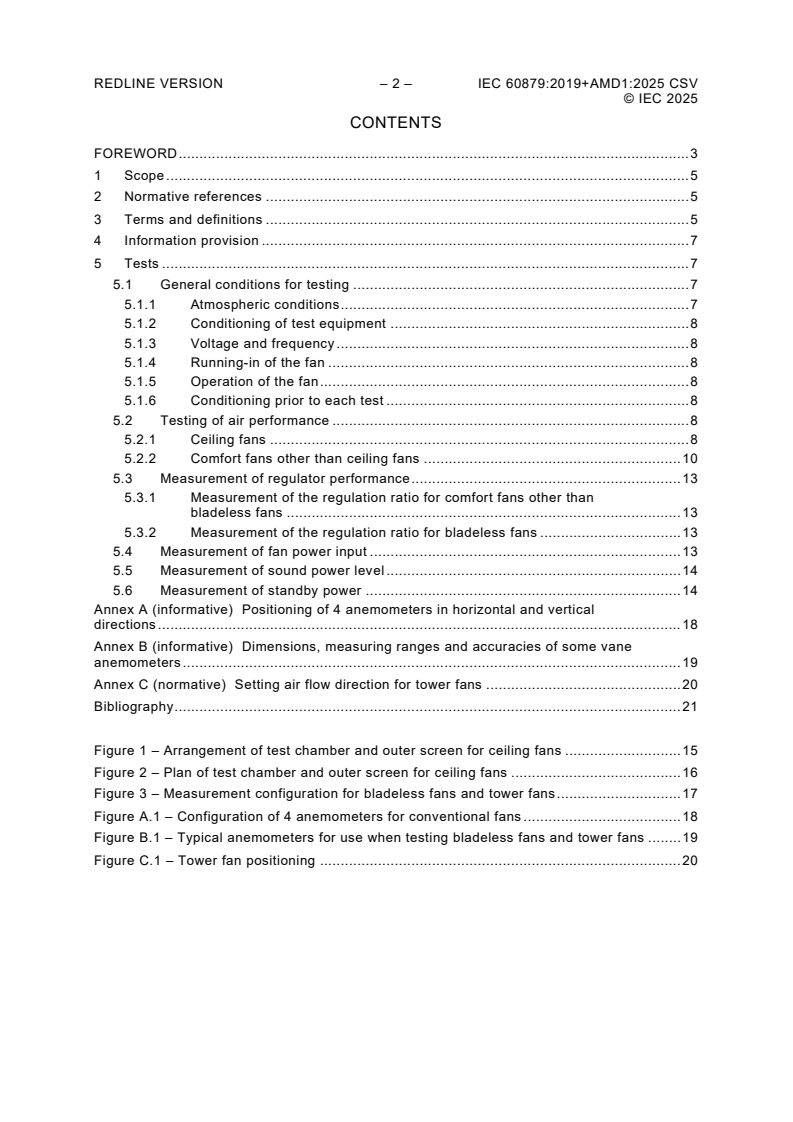
CONTENTS
FOREWORD . 3
1 Scope . 5
2 Normative references . 5
3 Terms and definitions . 5
4 Information provision . 7
5 Tests . 7
5.1 General conditions for testing . 7
5.1.1 Atmospheric conditions . 7
5.1.2 Conditioning of test equipment . 8
5.1.3 Voltage and frequency . 8
5.1.4 Running-in of the fan . 8
5.1.5 Operation of the fan . 8
5.1.6 Conditioning prior to each test . 8
5.2 Testing of air performance . 8
5.2.1 Ceiling fans . 8
5.2.2 Comfort fans other than ceiling fans . 10
5.3 Measurement of regulator performance . 13
5.3.1 Measurement of the regulation ratio for comfort fans other than
bladeless fans . 13
5.3.2 Measurement of the regulation ratio for bladeless fans . 13
5.4 Measurement of fan power input . 13
5.5 Measurement of sound power level . 14
5.6 Measurement of standby power . 14
Annex A (informative) Positioning of 4 anemometers in horizontal and vertical
directions . 18
Annex B (informative) Dimensions, measuring ranges and accuracies of some vane
anemometers . 19
Annex C (normative) Setting air flow direction for tower fans . 20
Bibliography . 21
Figure 1 – Arrangement of test chamber and outer screen for ceiling fans . 15
Figure 2 – Plan of test chamber and outer screen for ceiling fans . 16
Figure 3 – Measurement configuration for bladeless fans and tower fans . 17
Figure A.1 – Configuration of 4 anemometers for conventional fans . 18
Figure B.1 – Typical anemometers for use when testing bladeless fans and tower fans . 19
Figure C.1 – Tower fan positioning . 20
© IEC 2025
INTERNATIONAL ELECTROTECHNICAL COMMISSION
____________
COMFORT FANS AND REGULATORS
FOR HOUSEHOLD AND SIMILAR PURPOSES –
METHODS FOR MEASURING PERFORMANCE
FOREWORD
1) The International Electrotechnical Commission (IEC) is a worldwide organization for standardization comprising
all national electrotechnical committees (IEC National Committees). The object of IEC is to promote
international co-operation on all questions concerning standardization in the electrical and electronic fields. To
this end and in addition to other activities, IEC publishes International Standards, Technical Specifications,
Technical Reports, Publicly Available Specifications (PAS) and Guides (hereafter referred to as “IEC
Publication(s)”). Their preparation is entrusted to technical committees; any IEC National Committee interested
in the subject dealt with may participate in this preparatory work. International, governmental and non-
governmental organizations liaising with the IEC also participate in this preparation. IEC collaborates closely
with the International Organization for Standardization (ISO) in accordance with conditions determined by
agreement between the two organizations.
2) The formal decisions or agreements of IEC on technical matters express, as nearly as possible, an international
consensus of opinion on the relevant subjects since each technical committee has representation from all
interested IEC National Committees.
3) IEC Publications have the form of recommendations for international use and are accepted by IEC National
Committees in that sense. While all reasonable efforts are made to ensure that the technical content of IEC
Publications is accurate, IEC cannot be held responsible for the way in which they are used or for any
misinterpretation by any end user.
4) In order to promote international uniformity, IEC National Committees undertake to apply IEC Publications
transparently to the maximum extent possible in their national and regional publications. Any divergence
between any IEC Publication and the corresponding national or regional publication shall be clearly indicated in
the latter.
5) IEC itself does not provide any attestation of conformity. Independent certification bodies provide conformity
assessment services and, in some areas, access to IEC marks of conformity. IEC is not responsible for any
services carried out by independent certification bodies.
6) All users should ensure that they have the latest edition of this publication.
7) No liability shall attach to IEC or its directors, employees, servants or agents including individual experts and
members of its technical committees and IEC National Committees for any personal injury, property damage or
other damage of any nature whatsoever, whether direct or indirect, or for costs (including legal fees) and
expenses arising out of the publication, use of, or reliance upon, this IEC Publication or any other IEC
Publications.
8) Attention is drawn to the Normative references cited in this publication. Use of the referenced publications is
indispensable for the correct application of this publication.
9) IEC draws attention to the possibility that the implementation of this document may involve the use of (a)
patent(s). IEC takes no position concerning the evidence, validity or applicability of any claimed patent rights in
respect thereof. As of the date of publication of this document, IEC had not received notice of (a) patent(s),
which may be required to implement this document. However, implementers are cautioned that this may not
represent the latest information, which may be obtained from the patent database available at
https://patents.iec.ch. IEC shall not be held responsible for identifying any or all such patent rights.
This consolidated version of the official IEC Standard and its amendment has been
prepared for user convenience.
IEC 60879 edition 2.1 contains the second edition (2019-05) [documents 59L/171/FDIS
and 59L/172/RVD] and its amendment 1 (2025-03) [documents 59L/286/FDIS and
59L/288/RVD].
In this Redline version, a vertical line in the margin shows where the technical content
is modified by amendment 1. Additions are in green text, deletions are in strikethrough
red text. A separate Final version with all changes accepted is available in this
publication.
REDLINE VERSION – 4 – IEC 60879:2019+AMD1:2025 CSV
© IEC 2025
International Standard IEC 60879 has been prepared by subcommittee 59L: Small household
appliances, of IEC technical committee 59: Performance of household and similar electrical
appliances
This second edition cancels and replaces the first edition published in 1986. This edition
constitutes a technical revision.
This edition includes the following significant technical changes with respect to the previous
edition:
a) the definitions of fans have been revised;
b) the test methods for the different types of fans have been revised to allow modern test
instrumentation to be used;
c) acoustic noise measurement and standby power measurement methods have been
introduced.
The text of this International Standard is based on the following documents:
FDIS Report on voting
59L/171/FDIS 59L/172/RVD
Full information on the voting for the approval of this International Standard can be found in
the report on voting indicated in the above table.
This document has been drafted in accordance with the ISO/IEC Directives, Part 2.
The committee has decided that the contents of this document and its amendment will remain
unchanged until the stability date indicated on the IEC website under webstore.iec.ch in the
data related to the specific document. At this date, the document will be
• reconfirmed,
• withdrawn, or
• revised.
© IEC 2025
COMFORT FANS AND REGULATORS
FOR HOUSEHOLD AND SIMILAR PURPOSES –
METHODS FOR MEASURING PERFORMANCE
1 Scope
This International Standard specifies the performance-measuring methods of comfort fans and
regulators for household and similar purposes, including conventional fans, tower fans and
bladeless fans, their rated voltage being not more than 250 V for single-phase fans and 480 V
for other fans, and their rated power input being less than 125 W.
NOTE 1 According to the testing method, the comfort fans are classified into two groups:
– pedestal fans, table fans, wall fans, louvre fans, tower fans, bladeless fans;
– ceiling fans.
Wherever applicable, the term "fan" used in this document includes its associated regulator, if
any.
NOTE 2 This document does not apply to
– safety of electric fans for household and similar purposes (IEC 60335-2-80);
– performance of ventilating fans (IEC 60665);
– electromagnetic compatibility of fans (CISPR 14-1 and CISPR 14-2, IEC 61000-3-2, IEC 61000-3-3).
2 Normative references
The following documents are referred to in the text in such a way that some or all of their
content constitutes requirements of this document. For dated references, only the edition
cited applies. For undated references, the latest edition of the referenced document (including
any amendments) applies.
IEC 60704-2-7, Household and similar electrical appliances – Test code for the determination
of airborne acoustical noise – Part 2-7: Particular requirements for fans
IEC 62301, Household electrical appliances – Measurement of standby power
3 Terms and definitions
For the purposes of this document, the following terms and definitions apply.
ISO and IEC maintain terminological databases for use in standardization at the following
addresses:
• IEC Electropedia: available at http://www.electropedia.org/
• ISO Online browsing platform: available at http://www.iso.org/obp
NOTE When the term “voltage” is used, it implies an RMS value unless otherwise specified.
3.1
comfort fan
fan primarily designed for creating air movement around or on part of a human body for
personal cooling comfort, including fans that can perform additional functionalities such as
lighting
Note 1 to entry: A comfort fan is hereinafter also referred to by the term "fan".
3.2
conventional fan
comfort fan with a directly visible propeller having two or more blades, with free inlet and
outlet of air
REDLINE VERSION – 6 – IEC 60879:2019+AMD1:2025 CSV
© IEC 2025
3.3
tower fan
comfort fan for use on the floor having a vertically elongated design of the cross-flow type,
tangential type, centrifugal type or impeller type with a free inlet and outlet of air
3.4
bladeless fan
comfort fan of any type that is not fitted with a propeller with concealed impeller to pressurize
and eject air flow from non-free air ducting outlet
3.5
ceiling fan
conventional fan provided with a device for suspension from the ceiling of a room so that the
blades rotate in a horizontal plane with the diameter of the blade not larger than 1 800 mm
3.6
table fan
comfort conventional fan intended for use on a table
Note 1 to entry: Table fans have a maximum adjustable or non-adjustable height of less than 1 200 mm.
3.7
pedestal fan
comfort conventional fan mounted on a pedestal of fixed or variable height
Note 1 to entry: Pedestal fans have a minimum adjustable height or non-adjustable height equal to or greater
than 1 200 mm.
3.8
wall bracket fan
comfort fan for mounting on the wall
3.9
ceiling bracket fan
comfort fan for mounting on the ceiling
3.10
louvre fan
comfort fan having moving louvre which provides a continuously changing multi-directional air
flow
3.11
rated fan flow rate
air flow rate assigned to the fan by the manufacturer
Note 1 to entry: The rated fan flow rate is expressed in m /min.
3.12
service value
/min] to the measured fan power input [W]
ratio of the calculated maximum fan flow rate [m
Note 1 to entry: The service value is also known as the "coefficient of performance (COP)".
3.13
fan power input
power input of the fan operating at its maximum flow rate, measured with the oscillation
mechanism and the moving louvre, if any, turned off
Note 1 to entry: The power inputs for other functions, such as lighting are not included.
3.14
rated voltage
voltage assigned to the fan by the manufacturer
3.15
rated frequency
frequency assigned to the fan by the manufacturer
© IEC 2025
3.16
maximum fan flow rate
air flow rate of the comfort fan at its maximum setting [m /min], measured at the fan outlet
with the oscillating mechanism and the moving louvre, if any, turned off
3.17
oscillating mechanism
capability of the comfort fan to automatically vary the direction of the air flow while the fan is
operating
3.18
fan sound power level
A-weighted sound power level of the comfort fan while providing the maximum fan flow rate,
measured at the outlet side according to IEC 60704-2-7
3.19
moving louvre
grill provided at the air outlet of louvre fans, which is used to control the direction of the air
flow by its rotation or position
3.20
equivalent sweep size diameter of bladeless fan
value obtained by dividing the perimeter of the bladeless fan air outlet by 3,14
Note 1 to entry: The perimeter is obtained by measuring the length of the rope that wraps along the complete
enclosure of the bladeless fan's air outlet.
desktop type bladeless fan
bladeless fan intended for use on a table
Note 1 to entry: Desktop type bladeless fans have a maximum adjustable height or non-adjustable height less
than 500 mm.
3.21
floor type bladeless fan
bladeless fan intended for use on floor
Note 1 to entry: Floor type bladeless fans have a minimum adjustable height or non-adjustable height equal to or
greater than 500 mm.
4 Information provision
Manufacturers shall provide the following information in the instructions:
a) rated fan flow rate m /min (rounded to one decimal place);
b) service value (m /min)/W (rounded to one decimal place);
c) standby power consumption W (rounded to one decimal place);
d) sound power level dB(A).
5 Tests
5.1 General conditions for testing
5.1.1 Atmospheric conditions
Unless otherwise specified, the test procedures and measurements shall be carried out under
the following conditions:
– temperature: 20 °C ± 5°C, in case of doubt the temperature shall be 23 °C ± 2°C;
– relative humidity: 50 % ± 30 %;
– air pressure: 86 kPa to 106 kPa.
NOTE Temperature and humidity conditions within the specified ranges are required for good repeatability and
reproducibility.
REDLINE VERSION – 8 – IEC 60879:2019+AMD1:2025 CSV
© IEC 2025
Care should be taken to avoid changes in temperature and relative humidity during the test.
5.1.2 Conditioning of test equipment
Measuring equipment to be used for the tests shall be stored for at least 16 h at the
atmospheric conditions specified in 5.1.1 prior to the test.
5.1.3 Voltage and frequency
The tests shall be conducted at the rated voltage. Fans designed for DC only shall be
operated at DC. Fans designed for both AC and DC shall be operated at AC. Fans not marked
with rated frequency shall be operated at either 50 Hz ± 1 Hz or 60 Hz ± 1 Hz as is common in
the country of use and with a total harmonic distortion ≤ 5 %.
Unless otherwise specified, the tests are carried out at a specific test voltage within a voltage
range (for example 100 V to 240 V) or at the rated voltage or rated voltages (for example
120 V or 120 V and 240 V).
The stability of the voltage shall be ± 1 %.
5.1.4 Running-in of the fan
Prior to starting the tests on a new fan, it shall run at its maximum airflow setting with
unrestricted air flow and with the oscillating mechanisms and moving louvres, if any, in
operation for at least 1 hour to ensure adequate running-in. Any other functions such as
luminaires, purifiers, humidifiers, heaters, if any, shall be connected.
5.1.5 Operation of the fan
Before starting the tests, the fan and its attachments are adjusted in accordance with the
manufacturer's instructions for normal operation. Any controls shall be set for maximum
continuous air flow unless the manufacturer's instruction states otherwise. Any other functions
such as luminaires, purifiers, humidifiers, heaters, if any, shall be turned off.
5.1.6 Conditioning prior to each test
Prior to starting each test, the fan shall be conditioned for 30 min under the provisions given
in 5.1.4 but with oscillating mechanisms and moving louvres, if any, not in operation.
5.2 Testing of air performance
5.2.1 Ceiling fans
5.2.1.1 Test chamber
The fan shall be tested in a test chamber having the following dimensions: length 4 500 mm,
width 4 500 mm, height 3 000 mm (see Figure 1 and Figure 2).
The above dimensions shall have a tolerance of ± 15 mm.
The top of the test chamber shall be covered by the clapboard, except for a centrally situated
circular opening (top-opening), the diameter (D) of the top opening shall be between
1,1 and 1,2 times the blade's sweep. The top clapboard in which the top opening is located
shall be not more than 6 mm thick. The bottom of the test chamber is 450 mm from the ground,
to leave a suitable space for air outlet.
Readings shall be taken from a position between the chamber and the outer screen, and a
small shelf for electrical instruments may be provided in this space. Except for these, the
space between the test chamber and the outer screen and the space inside the test chamber
shall be clear of all obstructions, and any conditioning apparatus (including heating or cooling)
shall have no influence on the movement of air in the test room while the test is in progress.
The room in which the test chamber and the outer screen are erected shall be suitably
protected against extraneous draughts.
© IEC 2025
Any ceiling external to the test chamber or any projecting beam which might interfere with the
air flow shall be not less than 1 000 mm above the top opening, i.e. not less than 4 000 mm
from the ground level at this point.
The distances between the walls of the chamber and the walls of the outer screen
shall be 1 000 mm to 1 250 mm.
The fan shall be placed at such a height that the plane of the fan blades is 3 000 mm ± 10 mm
from the ground level and lies in the plane of the top edge of the clapboard containing the top
opening in the roof of the test chamber.
5.2.1.2 Measuring instrument
The air movement shall be measured by means of vane anemometers having an internal
diameter not exceeding 100 mm.
5.2.1.3 Arrangement of apparatus
The plane of the fan blades lies in the plane of the top edge of the clapboard containing the
top opening in the roof of the test chamber.
A flat plate is installed above the ceiling fan, the size of which shall be between 1,1 and 1,2
times the blade diameter. The distance between the plate and the plane of the fan blades is
determined by the distance between the plane of the fan blades and the ceiling after the
ceiling fan has been installed in accordance with the instructions for use.
The plane of the anemometer's vane is parallel to the plane of the fan blades. The
anemometers shall be moved in either direction along both diagonals of the test chamber in a
test plane 1 500 mm ± 10 mm below the plane of the fan blades. The anemometers shall be
supported in such a manner as to cause as little obstruction as possible to the air flow.
5.2.1.4 Procedure for test
The measurements shall be carried out with the fan running at full speed at the test voltage.
For the air velocity other than the origin point at axis of the fan blade (3 in Figure 2), the
measurements in each of four directions shall commence at a point 40 mm from the axis of
the fan blades and shall progress horizontally to the fan blade axis in increments of 80 mm
along the semi-diagonals of the test chamber (3 to A, 3 to B, 3 to AA and 3 to BB in Figure 2).
The measurements shall be continued in the 80 mm increments until the air velocity in each of
the four directions falls below 9 m/min.
For the air velocity of the origin point at the axis of the fan blade with a radius of 40 mm, the
measurement shall be carried out by one anemometer positioned on the origin point at the
axis of the fan blade.
The air velocity shall be averaged over a period of 60 s using an update rate of not less
than 2 Hz.
The average air velocity through each annulus is taken as the mean of the 8 air velocities
obtained at each anemometer position on the inner and outer radii of the annulus. The mean
radius of each annulus is equal to the mean of the inner and outer radii of the annulus.
Average air velocities below 9 m/min are discarded.
5.2.1.5 Calculation of flow rate
For each annulus having an average air velocity equal to or greater than 9 m/min, the product
of the area of the annulus and the average air velocity through that annulus, shall be taken as
the air delivery through that annulus.
For the circle around the original point at the axis of the fan blade with a radius of 40 mm, if
the air velocity is equal to or greater than 9 m/min, the product of the circle area and the air
velocity through the circle shall be taken as the air delivery through the circle. If the air
velocity is less than 9 m/min, the air delivery through the circle is ignored.
REDLINE VERSION – 10 – IEC 60879:2019+AMD1:2025 CSV
© IEC 2025
The sum of the air deliveries through the circle and all such annuli shall be taken as the
measured flow rate of the fan for the purposes of this document.
No correction is made for relative humidity or air pressure.
5.2.2 Comfort fans other than ceiling fans
5.2.2.1 Test chamber
m
The fan shall be tested in a test chamber having the following dimensions: length: 4 500 m
for the fan with sweep size or the equivalent sweep size (for bladeless fans) not larger than
400 mm or tower fans, and 6 000 mm for the fan sweep size larger than 400 mm or the
equivalent sweep size (for bladeless fans) larger than 400 mm, width: 4 500 mm, height:
3 000 mm. The chamber shall be suitably protected from extraneous draughts.
The test chamber shall be free from obstructions other than the stand on which the fan is kept.
Any table or shelf for electrical instruments shall be on the opposite side of the fan to the test
plane, beyond a distance of 900 mm from the plane of fan blades for the fans other than tower
fans and bladeless fans, or the plane of the air outlet for tower fans and bladeless fans.
NOTE For tower fans, the plane of the air outlet refers to the longitudinal cross-sectional plane, vertical to the
central line. For bladeless fans, the plane of the air outlet refers to the outlet plane closer to the anemometers.
Any air conditioning apparatus used in the test room shall have no influence on the movement
of the air in the test chamber while the test is in progress.
5.2.2.2 Arrangement of apparatus
The fan shall be located in the test chamber and arranged as follows:
The distance from the geometrical centre of the fan blades or the air outlet to the floor shall
be at least:
– 1 200 mm for the fan with sweep size or the equivalent sweep size (for bladeless fans) not
larger than 400 mm, bladeless fans or tower fans; or
– 1 500 mm for the fan with sweep size or the equivalent sweep size (for bladeless fans)
larger than 400 mm.
The arrangement shall ensure that all valid air velocity squares are in the range of the vane
anemometers matrix.
The distance to the back wall from the plane of the air outlet for tower fans and bladeless fans
or the plane of the blade for fans other than tower fans and bladeless fans shall be at
least 1 200 mm.
The distance from the plane of the air outlet for tower fans and bladeless fans or the plane of
the blade for fans other than tower fans and bladeless fans to the front wall shall be at least:
– 1 800 mm for the fan with sweep size or the equivalent sweep size (for bladeless fans) not
larger than 400 mm or tower fans; or
– 4 000 mm for the fan with sweep size or the equivalent sweep size (for bladeless fans)
larger than 400 mm or bladeless fans.
The distance from the geometrical centre of the air outlet or of the blade to the side walls
shall be at least 1 800 mm.
NOTE It is possible to make it central as long as it is larger than 1800 mm.
When the ceiling bracket fans and the wall bracket fans are tested, they shall be mounted on
a vertical 1 000 mm × 1 000 mm flat wooden board with a thickness of 20 mm ± 1mm.
The plane of the vane anemometers is parallel to the plane of the air outlet for tower fans and
bladeless fans or the plane of the blade for fans other than tower fans and bladeless fans.
For the fans other than bladeless fans and tower fans, the distance between the two planes is
3 times the sweep size with a tolerance of ± 15 mm.
© IEC 2025
For bladeless fans, the distance between the two planes is as follows:
– 1 000 mm for desktop type bladeless fans;
– 2 000 mm for floor type bladeless fans.
The distance between the two planes is 3 times the sweep size or the equivalent sweep size
(for bladeless fans) with a tolerance of ± 15 mm.
For tower fans, the plane of the vane anemometers is parallel to the plane of the air outlet
and the distance between the two planes is 1 200 mm ± 15 mm. The tower fan is then
adjusted so that the air flow direction is perpendicular to the plane of the vane anemometer.
See Annex C.
The anemometer shall be supported in such a manner as to offer as little obstruction as
possible to the airflow.
5.2.2.3 Testing instrument
The air movement shall be measured by means of vane anemometers suitable for the range
of velocities to be measured. At least 4 vane anemometers shall be used.
A greater number of anemometers may be used to reduce the time taken to map the airflow of
the fan under test. Care should be taken to use an even number of anemometers.
– For conventional fans, a set of vane anemometers having an internal diameter not
exceeding 100 mm shall be used;
– For bladeless fans and tower fans, an airflow auto test rig is used that:
• consists of a set of vane anemometers not exceeding 40 mm of external diameter. The
size of the anemometer shall enable it to be fitted in the space of 40 mm between two
anemometers. Dimensions, measuring ranges and accuracies for some vane
anemometers are given in Annex B;
• is capable of holding vane anemometers in a horizontal line or a vertical line at a
spacing of 40 mm;
• is maneuverable in the Z-axis (manually or automatically) to an accuracy of ± 2 mm;
• is remotely controllable to move in the X-axis and Y-axis to an accuracy of ± 1 mm.
NOTE The size of the fan under test will determine the number of measurements required to capture the total
airflow distribution. Before commencing a test, the airflow distribution can be checked in order to determine that
the distribution fits within the limits of the adjustment of the test rig in both Y-axis and X-axis. For instance, if the
test rig can be adjusted from −500 mm to +500 mm in the X-axis and Y-axis, a fan creating a distribution of 540 mm
or above will not be suitable for the rig and a larger rig will be required. Conducting measurements at the extremes
of the rig to ensure the airflow is below 24 m/min will identify whether the rig has a suitable amount of adjustment
before the test commences.
5.2.2.4 Procedure for test for conventional fans
The measurements shall be carried out with the fan running at full speed at the test voltage,
with the guard, if normally provided, in position, and with the oscillating mechanism, if any,
disconnected. For the louvre fan, the moving louvre is removed.
Anemometer vanes shall be moved both horizontally and vertically with respect to the fan
blades' horizontal axis, the movement being at right angles to this axis and extendable in both
directions. The axis of the anemometer vanes shall always be parallel to the fan blades'
horizontal axis. An example of positioning of 4 anemometers in horizontal and vertical
directions is given in Annex A.
For the air velocity measurement other than the origin point at the axis of the fan blade, the
measurements in each of four directions shall commence at a point 20 mm from the axis of
the fan blades and shall progress horizontally and vertically to the fan blade axis in
increments of 40 mm. The measurements shall be continued in the 40 mm increments until
the average air velocity in each of the four directions falls below 24 m/min.
REDLINE VERSION – 12 – IEC 60879:2019+AMD1:2025 CSV
© IEC 2025
For the air velocity at the origin point at the axis of the fan blade with a radius of 20 mm, the
measurement shall be carried out by one anemometer positioned at the origin point at the axis
of the fan blade.
The average air velocity shall be the average of the measurements over a period of 60 s using
an update rate of not less than 2 Hz. The axis of the fan blades shall be horizontal during the
test.
The average air velocity through each annulus is the mean of the 8 air velocities obtained at
each anemometer position taken horizontally and vertically at each of the inner and outer radii
of the annulus. The mean radius of each annulus is equal to the mean of the inner and outer
radii of the annulus. Average air velocities below 24 m/min are discarded.
NOTE For conventional fans it is possible to use the test method for bladeless fans and tower fans as specified in
5.2.2.6, but it is more time consuming.
5.2.2.5 Calculation of flow rate for conventional fans
For each annulus having an average air velocity equal to or greater than 24 m/min, the
product of the area of the annulus and the average air velocity through that annulus, shall be
taken as the total air delivery through that annulus.
For the circle around the origin point of the axis of the fan blade with a radius of 20 mm, if the
air velocity is equal to or greater than 24 m/min, the product of the circle area and the air
velocity through the circle shall be taken as the air delivery through the circle. If the air
velocity is less than 24 m/min, the air delivery through the circle is ignored.
The sum of the air deliveries through the circle and all such annuli shall be taken as the
measured fan flow rate of the fan for the purposes of this document.
No correction is made for relative humidity or air pressure.
5.2.2.6 Procedure for test for bladeless fans and tower fans
The measurements shall be carried out with the fan running at the highest settings at the test
voltage, with the guard, if normally provided, in position, and with the oscillating mechanism, if
any, disconnected.
The measurements shall be taken by moving the arm of the airflow test rig supporting the
anemometers as follows:
– along the X-axis if the anemometers are arranged along the Y-axis;
– along the Y-axis if the anemometers are arranged along the X-axis.
For anemometers arranged along the X-axis, the arm of the anemometer airflow test rig is
placed at the mid-height of the air outlet of the fan.
For anemometers arranged along the Y-axis, the arm of the anemometer airflow test rig is
placed at the mid-width of the air outlet of the fan.
Where the anemometers are arranged along the X-axis, the test rig is moved up along the
Y-axis at increments of 40 mm until the measurements at all anemometer positions do not
exceed 24 m/min. The anemometer airflow test rig is then returned to its starting position and
is then moved down along the Y-axis at increments of 40 mm until the measurements at all
anemometer positions do not exceed 24 m/min.
Where the anemometers are arranged along the Y-axis, the test rig is moved to the left along
the X-axis at increments of 40 mm until the measurements at all anemometer positions do not
exceed 24 m/min. The anemometer airflow test rig is then returned to its starting position and
is then moved to the right along the X-axis at increments of 40 mm until the measurements at
all anemometer positions do not exceed 24 m/min.
The measurements at each position are taken approximately 1 min after positioning the
anemometers.
© IEC 2025
The measurement from each anemometer shall be averaged over a period of 60 s using an
update rate of not less than 2 Hz.
5.2.2.7 Calculation of flow rate for bladeless fans and tower fans
The total fan flow rate shall be calculated by assuming that each measurement point is
indicative of the air velocity through the circle and a square of 40mm × 40mm centred about
that point (see Figure 3). Therefore, the flow rate can be calculated by multiplying the
measured air velocity by the area, A, of each square (see Figure 3).
2 2
The area A of each square = 40 mm × 40 mm = 1 600 mm = 0,001 6 m
If each of the air velocity measurements in m/min is U and the number of the squares with a
i
air velocity measurement above 24 m/min is N, then the total air flow rate of the fan will equal
the sum of all individual air flow rates through each square as given by:
N
Total flow rate of the fan in m /min = (0,001 6 U )
∑ i
i=1
Total flow rate of the fan is given by the following equation.
N
UV= (0,0016 )
∑
i
i=1
where
U is the total flow rate of the fan, expressed in m /min;
N is the number of the squares with an air velocity measurement above 24 m/min;
th
V is the measured air velocity above 24 m/min through the i square.
i
5.3 Measurement of regulator performance
5.3.1 Measurement of the regulation ratio for comfort fans other than bladeless fans
The regulators of comfort fans other than bladeless fans shall be capable of reducing the
speed of the fan, expressed in r/min. The regulation ratio is measured as follows. The fan is
supplied at the rated voltage and at the rated frequency. The oscillating mechanism, if any, is
disconnected. The regulator is set at the highest speed position and the speed of rotation is
measured. Then the regulator is set at the lowest speed position and the speed of rotation is
measured. The regulation ratio is the measured speed at the lowest setting divided by the
measured speed at the highest setting.
5.3.2 Measurement of the regulation ratio for bladeless fans
Bladeless fans regulators shall be capable of reducing the air velocity. The regulation ratio is
measured as follows.
The fan is supplied at the rated voltage and at the rated frequency. The oscillating mechanism,
if any, is disconnected. The test chamber, arrangement of apparatus, and testing instrument
are set up as specified in 5.2.2.
The regulator is set at the highest air velocity position and The air velocity is measured. Then
The regulator is set at the lowest air velocity position and the air velocity is measured.
The regulator is set at the highest air velocity position. The air velocity shall be measured
according to 5.2.2.6. The maximum value of the measured air velocity equal to or greater than
24 m/min is taken as the measured air velocity at the highest setting.
REDLINE VERSION – 14 – IEC 60879:2019+AMD1:2025 CSV
© IEC 2025
The regulator is set at the lowest air velocity position. The air velocity shall be measured
according to 5.2.2.6. The maximum value of the measured air velocity equal to or greater than
24 m/min is the measured air velocity at the lowest setting.
The regulation ratio is the measured air velocity at the lowest setting divided by the measured
air velocity at the highest setting.
5.4 Measurement of fan power input
The fan power input is measured with the fan connected to the supply at the test voltage and,
for AC fans, at the test frequency. Capacitors, if any, associated with the fan shall be retained
in the circuit. The regulator, if provided, shall be set at its maximum setting and the oscillating
mechanism and the moving louvre, if any, shall be inoperative. Luminaires, if any, shall be
disconnected.
5.5 Measurement of sound power level
IEC 60704-2-7 applies.
5.6 Measurement of standby power
IEC 62301 applies.
© IEC 2025
Dimensions in millimetres
Key
1 outer screen;
2 test chamber;
3 outer screen cut away to show bottom opening of test chamber
D = 4 500 mm
D = 1 000 mm to 1 250 mm
D = 450 mm
D = height to ceiling, ≥1 000 mm
D = height of outer screen, ≥3 000 mm
D see 5.2.1.1 for the diameter D
Figure 1 – Arrangement of test chamber and outer screen for ceiling fans
REDLINE VERSION – 16 – IEC 60879:2019+AMD1:2025 CSV
© IEC 2025
Dimensions in millimetres
Key
1 outer screen
2 test chamber
3 vertical axis of fan
4 top opening diameter D
D see 5.2.1.1 for the diameter D
D see Figure 1
Figure 2 – Plan of test chamber and outer screen for ceiling fans
© IEC 2025
Dimensions in millimetres
Key
A area around the reading point used for calculating the flow
X x-axis of the measurement points grid
Y y-axis of the measurement points grid
Figure 3 – Measurement configuration for bladeless fans and tower fans
REDLINE VERSION – 18 – IEC 60879:2019+AMD1:2025 CSV
© IEC 2025
Annex A
(informative)
Positioning of 4 anemometers in horizontal
and vertical directions
A schematic sketch of positioning of 4 anemometers in horizontal and vertical directions is
shown in Figure A.1.
Side view Front view
Air flow annuli
Figure A.1 – Configuration of 4 anemometers for conventional fans
© IEC 2025
Annex B
(informative)
Dimensions, measuring ranges and
accuracies of some vane anemometers
Dimensions, measuring ranges and accuracies for some vane anemometers are shown in
Figure B.1.
Figure B.1 – Typical anemometers for use when testing bladeless fans and tower fans
____________
This information is given for the convenience of users of this standard and does not constitute an endorsement
by IEC of these anemometers.
REDLINE VERSION – 20 – IEC 60879:2019+AMD1:2025 CSV
© IEC 2025
Annex C
(normative)
Setting air flow direction for tower fans
Adjustment of the tower fan is as shown in Figure C.1, so that the air velocity v
...
IEC 60879 ®
Edition 2.0 2019-05
INTERNATIONAL
STANDARD
NORME
INTERNATIONALE
colour
inside
Comfort fans and regulators for household and similar purposes – Methods for
measuring performance
Ventilateurs de confort et régulateurs de vitesse pour applications domestiques
et analogues – Méthodes de mesure de l'aptitude à la fonction
All rights reserved. Unless otherwise specified, no part of this publication may be reproduced or utilized in any form
or by any means, electronic or mechanical, including photocopying and microfilm, without permission in writing from
either IEC or IEC's member National Committee in the country of the requester. If you have any questions about IEC
copyright or have an enquiry about obtaining additional rights to this publication, please contact the address below or
your local IEC member National Committee for further information.
Droits de reproduction réservés. Sauf indication contraire, aucune partie de cette publication ne peut être reproduite
ni utilisée sous quelque forme que ce soit et par aucun procédé, électronique ou mécanique, y compris la photocopie
et les microfilms, sans l'accord écrit de l'IEC ou du Comité national de l'IEC du pays du demandeur. Si vous avez des
questions sur le copyright de l'IEC ou si vous désirez obtenir des droits supplémentaires sur cette publication, utilisez
les coordonnées ci-après ou contactez le Comité national de l'IEC de votre pays de résidence.
IEC Central Office Tel.: +41 22 919 02 11
3, rue de Varembé info@iec.ch
CH-1211 Geneva 20 www.iec.ch
Switzerland
About the IEC
The International Electrotechnical Commission (IEC) is the leading global organization that prepares and publishes
International Standards for all electrical, electronic and related technologies.
About IEC publications
The technical content of IEC publications is kept under constant review by the IEC. Please make sure that you have the
latest edition, a corrigendum or an amendment might have been published.
IEC publications search - webstore.iec.ch/advsearchform Electropedia - www.electropedia.org
The advanced search enables to find IEC publications by a The world's leading online dictionary on electrotechnology,
variety of criteria (reference number, text, technical containing more than 22 000 terminological entries in English
committee,…). It also gives information on projects, replaced and French, with equivalent terms in 16 additional languages.
and withdrawn publications. Also known as the International Electrotechnical Vocabulary
(IEV) online.
IEC Just Published - webstore.iec.ch/justpublished
Stay up to date on all new IEC publications. Just Published IEC Glossary - std.iec.ch/glossary
details all new publications released. Available online and 67 000 electrotechnical terminology entries in English and
once a month by email. French extracted from the Terms and Definitions clause of
IEC publications issued since 2002. Some entries have been
IEC Customer Service Centre - webstore.iec.ch/csc collected from earlier publications of IEC TC 37, 77, 86 and
If you wish to give us your feedback on this publication or CISPR.
need further assistance, please contact the Customer Service
Centre: sales@iec.ch.
A propos de l'IEC
La Commission Electrotechnique Internationale (IEC) est la première organisation mondiale qui élabore et publie des
Normes internationales pour tout ce qui a trait à l'électricité, à l'électronique et aux technologies apparentées.
A propos des publications IEC
Le contenu technique des publications IEC est constamment revu. Veuillez vous assurer que vous possédez l’édition la
plus récente, un corrigendum ou amendement peut avoir été publié.
Recherche de publications IEC - Electropedia - www.electropedia.org
webstore.iec.ch/advsearchform Le premier dictionnaire d'électrotechnologie en ligne au
La recherche avancée permet de trouver des publications IEC monde, avec plus de 22 000 articles terminologiques en
en utilisant différents critères (numéro de référence, texte, anglais et en français, ainsi que les termes équivalents dans
comité d’études,…). Elle donne aussi des informations sur les 16 langues additionnelles. Egalement appelé Vocabulaire
projets et les publications remplacées ou retirées. Electrotechnique International (IEV) en ligne.
IEC Just Published - webstore.iec.ch/justpublished Glossaire IEC - std.iec.ch/glossary
Restez informé sur les nouvelles publications IEC. Just 67 000 entrées terminologiques électrotechniques, en anglais
Published détaille les nouvelles publications parues. et en français, extraites des articles Termes et Définitions des
Disponible en ligne et une fois par mois par email. publications IEC parues depuis 2002. Plus certaines entrées
antérieures extraites des publications des CE 37, 77, 86 et
Service Clients - webstore.iec.ch/csc CISPR de l'IEC.
Si vous désirez nous donner des commentaires sur cette
publication ou si vous avez des questions contactez-nous:
sales@iec.ch.
IEC 60879 ®
Edition 2.0 2019-05
INTERNATIONAL
STANDARD
NORME
INTERNATIONALE
colour
inside
Comfort fans and regulators for household and similar purposes – Methods for
measuring performance
Ventilateurs de confort et régulateurs de vitesse pour applications domestiques
et analogues – Méthodes de mesure de l'aptitude à la fonction
INTERNATIONAL
ELECTROTECHNICAL
COMMISSION
COMMISSION
ELECTROTECHNIQUE
INTERNATIONALE
ICS 23.120 ISBN 978-2-8322-6957-2
– 2 – IEC 60879:2019 © IEC 2019
CONTENTS
FOREWORD . 3
1 Scope . 5
2 Normative references . 5
3 Terms and definitions . 5
4 Information provision . 7
5 Tests . 7
5.1 General conditions for testing . 7
5.1.1 Atmospheric conditions . 7
5.1.2 Conditioning of test equipment . 7
5.1.3 Voltage and frequency . 7
5.1.4 Running-in of the fan . 8
5.1.5 Operation of the fan . 8
5.1.6 Conditioning prior to each test . 8
5.2 Testing of air performance . 8
5.2.1 Ceiling fans . 8
5.2.2 Comfort fans other than ceiling fans . 9
5.3 Measurement of regulator performance . 12
5.3.1 Measurement of the regulation ratio for comfort fans other than
bladeless fans . 12
5.3.2 Measurement of the regulation ratio for bladeless fans . 12
5.4 Measurement of fan power input . 12
5.5 Measurement of sound power level . 12
5.6 Measurement of standby power . 13
Annex A (informative) Positioning of 4 anemometers in horizontal and vertical
directions . 16
Annex B (informative) Dimensions, measuring ranges and accuracies of some vane
anemometers . 17
Annex C (normative) Setting air flow direction for tower fans . 18
Bibliography . 19
Figure 1 – Arrangement of test chamber and outer screen for ceiling fans . 13
Figure 2 – Plan of test chamber and outer screen for ceiling fans . 14
Figure 3 – Measurement configuration for bladeless fans and tower fans . 15
Figure A.1 – Configuration of 4 anemometers for conventional fans . 16
Figure B.1 – Typical anemometers for use when testing bladeless fans and tower fans . 17
Figure C.1 – Tower fan positioning . 18
INTERNATIONAL ELECTROTECHNICAL COMMISSION
____________
COMFORT FANS AND REGULATORS
FOR HOUSEHOLD AND SIMILAR PURPOSES –
METHODS FOR MEASURING PERFORMANCE
FOREWORD
1) The International Electrotechnical Commission (IEC) is a worldwide organization for standardization comprising
all national electrotechnical committees (IEC National Committees). The object of IEC is to promote
international co-operation on all questions concerning standardization in the electrical and electronic fields. To
this end and in addition to other activities, IEC publishes International Standards, Technical Specifications,
Technical Reports, Publicly Available Specifications (PAS) and Guides (hereafter referred to as “IEC
Publication(s)”). Their preparation is entrusted to technical committees; any IEC National Committee interested
in the subject dealt with may participate in this preparatory work. International, governmental and non-
governmental organizations liaising with the IEC also participate in this preparation. IEC collaborates closely
with the International Organization for Standardization (ISO) in accordance with conditions determined by
agreement between the two organizations.
2) The formal decisions or agreements of IEC on technical matters express, as nearly as possible, an international
consensus of opinion on the relevant subjects since each technical committee has representation from all
interested IEC National Committees.
3) IEC Publications have the form of recommendations for international use and are accepted by IEC National
Committees in that sense. While all reasonable efforts are made to ensure that the technical content of IEC
Publications is accurate, IEC cannot be held responsible for the way in which they are used or for any
misinterpretation by any end user.
4) In order to promote international uniformity, IEC National Committees undertake to apply IEC Publications
transparently to the maximum extent possible in their national and regional publications. Any divergence
between any IEC Publication and the corresponding national or regional publication shall be clearly indicated in
the latter.
5) IEC itself does not provide any attestation of conformity. Independent certification bodies provide conformity
assessment services and, in some areas, access to IEC marks of conformity. IEC is not responsible for any
services carried out by independent certification bodies.
6) All users should ensure that they have the latest edition of this publication.
7) No liability shall attach to IEC or its directors, employees, servants or agents including individual experts and
members of its technical committees and IEC National Committees for any personal injury, property damage or
other damage of any nature whatsoever, whether direct or indirect, or for costs (including legal fees) and
expenses arising out of the publication, use of, or reliance upon, this IEC Publication or any other IEC
Publications.
8) Attention is drawn to the Normative references cited in this publication. Use of the referenced publications is
indispensable for the correct application of this publication.
9) Attention is drawn to the possibility that some of the elements of this IEC Publication may be the subject of
patent rights. IEC shall not be held responsible for identifying any or all such patent rights.
International Standard IEC 60879 has been prepared by subcommittee 59L: Small household
appliances, of IEC technical committee 59: Performance of household and similar electrical
appliances
This second edition cancels and replaces the first edition published in 1986. This edition
constitutes a technical revision.
This edition includes the following significant technical changes with respect to the previous
edition:
a) the definitions of fans have been revised;
b) the test methods for the different types of fans have been revised to allow modern test
instrumentation to be used;
c) acoustic noise measurement and standby power measurement methods have been
introduced.
– 4 – IEC 60879:2019 © IEC 2019
The text of this International Standard is based on the following documents:
FDIS Report on voting
59L/171/FDIS 59L/172/RVD
Full information on the voting for the approval of this International Standard can be found in
the report on voting indicated in the above table.
This document has been drafted in accordance with the ISO/IEC Directives, Part 2.
The committee has decided that the contents of this document will remain unchanged until the
stability date indicated on the IEC website under "http://webstore.iec.ch" in the data related to
the specific document. At this date, the document will be
• reconfirmed,
• withdrawn,
• replaced by a revised edition, or
• amended.
IMPORTANT – The 'colour inside' logo on the cover page of this publication indicates
that it contains colours which are considered to be useful for the correct
understanding of its contents. Users should therefore print this document using a
colour printer.
COMFORT FANS AND REGULATORS
FOR HOUSEHOLD AND SIMILAR PURPOSES –
METHODS FOR MEASURING PERFORMANCE
1 Scope
This International Standard specifies the performance-measuring methods of comfort fans and
regulators for household and similar purposes, including conventional fans, tower fans and
bladeless fans, their rated voltage being not more than 250 V for single-phase fans and 480 V
for other fans, and their rated power input being less than 125 W.
NOTE 1 According to the testing method, the comfort fans are classified into two groups:
– pedestal fans, table fans, wall fans, louvre fans, tower fans, bladeless fans;
– ceiling fans.
Wherever applicable, the term "fan" used in this document includes its associated regulator, if
any.
NOTE 2 This document does not apply to
– safety of electric fans for household and similar purposes (IEC 60335-2-80);
– performance of ventilating fans (IEC 60665);
– electromagnetic compatibility of fans (CISPR 14-1 and CISPR 14-2, IEC 61000-3-2, IEC 61000-3-3).
2 Normative references
The following documents are referred to in the text in such a way that some or all of their
content constitutes requirements of this document. For dated references, only the edition
cited applies. For undated references, the latest edition of the referenced document (including
any amendments) applies.
IEC 60704-2-7, Household and similar electrical appliances – Test code for the determination
of airborne acoustical noise – Part 2-7: Particular requirements for fans
IEC 62301, Household electrical appliances – Measurement of standby power
3 Terms and definitions
For the purposes of this document, the following terms and definitions apply.
ISO and IEC maintain terminological databases for use in standardization at the following
addresses:
• IEC Electropedia: available at http://www.electropedia.org/
• ISO Online browsing platform: available at http://www.iso.org/obp
NOTE When the term “voltage” is used, it implies an RMS value unless otherwise specified.
3.1
comfort fan
fan primarily designed for creating air movement around or on part of a human body for
personal cooling comfort, including fans that can perform additional functionalities such as
lighting
Note 1 to entry: A comfort fan is hereinafter also referred to by the term "fan".
3.2
conventional fan
comfort fan with a propeller having two or more blades, with free inlet and outlet of air
– 6 – IEC 60879:2019 © IEC 2019
3.3
tower fan
comfort fan for use on the floor having a vertically elongated design of the cross-flow type,
tangential type, centrifugal type or impeller type with a free inlet and outlet of air
3.4
bladeless fan
comfort fan of any type that is not fitted with a propeller
3.5
ceiling fan
conventional fan provided with a device for suspension from the ceiling of a room so that the
blades rotate in a horizontal plane with the diameter of the blade not larger than 1 800 mm
3.6
table fan
comfort fan intended for use on a table
Note 1 to entry: Table fans have a maximum adjustable or non-adjustable height of less than 1 200 mm.
3.7
pedestal fan
comfort fan mounted on a pedestal of fixed or variable height
Note 1 to entry: Pedestal fans have a minimum adjustable height or non-adjustable height equal to or greater
than 1 200 mm.
3.8
wall bracket fan
comfort fan for mounting on the wall
3.9
ceiling bracket fan
comfort fan for mounting on the ceiling
3.10
louvre fan
comfort fan having moving louvre which provides a continuously changing multi-directional air
flow
3.11
rated fan flow rate
air flow rate assigned to the fan by the manufacturer
Note 1 to entry: The rated fan flow rate is expressed in m /min.
3.12
service value
ratio of the calculated maximum fan flow rate [m /min] to the measured fan power input [W]
Note 1 to entry: The service value is also known as the "coefficient of performance (COP)".
3.13
fan power input
power input of the fan operating at its maximum flow rate, measured with the oscillation
mechanism and the moving louvre, if any, turned off
Note 1 to entry: The power inputs for other functions, such as lighting are not included.
3.14
rated voltage
voltage assigned to the fan by the manufacturer
3.15
rated frequency
frequency assigned to the fan by the manufacturer
3.16
maximum fan flow rate
air flow rate of the comfort fan at its maximum setting [m /min], measured at the fan outlet
with the oscillating mechanism and the moving louvre, if any, turned off
3.17
oscillating mechanism
capability of the comfort fan to automatically vary the direction of the air flow while the fan is
operating
3.18
fan sound power level
A-weighted sound power level of the comfort fan while providing the maximum fan flow rate,
measured at the outlet side
3.19
moving louvre
grill provided at the air outlet of louvre fans, which is used to control the direction of the air
flow by its rotation or position
3.20
equivalent sweep size diameter of bladeless fan
value obtained by dividing the perimeter of the bladeless fan air outlet by 3,14
Note 1 to entry: The perimeter is obtained by measuring the length of the rope that wraps along the complete
enclosure of the bladeless fan's air outlet.
4 Information provision
Manufacturers shall provide the following information in the instructions:
a) rated fan flow rate m /min (rounded to one decimal place);
b) service value (m /min)/W (rounded to one decimal place);
c) standby power consumption W (rounded to one decimal place);
d) sound power level dB(A).
5 Tests
5.1 General conditions for testing
5.1.1 Atmospheric conditions
Unless otherwise specified, the test procedures and measurements shall be carried out under
the following conditions:
– temperature: 20 °C ± 5°C, in case of doubt the temperature shall be 23 °C ± 2°C;
– relative humidity: 50 % ± 30 %;
– air pressure: 86 kPa to 106 kPa.
NOTE Temperature and humidity conditions within the specified ranges are required for good repeatability and
reproducibility.
Care should be taken to avoid changes in temperature and relative humidity during the test.
5.1.2 Conditioning of test equipment
Measuring equipment to be used for the tests shall be stored for at least 16 h at the
atmospheric conditions specified in 5.1.1 prior to the test.
5.1.3 Voltage and frequency
The tests shall be conducted at the rated voltage. Fans designed for DC only shall be
operated at DC. Fans designed for both AC and DC shall be operated at AC. Fans not marked
with rated frequency shall be operated at either 50 Hz ± 1 Hz or 60 Hz ± 1 Hz as is common in
the country of use and with a total harmonic distortion ≤ 5 %.
– 8 – IEC 60879:2019 © IEC 2019
Unless otherwise specified, the tests are carried out at a specific test voltage within a voltage
range (for example 100 V to 240 V) or at the rated voltage or rated voltages (for example
120 V or 120 V and 240 V).
The stability of the voltage shall be ± 1 %.
5.1.4 Running-in of the fan
Prior to starting the tests on a new fan, it shall run at its maximum airflow setting with
unrestricted air flow and with the oscillating mechanisms and moving louvres, if any, in
operation for at least 1 hour to ensure adequate running-in. Any other functions such as
luminaires, purifiers, humidifiers, heaters, if any, shall be connected.
5.1.5 Operation of the fan
Before starting the tests, the fan and its attachments are adjusted in accordance with the
manufacturer's instructions for normal operation. Any controls shall be set for maximum
continuous air flow unless the manufacturer's instruction states otherwise. Any other functions
such as luminaires, purifiers, humidifiers, heaters, if any, shall be turned off.
5.1.6 Conditioning prior to each test
Prior to starting each test, the fan shall be conditioned for 30 min under the provisions given
in 5.1.4 but with oscillating mechanisms and moving louvres, if any, not in operation.
5.2 Testing of air performance
5.2.1 Ceiling fans
5.2.1.1 Test chamber
The fan shall be tested in a test chamber having the following dimensions: length 4 500 mm,
width 4 500 mm, height 3 000 mm (see Figure 1 and Figure 2).
The above dimensions shall have a tolerance of ± 15 mm.
The top of the test chamber shall be covered by the clapboard, except for a centrally situated
circular opening (top-opening), the diameter (D) of the top opening shall be between
1,1 and 1,2 times the blade's sweep. The top clapboard in which the top opening is located
shall be not more than 6 mm thick. The bottom of the test chamber is 450 mm from the ground,
to leave a suitable space for air outlet.
Readings shall be taken from a position between the chamber and the outer screen, and a
small shelf for electrical instruments may be provided in this space. Except for these, the
space between the test chamber and the outer screen and the space inside the test chamber
shall be clear of all obstructions, and any conditioning apparatus (including heating or cooling)
shall have no influence on the movement of air in the test room while the test is in progress.
The room in which the test chamber and the outer screen are erected shall be suitably
protected against extraneous draughts.
Any ceiling external to the test chamber or any projecting beam which might interfere with the
air flow shall be not less than 1 000 mm above the top opening, i.e. not less than 4 000 mm
from the ground level at this point.
The distances between the walls of the chamber and the walls of the outer screen
shall be 1 000 mm to 1 250 mm.
The fan shall be placed at such a height that the plane of the fan blades is 3 000 mm ± 10 mm
from the ground level and lies in the plane of the top edge of the clapboard containing the top
opening in the roof of the test chamber.
5.2.1.2 Measuring instrument
The air movement shall be measured by means of vane anemometers having an internal
diameter not exceeding 100 mm.
5.2.1.3 Arrangement of apparatus
The plane of the fan blades lies in the plane of the top edge of the clapboard containing the
top opening in the roof of the test chamber.
A flat plate is installed above the ceiling fan, the size of which shall be between 1,1 and 1,2
times the blade diameter. The distance between the plate and the plane of the fan blades is
determined by the distance between the plane of the fan blades and the ceiling after the
ceiling fan has been installed in accordance with the instructions for use.
The plane of the anemometer's vane is parallel to the plane of the fan blades. The
anemometers shall be moved in either direction along both diagonals of the test chamber in a
test plane 1 500 mm ± 10 mm below the plane of the fan blades. The anemometers shall be
supported in such a manner as to cause as little obstruction as possible to the air flow.
5.2.1.4 Procedure for test
The measurements shall be carried out with the fan running at full speed at the test voltage.
Air velocity measurements in each of four directions shall commence at a point 40 mm from
the axis of the fan blades and shall progress horizontally to the fan blade axis in increments of
80 mm along the semi-diagonals of the test chamber (3 to A, 3 to B, 3 to AA and 3 to BB in
Figure 2). The measurements shall be continued in the 80-mm increments until the air velocity
in each of the four directions falls below 9 m/min.
The air velocity shall be averaged over a period of 60 s using an update rate of not less
than 2 Hz.
The average air velocity through each annulus is taken as the mean of the 8 air velocities
obtained at each anemometer position on the inner and outer radii of the annulus. The mean
radius of each annulus is equal to the mean of the inner and outer radii of the annulus.
Average air velocities below 9 m/min are discarded.
5.2.1.5 Calculation of flow rate
For each annulus having an average air velocity equal to or greater than 9 m/min, the product
of the area of the annulus and the average air velocity through that annulus, shall be taken as
the air delivery through that annulus.
The sum of the air deliveries through all such annuli shall be taken as the measured flow rate
of the fan for the purposes of this document.
No correction is made for relative humidity or air pressure.
5.2.2 Comfort fans other than ceiling fans
5.2.2.1 Test chamber
The fan shall be tested in a test chamber having the following dimensions: length: 4 500 mm
for the sweep size or the equivalent sweep size (for bladeless fans) not larger than 400 mm,
and 6 000 mm for the sweep size or the equivalent sweep size (for bladeless fans) larger than
400 mm, width: 4 500 mm, height: 3 000 mm. The chamber shall be suitably protected from
extraneous draughts.
The test chamber shall be free from obstructions other than the stand on which the fan is kept.
Any table or shelf for electrical instruments shall be on the opposite side of the fan to the test
plane, beyond a distance of 900 mm from the plane of fan blades for the fans other than tower
fans and bladeless fans, or the plane of the air outlet for tower fans and bladeless fans.
NOTE For tower fans, the plane of the air outlet refers to the longitudinal cross-sectional plane, vertical to the
central line. For bladeless fans, the plane of the air outlet refers to the outlet plane closer to the anemometers.
Any air conditioning apparatus used in the test room shall have no influence on the movement
of the air in the test chamber while the test is in progress.
5.2.2.2 Arrangement of apparatus
The fan shall be located in the test chamber and arranged as follows:
– 10 – IEC 60879:2019 © IEC 2019
The distance from the geometrical centre of the fan blades or the air outlet to the floor shall
be at least:
– 1 200 mm for the sweep size or the equivalent sweep size (for bladeless fans) not larger
than 400 mm; or
– 1 500 mm for the sweep size or the equivalent sweep size (for bladeless fans) larger than
400 mm.
The distance to the back wall from the plane of the air outlet for tower fans and bladeless fans
or the plane of the blade for fans other than tower fans and bladeless fans shall be at
least 1 200 mm.
The distance from the plane of the air outlet for tower fans and bladeless fans or the plane of
the blade for fans other than tower fans and bladeless fans to the front wall shall be at least:
– 1 800 mm for the sweep size or the equivalent sweep size (for bladeless fans) not larger
than 400 mm; or
– 4 000 mm for the sweep size or the equivalent sweep size (for bladeless fans) larger
than 400 mm.
The distance from the geometrical centre of the air outlet or of the blade to the side walls
shall be at least 1 800 mm.
NOTE It is possible to make it central as long as it is larger than 1800 mm.
When the ceiling bracket fans and the wall bracket fans are tested, they shall be mounted on
a vertical 1 000 mm × 1 000 mm flat wooden board with a thickness of 20 mm ± 1mm.
The plane of the vane anemometers is parallel to the plane of the air outlet for tower fans and
bladeless fans or the plane of the blade for fans other than tower fans and bladeless fans.
The distance between the two planes is 3 times the sweep size or the equivalent sweep size
(for bladeless fans) with a tolerance of ± 15 mm.
For tower fans, the plane of the vane anemometers is parallel to the plane of the air outlet
and the distance between the two planes is 1 200 mm ± 15 mm. The tower fan is then
adjusted so that the air flow direction is perpendicular to the plane of the vane anemometer.
See Annex C.
The anemometer shall be supported in such a manner as to offer as little obstruction as
possible to the airflow.
5.2.2.3 Testing instrument
The air movement shall be measured by means of vane anemometers suitable for the range
of velocities to be measured. At least 4 vane anemometers shall be used.
A greater number of anemometers may be used to reduce the time taken to map the airflow of
the fan under test. Care should be taken to use an even number of anemometers.
– For conventional fans, a set of vane anemometers having an internal diameter not
exceeding 100 mm shall be used;
– For bladeless fans and tower fans, an airflow auto test rig is used that:
• consists of a set of vane anemometers not exceeding 40 mm of external diameter. The
size of the anemometer shall enable it to be fitted in the space of 40 mm between two
anemometers. Dimensions, measuring ranges and accuracies for some vane
anemometers are given in Annex B;
• is capable of holding vane anemometers in a horizontal line or a vertical line at a
spacing of 40 mm;
• is maneuverable in the Z-axis (manually or automatically) to an accuracy of ± 2 mm;
• is remotely controllable to move in the X-axis and Y-axis to an accuracy of ± 1 mm.
NOTE The size of the fan under test will determine the number of measurements required to capture the total
airflow distribution. Before commencing a test, the airflow distribution can be checked in order to determine that
the distribution fits within the limits of the adjustment of the test rig in both Y-axis and X-axis. For instance, if the
test rig can be adjusted from −500 mm to +500 mm in the X-axis and Y-axis, a fan creating a distribution of 540 mm
or above will not be suitable for the rig and a larger rig will be required. Conducting measurements at the extremes
of the rig to ensure the airflow is below 24 m/min will identify whether the rig has a suitable amount of adjustment
before the test commences.
5.2.2.4 Procedure for test for conventional fans
The measurements shall be carried out with the fan running at full speed at the test voltage,
with the guard, if normally provided, in position, and with the oscillating mechanism, if any,
disconnected. For the louvre fan, the moving louvre is removed.
Anemometer vanes shall be moved both horizontally and vertically with respect to the fan
blades' horizontal axis, the movement being at right angles to this axis and extendable in both
directions. The axis of the anemometer vanes shall always be parallel to the fan blades'
horizontal axis. An example of positioning of 4 anemometers in horizontal and vertical
directions is given in Annex A.
Air velocity measurements in each of four directions shall commence at a point 20 mm from
the axis of the fan blades and shall progress horizontally and vertically to the fan blade axis in
increments of 40 mm. The measurements shall continue in the 40 mm increments until the
average air velocity in each of the four directions falls below 24 m/min.
The average air velocity shall be the average of the measurements over a period of 60 s using
an update rate of not less than 2 Hz. The axis of the fan blades shall be horizontal during the
test.
The average air velocity through each annulus is the mean of the 8 air velocities obtained at
each anemometer position taken horizontally and vertically at each of the inner and outer radii
of the annulus. The mean radius of each annulus is equal to the mean of the inner and outer
radii of the annulus. Average air velocities below 24 m/min are discarded.
NOTE For conventional fans it is possible to use the test method for bladeless fans and tower fans as specified in
5.2.2.6, but it is more time consuming.
5.2.2.5 Calculation of flow rate for conventional fans
For each annulus having an average air velocity equal to or greater than 24 m/min, the
product of the area of the annulus and the average air velocity through that annulus, shall be
taken as the total air delivery through that annulus.
The sum of the air deliveries through all such annuli shall be taken as the measured fan flow
rate of the fan for the purposes of this document.
No correction is made for relative humidity or air pressure.
5.2.2.6 Procedure for test for bladeless fans and tower fans
The measurements shall be carried out with the fan running at the highest settings at the test
voltage, with the guard, if normally provided, in position, and with the oscillating mechanism, if
any, disconnected.
The measurements shall be taken by moving the arm of the airflow test rig supporting the
anemometers as follows:
– along the X-axis if the anemometers are arranged along the Y-axis;
– along the Y-axis if the anemometers are arranged along the X-axis.
For anemometers arranged along the X-axis, the arm of the anemometer airflow test rig is
placed at the mid-height of the air outlet of the fan.
For anemometers arranged along the Y-axis, the arm of the anemometer airflow test rig is
placed at the mid-width of the air outlet of the fan.
Where the anemometers are arranged along the X-axis, the test rig is moved up along the
Y-axis at increments of 40 mm until the measurements at all anemometer positions do not
– 12 – IEC 60879:2019 © IEC 2019
exceed 24 m/min. The anemometer airflow test rig is then returned to its starting position and
is then moved down along the Y-axis at increments of 40 mm until the measurements at all
anemometer positions do not exceed 24 m/min.
Where the anemometers are arranged along the Y-axis, the test rig is moved to the left along
the X-axis at increments of 40 mm until the measurements at all anemometer positions do not
exceed 24 m/min. The anemometer airflow test rig is then returned to its starting position and
is then moved to the right along the X-axis at increments of 40 mm until the measurements at
all anemometer positions do not exceed 24 m/min.
The measurements at each position are taken approximately 1 min after positioning the
anemometers.
The measurement from each anemometer shall be averaged over a period of 60 s using an
update rate of not less than 2 Hz.
5.2.2.7 Calculation of flow rate for bladeless fans and tower fans
The total fan flow rate shall be calculated by assuming that each measurement point is
indicative of the air velocity through a square of 40mm × 40mm centred about that point (see
Figure 3). Therefore, the flow rate can be calculated by multiplying the measured air velocity
by the area, A, of each square (see Figure 3).
2 2
The area A of each square = 40 mm × 40 mm = 1 600 mm = 0,001 6 m
If each of the air velocity measurements in m/min is U and the number of the squares with a
i
air velocity measurement above 24 m/min is N, then the total air flow rate of the fan will equal
the sum of all individual air flow rates through each square as given by:
N
Total flow rate of the fan in m /min = (0,001 6 U )
∑ i
i=1
5.3 Measurement of regulator performance
5.3.1 Measurement of the regulation ratio for comfort fans other than bladeless fans
The regulators of comfort fans other than bladeless fans shall be capable of reducing the
speed of the fan, expressed in r/min. The regulation ratio is measured as follows. The fan is
supplied at the rated voltage and at the rated frequency. The oscillating mechanism, if any, is
disconnected. The regulator is set at the highest speed position and the speed of rotation is
measured. Then the regulator is set at the lowest speed position and the speed of rotation is
measured. The regulation ratio is the measured speed at the lowest setting divided by the
measured speed at the highest setting.
5.3.2 Measurement of the regulation ratio for bladeless fans
Bladeless fans regulators shall be capable of reducing the air velocity. The regulation ratio is
measured as follows. The fan is supplied at the rated voltage and at the rated frequency. The
oscillating mechanism, if any, is disconnected. The regulator is set at the highest air velocity
position and the air velocity is measured. Then the regulator is set at the lowest air velocity
position and the air velocity is measured. The regulation ratio is the measured air velocity at
the lowest setting divided by the measured air velocity at the highest setting.
5.4 Measurement of fan power input
The fan power input is measured with the fan connected to the supply at the test voltage and,
for AC fans, at the test frequency. Capacitors, if any, associated with the fan shall be retained
in the circuit. The regulator, if provided, shall be set at its maximum setting and the oscillating
mechanism and the moving louvre, if any, shall be inoperative. Luminaires, if any, shall be
disconnected.
5.5 Measurement of sound power level
IEC 60704-2-7 applies.
5.6 Measurement of standby power
IEC 62301 applies.
Dimensions in millimetres
Key
1 outer screen;
2 test chamber;
3 outer screen cut away to show bottom opening of test chamber
D = 4 500 mm
D = 1 000 mm to 1 250 mm
= 450 mm
D
D = height to ceiling, ≥1 000 mm
D = height of outer screen, ≥3 000 mm
D see 5.2.1.1 for the diameter D
Figure 1 – Arrangement of test chamber and outer screen for ceiling fans
– 14 – IEC 60879:2019 © IEC 2019
Dimensions in millimetres
Key
1 outer screen
2 test chamber
3 vertical axis of fan
4 top opening diameter D
D see 5.2.1.1 for the diameter D
D see Figure 1
Figure 2 – Plan of test chamber and outer screen for ceiling fans
Dimensions in millimetres
Key
A area around the reading point used for calculating the flow
X x-axis of the measurement points grid
Y y-axis of the measurement points grid
Figure 3 – Measurement configuration for bladeless fans and tower fans
– 16 – IEC 60879:2019 © IEC 2019
Annex A
(informative)
Positioning of 4 anemometers in horizontal
and vertical directions
A schematic sketch of positioning of 4 anemometers in horizontal and vertical directions is
shown in Figure A.1.
Side view Front view
Air flow annuli
Figure A.1 – Configuration of 4 anemometers for conventional fans
Annex B
(informative)
Dimensions, measuring ranges and
accuracies of some vane anemometers
Dimensions, measuring ranges and accuracies for some vane anemometers are shown in
Figure B.1.
Figure B.1 – Typical anemometers for use when testing bladeless fans and tower fans
____________
This information is given for the convenience of users of this standard and does not constitute an endorsement
by IEC of these anemometers.
– 18 – IEC 60879:2019 © IEC 2019
Annex C
(normative)
Setting air flow direction for tower fans
Adjustment of the tower fan is as shown in Figure C.1, so that the air velocity vector is
perpendicular to the plane of the vane anemometer.
Top view
Before adjustment After adjustment
Key
A tower fan under test
B anemometer
C air velocity vector
D clockwise rotation of 90-α
α angle between the air velocity vector and the horizontal
Figure C.1 – Tower fan positioning
Bibliography
IEC 60335-2-80, Household and similar electrical appliances – Safety – Part 2-80: Particular
requirements for fans
IEC 60665, A.C. ventilating fans and regulators for household and similar purposes – Methods
for measuring performance
IEC 61000-3-2, Electromagnetic compatibility (EMC) – Part 3-2: Limits – Limits for harmonic
current emissions (equipment input current ≤ 16 A per phase)
IEC 61000-3-3, Electromagnetic compatibility (EMC) – Part 3-3: Limits – Limitation of voltage
changes, voltage fluctuations and flicker in public low-voltage supply systems, for equipment
with rated current ≤16 A per phase and not subject to conditional connection
CISPR 14-1, Electromagnetic compatibility – Requirements for household appliances, electric
tools and similar apparatus – Part 1: Emission
CISPR 14-2, Electromagnetic compatibility – Requirements for household appliances, electric
tools and similar apparatus – Part 2: Immunity – Product family standard
___________
– 20 – IEC 60879:2019 © IEC 2019
SOMMAIRE
AVANT-PROPOS . 21
1 Domaine d'application . 23
2 Références normatives . 23
3 Termes et définitions .
...