

IEC 61800-3:2004
(Main)Adjustable speed electrical power drive systems - Part 3: EMC requirements and specific test methods
General Information
- Abstract
specifies electromagnetic compatibility (EMC) requirements for power drive systems (PDSs). A PDS is defined in 3.1. These are adjustable speed a.c. or d.c. motor drives. Requirements are stated for PDSs with converter input and/or output voltages (line-to-line voltage), up to 35 kV a.c. r.m.s.
- Status
- Published
- Publication Date
- 07-Mar-2012
- Technical Committee
- SC 22G - Adjustable speed electric power drive systems (PDS)
- Drafting Committee
- MT 7 - TC 22/SC 22G/MT 7
- Current Stage
- DELPUB - Deleted Publication
- Start Date
- 23-Feb-2017
- Completion Date
- 28-Aug-2026
Buy Documents
IEC 61800-3:2004 - Adjustable speed electrical power drive systems - Part 3: EMC requirements and specific test methods Released:8/12/2004

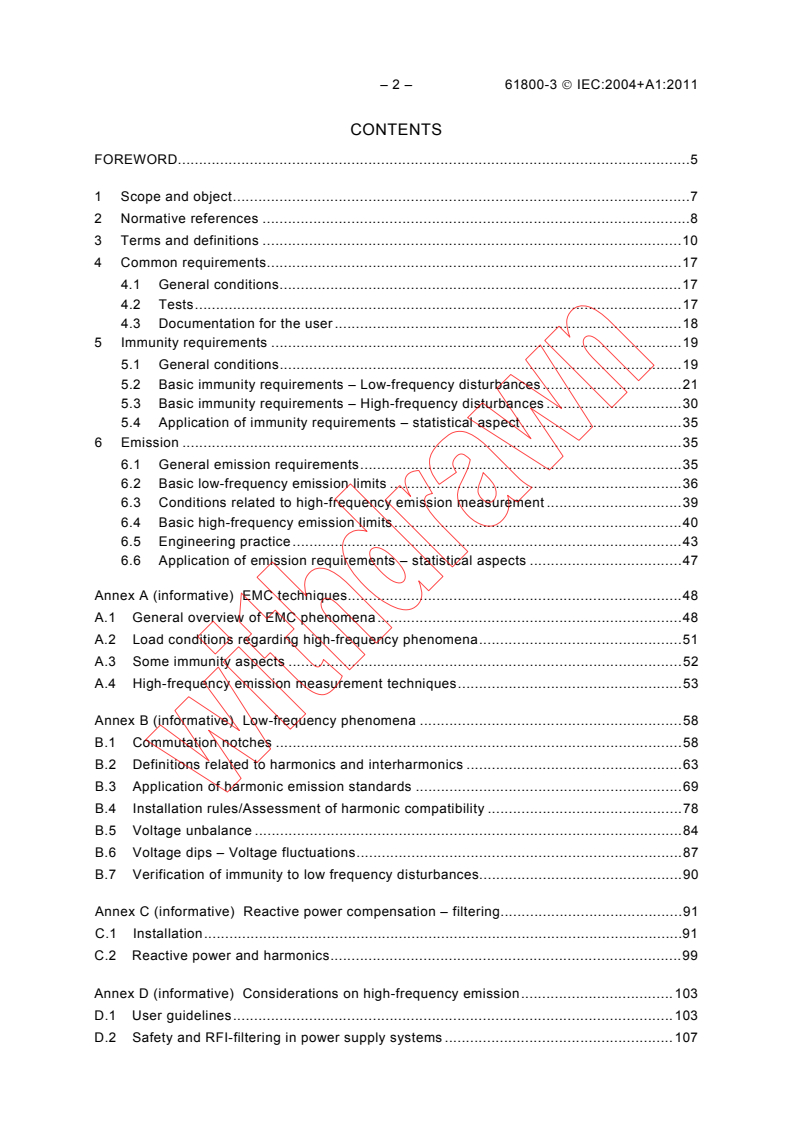
IEC 61800-3:2004+AMD1:2011 CSV - Adjustable speed electrical power drive systems - Part 3: EMC requirements and specific test methods Released:3/8/2012
Overview
IEC 61800-3:2004 is an international standard developed by the International Electrotechnical Commission (IEC) that specifies the Electromagnetic Compatibility (EMC) requirements and specific test methods for adjustable speed electrical power drive systems (PDSs). These systems include both alternating current (AC) and direct current (DC) motor drives designed for variable speed control.
This standard covers power drive systems with converter input and/or output line-to-line voltages up to 35 kV a.c. RMS. IEC 61800-3 aims to ensure reliable operation of power drive systems while minimizing electromagnetic disturbances that can affect other electrical equipment in industrial and commercial environments.
Key Topics
EMC Requirements for PDSs
Establishes minimum immunity and emission limits to electromagnetic disturbances related to adjustable speed drives, ensuring their stable function in different electromagnetic environments.Test Methods and Procedures
Specifies detailed procedures for assessing both low-frequency and high-frequency disturbances, including harmonic emissions, voltage distortions, voltage dips, and electromagnetic radiation.Immunity to Electrical Disturbances
Defines minimum immunity levels against harmonics, commutation notches, voltage unbalance, dips, fluctuations, and short interruptions, critical for PDS stability in noisy electromagnetic conditions.Emission Limits
Sets emission thresholds for conducted and radiated disturbances covering frequencies from 150 kHz up to 1 GHz, tailored to various installation categories and environments.Documentation and User Guidance
Requires manufacturers to provide clear documentation regarding EMC performance and instructions to assist users with EMC-compliant installation and operation practices.Annexes for Practical Implementation
Includes informative annexes offering insights into EMC phenomena, test techniques, harmonic and reactive power considerations, and EMC planning strategies to aid designers and engineers.
Applications
IEC 61800-3 is essential for industries utilizing adjustable speed drives, including:
Industrial Automation and Manufacturing
Ensures motor drives operate reliably and comply with EMC regulations in factories, avoiding potential interference with sensitive control equipment.Transportation Systems
Applicable to drive systems in railways and electric vehicles requiring robust EMC performance to guarantee safety and uninterrupted service.Energy Sector
Supports drives used in renewable energy systems and power generation plants to meet grid compatibility and minimize electromagnetic interference.Building Services and HVAC
Helps maintain EMC compliance of variable-speed drives in heating, ventilation, and air conditioning systems for commercial and large residential complexes.Testing and Certification Laboratories
Provides standardized test methods for EMC verification, enabling consistent certification and regulatory approval of adjustable speed drive products.
Related Standards
IEC 61000 Series
Addresses general EMC test methods and emissions/immunity requirements applicable to electrical and electronic equipment.IEC 61800-1
Specifies general requirements and definitions for adjustable speed power drive systems, providing foundational context for Part 3.IEC 60034 Series
Covers rotating electrical machines associated with motor drives, complementing power drive system standards.IEC 61400-21
Relates to power quality and EMC measurements specifically for wind turbine systems, where adjustable speed drives are often integral.
Keywords: IEC 61800-3, electromagnetic compatibility, EMC requirements, adjustable speed drive systems, power drive systems, emission limits, immunity requirements, electrical motor drives, test methods, harmonic distortion, voltage dips, reactive power compensation, industrial automation, EMC testing.
Relations
- Effective Date
- 05-Sep-2023
- Effective Date
- 05-Sep-2023
- Effective Date
- 05-Sep-2023
Buy Documents
IEC 61800-3:2004 - Adjustable speed electrical power drive systems - Part 3: EMC requirements and specific test methods Released:8/12/2004
IEC 61800-3:2004+AMD1:2011 CSV - Adjustable speed electrical power drive systems - Part 3: EMC requirements and specific test methods Released:3/8/2012
Get Certified
Connect with accredited certification bodies for this standard

IMQ S.p.A. (Certification)
Italian electrical product certification.

SLG Prüf- und Zertifizierungs GmbH
German testing and certification body.

UL Solutions
Global safety science company with testing, inspection and certification.
Sponsored listings
Frequently Asked Questions
IEC 61800-3:2004 is a standard published by the International Electrotechnical Commission (IEC). Its full title is "Adjustable speed electrical power drive systems - Part 3: EMC requirements and specific test methods". This standard covers: specifies electromagnetic compatibility (EMC) requirements for power drive systems (PDSs). A PDS is defined in 3.1. These are adjustable speed a.c. or d.c. motor drives. Requirements are stated for PDSs with converter input and/or output voltages (line-to-line voltage), up to 35 kV a.c. r.m.s.
specifies electromagnetic compatibility (EMC) requirements for power drive systems (PDSs). A PDS is defined in 3.1. These are adjustable speed a.c. or d.c. motor drives. Requirements are stated for PDSs with converter input and/or output voltages (line-to-line voltage), up to 35 kV a.c. r.m.s.
IEC 61800-3:2004 is classified under the following ICS (International Classification for Standards) categories: 29.200 - Rectifiers. Convertors. Stabilized power supply; 33.100.01 - Electromagnetic compatibility in general. The ICS classification helps identify the subject area and facilitates finding related standards.
IEC 61800-3:2004 has the following relationships with other standards: It is inter standard links to IEC 61800-3:2004/AMD1:2011, IEC 61800-3:1996, IEC 61800-3:2017. Understanding these relationships helps ensure you are using the most current and applicable version of the standard.
IEC 61800-3:2004 is available in PDF format for immediate download after purchase. The document can be added to your cart and obtained through the secure checkout process. Digital delivery ensures instant access to the complete standard document.
Standards Content (Sample)
NORME CEI
INTERNATIONALE IEC
61800-3
INTERNATIONAL
Deuxième édition
STANDARD
Second edition
2004-08
Entraînements électriques de puissance
à vitesse variable –
Partie 3:
Exigences de CEM et méthodes
d'essais spécifiques
Adjustable speed electrical power
drive systems –
Part 3:
EMC requirements and specific
test methods
Numéro de référence
Reference number
CEI/IEC 61800-3:2004
Numérotation des publications Publication numbering
Depuis le 1er janvier 1997, les publications de la CEI As from 1 January 1997 all IEC publications are
sont numérotées à partir de 60000. Ainsi, la CEI 34-1 issued with a designation in the 60000 series. For
devient la CEI 60034-1. example, IEC 34-1 is now referred to as IEC 60034-1.
Editions consolidées Consolidated editions
Les versions consolidées de certaines publications de la The IEC is now publishing consolidated versions of its
CEI incorporant les amendements sont disponibles. Par publications. For example, edition numbers 1.0, 1.1
exemple, les numéros d’édition 1.0, 1.1 et 1.2 indiquent and 1.2 refer, respectively, to the base publication,
respectivement la publication de base, la publication de the base publication incorporating amendment 1 and
base incorporant l’amendement 1, et la publication de the base publication incorporating amendments 1
base incorporant les amendements 1 et 2. and 2.
Informations supplémentaires Further information on IEC publications
sur les publications de la CEI
Le contenu technique des publications de la CEI est The technical content of IEC publications is kept
constamment revu par la CEI afin qu'il reflète l'état under constant review by the IEC, thus ensuring that
actuel de la technique. Des renseignements relatifs à the content reflects current technology. Information
cette publication, y compris sa validité, sont dispo- relating to this publication, including its validity, is
nibles dans le Catalogue des publications de la CEI available in the IEC Catalogue of publications
(voir ci-dessous) en plus des nouvelles éditions, (see below) in addition to new editions, amendments
amendements et corrigenda. Des informations sur les and corrigenda. Information on the subjects under
sujets à l’étude et l’avancement des travaux entrepris consideration and work in progress undertaken by the
par le comité d’études qui a élaboré cette publication, technical committee which has prepared this
ainsi que la liste des publications parues, sont publication, as well as the list of publications issued,
également disponibles par l’intermédiaire de: is also available from the following:
x Site web de la CEI (www.iec.ch) x IEC Web Site (www.iec.ch)
x Catalogue des publications de la CEI x Catalogue of IEC publications
Le catalogue en ligne sur le site web de la CEI The on-line catalogue on the IEC web site
(www.iec.ch/searchpub) vous permet de faire des (www.iec.ch/searchpub) enables you to search by a
recherches en utilisant de nombreux critères, variety of criteria including text searches,
comprenant des recherches textuelles, par comité technical committees and date of publication. On-
d’études ou date de publication. Des informations en line information is also available on recently
ligne sont également disponibles sur les nouvelles issued publications, withdrawn and replaced
publications, les publications remplacées ou retirées, publications, as well as corrigenda.
ainsi que sur les corrigenda.
x IEC Just Published x IEC Just Published
Ce résumé des dernières publications parues This summary of recently issued publications
(www.iec.ch/online_news/justpub) est aussi dispo- (www.iec.ch/online_news/justpub) is also available
nible par courrier électronique. Veuillez prendre by email. Please contact the Customer Service
contact avec le Service client (voir ci-dessous) Centre (see below) for further information.
pour plus d’informations.
x Service clients x Customer Service Centre
Si vous avez des questions au sujet de cette If you have any questions regarding this
publication ou avez besoin de renseignements publication or need further assistance, please
supplémentaires, prenez contact avec le Service contact the Customer Service Centre:
clients:
Email: custserv@iec.ch Email: custserv@iec.ch
Tél: +41 22 919 02 11 Tel: +41 22 919 02 11
Fax: +41 22 919 03 00 Fax: +41 22 919 03 00
.
NORME CEI
INTERNATIONALE IEC
61800-3
INTERNATIONAL
Deuxième édition
STANDARD
Second edition
2004-08
Entraînements électriques de puissance
à vitesse variable –
Partie 3:
Exigences de CEM et méthodes
d'essais spécifiques
Adjustable speed electrical power
drive systems –
Part 3:
EMC requirements and specific
test methods
” IEC 2004 Droits de reproduction réservés Copyright - all rights reserved
Aucune partie de cette publication ne peut être reproduite ni No part of this publication may be reproduced or utilized in any
utilisée sous quelque forme que ce soit et par aucun procédé, form or by any means, electronic or mechanical, including
électronique ou mécanique, y compris la photocopie et les photocopying and microfilm, without permission in writing from
microfilms, sans l'accord écrit de l'éditeur. the publisher.
International Electrotechnical Commission, 3, rue de Varembé, PO Box 131, CH-1211 Geneva 20, Switzerland
Telephone: +41 22 919 02 11 Telefax: +41 22 919 03 00 E-mail: inmail@iec.ch Web: www.iec.ch
CODE PRIX
Commission Electrotechnique Internationale XE
PRICE CODE
International Electrotechnical Commission
ɆɟɠɞɭɧɚɪɨɞɧɚɹɗɥɟɤɬɪɨɬɟɯɧɢɱɟɫɤɚɹɄɨɦɢɫɫɢɹ
Pour prix, voir catalogue en vigueur
For price, see current catalogue
– 2 – 61800-3 ” CEI:2004
SOMMAIRE
AVANT-PROPOS.10
1 Domaine d’application et objet .14
2 Références normatives.16
3 Définitions.20
4 Prescriptions communes.30
4.1 Conditions générales.30
4.2 Essais.32
4.3 Documentation utilisateur.32
5 Prescriptions d'immunité.34
5.1 Conditions générales.34
5.2 Prescriptions d'immunité de base – perturbations basse fréquence.40
5.3 Exigences d'immunité de base – perturbations hautes fréquences .50
5.4 Application des exigences d'immunité – aspect statistique.56
6 Emission.58
6.1 Généralités sur les exigences d'émission .58
6.2 Limites d'émission basse fréquence de base .58
6.3 Conditions liées à la mesure des émissions en haute fréquence .64
6.4 Limites de base des émissions hautes fréquences.66
6.5 Règles d’ingénierie.72
6.6 Application des exigences d'émissions – aspects statistiques .80
Annexe A (informative) Techniques CEM.82
A.1 Généralités sur les phénomènes de CEM.82
A.2 Conditions de charge vis-à-vis des phénomènes haute fréquence.88
A.3 Quelques aspects de l'immunité.90
A.4 Techniques de mesure des émissions de haute fréquence.92
Annexe B (informative) Phénomènes basse fréquence.102
B.1 Encoches de commutation .102
B.2 Définitions liées aux harmoniques et interharmoniques.112
B.3 Application des normes d’émission harmonique.124
B.4 Règles d'installation/Evaluation de la compatibilité harmonique .142
B.5 Déséquilibre de tension .152
B.6 Creux de tension – Fluctuations de tension .158
B.7 Vérification de l’immunité aux perturbations basses fréquences.162
Annexe C (informative) Compensation de puissance réactive – filtrage .166
C.1 Installation .166
C.2 Puissance réactive et harmoniques .182
61800-3 ” IEC:2004 – 3 –
CONTENTS
FOREWORD.11
1 Scope and object.15
2 Normative references.17
3 Terms and definitions .21
4 Common requirements.31
4.1 General conditions.31
4.2 Tests.33
4.3 Documentation for the user.33
5 Immunity requirements.35
5.1 General conditions.35
5.2 Basic immunity requirements – Low-frequency disturbances.41
5.3 Basic immunity requirements – High-frequency disturbances .51
5.4 Application of immunity requirements – statistical aspect.57
6 Emission.59
6.1 General emission requirements.59
6.2 Basic low-frequency emission limits .59
6.3 Conditions related to high-frequency emission measurement .65
6.4 Basic high-frequency emission limits.67
6.5 Engineering practice.73
6.6 Application of emission requirements – statistical aspects .81
Annex A (informative) EMC techniques.83
A.1 General overview of EMC phenomena.83
A.2 Load conditions regarding high-frequency phenomena .89
A.3 Some immunity aspects .91
A.4 High-frequency emission measurement techniques .93
Annex B (informative) Low-frequency phenomena .103
B.1 Commutation notches .103
B.2 Definitions related to harmonics and interharmonics .113
B.3 Application of harmonic emission standards .125
B.4 Installation rules/Assessment of harmonic compatibility.143
B.5 Voltage unbalance.153
B.6 Voltage dips – Voltage fluctuations .159
B.7 Verification of immunity to low frequency disturbances .163
Annex C (informative) Reactive power compensation – filtering.167
C.1 Installation .167
C.2 Reactive power and harmonics .183
– 4 – 61800-3 ” CEI:2004
Annexe D (informative) Considérations sur l'émission haute fréquence .190
D.1 Guide d'utilisation .190
D.2 Sécurité et filtrage RF sur les réseaux de puissance .198
Annexe E (informative) Analyse CEM et Plan CEM .202
E.1 Généralités – Analyse CEM du système appliquée aux PDS.202
E.2 Exemple de plan CEM pour applications générales .208
E.3 Exemple de supplément au plan CEM pour une application particulière .216
Bibliographie .224
Figure 1 – Définition de l'installation et de son contenu.22
Figure 2 – Interfaces internes d'un PDS et exemples d'accès.26
Figure 3 – Interfaces de puissance d’un PDS avec BUS continu commun.28
Figure 4 – Interfaces de puissance avec transformateur d'entrée commun .28
Figure 5 – Propagation des perturbations .76
Figure 6 – Propagation des perturbations dans une installation avec un PDS de
tension assignée > 1 000 V .76
Figure A.1 – Coordination entre perturbation et immunité .86
Figure B.1 – Forme d'onde typique des encoches de commutation – Distinction de
transitoire non répétitif .102
Figure B.2 – PCC, IPC, Rapport des courants de l'installation et R .122
SI
Figure B.3 – PCC, IPC, rapport des courants de l'installation et R .124
SC
Figure B.4 – Evaluation des émissions harmoniques d'un PDS .130
Figure B.5 – Conditions de charge pour la mesure des émissions harmoniques d'un PDS .132
Figure B.6 – Configuration d'essai avec une charge mécanique .134
Figure B.7 – Configuration d'essai avec une charge électrique remplaçant le moteur chargé134
Figure B.8 – Configuration d'essai avec une charge résistive.136
Figure B.9 – Evaluation des émissions harmoniques pour l'utilisation de PDS
(appareils, systèmes ou installations) .144
Figure C.1 – Compensation de puissance réactive.172
Figure C.2 – Schéma simplifié d'un réseau industriel .176
Figure C.3 – Impédance en fonction de la fréquence du réseau simplifié.176
Figure C.4 – Exemple de batterie de filtres passifs .182
Figure C.5 – Exemple de solution inappropriée de compensation de puissance réactive.184
Figure D.1 – Emission conduite, mesurée sur divers PDS non filtrés .192
Figure D.2 – Emission rayonnée probable d’un PDS de tension assignée jusqu'à 400 V
Valeurs crêtes normalisées à 10 m.194
Figure D.3 – Sécurité et filtrage.200
Figure E.1 – Interaction entre les systèmes et l'environnement EM .202
Figure E.2 – Concept de zone .204
Figure E.3 – Exemple d'entraînement.206
61800-3 ” IEC:2004 – 5 –
Annex D (informative) Considerations on high-frequency emission.191
D.1 User guidelines .191
D.2 Safety and RFI-filtering in power supply systems.199
Annex E (informative) EMC analysis and EMC plan .203
E.1 General – System EMC analysis applied to PDSs.203
E.2 Example of EMC plan for general applications.209
E.3 Example of supplement to EMC plan for particular application .217
Bibliography .225
Figure 1 – Definition of the installation and its content .23
Figure 2 – Internal interfaces of the PDS and examples of ports .27
Figure 3 – Power interfaces of a PDS with common d.c. BUS .29
Figure 4 – Power interfaces with common input transformer.29
Figure 5 – Propagation of disturbances .38
Figure 6 – Propagation of disturbances in installation with a PDS rated > 1 000 V.77
Figure A.1 – Coordination between disturbance and immunity.87
Figure B.1 – Typical waveform of commutation notches – Distinction from non-
repetitive transient. .103
Figure B.2 – PCC, IPC, Installation current ratio and R .123
SI
Figure B.3 – PCC, IPC, Installation current ratio and R .125
SC
Figure B.4 – Assessment of the harmonic emission of a PDS.131
Figure B.5 – Load conditions for the measurement of harmonic emission of a PDS .133
Figure B.6 – Test set up with mechanical load .135
Figure B.7 – Test set up with electrical load replacing the loaded motor .135
Figure B.8 – Test set up with resistive load .137
Figure B.9 – Assessment of harmonic emission where PDS are used (apparatus,
systems or installations).145
Figure C.1 – Reactive power compensation .173
Figure C.2 – Simplified diagram of an industrial network .177
Figure C.3 – Impedance versus frequency of the simplified network.177
Figure C.4 – Example of passive filter battery.183
Figure C.5 – Example of inadequate solution in reactive power compensation.185
Figure D.1 – Conducted emission of various unfiltered PDSs .193
Figure D.2 – Expected radiated emission of PDS up to rated voltage 400 V Peak
values normalised at 10 m .195
Figure D.3 – Safety and filtering.201
Figure E.1 – Interaction between systems and EM environment .203
Figure E.2 – Zone concept .205
Figure E.3 – Example of drive .207
– 6 – 61800-3 ” CEI:2004
Tableau 1 – Critères de qualification d'un PDS soumis aux perturbations
électromagnétiques.36
Tableau 2 – Exigences minimales d'immunité aux harmoniques et aux encoches de
commutation/distorsion de tension des accès puissance des PDS basse tension .42
Tableau 3 – Exigences minimales d'immunité aux harmoniques et aux encoches de
commutation/distorsion de tension pour les accès puissance principaux des PDS de
tension assignée supérieure à 1 000 V .42
Tableau 4 – Exigences minimales d'immunité aux harmoniques et aux encoches de
commutation/distorsion de tension pour les accès puissance sur les auxiliaires basse
tension des PDS.44
Tableau 5 – Exigences minimales d'immunité pour les déviations de tension, les creux
de tension et les coupures brèves sur les accès puissance des PDS basse tension .44
Tableau 6 – Exigences minimales d'immunité pour les déviations de tension, les creux
de tension et les coupures brèves sur les accès puissance principaux des PDS de
tension assignée supérieure à 1 000 V .46
Tableau 7 – Exigences minimales d'immunité pour les déviations de tension, les creux
de tension et les coupures brèves sur les accès puissance auxiliaires des PDS basse
tension .48
Tableau 8 – Exigences minimales d'immunité pour le déséquilibre de tension et les
variations de fréquence sur les accès puissance des PDS basse tension .48
Tableau 9 – Exigences minimales d'immunité pour le déséquilibre de tension et les
variations de fréquence sur les accès puissance principaux des PDS de tension
supérieure à 1 000 V.50
Tableau 10 – Exigences minimales d'immunité pour le déséquilibre de tension et les
variations de fréquence sur les accès puissance auxiliaires des PDS basse tension.50
Tableau 11 – Exigences minimales d'immunité des PDS destinés à être utilisés dans le
premier environnement .52
Tableau 12 – Exigences minimales d'immunité des PDS destinés à être utilisés dans le
second environnement.54
Tableau 13 – Résumé des exigences d'émission .58
Tableau 14 – Limites de tension perturbatrice sur les bornes réseau dans la plage de
fréquences comprises entre 150 kHz et 30 MHz .66
Tableau 15 – Limites de perturbation par rayonnement électromagnétique dans la
bande des fréquences comprises entre 30 MHz et 1 000 MHz.68
Tableau 16 – Limites de tension perturbatrice sur l’interface puissance .70
Tableau 17 – Limites de tension perturbatrice sur les bornes réseau dans la bande des
fréquences comprises entre 150 kHz et 30 MHz PDS dans le second environnement –
PDS de Catégorie C3.70
Tableau 18 – Limites de perturbation par rayonnement électromagnétique dans la
bande des fréquences comprises entre 30 MHz et 1 000 MHz PDS dans le second
environnement – PDS de Catégorie C3 .72
Tableau 19 – Limites de la tension perturbatrice propagée («au dehors» dans le
premier environnement) .78
Tableau 20 – Limites de la tension perturbatrice propagée («au dehors» dans le
second environnement).78
Tableau 21 – Limites des perturbations électromagnétiques propagées au-dessus de
30 MHz.78
Tableau 22 – Limites des perturbations électromagnétiques en dessous de 30 MHz.80
61800-3 ” IEC:2004 – 7 –
Table 1 – Criteria to prove the acceptance of a PDS against electromagnetic
disturbances.37
Table 2 – Minimum immunity requirements for harmonics and commutation
notches/voltage distortion on power ports of low voltage PDSs .43
Table 3 – Minimum immunity requirements for harmonics and commutation
notches/voltage distortion on main power ports of PDSs of rated voltage above 1 000 V .43
Table 4 – Minimum immunity requirements for harmonics and commutation
notches/voltage distortion on auxiliary low voltage power ports of PDSs.45
Table 5 – Minimum immunity requirements for voltage deviations, dips and short
interruptions on power ports of low voltage PDSs .45
Table 6 – Minimum immunity requirements for voltage deviations, dips and short
interruptions on main power ports of rated voltage above 1 000 V of PDSs .47
Table 7 – Minimum immunity requirements for voltage deviations, dips and short
interruptions on auxiliary low voltage power ports of PDSs.49
Table 8 – Minimum immunity requirements for voltage unbalance and frequency
variations on power ports of low voltage PDSs .49
Table 9 – Minimum immunity requirements for voltage unbalance and frequency
variations on main power ports of rated voltage above 1 000 V of PDSs.51
Table 10 – Minimum immunity requirements for voltage unbalance and frequency
variations on auxiliary low voltage power ports of PDSs.51
Table 11–Minimum immunity requirements for PDSs intended for use in the first
environment.53
Table 12 – Minimum immunity requirements for PDSs intended for use in the second
environment.55
Table 13 – Summary of emission requirements.59
Table 14 – Limits for mains terminal disturbance voltage in the frequency band 150
kHz to 30 MHz .67
Table 15 – Limits for electromagnetic radiation disturbance in the frequency band 30
MHz to 1 000 MHz .69
Table 16 – Limits of disturbance voltage on the power interface – Option 2 .71
Table 17 – Limits for mains terminal disturbance voltage in the frequency band
150 kHz to 30 MHz PDS in the second environment – PDS of category C3.71
Table 18 – Limits for electromagnetic radiation disturbance in the frequency band
30 MHz to 1 000 MHz PDS in the second environment – PDS of category C3.73
Table 19 – Limits for propagated disturbance voltage ("outside" in the first
environment) .79
Table 20 –Limits for propagated disturbance voltage ("outside" in the second
environment) .79
Table 21 – Limits for propagated electromagnetic disturbance above 30 MHz .79
Table 22 – Limits for electromagnetic disturbance below 30 MHz .81
– 8 – 61800-3 ” CEI:2004
Tableau A.1– Vue d’ensemble CEM .84
Tableau B.1 – Profondeur maximale admissible des encoches de commutation au PC .110
Tableau B.2 – Exigences d'émission de courant harmonique par rapport au courant
total de la puissance souscrite au PCC ou à l'IPC.148
Tableau B.3 – Plan de vérification de l’immunité aux perturbations basses fréquences.164
Tableau E.1 – Interaction EM entre sous-systèmes et environnement .206
Tableau E.2 – Analyse des fréquences.220
61800-3 ” IEC:2004 – 9 –
Table A.1 – EMC overview .85
Table B.1 – Maximum allowable depth of commutation notches at the PC .111
Table B.2 – Harmonic current emission requirements relative to the total current of the
agreed power at the PCC or IPC .149
Table B.3 – Verification plan for immunity to low frequency disturbances .165
Table E.1 – EM interaction between subsystems and environment .207
Table E.2 – Frequency analysis .221
– 10 – 61800-3 ” CEI:2004
COMMISSION ÉLECTROTECHNIQUE INTERNATIONALE
____________
ENTRAÎNEMENTS ÉLECTRIQUES DE PUISSANCE
À VITESSE VARIABLE –
Partie 3: Exigences de CEM et méthodes d'essais spécifiques
AVANT-PROPOS
1) La Commission Electrotechnique Internationale (CEI) est une organisation mondiale de normalisation
composée de l'ensemble des comités électrotechniques nationaux (Comités nationaux de la CEI). La CEI a
pour objet de favoriser la coopération internationale pour toutes les questions de normalisation dans les
domaines de l'électricité et de l'électronique. A cet effet, la CEI – entre autres activités – publie des Normes
internationales, des Spécifications techniques, des Rapports techniques, des Spécifications accessibles au
public (PAS) et des Guides (ci-après dénommés»Publication(s) de la CEI«). Leur élaboration est confiée à des
comités d'études, aux travaux desquels tout Comité national intéressé par le sujet traité peut participer. Les
organisations internationales, gouvernementales et non gouvernementales, en liaison avec la CEI, participent
également aux travaux. La CEI collabore étroitement avec l'Organisation Internationale de Normalisation (ISO),
selon des conditions fixées par accord entre les deux organisations.
2) Les décisions ou accords officiels de la CEI concernant les questions techniques représentent, dans la mesure
du possible, un accord international sur les sujets étudiés, étant donné que les Comités nationaux de la CEI
intéressés sont représentés dans chaque comité d’études.
3) Les Publications de la CEI se présentent sous la forme de recommandations internationales et sont agréées
comme telles par les Comités nationaux de la CEI. Tous les efforts raisonnables sont entrepris afin que la CEI
s'assure de l'exactitude du contenu technique de ses publications; la CEI ne peut pas être tenue responsable
de l'éventuelle mauvaise utilisation ou interprétation qui en est faite par un quelconque utilisateur final.
4) Dans le but d'encourager l'uniformité internationale, les Comités nationaux de la CEI s'engagent, dans toute la
mesure possible, à appliquer de façon transparente les Publications de la CEI dans leurs publications
nationales et régionales. Toutes divergences entre toutes Publications de la CEI et toutes publications
nationales ou régionales correspondantes doivent être indiquées en termes clairs dans ces dernières.
5) La CEI n’a prévu aucune procédure de marquage valant indication d’approbation et n'engage pas sa
responsabilité pour les équipements déclarés conformes à une de ses Publications.
6) Tous les utilisateurs doivent s'assurer qu'ils sont en possession de la dernière édition de cette publication.
7) Aucune responsabilité ne doit être imputée à la CEI, à ses administrateurs, employés, auxiliaires ou
mandataires, y compris ses experts particuliers et les membres de ses comités d'études et des Comités
nationaux de la CEI, pour tout préjudice causé en cas de dommages corporels et matériels, ou de tout autre
dommage de quelque nature que ce soit, directe ou indirecte, ou pour supporter les coûts (y compris les frais
de justice) et les dépenses découlant de la publication ou de l'utilisation de cette Publication de la CEI ou de
toute autre Publication de la CEI, ou au crédit qui lui est accordé.
8) L'attention est attirée sur les références normatives citées dans cette publication. L'utilisation de publications
référencées est obligatoire pour une application correcte de la présente publication.
9) L’attention est attirée sur le fait que certains des éléments de la présente Publication de la CEI peuvent faire
l’objet de droits de propriété intellectuelle ou de droits analogues. La CEI ne saurait être tenue pour
responsable de ne pas avoir identifié de tels droits de propriété et de ne pas avoir signalé leur existence.
La Norme internationale CEI 61800-3 a été établie par le sous-comité d'études 22G:
Systèmes d'entraînement électrique à vitesse variable, comprenant des convertisseurs à
semi-conducteurs, du comité d’études 22 de la CEI: Systèmes et équipements électroniques
de puissance.
Cette seconde édition annule et remplace la première édition parue en 1996, dont elle
constitue une révision technique.
Cette seconde édition introduit trois changements majeurs:
a) les classes de distribution (non restreinte et restreinte) des entraînements ont été
remplacées par les catégories d’entraînements (C1 à C4), définies par rapport à
l’entraînement lui-même et à son usage prévu;
b) une meilleure couverture des limites d’émission;
c) une planification CEM est généralisée en catégorie C4.
61800-3 ” IEC:2004 – 11 –
INTERNATIONAL ELECTROTECHNICAL COMMISSION
____________
ADJUSTABLE SPEED ELECTRICAL POWER
DRIVE SYSTEMS –
Part 3: EMC requirements and specific test methods
FOREWORD
1) The International Electrotechnical Commission (IEC) is a worldwide organization for standardization comprising
all national electrotechnical committees (IEC National Committees). The object of IEC is to promote
international co-operation on all questions concerning standardization in the electrical and electronic fields. To
this end and in addition to other activities, IEC publishes International Standards, Technical Specifications,
Technical Reports, Publicly Available Specifications (PAS) and Guides (hereafter referred to as “IEC
Publication(s)”). Their preparation is entrusted to technical committees; any IEC National Committee interested
in the subject dealt with may participate in this preparatory work. International, governmental and non-
governmental organizations liaising with the IEC also participate in this preparation. IEC collaborates closely
with the International Organization for Standardization (ISO) in accordance with conditions determined by
agreement between the two organizations.
2) The formal decisions or agreements of IEC on technical matters express, as nearly as possible, an international
consensus of opinion on the relevant subjects since each technical committee has representation from all
interested IEC National Committees.
3) IEC Publications have the form of recommendations for international use and are accepted by IEC National
Committees in that sense. While all reasonable efforts are made to ensure that the technical content of IEC
Publications is accurate, IEC cannot be held responsible for the way in which they are used or for any
misinterpretation by any end user.
4) In order to promote international uniformity, IEC National Committees undertake to apply IEC Publications
transparently to the maximum extent possible in their national and regional publications. Any divergence
between any IEC Publication and the corresponding national or regional publication shall be clearly indicated in
the latter.
5) IEC provides no marking procedure to indicate its approval and cannot be rendered responsible for any
equipment declared to be in conformity with an IEC Publication.
6) All users should ensure that they have the latest edition of this publication.
7) No liability shall attach to IEC or its directors, employees, servants or agents including individual experts and
members of its technical committees and IEC National Committees for any personal injury, property damage or
other damage of any nature whatsoever, whether direct or indirect, or for costs (including legal fees) and
expenses arising out of the publication, use of, or reliance upon, this IEC Publication or any other IEC
Publications.
8) Attention is drawn to the Normative references cited in this publication. Use of the referenced publications is
indispensable for the correct application of this publication.
9) Attention is drawn to the possibility that some of the elements of this IEC Publication may be the subject of
patent rights. IEC shall not be held responsible for identifying any or all such patent rights.
International Standard IEC 61800-3 has been prepared by sub-committee 22G: Adjustable
speed electric drive systems incorporating semiconductor power converters, of IEC technical
committee 22: Power electronic systems and equipment.
This second edition cancels and replaces the first edition issued in 1996 and constitutes a
technical revision.
This second edition introduces three main changes:
a) the classes of distribution (unrestricted and restricted) of the PDS have been replaced by
categories of PDS (C1 to C4) with definitions related to the product itself and its intended
use;
b) better coverage of emission limits;
c) an EMC plan is generalized for category C4.
– 12 – 61800-3 ” CEI:2004
Le texte de cette norme est issu des documents suivants:
FDIS Rapport de vote
22G/127/FDIS 22G/131/RVD
Le rapport de vote indiqué dans le tableau ci-dessus donne toute information sur le vote ayant
abouti à l’approbation de cette norme.
Cette publication a été préparée selon les Directives ISO/CEI, Partie 2.
Le comité a décidé que le contenu de cette publication ne sera pas modifié avant la date de
maintenance indiquée sur le site web de la CEI sous «http://webstore.iec.ch» dans les
données relatives à la publication recherchée. A cette date, la publication sera
reconduite;
supprimée;
remplacée par une édition révisée, ou
amendée.
La CEI 61800 comprend les parties suivantes, présentées sous le titre général Entraînements
électriques de puissance à vitesse variable.
Partie 1: Exigences générales – Spécifications de dimensionnement pour systèmes
d’entraînement de puissance à vitesse variable en courant continu et basse
tension
Partie 2: Exigences générales – Spécifications de dimensionnement pour systèmes
d’entraînement de puissance à fréquence variable en courant alternatif et basse
tension
Partie 3: Exigences de CEM et méthodes d’essais spécifiques
Partie 4: Exigences générales – Spécifications de dimensionnement pour systèmes
d’entraînements de puissance en courant alternatif de tension supérieure à 1 000 V
alternatif et ne dépassant pas 35 kV
Partie 5-1: Exigences de sécurité – Electrique, thermique et énergétique
Partie 6: Guide de détermination du type de régime de charge et de dimensionnement en
courant correspondant
61800-3 ” IEC:2004 – 13 –
The text of this standard is based on the following documents:
FDIS Report on voting
22G/127/FDIS 22G/131/RVD
Full information on the voting for the approval of this standard can be found in the report on
voting indicated in the above table.
This publication has been drafted in accordance with the ISO/IEC Directives, Part 2.
The committee has decided that the contents of this publication will remain unchanged until
the maintenance result date indicated on the IEC web site under "http://webstore.iec.ch" in
the data related to the specific publication. At this date, the publication will be
reconfirmed;
withdrawn;
replaced by a revised edition, or
amended.
IEC 61800 consists of the following parts, under the general title Adjustable speed electrical
power drive systems
Part 1: General requirements – Rating specifications for low voltage adjustable speed
d.c. power drive systems
Part 2: General requirements – Rating specifications for low voltage adjustable frequency
a.c. power drive systems
Part 3: EMC requiremen
...
IEC 61800-3 ®
Edition 2.1 2012-03
INTERNATIONAL
STANDARD
NORME
INTERNATIONALE
colour
inside
Adjustable speed electrical power drive systems –
Part 3: EMC requirements and specific test methods
Entraînements électriques de puissance à vitesse variable –
Partie 3: Exigences de CEM et méthodes d'essais spécifiques
All rights reserved. Unless otherwise specified, no part of this publication may be reproduced or utilized in any form
or by any means, electronic or mechanical, including photocopying and microfilm, without permission in writing from
either IEC or IEC's member National Committee in the country of the requester.
If you have any questions about IEC copyright or have an enquiry about obtaining additional rights to this publication,
please contact the address below or your local IEC member National Committee for further information.
Droits de reproduction réservés. Sauf indication contraire, aucune partie de cette publication ne peut être reproduite ni
utilisée sous quelque forme que ce soit et par aucun procédé, électronique ou mécanique, y compris la photocopie et les
microfilms, sans l'accord écrit de la CEI ou du Comité national de la CEI du pays du demandeur.
Si vous avez des questions sur le copyright de la CEI ou si vous désirez obtenir des droits supplémentaires sur cette
publication, utilisez les coordonnées ci-après ou contactez le Comité national de la CEI de votre pays de résidence.
IEC Central Office Tel.: +41 22 919 02 11
3, rue de Varembé Fax: +41 22 919 03 00
CH-1211 Geneva 20 info@iec.ch
Switzerland www.iec.ch
About the IEC
The International Electrotechnical Commission (IEC) is the leading global organization that prepares and publishes
International Standards for all electrical, electronic and related technologies.
About IEC publications
The technical content of IEC publications is kept under constant review by the IEC. Please make sure that you have the
latest edition, a corrigenda or an amendment might have been published.
Useful links:
IEC publications search - www.iec.ch/searchpub Electropedia - www.electropedia.org
The advanced search enables you to find IEC publications The world's leading online dictionary of electronic and
by a variety of criteria (reference number, text, technical electrical terms containing more than 30 000 terms and
committee,…). definitions in English and French, with equivalent terms in
It also gives information on projects, replaced and additional languages. Also known as the International
withdrawn publications. Electrotechnical Vocabulary (IEV) on-line.
IEC Just Published - webstore.iec.ch/justpublished Customer Service Centre - webstore.iec.ch/csc
Stay up to date on all new IEC publications. Just Published If you wish to give us your feedback on this publication
details all new publications released. Available on-line and or need further assistance, please contact the
also once a month by email. Customer Service Centre: csc@iec.ch.
A propos de la CEI
La Commission Electrotechnique Internationale (CEI) est la première organisation mondiale qui élabore et publie des
Normes internationales pour tout ce qui a trait à l'électricité, à l'électronique et aux technologies apparentées.
A propos des publications CEI
Le contenu technique des publications de la CEI est constamment revu. Veuillez vous assurer que vous possédez
l’édition la plus récente, un corrigendum ou amendement peut avoir été publié.
Liens utiles:
Recherche de publications CEI - www.iec.ch/searchpub Electropedia - www.electropedia.org
La recherche avancée vous permet de trouver des Le premier dictionnaire en ligne au monde de termes
publications CEI en utilisant différents critères (numéro de électroniques et électriques. Il contient plus de 30 000
référence, texte, comité d’études,…). termes et définitions en anglais et en français, ainsi que
Elle donne aussi des informations sur les projets et les les termes équivalents dans les langues additionnelles.
publications remplacées ou retirées. Egalement appelé Vocabulaire Electrotechnique
International (VEI) en ligne.
Just Published CEI - webstore.iec.ch/justpublished
Service Clients - webstore.iec.ch/csc
Restez informé sur les nouvelles publications de la CEI.
Just Published détaille les nouvelles publications parues. Si vous désirez nous donner des commentaires sur
Disponible en ligne et aussi une fois par mois par email. cette publication ou si vous avez des questions
contactez-nous: csc@iec.ch.
IEC 61800-3 ®
Edition 2.1 2012-03
INTERNATIONAL
STANDARD
NORME
INTERNATIONALE
colour
inside
Adjustable speed electrical power drive systems –
Part 3: EMC requirements and specific test methods
Entraînements électriques de puissance à vitesse variable –
Partie 3: Exigences de CEM et méthodes d'essais spécifiques
INTERNATIONAL
ELECTROTECHNICAL
COMMISSION
COMMISSION
ELECTROTECHNIQUE
PRICE CODE
INTERNATIONALE
CQ
CODE PRIX
ICS 29.200; 33.100 ISBN 978-2-88912-880-8
– 2 – 61800-3 IEC:2004+A1:2011
CONTENTS
FOREWORD. 5
1 Scope and object . 7
2 Normative references . 8
3 Terms and definitions . 10
4 Common requirements . 17
4.1 General conditions . 17
4.2 Tests . 17
4.3 Documentation for the user . 18
5 Immunity requirements . 19
5.1 General conditions . 19
5.2 Basic immunity requirements – Low-frequency disturbances . 21
5.3 Basic immunity requirements – High-frequency disturbances . 30
5.4 Application of immunity requirements – statistical aspect . 35
6 Emission . 35
6.1 General emission requirements . 35
6.2 Basic low-frequency emission limits . 36
6.3 Conditions related to high-frequency emission measurement . 39
6.4 Basic high-frequency emission limits . 40
6.5 Engineering practice . 43
6.6 Application of emission requirements – statistical aspects . 47
Annex A (informative) EMC techniques. 48
A.1 General overview of EMC phenomena . 48
A.2 Load conditions regarding high-frequency phenomena . 51
A.3 Some immunity aspects . 52
A.4 High-frequency emission measurement techniques . 53
Annex B (informative) Low-frequency phenomena . 58
B.1 Commutation notches . 58
B.2 Definitions related to harmonics and interharmonics . 63
B.3 Application of harmonic emission standards . 69
B.4 Installation rules/Assessment of harmonic compatibility . 78
B.5 Voltage unbalance . 84
B.6 Voltage dips – Voltage fluctuations . 87
B.7 Verification of immunity to low frequency disturbances. 90
Annex C (informative) Reactive power compensation – filtering. 91
C.1 Installation .91
C.2 Reactive power and harmonics . 99
Annex D (informative) Considerations on high-frequency emission . 103
D.1 User guidelines . 103
D.2 Safety and RFI-filtering in power supply systems . 107
61800-3 IEC:2004+A1:2011 – 3 –
Annex E (informative) EMC analysis and EMC plan . 109
E.1 General – System EMC analysis applied to PDSs . 109
E.2 Example of EMC plan for general applications . 112
E.3 Example of supplement to EMC plan for particular application . 116
Bibliography . 120
Figure 1 – Definition of the installation and its content . 11
Figure 2 – Internal interfaces of the PDS and examples of ports . 14
Figure 3 – Power interfaces of a PDS with common d.c. BUS . 15
Figure 4 – Power interfaces with common input transformer . 15
Figure 5 – Propagation of disturbances . 38
Figure 6 – Propagation of disturbances in installation with a PDS rated > 1 000 V . 45
Figure A.1 – Coordination between disturbance and immunity . 50
Figure B.1 – Typical waveform of commutation notches – Distinction from non-
repetitive transient. . 58
Figure B.2 – PCC, IPC, Installation current ratio and R . 68
SI
Figure B.3 – PCC, IPC, Installation current ratio and R . 69
SC
Figure B.4 – Assessment of the harmonic emission of a PDS . 72
Figure B.5 – Load conditions for the measurement of harmonic emission of a PDS . 73
Figure B.6 – Test set up with mechanical load . 74
Figure B.7 – Test set up with electrical load replacing the loaded motor . 74
Figure B.8 – Test set up with resistive load . 75
Figure B.9 – Assessment of harmonic emission where PDS are is used
(apparatus, systems or installations) . 80
Figure C.1 – Reactive power compensation . 94
Figure C.2 – Simplified diagram of an industrial network . 96
Figure C.3 – Impedance versus frequency of the simplified network . 96
Figure C.4 – Example of passive filter battery . 99
Figure C.5 – Example of inadequate solution in reactive power compensation . 100
Figure D.1 – Conducted emission of various unfiltered PDSs . 104
Figure D.2 – Expected radiated emission of PDS up to rated voltage 400 V Peak
values normalised at 10 m . 105
Figure D.3 – Safety and filtering . 108
Figure E.1 – Interaction between systems and EM environment . 109
Figure E.2 – Zone concept . 110
Figure E.3 – Example of drive . 111
Table 1 – Criteria to prove the acceptance of a PDS against electromagnetic
disturbances . 20
Table 2 – Minimum immunity requirements for harmonics and commutation
notches/voltage distortion on power ports of low voltage PDSs . 22
Table 3 – Minimum immunity requirements for harmonics and commutation
notches/voltage distortion on main power ports of PDSs of rated voltage above 1 000 V . 24
Table 4 – Minimum immunity requirements for harmonics and commutation
notches/voltage distortion on auxiliary low voltage power ports of PDSs . 25
– 4 – 61800-3 IEC:2004+A1:2011
Table 5 – Minimum immunity requirements for voltage deviations, dips and short
interruptions on power ports of low voltage PDSs . 25
Table 6 – Minimum immunity requirements for voltage deviations, dips and short
interruptions on main power ports of rated voltage above 1 000 V of PDSs . 27
Table 7 – Minimum immunity requirements for voltage deviations, dips and short
interruptions on auxiliary low voltage power ports of PDSs. 28
Table 8 – Minimum immunity requirements for voltage unbalance and frequency
variations on power ports of low voltage PDSs . 29
Table 9 – Minimum immunity requirements for voltage unbalance and frequency
variations on main power ports of rated voltage above 1 000 V of PDSs . 29
Table 10 – Minimum immunity requirements for voltage unbalance and frequency
variations on auxiliary low voltage power ports of PDSs . 30
Table 11–Minimum immunity requirements for PDSs intended for use in the first
environment . 31
Table 12 – Minimum immunity requirements for PDSs intended for use in the second
environment . 33
Table 13 – Summary of emission requirements . 36
Table 14 – Limits for mains terminal disturbance voltage in the frequency band
150 kHz to 30 MHz . 40
Table 15 – Limits for electromagnetic radiation disturbance in the frequency band
30 MHz to 1 000 MHz . 41
Table 16 – Limits of disturbance voltage on the power interface – Option 2 . 42
Table 17 – Limits for mains terminal disturbance voltage in the frequency band
150 kHz to 30 MHz PDS in the second environment – PDS of category C3 . 42
Table 18 – Limits for electromagnetic radiation disturbance in the frequency band
30 MHz to 1 000 MHz PDS in the second environment – PDS of category C3 . 43
Table 19 – Limits for propagated disturbance voltage ("outside" in the first
environment) . 46
Table 20 –Limits for propagated disturbance voltage ("outside" in the second
environment) . 46
Table 21 – Limits for propagated electromagnetic disturbance above 30 MHz . 46
Table 22 – Limits for electromagnetic disturbance below 30 MHz . 47
Table 23 – Minimum immunity requirements for total harmonic distortion on power
ports of low voltage PDSs . 22
Table 24 – Minimum immunity requirements for individual harmonic orders on power
ports of low voltage PDSs . 23
Table 25 – Minimum immunity requirements for commutation notches on power ports
of low voltage PDSs . 23
Table A.1 – EMC overview . 49
Table B.1 – Maximum allowable depth of commutation notches at the PC . 62
Table B.2 – Harmonic current emission requirements relative to the total current
of the agreed power at the PCC or IPC . 82
Table B.3 – Verification plan for immunity to low frequency disturbances . 90
Table E.1 – EM interaction between subsystems and environment . 111
Table E.2 – Frequency analysis . 118
61800-3 IEC:2004+A1:2011 – 5 –
INTERNATIONAL ELECTROTECHNICAL COMMISSION
____________
ADJUSTABLE SPEED ELECTRICAL POWER
DRIVE SYSTEMS –
Part 3: EMC requirements and specific test methods
FOREWORD
1) The International Electrotechnical Commission (IEC) is a worldwide organization for standardization comprising
all national electrotechnical committees (IEC National Committees). The object of IEC is to promote
international co-operation on all questions concerning standardization in the electrical and electronic fields. To
this end and in addition to other activities, IEC publishes International Standards, Technical Specifications,
Technical Reports, Publicly Available Specifications (PAS) and Guides (hereafter referred to as “IEC
Publication(s)”). Their preparation is entrusted to technical committees; any IEC National Committee interested
in the subject dealt with may participate in this preparatory work. International, governmental and non-
governmental organizations liaising with the IEC also participate in this preparation. IEC collaborates closely
with the International Organization for Standardization (ISO) in accordance with conditions determined by
agreement between the two organizations.
2) The formal decisions or agreements of IEC on technical matters express, as nearly as possible, an international
consensus of opinion on the relevant subjects since each technical committee has representation from all
interested IEC National Committees.
3) IEC Publications have the form of recommendations for international use and are accepted by IEC National
Committees in that sense. While all reasonable efforts are made to ensure that the technical content of IEC
Publications is accurate, IEC cannot be held responsible for the way in which they are used or for any
misinterpretation by any end user.
4) In order to promote international uniformity, IEC National Committees undertake to apply IEC Publications
transparently to the maximum extent possible in their national and regional publications. Any divergence
between any IEC Publication and the corresponding national or regional publication shall be clearly indicated in
the latter.
5) IEC itself does not provide any attestation of conformity. Independent certification bodies provide conformity
assessment services and, in some areas, access to IEC marks of conformity. IEC is not responsible for any
services carried out by independent certification bodies.
6) All users should ensure that they have the latest edition of this publication.
7) No liability shall attach to IEC or its directors, employees, servants or agents including individual experts and
members of its technical committees and IEC National Committees for any personal injury, property damage or
other damage of any nature whatsoever, whether direct or indirect, or for costs (including legal fees) and
expenses arising out of the publication, use of, or reliance upon, this IEC Publication or any other IEC
Publications.
8) Attention is drawn to the Normative references cited in this publication. Use of the referenced publications is
indispensable for the correct application of this publication.
9) Attention is drawn to the possibility that some of the elements of this IEC Publication may be the subject of
patent rights. IEC shall not be held responsible for identifying any or all such patent rights.
This consolidated version of IEC 61800-3 consists of the second edition (2004)
[documents 22G/127/FDIS and 22G/131/RVD] and its amendment 1 (2011) [documents
22G/227/FDIS and 22G/229/RVD]. It bears the edition number 2.1.
The technical content is therefore identical to the base edition and its amendment and
has been prepared for user convenience. A vertical line in the margin shows where the
base publication has been modified by amendment 1. Additions and deletions are
displayed in red, with deletions being struck through.
– 6 – 61800-3 IEC:2004+A1:2011
International Standard IEC 61800-3 has been prepared by sub-committee 22G: Adjustable
speed electric drive systems incorporating semiconductor power converters, of IEC technical
committee 22: Power electronic systems and equipment.
This second edition introduces three main changes:
a) the classes of distribution (unrestricted and restricted) of the PDS have been replaced by
categories of PDS (C1 to C4) with definitions related to the product itself and its intended
use;
b) better coverage of emission limits;
c) an EMC plan is generalized for category C4.
This publication has been drafted in accordance with the ISO/IEC Directives, Part 2.
IEC 61800 consists of the following parts, under the general title Adjustable speed electrical
power drive systems
Part 1: General requirements – Rating specifications for low voltage adjustable speed
d.c. power drive systems
Part 2: General requirements – Rating specifications for low voltage adjustable frequency
a.c. power drive systems
Part 3: EMC requirements and specific test methods
Part 4: General requirements – Rating specifications for a.c. power drive systems above
1 000 V a.c. and not exceeding 35 kV
Part 5-1: Safety requirements – Electrical, thermal and energy
Part 6: Guide for determination of types of load duty and corresponding current ratings
The committee has decided that the contents of the base publication and its amendments will
remain unchanged until the stability date indicated on the IEC web site under
"http://webstore.iec.ch" in the data related to the specific publication. At this date, the
publication will be
• reconfirmed,
• withdrawn,
• replaced by a revised edition, or
• amended.
IMPORTANT – The “colour inside” logo on the cover page of this publication indicates
that it contains colours which are considered to be useful for the correct understanding
of its contents. Users should therefore print this publication using a colour printer.
61800-3 IEC:2004+A1:2011 – 7 –
ADJUSTABLE SPEED ELECTRICAL POWER
DRIVE SYSTEMS –
Part 3: EMC requirements and specific test methods
1 Scope and object
This part of IEC 61800 specifies electromagnetic compatibility (EMC) requirements for power
drive systems (PDSs). A PDS is defined in 3.1. These are adjustable speed a.c. or d.c. motor
drives. Requirements are stated for PDSs with converter input and/or output voltages (line-to-
line voltage), up to 35 kV a.c. r.m.s.
PDSs covered by this standard are those installed in residential, commercial and industrial
locations with the exception of traction applications, and electric vehicles. PDSs may be
connected to either industrial or public power distribution networks. Industrial networks are
supplied by a dedicated distribution transformer, which is usually adjacent to or inside the
industrial location, and supplies only industrial customers. Industrial networks can also be
supplied by their own electric generating equipment. On the other hand, PDSs can be directly
connected to low-voltage public mains networks which also supply domestic premises, and in
which the neutral is generally earthed (grounded).
The scope of this part of IEC 61800, related to EMC, includes a broad range of PDSs from a
few hundred watts to hundreds of megawatts. PDSs are often included in a larger system. The
system aspect is not covered by this standard but guidance is provided in the informative
annexes.
The requirements have been selected so as to ensure EMC for PDSs at residential,
commercial and industrial locations. The requirements cannot, however, cover extreme cases
which may occur with an extremely low probability. Changes in the EMC behaviour of a PDS,
as a result of fault conditions, are not taken into account.
The object of this standard is to define the limits and test methods for a PDS according to its
intended use. This standard includes immunity requirements and requirements for electro-
magnetic emissions.
NOTE 1 Emission can cause interference in other electronic equipment (for example radio receivers, measuring
and computing devices). Immunity is required to protect the equipment from continuous and transient conducted
and radiated disturbances including electrostatic discharges. The emission and immunity requirements are
balanced against each other and against the actual environment of the PDS.
This standard defines the minimum EMC requirements for a PDS.
Immunity requirements are given according to the environment classification. Low-frequency
emission requirements are given according to the nature of the supply network. High-
frequency emission requirements are given according to four categories of intended use,
which cover both environment and bringing into operation.
As a product standard, this standard may be used for the assessment of PDS. It may also be
used for the assessment of CDM or BDM (see 3.1), which can be marketed separately.
– 8 – 61800-3 IEC:2004+A1:2011
This standard contains:
– conformity assessment requirements for products to be placed on the market;
– recommended engineering practice (see 6.5) for cases where high frequency emissions
cannot be measured before the equipment is placed on the market (such PDSs are
defined in 3.2.6 as category C4).
NOTE 2 The first edition of IEC 61800-3 identified that the intended use could require engineering for putting into
service. This was done by the “restricted distribution mode”. Equipment that used to be covered by the “restricted
distribution mode” is covered in the second edition by categories C2 and C4 (see 3.2).
This standard is intended as a complete EMC product standard for the EMC conformity
assessment of products of categories C1, C2 and C3, when placing them on the market (see
definitions 3.2.3 to 3.2.5).
Radio frequency emission of equipment of category C4 is only assessed when it is installed in
its intended location. It is therefore treated as a fixed installation, for which this standard
gives rules of engineering practice in 6.5 and annex E, although it gives no defined emission
limits (except in case of complaint).
This standard does not specify any safety requirements for the equipment such as protection
against electric shocks, insulation co-ordination and related dielectric tests, unsafe operation,
or unsafe consequences of a failure. It also does not cover safety and functional safety
implications of electromagnetic phenomena.
In special cases, when highly susceptible apparatus is being used in proximity, additional
mitigation measures may have to be employed to reduce the electromagnetic emission further
below the specified levels or additional countermeasures may have to be employed to
increase the immunity of the highly susceptible apparatus.
As an EMC product standard for PDSs, this standard takes precedence over all aspects of the
generic standards and no additional EMC tests are required or necessary. If a PDS is
included as part of equipment covered by a separate EMC product standard, the EMC
standard of the complete equipment applies.
2 Normative references
The following referenced documents are indispensable for the application of this document.
For dated references, only the edition cited applies. For undated references, the latest edition
of the referenced document (including any amendments) applies.
IEC 60050 (131):2002, International Electrotechnical Vocabulary (IEV) – Chapter 131: Circuit
theory
IEC 60050 (151):2001, International Electrotechnical Vocabulary (IEV) – Chapter 151:
Electrical and magnetic devices
IEC 60050 (161):1990, International Electrotechnical Vocabulary (IEV) – Chapter 161:
Electromagnetic compatibility
IEC 60146-1-1:1991, Semiconductor convertors – General requirements and line commutated
convertors – Part 1-1: Specifications of basic requirements
IEC 60364-1:2001, Electrical installations of buildings – Part 1: Fundamental principles,
assessment of general characteristics, definitions
IEC 60664-1:1992, Insulation co-ordination for equipment within low-voltage systems – Part 1:
Principles, requirements and tests
61800-3 IEC:2004+A1:2011 – 9 –
IEC 61000-1-1, Electromagnetic compatibility (EMC) – Part 1: General – Section 1:
Application and interpretation of fundamental definitions and terms
IEC 61000-2-1:1990, Electromagnetic compatibility (EMC) – Part 2: Environment – Section 1:
Description of the environment – Electromagnetic environment for low-frequency conducted
disturbances and signalling in public power supply systems
IEC 61000-2-2:2002, Electromagnetic compatibility (EMC) – Part 2: Environment – Section 2:
Compatibility levels for low-frequency conducted disturbances and signalling in public low-
voltage power supply systems
IEC 61000-2-4:20032, Electromagnetic compatibility (EMC) – Part 2-4: Environment –
Compatibility levels in industrial plants for low-frequency conducted disturbances
IEC 61000-2-6:1995, Electromagnetic compatibility (EMC) – Part 2: Environment – Section 6:
Assessment of the emission levels in the power supply of industrial plants as regards low-
frequency conducted disturbances
IEC 61000-3-2:2000, Electromagnetic compatibility (EMC) – Part 3: Limits – Section 2: Limits
for harmonic current emissions (equipment with input current < 16 A per phase)
IEC 61000-3-3:1994, Electromagnetic compatibility (EMC) – Part 3-3: Limits – Limitation of
voltage changes, voltage fluctuations and flicker in public low-voltage supply systems for
equipment with rated current ≤ 16 A per phase and subject to conditional connection
IEC 61000-3-4:1998, Electromagnetic compatibility (EMC) – Part 3: Limits – Section 4:
Limitation of emission of harmonic currents in low-voltage power supply systems for
equipment with rated current greater than 16 A
IEC 61000-3-7:1996, Electromagnetic compatibility (EMC) – Part 3: Limits – Section 7: Limits
for fluctuating loads in MV and HV power systems – Basic EMC publication
IEC 61000-3-11:2000, Electromagnetic compatibility (EMC) – Part 3-11: Limits – Limitation of
voltage changes, voltage fluctuations and flicker in public low-voltage supply systems for
equipment with rated current ≤ 75 A and subject to conditional connection
IEC 61000-4-2, Electromagnetic compatibility (EMC) – Part 4-2: Testing and measurement
techniques – Electrostatic discharge immunity test Basic EMC publication
IEC 61000-4-3:2002, Electromagnetic compatibility (EMC) – Part 4-3: Testing and measure-
ment techniques – Radiated, radio-frequency, electromagnetic field immunity test Basic EMC
publication
IEC 61000-4-4:1995, Electromagnetic compatibility (EMC) – Part 4: Testing and measurement
techniques – Section 4: Electrical fast transient/burst immunity test Basic EMC publication
Amendment 1 (2000)
Amendment 2 (2001)
IEC 61000-4-5:1995, Electromagnetic compatibility (EMC) – Part 4: Testing and measurement
techniques – Section 5: Surge immunity test
IEC 61000-4-6:2003, Electromagnetic compatibility (EMC) – Part 4-6: Testing and measure-
ment techniques – Immunity to conducted disturbances, induced by radio-frequency fields
IEC 61000-4-8:2001, Electromagnetic compatibility (EMC) – Part 4-8: Testing and measure-
ment techniques – Power frequency magnetic field immunity test Basic EMC publication
IEC 61000-4-11:2004, Electromagnetic compatibility (EMC) – Part 4-11: Testing and
measurement techniques – Voltage dips, short interruptions and voltage variations immunity
tests
– 10 – 61800-3 IEC:2004+A1:2011
IEC 61000-4-13:2002, Electromagnetic compatibility (EMC) – Part 4-13: Testing and
measurement techniques – Harmonics and interharmonics including mains signalling at a.c.
power port, low frequency immunity tests
IEC 61000-4-34:2005, Electromagnetic compatibility (EMC) – Part 4-34: Testing and
measurement techniques – Voltage dips, short interruptions and voltage variations immunity
tests for equipment with input current more than 16 A per phase
IEC 61800-1:1997, Adjustable speed electrical power drive systems – Part 1: Rating
specifications for low voltage d.c. power drive systems
IEC 61800-2:1998, Adjustable speed electrical power drive systems – Part 2: General
requirements – Rating specifications for low voltage adjustable frequency a.c. power drive
systems
IEC 61800-4:2002, Adjustable speed electrical power drive systems – Part 4: General
requirements – Rating specifications for a.c. power drive systems above 1000 V and not
exceeding 35 kV
CISPR 11:2003, Industrial, scientific and medical (ISM) radio-frequency equipment –
Electromagnetic disturbance characteristics – Limits and methods of measurement
CISPR 14, Electromagnetic compatibility – Requirements for household appliances, electric
tools and similar apparatus
CISPR 16-1:2002, Specification for radio disturbance and immunity measuring apparatus and
methods – Part 1: Radio disturbance and immunity measuring apparatus
CISPR 22:2003, Information technology equipment – Radio disturbance characteristics –
Limits and methods of measurement
3 Terms and definitions
3.1 Overview Definition of the installation and its content
For the purposes of this document, definitions related to EMC and to relevant phenomena to
be found in IEC 60050(161), in CISPR, and also, the following additional definitions apply.
A power drive system (PDS) consists of a motor and a complete drive module (CDM). It does
not include the equipment driven by the motor. The CDM consists of a basic drive module
(BDM) and its possible extensions such as the feeding section or some auxiliaries (e.g.
ventilation). The BDM contains converter, control and self-protection functions. Figure 1
shows the boundary between the PDS and the rest of the installation and/or manufacturing
process. IEC 61800-1, IEC 61800-2 and IEC 61800-4 give details for these definitions.
Figure 1 shows the major parts of the PDS as defined below and the rest of the installation.
61800-3 IEC:2004+A1:2011 – 11 –
Installation or part of installation
Power Drive System (PDS)
CDM (Complete Drive Module)
System control and sequencing
BDM (Basic Drive Module)
Control
converter
and protection
Feeding section
Field supply
dynamic braking
Auxiliaries, others .
Motor and sensors
Driven equipment
IEC 923/04
Figure 1 – Definition of the installation and its content
If the PDS has its own dedicated transformer, this transformer is included as a part of the
CDM.
3.1.1
basic drive module
BDM
electronic power converter and related control, connected between an electric supply and a
motor. The BDM is capable of transmitting power from the electric supply to the motor and
may be capable of transmitting power from the motor to the electric supply. The BDM controls
some or all of the following aspects of power transmitted to the motor and motor output:
• current;
• frequency;
• voltage;
• speed;
• torque;
• force;
– 12 – 61800-3 IEC:2004+A1:2011
• position
3.1.2
complete drive module
CDM
drive module consisting of, but not limited to, the BDM and extensions such as protection
devices, transformers and auxiliaries. However the motor and the sensors which are
mechanically coupled to the motor shaft are not included
3.1.3
power drive system
PDS
system consisting of one or more complete drive module(s) (CDM) and a motor or motors.
Any sensors which are mechanically coupled to the motor shaft are also part of the PDS;
however the driven equipment is not included
3.1.4
installation
equipment or equipments which include at least both the PDS and the driven equipment
3.2 Intended use
3.2.1
first environment
environment that includes domestic premises, it also includes establishments directly
connected without intermediate transformers to a low-voltage power supply network which
supplies buildings used for domestic purposes
NOTE Houses, apartments, commercial premises or offices in a residential building are examples of first
environment locations.
3.2.2
second environment
environment that includes all establishments other than those directly connected to a low-
voltage power supply network which supplies buildings used for domestic purposes
NOTE Industrial areas, technical areas of any building fed from a dedicated transformer are examples of second
environment locations.
3.2.3
PDS of category C1
PDS of rated voltage less than 1 000 V, intended for use in the first environment
3.2.4
PDS of category C2
PDS of rated voltage less than 1 000 V, which is neither a plug in device nor a movable
device and, when used in the first environment, is intended to be installed and commissioned
only by a professional
NOTE A professional is a person or an organisation having necessary skills in installing and/or commissioning
power drive systems, including their EMC aspects.
3.2.5
PDS of category C3
PDS of rated voltage less than 1 000 V, intended for use in the second environment and not
intended for use in the first environment
3.2.6
PDS of category C4
PDS of rated voltage equal to or above 1 000 V, or rated current equal to or above 400 A, or
intended for use in complex systems in the second environment
61800-3 IEC:2004+A1:2011 – 13 –
3.3 Location, ports and interfaces
3.3.1
in situ (for test)
location where the equipment is installed for its normal use by the end user
3.3.2
test site (radiation)
a site meeting requirements necessary for correctly measuring, under defined conditions,
electromagnetic fields emitted by a device under test
[IEV 161-04-28]
3.3.3
port
access to a device or network where electromagnetic energy or signals may be supplied or
received or where the device or network variables may be observed or measured
[IEV 131-12-60]
NOTE Figure 2 illustrates the diversity of the ports of a PDS.
3.3.4
enclosure port
physical boundary of the PDS through which electromagnetic fields may radiate or impinge
(see Figure 2)
3.3.5
port for process measurement and control
input/output (I/O) port for a conductor or cable which connects the process to the PDS as
defined in Clause 3 (see Figure 2)
3.3.6
power port
port which connects the PDS to the power supply which also feeds other equipment
3.3.7
main power port
power port which feeds the PDS for only the power which, after electrical power conversion, is
converted by the motor into mechanical power
3.3.8
auxiliary power port
power port which feeds only the auxiliaries of the PDS, including the field circuit if any
3.3.9
mechanical link
mechanical connection between the shaft of the motor of the PDS and the driven equipment
of the process as defined in Clause 3
3.3.10
signal interface
input/output (I/O) connection for a line connecting the basic drive module or complete drive
module (BDM/CDM) to another part of the PDS (see Figure 2)
– 14 – 61800-3 IEC:2004+A1:2011
Enclosure port
Process
measurement and
control port
P
D
Other part of
BDM Signal interface
S
CDM or PDS
or part of
CDM
Other part of
Main power port
PDS
Power interface
e.g. motor
Auxiliary power port
Earth port
IEC 924/04
Figure 2 – Internal interfaces of the PDS and examples of ports
3.3.11
power interface
connections needed for the distribution of electrical power within the PDS (see Figure 3 and
explanation in Clause E.1)
NOTE The power interfaces of the PDS may have different forms and extensions.
– Within the CDM/BDM
A power interface may be the connection for distribution of electrical power from one part of the BDM/CDM to
another part of the BDM/CDM. One power interface may be common to different components of the PDS. For
examples, see Figures 3 and 4.
Figure 3 shows a power interface which distributes power from an input converter (where power is converted
from the mains to another type (here d.c. power)) to output inverters (where power is converted from an
intermediate form (here d.c.) to another type (here a.c.) which can be directly applied to a.c. motors).
Figure 4 shows a power interface which distributes power from the secondary of a transformer (which is part of
the CDM) to individual BDMs.
– Within the PDS
Note that the connection between the inverter and the motor or the motors is also a power interface. It is the
last power interface before the conversion to mechanical power.
...