

IEC 62952-1:2016
(Main)Power sources for a wireless communication device - Part 1: General requirements of power modules
General Information
- Abstract
IEC 62952-1:2016 specifies the general requirements of power modules for wireless communication devices (WCD). This document includes additional optional specifications to permit use in explosive atmospheres and harsh environments. This International Standard is based on VDI/VDE 2185 Blatt 3.
- Status
- Published
- Publication Date
- 04-Oct-2016
- Technical Committee
- SC 65B - Measurement and control devices
- Drafting Committee
- WG 16 - TC 65/SC 65B/WG 16
- Current Stage
- PPUB - Publication issued
- Start Date
- 05-Oct-2016
- Completion Date
- 31-Oct-2016
Overview
IEC 62952-1:2016, titled Power sources for a wireless communication device – Part 1: General requirements of power modules, is an international standard developed by the International Electrotechnical Commission (IEC). This standard specifies the general requirements for power modules used in wireless communication devices (WCDs), including batteries and energy harvesting elements. It supports enhanced interoperability by defining standardized interfaces and harmonized conditions necessary for power modules in wireless industrial applications.
The standard is particularly valuable for devices operating in challenging environments, offering optional provisions for use in explosive atmospheres and harsh conditions such as vibration, humidity, and corrosive settings. Based on the VDI/VDE 2185 Blatt 3 framework, IEC 62952-1 helps ensure reliability, safety, and consistent performance of power sources throughout their lifecycle.
Key Topics
General requirements
Covers the usability, compliance, and lifecycle management of power modules, including storage, maintenance, and disposal.Environmental protection
Optional but essential specifications enable the safe use of power modules in explosive atmospheres, addressing requirements for transportation, replacement, and battery performance under extreme conditions such as low temperatures and varying air pressures.Harsh environments
Defines parameters for operation in environments with mechanical shocks, vibrations, humidity, temperature fluctuations, corrosive elements, and pressure changes to ensure device durability.Interchangeability of power modules
Specifies electrical and mechanical interfaces for power modules, facilitating seamless replacement and integration within wireless communication devices.Electrical parameters
Details on the performance characteristics and necessary electrical interfaces to maintain power module compatibility with wireless devices.Lifecycle usability
Stresses practical considerations for power module logistics including proper marking, storage conditions, transportation within facilities, and end-of-life disposal, enhancing operational efficiency and safety.
Applications
IEC 62952-1:2016 is applicable to wireless communication devices widely used in industrial automation and process control, such as pressure transmitters, valve positioners, and wireless sensors and actuators. Key applications include:
Industrial Wireless Networks
Power modules compliant with IEC 62952-1 ensure reliable operation of wireless communication nodes critical to industrial monitoring and control systems.Hazardous Area Equipment
Power sources designed according to this standard are suitable for explosive atmospheres, enabling deployment in oil and gas, chemical manufacturing, and mining industries.Energy Harvesting Devices
The standard supports integration of energy harvesting technologies-important for extending wireless device battery life and fostering sustainable power solutions.Maintenance and Replacement Programs
Operators and maintenance teams benefit from the standard’s specifications on interchangeability and lifecycle management, which simplify module replacement and reduce downtime.
Related Standards
IEC 60079-0 and IEC 60079-11
Standards covering equipment requirements and intrinsic safety for explosive atmospheres, referenced for enabling safe power module use in hazardous environments.IEC 62952-2:2016
Focuses specifically on power modules with batteries, providing profiles that expand upon the general requirements given in Part 1.IEC 62952-3 (Under Preparation)
Will address generic energy harvesting adapter modules, complementing the scope of power sources outlined in Part 1.IEC 60654-3 and IEC 60721-3-4
Standards related to operating conditions and classification of environmental parameters applicable to industrial-process measurement equipment.IEC 61326
EMC requirements for electrical measurement and control equipment ensuring electromagnetic compatibility of wireless device power modules.
Keywords: IEC 62952-1, power modules, wireless communication devices, wireless sensors, energy harvesting, explosive atmospheres, harsh environment, industrial wireless networks, battery standards, IEC standards, power source interoperability, industrial automation.
Get Certified
Connect with accredited certification bodies for this standard

IMQ S.p.A. (Certification)
Italian electrical product certification.

SLG Prüf- und Zertifizierungs GmbH
German testing and certification body.

UL Solutions
Global safety science company with testing, inspection and certification.
Sponsored listings
Frequently Asked Questions
IEC 62952-1:2016 is a standard published by the International Electrotechnical Commission (IEC). Its full title is "Power sources for a wireless communication device - Part 1: General requirements of power modules". This standard covers: IEC 62952-1:2016 specifies the general requirements of power modules for wireless communication devices (WCD). This document includes additional optional specifications to permit use in explosive atmospheres and harsh environments. This International Standard is based on VDI/VDE 2185 Blatt 3.
IEC 62952-1:2016 specifies the general requirements of power modules for wireless communication devices (WCD). This document includes additional optional specifications to permit use in explosive atmospheres and harsh environments. This International Standard is based on VDI/VDE 2185 Blatt 3.
IEC 62952-1:2016 is classified under the following ICS (International Classification for Standards) categories: 29.220.10 - Primary cells and batteries; 33.040.40 - Data communication networks. The ICS classification helps identify the subject area and facilitates finding related standards.
IEC 62952-1:2016 is available in PDF format for immediate download after purchase. The document can be added to your cart and obtained through the secure checkout process. Digital delivery ensures instant access to the complete standard document.
Standards Content (Sample)
IEC 62952-1 ®
Edition 1.0 2016-10
INTERNATIONAL
STANDARD
NORME
INTERNATIONALE
colour
inside
Power sources for a wireless communication device –
Part 1: General requirements of power modules
Sources d’énergie pour un appareil de communication sans fil –
Partie 1: Exigences générales relatives aux modules d'alimentation
All rights reserved. Unless otherwise specified, no part of this publication may be reproduced or utilized in any form
or by any means, electronic or mechanical, including photocopying and microfilm, without permission in writing from
either IEC or IEC's member National Committee in the country of the requester. If you have any questions about IEC
copyright or have an enquiry about obtaining additional rights to this publication, please contact the address below or
your local IEC member National Committee for further information.
Droits de reproduction réservés. Sauf indication contraire, aucune partie de cette publication ne peut être reproduite
ni utilisée sous quelque forme que ce soit et par aucun procédé, électronique ou mécanique, y compris la photocopie
et les microfilms, sans l'accord écrit de l'IEC ou du Comité national de l'IEC du pays du demandeur. Si vous avez des
questions sur le copyright de l'IEC ou si vous désirez obtenir des droits supplémentaires sur cette publication, utilisez
les coordonnées ci-après ou contactez le Comité national de l'IEC de votre pays de résidence.
IEC Central Office Tel.: +41 22 919 02 11
3, rue de Varembé Fax: +41 22 919 03 00
CH-1211 Geneva 20 info@iec.ch
Switzerland www.iec.ch
About the IEC
The International Electrotechnical Commission (IEC) is the leading global organization that prepares and publishes
International Standards for all electrical, electronic and related technologies.
About IEC publications
The technical content of IEC publications is kept under constant review by the IEC. Please make sure that you have the
latest edition, a corrigenda or an amendment might have been published.
IEC Catalogue - webstore.iec.ch/catalogue Electropedia - www.electropedia.org
The stand-alone application for consulting the entire The world's leading online dictionary of electronic and
bibliographical information on IEC International Standards, electrical terms containing 20 000 terms and definitions in
Technical Specifications, Technical Reports and other English and French, with equivalent terms in 15 additional
documents. Available for PC, Mac OS, Android Tablets and languages. Also known as the International Electrotechnical
iPad. Vocabulary (IEV) online.
IEC publications search - www.iec.ch/searchpub IEC Glossary - std.iec.ch/glossary
The advanced search enables to find IEC publications by a 65 000 electrotechnical terminology entries in English and
variety of criteria (reference number, text, technical French extracted from the Terms and Definitions clause of
committee,…). It also gives information on projects, replaced IEC publications issued since 2002. Some entries have been
and withdrawn publications. collected from earlier publications of IEC TC 37, 77, 86 and
CISPR.
IEC Just Published - webstore.iec.ch/justpublished
Stay up to date on all new IEC publications. Just Published IEC Customer Service Centre - webstore.iec.ch/csc
details all new publications released. Available online and If you wish to give us your feedback on this publication or
also once a month by email. need further assistance, please contact the Customer Service
Centre: csc@iec.ch.
A propos de l'IEC
La Commission Electrotechnique Internationale (IEC) est la première organisation mondiale qui élabore et publie des
Normes internationales pour tout ce qui a trait à l'électricité, à l'électronique et aux technologies apparentées.
A propos des publications IEC
Le contenu technique des publications IEC est constamment revu. Veuillez vous assurer que vous possédez l’édition la
plus récente, un corrigendum ou amendement peut avoir été publié.
Catalogue IEC - webstore.iec.ch/catalogue Electropedia - www.electropedia.org
Application autonome pour consulter tous les renseignements
Le premier dictionnaire en ligne de termes électroniques et
bibliographiques sur les Normes internationales,
électriques. Il contient 20 000 termes et définitions en anglais
Spécifications techniques, Rapports techniques et autres
et en français, ainsi que les termes équivalents dans 15
documents de l'IEC. Disponible pour PC, Mac OS, tablettes
langues additionnelles. Egalement appelé Vocabulaire
Android et iPad.
Electrotechnique International (IEV) en ligne.
Recherche de publications IEC - www.iec.ch/searchpub
Glossaire IEC - std.iec.ch/glossary
La recherche avancée permet de trouver des publications IEC 65 000 entrées terminologiques électrotechniques, en anglais
en utilisant différents critères (numéro de référence, texte, et en français, extraites des articles Termes et Définitions des
comité d’études,…). Elle donne aussi des informations sur les publications IEC parues depuis 2002. Plus certaines entrées
projets et les publications remplacées ou retirées. antérieures extraites des publications des CE 37, 77, 86 et
CISPR de l'IEC.
IEC Just Published - webstore.iec.ch/justpublished
Service Clients - webstore.iec.ch/csc
Restez informé sur les nouvelles publications IEC. Just
Published détaille les nouvelles publications parues. Si vous désirez nous donner des commentaires sur cette
Disponible en ligne et aussi une fois par mois par email. publication ou si vous avez des questions contactez-nous:
csc@iec.ch.
IEC 62952-1 ®
Edition 1.0 2016-10
INTERNATIONAL
STANDARD
NORME
INTERNATIONALE
colour
inside
Power sources for a wireless communication device –
Part 1: General requirements of power modules
Sources d’énergie pour un appareil de communication sans fil –
Partie 1: Exigences générales relatives aux modules d'alimentation
INTERNATIONAL
ELECTROTECHNICAL
COMMISSION
COMMISSION
ELECTROTECHNIQUE
INTERNATIONALE
ICS 29.220.10; 33.040.40 ISBN 978-2-8322-3638-3
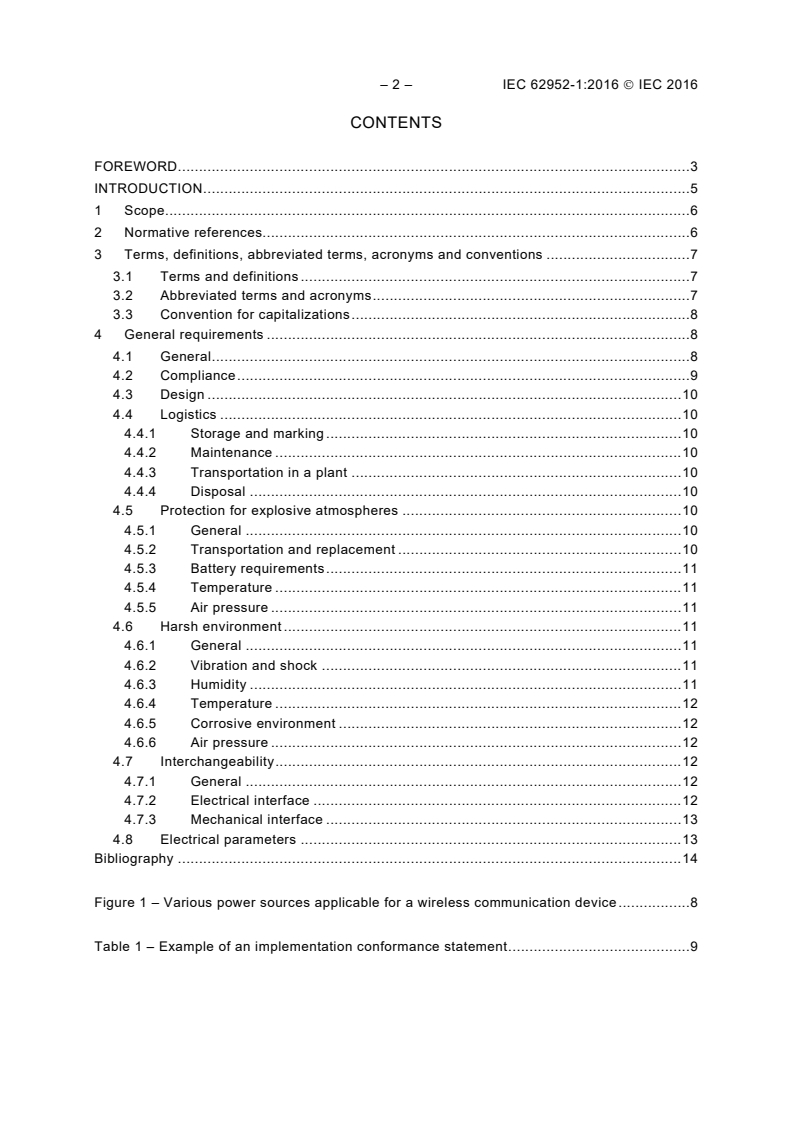
– 2 – IEC 62952-1:2016 IEC 2016
CONTENTS
FOREWORD . 3
INTRODUCTION . 5
1 Scope . 6
2 Normative references. 6
3 Terms, definitions, abbreviated terms, acronyms and conventions . 7
3.1 Terms and definitions . 7
3.2 Abbreviated terms and acronyms . 7
3.3 Convention for capitalizations . 8
4 General requirements . 8
4.1 General . 8
4.2 Compliance . 9
4.3 Design . 10
4.4 Logistics . 10
4.4.1 Storage and marking . 10
4.4.2 Maintenance . 10
4.4.3 Transportation in a plant . 10
4.4.4 Disposal . 10
4.5 Protection for explosive atmospheres . 10
4.5.1 General . 10
4.5.2 Transportation and replacement . 10
4.5.3 Battery requirements . 11
4.5.4 Temperature . 11
4.5.5 Air pressure . 11
4.6 Harsh environment . 11
4.6.1 General . 11
4.6.2 Vibration and shock . 11
4.6.3 Humidity . 11
4.6.4 Temperature . 12
4.6.5 Corrosive environment . 12
4.6.6 Air pressure . 12
4.7 Interchangeability . 12
4.7.1 General . 12
4.7.2 Electrical interface . 12
4.7.3 Mechanical interface . 13
4.8 Electrical parameters . 13
Bibliography . 14
Figure 1 – Various power sources applicable for a wireless communication device . 8
Table 1 ‒ Example of an implementation conformance statement . 9
INTERNATIONAL ELECTROTECHNICAL COMMISSION
____________
POWER SOURCES FOR A WIRELESS COMMUNICATION DEVICE –
Part 1: General requirements of power modules
FOREWORD
1) The International Electrotechnical Commission (IEC) is a worldwide organization for standardization comprising
all national electrotechnical committees (IEC National Committees). The object of IEC is to promote
international co-operation on all questions concerning standardization in the electrical and electronic fields. To
this end and in addition to other activities, IEC publishes International Standards, Technical Specifications,
Technical Reports, Publicly Available Specifications (PAS) and Guides (hereafter referred to as “IEC
Publication(s)”). Their preparation is entrusted to technical committees; any IEC National Committee interested
in the subject dealt with may participate in this preparatory work. International, governmental and non-
governmental organizations liaising with the IEC also participate in this preparation. IEC collaborates closely
with the International Organization for Standardization (ISO) in accordance with conditions determined by
agreement between the two organizations.
2) The formal decisions or agreements of IEC on technical matters express, as nearly as possible, an international
consensus of opinion on the relevant subjects since each technical committee has representation from all
interested IEC National Committees.
3) IEC Publications have the form of recommendations for international use and are accepted by IEC National
Committees in that sense. While all reasonable efforts are made to ensure that the technical content of IEC
Publications is accurate, IEC cannot be held responsible for the way in which they are used or for any
misinterpretation by any end user.
4) In order to promote international uniformity, IEC National Committees undertake to apply IEC Publications
transparently to the maximum extent possible in their national and regional publications. Any divergence
between any IEC Publication and the corresponding national or regional publication shall be clearly indicated in
the latter.
5) IEC itself does not provide any attestation of conformity. Independent certification bodies provide conformity
assessment services and, in some areas, access to IEC marks of conformity. IEC is not responsible for any
services carried out by independent certification bodies.
6) All users should ensure that they have the latest edition of this publication.
7) No liability shall attach to IEC or its directors, employees, servants or agents including individual experts and
members of its technical committees and IEC National Committees for any personal injury, property damage or
other damage of any nature whatsoever, whether direct or indirect, or for costs (including legal fees) and
expenses arising out of the publication, use of, or reliance upon, this IEC Publication or any other IEC
Publications.
8) Attention is drawn to the Normative references cited in this publication. Use of the referenced publications is
indispensable for the correct application of this publication.
9) Attention is drawn to the possibility that some of the elements of this IEC Publication may be the subject of
patent rights. IEC shall not be held responsible for identifying any or all such patent rights.
International Standard IEC 62952-1 has been prepared by subcommittee 65B: Measurement
and control devices, of IEC technical committee 65: Industrial-process measurement, control
and automation.
This International Standard is based on VDI/VDE 2185 Blatt 3.
The text of this standard is based on the following documents:
FDIS Report on voting
65B/1053/FDIS 65B/1056/RVD
Full information on the voting for the approval of this standard can be found in the report on
voting indicated in the above table.
A list of all parts of the IEC 62952 series, published under the general title Power source for a
wireless communication device, can be found on the IEC website.
– 4 – IEC 62952-1:2016 IEC 2016
This publication has been drafted in accordance with the ISO/IEC Directives, Part 2.
The committee has decided that the contents of this publication will remain unchanged until
the stability date indicated on the IEC web site under "http://webstore.iec.ch" in the data
related to the specific publication. At this date, the publication will be
• reconfirmed,
• withdrawn,
• replaced by a revised edition, or
• amended.
IMPORTANT – The 'colour inside' logo on the cover page of this publication indicates
that it contains colours which are considered to be useful for the correct
understanding of its contents. Users should therefore print this document using a
colour printer.
INTRODUCTION
Industrial wireless communication network devices like a pressure transmitter or a valve
positioner are mostly using non-copper-cable power sources. These devices are using a
power module for their power source that can contain a battery and / or an energy harvesting
element. In order to increase usability, power source of wireless sensors and actuators
require a standardized interface and harmonized requirements.
This part of IEC 62952 specifies interface and specification of power source of wireless
devices and does not specify the mechanical interface within a wireless communication
device and the power source. Additionally, energy harvesting is a key technology for power
source of wireless devices. This document also specifies interface and specification of energy
harvesting devices.
This document addresses the general requirements of power sources for wireless
communication devices.
– 6 – IEC 62952-1:2016 IEC 2016
POWER SOURCES FOR A WIRELESS COMMUNICATION DEVICE –
Part 1: General requirements of power modules
1 Scope
This part of IEC 62952 specifies the general requirements of power modules for wireless
communication devices (WCD). This document includes additional optional specifications to
permit use in explosive atmospheres and harsh environments.
This document specifies the usability over the life-cycle of a power module including replacing
in explosive atmosphere.Unreplaceable batteries such as memory backup are out of the
scope of this standard.
Secondary batteries or power modules are covered by this document, but method of its power
charging is out of scope.
2 Normative references
The following documents are referred to in the text in such a way that some or all of their
content constitutes requirements of this document. For dated references, only the edition
cited applies. For undated references, the latest edition of the referenced document (including
any amendments) applies.
IEC 60079-0:2011, Explosive atmospheres – Part 0: Equipment – General requirements
IEC 60079-11:2011, Explosive atmospheres – Part 11: Equipment protection by intrinsic
safety "i"
IEC 60086-1, Primary batteries – Part 1: General
IEC 60654-3, Operating conditions for industrial-process measurement and control
equipment – Part 3: Mechanical influences
IEC 60721-3-4:1995, Classification of environmental conditions – Part 3: Classification of
groups of environmental parameters and their severities – Section 4: Stationary use at non-
weatherprotected locations
IEC 61326 (all parts), Electrical equipment for measurement, control and laboratory use –
EMC requirements
IEC 62952-2:2016, Power sources for a wireless communication device – Part-2: Profile for
power modules with batteries
IEC 62952-3: — , Power sources for a wireless communication device – Part-3: Generic
energy harvesting adapter module
______________
Under preparation. Stage at the time of publication: IEC/CDV:2016.
3 Terms, definitions, abbreviated terms, acronyms and conventions
3.1 Terms and definitions
For the purposes of this document, the following terms and definitions apply.
ISO and IEC maintain terminological databases for use in standardization at the following
addresses:
• IEC Electropedia: available at http://www.electropedia.org/
• ISO Online browsing platform: available at http://www.iso.org/obp
3.1.1
battery
one or more cells electrically connected by permanent means, fitted in a case, with terminals,
markings and protective devices etc., as necessary for use
[SOURCE: IEC 60086-1:2015, 3.2, modified – Addition of "by permanent means".]
3.1.2
power module
stand-alone power supply element
3.1.3
power source
mechanical unit with electrical interface in order to provide power for a wireless
communication device
Note 1 to entry: A power source can contain a power module or a line powered module.
3.1.4
primary battery
battery that is not designed to be electrically recharged
[SOURCE: IEC 60086-1:2015, 3.9, modified]
3.1.5
secondary battery
battery that is designed to be electrically recharged
Note 1 to entry: The recharge is accomplished by way of a reversible chemical reaction.
[SOURCE: IEC 60050-482:2004, 482-01-03, modified – Replacement of "cell" by the term
"battery".]
3.1.6
wireless communication
communication in which electromagnetic radiations are used to transfer information without
the use of wires or optical fibers
3.2 Abbreviated terms and acronyms
For the purposes of this document, the following abbreviated terms and acronyms apply.
GEHAM Generic energy harvesting adapter module
WCD Wireless communication device
– 8 – IEC 62952-1:2016 IEC 2016
3.3 Convention for capitalizations
Capitalized terms are either based on the rules given in the ISO/IEC Directives Part 2 or
emphasize that these terms have a specific meaning throughout this series of IEC 62952.
4 General requirements
4.1 General
A WCD contains typically a sensor or an actuator or communication routing capability with a
wireless interface for example according to IEC 62601, IEC 62591, or IEC 62734. The WCD is
powered by replaceable batteries or power modules.
Figure 1 shows the possible various types of power modules that can be used as a power
source within a wireless communication device and that are specified in this series of
IEC 62952.
This document does not address the safety, fire and regulatory requirements typically
imposed on batteries and other power sources.
Power Module
Type A
Primary
or
Secondary
Alternatives
Battery
Wireless Communication Device
Power Module
Power Source
Type B
Power Module
Primary Type A,
or
Power Module
Secondary
Type B
Battery
or
Primary
GEHAM
or
Secondary
Battery
Power Module Type C
Generic Energy
Harvesting
Adapter Module
(GEHAM)
Primary or
Secondary
Battery
(Backup)
External Energy
Harvester
Power
(wired to GEHAM)
Management
IEC
Figure 1 – Various power sources applicable for a wireless communication device
NOTE The IEC 62952 series does not describe the mechanical interface within a wireless communication device
and the power source as it could be interpreted by Figure 1. The red colored elements in Figure 1 are the subject
of this IEC 62952 series and might not have identical dimension.
The Power Modules Type A, Type B and Type C are the internal energy source for the WCD.
The Power Modules Type A and Type B shall provide the capability that only batteries with
identical electro-mechanical parameters, as specified in IEC 62952-2, can be used.
IEC 62952-3 specifies requirements and profiles of Power Module Type C.”
A power module shall
• be a primary or secondary battery (Type A);
• be a mechanical unit that contains primary or secondary batteries (Type B);
• consist of generic external energy harvesting adapter module (GEHAM) and external
energy harvester (Type C).
4.2 Compliance
Claims of compliance shall clearly indicate compliance to the complete part or a subset of a
part of the IEC 62952. Part 2 and Part 3 of IEC 62952 provide tables that allow the vendor to
claim assertion of compliance to a specific clause or subclause of Part 1.
The vendor shall make an explicit claim in the conformance statement table if intrinsic safety
is supported.
An example of an Implementation conformance statement of a vendor is given in Table 1.
The conformance tables produced by the vendor shall be a copy of the conformance table
provided in the relevant profile document (for example IEC 62952-2), with the column
“Assertion” added and filled in with the description of what is implemented. This filled table
should be part of the product documentation if a claim of compliance to the referenced profile
document (for example IEC 62952-2) is made.
Table 1 ‒ Example of an implementation conformance statement
(Sub-) Header Presence Constraints Assertion
Clause
1 Scope YES Does not contain —
requirements
2 Normative references Partial — IEC 62952-3 does not
apply
3 Terms, definitions, abbreviated YES Does not contain —
terms, acronyms and requirements
conventions
4 General requirements — — —
4.1–4.4.4 — YES — —
4.5 Protection for explosive Partial — Supports Zone 1
atmospheres
4.6 Harsh environment — — —
4.6.1 General YES — —
4.6.2 Vibration and shock YES — Supports the full range
4.6.3 Humidity NO — Not supported.
4.6.4 Temperature Partial — Supports the range 10 °C
to 30 °C
4.6.5 Corrosive environment YES — Supports the full range
4.6.6 Air pressure YES — Supports the full range
4.7 Interchangeability YES —
4.8 Electrical parameters YES — —
– 10 – IEC 62952-1:2016 IEC 2016
4.3 Design
For the conceptual design of the power modules the following points shall apply.
• Anti slip-, grip-surfaces;
• Wear less or non-wearing materials for brackets and other stressed components;
• Resistant materials against material fatigue;
• Low proper weight or self-weight;
• Electrolyte emission prevention;
• Single handed use/handling (transportation and exchange including handling of the locking
device).
4.4 Logistics
4.4.1 Storage and marking
The storage conditions and marking of batteries shall be according to IEC 60086-1 (Primary
batteries), or relevant secondary battery standards.
The end user shall establish an appropriate process to handle the batteries in the power
modules. This includes the marking process of the power modules during the maintenance
process if the batteries are exchangeable.
4.4.2 Maintenance
For an easy maintenance of the power modules the following points shall apply.
• Simple assembly or disassembly under hindered/harsh conditions (darkness and badly
accessible control/ metering points);
• Exchangeability and battery handling with the use of gloves;
• No use of special tools for the entire battery exchange;
• Marking, see 4.4.1;
• Exchangeability in rain and snow;
• For an on-site inspection of the power module, a mechanism for direct measurement of
capacity or voltage shall be provided.
4.4.3 Transportation in a plant
Measures shall ensure the protection of the device from electro static discharges and short
circuits. The requirements in IEC 60086-1 about transport shall apply.
4.4.4 Disposal
It shall be easy to separate the battery from power modules without a special tool for handling
and to recycle the battery. The design should promote the ability to recycle and properly
dispose of the battery.
4.5 Protection for explosive atmospheres
4.5.1 General
Products claiming compliance for use in hazardous areas shall comply with all of the
requirements of 4.5 dependent on the selected Zone.
4.5.2 Transportation and replacement
The power module shall be according to IEC 60079-0 and IEC 60079-11:
– EPL Ga, Gb, Gc, Da, Db, or Dc as appropriate; and
– intrinsically safe, transportable and replaceable in hazardous areas.
Especially for the transportation of multiple batteries and multiple power modules the
requirements for explosion protection shall be fulfilled. For this purpose concepts shall be
defined (for example no open connections).
4.5.3 Battery requirements
IEC 60079-0:2011, Clause 23 applies and describes general requirements of batteries.
IEC 60079-11:2011, 7.4 applies and describes the requirements for intrinsically safe batteries.
IEC 60079-11:2011, 7.4 applies and is the main reference for the power module requirements.
4.5.4 Temperature
The allowed ambient temperature may be limited when using the power module in hazardous
areas due to maximum allowed surface temperature of devices according to
IEC 60079-0:2011, 5.3.2.2. The following requirements could also apply.
– The power supply module shall be classified as T4 at ambient temperature of 60 ºC at
least, in accordance with IEC 60079-0 and IEC 60079-11.
4.5.5 Air pressure
The standard atmospheric condition shall be according to IEC 60079-0, that specifies 80 kPa
to 110 kPa.
4.6 Harsh environment
4.6.1 General
The wireless communication device, which includes the power module, may be operating in a
variety of harsh environmental conditions including extreme ranges of vibration, shock,
humidity, temperature, corrosive and air pressure.
For the evaluation of the required environmental conditions the test shall be done with a
power module operating in a wireless communication device.
That does mean that all devices operating with a power module shall fulfill these conditions.
Compliance to 4.6 can be claimed to one or multiple subclauses of 4.6.
4.6.2 Vibration and shock
The power module (and its connections) shall withstand vibration and shock according to
specification of WCD. Device supplier shall assert compliant classes of vibration of
IEC 60654-3 at product documentation with the compliance statement.
4.6.3 Humidity
The power module shall be usable in humid environment in accordance with
IEC 60721-3-4:1995, Table 1, climate class 4K4H with the following range of humity.
• Relative Humidity: 4 % – 100 %, non-condensing
3 3
• Absolute Humidity: 0,9 g/m – 36 g/m
– 12 – IEC 62952-1:2016 IEC 2016
4.6.4 Temperature
IEC 60721-3-4:1995, Table 1, class 4K4H defines a temperature range of -20 °C to +50 °C,
but this is not sufficient for the majority of process applications. Therefore, the power module
shall be usable in following ambient temperatures:
• ambient temperature range -40 °C to +85 °C;
• rate of temperature change: 0,5 °C / min.
See 4.5.4 for the temperature in the explosive atmospheres.
4.6.5 Corrosive environment
The power module and the electrical contacts shall withstand corrosive atmosphere class 4C4
according to IEC 60721-3-4:1995, Table 4. Following chemicals are listed:
• Sea Salt: Salt Mist
3 3
• Sulphur Dioxide: Mean: 13 mg/m , Peak: 40 mg/m
3 3
• Hydrogen Sulphide: Mean: 4 mg/m , Peak: 70 mg/m
3 3
• Chlorine: Mean: 0,6 mg/m , Peak: 3,0 mg/m
3 3
• Hydrogen Chloride: Mean: 1,0 mg/m , Peak: 5 mg/m
3 3
• Hydrogen Fluoride: Mean: 0,1 mg/m , Peak: 2,0 mg/m
3 3
• Ammonia: Mean: 35 mg/m , Peak: 175 mg/m
3 3
• Ozone: Mean: 0,2 mg/m , Peak: 2,0 mg/m
3 3
• Nitrogen Oxides: Mean: 10 mg/m , Peak: 20 mg/m
The vendor is allowed to provide a tight enclosure to protect the contacts from the corrosive
atmosphere.
4.6.6 Air pressure
The power module shall be usable in environments with air pressure according to
IEC 60721-3-4:1995, Table 1. The following requirement could also apply.
70 kPa to 106 kPa
NOTE 1 70 kPa refers to an altitude of approximately 3 000 m.
NOTE 2 As for explosive atmospheres, IEC 60079-0 specifies 80 kPa to 110 kPa as a standard atmospheric
condition.
4.7 Interchangeability
4.7.1 General
The power module Type A or the batteries in the power module Type B respectively should be
interchangeable dependent of the WCD vendor product family. The number of types of power
module Type A or batteries in the power module Type B respectively in terms of size and
capacity should be as low as possible. The use of standardized components such as batteries
specified in IEC 60086-2 or coequal secondary batteries should be selected. The electrical
and mechanical interfaces shall be according to 4.7.2 and 4.7.3.
GEHAM should be interchangeable with the Power Modules Type A, and Type B within
particular WCD vendor. The types of GEHAMs with respect to size and electrical power shall
match the power modules according to 4.7.2 and 4.7.3.
4.7.2 Electrical interface
The electrical interface depends on the selected power module vendor.
Measure shall be incorporated to ensure the correct connection of the power module, for
example polarization.
Measure shall be incorporated to ensure protection from reverse voltage.
4.7.3 Mechanical interface
The mechanical interface depends on the selected power module vendor.
Measure shall be incorporated to e
...