

ISO/IEC 15045-2:2012
(Main)Information technology - Home electronic system (HES) gateway - Part 2: Modularity and protocol
General Information
- Abstract
ISO/IEC 15045-2:2012(E) specifies a gateway architecture that provides an interconnection between one or more Wide Area Networks (WANs) and one or more Home Area Networks (HANs). It is not needed for a "simple gateway" linking one WAN to one HAN where there is no intention of future expansion. It applies to a "distributed gateway," and is also referred to in ISO/IEC 15045-1 as the Complex Modular Gateway. Also, it specifies how separate gateways in a single house can interoperate to provide co-ordinated functions.
- Status
- Published
- Publication Date
- 04-Jul-2012
- Technical Committee
- ISO/IEC JTC 1/SC 25 - Interconnection of information technology equipment
- Drafting Committee
- WG 1 - ISO/IEC JTC 1/SC 25/WG 1
- Current Stage
- PPUB - Publication issued
- Start Date
- 05-Jul-2012
- Completion Date
- 15-Aug-2012
Overview
ISO/IEC 15045-2:2012 - "Information technology - Home electronic system (HES) gateway - Part 2: Modularity and protocol" specifies a modular gateway architecture that enables interconnection between one or more Wide Area Networks (WANs) and one or more Home Area Networks (HANs). The standard targets distributed (complex modular) gateways rather than simple single-WAN-to-single-HAN devices. It defines a common interoperability framework so separate gateways in the same residence can interoperate and provide coordinated services.
Key search terms: ISO/IEC 15045-2, HES gateway, home electronic system, modular gateway, distributed gateway, HAN, WAN, interoperability.
Key Topics and Requirements
- Gateway architecture and design philosophy - defines an architectural model for distributed HES gateways and design principles for modularity and scalability.
- Modularity requirements - specifies modular building blocks (for example WAN access module, HAN access module, and service module) and how they connect.
- Common Interoperability Framework (CIF) - conceptual process model to enable consistent interactions among modules and gateways.
- Generic Interworking Function (GIWF) - mechanism for protocol translation and interworking between heterogeneous networks and services.
- Intermediate processes and protocol stacks - generalized and special-case protocol stack models, including control and content/data planes.
- Intermediate logical bus (GL bus) and GL protocol - defines the internal bus topology and protocol layers used to interconnect modules.
- Data flows and gateway management - rules for control plane and content plane flows and for managing distributed gateway systems.
- Multi-gateway coordination - optional provisions to interconnect multiple gateways in one home to coordinate services from different providers.
Applications
ISO/IEC 15045-2 is practical for systems where multiple access technologies and home networks must interoperate. Typical application areas include:
- Entertainment (audio/video distribution across multiple HANs)
- Broadband data and internet access aggregation
- Telephony and unified communications
- Energy management and smart metering
- Healthcare monitoring and remote care
- Home security, safety monitoring and environmental control
- Appliance telemetry and lighting control
Who should use this standard
- Gateway and home-network device manufacturers
- Service providers (ISP, cable, satellite, utility) deploying residential gateways
- System integrators and solution architects designing multi-protocol home systems
- Standards developers and test labs creating interoperability profiles
- Product managers planning modular, upgradeable gateway solutions
Related Standards
- ISO/IEC 15045-1 (HES gateway - basic residential gateway model and functional requirements)
- This part (15045-2:2012) is part of the ISO/IEC 15045 series and complements other HES gateway guidance.
Adopting ISO/IEC 15045-2 helps ensure interoperable, scalable HES gateway designs that accommodate diverse WAN/HAN technologies and coordinated multi-gateway deployment in homes.
Get Certified
Connect with accredited certification bodies for this standard

BSI Group
BSI (British Standards Institution) is the business standards company that helps organizations make excellence a habit.

NYCE
Mexican standards and certification body.
Sponsored listings
Frequently Asked Questions
ISO/IEC 15045-2:2012 is a standard published by the International Electrotechnical Commission (IEC). Its full title is "Information technology - Home electronic system (HES) gateway - Part 2: Modularity and protocol". This standard covers: ISO/IEC 15045-2:2012(E) specifies a gateway architecture that provides an interconnection between one or more Wide Area Networks (WANs) and one or more Home Area Networks (HANs). It is not needed for a "simple gateway" linking one WAN to one HAN where there is no intention of future expansion. It applies to a "distributed gateway," and is also referred to in ISO/IEC 15045-1 as the Complex Modular Gateway. Also, it specifies how separate gateways in a single house can interoperate to provide co-ordinated functions.
ISO/IEC 15045-2:2012(E) specifies a gateway architecture that provides an interconnection between one or more Wide Area Networks (WANs) and one or more Home Area Networks (HANs). It is not needed for a "simple gateway" linking one WAN to one HAN where there is no intention of future expansion. It applies to a "distributed gateway," and is also referred to in ISO/IEC 15045-1 as the Complex Modular Gateway. Also, it specifies how separate gateways in a single house can interoperate to provide co-ordinated functions.
ISO/IEC 15045-2:2012 is classified under the following ICS (International Classification for Standards) categories: 35.200 - Interface and interconnection equipment. The ICS classification helps identify the subject area and facilitates finding related standards.
ISO/IEC 15045-2:2012 is available in PDF format for immediate download after purchase. The document can be added to your cart and obtained through the secure checkout process. Digital delivery ensures instant access to the complete standard document.
Standards Content (Sample)
ISO/IEC 15045-2
Edition 1.0 2012-07
INTERNATIONAL
STANDARD
colour
inside
Information technology – Home electronic system (HES) gateway –
Part 2: Modularity and protocol
All rights reserved. Unless otherwise specified, no part of this publication may be reproduced or utilized in any form
or by any means, electronic or mechanical, including photocopying and microfilm, without permission in writing from
either IEC or IEC's member National Committee in the country of the requester.
If you have any questions about ISO/IEC copyright or have an enquiry about obtaining additional rights to this
publication, please contact the address below or your local IEC member National Committee for further information.
IEC Central Office Tel.: +41 22 919 02 11
3, rue de Varembé Fax: +41 22 919 03 00
CH-1211 Geneva 20 info@iec.ch
Switzerland www.iec.ch
About the IEC
The International Electrotechnical Commission (IEC) is the leading global organization that prepares and publishes
International Standards for all electrical, electronic and related technologies.
About IEC publications
The technical content of IEC publications is kept under constant review by the IEC. Please make sure that you have the
latest edition, a corrigenda or an amendment might have been published.
Useful links:
IEC publications search - www.iec.ch/searchpub Electropedia - www.electropedia.org
The advanced search enables you to find IEC publications The world's leading online dictionary of electronic and
by a variety of criteria (reference number, text, technical electrical terms containing more than 30 000 terms and
committee,…). definitions in English and French, with equivalent terms in
It also gives information on projects, replaced and additional languages. Also known as the International
withdrawn publications. Electrotechnical Vocabulary (IEV) on-line.
IEC Just Published - webstore.iec.ch/justpublished Customer Service Centre - webstore.iec.ch/csc
Stay up to date on all new IEC publications. Just Published If you wish to give us your feedback on this publication
details all new publications released. Available on-line and or need further assistance, please contact the
also once a month by email. Customer Service Centre: csc@iec.ch.
ISO/IEC 15045-2
Edition 1.0 2012-07
INTERNATIONAL
STANDARD
colour
inside
Information technology – Home electronic system (HES) gateway –
Part 2: Modularity and protocol
INTERNATIONAL
ELECTROTECHNICAL
COMMISSION
PRICE CODE
P
ICS 35.200 ISBN 978-2-83220-190-9
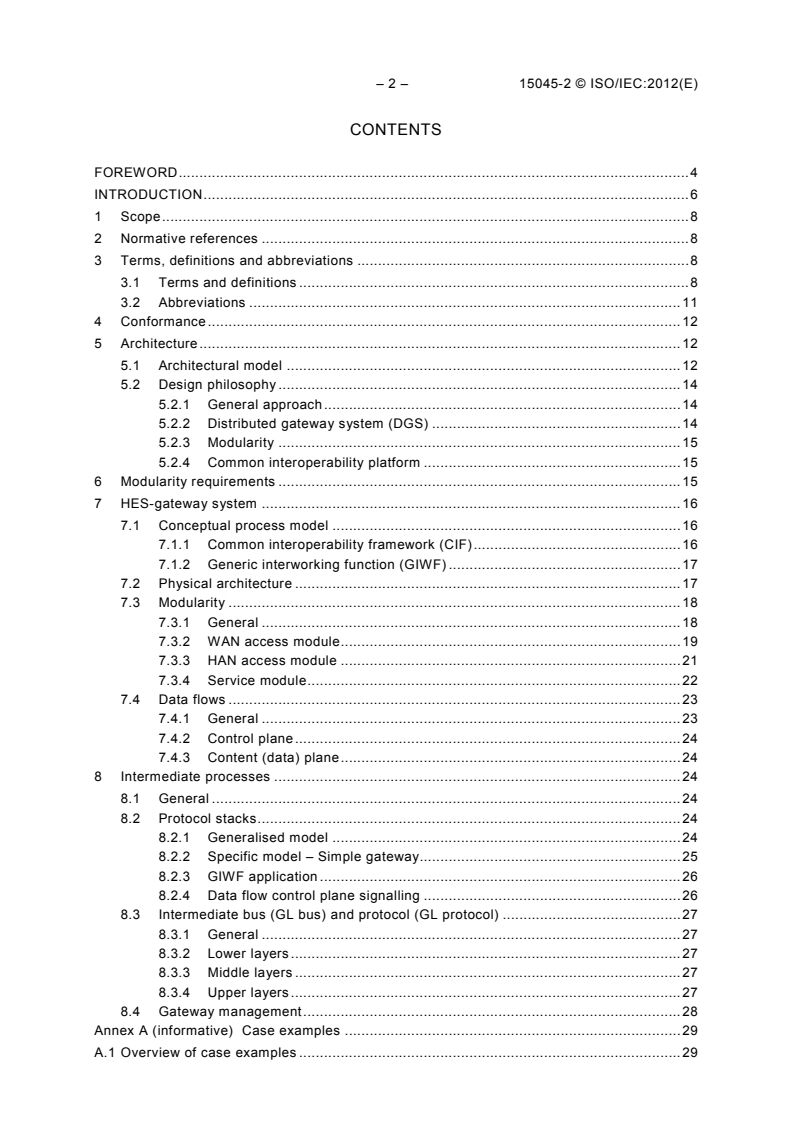
– 2 – 15045-2 © ISO/IEC:2012(E)
CONTENTS
FOREWORD . 4
INTRODUCTION . 6
1 Scope . 8
2 Normative references . 8
3 Terms, definitions and abbreviations . 8
3.1 Terms and definitions . 8
3.2 Abbreviations . 11
4 Conformance . 12
5 Architecture . 12
5.1 Architectural model . 12
5.2 Design philosophy . 14
5.2.1 General approach . 14
5.2.2 Distributed gateway system (DGS) . 14
5.2.3 Modularity . 15
5.2.4 Common interoperability platform . 15
6 Modularity requirements . 15
7 HES-gateway system . 16
7.1 Conceptual process model . 16
7.1.1 Common interoperability framework (CIF) . 16
7.1.2 Generic interworking function (GIWF) . 17
7.2 Physical architecture . 17
7.3 Modularity . 18
7.3.1 General . 18
7.3.2 WAN access module . 19
7.3.3 HAN access module . 21
7.3.4 Service module . 22
7.4 Data flows . 23
7.4.1 General . 23
7.4.2 Control plane . 24
7.4.3 Content (data) plane . 24
8 Intermediate processes . 24
8.1 General . 24
8.2 Protocol stacks . 24
8.2.1 Generalised model . 24
8.2.2 Specific model – Simple gateway. 25
8.2.3 GIWF application . 26
8.2.4 Data flow control plane signalling . 26
8.3 Intermediate bus (GL bus) and protocol (GL protocol) . 27
8.3.1 General . 27
8.3.2 Lower layers . 27
8.3.3 Middle layers . 27
8.3.4 Upper layers . 27
8.4 Gateway management . 28
Annex A (informative) Case examples . 29
A.1 Overview of case examples . 29
15045-2 © ISO/IEC:2012(E) – 3 –
A.2 VDSL scenario . 29
A.3 DBS/DSL scenario . 30
A.4 Healthcare management scenario . 31
A.5 DSL/HomePNA scenario . 31
Annex B (informative) Intermediate logical bus topologies . 33
B.1 Overview of intermediate bus topologies . 33
B.2 Mesh topology . 33
B.3 Star topology . 33
B.4 Combined mesh and star topology . 34
Annex C (informative) Distributed gateway extension methods . 35
Bibliography . 36
Figure 1 – Options for home-gateway configurations . 8
Figure 2 – Interoperating networks and domain of HES-gateway standard . 13
Figure 3 – Alternative distributed modular architectural models. 14
Figure 4 – Common interoperability framework (CIF) . 17
Figure 5 – HES-gateway architectural domains . 18
Figure 6 – HES-link module linkage model . 19
Figure 7 – WAN access module block diagram . 20
Figure 8 – HAN access module block diagram . 21
Figure 9 – Service module block diagram . 22
Figure 10 – Data flows . 23
Figure 11 – HES-gateway generalised protocol stack model . 25
Figure 12 – HES-gateway special case: simple gateway protocol stack model . 26
Figure A.1 – VDSL scenario . 29
Figure A.2 – DBS/DSL scenario . 30
Figure A.3 – Cable/DSL/energy management/ZigBee scenario . 30
Figure A.4 – Healthcare management scenario . 31
Figure A.5 – DSL/HomePNA Scenario . 31
Figure B.1 – Mesh topology . 33
Figure B.2 – Star topology . 34
Figure B.3 – Combined mesh and star topology . 34
Figure C.1 – HES-gateway GL bus extension methods . 35
– 4 – 15045-2 © ISO/IEC:2012(E)
INFORMATION TECHNOLOGY –
HOME ELECTRONIC SYSTEM (HES) GATEWAY –
Part 2: Modularity and protocol
FOREWORD
1) ISO (International Organization for Standardization) and IEC (International Electrotechnical Commission) form the
specialized system for worldwide standardization. National bodies that are members of ISO or IEC participate in
the development of International Standards. Their preparation is entrusted to technical committees; any ISO and
IEC member body interested in the subject dealt with may participate in this preparatory work. International
governmental and non-governmental organizations liaising with ISO and IEC also participate in this preparation.
2) In the field of information technology, ISO and IEC have established a joint technical committee, ISO/IEC JTC 1.
Draft International Standards adopted by the joint technical committee are circulated to national bodies for voting.
Publication as an International Standard requires approval by at least 75 % of the national bodies casting a vote.
3) The formal decisions or agreements of IEC and ISO on technical matters express, as nearly as possible, an
international consensus of opinion on the relevant subjects since each technical committee has representation
from all interested IEC and ISO member bodies.
4) IEC, ISO and ISO/IEC publications have the form of recommendations for international use and are accepted
by IEC and ISO member bodies in that sense. While all reasonable efforts are made to ensure that the
technical content of IEC, ISO and ISO/IEC publications is accurate, IEC or ISO cannot be held responsible for
the way in which they are used or for any misinterpretation by any end user.
5) In order to promote international uniformity, IEC and ISO member bodies undertake to apply IEC, ISO and
ISO/IEC publications transparently to the maximum extent possible in their national and regional publications.
Any divergence between any ISO/IEC publication and the corresponding national or regional publication
should be clearly indicated in the latter.
6) ISO and IEC provide no marking procedure to indicate their approval and cannot be rendered responsible for
any equipment declared to be in conformity with an ISO/IEC publication.
7) All users should ensure that they have the latest edition of this publication.
8) No liability shall attach to IEC or ISO or its directors, employees, servants or agents including individual experts
and members of their technical committees and IEC or ISO member bodies for any personal injury, property
damage or other damage of any nature whatsoever, whether direct or indirect, or for costs (including legal fees)
and expenses arising out of the publication of, use of, or reliance upon, this ISO/IEC publication or any other IEC,
ISO or ISO/IEC publications.
9) Attention is drawn to the normative references cited in this publication. Use of the referenced publications is
indispensable for the correct application of this publication.
10) Attention is drawn to the possibility that some of the elements of this International Standard may be the subject of
patent rights. ISO and IEC shall not be held responsible for identifying any or all such patent rights.
International Standard ISO/IEC 15045-2 was prepared by subcommittee 25: Interconnection
of information technology equipment, of ISO/IEC joint technical committee 1: Information
technology.
The list of all currently available parts of the ISO/IEC 15045 series, under the general title
Information technology – Home electronic system (HES) gateway, can be found on the IEC
web site.
This International Standard has been approved by vote of the member bodies, and the voting
results may be obtained from the address given on the second title page.
15045-2 © ISO/IEC:2012(E) – 5 –
This publication has been drafted in accordance with the ISO/IEC Directives, Part 2.
IMPORTANT – The 'colour inside' logo on the cover page of this publication indicates
that it contains colours which are considered to be useful for the correct
understanding of its contents. Users should therefore print this document using a
colour printer.
– 6 – 15045-2 © ISO/IEC:2012(E)
INTRODUCTION
As the market has developed for home systems, the number of communications protocols for
home networks and for access to the home has increased. This has occurred even while
ISO/IEC standards for these networks have been developed and published. Continuing
technological progress also suggests that such proliferation will persist, and that no single
technology or standard is likely to prevail.
Therefore, standards to enable interoperability among applications implemented on
incompatible networks are being written. This standard addresses the gateway, which
provides an interconnection between an access network (a wide area network) and one or
more home networks (home area networks).
This standard is part of a series of standards and technical reports for the Home Electronic
System (HES) that deal with the topic of control and communication networks in homes and
small buildings. ISO/IEC 15045-1, published in 2004, defines a basic model of the residential
gateway, including functional requirements.
This standard defines a common framework for implementing gateway platforms to achieve
interconnection and interoperability of home system products and applications. The objective
is to support products from any manufacturer or provider in a manner that is safe, reliable,
predictable and consistent. Service providers such as cable TV companies, Internet service
providers and telephone companies are each installing a gateway to deliver digital data and
audio/video streams, therefore some houses contain multiple gateways. As a consequence,
an optional feature of this standard specifies how to interconnect multiple gateways in one
house so that these gateways can co-ordinate service offerings.
A communications gateway provides an interconnection between a wide area network (WAN)
and local area network (LAN) where the protocols on each network differ. The gateway is
responsible for protocol translation of signals, message formats and timing. The home
systems industry has adapted LAN technology for Home Area Networks (HANs). Ideally, each
home system would be based on one HAN and all attached devices and appliances would use
one communications protocol. In reality, multiple incompatible HAN technologies are being
marketed. Also, each service provider is installing a separate gateway (e.g., DSL, cable
broadband and satellite). Therefore, it is possible that a user will purchase and install
products employing two (or more) dissimilar HANs within the same premises. These HANs
may be connected to WANs via separate incompatible gateways. However, the user expects
these products and networks to behave as if they were the same logical network in order to
deliver home services, such as:
• entertainment (audio/video);
• data/internet access;
• communication (telephony);
• energy management;
• health care and monitoring;
• environmental control (heating and cooling);
• security and safety monitoring;
• appliance telemetry;
• lighting control.
This standard accomplishes interoperability by specifying a modular architecture and set of
protocols for interconnecting the modular elements with a common signalling bus. It relies on
a common intermediate language to achieve interoperability among applications called the
Common Interoperability Framework (HES-CIF), described in this standard. Parts of
ISO/IEC 18012 define the network-specific interworking functions needed to provide
conforming products.
15045-2 © ISO/IEC:2012(E) – 7 –
This International Standard defines a universal gateway system by specifying interfaces
between
• standalone local/Home Area Networks (HANs) and connected devices,
• multiple implementations of local/home area networks (HANs) and connected devices,
• Wide Area Networks (WANs) (also known as access networks) and applications connected
to Home Area Networks (HANs) and connected devices.
This standard establishes a framework for implementation of a general-purpose
interoperability platform or “translator” among home area networks or between wide area
networks and home area networks. It represents one approach to implementation of the
interoperability standard ISO/IEC 18012. This standard does not attempt to specify a central
controller or control system; and does not attempt to improve or resolve disparities or
shortcomings among transmission technologies, protocols, or application languages.
However, this standard does provide the premises with a platform for supporting any number
of specific services and supporting fundamental elements of consumer security (i.e., firewall
services), safety and privacy.
This standard is not a design for a specific gateway, but rather it offers an architecture, and
therefore it is necessarily abstract. However, this standard is relevant for many commercial
gateway configurations. Examples of such implementations are included for information in
Annex A.
Summing up, this standard shows how to build a gateway out of modular building blocks. This
International Standard does not describe or specify gateway applications, service
requirements, network topologies, or how gateways are to be applied within home networks
and systems. These specifications are left to other home gateway-related standards.
– 8 – 15045-2 © ISO/IEC:2012(E)
INFORMATION TECHNOLOGY –
HOME ELECTRONIC SYSTEM (HES) GATEWAY –
Part 2: Modularity and protocol
1 Scope
This part of ISO/IEC 15045 specifies a gateway architecture that provides an interconnection
between one or more Wide Area Networks (WANs) and one or more Home Area Networks
(HANs). This standard is not needed for a “simple gateway” linking one WAN to one HAN
where there is no intention of future expansion, as illustrated in Figure 1. The scope of this
standard applies to a “distributed gateway,” as illustrated in Figure 1 and is also referred to in
ISO/IEC 15045-1 as the Complex Modular Gateway. Also, this standard specifies how
separate gateways in a single house can interoperate to provide co-ordinated functions.
WAN 1
HAN 1
Gateway
WAN HAN
Gateway
WAN 2 HAN 2
Gateway
WAN 3 HAN 3
Gateway
Simple gateway Distributed gateway
Figure 1 – Options for home-gateway configurations
2 Normative references
The following documents, in whole or in part, are normatively referenced in this document and
are indispensable for its application. For dated references, only the edition cited applies. For
undated references, the latest edition of the referenced document (including any
amendments) applies.
ISO/IEC 18012-2:—, Information technology – Home electronic system (HES) – Guidelines for
product interoperability – Part 2: Taxonomy and application interoperability model
3 Terms, definitions and abbreviations
3.1 Terms and definitions
For the purposes of this document, the following terms and definitions apply.
___________
To be published.
15045-2 © ISO/IEC:2012(E) – 9 –
3.1.1
appliance
apparatus intended for household or similar use
[SOURCE: IEC 60050-151:2001, 151-11-23]
Note 1 to entry: For example a clothes washer, water heater, television, inverter, etc.
3.1.2
bridge
interface between dissimilar lower layer networks
Note 1 to entry: A bridge may provide services at layer 1 (physical layer) or layer 2 (data link layer).
3.1.3
bus
common or shared communication path or highway
Note 1 to entry: A bus is a means of interconnecting devices under a single administration, such as a LAN
comprising devices sharing a common set of pathways.
Note 2 to entry: A distinction may be drawn between “logical” and “physical” buses when bus topologies are
considered.
3.1.4
common interoperability framework
CIF
abstract intermediate language expressions for tranlating HAN or WAN-specifid messages
Note 1 to entry: A common interoperability framework includes
a) an HES-AIL (Abstract Intermediate Language) and
b) a set of network-specific Generic Interworking Function (GIWF) processes to express (i.e., translate) any
message to or from any specific HAN or WAN message
3.1.5
compatibility
ability of two or more networks within a premises to be mutually tolerant and that do not
interfere with one another
Note 1 to entry: The networks are co-existent, but they are not necessarily interoperable.
3.1.6
component
logical subunit of a larger, encompassing concept
Note 1 to entry: For example, the concept of interoperability is subdivided into constituent components such as
safety, management and operation. These constituent components are further subdivided within their respective
sections. In the context of the HES-gateway, the term component is also used to refer to logical subunits of system
architecture concepts, such as the components of a networking implementation (e.g., addressing).
3.1.7
device
distinct physical unit on a network
Note 1 to entry: A device can either be an end node on the network, or an intermediate node (as in the case of a
gateway, router, or bridge device connecting two distinct physical networks).
3.1.8
distributed gateway
HES-gateway implemented as separate but interconnected modular elements
– 10 – 15045-2 © ISO/IEC:2012(E)
3.1.9
gateway
interface between dissimilar networks
Note 1 to entry: A gateway may provide services up to OSI layer seven and above.
Note 2 to entry: The HES-gateway provides protocol and language translation services above layer seven.
3.1.10
gateway link
GL
full seven-layer protocol stack and the physical bus internal to and specific to the HES-
gateway architecture to connect GL modules
Note 1 to entry: The GL is used to communicate the HES-AIL encoded messages (resulting from the GIWF
translation process) between HES-link modules and is not intended to link to end user devices. It is a link in the
sense that it transports messages within, or native to, the CIF (i.e., GL and HES-AIL). The GL may also be referred
to as the "HES-link".
3.1.11
generic interworking function
GIWF
translation function between a specific home network application language and the HES-AIL
(Abstract Intermediate Language) used within the HES-gateway system
3.1.12
HES abstract intermediate language
AIL
language to represent or express the messages of any HAN or WAN
Note 1 to entry: AIL is an intermediate HES-gateway-oriented application language that includes a syntactic
structure and semantic definitions comprising a lexicon of terms including objects and methods (actions).
3.1.13
HES-gateway
gateway conforming to ISO/IEC 15045-2
Note 1 to entry: The HES-gateway provides protocol and language translation services above layer seven in
conformance with this standard.
3.1.14
HES-link module
device that provides the required services for one of the networks of the HES-gateway system
Note 1 to entry: In the context of this standard, the HES-link module provides protocol and language translation
services above layer seven and provides an interface to the GL for purposes of connecting by the GL to one or
more other HES-link modules serving other networks. Two or more HES-link modules, connected together via a GL,
comprise a gateway.
3.1.15
home area network
HAN
network specifically serving nodes, devices, components and functions within a home or
premises
3.1.16
home electronic system
HES
collection of devices and components operating within the home and interconnected over one
or more networks, and within which such devices and networks are compatible and
interoperable according to various ISO/IEC standards
15045-2 © ISO/IEC:2012(E) – 11 –
3.1.17
interface module
HES-link module that provides an interface to a particular HAN or WAN network
3.1.18
interoperability
ability of logical entities to function together for applications on a network or between multiple
networks
3.1.19
management information base
MIB
memory function in some portion of the gateway that stores information useful for various
network management functions
Note 1 to entry: No relationship is implied here with Simple Network Management Protocol (SNMP) from which
the term "MIB" is borrowed.
3.1.20
network
distinct interconnection or set of nodes or devices that share a common communication
protocol and are mutually compatible and interoperable
3.1.21
object
program or unit of software functionality
Note 1 to entry: This definition is similar to that traditionally used in object-oriented programming.
[SOURCE: ISO/IEC 18012-2:– , 3.1.27]
3.1.22
product
device or network of devices that may be purchased to make up a home electronic system
3.1.23
router
interface between dissimilar middle layer networks
Note 1 to entry: A router may provide services at layer 2 (data link layer) or layer 3 (network layer).
3.1.24
service module
HES-link module that provides a specific service or process for the home that requires access
to one or more networks available to the HES gateway
3.2 Abbreviations
AAA Authentication, Authorization and Accounting
ATM Asynchronous Transfer Mode
CIF Common Interoperability Framework (as specified in 3.1.4)
DBS Direct Broadcast Satellite
DDS Data Distribution Service
DG Distributed Gateway
DGS Distributed Gateway System
DSL Digital Subscriber Line
GIWF Generic InterWorking Function
___________
ISO/IEC 18012-2 is planned to be published together with ISO/IEC 15045-2.
– 12 – 15045-2 © ISO/IEC:2012(E)
GL Gateway Link
HAN Home Area Network
HES Home Electronic System
HES-AIL Home Electronic System - Abstract Intermediate Language
IP Internet Protocol
IP Sec IP security
MIB Management Information Base
OMG Object Management Group
OSI Open Systems Interconnection
PLC PowerLine Carrier
PNA Phone Network Alliance
POTS Plain Old Telephone Service (analogue voice)
RTPS Real-Time Publish-Subscribe
SAR Segmentation And Re-assembly (of ATM packets)
SNMP Simple Network Management Protocol
TLS Transport Layer Security
USB Universal Serial Bus
VDSL Very high speed DSL
WAN Wide Area Network
4 Conformance
An HES gateway conforming to this standard shall implement the following elements in
accordance with the requirements of the indicated clauses of this standard:
• HES-link modules shall conform to the modular architecture described in Clause 6;
• HES-link modules shall implement GL bus interfaces conforming to the requirements
identified in 8.3.
• HES-link modules shall implement the GIWF in the manner specified in 7.1.2.
As described in the scope, this standard is not intended to apply to the non-modular “simple
gateway” situation where no future expansion is planned (i.e., no future connection to
additional WANs or HANs).
5 Architecture
5.1 Architectural model
ISO/IEC 15045-1 specifies the functional requirements and basic framework for the residential
gateway. This standard specifies the modular architecture, the interconnection of the modules
(employing intermediate busses or HES-links) and the overall structural, functional and
signalling requirements for interconnecting communications networks inside and outside the
house. These specifications describe the network interfaces as a design philosophy for a
universal gateway system interconnecting the networks in a manner that allows them to
interoperate without modification.
The architecture described here allows interconnection of multiple residential gateways,
where more than one may be installed in various locations within a home. These gateways
may be installed separately by various service providers. An optional feature of this standard
specifies how these gateways may exchange messages and function as a single gateway. In
other words, this standard anticipates two possible situations, as follows.
a) Simple gateway – one WAN connected to one HAN.
b) Distributed gateway – one or more interconnected gateways operating as one entity.
In case a) and if no of future expansion is planned, this standard need not apply. This
standard is only intended to apply to case b).
15045-2 © ISO/IEC:2012(E) – 13 –
This standard defines a gateway system of modular expandability employing a set of HES-link
modules. Each WAN and HAN connected to a distributed gateway should include an interface,
known as an HES-link module, that conforms to this standard, as shown in Figure 2.
Domain of HES-gateway
GL (Gateway link)
WAN a WAN b HAN c HAN d App’n x App’n y
Interface Interface Interface Interface Service Service
module module module module module module
WAN a WAN b HAN c HAN d Service x Service y
Service modules
Interface modules
Figure 2 – Interoperating networks and domain of HES-gateway standard
This standard provides an open, modular and expandable framework for the delivery of
services to the consumer that can accommodate diverse networks on both the HAN and WAN
side. The gateway may also provide a place to situate firewall functions that will protect the
autonomy, safety, privacy and security of the consumer, yet enable trusted relationships with
preferred service providers. The basic functionality of the HES-gateway system is shown in
Figure 2.
This standard provides a design guideline to create products that can offer interoperable
gateway functionalities. It describes all layers (or stacks) of the intermediate protocol, known
as the gateway link (GL) protocol, needed to interconnect an interoperable array of HES-Link
Modules, which consist of specific WAN Interface Modules, HAN Interface Modules and
specific Service Modules. Required layers of specific WAN or HAN protocols are not
specified, but are left entirely to the product manufacturer. The GL and other HAN/WAN
protocol stacks implement a Common Interoperability Framework (CIF) described in 7.1.1.
Such CIF includes generic interworking functions (GIWF) that reside above layer seven, (i.e.,
above the application layer of the ISO reference model, ISO 7498), and interfaces to the
HAN/WAN protocol stacks.
The HES-gateway system is intended to provide interconnection and interoperability
• where two or more dissimilar HANs are installed or implemented in a premises,
• where two or more dissimilar HANs are required to interoperate or interwork in a premises
or
• where a product acts as a bridge, router, gateway or residential gateway between two or
more dissimilar HANs, or between at least one WAN and at least one HAN, in a premises.
The HES-gateway architectural model is modular in concept, for purposes of definition and
conformity assessment. However, implementation is left to the choice of manufacturers.
Alternative distributed architectural models are depicted in Figure 3. In this figure, "W" and
"H" represent WAN and HAN HES-link modules, respectively. Methods of implementing these
alternative models are further described in Annex C. The distributed system may be thought
of as simply a combination of smaller centralised systems. These alternative architectural
models are referred to in ISO/IEC 15045-1 as the “complex modular implementation”.
– 14 – 15045-2 © ISO/IEC:2012(E)
H H W H b H a
H H
W
Distributed HES-gateway basic
configuration
H
H a
W H H b
Distributed HES-gateway alternative
configuration
Figure 3 – Alternative distributed modular architectural models
5.2 Design philosophy
5.2.1 General approach
Conventional gateways, e.g. set-top box designs, generally take a “one-size-fits-all” approach
tailored to some defined set of services on both the HAN and WAN side. In the quest for low
cost and economies of scale in manufacturing, modularity and expandability are sacrificed,
along with flexibility that service providers frequently need. Often, the result is a "big box" that
tries to accommodate many functions and services, yet frequently fails to provide the key
features that are most needed in any particular situation. These big boxes are frequently
designed around a powerful central processor and operating system.
5.2.2 Distributed gateway system (DGS)
This standard is based on a model, the distributed gateway system (DGS) that seeks to
design around the minimum feasible functional unit, rather than the maximum. There is no
requirement for a central processor or controller in a DGS.
NOTE For example, the most generalised implementation of the DGS would use a distributed computing model
consisting of a network of semi-autonomous interfaces and agents running in dedicated embedded microcomputers
situated on individual modules (e.g., circuit cards) and interconnected by a “backplane.” Multiple backplane units
could be linked together to form a single logical backplane. Each module may be associated with a single HAN or
WAN. This modularity is similar to the "blade server" architecture employed in the commercial computing
environment.
Much like the design of the Internet, the HES-gateway seeks simplicity by separating content
and application from transport and delivery. Such separation moves as much “intelligence” as
possible out of the gateway. Applications and services reside on the periphery of the gateway
(i.e., on the respective HANs and WANs or on service modules) where they can grow and
develop in directions not dependent on the gateway itself.
The HES-gateway system design seeks to minimise the information or knowledge that the
gateway needs about the products and services residing on each network. Therefore the
semantics are transposed from one product/service domain to another by applying the
interoperability taxonomy principles described in Clause 7 of 18012-2 of and the object
schema described in Clause 8 of ISO/IEC 18012-2. This architecture provides a measure of
“future-proofing” by employing intermediate bus and protocol or language elements that are
layered and upward compatible with future additions or changes. For example, the language
15045-2 © ISO/IEC:2012(E) – 15 –
elements may be defined and contained in a metadata registry that can be continuously
updated and accessed by product developers. In this case, protocol stacks for an expanding
list of WAN and HAN protocols may be maintained in an open-source library that is also
available to developers. Such a metadata registry will be specified in subsequent parts of this
standard.
5.2.3 Modularity
The interface to each HAN or WAN might be hosted in a variety of HES-gateway
configurations. These HAN and WAN modules might be housed in a common gateway chassis
or in multiple gateway chassis that may be directly interconnected over a network. This
system of modules is self-configuring and should be “hot-pluggable” so a module may be
added or removed while the others are operating. This approach is roughly analogous to the
“blade server” architecture widely employed in the commercial networking industry. In more
specialised implementations, although the modules might be combined and the intermediate
protocol and bus might be collapsed, the principle of modularity at the CIF level shall be
preserved.
Modularity in the HES-gateway system represents, more importantly, a functional division
rather than a physical one. The main principle is to provide a functional structure within which
the CIF can live. In terms of physical realisation, the entire gateway could end up as a single
piece of silicon, that choice is up to manufacturers and the specific set of services they may
wish to support (e.g., in the simple gateway, the intermediate bus and protocol are completely
collapsed). The modular architecture is simply a framework. The HES-link module and the
simple gateway concepts are introduced in order to clarify this concept.
NOTE In other words, the HES-gateway does not have to be manufactured in a modular fashion, however, it
should be DEFINED here within a modular framework so that CIF operates. This is because the CIF itself is a
modular concept. Conformity is assessable by the interchange of modules or by the passing of CIF messages at
the modular interface.
In any case (see above), implementations of HES-link modules compliant with this standard
shall conform to the modular architecture as specified in Clause 6.
5.2.4 Common interoperability platform
The HES-gateway accommodates the conventional (simple) gateway (one WAN and one
HAN) as a specific case, within a generally defined DGS architectural framework. The DGS is
a modular architecture that supports multiple WANs, HANs and services, and provides a
platform for implementing the CIF described in 7.1.1. It imposes no specific requirements on
implementations, although complying with it implies a certain specific choice of modularity that
preserves the integrity of the CIF. With respect to protocols and communications services, the
DGS model provides a structure that is analogous to the OSI reference model for
communications (ISO 7498). In both cases, a specific implementation is not required to
include every element (layer) of the reference model.
In any case (see above), implementations of HES-gateway modules compliant with this
standard shall conform to the modular architecture specified here, including conformance with
ISO/IEC 18012-2.
6 Modularity requirements
The basic function of the HES gateway is to translate messages between networks that use
different communication protocols and/or application languages. This translation is
accomplished by the Common Interoperability Framework (HES-CIF). Each message shall be
translated into a common intermediate language, the HES Abstract Intermediate Language
(HES-AIL) described in 7.2 of ISO/IEC 18012-2 as application domain. The translation
process in the HES gateway is performed by a network-specific Generic Interworking Function
(GIWF) specified in 7.1.2. In the case of the DGS where modules (HES-link modules) are
– 16 – 15045-2 © ISO/IEC:2012(E)
physically distributed on an HES-gateway intermediate bus or GL (gateway link), then the
translated message may be transported via the GL protocol to the receiving GIWF, which then
translates it into the language and protocol of the target network. The GL thus accommodates
multiple WANs and HANs without requiring separate translators for each possible combination
of networks (e.g., WAN and HAN, or HAN and HAN). A “simple gateway”, linking one WAN
and one HAN, may incorporate the dual translation process without using the GL, and lies
outside of the scope of this standard.
In the most generalised implementation of the HES distributed gateway system, network
interoperability shall be achieved by a dedicated interface module for each network, known as
a HES-link module, that provides a GIWF linking this network to an abstract HES common
interoperability system, comprising an abstract intermediate language and (AIL) and
intermediate protocol (GL protocol). Alternatively, specific appliances may incorporate such
GIWF and AIL/GL interface functions (examples on reference models are provided in
Annex A).
NOTE An optional specialised implementation such as the simple gateway (i.e., see A.2.6.2 of
ISO/IEC 15045-1:2004) may combine modules into a single unit and collapse the intermediate GL bus entirely, and
lies outside the scope of this standard.
Each module may be visualised as a HES-link module connected with an intermediate
protocol and GL bus. This bus need not be confined to a common chassis, but could be
extended throughout the premises using an appropriate bus technolo
...