

IEC 60079-25:2020
(Main)Explosive atmospheres - Part 25: Intrinsically safe electrical systems
General Information
- Abstract
IEC 60079-25:2020 contains the specific requirements for design, construction and assessment of intrinsically safe systems, Type of Protection “i”, intended for use, as a whole or in part, in locations in which the use of Group I, II or III Ex Equipment is required. This document supplements and modifies the general requirements of IEC 60079-0 and the intrinsic safety standard IEC 60079-11. Where a requirement of this standard conflicts with a requirement of IEC 60079-0 or IEC 60079-11, the requirement of this standard takes precedence. The installation requirements of Group II or Group III systems designed in accordance with this standard are specified in IEC 60079-14. This third edition cancels and replaces the second edition published in 2010 and constitutes a technical revision. The contents of the corrigendum 1 of October 2020 and corrigendum 2 of November 2022 have been included in this copy.
- Status
- Published
- Publication Date
- 24-Sep-2025
- Technical Committee
- SC 31G - Intrinsically-safe apparatus
- Drafting Committee
- MT 60079-25 - TC 31/SC 31G/MT 60079-25
- Current Stage
- PPUB - Publication issued
- Start Date
- 26-Jun-2020
- Completion Date
- 19-Jun-2020
Buy Documents
IEC 60079-25:2020+AMD1:2025 CSV - Explosive atmospheres - Part 25: Intrinsically safe electrical systems Released:9/25/2025
IEC 60079-25:2020 - Explosive atmospheres - Part 25: Intrinsically safe electrical systems Released:6/26/2020
Overview
IEC 60079-25:2020 (with Amendment 1 consolidated) specifies the design, construction and assessment of intrinsically safe electrical systems (Type of Protection “i”) intended for use in locations requiring Group I, II or III explosion-protected equipment. This edition supersedes the 2010 edition, incorporates corrigenda and technical revision material, and takes precedence where it conflicts with IEC 60079-0 or IEC 60079-11. Installation requirements for Group II/III systems designed to this standard are given in IEC 60079-14.
Key topics and requirements
- Scope and applicability: Systems intended for explosive atmospheres in mining (Group I), surface industries (Group II) and combustible dust environments (Group III).
- Levels of protection: Definitions and requirements for ia, ib and ic intrinsic safety levels.
- System documentation: Requirement for a descriptive system document that records system parameters, limitations and interconnections.
- Cable and wiring rules: Guidance for interconnecting wiring, single- and multi-circuit cables, dielectric strength, screens and defined Type A/B/C cable classifications.
- Assessment methods: Procedures for assessing systems containing apparatus certified to IEC 60079-11 and apparatus not separately evaluated; methods for single and multiple power-source systems.
- Electrical parameters: Assessment and verification of capacitance, inductance, L/R, and inductive parameters; adjustments for unspecified parameters and combined lumped effects.
- Enclosures, earthing and bonding: Requirements for enclosures and grounding practices specific to intrinsically safe systems.
- Fault conditions and testing: Assessment of faults in multi‑circuit cables, type verifications and type tests.
- Predefined/recognized systems and schemes: Normative/informative annexes covering FISCO, 2‑WISE, simple apparatus use, predefined systems and worked examples for system verification.
Practical applications and users
Who uses IEC 60079-25:
- Design engineers and system integrators developing intrinsically safe control systems and fieldbus networks.
- Manufacturers of intrinsically safe apparatus and multicore cables.
- Certification bodies and notified testing labs performing system assessments and type tests.
- Installation/maintenance personnel and safety engineers in hazardous industries.
Typical industries and applications:
- Oil & gas, petrochemical and chemical plants; mining and tunnelling (Group I); grain handling, pharmaceuticals and food processing where combustible dust (Group III) is present; process control, instrumentation and field communication networks requiring intrinsic safety.
Related standards
- IEC 60079-0 - General requirements for explosive atmospheres
- IEC 60079-11 - Intrinsic safety “i” for apparatus
- IEC 60079-14 - Installation requirements for electrical installations in explosive atmospheres
- IEC Electropedia - terminology reference
Keywords: IEC 60079-25:2020, intrinsically safe, explosive atmospheres, intrinsic safety, Type of Protection i, FISCO, 2‑WISE, Group I II III, IEC 60079-11, IEC 60079-14.
Relations
- Effective Date
- 11-Mar-2026
- Effective Date
- 10-Feb-2026
- Effective Date
- 09-Feb-2026
- Effective Date
- 09-Feb-2026
- Effective Date
- 12-Jan-2024
- Effective Date
- 05-Sep-2023
- Effective Date
- 05-Sep-2023
- Effective Date
- 05-Sep-2023
- Effective Date
- 05-Sep-2023
Buy Documents
IEC 60079-25:2020+AMD1:2025 CSV - Explosive atmospheres - Part 25: Intrinsically safe electrical systems Released:9/25/2025
IEC 60079-25:2020 - Explosive atmospheres - Part 25: Intrinsically safe electrical systems Released:6/26/2020
Get Certified
Connect with accredited certification bodies for this standard

IMQ S.p.A. (Certification)
Italian electrical product certification.

SLG Prüf- und Zertifizierungs GmbH
German testing and certification body.

UL Solutions
Global safety science company with testing, inspection and certification.
Sponsored listings
Frequently Asked Questions
IEC 60079-25:2020 is a standard published by the International Electrotechnical Commission (IEC). Its full title is "Explosive atmospheres - Part 25: Intrinsically safe electrical systems". This standard covers: IEC 60079-25:2020 contains the specific requirements for design, construction and assessment of intrinsically safe systems, Type of Protection “i”, intended for use, as a whole or in part, in locations in which the use of Group I, II or III Ex Equipment is required. This document supplements and modifies the general requirements of IEC 60079-0 and the intrinsic safety standard IEC 60079-11. Where a requirement of this standard conflicts with a requirement of IEC 60079-0 or IEC 60079-11, the requirement of this standard takes precedence. The installation requirements of Group II or Group III systems designed in accordance with this standard are specified in IEC 60079-14. This third edition cancels and replaces the second edition published in 2010 and constitutes a technical revision. The contents of the corrigendum 1 of October 2020 and corrigendum 2 of November 2022 have been included in this copy.
IEC 60079-25:2020 contains the specific requirements for design, construction and assessment of intrinsically safe systems, Type of Protection “i”, intended for use, as a whole or in part, in locations in which the use of Group I, II or III Ex Equipment is required. This document supplements and modifies the general requirements of IEC 60079-0 and the intrinsic safety standard IEC 60079-11. Where a requirement of this standard conflicts with a requirement of IEC 60079-0 or IEC 60079-11, the requirement of this standard takes precedence. The installation requirements of Group II or Group III systems designed in accordance with this standard are specified in IEC 60079-14. This third edition cancels and replaces the second edition published in 2010 and constitutes a technical revision. The contents of the corrigendum 1 of October 2020 and corrigendum 2 of November 2022 have been included in this copy.
IEC 60079-25:2020 is classified under the following ICS (International Classification for Standards) categories: 29.260.20 - Electrical apparatus for explosive atmospheres. The ICS classification helps identify the subject area and facilitates finding related standards.
IEC 60079-25:2020 has the following relationships with other standards: It is inter standard links to EN ISO 16923:2026, EN 61800-2:2015, EN ISO 12643-1:2023, EN ISO 20257-1:2020, IEC 60079-25:2020/AMD1:2025, IEC 60079-25:2020/COR2:2022, IEC 60079-25:2020/COR1:2020, IEC 60079-25:2010, IEC 60079-25:2010/ISH1:2023. Understanding these relationships helps ensure you are using the most current and applicable version of the standard.
IEC 60079-25:2020 is available in PDF format for immediate download after purchase. The document can be added to your cart and obtained through the secure checkout process. Digital delivery ensures instant access to the complete standard document.
Standards Content (Sample)
IEC 60079-25 ®
Edition 3.1 2025-09
INTERNATIONAL
STANDARD
CONSOLIDATED VERSION
Explosive atmospheres -
Part 25: Intrinsically safe electrical systems
ICS 29.260.20 ISBN 978-2-8327-0750-0
All rights reserved. Unless otherwise specified, no part of this publication may be reproduced or utilized in any form or
by any means, electronic or mechanical, including photocopying and microfilm, without permission in writing from either
IEC or IEC's member National Committee in the country of the requester. If you have any questions about IEC copyright
or have an enquiry about obtaining additional rights to this publication, please contact the address below or your local
IEC member National Committee for further information.
IEC Secretariat Tel.: +41 22 919 02 11
3, rue de Varembé info@iec.ch
CH-1211 Geneva 20 www.iec.ch
Switzerland
About the IEC
The International Electrotechnical Commission (IEC) is the leading global organization that prepares and publishes
International Standards for all electrical, electronic and related technologies.
About IEC publications
The technical content of IEC publications is kept under constant review by the IEC. Please make sure that you have the
latest edition, a corrigendum or an amendment might have been published.
IEC publications search - IEC Products & Services Portal - products.iec.ch
webstore.iec.ch/advsearchform Discover our powerful search engine and read freely all the
The advanced search enables to find IEC publications by a publications previews, graphical symbols and the glossary.
variety of criteria (reference number, text, technical With a subscription you will always have access to up to date
committee, …). It also gives information on projects, content tailored to your needs.
replaced and withdrawn publications.
Electropedia - www.electropedia.org
The world's leading online dictionary on electrotechnology,
IEC Just Published - webstore.iec.ch/justpublished
Stay up to date on all new IEC publications. Just Published containing more than 22 500 terminological entries in English
details all new publications released. Available online and and French, with equivalent terms in 25 additional languages.
once a month by email. Also known as the International Electrotechnical Vocabulary
(IEV) online.
IEC Customer Service Centre - webstore.iec.ch/csc
If you wish to give us your feedback on this publication or
need further assistance, please contact the Customer
Service Centre: sales@iec.ch.
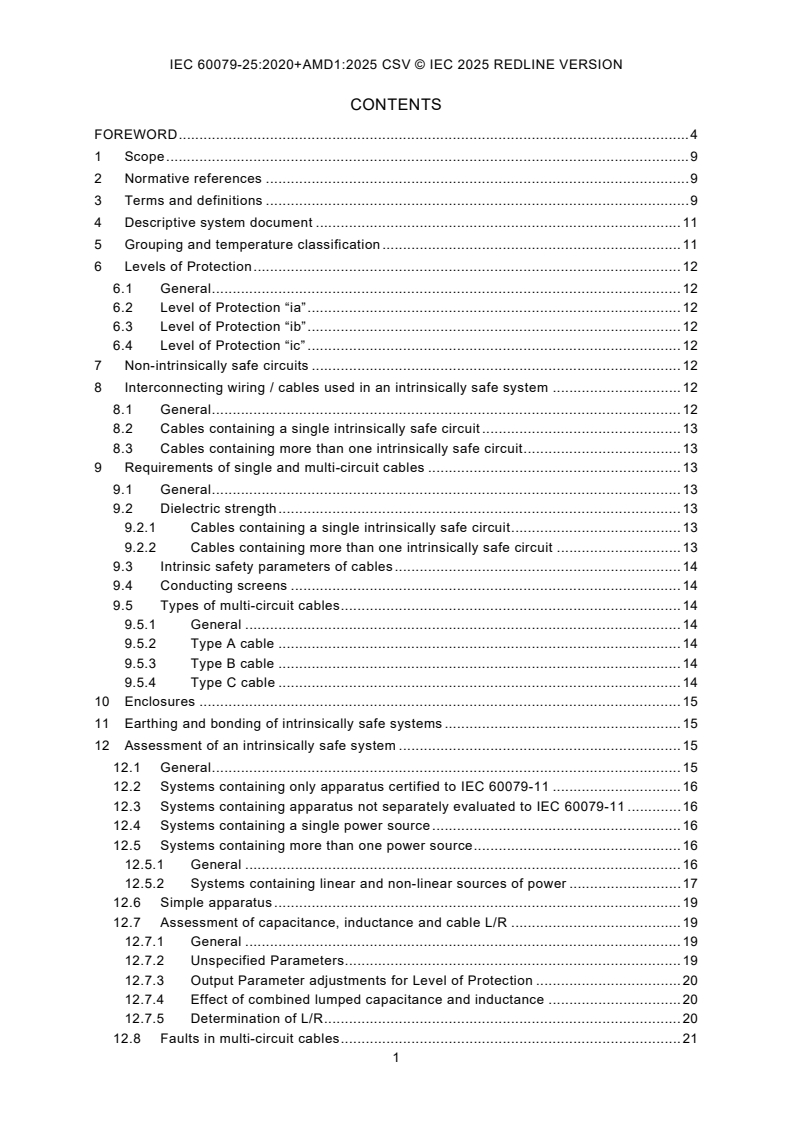
CONTENTS
FOREWORD . 4
1 Scope . 9
2 Normative references . 9
3 Terms and definitions . 9
4 Descriptive system document . 11
5 Grouping and temperature classification . 11
6 Levels of Protection . 12
6.1 General . 12
6.2 Level of Protection “ia” . 12
6.3 Level of Protection “ib” . 12
6.4 Level of Protection “ic” . 12
7 Non-intrinsically safe circuits . 12
8 Interconnecting wiring / cables used in an intrinsically safe system . 12
8.1 General . 12
8.2 Cables containing a single intrinsically safe circuit . 13
8.3 Cables containing more than one intrinsically safe circuit . 13
9 Requirements of single and multi-circuit cables . 13
9.1 General . 13
9.2 Dielectric strength . 13
9.2.1 Cables containing a single intrinsically safe circuit . 13
9.2.2 Cables containing more than one intrinsically safe circuit . 13
9.3 Intrinsic safety parameters of cables . 14
9.4 Conducting screens . 14
9.5 Types of multi-circuit cables . 14
9.5.1 General . 14
9.5.2 Type A cable . 14
9.5.3 Type B cable . 14
9.5.4 Type C cable . 14
10 Enclosures . 15
11 Earthing and bonding of intrinsically safe systems . 15
12 Assessment of an intrinsically safe system . 15
12.1 General . 15
12.2 Systems containing only apparatus certified to IEC 60079-11 . 16
12.3 Systems containing apparatus not separately evaluated to IEC 60079-11 . 16
12.4 Systems containing a single power source . 16
12.5 Systems containing more than one power source . 16
12.5.1 General . 16
12.5.2 Systems containing linear and non-linear sources of power . 17
12.6 Simple apparatus . 19
12.7 Assessment of capacitance, inductance and cable L/R . 19
12.7.1 General . 19
12.7.2 Unspecified Parameters . 19
12.7.3 Output Parameter adjustments for Level of Protection . 20
12.7.4 Effect of combined lumped capacitance and inductance . 20
12.7.5 Determination of L/R . 20
12.8 Faults in multi-circuit cables . 21
12.9 Type verifications and type tests . 21
13 Predefined systems . 21
Annex A (informative) Assessment of a simple intrinsically safe system . 22
Annex B (informative) Assessment of circuits with more than one power source . 24
Annex C (informative) Interconnection of non-linear and linear intrinsically safe circuits . 27
C.1 General . 27
C.2 Assessment of the output characteristics of the power sources . 27
C.3 Assessment of interconnection possibilities and resultant output
characteristics . 30
C.4 Determination of intrinsic safety and the use of graphs . 33
C.5 Verification against IEC 60079-11 . 35
C.6 Illustration of the procedure . 35
C.7 Limit curves for universal source characteristic . 39
Annex D (informative) Verification of inductive parameters . 50
Annex E (informative) Example format for a descriptive system document . 52
Annex F (informative) Use of simple apparatus in systems . 54
F.1 General . 54
F.2 Use of apparatus with ‘simple apparatus’ . 55
Annex G (normative) FISCO systems . 56
G.1 General . 56
G.2 System requirements . 56
G.2.1 General . 56
G.3 Additional requirements of “ic” FISCO systems . 57
Annex H (normative) 2-WISE systems . 59
H.1 General . 59
H.2 Wiring systems . 59
H.3 Powered 2-WISE systems . 59
H.4 Communication only 2-WISE systems . 60
H.5 Descriptive system document. 61
Bibliography . 62
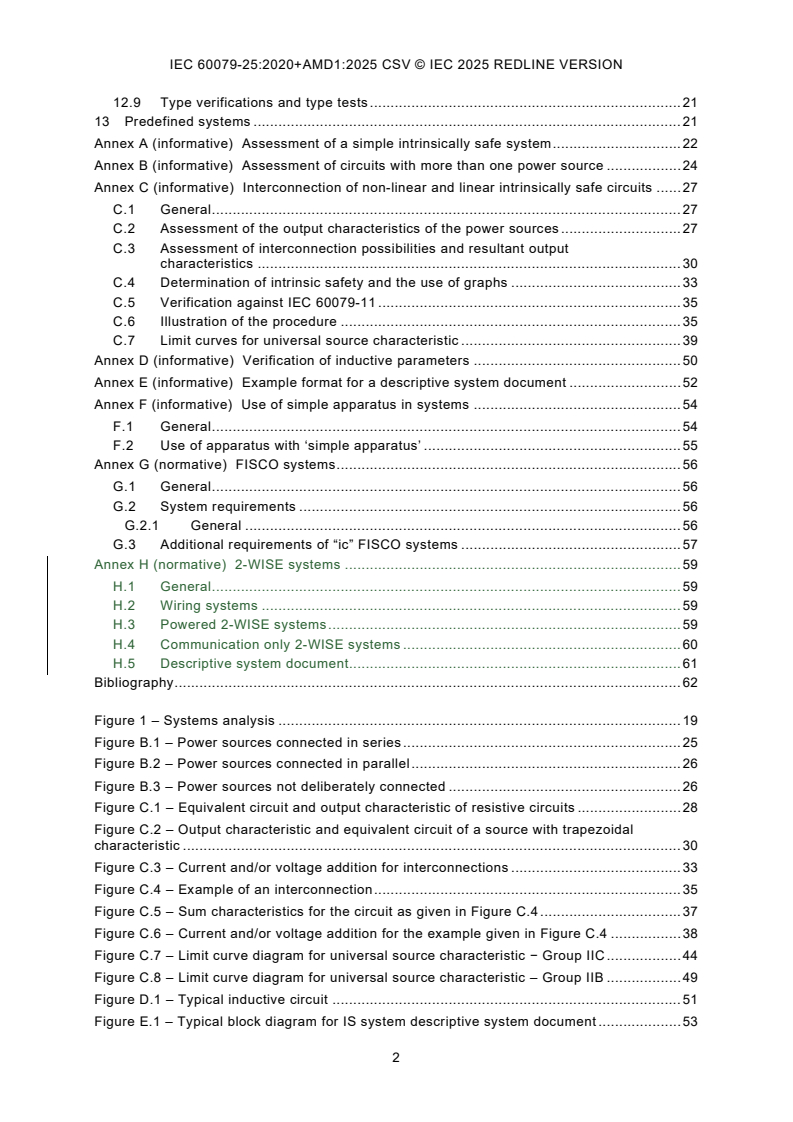
Figure 1 – Systems analysis . 19
Figure B.1 – Power sources connected in series . 25
Figure B.2 – Power sources connected in parallel . 26
Figure B.3 – Power sources not deliberately connected . 26
Figure C.1 – Equivalent circuit and output characteristic of resistive circuits . 28
Figure C.2 – Output characteristic and equivalent circuit of a source with trapezoidal
characteristic . 30
Figure C.3 – Current and/or voltage addition for interconnections . 33
Figure C.4 – Example of an interconnection . 35
Figure C.5 – Sum characteristics for the circuit as given in Figure C.4 . 37
Figure C.6 – Current and/or voltage addition for the example given in Figure C.4 . 38
Figure C.7 – Limit curve diagram for universal source characteristic − Group IIC . 44
Figure C.8 – Limit curve diagram for universal source characteristic – Group IIB . 49
Figure D.1 – Typical inductive circuit . 51
Figure E.1 – Typical block diagram for IS system descriptive system document . 53
Figure G.1 – Typical system . 58
Figure H.1 – DC-powered 2-WISE system. 60
Figure H.2 – Communication only 2-WISE system . 61
Table A.1 – Simple system analysis . 23
Table C.1 – Parameters necessary to describe the output characteristic . 28
Table C.2 – Assignment of diagrams to equipment Groups and inductances . 34
INTERNATIONAL ELECTROTECHNICAL COMMISSION
_____________
Explosive atmospheres -
Part 25: Intrinsically safe electrical systems
FOREWORD
1) The International Electrotechnical Commission (IEC) is a worldwide organization for standardization comprising
all national electrotechnical committees (IEC National Committees). The object of IEC is to promote international
co-operation on all questions concerning standardization in the electrical and electronic fields. To this end and
in addition to other activities, IEC publishes International Standards, Technical Specifications, Technical Reports,
Publicly Available Specifications (PAS) and Guides (hereafter referred to as “IEC Publication(s)”). Their
preparation is entrusted to technical committees; any IEC National Committee interested in the subject dealt with
may participate in this preparatory work. International, governmental and non-governmental organizations liaising
with the IEC also participate in this preparation. IEC collaborates closely with the International Organization for
Standardization (ISO) in accordance with conditions determined by agreement between the two organizations.
2) The formal decisions or agreements of IEC on technical matters express, as nearly as possible, an international
consensus of opinion on the relevant subjects since each technical committee has representation from all
interested IEC National Committees.
3) IEC Publications have the form of recommendations for international use and are accepted by IEC National
Committees in that sense. While all reasonable efforts are made to ensure that the technical content of IEC
Publications is accurate, IEC cannot be held responsible for the way in which they are used or for any
misinterpretation by any end user.
4) In order to promote international uniformity, IEC National Committees undertake to apply IEC Publications
transparently to the maximum extent possible in their national and regional publications. Any divergence between
any IEC Publication and the corresponding national or regional publication shall be clearly indicated in the latter.
5) IEC itself does not provide any attestation of conformity. Independent certification bodies provide conformity
assessment services and, in some areas, access to IEC marks of conformity. IEC is not responsible for any
services carried out by independent certification bodies.
6) All users should ensure that they have the latest edition of this publication.
7) No liability shall attach to IEC or its directors, employees, servants or agents including individual experts and
members of its technical committees and IEC National Committees for any personal injury, property damage or
other damage of any nature whatsoever, whether direct or indirect, or for costs (including legal fees) and
expenses arising out of the publication, use of, or reliance upon, this IEC Publication or any other IEC
Publications.
8) Attention is drawn to the Normative references cited in this publication. Use of the referenced publications is
indispensable for the correct application of this publication.
9) IEC draws attention to the possibility that the implementation of this document may involve the use of (a)
patent(s). IEC takes no position concerning the evidence, validity or applicability of any claimed patent rights in
respect thereof. As of the date of publication of this document, IEC had not received notice of (a) patent(s), which
may be required to implement this document. However, implementers are cautioned that this may not represent
the latest information, which may be obtained from the patent database available at https://patents.iec.ch [and/or]
www.iso.org/patents. IEC shall not be held responsible for identifying any or all such patent rights.
This consolidated version of the official IEC Standard and its amendment has been prepared
for user convenience.
IEC 60079-25 edition 3.1 contains the third edition (2020-06) [documents 31G/318/FDIS and
31G/321/RVD], its corrigenda 1 (2020-10) and 2 (2022-11), and its amendment 1 (2025-09)
[documents 31G/426/FDIS and 31G/432/RVD].
In this Redline version, a vertical line in the margin shows where the technical content is
modified by amendment 1. Additions are in green text, deletions are in strikethrough red text.
A separate Final version with all changes accepted is available in this publication.
International Standard IEC 60079-25 has been prepared by subcommittee 31G: Intrinsically
safe apparatus, of IEC technical committee 31: Equipment for explosive atmospheres.
This third edition cancels and replaces the second edition published in 2010 and constitutes a
technical revision.
The significance of the changes between IEC 60079-25, Edition 2 (2010) and IEC 60079-25,
Edition 3 (2019) are as listed below:
Type
Changes Clause Minor and Extension Major
editorial technical
changes changes
X
References to ‘electrical systems’ changed to ‘systems’ 1
and note added that installation requirement for Group I
are being considered.
X
Normative references updated to remove references that 2
were outdated or not mentioned in the body of the
standard.
X
Reference to IEC Electropedia and ISO Online Browsing 3
platform added, abbreviations dropped from title.
Definition of ‘system designer’ deleted, definitions of
‘certified intrinsically safe electrical system’, and
‘uncertified intrinsically safe electrical system’ dropped.
X
‘Intrinsically safe electrical system’ changed to 3.1
‘intrinsically safe system’.
Definition for ‘multi-circuit cable’ added. X
3.2
X
‘Maximum’ changed to ‘total’ on definitions of cable 3.4, 3.5
capacitance and cable inductance.
X
‘Maximum’ deleted on definition of cable inductance to
3.6
resistance ratio.
X
FISCO changed to definition from abbreviation. 3.9
X
The requirement for the system designer to sign and date 4
the document dropped, editorial changes for clarity made,
and a reference to Annex E made to show typical
descriptive system documents.
X
Title of clause changed to ‘Grouping and temperature 5
classification’, ambient temperature range added to things
to be included in the system document and reworded for
clarity.
X
Notes moved and reworded among the clauses. 6.1, 6.2,
6.3, 6.4
X
Changed from ‘Ambient temperature rating’ which was 7
moved to Clause 5, and new section renamed ‘Non-
intrinsically safe circuits’ added.
X
Clause reorganized into sections and some rewording 8
done for clarity.
X
Title changed to ‘Requirements of single and multi-circuit 9
cables’.
X
Requirement for insulation thickness moved into this 9.1
clause, and it now applies to all cables.
X
Title changed to ‘Dielectric strength’ and consolidation of 9.2
requirements for single circuit and multi-circuit cables.
Requirement for dielectric testing changed to twice the
circuit voltage with a minimum of 500VAC.
Type
Changes Clause Minor and Extension Major
editorial technical
changes changes
X
Dielectric strength requirements for single circuit cables 9.2.1
consolidated here.
X
Dielectric strength requirements for multi- circuit cables 9.2.2
consolidated here.
C1
Multi-circuit cables shall not be used for intrinsically safe 9.2.2
circuits with voltages exceeding 90 V.
X
Title changed to ‘Intrinsic safety parameters of cables’ 9.3
X
Title changed to ‘Enclosures’ 10
C2
Most of the old Clause 12 moved to IEC 60079-14. 11
X
This clause was Clause 13 in the previous edition, and the 12
entire clause has been re-arranged for clarity and easier
reading.
X
This General clause has been re-written in list format to 12.1
make it easier to understand, and analysis of single and
multiple power supplies moved to 12.4 and 12.5
respectively.
X
This clause added to clarify fault applications in 12.2
assemblies of certified equipment.
X
This clause added to provide guidance on how to handle 12.3
non-certified items in larger assemblies.
X
Analysis of single power source information consolidated 12.4
here and amplified.
X
Analysis of multiple power sources information 12.5
consolidated in this clause. Information added for clarity.
X
The circuit analysis example dropped in text for simple 12.6
apparatus, new Annex F added with more information.
X
Section added to provide more information on determining 12.7
capacitance, inductance and L/R that was moved from
Annex A.
X
Requirements for Type A, B, and C cables reworded for 12.8
clarity.
X
Information on evaluation of capacitance and inductance Annex A
moved to 12.7.
X
Changed from normative to informative Annex B
X
Reordered and rewritten for greater clarity. Annex C
X
Annex updated for clarity. Annex E
C3
The former Annex F on surge protection has been Annex F
removed.
X
Annex G in the previous edition was on testing of cable Annex G
parameters and has been removed from this edition.
Annex G is now FISCO systems.
NOTE The technical changes referred to include the significance of technical changes in the revised IEC Standard,
but they do not form an exhaustive list of all modifications from the previous version. More guidance may be found
by referring to the Redline Version of the standard.
Explanations:
A) Definitions
Minor and editorial changes clarification
decrease of technical requirements
minor technical change
editorial corrections
These are changes which modify requirements in an editorial or a minor technical way. They
include changes of the wording to clarify technical requirements without any technical change,
or a reduction in level of existing requirement.
Extension addition of technical options
These are changes which add new or modify existing technical requirements, in a way that new
options are given, but without increasing requirements for equipment that was fully compliant
with the previous standard. Therefore, these will not have to be considered for products in
conformity with the preceding edition.
Major technical changes addition of technical requirements
increase of technical requirements
These are changes to technical requirements (addition, increase of the level or removal) made
in a way that a product in conformity with the preceding edition will not always be able to fulfil
the requirements given in the later edition. These changes have to be considered for products
in conformity with the preceding edition. For these changes additional information is provided
in clause B) below.
NOTE These changes represent current technological knowledge. However, these changes should not normally
have an influence on equipment already placed on the market.
B) Information about the background of ‘Major Technical Changes’
B1 – A limitation of 90 V for multi-circuit system has been added since for this voltage level a
dielectric test of at least 500 V AC or 700 V DC is normally used to validate the insulation.
B2 – Most of the earthing and bonding requirements have been removed and moved to
IEC 60079-14, and the surge protection requirements that were in the old Clause 12 were added
here in Clause 11. The rest of the old Clause 12 was also removed and moved to IEC 60079-
14.
B3 – The former Annex F on surge protection has been removed and will be covered in
IEC 60079-14. Annex F is now Simple Apparatus, which was Annex H in the previous edition.
The text of this standard is based on the following documents:
FDIS Report on voting
31G/318/FDIS 31G/321/RVD
Full information on the voting for the approval of this standard can be found in the report on
voting indicated in the above table.
This publication has been drafted in accordance with the ISO/IEC Directives, Part 2.
A list of all parts in the IEC 60079 series, published under the general title Explosive
atmospheres, can be found on the IEC website.
The committee has decided that the contents of this document and its amendment will remain
unchanged until the stability date indicated on the IEC website under webstore.iec.ch in the
data related to the specific document. At this date, the document will be
– reconfirmed,
– withdrawn, or
– revised.
1 Scope
This part of IEC 60079 contains the specific requirements for design, construction and
assessment of intrinsically safe systems, Type of Protection “i”, intended for use, as a whole or
in part, in locations in which the use of Group I, II or III Ex Equipment is required.
NOTE 1 This standard is intended for use by the designer of the system e.g. a person who could be a manufacturer,
a specialist consultant or a member of the end-user’s staff.
This document supplements and modifies the general requirements of IEC 60079-0 and the
intrinsic safety standard IEC 60079-11. Where a requirement of this standard conflicts with a
requirement of IEC 60079-0 or IEC 60079-11, the requirement of this standard takes
precedence.
The installation requirements of Group II or Group III systems designed in accordance with this
standard document are specified in IEC 60079-14. Where a specific requirement of IEC 60079-
14 is applied by this document, the same requirements can be applied for Group I.
NOTE 2 Group I installation requirements are presently not provided in IEC 60079-14. Installation requirements for
Group I are being considered.
2 Normative references
The following documents are referred to in the text in such a way that some or all of their content
constitutes requirements of this document. For dated references, only the edition cited applies.
For undated references, the latest edition of the referenced document (including any
amendments) applies.
IEC 60079-0, Explosive atmospheres – Part 0: Equipment – General requirements
IEC 60079-11, Explosive atmospheres – Part 11: Equipment protection by intrinsic safety "i"
IEC 60079-14, Explosive atmospheres – Part 14: Electrical installations design, selection and
erection
IEC TS 60079-47, Explosive atmospheres – Part 47: Equipment protection by 2-wire
intrinsically safe ethernet concept (2-WISE)
IEC 61158-2, Industrial communication networks – Fieldbus specifications – Part 2: Physical
layer specification and service definition
3 Terms and definitions
For the purposes of this document, the following terms and definitions, specific to intrinsically
safe systems, apply. They supplement the terms and definitions which are given in IEC 60079-0
and IEC 60079-11.
ISO and IEC maintain terminological databases for use in standardization at the following
addresses:
• IEC Electropedia: available at http://www.electropedia.org/
• ISO Online browsing platform: available at http://www.iso.org/obp
3.1
intrinsically safe system
assembly of interconnected items of apparatus, described in a descriptive system document, in
which the circuits or parts of circuits, intended to be used in an explosive atmosphere, are
intrinsically safe circuits
3.2
multi-circuit cable
multi-core cable containing more than one intrinsically safe circuit
3.3
descriptive system document
document in which the items of apparatus, their intrinsic safety parameters and those of the
interconnecting wiring are specified
Note 1 to entry: Document, in this context, is any means of recording the required information. Examples include
reports, drawings, spreadsheets, and databases.
3.4
total cable capacitance
C
c
total capacitance of the interconnecting cable that can be connected into an intrinsically safe
circuit
3.5
total cable inductance
L
c
total inductance of the interconnecting cable that can be connected into an intrinsically safe
circuit
3.6
cable inductance to resistance ratio
L /R
c c
value of the ratio inductance (L ) to resistance (R ) of the interconnecting cable connected into
c c
an intrinsically safe circuit
3.7
linear power source
power source from which the available output current is determined by a resistor; the output
voltage decreasing linearly as the output current increases
3.8
non-linear power source
power source where the output voltage and output current have a non-linear relationship
Note 1 to entry: For example, a supply with a constant voltage output that can reach a constant current limit
controlled by semiconductors
3.9
FISCO
Fieldbus Intrinsically Safe Concept
intrinsically safe system architecture that is bus-powered and designed in accordance with
specific requirements
Note 1 to entry: The requirements are specified in IEC 61158-2, Industrial communication networks – Fieldbus
specifications – Part 2: Physical layer specification and service definition.
3.10
2-WISE system
assembly of interconnected items of 2-WISE devices, described in a descriptive system
document, in which the circuits or parts of the circuits, intended to be used in an explosive
atmosphere, are intrinsically safe circuits
[SOURCE: IEC TS 60079-47:2021, 3.5]
4 Descriptive system document
A descriptive system document shall be created for all intrinsically safe systems. The
descriptive system document shall include the technical justification for the combination of the
apparatus and shall include at a minimum the following:
a) a block diagram of the system listing all the items of apparatus within the system including
simple apparatus and the interconnecting wiring;
b) a statement of the equipment Group subdivision (for equipment Groups II and III), the Level
of Protection and the Equipment Protection Level (EPL) for each part of the system, the
temperature classification, and the ambient temperature rating in accordance with Clauses
5 and 6;
c) the requirements and permitted parameters of the interconnecting wiring in accordance with
Clause 8;
d) details of the earthing and bonding points on which intrinsic safety depends;
e) where applicable, the confirmation of apparatus as simple apparatus in accordance with
IEC 60079-11;
f) the result of the assessment of intrinsically safe systems in accordance with Clause 12; and
g) a unique document identification.
The requirements found in Clauses 5 through 12 shall be used to determine the content of the
descriptive system document.
NOTE The descriptive system document is not the same as the control drawing referred to in IEC 60079-11.
Annex E shows an example of a typical diagram, illustrating the requirements of the descriptive
system document.
5 Grouping and temperature classification
Parts of intrinsically safe systems that are intended for use in an explosive atmosphere shall
be grouped in accordance with the equipment grouping requirements of IEC 60079-0 and be
assigned a temperature class or a maximum surface temperature in accordance with the
temperature requirements of IEC 60079-0 and IEC 60079-11.
Associated apparatus not intended for use in an explosive atmosphere shall only be grouped in
accordance with the equipment grouping requirements of IEC 60079-0.
Where the intrinsically safe system or parts of the intrinsically safe system are specified as
being suitable for operation outside the normal ambient temperature range of −20 °C and
+40 °C, then this shall be specified in the descriptive system document.
NOTE Different parts of the same intrinsically safe system can have different groups. The apparatus used can have
different temperature classes and different ambient temperature ratings.
6 Levels of Protection
6.1 General
Each part of an intrinsically safe system intended for use in an explosive atmosphere shall have
a Level of Protection “ia”, “ib” or “ic” in accordance with IEC 60079-11 and an EPL in accordance
with IEC 60079-0. Separate parts of the system may have a different Level of Protection or
EPL.
NOTE For Group I applications, an intrinsically safe system can be “ib” in normal operation with external power, but
when power is removed under defined safety circumstances (e.g. ventilation failure) then the system could become
“ia” under back up battery power. The Level of Protection will be clearly defined for intended circumstances.
6.2 Level of Protection “ia”
Where the requirements applicable to apparatus of Level of Protection “ia” (see IEC 60079-11)
are satisfied by an intrinsically safe system or part of a system considered as an entity, then
that system or part of a system shall be assigned a Level of Protection “ia”.
6.3 Level of Protection “ib”
Where the requirements applicable to apparatus of Level of Protection “ib” (see IEC 60079-11)
are satisfied by an intrinsically safe system or part of a system considered as an entity, then
that system or part of a system shall be assigned a Level of Protection “ib”.
EXAMPLE A Level of Protection “ia” field instrument powered via a Level of Protection “ib” associated apparatus
would be considered as a Level of Protection “ib” system or a Level of Protection “ib” field instrument powered via a
Level of Protection “ia” associated apparatus would also be considered as a Level of Protection “ib” system.
6.4 Level of Protection “ic”
Where the requirements applicable to apparatus of Level of Protection “ic” (see IEC 60079-11)
are satisfied by an intrinsically safe system or part of a system considered as an entity, then
that system or part of a system shall be assigned a Level of Protection “ic”.
EXAMPLE A Level of Protection “ia” field instrument powered via a Level of Protection “ic” associated apparatus
would be considered as Level of Protection “ic” system or a Level of Protection “ic” field instrument powered via a
Level of Protection “ia” associated apparatus would also be considered as a Level of Protection “ic” system.
7 Non-intrinsically safe circuits
The descriptive system document shall define the limitations for connection of circuits to the
non-intrinsically safe terminals of associated apparatus, such as the U value(s) and the
m
maximum permitted prospective short-circuit current of the supply if less than 1 500 A.
8 Interconnecting wiring / cables used in an intrinsically safe system
8.1 General
The intrinsic safety parameters of the interconnecting wiring upon which intrinsic safety
depends, and their derivation, shall be specified in the descriptive system document. If a
specific type of wiring is specified, then the justification for its use shall be included in the
documentation.
Cables for the interconnecting wiring shall comply with the applicable requirements of Clause 9.
Cable faults shall be assessed in accordance with the requirements of 12.8.
8.2 Cables containing a single intrinsically safe circuit
Cables containing a single intrinsically safe circuit shall comply with the requirements of 9.1,
9.2.1, 9.3 and, where applicable, 9.4.
8.3 Cables containing more than one intrinsically safe circuit
The descriptive system document shall specify the permissible types of multi-circuit cables
according to Clause 9, if used for particular circuits. In the particular case where faults between
separate circuits have not been taken into account, a note shall be included on the block
diagram of the descriptive system document stating the following: ‘Where the interconnecting
cable utilizes part of a multi-circuit cable containing other intrinsically safe circuits, the multi-
circuit cable shall be in accordance with the requirements of a multi-circuit cable Type A or
Type B, as specified in IEC 60079-14.
A multi-circuit cable containing circuits classified as Level of Protection “ia”, “ib” or “ic” shall not
contain non-intrinsically safe circuits.
Where Level of Protection “ia”, “ib” or “ic” circuits are run together in a cable of Type A or Type
B as specified in 9.5.2 and 9.5.3, each circuit retains its Level of Protection and equipment
grouping.
Where Level of Protection “ia”, “ib” or “ic” circuits are run together in a cable of Type C as
specified in 9.5.4, the combination of circuits shall be assessed according to 12.8 to determine
the Level of Protection, EPL and applicable equipment grouping.
NOTE Assessment according to 12.8 might determine that the combination is no longer intrinsically safe.
9 Requirements of single and multi-circuit cables
9.1 General
If the cable is specified as part of the system, then:
– individual conductors or strands of multi-stranded conductors within the hazardous area
shall have a diameter of at least 0,1 mm; and
– the radial thickness of the insulation of each core of multi circuit cable shall be appropriate
to the conductor diameter and the nature of the insulation with a minimum of 0,2 mm.
NOTE This clause is not intended to prevent the use of bare conductors that are intended to be bridged out in a
signalling system. Such conductors are considered as simple apparatus and not interconnecting wiring.
9.2 Dielectric strength
9.2.1 Cables containing a single intrinsically safe circuit
The insulation of cables used for intrinsically safe circuits shall be capable of withstanding a
dielectric strength test with twice the voltage of the intrinsically safe circuit or 500 V
RMS
(or 700 V DC), whichever is the greater.
9.2.2 Cables containing more than one intrinsically safe circuit
Multi-circuit cables shall not be used for intrinsically safe circuits with voltages exceeding 90 V.
Multi-circuit cables shall be capable of withstanding a dielectric strength test of at least:
a) 500 V or 700 V DC applied between any armouring and/or screen(s) joined together
RMS
and all the cores joined together; and
b) 1 000 V or 1 400 V DC applied between a bundle comprising one half of the cable
RMS
cores joined together and a bundle comprising the other half of the cores joined together.
This test is not applicable to multi-circuit cables with conducting screens for individual
circuits.
If information from the cable manufacturer is not available, then the dielectric strength test shall
be carried out in accordance with an appropriate cable standard or dielectric strength tests of
IEC 60079-11.
NOTE It is not a requirement of this standard that the conformity of the manufacturer’s specification of the cable
needs to be verified.
9.3 Intrinsic safety parameters of cables
The intrinsic safety parameters (C and L , or C and L /R ) for all cables used within an
c c c c c
intrinsically safe system shall be determined according to one of the following:
a) the most onerous intrinsic safety parameters provided by the cable manufacturer;
b) intrinsic safety parameters determined by measurement of a sample, with the method of
testing intrinsic safety parameters of cables given in IEC 60079-14;
c) where the interconnection comprises two or three cores of a conventionally constructed
cable (with or without screen) the following values may be used: 200 pF/m and either 1 µH/m
or an inductance to resistance ratio (L /R ) calculated by dividing 1 µH by the manufacturers
c c
specified loop resistance per meter. Alternatively, for currents up to I = 3 A an L/R ratio of
o
30 µH/Ω may be used.
Where a FISCO system is used, the requirements for the cable parameters shall comply with
Annex G.
Where a 2-WISE system is used, the requirements for the cable parameters shall comply with
Annex H.
9.4 Conducting screens
Where conducting screens provide protection for separate intrinsically safe circuits in order to
prevent such circuits becoming connected to one another, the screen shall provide a minimum
60 % coverage along the entire length of the cable.
9.5 Types of multi-circuit cables
9.5.1 General
Multi-circuit cables shall be identified as Type A, Type B or Type C for the purposes of applying
faults and assessing the safety of the cabling within an intrinsically safe system. The cable
types are specified in 9.5.2, 9.5.3, and 9.5.4.
9.5.2 Type A cable
A multi-circuit cable that has conducting screens providing individual protection according to
9.4 for each intrinsically safe circuit.
9.5.3 Type B cable
A multi-circuit cable that is fixed, is protected against damage by installation and does not
contain any circuit with a maximum voltage U exceeding 60 V.
o
9.5.4 Type C cable
A multi-circuit cable that is not Type A or Type B.
10 Enclosures
Enclosures used for connection of separate intrinsically safe circuits, such as terminal boxes,
shall provide separations for external connection facilities and meet the applicable enclosure
requirements in IEC 60079-11.
11 Earthing and bonding of intrinsically safe systems
The descriptive system document should clearly indicate which point or points of the system
are intended to be earthed, and any special requirements of such a bond.
The use of surge protection devices which interconnect the circuit and the structure via
nonlinear devices such as gas discharge tubes and semiconductors is not considered to
adversely affect the intrinsic safety of a circuit, provided that in normal operation the current
through the device i
...
IEC 60079-25 ®
Edition 3.0 2020-06
INTERNATIONAL
STANDARD
NORME
INTERNATIONALE
Explosive atmospheres –
Part 25: Intrinsically safe electrical systems
Atmosphères explosives –
Partie 25: Systèmes électriques de sécurité intrinsèque
All rights reserved. Unless otherwise specified, no part of this publication may be reproduced or utilized in any form
or by any means, electronic or mechanical, including photocopying and microfilm, without permission in writing from
either IEC or IEC's member National Committee in the country of the requester. If you have any questions about IEC
copyright or have an enquiry about obtaining additional rights to this publication, please contact the address below or
your local IEC member National Committee for further information.
Droits de reproduction réservés. Sauf indication contraire, aucune partie de cette publication ne peut être reproduite
ni utilisée sous quelque forme que ce soit et par aucun procédé, électronique ou mécanique, y compris la photocopie
et les microfilms, sans l'accord écrit de l'IEC ou du Comité national de l'IEC du pays du demandeur. Si vous avez des
questions sur le copyright de l'IEC ou si vous désirez obtenir des droits supplémentaires sur cette publication, utilisez
les coordonnées ci-après ou contactez le Comité national de l'IEC de votre pays de résidence.
IEC Central Office Tel.: +41 22 919 02 11
3, rue de Varembé info@iec.ch
CH-1211 Geneva 20 www.iec.ch
Switzerland
About the IEC
The International Electrotechnical Commission (IEC) is the leading global organization that prepares and publishes
International Standards for all electrical, electronic and related technologies.
About IEC publications
The technical content of IEC publications is kept under constant review by the IEC. Please make sure that you have the
latest edition, a corrigendum or an amendment might have been published.
IEC publications search - webstore.iec.ch/advsearchform Electropedia - www.electropedia.org
The advanced search enables to find IEC publications by a The world's leading online dictionary on electrotechnology,
variety of criteria (reference number, text, technical containing more than 22 000 terminological entries in English
committee,…). It also gives information on projects, replaced and French, with equivalent terms in 16 additional languages.
and withdrawn publications. Also known as the International Electrotechnical Vocabulary
(IEV) online.
IEC Just Published - webstore.iec.ch/justpublished
Stay up to date on all new IEC publications. Just Published IEC Glossary - std.iec.ch/glossary
details all new publications released. Available online and 67 000 electrotechnical terminology entries in English and
once a month by email. French extracted from the Terms and Definitions clause of
IEC publications issued since 2002. Some entries have been
IEC Customer Service Centre - webstore.iec.ch/csc collected from earlier publications of IEC TC 37, 77, 86 and
If you wish to give us your feedback on this publication or CISPR.
need further assistance, please contact the Customer Service
Centre: sales@iec.ch.
A propos de l'IEC
La Commission Electrotechnique Internationale (IEC) est la première organisation mondiale qui élabore et publie des
Normes internationales pour tout ce qui a trait à l'électricité, à l'électronique et aux technologies apparentées.
A propos des publications IEC
Le contenu technique des publications IEC est constamment revu. Veuillez vous assurer que vous possédez l’édition la
plus récente, un corrigendum ou amendement peut avoir été publié.
Recherche de publications IEC - Electropedia - www.electropedia.org
webstore.iec.ch/advsearchform Le premier dictionnaire d'électrotechnologie en ligne au
La recherche avancée permet de trouver des publications IEC monde, avec plus de 22 000 articles terminologiques en
en utilisant différents critères (numéro de référence, texte, anglais et en français, ainsi que les termes équivalents dans
comité d’études,…). Elle donne aussi des informations sur les 16 langues additionnelles. Egalement appelé Vocabulaire
projets et les publications remplacées ou retirées. Electrotechnique International (IEV) en ligne.
IEC Just Published - webstore.iec.ch/justpublished Glossaire IEC - std.iec.ch/glossary
Restez informé sur les nouvelles publications IEC. Just 67 000 entrées terminologiques électrotechniques, en anglais
Published détaille les nouvelles publications parues. et en français, extraites des articles Termes et Définitions des
Disponible en ligne et une fois par mois par email. publications IEC parues depuis 2002. Plus certaines entrées
antérieures extraites des publications des CE 37, 77, 86 et
Service Clients - webstore.iec.ch/csc CISPR de l'IEC.
Si vous désirez nous donner des commentaires sur cette
publication ou si vous avez des questions contactez-nous:
sales@iec.ch.
IEC 60079-25 ®
Edition 3.0 2020-06
INTERNATIONAL
STANDARD
NORME
INTERNATIONALE
Explosive atmospheres –
Part 25: Intrinsically safe electrical systems
Atmosphères explosives –
Partie 25: Systèmes électriques de sécurité intrinsèque
INTERNATIONAL
ELECTROTECHNICAL
COMMISSION
COMMISSION
ELECTROTECHNIQUE
INTERNATIONALE
ICS 29.260.20 ISBN 978-2-8322-8512-1
– 2 – IEC 60079-25:2020 IEC 2020
CONTENTS
FOREWORD . 4
1 Scope . 9
2 Normative references . 9
3 Terms and definitions . 9
4 Descriptive system document . 11
5 Grouping and temperature classification . 11
6 Levels of Protection . 11
6.1 General . 11
6.2 Level of Protection “ia” . 12
6.3 Level of Protection “ib” . 12
6.4 Level of Protection “ic” . 12
7 Non-intrinsically safe circuits . 12
8 Interconnecting wiring / cables used in an intrinsically safe system . 12
8.1 General . 12
8.2 Cables containing a single intrinsically safe circuit . 12
8.3 Cables containing more than one intrinsically safe circuit . 12
9 Requirements of single and multi-circuit cables . 13
9.1 General . 13
9.2 Dielectric strength . 13
9.2.1 Cables containing a single intrinsically safe circuit . 13
9.2.2 Cables containing more than one intrinsically safe circuit . 13
9.3 Intrinsic safety parameters of cables . 13
9.4 Conducting screens . 14
9.5 Types of multi-circuit cables . 14
9.5.1 General . 14
9.5.2 Type A cable . 14
9.5.3 Type B cable . 14
9.5.4 Type C cable . 14
10 Enclosures . 14
11 Earthing and bonding of intrinsically safe systems . 14
12 Assessment of an intrinsically safe system . 15
12.1 General . 15
12.2 Systems containing only apparatus certified to IEC 60079-11 . 15
12.3 Systems containing apparatus not separately evaluated to IEC 60079-11 . 15
12.4 Systems containing a single power source . 15
12.5 Systems containing more than one power source . 16
12.5.1 General . 16
12.5.2 Systems containing linear and non-linear sources of power . 16
12.6 Simple apparatus . 18
12.7 Assessment of capacitance, inductance and cable L/R . 18
12.7.1 General . 18
12.7.2 Unspecified Parameters . 18
12.7.3 Output Parameter adjustments for Level of Protection . 18
12.7.4 Effect of combined lumped capacitance and inductance . 18
12.7.5 Determination of L/R . 18
12.8 Faults in multi-circuit cables . 19
12.9 Type verifications and type tests . 19
13 Predefined systems . 19
Annex A (informative) Assessment of a simple intrinsically safe system . 20
Annex B (informative) Assessment of circuits with more than one power source . 22
Annex C (informative) Interconnection of non-linear and linear intrinsically safe circuits . 25
C.1 General . 25
C.2 Assessment of the output characteristics of the power sources . 25
C.3 Assessment of interconnection possibilities and resultant output
characteristics . 28
C.4 Determination of intrinsic safety and the use of graphs . 31
C.5 Verification against IEC 60079-11 . 33
C.6 Illustration of the procedure . 33
C.7 Limit curves for universal source characteristic . 37
Annex D (informative) Verification of inductive parameters . 48
Annex E (informative) Example format for a descriptive system document . 50
Annex F (informative) Use of simple apparatus in systems . 52
F.1 General . 52
F.2 Use of apparatus with ‘simple apparatus’ . 53
Annex G (normative) FISCO systems . 54
G.1 General . 54
G.2 System requirements . 54
G.2.1 General . 54
G.3 Additional requirements of “ic” FISCO systems . 55
Bibliography . 57
Figure 1 – Systems analysis . 17
Figure B.1 – Power sources connected in series . 23
Figure B.2 – Power sources connected in parallel . 24
Figure B.3 – Power sources not deliberately connected . 24
Figure C.1 – Equivalent circuit and output characteristic of resistive circuits . 26
Figure C.2 – Output characteristic and equivalent circuit of a source with trapezoidal
characteristic . 28
Figure C.3 – Current and/or voltage addition for interconnections . 31
Figure C.4 – Example of an interconnection . 33
Figure C.5 – Sum characteristics for the circuit as given in Figure C.4 . 35
Figure C.6 – Current and/or voltage addition for the example given in Figure C.4 . 36
Figure C.7 – Limit curve diagram for universal source characteristic − Group IIC . 42
Figure C.8 – Limit curve diagram for universal source characteristic – Group IIB . 47
Figure D.1 – Typical inductive circuit . 49
Figure E.1 – Typical block diagram for IS system descriptive system document . 51
Figure G.1 – Typical system . 56
Table A.1 – Simple system analysis . 21
Table C.1 – Parameters necessary to describe the output characteristic . 26
Table C.2 – Assignment of diagrams to equipment Groups and inductances . 32
– 4 – IEC 60079-25:2020 IEC 2020
INTERNATIONAL ELECTROTECHNICAL COMMISSION
_____________
EXPLOSIVE ATMOSPHERES –
Part 25: Intrinsically safe electrical systems
FOREWORD
1) The International Electrotechnical Commission (IEC) is a worldwide organization for standardization comprising
all national electrotechnical committees (IEC National Committees). The object of IEC is to promote international
co-operation on all questions concerning standardization in the electrical and electronic fields. To this end and
in addition to other activities, IEC publishes International Standards, Technical Specifications, Technical Reports,
Publicly Available Specifications (PAS) and Guides (hereafter referred to as “IEC Publication(s)”). Their
preparation is entrusted to technical committees; any IEC National Committee interested in the subject dealt with
may participate in this preparatory work. International, governmental and non-governmental organizations liaising
with the IEC also participate in this preparation. IEC collaborates closely with the International Organization for
Standardization (ISO) in accordance with conditions determined by agreement between the two organizations.
2) The formal decisions or agreements of IEC on technical matters express, as nearly as possible, an international
consensus of opinion on the relevant subjects since each technical committee has representation from all
interested IEC National Committees.
3) IEC Publications have the form of recommendations for international use and are accepted by IEC National
Committees in that sense. While all reasonable efforts are made to ensure that the technical content of IEC
Publications is accurate, IEC cannot be held responsible for the way in which they are used or for any
misinterpretation by any end user.
4) In order to promote international uniformity, IEC National Committees undertake to apply IEC Publications
transparently to the maximum extent possible in their national and regional publications. Any divergence between
any IEC Publication and the corresponding national or regional publication shall be clearly indicated in the latter.
5) IEC itself does not provide any attestation of conformity. Independent certification bodies provide conformity
assessment services and, in some areas, access to IEC marks of conformity. IEC is not responsible for any
services carried out by independent certification bodies.
6) All users should ensure that they have the latest edition of this publication.
7) No liability shall attach to IEC or its directors, employees, servants or agents including individual experts and
members of its technical committees and IEC National Committees for any personal injury, property damage or
other damage of any nature whatsoever, whether direct or indirect, or for costs (including legal fees) and
expenses arising out of the publication, use of, or reliance upon, this IEC Publication or any other IEC
Publications.
8) Attention is drawn to the Normative references cited in this publication. Use of the referenced publications is
indispensable for the correct application of this publication.
9) Attention is drawn to the possibility that some of the elements of this IEC Publication may be the subject of patent
rights. IEC shall not be held responsible for identifying any or all such patent rights.
International Standard IEC 60079-25 has been prepared by subcommittee 31G: Intrinsically
safe apparatus, of IEC technical committee 31: Equipment for explosive atmospheres.
This third edition cancels and replaces the second edition published in 2010 and constitutes a
technical revision.
The significance of the changes between IEC 60079-25, Edition 2 (2010) and IEC 60079-25,
Edition 3 (2019) are as listed below:
Type
Changes Clause Minor and Extension Major
editorial technical
changes changes
X
References to ‘electrical systems’ changed to ‘systems’ 1
and note added that installation requirement for Group I
are being considered.
X
Normative references updated to remove references that 2
were outdated or not mentioned in the body of the
standard.
X
Reference to IEC Electropedia and ISO Online Browsing 3
platform added, abbreviations dropped from title.
Definition of ‘system designer’ deleted, definitions of
‘certified intrinsically safe electrical system’, and
‘uncertified intrinsically safe electrical system’ dropped.
X
‘Intrinsically safe electrical system’ changed to 3.1
‘intrinsically safe system’.
Definition for ‘multi-circuit cable’ added. X
3.2
X
‘Maximum’ changed to ‘total’ on definitions of cable 3.4, 3.5
capacitance and cable inductance.
X
‘Maximum’ deleted on definition of cable inductance to 3.6
resistance ratio.
X
FISCO changed to definition from abbreviation. 3.9
X
The requirement for the system designer to sign and date
the document dropped, editorial changes for clarity made,
and a reference to Annex E made to show typical
descriptive system documents.
X
Title of clause changed to ‘Grouping and temperature 5
classification’, ambient temperature range added to things
to be included in the system document and reworded for
clarity.
X
Notes moved and reworded among the clauses. 6.1, 6.2,
6.3, 6.4
X
Changed from ‘Ambient temperature rating’ which was 7
moved to Clause 5, and new section renamed ‘Non-
intrinsically safe circuits’ added.
X
Clause reorganized into sections and some rewording 8
done for clarity.
X
Title changed to ‘Requirements of single and multi-circuit 9
cables’.
X
Requirement for insulation thickness moved into this 9.1
clause, and it now applies to all cables.
X
Title changed to ‘Dielectric strength’ and consolidation of 9.2
requirements for single circuit and multi-circuit cables.
Requirement for dielectric testing changed to twice the
circuit voltage with a minimum of 500VAC.
X
Dielectric strength requirements for single circuit cables 9.2.1
consolidated here.
X
Dielectric strength requirements for multi- circuit cables 9.2.2
consolidated here.
C1
Multi-circuit cables shall not be used for intrinsically safe 9.2.2
circuits with voltages exceeding 90 V.
X
Title changed to ‘Intrinsic safety parameters of cables’ 9.3
– 6 – IEC 60079-25:2020 IEC 2020
Type
Changes Clause Minor and Extension Major
editorial technical
changes changes
X
Title changed to ‘Enclosures’ 10
C2
Most of the old Clause 12 moved to IEC 60079-14. 11
X
This clause was Clause 13 in the previous edition, and the 12
entire clause has been re-arranged for clarity and easier
reading.
X
This General clause has been re-written in list format to 12.1
make it easier to understand, and analysis of single and
multiple power supplies moved to 12.4 and 12.5
respectively.
X
This clause added to clarify fault applications in 12.2
assemblies of certified equipment.
X
This clause added to provide guidance on how to handle 12.3
non-certified items in larger assemblies.
X
Analysis of single power source information consolidated 12.4
here and amplified.
X
Analysis of multiple power sources information 12.5
consolidated in this clause. Information added for clarity.
X
The circuit analysis example dropped in text for simple 12.6
apparatus, new Annex F added with more information.
X
Section added to provide more information on determining 12.7
capacitance, inductance and L/R that was moved from
Annex A.
X
Requirements for Type A, B, and C cables reworded for 12.8
clarity.
X
Information on evaluation of capacitance and inductance Annex A
moved to 12.7.
X
Changed from normative to informative Annex B
X
Reordered and rewritten for greater clarity. Annex C
X
Annex updated for clarity. Annex E
C3
The former Annex F on surge protection has been
Annex F
removed.
X
Annex G in the previous edition was on testing of cable Annex G
parameters and has been removed from this edition.
Annex G is now FISCO systems.
NOTE The technical changes referred to include the significance of technical changes in the revised IEC Standard,
but they do not form an exhaustive list of all modifications from the previous version. More guidance may be found
by referring to the Redline Version of the standard.
Explanations:
A) Definitions
Minor and editorial changes clarification
decrease of technical requirements
minor technical change
editorial corrections
These are changes which modify requirements in an editorial or a minor technical way. They
include changes of the wording to clarify technical requirements without any technical change,
or a reduction in level of existing requirement.
Extension addition of technical options
These are changes which add new or modify existing technical requirements, in a way that new
options are given, but without increasing requirements for equipment that was fully compliant
with the previous standard. Therefore, these will not have to be considered for products in
conformity with the preceding edition.
Major technical changes addition of technical requirements
increase of technical requirements
These are changes to technical requirements (addition, increase of the level or removal) made
in a way that a product in conformity with the preceding edition will not always be able to fulfil
the requirements given in the later edition. These changes have to be considered for products
in conformity with the preceding edition. For these changes additional information is provided
in clause B) below.
NOTE These changes represent current technological knowledge. However, these changes should not normally
have an influence on equipment already placed on the market.
B) Information about the background of ‘Major Technical Changes’
B1 – A limitation of 90 V for multi-circuit system has been added since for this voltage level a
dielectric test of at least 500 V AC or 700 V DC is normally used to validate the insulation.
B2 – Most of the earthing and bonding requirements have been removed and moved to
IEC 60079-14, and the surge protection requirements that were in the old Clause 12 were added
here in Clause 11. The rest of the old Clause 12 was also removed and moved to IEC 60079-
14.
B3 – The former Annex F on surge protection has been removed and will be covered in
IEC 60079-14. Annex F is now Simple Apparatus, which was Annex H in the previous edition.
The text of this standard is based on the following documents:
FDIS Report on voting
31G/318/FDIS 31G/321/RVD
Full information on the voting for the approval of this standard can be found in the report on
voting indicated in the above table.
This publication has been drafted in accordance with the ISO/IEC Directives, Part 2.
– 8 – IEC 60079-25:2020 IEC 2020
A list of all parts in the IEC 60079 series, published under the general title Explosive
atmospheres, can be found on the IEC website.
The committee has decided that the contents of this publication will remain unchanged until the
stability date indicated on the IEC web site under "http://webstore.iec.ch" in the data related to
the specific publication. At this date, the publication will be
• reconfirmed,
• withdrawn,
• replaced by a revised edition, or
• amended.
EXPLOSIVE ATMOSPHERES –
Part 25: Intrinsically safe electrical systems
1 Scope
This part of IEC 60079 contains the specific requirements for design, construction and
assessment of intrinsically safe systems, Type of Protection “i”, intended for use, as a whole or
in part, in locations in which the use of Group I, II or III Ex Equipment is required.
NOTE 1 This standard is intended for use by the designer of the system e.g. a person who could be a manufacturer,
a specialist consultant or a member of the end-user’s staff.
This document supplements and modifies the general requirements of IEC 60079-0 and the
intrinsic safety standard IEC 60079-11. Where a requirement of this standard conflicts with a
requirement of IEC 60079-0 or IEC 60079-11, the requirement of this standard takes
precedence.
The installation requirements of Group II or Group III systems designed in accordance with this
standard are specified in IEC 60079-14.
NOTE 2 Group I installation requirements are presently not provided in IEC 60079-14. Installation requirements for
Group I are being considered.
2 Normative references
The following documents are referred to in the text in such a way that some or all of their content
constitutes requirements of this document. For dated references, only the edition cited applies.
For undated references, the latest edition of the referenced document (including any
amendments) applies.
IEC 60079-0, Explosive atmospheres – Part 0: Equipment – General requirements
IEC 60079-11, Explosive atmospheres – Part 11: Equipment protection by intrinsic safety "i"
IEC 60079-14, Explosive atmospheres – Part 14: Electrical installations design, selection and
erection
IEC 61158-2, Industrial communication networks – Fieldbus specifications – Part 2: Physical
layer specification and service definition
3 Terms and definitions
For the purposes of this document, the following terms and definitions, specific to intrinsically
safe systems, apply. They supplement the terms and definitions which are given in IEC 60079-0
and IEC 60079-11.
ISO and IEC maintain terminological databases for use in standardization at the following
addresses:
• IEC Electropedia: available at http://www.electropedia.org/
• ISO Online browsing platform: available at http://www.iso.org/obp
– 10 – IEC 60079-25:2020 IEC 2020
3.1
intrinsically safe system
assembly of interconnected items of apparatus, described in a descriptive system document, in
which the circuits or parts of circuits, intended to be used in an explosive atmosphere, are
intrinsically safe circuits
3.2
multi-circuit cable
multi-core cable containing more than one intrinsically safe circuit
3.3
descriptive system document
document in which the items of apparatus, their intrinsic safety parameters and those of the
interconnecting wiring are specified
3.4
total cable capacitance
C
c
total capacitance of the interconnecting cable that can be connected into an intrinsically safe
circuit
3.5
total cable inductance
L
c
total inductance of the interconnecting cable that can be connected into an intrinsically safe
circuit
3.6
cable inductance to resistance ratio
L /R
c c
value of the ratio inductance (L ) to resistance (R ) of the interconnecting cable connected into
c c
an intrinsically safe circuit
3.7
linear power source
power source from which the available output current is determined by a resistor; the output
voltage decreasing linearly as the output current increases
3.8
non-linear power source
power source where the output voltage and output current have a non-linear relationship
Note 1 to entry: For example, a supply with a constant voltage output that can reach a constant current limit
controlled by semiconductors
3.9
FISCO
Fieldbus Intrinsically Safe Concept
intrinsically safe system architecture that is bus-powered and designed in accordance with
specific requirements
Note 1 to entry: The requirements are specified in IEC 61158-2, Industrial communication networks – Fieldbus
specifications – Part 2: Physical layer specification and service definition.
4 Descriptive system document
A descriptive system document shall be created for all intrinsically safe systems. The
descriptive system document shall include the technical justification for the combination of the
apparatus and shall include at a minimum the following:
a) a block diagram of the system listing all the items of apparatus within the system including
simple apparatus and the interconnecting wiring;
b) a statement of the equipment Group subdivision (for equipment Groups II and III), the Level
of Protection and the Equipment Protection Level (EPL) for each part of the system, the
temperature classification, and the ambient temperature rating in accordance with Clauses
5 and 6;
c) the requirements and permitted parameters of the interconnecting wiring in accordance with
Clause 8;
d) details of the earthing and bonding points on which intrinsic safety depends;
e) where applicable, the confirmation of apparatus as simple apparatus in accordance with
IEC 60079-11;
f) the result of the assessment of intrinsically safe systems in accordance with Clause 12; and
g) a unique document identification.
The requirements found in Clauses 5 through 12 shall be used to determine the content of the
descriptive system document.
NOTE The descriptive system document is not the same as the control drawing referred to in IEC 60079-11.
Annex E shows an example of a typical diagram, illustrating the requirements of the descriptive
system document.
5 Grouping and temperature classification
Parts of intrinsically safe systems that are intended for use in an explosive atmosphere shall
be grouped in accordance with the equipment grouping requirements of IEC 60079-0 and be
assigned a temperature class or a maximum surface temperature in accordance with the
temperature requirements of IEC 60079-0 and IEC 60079-11.
Associated apparatus not intended for use in an explosive atmosphere shall only be grouped in
accordance with the equipment grouping requirements of IEC 60079-0.
Where the intrinsically safe system or parts of the intrinsically safe system are specified as
being suitable for operation outside the normal ambient temperature range of −20 °C and
+40 °C, then this shall be specified in the descriptive system document.
NOTE Different parts of the same intrinsically safe system can have different groups. The apparatus used can have
different temperature classes and different ambient temperature ratings.
6 Levels of Protection
6.1 General
Each part of an intrinsically safe system intended for use in an explosive atmosphere shall have
a Level of Protection “ia”, “ib” or “ic” in accordance with IEC 60079-11 and an EPL in accordance
with IEC 60079-0. Separate parts of the system may have a different Level of Protection or
EPL.
NOTE For Group I applications, an intrinsically safe system can be “ib” in normal operation with external power, but
when power is removed under defined safety circumstances (e.g. ventilation failure) then the system could become
“ia” under back up battery power. The Level of Protection will be clearly defined for intended circumstances.
– 12 – IEC 60079-25:2020 IEC 2020
6.2 Level of Protection “ia”
Where the requirements applicable to apparatus of Level of Protection “ia” (see IEC 60079-11)
are satisfied by an intrinsically safe system or part of a system considered as an entity, then
that system or part of a system shall be assigned a Level of Protection “ia”.
6.3 Level of Protection “ib”
Where the requirements applicable to apparatus of Level of Protection “ib” (see IEC 60079-11)
are satisfied by an intrinsically safe system or part of a system considered as an entity, then
that system or part of a system shall be assigned a Level of Protection “ib”.
EXAMPLE A Level of Protection “ia” field instrument powered via a Level of Protection “ib” associated apparatus
would be considered as a Level of Protection “ib” system or a Level of Protection “ib” field instrument powered via a
Level of Protection “ia” associated apparatus would also be considered as a Level of Protection “ib” system.
6.4 Level of Protection “ic”
Where the requirements applicable to apparatus of Level of Protection “ic” (see IEC 60079-11)
are satisfied by an intrinsically safe system or part of a system considered as an entity, then
that system or part of a system shall be assigned a Level of Protection “ic”.
EXAMPLE A Level of Protection “ia” field instrument powered via a Level of Protection “ic” associated apparatus
would be considered as Level of Protection “ic” system or a Level of Protection “ic” field instrument powered via a
Level of Protection “ia” associated apparatus would also be considered as a Level of Protection “ic” system.
7 Non-intrinsically safe circuits
The descriptive system document shall define the limitations for connection of circuits to the
non-intrinsically safe terminals of associated apparatus, such as the U value(s).
m
8 Interconnecting wiring / cables used in an intrinsically safe system
8.1 General
The intrinsic safety parameters of the interconnecting wiring upon which intrinsic safety
depends, and their derivation, shall be specified in the descriptive system document. If a
specific type of wiring is specified, then the justification for its use shall be included in the
documentation.
Cables for the interconnecting wiring shall comply with the applicable requirements of Clause 9.
Cable faults shall be assessed in accordance with the requirements of 12.8.
8.2 Cables containing a single intrinsically safe circuit
Cables containing a single intrinsically safe circuit shall comply with the requirements of 9.1,
9.2.1, 9.3 and, where applicable, 9.4.
8.3 Cables containing more than one intrinsically safe circuit
The descriptive system document shall specify the permissible types of multi-circuit cables
according to Clause 9, if used for particular circuits. In the particular case where faults between
separate circuits have not been taken into account, a note shall be included on the block
diagram of the descriptive system document stating the following: ‘Where the interconnecting
cable utilizes part of a multi-circuit cable containing other intrinsically safe circuits, the multi-
circuit cable shall be in accordance with the requirements of a multi-circuit cable Type A or
Type B, as specified in IEC 60079-14.
A multi-circuit cable containing circuits classified as Level of Protection “ia”, “ib” or “ic” shall not
contain non-intrinsically safe circuits.
Where Level of Protection “ia”, “ib” or “ic” circuits are run together in a cable of Type A or Type
B as specified in 9.5.2 and 9.5.3, each circuit retains its Level of Protection and equipment
grouping.
Where Level of Protection “ia”, “ib” or “ic” circuits are run together in a cable of Type C as
specified in 9.5.4, the combination of circuits shall be assessed according to 12.8 to determine
the Level of Protection, EPL and applicable equipment grouping.
NOTE Assessment according to 12.8 might determine that the combination is no longer intrinsically safe.
9 Requirements of single and multi-circuit cables
9.1 General
If the cable is specified as part of the system, then:
– individual conductors or strands of multi-stranded conductors within the hazardous area
shall have a diameter of at least 0,1 mm; and
– the radial thickness of the insulation of each core of multi circuit cable shall be appropriate
to the conductor diameter and the nature of the insulation with a minimum of 0,2 mm.
NOTE This clause is not intended to prevent the use of bare conductors that are intended to be bridged out in a
signalling system. Such conductors are considered as simple apparatus and not interconnecting wiring.
9.2 Dielectric strength
9.2.1 Cables containing a single intrinsically safe circuit
The insulation of cables used for intrinsically safe circuits shall be capable of withstanding a
dielectric strength test with twice the voltage of the intrinsically safe circuit or 500 V
RMS
(or 700 V DC), whichever is the greater.
9.2.2 Cables containing more than one intrinsically safe circuit
Multi-circuit cables shall not be used for intrinsically safe circuits with voltages exceeding 90 V.
Multi-circuit cables shall be capable of withstanding a dielectric strength test of at least:
a) 500 V or 700 V DC applied between any armouring and/or screen(s) joined together
RMS
and all the cores joined together; and
b) 1 000 V or 1 400 V DC applied between a bundle comprising one half of the cable
RMS
cores joined together and a bundle comprising the other half of the cores joined together.
This test is not applicable to multi-circuit cables with conducting screens for individual
circuits.
If information from the cable manufacturer is not available, then the dielectric strength test shall
be carried out in accordance with an appropriate cable standard or dielectric strength tests of
IEC 60079-11.
NOTE It is not a requirement of this standard that the conformity of the manufacturer’s specification of the cable
needs to be verified.
9.3 Intrinsic safety parameters of cables
The intrinsic safety parameters (C and L , or C and L /R ) for all cables used within an
c c c c c
intrinsically safe system shall be determined according to one of the following:
– 14 – IEC 60079-25:2020 IEC 2020
a) the most onerous intrinsic safety parameters provided by the cable manufacturer;
b) intrinsic safety parameters determined by measurement of a sample, with the method of
testing intrinsic safety parameters of cables given in IEC 60079-14;
c) where the interconnection comprises two or three cores of a conventionally constructed
cable (with or without screen) the following values may be used: 200 pF/m and either 1 µH/m
or an inductance to resistance ratio (L /R ) calculated by dividing 1 µH by the manufacturers
c c
= 3 A an L/R ratio of
specified loop resistance per meter. Alternatively, for currents up to I
o
30 µH/Ω may be used.
Where a FISCO system is used, the requirements for the cable parameters shall comply with
Annex G.
9.4 Conducting screens
Where conducting screens provide protection for separate intrinsically safe circuits in order to
prevent such circuits becoming connected to one another, the screen shall provide a minimum
60 % coverage along the entire length of the cable.
9.5 Types of multi-circuit cables
9.5.1 General
Multi-circuit cables shall be identified as Type A, Type B or Type C for the purposes of applying
faults and assessing the safety of the cabling within an intrinsically safe system. The cable
types are specified in 9.5.2, 9.5.3, and 9.5.4.
9.5.2 Type A cable
A multi-circuit cable that has conducting screens providing individual protection according to
9.4 for each intrinsically safe circuit.
9.5.3 Type B cable
A multi-circuit cable that is fixed, is protected against damage by installation and does not
contain any circuit with a maximum voltage U exceeding 60 V.
o
9.5.4 Type C cable
A multi-circuit cable that is not Type A or Type B.
10 Enclosures
Enclosures used for connection of separate intrinsically safe circuits, such as terminal boxes,
shall provide separations for external connection facilities and meet the applicable enclosure
requirements in IEC 60079-11.
11 Earthing and bonding of intrinsically safe systems
The descriptive system document should clearly indicate which point or points of the system
are intended to be earthed, and any special requirements of such a bond.
The use of surge protection devices which interconnect the circuit and the structure via
nonlinear devices such as gas discharge tubes and semiconductors is not considered to
adversely affect the intrinsic safety of a circuit, provided that in normal operation the current
through the device is less than 10 μA.
NOTE If insulation testing at 500 V is carried out then it might be necessary to disco
...