

IEC 61156-11:2023
(Main)Multicore and symmetrical pair/quad cables for digital communications - Part 11: Symmetrical single pair cables with transmission characteristics up to 1,25 GHz - Horizontal floor wiring - Sectional specification
General Information
- Abstract
IEC 61156-11:2023 describes cables intended to be used for single balanced pair (office, home, industrial) applications according to ISO/IEC 11801-1. An example of existing application is 1000BASE-T1, see ISO/IEC TR 11801-9906. The transmission characteristics of these cables are specified up to a frequency of 1,25 GHz and at a temperature of 20 °C. The T1-C type cable is specified up to 600 MHz, the T1-D type cable up to 1,25 GHz. Depending on the MICE environment and the installation conditions either unscreened or screened cables can be used. A blank detail specification can be found in Annex A.
- Status
- Published
- Publication Date
- 11-Jun-2025
- Technical Committee
- SC 46C - Wires and symmetric cables
- Drafting Committee
- WG 7 - TC 46/SC 46C/WG 7
- Current Stage
- PPUB - Publication issued
- Start Date
- 02-May-2023
- Completion Date
- 02-Jun-2023
Buy Documents
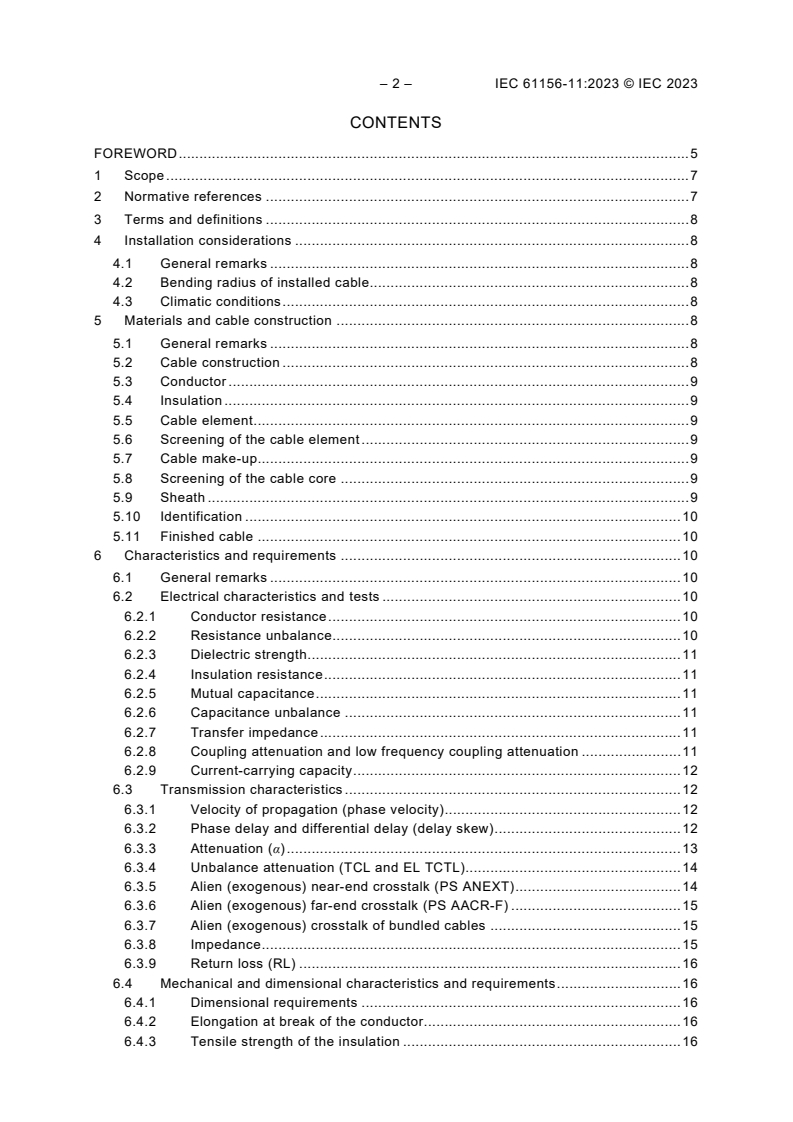
IEC 61156-11:2023 - Multicore and symmetrical pair/quad cables for digital communications - Part 11: Symmetrical single pair cables with transmission characteristics up to 1,25 GHz - Horizontal floor wiring - Sectional specification Released:5/2/2023
IEC 61156-11:2023+AMD1:2025 CSV - Multicore and symmetrical pair/quad cables for digital communications - Part 11: Symmetrical single pair cables with transmission characteristics up to 1,25 GHz - Horizontal floor wiring - Sectional specification Released:6/12/2025
IEC 61156-11:2023 RLV - Multicore and symmetrical pair/quad cables for digital communications - Part 11: Symmetrical single pair cables with transmission characteristics up to 1,25 GHz - Horizontal floor wiring - Sectional specification Released:5/2/2023
Overview
IEC 61156-11:2023 is the sectional specification for symmetrical single pair cables intended for horizontal floor wiring with transmission characteristics specified up to 1.25 GHz. It covers cable design, electrical and mechanical characteristics, environmental performance and test methods for single balanced pair applications in office, home and industrial environments. The standard supports cabling used with systems referenced in ISO/IEC 11801-1, including example applications such as 1000BASE‑T1 (see ISO/IEC TR 11801‑9906). Two performance types are defined: T1‑C (up to 600 MHz) and T1‑D (up to 1.25 GHz). Depending on the installation MICE environment, either unscreened or screened cables can be specified. Annex A provides a blank detail specification for customization.
Key topics and requirements
- Cable construction and materials: conductor, insulation, cable element, screening options, sheath and identification requirements.
- Electrical characteristics: conductor resistance and unbalance, mutual capacitance and capacitance unbalance, impedance, attenuation, phase velocity, delay skew, and return loss.
- Electromagnetic performance: transfer impedance, coupling attenuation, low‑frequency coupling attenuation, alien (exogenous) near‑end crosstalk (PS ANEXT) and far‑end crosstalk (PS AACR‑F).
- Mechanical tests: dimensional checks, tensile and elongation tests, crush, impact, bending and repeated bending, vibration, shock and bump tests.
- Environmental tests: thermal ageing, cold bend, damp heat, solar radiation, solvents, salt mist, water immersion, flame propagation, smoke and halogen gas evolution.
- Bundled cable behaviour: NEXT, ACR‑F and crosstalk requirements for pairs sharing a sheath or installed in bundles.
- Test tables and equations: transfer impedance tables, coupling attenuation requirements and attenuation equation constants to support verification.
Applications
- Structured horizontal floor cabling in commercial offices, residential installations and industrial sites.
- Automotive and industrial single‑pair Ethernet links (e.g., 1000BASE‑T1) where higher-frequency single-pair performance is required.
- Environments requiring either screened or unscreened single-pair solutions based on MICE (mechanical, ingress, climatic, electromagnetic) considerations.
- Use in horizontal channels compliant with ISO/IEC 11801-1 topologies.
Who should use this standard
- Cable manufacturers and component designers preparing product specifications and test plans.
- System integrators, network designers and installers specifying horizontal cabling for new and renovated buildings.
- Test labs and certification bodies validating single‑pair cable performance.
- Specification writers and consultants creating detail specifications (use Annex A as a template).
Related standards
- ISO/IEC 11801‑1 - Generic cabling for customer premises (horizontal cabling).
- ISO/IEC TR 11801‑9906 - Example application: 1000BASE‑T1.
- Other parts of the IEC 61156 series covering multicore and balanced pair/quad cables.
Keywords: IEC 61156-11:2023, symmetrical single pair cables, horizontal floor wiring, 1.25 GHz, T1‑C, T1‑D, screened cable, unscreened cable, coupling attenuation, ANEXT, AACR‑F.
Relations
- Effective Date
- 13-Sep-2024
- Effective Date
- 05-Sep-2023
Buy Documents
IEC 61156-11:2023 - Multicore and symmetrical pair/quad cables for digital communications - Part 11: Symmetrical single pair cables with transmission characteristics up to 1,25 GHz - Horizontal floor wiring - Sectional specification Released:5/2/2023
IEC 61156-11:2023+AMD1:2025 CSV - Multicore and symmetrical pair/quad cables for digital communications - Part 11: Symmetrical single pair cables with transmission characteristics up to 1,25 GHz - Horizontal floor wiring - Sectional specification Released:6/12/2025
IEC 61156-11:2023 RLV - Multicore and symmetrical pair/quad cables for digital communications - Part 11: Symmetrical single pair cables with transmission characteristics up to 1,25 GHz - Horizontal floor wiring - Sectional specification Released:5/2/2023
Get Certified
Connect with accredited certification bodies for this standard

ANCE
Mexican certification and testing association.

Intertek Slovenia
Intertek testing, inspection, and certification services in Slovenia.

LNE (Laboratoire National de Métrologie et d'Essais)
French national laboratory for metrology and testing.
Sponsored listings
Frequently Asked Questions
IEC 61156-11:2023 is a standard published by the International Electrotechnical Commission (IEC). Its full title is "Multicore and symmetrical pair/quad cables for digital communications - Part 11: Symmetrical single pair cables with transmission characteristics up to 1,25 GHz - Horizontal floor wiring - Sectional specification". This standard covers: IEC 61156-11:2023 describes cables intended to be used for single balanced pair (office, home, industrial) applications according to ISO/IEC 11801-1. An example of existing application is 1000BASE-T1, see ISO/IEC TR 11801-9906. The transmission characteristics of these cables are specified up to a frequency of 1,25 GHz and at a temperature of 20 °C. The T1-C type cable is specified up to 600 MHz, the T1-D type cable up to 1,25 GHz. Depending on the MICE environment and the installation conditions either unscreened or screened cables can be used. A blank detail specification can be found in Annex A.
IEC 61156-11:2023 describes cables intended to be used for single balanced pair (office, home, industrial) applications according to ISO/IEC 11801-1. An example of existing application is 1000BASE-T1, see ISO/IEC TR 11801-9906. The transmission characteristics of these cables are specified up to a frequency of 1,25 GHz and at a temperature of 20 °C. The T1-C type cable is specified up to 600 MHz, the T1-D type cable up to 1,25 GHz. Depending on the MICE environment and the installation conditions either unscreened or screened cables can be used. A blank detail specification can be found in Annex A.
IEC 61156-11:2023 is classified under the following ICS (International Classification for Standards) categories: 33.120.20 - Wires and symmetrical cables. The ICS classification helps identify the subject area and facilitates finding related standards.
IEC 61156-11:2023 has the following relationships with other standards: It is inter standard links to IEC 61156-11:2023/AMD1:2025, IEC 61156-11:2019. Understanding these relationships helps ensure you are using the most current and applicable version of the standard.
IEC 61156-11:2023 is available in PDF format for immediate download after purchase. The document can be added to your cart and obtained through the secure checkout process. Digital delivery ensures instant access to the complete standard document.
Standards Content (Sample)
IEC 61156-11 ®
Edition 2.0 2023-05
INTERNATIONAL
STANDARD
Multicore and symmetrical pair/quad cables for digital communications –
Part 11: Symmetrical single pair cables with transmission characteristics up to
1,25 GHz – Horizontal floor wiring – Sectional specification
All rights reserved. Unless otherwise specified, no part of this publication may be reproduced or utilized in any form
or by any means, electronic or mechanical, including photocopying and microfilm, without permission in writing from
either IEC or IEC's member National Committee in the country of the requester. If you have any questions about IEC
copyright or have an enquiry about obtaining additional rights to this publication, please contact the address below or
your local IEC member National Committee for further information.
IEC Secretariat Tel.: +41 22 919 02 11
3, rue de Varembé info@iec.ch
CH-1211 Geneva 20 www.iec.ch
Switzerland
About the IEC
The International Electrotechnical Commission (IEC) is the leading global organization that prepares and publishes
International Standards for all electrical, electronic and related technologies.
About IEC publications
The technical content of IEC publications is kept under constant review by the IEC. Please make sure that you have the
latest edition, a corrigendum or an amendment might have been published.
IEC publications search - webstore.iec.ch/advsearchform IEC Products & Services Portal - products.iec.ch
The advanced search enables to find IEC publications by a Discover our powerful search engine and read freely all the
variety of criteria (reference number, text, technical publications previews. With a subscription you will always have
committee, …). It also gives information on projects, replaced access to up to date content tailored to your needs.
and withdrawn publications.
Electropedia - www.electropedia.org
IEC Just Published - webstore.iec.ch/justpublished
The world's leading online dictionary on electrotechnology,
Stay up to date on all new IEC publications. Just Published
containing more than 22 300 terminological entries in English
details all new publications released. Available online and once
and French, with equivalent terms in 19 additional languages.
a month by email.
Also known as the International Electrotechnical Vocabulary
(IEV) online.
IEC Customer Service Centre - webstore.iec.ch/csc
If you wish to give us your feedback on this publication or need
further assistance, please contact the Customer Service
Centre: sales@iec.ch.
IEC 61156-11 ®
Edition 2.0 2023-05
INTERNATIONAL
STANDARD
Multicore and symmetrical pair/quad cables for digital communications –
Part 11: Symmetrical single pair cables with transmission characteristics up to
1,25 GHz – Horizontal floor wiring – Sectional specification
INTERNATIONAL
ELECTROTECHNICAL
COMMISSION
ICS 33.120.20 ISBN 978-2-8322-6938-1
– 2 – IEC 61156-11:2023 © IEC 2023
CONTENTS
FOREWORD . 5
1 Scope . 7
2 Normative references . 7
3 Terms and definitions . 8
4 Installation considerations . 8
4.1 General remarks . 8
4.2 Bending radius of installed cable. 8
4.3 Climatic conditions . 8
5 Materials and cable construction . 8
5.1 General remarks . 8
5.2 Cable construction . 8
5.3 Conductor . 9
5.4 Insulation . 9
5.5 Cable element . 9
5.6 Screening of the cable element . 9
5.7 Cable make-up. 9
5.8 Screening of the cable core . 9
5.9 Sheath . 9
5.10 Identification . 10
5.11 Finished cable . 10
6 Characteristics and requirements . 10
6.1 General remarks . 10
6.2 Electrical characteristics and tests . 10
6.2.1 Conductor resistance . 10
6.2.2 Resistance unbalance. 10
6.2.3 Dielectric strength . 11
6.2.4 Insulation resistance . 11
6.2.5 Mutual capacitance . 11
6.2.6 Capacitance unbalance . 11
6.2.7 Transfer impedance . 11
6.2.8 Coupling attenuation and low frequency coupling attenuation . 11
6.2.9 Current-carrying capacity . 12
6.3 Transmission characteristics . 12
6.3.1 Velocity of propagation (phase velocity) . 12
6.3.2 Phase delay and differential delay (delay skew) . 12
6.3.3 Attenuation (α) . 13
6.3.4 Unbalance attenuation (TCL and EL TCTL). 14
6.3.5 Alien (exogenous) near-end crosstalk (PS ANEXT) . 14
6.3.6 Alien (exogenous) far-end crosstalk (PS AACR-F) . 15
6.3.7 Alien (exogenous) crosstalk of bundled cables . 15
6.3.8 Impedance . 15
6.3.9 Return loss (RL) . 16
6.4 Mechanical and dimensional characteristics and requirements . 16
6.4.1 Dimensional requirements . 16
6.4.2 Elongation at break of the conductor. 16
6.4.3 Tensile strength of the insulation . 16
6.4.4 Elongation at break of the insulation . 16
6.4.5 Adhesion of the insulation to the conductor . 16
6.4.6 Elongation at break of the sheath . 16
6.4.7 Tensile strength of the sheath . 16
6.4.8 Crush test of the cable . 17
6.4.9 Impact test of the cable . 17
6.4.10 Bending under tension . 17
6.4.11 Repeated bending of the cable . 17
6.4.12 Tensile performance of the cable . 17
6.4.13 Shock-test requirements of the cable . 17
6.4.14 Bump-test requirements of the cable . 17
6.4.15 Vibration-test requirements of a cable . 17
6.5 Environmental characteristics . 17
6.5.1 Shrinkage of the insulation . 17
6.5.2 Wrapping test of the insulation after thermal ageing . 17
6.5.3 Bending test of insulation at low temperature . 17
6.5.4 Elongation at break of the sheath after ageing . 17
6.5.5 Tensile strength of the sheath after ageing . 18
6.5.6 Sheath pressure test at high temperature . 18
6.5.7 Cold bend test of the cable . 18
6.5.8 Heat shock test . 18
6.5.9 Damp heat steady state . 18
6.5.10 Solar radiation . 18
6.5.11 Solvents and contaminating fluids . 18
6.5.12 Salt mist and sulphur dioxide . 18
6.5.13 Water immersion . 18
6.5.14 Hygroscopicity . 18
6.5.15 Wicking. 18
6.5.16 Flame propagation characteristics of a single cable . 18
6.5.17 Flame propagation characteristics of bunched cables . 18
6.5.18 Halogen gas evolution . 19
6.5.19 Smoke generation . 19
6.5.20 Toxic gas emission . 19
6.5.21 Integrated fire test method for cables in environmental air handling
spaces . 19
7 Bundled cable requirements . 19
7.1 General . 19
7.2 Single pairs sharing one sheath . 19
7.2.1 General . 19
7.2.2 Near-end crosstalk (NEXT) . 19
7.2.3 Attenuation to crosstalk ratio far-end (PS ACR-F) . 20
Annex A (informative) Blank detail specification . 21
Annex B (informative) Background information for coupling attenuation and low
frequency coupling attenuation requirements . 26
Bibliography . 27
Table 1 – Transfer impedance . 11
Table 2 – Coupling attenuation . 12
– 4 – IEC 61156-11:2023 © IEC 2023
Table 3 – Low frequency coupling attenuation . 12
Table 4 – Attenuation equation constants . 13
Table 5 – TCL requirements . 14
Table 6 – EL TCTL requirements . 14
Table 7 – PS ANEXT requirements . 15
Table 8 – PS AACR-F requirements . 15
Table 9 – RL requirements . 16
Table 10 – NEXT and PS NEXT requirements . 19
Table 11 – ACR-F and PS ACR-F requirements . 20
INTERNATIONAL ELECTROTECHNICAL COMMISSION
____________
MULTICORE AND SYMMETRICAL PAIR/QUAD CABLES
FOR DIGITAL COMMUNICATIONS –
Part 11: Symmetrical single pair cables with transmission characteristics
up to 1,25 GHz – Horizontal floor wiring – Sectional specification
FOREWORD
1) The International Electrotechnical Commission (IEC) is a worldwide organization for standardization comprising
all national electrotechnical committees (IEC National Committees). The object of IEC is to promote international
co-operation on all questions concerning standardization in the electrical and electronic fields. To this end and
in addition to other activities, IEC publishes International Standards, Technical Specifications, Technical Reports,
Publicly Available Specifications (PAS) and Guides (hereafter referred to as “IEC Publication(s)”). Their
preparation is entrusted to technical committees; any IEC National Committee interested in the subject dealt with
may participate in this preparatory work. International, governmental and non-governmental organizations liaising
with the IEC also participate in this preparation. IEC collaborates closely with the International Organization for
Standardization (ISO) in accordance with conditions determined by agreement between the two organizations.
2) The formal decisions or agreements of IEC on technical matters express, as nearly as possible, an international
consensus of opinion on the relevant subjects since each technical committee has representation from all
interested IEC National Committees.
3) IEC Publications have the form of recommendations for international use and are accepted by IEC National
Committees in that sense. While all reasonable efforts are made to ensure that the technical content of IEC
Publications is accurate, IEC cannot be held responsible for the way in which they are used or for any
misinterpretation by any end user.
4) In order to promote international uniformity, IEC National Committees undertake to apply IEC Publications
transparently to the maximum extent possible in their national and regional publications. Any divergence between
any IEC Publication and the corresponding national or regional publication shall be clearly indicated in the latter.
5) IEC itself does not provide any attestation of conformity. Independent certification bodies provide conformity
assessment services and, in some areas, access to IEC marks of conformity. IEC is not responsible for any
services carried out by independent certification bodies.
6) All users should ensure that they have the latest edition of this publication.
7) No liability shall attach to IEC or its directors, employees, servants or agents including individual experts and
members of its technical committees and IEC National Committees for any personal injury, property damage or
other damage of any nature whatsoever, whether direct or indirect, or for costs (including legal fees) and
expenses arising out of the publication, use of, or reliance upon, this IEC Publication or any other IEC
Publications.
8) Attention is drawn to the Normative references cited in this publication. Use of the referenced publications is
indispensable for the correct application of this publication.
9) Attention is drawn to the possibility that some of the elements of this IEC Publication may be the subject of patent
rights. IEC shall not be held responsible for identifying any or all such patent rights.
IEC 61156-11 has been prepared by subcommittee 46C: Wires and symmetric cables, of IEC
technical committee 46: Cables, wires, waveguides, RF connectors, RF and microwave passive
components and accessories. It is an International Standard.
This second edition cancels and replaces the first edition published in 2019. This edition
constitutes a technical revision.
This edition includes the following significant technical changes with respect to the previous
edition:
a) additional cable type in support of T1-C generic single pair cabling up to 1,25 GHz;
b) introduction of low frequency coupling attenuation as an integral parameter describing
screening efficiency at frequencies below 30 MHz.
– 6 – IEC 61156-11:2023 © IEC 2023
The text of this International Standard is based on the following documents:
Draft Report on voting
46C/1254/FDIS 46C/1258/RVD
Full information on the voting for its approval can be found in the report on voting indicated in
the above table.
The language used for the development of this International Standard is English.
This document was drafted in accordance with ISO/IEC Directives, Part 2, and developed in
accordance with ISO/IEC Directives, Part 1 and ISO/IEC Directives, IEC Supplement, available
at www.iec.ch/members_experts/refdocs. The main document types developed by IEC are
described in greater detail at www.iec.ch/publications.
A list of all parts in the IEC 61156 series, published under the general title Multicore and
symmetrical pair/quad cables for digital communications, can be found on the IEC website.
The committee has decided that the contents of this document will remain unchanged until the
stability date indicated on the IEC website under webstore.iec.ch in the data related to the
specific document. At this date, the document will be
• reconfirmed,
• withdrawn,
• replaced by a revised edition, or
• amended.
MULTICORE AND SYMMETRICAL PAIR/QUAD CABLES
FOR DIGITAL COMMUNICATIONS –
Part 11: Symmetrical single pair cables with transmission characteristics
up to 1,25 GHz – Horizontal floor wiring – Sectional specification
1 Scope
This part of IEC 61156 describes cables intended to be used for single balanced pair (office,
home, industrial) applications according to ISO/IEC 11801-1. An example of existing application
is 1000BASE-T1, see ISO/IEC TR 11801-9906. The transmission characteristics of these
cables are specified up to a frequency of 1,25 GHz and at a temperature of 20 °C. The T1-C
type cable is specified up to 600 MHz, the T1-D type cable up to 1,25 GHz. Depending on the
MICE environment and the installation conditions either unscreened or screened cables can be
used. A blank detail specification can be found in Annex A.
These cables can comprise more than one pair in the event that several systems are operated
in parallel. In this case, refer to Clause 7.
The cables covered by this document are intended to operate with voltages and currents
normally encountered in communication systems. While these cables are not intended to be
used in conjunction with low impedance sources, for example the electric power supplies of
public utility mains, they are intended to be used to support the delivery of low-voltage remote
powering applications.
2 Normative references
The following documents are referred to in the text in such a way that some or all of their content
constitutes requirements of this document. For dated references, only the edition cited applies.
For undated references, the latest edition of the referenced document (including any
amendments) applies.
IEC 60708, Low-frequency cables with polyolefin insulation and moisture barrier polyolefin
sheath
IEC 61156-1, Multicore and symmetrical pair/quad cables for digital communications – Part 1:
Generic specification
IEC 61156-5, Multicore and symmetrical pair/quad cables for digital communications – Part 5:
Symmetrical pair/quad cables with transmission characteristics up to 1 000 MHz – Horizontal
floor wiring – Sectional specification
IEC 62153-4-3, Metallic communication cable test methods – Part 4-3: Electromagnetic
compatibility (EMC) – Surface transfer impedance – Triaxial method
IEC 62153-4-5, Metallic communication cables test methods – Part 4-5: Electromagnetic
compatibility (EMC) – Screening or coupling attenuation – Absorbing clamp method
IEC 62153-4-9:2018, Metallic communication cable test methods – Part 4-9: Electromagnetic
compatibility (EMC) – Coupling attenuation of screened balanced cables, triaxial method
IEC 62153-4-9:2018/AMD1:2020
– 8 – IEC 61156-11:2023 © IEC 2023
ISO/IEC TS 29125, Information technology – Telecommunications cabling requirements for
remote powering of terminal equipment
3 Terms and definitions
For the purposes of this document, the terms and definitions given in IEC 61156-1 apply.
ISO and IEC maintain terminology databases for use in standardization at the following
addresses:
• IEC Electropedia: available at https://www.electropedia.org/
• ISO Online browsing platform: available at https://www.iso.org/obp
4 Installation considerations
4.1 General remarks
Installation area considerations are defined in IEC 61156-1. Other areas may be considered.
4.2 Bending radius of installed cable
The minimum bending radius of the cable shall be equal to or less than four times the outside
diameter of the cable unless otherwise specified.
4.3 Climatic conditions
Under static conditions, the cable shall operate at least in the temperature range of the
environment from −20 °C to +60 °C.
The attenuation increase due to the elevated operating temperature (temperature of the
environment) is described in 6.3.3.2.
In the case of application of remote powering, the maximum temperature of the conductor shall
not exceed the maximum operation temperature under static conditions (60 °C) in order to
maintain the integrity of the dielectric material performance which is aligned to the
environmental temperature range.
Extended temperature ranges are permitted and shall be specified in the relevant detail
specification.
5 Materials and cable construction
5.1 General remarks
For the purposes of this document, the requirements of IEC 61156-5 apply.
The choice of materials and cable construction shall be suitable for the intended application
and installation of the cable and in line with the requirements of IEC 61156-1. Ensure that any
requirements for EMC and fire performance (such as burning properties, smoke generation,
evolution of halogen gas) are met. Regional regulations can apply as well.
5.2 Cable construction
The cable construction shall be in accordance with the details and dimensions given in the
relevant detail specification.
5.3 Conductor
The conductor shall be a solid annealed copper conductor in accordance with the requirements
of IEC 61156-1 and should have a nominal diameter between 0,4 mm and 0,65 mm. A conductor
diameter of up to 1,05 mm may be used.
NOTE The conductor dimensions seen in practice are wider than those dimensions that correspond to the resistance
requirements according to 6.2.1 and are therefore relevant for the design of the contact terminals of connecting
hardware.
5.4 Insulation
The conductor shall be insulated with a suitable material. Examples of suitable materials are:
– polyolefin;
– fluoropolymer;
– low-smoke halogen-free thermoplastic material.
The colour code shall be in accordance with IEC 60708 if not specified differently in the relevant
detail specification.
5.5 Cable element
The cable element shall be a balanced twisted pair. The entire cable may comprise more than
one cable element, see 6.3.5 and Clause 7.
5.6 Screening of the cable element
The screen of the cable element (if exists) shall be in accordance with the requirements of
IEC 61156-1.
5.7 Cable make-up
Fillers or spacers may be used in the cable elements and to separate cable elements. The cable
elements and their screens, if they are screened, may be covered by an intermediate jacket.
This jacket shall be in accordance with 5.9. The core of the cable may be wrapped with a
protective layer of non-hygroscopic and non-wicking material.
5.8 Screening of the cable core
For screened cables, a screen for the cable core shall be provided. The screen shall be in
accordance with the requirements of IEC 61156-1.
5.9 Sheath
The sheath material shall consist of a suitable material. Examples of suitable materials are:
– polyolefin;
– PVC;
– fluoropolymer;
– low-smoke halogen-free thermoplastic material.
The sheath shall be continuous, having a thickness as uniform as possible. A non-metallic
ripcord may be provided. When provided, the ripcord shall be non-hygroscopic and non-wicking.
The colour of the sheath is not specified but it should be specified in the relevant detail
specification.
– 10 – IEC 61156-11:2023 © IEC 2023
5.10 Identification
Each length of cable shall be identified as to the supplier and, when required, a traceability
code, using one or a combination of the following methods:
– appropriately coloured threads or tapes;
– with a printed tape;
– printing on the cable core wrapping;
– marking on the sheath.
Additional markings, such as length marking, are permitted. If used, such markings shall refer
to this document.
5.11 Finished cable
The finished cable shall be adequately protected for storage and shipment.
6 Characteristics and requirements
6.1 General remarks
Clause 6 lists the characteristics and minimum requirements of a cable complying with this
document. Test methods shall be in accordance with the requirements of IEC 61156-1, except
for the length of the cable under test which shall be as specified in Clause 6.
The computed requirements in dB, rounded to one decimal place, shall be used to determine
compliance.
The tests for electrical characteristics in accordance with 6.2 shall be carried out on a cable
length of not less than 100 m, unless otherwise specified.
The tests for transmission characteristics in accordance with 6.3 shall be carried out on a cable
length of 100 m, unless otherwise specified. For T1-D type cables a length of 50 m may be used
to improve accuracy at high frequencies.
For measurements over a wide frequency range as required for T1-D type cable, a balun-less
measurement technique is recommended, see IEC TR 61156-1-2 .
6.2 Electrical characteristics and tests
6.2.1 Conductor resistance
The maximum conductor resistance at or corrected to 20 °C shall not exceed 72,5 Ω/km.
6.2.2 Resistance unbalance
6.2.2.1 Resistance unbalance within a pair
The resistance unbalance shall not exceed 2,0 %.
6.2.2.2 Resistance unbalance between pairs
If applicable, for example in the case of bundled cables (see Clause 7), the pair-to-pair
resistance unbalance shall not exceed 5,0 %.
__________
Currently under revision to become a TS.
6.2.3 Dielectric strength
There shall be no failures when a test is performed on a conductor/conductor and, where
screens are present, on a conductor/screen with 1,0 kV DC for 1 min or, alternatively, with
2,5 kV DC for 2 s. An AC voltage may be used. The AC voltage levels in these cases shall be
0,7 kV AC for 1 min or alternatively 1,7 kV AC for 2 s.
6.2.4 Insulation resistance
The test shall be performed on:
– conductor/conductor;
– conductor/screen (if exists).
.
The minimum insulation resistance at or corrected to 20 °C shall be not less than 5 000 MΩ km
when tested immediately after the dielectric strength test.
6.2.5 Mutual capacitance
The mutual capacitance is not specified but may be indicated in the relevant detail specification.
6.2.6 Capacitance unbalance
The maximum capacitance unbalance pair to ground shall not exceed 1 200 pF/km at a
frequency of 800 Hz or 1 000 Hz.
6.2.7 Transfer impedance
For screened cables, three grades of performance are recognised for transfer impedance. The
transfer impedance measured in accordance with IEC 62153-4-3 shall not exceed the values of
at least one grade shown in Table 1. Requirements at frequencies below 1 MHz are for further
studies (ffs).
Table 1 – Transfer impedance
Maximum s
...
IEC 61156-11 ®
Edition 2.1 2025-06
CONSOLIDATED VERSION
INTERNATIONAL
STANDARD
Multicore and symmetrical pair/quad cables for digital communications -
Part 11: Symmetrical single pair cables with transmission characteristics up to
1,25 GHz - Horizontal floor wiring - Sectional specification
ICS 33.120.20 ISBN 978-2-8327-0503-2
All rights reserved. Unless otherwise specified, no part of this publication may be reproduced or utilized in any form or
by any means, electronic or mechanical, including photocopying and microfilm, without permission in writing from either
IEC or IEC's member National Committee in the country of the requester. If you have any questions about IEC copyright
or have an enquiry about obtaining additional rights to this publication, please contact the address below or your local
IEC member National Committee for further information.
IEC Secretariat Tel.: +41 22 919 02 11
3, rue de Varembé info@iec.ch
CH-1211 Geneva 20 www.iec.ch
Switzerland
About the IEC
The International Electrotechnical Commission (IEC) is the leading global organization that prepares and publishes
International Standards for all electrical, electronic and related technologies.
About IEC publications
The technical content of IEC publications is kept under constant review by the IEC. Please make sure that you have the
latest edition, a corrigendum or an amendment might have been published.
IEC publications search - IEC Products & Services Portal - products.iec.ch
webstore.iec.ch/advsearchform Discover our powerful search engine and read freely all the
The advanced search enables to find IEC publications by a publications previews, graphical symbols and the glossary.
variety of criteria (reference number, text, technical With a subscription you will always have access to up to date
committee, …). It also gives information on projects, content tailored to your needs.
replaced and withdrawn publications.
Electropedia - www.electropedia.org
The world's leading online dictionary on electrotechnology,
IEC Just Published - webstore.iec.ch/justpublished
Stay up to date on all new IEC publications. Just Published containing more than 22 500 terminological entries in English
details all new publications released. Available online and and French, with equivalent terms in 25 additional languages.
once a month by email. Also known as the International Electrotechnical Vocabulary
(IEV) online.
IEC Customer Service Centre - webstore.iec.ch/csc
If you wish to give us your feedback on this publication or
need further assistance, please contact the Customer
Service Centre: sales@iec.ch.
CONTENTS
FOREWORD . 4
INTRODUCTION to Amendment 1 . 6
1 Scope . 7
2 Normative references . 7
3 Terms and definitions . 8
4 Installation considerations . 8
4.1 General remarks . 8
4.2 Bending radius of installed cable . 8
4.3 Climatic conditions . 8
5 Materials and cable construction . 8
5.1 General remarks . 8
5.2 Cable construction . 8
5.3 Conductor . 9
5.4 Insulation . 9
5.5 Cable element. 9
5.6 Screening of the cable element . 9
5.7 Cable make-up . 9
5.8 Screening of the cable core . 9
5.9 Sheath . 9
5.10 Identification . 10
5.11 Finished cable . 10
6 Characteristics and requirements . 10
6.1 General remarks . 10
6.2 Electrical characteristics and tests . 10
6.2.1 Conductor resistance . 10
6.2.2 Resistance unbalance . 10
6.2.3 Dielectric strength. 11
6.2.4 Insulation resistance . 11
6.2.5 Mutual capacitance . 11
6.2.6 Capacitance unbalance . 11
6.2.7 Transfer impedance . 11
6.2.8 Coupling attenuation and low frequency coupling attenuation . 11
6.2.9 Current-carrying capacity . 12
6.3 Transmission characteristics . 12
6.3.1 Velocity of propagation (phase velocity). 12
6.3.2 Phase delay and differential delay (delay skew) . 13
6.3.3 Attenuation (α) . 13
6.3.4 Unbalance attenuation (TCL and EL TCTL) . 14
6.3.5 Alien (exogenous) near-end crosstalk (PS ANEXT) . 14
6.3.6 Alien (exogenous) far-end crosstalk (PS AACR-F) . 15
6.3.7 Alien (exogenous) crosstalk of bundled cables . 15
6.3.8 Impedance . 15
6.3.9 Return loss (RL) . 16
6.4 Mechanical and dimensional characteristics and requirements . 16
6.4.1 Dimensional requirements . 16
6.4.2 Elongation at break of the conductor . 16
6.4.3 Tensile strength of the insulation . 16
6.4.4 Elongation at break of the insulation . 16
6.4.5 Adhesion of the insulation to the conductor. 16
6.4.6 Elongation at break of the sheath . 16
6.4.7 Tensile strength of the sheath. 17
6.4.8 Crush test of the cable . 17
6.4.9 Impact test of the cable . 17
6.4.10 Bending under tension . 17
6.4.11 Repeated bending of the cable . 17
6.4.12 Tensile performance of the cable . 17
6.4.13 Shock-test requirements of the cable . 17
6.4.14 Bump-test requirements of the cable . 17
6.4.15 Vibration-test requirements of a cable . 17
6.5 Environmental characteristics . 17
6.5.1 Shrinkage of the insulation . 17
6.5.2 Wrapping test of the insulation after thermal ageing . 17
6.5.3 Bending test of insulation at low temperature . 17
6.5.4 Elongation at break of the sheath after ageing . 18
6.5.5 Tensile strength of the sheath after ageing . 18
6.5.6 Sheath pressure test at high temperature . 18
6.5.7 Cold bend test of the cable . 18
6.5.8 Heat shock test . 18
6.5.9 Damp heat steady state . 18
6.5.10 Solar radiation . 18
6.5.11 Solvents and contaminating fluids . 18
6.5.12 Salt mist and sulphur dioxide . 18
6.5.13 Water immersion . 18
6.5.14 Hygroscopicity . 18
6.5.15 Wicking . 18
6.5.16 Flame propagation characteristics of a single cable . 18
6.5.17 Flame propagation characteristics of bunched cables . 19
6.5.18 Halogen gas evolution . 19
6.5.19 Smoke generation. 19
6.5.20 Toxic gas emission . 19
6.5.21 Integrated fire test method for cables in environmental air handling
spaces . 19
7 Bundled cable requirements . 19
7.1 General . 19
7.2 Single pairs sharing one sheath . 19
7.2.1 General . 19
7.2.2 Near-end crosstalk (NEXT) . 19
7.2.3 Attenuation to crosstalk ratio far-end (PS ACR-F) . 20
Annex A (informative) Blank detail specification . 21
Annex B (informative) Background information for coupling attenuation and low
frequency coupling attenuation requirements . 26
Bibliography . 27
Table 1 – Transfer impedance . 11
Table 2 – Coupling attenuation . 12
Table 3 – Low frequency coupling attenuation . 12
Table 4 – Attenuation equation constants . 13
Table 5 – TCL requirements . 14
Table 6 – EL TCTL requirements . 14
Table 7 – PS ANEXT requirements . 15
Table 8 – PS AACR-F requirements . 15
Table 9 – RL requirements . 16
Table 10 – NEXT and PS NEXT requirements . 19
Table 11 – ACR-F and PS ACR-F requirements . 20
INTERNATIONAL ELECTROTECHNICAL COMMISSION
____________
Multicore and symmetrical pair/quad cables for digital communications -
Part 11: Symmetrical single pair cables with transmission characteristics
up to 1,25 GHz - Horizontal floor wiring - Sectional specification
FOREWORD
1) The International Electrotechnical Commission (IEC) is a worldwide organization for standardization comprising
all national electrotechnical committees (IEC National Committees). The object of IEC is to promote international
co-operation on all questions concerning standardization in the electrical and electronic fields. To this end and
in addition to other activities, IEC publishes International Standards, Technical Specifications, Technical Reports,
Publicly Available Specifications (PAS) and Guides (hereafter referred to as "IEC Publication(s)"). Their
preparation is entrusted to technical committees; any IEC National Committee interested in the subject dealt with
may participate in this preparatory work. International, governmental and non-governmental organizations liaising
with the IEC also participate in this preparation. IEC collaborates closely with the International Organization for
Standardization (ISO) in accordance with conditions determined by agreement between the two organizations.
2) The formal decisions or agreements of IEC on technical matters express, as nearly as possible, an international
consensus of opinion on the relevant subjects since each technical committee has representation from all
interested IEC National Committees.
3) IEC Publications have the form of recommendations for international use and are accepted by IEC National
Committees in that sense. While all reasonable efforts are made to ensure that the technical content of IEC
Publications is accurate, IEC cannot be held responsible for the way in which they are used or for any
misinterpretation by any end user.
4) In order to promote international uniformity, IEC National Committees undertake to apply IEC Publications
transparently to the maximum extent possible in their national and regional publications. Any divergence between
any IEC Publication and the corresponding national or regional publication shall be clearly indicated in the latter.
5) IEC itself does not provide any attestation of conformity. Independent certification bodies provide conformity
assessment services and, in some areas, access to IEC marks of conformity. IEC is not responsible for any
services carried out by independent certification bodies.
6) All users should ensure that they have the latest edition of this publication.
7) No liability shall attach to IEC or its directors, employees, servants or agents including individual experts and
members of its technical committees and IEC National Committees for any personal injury, property damage or
other damage of any nature whatsoever, whether direct or indirect, or for costs (including legal fees) and
expenses arising out of the publication, use of, or reliance upon, this IEC Publication or any other IEC
Publications.
8) Attention is drawn to the Normative references cited in this publication. Use of the referenced publications is
indispensable for the correct application of this publication.
9) IEC draws attention to the possibility that the implementation of this document may involve the use of (a)
patent(s). IEC takes no position concerning the evidence, validity or applicability of any claimed patent rights in
respect thereof. As of the date of publication of this document, IEC had not received notice of (a) patent(s), which
may be required to implement this document. However, implementers are cautioned that this may not represent
the latest information, which may be obtained from the patent database available at https://patents.iec.ch. IEC
shall not be held responsible for identifying any or all such patent rights.
This consolidated version of the official IEC Standard and its amendment has been
prepared for user convenience.
IEC 61156-11 edition 2.1 contains the second edition (2023-05) [documents 46C/1254/FDIS
and 46C/1258/RVD] and its amendment 1 (2025-06) [documents 46C/1301/CDV and
46C/1314/RVC].
In this Redline version, a vertical line in the margin shows where the technical content is
modified by amendment 1. Additions are in green text, deletions are in strikethrough red
text. A separate Final version with all changes accepted is available in this publication.
IEC 61156-11 has been prepared by subcommittee 46C: Wires and symmetric cables, of IEC
technical committee 46: Cables, wires, waveguides, RF connectors, RF and microwave passive
components and accessories. It is an International Standard.
This second edition cancels and replaces the first edition published in 2019. This edition
constitutes a technical revision.
This edition includes the following significant technical changes with respect to the previous
edition:
a) additional cable type in support of T1-C generic single pair cabling up to 1,25 GHz;
b) introduction of low frequency coupling attenuation as an integral parameter describing
screening efficiency at frequencies below 30 MHz.
The text of this International Standard is based on the following documents:
Draft Report on voting
46C/1254/FDIS 46C/1258/RVD
Full information on the voting for its approval can be found in the report on voting indicated in
the above table.
The language used for the development of this International Standard is English.
This document was drafted in accordance with ISO/IEC Directives, Part 2, and developed in
accordance with ISO/IEC Directives, Part 1 and ISO/IEC Directives, IEC Supplement, available
at www.iec.ch/members_experts/refdocs. The main document types developed by IEC are
described in greater detail at www.iec.ch/publications.
A list of all parts in the IEC 61156 series, published under the general title Multicore and
symmetrical pair/quad cables for digital communications, can be found on the IEC website.
The committee has decided that the contents of this document and its amendment will remain
unchanged until the stability date indicated on the IEC website under webstore.iec.ch in the
data related to the specific document. At this date, the document will be
• reconfirmed,
• withdrawn, or
• revised.
INTRODUCTION to Amendment 1
Since the development of IEC 61156-11:2023, the naming convention of the proposed generic
single pair cabling channels has changed. To update the document to the latest naming
convention is the main background of this amendment. "T1-C" changes to "T1-B" and "T1-D"
changes to "T1-C".
Additionally, a typo in Table 1, which shows requirements for transfer impedance, is corrected
and the requirements below 1 MHz are defined more clearly.
Finally, an item in the Bibliography is updated.
1 Scope
This part of IEC 61156 describes specifies cables intended to be used for single balanced pair
(cabling for office, home, and industrial) applications according to application described in
ISO/IEC 11801-1:2017 and ISO/IEC 11801-1/AMD1 . An example of existing application is
1000BASE-T1, see ISO/IEC TR 11801-9906. The transmission characteristics of these cables
are specified up to a frequency of 1,25 GHz and at a temperature of 20 °C. The T1-CB type
cable is specified up to 600 MHz, the T1-DC type cable up to 1,25 GHz. Depending on the MICE
environment and the installation conditions, either unscreened or screened cables can be used.
A blank detail specification can be found in Annex A.
These cables can comprise more than one pair in the event that several systems are operated
in parallel. In this case, refer to Clause 7.
The cables covered by this document are intended to operate with voltages and currents
normally encountered in communication systems. While these cables are not intended to be
used in conjunction with low impedance sources, for example the electric power supplies of
public utility mains, they are intended to be used to support the delivery of low-voltage remote
powering applications.
2 Normative references
The following documents are referred to in the text in such a way that some or all of their content
constitutes requirements of this document. For dated references, only the edition cited applies.
For undated references, the latest edition of the referenced document (including any
amendments) applies.
IEC 60708, Low-frequency cables with polyolefin insulation and moisture barrier polyolefin
sheath
IEC 61156-1, Multicore and symmetrical pair/quad cables for digital communications – Part 1:
Generic specification
IEC 61156-5, Multicore and symmetrical pair/quad cables for digital communications – Part 5:
Symmetrical pair/quad cables with transmission characteristics up to 1 000 MHz – Horizontal
floor wiring – Sectional specification
IEC 62153-4-3, Metallic communication cable test methods – Part 4-3: Electromagnetic
compatibility (EMC) – Surface transfer impedance – Triaxial method
IEC 62153-4-5, Metallic communication cables test methods – Part 4-5: Electromagnetic
compatibility (EMC) – Screening or coupling attenuation – Absorbing clamp method
IEC 62153-4-9:2018, Metallic communication cable test methods – Part 4-9: Electromagnetic
compatibility (EMC) – Coupling attenuation of screened balanced cables, triaxial method
IEC 62153-4-9:2018/AMD1:2020
ISO/IEC TS 29125, Information technology – Telecommunications cabling requirements for
remote powering of terminal equipment
__________
Under preparation. Stage at the time of publication: ISO/IEC CCDV 11801-1:2017/AMD1:2024.
3 Terms and definitions
For the purposes of this document, the terms and definitions given in IEC 61156-1 apply.
ISO and IEC maintain terminology databases for use in standardization at the following
addresses:
• IEC Electropedia: available at https://www.electropedia.org/
• ISO Online browsing platform: available at https://www.iso.org/obp
4 Installation considerations
4.1 General remarks
Installation area considerations are defined in IEC 61156-1. Other areas may be considered.
4.2 Bending radius of installed cable
The minimum bending radius of the cable shall be equal to or less than four times the outside
diameter of the cable unless otherwise specified.
4.3 Climatic conditions
Under static conditions, the cable shall operate at least in the temperature range of the
environment from −20 °C to +60 °C.
The attenuation increase due to the elevated operating temperature (temperature of the
environment) is described in 6.3.3.2.
In the case of application of remote powering, the maximum temperature of the conductor shall
not exceed the maximum operation temperature under static conditions (60 °C) in order to
maintain the integrity of the dielectric material performance which is aligned to the
environmental temperature range.
Extended temperature ranges are permitted and shall be specified in the relevant detail
specification.
5 Materials and cable construction
5.1 General remarks
For the purposes of this document, the requirements of IEC 61156-5 apply.
The choice of materials and cable construction shall be suitable for the intended application
and installation of the cable and in line with the requirements of IEC 61156-1. Ensure that any
requirements for EMC and fire performance (such as burning properties, smoke generation,
evolution of halogen gas) are met. Regional regulations can apply as well.
5.2 Cable construction
The cable construction shall be in accordance with the details and dimensions given in the
relevant detail specification.
5.3 Conductor
The conductor shall be a solid annealed copper conductor in accordance with the requirements
of IEC 61156-1 and should have a nominal diameter between 0,4 mm and 0,65 mm. A conductor
diameter of up to 1,05 mm may be used.
NOTE The conductor dimensions seen in practice are wider than those dimensions that correspond to the resistance
requirements according to 6.2.1 and are therefore relevant for the design of the contact terminals of connecting
hardware.
5.4 Insulation
The conductor shall be insulated with a suitable material. Examples of suitable materials are:
– polyolefin;
– fluoropolymer;
– low-smoke halogen-free thermoplastic material.
The colour code shall be in accordance with IEC 60708 if not specified differently in the relevant
detail specification.
5.5 Cable element
The cable element shall be a balanced twisted pair. The entire cable may comprise more than
one cable element, see 6.3.5 and Clause 7.
5.6 Screening of the cable element
The screen of the cable element (if exists) shall be in accordance with the requirements of
IEC 61156-1.
5.7 Cable make-up
Fillers or spacers may be used in the cable elements and to separate cable elements. The cable
elements and their screens, if they are screened, may be covered by an intermediate jacket.
This jacket shall be in accordance with 5.9. The core of the cable may be wrapped with a
protective layer of non-hygroscopic and non-wicking material.
5.8 Screening of the cable core
For screened cables, a screen for the cable core shall be provided. The screen shall be in
accordance with the requirements of IEC 61156-1.
5.9 Sheath
The sheath material shall consist of a suitable material. Examples of suitable materials are:
– polyolefin;
– PVC;
– fluoropolymer;
– low-smoke halogen-free thermoplastic material.
The sheath shall be continuous, having a thickness as uniform as possible. A non-metallic
ripcord may be provided. When provided, the ripcord shall be non-hygroscopic and non-wicking.
The colour of the sheath is not specified but it should be specified in the relevant detail
specification.
5.10 Identification
Each length of cable shall be identified as to the supplier and, when required, a traceability
code, using one or a combination of the following methods:
– appropriately coloured threads or tapes;
– with a printed tape;
– printing on the cable core wrapping;
– marking on the sheath.
Additional markings, such as length marking, are permitted. If used, such markings shall refer
to this document.
5.11 Finished cable
The finished cable shall be adequately protected for storage and shipment.
6 Characteristics and requirements
6.1 General remarks
Clause 6 lists the characteristics and minimum requirements of a cable complying with this
document. Test methods shall be in accordance with the requirements of IEC 61156-1, except
for the length of the cable under test which shall be as specified in Clause 6.
The computed requirements in dB, rounded to one decimal place, shall be used to determine
compliance.
The tests for electrical characteristics in accordance with 6.2 shall be carried out on a cable
length of not less than 100 m, unless otherwise specified.
The tests for transmission characteristics in accordance with 6.3 shall be carried out on a cable
length of 100 m, unless otherwise specified. For T1-DC type cables a length of 50 m may be
used to improve accuracy at high frequencies.
For measurements over a wide frequency range as required for T1-DC type cable, a balun-less
measurement technique is recommended, see IEC TR TS 61156-1-2 .
6.2 Electrical characteristics and tests
6.2.1 Conductor resistance
The maximum conductor resistance at or corrected to 20 °C shall not exceed 72,5 Ω/km.
6.2.2 Resistance unbalance
6.2.2.1 Resistance unbalance within a pair
The resistance unbalance shall not exceed 2,0 %.
__________
Currently under revision to become a TS.
6.2.2.2 Resistance unbalance between pairs
If applicable, for example in the case of bundled cables (see Clause 7), the pair-to-pair
resistance unbalance shall not exceed 5,0 %.
6.2.3 Dielectric strength
There shall be no failures when a test is performed on a conductor/conductor and, where
screens are present, on a conductor/screen with 1,0 kV DC for 1 min or, alternatively, with
2,5 kV DC for 2 s. An AC voltage may be used. The AC voltage levels in these cases shall be
0,7 kV AC for 1 min or alternatively 1,7 kV AC for 2 s.
6.2.4 Insulation resistance
The test shall be performed on:
– conductor/conductor;
– conductor/screen (if exists).
.
The minimum insulation resistance at or corrected to 20 °C shall be not less than 5 000 MΩ km
when tested immediately after the dielectric strength test.
6.2.5 Mutual capacitance
The mutual capacitance is not specified but may be indicated in the relevant detail specification.
6.2.6 Capacitance unbalance
The maximum capacitance unbalance pair to ground shall not exceed 1 200 pF/km at a
frequency of 800 Hz or 1 000 Hz.
6.2.7 Transfer impedance
For screened cables, three grades of performance are recognised for transfer impedance. The
transfer impedance measured in accordance with IEC 62153-4-3 shall not exceed the values of
at least one grade shown in Table 1. Requirements at frequencies below 1 MHz are for further
studies (ffs).
Table 1 – Transfer impedance
Maximum surface transfer impedance in mΩ/m
Frequency range
f in MHz
Grade 1 Grade 1b Grade 2
0,1 to 1 15 30 50
−0,176 −0,176 −0,301
Zf≤ 15 Zf≤ 30 Zf≤ 50
( ) ( ) ( )
t t t
1 to 10
0,301
Zf≤ 50( )
t
0,631
f f
Zf≤ 23,392
( )
10 to 20
Z ≤ 10 Z ≤ 20 t
t t
10 10
6.2.8 Coupling attenuation and low frequency coupling attenuation
Three performance types for coupling attenuation are recognised. Coupling attenuation shall
be measured using either the absorbing clamp method (IEC 62153-4-5) or the triaxial method
for screened cables (IEC 62153-4-9). When measured using one of these methods, the coupling
attenuation in the frequency range from f = 30 MHz to 1 GHz for T1-CB type cables or 1,25 GHz
for T1-DC type cables shall meet the requirements of Type I, Type Ib or Type II indicated in
Table 2.
Table 2 – Coupling attenuation
Frequency range Coupling attenuation
Coupling
attenuation type
MHz dB
30 to 100 ≥ 85
Type I 100 to1 000 for T1-CB type cables
≥ 85 – 20 log (f /100); f in MHz
100 to 1 250 for T1-DC type cables
30 to 100 ≥ 70
Type Ib 100 to 1 000 for T1-CB type cables
≥ 70 − 20 log (f /100); f in MHz
100 to 1 250 for T1-DC type cables
30 to 100 ≥ 55
Type II 100 to 1 000 for T1-CB type cables
≥ 55 − 20 log (f /100); f in MHz
100 to 1 250 for T1-DC type cables
For frequencies below 30 MHz three performance types for low frequency coupling attenuation
are recognised (see Table 3). Low frequency coupling attenuation shall be measured using the
triaxial method according to IEC 62153-4-9 in a tube of 3 m length.
Table 3 – Low frequency coupling attenuation
Frequency range Low frequency coupling attenuation
Low frequency coupling
attenuation type
MHz dB
≥ 85-10 log (f /30), 100 dB max. (ffs); f in MHz
Type I 0,1 to 30
≥ 70-10 log (f /30), 85 dB max. (ffs); f in MHz
Type Ib 0,1 to 30
≥ 55-10 log (f /30), 70 dB max. (ffs); f in MHz
Type II 0,1 to 30
Further details about the background of coupling attenuation versus low frequency coupling
attenuation requirements are given in Annex B.
NOTE Coupling attenuation and low frequency coupling attenuation requirements according to Type II are not
applicable for MICE E3.
6.2.9 Current-carrying capacity
The maximum current-carrying capacity is installation dependent and therefore not specified
but may be indicated in the relevant detail specification. Further guidance with respect to
current-carrying capacity is provided by ISO/IEC TS 29125.
NOTE Local regulations can apply when supplying remote power.
6.3 Transmission characteristics
6.3.1 Velocity of propagation (phase velocity)
The requirements are not specified but may be indicated in the relevant detail specification.
6.3.2 Phase delay and differential delay (delay skew)
6.3.2.1 Phase delay
The phase delay, , shall not exceed the value obtained from Formula (1) in the frequency
τ
range from 0,1 MHz to 600 MHz for T1-CB type cables or 1,25 GHz for T1-DC type cables. The
requirements from 0,1 MHz to 1 MHz are ffs.
τ 534+
(1)
f
where
τ is the phase delay in ns/100 m;
f is the frequency in MHz.
6.3.2.2 Differential delay (delay skew)
If applicable, for example in the case of bundled cables (see Clause 7), the maximum delay
skew between any two pairs, when measured at (20 ± 3) °C, shall not exceed 25 ns/100 m in
the frequency range from 0,1 MHz to 600 MHz for T1-CB type cables or 1,25 GHz for T1-DC
type cables. The requirements from 0,1 MHz to 1 MHz are ffs.
6.3.3 Attenuation (α)
6.3.3.1 Attenuation at 20 °C operating temperature
The maximum attenuation, α, of any pair in the frequency range indicated in Table 4 shall not
exceed the value obtained from Formula (2). The requirements from 0,1 MHz to 1 MHz are ffs.
(2)
α a f+bf+c f
where
α is the attenuation expressed in dB/100 m;
a, b, c are constants indicated in Table 4;
f is the frequency expressed in MHz.
Table 4 – Attenuation equation constants
Frequency range Constants
MHz a b c
0,1 to 600 for T1-CB type cables
1,8 0,005 0,25
0,1 to 1 250 for T1-DC type cables
6.3.3.2 Attenuation at elevated operating temperature
The increase of the maximum attenuation from Formula (2) due to elevated environmental
temperature above 20 °C is obtained by calculation as follows:
– for unscreened cables: 0,4 %/°C, for the temperature range from 20 °C to 40 °C and
0,6 %/ °C for the temperature range from 40 °C to 60 °C;
– for screened cables: 0,2 %/ °C in the temperature range from 20 °C to 60 °C.
=
=
In the event of application of remote powering, the actual conductor temperature should be
considered in order to calculate the attenuation increase. If an extended environmental
temperature range is specified (see 4.3), the temperature coefficients given in 6.3.3.2 might not
be applicable. The method provided in IEC 61156-1 should be used to determine temperature
coefficients in this case.
6.3.4 Unbalance attenuation (TCL and EL TCTL)
The minimum near-end unbalance attenuation (transverse conversion loss (TCL)) shall not be
less than the value obtained from Table 5 in the frequency range from 0,1 MHz to 600 MHz for
T1-CB type cables or 1,25 GHz for T1-DC type cables. The requirements from 0,1 MHz to
1 MHz are ffs.
Table 5 – TCL requirements
Screened cables Unscreened cables
dB dB
40 − 15 log (f); f in MHz; 40 dB maximum 68 − 15 log (f); f in MHz; 53 dB maximum
10 10
Level 1
7 dB minimum 7 dB minimum
68 − 15 log (f); f in MHz; 53 dB maximum 68 − 15 log (f); f in MHz; 53 dB maximum
10 10
Level 2
7 dB minimum 7 dB minimum
68 − 15 log (f); f in MHz; 53 dB maximum 76 − 15 log (f); f in MHz; 53 dB maximum
10 10
Level 3
7 dB minimum 7 dB minimum
68 − 15 log (f); f in MHz; 53 dB maximum 84 − 15 log (f); f in MHz; 53 dB maximum
10 10
Level 4
7 dB minimum 7 dB minimum
The minimum equal-level far-end unbalance attenuation (equal-level transverse conversion
transfer loss (EL TCTL)) shall not be less than the value obtained from Table 6 in the frequency
range from 0,1 MHz to 600 MHz for T1-CB type cables or 1,25 GHz for T1-DC type cables. The
requirements from 0,1 MHz to 1 MHz are ffs.
Table 6 – EL TCTL requirements
Screened cables Unscreened cables
dB dB
40 − 20 log (f); f in MHz; 53 dB maximum 40 − 20 log (f); f in MHz; 53 dB maximum
10 10
Level 1
6 dB minimum 6 dB minimum
50 − 20 log (f); f in MHz; 53 dB maximum 50 − 20 log (f); f in MHz; 53 dB maximum
10 10
Level 2
6 dB minimum 6 dB minimum
60 − 20 log (f); f in MHz; 53 dB maximum 60 − 20 log (f); f in MHz; 53 dB maximum
10 10
Level 3
6 dB minimum 6 dB minimum
For calculation of EL TCTL, the TCTL and the attenuation measurement of the test specimen
with the same length as defined in 6.1 shall be used.
6.3.5 Alien (exogenous) near-end crosstalk (PS ANEXT)
The PS ANEXT (power-sum alien near-end crosstalk) of the cable when tested in accordance
with IEC 61156-1 shall be not less than the values obtained from Table 7. The requirements
from 0,1 MHz to 1 MHz are ffs.
Table 7 – PS ANEXT requirements
Cable type Frequency range PS ANEXT
MHz dB
T1-CB type cables 0,1 to 100 70
70 − 10 log (f/100); f in MHz
100 to 600
T1-DC type cables
0,1 to 100 75
75 − 10 log (f/100); f in MHz
100 to 1 250
For screened cables meeting the requirements of 6.2.7 and 6.2.8 (minimum Type I) ANEXT is
proven by design (ffs).
6.3.6 Alien (exogenous) far-end crosstalk (PS AACR-F)
The PS AACR-F (power-sum alien attenuation to crosstalk ratio far-end) of the cable when
tested in accordance with IEC 61156-1 shall not be less than the values obtained from Table 8.
The requirements from 0,1 MHz to 1 MHz are ffs.
For calculation of AACR-F, the AFEXT and the attenuation measurement of the test specimen
with a length as specified in 6.1 shall be used.
Table 8 – PS AACR-F requirements
Cable type Frequency range PS AACR-F
MHz dB
T1-CB type cables
98 − 20 log (f); f in MHz
0,1 to 600
T1-DC type cables
103 − 20 log (f); f in MHz
0,1 to 1 250
If AFEXT up to 600 MHz is greater than 90 dB for T1-CB type cables or greater than 90 dB up
to 1 GHz and greater than 80 dB from 1 GHz to 1,25 GHz for T1-DC type cables, it might not
be possible to calculate the AACR-F and it can be assumed the criteria according to Table 8
are met the AACR-F may not be calculated.
For those frequencies where the calculated limit value of PS AACR-F is greater than 75 dB for
T1-CB type cables, the requirement shall be 75 dB.
For those frequencies where the calculated limit value of PS AACR-F is greater than 80 dB for
T1-DC type cables, the requirement shall be 80 dB.
For screened cables meeting the requirements in accordance with 6.2.7 and 6.2.8 (minimum
Type Ib), AFEXT is proven by design.
6.3.7 Alien (exogenous) crosstalk of bundled cables
The relevant requirements of this document – especially those of 6.3.5 and 6.3.6 – apply; see
also Clause 7.
6.3.8 Impedance
The fitted or mean characteristic impedance measured in accordance with IEC 61156-1 shall
be 100 Ω ± 5 Ω at 100 MHz. A measurement of the input impedance is not sufficient to ensure
return loss limits.
Recommendations given in IEC TR 61156-1-2 and IEC TR 61156-1-5 for improvement of
measurement uncertainty can be considered.
6.3.9 Return loss (RL)
The minimum return loss of any pair in the frequency range indicated in Table 9 shall not be
less than the values in Table 9.
Table 9 – RL requirements
Frequency range RL
MHz dB
20 + 10 log (f); f in MHz (ffs)
0,1 to 1
20 + 5 log (f); f in MHz
1 to 10
10 to 20 25
25 − 7 log (f/20); f in MHz
20 to 600
17,3 dB minimum
600 to 1 250
17,3 − 10 log (f/600); f in MHz
T1-DC type cables only
When using a balun-less measurement technique, the corresponding descriptions of
IEC TR 61156-1-2 can be considered. Recommendations contained in IEC TR 61156-1-5 for
improvement of measurement uncertainty by a correction technique can be considered.
6.4 Mechanical and dimensional characteristics and requirements
6.4.1 Dimensional requirements
The overall diameter of insulation, the nominal thickness of the sheath and the maximum overall
diameter of the sheath are not specified, but shall be indicated in the relevant detail
specification.
6.4.2 Elongation at break of the conductor
The minimum elongation at break of the conductor shall be not less than 8 %.
6.4.3 Tensile strength of the insulation
The tensile strength of the insulation is not specified, but may be indicated in the relevant detail
specification.
6.4.4 Elongation at break of the insulation
The minimum value of the elongation at break of the insulation shall be not less than 100 %.
6.4.5 Adhesion of the insulation to the conductor
The adhesion of the insulation to the conductor is not specified, but may be indicated in the
relevant detail specification.
6.4.6 Elongation at break of the sheath
The minimum value of the elo
...
IEC 61156-11 ®
Edition 2.0 2023-05
REDLINE VERSION
INTERNATIONAL
STANDARD
colour
inside
Multicore and symmetrical pair/quad cables for digital communications –
Part 11: Symmetrical single pair cables with transmission characteristics
up to 600 MHz 1,25 GHz – Horizontal floor wiring – Sectional specification
All rights reserved. Unless otherwise specified, no part of this publication may be reproduced or utilized in any form
or by any means, electronic or mechanical, including photocopying and microfilm, without permission in writing from
either IEC or IEC's member National Committee in the country of the requester. If you have any questions about IEC
copyright or have an enquiry about obtaining additional rights to this publication, please contact the address below or
your local IEC member National Committee for further information.
IEC Secretariat Tel.: +41 22 919 02 11
3, rue de Varembé info@iec.ch
CH-1211 Geneva 20 www.iec.ch
Switzerland
About the IEC
The International Electrotechnical Commission (IEC) is the leading global organization that prepares and publishes
International Standards for all electrical, electronic and related technologies.
About IEC publications
The technical content of IEC publications is kept under constant review by the IEC. Please make sure that you have the
latest edition, a corrigendum or an amendment might have been published.
IEC publications search - webstore.iec.ch/advsearchform IEC Products & Services Portal - products.iec.ch
The advanced search enables to find IEC publications by a Discover our powerful search engine and read freely all the
variety of criteria (reference number, text, technical publications previews. With a subscription you will always have
committee, …). It also gives information on projects, replaced access to up to date content tailored to your needs.
and withdrawn publications.
Electropedia - www.electropedia.org
IEC Just Published - webstore.iec.ch/justpublished
The world's leading online dictionary on electrotechnology,
Stay up to date on all new IEC publications. Just Published
containing more than 22 300 terminological entries in English
details all new publications released. Available online and once
and French, with equivalent terms in 19 additional languages.
a month by email.
Also known as the International Electrotechnical Vocabulary
(IEV) online.
IEC Customer Service Centre - webstore.iec.ch/csc
If you wish to give us your feedback on this publication or need
further assistance, please contact the Customer Service
Centre: sales@iec.ch.
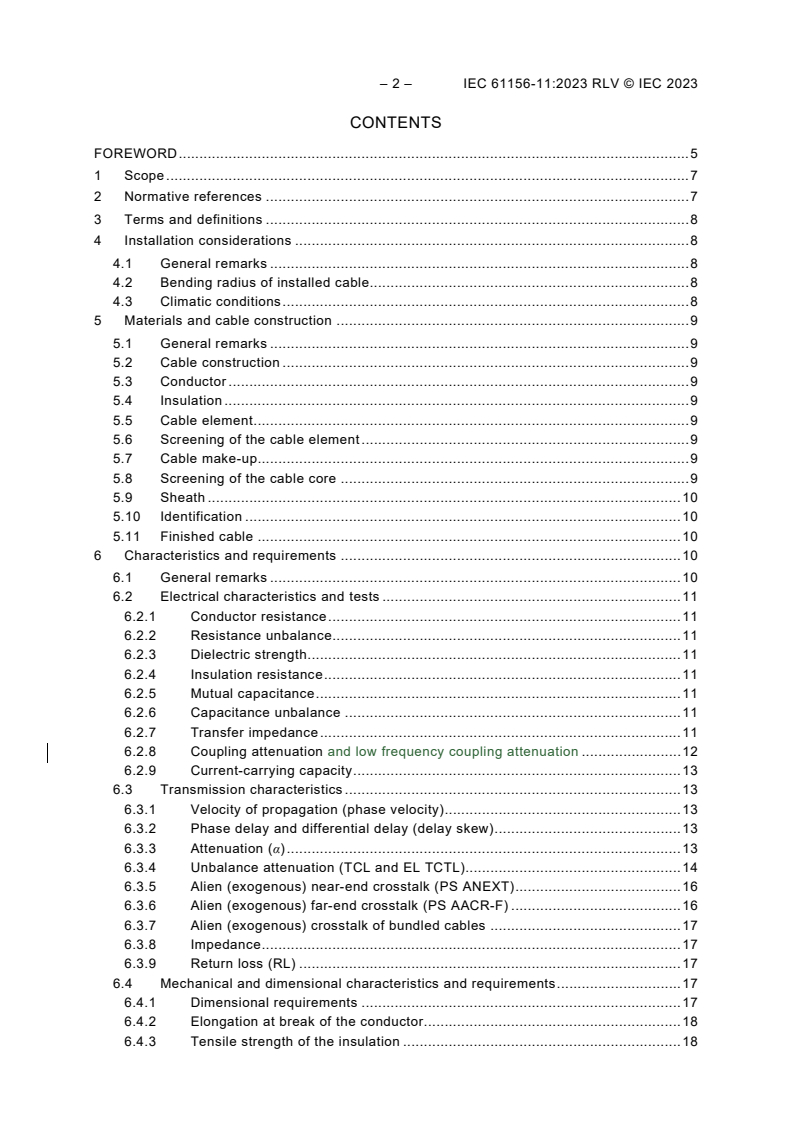
IEC 61156-11 ®
Edition 2.0 2023-05
REDLINE VERSION
INTERNATIONAL
STANDARD
colour
inside
Multicore and symmetrical pair/quad cables for digital communications –
Part 11: Symmetrical single pair cables with transmission characteristics
up to 600 MHz 1,25 GHz – Horizontal floor wiring – Sectional specification
INTERNATIONAL
ELECTROTECHNICAL
COMMISSION
ICS 33.120.20 ISBN 978-2-8322-6984-8
– 2 – IEC 61156-11:2023 RLV © IEC 2023
CONTENTS
FOREWORD . 5
1 Scope . 7
2 Normative references . 7
3 Terms and definitions . 8
4 Installation considerations . 8
4.1 General remarks . 8
4.2 Bending radius of installed cable. 8
4.3 Climatic conditions . 8
5 Materials and cable construction . 9
5.1 General remarks . 9
5.2 Cable construction . 9
5.3 Conductor . 9
5.4 Insulation . 9
5.5 Cable element . 9
5.6 Screening of the cable element . 9
5.7 Cable make-up. 9
5.8 Screening of the cable core . 9
5.9 Sheath . 10
5.10 Identification . 10
5.11 Finished cable . 10
6 Characteristics and requirements . 10
6.1 General remarks . 10
6.2 Electrical characteristics and tests . 11
6.2.1 Conductor resistance . 11
6.2.2 Resistance unbalance. 11
6.2.3 Dielectric strength . 11
6.2.4 Insulation resistance . 11
6.2.5 Mutual capacitance . 11
6.2.6 Capacitance unbalance . 11
6.2.7 Transfer impedance . 11
6.2.8 Coupling attenuation and low frequency coupling attenuation . 12
6.2.9 Current-carrying capacity . 13
6.3 Transmission characteristics . 13
6.3.1 Velocity of propagation (phase velocity) . 13
6.3.2 Phase delay and differential delay (delay skew) . 13
6.3.3 Attenuation (α) . 13
6.3.4 Unbalance attenuation (TCL and EL TCTL). 14
6.3.5 Alien (exogenous) near-end crosstalk (PS ANEXT) . 16
6.3.6 Alien (exogenous) far-end crosstalk (PS AACR-F) . 16
6.3.7 Alien (exogenous) crosstalk of bundled cables . 17
6.3.8 Impedance . 17
6.3.9 Return loss (RL) . 17
6.4 Mechanical and dimensional characteristics and requirements . 17
6.4.1 Dimensional requirements . 17
6.4.2 Elongation at break of the conductor. 18
6.4.3 Tensile strength of the insulation . 18
6.4.4 Elongation at break of the insulation . 18
6.4.5 Adhesion of the insulation to the conductor . 18
6.4.6 Elongation at break of the sheath . 18
6.4.7 Tensile strength of the sheath . 18
6.4.8 Crush test of the cable . 18
6.4.9 Impact test of the cable . 18
6.4.10 Bending under tension . 18
6.4.11 Repeated bending of the cable . 18
6.4.12 Tensile performance of the cable . 18
6.4.13 Shock-test requirements of the cable . 18
6.4.14 Bump-test requirements of the cable . 18
6.4.15 Vibration-test requirements of a cable . 19
6.5 Environmental characteristics . 19
6.5.1 Shrinkage of the insulation . 19
6.5.2 Wrapping test of the insulation after thermal ageing . 19
6.5.3 Bending test of insulation at low temperature . 19
6.5.4 Elongation at break of the sheath after ageing . 19
6.5.5 Tensile strength of the sheath after ageing . 19
6.5.6 Sheath pressure test at high temperature . 19
6.5.7 Cold bend test of the cable . 19
6.5.8 Heat shock test . 19
6.5.9 Damp heat steady state . 19
6.5.10 Solar radiation . 19
6.5.11 Solvents and contaminating fluids . 19
6.5.12 Salt mist and sulphur dioxide . 20
6.5.13 Water immersion . 20
6.5.14 Hygroscopicity . 20
6.5.15 Wicking. 20
6.5.16 Flame propagation characteristics of a single cable . 20
6.5.17 Flame propagation characteristics of bunched cables . 20
6.5.18 Halogen gas evolution . 20
6.5.19 Smoke generation . 20
6.5.20 Toxic gas emission . 20
6.5.21 Integrated fire test method for cables in environmental air handling
spaces . 21
7 Bundled cable requirements . 21
7.1 General . 21
7.2 Single pairs sharing one sheath . 21
7.2.1 General . 21
7.2.2 Near-end crosstalk (NEXT) . 21
7.2.3 Attenuation to crosstalk ratio far-end (PS ACR-F) . 22
Annex A (informative) Blank detail specification . 23
Annex B (informative) Background information for coupling attenuation and low
frequency coupling attenuation requirements . 28
Bibliography . 29
Table 1 – Transfer impedance . 12
Table 2 – Coupling attenuation . 12
– 4 – IEC 61156-11:2023 RLV © IEC 2023
Table 3 – Low frequency coupling attenuation . 13
Table 4 – Attenuation equation constants . 14
Table 5 – TCL requirements . 15
Table 6 – EL TCTL requirements . 15
Table 7 – PS ANEXT requirements . 16
Table 8 – PS AACR-F requirements . 16
Table 9 – RL requirements . 17
Table 10 – NEXT and PS NEXT requirements . 21
Table 11 – ACR-F and PS ACR-F requirements . 22
INTERNATIONAL ELECTROTECHNICAL COMMISSION
____________
MULTICORE AND SYMMETRICAL PAIR/QUAD CABLES
FOR DIGITAL COMMUNICATIONS –
Part 11: Symmetrical single pair cables with transmission characteristics
up to 600 MHz 1,25 GHz – Horizontal floor wiring – Sectional specification
FOREWORD
1) The International Electrotechnical Commission (IEC) is a worldwide organization for standardization comprising
all national electrotechnical committees (IEC National Committees). The object of IEC is to promote international
co-operation on all questions concerning standardization in the electrical and electronic fields. To this end and
in addition to other activities, IEC publishes International Standards, Technical Specifications, Technical Reports,
Publicly Available Specifications (PAS) and Guides (hereafter referred to as “IEC Publication(s)”). Their
preparation is entrusted to technical committees; any IEC National Committee interested in the subject dealt with
may participate in this preparatory work. International, governmental and non-governmental organizations liaising
with the IEC also participate in this preparation. IEC collaborates closely with the International Organization for
Standardization (ISO) in accordance with conditions determined by agreement between the two organizations.
2) The formal decisions or agreements of IEC on technical matters express, as nearly as possible, an international
consensus of opinion on the relevant subjects since each technical committee has representation from all
interested IEC National Committees.
3) IEC Publications have the form of recommendations for international use and are accepted by IEC National
Committees in that sense. While all reasonable efforts are made to ensure that the technical content of IEC
Publications is accurate, IEC cannot be held responsible for the way in which they are used or for any
misinterpretation by any end user.
4) In order to promote international uniformity, IEC National Committees undertake to apply IEC Publications
transparently to the maximum extent possible in their national and regional publications. Any divergence between
any IEC Publication and the corresponding national or regional publication shall be clearly indicated in the latter.
5) IEC itself does not provide any attestation of conformity. Independent certification bodies provide conformity
assessment services and, in some areas, access to IEC marks of conformity. IEC is not responsible for any
services carried out by independent certification bodies.
6) All users should ensure that they have the latest edition of this publication.
7) No liability shall attach to IEC or its directors, employees, servants or agents including individual experts and
members of its technical committees and IEC National Committees for any personal injury, property damage or
other damage of any nature whatsoever, whether direct or indirect, or for costs (including legal fees) and
expenses arising out of the publication, use of, or reliance upon, this IEC Publication or any other IEC
Publications.
8) Attention is drawn to the Normative references cited in this publication. Use of the referenced publications is
indispensable for the correct application of this publication.
9) Attention is drawn to the possibility that some of the elements of this IEC Publication may be the subject of patent
rights. IEC shall not be held responsible for identifying any or all such patent rights.
This redline version of the official IEC Standard allows the user to identify the changes
made to the previous edition IEC 61156-11:2019. A vertical bar appears in the margin
wherever a change has been made. Additions are in green text, deletions are in
strikethrough red text.
– 6 – IEC 61156-11:2023 RLV © IEC 2023
IEC 61156-11 has been prepared by subcommittee 46C: Wires and symmetric cables, of IEC
technical committee 46: Cables, wires, waveguides, RF connectors, RF and microwave passive
components and accessories. It is an International Standard.
This second edition cancels and replaces the first edition published in 2019. This edition
constitutes a technical revision.
This edition includes the following significant technical changes with respect to the previous
edition:
a) additional cable type in support of T1-C generic single pair cabling up to 1,25 GHz;
b) introduction of low frequency coupling attenuation as an integral parameter describing
screening efficiency at frequencies below 30 MHz.
The text of this International Standard is based on the following documents:
Draft Report on voting
46C/1254/FDIS 46C/1258/RVD
Full information on the voting for its approval can be found in the report on voting indicated in
the above table.
The language used for the development of this International Standard is English.
This document was drafted in accordance with ISO/IEC Directives, Part 2, and developed in
accordance with ISO/IEC Directives, Part 1 and ISO/IEC Directives, IEC Supplement, available
at www.iec.ch/members_experts/refdocs. The main document types developed by IEC are
described in greater detail at www.iec.ch/publications.
A list of all parts in the IEC 61156 series, published under the general title Multicore and
symmetrical pair/quad cables for digital communications, can be found on the IEC website.
The committee has decided that the contents of this document will remain unchanged until the
stability date indicated on the IEC website under webstore.iec.ch in the data related to the
specific document. At this date, the document will be
• reconfirmed,
• withdrawn,
• replaced by a revised edition, or
• amended.
IMPORTANT – The "colour inside" logo on the cover page of this document indicates that it
contains colours which are considered to be useful for the correct understanding of its
contents. Users should therefore print this document using a colour printer.
MULTICORE AND SYMMETRICAL PAIR/QUAD CABLES
FOR DIGITAL COMMUNICATIONS –
Part 11: Symmetrical single pair cables with transmission characteristics
up to 600 MHz 1,25 GHz – Horizontal floor wiring – Sectional specification
1 Scope
This part of IEC 61156 describes cables intended to be used for transmission of 1 Gbps over a
single twisted pair for office, home and industrial application. An example of existing application
is 1000BASE-T1, see ISO/IEC TR 11801-9906 . The transmission characteristics of these
cables are specified up to a frequency of 600 MHz and at a temperature of 20 °C. The cable
type recognised is intended to be used for shielded channels with a nominal length of 40 m.
Possible designs are U/FTP, X/UTP and X/FTP, where X stands for F, S or SF. This part of
IEC 61156 describes cables intended to be used for single balanced pair (office, home,
industrial) applications according to ISO/IEC 11801-1. An example of existing application is
1000BASE-T1, see ISO/IEC TR 11801-9906. The transmission characteristics of these cables
are specified up to a frequency of 1,25 GHz and at a temperature of 20 °C. The T1-C type cable
is specified up to 600 MHz, the T1-D type cable up to 1,25 GHz. Depending on the MICE
environment and the installation conditions either unscreened or screened cables can be used.
A blank detail specification can be found in Annex A.
These cables can comprise more than one pair in the event that several systems are operated
in parallel. In this case, refer to Clause 7.
The cables covered by this document are intended to operate with voltages and currents
normally encountered in communication systems. While these cables are not intended to be
used in conjunction with low impedance sources, for example the electric power supplies of
public utility mains, they are intended to be used to support the delivery of low-voltage remote
powering applications.
2 Normative references
The following documents are referred to in the text in such a way that some or all of their content
constitutes requirements of this document. For dated references, only the edition cited applies.
For undated references, the latest edition of the referenced document (including any
amendments) applies.
IEC 60708:2005, Low-frequency cables with polyolefin insulation and moisture barrier
polyolefin sheath
IEC 61156-1:2007, Multicore and symmetrical pair/quad cables for digital communications –
Part 1: Generic specification
IEC 61156-1:2007/AMD1:2009
__________
Under consideration.
A consolidated version of this publication exists, comprising IEC 61156-1:2007 and
IEC 61156-1:2007/AMD1:2009.
– 8 – IEC 61156-11:2023 RLV © IEC 2023
IEC 61156-5:2009, Multicore and symmetrical pair/quad cables for digital communications –
Part 5: Symmetrical pair/quad cables with transmission characteristics up to 1 000 MHz –
Horizontal floor wiring – Sectional specification
IEC 62153-4-3:2013, Metallic communication cable test methods – Part 4-3: Electromagnetic
compatibility (EMC) – Surface transfer impedance – Triaxial method
IEC 62153-4-5:2006, Metallic communication cables test methods – Part 4-5: Electromagnetic
compatibility (EMC) – Coupling Screening or screening coupling attenuation – Absorbing clamp
method
IEC 62153-4-9:2018, Metallic communication cable test methods – Part 4-9: Electromagnetic
compatibility (EMC) – Coupling attenuation of screened balanced cables, triaxial method
IEC 62153-4-9:2018/AMD1:2020
ISO/IEC TS 29125:2017, Information technology – Telecommunications cabling requirements
for remote powering of terminal equipment
3 Terms and definitions
For the purposes of this document, the terms and definitions given in IEC 61156-1:2007 and in
IEC 61156-1:2007/AMD1:2009 apply.
ISO and IEC maintain terminology databases for use in standardization at the following
addresses:
• IEC Electropedia: available at https://www.electropedia.org/
• ISO Online browsing platform: available at https://www.iso.org/obp
4 Installation considerations
4.1 General remarks
Installation area considerations are defined in IEC 61156-1:2007. Other areas may be
considered.
4.2 Bending radius of installed cable
The minimum bending radius of the cable shall be equal to or less than four times the outside
diameter of the cable unless otherwise specified.
4.3 Climatic conditions
Under static conditions, the cable shall operate at least in the temperature range of the
environment from −20 °C to +60 °C.
The attenuation increase due to the elevated operating temperature (temperature of the
environment) is described in 6.3.3.2.
In the case of application of remote powering, the maximum temperature of the conductor shall
not exceed the maximum operation temperature under static conditions (60 °C) in order to
maintain the integrity of the dielectric material performance which is aligned to the
environmental temperature range.
Extended temperature ranges are permitted and may shall be specified in the relevant detail
specification.
5 Materials and cable construction
5.1 General remarks
For the purposes of this document, the requirements of IEC 61156-5:2009 apply.
The choice of materials and cable construction shall be suitable for the intended application
and installation of the cable and in line with the requirements of IEC 61156-1. Particular care
shall be taken to meet Ensure that any requirements for EMC and fire performance (such as
burning properties, smoke generation, evolution of halogen gas) are met. Regional regulations
can apply as well.
5.2 Cable construction
The cable construction shall be in accordance with the details and dimensions given in the
relevant detail specification.
5.3 Conductor
The conductor shall be a solid annealed copper conductor in accordance with the requirements
of IEC 61156-1:2007 and should have a nominal diameter between 0,4 mm and 0,65 mm. A
conductor diameter of up to 1,0 1,05 mm may be used.
NOTE The conductor dimensions seen in practice are wider than those dimensions that correspond to the resistance
requirements according to 6.2.1 and are therefore relevant for the design of the contact terminals of connecting
hardware.
5.4 Insulation
The conductor shall be insulated with a suitable material. Examples of suitable materials are:
– polyolefin;
– fluoropolymer;
– low-smoke zero-halogen-free thermoplastic material.
The colour code shall be in accordance with IEC 60708 if not specified differently in the relevant
detail specification.
5.5 Cable element
The cable element shall be a pair and shall be balanced twisted pair. The entire cable may
comprise more than one cable element, see 6.3.5 and Clause 7.
5.6 Screening of the cable element
The screen of the cable element (if exists) shall be in accordance with the requirements of
IEC 61156-1:2007.
5.7 Cable make-up
Fillers or spacers may be used in the cable elements and to separate cable elements. The cable
elements and their screens, if they are screened, may be covered by an intermediate jacket.
This jacket shall be in accordance with 5.9. The core of the cable may be wrapped with a
protective layer of non-hygroscopic and non-wicking material.
5.8 Screening of the cable core
For screened cables, a screen for the cable core shall be provided. The screen shall be in
accordance with the requirements of IEC 61156-1:2007.
– 10 – IEC 61156-11:2023 RLV © IEC 2023
5.9 Sheath
The sheath material shall consist of a suitable material. Examples of suitable materials are:
– polyolefin;
– PVC;
– fluoropolymer;
– low-smoke zero-halogen-free thermoplastic material.
The sheath shall be continuous, having a thickness as uniform as possible. A non-metallic
ripcord may be provided. When provided, the ripcord shall be non-hygroscopic and non-wicking.
The colour of the sheath is not specified but it should be specified in the relevant detail
specification.
5.10 Identification
Each length of cable shall be identified as to the supplier and, when required, a traceability
code, using one or a combination of the following methods:
– appropriately coloured threads or tapes;
– with a printed tape;
– printing on the cable core wrapping;
– marking on the sheath.
Additional markings, such as length marking, are permitted. If used, such markings shall refer
to this document.
5.11 Finished cable
The finished cable shall be adequately protected for storage and shipment.
6 Characteristics and requirements
6.1 General remarks
Clause 6 lists the characteristics and minimum requirements of a cable complying with this
document. Test methods shall be in accordance with the requirements of IEC 61156-1:2007
and IEC 61156-1:2007/AMD1:2009, except for the length of the cable under test which shall be
as specified in Clause 6.
The computed requirements in dB, rounded to one decimal place, shall be used to determine
compliance.
The tests for electrical characteristics in accordance with 6.2 shall be carried out on a cable
length of not less than 100 m, unless otherwise specified.
The tests for transmission characteristics in accordance with 6.3 shall be carried out on a cable
length of 100 m, unless otherwise specified. For T1-D type cables a length of 50 m may be used
to improve accuracy at high frequencies.
For measurements over a wide frequency range as required for T1-D type cable, a balun-less
measurement technique is recommended, see IEC TR 61156-1-2 .
6.2 Electrical characteristics and tests
6.2.1 Conductor resistance
The maximum conductor resistance at or corrected to 20 °C shall not exceed 145 72,5 Ω/km.
6.2.2 Resistance unbalance
6.2.2.1 Resistance unbalance within a pair
The resistance unbalance shall not exceed 2,0 %.
6.2.2.2 Resistance unbalance between pairs
If applicable, for example in the case of bundled cables (see Clause 7), the pair-to-pair
resistance unbalance shall not exceed 5,0 %.
6.2.3 Dielectric strength
There shall be no failures when a test is performed on a conductor/conductor and, where
screens are present, on a conductor/screen with 1,0 kV DC for 1 min or, alternatively, with
2,5 kV DC for 2 s. An AC voltage may be used. The AC voltage levels in these cases shall be
0,7 kV AC for 1 min or alternatively 1,7 kV AC for 2 s.
6.2.4 Insulation resistance
The test shall be performed on:
– conductor/conductor;
– conductor/screen (if exists).
The minimum insulation resistance at or corrected to 20 °C shall be not less than 5 GΩ·km
.
5 000 MΩ km when tested immediately after the dielectric strength test.
6.2.5 Mutual capacitance
The mutual capacitance is not specified but may be indicated in the relevant detail specification.
6.2.6 Capacitance unbalance
The maximum capacitance unbalance pair to ground shall not exceed 1 200 pF/km at a
frequency of 800 Hz or 1 000 Hz.
6.2.7 Transfer impedance
For screened cables, Two three grades of performance are recognised for transfer impedance.
The transfer impedance measured in accordance with IEC 62153-4-3 shall not exceed the
values of at least one grade shown in Table 1. Requirements at frequencies below 1 MHz are
for further studies (ffs).
__________
Currently under revision to become a TS.
– 12 – IEC 61156-11:2023 RLV © IEC 2023
Table 1 – Transfer impedance
Frequency range
Maximum surface transfer impedance
MHz
mΩ/m
Grade 1 Grade 2
1 to 10
−0,176 0,301
Zf≤ 15 Zf≤ 50
t t
10 to 30
0,631
f
Zf≤ 23,392
Z ≤ 10
t
t
Where f is the frequency in MHz.
Maximum surface transfer impedance in mΩ/m
Frequency range
f in MHz
Grade 1 Grade 1b Grade 2
0,1 to 1 15 30 50
−0,176 −0,176 −0,301
1 to 10
Zf≤ 15 Zf≤ 30 Zf≤ 50
( ) ( ) ( )
t t t
0,631
f f
Zf≤ 23,392
10 to 20 ( )
Z ≤ 10 Z ≤ 20
t
t t
10 10
6.2.8 Coupling attenuation and low frequency coupling attenuation
Four Three performance types for coupling attenuation are recognised. Coupling attenuation
shall be measured using either the absorbing clamp method (IEC 62153-4-5) or the triaxial
method for screened cables (IEC 62153-4-9). When measured using one of these methods, the
coupling attenuation in the frequency range from f = 30 MHz to 1 000 MHz 1 GHz for T1-C type
cables or 1,25 GHz for T1-D type cables shall meet the requirements of Type I, Type Ib or Type
II indicated in Table 2.
Table 2 – Coupling attenuation
Frequency range Coupling attenuation
Coupling
attenuation type
MHz dB
30 to 100 ≥ 85
Type I 100 to1 000 for T1-C type cables
≥ 85 – 20 log (f /100); f in MHz
100 to 1 000 1 250 for T1-D type cables
30 to 100 ≥ 70
Type Ib
100 to 1 000 for T1-C type cables
≥ 70 − 20 log (f /100); f in MHz
100 to 1 250 for T1-D type cables
30 to 100 ≥ 55
Type II 100 to 1 000 for T1-C type cables
≥ 55 − 20 log (f /100); f in MHz
100 to 1 250 for T1-D type cables
For frequencies below 30 MHz three performance types for low frequency coupling attenuation
are recognised (see Table 3). Low frequency coupling attenuation shall be measured using the
triaxial method according to IEC 62153-4-9 in a tube of 3 m length.
Table 3 – Low frequency coupling attenuation
Frequency range Low frequency coupling attenuation
Low frequency coupling
attenuation type
MHz dB
≥ 85-10 log (f /30), 100 dB max. (ffs); f in MHz
Type I 0,1 to 30
≥ 70-10 log (f /30), 85 dB max. (ffs); f in MHz
Type Ib 0,1 to 30
≥ 55-10 log (f /30), 70 dB max. (ffs); f in MHz
Type II 0,1 to 30
Further details about the background of coupling attenuation versus low frequency coupling
attenuation requirements are given in Annex B.
NOTE Coupling attenuation and low frequency coupling attenuation requirements according to Type II are not
applicable for MICE E3.
6.2.9 Current-carrying capacity
The maximum current-carrying capacity is installation dependent and therefore not specified
but may be indicated in the relevant detail specification. Further guidance with respect to
current-carrying capacity is provided by ISO/IEC TS 29125:2017.
NOTE Local regulations can apply when supplying remote power.
6.3 Transmission characteristics
6.3.1 Velocity of propagation (phase velocity)
The requirements are not specified but may be indicated in the relevant detail specification.
6.3.2 Phase delay and differential delay (delay skew)
6.3.2.1 Phase delay
The phase delay, , shall not exceed the value obtained from Formula (1) in the frequency
τ
range from 1 0,1 MHz to 600 MHz for T1-C type cables or 1,25 GHz for T1-D type cables. The
requirements from 0,1 MHz to 1 MHz are ffs.
τ 534+
(1)
f
where
is the phase delay in ns/100 m;
τ
f is the frequency in MHz.
6.3.2.2 Differential delay (delay skew)
If applicable, for example in the case of bundled cables (see Clause 7), the maximum delay
skew between any two pairs, when measured at (20 ± 3) °C, shall not exceed 25 ns/100 m in
the frequency range from 0,1 MHz to 600 MHz for T1-C type cables or 1,25 GHz for T1-D type
cables. The requirements from 0,1 MHz to 1 MHz are ffs.
6.3.3 Attenuation (α)
6.3.3.1 Attenuation at 20 °C operating temperature
The maximum attenuation, α, of any pair in the frequency range indicated in Table 4 shall not
exceed the value obtained from Formula (2). The requirements from 0,1 MHz to 1 MHz are ffs.
=
– 14 – IEC 61156-11:2023 RLV © IEC 2023
(2)
α a f+bf+c f
where
α is the attenuation expressed in dB/100 m;
a, b, c are constants indicated in Table 4;
f is the frequency expressed in MHz.
Table 4 – Attenuation equation constants
Frequency range Constants
MHz a b c
0,1 to 600 for T1-C type cables
1,8 0,005 0,25
0,1 to 1 250 for T1-D type cables
6.3.3.2 Attenuation at elevated operating temperature
The increase of the maximum attenuation from Formula (2) due to elevated environmental
temperature above 20 °C is obtained by calculation as follows:
– for unscreened cables: 0,4 %/°C, for the temperature range from 20 °C to 40 °C and
0,6 %/ °C for the temperature range from 40 °C to 60 °C;
– for screened cables: 0,2 %/ °C in the temperature range from 20 °C to 60 °C.
In the event of application of remote powering, the actual conductor temperature should be
considered in order to calculate the attenuation increase. If an extended environmental
temperature range is specified (see 4.3), the temperature coefficients given in 6.3.3.2 might not
be applicable. The method provided in IEC 61156-1 should be used to determine temperature
coefficients in this case.
6.3.4 Unbalance attenuation (TCL and EL TCTL)
The minimum near-end unbalance attenuation (transverse conversion loss (TCL)) shall not be
less than the value obtained from Table 5 in the frequency range from 0,1 MHz to 600 MHz for
T1-C type cables or 1,25 GHz for T1-D type cables. The requirements from 0,1 MHz to 1 MHz
are ffs.
=
Table 5 – TCL requirements
Frequency range TCL
MHz dB
50 – 15 log (f); f in MHz;
1 to 600
40 dB maximum
Screened cables Unscreened cables
dB dB
40 − 15 log (f); f in MHz; 40 dB maximum 68 − 15 log (f); f in MHz; 53 dB maximum
10 10
Level 1
7 dB minimum 7 dB minimum
68 − 15 log (f); f in MHz; 53 dB maximum 68 − 15 log (f); f in MHz; 53 dB maximum
10 10
Level 2
7 dB minimum 7 dB minimum
68 − 15 log (f); f in MHz; 53 dB maximum 76 − 15 log (f); f in MHz; 53 dB maximum
10 10
Level 3
7 dB minimum 7 dB minimum
68 − 15 log (f); f in MHz; 53 dB maximum 84 − 15 log (f); f in MHz; 53 dB maximum
10 10
Level 4
7 dB minimum 7 dB minimum
The minimum equal-level far-end unbalance attenuation (equal-level transverse conversion
transfer loss (EL TCTL)) shall not be less than the value obtained from Table 6 in the frequency
range from 0,1 MHz to 600 MHz for T1-C type cables or 1,25 GHz for T1-D type cables. The
requirements from 0,1 MHz to 1 MHz are ffs.
Table 6 – EL TCTL requirements
Frequency range EL TCTL
MHz dB
40 − 20 log (f); f in MHz; 5 dB minimum
1 to 600
Screened cables Unscreened cables
dB dB
40 − 20 log (f); f in MHz; 53 dB maximum 40 − 20 log (f); f in MHz; 53 dB maximum
10 10
Level 1
6 dB minimum 6 dB minimum
50 − 20 log (f); f in MHz; 53 dB maximum 50 − 20 log (f); f in MHz; 53 dB maximum
10 10
Level 2
6 dB minimum 6 dB minimum
60 − 20 log (f); f in MHz; 53 dB maximum 60 − 20 log (f); f in MHz; 53 dB maximum
10 10
Level 3
6 dB minimum 6 dB minimum
For calculation of EL TCTL, the TCTL and the attenuation measurement of the test specimen
with the same length as defined in 6.1 shall be used.
– 16 – IEC 61156-11:2023 RLV © IEC 2023
6.3.5 Alien (exogenous) near-end crosstalk (PS ANEXT)
The PS ANEXT (power-sum alien near-end crosstalk) of the cable when tested in accordance
with IEC 61156-1:2007 shall be not less than the values obtained from Table 7. The
requirements from 0,1 MHz to 1 MHz are ffs.
Table 7 – PS ANEXT requirements
Frequency range PS ANEXT
MHz dB
1 to 100 67
100 to 600 67
Cable type Frequency range PS ANEXT
MHz dB
T1-C type cables 0,1 to 100 70
70 − 10 log (f/100); f in MHz
100 to 600
T1-D type cables
0,1 to 100 75
75 − 10 log (f/100); f in MHz
100 to 1 250
For screened cables meeting the requirements of 6.2.7 and 6.2.8 (minimum Type IbI) ANEXT
is proven by design (ffs).
6.3.6 Alien (exogenous) far-end crosstalk (PS AACR-F)
The PS AACR-F (power-sum alien attenuation to crosstalk ratio far-end) of the cable when
tested in accordance with IEC 61156-1:2007 shall not be less than the values obtained from
Table 8. The requirements from 0,1 MHz to 1 MHz are ffs.
For calculation of AACR-F, the AFEXT and the attenuation measurement of the test specimen
with a length as specified in 6.1 shall be used.
Table 8 – PS AACR-F requirements
Frequency range PS AACR-F
MHz dB
103 − 20 log (f); f in MHz
1 to 600
Cable type Frequency range PS AACR-F
MHz dB
T1-C type cables
98 − 20 log (f); f in MHz
0,1 to 600
T1-D type cables
103 − 20 log (f); f in MHz
0,1 to 1 250
If AFEXT up to 600 MHz is greater than 90 dB, the ACR-F may not be calculated.
If AFEXT up to 600 MHz is greater than 90 dB for T1-C type cables or greater than 90 dB up to
1 GHz and greater than 80 dB from 1 GHz to 1,25 GHz for T1-D type cables, it might not be
possible to calculate the AACR-F and it can be assumed the criteria according to Table 8 are
met.
For those frequencies where the calculated limit value of PS AACR-F is greater than 75 dB for
T1-C type cables, the requirement shall be 75 dB.
For those frequencies where the calculated limit value of PS AACR-F is greater than 80 dB for
T1-D type cables, the requirement shall be 80 dB.
For screened cables meeting the requirements in accordance with 6.2.7 and 6.2.8 (minimum
Type Ib), AFEXT is proven by design.
6.3.7 Alien (exogenous) crosstalk of bundled cables
The relevant requirements of this document – especially those of 6.3.5 and 6.3.6 – apply; see
also Clause 7.
6.3.8 Impedance
The fitted or mean characteristic impedance measured in accordance with IEC 61156-
1:2007/AMD1:2009 shall be 100 Ω ± 5 Ω at 100 MHz. A measurement of the input impedance
is not sufficient to ensure return loss limits.
Recommendations contained given in IEC TR 61156-1-2 and IEC TR 61156-1-5 for
improvement of measurement uncertainty may can be considered.
6.3.9 Return loss (RL)
The minimum return loss of any pair in the frequency range indicated in Table 9 shall not be
less than the values in Table 9.
Table 9 – RL requirements
Frequency range RL
MHz dB
20 + 10 log (f); f in MHz (ffs)
0,1 to 1
20 + 5 log (f); f in MHz
1 to 10
10 to 20 25
25 − 7 log (f/20); f in MHz
20 to 600
17,3 dB minimum
600 to 1 250
17,3 − 10 log (f/600); f in MHz
T1-D type cables only
When using a balun-less measurement technique, the corresponding descriptions of
IEC TR 61156-1-2 may can be considered. Recommendations contained in IEC TR 61156-1-5
for improvement of measurement uncertainty by a correction technique may can be considered.
6.4 Mechanical and dimensional characteristics and requirements
6.4.1 Dimensional requirements
The overall diameter of insulation, the nominal thickness of the sheath and the maximum overall
diameter of the sheath are not specified, but shall be indicated in the relevant detail
specification.
...