

IEC 60747-2:2025
(Main)Semiconductor devices - Part 2: Discrete devices - Rectifier diodes
General Information
- Abstract
IEC 60747-2:2025 specifies product specific standards for terminology, letter symbols, essential ratings and characteristics (properties), measuring and test methods, requirements for type tests, routine tests, endurance tests and marking for the following discrete semiconductor devices:
- generic rectifier diodes;
- avalanche rectifier diodes;
- fast-switching rectifier diodes;
- Schottky barrier diodes.
If no ambiguity is likely to result, any of the above will be referred to as diodes.
This edition includes the following significant technical changes with respect to the previous edition:
a) the terms and definitions for partial thermal resistance junction-to-case have been added;
b) Clauses 3, 4, 5, 6 and 7 have been amended with some deletions of information no longer in use and with some necessary additions.
- Status
- Published
- Publication Date
- 28-Sep-2025
- Technical Committee
- SC 47E - Discrete semiconductor devices
- Drafting Committee
- WG 3 - TC 47/SC 47E/WG 3
- Current Stage
- PPUB - Publication issued
- Start Date
- 29-Sep-2025
- Completion Date
- 03-Oct-2025
Overview
IEC 60747-2:2025 - "Semiconductor devices – Part 2: Discrete devices – Rectifier diodes" is the fourth edition (2025) of the IEC product-specific standard for rectifier diodes. It covers generic rectifier diodes, avalanche rectifier diodes, fast-switching rectifier diodes and Schottky barrier diodes. The standard defines terminology, letter symbols, essential ratings and characteristics, measuring and test methods, and requirements for type, routine and endurance tests plus marking.
This edition introduces terms for partial thermal resistance (junction‑to‑case) and updates Clauses 3–7 to remove obsolete information and add needed clarifications.
Key topics and requirements
- Terminology & symbols: Harmonized terms and letter symbols for voltages, currents, power dissipation, switching and mechanical ratings.
- Essential ratings & characteristics: Definitions and limits for storage/operating temperatures, repetitive and non‑repetitive reverse voltages, forward currents, reverse currents, breakdown voltage (avalanche diodes), forward/reverse recovery behavior, thermal resistance and transient thermal impedance.
- Measuring & test methods: Standardized circuits and waveforms for verifying forward voltage, breakdown, reverse current, recovered charge, reverse/forward recovery, capacitive charge and thermal impedance (see annexed figures and measurement diagrams).
- Type, routine & endurance tests: Minimum type and routine test lists, endurance test conditions, acceptance-defining characteristics and criteria, and marking requirements for product identification and traceability.
- Thermal metrics: Inclusion of partial thermal resistance junction‑to‑case and methods for measuring transient thermal impedance and Rth.
Practical applications and who uses it
IEC 60747-2:2025 is essential for stakeholders involved with discrete diode products:
- Manufacturers - use the standard to specify device ratings, test procedures, and marking for product datasheets and quality control.
- Test laboratories - apply the measuring circuits and acceptance criteria for type and routine testing.
- Component & systems designers (power electronics, automotive, industrial, consumer) - rely on standardized characteristics (forward voltage, reverse recovery, thermal impedance) for reliable circuit design and thermal management.
- Procurement & compliance teams - reference the standard for supplier qualification, conformity checks and documentation.
- Reliability engineers - use endurance test definitions and acceptance criteria to assess long‑term performance.
Keywords: IEC 60747-2:2025, rectifier diodes, avalanche diodes, Schottky diodes, fast-switching diodes, thermal resistance, reverse recovery, test methods, semiconductor device standards.
Related standards
- Other parts of IEC 60747 (general semiconductor device standards)
- Relevant IEC/ISO standards for electro-technical testing, marking and conformity assessment (check normative references in the standard for exact cross-references).
For implementation, ensure you consult the full IEC 60747-2:2025 text for exact test circuits, parameter definitions and normative requirements.
Relations
- Effective Date
- 05-Sep-2023
Frequently Asked Questions
IEC 60747-2:2025 is a standard published by the International Electrotechnical Commission (IEC). Its full title is "Semiconductor devices - Part 2: Discrete devices - Rectifier diodes". This standard covers: IEC 60747-2:2025 specifies product specific standards for terminology, letter symbols, essential ratings and characteristics (properties), measuring and test methods, requirements for type tests, routine tests, endurance tests and marking for the following discrete semiconductor devices: - generic rectifier diodes; - avalanche rectifier diodes; - fast-switching rectifier diodes; - Schottky barrier diodes. If no ambiguity is likely to result, any of the above will be referred to as diodes. This edition includes the following significant technical changes with respect to the previous edition: a) the terms and definitions for partial thermal resistance junction-to-case have been added; b) Clauses 3, 4, 5, 6 and 7 have been amended with some deletions of information no longer in use and with some necessary additions.
IEC 60747-2:2025 specifies product specific standards for terminology, letter symbols, essential ratings and characteristics (properties), measuring and test methods, requirements for type tests, routine tests, endurance tests and marking for the following discrete semiconductor devices: - generic rectifier diodes; - avalanche rectifier diodes; - fast-switching rectifier diodes; - Schottky barrier diodes. If no ambiguity is likely to result, any of the above will be referred to as diodes. This edition includes the following significant technical changes with respect to the previous edition: a) the terms and definitions for partial thermal resistance junction-to-case have been added; b) Clauses 3, 4, 5, 6 and 7 have been amended with some deletions of information no longer in use and with some necessary additions.
IEC 60747-2:2025 is classified under the following ICS (International Classification for Standards) categories: 31.080.10 - Diodes. The ICS classification helps identify the subject area and facilitates finding related standards.
IEC 60747-2:2025 has the following relationships with other standards: It is inter standard links to IEC 60747-2:2016. Understanding these relationships helps ensure you are using the most current and applicable version of the standard.
IEC 60747-2:2025 is available in PDF format for immediate download after purchase. The document can be added to your cart and obtained through the secure checkout process. Digital delivery ensures instant access to the complete standard document.
Standards Content (Sample)
IEC 60747-2 ®
Edition 4.0 2025-09
INTERNATIONAL
STANDARD
Semiconductor devices -
Part 2: Discrete devices - Rectifier diodes
ICS 31.080.10 ISBN 978-2-8327-0704-3
All rights reserved. Unless otherwise specified, no part of this publication may be reproduced or utilized in any form or
by any means, electronic or mechanical, including photocopying and microfilm, without permission in writing from either
IEC or IEC's member National Committee in the country of the requester. If you have any questions about IEC copyright
or have an enquiry about obtaining additional rights to this publication, please contact the address below or your local
IEC member National Committee for further information.
IEC Secretariat Tel.: +41 22 919 02 11
3, rue de Varembé info@iec.ch
CH-1211 Geneva 20 www.iec.ch
Switzerland
About the IEC
The International Electrotechnical Commission (IEC) is the leading global organization that prepares and publishes
International Standards for all electrical, electronic and related technologies.
About IEC publications
The technical content of IEC publications is kept under constant review by the IEC. Please make sure that you have the
latest edition, a corrigendum or an amendment might have been published.
IEC publications search - IEC Products & Services Portal - products.iec.ch
webstore.iec.ch/advsearchform Discover our powerful search engine and read freely all the
The advanced search enables to find IEC publications by a
publications previews, graphical symbols and the glossary.
variety of criteria (reference number, text, technical With a subscription you will always have access to up to date
committee, …). It also gives information on projects, content tailored to your needs.
replaced and withdrawn publications.
Electropedia - www.electropedia.org
IEC Just Published - webstore.iec.ch/justpublished The world's leading online dictionary on electrotechnology,
Stay up to date on all new IEC publications. Just Published containing more than 22 500 terminological entries in English
details all new publications released. Available online and and French, with equivalent terms in 25 additional languages.
once a month by email. Also known as the International Electrotechnical Vocabulary
(IEV) online.
IEC Customer Service Centre - webstore.iec.ch/csc
If you wish to give us your feedback on this publication or
need further assistance, please contact the Customer
Service Centre: sales@iec.ch.
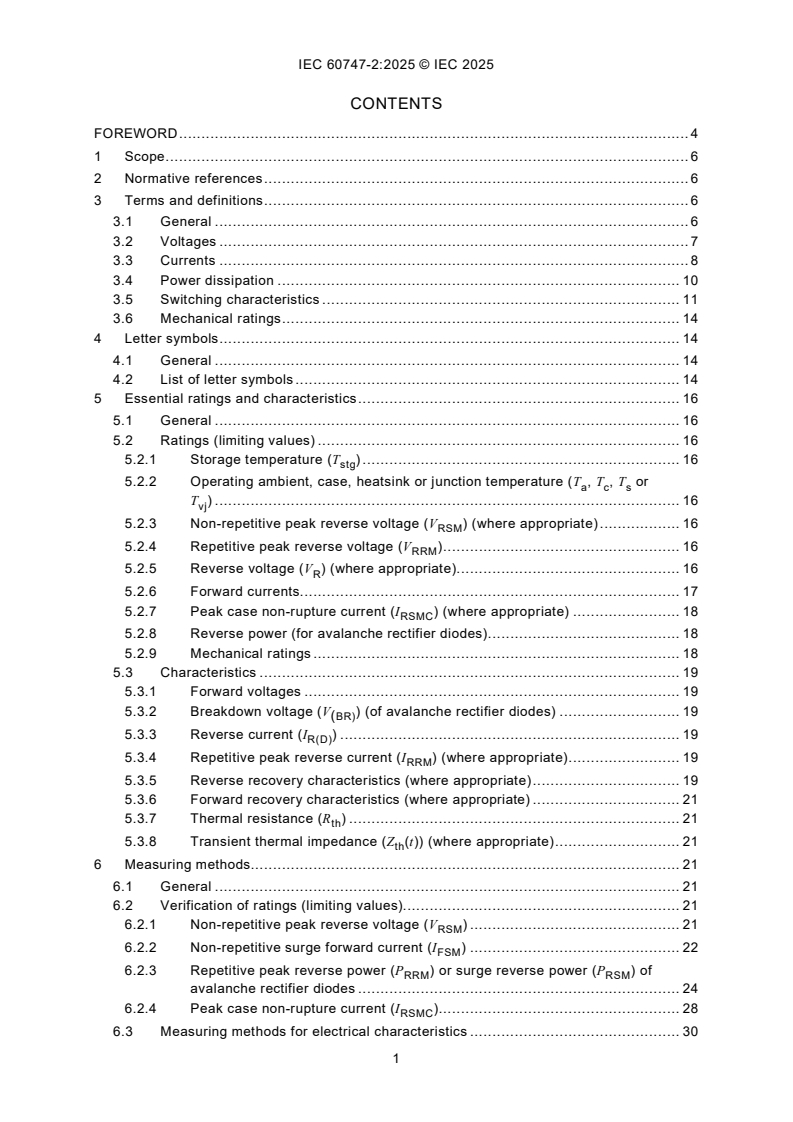
CONTENTS
FOREWORD . 4
1 Scope . 6
2 Normative references . 6
3 Terms and definitions . 6
3.1 General . 6
3.2 Voltages . 7
3.3 Currents . 8
3.4 Power dissipation . 10
3.5 Switching characteristics . 11
3.6 Mechanical ratings . 14
4 Letter symbols . 14
4.1 General . 14
4.2 List of letter symbols . 14
5 Essential ratings and characteristics . 16
5.1 General . 16
5.2 Ratings (limiting values) . 16
5.2.1 Storage temperature (T ) . 16
stg
5.2.2 Operating ambient, case, heatsink or junction temperature (T , T , T or
a c s
T ) . 16
vj
5.2.3 Non-repetitive peak reverse voltage (V ) (where appropriate) . 16
RSM
5.2.4 Repetitive peak reverse voltage (V ) . 16
RRM
5.2.5 Reverse voltage (V ) (where appropriate). 16
R
5.2.6 Forward currents. 17
5.2.7 Peak case non-rupture current (I ) (where appropriate) . 18
RSMC
5.2.8 Reverse power (for avalanche rectifier diodes) . 18
5.2.9 Mechanical ratings . 18
5.3 Characteristics . 19
5.3.1 Forward voltages . 19
5.3.2 Breakdown voltage (V ) (of avalanche rectifier diodes) . 19
(BR)
5.3.3 Reverse current (I ) . 19
R(D)
5.3.4 Repetitive peak reverse current (I ) (where appropriate) . 19
RRM
5.3.5 Reverse recovery characteristics (where appropriate) . 19
5.3.6 Forward recovery characteristics (where appropriate) . 21
5.3.7 Thermal resistance (R ) . 21
th
5.3.8 Transient thermal impedance (Z (t)) (where appropriate) . 21
th
6 Measuring methods. 21
6.1 General . 21
6.2 Verification of ratings (limiting values). 21
6.2.1 Non-repetitive peak reverse voltage (V ) . 21
RSM
6.2.2 Non-repetitive surge forward current (I ) . 22
FSM
6.2.3 Repetitive peak reverse power (P ) or surge reverse power (P ) of
RRM RSM
avalanche rectifier diodes . 24
6.2.4 Peak case non-rupture current (I ). 28
RSMC
6.3 Measuring methods for electrical characteristics . 30
6.3.1 Forward voltage (V ) . 30
F
6.3.2 Breakdown voltage (V ) of avalanche rectifier diodes . 33
(BR)
6.3.3 Reverse current (I ) . 34
R
6.3.4 Repetitive peak reverse current (I ) . 35
RRM
6.3.5 Recovered charge (Q ), reverse recovery time (t ), reverse recovery
r rr
energy (E ) and reverse recovery softness factor (S ) . 36
rr rr
6.3.6 Capacitive charge (Q ) . 41
C
6.3.7 Forward recovery time (t ) and peak forward recovery voltage (V ) . 42
fr frm
6.4 Measuring methods for thermal properties . 44
6.4.1 General. 44
6.4.2 Thermal resistance (R ) and transient thermal impedance (Z (t)) . 45
th th
7 Requirements for type tests, routine tests, endurance tests and marking . 47
7.1 Type tests . 47
7.2 Routine tests . 47
7.3 Endurance tests . 48
7.3.1 General. 48
7.3.2 List of endurance tests . 48
7.3.3 Conditions for endurance tests . 48
7.3.4 Acceptance-defining characteristics and acceptance criteria for
endurance tests . 48
7.3.5 Acceptance-defining characteristics and acceptance criteria for
reliability tests . 49
7.4 Measuring and test methods . 49
7.5 Marking . 49
Bibliography . 50
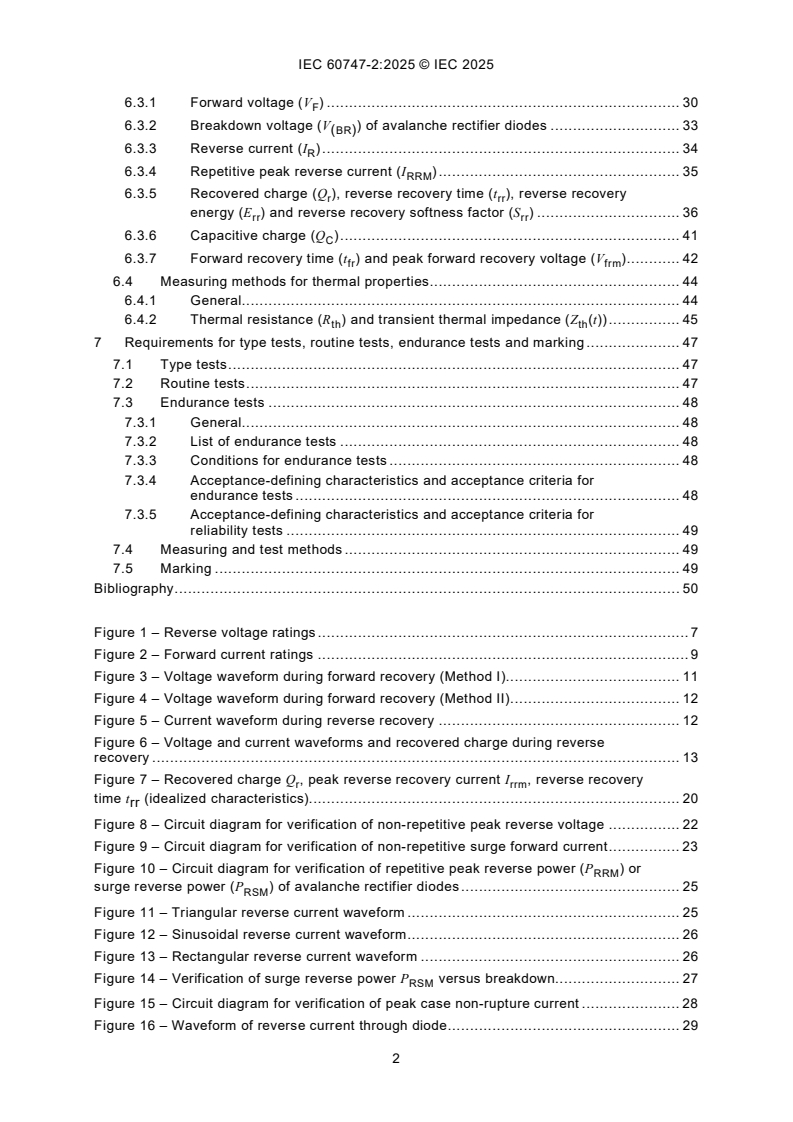
Figure 1 – Reverse voltage ratings . 7
Figure 2 – Forward current ratings . 9
Figure 3 – Voltage waveform during forward recovery (Method I). 11
Figure 4 – Voltage waveform during forward recovery (Method II) . 12
Figure 5 – Current waveform during reverse recovery . 12
Figure 6 – Voltage and current waveforms and recovered charge during reverse
recovery . 13
Figure 7 – Recovered charge Q , peak reverse recovery current I , reverse recovery
r rrm
time t (idealized characteristics). 20
rr
Figure 8 – Circuit diagram for verification of non-repetitive peak reverse voltage . 22
Figure 9 – Circuit diagram for verification of non-repetitive surge forward current . 23
Figure 10 – Circuit diagram for verification of repetitive peak reverse power (P ) or
RRM
surge reverse power (P ) of avalanche rectifier diodes . 25
RSM
Figure 11 – Triangular reverse current waveform . 25
Figure 12 – Sinusoidal reverse current waveform . 26
Figure 13 – Rectangular reverse current waveform . 26
Figure 14 – Verification of surge reverse power P versus breakdown. 27
RSM
Figure 15 – Circuit diagram for verification of peak case non-rupture current . 28
Figure 16 – Waveform of reverse current through diode . 29
Figure 17 – Circuit diagram for measurement of forward voltage . 30
Figure 18 – Circuit diagram for measurement of average forward voltage and/or peak
forward voltage (AC method) . 31
Figure 19 – Graphic representation of forward voltage versus current characteristic . 32
Figure 20 – Circuit diagram for measurement of peak forward voltage (pulse method) . 32
Figure 21 – Circuit diagram for measurement of breakdown voltage. 33
Figure 22 – Circuit diagram for measurement of reverse current . 34
Figure 23 – Circuit diagram for measurement of peak reverse current . 35
Figure 24 – Circuit diagram for measurement of reverse recovery characteristics . 36
Figure 25 – Current waveform through diode during reverse recovery (half sinusoidal
method) . 37
Figure 26 – Circuit diagram for measurement of reverse recovery characteristics
(rectangular method) . 39
Figure 27 – Current waveform through diode during reverse recovery (rectangular
method) . 39
Figure 28 – Circuit diagram for measurement of capacitive charge . 41
Figure 29 – Circuit diagram for measurement of forward recovery . 42
Figure 30 – Current waveform during forward recovery . 43
Figure 31 – Voltage waveform during forward recovery. 43
Figure 32 – Circuit diagram for measurement of thermal resistance and transient
thermal impedance . 45
Figure 33 – Calibration curve showing typical variation of forward voltage at measuring
current with case temperature (when heated from outside, i.e. T = T ). 46
c vj
Table 1 – Voltages. 15
Table 2 – Currents . 15
Table 3 – Power dissipation . 15
Table 4 – Switching characteristics . 16
Table 5 – Minimum type and routine tests for rectifier diodes . 48
Table 6 – Acceptance-defining characteristics for acceptance after endurance tests. 48
INTERNATIONAL ELECTROTECHNICAL COMMISSION
____________
Semiconductor devices -
Part 2: Discrete devices - Rectifier diodes
FOREWORD
1) The International Electrotechnical Commission (IEC) is a worldwide organization for standardization comprising
all national electrotechnical committees (IEC National Committees). The object of IEC is to promote
international co-operation on all questions concerning standardization in the electrical and electronic fields. To
this end and in addition to other activities, IEC publishes International Standards, Technical Specifications,
Technical Reports, Publicly Available Specifications (PAS) and Guides (hereafter referred to as “IEC
Publication(s)”). Their preparation is entrusted to technical committees; any IEC National Committee interested
in the subject dealt with may participate in this preparatory work. International, governmental and non-
governmental organizations liaising with the IEC also participate in this preparation. IEC collaborates closely
with the International Organization for Standardization (ISO) in accordance with conditions determined by
agreement between the two organizations.
2) The formal decisions or agreements of IEC on technical matters express, as nearly as possible, an international
consensus of opinion on the relevant subjects since each technical committee has representation from all
interested IEC National Committees.
3) IEC Publications have the form of recommendations for international use and are accepted by IEC National
Committees in that sense. While all reasonable efforts are made to ensure that the technical content of IEC
Publications is accurate, IEC cannot be held responsible for the way in which they are used or for any
misinterpretation by any end user.
4) In order to promote international uniformity, IEC National Committees undertake to apply IEC Publications
transparently to the maximum extent possible in their national and regional publications. Any divergence
between any IEC Publication and the corresponding national or regional publication shall be clearly indicated in
the latter.
5) IEC itself does not provide any attestation of conformity. Independent certification bodies provide conformity
assessment services and, in some areas, access to IEC marks of conformity. IEC is not responsible for any
services carried out by independent certification bodies.
6) All users should ensure that they have the latest edition of this publication.
7) No liability shall attach to IEC or its directors, employees, servants or agents including individual experts and
members of its technical committees and IEC National Committees for any personal injury, property damage or
other damage of any nature whatsoever, whether direct or indirect, or for costs (including legal fees) and
expenses arising out of the publication, use of, or reliance upon, this IEC Publication or any other IEC
Publications.
8) Attention is drawn to the Normative references cited in this publication. Use of the referenced publications is
indispensable for the correct application of this publication.
9) IEC draws attention to the possibility that the implementation of this document may involve the use of (a)
patent(s). IEC takes no position concerning the evidence, validity or applicability of any claimed patent rights in
respect thereof. As of the date of publication of this document, IEC had not received notice of (a) patent(s),
which may be required to implement this document. However, implementers are cautioned that this may not
represent the latest information, which may be obtained from the patent database available at
https://patents.iec.ch or www.iso.org/patents. IEC shall not be held responsible for identifying any or all such
patent rights.
IEC 60747-2 has been prepared by subcommittee 47E: Discrete semiconductor devices, of
IEC technical committee 47: Semiconductor devices. It is an International Standard.
This fourth edition cancels and replaces the third edition published in 2016. This edition
constitutes a technical revision.
This edition includes the following significant technical changes with respect to the previous
edition:
a) the terms and definitions for partial thermal resistance junction-to-case have been added;
b) Clauses 3, 4, 5, 6 and 7 have been amended with some deletions of information no longer
in use and with some necessary additions.
The text of this International Standard is based on the following documents:
Draft Report on voting
47E/861/FDIS 47E/869/RVD
Full information on the voting for its approval can be found in the report on voting indicated in
the above table.
The language used for the development of this International Standard is English.
This document was drafted in accordance with ISO/IEC Directives, Part 2, and developed in
accordance with ISO/IEC Directives, Part 1 and ISO/IEC Directives, IEC Supplement,
available at www.iec.ch/members_experts/refdocs. The main document types developed by
IEC are described in greater detail at www.iec.ch/publications.
This International Standard is to be used in conjunction with IEC 60747-1:2006 and its
Amendment 1:2010.
A list of all parts in the IEC 60747 series, published under the general title Semiconductor
devices, can be found on the IEC website.
The committee has decided that the contents of this document will remain unchanged until the
stability date indicated on the IEC website under webstore.iec.ch in the data related to the
specific document. At this date, the document will be
• reconfirmed,
• withdrawn, or
• revised.
1 Scope
This part of IEC 60747 specifies product specific standards for terminology, letter symbols,
essential ratings and characteristics (properties), measuring and test methods, requirements
for type tests, routine tests, endurance tests and marking for the following discrete
semiconductor devices:
– generic rectifier diodes;
– avalanche rectifier diodes;
– fast-switching rectifier diodes;
– Schottky barrier diodes.
If no ambiguity is likely to result, any of the above will be referred to as diodes.
2 Normative references
The following documents are referred to in the text in such a way that some or all of their
content constitutes requirements of this document. For dated references, only the edition
cited applies. For undated references, the latest edition of the referenced document (including
any amendments) applies.
IEC 60050-521, International Electrotechnical Vocabulary - Part 521: Semiconductor devices
and integrated circuits, available at https://www.electropedia.org
IEC 60747-1:2006, Semiconductor devices - Part 1: General
IEC 60747-1:2006/AMD1: 2010
IEC 60749-23, Semiconductor devices - Mechanical and climatic test methods - Part 23: High
temperature operating life
IEC 60749-25, Semiconductor devices - Mechanical and climatic test methods - Part 25:
Temperature cycling
IEC 60749-34, Semiconductor devices - Mechanical and climatic test methods - Part 34:
Power cycling
3 Terms and definitions
For the purposes of this document, the terms and definitions given in IEC 60747-1,
IEC 60050-521 and the following apply.
ISO and IEC maintain terminology databases for use in standardization at the following
addresses:
• IEC Electropedia: available at https://www.electropedia.org/
• ISO Online browsing platform: available at https://www.iso.org/obp
3.1 General
3.1.1
forward direction
direction of the flow of continuous (direct) current in which a semiconductor diode has the
lower resistance
3.1.2
reverse direction
direction of the flow of continuous (direct) current in which a semiconductor diode has the
higher resistance
3.1.3
anode terminal
terminal to which forward current flows from the external circuit
3.1.4
cathode terminal
terminal from which forward current flows to the external circuit
3.2 Voltages
3.2.1
reverse voltage
V
R
constant voltage applied to a diode in the reverse direction
3.2.2
repetitive peak reverse voltage
V
RRM
highest instantaneous value of the reverse voltage, including all repetitive transient voltages,
but excluding all non-repetitive transient voltages
Note 1 to entry: The repetitive voltage is usually a function of the circuit and increases the power dissipation of
the device. See Figure 1.
Figure 1 – Reverse voltage ratings
3.2.3
non-repetitive peak reverse voltage
peak transient reverse voltage
V
RSM
highest instantaneous value of any non-repetitive transient reverse voltage
Note 1 to entry: A non-repetitive transient voltage is usually due to an external cause. See Figure 1.
3.2.4
breakdown voltage
V
(BR)
voltage in the region where breakdown occurs
3.2.5
forward voltage
V
F
voltage across the terminals which results from the flow of current in the forward direction
3.2.6
peak forward voltage
V
FM
voltage across the terminals which results from the specified peak forward current
3.2.7
average forward voltage
V
F(AV)
average value of the voltage across the terminals over the full cycle, which results from the
specified average forward current with half sinusoidal waveform of 180° conduction angle
3.2.8
peak forward recovery voltage
V
frm
highest instantaneous value of the voltage occurring during the forward recovery time after
instantaneous switching from zero or a specified reverse voltage to a specified forward
current
3.3 Currents
3.3.1
forward current
I
F
current flowing through the diode in forward direction
3.3.2
average forward current
I
F(AV)
value of the forward current averaged over the full cycle
3.3.3
RMS forward current
I
F(RMS)
RMS value of the forward current over one complete cycle of the operating frequency
3.3.4
peak forward current
I
FM
maximum value of forward current time function
3.3.5
repetitive peak forward current
I
FRM
peak value of the forward current including all repetitive transient currents
SEE: Figure 2.
Figure 2 – Forward current ratings
3.3.6
non-repetitive surge forward current
I
FSM
forward current pulse of short time duration and specified waveform, whose application
causes or would cause the maximum rated virtual junction temperature to be exceeded, but
which is assumed to occur rarely and with a limited number of such occurrences during the
service life of the device and to be a consequence of unusual circuit conditions (e.g., a fault)
SEE: Figure 2.
3.3.7
I t value
integral of the square of non-repetitive surge forward current over the duration of the current
surge
3.3.8
reverse current
I
R
current flowing through the diode when reverse voltage is applied
3.3.9
repetitive peak reverse current
I
RRM
current flowing through the diode when repetitive peak reverse voltage is applied
3.3.10
peak reverse recovery current
I
rrm
highest instantaneous value of the reverse current which occurs during the reverse recovery
until quasi static conditions have been reached
3.3.11
peak case non-rupture current
I
RSMC
peak value of reverse current that will not cause bursting of the case or the emission of a
plasma beam under specified waveform and duration of the current as well as temperature
Note 1 to entry: This definition implies that a fine crack in the case could also be found in a device subjected to
the peak case non-rupture current, provided that no plasma beam was emitted. Parts of the case shall not break
away, nor shall the device melt externally or burst into flames.
3.4 Power dissipation
3.4.1
total power dissipation
P
tot
sum of all partial power dissipation during a full cycle
3.4.2
forward power dissipation
P
F
partial power dissipation resulting from forward power
3.4.3
average forward power dissipation
P
F(AV)
average partial power dissipation resulting from forward power
3.4.4
forward recovery dissipation
P
fr
power dissipation during forward recovery
3.4.5
reverse power dissipation
P
R
partial power dissipation resulting from reverse power
3.4.6
reverse recovery dissipation
P
rr
power dissipation during reverse recovery
3.4.7
surge reverse power
P
RSM
power which is dissipated within the diode resulting from surges
occurring when it is operating in the reverse direction
3.4.8
repetitive peak reverse power
P
RRM
power which is dissipated within the diode resulting from
repetitive peak currents when it is operating in the reverse direction
3.4.9
average reverse power dissipation
P
R(AV)
power which is dissipated within the diode resulting from
constant reverse current or as an average value of a periodical function when it is operating in
the reverse direction
3.4.10
partial thermal resistance junction-to-case at anode side
R
th(j-c)A
thermal resistance between the junction and the anode side of the case
3.4.11
partial thermal resistance junction-to-case at cathode side
R
th(j-c)K
thermal resistance between the junction and the cathode side of the case
3.5 Switching characteristics
3.5.1
forward recovery time
t
fr
time interval between the instant when the forward voltage rises through a specified first value
and the instant when it falls from its peak value V to a specified second value close to the
frm
final stable value of forward voltage, or when the extrapolated forward voltage reaches zero,
upon the application of a specified step of forward current following a zero voltage or other
specified reverse voltage condition
Note 1 to entry: See Figure 3 and Figure 4, especially for the final stable value and extrapolation of the forward
voltage.
Figure 3 – Voltage waveform during forward recovery (Method I)
Figure 4 – Voltage waveform during forward recovery (Method II)
Note 2 to entry: For Method I, the specified first and second values referred to in the definition are usually 10 %
and 110 %, respectively, of the final stable value (V in Figure 3).
F
Note 3 to entry: For Method II, the extrapolation is carried out with respect to specified points A and B where A
and B are usually 90 % and 50 % of V as shown in generalized form in Figure 4.
frm
Note 4 to entry: The Method I is preferred for V values up to about 10 V and the Method II for values
frm
considerably higher.
3.5.2
reverse recovery time
t
rr
time interval between the instant when the current passes through zero, when changing from
the forward direction to the reverse direction, and the instant when the extrapolated reverse
current reaches zero
SEE: Figure 5.
Figure 5 – Current waveform during reverse recovery
Note 5 to entry: The extrapolation is carried out with respect to specified points A and B as shown in generalized
form in Figure 5. Point A is often specified at 90 % of I , and point B at 25 % of I .
rrm rrm
3.5.3
reverse recovery current rise time
t
rrr
time interval between the beginning of the reverse recovery time and the instant when the
reverse recovery current reaches its peak value after instantaneous switching from a specified
forward current to a specified reverse voltage
3.5.4
reverse recovery current fall time
t
rrf
time interval between the instant when the reverse recovery current reaches its peak value
and the end of reverse recovery time after instantaneous switching from a specified forward
current to a specified reverse voltage
3.5.5
recovered charge
Q
r
total charge recovered from the diode during a specified integration time after switching from
a specified forward current condition to a specified reverse condition [see Formula (1)]
tt+
0i
Q it⋅ d
(1)
r ∫ rr
t
where
t is the instant when the current passes through zero;
t is the specified integration time from t to a time where i has fallen to 0,02 I .
i 0 rr rrm
Note 1 to entry: See Figure 6.
Figure 6 – Voltage and current waveforms and recovered
charge during reverse recovery
Note 2 to entry: This charge includes components due to both carrier storage and depletion layer capacitance.
[SOURCE: IEC 60050-521:2002, 521-05-18, modified – A phrase “during a specified
integration time”, integration formula and figure added.]
=
3.5.6
capacitive charge
Q
C
charge required to raise the cathode-anode voltage from zero to a
specified value
3.5.7
reverse recovery energy
E
rr
switching energy which results from the integration of the product from device voltage and
current during the integration time t of recovered charge
i
Note 1 to entry: t is shown in Figure 6.
i
3.5.8
reverse recovery softness factor
S
rr
absolute value of the ratio of the rate of rise of the reverse recovery current when passing
through zero to the maximum rate of fall of the recovery current
SEE: Formula (2).
(dit/ d )
rrr i=0
S =
(2)
rr
(dit/ d )
rrf max
Note 1 to entry: di /dt and di /dt are shown in Figure 5.
rrr rrf
3.6 Mechanical ratings
3.6.1
mounting torque
M
torque applied to rotate a screw or stud to mount a device
Note 1 to entry: For diodes having screw connections, the minimum and maximum values of the rated mounting
torque shall be specified.
3.6.2
clamping force
F
force applied to disc type device by external means to ensure electrical and thermal contact
4 Letter symbols
4.1 General
The general rules given in IEC 60747-1:2006, Clause 4 apply.
4.2 List of letter symbols
The letter symbols contained in Table 1 to Table 4 are recommended for use in the field of
rectifier diodes.
Table 1 – Voltages
Letter symbol Name and designation Remark
V
Breakdown voltage See 3.2.4 and 5.3.2
(BR)
V
Forward voltage See 3.2.5 and 5.3.1.1
F
V
Average forward voltage See 3.2.7
F(AV)
V
Peak forward voltage See 3.2.6 and 5.3.1.2
FM
V
Peak forward recovery voltage See 3.2.8 and 5.3.6.2
frm
V
Reverse voltage See 3.2.1 and 5.2.5
R
V
Repetitive peak reverse voltage See 3.2.2 and 5.2.4
RRM
V
Non-repetitive peak reverse voltage See 3.2.3 and 5.2.3
RSM
Table 2 – Currents
Letter symbol Name and designation Remark
I Forward current See 3.3.1 and 5.2.6.3
F
I Average forward current See 3.3.2 and 5.2.6.1
F(AV)
I Peak forward current See 3.3.4
FM
I Repetitive peak forward current See 3.3.5 and 5.2.6.4
FRM
I RMS forward current See 3.3.3 and 5.2.6.2
F(RMS)
I Non-repetitive surge forward current See 3.3.6 and 5.2.6.5
FSM
I Reverse current See 3.3.8
R
I Repetitive peak reverse current See 3.3.9 and 5.3.4
RRM
I Peak reverse recovery current See 3.3.10 and 5.3.5.3
rrm
I Peak case non-rupture current See 3.3.11 and 5.2.7
RSMC
Table 3 – Power dissipation
Letter symbol Name and designation Remark
P Forward power dissipation See 3.4.2
F
P Average forward power dissipation See 3.4.3
F(AV)
P Forward recovery dissipation See 3.4.4
fr
P Reverse power dissipation See 3.4.5
R
P Average reverse power dissipation See 3.4.9 and 5.2.8.3
R(AV)
P Reverse recovery dissipation See 3.4.6
rr
P Repetitive peak reverse power See 3.4.8 and 5.2.8.2
RRM
P Surge reverse power See 3.4.7 and 5.2.8.1
RSM
P Total power dissipation See 3.4.1
tot
Table 4 – Switching characteristics
Letter symbol Name and designation Remark
E Reverse recovery energy See 3.5.7 and 5.3.5.5
rr
Q Capacitive charge See 3.5.6 and 5.3.5.2
C
Q Recovered charge See 3.5.5 and 5.3.5.1
r
S Reverse recovery softness factor See 3.5.8 and 5.3.5.6
rr
t Forward recovery time See 3.5.1 and 5.3.6.1
fr
t Reverse recovery time See 3.5.2 and 5.3.5.4
rr
t Reverse recovery current fall time See 3.5.4
rrf
t Reverse recovery current rise time See 3.5.3
rrr
5 Essential ratings and characteristics
5.1 General
Many of the ratings and characteristics (properties) shall be given at T = 25 °C except where
vj
otherwise stated and at one other specified temperature.
5.2 Ratings (limiting values)
5.2.1 Storage temperature (T )
stg
Minimum and maximum values.
5.2.2 Operating ambient, case, heatsink or junction temperature (T , T , T or T )
a c s vj
Minimum and maximum values.
NOTE The case temperature is normally measured on the body of the device. For some rectifier diodes, the case
temperature is specified on one of the terminals.
5.2.3 Non-repetitive peak reverse voltage (V ) (where appropriate)
RSM
Maximum value of a reverse voltage pulse with half sinusoidal waveform, the pulse duration of
which shall be specified.
5.2.4 Repetitive peak reverse voltage (V )
RRM
Maximum value of reverse voltage pulses with half sinusoidal waveform, the pulse duration
and repetition rate of which has to be specified. If this value has to be derated at higher
operating frequencies, the derating factor or curve shall be given (see Figure 1).
5.2.5 Reverse voltage (V ) (where appropriate)
R
Maximum value of the direct voltage.
5.2.6 Forward currents
5.2.6.1 Average forward current (I )
F(AV)
Maximum value for continuous operation with half sinusoidal waveform of 180° conduction
angle and with rectangular pulses of various conduction angles, at least 180° and 120°, at
50 Hz or 60 Hz, versus ambient or case temperature.
5.2.6.2 RMS forward current (I )
F(RMS)
Maximum value for continuous operation with half sinusoidal waveform of 180° conduction
angle and with rectangular pulses of various conduction angles, at least 180° and 120°, at
50 Hz or 60 Hz, versus ambient or case temperature.
NOTE The RMS forward current is given on the assumption that no overload occurs.
5.2.6.3 Forward current (I )
F
Maximum value of the forward current at a specified ambient, case, heatsink or junction
temperature.
5.2.6.4 Repetitive peak forward current (I ) (where appropriate)
FRM
Maximum value of the repetitive peak forward current at a specified ambient, case, heatsink
or junction temperature.
5.2.6.5 Non-repetitive surge forward current (I )
FSM
Maximum value at initial conditions corresponding to maximum rated virtual junction
temperature, a specified pulse duration and a subsequently applied reverse voltage. In
addition, figures corresponding to lower initial junction temperatures can be given.
Surge current ratings shall be given for the following time periods:
a) For times smaller than one half cycle (at 50 Hz or 60 Hz), but greater than approximately
1 ms, in terms of maximum value of
i ⋅dt
∫
These ratings may be given by means of a curve or by specified values. No immediate
subsequent application of reverse voltage is assumed;
b) For times equal to or greater than one half cycle, and for at least 15 cycles (at 50 Hz or
60 Hz) in the form of a curve showing the rated surge current versus time.
These ratings should preferably be given for a reverse voltage of 80 % of the rated
repetitive peak reverse voltage. Additional ratings may be given for reverse voltages of
50 % or 100 % of the rated repetitive peak reverse voltage;
c) For a time equal to one cycle, with no reverse voltage applied.
NOTE Although surge forward current ratings are given for half sinusoidal waveform, they are, according to
experience, also applicable to approximately triangular current waveform, which occur when a sinusoidally rising
fault current is interrupted by a current-limiting fuse.
2 2
5.2.6.6 I t value (of surge forward current) (I t)
Maximum value used for the specification of non-repetitive surge forward current, given in
Formula (3):
t
22i
I t= i ⋅ dt (3)
∫
for a specified short integration time t .
i
5.2.7 Peak case non-rupture current (I ) (where appropriate)
RSMC
Maximum value for the reverse current, at specified waveform, average pulse duration and
rate of rise of the current, as well as specified initial case or junction temperature.
NOTE The value of the peak case non-rupture current depends considerably on the location of the initial
breakdown, on the chip and is usually lowest if the breakdown occurs near the edge.
5.2.8 Reverse power (for avalanche rectifier diodes)
5.2.8.1 Surge reverse power (P ) (for avalanche rectifier diodes)
RSM
Maximum value of the surge reverse power at the specified waveform (triangular, sinusoidal
or rectangular) and its pulse duration, or corresponding average pulse duration, as well as
maximum rated virtual junction temperature.
5.2.8.2 Repetitive peak reverse power (P ) (for avalanche rectifier diodes)
RRM
Maximum value of the repetitive peak reverse power at the specified waveform (triangular,
sinusoidal or rectangular), its repetition rate and pulse duration, or corresponding average
pulse duration, as well as a specified ambient or case temperature with zero forward
dissipation.
5.2.8.3 Average reverse power dissipation (P ) (for avalanche rectifier diodes)
R(AV)
Maximum value of the average reverse power at the specified waveform (triangular,
sinusoidal or rectangular), its repetition rate and pulse duration, or corresponding average
pulse duration, as well as a specified ambient or case temperature with zero forward
dissipation.
5.2.9 Mechanical ratings
5.2.9.1 Mounting torque (M) (where appropriate)
Minimum and maximum values applied to rotate a screw or stud type diode.
5.2.9.2 Clamping force (F) for disc type diodes (where appropriate)
Minimum and maximum values applied to a disc type diode. The planarity of the mounting
surface shall also be specified.
5.3 Characteristics
5.3.1 Forward voltages
5.3.1.1 Forward voltage (V )
F
Maximum value of the forward voltage at the rated forward current.
5.3.1.2 Peak forward voltage (V )
FM
Maximum value of the peak forward voltage at the specified peak forward current and at a
case or ambient temperature of 25 °C or the maximum rated virtual junction temperature. The
value of the specified peak forward current shall be stated when the peak forward voltage is
given.
NOTE If the peak forward current is specified as π times the rated average forward current, π herein can be
replaced with 3.
5.3.2 Breakdown voltage (V ) (of avalanche rectifier diodes)
(BR)
Minimum value of the reverse voltage at a specified current.
)
5.3.3 Reverse current (I
R(D)
Maximum value of the reverse current at specified high direct reverse voltage and at the
maximum rated virtual junction temperature.
NOTE If no ambiguity is likely to result, the letter symbol I can be used.
R
5.3.4 Repetitive peak reverse current (I ) (where appropriate)
RRM
Maximum value of the repetitive peak reverse current at the rated repetitive peak reverse
voltage and at 25 °C and, where appropriate, the maximum rated virtual junction temperature.
5.3.5 Reverse recovery characteristics (where appropriate)
5.3.5.1 Recovered charge (Q ) (where appropriate)
r
Maximum value, or minimum and maximum values, under the following specified conditions
(see also Figure 5 and Figure 7):
a) ambient, case or junction temperature equal to the highest temperature at which the peak
value of the forward current is permitted;
b) forward current, preferably equal to the peak value of the rated average forward current;
c) rate of fall of forward current (–di /dt);
F
d) reverse voltage, preferably equal to 50 % of the rated repetitive peak reverse voltage.
Figure 7 – Recovered charge Q , peak reverse recovery current I ,
r rrm
reverse recovery time t (idealized characteristics)
rr
) (where appropriate)
5.3.5.2 Capacitive charge (Q
C
Maximum value under the following conditions:
a) case, heatsink or junction temperature;
b) reverse voltage, preferably 67 % of rated repetitive peak reverse voltage.
5.3.5.3 Peak reverse recovery current (I ) (where appropriate)
rrm
Maximum value under the conditions as specified for recovered charge (see 5.3.5.1).
5.3.5.4 Reverse recovery time (t ) (where
...