

IEC TS 62735-1:2015
(Main)Direct current (DC) plugs and socket-outlets for information and communication technology (ICT) equipment installed in data centres and telecom central offices - Part 1: Plug and socket-outlet system for 2,6 kW
General Information
- Abstract
IEC TS 62735-1:2015(E) applies to plugs and fixed socket-outlets for class I equipment with two active contacts plus an earthing contact, a rated power of 2,6 kW and a rated voltage range from 294 V to 400 V d.c. They are intended to power d.c. information and communication technology equipment only, products according to IEC 60950.
- Status
- Published
- Publication Date
- 27-Aug-2015
- Technical Committee
- TC 23 - Electrical accessories
- Drafting Committee
- WG 19 - TC 23/SC 23B/WG 19
- Current Stage
- PPUB - Publication issued
- Start Date
- 28-Aug-2015
- Completion Date
- 31-Oct-2015
Buy Documents
IEC TS 62735-1:2015 - Direct current (DC) plugs and socket-outlets for information and communication technology (ICT) equipment installed in data centres and telecom central offices - Part 1: Plug and socket-outlet system for 2,6 kW Released:8/28/2015
Overview
IEC TS 62735-1:2015 is a Technical Specification developed by the International Electrotechnical Commission (IEC) that defines requirements and tests for direct current (DC) plugs and socket-outlets intended for information and communication technology (ICT) equipment. The specification focuses on the 2.6 kW DC plug and socket-outlet system designed for class I equipment, with a voltage range from 294 V to 400 V DC. Its primary application is in data centres and telecom central offices, where safe and standardized DC power distribution is critical for powering ICT equipment.
Key Topics
Scope and Applicability:
- Applies to plugs and fixed socket-outlets for class I ICT equipment in data centres and telecom central offices.
- Suitable for systems with a rated power of 2.6 kW and a rated voltage between 294 V and 400 V DC.
- Covers plugs and socket-outlets incorporated in cord sets and fixed to racks or walls, as well as those used as a component in assemblies like power distribution units (PDUs).
- Excludes portable socket-outlets, industrial couplers, electric vehicle connectors, household plugs, and extra-low voltage fittings.
Design Requirements:
- Two active contacts plus an earthing contact for safety and reliability.
- Intended for ordinary users in controlled data centre environments.
- Suited for use at temperatures not normally exceeding 40°C.
Electrical Requirements:
- Maximum plug/socket current: 6.5 A at 400 V DC, 8.8 A at 294 V DC, and up to 10 A at 260 V DC for short periods.
- Accessories do not require routine maintenance.
Mounting and Installation:
- Focus on fixtures intended for installation on walls, racks, or as built-in assemblies.
- Addresses essential requirements for surface-mounting boxes as they pertain to socket-outlet tests.
- Not intended for applications where ambient temperature consistently exceeds 35°C.
Safety Provisions:
- Ensures basic, overcurrent, fault, and additional protection are implemented in the connected circuits.
- Inclusion of pilot lights is allowed if they meet applicable standards.
Applications
IEC TS 62735-1:2015 is especially relevant for environments requiring reliable, standardized DC power distribution, such as:
Data Centres:
- Streamlines DC power delivery to servers and networking equipment.
- Supports high-density, energy-efficient data centre designs by using standard DC plugs and socket-outlets.
Telecom Central Offices:
- Facilitates interoperable power connections for telecom hardware.
- Helps future-proof installations with defined safety and compatibility requirements.
Rack and Wall-Mounted Assemblies:
- Standardizes components in power distribution units, cord sets, and other fixed installations.
Using standardized DC plugs and socket-outlets enhances equipment interoperability, simplifies deployment, supports modular infrastructure growth, and promotes safety and reliability in mission-critical ICT applications.
Related Standards
Implementing IEC TS 62735-1:2015 often involves consideration of several other IEC standards for comprehensive compliance and system safety:
- IEC 60950: Safety of information technology equipment, referenced for product compatibility.
- IEC 60050-151: Electrotechnical vocabulary for consistent terminology.
- IEC 60529: Degrees of protection (IP code) for enclosures.
- IEC 60670: General requirements for mounting boxes.
- IEC 61032: Protection by enclosures and test probes.
- IEC 61210: Flat quick-connect terminations for copper conductors.
- IEC 60227/60245: Cables for rated voltages up to and including 450/750 V.
IEC TS 62735-1 is part of a broader standardization effort for DC power infrastructure, helping drive efficient, safe, and scalable DC power adoption in ICT facilities worldwide.
Buy Documents
IEC TS 62735-1:2015 - Direct current (DC) plugs and socket-outlets for information and communication technology (ICT) equipment installed in data centres and telecom central offices - Part 1: Plug and socket-outlet system for 2,6 kW Released:8/28/2015
Get Certified
Connect with accredited certification bodies for this standard

IMQ S.p.A. (Certification)
Italian electrical product certification.

SLG Prüf- und Zertifizierungs GmbH
German testing and certification body.

UL Solutions
Global safety science company with testing, inspection and certification.
Sponsored listings
Frequently Asked Questions
IEC TS 62735-1:2015 is a technical specification published by the International Electrotechnical Commission (IEC). Its full title is "Direct current (DC) plugs and socket-outlets for information and communication technology (ICT) equipment installed in data centres and telecom central offices - Part 1: Plug and socket-outlet system for 2,6 kW". This standard covers: IEC TS 62735-1:2015(E) applies to plugs and fixed socket-outlets for class I equipment with two active contacts plus an earthing contact, a rated power of 2,6 kW and a rated voltage range from 294 V to 400 V d.c. They are intended to power d.c. information and communication technology equipment only, products according to IEC 60950.
IEC TS 62735-1:2015(E) applies to plugs and fixed socket-outlets for class I equipment with two active contacts plus an earthing contact, a rated power of 2,6 kW and a rated voltage range from 294 V to 400 V d.c. They are intended to power d.c. information and communication technology equipment only, products according to IEC 60950.
IEC TS 62735-1:2015 is classified under the following ICS (International Classification for Standards) categories: 29.120.01 - Electrical accessories in general; 29.120.30 - Plugs, socket-outlets, couplers. The ICS classification helps identify the subject area and facilitates finding related standards.
IEC TS 62735-1:2015 is available in PDF format for immediate download after purchase. The document can be added to your cart and obtained through the secure checkout process. Digital delivery ensures instant access to the complete standard document.
Standards Content (Sample)
IEC TS 62735-1 ®
Edition 1.0 2015-08
TECHNICAL
SPECIFICATION
colour
inside
Direct current (DC) plugs and socket-outlets for information and communication
technology (ICT) equipment installed in data centres and telecom central offices
Part 1: Plug and socket-outlet system for 2,6 kW
All rights reserved. Unless otherwise specified, no part of this publication may be reproduced or utilized in any form
or by any means, electronic or mechanical, including photocopying and microfilm, without permission in writing from
either IEC or IEC's member National Committee in the country of the requester. If you have any questions about IEC
copyright or have an enquiry about obtaining additional rights to this publication, please contact the address below or
your local IEC member National Committee for further information.
IEC Central Office Tel.: +41 22 919 02 11
3, rue de Varembé Fax: +41 22 919 03 00
CH-1211 Geneva 20 info@iec.ch
Switzerland www.iec.ch
About the IEC
The International Electrotechnical Commission (IEC) is the leading global organization that prepares and publishes
International Standards for all electrical, electronic and related technologies.
About IEC publications
The technical content of IEC publications is kept under constant review by the IEC. Please make sure that you have the
latest edition, a corrigenda or an amendment might have been published.
IEC Catalogue - webstore.iec.ch/catalogue Electropedia - www.electropedia.org
The stand-alone application for consulting the entire The world's leading online dictionary of electronic and
bibliographical information on IEC International Standards, electrical terms containing more than 30 000 terms and
Technical Specifications, Technical Reports and other definitions in English and French, with equivalent terms in 15
documents. Available for PC, Mac OS, Android Tablets and additional languages. Also known as the International
iPad. Electrotechnical Vocabulary (IEV) online.
IEC publications search - www.iec.ch/searchpub IEC Glossary - std.iec.ch/glossary
The advanced search enables to find IEC publications by a More than 60 000 electrotechnical terminology entries in
variety of criteria (reference number, text, technical English and French extracted from the Terms and Definitions
committee,…). It also gives information on projects, replaced clause of IEC publications issued since 2002. Some entries
and withdrawn publications. have been collected from earlier publications of IEC TC 37,
77, 86 and CISPR.
IEC Just Published - webstore.iec.ch/justpublished
Stay up to date on all new IEC publications. Just Published IEC Customer Service Centre - webstore.iec.ch/csc
details all new publications released. Available online and If you wish to give us your feedback on this publication or
also once a month by email. need further assistance, please contact the Customer Service
Centre: csc@iec.ch.
IEC TS 62735-1 ®
Edition 1.0 2015-08
TECHNICAL
SPECIFICATION
colour
inside
Direct current (DC) plugs and socket-outlets for information and communication
technology (ICT) equipment installed in data centres and telecom central offices
Part 1: Plug and socket-outlet system for 2,6 kW
INTERNATIONAL
ELECTROTECHNICAL
COMMISSION
ICS 29.120; 29.120.30 ISBN 978-2-8322-2869-2
– 2 – IEC TS 62735-1:2015 © IEC 2015
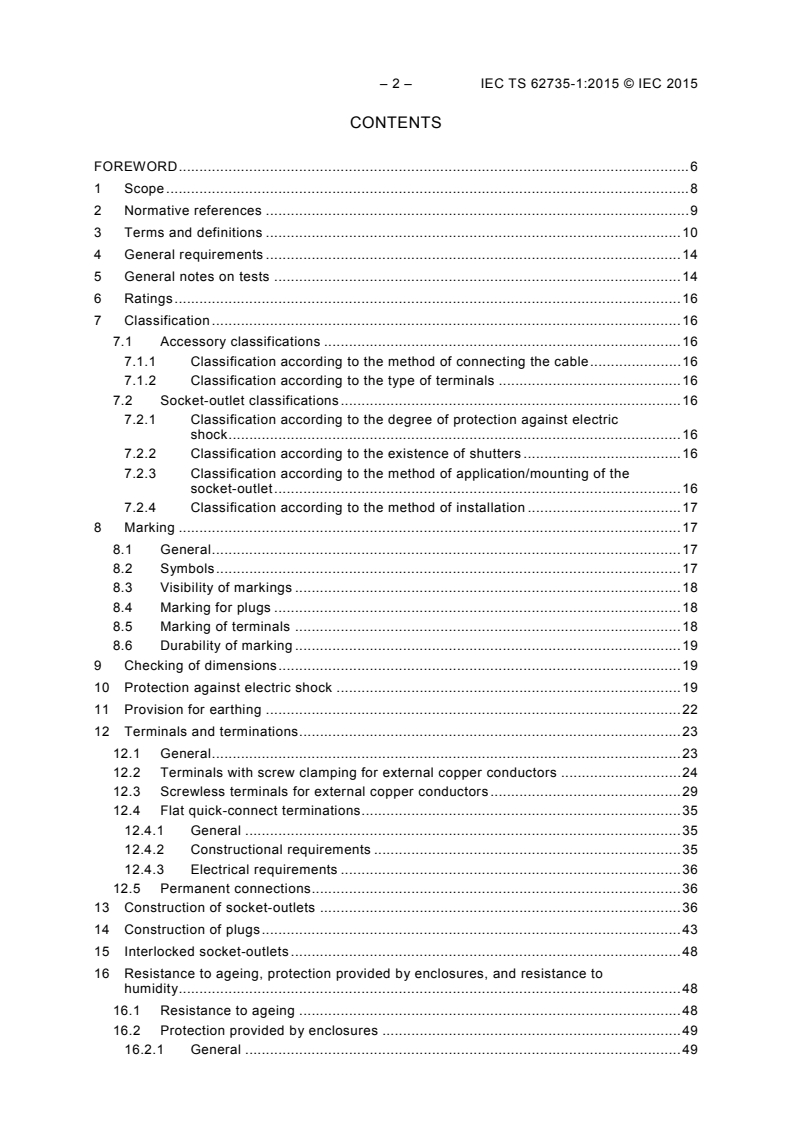
CONTENTS
FOREWORD . 6
1 Scope . 8
2 Normative references . 9
3 Terms and definitions . 10
4 General requirements . 14
5 General notes on tests . 14
6 Ratings . 16
7 Classification . 16
7.1 Accessory classifications . 16
7.1.1 Classification according to the method of connecting the cable . 16
7.1.2 Classification according to the type of terminals . 16
7.2 Socket-outlet classifications . 16
7.2.1 Classification according to the degree of protection against electric
shock . 16
7.2.2 Classification according to the existence of shutters . 16
7.2.3 Classification according to the method of application/mounting of the
socket-outlet . 16
7.2.4 Classification according to the method of installation . 17
8 Marking . 17
8.1 General . 17
8.2 Symbols . 17
8.3 Visibility of markings . 18
8.4 Marking for plugs . 18
8.5 Marking of terminals . 18
8.6 Durability of marking . 19
9 Checking of dimensions . 19
10 Protection against electric shock . 19
11 Provision for earthing . 22
12 Terminals and terminations . 23
12.1 General . 23
12.2 Terminals with screw clamping for external copper conductors . 24
12.3 Screwless terminals for external copper conductors . 29
12.4 Flat quick-connect terminations . 35
12.4.1 General . 35
12.4.2 Constructional requirements . 35
12.4.3 Electrical requirements . 36
12.5 Permanent connections. 36
13 Construction of socket-outlets . 36
14 Construction of plugs . 43
15 Interlocked socket-outlets . 48
16 Resistance to ageing, protection provided by enclosures, and resistance to
humidity . 48
16.1 Resistance to ageing . 48
16.2 Protection provided by enclosures . 49
16.2.1 General . 49
16.2.2 Protection against access to hazardous parts and against harmful
effects due to ingress of solid foreign objects . 49
16.3 Resistance to humidity . 50
17 Insulation resistance and electric strength . 51
18 Operation of earthing contacts . 52
19 Temperature rise . 53
20 Breaking capacity . 56
21 Normal operation . 57
22 Force necessary to withdraw the plug . 58
22.1 General . 58
22.2 Verification of the maximum withdrawal force for socket-outlets . 59
22.3 Verification of the minimum withdrawal force . 59
23 Flexible cables and their connection . 60
24 Mechanical strength . 63
25 Resistance to heat . 72
26 Screws, current-carrying parts and connections . 73
27 Creepage distances, clearances and distances through sealing compound . 75
28 Resistance of insulating material to abnormal heat and to fire . 77
29 Resistance to rusting . 78
Annex A (normative) Safety-related routine tests for factory-wired accessories
(protection against electric shock and correct polarity) . 107
A.1 General remarks . 107
A.2 Polarized systems, “+” and “−” – correct connection . 107
A.3 Earth continuity . 108
A.4 Short-circuit/wrong connection and reduction of creepage distance and
clearances between “+” and “−” to earth ( ) . 108
Annex B (normative) Survey of specimens needed for tests . 109
Annex C (informative) Alternative gripping tests . 110
C.1 Gripping test C1 . 110
C.2 Gripping test C2 . 112
Annex D (normative) Standard sheets and gauges . 114
D.1 Standard sheets . 114
D.2 Gauges for checking the dimensions of the entry holes . 118
Bibliography . 121
Figure 1 – Examples of accessories . 80
Figure 2 – Pillar terminals . 81
Figure 3 – Screw terminals and stud terminals . 82
Figure 4 – Saddle terminals . 83
Figure 5 – Mantle terminals. 84
Figure 6 – Example of thread-forming screw . 84
Figure 7 – Example of thread-cutting screw . 84
Figure 8 – Arrangement for compression test of 10.2 and 24.6 . 85
Figure 9 – Gauge for checking non-accessibility of live parts, through shutters . 86
Figure 10 – Gauge for checking non-accessibility of live parts, through shutters, and of
live parts of socket-outlets with increased protection. 87
– 4 – IEC TS 62735-1:2015 © IEC 2015
Figure 11 – Arrangement for checking damage to conductors . 88
Figure 12 – Information for deflection test . 89
Figure 13 – Device for checking the resistance to lateral strain . 90
Figure 14 – Example of apparatus for breaking capacity and normal operation test . 91
Figure 15 – Circuit diagram for breaking capacity and normal operation tests . 92
Figure 16 – Apparatus for verification of maximum withdrawal force . 92
Figure 17 – Apparatus for testing cord retention. 93
Figure 18 – Apparatus for flexing test . 94
Figure 19 – Sketches showing the application of the blows according to Table 20. 95
Figure 20 – Apparatus for impact test at low temperature of 24.5 . 96
Figure 21 – Example of test arrangement to verify the fixation of pins in the body of the
plug . 97
Figure 22 – Arrangement for test on covers or cover-plates . 97
Figure 23 – Gauge (thickness about 2 mm) for the verification of the outline of covers
or cover-plates . 98
Figure 24 – Examples of application of the gauge of Figure 23 on covers fixed without
screws on a mounting surface or supporting surface . 99
Figure 25 – Examples of application of the gauge of Figure 23 in accordance with the
requirements of 24.16 . 100
Figure 26 – Gauge for verification of grooves, holes and reverse tapers . 101
Figure 27 – Sketch showing the direction of application of the gauge of Figure 26 . 101
Figure 28 – Ball pressure test apparatus . 101
Figure 29 – Apparatus for compression test for the verification of resistance to heat of
25.5 . 102
Figure 30 – Test procedures for normal operation (see Clause 21) . 103
Figure 31 – Clamping unit for the temperature rise test of Clause 19 . 104
Figure 32 – The profile of the inrush current for the test of Clause 20 . 105
Figure 33 – Annex to Figure 32 with additional information on a possible circuit to
produce the inrush current as given in Figure 32 . 105
Figure 34 – Circuit diagram for testing socket-outlets and plugs according to 18.2 . 106
Figure 35 – Possible test setup for the temperature rise test for Clauses 19 and 21 . 106
Figure C.1 – Reference plug for gripping test . 111
Figure C.2 – Example of the test apparatus for plug gripping test . 112
Figure D.1 – Standard sheet 1: 2,6 kW / 294 V to 400 V d.c. socket-outlet for class I
equipment . 115
Figure D.2 – Standard sheet 2: 2,6 kW / 294 V to 400 V d.c. plug for class I equipment . 116
Figure D.3 – Standard sheet 3: positioning of the “+” and “−” pins/socket-contacts . 117
Figure D.4 – Minimum gauges for checking the dimensions of the entry holes: C1 . 118
Figure D.5 – Maximum gauges for checking the dimensions of the entry holes: C2 . 118
Figure D.6 – Gauge for checking the first point of contact: C3 . 119
Figure D.7 – Gauges for checking the minimum withdrawal force (see 22.3) . 119
Figure D.8 – Gauge for checking the maximum withdrawal force: C4max (see 22.2) . 120
Table 1 – Relationship between rated power and connectable nominal cross-sectional
areas or American Wire Gauge (AWG) size of copper conductors . 24
Table 2 – Values for pull test for screw-type terminals . 26
Table 3 – Composition of conductors . 27
Table 4 – Tightening torques for the verification of the mechanical strength of screw-
type terminals . 28
Table 5 – Relationship between rated power and connectable cross-sectional areas or
AWG size of copper conductors for screwless terminals . 30
Table 6 – Value for pull test for screwless-type terminals . 32
Table 7 – Values for flexing under mechanical load test for copper conductors . 32
Table 8 – Test current for the verification of electrical and thermal stresses in normal
use for screwless terminals . 33
Table 9 – Nominal cross-sectional areas or AWG size of rigid copper conductors for
deflection test of screwless terminals . 34
Table 10 – Deflection test forces . 35
Table 11 – Forces to be applied to tabs . 36
Table 12 – Relationship between tab size and maximum current . 36
Table 13 – Forces to be applied to covers, cover-plates or actuating members whose
fixing is not dependent on screws . 38
Table 14 – External cable dimension limits for surface-type socket-outlets . 40
Table 15 – Nominal cross-sectional areas of copper conductors and test currents for
the temperature rise test . 54
Table 16 – Maximum and minimum withdrawal force for plugs and socket-outlets . 60
Table 17 – External dimensions of flexible cables to be accommodated by cord
anchorages . 60
Table 18 – Torque test values for cord anchorages . 61
Table 19 – Maximum dimensions of flexible cables to be accommodated in rewirable
accessories . 62
Table 20 – Height of fall for impact tests . 65
Table 21 – Torque test values for glands . 68
Table 22 – Resistance to heat of different types or parts of accessories . 72
Table 23 – Creepage distances, clearances and distances through insulating sealing
compound . 76
Table B.1 – Number of specimens needed for the tests according to 5.5 . 109
– 6 – IEC TS 62735-1:2015 © IEC 2015
INTERNATIONAL ELECTROTECHNICAL COMMISSION
____________
DIRECT CURRENT (DC) PLUGS AND SOCKET-OUTLETS FOR
INFORMATION AND COMMUNICATION TECHNOLOGY (ICT) EQUIPMENT
INSTALLED IN DATA CENTRES AND TELECOM CENTRAL OFFICES
Part 1: Plug and socket-outlet system for 2,6 kW
FOREWORD
1) The International Electrotechnical Commission (IEC) is a worldwide organization for standardization comprising
all national electrotechnical committees (IEC National Committees). The object of IEC is to promote
international co-operation on all questions concerning standardization in the electrical and electronic fields. To
this end and in addition to other activities, IEC publishes International Standards, Technical Specifications,
Technical Reports, Publicly Available Specifications (PAS) and Guides (hereafter referred to as “IEC
Publication(s)”). Their preparation is entrusted to technical committees; any IEC National Committee interested
in the subject dealt with may participate in this preparatory work. International, governmental and non-
governmental organizations liaising with the IEC also participate in this preparation. IEC collaborates closely
with the International Organization for Standardization (ISO) in accordance with conditions determined by
agreement between the two organizations.
2) The formal decisions or agreements of IEC on technical matters express, as nearly as possible, an international
consensus of opinion on the relevant subjects since each technical committee has representation from all
interested IEC National Committees.
3) IEC Publications have the form of recommendations for international use and are accepted by IEC National
Committees in that sense. While all reasonable efforts are made to ensure that the technical content of IEC
Publications is accurate, IEC cannot be held responsible for the way in which they are used or for any
misinterpretation by any end user.
4) In order to promote international uniformity, IEC National Committees undertake to apply IEC Publications
transparently to the maximum extent possible in their national and regional publications. Any divergence
between any IEC Publication and the corresponding national or regional publication shall be clearly indicated in
the latter.
5) IEC itself does not provide any attestation of conformity. Independent certification bodies provide conformity
assessment services and, in some areas, access to IEC marks of conformity. IEC is not responsible for any
services carried out by independent certification bodies.
6) All users should ensure that they have the latest edition of this publication.
7) No liability shall attach to IEC or its directors, employees, servants or agents including individual experts and
members of its technical committees and IEC National Committees for any personal injury, property damage or
other damage of any nature whatsoever, whether direct or indirect, or for costs (including legal fees) and
expenses arising out of the publication, use of, or reliance upon, this IEC Publication or any other IEC
Publications.
8) Attention is drawn to the Normative references cited in this publication. Use of the referenced publications is
indispensable for the correct application of this publication.
9) Attention is drawn to the possibility that some of the elements of this IEC Publication may be the subject of
patent rights. IEC shall not be held responsible for identifying any or all such patent rights.
The main task of IEC technical committees is to prepare International Standards. In
exceptional circumstances, a technical committee may propose the publication of a Technical
Specification when
• the required support cannot be obtained for the publication of an International Standard,
despite repeated efforts, or
• the subject is still under technical development or where, for any other reason, there is the
future but no immediate possibility of an agreement on an International Standard.
Technical Specifications are subject to review within three years of publication to decide
whether they can be transformed into International Standards.
IEC TS 62735-1, which is a Technical Specification, has been prepared by IEC technical
committee 23: Electrical accessories.
In this standard, the following print types are used:
– compliance statements: in italic type
The text of this Technical Specification is based on the following documents:
Enquiry draft Report on voting
23/692/DTS 23/708A/RVC
Full information on the voting for the approval of this Technical Specification can be found in
the report on voting indicated in the above table.
This publication has been drafted in accordance with the ISO/IEC Directives, Part 2.
A list of all parts in the IEC 62735 series, published under the general title Direct current (DC)
plugs and socket-outlets for information and communication technology (ICT) equipment
installed in data centres and telecom central offices, can be found on the IEC website.
The committee has decided that the contents of this publication will remain unchanged until
the stability date indicated on the IEC website under "http://webstore.iec.ch" in the data
related to the specific publication. At this date, the publication will be
• transformed into an International Standard,
• reconfirmed,
• withdrawn,
• replaced by a revised edition, or
• amended.
A bilingual version of this publication may be issued at a later date.
IMPORTANT – The 'colour inside' logo on the cover page of this publication indicates
that it contains colours which are considered to be useful for the correct
understanding of its contents. Users should therefore print this document using a
colour printer.
– 8 – IEC TS 62735-1:2015 © IEC 2015
DIRECT CURRENT (DC) PLUGS AND SOCKET-OUTLETS FOR
INFORMATION AND COMMUNICATION TECHNOLOGY (ICT) EQUIPMENT
INSTALLED IN DATA CENTRES AND TELECOM CENTRAL OFFICES
Part 1: Plug and socket-outlet system for 2,6 kW
1 Scope
This part of IEC 62735, which is a Technical Specification, applies to plugs and fixed socket-
outlets for class I equipment with two active contacts plus an earthing contact, a rated power
of 2,6 kW and a rated voltage range from 294 V to 400 V d.c. They are intended to power d.c.
information and communication technology equipment only, products according to IEC 60950.
The accessories according to this part of IEC 62735 are intended to be used by ordinary
persons in data centres only where the value of the d.c. voltage distribution system is defined
as follows:
– 380 V with a tolerance of ±20 V for installations with no backup battery or with a voltage
regulation system;
– 380 V with a voltage range of 294 V to 400 V for installations with a backup battery where
voltage regulation is not guaranteed;
– the voltage value between each live conductor and earth does not exceed 200 V d.c.
during normal operation;
– there are two abnormal voltage ranges (duration below 10 min):
• 260 V up to 294 V, and
• above 400 V to 410 V.
The maximum current of the plug and the socket-outlet is
– 6,5 A when the voltage between live contacts is 400 V d.c.,
– 8,8 A when the voltage between live contacts is 294 V d.c.
and can rise up to 10 A when the voltage between live contacts decreases to 260 V d.c. for
10 min maximum.
The voltage between live conductors can fall down to 260 V d.c. when the voltage discharge
value of the battery reaches the disconnecting level. The consequence is that the current
increases accordingly.
The accessories according to this part of IEC 62735 do not require maintenance.
Plugs and socket-outlets covered by this part of IEC 62735 are intended for use in circuits
where
– basic protection,
– an overcurrent protection (of 8,8 A or less for each socket-outlet or multiple socket-outlet),
– the fault protection (indirect contact protection), and
– additional protection
are already assured.
This part of IEC 62735 does not cover requirements for flush mounting boxes: however, it
covers only those requirements for surface-type mounting boxes which are necessary for the
tests on the socket-outlet.
NOTE 1 General requirements for mounting boxes are given in IEC 60670.
This part of IEC 62735 also applies to
– plugs incorporated in cord sets,
– plugs and socket-outlets incorporated in cord extension sets for data centres to be fixed to
a wall or a rack,
– the cord extension set and multiple socket-outlets for data centres intended to be fixed to
a wall or a rack, and
– socket-outlets which are a component of an assembly,
unless otherwise stated in the standard for the relevant assembly.
This part of IEC 62735 does not apply to
– single or multiple portable socket-outlets not fixed to a wall or a rack;
– plugs, socket-outlets and couplers for industrial purposes;
– plugs, socket-outlets and vehicle couplers for electric vehicles according to the IEC 61851
and IEC 62196 series;
– plugs and socket-outlets for household;
– appliance couplers;
– plugs, fixed and portable socket-outlets for extra-low voltage (ELV);
NOTE 2 ELV values are specified in IEC 60364-4-41.
– fixed socket-outlets combined with fuses, automatic switches, etc.
Socket-outlets with pilot lights are allowed provided that pilot lights comply with the relevant
standard, if any.
Plugs and socket-outlets complying with this part of IEC 62735 are only suitable for use at
ambient temperatures not normally exceeding +40 °C, but their average over a period of 24 h
does not exceed +35 °C, with a lower limit of the ambient air temperature of −5 °C.
Socket-outlets complying with this part of IEC 62735 are only suitable for incorporation or
mounting in equipment in such a way and in such a place that it is unlikely that the
surrounding temperature exceeds 35 °C.
2 Normative references
The following documents, in whole or in part, are normatively referenced in this document and
are indispensable for its application. For dated references, only the edition cited applies. For
undated references, the latest edition of the referenced document (including any
amendments) applies.
IEC 60050-151:2001, International Electrotechnical Vocabulary – Part 151: Electrical and
magnetic devices (available at: www.electropedia.org)
IEC 60068-2-31, Environmental testing – Part 2-31: Tests – Test Ec: Rough handling shocks,
primarily for equipment-type specimens
– 10 – IEC TS 62735-1:2015 © IEC 2015
IEC 60227 (all parts), Polyvinyl chloride insulated cables of rated voltages up to and including
450/750 V
IEC 60245 (all parts), Rubber insulated cables – Rated voltages up to and including
450/750 V
IEC 60352-2, Solderless connections – Part 2: Crimped connections – General requirements,
test methods and practical guidance
IEC 60423, Conduit systems for cable management – Outside diameters of conduits for
electrical installations and threads for conduits and fittings
IEC 60512-12-1, Connectors for electronic equipment – Tests and measurements – Part 12-1:
Soldering tests – Test 12a: Solderability, wetting, solder bath method
IEC 60512-12-2, Connectors for electronic equipment – Tests and measurements – Part 12-2:
Soldering tests – Test 12b: Solderability, wetting, soldering iron method
IEC 60529, Degrees of protection provided by enclosures (IP Code)
IEC 60695-2-11, Fire hazard testing – Part 2-11: Glowing/hot-wire based test methods –
Glow-wire flammability test method for end-products (GWEPT)
IEC 61032, Protection of persons and equipment by enclosures – Probes for verification
IEC 61210, Connecting devices – Flat quick-connect terminations for electrical copper
conductors – Safety requirements
ISO 1456, Metallic coatings – Electrodeposited coatings of nickel, nickel plus chromium,
copper plus nickel and of copper plus nickel plus chromium
3 Terms and definitions
For the purposes of this document, the terms and definitions given in IEC 60050-151 and the
following apply.
NOTE 1 Where the terms "voltage" and "current" are used, they imply r.m.s. values, unless otherwise specified.
NOTE 2 Throughout this part of IEC 62735, the word "earthing" is used for “protective earthing”.
NOTE 3 The term "accessory" is used as a general term covering plugs and socket-outlets; the term "portable
accessory" covers plugs. Examples of the use of accessories are shown in Figure 1a.
3.1
plug
accessory having pins designed to engage with the contacts of a socket-outlet, also
incorporating means for the electrical connection and mechanical retention of flexible cable
3.2
socket-outlet
accessory intended for frequent use by ordinary persons, having socket contacts designed to
engage with the pins of a plug and having terminals, terminations or other means for the
connection of cable and the like
Note 1 to entry: Throughout this part of IEC 62735, socket-outlets cover fixed socket-outlets, single and multiple
socket-outlets for data centres to be fixed to a wall or a rack.
3.3
fixed socket-outlet
socket-outlet intended to be connected to fixed wiring
Note 1 to entry: An example is shown in Figure 1a.
3.4
single socket-outlet for data centres to be fixed to a wall or a rack
one socket-outlet for assemblies with or without cable
3.5
multiple socket-outlet for data centres to be fixed to a wall or a rack
combination of two or more socket-outlets for assemblies with or without cable
Note 1 to entry: An example is shown in Figure 1d.
3.6
socket-outlet for assemblies
socket-outlet intended to be built in, or fixed to assemblies
Note 1 to entry: Examples of assemblies are power strips, multiple socket-outlets to be fixed to a wall or a rack,
power distribution units (PDUs), rectifier, d.c. power supply, and test equipment.
3.7
rewirable plug
plug so constructed that the flexible cable can be replaced
3.8
rewirable multiple socket-outlet for data centres intended to be fixed to a wall or a rack
multiple socket-outlet for data centres intended to be fixed to a wall or a rack so constructed
that the flexible cable can be replaced
3.9
non-rewirable plug
plug so constructed that it forms a complete unit with the flexible cable after connection and
assembly by the manufacturer of the accessory
Note 1 to entry: See also 14.1.
3.10
non-rewirable multiple socket-outlet for data centres intended to be fixed to a wall or a
rack
multiple socket-outlet for data centres intended to be fixed to a wall or a rack so constructed
that it forms a complete unit with the flexible cable after connection and assembly by the
manufacturer of the accessory
Note 1 to entry: See also 14.1.
3.11
moulded-on plug
non-rewirable plug, the manufacture of which is completed by insulating material moulded
around pre-assembled component parts and the terminations for the flexible cable or cord
[SOURCE: IEC 60050-442:1998, 442-01-14, modified – "accessory" has been replaced by
“plug”.]
3.12
mounting box
box intended for mounting in or on a wall, floor or ceiling, etc., for flush or surface application,
intended for use with fixed socket-outlet(s)
– 12 – IEC TS 62735-1:2015 © IEC 2015
3.13
cord extension set for data centres intended to be fixed to a wall or a rack
assembly consisting of one flexible cable fitted with one plug and one single socket-outlet for
equipment or multiple socket-outlet for data centres to be fixed to a wall or a rack
3.14
terminal
insulated or non-insulated connecting device intended for reusable electrical connection of the
external conductors
3.15
termination
insulated or non-insulated connecting device intended for non-reusable electrical connection
of the external conductors
3.16
clamping unit
part or parts of a terminal necessary for the mechanical clamping and the electrical
connection of the conductor(s) for test purposes
3.17
screw-type terminal
terminal for the connection and subsequent disconnection of a conductor or the
interconnection of two or more conductors, capable of being dismantled, the connection being
made, directly or indirectly, by means of screws or nuts of any kind
3.18
pillar terminal
screw-type terminal in which the conductor is inserted into a hole or cavity, where it is
clamped under the end of the screw or screws
Note 1 to entry: The clamping pressure may be applied directly by the end of the screw or through an
intermediate clamping member to which pressure is applied by the end of the screw.
Note 2 to entry: Examples of pillar terminals are shown in Figure 2.
3.19
screw terminal
screw-type terminal in which the conductor is clamped under the head of the screw
Note 1 to entry: The clamping pressure may be applied directly to the head of a screw or through an intermediate
part, such as a washer, clamping plate or anti-spread device.
Note 2 to entry: Examples of screw terminals are shown in Figure 3.
3.20
stud terminal
screw-type terminal in which the conductor is clamped under a nut
Note 1 to entry: The clamping pressure may be applied directly by a suitably shaped nut or through an
intermediate part, such as a washer, clamping plate or anti-spread device.
Note 2 to entry: Examples of stud terminals are shown in Figure 3.
3.21
saddle terminal
screw-type terminal in which the conductor is clamped under a saddle by means of two or
more screws or nuts
Note 1 to entry: Examples of saddle terminals are shown in Figure 4.
3.22
mantle terminal
screw-type terminal in which the conductor is clamped against the base of a slot in a threaded
stud by means of a nut
Note 1 to entry: The conductor is clamped against the base of the slot by a suitably shaped washer under the nut,
by a central peg if the nut is a cap nut, or by an equally effective means for transmitting the pressure from the nut
to the conductor within the slot.
Note 2 to entry: Examples of mantle terminals are shown in Figure 5.
3.23
screwless terminal
connecting device for the connection and subsequent disconnection of a rigid (solid or
stranded) or flexible conductor or the interconnection of two or more conductors, capable of
being dismantled, the connection being made, directly or indirectly, by means of springs, parts
of angled, eccentric or conical form, etc., without special preparation of the conductor
concerned, other than removal of insulation
3.24
thread-forming screw
screw having an uninterrupted thread, which by screwing in, forms a thread by displacing
material
Note 1 to entry: An example of a thread-forming screw is shown in Figure 6.
3.25
thread-cutting screw
screw having an interrupted thread, which by screwing in, forms a thread by removing
material
Note 1 to entry: An example of a thread-cutting screw is shown in Figure 7.
3.26
rated power
power assigned to the plug or socket-outlet
3.27
rated voltage range
voltage range assigned to the plug or socket-outlet
3.28
shutter
movable part incorporated into a socket-outlet arranged to shield at least the live socket-outlet
contacts automatically when the plug is withdrawn
3.29
type test
test of one or more devices made to a certain design to show that the design meets certain
specifications
3.30
routine test
test to which each individual device is subjected during and/or after manufacture to ascertain
whether it complies with certain criteria
3.31
base
part of the socket-outlet supporting the socket-contacts
– 14 – IEC TS 62735-1:2015 © IEC 2015
3.32
live part
conductor or conductive part intended to be energized in normal use, including a neutral
conductor, but, by convention, not a PEN conductor
[SOURCE: IEC 60050-826: 826-12-08, modified – "normal operation" has been replaced by
"normal use", "PEM or PEL conductor" has been deleted, and the note has been deleted.]
3.33
cable anchorage
that part of an accessory which has the ability to limit the displacement of a fitted flexible
cable against pull, push and turning forces
3.34
main part
assembly consisting of the base and other parts
Note 1 to entry: This assembly is not intended to be dismantled at any time after manufacture.
3.35
prospective short-circuit current
current that would flow in the circuit if the socket-outlet, the limitation device and the short
circuit in the plug were replaced by links of negligible impedance without any other change in
the circuit.
3.36
prospective let-through I t value
value that would be let through by the current limiting device if the socket-outlet and the short
circuit in the plug were replaced by links of negligible impedance
Note 1 to entry: The I t value may be limited by using an open wire fuse or other suitable devices.
3.37
stroke
insertion or a withdrawal of the plug
4 General requirements
Accessories and boxes of surface mounting accessories shall be so designed and constructed
that, in normal use, their performance is reliable and safety
...