

IEC 62282-3-300:2012
(Main)Fuel cell technologies - Part 3-300: Stationary fuel cell power systems - Installation
General Information
- Abstract
IEC 62282-3-300:2012 provides minimum safety requirements for the installation of indoor and outdoor stationary fuel cell power systems in compliance with IEC 62282-3-100 and applies to the installation of the following systems:
- intended for electrical connection to mains directly or with a readily accessible, manually operable switch or circuit-breaker;
- intended for a stand-alone power distribution system;
- intended to provide AC or DC power;
- with or without the ability to recover useful heat.
- Status
- Published
- Publication Date
- 13-Jun-2012
- Technical Committee
- TC 105 - Fuel cell technologies
- Drafting Committee
- MT 204 - TC 105/MT 204
- Current Stage
- PPUB - Publication issued
- Start Date
- 14-Jun-2012
- Completion Date
- 31-Mar-2012
Overview
IEC 62282-3-300:2012 specifies the minimum safety requirements for the installation of stationary fuel cell power systems, both indoor and outdoor. Published by the International Electrotechnical Commission (IEC), this standard addresses installation-related risks to ensure personnel and property safety, ensuring compliance with IEC 62282-3-100 for overall safety of fuel cell technologies. The requirements apply to systems connected directly to the mains or operating independently, providing AC or DC power, and may include heat recovery features. Notably, this standard focuses on safe installation practices and does not cover the operation or manufacturing safety requirements that are defined separately.
Key Topics
General Safety Requirements
Installation must adhere to manufacturer’s guidelines and address hazards related to fuel, other stored energy, and potential releases of gases or liquids. Installers are required to:- Eliminate hazards to personnel and equipment
- Mark remaining risks clearly
- Apply strategies to prevent, contain, or respond to hazardous incidents
Siting Considerations
Safe placement of stationary fuel cell power systems is critical, including:- Secure fixing to prevent movement
- Protection from weather, seismic events, and unauthorized access
- Sufficient distance from building exits, air intakes, combustible materials, and pedestrian paths
- Maintaining accessibility for maintenance and emergency response
Ventilation and Exhaust Systems
- Adequate ventilation (forced or natural) is mandatory to prevent hazardous atmosphere accumulation
- Dedicated exhaust systems must discharge emissions outside, away from doors, windows, or air intakes
- For small systems in sheds, special provisions apply to ensure safe air quality
Fire Protection and Gas Detection
- Installation sites with flammable liquid storage must comply with fire protection regulations
- Combustible gas detectors are required in indoor installations, except where exemptions apply
- Detectors must alarm at 25% LFL (lower flammability limit) and shut down at 50% LFL
Interconnections and Interfaces
- Proper connection to fuel, water, auxiliary gases, and waste disposal must follow national standards
- Manual and automatic shut-off valves are specified for different installation scenarios
- All piping and wiring must be protected from damage and ensure fail-safe operation during faults
Applications
IEC 62282-3-300:2012 is widely applicable across industries adopting stationary fuel cell power systems. Key applications include:
Commercial and Industrial Facilities
Safe installation of onsite power generation equipment, ensuring uninterrupted and secure power supply for buildings, data centers, or factories.Utility Grid Integration
Deployment of auxiliary power systems connected to the main electrical grid or running as standalone sources, supporting energy resilience and decentralized generation.Microgrids and Off-Grid Solutions
Installations in remote or critical locations where reliable, efficient, and eco-friendly power sources are required, such as telecom towers, hospitals, or isolated communities.Combined Heat and Power (CHP) Systems
Installations that recover useful heat from fuel cell operation, optimizing overall energy efficiency in facilities seeking to reduce carbon footprint.
Related Standards
When implementing IEC 62282-3-300:2012, consider these related standards for comprehensive compliance and best practices:
IEC 62282-3-100: Fuel cell technologies - Stationary fuel cell power systems - Safety
Defines fundamental safety requirements for stationary fuel cell power systems.IEC 60079-10: Explosive atmospheres - Classification of areas
Critical for assessing hazardous locations due to flammable atmospheres.IEC 60079-29-1 & -29-2: Gas detectors – Performance, selection, and installation
Specify requirements for use, installation, and maintenance of gas detection systems.ISO 23551-1: Automatic valves for gas-burning appliances
Ensures safety in the design and installation of automatic fuel shut-off devices.ISO 1182 and ISO 14121: Non-combustibility testing and risk assessment
Provide guidance on selecting non-combustible materials and risk identification.
IEC 62282-3-300:2012 ensures that stationary fuel cell power system installations are executed with a focus on safety, reliability, and regulatory compliance, supporting the adoption of clean energy technologies worldwide.
Relations
- Effective Date
- 05-Sep-2023
Get Certified
Connect with accredited certification bodies for this standard

DNV
DNV is an independent assurance and risk management provider.

Lloyd's Register
Lloyd's Register is a global professional services organisation specialising in engineering and technology.
DNV Energy Systems
Energy and renewable energy certification.
Sponsored listings
Frequently Asked Questions
IEC 62282-3-300:2012 is a standard published by the International Electrotechnical Commission (IEC). Its full title is "Fuel cell technologies - Part 3-300: Stationary fuel cell power systems - Installation". This standard covers: IEC 62282-3-300:2012 provides minimum safety requirements for the installation of indoor and outdoor stationary fuel cell power systems in compliance with IEC 62282-3-100 and applies to the installation of the following systems: - intended for electrical connection to mains directly or with a readily accessible, manually operable switch or circuit-breaker; - intended for a stand-alone power distribution system; - intended to provide AC or DC power; - with or without the ability to recover useful heat.
IEC 62282-3-300:2012 provides minimum safety requirements for the installation of indoor and outdoor stationary fuel cell power systems in compliance with IEC 62282-3-100 and applies to the installation of the following systems: - intended for electrical connection to mains directly or with a readily accessible, manually operable switch or circuit-breaker; - intended for a stand-alone power distribution system; - intended to provide AC or DC power; - with or without the ability to recover useful heat.
IEC 62282-3-300:2012 is classified under the following ICS (International Classification for Standards) categories: 27.070 - Fuel cells; 29.060.20 - Cables. The ICS classification helps identify the subject area and facilitates finding related standards.
IEC 62282-3-300:2012 has the following relationships with other standards: It is inter standard links to IEC 62282-3-3:2007. Understanding these relationships helps ensure you are using the most current and applicable version of the standard.
IEC 62282-3-300:2012 is available in PDF format for immediate download after purchase. The document can be added to your cart and obtained through the secure checkout process. Digital delivery ensures instant access to the complete standard document.
Standards Content (Sample)
IEC 62282-3-300 ®
Edition 1.0 2012-06
INTERNATIONAL
STANDARD
NORME
INTERNATIONALE
Fuel cell technologies –
Part 3-300: Stationary fuel cell power systems – Installation
Technologies des piles à combustible –
Partie 3-300: Systèmes à piles à combustible stationnaires – Installation
All rights reserved. Unless otherwise specified, no part of this publication may be reproduced or utilized in any form
or by any means, electronic or mechanical, including photocopying and microfilm, without permission in writing from
either IEC or IEC's member National Committee in the country of the requester.
If you have any questions about IEC copyright or have an enquiry about obtaining additional rights to this publication,
please contact the address below or your local IEC member National Committee for further information.
Droits de reproduction réservés. Sauf indication contraire, aucune partie de cette publication ne peut être reproduite ni
utilisée sous quelque forme que ce soit et par aucun procédé, électronique ou mécanique, y compris la photocopie et les
microfilms, sans l'accord écrit de la CEI ou du Comité national de la CEI du pays du demandeur.
Si vous avez des questions sur le copyright de la CEI ou si vous désirez obtenir des droits supplémentaires sur cette
publication, utilisez les coordonnées ci-après ou contactez le Comité national de la CEI de votre pays de résidence.
IEC Central Office Tel.: +41 22 919 02 11
3, rue de Varembé Fax: +41 22 919 03 00
CH-1211 Geneva 20 info@iec.ch
Switzerland www.iec.ch
About the IEC
The International Electrotechnical Commission (IEC) is the leading global organization that prepares and publishes
International Standards for all electrical, electronic and related technologies.
About IEC publications
The technical content of IEC publications is kept under constant review by the IEC. Please make sure that you have the
latest edition, a corrigenda or an amendment might have been published.
Useful links:
IEC publications search - www.iec.ch/searchpub Electropedia - www.electropedia.org
The advanced search enables you to find IEC publications The world's leading online dictionary of electronic and
by a variety of criteria (reference number, text, technical electrical terms containing more than 30 000 terms and
committee,…). definitions in English and French, with equivalent terms in
It also gives information on projects, replaced and additional languages. Also known as the International
withdrawn publications. Electrotechnical Vocabulary (IEV) on-line.
IEC Just Published - webstore.iec.ch/justpublished Customer Service Centre - webstore.iec.ch/csc
Stay up to date on all new IEC publications. Just Published If you wish to give us your feedback on this publication
details all new publications released. Available on-line and or need further assistance, please contact the
also once a month by email. Customer Service Centre: csc@iec.ch.
A propos de la CEI
La Commission Electrotechnique Internationale (CEI) est la première organisation mondiale qui élabore et publie des
Normes internationales pour tout ce qui a trait à l'électricité, à l'électronique et aux technologies apparentées.
A propos des publications CEI
Le contenu technique des publications de la CEI est constamment revu. Veuillez vous assurer que vous possédez
l’édition la plus récente, un corrigendum ou amendement peut avoir été publié.
Liens utiles:
Recherche de publications CEI - www.iec.ch/searchpub Electropedia - www.electropedia.org
La recherche avancée vous permet de trouver des Le premier dictionnaire en ligne au monde de termes
publications CEI en utilisant différents critères (numéro de électroniques et électriques. Il contient plus de 30 000
référence, texte, comité d’études,…). termes et définitions en anglais et en français, ainsi que
Elle donne aussi des informations sur les projets et les les termes équivalents dans les langues additionnelles.
publications remplacées ou retirées. Egalement appelé Vocabulaire Electrotechnique
International (VEI) en ligne.
Just Published CEI - webstore.iec.ch/justpublished
Service Clients - webstore.iec.ch/csc
Restez informé sur les nouvelles publications de la CEI.
Just Published détaille les nouvelles publications parues. Si vous désirez nous donner des commentaires sur
Disponible en ligne et aussi une fois par mois par email. cette publication ou si vous avez des questions
contactez-nous: csc@iec.ch.
IEC 62282-3-300 ®
Edition 1.0 2012-06
INTERNATIONAL
STANDARD
NORME
INTERNATIONALE
Fuel cell technologies –
Part 3-300: Stationary fuel cell power systems – Installation
Technologies des piles à combustible –
Partie 3-300: Systèmes à piles à combustible stationnaires – Installation
INTERNATIONAL
ELECTROTECHNICAL
COMMISSION
COMMISSION
ELECTROTECHNIQUE
PRICE CODE
INTERNATIONALE
CODE PRIX R
ICS 27.070 ISBN 978-2-83220-158-9
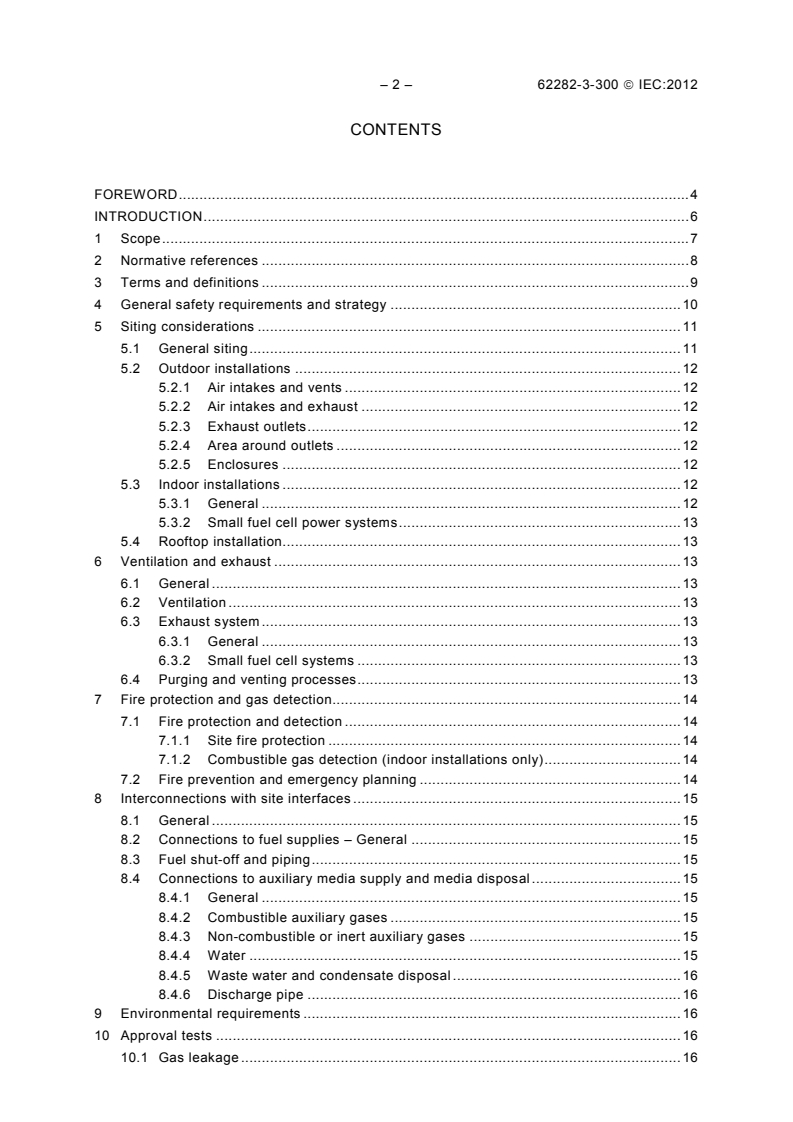
– 2 – 62282-3-300 IEC:2012
CONTENTS
FOREWORD . 4
INTRODUCTION . 6
1 Scope . 7
2 Normative references . 8
3 Terms and definitions . 9
4 General safety requirements and strategy . 10
5 Siting considerations . 11
5.1 General siting . 11
5.2 Outdoor installations . 12
5.2.1 Air intakes and vents . 12
5.2.2 Air intakes and exhaust . 12
5.2.3 Exhaust outlets . 12
5.2.4 Area around outlets . 12
5.2.5 Enclosures . 12
5.3 Indoor installations . 12
5.3.1 General . 12
5.3.2 Small fuel cell power systems . 13
5.4 Rooftop installation. 13
6 Ventilation and exhaust . 13
6.1 General . 13
6.2 Ventilation . 13
6.3 Exhaust system . 13
6.3.1 General . 13
6.3.2 Small fuel cell systems . 13
6.4 Purging and venting processes . 13
7 Fire protection and gas detection. 14
7.1 Fire protection and detection . 14
7.1.1 Site fire protection . 14
7.1.2 Combustible gas detection (indoor installations only) . 14
7.2 Fire prevention and emergency planning . 14
8 Interconnections with site interfaces . 15
8.1 General . 15
8.2 Connections to fuel supplies – General . 15
8.3 Fuel shut-off and piping . 15
8.4 Connections to auxiliary media supply and media disposal . 15
8.4.1 General . 15
8.4.2 Combustible auxiliary gases . 15
8.4.3 Non-combustible or inert auxiliary gases . 15
8.4.4 Water . 15
8.4.5 Waste water and condensate disposal . 16
8.4.6 Discharge pipe . 16
9 Environmental requirements . 16
10 Approval tests . 16
10.1 Gas leakage . 16
62282-3-300 IEC:2012 – 3 –
10.2 Site specific shut-down devices . 16
11 Maintenance tests . 16
12 Documentation . 17
12.1 Markings and instructions . 17
12.2 Inspection checklist . 17
12.3 Installation manual . 17
12.4 User’s information manual . 17
12.5 Maintenance manual . 17
Figure 1 – Fuel cell power system . 8
– 4 – 62282-3-300 IEC:2012
INTERNATIONAL ELECTROTECHNICAL COMMISSION
_____________
FUEL CELL TECHNOLOGIES –
Part 3-300: Stationary fuel cell power systems –
Installation
FOREWORD
1) The International Electrotechnical Commission (IEC) is a worldwide organization for standardization comprising
all national electrotechnical committees (IEC National Committees). The object of IEC is to promote
international co-operation on all questions concerning standardization in the electrical and electronic fields. To
this end and in addition to other activities, IEC publishes International Standards, Technical Specifications,
Technical Reports, Publicly Available Specifications (PAS) and Guides (hereafter referred to as “IEC
Publication(s)”). Their preparation is entrusted to technical committees; any IEC National Committee interested
in the subject dealt with may participate in this preparatory work. International, governmental and non-
governmental organizations liaising with the IEC also participate in this preparation. IEC collaborates closely
with the International Organization for Standardization (ISO) in accordance with conditions determined by
agreement between the two organizations.
2) The formal decisions or agreements of IEC on technical matters express, as nearly as possible, an international
consensus of opinion on the relevant subjects since each technical committee has representation from all
interested IEC National Committees.
3) IEC Publications have the form of recommendations for international use and are accepted by IEC National
Committees in that sense. While all reasonable efforts are made to ensure that the technical content of IEC
Publications is accurate, IEC cannot be held responsible for the way in which they are used or for any
misinterpretation by any end user.
4) In order to promote international uniformity, IEC National Committees undertake to apply IEC Publications
transparently to the maximum extent possible in their national and regional publications. Any divergence
between any IEC Publication and the corresponding national or regional publication shall be clearly indicated in
the latter.
5) IEC itself does not provide any attestation of conformity. Independent certification bodies provide conformity
assessment services and, in some areas, access to IEC marks of conformity. IEC is not responsible for any
services carried out by independent certification bodies.
6) All users should ensure that they have the latest edition of this publication.
7) No liability shall attach to IEC or its directors, employees, servants or agents including individual experts and
members of its technical committees and IEC National Committees for any personal injury, property damage or
other damage of any nature whatsoever, whether direct or indirect, or for costs (including legal fees) and
expenses arising out of the publication, use of, or reliance upon, this IEC Publication or any other IEC
Publications.
8) Attention is drawn to the Normative references cited in this publication. Use of the referenced publications is
indispensable for the correct application of this publication.
9) Attention is drawn to the possibility that some of the elements of this IEC Publication may be the subject of
patent rights. IEC shall not be held responsible for identifying any or all such patent rights.
International Standard IEC 62282-3-300 has been prepared by IEC technical committee 105:
Fuel cell technologies.
IEC 62282-3-300 cancels and replaces IEC 62282-3-3, published in 2007, and constitutes a
technical revision.
IEC 62282-3-300 includes the following significant technical changes with respect to
IEC 62282-3-3:
– addition in the scope to avoid overlapping between IEC 62282-3-100 and IEC 62282-3-300
concerning safety related requirements;
– updating normative references and definitions;
– requirements applicable to the stationary fuel cell removed, so that the target of this
standard focuses on “installation risks”;
62282-3-300 IEC:2012 – 5 –
– level of CO reduced for small fuel cell power systems which exhaust directly into a utility
shed where they are installed, and where the shed is to ensure safety;
– requirement for using a combustible gas detection system modified;
– reference to the gas valve standard ISO 23551-1 added.
The text of this standard is based on the following documents:
FDIS Report on voting
105/377/FDIS 105/388/RVD
Full information on the voting for the approval of this standard can be found in the report on
voting indicated in the above table.
This publication has been drafted in accordance with the ISO/IEC Directives, Part 2.
A list of all parts of the IEC 62282 series, under the general title Fuel cell technologies, can
be found on the IEC website.
The committee has decided that the contents of this publication will remain unchanged until
the stability date indicated on the IEC web site under "http://webstore.iec.ch" in the data
related to the specific publication. At this date, the publication will be
• reconfirmed,
• withdrawn,
• replaced by a revised edition, or
• amended.
– 6 – 62282-3-300 IEC:2012
INTRODUCTION
This International Standard covers the installation of stationary fuel cell power systems that
are built in compliance with IEC 62282-3-100.
The requirements of this standard are not intended to constrain innovation. Installations
employing materials and/or methods differing from those detailed in this standard may be
examined and tested according to the intent of the requirements and, if found to be
substantially equivalent, may be considered to comply with the standard.
62282-3-300 IEC:2012 – 7 –
FUEL CELL TECHNOLOGIES –
Part 3-300: Stationary fuel cell power systems –
Installation
1 Scope
This part of IEC 62282 provides minimum safety requirements for the installation of indoor
and outdoor stationary fuel cell power systems in compliance with IEC 62282-3-100 and
applies to the installation of the following systems:
– intended for electrical connection to mains directly or with a readily accessible, manually
operable switch or circuit-breaker;
– intended for a stand-alone power distribution system;
– intended to provide AC or DC power;
– with or without the ability to recover useful heat.
This standard is limited to those conditions that may be created by the installation process
that can lead to personnel hazards or damage to equipment or property external to the fuel
cell power system.
This standard does not cover the safety requirements of the stationary fuel cell power system
which are covered by IEC 62282-3-100.
Additionally, this standard does not cover:
– fuel supply and/or fuel storage systems;
– auxiliary media supply and disposal;
– switches or circuit-breakers;
– portable fuel cell power systems;
– propulsion fuel cell power systems;
– APU (auxiliary power units) applications.
A typical stationary fuel cell power system installation is represented in Figure 1.
– 8 – 62282-3-300 IEC:2012
System boundary
Power inputs
Recovered heat
Thermal
Electrical
management
Thermal
system
Waste heat
Mechanical
Fuel
Fuel
processing
Fuel Useable power
system
cell electrical
Power
module
conditioning
system
Oxidant
Oxidant
processing Water
system treatment
Internal power
Ventilation
system
needs Discharge water
Inert gas
Exhaust gases
ventilation
Onboard
Automatic
Water
Ventilation
energy
control
system
storage
system
EMI
EMD
noise
vibration,
vibration
wind, rain,
temperature
etc.
IEC 105/12
Key
EMD electromagnetic disturbance
EMI electromagnetic interference
Figure 1 – Fuel cell power system
Fuel cell power systems are divided into two categories:
– small systems;
– large systems.
Terms and definitions are given in Clause 3.
2 Normative references
The following documents, in whole or in part, are normatively referenced in this document and
are indispensable for its application. For dated references, only the edition cited applies. For
undated references, the latest edition of the referenced document (including any
amendments) applies.
IEC 60079-10 (all parts), Explosive atmospheres – Part 10: Classification of areas
IEC 60079-29-1, Explosive atmospheres – Part 29-1: Gas detectors – Performance
requirements of detectors for flammable gases
IEC 60079-29-2, Explosive atmospheres – Part 29-2: Gas detectors – Selection, installation,
use and maintenance of detectors for flammable gases and oxygen
IEC 62282-3-100:2012, Fuel cell technologies – Part 3-100: Stationary fuel cell power
systems – Safety
ISO 1182, Reaction to fire tests for building and transport products – Non-combustibility test
ISO 14121, Safety of machinery – Risk assessment
62282-3-300 IEC:2012 – 9 –
ISO 23551-1, Safety and control devices for gas burners and gas-burning appliances –
Particular requirements – Part 1: Automatic valves
3 Terms and definitions
For the purposes of this document, the following terms and definitions apply.
3.1
accessible (operator access area)
area to which, under normal operating conditions, one of the following applies:
– access can be gained without the use of a tool;
– the means of access are deliberately provided to the operator;
– the operator is instructed to enter, regardless of whether or not a tool is needed to gain
access.
Note 1 to entry The terms "access" and "accessible", unless qualified, relate to operator access area as defined
above.
3.2
approved
acceptable to the authority having jurisdiction
3.3
authority having jurisdiction
AHJ
organization, office, or individual responsible for enforcing the requirements of a code or
standard, or for approving equipment, materials, an installation, or a procedure
3.4
exhaust
gases removed from a fuel cell power system and not reused
3.5
exhaust system
gas-conveying system for moving gases from a source to a point of discharge
3.6
fire prevention
measures directed toward avoiding the inception of fire
3.7
fire protection
methods of providing for fire control or fire extinguishment
3.8
fire risk evaluation
detailed engineering review of a plant's construction features and operating processes
conducted to ensure that applicable fire prevention and fire protection requirements for
safeguarding life and physical property are met
3.9
forced ventilation
movement of air and its replacement with fresh air by mechanical means
3.10
indoor installation
fuel cell power system completely surrounded and enclosed by walls, a roof and a floor
– 10 – 62282-3-300 IEC:2012
3.11
installation
– location where a fuel cell power system is sited as a unit or built as an assembly
– act to install a fuel cell power system
3.12
large fuel cell power systems
fuel cell power systems having a net electrical output of more than 10 kW
3.13
lower flammability limit
LFL
lowest concentration of a flammable gas/vapour in air in which flame is propagated
3.14
natural ventilation
movement of air and its replacement with fresh air due to the effects of wind and/or
temperature gradients
3.15
non-combustible
not capable of supporting combustion in accordance with ISO 1182 or equivalent method
3.16
outside or outdoor installation
power system installation that is not an indoor installation. When permitted by local or national
regulations, an open-air structure with partial roof and/or walls may be considered an outdoor
installation
3.17
portable fuel cell power system
fuel cell power system that is not intended to be permanently fastened or otherwise secured in
a specific location
3.18
rooftop installation
power system installation located on the roof of a building
3.19
room ventilation
air supply to the room for cooling, heating, makeup atmosphere, safety ventilation
Note 1 to entry This air can be taken from indoors or outdoors.
3.20
small fuel cell power system
fuel cell power system having a net electrical output up to 10 kW
3.21
stationary
permanently connected and fixed in place
4 General safety requirements and strategy
A fuel cell power system and associated equipment, components and controls shall be
installed in accordance with the manufacturer’s instructions. Based on the quantity of fuel and
other stored energy (e.g. flammable materials, pressurized media, electrical energy,
mechanical energy, etc.) within the fuel cell power systems, there is a need to eliminate
hazards to personnel or damage to equipment or property external to the fuel cell power
62282-3-300 IEC:2012 – 11 –
system as far as rationally possible. The general safety strategy for the installation of the fuel
cell power systems shall be established according to the following sequence:
– Avoid the possible release of combustible and/or toxic gases and pollutant gases, liquids
and solids.
– Eliminate hazards to personnel or damage to equipment or property external to the fuel
cell power system and the related installation as far as rationally possible, when such
energy or gases are released almost instantaneously.
– Provide appropriate safety markings concerning the remaining risks of hazards.
Special care shall be taken to address the following:
– Mechanical hazards – Sharp surfaces, tripping hazards, moving masses and instability,
strength of materials and liquids or gases under pressure.
– Electrical hazards – Contact of persons with live parts, short-circuits, high voltage.
– Thermal hazards – Hot surfaces, release of high temperature liquids or gases, thermal
fatigue.
– Fire and explosion hazards – Flammable gases or liquids, potential for explosive mixtures
during normal or abnormal operating conditions, potential for explosive mixtures during
fault conditions.
– Malfunction hazards – Unsafe operation of installation related equipment due to failures of
software, control circuit or protective/safety components or incorrect manufacturing or
misoperation.
– Material and substance hazards – Material deterioration, corrosion, embrittlement, toxic
releases, choking hazards (e.g. by replacing oxygen by inert purge gases).
– Waste disposal hazards – Disposal of toxic materials, recycling, disposal of flammable
liquids or gases.
– Environmental hazards – Unsafe operation in hot/cold environments, rain, flooding, wind,
earthquake, external fire, smoke.
5 Siting considerations
5.1 General siting
The fuel cell power system shall comply with IEC 62282-3-100.
A fuel cell power system(s) and associated equipment, components, and controls shall be
sited in accordance with the manufacturer’s instructions and meet the following requirements:
– It shall be placed and fixed firmly so that it will not be easily moved, toppled, or dislocated.
– It shall be located and secured as necessary so that the system and equipment will not be
adversely affected by wind, and seismic events. It shall be protected so as not to be
adversely affected by rain, snow, ice, water and or freezing temperatures, unless the
system and installation equipment is designed for those conditions.
– Sites for large power systems shall be protected against access by unauthorized persons
if required by the location and installation environment. Fire department access shall be
provided.
– It shall be located outside of potentially hazardous atmospheres as defined by IEC 60079-
10, unless approved for the specific installation.
– It shall be sited so that the power system and equipment do not adversely affect building
exits.
– It shall be located so that the power system(s) and components of a fuel cell power
system and their respective vent or exhaust terminations are separated from doors,
windows, outdoor intakes and other openings into a building to prevent introduction of
exhaust gases into the building.
– 12 – 62282-3-300 IEC:2012
– The exhaust outlet(s) shall not present a hazard when directed onto walkways or other
paths of travel for pedestrians.
– It shall be located in a manner that allows service, maintenance and emergency access.
– It shall be located away from combustible materials, high-piled stock and other exposures
to fire hazards. Distances and clearances shall be according to regulations given by the
authority having jurisdiction (AHJ).
– It shall be located or protected to prevent physical damage from moving vehicles or
equipment.
– Multiple power systems shall be located or protected such that a fire or failure of one of
the systems does not present a safety hazard to adjacent power systems.
– Where demonstrated by an engineering analysis that the prescriptive requirements in this
clause are unnecessary to achieve an equivalent level of safety, approved alternatives
shall be proposed for permission by the AHJ.
– Discharged liquids and vapours shall be disposed of according to AHJ.
– Waterproofing of floors and installation of drainage piping and other appropriate actions
shall be taken when installing a fuel cell power system which is expected to require
drainage.
5.2 Outdoor installations
5.2.1 Air intakes and vents
Air intakes and vents to a fuel cell power system shall be located so that the plant is not
adversely affected by other exhausts, gases or contaminants. Air intakes to a fuel cell power
system shall be kept unobstructed so their flow capacity is not affected by agglomeration of
solids, dust, water, ice and snow.
5.2.2 Air intakes and exhaust
Air intakes and exhaust to and from a fuel cell power system shall not impact travel on
walkways or other paths of travel for pedestrians.
5.2.3 Exhaust outlets
The exhaust outlet(s) from process areas, or areas that contain fuel-bearing components of a
fuel cell power system, including outlets from relief valves, shall be located in such a manner
that it will not affect heating, ventilating, and air-conditioning (HVAC) air intakes, windows,
doors, and other openings into buildings.
5.2.4 Area around outlets
The area around outlets from fuel processes or compartments that contain fuel-bearing
components and relief valves outlets shall be evaluated in accordance with IEC 60079-10.
5.2.5 Enclosures
Security barriers, fences, landscaping and other enclosures shall not affect the required
airflow into or exhaust out of the fuel cell power system and its components.
5.3 Indoor installations
5.3.1 General
Indoor fuel cell power systems and their associated components shall be installed in rooms
that meet the requirements of the applicable national standards.
62282-3-300 IEC:2012 – 13 –
5.3.2 Small fuel cell power systems
Small fuel cell power systems shall not be required to have fire rated separations.
5.4 Rooftop installation
5.4.1 Fuel cell power systems and components located on rooftops shall be installed in
accordance with 5.2.
5.4.2 The material under and within 30 cm horizontally of a fuel cell power system or
component shall be non-combustible or shall be certified to afford an appropriate degree of
fire protection to the roof deck in accordance with national regulations. Exemption is made for
fuel cell power systems complying with 5.12 b) of IEC 62282-3-100:2012.
6 Ventilation and exhaust
6.1 General
All indoor fuel cell power systems shall be provided with adequate ventilation and exhaust
systems.
The intakes and exits of the ventilation and exhaust systems shall meet the requirements
specified in 5.2.1, 5.2.2 and 5.2.3.
6.2 Ventilation
Air that is supplied to the room where the fuel cell power system is located, whether taken
from the vicinity of the appliance, an adjacent room or outdoors, may serve as ventilation air,
process air or both. This air shall be supplied by either a forced ventilation system or natural
ventilation in accordance with the manufacturer’s installation instructions.
If forced ventilation is required for safety during normal operation, a control interlock shall be
provided to alarm and/or shutdown the fuel cell power system upon loss of ventilation.
6.3 Exhaust system
6.3.1 General
Fuel cell power systems shall have a dedicated exhaust system according to IEC 62282-3-100
that discharges the emissions outdoors.
6.3.2 Small fuel cell systems
Small fuel cell power systems may exhaust directly into a utility shed, where they are
installed, if the shed
a) is unattached from a building or attached without direct access to the building’s occupied
areas, and
b) has an interlocked ventilation system, or natural ventilation, that has sufficient flow to
ensure, under all circumstances, that it will prevent
–6
1) concentrations of air free CO higher than 50 × 10 under normal working conditions,
2) values greater than 25 % of the relevant LFL, and
3) oxygen concentrations below 18 %.
6.4 Purging and venting processes
6.4.1 Pressure tanks and piping intended to be purged, pressure regulators, relief valves,
and other potential sources of combustible gas shall be vented to the outside of the building
– 14 – 62282-3-300 IEC:2012
in accordance with 5.2.3. For small fuel cell power systems, purging is permitted into room
atmosphere, if it is ensured, that a maximum 25 % of the relevant LFL will not be exceeded
–6
and that the atmosphere will not exceed 50 × 10 of air-free CO anywhere in the room.
6.4.2 The vent shall be designed to prevent entry of water or foreign objects.
7 Fire protection and gas detection
7.1 Fire protection and detection
7.1.1 Site fire protection
Sites that have flammable or combustible liquid fuel storage shall be protected in accordance
with national regulations.
7.1.2 Combustible gas detection (indoor installations only)
7.1.2.1 A combustible gas detection system shall be installed in the fuel cell power system
enclosure or fuel cell power system exhaust system or in the room containing fuel cell power
system installations. Location of gas detection systems in the room shall be chosen to provide
the earliest warning of the combustible gases present.
Location of gas detectors shall be in accordance with IEC 60079-29-2.
The requirements for the gas sensors are defined in IEC 60079-29-1.
The combustible gas detection system is not required for fuel cell power systems that are
• fuelled with odorized gas, or
• fuelled with non-odorized gas, such as hydrogen, from bottles of limited capacity
according to relevant national standards such that they can be stored indoors without
special ventilation.
7.1.2.2 The following criteria for combustible gas detection systems shall be met:
a) The combustible gas detection system shall be arranged to alarm at 25 % of the lower
flammability limit (LFL) and be interlocked to shut down the power system fuel supply at
50 % of LFL, respectively.
b) The LFL used shall be the lowest flammability limit of the gas or gas mixtures.
7.1.2.3 A combustible gas detector that meets the requirements of 7.1.2.2 shall be provided
for all indoor or separately enclosed gas compressors. Exempted are separately enclosed gas
compressors, provided that the room ventilation ensures combustible gas concentrations
lower than 25 % of LFL.
7.1.2.4 The room or area where the fuel cell power system is installed shall have a
combustible gas detector located according 7.1.2.1 if non-odorized gas, such as hydrogen, is
piped into the room or area from outside. The gas detection system shall alarm and shutdown
according to the respective limits in 7.1.2.2.
7.2 Fire prevention and emergency planning
For large fuel cell installations, a written fire prevention and emergency plan shall be
provided. This is not required for small fuel cell power systems.
62282-3-300 IEC:2012 – 15 –
8 Interconnections with site interfaces
8.1 General
All interconnections including piping, electrical wiring, disconnections and ducting between
site interfaces and the fuel cell power system shall be in accordance to relevant national
standards.
8.2 Connections to fuel supplies – General
The installation and location of the interface point equipment downstream of the fuel supply
system and the associated fuel piping, including the necessary components and their
connection to the stationary fuel cell power system, shall be in accordance with this clause.
8.3 Fuel shut-off and piping
8.3.1 For indoor installations an accessible manual shut-off valve shall be located within the
room or within 1,8 m upstream of the fuel cell power system, unless the power system is
enclosed by a fire rated room. In that case, the shut-off valve shall be located outside the
room. A second shut-off valve may be located within the room for maintenance. If this second
valve is not provided, and the shut-off is located outside the room, it shall be a lockable type.
8.3.2 For outdoor installations, a single manually operated shut-off valve is required.
8.3.3 Piping, valves, regulators or other equipment shall be located so that they are not
subject to physical damage.
8.3.4 For an indoor installation of a power system being fed by non-odorized fuel gas
mixtures, an automatic shut-off valve according ISO 23551-1, interlocked with gas detection,
shall be located outside the building that houses the power system in accordance with Clause
7. The gas detection system shall be arranged to alarm at 25 % of LFL and be interlocked to
shut down the power system fuel supply at 50 % of LFL.
8.4 Connections to auxiliary media supply and media disposal
8.4.1 General
Different fuel cell power systems need some auxiliary media supply and disposal, for example
normal operation, safety reasons, start-up or shutdown procedures, purging or protection
against internal damages. Water, nitrogen, carbon dioxide and hydrogen are typical auxiliary
media for fuel cell power systems. As storage of these media is not in the scope of this
standard, only the interfaces shall be defined.
8.4.2 Combustible auxiliary gases
Redundant safety systems consisting of a quick-action shut-off valve controlled by the fuel
cell power system’s automatic control system and an accessible second valve with an
additional manual operability in the feed line are required in each system for combustible
gases.
8.4.3 Non-combustible or inert auxiliary gases
Connections according to national standards.
8.4.4 Water
Tap-water, recycled water: connections according to national standards.
– 16 – 62282-3-300 IEC:2012
8.4.5 Waste water and condensate disposal
Connection according to national standards.
8.4.6 Discharge pipe
Connection according to national standards.
9 Environmental requirements
Emissions, contaminants and other environmental loads under normal and abnormal
operation as well as failure modes operation are defined in IEC 62282-3-100.
Requirements for installation and initial commissioning:
The following emissions during installation and initial commissioning shall not exceed levels
as limited by applicable national regulations:
– noise;
– toxic and/or pollutant emissions;
– discharge of construction materials;
– auxiliary materials;
– binder burn out gases.
If required by national regulations, adequate facilities to reduce emissions during installation
and commissioning of the fuel cell power system shall be provided and operated.
10 Approval tests
10.1 Gas leakage
A gas leakage test is required for site-installed piping only. The gas leakage test shall be
performed according to relevant national standards.
10.2 Site specific shut-down devices
Shut-off devices required by
– 6.2 (forced ventilation),
– 6.3 (forced exhaust),
– 7.1.2.1 and 7.1.2.4 (combustibility sensor),
– 8.3.4 (non-odorized gas shut-off valve),
shall be demonstrated to function properly.
11 Maintenance tests
Procedures shall be in place for maintenance tests of site-installed items, as required for
normal periodic maintenance, that will be performed according to the manufacturer’s
instructions and national regulations.
Deficiencies stated during maintenance test shall be corrected immediately by authorized
personnel only.
62282-3-300 IEC:2012 – 17 –
12 Documentation
12.1 Markings and instructions
Interface markings: all interfaces to a fuel cell system shall be clearly identifiable at least by
marking in a local language or by clear symbol indications. Any emergency devices shall be
marked according to the local or national regulations.
All fuel piping covered by this standard shall be marked or identified in accordance with a
relevant national standard.
12.2 Inspection checklist
12.2.1 An inspection checklist shall be included within the documentation package or
contained within the installation manual. The inspection checklist shall be kept by the owner
or operator of the facility.
12.2.2 The installation checklist shall bear the following information:
– installer’s company name;
– installer’s name;
– date of installation;
– location of fuel cell power system installation.
12.2.3 The installation checklist shall include confirmation by signature of the installer of the
proper installation of the following:
– fuel supply connection requirements as prescribed in 8.2;
– gas leakage test results as prescribed in 10.1;
– connections to auxiliary equipment as prescribed in 8.4;
– ventilation connections, construction and testing of ventilation interlock, as prescribed in
6.2;
– exhaust connections, construction and testing of exhaust interlock as prescribed in 6.3;
– electrical connections and grounding shall be as defined in national regulations;
– external safety sensors as applicable in 7.1.2;
– process purge connections as required by 6.4.
12.3 Installation manual
The installation manual shall comply with IEC 62282-3-100. The installation manual shall be
supplied with the fuel cell power system and is written in the prevalent local language or
several languages, including the prevalent local language. The installation manual shall be
kept by the owner or operator of the facility.
12.4 User’s information manual
The user’s information manual shall comply with IEC 62282-3-100. The user’s information
manual shall be supplied with the fuel cell power system and is written in the prevalent local
language or several languages, including the prevalent local language. The user’s information
manual shall be kept by the owner or operator of the facility.
12.5 Maintenance manual
12.5.1 The maintenance manual shall comply with IEC 62282-3-100. The maintenance
manual shall be supplied with the fuel cell power system and is written in the prevalent local
– 18 – 62282-3-300 IEC:2012
language or several languages, including the prevalent local language. The maintenance
manual shall be supplied to the owner or operator or the service personnel of the facility.
12.5.2 The maintenance manual shall be augmented with maintenance information, in
particular on site specific equipment.
___________
– 20 – 62282-3-300 CEI:2012
SOMMAIRE
AVANT-PROPOS . 22
INTRODUCTION . 24
1 Domaine d’application . 25
2 Références normatives . 26
3 Termes et définitions .
...