

IEC 62608-1:2025
(Main)Multimedia home network configuration - Basic reference model - Part 1: System model
General Information
- Abstract
IEC 62608-1:2025 specifies the basic reference model to configure devices connected to a home network with a configuration framework for network applications running on such devices. This document applies to devices that are cable or wireless LAN connected and switched on and that support IP protocol. The reference model covers inside and outside network connectivity. This document specifies the system model and functions that each component should support. This second edition cancels and replaces the first edition published in 2014. This edition constitutes a technical revision.
This edition includes the following significant technical changes with respect to the previous edition:
- addition of devices connected via wireless LAN;
- addition of servers on the cloud.
- Status
- Published
- Publication Date
- 14-Jul-2025
- Technical Committee
- TA 18 - Multimedia home systems and applications for end-user networks
- Drafting Committee
- MT 62608-1 - TC 100/TA 18/MT 62608-1
- Current Stage
- PPUB - Publication issued
- Start Date
- 15-Jul-2025
- Completion Date
- 24-Jul-2025
Buy Documents

IEC 62608-1:2025 - Multimedia home network configuration - Basic reference model - Part 1: System model/15/2025

IEC 62608-1:2025 RLV - Multimedia home network configuration - Basic reference model - Part 1: System model Released:7/15/2025
Overview
IEC 62608-1:2025 - Multimedia home network configuration - Basic reference model - Part 1: System model defines a system-level reference for automatic configuration of IP devices in home networks. This second edition updates the 2014 version by adding wireless LAN devices and cloud servers, and specifies the roles, functions and interactions required to configure devices that are cable or wireless LAN connected, switched on, and supporting IP. The reference model covers both inside (local) and outside (cloud/external) network connectivity and describes the system components and their expected behavior.
Key topics
- Configurator and Configuration Agent: Definitions and responsibilities of the configurator (management entity running in the home network) and the configuration agent (software on managed devices) - core to the multimedia home network configuration model.
- System model and management model: Component roles, layered management, and the functions each element should support to enable automated setup and operation.
- Network configuration framework: Coverage of the configuration protocol, configuration data model and associated metadata required for reliable device onboarding and management.
- Inside and outside connectivity: How the model accounts for local LAN (including wireless LAN) and external service servers or cloud-hosted functionality.
- Use cases and examples: Informative annexes include audio/video equipment configuration and sensor management scenarios illustrating real-world workflows.
Practical applications
IEC 62608-1:2025 is intended for practitioners involved in designing, building and operating IP-based home networks and services:
- Device manufacturers implementing embedded configuration agents for TVs, set-top boxes, AV equipment, sensors and smart home devices.
- Home gateway and router vendors integrating a configurator or supporting protocols to enable automated device onboarding.
- Software developers and system integrators building home network management platforms, cloud-based service servers, or diagnostics/quality-check servers.
- Network architects and standards bodies ensuring interoperability across cable and wireless LAN devices. Benefits include streamlined device setup, improved interoperability in multimedia home networks, and clearer integration patterns between local devices and cloud services.
Related standards
- IEC 62608-2: Multimedia home network configuration – Part 2: Operational model
- ISO/IEC 7498-1:1994 (OSI Basic Reference Model)
- References in the introduction: IEC 62481 series and IEC 62514 (multimedia home gateway context)
Keywords: IEC 62608-1:2025, multimedia home network configuration, basic reference model, system model, configurator, configuration agent, wireless LAN, cloud servers, IP devices, home gateway.
Relations
- Effective Date
- 05-Sep-2023
Buy Documents
IEC 62608-1:2025 - Multimedia home network configuration - Basic reference model - Part 1: System model/15/2025
IEC 62608-1:2025 RLV - Multimedia home network configuration - Basic reference model - Part 1: System model Released:7/15/2025
Get Certified
Connect with accredited certification bodies for this standard

ANCE
Mexican certification and testing association.

Intertek Slovenia
Intertek testing, inspection, and certification services in Slovenia.

LNE (Laboratoire National de Métrologie et d'Essais)
French national laboratory for metrology and testing.
Sponsored listings
Frequently Asked Questions
IEC 62608-1:2025 is a standard published by the International Electrotechnical Commission (IEC). Its full title is "Multimedia home network configuration - Basic reference model - Part 1: System model". This standard covers: IEC 62608-1:2025 specifies the basic reference model to configure devices connected to a home network with a configuration framework for network applications running on such devices. This document applies to devices that are cable or wireless LAN connected and switched on and that support IP protocol. The reference model covers inside and outside network connectivity. This document specifies the system model and functions that each component should support. This second edition cancels and replaces the first edition published in 2014. This edition constitutes a technical revision. This edition includes the following significant technical changes with respect to the previous edition: - addition of devices connected via wireless LAN; - addition of servers on the cloud.
IEC 62608-1:2025 specifies the basic reference model to configure devices connected to a home network with a configuration framework for network applications running on such devices. This document applies to devices that are cable or wireless LAN connected and switched on and that support IP protocol. The reference model covers inside and outside network connectivity. This document specifies the system model and functions that each component should support. This second edition cancels and replaces the first edition published in 2014. This edition constitutes a technical revision. This edition includes the following significant technical changes with respect to the previous edition: - addition of devices connected via wireless LAN; - addition of servers on the cloud.
IEC 62608-1:2025 is classified under the following ICS (International Classification for Standards) categories: 33.160.60 - Multimedia systems and teleconferencing equipment. The ICS classification helps identify the subject area and facilitates finding related standards.
IEC 62608-1:2025 has the following relationships with other standards: It is inter standard links to IEC 62608-1:2014. Understanding these relationships helps ensure you are using the most current and applicable version of the standard.
IEC 62608-1:2025 is available in PDF format for immediate download after purchase. The document can be added to your cart and obtained through the secure checkout process. Digital delivery ensures instant access to the complete standard document.
Standards Content (Sample)
IEC 62608-1 ®
Edition 2.0 2025-07
INTERNATIONAL
STANDARD
Multimedia home network configuration - Basic reference model -
Part 1: System model
ICS 33.160.60 ISBN 978-2-8327-0515-5
All rights reserved. Unless otherwise specified, no part of this publication may be reproduced or utilized in any form or
by any means, electronic or mechanical, including photocopying and microfilm, without permission in writing from either
IEC or IEC's member National Committee in the country of the requester. If you have any questions about IEC copyright
or have an enquiry about obtaining additional rights to this publication, please contact the address below or your local
IEC member National Committee for further information.
IEC Secretariat Tel.: +41 22 919 02 11
3, rue de Varembé info@iec.ch
CH-1211 Geneva 20 www.iec.ch
Switzerland
About the IEC
The International Electrotechnical Commission (IEC) is the leading global organization that prepares and publishes
International Standards for all electrical, electronic and related technologies.
About IEC publications
The technical content of IEC publications is kept under constant review by the IEC. Please make sure that you have the
latest edition, a corrigendum or an amendment might have been published.
IEC publications search - IEC Products & Services Portal - products.iec.ch
webstore.iec.ch/advsearchform Discover our powerful search engine and read freely all the
The advanced search enables to find IEC publications by a publications previews, graphical symbols and the glossary.
variety of criteria (reference number, text, technical With a subscription you will always have access to up to date
committee, …). It also gives information on projects, content tailored to your needs.
replaced and withdrawn publications.
Electropedia - www.electropedia.org
The world's leading online dictionary on electrotechnology,
IEC Just Published - webstore.iec.ch/justpublished
Stay up to date on all new IEC publications. Just Published containing more than 22 500 terminological entries in English
details all new publications released. Available online and and French, with equivalent terms in 25 additional languages.
once a month by email. Also known as the International Electrotechnical Vocabulary
(IEV) online.
IEC Customer Service Centre - webstore.iec.ch/csc
If you wish to give us your feedback on this publication or
need further assistance, please contact the Customer
Service Centre: sales@iec.ch.
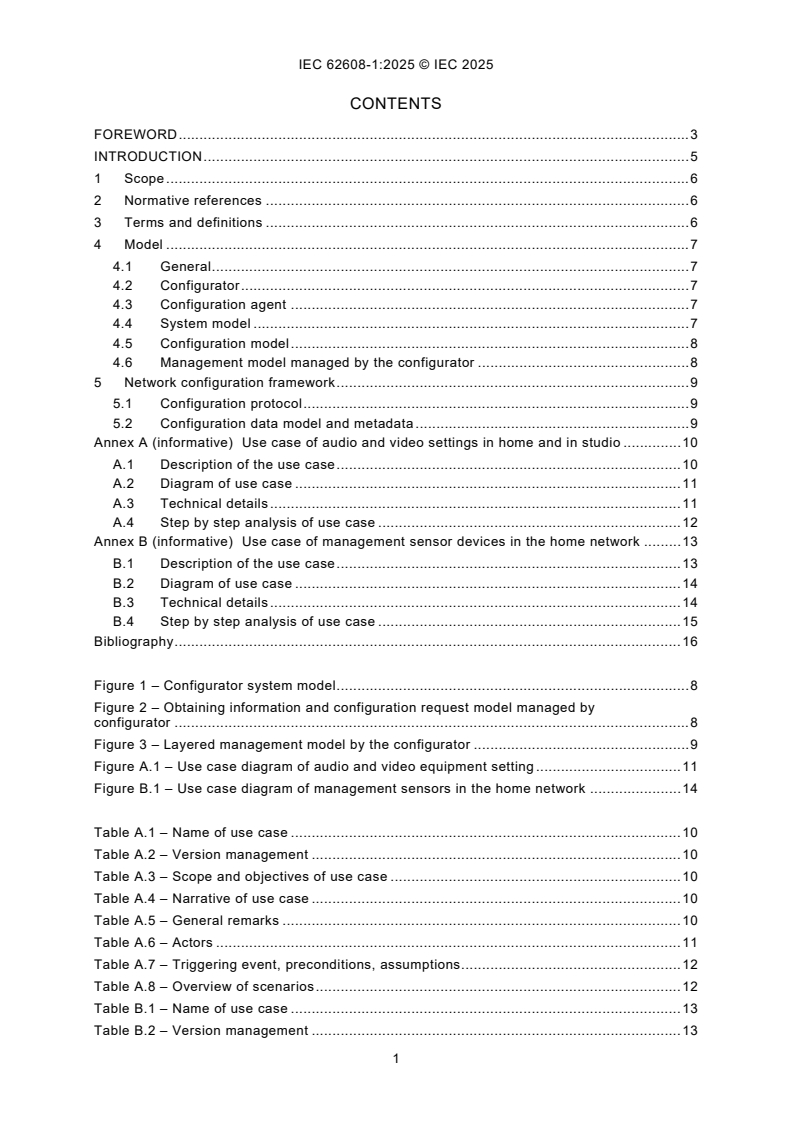
CONTENTS
FOREWORD . 3
INTRODUCTION . 5
1 Scope . 6
2 Normative references . 6
3 Terms and definitions . 6
4 Model . 7
4.1 General . 7
4.2 Configurator . 7
4.3 Configuration agent . 7
4.4 System model . 7
4.5 Configuration model . 8
4.6 Management model managed by the configurator . 8
5 Network configuration framework . 9
5.1 Configuration protocol . 9
5.2 Configuration data model and metadata . 9
Annex A (informative) Use case of audio and video settings in home and in studio . 10
A.1 Description of the use case . 10
A.2 Diagram of use case . 11
A.3 Technical details . 11
A.4 Step by step analysis of use case . 12
Annex B (informative) Use case of management sensor devices in the home network . 13
B.1 Description of the use case . 13
B.2 Diagram of use case . 14
B.3 Technical details . 14
B.4 Step by step analysis of use case . 15
Bibliography . 16
Figure 1 – Configurator system model . 8
Figure 2 – Obtaining information and configuration request model managed by
configurator . 8
Figure 3 – Layered management model by the configurator . 9
Figure A.1 – Use case diagram of audio and video equipment setting . 11
Figure B.1 – Use case diagram of management sensors in the home network . 14
Table A.1 – Name of use case . 10
Table A.2 – Version management . 10
Table A.3 – Scope and objectives of use case . 10
Table A.4 – Narrative of use case . 10
Table A.5 – General remarks . 10
Table A.6 – Actors . 11
Table A.7 – Triggering event, preconditions, assumptions . 12
Table A.8 – Overview of scenarios . 12
Table B.1 – Name of use case . 13
Table B.2 – Version management . 13
Table B.3 – Scope and objectives of use case . 13
Table B.4 – Narrative of use case . 13
Table B.5 – General remarks . 13
Table B.6 – Actors . 14
Table B.7 – Triggering event, preconditions, assumptions . 15
Table B.8 – Overview of scenarios . 15
INTERNATIONAL ELECTROTECHNICAL COMMISSION
____________
Multimedia home network configuration - Basic reference model -
Part 1: System model
FOREWORD
1) The International Electrotechnical Commission (IEC) is a worldwide organization for standardization comprising
all national electrotechnical committees (IEC National Committees). The object of IEC is to promote international
co-operation on all questions concerning standardization in the electrical and electronic fields. To this end and
in addition to other activities, IEC publishes International Standards, Technical Specifications, Technical Reports,
Publicly Available Specifications (PAS) and Guides (hereafter referred to as “IEC Publication(s)”). Their
preparation is entrusted to technical committees; any IEC National Committee interested in the subject dealt with
may participate in this preparatory work. International, governmental and non-governmental organizations liaising
with the IEC also participate in this preparation. IEC collaborates closely with the International Organization for
Standardization (ISO) in accordance with conditions determined by agreement between the two organizations.
2) The formal decisions or agreements of IEC on technical matters express, as nearly as possible, an international
consensus of opinion on the relevant subjects since each technical committee has representation from all
interested IEC National Committees.
3) IEC Publications have the form of recommendations for international use and are accepted by IEC National
Committees in that sense. While all reasonable efforts are made to ensure that the technical content of IEC
Publications is accurate, IEC cannot be held responsible for the way in which they are used or for any
misinterpretation by any end user.
4) In order to promote international uniformity, IEC National Committees undertake to apply IEC Publications
transparently to the maximum extent possible in their national and regional publications. Any divergence between
any IEC Publication and the corresponding national or regional publication shall be clearly indicated in the latter.
5) IEC itself does not provide any attestation of conformity. Independent certification bodies provide conformity
assessment services and, in some areas, access to IEC marks of conformity. IEC is not responsible for any
services carried out by independent certification bodies.
6) All users should ensure that they have the latest edition of this publication.
7) No liability shall attach to IEC or its directors, employees, servants or agents including individual experts and
members of its technical committees and IEC National Committees for any personal injury, property damage or
other damage of any nature whatsoever, whether direct or indirect, or for costs (including legal fees) and
expenses arising out of the publication, use of, or reliance upon, this IEC Publication or any other IEC
Publications.
8) Attention is drawn to the Normative references cited in this publication. Use of the referenced publications is
indispensable for the correct application of this publication.
9) IEC draws attention to the possibility that the implementation of this document may involve the use of (a)
patent(s). IEC takes no position concerning the evidence, validity or applicability of any claimed patent rights in
respect thereof. As of the date of publication of this document, IEC had not received notice of (a) patent(s), which
may be required to implement this document. However, implementers are cautioned that this may not represent
the latest information, which may be obtained from the patent database available at https://patents.iec.ch. IEC
shall not be held responsible for identifying any or all such patent rights.
IEC 62608-1 has been prepared by subcommittee TA 18: Multimedia home systems and
applications for end-user networks, of IEC technical committee TC 100: Audio, video and
multimedia systems and equipment. It is an International Standard.
This second edition cancels and replaces the first edition published in 2014. This edition
constitutes a technical revision.
This edition includes the following significant technical changes with respect to the previous
edition:
a) addition of devices connected via wireless LAN;
b) addition of servers on the cloud.
The text of this International Standard is based on the following documents:
Draft Report on voting
100/4200/CDV 100/4302/RVC
Full information on the voting for its approval can be found in the report on voting indicated in
the above table.
The language used for the development of this International Standard is English.
A list of all parts in the IEC 62608 series, published under the general title Multimedia home
network configuration – Basic reference model, can be found on the IEC website.
This document was drafted in accordance with ISO/IEC Directives, Part 2, and developed in
accordance with ISO/IEC Directives, Part 1 and ISO/IEC Directives, IEC Supplement, available
at www.iec.ch/members_experts/refdocs. The main document types developed by IEC are
described in greater detail at www.iec.ch/publications.
The committee has decided that the contents of this document will remain unchanged until the
stability date indicated on the IEC website under webstore.iec.ch in the data related to the
specific document. At this date, the document will be
• reconfirmed,
• withdrawn, or
• revised.
INTRODUCTION
Electronic power, as well as network connectivity, is necessary in order to use electronic
devices at home. Some applications running on the devices do not work without an inside and
outside network.
When a device connects to a home network, an appropriate network service must already be in
place. Since network connections are a precondition of many applications, such as the
applications in IEC 62481-1, IEC 62481-2 and IEC 6248-3, a digital living network alliance
(DLNA) network management function is necessary.
Sometimes applications are asked to change the configuration of another device, gateway, and
so on. Since it is too difficult to change the configuration of the device manually, an automatic
configuration mechanism is needed for the home network. IEC 62514 defines the functions of
a multimedia home
...
IEC 62608-1 ®
Edition 2.0 2025-07
INTERNATIONAL
STANDARD
REDLINE VERSION
Multimedia home network configuration - Basic reference model -
Part 1: System model
ICS 33.160.60 ISBN 978-2-8327-0587-2
All rights reserved. Unless otherwise specified, no part of this publication may be reproduced or utilized in any form or
by any means, electronic or mechanical, including photocopying and microfilm, without permission in writing from either
IEC or IEC's member National Committee in the country of the requester. If you have any questions about IEC copyright
or have an enquiry about obtaining additional rights to this publication, please contact the address below or your local
IEC member National Committee for further information.
IEC Secretariat Tel.: +41 22 919 02 11
3, rue de Varembé info@iec.ch
CH-1211 Geneva 20 www.iec.ch
Switzerland
About the IEC
The International Electrotechnical Commission (IEC) is the leading global organization that prepares and publishes
International Standards for all electrical, electronic and related technologies.
About IEC publications
The technical content of IEC publications is kept under constant review by the IEC. Please make sure that you have the
latest edition, a corrigendum or an amendment might have been published.
IEC publications search - IEC Products & Services Portal - products.iec.ch
webstore.iec.ch/advsearchform Discover our powerful search engine and read freely all the
The advanced search enables to find IEC publications by a publications previews, graphical symbols and the glossary.
variety of criteria (reference number, text, technical With a subscription you will always have access to up to date
committee, …). It also gives information on projects, content tailored to your needs.
replaced and withdrawn publications.
Electropedia - www.electropedia.org
The world's leading online dictionary on electrotechnology,
IEC Just Published - webstore.iec.ch/justpublished
Stay up to date on all new IEC publications. Just Published containing more than 22 500 terminological entries in English
details all new publications released. Available online and and French, with equivalent terms in 25 additional languages.
once a month by email. Also known as the International Electrotechnical Vocabulary
(IEV) online.
IEC Customer Service Centre - webstore.iec.ch/csc
If you wish to give us your feedback on this publication or
need further assistance, please contact the Customer
Service Centre: sales@iec.ch.
CONTENTS
FOREWORD . 3
INTRODUCTION . 5
1 Scope . 6
2 Normative references . 6
3 Terms and definitions . 6
4 Model . 7
4.1 General . 7
4.2 Configurator . 7
4.3 ConfiguredConfiguration agent . 8
4.4 System model . 8
4.5 Configuration model . 9
4.6 Management model managed by the configurator . 9
5 Network configuration framework . 10
5.1 Configuration protocol . 10
5.2 Configuration data model and metadata . 10
Annex A (informative) Use case of audio and video settings in home and in studio . 11
A.1 Description of the use case . 11
A.2 Diagram of use case . 12
A.3 Technical details . 12
A.4 Step by step analysis of use case . 13
Annex B (informative) Use case of management sensor devices in the home network . 14
B.1 Description of the use case . 14
B.2 Diagram of use case . 15
B.3 Technical details . 15
B.4 Step by step analysis of use case . 16
Bibliography . 17
Figure 1 – Configurator system model . 8
Figure 2 – Obtaining information and configuration request model of the managed by
configurator . 9
Figure 3 – Layered management model by the configurator . 10
Figure A.1 – Use case diagram of audio and video equipment setting . 12
Figure B.1 – Use case diagram of management sensors in the home network . 15
Table A.1 – Name of use case . 11
Table A.2 – Version management . 11
Table A.3 – Scope and objectives of use case . 11
Table A.4 – Narrative of use case . 11
Table A.5 – General remarks . 11
Table A.6 – Actors . 12
Table A.7 – Triggering event, preconditions, assumptions . 13
Table A.8 – Overview of scenarios . 13
Table B.1 – Name of use case . 14
Table B.2 – Version management . 14
Table B.3 – Scope and objectives of use case . 14
Table B.4 – Narrative of use case . 14
Table B.5 – General remarks . 14
Table B.6 – Actors . 15
Table B.7 – Triggering event, preconditions, assumptions . 16
Table B.8 – Overview of scenarios . 16
INTERNATIONAL ELECTROTECHNICAL COMMISSION
____________
Multimedia home network configuration - Basic reference model -
Part 1: System model
FOREWORD
1) The International Electrotechnical Commission (IEC) is a worldwide organization for standardization comprising
all national electrotechnical committees (IEC National Committees). The object of IEC is to promote international
co-operation on all questions concerning standardization in the electrical and electronic fields. To this end and
in addition to other activities, IEC publishes International Standards, Technical Specifications, Technical Reports,
Publicly Available Specifications (PAS) and Guides (hereafter referred to as “IEC Publication(s)”). Their
preparation is entrusted to technical committees; any IEC National Committee interested in the subject dealt with
may participate in this preparatory work. International, governmental and non-governmental organizations liaising
with the IEC also participate in this preparation. IEC collaborates closely with the International Organization for
Standardization (ISO) in accordance with conditions determined by agreement between the two organizations.
2) The formal decisions or agreements of IEC on technical matters express, as nearly as possible, an international
consensus of opinion on the relevant subjects since each technical committee has representation from all
interested IEC National Committees.
3) IEC Publications have the form of recommendations for international use and are accepted by IEC National
Committees in that sense. While all reasonable efforts are made to ensure that the technical content of IEC
Publications is accurate, IEC cannot be held responsible for the way in which they are used or for any
misinterpretation by any end user.
4) In order to promote international uniformity, IEC National Committees undertake to apply IEC Publications
transparently to the maximum extent possible in their national and regional publications. Any divergence between
any IEC Publication and the corresponding national or regional publication shall be clearly indicated in the latter.
5) IEC itself does not provide any attestation of conformity. Independent certification bodies provide conformity
assessment services and, in some areas, access to IEC marks of conformity. IEC is not responsible for any
services carried out by independent certification bodies.
6) All users should ensure that they have the latest edition of this publication.
7) No liability shall attach to IEC or its directors, employees, servants or agents including individual experts and
members of its technical committees and IEC National Committees for any personal injury, property damage or
other damage of any nature whatsoever, whether direct or indirect, or for costs (including legal fees) and
expenses arising out of the publication, use of, or reliance upon, this IEC Publication or any other IEC
Publications.
8) Attention is drawn to the Normative references cited in this publication. Use of the referenced publications is
indispensable for the correct application of this publication.
9) IEC draws attention to the possibility that the implementation of this document may involve the use of (a)
patent(s). IEC takes no position concerning the evidence, validity or applicability of any claimed patent rights in
respect thereof. As of the date of publication of this document, IEC had not received notice of (a) patent(s), which
may be required to implement this document. However, implementers are cautioned that this may not represent
the latest information, which may be obtained from the patent database available at https://patents.iec.ch. IEC
shall not be held responsible for identifying any or all such patent rights.
This redline version of the official IEC Standard allows the user to identify the changes made
to the previous edition IEC 62608-1:2014. A vertical bar appears in the margin wherever a
change has been made. Additions are in green text, deletions are in strikethrough red text.
IEC 62608-1 has been prepared by subcommittee TA 18: Multimedia home systems and
applications for end-user networks, of IEC technical committee TC 100: Audio, video and
multimedia systems and equipment. It is an International Standard.
This second edition cancels and replaces the first edition published in 2014. This edition
constitutes a technical revision.
This edition includes the following significant technical changes with respect to the previous
edition:
a) addition of devices connected via wireless LAN;
b) addition of servers on the cloud.
The text of this International Standard is based on the following documents:
Draft Report on voting
100/4200/CDV 100/4302/RVC
Full information on the voting for its approval can be found in the report on voting indicated in
the above table.
The language used for the development of this International Standard is English.
A list of all parts in the IEC 62608 series, published under the general title Multimedia home
network configuration – Basic reference model, can be found on the IEC website.
This document was drafted in accordance with ISO/IEC Directives, Part 2, and developed in
accordance with ISO/IEC Directives, Part 1 and ISO/IEC Directives, IEC Supplement, available
at www.iec.ch/members_experts/refdocs. The main document types developed by IEC are
described in greater detail at www.iec.ch/publications.
The committee has decided that the contents of this document will remain unchanged until the
stability date indicated on the IEC website under webstore.iec.ch in the data related to the
specific document. At this date, the document will be
• reconfirmed,
• withdrawn, or
• revised.
INTRODUCTION
Electronic power, as well as network connectivity, is necessary in order to use electronic
devices at home. Some applications running on the devices do not work without an inside and
outside network.
When a device connects to a home network, an appropriate network service needs to must
already be in place. Since network connections are a precondition of many applications, such
as the applications in IEC 62481-1, IEC 62481-2 and IEC 6248-3, a digital living network
alliance (DLNA) network management function is necessary.
Sometimes applications need are asked to change the configuration of another device, gateway,
and so on. Since it is too difficult to change the configuration of the device manually, an
automatic configuration mechanism is needed for the home network. IEC 62514 defines the
functions of a multimedia home gateway; this document complements the multimedia home
gateway by enabling to establish establishing network connection automatically.
This document expands the scope of management to include devices connected via wireless
LAN and servers on the cloud.
1 Scope
This part of IEC 62608 specifies the basic reference model to configure devices connected to
a home network with a configuration framework for network applications running on such
devices.
This document applies to devices that are cable or wireless LAN connected via cables and
switched on and that support IP protocol. The reference model covers inside and outside
network connectivity.
This document specifies the system model and functions that each component should support.
2 Normative references
The following documents are referred to in the text in such a way that some or all of their content
constitutes requirements of this document. For dated references, only the edition cited applies.
For undated references, the latest edition of the referenced document (including any
amendments) applies.
ISO/IEC 7498-1:1994, Information technology – Open Systems Interconnection – Basic
reference model: The Basic model
IEC 62608-2, Multimedia home network configuration – Basic reference model – Part 2:
Operational model
3 Terms and definitions
For the purposes of this document, the following terms and definitions apply.
ISO and IEC maintain terminology databases for use in standardization at the following
addresses:
• IEC Electropedia: available at https://www.electropedia.org/
• ISO Online browsing platform: available at https://www.iso.org/obp
3.1
home network
network that connects equipment intended to be configured in the model
Note 1 to entry: The network is built mainly in a home.
3.2
home gateway
equipment that relays a communication from target equipment to outside the home network
facilitates bidirectional communication between target devices within a home network and
external networks
3.3
layer 1
physical layer of the commonly referenced multi-layered communication model, open systems
interconnection
3.4
layer 2
data link layer of the commonly referenced multi-layered communication model, open systems
interconnection
Note 1 to entry: A description of OSI-layers is given in ISO/IEC 7498-1:1994, Clause 6.
3.5
layer 3
network layer of the commonly referenced multi-layered communication model, open systems
interconnection
Note 1 to entry: A description of OSI-layers is given in ISO/IEC 7498-1:1994, Clause 6.
3.6
broadcast domain
segment of a network where broadcasts are shared among all devices at Layer 2 of the OSI
model
Note 1 to entry: Layer 2 broadcasts use MAC addresses for communication, making them relevant within a single
local network segment only.
3.7
configurator
entity that configures equipment
tool that manages devices, collects information from configuration agent, and configures
network functions within the home network and cloud
3.8
configuredconfiguration agent
entity that sends configuration information to the configurator
agent running on the equipment managed by the configurator, which sends configuration
information to the configurator and configures the network functions of the equipment
3.9
service server
server that collaborates with the configurator to accomplish the required function located
outside of the home
Note 1 to entry: Examples of service servers include quality check server, service failure information server, and
diagnostics server.
4 Model
4.1 General
This document defines the configurator that manages the configuration information of
equipment connected to a home network and the configuration agents that are managed by the
configurator.
4.2 Configurator
The configurator configures the equipment as needed and runs on a home network.
The configurator assumes that all devices are set up on the layer 2 network, i.e. and that all
devices are cable connected with pieces of network equipment. Based on the environment, the
configurator supports the creation of a layer 3 connection and application running on consumer
equipment.
4.3 ConfiguredConfiguration agent
The configured configuration agent sends configuration information to the configurator and
configures equipment requested by the configurator. The configured configuration agent runs
on the equipment managed by configurator.
The configured configuration agent specifies the procedure needed to establish the of
connection establishment with the configurator on the layer 2 network. Once the connection is
established, the configured configuration agent operates as required by the configurator. The
function of the configured configuration agent consists of collecting information from the devices,
changing the device configuration, and so on.
4.4 System model
Figure 1 shows the system model of the configurator and configured configuration agent. The
lines connecting the configurator and AV equipment, etc., indicate that they are on the
broadcast domain. This applies to both wired and wireless connections.
Recorder
Configurator
Configured agent
Home
gateway
Configured
agent
TV
IEC 0914/14
Figure 1 – Configurator system model
4.5 Configuration model
The configurator obtains the configuration information from the configured configuration agent
running on each item of equipment and requests it to configure as needed. The configurator
also requests configurations to the home gateway. Figure 2 shows how the configurator obtains
information and the configuration request model.
Configuration
Recorder
request
Configurator
Configured agent
Home
gateway
Configuration
Configured
information
agent
TV
IEC 0915/14
Figure 2 – Obtaining information and configuration
request model of the managed by configurator
For the use cases, see Annex A for audio and video settings in home and in studio, and Annex B
for management sensor devices in the home network.
4.6 Management model managed by the configurator
The information that the configurator collects can be divided into the categories of L1/L2
Network, L3 Network, and Service:
a) L1/L2 Network manages the physical connections and L2 connections within the home
network;
b) L3 Network manages the L3 network configuration between the home network and the cloud,
etc.;
a) Service manages the devices and applications that connect to the network and are visible
to the user.
The configurator manages all this information in a coordinated manner and makes it accessible
as needed (see Figure 3 for layered management model).
Figure 3 – Layered management model by the configurator
5 Network configuration framework
5.1 Configuration protocol
A protocol is required to communicate between the configurator, the configured configuration
agent, and the home gateway. The protocol and operational model specification will shall be as
defined in IEC 62608-2 .
5.2 Configuration data model and metadata
A data model and metadata are required in order to construct the configured agent by the
configurator for the configurator to construct the configuration agent. The specification of data
model and metadata will be described in IEC 62608-3 .
___________
Under consideration.
Annex A
(informative)
Use case of audio and video settings in home and in studio
A.1 Description of the use case
See Table A.1 to Table A.8 for description of the use case of audio and video settings in home
and in studio.
Table A.1 – Name of use case
Use case identification
ID Area / Domain(s) / Zone(s) Name of use case
N/A Audio, video and multimedia Audio and video settings in home and in studio
systems and equipment
Table A.2 – Version management
Version management
Version No. Date Name of author(s) Changes Approval status
N/A 2023 TC 100 N/A N/A
Table A.3 – Scope and objectives of use case
Scope and objectives of use case
Scope Live studio
Objective(s) Provide automatic studio setting
Related business case(s)
Table A.4 – Narrative of use case
Narrative of use case
Short description
− Producer arrives at the studio and begins setting up audio and video. He/she places all devices and
connects to the network.
− Configurator collects device information and visualizes automatically.
− Producer selects today’s setting from service server hosted in cloud.
− Configurator sets up the devices automatically.
Complete description
Table A.5 – General remarks
General remarks
The producer is an audio and video equipment expert but not a network expert.
A.2 Diagram of use case
See Figure A.1 for use case diagram of audio and video equipment setting.
Diagram(s) of use case
Figure A.1 – Use case diagram of audio and video equipment setting
A.3 Technical details
Table A.6 – Actors
Actors
Grouping Group description
N/A N/A
Actor name Actor type Actor description Further information
specific to this use case
see actor list see actor list see actor list
Producer Person Person in the studio N/A
Audio and video Equipment Audio and video equipment N/A
PC or tablet Device Device that monitors the audio and video N/A
equipment managed by the configurator
Configurator System System monitors connected devices by L1/L2 N/A
network, L3 network and Service
Service server System System manages configuration information by N/A
collaborating with the configurator
Cloud System System that hosts service server N/A
Table A.7 – Triggering event, preconditions, assumptions
Use case conditions
Actor/System/Information/ Triggering event Pre-conditions Assumption
Contract
Producer N/A Entered the studio N/A
Audio and video equipment N/A Connected network and works well N/A
Service server N/A Works well
Configurator N/A Maintained well N/A
A.4 Step by step analysis of use case
Table A.8 – Overview of scenarios
Scenario conditions
No. Scenario name Primary actor Triggering event Pre-condition Post-condition
1 Connecting Producer Connect equipment N/A N/A
2 Set up Producer Set up equipment N/A N/A
3 Request Configurator Get configuration N/A N/A
4 Configure Configurator Configure equipment N/A N/A
Annex B
(informative)
Use case of management sensor devices in the home network
B.1 Description of the use case
See Table B.1 to Table B.8 for description of the use case of management of sensor devices in
the home network.
Table B.1 – Name of use case
Use case identification
ID Area/ Domain(s)/ Zone(s) Name of use case
NA Smart home Management sensor devices in the home network
Table B.2 – Version management
Version management
Version no. Date Name of author(s) Changes Approval status
N/A 2023 TC 100 N/A N/A
Table B.3 – Scope and objectives of use case
Scope and objectives of use case
Scope Sensor device in the home network
Objective(s) Provide sensor device management simply
Related business case(s)
Table B.4 – Narrative of use case
Narrative of use case
Short description
− A user collects and manages data such as temperature and healthcare data using sensor device.
− The configurator detected that the thermometer is disconnected. Configurator notified the user when the
thermometer data stopped.
− The user checked and found that the battery was dead, so the user replaced it. The thermometer became
available again.
Complete description
Table B.5 – General remarks
General remarks
The user is not a network expert.
B.2 Diagram of use case
See Figure B.1 for use case diagram of management sensors in the home network.
Diagram(s) of Use Case
Figure B.1 – Use case diagram of management sensors in the home network
B.3 Technical details
Table B.6 – Actors
Actors
Grouping Group description
N/A N/A
Actor name Actor type Actor description Further information
specific to this use case
see Actor list see Actor list see Actor list
Person who uses sensor or healthcare device in
User Person N/A
the home
Thermometer Device Device that monitors the temperature. It is N/A
managed by configurator
Configurator System System monitors connected devices by L1/L2 N/A
network, L3 network and Service
Service server System System manages configuration information by N/A
collaborating with configurator
IoT platform System System collects and analyzes sensor data N/A
Cloud System System that hosts service server N/A
Table B.7 – Triggering event, preconditions, assumptions
Use case conditions
Actor/System/Information/ Triggering event Pre-conditions Assumption
Contract
User N/A Set the thermometer in the home N/A
Devices N/A Connected network and works well N/A
Configurator N/A Maintained well N/A
B.4 Step by step analysis of use case
Table B.8 – Overview of scenarios
Scenario conditions
No. Scenario name Primary actor Triggering event Pre-condition Post-condition
1 Alarm from application User Disconnected N/A N/A
2 Diagnose Configurator User request N/A N/A
3 Report the problem Configurator Detect the problem N/A N/A
4 Recovery User Recover the device N/A N/A
Bibliography
ISO/IEC 7498-1:1994, Information technology – Open Systems Interconnection – Basic
Reference Model: The Basic Model – Part 1
IEC 62481-1, Digital living network alliance (DLNA) home networked device interoperability
guidelines – Part 1: Architecture and protocols
IEC 62481-1-1:2017, Digital living network alliance (DLNA) home networked device
interoperability guidelines – Part 1-1: Architecture and protocols – Core architecture and
protocols
IEC 62481-1-2:2017, Digital living network alliance (DLNA)
...