

IEC TS 63191:2023
(Main)Demand-side power quality management
General Information
- Abstract
IEC TS 63191:2023 specifies recommendations about power quality measurement and assessment within installations.
This document outlines the various phases needed for the establishment of a demand-side power quality measurement plan for buildings and industry installations.
Such a power quality measurement plan will enable the optimization of the energy availability and efficiency, improve the assets lifetime and facilitate the resolutions of power quality problems. A power quality measurement plan encompasses the following phases:
• definition of the context, objectives and constraints;
• assessment of the initial power quality situation;
• definition of an action plan for the improvement of the power quality situation;
• implementation of the power quality measuring system;
• exploitation of the measurement system for the improvement of the power quality situation;
• maintenance of the measurement system.
This document will also help facility managers tailor their measurement plan to the specific needs of the electrical system under their control. It addresses all the disturbances present in such networks, but does not cover the disturbances present in public electrical distribution networks (supply side) as they are governed by specific documents such as EN 50160 and IEC TS 62749.
IEC TS 63191:2023 cancels and replaces IEC TR 63191, published in 2018. This edition constitutes a technical revision.
This edition includes the following significant technical changes with respect to the previous edition:
a) a new informative Annex A describing a tool to report the ability to assess the power quality of an electrical installation.
- Status
- Published
- Publication Date
- 28-Nov-2023
- Technical Committee
- TC 85 - Measuring equipment for electrical and electromagnetic quantities
- Drafting Committee
- WG 20 - TC 85/WG 20
- Current Stage
- PPUB - Publication issued
- Start Date
- 29-Nov-2023
- Completion Date
- 22-Dec-2023
Overview
IEC TS 63191:2023 - Demand-side power quality management - provides recommendations for planning, measuring and assessing power quality within buildings and industrial installations. The Technical Specification describes a six‑phase approach to establish a demand‑side power quality (DSPQ) measurement plan that helps optimize energy availability and efficiency, extend asset lifetime and facilitate resolution of power quality problems. IEC TS 63191:2023 cancels and replaces IEC TR 63191 (2018) and introduces an informative Annex A: a tool to report the ability to assess the power quality of an electrical installation.
Key topics and requirements
The document lays out practical, non‑prescriptive guidance covering:
Six phases of a measurement plan
- Definition of context, objectives and constraints
- Assessment of the initial power quality situation
- Definition of an action plan to improve power quality
- Implementation of the power quality measuring system
- Use (exploitation) of measurement data to improve DSPQ
- Maintenance and metrological verification of the measurement system
Power quality disturbances and impacts
- Frequency deviations, voltage deviations (under/over), flicker
- Voltage dips, swells, interruptions, transient overvoltages
- Supply voltage/current unbalance, harmonics, inter‑harmonics, sub‑harmonics
- Rapid voltage changes, mains signalling and DC distribution phenomena
Measurement and data considerations
- Identification of critical/disruptive loads and zones
- Relevant variables to monitor and existing device inventory
- Data storage, analysis, dissemination, and protection
- Deliverables and documentation for each phase
Assessment tool (Annex A) for reporting an installation’s ability to monitor and manage DSPQ.
Note: IEC TS 63191:2023 focuses on demand‑side networks and does not replace supply‑side standards such as EN 50160 or IEC TS 62749.
Practical applications and users
IEC TS 63191:2023 is designed for practitioners who need to implement or improve power quality monitoring and mitigation at the customer side:
- Facility managers and building services engineers
- Industrial electrical engineers and maintenance teams
- Energy managers and asset managers
- Power quality consultants and integrators
- System designers specifying on‑site measurement systems
Typical uses:
- Designing a site‑specific power quality measurement plan
- Selecting measurement points and tools to diagnose disturbances
- Prioritizing corrective actions to reduce downtime and equipment stress
- Setting up data collection, analysis and reporting workflows
- Demonstrating compliance and readiness using the Annex A assessment tool
Related standards
- EN 50160 (supply‑side voltage characteristics)
- IEC TS 62749 (grid connection power quality aspects)
- Other IEC and IEC/ISO standards on measurement, metrology and harmonics (see Annex G of IEC TS 63191)
Keywords: IEC TS 63191:2023, demand-side power quality management, power quality measurement plan, power quality disturbances, facility managers, measurement system, buildings and industry installations.
Relations
- Effective Date
- 05-Sep-2023
Get Certified
Connect with accredited certification bodies for this standard

IMQ S.p.A. (Certification)
Italian electrical product certification.

SLG Prüf- und Zertifizierungs GmbH
German testing and certification body.

UL Solutions
Global safety science company with testing, inspection and certification.
Sponsored listings
Frequently Asked Questions
IEC TS 63191:2023 is a technical specification published by the International Electrotechnical Commission (IEC). Its full title is "Demand-side power quality management". This standard covers: IEC TS 63191:2023 specifies recommendations about power quality measurement and assessment within installations. This document outlines the various phases needed for the establishment of a demand-side power quality measurement plan for buildings and industry installations. Such a power quality measurement plan will enable the optimization of the energy availability and efficiency, improve the assets lifetime and facilitate the resolutions of power quality problems. A power quality measurement plan encompasses the following phases: • definition of the context, objectives and constraints; • assessment of the initial power quality situation; • definition of an action plan for the improvement of the power quality situation; • implementation of the power quality measuring system; • exploitation of the measurement system for the improvement of the power quality situation; • maintenance of the measurement system. This document will also help facility managers tailor their measurement plan to the specific needs of the electrical system under their control. It addresses all the disturbances present in such networks, but does not cover the disturbances present in public electrical distribution networks (supply side) as they are governed by specific documents such as EN 50160 and IEC TS 62749. IEC TS 63191:2023 cancels and replaces IEC TR 63191, published in 2018. This edition constitutes a technical revision. This edition includes the following significant technical changes with respect to the previous edition: a) a new informative Annex A describing a tool to report the ability to assess the power quality of an electrical installation.
IEC TS 63191:2023 specifies recommendations about power quality measurement and assessment within installations. This document outlines the various phases needed for the establishment of a demand-side power quality measurement plan for buildings and industry installations. Such a power quality measurement plan will enable the optimization of the energy availability and efficiency, improve the assets lifetime and facilitate the resolutions of power quality problems. A power quality measurement plan encompasses the following phases: • definition of the context, objectives and constraints; • assessment of the initial power quality situation; • definition of an action plan for the improvement of the power quality situation; • implementation of the power quality measuring system; • exploitation of the measurement system for the improvement of the power quality situation; • maintenance of the measurement system. This document will also help facility managers tailor their measurement plan to the specific needs of the electrical system under their control. It addresses all the disturbances present in such networks, but does not cover the disturbances present in public electrical distribution networks (supply side) as they are governed by specific documents such as EN 50160 and IEC TS 62749. IEC TS 63191:2023 cancels and replaces IEC TR 63191, published in 2018. This edition constitutes a technical revision. This edition includes the following significant technical changes with respect to the previous edition: a) a new informative Annex A describing a tool to report the ability to assess the power quality of an electrical installation.
IEC TS 63191:2023 is classified under the following ICS (International Classification for Standards) categories: 29.020 - Electrical engineering in general; 33.200 - Telecontrol. Telemetering. The ICS classification helps identify the subject area and facilitates finding related standards.
IEC TS 63191:2023 has the following relationships with other standards: It is inter standard links to IEC TR 63191:2018. Understanding these relationships helps ensure you are using the most current and applicable version of the standard.
IEC TS 63191:2023 is available in PDF format for immediate download after purchase. The document can be added to your cart and obtained through the secure checkout process. Digital delivery ensures instant access to the complete standard document.
Standards Content (Sample)
IEC TS 63191 ®
Edition 1.0 2023-11
TECHNICAL
SPECIFICATION
colour
inside
Demand-side power quality management
All rights reserved. Unless otherwise specified, no part of this publication may be reproduced or utilized in any form
or by any means, electronic or mechanical, including photocopying and microfilm, without permission in writing from
either IEC or IEC's member National Committee in the country of the requester. If you have any questions about IEC
copyright or have an enquiry about obtaining additional rights to this publication, please contact the address below or
your local IEC member National Committee for further information.
IEC Secretariat Tel.: +41 22 919 02 11
3, rue de Varembé info@iec.ch
CH-1211 Geneva 20 www.iec.ch
Switzerland
About the IEC
The International Electrotechnical Commission (IEC) is the leading global organization that prepares and publishes
International Standards for all electrical, electronic and related technologies.
About IEC publications
The technical content of IEC publications is kept under constant review by the IEC. Please make sure that you have the
latest edition, a corrigendum or an amendment might have been published.
IEC publications search - webstore.iec.ch/advsearchform IEC Products & Services Portal - products.iec.ch
The advanced search enables to find IEC publications by a Discover our powerful search engine and read freely all the
variety of criteria (reference number, text, technical publications previews. With a subscription you will always have
committee, …). It also gives information on projects, replaced access to up to date content tailored to your needs.
and withdrawn publications.
Electropedia - www.electropedia.org
IEC Just Published - webstore.iec.ch/justpublished
The world's leading online dictionary on electrotechnology,
Stay up to date on all new IEC publications. Just Published
containing more than 22 300 terminological entries in English
details all new publications released. Available online and once
and French, with equivalent terms in 19 additional languages.
a month by email.
Also known as the International Electrotechnical Vocabulary
(IEV) online.
IEC Customer Service Centre - webstore.iec.ch/csc
If you wish to give us your feedback on this publication or need
further assistance, please contact the Customer Service
Centre: sales@iec.ch.
IEC TS 63191 ®
Edition 1.0 2023-11
TECHNICAL
SPECIFICATION
colour
inside
Demand-side power quality management
INTERNATIONAL
ELECTROTECHNICAL
COMMISSION
ICS 33.200; 29.020 ISBN 978-2-8322-7936-6
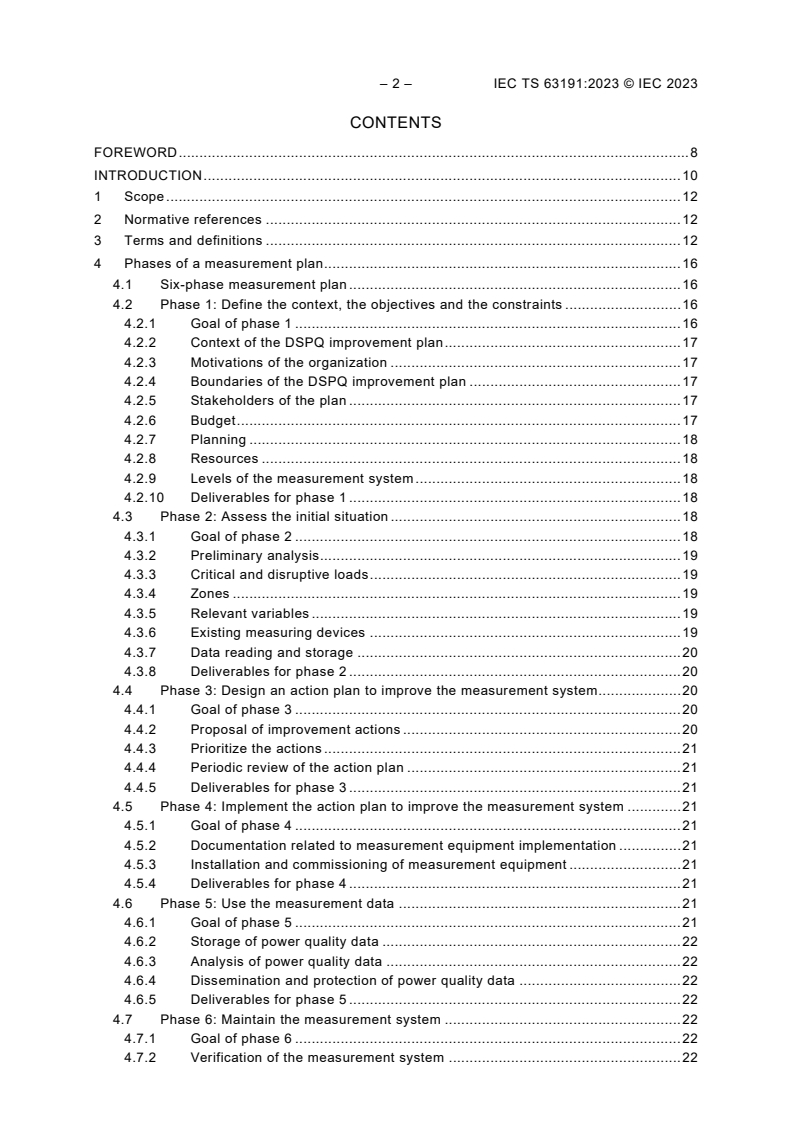
– 2 – IEC TS 63191:2023 © IEC 2023
CONTENTS
FOREWORD . 8
INTRODUCTION . 10
1 Scope . 12
2 Normative references . 12
3 Terms and definitions . 12
4 Phases of a measurement plan . 16
4.1 Six-phase measurement plan . 16
4.2 Phase 1: Define the context, the objectives and the constraints . 16
4.2.1 Goal of phase 1 . 16
4.2.2 Context of the DSPQ improvement plan . 17
4.2.3 Motivations of the organization . 17
4.2.4 Boundaries of the DSPQ improvement plan . 17
4.2.5 Stakeholders of the plan . 17
4.2.6 Budget . 17
4.2.7 Planning . 18
4.2.8 Resources . 18
4.2.9 Levels of the measurement system . 18
4.2.10 Deliverables for phase 1 . 18
4.3 Phase 2: Assess the initial situation . 18
4.3.1 Goal of phase 2 . 18
4.3.2 Preliminary analysis . 19
4.3.3 Critical and disruptive loads . 19
4.3.4 Zones . 19
4.3.5 Relevant variables . 19
4.3.6 Existing measuring devices . 19
4.3.7 Data reading and storage . 20
4.3.8 Deliverables for phase 2 . 20
4.4 Phase 3: Design an action plan to improve the measurement system . 20
4.4.1 Goal of phase 3 . 20
4.4.2 Proposal of improvement actions . 20
4.4.3 Prioritize the actions . 21
4.4.4 Periodic review of the action plan . 21
4.4.5 Deliverables for phase 3 . 21
4.5 Phase 4: Implement the action plan to improve the measurement system . 21
4.5.1 Goal of phase 4 . 21
4.5.2 Documentation related to measurement equipment implementation . 21
4.5.3 Installation and commissioning of measurement equipment . 21
4.5.4 Deliverables for phase 4 . 21
4.6 Phase 5: Use the measurement data . 21
4.6.1 Goal of phase 5 . 21
4.6.2 Storage of power quality data . 22
4.6.3 Analysis of power quality data . 22
4.6.4 Dissemination and protection of power quality data . 22
4.6.5 Deliverables for phase 5 . 22
4.7 Phase 6: Maintain the measurement system . 22
4.7.1 Goal of phase 6 . 22
4.7.2 Verification of the measurement system . 22
4.7.3 Metrological maintenance and monitoring . 22
4.7.4 Deliverables for phase 6 . 22
5 Demand-side power quality disturbances and their impact . 23
5.1 General . 23
5.2 Frequency deviation . 24
5.2.1 Origins . 24
5.2.2 Effects . 24
5.2.3 Possible mitigation measures . 24
5.2.4 Key parameters to measure . 24
5.3 Magnitude of supply voltage: deviation, underdeviations, overdeviations . 25
5.3.1 Origins . 25
5.3.2 Effects . 25
5.3.3 Possible mitigation measures . 26
5.3.4 Key parameters to measure . 26
5.4 Flicker . 26
5.4.1 Origins . 26
5.4.2 Effects . 27
5.4.3 Possible mitigation measures . 27
5.4.4 Key parameters to measure . 27
5.5 Voltage dips, swells and interruptions . 27
5.5.1 Origins . 27
5.5.2 Effects . 28
5.5.3 Possible mitigation measures . 28
5.5.4 Key parameters to measure . 28
5.6 Transient overvoltages . 30
5.6.1 General . 30
5.6.2 Origins . 30
5.6.3 Effects . 30
5.6.4 Possible mitigation measures . 30
5.6.5 Key parameters to measure . 31
5.7 Supply voltage unbalance and current unbalance . 31
5.7.1 General . 31
5.7.2 Origins . 32
5.7.3 Effects . 32
5.7.4 Possible mitigation measures . 32
5.7.5 Key parameters to measure . 32
5.8 Voltage and current harmonics, inter-harmonics and sub-harmonics . 33
5.8.1 Origins . 33
5.8.2 Effects . 34
5.8.3 Possible mitigation measures . 35
5.8.4 Key parameters to measure . 35
5.8.5 Emerging topic . 36
5.9 Mains signalling voltage . 36
5.9.1 Origins . 36
5.9.2 Effects . 36
5.9.3 Possible mitigation measures . 36
5.9.4 Key parameters to measure . 36
5.10 Rapid voltage changes . 36
5.10.1 Origins . 36
– 4 – IEC TS 63191:2023 © IEC 2023
5.10.2 Effects . 37
5.10.3 Possible mitigation measures . 37
5.10.4 Key parameters to measure . 37
5.11 Synthesis of events and their impacts . 38
5.12 Synthesis of events and their impact on energy usage . 38
Annex A (informative) Tool to report the ability to assess the power quality of an
electrical installation . 40
A.1 General . 40
A.2 Ability to assess the power quality of an electrical installation . 40
A.3 Determination of the ability to assess the power quality of an electrical
installation . 41
A.3.1 General . 41
A.3.2 Ability to manage the power quality of the installation . 42
A.3.3 Ability to monitor the installation . 42
A.3.4 Ability to quantify the influencing factors that affect the DSPQ . 47
A.3.5 Ability to take readings from the quality points at regular intervals . 47
A.3.6 Ability to monitor and analyse the DSPQ . 48
A.3.7 Ability to maintain the measurement system . 50
A.4 Results summary . 50
A.5 Typical level according to application . 51
Annex B (informative) Example of the scope of a measurement plan: organization,
sites, zones, energy uses . 53
Annex C (informative) Disturbance levels on the demand-side PQ . 54
C.1 General . 54
C.2 Transients and short-term events . 55
C.3 Continuous voltage phenomena . 56
C.4 Continuous current phenomena . 58
C.5 Power-related events . 58
Annex D (informative) Relationship between devices and electrical phenomena . 59
Annex E (informative) General statements about demand-side power quality . 72
Annex F (informative) Consequence of grid evolution . 73
Annex G (informative) Non-exhaustive list of relevant standards . 75
Annex H (informative) Definitions of electrical parameters . 77
H.1 General . 77
H.2 Definitions in the presence of a neutral . 77
H.3 Power measurement in three-phase three-wire systems using the two-
wattmeter method . 83
H.3.1 General . 83
H.3.2 Total active power . 83
H.3.3 Total vector reactive power using quadrature phase shift definition . 84
H.3.4 Total vector reactive power using Budeanu’s definition . 84
H.4 Additional relationships in case of sinusoidal voltage . 84
Annex I (informative) DC distribution . 85
I.1 General . 85
I.2 DC demand-side power quality disturbances and impact . 85
I.2.1 General . 85
I.2.2 Frequency . 85
I.2.3 Magnitude of supply voltage deviations, under-deviations, over-
deviations . 85
I.2.4 Transient overvoltages . 86
I.2.5 Supply voltage unbalance, current unbalance . 87
I.2.6 Voltage and current harmonics, interharmonics and subharmonics . 87
I.2.7 Rapid voltage changes . 88
I.3 Examples of demand-side AC distribution and of demand-side DC
distribution . 88
I.4 Examples of AC signals and DC signals . 89
Bibliography . 92
Figure 1 – Overview of electrical distribution system from supply side to demand side,
with related standards . 10
Figure 2 – Six-phase measurement plan . 16
Figure 3 – Effects of voltage deviation on a motor . 25
Figure 4 – Visualization of voltage events in modified ITI curve . 29
Figure 5 – Examples of balanced and unbalanced systems . 31
Figure 6 – Typical current waveforms for single-phase non-linear loads . 34
Figure 7 – Typical current waveforms for three-phase non-linear loads . 34
Figure 8 – RVC characterization . 37
Figure A.1 – Ability levels to assess the power quality of an electrical installation . 40
Figure A.2 – Parameter AM01: Example . 43
Figure A.3 – Parameter AM02: Example . 44
Figure A.4 – Parameter AM03 . 45
Figure A.5 – Parameter AM03: Example . 45
Figure A.6 – Parameter AM04: Example . 46
Figure B.1 – Example of the scope of a measurement plan . 53
Figure F.1 – The old centralized grid . 73
Figure F.2 – The new decentralized grid . 73
Figure F.3 – Example of consequences of a decentralized grid (DG) . 74
Figure H.1 – Arithmetic and vector apparent powers in sinusoidal situation . 82
Figure H.2 – Three-phase circuit without neutral . 83
Figure I.1 – Overvoltage phenomena in DC distribution. 86
Figure I.2 – Example of DC interconnected sources . 87
Figure I.3 – Example 1 of disturbed DC signal . 87
Figure I.4 – Example 2 of disturbed DC signal . 88
Figure I.5 – Demand-side DC distribution . 89
Figure I.6 – Demand-side AC distribution . 89
Figure I.7 – Examples of AC signals [a) to d)] and DC signals [e) to i)] . 90
Table 1 – Example of overview of the readings and storage carried out . 20
Table 2 – Classification of PQ phenomena . 23
Table 3 – Origins of PQ problems . 23
Table 4 – Impacts of PQ problems on consumers, manufacturers and utilities . 24
Table 5 – Voltage dip, interruption and swell classification according to EN 50160 . 29
Table 6 – Voltage event classification according to IEC TS 62749 . 29
– 6 – IEC TS 63191:2023 © IEC 2023
Table 7 – Rapid voltage change limits . 37
Table 8 – Overview of events and impacts . 38
Table 9 – Overview of events and impact on usages . 39
Table A.1 – Electrical installation power quality ability levels . 41
Table A.2 – Power quality parameters . 41
Table A.3 – Parameter EX01. 42
Table A.4 – Parameter EX02. 42
Table A.5 – Parameter AM01 . 42
Table A.6 – Parameter AM02 . 43
Table A.7 – Parameter AM03 . 44
Table A.8 – Minimum required functions . 46
Table A.9 – Parameter AM04 . 46
Table A.10 – Parameter IF01 . 47
Table A.11 – Parameter IF02 . 47
Table A.12 – Parameter IF03 . 47
Table A.13 – Parameter RI01 . 48
Table A.14 – Parameter RI02 . 48
Table A.15 – Parameter AA01 . 48
Table A.16 – Parameter AA02 . 49
Table A.17 – Parameter AA03 . 49
Table A.18 – Parameter AA04 . 50
Table A.19 – Parameter MS01 . 50
Table A.20 – Parameter MS02 . 50
Table A.21 – Calculation table . 51
Table A.22 – Typical level according to application . 52
Table C.1 – Classification of transients and short-term events . 55
Table C.2 – Classification of continuous voltage phenomena . 56
Table C.3 – Classification of continuous current phenomena . 58
Table C.4 – Classification of power-related events . 58
Table D.1 – Relationship between current-using equipment and electrical phenomena . 60
Table D.2 – Motors . 61
Table D.3 – Variable speed drives . 62
Table D.4 – Transformers . 63
Table D.5 – Capacitors . 64
Table D.6 – Conventional generators (Genset) . 65
Table D.7 – Uninterrupted power supply (UPS) . 66
Table D.8 – Lighting . 67
Table D.9 – Office equipment. 68
Table D.10 – Cabling . 69
Table D.11 – Programmable logic controllers (PLCs) . 70
Table D.12 – Inverter based generators (PV, storage) . 71
Table G.1 – Existing requirements about PQ (non-exhaustive list) . 75
Table G.2 – Compatibility levels . 76
Table G.3 – Existing requirements about disturbance measurement methods and
instruments (non-exhaustive list) . 76
Table H.1 – Definition of symbols . 77
Table H.2 – Calculation definitions for RMS values . 78
Table H.3 – Calculation definitions for phase powers . 79
Table H.4 – Calculation definitions for phase energies . 79
Table H.5 – Calculation definitions for total powers . 80
Table H.6 – Calculation definitions for power factors . 80
Table H.7 – Calculation definitions for fundamental powers . 80
Table H.8 – Calculation definitions for distortion indicators . 81
Table H.9 – Calculation definitions for unbalance indicators . 82
Table H.10 – Calculation definitions for electrical quantity indicators . 82
Table I.1 – Definitions of AC signals and DC signals . 91
– 8 – IEC TS 63191:2023 © IEC 2023
INTERNATIONAL ELECTROTECHNICAL COMMISSION
____________
DEMAND-SIDE POWER QUALITY MANAGEMENT
FOREWORD
1) The International Electrotechnical Commission (IEC) is a worldwide organization for standardization comprising
all national electrotechnical committees (IEC National Committees). The object of IEC is to promote international
co-operation on all questions concerning standardization in the electrical and electronic fields. To this end and
in addition to other activities, IEC publishes International Standards, Technical Specifications, Technical Reports,
Publicly Available Specifications (PAS) and Guides (hereafter referred to as “IEC Publication(s)”). Their
preparation is entrusted to technical committees; any IEC National Committee interested in the subject dealt with
may participate in this preparatory work. International, governmental and non-governmental organizations liaising
with the IEC also participate in this preparation. IEC collaborates closely with the International Organization for
Standardization (ISO) in accordance with conditions determined by agreement between the two organizations.
2) The formal decisions or agreements of IEC on technical matters express, as nearly as possible, an international
consensus of opinion on the relevant subjects since each technical committee has representation from all
interested IEC National Committees.
3) IEC Publications have the form of recommendations for international use and are accepted by IEC National
Committees in that sense. While all reasonable efforts are made to ensure that the technical content of IEC
Publications is accurate, IEC cannot be held responsible for the way in which they are used or for any
misinterpretation by any end user.
4) In order to promote international uniformity, IEC National Committees undertake to apply IEC Publications
transparently to the maximum extent possible in their national and regional publications. Any divergence between
any IEC Publication and the corresponding national or regional publication shall be clearly indicated in the latter.
5) IEC itself does not provide any attestation of conformity. Independent certification bodies provide conformity
assessment services and, in some areas, access to IEC marks of conformity. IEC is not responsible for any
services carried out by independent certification bodies.
6) All users should ensure that they have the latest edition of this publication.
7) No liability shall attach to IEC or its directors, employees, servants or agents including individual experts and
members of its technical committees and IEC National Committees for any personal injury, property damage or
other damage of any nature whatsoever, whether direct or indirect, or for costs (including legal fees) and
expenses arising out of the publication, use of, or reliance upon, this IEC Publication or any other IEC
Publications.
8) Attention is drawn to the Normative references cited in this publication. Use of the referenced publications is
indispensable for the correct application of this publication.
9) IEC draws attention to the possibility that the implementation of this document may involve the use of (a)
patent(s). IEC takes no position concerning the evidence, validity or applicability of any claimed patent rights in
respect thereof. As of the date of publication of this document, IEC had not received notice of (a) patent(s), which
may be required to implement this document. However, implementers are cautioned that this may not represent
the latest information, which may be obtained from the patent database available at https://patents.iec.ch. IEC
shall not be held responsible for identifying any or all such patent rights.
IEC TS 63191 has been prepared by IEC technical committee 85: Measuring equipment for
electrical and electromagnetic quantities. It is a Technical Specification.
This first edition cancels and replaces IEC TR 63191, published in 2018. This edition constitutes
a technical revision.
This edition includes the following significant technical changes with respect to the previous
edition:
a) a new informative Annex A describing a tool to report the ability to assess the power quality
of an electrical installation.
The text of this Technical Specification is based on the following documents:
Draft Report on voting
85/893/DTS 85/902/RVDTS
Full information on the voting for its approval can be found in the report on voting indicated in
the above table.
The language used for the development of this Technical Specification is English.
This document was drafted in accordance with ISO/IEC Directives, Part 2, and developed in
accordance with ISO/IEC Directives, Part 1 and ISO/IEC Directives, IEC Supplement, available
at www.iec.ch/members_experts/refdocs. The main document types developed by IEC are
described in greater detail at www.iec.ch/publications.
The committee has decided that the contents of this document will remain unchanged until the
stability date indicated on the IEC website under webstore.iec.ch in the data related to the
specific document. At this date, the document will be
• reconfirmed,
• withdrawn,
• replaced by a revised edition, or
• amended.
IMPORTANT – The "colour inside" logo on the cover page of this document indicates
that it contains colours which are considered to be useful for the correct understanding
of its contents. Users should therefore print this document using a colour printer.
– 10 – IEC TS 63191:2023 © IEC 2023
INTRODUCTION
The effective management of power quality on the demand side (power consumer) is an
essential activity to ensure the proper operation of the electrical equipment operating on the
consumer site.
While the level of power quality present at the point of supply is generally monitored and
managed by the power provider (utility), the actual level of power disturbances present on the
consumer site can be significantly worse and can negatively impact the operation of the
electrical equipment. The interaction between these loads and the voltage supply is often the
cause of degraded power quality on the demand side.
One effective step in the prevention of the hindrances caused by inadequate power quality is
the assessment of the level of power quality disturbance present on the demand side. However,
proper measurements require adequate planning and understanding of the measurement
systems and their results.
This document provides guidance on how to establish, implement, exploit, maintain and improve
a demand-side power quality monitoring system. This document will also facilitate the tailoring
of power quality monitoring concepts to the specific site where it will be deployed.
Disturbances in the electrical energy can have an important impact on the equipment, processes,
organization's activities. Some electrical installations (industrial sites, data centres, hospitals,
etc.) are particularly impacted by the poor quality of electrical energy.
The quality of the electrical energy has different origins, impacts and measurement indicators
on the supply side and on the demand side – see Figure 1 presenting an overview of the
electrical network from generation (supply side) to consumer (demand side).
Figure 1 – Overview of electrical distribution system from supply side to demand side,
with related standards
While documents such as IEC TS 62749 and EN 50160 define the voltage characteristics
provided by a public network (called power quality of the grid), this document gives guidance
on qualifying the power quality in internal networks (called demand-side power quality).
In this document, power quality on the demand side, related to buildings, industrial and data
centre applications is referred to as demand-side power quality (DSPQ).
See Annex A for a tool to report the ability to assess the power quality.
See Annex E for a general statement on demand-side power quality.
See Annex F for a discussion about grid evolution.
See Annex G for a list of standards related to demand-side power quality.
See Annex H for definition of electrical parameters.
It is assumed that users of this document possess a minimum knowledge of power quality
phenomena.
– 12 – IEC TS 63191:2023 © IEC 2023
DEMAND-SIDE POWER QUALITY MANAGEMENT
1 Scope
This document specifies recommendations about power quality measurement and assessment
within installations.
NOTE 1 Most standards address power quality at the delivery point between energy providers and customers.
This document outlines the various phases needed for the establishment of a demand-side
power quality measurement plan for buildings and industry installations.
NOTE 2 The demand side refers to the electrical installation, beyond the PCC (point of common coupling), which
is under the jurisdiction of facility managers.
Such a power quality measurement plan will enable the optimization of the energy availability
and efficiency, improve the assets lifetime and facilitate the resolutions of power quality
problems. A power quality measurement plan encompasses the following phases:
• definition of the context, objectives and constraints;
• assessment of the initial power quality situation;
• definition of an action plan for the improvement of the power quality situation;
• implementation of the power quality measuring system;
• exploitation of the measurement system for the improvement of the power quality situation;
• maintenance of the measurement system.
This document will also help facility managers tailor their measurement plan to the specific
needs of the electrical system under their control. It addresses all the disturbances present in
such networks, but does not cover the disturbances present in public electrical distribution
networks (supply side) as they are governed by specific documents such as EN 50160 and
IEC TS 62749.
2 Normative references
There are no normative references in this document.
3 Terms and definitions
For the purposes of this document, the following terms and definitions apply.
ISO and IEC maintain terminological databases for use in standardization at the following
addresses:
• IEC Electropedia: available at http://www.electropedia.org/
• ISO Online browsing platform: available at http://www.iso.org/obp
3.1
demand side
part of the grid where electric energy is consumed by end-use customers within their electric
distribution system
3.2
DSPQ
demand-side power quality
characteristics of the electric current, voltage and frequencies at a given point in an electric
distribution system located on the demand side, evaluated against a set of reference technical
parameters
3.3
IPC
in-plant point of coupling
point on a network inside a system or an installation, electrically nearest to a particular load, at
which other loads are, or can be, connected
Note 1 to entry: The IPC is usually the point for which electromagnetic compatibility is to be considered.
3.4
PCC
point of common coupling
point of a power supply network, electrically nearest to a particular load, at which other loads
are, or can be, connected
3.5
flicker
impression of unsteadiness of visual sensation induced by a light stimulus whose luminance or
spectral distribution fluctuates with time
3.6
interruption
reduction of the voltage at a point in the electrical system below the interruption threshold
3.7
interruption threshold
voltage magnitude specified for the purpose of detecting the start and the end of a voltage
interruption
3.8
voltage dip
voltage sag
temporary reduction of the voltage magnitude at a point in the electrical system below a
threshold
Note 1 to entry: Interruptions are a special case of a voltage dip. Post-processing can be used to distinguish
between voltage dips and interruptions.
Note 2 to entry: A voltage dip is also referred to as voltage sag. The two terms are considered as interchangeable;
however, this document uses only the term "voltage dip".
3.9
voltage swell
temporary increase of the voltage magnitude at a point in the electrical system above a
threshold
– 14 – IEC TS 63191:2023 © IEC 2023
3.10
voltage unbalance
condition in a polyphase system in which the RMS values of the line voltages (fundamental
component), and/or the phase ang
...