

IEC 61515:2016
(Main)Mineral insulated metal-sheathed thermocouple cables and thermocouples
General Information
- Abstract
IEC 61515:2016 establishes the requirements for simplex, duplex and triplex mineral-insulated metal-sheathed thermocouple cables and thermocouples, which are intended for use in general industrial applications. The abbreviation MIMS (for "mineral-insulated metal-sheathed") will be used hereafter. It covers thermocouple cables and thermocouples with only base-metal conductors of Types T, J, E, K and N. The specifications in this standard apply to new thermocouple cables and thermocouple units as delivered to the user. They do not apply to the product after use. This second edition cancels and replaces the first edition published in 1995. This edition constitutes a technical revision. This edition includes the following significant technical changes with respect to the previous edition:
- Duplex and triplex are standardized.
- Specification of insulation resistance is revised so that the user can choose the best product to fit for the purpose.
- "Table 2 Recommended maximum operating temperatures" in the previous version is expanded significantly including newly developed sheath material and it is moved to Annex C.
- Test items and their methods are expanded and a guide table (Table 4) is added for userfriendliness.
- Status
- Published
- Publication Date
- 26-Apr-2016
- Technical Committee
- SC 65B - Measurement and control devices
- Drafting Committee
- WG 5 - TC 65/SC 65B/WG 5
- Current Stage
- PPUB - Publication issued
- Start Date
- 27-Apr-2016
- Completion Date
- 15-Apr-2016
Overview
IEC 61515:2016 is an international standard published by the International Electrotechnical Commission (IEC) that specifies requirements for mineral insulated metal-sheathed (MIMS) thermocouple cables and thermocouples. This second edition updates the first 1995 version with a technical revision, emphasizing industrial applications of simplex, duplex, and triplex MIMS thermocouples made from base-metal conductors of Types T, J, E, K, and N.
The standard focuses on ensuring reliability, performance, and safety of thermocouple cables and units as supplied to users, providing comprehensive specifications related to construction, materials, electrical characteristics, mechanical properties, and insulation. It does not apply to products after usage.
Key Topics
- Types of MIMS Thermocouples: The standard covers simplex, duplex, and triplex cable configurations designed to meet varying industrial requirements.
- Materials and Construction: IEC 61515 details the sheath materials, conductor types (including thermal characteristics), and insulation materials (notably mineral insulation such as magnesia and alumina).
- Electrical Properties and Insulation Resistance: The revision introduces enhanced specifications for insulation resistance, allowing users to select cables tailored for specific operating conditions.
- Maximum Operating Temperatures: Annex C provides an expanded and updated guide on temperature limits considering advanced sheath materials and insulation capabilities.
- Dimensional Specifications: Precise dimensions for the transverse cross-sections of simplex, duplex, and triplex cables ensure compatibility and standardized installation.
- Verification Testing: The standard outlines required performance and structural tests under mechanical, electrical, and thermal stress conditions to guarantee product quality.
- Marking and Packaging: Clear labeling and packaging instructions assist in traceability and safe handling of thermocouple cables.
Applications
IEC 61515:2016-certified MIMS thermocouple cables and thermocouples are widely used in general industrial temperature measurement and control systems, including:
- Process Automation: Critical in monitoring and controlling industrial processes where accurate temperature measurement ensures operational safety and efficiency.
- Harsh Environments: The mineral insulation and metal sheath offer enhanced protection against corrosive agents, moisture, and mechanical damage, making them ideal for high-temperature or aggressive environments.
- Power Generation: Used in turbines, boilers, and generators to ensure precise thermal measurements under extreme conditions.
- Manufacturing: Suitable for steel, glass, chemical, petrochemical, and other heavy industries requiring robust thermal sensing solutions.
- Instrumentation and Control Networks: Duplex and triplex cables enable multi-channel temperature measurements with reduced wiring complexity.
By following IEC 61515, manufacturers provide reliable thermocouple products with standardized quality and performance, simplifying installation, maintenance, and calibration.
Related Standards
For comprehensive industrial temperature measurement solutions, IEC 61515:2016 aligns with and complements other relevant standards and guidelines such as:
- IEC 60584 – Thermocouples: Specification and temperature–EMF tables for base-metal thermocouples.
- IEC 60751 – Industrial platinum resistance thermometers and platinum temperature sensors.
- ISO/IEC Directives – For conformity assessment and documentation related to electrical measurement devices.
- National and Regional Variants – Many countries adopt IEC 61515 or develop related standards based on it for thermocouple cable manufacturing and application.
Users are encouraged to consult these standards alongside IEC 61515 to ensure full compliance in thermocouple system design, testing, and installation.
By adopting IEC 61515:2016, industrial operators and manufacturers benefit from internationally recognized requirements and guidelines for mineral insulated metal-sheathed thermocouple cables, driving enhanced accuracy, durability, and safety in temperature measurement solutions across diverse sectors.
Get Certified
Connect with accredited certification bodies for this standard

BSMI (Bureau of Standards, Metrology and Inspection)
Taiwan's standards and inspection authority.
Sponsored listings
Frequently Asked Questions
IEC 61515:2016 is a standard published by the International Electrotechnical Commission (IEC). Its full title is "Mineral insulated metal-sheathed thermocouple cables and thermocouples". This standard covers: IEC 61515:2016 establishes the requirements for simplex, duplex and triplex mineral-insulated metal-sheathed thermocouple cables and thermocouples, which are intended for use in general industrial applications. The abbreviation MIMS (for "mineral-insulated metal-sheathed") will be used hereafter. It covers thermocouple cables and thermocouples with only base-metal conductors of Types T, J, E, K and N. The specifications in this standard apply to new thermocouple cables and thermocouple units as delivered to the user. They do not apply to the product after use. This second edition cancels and replaces the first edition published in 1995. This edition constitutes a technical revision. This edition includes the following significant technical changes with respect to the previous edition: - Duplex and triplex are standardized. - Specification of insulation resistance is revised so that the user can choose the best product to fit for the purpose. - "Table 2 Recommended maximum operating temperatures" in the previous version is expanded significantly including newly developed sheath material and it is moved to Annex C. - Test items and their methods are expanded and a guide table (Table 4) is added for userfriendliness.
IEC 61515:2016 establishes the requirements for simplex, duplex and triplex mineral-insulated metal-sheathed thermocouple cables and thermocouples, which are intended for use in general industrial applications. The abbreviation MIMS (for "mineral-insulated metal-sheathed") will be used hereafter. It covers thermocouple cables and thermocouples with only base-metal conductors of Types T, J, E, K and N. The specifications in this standard apply to new thermocouple cables and thermocouple units as delivered to the user. They do not apply to the product after use. This second edition cancels and replaces the first edition published in 1995. This edition constitutes a technical revision. This edition includes the following significant technical changes with respect to the previous edition: - Duplex and triplex are standardized. - Specification of insulation resistance is revised so that the user can choose the best product to fit for the purpose. - "Table 2 Recommended maximum operating temperatures" in the previous version is expanded significantly including newly developed sheath material and it is moved to Annex C. - Test items and their methods are expanded and a guide table (Table 4) is added for userfriendliness.
IEC 61515:2016 is classified under the following ICS (International Classification for Standards) categories: 17.200.20 - Temperature-measuring instruments. The ICS classification helps identify the subject area and facilitates finding related standards.
IEC 61515:2016 is available in PDF format for immediate download after purchase. The document can be added to your cart and obtained through the secure checkout process. Digital delivery ensures instant access to the complete standard document.
Standards Content (Sample)
IEC 61515 ®
Edition 2.0 2016-04
INTERNATIONAL
STANDARD
NORME
INTERNATIONALE
Mineral insulated metal-sheathed thermocouple cables and thermocouples
Câbles et couples thermoélectriques à isolation minérale dits "chemisés"
All rights reserved. Unless otherwise specified, no part of this publication may be reproduced or utilized in any form
or by any means, electronic or mechanical, including photocopying and microfilm, without permission in writing from
either IEC or IEC's member National Committee in the country of the requester. If you have any questions about IEC
copyright or have an enquiry about obtaining additional rights to this publication, please contact the address below or
your local IEC member National Committee for further information.
Droits de reproduction réservés. Sauf indication contraire, aucune partie de cette publication ne peut être reproduite
ni utilisée sous quelque forme que ce soit et par aucun procédé, électronique ou mécanique, y compris la photocopie
et les microfilms, sans l'accord écrit de l'IEC ou du Comité national de l'IEC du pays du demandeur. Si vous avez des
questions sur le copyright de l'IEC ou si vous désirez obtenir des droits supplémentaires sur cette publication, utilisez
les coordonnées ci-après ou contactez le Comité national de l'IEC de votre pays de résidence.
IEC Central Office Tel.: +41 22 919 02 11
3, rue de Varembé Fax: +41 22 919 03 00
CH-1211 Geneva 20 info@iec.ch
Switzerland www.iec.ch
About the IEC
The International Electrotechnical Commission (IEC) is the leading global organization that prepares and publishes
International Standards for all electrical, electronic and related technologies.
About IEC publications
The technical content of IEC publications is kept under constant review by the IEC. Please make sure that you have the
latest edition, a corrigenda or an amendment might have been published.
IEC Catalogue - webstore.iec.ch/catalogue Electropedia - www.electropedia.org
The stand-alone application for consulting the entire The world's leading online dictionary of electronic and
bibliographical information on IEC International Standards, electrical terms containing 20 000 terms and definitions in
Technical Specifications, Technical Reports and other English and French, with equivalent terms in 15 additional
documents. Available for PC, Mac OS, Android Tablets and languages. Also known as the International Electrotechnical
iPad. Vocabulary (IEV) online.
IEC publications search - www.iec.ch/searchpub IEC Glossary - std.iec.ch/glossary
The advanced search enables to find IEC publications by a 65 000 electrotechnical terminology entries in English and
variety of criteria (reference number, text, technical French extracted from the Terms and Definitions clause of
committee,…). It also gives information on projects, replaced IEC publications issued since 2002. Some entries have been
and withdrawn publications. collected from earlier publications of IEC TC 37, 77, 86 and
CISPR.
IEC Just Published - webstore.iec.ch/justpublished
Stay up to date on all new IEC publications. Just Published IEC Customer Service Centre - webstore.iec.ch/csc
details all new publications released. Available online and If you wish to give us your feedback on this publication or
also once a month by email. need further assistance, please contact the Customer Service
Centre: csc@iec.ch.
A propos de l'IEC
La Commission Electrotechnique Internationale (IEC) est la première organisation mondiale qui élabore et publie des
Normes internationales pour tout ce qui a trait à l'électricité, à l'électronique et aux technologies apparentées.
A propos des publications IEC
Le contenu technique des publications IEC est constamment revu. Veuillez vous assurer que vous possédez l’édition la
plus récente, un corrigendum ou amendement peut avoir été publié.
Catalogue IEC - webstore.iec.ch/catalogue Electropedia - www.electropedia.org
Application autonome pour consulter tous les renseignements
Le premier dictionnaire en ligne de termes électroniques et
bibliographiques sur les Normes internationales,
électriques. Il contient 20 000 termes et définitions en anglais
Spécifications techniques, Rapports techniques et autres
et en français, ainsi que les termes équivalents dans 15
documents de l'IEC. Disponible pour PC, Mac OS, tablettes
langues additionnelles. Egalement appelé Vocabulaire
Android et iPad.
Electrotechnique International (IEV) en ligne.
Recherche de publications IEC - www.iec.ch/searchpub
Glossaire IEC - std.iec.ch/glossary
La recherche avancée permet de trouver des publications IEC 65 000 entrées terminologiques électrotechniques, en anglais
en utilisant différents critères (numéro de référence, texte, et en français, extraites des articles Termes et Définitions des
comité d’études,…). Elle donne aussi des informations sur les publications IEC parues depuis 2002. Plus certaines entrées
projets et les publications remplacées ou retirées. antérieures extraites des publications des CE 37, 77, 86 et
CISPR de l'IEC.
IEC Just Published - webstore.iec.ch/justpublished
Service Clients - webstore.iec.ch/csc
Restez informé sur les nouvelles publications IEC. Just
Published détaille les nouvelles publications parues. Si vous désirez nous donner des commentaires sur cette
Disponible en ligne et aussi une fois par mois par email. publication ou si vous avez des questions contactez-nous:
csc@iec.ch.
IEC 61515 ®
Edition 2.0 2016-04
INTERNATIONAL
STANDARD
NORME
INTERNATIONALE
Mineral insulated metal-sheathed thermocouple cables and thermocouples
Câbles et couples thermoélectriques à isolation minérale dits "chemisés"
INTERNATIONAL
ELECTROTECHNICAL
COMMISSION
COMMISSION
ELECTROTECHNIQUE
INTERNATIONALE
ICS 17.200.20 ISBN 978-2-8322-3225-5
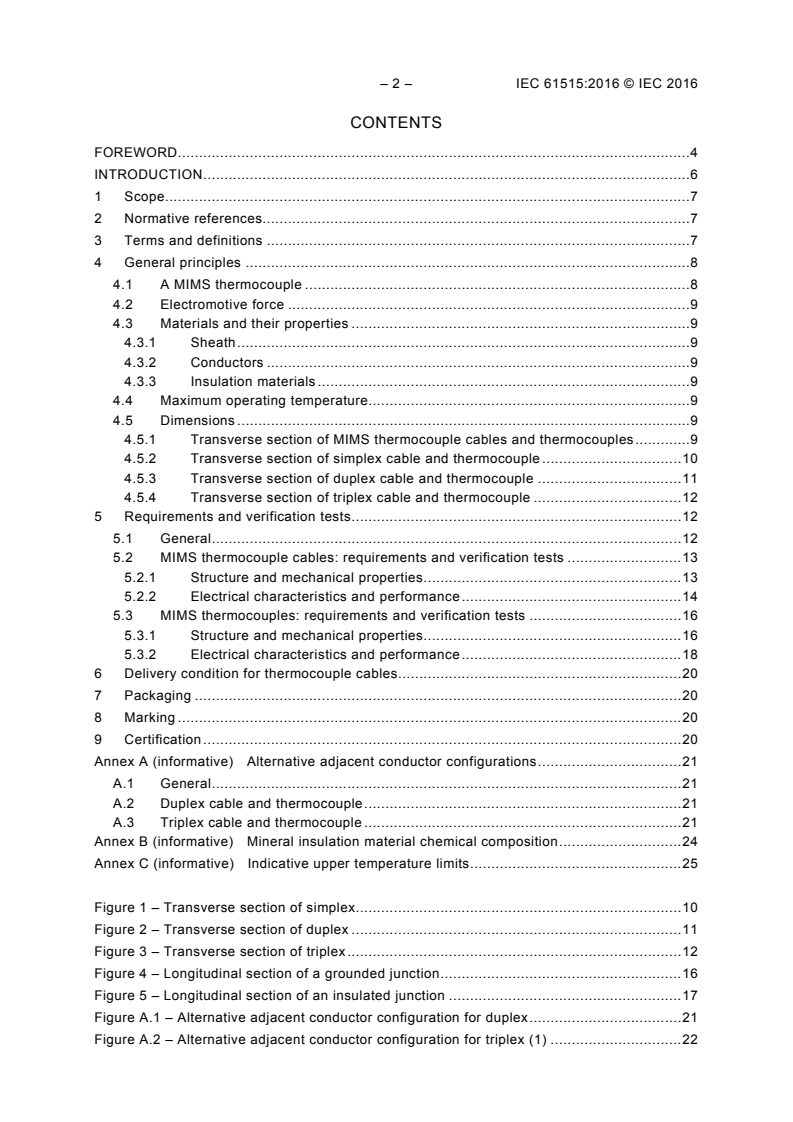
– 2 – IEC 61515:2016 © IEC 2016
CONTENTS
FOREWORD . 4
INTRODUCTION . 6
1 Scope . 7
2 Normative references. 7
3 Terms and definitions . 7
4 General principles . 8
4.1 A MIMS thermocouple . 8
4.2 Electromotive force . 9
4.3 Materials and their properties . 9
4.3.1 Sheath . 9
4.3.2 Conductors . 9
4.3.3 Insulation materials . 9
4.4 Maximum operating temperature . 9
4.5 Dimensions . 9
4.5.1 Transverse section of MIMS thermocouple cables and thermocouples . 9
4.5.2 Transverse section of simplex cable and thermocouple . 10
4.5.3 Transverse section of duplex cable and thermocouple . 11
4.5.4 Transverse section of triplex cable and thermocouple . 12
5 Requirements and verification tests . 12
5.1 General . 12
5.2 MIMS thermocouple cables: requirements and verification tests . 13
5.2.1 Structure and mechanical properties . 13
5.2.2 Electrical characteristics and performance . 14
5.3 MIMS thermocouples: requirements and verification tests . 16
5.3.1 Structure and mechanical properties . 16
5.3.2 Electrical characteristics and performance . 18
6 Delivery condition for thermocouple cables . 20
7 Packaging . 20
8 Marking . 20
9 Certification . 20
Annex A (informative) Alternative adjacent conductor configurations . 21
A.1 General . 21
A.2 Duplex cable and thermocouple . 21
A.3 Triplex cable and thermocouple . 21
Annex B (informative) Mineral insulation material chemical composition . 24
Annex C (informative) Indicative upper temperature limits . 25
Figure 1 – Transverse section of simplex . 10
Figure 2 – Transverse section of duplex . 11
Figure 3 – Transverse section of triplex . 12
Figure 4 – Longitudinal section of a grounded junction . 16
Figure 5 – Longitudinal section of an insulated junction . 17
Figure A.1 – Alternative adjacent conductor configuration for duplex . 21
Figure A.2 – Alternative adjacent conductor configuration for triplex (1) . 22
Figure A.3 – Alternative adjacent conductor configuration for triplex (2) . 22
Figure A.4 – Alternative adjacent conductor configuration for triplex (3) . 23
Table 1 – Dimensional specifications of simplex . 10
Table 2 – Dimensional specifications of duplex . 11
Table 3 – Dimensional specifications of triplex. 12
Table 4 – Tests for MIMS thermocouple cables and thermocouples . 13
Table 5 – Test voltage for dielectric strength . 15
Table 6 – Minimum insulation resistance at ambient temperature (MIMS cables) . 15
Table 7 – Insulation resistance at elevated temperatures (MIMS cables) . 16
Table 8 – Minimum insulation resistance at ambient temperature . 19
Table 9 – Insulation resistance at elevated temperatures (MIMS thermocouples) . 19
Table B.1 – Example values of recommended magnesia (MgO) – Chemical
composition in weight percent . 24
Table B.2 – Example values of recommended alumina (Al O ) – Chemical composition
2 3
in weight percent . 24
Table C.1 – Indicative temperature limits of MIMS thermocouple sheath and conductor
combinations . 25
– 4 – IEC 61515:2016 © IEC 2016
INTERNATIONAL ELECTROTECHNICAL COMMISSION
____________
MINERAL INSULATED METAL-SHEATHED
THERMOCOUPLE CABLES AND THERMOCOUPLES
FOREWORD
1) The International Electrotechnical Commission (IEC) is a worldwide organization for standardization comprising
all national electrotechnical committees (IEC National Committees). The object of IEC is to promote international
co-operation on all questions concerning standardization in the electrical and electronic fields. To this end and in
addition to other activities, IEC publishes International Standards, Technical Specifications, Technical Reports,
Publicly Available Specifications (PAS) and Guides (hereafter referred to as “IEC Publication(s)”). Their
preparation is entrusted to technical committees; any IEC National Committee interested in the subject dealt with
may participate in this preparatory work. International, governmental and non-governmental organizations liaising
with the IEC also participate in this preparation. IEC collaborates closely with the International Organization for
Standardization (ISO) in accordance with conditions determined by agreement between the two organizations.
2) The formal decisions or agreements of IEC on technical matters express, as nearly as possible, an international
consensus of opinion on the relevant subjects since each technical committee has representation from all
interested IEC National Committees.
3) IEC Publications have the form of recommendations for international use and are accepted by IEC National
Committees in that sense. While all reasonable efforts are made to ensure that the technical content of IEC
Publications is accurate, IEC cannot be held responsible for the way in which they are used or for any
misinterpretation by any end user.
4) In order to promote international uniformity, IEC National Committees undertake to apply IEC Publications
transparently to the maximum extent possible in their national and regional publications. Any divergence between
any IEC Publication and the corresponding national or regional publication shall be clearly indicated in the latter.
5) IEC itself does not provide any attestation of conformity. Independent certification bodies provide conformity
assessment services and, in some areas, access to IEC marks of conformity. IEC is not responsible for any
services carried out by independent certification bodies.
6) All users should ensure that they have the latest edition of this publication.
7) No liability shall attach to IEC or its directors, employees, servants or agents including individual experts and
members of its technical committees and IEC National Committees for any personal injury, property damage or
other damage of any nature whatsoever, whether direct or indirect, or for costs (including legal fees) and expenses
arising out of the publication, use of, or reliance upon, this IEC Publication or any other IEC Publications.
8) Attention is drawn to the Normative references cited in this publication. Use of the referenced publications is
indispensable for the correct application of this publication.
9) Attention is drawn to the possibility that some of the elements of this IEC Publication may be the subject of patent
rights. IEC shall not be held responsible for identifying any or all such patent rights.
International Standard IEC 61515 has been prepared by subcommittee 65B: Measurement and
control devices, of IEC technical committee 65: Industrial-process measurement, control and
automation.
This second edition cancels and replaces the first edition published in 1995. This edition
constitutes a technical revision.
This edition includes the following significant technical changes with respect to the previous
edition:
a) Duplex and triplex are standardized.
b) Specification of insulation resistance is revised so that the user can choose the best product
to fit for the purpose.
c) “Table 2 Recommended maximum operating temperatures” in the previous version is
expanded significantly including newly developed sheath material and it is moved to
Annex C.
d) Test items and their methods are expanded and a guide table (Table 4) is added for
userfriendliness.
The text of this standard is based on the following documents:
FDIS Report on voting
65B/1034/FDIS 65B/1038/RVD
Full information on the voting for the approval of this standard can be found in the report on
voting indicated in the above table.
This publication has been drafted in accordance with the ISO/IEC Directives, Part 2.
The committee has decided that the contents of this publication will remain unchanged until the
stability date indicated on the IEC website under "http://webstore.iec.ch" in the data related to
the specific publication. At this date, the publication will be
• reconfirmed,
• withdrawn,
• replaced by a revised edition, or
• amended.
– 6 – IEC 61515:2016 © IEC 2016
INTRODUCTION
This new edition of IEC 61515 reflects recent developments in production technology, sheath
materials and insulation materials. It aims to be a flexible standard allowing suppliers to provide
fit-for-purpose products at an acceptable cost.
It includes informative guidance to help users choose the products that meet their needs.
Annex A gives alternative adjacent conductor configurations for duplex and triplex MIMS
thermocouple cables and thermocouples.
Annex B gives recommendations to suppliers with respect to insulation composition.
Annex C gives guidelines to users with regard to temperature limits of operation.
MINERAL INSULATED METAL-SHEATHED
THERMOCOUPLE CABLES AND THERMOCOUPLES
1 Scope
This International Standard establishes the requirements for simplex, duplex and triplex
mineral-insulated metal-sheathed thermocouple cables and thermocouples, which are intended
for use in general industrial applications. The abbreviation MIMS (for “mineral-insulated
metal-sheathed”) will be used hereafter. It covers thermocouple cables and thermocouples with
only base-metal conductors of Types T, J, E, K and N. The specifications in this standard apply
to new thermocouple cables and thermocouple units as delivered to the user. They do not apply
to the product after use.
External seals, terminations, connections and other accessories are not within the scope of this
International Standard.
This standard does not apply to precious metal thermocouple cables and thermocouples. The
special requirements for nuclear primary loop applications are dealt with in the other standards.
2 Normative references
The following documents, in whole or in part, are normatively referenced in this document and
are indispensable for its application. For dated references, only the edition cited applies. For
undated references, the latest edition of the referenced document (including any amendments)
applies.
IEC 60068-2-6, Environmental testing – Part 2-6: Tests – Test Fc: Vibration (sinusoidal)
IEC 60584-1, Thermocouples: Part 1 – EMF specifications and tolerances
ISO 1302, Geometrical Product Specifications (GPS) — Indication of surface texture in
technical product documentation
3 Terms and definitions
For the purposes of this document, the terms and definitions given in IEC 60584-1 and the
following apply.
3.1
mineral insulated metal-sheathed thermocouple cable
bendable cable consisting of one or more pairs of thermocouple conductors encapsulated in a
metal protecting sheath, insulated from each other and from the sheath by a compacted mineral
material
Note 1 to entry: Abbreviation MIMS for “mineral insulated metal-sheathed” is used hereafter.
3.2
MIMS thermocouple
thermocouple manufactured from mineral-insulated metal-sheathed thermocouple cable
Note 1 to entry: This note applies to the French language only.
– 8 – IEC 61515:2016 © IEC 2016
3.3
simplex thermocouple
thermocouple unit comprising one pair of thermocouple conductors
3.4
duplex thermocouple
thermocouple unit comprising two pairs of thermocouple conductors
3.5
triplex thermocouple
thermocouple unit comprising three pairs of thermocouple conductors
3.6
measuring junction
junction of the thermocouple conductors which is subjected to the temperature to be measured
3.7
grounded junction
bonded junction
earthed junction
measuring junction electrically connected to the metal sheath
3.8
insulated junction
ungrounded junction
measuring junction electrically insulated from the metal sheath
3.9
thermal response time
time a thermocouple takes to respond at a specified percentage to a step change in temperature
Note 1 to entry: The time to register 50 % of the step change, for example, is written τ .
0,5
Note 2 to entry: The test medium and its flow conditions shall be specified (usually flowing water or flowing air).
3.10
type test
test conducted on one or more samples of the production to verify that the product is compliant
with the requirements of IEC 61515 following the introduction or change of material specification,
design or manufacturing process
3.11
routine test
test to which each individual product is subjected during or after manufacture to ascertain
whether it complies with the requirements of IEC 61515
3.12
optional test
test that is performed upon agreement between a supplier and a user to ensure compliance with
the user’s specific application
4 General principles
4.1 A MIMS thermocouple
A MIMS thermocouple specified in this standard shall be made of a MIMS thermocouple cable
that complies with this standard.
4.2 Electromotive force
The electromotive force (abbreviated EMF hereafter) versus temperature relationship shall
comply with IEC 60584-1. The EMF tolerance, as specified in IEC 60584-1, should be agreed
between the supplier and the user.
4.3 Materials and their properties
4.3.1 Sheath
The sheath material shall be of qualified stainless steel or high nickel alloy or other metals
selected by agreement between users and suppliers. It shall be chosen to suit user’s application
in order to protect the thermocouple during use. The general surface finish of the sheath upon
delivery shall be equal to, or better than, roughness grade ISO 1302 scale 8 (3,2 µm Ra).
4.3.2 Conductors
Conductors shall be those forming thermocouple types T, J, E, K or N as specified in
IEC 60584-1.This standard applies to thermocouple cables and thermocouples that have 1, 2
and 3 pairs of thermocouple conductors.
For duplex and triplex, cables basic adjacent conductor configurations are specified. Alternative
configurations are acceptable by the agreement between supplier and user provided that all the
other requirements of this standard are met.
Some examples of alternative adjacent conductor configurations are given in Annex A.
4.3.3 Insulation materials
The mineral insulation shall consist of compacted ceramic powder.
The purity of insulating material should be at least 96 % and informative compositions are shown
in Annex B.
Specific requirements, concerning the purity of the insulation material, can be customized by
agreement between the user and the supplier.
4.4 Maximum operating temperature
Definitive maximum operating temperatures cannot be specified because of the number of
influencing factors. Instead Annex C gives indicative temperature limits which are the
recommended maximum operating temperatures for the standardized thermocouples and some
commonly used sheath materials and diameters. They are to be considered only as guidance for
users.
4.5 Dimensions
4.5.1 Transverse section of MIMS thermocouple cables and thermocouples
The outside diameter, conductor diameter and sheath wall thickness shall be as specified in the
following 4.5.2 to 4.5.4. Throughout this standard the following symbols are used.
• outside diameter D;
• conductor diameter C;
• sheath wall thickness S;
• insulation thickness I.
The insulation thickness I is not quantified in this standard. It shall be such that the specified
requirements for dielectric strength (specified in 5.2.2.3 and 5.3.2.3) and insulation resistance
– 10 – IEC 61515:2016 © IEC 2016
(specified in 5.2.2.5 and 5.3.2.4) shall be met. (The maximum value of the insulation thickness
can be deduced from the specified value of D, S and C). Conductors shall be approximately
evenly spaced unless specified otherwise. The following Figures 1, 2 and 3, as well as
Figures A.1, A.2, A.3 and A.4 clarify which part the specifications of D, C and S are applied to.
Insulation thickness is always given in brackets in those figures because it is not numerically
specified.
4.5.2 Transverse section of simplex cable and thermocouple
D
S
( I ) ( I ) ( I )
C C
IEC
Figure 1 – Transverse section of simplex
Table 1 – Dimensional specifications of simplex
Outside diameter D Minimum sheath Minimum diameter of
and its tolerance wall thickness S conductor C
mm mm mm
0,5 ± 0,025 0,05 0,08
0,10 0,15
1,0 ± 0,025
0,15 0,23
1,5 ± 0,025
2,0 ± 0,025 0,20 0,30
3,0 ± 0,030 0,30 0,45
3,2 ± 0,032 0,32 0,48
0,40 0,60
4,0 ± 0,040
0,45 0,68
4,5 ± 0,045
4,8 ± 0,048 0,48 0,72
6,0 ± 0,060 0,60 0,90
6,4 ± 0,064 0,64 0,96
8,0 ± 0,080 0,80 1,20
0,95 1,43
9,5 ± 0,095
10,8 ± 0,108 1,08 1,62
Sizes not included in Table 1 are acceptable provided that the sheath wall thickness is not less
than 10 % of the thermocouple cable diameter (D) and the conductor diameter (C) is not less
than 15 % of D. The tolerance on D shall be the greater of 0,025 mm or 0,01·D.
4.5.3 Transverse section of duplex cable and thermocouple
D
S
( I )
( I )
C
IEC
Figure 2 – Transverse section of duplex
Table 2 – Dimensional specifications of duplex
Outside diameter D Minimum sheath wall thickness S Minimum diameter of
and its tolerance conductor C
mm mm mm
0,14 0,17
1,5 ± 0,025
2,0 ± 0,025 0,18 0,22
3,0 ± 0,030 0,27 0,33
3,2 ± 0,032 0,29 0,35
4,0 ± 0,040 0,36 0,44
0,41 0,50
4,5 ± 0,045
4,8 ± 0,048 0,43 0,53
6,0 ± 0,060 0,54 0,66
6,4 ± 0,064 0,58 0,70
8,0 ± 0,080 0,72 0,88
0,86 1,05
9,5 ± 0,095
10,8 ± 0,108 0,97 1,19
Sizes not included in Table 2 are acceptable provided that sheath wall thickness is not less than
9 % of the thermocouple cable diameter (D) and conductor diameter (C) is not less than 11 % of
D. The tolerance on D, shall be the greater of 0,025 mm or 0,01·D.
– 12 – IEC 61515:2016 © IEC 2016
4.5.4 Transverse section of triplex cable and thermocouple
D
C ( I ) S
( I )
IEC
Figure 3 – Transverse section of triplex
Table 3 – Dimensional specifications of triplex
Outside diameter D Minimum sheath wall thickness S Minimum diameter of
and its tolerance conductor C
mm mm mm
0,24 0,27
3,0 ± 0,030
3,2 ± 0,032 0,26 0,29
4,0 ±0,040 0,32 0,36
4,5 ± 0,045 0,36 0,41
0,38 0,43
4,8 ± 0,048
0,48 0,54
6,0 ± 0,060
6,4± 0,064 0,51 0,58
8,0 ± 0,080 0,64 0,72
9,5 ± 0,095 0,76 0,86
0,86 0,97
10,8 ± 0,108
Sizes not included in the Table 3 are acceptable provided that sheath wall thickness is not less
than 8 % of the thermocouple cable diameter (D) and conductor diameter (C) is not less than 9 %
of D. The tolerance on D shall be 0,01·D.
5 Requirements and verification tests
5.1 General
Tests are divided into three categories, type tests, routine tests and optional tests. The type
tests and the routine tests are mandatory. Therefore suppliers shall keep the record of the test
result which shall be provided to users upon request. Optional tests are not required unless they
are requested. Details of the optional tests shall be determined by agreement between the
supplier and the user.
Some routine tests can be replaced by sampling tests provided technically established control
procedures are in place to demonstrate that the statistical sample testing is sufficient. In this
case the supplier shall make documentation of the statistical process available to the user upon
request.
Table 4 – Tests for MIMS thermocouple cables and thermocouples
MIMS cable MIMS thermocouple
Test item
Type Routine Optional Type Routine Optional
test test test test test test
Dimensions 5.2.1.1
Outside diameter 5.2.1.2 5.2.1.2
Surface finish 5.2.1.3 5.2.1.3 5.3.1.3
Verification of sheath integrity 5.2.1.4 5.2.1.4
Sheath ductility 5.2.1.5
Conductor ductility 5.2.1.6
Sheath material identification 5.2.1.7
Electrical continuity 5.2.2.1 5.2.2.1 5.3.2.1 5.3.2.1
Electrical resistance of conductor 5.2.2.2 5.2.2.2 5.3.2.6
Dielectric strength 5.2.2.3 5.2.2.3 5.3.2.3
Verification of EMF-temperature 5.2.2.4 5.2.2.4 5.3.2.7
relationship
Insulation resistance at ambient 5.2.2.5 5.2.2.5 5.3.2.4 5.3.2.4
temperatures
Insulation resistance at elevated 5.2.2.6 5.3.2.5
temperatures
Outside diameter of a 5.3.1.1 5.3.1.1
thermocouple at the measuring
junction
Dimensions of longitudinal 5.3.1.2
section of measuring junction of a
thermocouple
Weld closure integrity 5.3.1.4 5.3.1.4
Cold seal immersion test 5.3.1.5
(Insulated thermocouples only)
Radiographic inspection 5.3.1.6
Vibration test 5.3.1.7
Drop test 5.3.1.8
Polarity 5.3.2.2 5.3.2.2
Thermal response time 5.3.2.8
5.2 MIMS thermocouple cables: requirements and verification tests
5.2.1 Structure and mechanical properties
5.2.1.1 Dimensions of transverse section
The outside diameter, sheath thickness, conductor diameter and insulation thickness shall be
optically measured at necessary magnification. Dimensions specified in 4.5 shall be met.
– 14 – IEC 61515:2016 © IEC 2016
5.2.1.2 Outside diameter
The outside diameter of each MIMS thermocouple cable shall be measured in two planes 90°
apart using a flat anvil micrometer. Outside diameter specified in 4.5 shall be met.
5.2.1.3 Surface finish
Thermocouple cables shall be visually free from defects, indentations and inclusions. The
general surface finish of the sheath upon delivery shall be equal to, or better than, roughness
grade ISO 1302 scale 8 (3,2 µm Ra).
5.2.1.4 Verification of sheath integrity
To ensure that the sheath is free from holes, cracks and other defects and protects
thermocouple conductor adequately from penetration of gases and liquids the following test
shall be carried out. Thermocouple cables shall be immersed in water for 5 min (excluding
thermocouple cable ends). Upon removal, the insulation resistance shall be measured and the
insulation resistance shall comply with the specification provided in 5.2.2.5. Alternative test
method and acceptance criteria shall be established by agreement between the user and the
supplier.
5.2.1.5 Sheath ductility
A sample thermocouple cable length shall be coiled 3 turns round a mandrel with a diameter of
6 times the sample diameter. The ends of the sample shall be sealed to prevent ingress of
moisture. The sample, excluding the sealed thermocouple cable ends, shall be immersed in
water. Upon removal from the water, the insulation resistance shall be measured. It shall meet
the requirements of the specification provided in 5.2.2.5.
5.2.1.6 Conductor ductility
The sheath of a sample thermocouple cable length shall be stripped back to expose a minimum
of 25 mm of the conductors. Each conductor shall be bent back and forth around a mandrel
whose diameter is 4 times the minimum conductor diameter C specified in 4.5 without visible
signs of fracture.
5.2.1.7 Sheath material identification
Identification of the sheath materials shall be performed by means of quantitative spectral
analysis on a representative sample taken from the coil of the cable. The acceptance criteria
shall be established by agreement between the user and the supplier.
Alternative methods and acceptance criteria shall be established by agreement between the
user and the supplier.
5.2.2 Electrical characteristics and performance
5.2.2.1 Electrical continuity
The electrical continuity of each conductor in each coil of thermocouple cable shall be verified.
5.2.2.2 Electrical resistance of a conductor
The resistance of each conductor shall be measured, calculated to 1 m length and corrected to
20 °C. It shall be less than the supplier’s specified maximum resistance.
5.2.2.3 Dielectric strength
A test voltage as indicated in Table 5 shall be applied between each conductor and the sheath
and between a pair of conductors under ambient conditions (20 °C ± 15 °C and a relative
humidity of not more than 80 %) for a period of 1 min (in the case of AC voltage, Table 5 refers
to the peak voltage value.) For duplex and triplex cables, the same test procedure between each
conductor and the sheath and between every pair of conductors shall be applied. During this test
no breakdown shall occur.
Table 5 – Test voltage for dielectric strength
Test voltage
Thermocouple cable diameter D
Vdc
mm
Simplex Duplex Triplex
100 – –
D ≤ 1,6
100 100 –
1,6 < D ≤ 2,0
2,0 < D ≤ 3,2 250 250 100
3,2 < D 500 500 500
5.2.2.4 Verification of EMF-temperature relationship
EMF of a sample from every production length of thermocouple cable shall be measured at
intended maximum upper temperature and at two or more other temperatures, evenly distributed
in the range. The EMF tolerance, as specified in IEC 60584-1, should be agreed between the
supplier and the user.
5.2.2.5 Insulation resistance at ambient temperature
The insulation resistance between the sheath and each conductor, and between the two
conductors, under ambient conditions (20 °C ± 15 °C and a relative humidity of not more than
80 %) shall be measured on thermocouple cables. Both ends of the cables shall be sealed to
prevent moisture ingress. The minimum insulation resistance values specified in Table 6 shall
be attained within 1 minute of the test voltage application. The measured value of the insulation
resistance shall be made available to the user on request.
Table 6 – Minimum insulation resistance at ambient temperature (MIMS cables)
Thermocouple cable diameter D Test voltage Minimum insulation resistance
a
mm Vdc MΩ·m
D ≤ 1,0 50 to100 1 000
50 to 100 5 000
1,0 < D ≤ 1,6
1,6 < D 450 to 550 10 000
a
The insulation of a MIMS thermocouple cable has finite conductivity and therefore the insulation resistance
decreases as the length of the thermocouple cable increases. The conductance of a specific thermocouple
–1 –1 –1
cable is therefore expressed in S·m (equivalent to Ω ·m ) and the minimum specified insulation resistance
is expressed in Ω·m, kΩ·m or MΩ·m for thermocouple cables.
5.2.2.6 Insulation resistance at elevated temperatures
The insulation resistance of a sample from production length of thermocouple cable shall be
measured at elevated temperatures. If it is necessary, EMF effect shall be cancelled by
averaging the two measurements with alternative polarity. Thermocouple cable end or ends not
immersed into the furnace shall be sealed. Immersed length at each test temperature shall be
not less than 0,3 m where the temperature uniformity must be assured within listed value of the
test temperature. Those lengths of the thermocouple cable being not at elevated temperatures
shall be maintained at 20 °C ± 15 °C. The minimum insulation resistance values specified in
Table 7 shall be attained within 1 minute of the test voltage application. Acceptance criteria
– 16 – IEC 61515:2016 © IEC 2016
other than those in Table 7 shall be established by agreement between the user and the
supplier.
Table 7 – Insulation resistance at elevated temperatures (MIMS cables)
Applicable Test temperature Minimum insulation resistance
thermocouple type
°C
0,5 < D ≤ 1,6 1,6 < D ≤ 3,2 3,2 < D
(Test voltage is 50 (Test voltage is (Test voltage
Vdc) 100 Vdc) is100 Vdc)
MΩ⋅m MΩ⋅m MΩ⋅m
150 300
T, J, E, K, N 300 ± 15 1 000
J, E, K, N 500 ± 15 7,5 15 30
E, K, N 800 ± 15 0,075 0,15 0,3
K, N – 0,003 0,006
1 000 ± 15
NOTE D denotes thermocouple cable diameter in mm.
5.3 MIMS thermocouples: requirements and verification tests
5.3.1 Structure and mechanical properties
5.3.1.1 Outside diameter of a thermocouple at the measuring junction
The outside diameter of grounded and insulated junction thermocouple at the measuring
junction shall be measured in two planes 90° apart using a flat anvil micrometer or gauge from
the top to a distance of five times the outside diameter. The tolerance of the outside diameter at
the measuring junction shall be the greater of 0,05 mm or 0,01·D.
5.3.1.2 Dimensions of longitudinal section of measuring junction of a thermocouple
Dimensional requirements of weld thickness at the measuring junction for a MIMS thermocouple
shall be as specified in Figure 4 for grounded measuring junction thermocouple and as specified
in Figure 5 for insulated junction thermocouple.
W
IEC
Dimension Magnitude
Min. 0,1·D
W = Weld thickness
Max. 0,8·D
Figure 4 – Longitudinal section of a grounded junction
C
C
D
A W
B
IEC
Dimension Magnitude
A = Insulation thickness at the junction Min. 0,05·D
Min. 0,1·D
W = Weld thickness
Max. 0,8·D
Min. 0,15·D
B = Bead position
Max. 1,5·D
Figure 5 – Longitudinal section of an insulated junction
5.3.1.3 Surface finish of a thermocouple
The surface of the finished thermocouple shall be visually clean and dry. The general surface
finish shall be equal to or better than roughness grade number ISO 1302 Scale 8 (3,2 µm Ra).
The roughness shall be determined by means of roughness comparison specimens.
5.3.1.4 Weld closure integrity
5.3.1.4.1 General
Weld closure integrity of both of insulated and grounded junction thermocouples shall be verified
by one of the tests specified in 5.3.1.4.2 to 5.3.1.4.4. The test method shall be agreed between
the supplier and user.
5.3.1.4.2 Water quench test (insulated junction thermocouples only)
The measuring junction of the thermocouple of which the cold end is sealed shall be subjected
to a minimum temperature of 300 °C for a minimum time of 5 min with the immersion length being
more than 10 times the diameter and then immediately plunged into water at room temperature.
The insulation resistance shall be measured while the thermocouple is immersed. The insulation
resistance shall meet the requirements of 5.3.2.4.
NOTE This test may affect the EMF characteristics of the thermocouple under test.
5.3.1.4.3 Test by pressurization with inert gas
The measuring junction of the thermocouple of which the cold end is sealed shall be externally
pressurized in an inert gas for approximately 60 s at a minimum of 1 MPa or at a pressure of
2,5 MPa for 30 s. After pressurization, it shall be immediately immersed in water or alcohol.
There shall be no bubbling from the weld closure.
5.3.1.4.4 Liquid nitrogen test
The measuring junction of the thermocouple of which the cold end is sealed shall be immersed
in liquid nitrogen with immersion length of minimum of 3 times the diameter of the thermocouple
C
C
A A
D
– 18 – IEC 61515:2016 © IEC 2016
until the temperature is stabilized, after which it shall be immediately immersed in water or
alcohol. There shall be no bubbling from the weld closure.
5.3.1.4.5 Dye penetration test
By agreement between a user and a supplier, dye penetration test can be arranged as an
additional alternative test method for the weld closure integrity. The test is a visual examination
of the surface of the weld. The examiner first applies dedicated liquid penetrant to the surface of
the weld and wipes off surplus residue. Defects such as weld porosity or cracks which are
present on the surface of the material can be detected visually.
5.3.1.5 Cold seal immersion test (insulated junction thermocouples only)
Permanent cold seal terminations shall be immersed in water for a minimum of 1 h. Upon
removal, the surface of the seal shall be hand dried without heating and immediately the
insulation resistance shall be measured. The result shall meet the criteria specified in 5.3.2.4.
5.3.1.6 Radiographic inspection
Radiographs of the measuring junction region shall be made in two mutually perpendicular
planes to confirm dimensional requirements specified in 5.3.1.2.
5.3.1.7 Vibration test
Vibration tests may be performed for the thermocouples used in a specific environment with
possible vibrations. The thermocouple shall be mounted as it will be installed. Test methods
shall comply with IEC 60068-2-6.The parameters such as frequency range and forcing
acceleration of the vibration shall be determined by the agreement between the user and the
supplier. The tested thermocouple shall comply with all the other applicable requirements
specified in 5.3 of this standard.
5.3.1.8 Drop test
This test is intended to reveal any weakness of construction. The thermocouple shall be held
with its longitudinal axis horizontal then be dropped ten times from the height of 250 mm on to a
6 mm thick steel plate on a rigid floor. After that the thermocouple shall be inspected for
mechanical damage. The tested thermocouple shall comply with all the other applicable
requirements specified in 5.3 of this standard.
5.3.2 Electrical characteristics and performance
5.3.2.1 Electrical continuity of a conductor pair
Electrical continuity of each conductor pair shall be verified. For a grounded junction
thermocouple, electrical continuity of each pair of conductors to sheath shall be verified. This
test shall be so conducted that stable continuity is assured including any kind of incorporated
electric connection such as lead wires, a connector and electric terminals.
5.3.2.2 Polarity
A pair or pairs of thermocouple conductors including any kind of electric connection which is
incorporated with the thermocouple shall be checked for polarity identifications.
5.3.2.3 Dielectric strength (insulated junction thermocouples only)
A test voltage as indicated in Table 5 shall be applied between the conductors and the sheath of
the thermocouple under ambient conditions (20 °C ± 15 °C and a relative humidity of not more
than 80 %) for a period of 1 min
...