

IEC 60455-2:2015
(Main)Resin based reactive compounds used for electrical insulation - Part 2: Methods of test
General Information
- Abstract
IEC 60455-2:2015 specifies methods of test to be used for testing resin based reactive compounds, their components and cured compounds used for electrical insulation. This third edition cancels and replaces the second edition published in 1998. This edition constitutes a technical revision. This edition includes the following significant technical changes with respect to the previous edition:
- Introduction of test methods related to IEC 60455-3-8;
- Additional and updated test methods for resins. Keywords: resin based reactive compounds used for electrical insulation
- Status
- Published
- Publication Date
- 24-Jun-2015
- Technical Committee
- TC 15 - Solid electrical insulating materials
- Drafting Committee
- WG 7 - TC 15/WG 7
- Current Stage
- DELPUB - Deleted Publication
- Start Date
- 27-Jul-2023
- Completion Date
- 22-Nov-2019
Buy Documents
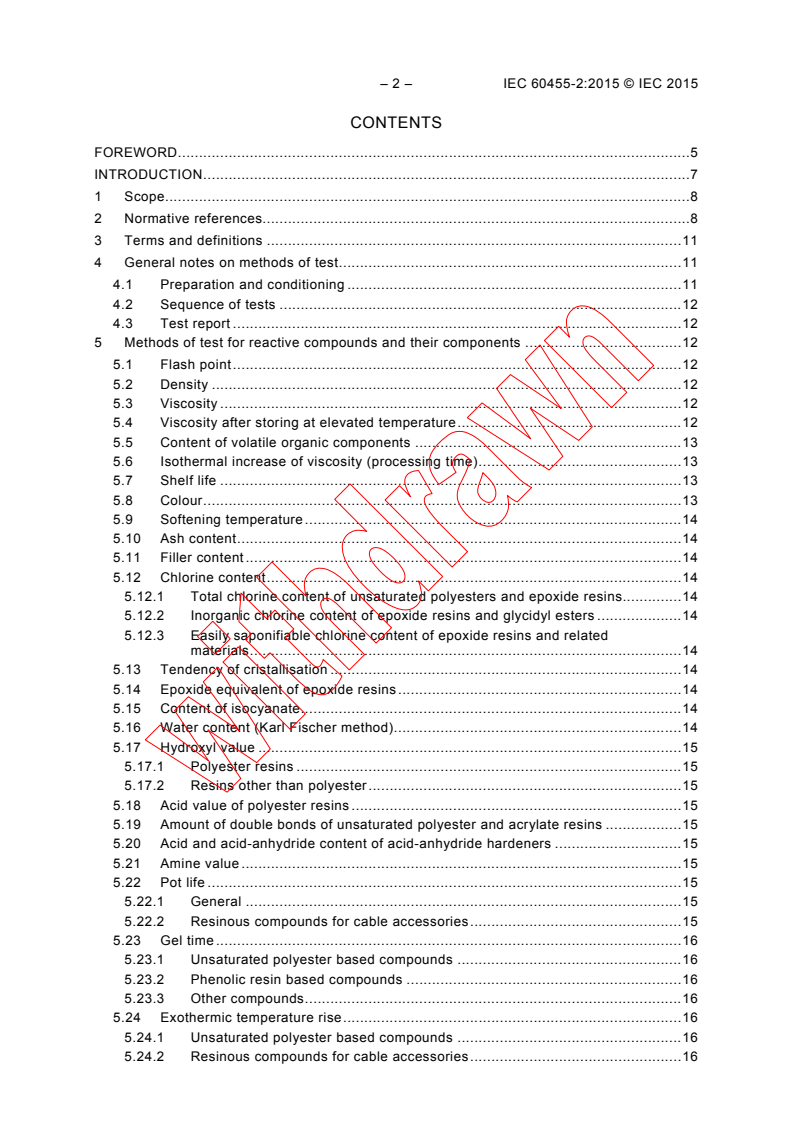
IEC 60455-2:2015 - Resin based reactive compounds used for electrical insulation - Part 2: Methods of test Released:6/25/2015
IEC 60455-2:2015 - Resin based reactive compounds used for electrical insulation - Part 2: Methods of test Released:6/25/2015
Overview
IEC 60455-2:2015 - "Resin based reactive compounds used for electrical insulation – Part 2: Methods of test" - specifies standardized test methods for both uncured (reactive) resin compounds and their cured counterparts used in electrical insulation applications. This third edition (2015) updates the 1998 edition, introduces test methods related to IEC 60455-3-8, and adds/updates test procedures for resins. The standard is essential for objective evaluation of material properties, quality control, and product development for insulation resins, potting compounds, cast insulating parts and cable accessory materials.
Key topics and technical requirements
The standard defines practical laboratory procedures and reporting conventions for a wide range of material properties, including:
- General test preparation and conditioning: specimen preparation, sequence of tests and test reporting.
- Tests for reactive compounds and components:
- Flash point, density, viscosity (including viscosity after elevated storage), volatile organic content (VOC)
- Isothermal viscosity increase (processing time), pot life and gel time
- Shelf life, softening point, filler/ash content, chlorine content, water content (Karl Fischer)
- Chemical metrics: epoxide equivalent, hydroxyl/acid/amine values, double-bond content, isocyanate content
- Special procedures: curing behavior (including curing in presence of water), exothermic temperature rise, total volume shrinkage, degree of curing
- Tests for cured compounds:
- Mechanical: tensile, compressive, flexural, impact, hardness
- Thermal: glass transition (Tg), thermal conductivity, linear thermal expansion, thermal shock, flammability, temperature index, dry/wet heat resistance
- Chemical: water absorption, resistance to liquids and mould growth, water vapour permeability
- Electrical: volume resistivity, dielectric dissipation factor (tan δ) and permittivity, breakdown voltage/electric strength, proof tracking index (PTI), electrolytic corrosion
- Health and safety considerations (informative annex)
Practical applications and users
IEC 60455-2 is used by:
- Manufacturers of resin-based insulations, potting and casting compounds for product specification and quality control
- Test laboratories and certification bodies performing type tests and compliance verification
- R&D teams developing new resin formulations or optimizing processing (pot life, gel time, curing)
- Specifiers and purchasers in power, cable accessories, switchgear, transformers and electronics to ensure material performance and comparability
- Regulatory and safety engineers assessing thermal, electrical and chemical resilience of insulating materials
Related standards
- IEC 60455 series (other parts defining product specifications and applications)
- Specifically referenced: IEC 60455-3-8 (test methods introduced in this edition)
- Users should review normative references cited within IEC 60455-2 for complete test applicability.
Keywords: resin based reactive compounds used for electrical insulation, IEC 60455-2:2015, methods of test, pot life, gel time, dielectric strength, thermal properties, quality control.
Relations
- Effective Date
- 05-Sep-2023
- Effective Date
- 05-Sep-2023
Buy Documents
IEC 60455-2:2015 - Resin based reactive compounds used for electrical insulation - Part 2: Methods of test Released:6/25/2015
IEC 60455-2:2015 - Resin based reactive compounds used for electrical insulation - Part 2: Methods of test Released:6/25/2015
Get Certified
Connect with accredited certification bodies for this standard

BSI Group
BSI (British Standards Institution) is the business standards company that helps organizations make excellence a habit.

TÜV Rheinland
TÜV Rheinland is a leading international provider of technical services.

TÜV SÜD
TÜV SÜD is a trusted partner of choice for safety, security and sustainability solutions.
Sponsored listings
Frequently Asked Questions
IEC 60455-2:2015 is a standard published by the International Electrotechnical Commission (IEC). Its full title is "Resin based reactive compounds used for electrical insulation - Part 2: Methods of test". This standard covers: IEC 60455-2:2015 specifies methods of test to be used for testing resin based reactive compounds, their components and cured compounds used for electrical insulation. This third edition cancels and replaces the second edition published in 1998. This edition constitutes a technical revision. This edition includes the following significant technical changes with respect to the previous edition: - Introduction of test methods related to IEC 60455-3-8; - Additional and updated test methods for resins. Keywords: resin based reactive compounds used for electrical insulation
IEC 60455-2:2015 specifies methods of test to be used for testing resin based reactive compounds, their components and cured compounds used for electrical insulation. This third edition cancels and replaces the second edition published in 1998. This edition constitutes a technical revision. This edition includes the following significant technical changes with respect to the previous edition: - Introduction of test methods related to IEC 60455-3-8; - Additional and updated test methods for resins. Keywords: resin based reactive compounds used for electrical insulation
IEC 60455-2:2015 is classified under the following ICS (International Classification for Standards) categories: 11.040.50 - Radiographic equipment; 17.220.99 - Other standards related to electricity and magnetism; 29.035.01 - Insulating materials in general. The ICS classification helps identify the subject area and facilitates finding related standards.
IEC 60455-2:2015 has the following relationships with other standards: It is inter standard links to IEC 60455-2:2023, IEC 60455-2:1998. Understanding these relationships helps ensure you are using the most current and applicable version of the standard.
IEC 60455-2:2015 is available in PDF format for immediate download after purchase. The document can be added to your cart and obtained through the secure checkout process. Digital delivery ensures instant access to the complete standard document.
Standards Content (Sample)
IEC 60455-2 ®
Edition 3.0 2015-06
INTERNATIONAL
STANDARD
Resin based reactive compounds used for electrical insulation –
Part 2: Methods of test
All rights reserved. Unless otherwise specified, no part of this publication may be reproduced or utilized in any form
or by any means, electronic or mechanical, including photocopying and microfilm, without permission in writing from
either IEC or IEC's member National Committee in the country of the requester. If you have any questions about IEC
copyright or have an enquiry about obtaining additional rights to this publication, please contact the address below or
your local IEC member National Committee for further information.
IEC Central Office Tel.: +41 22 919 02 11
3, rue de Varembé Fax: +41 22 919 03 00
CH-1211 Geneva 20 info@iec.ch
Switzerland www.iec.ch
About the IEC
The International Electrotechnical Commission (IEC) is the leading global organization that prepares and publishes
International Standards for all electrical, electronic and related technologies.
About IEC publications
The technical content of IEC publications is kept under constant review by the IEC. Please make sure that you have the
latest edition, a corrigenda or an amendment might have been published.
IEC Catalogue - webstore.iec.ch/catalogue Electropedia - www.electropedia.org
The stand-alone application for consulting the entire The world's leading online dictionary of electronic and
bibliographical information on IEC International Standards, electrical terms containing more than 30 000 terms and
Technical Specifications, Technical Reports and other definitions in English and French, with equivalent terms in 15
documents. Available for PC, Mac OS, Android Tablets and additional languages. Also known as the International
iPad. Electrotechnical Vocabulary (IEV) online.
IEC publications search - www.iec.ch/searchpub IEC Glossary - std.iec.ch/glossary
The advanced search enables to find IEC publications by a More than 60 000 electrotechnical terminology entries in
variety of criteria (reference number, text, technical English and French extracted from the Terms and Definitions
committee,…). It also gives information on projects, replaced clause of IEC publications issued since 2002. Some entries
and withdrawn publications. have been collected from earlier publications of IEC TC 37,
77, 86 and CISPR.
IEC Just Published - webstore.iec.ch/justpublished
Stay up to date on all new IEC publications. Just Published IEC Customer Service Centre - webstore.iec.ch/csc
details all new publications released. Available online and If you wish to give us your feedback on this publication or
also once a month by email. need further assistance, please contact the Customer Service
Centre: csc@iec.ch.
IEC 60455-2 ®
Edition 3.0 2015-06
INTERNATIONAL
STANDARD
Resin based reactive compounds used for electrical insulation –
Part 2: Methods of test
INTERNATIONAL
ELECTROTECHNICAL
COMMISSION
ICS 17.220.99; 29.035.01 ISBN 978-2-8322-2748-0
– 2 – IEC 60455-2:2015 © IEC 2015
CONTENTS
FOREWORD . 5
INTRODUCTION . 7
1 Scope . 8
2 Normative references. 8
3 Terms and definitions . 11
4 General notes on methods of test . 11
4.1 Preparation and conditioning . 11
4.2 Sequence of tests . 12
4.3 Test report . 12
5 Methods of test for reactive compounds and their components . 12
5.1 Flash point . 12
5.2 Density . 12
5.3 Viscosity . 12
5.4 Viscosity after storing at elevated temperature . 12
5.5 Content of volatile organic components . 13
5.6 Isothermal increase of viscosity (processing time) . 13
5.7 Shelf life . 13
5.8 Colour . 13
5.9 Softening temperature . 14
5.10 Ash content . 14
5.11 Filler content . 14
5.12 Chlorine content . 14
5.12.1 Total chlorine content of unsaturated polyesters and epoxide resins . 14
5.12.2 Inorganic chlorine content of epoxide resins and glycidyl esters . 14
5.12.3 Easily saponifiable chlorine content of epoxide resins and related
materials . 14
5.13 Tendency of cristallisation . 14
5.14 Epoxide equivalent of epoxide resins . 14
5.15 Content of isocyanate . 14
5.16 Water content (Karl Fischer method) . 14
5.17 Hydroxyl value . 15
5.17.1 Polyester resins . 15
5.17.2 Resins other than polyester . 15
5.18 Acid value of polyester resins . 15
5.19 Amount of double bonds of unsaturated polyester and acrylate resins . 15
5.20 Acid and acid-anhydride content of acid-anhydride hardeners . 15
5.21 Amine value . 15
5.22 Pot life . 15
5.22.1 General . 15
5.22.2 Resinous compounds for cable accessories . 15
5.23 Gel time . 16
5.23.1 Unsaturated polyester based compounds . 16
5.23.2 Phenolic resin based compounds . 16
5.23.3 Other compounds . 16
5.24 Exothermic temperature rise . 16
5.24.1 Unsaturated polyester based compounds . 16
5.24.2 Resinous compounds for cable accessories . 16
5.24.3 Other compounds . 17
5.25 Total volume shrinkage of epoxide and unsaturated polyester based
compounds . 17
5.26 Curing in presence of water . 17
5.26.1 General . 17
5.26.2 Apparatus and materials. 17
5.26.3 Pouring device . 18
5.26.4 Procedure . 18
5.26.5 Test report . 18
5.27 Determination of the degree of curing . 18
5.28 Curing in thick layer and emissions during curing . 18
5.28.1 General . 18
5.28.2 Equipment . 19
5.28.3 Test specimen . 19
5.28.4 Procedure . 19
6 Methods of test for cured reactive compounds . 20
6.1 General . 20
6.2 Test specimens . 20
6.2.1 General . 20
6.2.2 Preparation of the reactive compound . 20
6.2.3 Preparation of test specimens . 21
6.2.4 Type and number of test specimens . 21
6.3 Density . 21
6.4 Mechanical properties . 21
6.4.1 Tensile properties . 21
6.4.2 Compressive properties . 21
6.4.3 Flexural properties . 22
6.4.4 Impact strength . 22
6.4.5 Hardness . 22
6.5 Thermal properties . 22
6.5.1 Bond strength at elevated temperature . 22
6.5.2 Linear thermal expansion . 22
6.5.3 Thermal conductivity . 22
6.5.4 Glass transition . 23
6.5.5 Flammability . 23
6.5.6 Thermal shock . 23
6.5.7 Dry heat resistance of resins for cable accessories – Method of test . 23
6.5.8 Wet heat resistance of resins for cable accessories . 24
6.5.9 Loss of mass . 26
6.5.10 Temperature index . 27
6.6 Chemical properties . 27
6.6.1 Water absorption . 27
6.6.2 Effect of liquid chemicals . 28
6.6.3 Resistance to mould growth . 28
6.6.4 Water vapour permeability . 28
6.7 Electrical properties . 28
6.7.1 Effect of water immersion on volume resistivity . 28
6.7.2 Dielectric dissipation factor (tan δ) and relative permittivity (ε ) . 29
r
6.7.3 Breakdown voltage and electric strength . 30
– 4 – IEC 60455-2:2015 © IEC 2015
6.7.4 Proof tracking index (PTI) . 31
6.7.5 Electrolytic corrosion . 31
Annex A (informative) Health and safety . 36
Bibliography . 37
Figure 1 – Test apparatus for curing in presence of water test . 32
Figure 2 – Test set-up for volume resistivity . 33
Figure 3 – Example of electrode arrangement for flexible cured compound . 34
Figure 4 – Example of electrode arrangement for rigid cured compound . 35
Table 1 – Condition of the top side . 19
Table 2 – Condition of the bottom side . 19
Table 3 – Condition of the interior . 20
INTERNATIONAL ELECTROTECHNICAL COMMISSION
____________
RESIN BASED REACTIVE COMPOUNDS
USED FOR ELECTRICAL INSULATION –
Part 2: Methods of test
FOREWORD
1) The International Electrotechnical Commission (IEC) is a worldwide organization for standardization comprising
all national electrotechnical committees (IEC National Committees). The object of IEC is to promote
international co-operation on all questions concerning standardization in the electrical and electronic fields. To
this end and in addition to other activities, IEC publishes International Standards, Technical Specifications,
Technical Reports, Publicly Available Specifications (PAS) and Guides (hereafter referred to as “IEC
Publication(s)”). Their preparation is entrusted to technical committees; any IEC National Committee interested
in the subject dealt with may participate in this preparatory work. International, governmental and non-
governmental organizations liaising with the IEC also participate in this preparation. IEC collaborates closely
with the International Organization for Standardization (ISO) in accordance with conditions determined by
agreement between the two organizations.
2) The formal decisions or agreements of IEC on technical matters express, as nearly as possible, an international
consensus of opinion on the relevant subjects since each technical committee has representation from all
interested IEC National Committees.
3) IEC Publications have the form of recommendations for international use and are accepted by IEC National
Committees in that sense. While all reasonable efforts are made to ensure that the technical content of IEC
Publications is accurate, IEC cannot be held responsible for the way in which they are used or for any
misinterpretation by any end user.
4) In order to promote international uniformity, IEC National Committees undertake to apply IEC Publications
transparently to the maximum extent possible in their national and regional publications. Any divergence
between any IEC Publication and the corresponding national or regional publication shall be clearly indicated in
the latter.
5) IEC itself does not provide any attestation of conformity. Independent certification bodies provide conformity
assessment services and, in some areas, access to IEC marks of conformity. IEC is not responsible for any
services carried out by independent certification bodies.
6) All users should ensure that they have the latest edition of this publication.
7) No liability shall attach to IEC or its directors, employees, servants or agents including individual experts and
members of its technical committees and IEC National Committees for any personal injury, property damage or
other damage of any nature whatsoever, whether direct or indirect, or for costs (including legal fees) and
expenses arising out of the publication, use of, or reliance upon, this IEC Publication or any other IEC
Publications.
8) Attention is drawn to the Normative references cited in this publication. Use of the referenced publications is
indispensable for the correct application of this publication.
9) Attention is drawn to the possibility that some of the elements of this IEC Publication may be the subject of
patent rights. IEC shall not be held responsible for identifying any or all such patent rights.
International Standard IEC 60455-2 has been prepared by IEC technical committee 15: Solid
electrical insulating materials.
This third edition cancels and replaces the second edition published in 1998. This edition
constitutes a technical revision.
This edition includes the following significant technical changes with respect to the previous
edition:
a) Introduction of test methods related to IEC 60455-3-8;
b) Additional and updated test methods for resins.
– 6 – IEC 60455-2:2015 © IEC 2015
The text of this standard is based on the following documents:
FDIS Report on voting
15/751/FDIS 15/757/RVD
Full information on the voting for the approval of this standard can be found in the report on
voting indicated in the above table.
This publication has been drafted in accordance with the ISO/IEC Directives, Part 2.
A list of all parts in the IEC 60455 series, published under the general title Resin based
reactive compounds used for electrical insulation, can be found on the IEC website.
The committee has decided that the contents of this publication will remain unchanged until
the stability date indicated on the IEC web site under "http://webstore.iec.ch" in the data
related to the specific publication. At this date, the publication will be
• reconfirmed,
• withdrawn,
• replaced by a revised edition, or
• amended.
A bilingual version of this publication may be issued at a later date.
INTRODUCTION
This part of IEC 60455 is one of a series which deals with solvent-free resin based reactive
compounds and their components used for electrical insulation.
The series consists of three parts:
– Part 1: Definitions and general requirements (IEC 60455-1);
– Part 2: Methods of test (IEC 60455-2);
– Part 3: Specifications for individual materials (IEC 60455-3).
– 8 – IEC 60455-2:2015 © IEC 2015
RESIN BASED REACTIVE COMPOUNDS
USED FOR ELECTRICAL INSULATION –
Part 2: Methods of test
1 Scope
This part of IEC 60455 specifies methods of test to be used for testing resin based reactive
compounds, their components and cured compounds used for electrical insulation.
2 Normative references
The following documents, in whole or in part, are normatively referenced in this document and
are indispensable for its application. For dated references, only the edition cited applies. For
undated references, the latest edition of the referenced document (including any
amendments) applies.
IEC 60050 (all parts), International Electrotechnical Vocabulary (available at
http://www.electropedia.org)
IEC 60068-2-10:2005, Environmental testing – Part 2-10: Tests – Test J and guidance: Mould
growth
IEC 60093:1980, Methods of test for volume resistivity and surface resistivity of solid
electrical insulating materials
IEC 60112:2003, Method for the determination of the proof and the comparative tracking
indices of solid insulating materials
IEC 60216 (all parts), Electrical insulating materials – Thermal endurance properties
IEC 60243-1:1998, Electrical strength of insulating materials – Test methods – Part 1: Tests
at power frequencies
IEC 60250:1969, Recommended methods for the determination of the permittivity and
dielectric dissipation factor of electrical insulating materials at power, audio and radio
frequencies including metre wavelengths
IEC 60296:2012, Fluids for electrotechnical applications – Unused mineral insulating oils for
transformers and switchgear
IEC 60426:2007, Electrical insulating materials – Determination of electrolytic corrosion
caused by insulating materials – Test methods
IEC 60455-1:1998, Resin based reactive compounds used for electrical insulation – Part 1:
Definitions and general requirements
IEC 60455-3 (all parts), Resin based reactive compounds used for electrical insulation –
Part 3: Specifications for individual materials
IEC 60455-3-8:2013, Resin based reactive compounds used for electrical insulation – Part 3:
Specifications for individual materials – Sheet 8: Resins for cable accessories
IEC 60695-11-10:1999, Fire hazard testing – Part 11-10: Test flames – 50 W horizontal and
vertical flame test methods
IEC 60814:1997, Insulating liquids – Oil-impregnated paper and pressboard – Determination
of water by automatic coulometric Karl Fischer titration
IEC 61033:1991, Test methods for the determination of bond strength of impregnating agents
to an enamelled wire substrate
IEC 61099:2010, Insulating liquids – Specifications for unused synthetic organic esters for
electrical purposes
ISO 37:2011, Rubber, vulcanized or thermoplastic – Determination of tensile stress-strain
properties
ISO 62:2008, Plastics – Determination of water absorption
ISO 75 (all parts), Plastics and ebonite – Determination of temperature of deflection under
load
ISO 175:2010, Plastics – Determination of the effects of liquid chemicals, including water
ISO 178:2010, Plastics – Determination of flexural properties
ISO 179-1:2010, Plastics – Determination of Charpy impact properties – Part 1: Non-
instrumented impact test
ISO 179-2:1997, Plastics – Determination of Charpy impact properties – Part 2: Instrumented
impact test
ISO 291, Plastics – Standard atmospheres for conditioning and testing
ISO 306:2004, Plastics – Thermoplastic materials – Determination of Vicat softening
temperature (VST)
ISO 527 (all parts), Plastics – Determination of tensile properties
ISO 584:1982, Plastics – Unsaturated polyester resins – Determination of reactivity at
80 degrees C (conventional method)
ISO 604:2002, Plastics – Determination of compressive properties
ISO 868:2003, Plastics and ebonite – Determination of indentation hardness by means of a
durometer (Shore hardness)
ISO 1183-1:2012, Plastics – Methods for determining the density of non-cellular plastics –
Part 1: Immersion method, liquid pyknometer method and titration method
ISO 1513:2010, Paints and varnishes – Examination and preparation of samples for testing
ISO 1523:2002, Paints, varnishes, petroleum and related products – Determination of
flashpoint – Closed cup equilibrium method
ISO 1675:1985, Plastics – Liquid resins – Determination of density by the pyknometer method
– 10 – IEC 60455-2:2015 © IEC 2015
ISO 2039-1:1993, Plastics – Determination of hardness – Part 1: Ball indentation method
ISO 2114:1996, Plastics – Unsaturated polyester resins – Determination of partial acid value
and total acid value
ISO 2431:1993, Paints and varnishes – Determination of flow time by use of flow cups
ISO 2535:1997, Plastics – Unsaturated polyester resins – Measurement of gel time at
25 degrees C
ISO 2554:1997, Plastics – Unsaturated polyester resins – Determination of hydroxyl value
ISO 2555:1989, Plastics – Resins in the liquid state or as emulsions or dispersions –
Determination of apparent viscosity by the Brookfield test method
ISO 2592:1973, Petroleum products – Determination of flash and fire points – Cleveland open
cup method
ISO 3001:1997, Plastics – Epoxide compounds – Determination of epoxide equivalent
ISO 3219:1993, Plastics – Polymers/resins in the liquid state or as emulsions or dispersions –
Determination of viscosity using a rotational viscometer with defined shear rate
ISO 3451-1:1997, Plastics – Determination of ash – Part 1: General methods
ISO 3521:1997, Plastics – Unsaturated polyester and epoxy resins – Determination of overall
volume shrinkage
ISO 3679:1983, Paints, varnishes, petroleum and related products – Determination of
flashpoint – Rapid equilibrium method
ISO 4573:1978, Plastics – Epoxide resins and glycidyl esters – Determination of inorganic
chlorine
ISO 4583:1998, Plastics – Epoxide resins and related materials – Determination of easily
saponifiable chlorine
ISO 4615:1979, Plastics – Unsaturated polyesters and epoxide resins – Determination of total
chlorine content
ISO 4625:1980, Binders for paints and varnishes – Determination of softening point –
Ringand-ball method
ISO 4895, Plastics – Liquid epoxy resins – Determination of tendency to crystallize
ISO 7056, Plastics laboratory ware – Beakers
ISO 9396:1997, Plastics – Phenolic resins – Determination of the gel time at a given
temperature using automatic apparatus
ISO 11357-2:1999; Plastics – Differential scanning calorimetry (DSC) – Part 2: Determination
of glass transition temperature
ISO 11359-2:1999, Plastics – Thermomechanical analysis (TMA) – Part 2: Determination of
coefficient of linear thermal expansion and glass transition temperature
ISO 11359-3:2002, Plastics – Thermomechanical analysis (TMA) – Part 3: Determination of
penetration temperature
ISO 14896:2009, Plastics – Polyurethane raw materials – Determination of isocyanate content
ISO 15528:2000, Paints, varnishes and raw materials for paints and varnishes – Sampling
3 Terms and definitions
For the purposes of this document, the terms and definitions given in IEC 60455-1,
IEC 60050, as well as the following apply.
3.1
volume resistance
that part of the insulation resistance which is due to conduction through the volume and
excluding surface current
3.2
volume resistivity
volume resistance reduced to a cubical unit volume
3.3
dielectric dissipation factor
tan δ
numerical value of the ratio of the imaginary to the real part of the complex permittivity
3.4
relative permittivity
ε
r
ratio of the absolute permittivity to the electric constant
Note 1 to entry: In practical engineering, it is usual to employ the term ‘permittivity’ when referring to relative
permittivity.
4 General notes on methods of test
4.1 Preparation and conditioning
Unless otherwise specified in the relevant specification standard or in the method of test, all
tests shall be carried out at atmospheric conditions in a temperature range of between 21 °C
and 29 °C and a relative humidity range of between 45 % and 70 %. Before measurements
are made, the sample or test specimen shall be pre-conditioned under these atmospheric
conditions for a time sufficient to allow the sample or the test specimen to reach stability. For
taking samples in liquid or paste form, ISO 15528 shall be applied. For preparation of such
samples for testing, ISO 1513 shall be applied.
NOTE For definitions of terms for standard atmospheres, see ISO 558. The test atmosphere as specified above
does not comply with any of the two standard atmospheres as specified in ISO 291 but covers both ranges
inclusive of their tolerances.
Normally, all requirements for a method of test are given in the description, and diagrams are
intended only to illustrate one possible arrangement for conducting the test. In case of
inconsistencies between this standard and the specification sheets of the IEC 60455-3 series,
the latter shall prevail. When another standard is invoked for a test method, reference to that
standard shall be included in the report.
– 12 – IEC 60455-2:2015 © IEC 2015
4.2 Sequence of tests
To avoid unnecessary efforts, tests shall be carried out on the samples in the following
sequence:
1) tests on individual components prior to mixing;
2) tests on reactive compound just after mixing (ready to use);
3) tests on cured compound;
4) tests on cured compound after pre treatment (thermal, humidity, water etc.).
If the sample under test fails a test the following tests may become obsolete.
4.3 Test report
If not otherwise specified, the test report shall include the following data:
1) resin designation and identification;
2) lot number or other identification;
3) confirmation of marking and labelling according to the material safety data sheet (MSDS);
4) test results;
5) major test parameters, including conditioning and calibration, if any;
6) processing conditions used to reactive compound;
7) copy of the technical data sheet (TDS) and MSDS.
5 Methods of test for reactive compounds and their components
5.1 Flash point
For flash point temperatures of 79 °C and above, the method given in ISO 2592 shall be used.
For flash point temperatures below 79 °C, the method given in ISO 1523 shall be used with
any of the closed-cup apparatus as described in Annex A of ISO 1523:2002. ISO 1523 shall
be read in conjunction with ISO 3679. Two measurements shall be made on two separate
samples, and the two results of the flash point shall be reported along with reference to the
standards applied.
5.2 Density
The method given in ISO 1675 shall be used. Two measurements shall be made, and the two
results of the density shall be reported.
5.3 Viscosity
The viscosity shall be determined with a suitable device at (23 ± 0,5) °C if not otherwise
specified. If a rotating type of device is used, it shall be in accordance with ISO 2555
(Brookfield type) or with ISO 3219 (a type working at a defined shear rate). If an efflux type of
equipment is used, the method of test and the flow cup shall be in accordance with ISO 2431.
Two measurements shall be made, and the two results of the viscosity shall be reported,
along with reference to the standards applied.
5.4 Viscosity after storing at elevated temperature
This method is not applicable to one-component systems or components containing hardener.
If not otherwise specified, a sample of sufficient amount is stored for (20 ± 0,5) h at a
temperature of (100 ± 3) °C in a sealed container. After cooling down to room temperature the
viscosity is measured according to 5.3. The increase of viscosity is calculated using the
following equation:
Increase of viscosity in % = (η – η ) × 100 / η
2 1 1
where
η = dynamic viscosity before storing
η = dynamic viscosity after storing
5.5 Content of volatile organic components
This method is not applicable to one-component systems or components containing hardener.
If not otherwise specified, the test shall be carried out in the following way:
The mass of an empty weighing bottle (about 80 mm × 30 mm), is taken to 0,001 g (m ). A
mass of 0,4 g to 0,5 g resin (m ) is weighed to 0,001 g into the weighing bottle (well closed
during weighing). Some drops of toluene are added to dilute the resin. The liquid is spread on
the floor of the weighing bottle with a slight twist.
The open weighing bottle is placed into an oven with forced air circulation for at least 2 h at
(110 ± 2) °C. After cooling down to room temperature in a desiccator the weighing bottle is
weighed again to 0,001 g (m ).
Volatile organic components = 100 × (m – (m – m )) / m .
2 3 1 2
5.6 Isothermal increase of viscosity (processing time)
This method is designed for PUR and EP resins. For UP resins gel time shall be used. If not
otherwise specified, the test shall be carried out in the following way:
All components and equipment shall be at room temperature. The components of the resin are
mixed according to the manufacturer’s instructions. The mixing procedure shall not take more
than 3 min. The time measurement starts after adding and mixing of the last component. After
10 min the first viscosity measurement is taken as the initial value. The measurement is
repeated until the specified maximum viscosity is reached. The time between the initial value
and the maximum value is reported as processing time.
5.7 Shelf life
The shelf life shall be determined by measurement of the change in a specified characteristic
property after a certain storage time and temperature. Experience has shown that viscosity
according to 5.3 and gel time according to 5.23 are appropriate characteristics. To assess
shelf life, viscosity and/or gel time shall be determined according to 5.3 and/or 5.23
respectively, at a temperature and with an end-point as agreed upon between supplier and
purchaser. Two measurements shall be made on both fresh material and on material stored
for a time and at a temperature as agreed between supplier and purchaser. The two results of
shelf life shall be reported, along with reference to the standards applied. The results shall
contain the viscosity and/or the gel time before and after storing, the storing time and
temperature and the test temperature.
5.8 Colour
The method given in ISO 6271 shall be used. Two measurements shall be made, and the two
results of colour shall be reported along with reference to the standard applied.
– 14 – IEC 60455-2:2015 © IEC 2015
5.9 Softening temperature
The method given in ISO 306 or ISO 4625 shall be used. Two measurements shall be made,
and the two results of softening temperature shall be reported along with reference to the
standard applied.
5.10 Ash content
The method given in ISO 3451-1, method A, shall be used. Two measurements shall be
made, and the two results of the ash content shall be reported.
5.11 Filler content
To be agreed between supplier and purchaser.
5.12 Chlorine content
5.12.1 Total chlorine content of unsaturated polyesters and epoxide resins
The method given in ISO 4615 shall be used. Two measurements shall be made, and the two
results of the total chlorine content shall be reported.
5.12.2 Inorganic chlorine content of epoxide resins and glycidyl esters
The method given in ISO 4573 shall be used. Two measurements shall be made, and the two
results of the inorganic chlorine content shall be reported.
5.12.3 Easily saponifiable chlorine content of epoxide resins and related materials
The method given in ISO 4583 shall be used. Two measurements shall be made, and the two
results of the saponifiable chlorine content shall be reported.
5.13 Tendency of cristallisation
This method is applicable to epoxy resins only.
The method given in ISO 4895 shall be used. Two measurements shall be made, and the two
results shall be reported.
5.14 Epoxide equivalent of epoxide resins
The method given in ISO 3001 shall be used. Two measurements shall be made, and the two
results of the epoxide equivalent shall be reported.
5.15 Content of isocyanate
This method is applicable to polyurethane hardeners only.
The method given in ISO 14896 shall be used. Two measurements shall be made, and the
two results shall be reported.
5.16 Water content (Karl Fischer method)
The method given in IEC 60814 shall be used. Two measurements shall be made, and the two
results of the water content shall be reported.
5.17 Hydroxyl value
5.17.1 Polyester resins
The method given in ISO 2554 shall be used. Two measurements shall be made, and the two
results of the hydroxyl value shall be reported.
5.17.2 Resins other than polyester
To be agreed between supplier and purchaser.
5.18 Acid value of polyester resins
The method given in ISO 2114 shall be used. Two measurements shall be made, and the two
results of the acid value shall be reported.
5.19 Amount of double bonds of unsaturated polyester and acrylate resins
To be agreed between supplier and purchaser.
5.20 Acid and acid-anhydride content of acid-anhydride hardeners
The method given in ISO 2114 shall be used for acid content. The method given in ISO 7327
shall be used for anhydride content. Two measurements shall be made, and the two results of
the acid value and/or anhydride content shall be reported.
5.21 Amine value
The method given in ISO 9702 shall be used if not otherwise agreed between supplier and
purchaser.
5.22 Pot life
5.22.1 General
The time which a particular method requires to achieve a viscosity of 50 Pas is measured.
The viscosity can be determined in any viscosimeter.
5.22.2 Resinous compounds for cable accessories
5.22.2.1 Apparatus and materials
Equipment to be used:
• beaker in accordance with ISO 7056, polyethylene, polypropylene or glass with
dimensions: 70 mm to 100 mm diameter and 70 mm to 130 mm high;
• environmental chamber;
• time measuring device;
• viscosimeter.
5.22.2.2 Preparation of the sample
The beaker shall be marked to a volume of (300 ± 25) ml.
The beaker and a standard manufacturer pack shall be stored in an environmental chamber
for 24 h at the temperature specified with a tolerance of K.
−2
– 16 – IEC 60455-2:2015 © IEC 2015
5.22.2.3 Procedure
The components shall be removed from the environmental chamber and start mixing
immediately according to the supplier´s instructions. The time starts at the commencement of
mixing the components.
Remove the beaker from the environmental chamber, and pour the mixed compound into the
beaker up to the mark previously made.
5.22.2.4 Test report
The test report shall include the following information:
– the time from the start of mixing until a viscosity of 50 Pas is reached is determined. The
pot life shall be rounded to the nearest of a second;
– the viscosimeter, test parameters and system used (e.g. spindle size, rotation speed etc.).
The viscosimeter with the system used shall be calibrated at 50 Pas.
5.23 Gel time
5.23.1 Unsaturated polyester based compounds
Gel time is the period of time after which the reactive compound reaches the gel state. The
method given in ISO 2535 shall be used at a test temperature as agreed upon between
supplier and purchaser. Two measurements shall be made, and the two results of the gel time
shall be reported along with the test temperature.
5.23.2 Phenolic resin based compounds
The method given in ISO 9396 shall be used. Two measurements shall be made, and the two
results of the gel time shall be reported.
5.23.3 Other compounds
If applicable, the methods given in ISO 2535 or ISO 9696 or ISO 8987 shall be used.
5.24 Exothermic temperature rise
5.24.1 Unsaturated polyester based compounds
The method given in ISO 584 shall be used. Two measurements shall be made, and the two
results of the exothermic temperature rise shall be reported.
5.24.2 Resinous compounds for cable accessories
5.24.2.1 Apparatus and materials
Equipment to be used:
• beaker in accordance with ISO 7056, polyethylene, polypropylene or glass with
dimensions: 70 mm to 100 mm diameter and 70 mm to 130 mm high;
• thermocouple made with twisted wires;
• temperature recorder;
• time measurement device.
5.24.2.2 Preparation of the sample: Test at 23 °C
The beaker shall be marked to a volume of (300 ± 25) ml. The beaker and a sufficient amount
of resinous compound components (prepare 400 ml to 700 ml of the compound) shall be
stored for 24 h at (23 ± 2) °C.
The components shall be mixed according to manufacturer’s instructions. The time starts at
the commencement of mixing the components.
The mixed components shall be poured into the beaker up to the mark previously made. The
thermocouple shall be inserted vertically in the centre of the mixture to a depth of (25 ± 5) mm
under the compound surface and held in position by a suitable device (e.g. ring-stand).
5.24.2.3 Procedure
The temperature increase shall be checked and the maximum temperature rise and the time
to peak recorded. The test is finished after the highest temperature has been reached and the
temperature starts to drop significantly.
NOTE For ease of testing, the temperature can be recorded as a curve.
5.24.2.4 Test report
The maximum temperature reached (rounded to the nearest °C) and the time to peak
(rounded to the nearest min) shall be reported.
5.24.3 Other compounds
Method of test required, but not available.
5.25 Total volume shrinkage of epoxide and unsaturated polyester based compounds
The method given in ISO 3521 shall be used. Two measurements shall be made, and the two
results of the total volume shrinkage shall be reported. The report shall contain the test
temperature, the density of the compound at test temperature, and the density of the
specimen made of the cured compound.
5.26 Curing in presence of water
5.26.1 General
This test applies only to polyurethane resinous compound for cable accessories. Th
...
IEC 60455-2 ®
Edition 3.0 2015-06
INTERNATIONAL
STANDARD
NORME
INTERNATIONALE
Resin based reactive compounds used for electrical insulation –
Part 2: Methods of test
Composés réactifs à base de résines utilisés comme isolants électriques –
Partie 2: Méthodes d’essai
All rights reserved. Unless otherwise specified, no part of this publication may be reproduced or utilized in any form
or by any means, electronic or mechanical, including photocopying and microfilm, without permission in writing from
either IEC or IEC's member National Committee in the country of the requester. If you have any questions about IEC
copyright or have an enquiry about obtaining additional rights to this publication, please contact the address below or
your local IEC member National Committee for further information.
Droits de reproduction réservés. Sauf indication contraire, aucune partie de cette publication ne peut être reproduite
ni utilisée sous quelque forme que ce soit et par aucun procédé, électronique ou mécanique, y compris la photocopie
et les microfilms, sans l'accord écrit de l'IEC ou du Comité national de l'IEC du pays du demandeur. Si vous avez des
questions sur le copyright de l'IEC ou si vous désirez obtenir des droits supplémentaires sur cette publication, utilisez
les coordonnées ci-après ou contactez le Comité national de l'IEC de votre pays de résidence.
IEC Central Office Tel.: +41 22 919 02 11
3, rue de Varembé Fax: +41 22 919 03 00
CH-1211 Geneva 20 info@iec.ch
Switzerland www.iec.ch
About the IEC
The International Electrotechnical Commission (IEC) is the leading global organization that prepares and publishes
International Standards for all electrical, electronic and related technologies.
About IEC publications
The technical content of IEC publications is kept under constant review by the IEC. Please make sure that you have the
latest edition, a corrigenda or an amendment might have been published.
IEC Catalogue - webstore.iec.ch/catalogue Electropedia - www.electropedia.org
The stand-alone application for consulting the entire The world's leading online dictionary of electronic and
bibliographical information on IEC International Standards, electrical terms containing 20 000 terms and definitions in
Technical Specifications, Technical Reports and other English and French, with equivalent terms in 15 additional
documents. Available for PC, Mac OS, Android Tablets and languages. Also known as the International Electrotechnical
iPad. Vocabulary (IEV) online.
IEC publications search - www.iec.ch/searchpub IEC Glossary - std.iec.ch/glossary
The advanced search enables to find IEC publications by a 65 000 electrotechnical terminology entries in English and
variety of criteria (reference number, text, technical French extracted from the Terms and Definitions clause of
committee,…). It also gives information on projects, replaced IEC publications issued since 2002. Some entries have been
and withdrawn publications. collected from earlier publications of IEC TC 37, 77, 86 and
CISPR.
IEC Just Published - webstore.iec.ch/justpublished
Stay up to date on all new IEC publications. Just Published IEC Customer Service Centre - webstore.iec.ch/csc
details all new publications released. Available online and If you wish to give us your feedback on this publication or
also once a month by email. need further assistance, please contact the Customer Service
Centre: csc@iec.ch.
A propos de l'IEC
La Commission Electrotechnique Internationale (IEC) est la première organisation mondiale qui élabore et publie des
Normes internationales pour tout ce qui a trait à l'électricité, à l'électronique et aux technologies apparentées.
A propos des publications IEC
Le contenu technique des publications IEC est constamment revu. Veuillez vous assurer que vous possédez l’édition la
plus récente, un corrigendum ou amendement peut avoir été publié.
Catalogue IEC - webstore.iec.ch/catalogue Electropedia - www.electropedia.org
Application autonome pour consulter tous les renseignements
Le premier dictionnaire en ligne de termes électroniques et
bibliographiques sur les Normes internationales,
électriques. Il contient 20 000 termes et définitions en anglais
Spécifications techniques, Rapports techniques et autres
et en français, ainsi que les termes équivalents dans 15
documents de l'IEC. Disponible pour PC, Mac OS, tablettes
langues additionnelles. Egalement appelé Vocabulaire
Android et iPad.
Electrotechnique International (IEV) en ligne.
Recherche de publications IEC - www.iec.ch/searchpub
Glossaire IEC - std.iec.ch/glossary
La recherche avancée permet de trouver des publications IEC 65 000 entrées terminologiques électrotechniques, en anglais
en utilisant différents critères (numéro de référence, texte, et en français, extraites des articles Termes et Définitions des
comité d’études,…). Elle donne aussi des informations sur les publications IEC parues depuis 2002. Plus certaines entrées
projets et les publications remplacées ou retirées. antérieures extraites des publications des CE 37, 77, 86 et
CISPR de l'IEC.
IEC Just Published - webstore.iec.ch/justpublished
Service Clients - webstore.iec.ch/csc
Restez informé sur les nouvelles publications IEC. Just
Published détaille les nouvelles publications parues. Si vous désirez nous donner des commentaires sur cette
Disponible en ligne et aussi une fois par mois par email. publication ou si vous avez des questions contactez-nous:
csc@iec.ch.
IEC 60455-2 ®
Edition 3.0 2015-06
INTERNATIONAL
STANDARD
NORME
INTERNATIONALE
Resin based reactive compounds used for electrical insulation –
Part 2: Methods of test
Composés réactifs à base de résines utilisés comme isolants électriques –
Partie 2: Méthodes d’essai
INTERNATIONAL
ELECTROTECHNICAL
COMMISSION
COMMISSION
ELECTROTECHNIQUE
INTERNATIONALE
ICS 17.220.99; 29.035.01 ISBN 978-2-8322-3142-5
– 2 – IEC 60455-2:2015 © IEC 2015
CONTENTS
FOREWORD . 5
INTRODUCTION . 7
1 Scope . 8
2 Normative references. 8
3 Terms and definitions . 11
4 General notes on methods of test . 11
4.1 Preparation and conditioning . 11
4.2 Sequence of tests . 12
4.3 Test report . 12
5 Methods of test for reactive compounds and their components . 12
5.1 Flash point . 12
5.2 Density . 12
5.3 Viscosity . 12
5.4 Viscosity after storing at elevated temperature . 12
5.5 Content of volatile organic components . 13
5.6 Isothermal increase of viscosity (processing time) . 13
5.7 Shelf life . 13
5.8 Colour . 13
5.9 Softening temperature . 14
5.10 Ash content . 14
5.11 Filler content . 14
5.12 Chlorine content . 14
5.12.1 Total chlorine content of unsaturated polyesters and epoxide resins . 14
5.12.2 Inorganic chlorine content of epoxide resins and glycidyl esters . 14
5.12.3 Easily saponifiable chlorine content of epoxide resins and related
materials . 14
5.13 Tendency of cristallisation . 14
5.14 Epoxide equivalent of epoxide resins . 14
5.15 Content of isocyanate . 14
5.16 Water content (Karl Fischer method) . 14
5.17 Hydroxyl value . 15
5.17.1 Polyester resins . 15
5.17.2 Resins other than polyester . 15
5.18 Acid value of polyester resins . 15
5.19 Amount of double bonds of unsaturated polyester and acrylate resins . 15
5.20 Acid and acid-anhydride content of acid-anhydride hardeners . 15
5.21 Amine value . 15
5.22 Pot life . 15
5.22.1 General . 15
5.22.2 Resinous compounds for cable accessories . 15
5.23 Gel time . 16
5.23.1 Unsaturated polyester based compounds . 16
5.23.2 Phenolic resin based compounds . 16
5.23.3 Other compounds . 16
5.24 Exothermic temperature rise . 16
5.24.1 Unsaturated polyester based compounds . 16
5.24.2 Resinous compounds for cable accessories . 16
5.24.3 Other compounds . 17
5.25 Total volume shrinkage of epoxide and unsaturated polyester based
compounds . 17
5.26 Curing in presence of water . 17
5.26.1 General . 17
5.26.2 Apparatus and materials. 17
5.26.3 Pouring device . 18
5.26.4 Procedure . 18
5.26.5 Test report . 18
5.27 Determination of the degree of curing . 18
5.28 Curing in thick layer and emissions during curing . 18
5.28.1 General . 18
5.28.2 Equipment . 19
5.28.3 Test specimen . 19
5.28.4 Procedure . 19
6 Methods of test for cured reactive compounds . 20
6.1 General . 20
6.2 Test specimens . 20
6.2.1 General . 20
6.2.2 Preparation of the reactive compound . 20
6.2.3 Preparation of test specimens . 21
6.2.4 Type and number of test specimens . 21
6.3 Density . 21
6.4 Mechanical properties . 21
6.4.1 Tensile properties . 21
6.4.2 Compressive properties . 21
6.4.3 Flexural properties . 22
6.4.4 Impact strength . 22
6.4.5 Hardness . 22
6.5 Thermal properties . 22
6.5.1 Bond strength at elevated temperature . 22
6.5.2 Linear thermal expansion . 22
6.5.3 Thermal conductivity . 22
6.5.4 Glass transition . 23
6.5.5 Flammability . 23
6.5.6 Thermal shock . 23
6.5.7 Dry heat resistance of resins for cable accessories – Method of test . 23
6.5.8 Wet heat resistance of resins for cable accessories . 24
6.5.9 Loss of mass . 26
6.5.10 Temperature index . 27
6.6 Chemical properties . 27
6.6.1 Water absorption . 27
6.6.2 Effect of liquid chemicals . 28
6.6.3 Resistance to mould growth . 28
6.6.4 Water vapour permeability . 28
6.7 Electrical properties . 28
6.7.1 Effect of water immersion on volume resistivity . 28
6.7.2 Dielectric dissipation factor (tan δ) and relative permittivity (ε ) . 29
r
– 4 – IEC 60455-2:2015 © IEC 2015
6.7.3 Breakdown voltage and electric strength . 30
6.7.4 Proof tracking index (PTI) . 31
6.7.5 Electrolytic corrosion . 31
Annex A (informative) Health and safety . 36
Bibliography . 37
Figure 1 – Test apparatus for curing in presence of water test . 32
Figure 2 – Test set-up for volume resistivity . 33
Figure 3 – Example of electrode arrangement for flexible cured compound . 34
Figure 4 – Example of electrode arrangement for rigid cured compound . 35
Table 1 – Condition of the top side . 19
Table 2 – Condition of the bottom side . 19
Table 3 – Condition of the interior . 20
INTERNATIONAL ELECTROTECHNICAL COMMISSION
____________
RESIN BASED REACTIVE COMPOUNDS
USED FOR ELECTRICAL INSULATION –
Part 2: Methods of test
FOREWORD
1) The International Electrotechnical Commission (IEC) is a worldwide organization for standardization comprising
all national electrotechnical committees (IEC National Committees). The object of IEC is to promote
international co-operation on all questions concerning standardization in the electrical and electronic fields. To
this end and in addition to other activities, IEC publishes International Standards, Technical Specifications,
Technical Reports, Publicly Available Specifications (PAS) and Guides (hereafter referred to as “IEC
Publication(s)”). Their preparation is entrusted to technical committees; any IEC National Committee interested
in the subject dealt with may participate in this preparatory work. International, governmental and non-
governmental organizations liaising with the IEC also participate in this preparation. IEC collaborates closely
with the International Organization for Standardization (ISO) in accordance with conditions determined by
agreement between the two organizations.
2) The formal decisions or agreements of IEC on technical matters express, as nearly as possible, an international
consensus of opinion on the relevant subjects since each technical committee has representation from all
interested IEC National Committees.
3) IEC Publications have the form of recommendations for international use and are accepted by IEC National
Committees in that sense. While all reasonable efforts are made to ensure that the technical content of IEC
Publications is accurate, IEC cannot be held responsible for the way in which they are used or for any
misinterpretation by any end user.
4) In order to promote international uniformity, IEC National Committees undertake to apply IEC Publications
transparently to the maximum extent possible in their national and regional publications. Any divergence
between any IEC Publication and the corresponding national or regional publication shall be clearly indicated in
the latter.
5) IEC itself does not provide any attestation of conformity. Independent certification bodies provide conformity
assessment services and, in some areas, access to IEC marks of conformity. IEC is not responsible for any
services carried out by independent certification bodies.
6) All users should ensure that they have the latest edition of this publication.
7) No liability shall attach to IEC or its directors, employees, servants or agents including individual experts and
members of its technical committees and IEC National Committees for any personal injury, property damage or
other damage of any nature whatsoever, whether direct or indirect, or for costs (including legal fees) and
expenses arising out of the publication, use of, or reliance upon, this IEC Publication or any other IEC
Publications.
8) Attention is drawn to the Normative references cited in this publication. Use of the referenced publications is
indispensable for the correct application of this publication.
9) Attention is drawn to the possibility that some of the elements of this IEC Publication may be the subject of
patent rights. IEC shall not be held responsible for identifying any or all such patent rights.
International Standard IEC 60455-2 has been prepared by IEC technical committee 15: Solid
electrical insulating materials.
This third edition cancels and replaces the second edition published in 1998. This edition
constitutes a technical revision.
This edition includes the following significant technical changes with respect to the previous
edition:
a) Introduction of test methods related to IEC 60455-3-8;
b) Additional and updated test methods for resins.
– 6 – IEC 60455-2:2015 © IEC 2015
This bilingual version (2016-01) corresponds to the monolingual English version, published in
2015-06.
The text of this standard is based on the following documents:
FDIS Report on voting
15/751/FDIS 15/757/RVD
Full information on the voting for the approval of this standard can be found in the report on
voting indicated in the above table.
This publication has been drafted in accordance with the ISO/IEC Directives, Part 2.
The French version of this standard has not been voted upon.
A list of all parts in the IEC 60455 series, published under the general title Resin based
reactive compounds used for electrical insulation, can be found on the IEC website.
The committee has decided that the contents of this publication will remain unchanged until
the stability date indicated on the IEC web site under "http://webstore.iec.ch" in the data
related to the specific publication. At this date, the publication will be
• reconfirmed,
• withdrawn,
• replaced by a revised edition, or
• amended.
INTRODUCTION
This part of IEC 60455 is one of a series which deals with solvent-free resin based reactive
compounds and their components used for electrical insulation.
The series consists of three parts:
– Part 1: Definitions and general requirements (IEC 60455-1);
– Part 2: Methods of test (IEC 60455-2);
– Part 3: Specifications for individual materials (IEC 60455-3).
– 8 – IEC 60455-2:2015 © IEC 2015
RESIN BASED REACTIVE COMPOUNDS
USED FOR ELECTRICAL INSULATION –
Part 2: Methods of test
1 Scope
This part of IEC 60455 specifies methods of test to be used for testing resin based reactive
compounds, their components and cured compounds used for electrical insulation.
2 Normative references
The following documents, in whole or in part, are normatively referenced in this document and
are indispensable for its application. For dated references, only the edition cited applies. For
undated references, the latest edition of the referenced document (including any
amendments) applies.
IEC 60050 (all parts), International Electrotechnical Vocabulary (available at
http://www.electropedia.org)
IEC 60068-2-10:2005, Environmental testing – Part 2-10: Tests – Test J and guidance: Mould
growth
IEC 60093:1980, Methods of test for volume resistivity and surface resistivity of solid
electrical insulating materials
IEC 60112:2003, Method for the determination of the proof and the comparative tracking
indices of solid insulating materials
IEC 60216 (all parts), Electrical insulating materials – Thermal endurance properties
IEC 60243-1:1998, Electrical strength of insulating materials – Test methods – Part 1: Tests
at power frequencies
IEC 60250:1969, Recommended methods for the determination of the permittivity and
dielectric dissipation factor of electrical insulating materials at power, audio and radio
frequencies including metre wavelengths
IEC 60296:2012, Fluids for electrotechnical applications – Unused mineral insulating oils for
transformers and switchgear
IEC 60426:2007, Electrical insulating materials – Determination of electrolytic corrosion
caused by insulating materials – Test methods
IEC 60455-1:1998, Resin based reactive compounds used for electrical insulation – Part 1:
Definitions and general requirements
IEC 60455-3 (all parts), Resin based reactive compounds used for electrical insulation –
Part 3: Specifications for individual materials
IEC 60455-3-8:2013, Resin based reactive compounds used for electrical insulation – Part 3:
Specifications for individual materials – Sheet 8: Resins for cable accessories
IEC 60695-11-10:1999, Fire hazard testing – Part 11-10: Test flames – 50 W horizontal and
vertical flame test methods
IEC 60814:1997, Insulating liquids – Oil-impregnated paper and pressboard – Determination
of water by automatic coulometric Karl Fischer titration
IEC 61033:1991, Test methods for the determination of bond strength of impregnating agents
to an enamelled wire substrate
IEC 61099:2010, Insulating liquids – Specifications for unused synthetic organic esters for
electrical purposes
ISO 37:2011, Rubber, vulcanized or thermoplastic – Determination of tensile stress-strain
properties
ISO 62:2008, Plastics – Determination of water absorption
ISO 75 (all parts), Plastics and ebonite – Determination of temperature of deflection under
load
ISO 175:2010, Plastics – Determination of the effects of liquid chemicals, including water
ISO 178:2010, Plastics – Determination of flexural properties
ISO 179-1:2010, Plastics – Determination of Charpy impact properties – Part 1: Non-
instrumented impact test
ISO 179-2:1997, Plastics – Determination of Charpy impact properties – Part 2: Instrumented
impact test
ISO 291, Plastics – Standard atmospheres for conditioning and testing
ISO 306:2004, Plastics – Thermoplastic materials – Determination of Vicat softening
temperature (VST)
ISO 527 (all parts), Plastics – Determination of tensile properties
ISO 584:1982, Plastics – Unsaturated polyester resins – Determination of reactivity at
80 degrees C (conventional method)
ISO 604:2002, Plastics – Determination of compressive properties
ISO 868:2003, Plastics and ebonite – Determination of indentation hardness by means of a
durometer (Shore hardness)
ISO 1183-1:2012, Plastics – Methods for determining the density of non-cellular plastics –
Part 1: Immersion method, liquid pyknometer method and titration method
ISO 1513:2010, Paints and varnishes – Examination and preparation of samples for testing
ISO 1523:2002, Paints, varnishes, petroleum and related products – Determination of
flashpoint – Closed cup equilibrium method
ISO 1675:1985, Plastics – Liquid resins – Determination of density by the pyknometer method
– 10 – IEC 60455-2:2015 © IEC 2015
ISO 2039-1:1993, Plastics – Determination of hardness – Part 1: Ball indentation method
ISO 2114:1996, Plastics – Unsaturated polyester resins – Determination of partial acid value
and total acid value
ISO 2431:1993, Paints and varnishes – Determination of flow time by use of flow cups
ISO 2535:1997, Plastics – Unsaturated polyester resins – Measurement of gel time at
25 degrees C
ISO 2554:1997, Plastics – Unsaturated polyester resins – Determination of hydroxyl value
ISO 2555:1989, Plastics – Resins in the liquid state or as emulsions or dispersions –
Determination of apparent viscosity by the Brookfield test method
ISO 2592:1973, Petroleum products – Determination of flash and fire points – Cleveland open
cup method
ISO 3001:1997, Plastics – Epoxide compounds – Determination of epoxide equivalent
ISO 3219:1993, Plastics – Polymers/resins in the liquid state or as emulsions or dispersions –
Determination of viscosity using a rotational viscometer with defined shear rate
ISO 3451-1:1997, Plastics – Determination of ash – Part 1: General methods
ISO 3521:1997, Plastics – Unsaturated polyester and epoxy resins – Determination of overall
volume shrinkage
ISO 3679:1983, Paints, varnishes, petroleum and related products – Determination of
flashpoint – Rapid equilibrium method
ISO 4573:1978, Plastics – Epoxide resins and glycidyl esters – Determination of inorganic
chlorine
ISO 4583:1998, Plastics – Epoxide resins and related materials – Determination of easily
saponifiable chlorine
ISO 4615:1979, Plastics – Unsaturated polyesters and epoxide resins – Determination of total
chlorine content
ISO 4625:1980, Binders for paints and varnishes – Determination of softening point –
Ringand-ball method
ISO 4895, Plastics – Liquid epoxy resins – Determination of tendency to crystallize
ISO 7056, Plastics laboratory ware – Beakers
ISO 9396:1997, Plastics – Phenolic resins – Determination of the gel time at a given
temperature using automatic apparatus
ISO 11357-2:1999; Plastics – Differential scanning calorimetry (DSC) – Part 2: Determination
of glass transition temperature
ISO 11359-2:1999, Plastics – Thermomechanical analysis (TMA) – Part 2: Determination of
coefficient of linear thermal expansion and glass transition temperature
ISO 11359-3:2002, Plastics – Thermomechanical analysis (TMA) – Part 3: Determination of
penetration temperature
ISO 14896:2009, Plastics – Polyurethane raw materials – Determination of isocyanate content
ISO 15528:2000, Paints, varnishes and raw materials for paints and varnishes – Sampling
3 Terms and definitions
For the purposes of this document, the terms and definitions given in IEC 60455-1,
IEC 60050, as well as the following apply.
3.1
volume resistance
that part of the insulation resistance which is due to conduction through the volume and
excluding surface current
3.2
volume resistivity
volume resistance reduced to a cubical unit volume
3.3
dielectric dissipation factor
tan δ
numerical value of the ratio of the imaginary to the real part of the complex permittivity
3.4
relative permittivity
ε
r
ratio of the absolute permittivity to the electric constant
Note 1 to entry: In practical engineering, it is usual to employ the term ‘permittivity’ when referring to relative
permittivity.
4 General notes on methods of test
4.1 Preparation and conditioning
Unless otherwise specified in the relevant specification standard or in the method of test, all
tests shall be carried out at atmospheric conditions in a temperature range of between 21 °C
and 29 °C and a relative humidity range of between 45 % and 70 %. Before measurements
are made, the sample or test specimen shall be pre-conditioned under these atmospheric
conditions for a time sufficient to allow the sample or the test specimen to reach stability. For
taking samples in liquid or paste form, ISO 15528 shall be applied. For preparation of such
samples for testing, ISO 1513 shall be applied.
NOTE For definitions of terms for standard atmospheres, see ISO 558. The test atmosphere as specified above
does not comply with any of the two standard atmospheres as specified in ISO 291 but covers both ranges
inclusive of their tolerances.
Normally, all requirements for a method of test are given in the description, and diagrams are
intended only to illustrate one possible arrangement for conducting the test. In case of
inconsistencies between this standard and the specification sheets of the IEC 60455-3 series,
the latter shall prevail. When another standard is invoked for a test method, reference to that
standard shall be included in the report.
– 12 – IEC 60455-2:2015 © IEC 2015
4.2 Sequence of tests
To avoid unnecessary efforts, tests shall be carried out on the samples in the following
sequence:
1) tests on individual components prior to mixing;
2) tests on reactive compound just after mixing (ready to use);
3) tests on cured compound;
4) tests on cured compound after pre treatment (thermal, humidity, water etc.).
If the sample under test fails a test the following tests may become obsolete.
4.3 Test report
If not otherwise specified, the test report shall include the following data:
1) resin designation and identification;
2) lot number or other identification;
3) confirmation of marking and labelling according to the material safety data sheet (MSDS);
4) test results;
5) major test parameters, including conditioning and calibration, if any;
6) processing conditions used to reactive compound;
7) copy of the technical data sheet (TDS) and MSDS.
5 Methods of test for reactive compounds and their components
5.1 Flash point
For flash point temperatures of 79 °C and above, the method given in ISO 2592 shall be used.
For flash point temperatures below 79 °C, the method given in ISO 1523 shall be used with
any of the closed-cup apparatus as described in Annex A of ISO 1523:2002. ISO 1523 shall
be read in conjunction with ISO 3679. Two measurements shall be made on two separate
samples, and the two results of the flash point shall be reported along with reference to the
standards applied.
5.2 Density
The method given in ISO 1675 shall be used. Two measurements shall be made, and the two
results of the density shall be reported.
5.3 Viscosity
The viscosity shall be determined with a suitable device at (23 ± 0,5) °C if not otherwise
specified. If a rotating type of device is used, it shall be in accordance with ISO 2555
(Brookfield type) or with ISO 3219 (a type working at a defined shear rate). If an efflux type of
equipment is used, the method of test and the flow cup shall be in accordance with ISO 2431.
Two measurements shall be made, and the two results of the viscosity shall be reported,
along with reference to the standards applied.
5.4 Viscosity after storing at elevated temperature
This method is not applicable to one-component systems or components containing hardener.
If not otherwise specified, a sample of sufficient amount is stored for (20 ± 0,5) h at a
temperature of (100 ± 3) °C in a sealed container. After cooling down to room temperature the
viscosity is measured according to 5.3. The increase of viscosity is calculated using the
following equation:
Increase of viscosity in % = (η – η ) × 100 / η
2 1 1
where
η = dynamic viscosity before storing
η = dynamic viscosity after storing
5.5 Content of volatile organic components
This method is not applicable to one-component systems or components containing hardener.
If not otherwise specified, the test shall be carried out in the following way:
The mass of an empty weighing bottle (about 80 mm × 30 mm), is taken to 0,001 g (m ). A
mass of 0,4 g to 0,5 g resin (m ) is weighed to 0,001 g into the weighing bottle (well closed
during weighing). Some drops of toluene are added to dilute the resin. The liquid is spread on
the floor of the weighing bottle with a slight twist.
The open weighing bottle is placed into an oven with forced air circulation for at least 2 h at
(110 ± 2) °C. After cooling down to room temperature in a desiccator the weighing bottle is
weighed again to 0,001 g (m ).
Volatile organic components = 100 × (m – (m – m )) / m .
2 3 1 2
5.6 Isothermal increase of viscosity (processing time)
This method is designed for PUR and EP resins. For UP resins gel time shall be used. If not
otherwise specified, the test shall be carried out in the following way:
All components and equipment shall be at room temperature. The components of the resin are
mixed according to the manufacturer’s instructions. The mixing procedure shall not take more
than 3 min. The time measurement starts after adding and mixing of the last component. After
10 min the first viscosity measurement is taken as the initial value. The measurement is
repeated until the specified maximum viscosity is reached. The time between the initial value
and the maximum value is reported as processing time.
5.7 Shelf life
The shelf life shall be determined by measurement of the change in a specified characteristic
property after a certain storage time and temperature. Experience has shown that viscosity
according to 5.3 and gel time according to 5.23 are appropriate characteristics. To assess
shelf life, viscosity and/or gel time shall be determined according to 5.3 and/or 5.23
respectively, at a temperature and with an end-point as agreed upon between supplier and
purchaser. Two measurements shall be made on both fresh material and on material stored
for a time and at a temperature as agreed between supplier and purchaser. The two results of
shelf life shall be reported, along with reference to the standards applied. The results shall
contain the viscosity and/or the gel time before and after storing, the storing time and
temperature and the test temperature.
5.8 Colour
The method given in ISO 6271 shall be used. Two measurements shall be made, and the two
results of colour shall be reported along with reference to the standard applied.
– 14 – IEC 60455-2:2015 © IEC 2015
5.9 Softening temperature
The method given in ISO 306 or ISO 4625 shall be used. Two measurements shall be made,
and the two results of softening temperature shall be reported along with reference to the
standard applied.
5.10 Ash content
The method given in ISO 3451-1, method A, shall be used. Two measurements shall be
made, and the two results of the ash content shall be reported.
5.11 Filler content
To be agreed between supplier and purchaser.
5.12 Chlorine content
5.12.1 Total chlorine content of unsaturated polyesters and epoxide resins
The method given in ISO 4615 shall be used. Two measurements shall be made, and the two
results of the total chlorine content shall be reported.
5.12.2 Inorganic chlorine content of epoxide resins and glycidyl esters
The method given in ISO 4573 shall be used. Two measurements shall be made, and the two
results of the inorganic chlorine content shall be reported.
5.12.3 Easily saponifiable chlorine content of epoxide resins and related materials
The method given in ISO 4583 shall be used. Two measurements shall be made, and the two
results of the saponifiable chlorine content shall be reported.
5.13 Tendency of cristallisation
This method is applicable to epoxy resins only.
The method given in ISO 4895 shall be used. Two measurements shall be made, and the two
results shall be reported.
5.14 Epoxide equivalent of epoxide resins
The method given in ISO 3001 shall be used. Two measurements shall be made, and the two
results of the epoxide equivalent shall be reported.
5.15 Content of isocyanate
This method is applicable to polyurethane hardeners only.
The method given in ISO 14896 shall be used. Two measurements shall be made, and the
two results shall be reported.
5.16 Water content (Karl Fischer method)
The method given in IEC 60814 shall be used. Two measurements shall be made, and the two
results of the water content shall be reported.
5.17 Hydroxyl value
5.17.1 Polyester resins
The method given in ISO 2554 shall be used. Two measurements shall be made, and the two
results of the hydroxyl value shall be reported.
5.17.2 Resins other than polyester
To be agreed between supplier and purchaser.
5.18 Acid value of polyester resins
The method given in ISO 2114 shall be used. Two measurements shall be made, and the two
results of the acid value shall be reported.
5.19 Amount of double bonds of unsaturated polyester and acrylate resins
To be agreed between supplier and purchaser.
5.20 Acid and acid-anhydride content of acid-anhydride hardeners
The method given in ISO 2114 shall be used for acid content. The method given in ISO 7327
shall be used for anhydride content. Two measurements shall be made, and the two results of
the acid value and/or anhydride content shall be reported.
5.21 Amine value
The method given in ISO 9702 shall be used if not otherwise agreed between supplier and
purchaser.
5.22 Pot life
5.22.1 General
The time which a particular method requires to achieve a viscosity of 50 Pas is measured.
The viscosity can be determined in any viscosimeter.
5.22.2 Resinous compounds for cable accessories
5.22.2.1 Apparatus and materials
Equipment to be used:
• beaker in accordance with ISO 7056, polyethylene, polypropylene or glass with
dimensions: 70 mm to 100 mm diameter and 70 mm to 130 mm high;
• environmental chamber;
• time measuring device;
• viscosimeter.
5.22.2.2 Preparation of the sample
The beaker shall be marked to a volume of (300 ± 25) ml.
The beaker and a standard manufacturer pack shall be stored in an environmental chamber
for 24 h at the temperature specified with a tolerance of K.
−2
– 16 – IEC 60455-2:2015 © IEC 2015
5.22.2.3 Procedure
The components shall be removed from the environmental chamber and start mixing
immediately according to the supplier´s instructions. The time starts at the commencement of
mixing the components.
Remove the beaker from the environmental chamber, and pour the mixed compound into the
beaker up to the mark previously made.
5.22.2.4 Test report
The test report shall include the following information:
– the time from the start of mixing until a viscosity of 50 Pas is reached is determined. The
pot life shall be rounded to the nearest of a second;
– the viscosimeter, test parameters and system used (e.g. spindle size, rotation speed etc.).
The viscosimeter with the system used shall be calibrated at 50 Pas.
5.23 Gel time
5.23.1 Unsaturated polyester based compounds
Gel time is the period of time after which the reactive compound reaches the gel state. The
method given in ISO 2535 shall be used at a test temperature as agreed upon between
supplier and purchaser. Two measurements shall be made, and the two results of the gel time
shall be reported along with the test temper
...