

IEC 62443-3-2:2020
(Main)Security for industrial automation and control systems - Part 3-2: Security risk assessment for system design
General Information
- Abstract
IEC 62443-3-2:2020 establishes requirements for:
• defining a system under consideration (SUC) for an industrial automation and control system (IACS);
• partitioning the SUC into zones and conduits;
• assessing risk for each zone and conduit;
• establishing the target security level (SL-T) for each zone and conduit; and
• documenting the security requirements.
- Status
- Published
- Publication Date
- 23-Jun-2020
- Technical Committee
- TC 65 - Industrial-process measurement, control and automation
- Drafting Committee
- WG 10 - TC 65/WG 10
- Current Stage
- PPUB - Publication issued
- Start Date
- 24-Jun-2020
- Completion Date
- 03-Jul-2020
Buy Documents
IEC 62443-3-2:2020 - Security for industrial automation and control systems - Part 3-2: Security risk assessment for system design Released:6/24/2020
IEC 62443-3-2:2020 - Security for industrial automation and control systems - Part 3-2: Security risk assessment for system design Released:6/24/2020
Overview
IEC 62443-3-2:2020 is part of the IEC 62443 series for security for industrial automation and control systems (IACS). It defines a structured security risk assessment for system design, focused on the System Under Consideration (SUC). The standard prescribes how to partition an SUC into zones and conduits, assess risks per zone/conduit, set target security levels (SL‑T), and document security requirements for procurement, engineering and compliance.
Key Topics and Requirements
- Define the SUC: identify the SUC perimeter, access points and operating environment.
- Zones and conduits: partition the SUC into logical/physical zones and the conduits (communication groupings) that connect them.
- Initial and detailed risk assessment: perform an initial cyber security risk assessment and, for each zone/conduit, conduct a detailed workflow that includes:
- identifying threats and vulnerabilities,
- determining consequences and impacts,
- estimating likelihood,
- calculating unmitigated and residual risk,
- comparing risk to tolerable risk,
- identifying existing and additional countermeasures.
- Determine SL‑T: establish the target security level for each zone/conduit to align design decisions with required capabilities.
- Documentation and approval: produce a cyber security requirements specification, zone/conduit drawings and characteristics, threat/environment assumptions, and obtain asset owner approval.
- Supporting material: the standard contains workflow diagrams, annexes with example risk matrices and guidance on security levels.
Practical Applications
IEC 62443-3-2 is applied during the design and engineering phases of industrial control systems to ensure security is built into system architecture. Typical uses:
- Security architecture design for SCADA, DCS and other IACS deployments.
- Supplier and system integrator scoping of security requirements during procurement and projects.
- Asset owner risk management and compliance evidence for audits and regulators.
- Aligning technical countermeasures with required SL‑T and with product/system capabilities.
Who uses it:
- Asset owners, engineering teams and OT security professionals.
- System integrators and product suppliers designing or delivering IACS.
- Service providers performing risk assessments and security testing.
- Compliance authorities and auditors assessing adequacy of system design.
Related Standards
- IEC 62443-3-3: aligns SL‑T with system security requirements and SL‑C capability levels.
- IEC TS 62443‑1‑1: introduces the zones and conduits concept referenced in 3‑2.
Keywords: IEC 62443-3-2, industrial automation security, IACS risk assessment, zones and conduits, SL-T, OT cybersecurity, system design risk assessment.
Relations
- Effective Date
- 11-Mar-2026
Buy Documents
IEC 62443-3-2:2020 - Security for industrial automation and control systems - Part 3-2: Security risk assessment for system design Released:6/24/2020
IEC 62443-3-2:2020 - Security for industrial automation and control systems - Part 3-2: Security risk assessment for system design Released:6/24/2020
Get Certified
Connect with accredited certification bodies for this standard

BSI Group
BSI (British Standards Institution) is the business standards company that helps organizations make excellence a habit.

Bureau Veritas
Bureau Veritas is a world leader in laboratory testing, inspection and certification services.

DNV
DNV is an independent assurance and risk management provider.
Sponsored listings
Frequently Asked Questions
IEC 62443-3-2:2020 is a standard published by the International Electrotechnical Commission (IEC). Its full title is "Security for industrial automation and control systems - Part 3-2: Security risk assessment for system design". This standard covers: IEC 62443-3-2:2020 establishes requirements for: • defining a system under consideration (SUC) for an industrial automation and control system (IACS); • partitioning the SUC into zones and conduits; • assessing risk for each zone and conduit; • establishing the target security level (SL-T) for each zone and conduit; and • documenting the security requirements.
IEC 62443-3-2:2020 establishes requirements for: • defining a system under consideration (SUC) for an industrial automation and control system (IACS); • partitioning the SUC into zones and conduits; • assessing risk for each zone and conduit; • establishing the target security level (SL-T) for each zone and conduit; and • documenting the security requirements.
IEC 62443-3-2:2020 is classified under the following ICS (International Classification for Standards) categories: 25.040.40 - Industrial process measurement and control; 35.030 - IT Security. The ICS classification helps identify the subject area and facilitates finding related standards.
IEC 62443-3-2:2020 has the following relationships with other standards: It is inter standard links to EN ISO 16923:2026. Understanding these relationships helps ensure you are using the most current and applicable version of the standard.
IEC 62443-3-2:2020 is available in PDF format for immediate download after purchase. The document can be added to your cart and obtained through the secure checkout process. Digital delivery ensures instant access to the complete standard document.
Standards Content (Sample)
IEC 62443-3-2 ®
Edition 1.0 2020-06
INTERNATIONAL
STANDARD
colour
inside
Security for industrial automation and control systems –
Part 3-2: Security risk assessment for system design
All rights reserved. Unless otherwise specified, no part of this publication may be reproduced or utilized in any form
or by any means, electronic or mechanical, including photocopying and microfilm, without permission in writing from
either IEC or IEC's member National Committee in the country of the requester. If you have any questions about IEC
copyright or have an enquiry about obtaining additional rights to this publication, please contact the address below or
your local IEC member National Committee for further information.
IEC Central Office Tel.: +41 22 919 02 11
3, rue de Varembé info@iec.ch
CH-1211 Geneva 20 www.iec.ch
Switzerland
About the IEC
The International Electrotechnical Commission (IEC) is the leading global organization that prepares and publishes
International Standards for all electrical, electronic and related technologies.
About IEC publications
The technical content of IEC publications is kept under constant review by the IEC. Please make sure that you have the
latest edition, a corrigendum or an amendment might have been published.
IEC publications search - webstore.iec.ch/advsearchform Electropedia - www.electropedia.org
The advanced search enables to find IEC publications by a The world's leading online dictionary on electrotechnology,
variety of criteria (reference number, text, technical containing more than 22 000 terminological entries in English
committee,…). It also gives information on projects, replaced and French, with equivalent terms in 16 additional languages.
and withdrawn publications. Also known as the International Electrotechnical Vocabulary
(IEV) online.
IEC Just Published - webstore.iec.ch/justpublished
Stay up to date on all new IEC publications. Just Published IEC Glossary - std.iec.ch/glossary
details all new publications released. Available online and 67 000 electrotechnical terminology entries in English and
once a month by email. French extracted from the Terms and Definitions clause of
IEC publications issued since 2002. Some entries have been
IEC Customer Service Centre - webstore.iec.ch/csc collected from earlier publications of IEC TC 37, 77, 86 and
If you wish to give us your feedback on this publication or CISPR.
need further assistance, please contact the Customer Service
Centre: sales@iec.ch.
IEC 62443-3-2 ®
Edition 1.0 2020-06
INTERNATIONAL
STANDARD
colour
inside
Security for industrial automation and control systems –
Part 3-2: Security risk assessment for system design
INTERNATIONAL
ELECTROTECHNICAL
COMMISSION
ICS 25.040.40; 35.030 ISBN 978-2-8322-8501-5
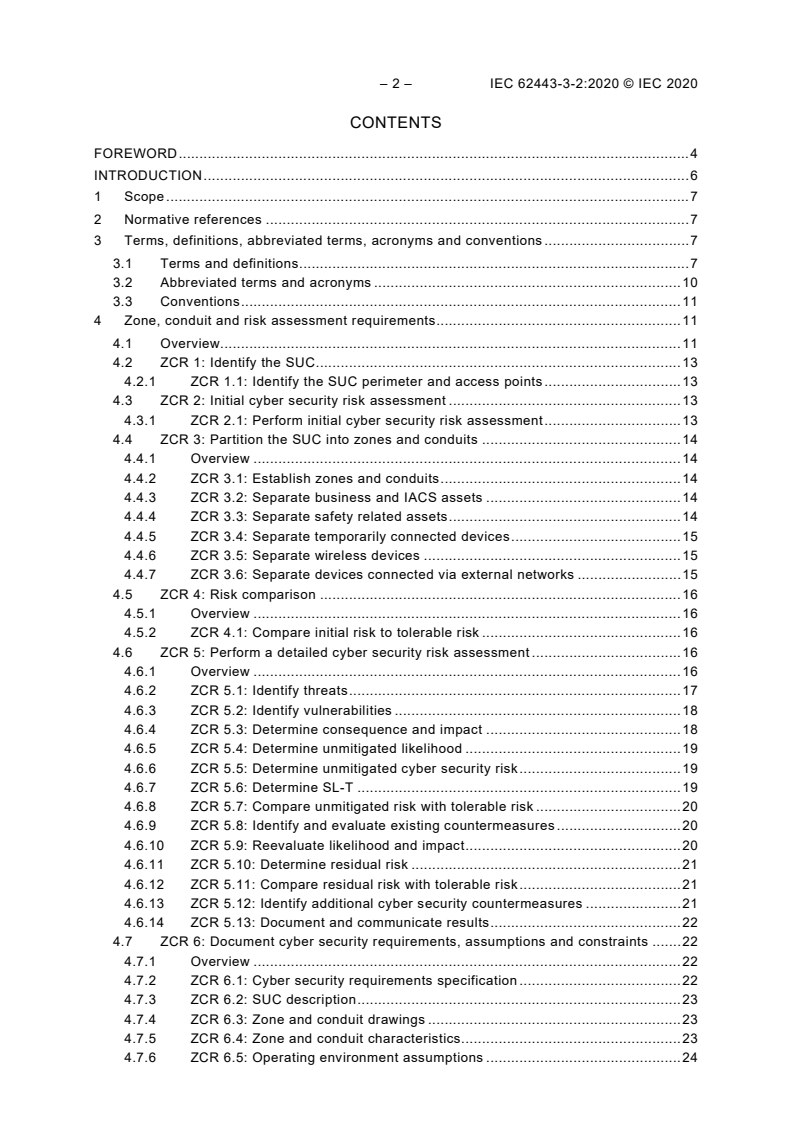
– 2 – IEC 62443-3-2:2020 © IEC 2020
CONTENTS
FOREWORD . 4
INTRODUCTION . 6
1 Scope . 7
2 Normative references . 7
3 Terms, definitions, abbreviated terms, acronyms and conventions . 7
3.1 Terms and definitions . 7
3.2 Abbreviated terms and acronyms . 10
3.3 Conventions . 11
4 Zone, conduit and risk assessment requirements . 11
4.1 Overview. 11
4.2 ZCR 1: Identify the SUC . 13
4.2.1 ZCR 1.1: Identify the SUC perimeter and access points . 13
4.3 ZCR 2: Initial cyber security risk assessment . 13
4.3.1 ZCR 2.1: Perform initial cyber security risk assessment . 13
4.4 ZCR 3: Partition the SUC into zones and conduits . 14
4.4.1 Overview . 14
4.4.2 ZCR 3.1: Establish zones and conduits . 14
4.4.3 ZCR 3.2: Separate business and IACS assets . 14
4.4.4 ZCR 3.3: Separate safety related assets . 14
4.4.5 ZCR 3.4: Separate temporarily connected devices . 15
4.4.6 ZCR 3.5: Separate wireless devices . 15
4.4.7 ZCR 3.6: Separate devices connected via external networks . 15
4.5 ZCR 4: Risk comparison . 16
4.5.1 Overview . 16
4.5.2 ZCR 4.1: Compare initial risk to tolerable risk . 16
4.6 ZCR 5: Perform a detailed cyber security risk assessment . 16
4.6.1 Overview . 16
4.6.2 ZCR 5.1: Identify threats . 17
4.6.3 ZCR 5.2: Identify vulnerabilities . 18
4.6.4 ZCR 5.3: Determine consequence and impact . 18
4.6.5 ZCR 5.4: Determine unmitigated likelihood . 19
4.6.6 ZCR 5.5: Determine unmitigated cyber security risk . 19
4.6.7 ZCR 5.6: Determine SL-T . 19
4.6.8 ZCR 5.7: Compare unmitigated risk with tolerable risk . 20
4.6.9 ZCR 5.8: Identify and evaluate existing countermeasures . 20
4.6.10 ZCR 5.9: Reevaluate likelihood and impact . 20
4.6.11 ZCR 5.10: Determine residual risk . 21
4.6.12 ZCR 5.11: Compare residual risk with tolerable risk . 21
4.6.13 ZCR 5.12: Identify additional cyber security countermeasures . 21
4.6.14 ZCR 5.13: Document and communicate results . 22
4.7 ZCR 6: Document cyber security requirements, assumptions and constraints . 22
4.7.1 Overview . 22
4.7.2 ZCR 6.1: Cyber security requirements specification . 22
4.7.3 ZCR 6.2: SUC description . 23
4.7.4 ZCR 6.3: Zone and conduit drawings . 23
4.7.5 ZCR 6.4: Zone and conduit characteristics. 23
4.7.6 ZCR 6.5: Operating environment assumptions . 24
4.7.7 ZCR 6.6: Threat environment . 25
4.7.8 ZCR 6.7: Organizational security policies . 25
4.7.9 ZCR 6.8: Tolerable risk . 25
4.7.10 ZCR 6.9: Regulatory requirements . 26
4.8 ZCR 7: Asset owner approval . 26
4.8.1 Overview . 26
4.8.2 ZCR 7.1: Attain asset owner approval . 26
Annex A (informative) Security levels . 27
Annex B (informative) Risk matrices . 28
Bibliography . 31
Figure 1 – Workflow diagram outlining the primary steps required to establish zones
and conduits, as well as to assess risk . 12
Figure 2 – Detailed cyber security risk assessment workflow per zone or conduit . 17
Table B.1 – Example of a 3 x 5 risk matrix . 28
Table B.2 – Example of likelihood scale . 28
Table B.3 – Example of consequence or severity scale . 29
Table B.4 – Example of a simple 3 x 3 risk matrix . 29
Table B.5 – Example of a 5 x 5 risk matrix . 30
Table B.6 – Example of a 3 x 4 matrix . 30
– 4 – IEC 62443-3-2:2020 © IEC 2020
INTERNATIONAL ELECTROTECHNICAL COMMISSION
____________
SECURITY FOR INDUSTRIAL AUTOMATION AND CONTROL SYSTEMS –
Part 3-2: Security risk assessment for system design
FOREWORD
1) The International Electrotechnical Commission (IEC) is a worldwide organization for standardization comprising
all national electrotechnical committees (IEC National Committees). The object of IEC is to promote
international co-operation on all questions concerning standardization in the electrical and electronic fields. To
this end and in addition to other activities, IEC publishes International Standards, Technical Specifications,
Technical Reports, Publicly Available Specifications (PAS) and Guides (hereafter referred to as “IEC
Publication(s)”). Their preparation is entrusted to technical committees; any IEC National Committee interested
in the subject dealt with may participate in this preparatory work. International, governmental and non-
governmental organizations liaising with the IEC also participate in this preparation. IEC collaborates closely
with the International Organization for Standardization (ISO) in accordance with conditions determined by
agreement between the two organizations.
2) The formal decisions or agreements of IEC on technical matters express, as nearly as possible, an international
consensus of opinion on the relevant subjects since each technical committee has representation from all
interested IEC National Committees.
3) IEC Publications have the form of recommendations for international use and are accepted by IEC National
Committees in that sense. While all reasonable efforts are made to ensure that the technical content of IEC
Publications is accurate, IEC cannot be held responsible for the way in which they are used or for any
misinterpretation by any end user.
4) In order to promote international uniformity, IEC National Committees undertake to apply IEC Publications
transparently to the maximum extent possible in their national and regional publications. Any divergence
between any IEC Publication and the corresponding national or regional publication shall be clearly indicated in
the latter.
5) IEC itself does not provide any attestation of conformity. Independent certification bodies provide conformity
assessment services and, in some areas, access to IEC marks of conformity. IEC is not responsible for any
services carried out by independent certification bodies.
6) All users should ensure that they have the latest edition of this publication.
7) No liability shall attach to IEC or its directors, employees, servants or agents including individual experts and
members of its technical committees and IEC National Committees for any personal injury, property damage or
other damage of any nature whatsoever, whether direct or indirect, or for costs (including legal fees) and
expenses arising out of the publication, use of, or reliance upon, this IEC Publication or any other IEC
Publications.
8) Attention is drawn to the Normative references cited in this publication. Use of the referenced publications is
indispensable for the correct application of this publication.
9) Attention is drawn to the possibility that some of the elements of this IEC Publication may be the subject of
patent rights. IEC shall not be held responsible for identifying any or all such patent rights.
International Standard IEC 62443-3‑2 has been prepared by IEC technical committee 65:
Industrial-process measurement, control and automation.
The text of this standard is based on the following documents:
FDIS Report on voting
65/799/FDIS 65/804/RVD
Full information on the voting for the approval of this International Standard can be found in
the report on voting indicated in the above table.
This document has been drafted in accordance with the ISO/IEC Directives, Part 2.
A list of all parts in the IEC 62443 series, published under the general title Security for
industrial automation and control systems, can be found on the IEC website.
The committee has decided that the contents of this document will remain unchanged until the
stability date indicated on the IEC website under "http://webstore.iec.ch" in the data related to
the specific document. At this date, the document will be
• reconfirmed,
• withdrawn,
• replaced by a revised edition, or
• amended.
IMPORTANT – The 'colour inside' logo on the cover page of this publication indicates
that it contains colours which are considered to be useful for the correct
understanding of its contents. Users should therefore print this document using a
colour printer.
– 6 – IEC 62443-3-2:2020 © IEC 2020
INTRODUCTION
There is no simple recipe for how to secure an industrial automation and control system (IACS)
and there is good reason for this. It is because security is a matter of risk management. Every
IACS presents a different risk to the organization depending upon the threats it is exposed to,
the likelihood of those threats arising, the inherent vulnerabilities in the system and the
consequences if the system were to be compromised. Furthermore, every organization that
owns and operates an IACS has a different tolerance for risk.
This document strives to define a set of engineering measures that will guide an organization
through the process of assessing the risk of a particular IACS and identifying and applying
security countermeasures to reduce that risk to tolerable levels.
A key concept in this document is the application of IACS security zones and conduits. Zones
and conduits are introduced in IEC TS 62443-1-1.
This document has been developed in cooperation with the ISA99 liaison. ISA99 is the
committee on Industrial Automation and Control Systems Security of the International Society
of Automation (ISA).
The audience for this document is intended to include the asset owner, system integrator,
product supplier, service provider, and compliance authority.
This document provides a basis for specifying security countermeasures by aligning the target
security levels (SL-Ts) identified in this document with the required capability security levels
(SL-Cs) specified in IEC 62443-3-3.
SECURITY FOR INDUSTRIAL AUTOMATION AND CONTROL SYSTEMS –
Part 3-2: Security risk assessment for system design
1 Scope
This part of IEC 62443 establishes requirements for:
• defining a system under consideration (SUC) for an industrial automation and control
system (IACS);
• partitioning the SUC into zones and conduits;
• assessing risk for each zone and conduit;
• establishing the target security level (SL-T) for each zone and conduit; and
• documenting the security requirements.
2 Normative references
The following documents are referred to in the text in such a way that some or all of their
content constitutes requirements of this document. For dated references, only the edition
cited applies. For undated references, the latest edition of the referenced document (including
any amendments) applies.
IEC 62443-3-3:2013, Industrial communication networks – Network and system security –
Part 3-3: System security requirements and security levels
3 Terms, definitions, abbreviated terms, acronyms and conventions
3.1 Terms and definitions
For the purposes of this document, the following terms and definitions apply.
ISO and IEC maintain terminological databases for use in standardization at the following
addresses:
• ISO Online browsing platform: available at https://www.iso.org/obp
• IEC Electropedia: available at http://www.electropedia.org/
3.1.1
channel
specific logical or physical communication link between assets
Note 1 to entry: A channel facilitates the establishment of a connection.
3.1.2
compliance authority
entity with jurisdiction to determine the adequacy of a security assessment or the
effectiveness of implementation as specified in a governing document
Note 1 to entry: Examples of compliance authorities include government agencies, regulators, external and
internal auditors.
– 8 – IEC 62443-3-2:2020 © IEC 2020
3.1.3
conduit
logical grouping of communication channels that share common security requirements
connecting two or more zones
3.1.4
confidentiality
preservation of authorized restrictions on information access and disclosure, including means
for protecting personal privacy and proprietary information
3.1.5
consequence
result of an incident, usually described in terms of health and safety effects, environmental
impacts, loss of property, loss of information (for example, intellectual property), and/or
business interruption costs, that occurs from a particular incident
3.1.6
countermeasure
action, device, procedure, or technique that reduces a threat, a vulnerability, or the
consequences of an attack by eliminating or preventing it, by minimizing the harm it can
cause, or by discovering and reporting it so that corrective action can be taken
Note 1 to entry: The term “control” is also used to describe this concept in some contexts. The term
countermeasure has been chosen for this document to avoid confusion with the word control in the context of
“process control.”
3.1.7
cyber security
measures taken to protect a computer or computer system against unauthorized access or
attack
Note 1 to entry: IACS are computer systems.
3.1.8
dataflow
movement of data through a system comprised of software, hardware, or a combination of
both
3.1.9
external network
network that is connected to the SUC that is not part of the SUC
3.1.10
impact
measure of the ultimate loss or harm associated with a consequence
EXAMPLE: The consequence of the incident was a spill. The impact of the spill was a $100 000 fine and $25 000
in clean-up expenses.
Note 1 to entry: Impact may be expressed in terms of numbers of injuries and/or fatalities, extent of
environmental damage and/or magnitude of losses such as property damage, material loss, loss of intellectual
property, lost production, market share loss, and recovery costs.
3.1.11
likelihood
chance of something happening
Note 1 to entry: In risk management terminology, the word “likelihood” is used to refer to the chance of something
happening, whether defined, measured or determined objectively or subjectively, qualitatively or quantitatively, and
described using general terms or mathematically (such as a probability or a frequency over a given time period).
Note 2 to entry: A number of factors are considered when estimating likelihood in information system risk
management such as the motivation and capability of the threat source, the history of similar threats, known
vulnerabilities, the attractiveness of the target, etc.
[SOURCE: ISO Guide 73:2009 [13] , 3.6.1.1 and ISO/IEC 27005:2018 [12], 3.7]
3.1.12
process hazard analysis
set of organized and systematic assessments of the potential hazards associated with an
industrial process
3.1.13
residual risk
risk that remains after existing countermeasures are implemented (such as, the net risk or risk
after countermeasures are applied)
3.1.14
risk
expectation of loss expressed as the likelihood that a particular threat will exploit a particular
vulnerability with a particular consequence
3.1.15
security level
SL
measure of confidence that the SUC, security zone or conduit is free from vulnerabilities and
functions in the intended manner
3.1.16
security perimeter
logical or physical boundary surrounding all the assets that are controlled and protected by
the security zone
3.1.17
system under consideration
SUC
defined collection of IACS assets that are needed to provide a complete automation solution,
including any relevant network infrastructure assets
Note 1 to entry: An SUC consists of one or more zones and related conduits. All assets within a SUC belong to
either a zone or conduit.
3.1.18
threat
circumstance or event with the potential to adversely impact organizational operations
(including mission, functions, image or reputation) and/or organizational assets including
IACS
Note 1 to entry: Circumstances include individuals who, contrary to security policy, intentionally or unintentionally
prevent access to data or cause the destruction, disclosure, or modification of data such as control
logic/parameters, protection logic/parameters or diagnostics.
3.1.19
threat environment
summary of information about threats, such as threat sources, threat vectors and trends, that
have the potential to adversely impact a defined target (for example, company, facility or SUC)
_______________
Numbers in square brackets refer to the bibliography.
– 10 – IEC 62443-3-2:2020 © IEC 2020
3.1.20
threat source
intent and method targeted at the intentional exploitation of a vulnerability or a situation and
method that can accidentally exploit a vulnerability
3.1.21
threat vector
path or means by which a threat source can gain access to an asset
3.1.22
tolerable risk
level of risk deemed acceptable to an organization
Note 1 to entry: Organizations should include consideration of legal requirements when establishing tolerable risk.
Additional guidance on establishing tolerable risk can be found in ISO 31000 [14] and NIST 800-39 [16].
3.1.23
unmitigated cyber security risk
level of cyber security risk that is present in a system before any cyber security
countermeasures are considered
Note 1 to entry: This level helps identify how much cyber security risk reduction is required to be provided by any
countermeasure.
3.1.24
vulnerability
flaw or weakness in a system's design, implementation or operation and management that
could be exploited to violate the system's integrity or security policy
3.1.25
zone
grouping of logical or physical assets based upon risk or other criteria, such as criticality of
assets, operational function, physical or logical location, required access (for example, least
privilege principles) or responsible organization
Note 1 to entry: Collection of logical or physical assets that represents partitioning of a system under
consideration on the basis of their common security requirements, criticality (for example, high financial, health,
safety, or environmental impact), functionality, logical and physical (including location) relationship.
3.2 Abbreviated terms and acronyms
The list below defines the abbreviated terms and acronyms used in this document.
ANSI American National Standards Institute
BPCS Basic process control system
CERT Computer emergency response team
CRS Cyber security requirements specification
DCS Distributed control system
HMI Human machine interface
HSE Health, safety and environment
HVAC Heating, ventilation and air-conditioning
IACS Industrial automation and control system(s)
ICS-CERT Industrial control system CERT
IEC International Electrotechnical Commission
IIoT Industrial Internet of Things
IPL Independent protection layer
ISA International Society of Automation
ISAC Information Sharing and Analysis Centers
ISO International Organization for Standardization
MES Manufacturing execution system
NIST [US] National Institute of Standards and Technology
PHA Process hazard analysis
PLC Programmable logic controller
RTU Remote terminal unit
SCADA Supervisory control and data acquisition
SIS Safety instrumented system
SUC System under consideration
SL Security level
SL-A Achieved SL
SL-C Capability SL
SL-T Target SL
SP [US NIST] Special Publication
USB Universal serial bus
ZCR Zone and conduit requirement
3.3 Conventions
This document uses flowcharts to illustrate the workflow between requirements. These
flowcharts are informative. Alternate workflows may be used.
4 Zone, conduit and risk assessment requirements
4.1 Overview
Clause 4 describes the requirements for partitioning an SUC into zones and conduits as well
as the requirements for assessing the cyber security risk and determining the SL-T for each
defined zone and conduit. The requirements introduced in Clause 4 are referred to as zone
and conduit requirements (ZCR). Clause 4 also provides rationale and supplemental guidance
on each of the requirements. Figure 1 is a workflow diagram outlining the primary steps
required to establish zones and conduits, as well as to assess risk. The steps are numbered
to indicate their relationship to the ZCRs.
– 12 – IEC 62443-3-2:2020 © IEC 2020
Figure 1 – Workflow diagram outlining the primary steps required
to establish zones and conduits, as well as to assess risk
4.2 ZCR 1: Identify the SUC
4.2.1 ZCR 1.1: Identify the SUC perimeter and access points
4.2.1.1 Requirement
The organization shall clearly identify the SUC, including clear demarcation of the security
perimeter and identification of all access points to the SUC.
4.2.1.2 Rationale and supplemental guidance
Organizations typically own and operate multiple control systems, especially larger
organizations with multiple industrial facilities. Any of these control systems may be defined
as a SUC. For example, there is generally at least one control system at an industrial facility,
but oftentimes there are several systems that control various functions within the facility.
This requirement specifies that SUCs are identified for the purpose of performing cyber
security analysis. The definition of a SUC is intended to include all IACS assets that are
needed to provide a complete automation solution.
System inventory, architecture diagrams, network diagrams and dataflows can be used to
determine and illustrate the IACS assets that are included in the SUC description.
NOTE The SUC can include multiple subsystems such as basic process control systems (BPCSs), distributed
control systems (DCSs), safety instrumented systems (SISs), supervisory control and data acquisition (SCADA)
and IACS product supplier’s packages. This could also include emerging technologies such as the industrial
Internet of Things (IIoT) or cloud-based solutions.
4.3 ZCR 2: Initial cyber security risk assessment
4.3.1 ZCR 2.1: Perform initial cyber security risk assessment
4.3.1.1 Requirement
The organization shall perform a cyber security risk assessment of the SUC or confirm a
previous initial cyber security risk assessment is still applicable in order to identify the worst
case unmitigated cyber security risk that could result from the interference with, breach or
disruption of, or disablement of mission critical IACS operations.
4.3.1.2 Rationale and supplemental guidance
The purpose of the initial cyber security risk assessment is to gain an initial understanding of
the worst-case risk the SUC presents to the organization should it be compromised. This is
typically evaluated in terms of impacts to health, safety, environmental, business interruption,
production loss, product quality, financial, legal, regulatory, reputation, etc. This assessment
assists with the prioritization of detailed risk assessments and facilitates the grouping of
assets into zones and conduits within the SUC.
For potentially hazardous processes, the results of the process hazard analysis (PHA) and
functional safety assessments as defined in IEC 61511-2 [8] should be referenced as part of
the initial cyber security risk assessment to identify worst-case impacts. Organizations should
also take into consideration threat intelligence from governments, sector specific Information
Sharing and Analysis Centers (ISACs) and other relevant sources.
Assessment of initial risk is often accomplished using a risk matrix that establishes the
relationship between likelihood, impact and risk (such as, a corporate risk matrix). Examples
of risk matrices can be found in Annex B.
– 14 – IEC 62443-3-2:2020 © IEC 2020
4.4 ZCR 3: Partition the SUC into zones and conduits
4.4.1 Overview
Subclauses 4.4.2 through 4.8.1 describe the ZCRs for partitioning the SUC into zones and
conduits and provide rationale and supplemental guidance for each requirement. Subclause
4.4.2, sets out the base requirement for establishing zones and conduits within the SUC.
Subclauses 4.4.3 through 4.4.7 are intended to provide guidance on assignment of assets to
zones based upon industry best practices. This is not intended to be an exhaustive list.
4.4.2 ZCR 3.1: Establish zones and conduits
4.4.2.1 Requirement
The organization shall group IACS and related assets into zones or conduits as determined by
risk. Grouping shall be based upon the results of the initial cyber security risk assessment or
other criteria, such as criticality of assets, operational function, physical or logical location,
required access (for example, least privilege principles) or responsible organization.
4.4.2.2 Rationale and supplemental guidance
The intention of grouping assets into zones and conduits is to identify those assets which
share common security requirements and to permit the identification of common security
measures required to mitigate risk. The assignment of IACS assets to zones and conduits
may be adjusted based upon the results of the detailed risk assessment. This is a general
requirement, but special attention should be given to the safety related systems including
safety instrumented systems, wireless systems, systems directly connected to Internet
endpoints, systems that interface to the IACS but are managed by other entities (including
external systems) and mobile devices.
For example, a facility might first be divided into operational areas, such as materials storage,
processing, finishing, etc. Operational areas can often be further divided into functional layers,
such as manufacturing execution systems (MESs), supervisory systems (for example, human
machine interfaces [HMIs]), primary control systems (for example, BPCS, DCS, remote
terminal units [RTUs] and programmable logic controllers [PLCs]) and safety systems. Models
such as the Purdue reference model as defined in IEC 62264-1 [9] are often used as a basis
for this division. IACS product supplier reference architectures can also be helpful.
4.4.3 ZCR 3.2: Separate business and IACS assets
4.4.3.1 Requirement
IACS assets shall be grouped into zones that are logically or physically separated from
business or enterprise system assets.
4.4.3.2 Rationale and supplemental guidance
Business and IACS are two different types of systems that need to be divided into separate
zones as their functionality, responsible organization, results of initial risk assessment and
location are often fundamentally different. It is important to understand the basic difference
between business and IACS, and the ability of IACS to impact health, safety and environment
(HSE).
4.4.4 ZCR 3.3: Separate safety related assets
4.4.4.1 Requirement
Safety related IACS assets shall be grouped into zones that are logically or physically
separated from zones with non-safety related IACS assets. However, if they cannot be
separated, the entire zone shall be identified as a safety related zone.
4.4.4.2 Rationale and supplemental guidance
Safety related IACS assets usually have different security requirements than basic control
system components or systems, and components interfaced to the control system
components. Safety related zones typically require a higher-level of security protection due to
the higher potential for health, safety and environmental consequences if the zone is
compromised.
4.4.5 ZCR 3.4: Separate temporarily connected devices
4.4.5.1 Recommendation
Devices that are permitted to make temporary connections to the SUC should be grouped into
a separate zone or zones from assets that are intended to be permanently connected to the
IACS.
4.4.5.2 Rationale and supplemental guidance
Devices that are temporarily connected to the SUC (for example, maintenance portable
computers, portable processing equipment, portable security appliances and universal serial
bus [USB] devices) are more likely exposed to a different and wider variety of threats than
devices that are permanently part of the zone. Therefore, these devices should be modelled in
a separate zone or zones. The primary concern with these devices is that, because of the
temporary nature of the connection, they may also be able to connect to other networks
outside the zone. However, there are exceptions. For example, a hand-held device that is only
used within a single zone and never leaves the physical boundary of the zone may be
included in the zone.
4.4.6 ZCR 3.5: Separate wireless devices
4.4.6.1 Recommendation
Wireless devices should be in one or more zones that are separated from wired devices.
4.4.6.2 Rationale and supplemental guidance
Wireless signals are not controlled by fences or cabinets and are therefore more accessible
than normal wired networks. Because of this increased access potential, they are more likely
exposed to a different and wider variety of threats than devices that are wired.
Typically, a wireless access point is modelled as the conduit between a wireless zone and a
wired zone. Depending upon the capabilities of the wireless access point additional security
controls (for example, firewall) may be required to provide appropriate level of separation.
4.4.7 ZCR 3.6: Separate devices connected via external networks
4.4.7.1 Recommendation
Devices that are permitted to make connections to the SUC via networks external to the SUC
should be grouped into a separate zone or zones.
4.4.7.2 Rationale and supplemental guidance
It is not uncommon for organizations to grant remote access to personnel such as employees,
suppliers and other business partners for maintenance, optimization and reporting purposes.
Because remote access is outside the physical boundary of the SUC, it should be modelled as
a separate zone or zones with its own security requirements.
– 16 – IEC 62443-3-2:2020 © IEC 2020
4.5 ZCR 4: Risk comparison
4.5.1 Overview
Subclause 4.5.2 includes one ZCR to compare initial risk to tolerable risk.
4.5.2 ZCR 4.1: Compare initial risk to tolerable risk
4.5.2.1 Requirement
The initial risk determined in 4.3 shall be compared to the organization’s tolerable risk. If the
initial risk exceeds the tolerable risk, the organization shall perform a detailed cyber security
risk assessment as defined in 4.6.
4.5.2.2 Rationale and supplemental guidance
The purpose of this step is to determine if the initial risk is tolerable or requires further
mitigation.
4.6 ZCR 5: Perform a detailed cyber security risk assessment
4.6.1 Overview
This ZCR discusses the detailed risk assessment requirements for an IACS and provides
rationale and supplemental guidance on each requirement. The requirements in this ZCR
apply to every zone and conduit. If zones or conduits share similar threat(s), consequences
and/or similar assets, it is allowable to analyse groups of zones or conduits together if such
grouping enables optimized analysis. It is permissible to use existing results if the zone is
standardized (for example, replication of multiple instances of a reference design). The
flowchart shown in Figure 2 illustrates the cyber security risk assessment workflow.
Any detailed risk assessment methodology (such as, ISO 31000 [14], NIST SP 800-39 [16],
and ISO/IEC 27005 [12]) may be followed provided the risk assessment requirements are
satisfied by the methodology selected. The initial and detailed risk assessment methodologies
should be derived from the same framework, standard or source and have to use a consistent
risk ranking scale in order to produce consistent and coherent results.
Figure 2 – Detailed cyber security risk assessment workflow per zone or conduit
4.6.2 ZCR 5.1: Identify threats
4.6.2.1 Requirement
A list of the threats that could affect the assets contained within the zone or conduit shall be
developed.
4.6.2.2 Rationale and supplemental guidance
It is important to prepare a comprehensive and realistic list of threats in order to perform a
security risk assessment. A threat description should include but is not limited to the following:
a) a description of the threat source;
b) a description of the capability or skill-level of the threat source;
c) a description of possible threat vectors;
– 18 – IEC 62443-3-2:2020 © IEC 2020
d) an identification of the potentially affected asset(s).
Some examples of threat descriptions are:
• A non-malicious employee physically accesses the process control zone and plugs a USB
memory stick into one of the computers;
• An authorized support person logically accesses the process control zone using an
infected laptop; and
• A non-malicious employee opens a phishing email compromising their access credentials.
Given the potential for a large number of possible threats, it is acceptable to summarize by
grouping sources, assets, entry points, etc. into classes.
4.6.3 ZCR 5.2: Identify vulnerabilities
4.6.3.1 Requirement
The zone or conduit shall be analysed in order to identify and document the known
vulnerabilities associated with the assets contained within the zone or conduit including the
access points.
4.6.3.2 Rationale and supplemental guidance
In order for a threat to be successful, it is necessary to exploit one or more vulnerabilities in
an asset. Therefore, it is necessary to identify known vulnerabilities associated with the
assets to better understand threat vectors.
A generally accepted approach to identifying vulnerabilities in an IACS is to perform a
vulnerability assessment. Additional information on IACS cyber security vulnerability
assessments is available in ISA-TR84.00.09 [15].
Additionally, there are numerous sources of information regarding known and common
vulnerabilities in IACS, such as the industrial control system computer emergency response
team (ICS-CERT), IACS product suppliers, etc.
4.6.4 ZCR 5.3: Determine consequence and impact
4.6.4.1 Requirement
Each threat scenario shall be evaluated to determine the consequence and the impact should
the threat be realized. Consequences should be documented in terms of the worst-case
impact on risk areas such as personnel safety, financial loss, business interruption and
environment.
4.6.4.2 Rationale and supplemental guidance
Estimating the worst-case impact of a cyber threat is an important input in performing the
cost/benefit analysis of security controls. If the worst-case impact is low, the risk assessment
team may decide to proceed to the next threat.
Existing PHA and other related risk assessments (such as, information technology, functional
safety, business and physical security) should be reviewed to assist in determining
consequences and impact.
The measure of impact may be qualitative or quantitative. One method is to use a
consequence scale that is defined by the organization as part of their risk management
system (refer to Annex B for examples).
4.6.5 ZCR 5.4: Determine unmitigated likelihood
4.6.5.1 Requirement
Each threat shall be evaluated to determine the unmitigated likelihood. This is the likelihood
that the threat will materialize.
4.6.5.2 Rationale and supplemental guidance
In risk management terminology, the word “likelihood” is used to refer to the chance of
something happening, whether defined, measured or determined objectively or subjectively,
qualitatively or quantitatively, and described using general terms or mathematically (such as,
a probability or a frequency over a given time period). A common method of estimating
likelihood is to use a semi-quantitative likelihood scale that is defined by the organization as
part of their risk management system (refer to Annex B for examples). Either qualitative or
quantitative methods are allowed by this document.
A number of factors are considered when estimating unmitigated likelihood such as the
motivation and capability of the threat source, the history of similar threats, known
vulnerabilities, the attractiveness of the target, etc.
Existing cyber security countermeasures for the zone or conduit being evaluated should not
be considered when determining unmitigated likelihood; they should be hypothetically
eliminated. However, the likelihood determination recognizes countermeasures that are
inherent to IACS components and any non-cyber independent protection layers (IPLs) such as
physical security, mechanical safeguards (such as, pressure safety valves) or emergency
procedures that are in place to reduce the likelihood.
Likelihood is evaluated twice during the detailed risk assessment process. It is initially
...
IEC 62443-3-2 ®
Edition 1.0 2020-06
INTERNATIONAL
STANDARD
NORME
INTERNATIONALE
colour
inside
Security for industrial automation and control systems –
Part 3-2: Security risk assessment for system design
Sécurité des systèmes d'automatisation et de commande industriels –
Partie 3-2: Évaluation des risques de sécurité pour la conception des systèmes
All rights reserved. Unless otherwise specified, no part of this publication may be reproduced or utilized in any form
or by any means, electronic or mechanical, including photocopying and microfilm, without permission in writing from
either IEC or IEC's member National Committee in the country of the requester. If you have any questions about IEC
copyright or have an enquiry about obtaining additional rights to this publication, please contact the address below or
your local IEC member National Committee for further information.
Droits de reproduction réservés. Sauf indication contraire, aucune partie de cette publication ne peut être reproduite
ni utilisée sous quelque forme que ce soit et par aucun procédé, électronique ou mécanique, y compris la photocopie
et les microfilms, sans l'accord écrit de l'IEC ou du Comité national de l'IEC du pays du demandeur. Si vous avez des
questions sur le copyright de l'IEC ou si vous désirez obtenir des droits supplémentaires sur cette publication, utilisez
les coordonnées ci-après ou contactez le Comité national de l'IEC de votre pays de résidence.
IEC Central Office Tel.: +41 22 919 02 11
3, rue de Varembé info@iec.ch
CH-1211 Geneva 20 www.iec.ch
Switzerland
About the IEC
The International Electrotechnical Commission (IEC) is the leading global organization that prepares and publishes
International Standards for all electrical, electronic and related technologies.
About IEC publications
The technical content of IEC publications is kept under constant review by the IEC. Please make sure that you have the
latest edition, a corrigendum or an amendment might have been published.
IEC publications search - webstore.iec.ch/advsearchform Electropedia - www.electropedia.org
The advanced search enables to find IEC publications by a The world's leading online dictionary on electrotechnology,
variety of criteria (reference number, text, technical containing more than 22 000 terminological entries in English
committee,…). It also gives information on projects, replaced and French, with equivalent terms in 16 additional languages.
and withdrawn publications. Also known as the International Electrotechnical Vocabulary
(IEV) online.
IEC Just Published - webstore.iec.ch/justpublished
Stay up to date on all new IEC publications. Just Published IEC Glossary - std.iec.ch/glossary
details all new publications released. Available online and 67 000 electrotechnical terminology entries in English and
once a month by email. French extracted from the Terms and Definitions clause of
IEC publications issued since 2002. Some entries have been
IEC Customer Service Centre - webstore.iec.ch/csc collected from earlier publications of IEC TC 37, 77, 86 and
If you wish to give us your feedback on this publication or CISPR.
need further assistance, please contact the Customer Service
Centre: sales@iec.ch.
A propos de l'IEC
La Commission Electrotechnique Internationale (IEC) est la première organisation mondiale qui élabore et publie des
Normes internationales pour tout ce qui a trait à l'électricité, à l'électronique et aux technologies apparentées.
A propos des publications IEC
Le contenu technique des publications IEC est constamment revu. Veuillez vous assurer que vous possédez l’édition la
plus récente, un corrigendum ou amendement peut avoir été publié.
Recherche de publications IEC - Electropedia - www.electropedia.org
webstore.iec.ch/advsearchform Le premier dictionnaire d'électrotechnologie en ligne au
La recherche avancée permet de trouver des publications IEC monde, avec plus de 22 000 articles terminologiques en
en utilisant différents critères (numéro de référence, texte, anglais et en français, ainsi que les termes équivalents dans
comité d’études,…). Elle donne aussi des informations sur les 16 langues additionnelles. Egalement appelé Vocabulaire
projets et les publications remplacées ou retirées. Electrotechnique International (IEV) en ligne.
IEC Just Published - webstore.iec.ch/justpublished Glossaire IEC - std.iec.ch/glossary
Restez informé sur les nouvelles publications IEC. Just 67 000 entrées terminologiques électrotechniques, en anglais
Published détaille les nouvelles publications parues. et en français, extraites des articles Termes et Définitions des
Disponible en ligne et une fois par mois par email. publications IEC parues depuis 2002. Plus certaines entrées
antérieures extraites des publications des CE 37, 77, 86 et
Service Clients - webstore.iec.ch/csc CISPR de l'IEC.
Si vous désirez nous donner des commentaires sur cette
publication ou si vous avez des questions contactez-nous:
sales@iec.ch.
IEC 62443-3-2 ®
Edition 1.0 2020-06
INTERNATIONAL
STANDARD
NORME
INTERNATIONALE
colour
inside
Security for industrial automation and control systems –
Part 3-2: Security risk assessment for system design
Sécurité des systèmes d'automatisation et de commande industriels –
Partie 3-2: Évaluation des risques de sécurité pour la conception des systèmes
INTERNATIONAL
ELECTROTECHNICAL
COMMISSION
COMMISSION
ELECTROTECHNIQUE
INTERNATIONALE
ICS 25.040.40; 35.030 ISBN 978-2-8322-8613-5
– 2 – IEC 62443-3-2:2020 © IEC 2020
CONTENTS
FOREWORD . 4
INTRODUCTION . 6
1 Scope . 7
2 Normative references . 7
3 Terms, definitions, abbreviated terms, acronyms and conventions . 7
3.1 Terms and definitions . 7
3.2 Abbreviated terms and acronyms . 10
3.3 Conventions . 11
4 Zone, conduit and risk assessment requirements . 11
4.1 Overview. 11
4.2 ZCR 1: Identify the SUC . 13
4.2.1 ZCR 1.1: Identify the SUC perimeter and access points . 13
4.3 ZCR 2: Initial cyber security risk assessment . 13
4.3.1 ZCR 2.1: Perform initial cyber security risk assessment . 13
4.4 ZCR 3: Partition the SUC into zones and conduits . 14
4.4.1 Overview . 14
4.4.2 ZCR 3.1: Establish zones and conduits . 14
4.4.3 ZCR 3.2: Separate business and IACS assets . 14
4.4.4 ZCR 3.3: Separate safety related assets . 14
4.4.5 ZCR 3.4: Separate temporarily connected devices . 15
4.4.6 ZCR 3.5: Separate wireless devices . 15
4.4.7 ZCR 3.6: Separate devices connected via external networks . 15
4.5 ZCR 4: Risk comparison . 16
4.5.1 Overview . 16
4.5.2 ZCR 4.1: Compare initial risk to tolerable risk . 16
4.6 ZCR 5: Perform a detailed cyber security risk assessment . 16
4.6.1 Overview . 16
4.6.2 ZCR 5.1: Identify threats . 17
4.6.3 ZCR 5.2: Identify vulnerabilities . 18
4.6.4 ZCR 5.3: Determine consequence and impact . 18
4.6.5 ZCR 5.4: Determine unmitigated likelihood . 19
4.6.6 ZCR 5.5: Determine unmitigated cyber security risk . 19
4.6.7 ZCR 5.6: Determine SL-T . 19
4.6.8 ZCR 5.7: Compare unmitigated risk with tolerable risk . 20
4.6.9 ZCR 5.8: Identify and evaluate existing countermeasures . 20
4.6.10 ZCR 5.9: Reevaluate likelihood and impact . 20
4.6.11 ZCR 5.10: Determine residual risk . 21
4.6.12 ZCR 5.11: Compare residual risk with tolerable risk . 21
4.6.13 ZCR 5.12: Identify additional cyber security countermeasures . 21
4.6.14 ZCR 5.13: Document and communicate results . 22
4.7 ZCR 6: Document cyber security requirements, assumptions and constraints . 22
4.7.1 Overview . 22
4.7.2 ZCR 6.1: Cyber security requirements specification . 22
4.7.3 ZCR 6.2: SUC description . 23
4.7.4 ZCR 6.3: Zone and conduit drawings . 23
4.7.5 ZCR 6.4: Zone and conduit characteristics. 23
4.7.6 ZCR 6.5: Operating environment assumptions . 24
4.7.7 ZCR 6.6: Threat environment . 25
4.7.8 ZCR 6.7: Organizational security policies . 25
4.7.9 ZCR 6.8: Tolerable risk . 25
4.7.10 ZCR 6.9: Regulatory requirements . 26
4.8 ZCR 7: Asset owner approval . 26
4.8.1 Overview . 26
4.8.2 ZCR 7.1: Attain asset owner approval . 26
Annex A (informative) Security levels . 27
Annex B (informative) Risk matrices . 28
Bibliography . 31
Figure 1 – Workflow diagram outlining the primary steps required to establish zones
and conduits, as well as to assess risk . 12
Figure 2 – Detailed cyber security risk assessment workflow per zone or conduit . 17
Table B.1 – Example of a 3 x 5 risk matrix . 28
Table B.2 – Example of likelihood scale . 28
Table B.3 – Example of consequence or severity scale . 29
Table B.4 – Example of a simple 3 x 3 risk matrix . 29
Table B.5 – Example of a 5 x 5 risk matrix . 30
Table B.6 – Example of a 3 x 4 matrix . 30
– 4 – IEC 62443-3-2:2020 © IEC 2020
INTERNATIONAL ELECTROTECHNICAL COMMISSION
____________
SECURITY FOR INDUSTRIAL AUTOMATION AND CONTROL SYSTEMS –
Part 3-2: Security risk assessment for system design
FOREWORD
1) The International Electrotechnical Commission (IEC) is a worldwide organization for standardization comprising
all national electrotechnical committees (IEC National Committees). The object of IEC is to promote
international co-operation on all questions concerning standardization in the electrical and electronic fields. To
this end and in addition to other activities, IEC publishes International Standards, Technical Specifications,
Technical Reports, Publicly Available Specifications (PAS) and Guides (hereafter referred to as “IEC
Publication(s)”). Their preparation is entrusted to technical committees; any IEC National Committee interested
in the subject dealt with may participate in this preparatory work. International, governmental and non-
governmental organizations liaising with the IEC also participate in this preparation. IEC collaborates closely
with the International Organization for Standardization (ISO) in accordance with conditions determined by
agreement between the two organizations.
2) The formal decisions or agreements of IEC on technical matters express, as nearly as possible, an international
consensus of opinion on the relevant subjects since each technical committee has representation from all
interested IEC National Committees.
3) IEC Publications have the form of recommendations for international use and are accepted by IEC National
Committees in that sense. While all reasonable efforts are made to ensure that the technical content of IEC
Publications is accurate, IEC cannot be held responsible for the way in which they are used or for any
misinterpretation by any end user.
4) In order to promote international uniformity, IEC National Committees undertake to apply IEC Publications
transparently to the maximum extent possible in their national and regional publications. Any divergence
between any IEC Publication and the corresponding national or regional publication shall be clearly indicated in
the latter.
5) IEC itself does not provide any attestation of conformity. Independent certification bodies provide conformity
assessment services and, in some areas, access to IEC marks of conformity. IEC is not responsible for any
services carried out by independent certification bodies.
6) All users should ensure that they have the latest edition of this publication.
7) No liability shall attach to IEC or its directors, employees, servants or agents including individual experts and
members of its technical committees and IEC National Committees for any personal injury, property damage or
other damage of any nature whatsoever, whether direct or indirect, or for costs (including legal fees) and
expenses arising out of the publication, use of, or reliance upon, this IEC Publication or any other IEC
Publications.
8) Attention is drawn to the Normative references cited in this publication. Use of the referenced publications is
indispensable for the correct application of this publication.
9) Attention is drawn to the possibility that some of the elements of this IEC Publication may be the subject of
patent rights. IEC shall not be held responsible for identifying any or all such patent rights.
International Standard IEC 62443-3‑2 has been prepared by IEC technical committee 65:
Industrial-process measurement, control and automation.
The text of this standard is based on the following documents:
FDIS Report on voting
65/799/FDIS 65/804/RVD
Full information on the voting for the approval of this International Standard can be found in
the report on voting indicated in the above table.
This document has been drafted in accordance with the ISO/IEC Directives, Part 2.
A list of all parts in the IEC 62443 series, published under the general title Security for
industrial automation and control systems, can be found on the IEC website.
The committee has decided that the contents of this document will remain unchanged until the
stability date indicated on the IEC website under "http://webstore.iec.ch" in the data related to
the specific document. At this date, the document will be
• reconfirmed,
• withdrawn,
• replaced by a revised edition, or
• amended.
IMPORTANT – The 'colour inside' logo on the cover page of this publication indicates
that it contains colours which are considered to be useful for the correct
understanding of its contents. Users should therefore print this document using a
colour printer.
– 6 – IEC 62443-3-2:2020 © IEC 2020
INTRODUCTION
There is no simple recipe for how to secure an industrial automation and control system (IACS)
and there is good reason for this. It is because security is a matter of risk management. Every
IACS presents a different risk to the organization depending upon the threats it is exposed to,
the likelihood of those threats arising, the inherent vulnerabilities in the system and the
consequences if the system were to be compromised. Furthermore, every organization that
owns and operates an IACS has a different tolerance for risk.
This document strives to define a set of engineering measures that will guide an organization
through the process of assessing the risk of a particular IACS and identifying and applying
security countermeasures to reduce that risk to tolerable levels.
A key concept in this document is the application of IACS security zones and conduits. Zones
and conduits are introduced in IEC TS 62443-1-1.
This document has been developed in cooperation with the ISA99 liaison. ISA99 is the
committee on Industrial Automation and Control Systems Security of the International Society
of Automation (ISA).
The audience for this document is intended to include the asset owner, system integrator,
product supplier, service provider, and compliance authority.
This document provides a basis for specifying security countermeasures by aligning the target
security levels (SL-Ts) identified in this document with the required capability security levels
(SL-Cs) specified in IEC 62443-3-3.
SECURITY FOR INDUSTRIAL AUTOMATION AND CONTROL SYSTEMS –
Part 3-2: Security risk assessment for system design
1 Scope
This part of IEC 62443 establishes requirements for:
• defining a system under consideration (SUC) for an industrial automation and control
system (IACS);
• partitioning the SUC into zones and conduits;
• assessing risk for each zone and conduit;
• establishing the target security level (SL-T) for each zone and conduit; and
• documenting the security requirements.
2 Normative references
The following documents are referred to in the text in such a way that some or all of their
content constitutes requirements of this document. For dated references, only the edition
cited applies. For undated references, the latest edition of the referenced document (including
any amendments) applies.
IEC 62443-3-3:2013, Industrial communication networks – Network and system security –
Part 3-3: System security requirements and security levels
3 Terms, definitions, abbreviated terms, acronyms and conventions
3.1 Terms and definitions
For the purposes of this document, the following terms and definitions apply.
ISO and IEC maintain terminological databases for use in standardization at the following
addresses:
• ISO Online browsing platform: available at https://www.iso.org/obp
• IEC Electropedia: available at http://www.electropedia.org/
3.1.1
channel
specific logical or physical communication link between assets
Note 1 to entry: A channel facilitates the establishment of a connection.
3.1.2
compliance authority
entity with jurisdiction to determine the adequacy of a security assessment or the
effectiveness of implementation as specified in a governing document
Note 1 to entry: Examples of compliance authorities include government agencies, regulators, external and
internal auditors.
– 8 – IEC 62443-3-2:2020 © IEC 2020
3.1.3
conduit
logical grouping of communication channels that share common security requirements
connecting two or more zones
3.1.4
confidentiality
preservation of authorized restrictions on information access and disclosure, including means
for protecting personal privacy and proprietary information
3.1.5
consequence
result of an incident, usually described in terms of health and safety effects, environmental
impacts, loss of property, loss of information (for example, intellectual property), and/or
business interruption costs, that occurs from a particular incident
3.1.6
countermeasure
action, device, procedure, or technique that reduces a threat, a vulnerability, or the
consequences of an attack by eliminating or preventing it, by minimizing the harm it can
cause, or by discovering and reporting it so that corrective action can be taken
Note 1 to entry: The term “control” is also used to describe this concept in some contexts. The term
countermeasure has been chosen for this document to avoid confusion with the word control in the context of
“process control.”
3.1.7
cyber security
measures taken to protect a computer or computer system against unauthorized access or
attack
Note 1 to entry: IACS are computer systems.
3.1.8
dataflow
movement of data through a system comprised of software, hardware, or a combination of
both
3.1.9
external network
network that is connected to the SUC that is not part of the SUC
3.1.10
impact
measure of the ultimate loss or harm associated with a consequence
EXAMPLE: The consequence of the incident was a spill. The impact of the spill was a $100 000 fine and $25 000
in clean-up expenses.
Note 1 to entry: Impact may be expressed in terms of numbers of injuries and/or fatalities, extent of
environmental damage and/or magnitude of losses such as property damage, material loss, loss of intellectual
property, lost production, market share loss, and recovery costs.
3.1.11
likelihood
chance of something happening
Note 1 to entry: In risk management terminology, the word “likelihood” is used to refer to the chance of something
happening, whether defined, measured or determined objectively or subjectively, qualitatively or quantitatively, and
described using general terms or mathematically (such as a probability or a frequency over a given time period).
Note 2 to entry: A number of factors are considered when estimating likelihood in information system risk
management such as the motivation and capability of the threat source, the history of similar threats, known
vulnerabilities, the attractiveness of the target, etc.
[SOURCE: ISO Guide 73:2009 [13] , 3.6.1.1 and ISO/IEC 27005:2018 [12], 3.7]
3.1.12
process hazard analysis
set of organized and systematic assessments of the potential hazards associated with an
industrial process
3.1.13
residual risk
risk that remains after existing countermeasures are implemented (such as, the net risk or risk
after countermeasures are applied)
3.1.14
risk
expectation of loss expressed as the likelihood that a particular threat will exploit a particular
vulnerability with a particular consequence
3.1.15
security level
SL
measure of confidence that the SUC, security zone or conduit is free from vulnerabilities and
functions in the intended manner
3.1.16
security perimeter
logical or physical boundary surrounding all the assets that are controlled and protected by
the security zone
3.1.17
system under consideration
SUC
defined collection of IACS assets that are needed to provide a complete automation solution,
including any relevant network infrastructure assets
Note 1 to entry: An SUC consists of one or more zones and related conduits. All assets within a SUC belong to
either a zone or conduit.
3.1.18
threat
circumstance or event with the potential to adversely impact organizational operations
(including mission, functions, image or reputation) and/or organizational assets including
IACS
Note 1 to entry: Circumstances include individuals who, contrary to security policy, intentionally or unintentionally
prevent access to data or cause the destruction, disclosure, or modification of data such as control
logic/parameters, protection logic/parameters or diagnostics.
3.1.19
threat environment
summary of information about threats, such as threat sources, threat vectors and trends, that
have the potential to adversely impact a defined target (for example, company, facility or SUC)
_______________
Numbers in square brackets refer to the bibliography.
– 10 – IEC 62443-3-2:2020 © IEC 2020
3.1.20
threat source
intent and method targeted at the intentional exploitation of a vulnerability or a situation and
method that can accidentally exploit a vulnerability
3.1.21
threat vector
path or means by which a threat source can gain access to an asset
3.1.22
tolerable risk
level of risk deemed acceptable to an organization
Note 1 to entry: Organizations should include consideration of legal requirements when establishing tolerable risk.
Additional guidance on establishing tolerable risk can be found in ISO 31000 [14] and NIST 800-39 [16].
3.1.23
unmitigated cyber security risk
level of cyber security risk that is present in a system before any cyber security
countermeasures are considered
Note 1 to entry: This level helps identify how much cyber security risk reduction is required to be provided by any
countermeasure.
3.1.24
vulnerability
flaw or weakness in a system's design, implementation or operation and management that
could be exploited to violate the system's integrity or security policy
3.1.25
zone
grouping of logical or physical assets based upon risk or other criteria, such as criticality of
assets, operational function, physical or logical location, required access (for example, least
privilege principles) or responsible organization
Note 1 to entry: Collection of logical or physical assets that represents partitioning of a system under
consideration on the basis of their common security requirements, criticality (for example, high financial, health,
safety, or environmental impact), functionality, logical and physical (including location) relationship.
3.2 Abbreviated terms and acronyms
The list below defines the abbreviated terms and acronyms used in this document.
ANSI American National Standards Institute
BPCS Basic process control system
CERT Computer emergency response team
CRS Cyber security requirements specification
DCS Distributed control system
HMI Human machine interface
HSE Health, safety and environment
HVAC Heating, ventilation and air-conditioning
IACS Industrial automation and control system(s)
ICS-CERT Industrial control system CERT
IEC International Electrotechnical Commission
IIoT Industrial Internet of Things
IPL Independent protection layer
ISA International Society of Automation
ISAC Information Sharing and Analysis Centers
ISO International Organization for Standardization
MES Manufacturing execution system
NIST [US] National Institute of Standards and Technology
PHA Process hazard analysis
PLC Programmable logic controller
RTU Remote terminal unit
SCADA Supervisory control and data acquisition
SIS Safety instrumented system
SUC System under consideration
SL Security level
SL-A Achieved SL
SL-C Capability SL
SL-T Target SL
SP [US NIST] Special Publication
USB Universal serial bus
ZCR Zone and conduit requirement
3.3 Conventions
This document uses flowcharts to illustrate the workflow between requirements. These
flowcharts are informative. Alternate workflows may be used.
4 Zone, conduit and risk assessment requirements
4.1 Overview
Clause 4 describes the requirements for partitioning an SUC into zones and conduits as well
as the requirements for assessing the cyber security risk and determining the SL-T for each
defined zone and conduit. The requirements introduced in Clause 4 are referred to as zone
and conduit requirements (ZCR). Clause 4 also provides rationale and supplemental guidance
on each of the requirements. Figure 1 is a workflow diagram outlining the primary steps
required to establish zones and conduits, as well as to assess risk. The steps are numbered
to indicate their relationship to the ZCRs.
– 12 – IEC 62443-3-2:2020 © IEC 2020
Figure 1 – Workflow diagram outlining the primary steps required
to establish zones and conduits, as well as to assess risk
4.2 ZCR 1: Identify the SUC
4.2.1 ZCR 1.1: Identify the SUC perimeter and access points
4.2.1.1 Requirement
The organization shall clearly identify the SUC, including clear demarcation of the security
perimeter and identification of all access points to the SUC.
4.2.1.2 Rationale and supplemental guidance
Organizations typically own and operate multiple control systems, especially larger
organizations with multiple industrial facilities. Any of these control systems may be defined
as a SUC. For example, there is generally at least one control system at an industrial facility,
but oftentimes there are several systems that control various functions within the facility.
This requirement specifies that SUCs are identified for the purpose of performing cyber
security analysis. The definition of a SUC is intended to include all IACS assets that are
needed to provide a complete automation solution.
System inventory, architecture diagrams, network diagrams and dataflows can be used to
determine and illustrate the IACS assets that are included in the SUC description.
NOTE The SUC can include multiple subsystems such as basic process control systems (BPCSs), distributed
control systems (DCSs), safety instrumented systems (SISs), supervisory control and data acquisition (SCADA)
and IACS product supplier’s packages. This could also include emerging technologies such as the industrial
Internet of Things (IIoT) or cloud-based solutions.
4.3 ZCR 2: Initial cyber security risk assessment
4.3.1 ZCR 2.1: Perform initial cyber security risk assessment
4.3.1.1 Requirement
The organization shall perform a cyber security risk assessment of the SUC or confirm a
previous initial cyber security risk assessment is still applicable in order to identify the worst
case unmitigated cyber security risk that could result from the interference with, breach or
disruption of, or disablement of mission critical IACS operations.
4.3.1.2 Rationale and supplemental guidance
The purpose of the initial cyber security risk assessment is to gain an initial understanding of
the worst-case risk the SUC presents to the organization should it be compromised. This is
typically evaluated in terms of impacts to health, safety, environmental, business interruption,
production loss, product quality, financial, legal, regulatory, reputation, etc. This assessment
assists with the prioritization of detailed risk assessments and facilitates the grouping of
assets into zones and conduits within the SUC.
For potentially hazardous processes, the results of the process hazard analysis (PHA) and
functional safety assessments as defined in IEC 61511-2 [8] should be referenced as part of
the initial cyber security risk assessment to identify worst-case impacts. Organizations should
also take into consideration threat intelligence from governments, sector specific Information
Sharing and Analysis Centers (ISACs) and other relevant sources.
Assessment of initial risk is often accomplished using a risk matrix that establishes the
relationship between likelihood, impact and risk (such as, a corporate risk matrix). Examples
of risk matrices can be found in Annex B.
– 14 – IEC 62443-3-2:2020 © IEC 2020
4.4 ZCR 3: Partition the SUC into zones and conduits
4.4.1 Overview
Subclauses 4.4.2 through 4.8.1 describe the ZCRs for partitioning the SUC into zones and
conduits and provide rationale and supplemental guidance for each requirement. Subclause
4.4.2, sets out the base requirement for establishing zones and conduits within the SUC.
Subclauses 4.4.3 through 4.4.7 are intended to provide guidance on assignment of assets to
zones based upon industry best practices. This is not intended to be an exhaustive list.
4.4.2 ZCR 3.1: Establish zones and conduits
4.4.2.1 Requirement
The organization shall group IACS and related assets into zones or conduits as determined by
risk. Grouping shall be based upon the results of the initial cyber security risk assessment or
other criteria, such as criticality of assets, operational function, physical or logical location,
required access (for example, least privilege principles) or responsible organization.
4.4.2.2 Rationale and supplemental guidance
The intention of grouping assets into zones and conduits is to identify those assets which
share common security requirements and to permit the identification of common security
measures required to mitigate risk. The assignment of IACS assets to zones and conduits
may be adjusted based upon the results of the detailed risk assessment. This is a general
requirement, but special attention should be given to the safety related systems including
safety instrumented systems, wireless systems, systems directly connected to Internet
endpoints, systems that interface to the IACS but are managed by other entities (including
external systems) and mobile devices.
For example, a facility might first be divided into operational areas, such as materials storage,
processing, finishing, etc. Operational areas can often be further divided into functional layers,
such as manufacturing execution systems (MESs), supervisory systems (for example, human
machine interfaces [HMIs]), primary control systems (for example, BPCS, DCS, remote
terminal units [RTUs] and programmable logic controllers [PLCs]) and safety systems. Models
such as the Purdue reference model as defined in IEC 62264-1 [9] are often used as a basis
for this division. IACS product supplier reference architectures can also be helpful.
4.4.3 ZCR 3.2: Separate business and IACS assets
4.4.3.1 Requirement
IACS assets shall be grouped into zones that are logically or physically separated from
business or enterprise system assets.
4.4.3.2 Rationale and supplemental guidance
Business and IACS are two different types of systems that need to be divided into separate
zones as their functionality, responsible organization, results of initial risk assessment and
location are often fundamentally different. It is important to understand the basic difference
between business and IACS, and the ability of IACS to impact health, safety and environment
(HSE).
4.4.4 ZCR 3.3: Separate safety related assets
4.4.4.1 Requirement
Safety related IACS assets shall be grouped into zones that are logically or physically
separated from zones with non-safety related IACS assets. However, if they cannot be
separated, the entire zone shall be identified as a safety related zone.
4.4.4.2 Rationale and supplemental guidance
Safety related IACS assets usually have different security requirements than basic control
system components or systems, and components interfaced to the control system
components. Safety related zones typically require a higher-level of security protection due to
the higher potential for health, safety and environmental consequences if the zone is
compromised.
4.4.5 ZCR 3.4: Separate temporarily connected devices
4.4.5.1 Recommendation
Devices that are permitted to make temporary connections to the SUC should be grouped into
a separate zone or zones from assets that are intended to be permanently connected to the
IACS.
4.4.5.2 Rationale and supplemental guidance
Devices that are temporarily connected to the SUC (for example, maintenance portable
computers, portable processing equipment, portable security appliances and universal serial
bus [USB] devices) are more likely exposed to a different and wider variety of threats than
devices that are permanently part of the zone. Therefore, these devices should be modelled in
a separate zone or zones. The primary concern with these devices is that, because of the
temporary nature of the connection, they may also be able to connect to other networks
outside the zone. However, there are exceptions. For example, a hand-held device that is only
used within a single zone and never leaves the physical boundary of the zone may be
included in the zone.
4.4.6 ZCR 3.5: Separate wireless devices
4.4.6.1 Recommendation
Wireless devices should be in one or more zones that are separated from wired devices.
4.4.6.2 Rationale and supplemental guidance
Wireless signals are not controlled by fences or cabinets and are therefore more accessible
than normal wired networks. Because of this increased access potential, they are more likely
exposed to a different and wider variety of threats than devices that are wired.
Typically, a wireless access point is modelled as the conduit between a wireless zone and a
wired zone. Depending upon the capabilities of the wireless access point additional security
controls (for example, firewall) may be required to provide appropriate level of separation.
4.4.7 ZCR 3.6: Separate devices connected via external networks
4.4.7.1 Recommendation
Devices that are permitted to make connections to the SUC via networks external to the SUC
should be grouped into a separate zone or zones.
4.4.7.2 Rationale and supplemental guidance
It is not uncommon for organizations to grant remote access to personnel such as employees,
suppliers and other business partners for maintenance, optimization and reporting purposes.
Because remote access is outside the physical boundary of the SUC, it should be modelled as
a separate zone or zones with its own security requirements.
– 16 – IEC 62443-3-2:2020 © IEC 2020
4.5 ZCR 4: Risk comparison
4.5.1 Overview
Subclause 4.5.2 includes one ZCR to compare initial risk to tolerable risk.
4.5.2 ZCR 4.1: Compare initial risk to tolerable risk
4.5.2.1 Requirement
The initial risk determined in 4.3 shall be compared to the organization’s tolerable risk. If the
initial risk exceeds the tolerable risk, the organization shall perform a detailed cyber security
risk assessment as defined in 4.6.
4.5.2.2 Rationale and supplemental guidance
The purpose of this step is to determine if the initial risk is tolerable or requires further
mitigation.
4.6 ZCR 5: Perform a detailed cyber security risk assessment
4.6.1 Overview
This ZCR discusses the detailed risk assessment requirements for an IACS and provides
rationale and supplemental guidance on each requirement. The requirements in this ZCR
apply to every zone and conduit. If zones or conduits share similar threat(s), consequences
and/or similar assets, it is allowable to analyse groups of zones or conduits together if such
grouping enables optimized analysis. It is permissible to use existing results if the zone is
standardized (for example, replication of multiple instances of a reference design). The
flowchart shown in Figure 2 illustrates the cyber security risk assessment workflow.
Any detailed risk assessment methodology (such as, ISO 31000 [14], NIST SP 800-39 [16],
and ISO/IEC 27005 [12]) may be followed provided the risk assessment requirements are
satisfied by the methodology selected. The initial and detailed risk assessment methodologies
should be derived from the same framework, standard or source and have to use a consistent
risk ranking scale in order to produce consistent and coherent results.
Figure 2 – Detailed cyber security risk assessment workflow per zone or conduit
4.6.2 ZCR 5.1: Identify threats
4.6.2.1 Requirement
A list of the threats that could affect the assets contained within the zone or conduit shall be
developed.
4.6.2.2 Rationale and supplemental guidance
It is important to prepare a comprehensive and realistic list of threats in order to perform a
security risk assessment. A threat description should include but is not limited to the following:
a) a description of the threat source;
b) a description of the capability or skill-level of the threat source;
c) a description of possible threat vectors;
– 18 – IEC 62443-3-2:2020 © IEC 2020
d) an identification of the potentially affected asset(s).
Some examples of threat descriptions are:
• A non-malicious employee physically accesses the process control zone and plugs a USB
memory stick into one of the computers;
• An authorized support person logically accesses the process control zone using an
infected laptop; and
• A non-malicious employee opens a phishing email compromising their access credentials.
Given the potential for a large number of possible threats, it is acceptable to summarize by
grouping sources, assets, entry points, etc. into classes.
4.6.3 ZCR 5.2: Identify vulnerabilities
4.6.3.1 Requirement
The zone or conduit shall be analysed in order to identify and document the known
vulnerabilities associated with the assets contained within the zone or conduit including the
access points.
4.6.3.2 Rationale and supplemental guidance
In order for a threat to be successful, it is necessary to exploit one or more vulnerabilities in
an asset. Therefore, it is necessary to identify known vulnerabilities associated with the
assets to better understand threat vectors.
A generally accepted approach to identifying vulnerabilities in an IACS is to perform a
vulnerability assessment. Additional information on IACS cyber security vulnerability
assessments is available in ISA-TR84.00.09 [15].
Additionally, there are numerous sources of information regarding known and common
vulnerabilities in IACS, such as the industrial control
...