

IEC 61000-4-36:2020
(Main)Electromagnetic compatibility (EMC) - Part 4-36: Testing and measurement techniques - IEMI immunity test methods for equipment and systems
General Information
- Abstract
IEC 61000-4-36:2020 provides methods to determine test levels for the assessment of the immunity of equipment and systems to intentional electromagnetic interference (IEMI) sources. It introduces the general IEMI problem, IEMI source parameters, derivation of test limits and summarises practical test methods. This second edition cancels and replaces the first edition published in 2014. This edition constitutes a technical revision. This edition includes the following significant technical changes with respect to the previous edition:
- addition of a hyperband and mesoband radiated transients immunity test method in
- Annex H;
- addition of a calibration method of sensors for radiated hyperband and mesoband transient fields and measurement uncertainty in Annex I.
- Status
- Published
- Publication Date
- 22-Mar-2020
- Technical Committee
- SC 77C - High power transient phenomena
- Drafting Committee
- MT 61000-4-36 - TC 77/SC 77C/MT 61000-4-36
- Current Stage
- PPUB - Publication issued
- Start Date
- 23-Mar-2020
- Completion Date
- 06-Mar-2020
Buy Documents
IEC 61000-4-36:2020 - Electromagnetic compatibility (EMC) - Part 4-36: Testing and measurement techniques - IEMI immunity test methods for equipment and systems Released:3/23/2020
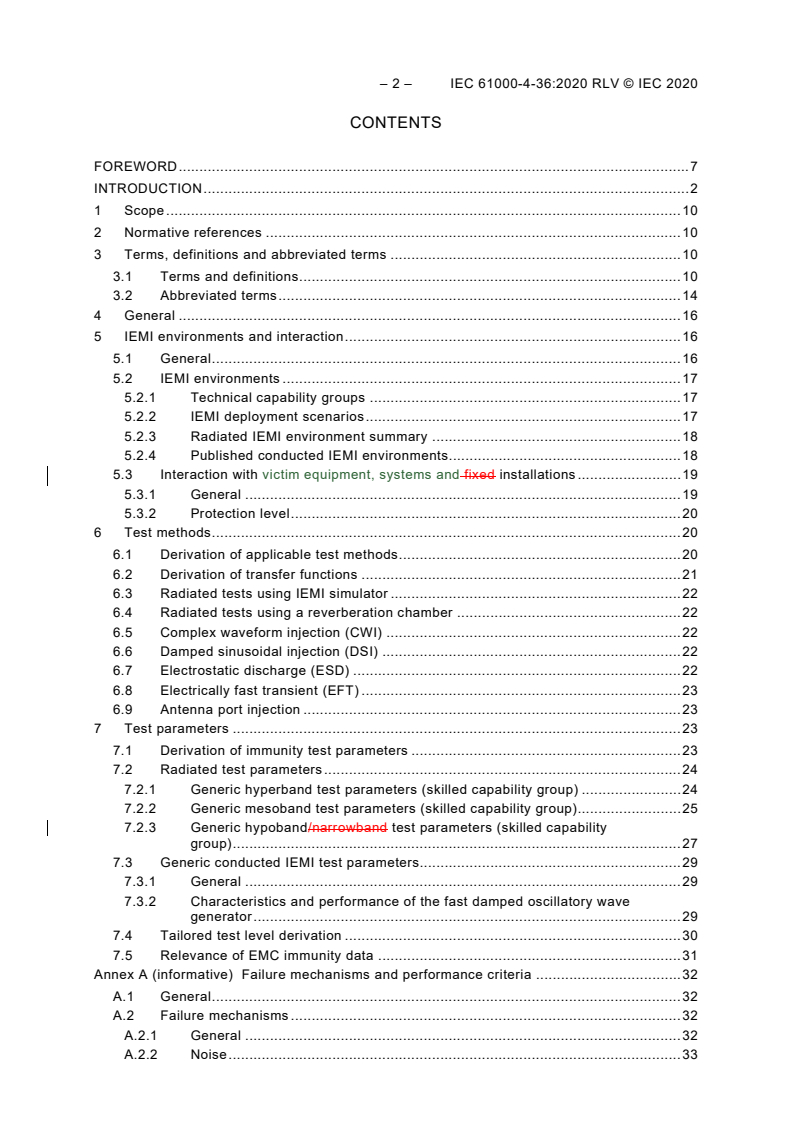
IEC 61000-4-36:2020 RLV - Electromagnetic compatibility (EMC) - Part 4-36: Testing and measurement techniques - IEMI immunity test methods for equipment and systems Released:3/23/2020
Overview - IEC 61000-4-36:2020 (IEMI immunity test methods)
IEC 61000-4-36:2020 is part of the IEC electromagnetic compatibility (EMC) test and measurement techniques series. It provides standardized methods to determine test levels and procedures for assessing the immunity of equipment and systems to intentional electromagnetic interference (IEMI) sources. The second edition (2020) is a technical revision of the 2014 edition and adds a hyperband and mesoband radiated transients immunity test method (Annex H) and a calibration and uncertainty method for sensors measuring hyper/mesoband transient fields (Annex I).
Key topics and technical requirements
- IEMI problem definition and source parameters: describes IEMI environments, deployment scenarios and technical capability groupings to support realistic threat models.
- Derivation of test limits and immunity parameters: guidance for deriving applicable test levels and transfer functions from threat descriptions.
- Radiated test methods: procedures using IEMI simulators, reverberation chambers and anechoic/GTEM test setups to generate transient radiated fields.
- Conducted test methods: complex waveform injection (CWI), damped sinusoidal injection (DSI), antenna-port injection and conducted transient tests.
- Pulse and transient characteristics: discussion of pulse widths, failure mechanisms (noise, parameter drift, system upset, component damage) and performance criteria.
- Measurement and calibration: Annex I provides calibration methods for sensors (including D-dot style probes) in TEM waveguides and discusses measurement uncertainty for hyperband/mesoband transient fields.
- Field uniformity and test set-up: requirements for field uniformity assessment, laboratory reference conditions, wiring arrangements and test reporting (Annex H).
- Supporting methods and analysis: transfer function derivation, relevance of immunity data, and margins associated with test methodology.
Practical applications and who uses this standard
IEC 61000-4-36 is intended for organizations and professionals involved in EMC and security resilience, including:
- EMC test laboratories performing IEMI immunity assessments.
- Manufacturers of critical systems (power, transportation, medical, telecoms, industrial control) seeking to evaluate or improve resilience to intentional or high-energy transient threats.
- System integrators and asset owners performing risk assessments and tailored immunity testing.
- Standards committees and security engineers developing threat models or test programs.
Practical outcomes include consistent test methods, repeatable immunity measurements, calibrated sensors for transient fields, and standardized reporting to support system hardening and procurement specifications.
Related standards
- IEC 61000 series (EMC) - general family context
- IEC 61000-2-13 (referenced in Annex B) - published radiated IEMI environments
- IEC 61000-4-20 (referenced in Annex I) - TEM waveguide probe calibration
Keywords: IEC 61000-4-36, IEMI immunity, electromagnetic compatibility, EMC testing, hyperband mesoband, radiated transients, calibration, reverberation chamber, complex waveform injection.
Relations
- Effective Date
- 05-Sep-2023
Buy Documents
IEC 61000-4-36:2020 - Electromagnetic compatibility (EMC) - Part 4-36: Testing and measurement techniques - IEMI immunity test methods for equipment and systems Released:3/23/2020
IEC 61000-4-36:2020 RLV - Electromagnetic compatibility (EMC) - Part 4-36: Testing and measurement techniques - IEMI immunity test methods for equipment and systems Released:3/23/2020
Get Certified
Connect with accredited certification bodies for this standard

IMQ S.p.A. (Certification)
Italian electrical product certification.

SLG Prüf- und Zertifizierungs GmbH
German testing and certification body.

UL Solutions
Global safety science company with testing, inspection and certification.
Sponsored listings
Frequently Asked Questions
IEC 61000-4-36:2020 is a standard published by the International Electrotechnical Commission (IEC). Its full title is "Electromagnetic compatibility (EMC) - Part 4-36: Testing and measurement techniques - IEMI immunity test methods for equipment and systems". This standard covers: IEC 61000-4-36:2020 provides methods to determine test levels for the assessment of the immunity of equipment and systems to intentional electromagnetic interference (IEMI) sources. It introduces the general IEMI problem, IEMI source parameters, derivation of test limits and summarises practical test methods. This second edition cancels and replaces the first edition published in 2014. This edition constitutes a technical revision. This edition includes the following significant technical changes with respect to the previous edition: - addition of a hyperband and mesoband radiated transients immunity test method in - Annex H; - addition of a calibration method of sensors for radiated hyperband and mesoband transient fields and measurement uncertainty in Annex I.
IEC 61000-4-36:2020 provides methods to determine test levels for the assessment of the immunity of equipment and systems to intentional electromagnetic interference (IEMI) sources. It introduces the general IEMI problem, IEMI source parameters, derivation of test limits and summarises practical test methods. This second edition cancels and replaces the first edition published in 2014. This edition constitutes a technical revision. This edition includes the following significant technical changes with respect to the previous edition: - addition of a hyperband and mesoband radiated transients immunity test method in - Annex H; - addition of a calibration method of sensors for radiated hyperband and mesoband transient fields and measurement uncertainty in Annex I.
IEC 61000-4-36:2020 is classified under the following ICS (International Classification for Standards) categories: 29.130.10 - High voltage switchgear and controlgear; 29.130.99 - Other switchgear and controlgear; 33.100.20 - Immunity. The ICS classification helps identify the subject area and facilitates finding related standards.
IEC 61000-4-36:2020 has the following relationships with other standards: It is inter standard links to IEC 61000-4-36:2014. Understanding these relationships helps ensure you are using the most current and applicable version of the standard.
IEC 61000-4-36:2020 is available in PDF format for immediate download after purchase. The document can be added to your cart and obtained through the secure checkout process. Digital delivery ensures instant access to the complete standard document.
Standards Content (Sample)
IEC 61000-4-36 ®
Edition 2.0 2020-03
INTERNATIONAL
STANDARD
colour
inside
BASIC EMC PUBLICATION
Electromagnetic compatibility (EMC) –
Part 4-36: Testing and measurement techniques – IEMI immunity test methods
for equipment and systems
All rights reserved. Unless otherwise specified, no part of this publication may be reproduced or utilized in any form
or by any means, electronic or mechanical, including photocopying and microfilm, without permission in writing from
either IEC or IEC's member National Committee in the country of the requester. If you have any questions about IEC
copyright or have an enquiry about obtaining additional rights to this publication, please contact the address below or
your local IEC member National Committee for further information.
IEC Central Office Tel.: +41 22 919 02 11
3, rue de Varembé info@iec.ch
CH-1211 Geneva 20 www.iec.ch
Switzerland
About the IEC
The International Electrotechnical Commission (IEC) is the leading global organization that prepares and publishes
International Standards for all electrical, electronic and related technologies.
About IEC publications
The technical content of IEC publications is kept under constant review by the IEC. Please make sure that you have the
latest edition, a corrigendum or an amendment might have been published.
IEC publications search - webstore.iec.ch/advsearchform Electropedia - www.electropedia.org
The advanced search enables to find IEC publications by a The world's leading online dictionary on electrotechnology,
variety of criteria (reference number, text, technical containing more than 22 000 terminological entries in English
committee,…). It also gives information on projects, replaced and French, with equivalent terms in 16 additional languages.
and withdrawn publications. Also known as the International Electrotechnical Vocabulary
(IEV) online.
IEC Just Published - webstore.iec.ch/justpublished
Stay up to date on all new IEC publications. Just Published IEC Glossary - std.iec.ch/glossary
details all new publications released. Available online and 67 000 electrotechnical terminology entries in English and
once a month by email. French extracted from the Terms and definitions clause of
IEC publications issued between 2002 and 2015. Some
IEC Customer Service Centre - webstore.iec.ch/csc entries have been collected from earlier publications of IEC
If you wish to give us your feedback on this publication or TC 37, 77, 86 and CISPR.
need further assistance, please contact the Customer Service
Centre: sales@iec.ch.
IEC 61000-4-36 ®
Edition 2.0 2020-03
INTERNATIONAL
STANDARD
colour
inside
BASIC EMC PUBLICATION
Electromagnetic compatibility (EMC) –
Part 4-36: Testing and measurement techniques – IEMI immunity test methods
for equipment and systems
INTERNATIONAL
ELECTROTECHNICAL
COMMISSION
ICS 33.100.20 ISBN 978-2-8322-7942-7
– 2 – IEC 61000-4-36:2020 © IEC 2020
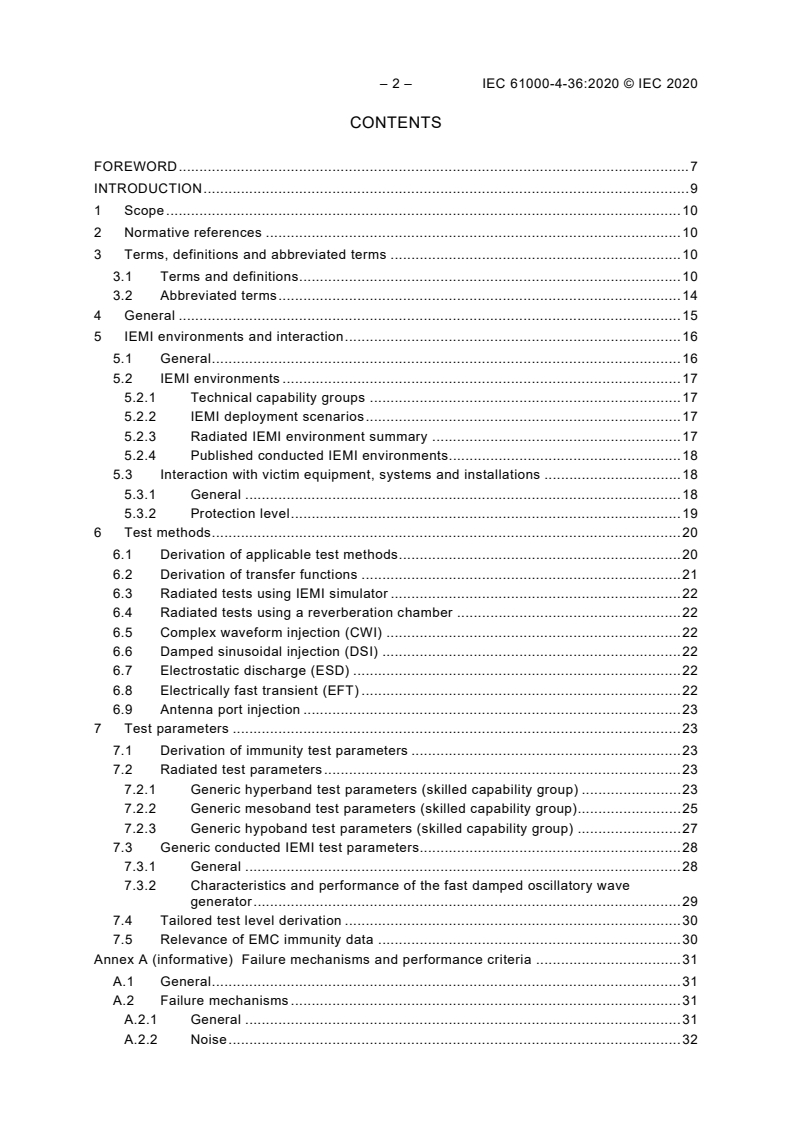
CONTENTS
FOREWORD . 7
INTRODUCTION . 9
1 Scope . 10
2 Normative references . 10
3 Terms, definitions and abbreviated terms . 10
3.1 Terms and definitions . 10
3.2 Abbreviated terms . 14
4 General . 15
5 IEMI environments and interaction . 16
5.1 General . 16
5.2 IEMI environments . 17
5.2.1 Technical capability groups . 17
5.2.2 IEMI deployment scenarios . 17
5.2.3 Radiated IEMI environment summary . 17
5.2.4 Published conducted IEMI environments. 18
5.3 Interaction with victim equipment, systems and installations . 18
5.3.1 General . 18
5.3.2 Protection level . 19
6 Test methods . 20
6.1 Derivation of applicable test methods . 20
6.2 Derivation of transfer functions . 21
6.3 Radiated tests using IEMI simulator . 22
6.4 Radiated tests using a reverberation chamber . 22
6.5 Complex waveform injection (CWI) . 22
6.6 Damped sinusoidal injection (DSI) . 22
6.7 Electrostatic discharge (ESD) . 22
6.8 Electrically fast transient (EFT) . 22
6.9 Antenna port injection . 23
7 Test parameters . 23
7.1 Derivation of immunity test parameters . 23
7.2 Radiated test parameters . 23
7.2.1 Generic hyperband test parameters (skilled capability group) . 23
7.2.2 Generic mesoband test parameters (skilled capability group). 25
7.2.3 Generic hypoband test parameters (skilled capability group) . 27
7.3 Generic conducted IEMI test parameters. 28
7.3.1 General . 28
7.3.2 Characteristics and performance of the fast damped oscillatory wave
generator . 29
7.4 Tailored test level derivation . 30
7.5 Relevance of EMC immunity data . 30
Annex A (informative) Failure mechanisms and performance criteria . 31
A.1 General . 31
A.2 Failure mechanisms . 31
A.2.1 General . 31
A.2.2 Noise . 32
A.2.3 Parameter offset and drifts . 32
A.2.4 System upset or breakdown . 33
A.2.5 Component destruction . 33
A.3 Effect of pulse width. 34
A.4 Performance criteria . 34
A.5 References . 35
Annex B (informative) Developments in IEMI source environments . 37
B.1 General . 37
B.2 IEMI environment . 38
B.3 IEMI sources . 39
B.4 Published radiated IEMI environments . 43
B.4.1 IEC 61000-2-13 [B.14] . 43
B.4.2 Mil-Std-464C . 43
B.4.3 Selection of parameters for mesoband immunity test . 45
B.4.4 International Telecommunication Union (ITU) . 47
B.5 Summary . 47
B.6 References . 48
Annex C (informative) Interaction with buildings . 50
C.1 Building attenuation . 50
C.2 Coupling to cables . 51
C.3 Low voltage cable attenuation . 52
C.4 References . 53
Annex D (informative) Relation between plane wave immunity testing and immunity
testing in a reverberation chamber . 55
D.1 General . 55
D.2 Relation between measurements of shielding effectiveness in the two
environments . 56
D.3 Relation between immunity testing in the two environments . 59
D.4 Additional aspects . 61
D.5 References . 61
Annex E (informative) Complex waveform injection – Test method . 64
E.1 General . 64
E.2 Prediction . 64
E.2.1 General . 64
E.2.2 Example . 68
E.3 Construction . 70
E.4 Injection . 74
E.5 Summary . 76
E.6 References . 76
Annex F (informative) Significance of test methodology margins . 78
F.1 General . 78
F.2 Examples . 78
F.2.1 General . 78
F.2.2 Negative contributions . 79
F.2.3 Positive contributions. 81
F.2.4 Summary . 83
F.3 References . 83
Annex G (informative) Intentional EMI – The issue of jammers . 84
G.1 General . 84
– 4 – IEC 61000-4-36:2020 © IEC 2020
G.2 Effects . 84
G.3 Published accounts of jamming . 85
G.4 Risk assessment . 85
G.5 Mitigation . 85
G.6 References . 86
Annex H (normative) Hyperband and mesoband radiated transients immunity test
method . 88
H.1 Overview. 88
H.2 Test equipment . 88
H.2.1 General . 88
H.2.2 Test facility . 88
H.2.3 Hyperband transient pulse radiating test system . 89
H.2.4 Mesoband transient pulse radiating test system . 89
H.2.5 Measurement chain . 89
H.3 Field uniformity assessment . 90
H.3.1 Field uniformity assessment in an anechoic chamber . 90
H.3.2 Field uniformity in GTEM waveguide . 93
H.4 Test set-up . 93
H.4.1 General . 93
H.4.2 Arrangement of table-top equipment . 95
H.4.3 Arrangement of floor-standing equipment . 95
H.4.4 Arrangement of wiring . 95
H.5 Test procedure . 96
H.5.1 General . 96
H.5.2 Laboratory reference conditions . 96
H.5.3 Execution of the test . 96
H.5.4 Evaluation of test results . 98
H.6 Test report . 98
H.7 References . 99
Annex I (informative) Calibration method and measurement uncertainty of sensors for
the measurement of radiated hyperband and mesoband transient fields . 100
I.1 General . 100
I.2 Calibration method in TEM waveguides in IEC 61000-4-20:2010, Annex E [I.1] . 100
I.2.1 General . 100
I.2.2 Probe calibration requirements . 101
I.2.3 Field probe calibration procedure in case of a one-port TEM waveguide . 102
I.3 Calibration procedures for D-dot sensors in the time domain. 103
I.3.1 General . 103
I.4 Measurement uncertainty . 105
I.5 References . 106
Bibliography . 107
Figure 1 – Example of radiated and conducted IEMI interaction with a building . 19
Figure 2 – Assessment options . 21
Figure 3 – Examples of ports . 23
Figure 4 – Example of hyperband waveform. 25
Figure 5 – Example of mesoband waveform . 27
Figure 6 – Typical hypoband/narrowband waveform . 28
Figure 7 – Waveform of the damped oscillatory wave (open circuit voltage) . 29
Figure A.1 – IEMI induced offset of sensor output – Corruption of information . 32
Figure A.2 – Collision of an induced disturbance with data bits [A.1] . 33
Figure A.3 – Examples of destruction on a chip [A.2] . 33
Figure A.4 – Generic failure trend as a function of pulse width . 34
Figure B.1 – A comparison of HPEM and IEMI spectra [B.6] . 37
Figure B.2 – Representation of typical IEMI radiation and coupling onto systems [B.3] . 39
Figure B.3 – Parameter space in power/frequency occupied by sophisticated IEMI (i.e.
DEW) sources in comparison to common RF systems [B.1]. 40
Figure B.4 – Peak power and energy from continuous and pulsed (durations shown)
microwave sources, narrowband and wideband . 40
Figure B.5 – Peak powers of various types of pulsed hypoband/narrowband sources [B.1] . 41
Figure B.6 – Peak versus average power for microwave sources with duty factors
indicated . 41
Figure B.7 – Phase coherence leading to a compact HPM source with N scaling of
output power . 42
Figure B.8 – Briefcase mesoband DS source sold by Diehl-Rheinmetall [B.3] . 42
Figure B.9 – A do-it-yourself electromagnetic weapon made from an oven magnetron
[B.13] . 43
Figure B.10 – Wideband (mesoband and hyperband) EME derived from [B.17] . 45
Figure B.11 – Plot of entire narrowband system weight as a function of output
microwave power for land-mobile and land-transportable systems . 48
Figure C.1 – Typical unprotected low-rise building plane wave E-field attenuation
collected from references . 50
Figure C.2 – Cable coupling and resonance region . 52
Figure C.3 – Mains cable attenuation profile . 53
Figure E.1 – LLSC reference field measurement set-up . 65
Figure E.2 – LLSC induced current measurement set-up . 66
Figure E.3 – Typical LLSC magnitude-only transfer function . 66
Figure E.4 – Prediction of induced current using minimum phase constraints . 67
Figure E.5 – IEC 61000-2-9 early-time (E1) HEMP environment . 68
Figure E.6 – Overlay of transfer function and threat (frequency domain) . 69
Figure E.7 – Predicted current . 69
Figure E.8 – Example of de-convolution result . 71
Figure E.9 – Damped sinusoidal waveforms – Ten-component fit . 71
Figure E.10 – Approximated and predicted transient . 72
Figure E.11 – Approximated and predicted transient (0 ns to 100 ns) . 72
Figure E.12 – Approximation and prediction transient – Frequency domain comparison . 73
Figure E.13 – Variation in error for an increasing number of damped sinusoids . 74
Figure E.14 – Complex injection set-up . 75
Figure E.15 – Amplifier requirements for various current levels . 75
Figure E.16 – Comparison of predicted (green) and injected (red) current . 76
Figure F.1 – Variation in induced currents as a result of configuration . 79
Figure F.2 – Comparison of HPD and VPD induced currents . 80
Figure F.3 – System variability . 80
– 6 – IEC 61000-4-36:2020 © IEC 2020
Figure F.4 – Comparison of single- and multi-port injection . 81
Figure F.5 – Example of transfer functions and worst-case envelope . 82
Figure F.6 – Comparison of individual and worst-case transfer function predictions . 82
Figure F.7 – Comparison between predicted and measured induced currents . 83
Figure H.1 – Measurement chain for field uniformity assessment and transient
responses . 89
Figure H.2 – Test set-up for field uniformity assessment in anechoic chamber . 91
Figure H.3 – Example of test set-up for table-top equipment/system . 94
Figure H.4 – Example of test set-up for floor-standing equipment/system . 94
Figure H.5 – Example of test set-up in GTEM waveguide . 95
Figure I.1 – Example of the measurement points for the validation . 102
Figure I.2 – Set-up for calibration of E-field probe in one-port TEM waveguide . 103
Figure I.3 – Cone and ground plane sensor calibration set-up . 104
Table 1 – Possible IEMI deployment scenarios . 17
Table 2 – Summary of high power radiated IEMI source output (rE ) by capability group . 18
far
Table 3 – Examples of protection levels . 19
Table 4 – Generic hyperband test parameters (skilled capability group) . 24
Table 5 – Radiated hyperband test waveform and other pulse parameters . 24
Table 6 – Generic mesoband test parameters (skilled capability group) . 25
Table 7 – Comparison of quality factor (Q) with bandratio . 26
Table 8 – Radiated mesoband waveform and other pulse parameters . 26
Table 9 – Generic hypoband/narrowband test parameters (skilled capability group) . 27
Table 10 – Conducted IEMI test levels . 28
Table 11 – Open circuit specifications . 29
Table 12 – Short circuit specifications . 30
Table A.1 – Recommended performance criteria . 35
Table B.1 – IEMI environments from IEC 61000-2-13 . 43
Table B.2 – Hypoband/narrowband HPM environment from [B.17] . 44
Table B.3 – Wideband (mesoband/hyperband) HPM environment from [B.17] . 44
Table C.1 – Shielding effectiveness measurements for various power system buildings
and rooms. 51
Table E.1 – Time waveform norms . 70
Table I.1 – Calibration frequencies. 102
Table I.2 – Type B expanded uncertainties for sensor calibrations in GTEM cell field
generation system . 105
Table I.3 – Type B expanded uncertainties for sensor calibrations in the cone and
ground plane cell field generation system . 106
INTERNATIONAL ELECTROTECHNICAL COMMISSION
____________
ELECTROMAGNETIC COMPATIBILITY (EMC) –
Part 4-36: Testing and measurement techniques –
IEMI immunity test methods for equipment and systems
FOREWORD
1) The International Electrotechnical Commission (IEC) is a worldwide organization for standardization comprising
all national electrotechnical committees (IEC National Committees). The object of IEC is to promote international
co-operation on all questions concerning standardization in the electrical and electronic fields. To this end and
in addition to other activities, IEC publishes International Standards, Technical Specifications, Technical Reports,
Publicly Available Specifications (PAS) and Guides (hereafter referred to as “IEC Publication(s)”). Their
preparation is entrusted to technical committees; any IEC National Committee interested in the subject dealt with
may participate in this preparatory work. International, governmental and non-governmental organizations liaising
with the IEC also participate in this preparation. IEC collaborates closely with the International Organization for
Standardization (ISO) in accordance with conditions determined by agreement between the two organizations.
2) The formal decisions or agreements of IEC on technical matters express, as nearly as possible, an international
consensus of opinion on the relevant subjects since each technical committee has representation from all
interested IEC National Committees.
3) IEC Publications have the form of recommendations for international use and are accepted by IEC National
Committees in that sense. While all reasonable efforts are made to ensure that the technical content of IEC
Publications is accurate, IEC cannot be held responsible for the way in which they are used or for any
misinterpretation by any end user.
4) In order to promote international uniformity, IEC National Committees undertake to apply IEC Publications
transparently to the maximum extent possible in their national and regional publications. Any divergence between
any IEC Publication and the corresponding national or regional publication shall be clearly indicated in the latter.
5) IEC itself does not provide any attestation of conformity. Independent certification bodies provide conformity
assessment services and, in some areas, access to IEC marks of conformity. IEC is not responsible for any
services carried out by independent certification bodies.
6) All users should ensure that they have the latest edition of this publication.
7) No liability shall attach to IEC or its directors, employees, servants or agents including individual experts and
members of its technical committees and IEC National Committees for any personal injury, property damage or
other damage of any nature whatsoever, whether direct or indirect, or for costs (including legal fees) and
expenses arising out of the publication, use of, or reliance upon, this IEC Publication or any other IEC Publications.
8) Attention is drawn to the Normative references cited in this publication. Use of the referenced publications is
indispensable for the correct application of this publication.
9) Attention is drawn to the possibility that some of the elements of this IEC Publication may be the subject of patent
rights. IEC shall not be held responsible for identifying any or all such patent rights.
International Standard IEC 61000-4-36 has been prepared by subcommittee 77C: High power
transient phenomena, of IEC technical committee 77: Electromagnetic compatibility.
It forms part 4-36 of IEC 61000. It has the status of a basic EMC publication in accordance with
IEC Guide 107.
This second edition cancels and replaces the first edition published in 2014. This edition
constitutes a technical revision.
This edition includes the following significant technical changes with respect to the previous
edition:
a) addition of a hyperband and mesoband radiated transients immunity test method in
Annex H;
b) addition of a calibration method of sensors for radiated hyperband and mesoband transient
fields and measurement uncertainty in Annex I.
– 8 – IEC 61000-4-36:2020 © IEC 2020
The text of this International Standard is based on the following documents:
FDIS Report on voting
77C/295/FDIS 77C/299/RVD
Full information on the voting for the approval of this standard can be found in the report on
voting indicated in the above table.
This publication has been drafted in accordance with the ISO/IEC Directives, Part 2.
A list of all parts in the IEC 61000 series, published under the general title Electromagnetic
compatibility (EMC), can be found on the IEC website.
The committee has decided that the contents of this publication will remain unchanged until the
stability date indicated on the IEC website under "http://webstore.iec.ch" in the data related to
the specific publication. At this date, the publication will be
• reconfirmed,
• withdrawn,
• replaced by a revised edition, or
• amended.
IMPORTANT – The 'colour inside' logo on the cover page of this publication indicates
that it contains colours which are considered to be useful for the correct understanding
of its contents. Users should therefore print this document using a colour printer.
INTRODUCTION
IEC 61000 is published in separate parts according to the following structure:
Part 1: General
General considerations (introduction, fundamental principles)
Definitions, terminology
Part 2: Environment
Description of the environment
Classification of the environment
Compatibility levels
Part 3: Limits
Emission limits
Immunity limits (in so far as they do not fall under the responsibility of the product committees)
Part 4: Testing and measurement techniques
Measurement techniques
Testing techniques
Part 5: Installation and mitigation guidelines
Installation guidelines
Mitigation methods and devices
Part 6: Generic standards
Part 9: Miscellaneous
Each part is further subdivided into several parts, published either as international standards
or as technical specifications or technical reports, some of which have already been published
as sections. Others will be published with the part number followed by a dash and a second
number identifying the subdivision (example: IEC 61000-6-1).
– 10 – IEC 61000-4-36:2020 © IEC 2020
ELECTROMAGNETIC COMPATIBILITY (EMC) –
Part 4-36: Testing and measurement techniques –
IEMI immunity test methods for equipment and systems
1 Scope
This part of IEC 61000 provides methods to determine test levels for the assessment of the
immunity of equipment and systems to intentional electromagnetic interference (IEMI) sources.
It introduces the general IEMI problem, IEMI source parameters, derivation of test limits and
summarises practical test methods.
2 Normative references
There are no normative references in this document.
3 Terms, definitions and abbreviated terms
For the purposes of this document, the following terms, definitions and abbreviated terms apply.
ISO and IEC maintain terminological databases for use in standardization at the following
addresses:
• IEC Electropedia: available at http://www.electropedia.org/
• ISO Online browsing platform: available at http://www.iso.org/obp
3.1 Terms and definitions
3.1.1
attenuation
reduction in magnitude (as a result of absorption and/or scattering) of an electric or magnetic
field or a current or voltage, usually expressed in decibels
, 3.1]
[SOURCE: IEC 61000-2-13:2005 [3]
3.1.2
bandratio
ratio of the high and low frequencies between which there is 90 % of the energy
Note 1 to entry: If the spectrum has a large DC content, the lower limit is nominally defined as 1 Hz
(see IEC 61000-2-13 [3] for further details).
[SOURCE: IEC 61000-2-13:2005 [3], 3.2, modified – The second part of the definition has been
made into a note.]
3.1.3
bandratio decades
bandratio expressed in decades as: bandratio decades = log10(bandratio)
___________
Numbers in square brackets refer to the Bibliography.
[SOURCE: IEC 61000-2-13:2005 [3], 3.3]
3.1.4
burst
sequence of a limited number of distinct pulses or oscillations of limited duration
Note 1 to entry: When multiple bursts occur, the time between bursts is usually defined.
SOURCE: [IEC 60050-161:1990 [19], 161-02-07, modified – The note has been added.]
3.1.5
conducted HPEM environment
high-power electromagnetic currents and voltages that are either coupled or directly injected to
cables and wires with voltage levels that typically exceed 1 kV
[SOURCE: IEC 61000-2-13:2005 [3], 3.5]
3.1.6
continuous wave
CW
time waveform that has a fixed frequency and is continuous
[SOURCE: IEC 61000-2-13:2005 [3], 3.6]
3.1.7
electromagnetic compatibility
EMC
ability of an equipment or system to function satisfactorily in its electromagnetic environment
without introducing intolerable electromagnetic disturbances to anything in that environment
[SOURCE: IEC 60050-161:2018, 161-01-07.]
3.1.8
electromagnetic disturbance
any electromagnetic phenomenon which can degrade the performance of a device, equipment
or system
[SOURCE: IEC 60050-161:2018, [19] 161-01-05, modified – The last part of the definition, "or
adversely affect living or inert matter", has been removed.]
3.1.9
electromagnetic interference
EMI
degradation of the performance of a device, transmission channel or system caused by an
electromagnetic disturbance
Note 1 to entry: Disturbance and interference are respectively cause and effect.
[SOURCE: IEC 60050-161:2018 [19], 161-01-06, modified – Notes 1 and 2 have been removed
and a new Note 1 has been added.]
3.1.10
shield
electrically continuous housing for a facility, area, or component used to
attenuate incident electric and magnetic fields by both absorption and reflection
– 12 – IEC 61000-4-36:2020 © IEC 2020
3.1.11
(electromagnetic) susceptibility
possibility of degradation to the performance of a device, equipment or system in the presence
of an electromagnetic field
Note 1 to entry: Susceptibility is a lack of immunity.
3.1.12
high-altitude electromagnetic pulse
HEMP
electromagnetic pulse produced by a nuclear explosion outside the earth’s atmosphere
Note 1 to entry: Typically above an altitude of 30 km.
[SOURCE: IEC 61000-2-13:2005 [3], 3.12]
3.1.13
high-power microwave
HPM
narrowband signals, nominally with peak power in a pulse, in excess of 100 MW at the source
Note 1 to entry: This is a historical definition that depended on the strength of the source. The interest in this
document is mainly on the EM field incident on an electronic system.
[SOURCE: IEC 61000-2-13:2005 [3], 3.13]
3.1.14
hyperband signal
signal or waveform with a pbw (see 3.1.19) value between 163,4 % and 200 % or a
bandratio > 10
[SOURCE: IEC 61000-2-13:2005 [3], 3.14]
3.1.15
hypoband signal
narrowband signal or waveform with a pbw (see 3.1.19) of < 1 % or a bandratio < 1,01
[SOURCE: IEC 61000-2-13:2005 [3], 3.15, modified – The second term "narrowband signal"
has been removed.]
3.1.16
intentional electromagnetic interference
IEMI
intentional malicious generation of electromagnetic energy introducing noise or signals into
electric and electronic systems, thus disrupting, confusing or damaging these systems for
terrorist or criminal purposes
[SOURCE: IEC 61000-2-13:2005 [3], 3.16]
3.1.17
L band
radar frequency band between 1 GHz and 2 GHz
[SOURCE: IEC 61000-2-13:2005 [3], 3.17]
3.1.18
mesoband signal
signal or waveform with a pbw (see 3.1.19) value between 1 % and 100 % or a bandratio
between 1,01 and 3
[SOURCE: IEC 61000-2-13:2005 [3], 3.18]
3.1.19
percentage bandwidth
pbw
bandwidth of a waveform expressed as a percentage of the centre frequency of that waveform
Note 1 to entry: The pbw has a maximum value of 200 % when the centre frequency is the mean of the high and
low frequencies. The pbw does not apply to signals with a large DC content (e.g., HEMP) for which the bandratio
decades is used.
[SOURCE: IEC 61000-2-13:2005 [3], 3.19]
3.1.20
port-of-entry
PoE
physical location (point) on an electromagnetic barrier, where EM energy may enter or exit a
topological volume, unless an adequate PoE protective device is provided
Note 1 to entry: A PoE is not limited to a geometrical point.
Note 2 to entry: PoEs are classified as aperture PoEs or conductive PoEs according to the type of penetration.
They are also classified as architectural, mechanical, structural or electrical PoEs according to the functions they
serve.
[SOURCE: IEC 61000-2-13:2005 [3], 3.20, modified – The second term "point-of-entry" has
been removed.]
3.1.21
pulse
transient waveform that usually rises to a peak value and then decays, or a similar waveform
that is an envelope of an oscillating waveform
[SOURCE: IEC 61000-2-13:2005 [3], 3.21]
3.1.22
pulse repetition frequency
prf
number of pulses per unit time, measured in Hz
3.1.23
radiated HPEM environment
high-power electromagnetic fields with peak electric field levels that typically exceed 100 V/m
[SOURCE: IEC 61000-2-13:2005 [3], 3.22]
3.1.24
rE
far
measured or known electric field multiplied by the distance at which it was measured to give an
equivalent voltage at a distance of 1 m from the antenna
3.1.25
sub-hyperband signal
signal or a waveform with a pbw value between 100 % and 163,4 % or a bandratio between 3
and 10
[SOURCE: IEC 61000-2-13:2005 [3], 3.23]
– 14 – IEC 61000-4-36:2020 © IEC 2020
3.1.26
transient
pertaining to or designating a phenomenon or quantity which varies between two consecutive
steady states during a time interval which is short compared with the time-scale of interest
Note 1 to entry: A transient can be a unidirectional impulse of either polarity or a damped oscillatory wave with the
first peak occurring in either polarity.
[SOURCE: IEC 60050-702:2019 [20], 702-07-781, modified – The words "pertaining to or
designating a" and the note have been added.]
3.1.27
ultrawideband
UWB
signal that has a percent bandwidth greater than 25 %
[SOURCE: IEC 61000-2-13:2005 [3], 3.25]
3.2 Abbreviated terms
AC Anechoic chamber
BCI Bulk current injection
CWI Complex waveform injection
DEW Directed energy weapon
DS Damped sinusoid
DSI Damped sinusoid injection
EFT Electrically fast transient
EM Electromagnetic
EME Electromagnetic environment
EMI Electromagnetic interference
EMP Electromagnetic pulse
ERTMS European rail traffic management system
ESD Electrostatic discharge
EUT Equipment under test
FO Fibre optic
FOL Fibre optic link
FT Fourier transform
GNSS Global navigation satellite system
GP
...
IEC 61000-4-36 ®
Edition 2.0 2020-03
REDLINE VERSION
INTERNATIONAL
STANDARD
colour
inside
BASIC EMC PUBLICATION
Electromagnetic compatibility (EMC) –
Part 4-36: Testing and measurement techniques – IEMI immunity test methods
for equipment and systems
All rights reserved. Unless otherwise specified, no part of this publication may be reproduced or utilized in any form
or by any means, electronic or mechanical, including photocopying and microfilm, without permission in writing from
either IEC or IEC's member National Committee in the country of the requester. If you have any questions about IEC
copyright or have an enquiry about obtaining additional rights to this publication, please contact the address below or
your local IEC member National Committee for further information.
IEC Central Office Tel.: +41 22 919 02 11
3, rue de Varembé info@iec.ch
CH-1211 Geneva 20 www.iec.ch
Switzerland
About the IEC
The International Electrotechnical Commission (IEC) is the leading global organization that prepares and publishes
International Standards for all electrical, electronic and related technologies.
About IEC publications
The technical content of IEC publications is kept under constant review by the IEC. Please make sure that you have the
latest edition, a corrigendum or an amendment might have been published.
IEC publications search - webstore.iec.ch/advsearchform Electropedia - www.electropedia.org
The advanced search enables to find IEC publications by a The world's leading online dictionary on electrotechnology,
variety of criteria (reference number, text, technical containing more than 22 000 terminological entries in English
committee,…). It also gives information on projects, replaced and French, with equivalent terms in 16 additional languages.
and withdrawn publications. Also known as the International Electrotechnical Vocabulary
(IEV) online.
IEC Just Published - webstore.iec.ch/justpublished
Stay up to date on all new IEC publications. Just Published IEC Glossary - std.iec.ch/glossary
details all new publications released. Available online and 67 000 electrotechnical terminology entries in English and
once a month by email. French extracted from the Terms and Definitions clause of
IEC publications issued since 2002. Some entries have been
IEC Customer Service Centre - webstore.iec.ch/csc collected from earlier publications of IEC TC 37, 77, 86 and
If you wish to give us your feedback on this publication or CISPR.
need further assistance, please contact the Customer Service
Centre: sales@iec.ch.
IEC 61000-4-36 ®
Edition 2.0 2020-03
REDLINE VERSION
INTERNATIONAL
STANDARD
colour
inside
BASIC EMC PUBLICATION
Electromagnetic compatibility (EMC) –
Part 4-36: Testing and measurement techniques – IEMI immunity test methods
for equipment and systems
INTERNATIONAL
ELECTROTECHNICAL
COMMISSION
ICS 33.100.20 ISBN 978-2-8322-8045-4
– 2 – IEC 61000-4-36:2020 RLV © IEC 2020
CONTENTS
FOREWORD . 7
INTRODUCTION . 2
1 Scope . 10
2 Normative references . 10
3 Terms, definitions and abbreviated terms . 10
3.1 Terms and definitions . 10
3.2 Abbreviated terms . 14
4 General . 16
5 IEMI environments and interaction . 16
5.1 General . 16
5.2 IEMI environments . 17
5.2.1 Technical capability groups . 17
5.2.2 IEMI deployment scenarios . 17
5.2.3 Radiated IEMI environment summary . 18
5.2.4 Published conducted IEMI environments. 18
5.3 Interaction with victim equipment, systems and fixed installations . 19
5.3.1 General . 19
5.3.2 Protection level . 20
6 Test methods . 20
6.1 Derivation of applicable test methods . 20
6.2 Derivation of transfer functions . 21
6.3 Radiated tests using IEMI simulator . 22
6.4 Radiated tests using a reverberation chamber . 22
6.5 Complex waveform injection (CWI) . 22
6.6 Damped sinusoidal injection (DSI) . 22
6.7 Electrostatic discharge (ESD) . 22
6.8 Electrically fast transient (EFT) . 23
6.9 Antenna port injection . 23
7 Test parameters . 23
7.1 Derivation of immunity test parameters . 23
7.2 Radiated test parameters . 24
7.2.1 Generic hyperband test parameters (skilled capability group) . 24
7.2.2 Generic mesoband test parameters (skilled capability group). 25
7.2.3 Generic hypoband/narrowband test parameters (skilled capability
group) . 27
7.3 Generic conducted IEMI test parameters. 29
7.3.1 General . 29
7.3.2 Characteristics and performance of the fast damped oscillatory wave
generator . 29
7.4 Tailored test level derivation . 30
7.5 Relevance of EMC immunity data . 31
Annex A (informative) Failure mechanisms and performance criteria . 32
A.1 General . 32
A.2 Failure mechanisms . 32
A.2.1 General . 32
A.2.2 Noise . 33
A.2.3 Parameter offset and drifts . 33
A.2.4 System upset or breakdown . 34
A.2.5 Component destruction . 34
A.3 Effect of pulse width. 35
A.4 Performance criteria . 35
A.5 References . 36
Annex B (informative) Developments in IEMI source environments . 38
B.1 General . 38
B.2 IEMI environment . 39
B.3 IEMI sources . 40
B.4 Published radiated IEMI environments . 44
B.4.1 IEC 61000-2-13 [B.14] . 44
B.4.2 Mil-Std-464C . 44
B.4.3 Selection of parameters for mesoband immunity test . 46
Practical determination of a tailored test level – An example.
B.4.4 International Telecommunication Union (ITU) . 46
B.5 Summary . 49
B.6 References . 50
Annex C (informative) Interaction with buildings . 52
C.1 Building attenuation . 52
C.2 Coupling to cables . 53
C.3 Low voltage cable attenuation . 54
C.4 References . 55
Annex D (informative) Relation between plane wave immunity testing and immunity
testing in a reverberation chamber . 57
D.1 General . 57
D.2 Relation between measurements of shielding effectiveness in the two
environments . 58
D.3 Relation between immunity testing in the two environments . 61
D.4 Additional aspects . 63
D.5 References . 63
Annex E (informative) Complex waveform injection – Test method . 66
E.1 General . 66
E.2 Prediction . 66
E.2.1 General . 66
E.2.2 Example . 70
E.3 Construction . 72
E.4 Injection . 76
E.5 Summary . 78
E.6 References . 78
Annex F (informative) Significance of test methodology margins . 80
F.1 General . 80
F.2 Examples . 80
F.2.1 General . 80
F.2.2 Negative contributions . 81
F.2.3 Positive contributions. 83
F.2.4 Summary . 85
F.3 References . 85
Annex G (informative) Intentional EMI – The issue of jammers . 86
– 4 – IEC 61000-4-36:2020 RLV © IEC 2020
G.1 General . 86
G.2 Effects . 86
G.3 Published accounts of jamming . 87
G.4 Risk assessment . 87
G.5 Mitigation . 87
G.6 References . 88
Annex H (normative) Hyperband and mesoband radiated transients immunity test
method . 90
H.1 Overview. 90
H.2 Test equipment . 90
H.2.1 General . 90
H.2.2 Test facility . 90
H.2.3 Hyperband transient pulse radiating test system . 91
H.2.4 Mesoband transient pulse radiating test system . 91
H.2.5 Measurement chain . 91
H.3 Field uniformity assessment . 92
H.3.1 Field uniformity assessment in an anechoic chamber . 92
H.3.2 Field uniformity in GTEM waveguide . 95
H.4 Test set-up . 95
H.4.1 General . 95
H.4.2 Arrangement of table-top equipment . 97
H.4.3 Arrangement of floor-standing equipment . 97
H.4.4 Arrangement of wiring . 97
H.5 Test procedure . 98
H.5.1 General . 98
H.5.2 Laboratory reference conditions . 98
H.5.3 Execution of the test . 98
H.5.4 Evaluation of test results . 100
H.6 Test report . 100
H.7 References . 101
Annex I (informative) Calibration method and measurement uncertainty of sensors for
the measurement of radiated hyperband and mesoband transient fields . 102
I.1 General . 102
I.2 Calibration method in TEM waveguides in IEC 61000-4-20:2010, Annex E [I.1] . 102
I.2.1 General . 102
I.2.2 Probe calibration requirements . 103
I.2.3 Field probe calibration procedure in case of a one-port TEM waveguide . 104
I.3 Calibration procedures for D-dot sensors in the time domain. 105
I.3.1 General . 105
I.4 Measurement uncertainty . 107
I.5 References . 108
Bibliography . 109
Figure 1 – Example of radiated and conducted IEMI interaction with a building . 19
Figure 2 – Assessment options . 21
Figure 3 – Examples of ports . 23
Figure 4 – Typical Example of hyperband waveform . 25
Figure 5 – Typical Example of mesoband waveform . 27
Figure 6 – Typical hypoband/narrowband waveform . 28
Figure 7 – Waveform of the damped oscillatory wave (open circuit voltage) . 29
Figure A.1 – IEMI induced offset of sensor output – Corruption of information . 33
Figure A.2 – Collision of an induced disturbance with data bits [A.1] . 34
Figure A.3 – Examples of destruction on a chip [A.2] . 34
Figure A.4 – Generic failure trend as a function of pulse width . 35
Figure B.1 – A comparison of HPEM and IEMI spectra [B.6] . 38
Figure B.2 – Representation of typical IEMI radiation and coupling onto systems [B.3] . 40
Figure B.3 – Parameter space in power/frequency occupied by sophisticated IEMI (i.e.
DEW) sources in comparison to common RF systems [B.1]. 41
Figure B.4 – Peak power and energy from continuous and pulsed (durations shown)
microwave sources, narrowband and wideband . 41
Figure B.5 – Peak powers of various types of pulsed HPM hypoband/narrowband sources
[B.1] . 42
Figure B.6 – Peak versus average power for microwave sources with duty factors
indicated . 42
Figure B.7 – Phase coherence leading to a compact HPM source with N scaling of
output power . 43
Figure B.8 – Briefcase mesoband UWB DS source sold by Diehl-Rheinmetall [B.3] . 43
Figure B.9 – A do-it-yourself electromagnetic weapon made from an oven magnetron
[B.13] . 44
Figure B.10 – Wideband (mesoband and hyperband) EME derived from [B.17] . 46
Figure B.11 – Plot of entire narrowband system weight as a function of output
microwave power for land-mobile and land-transportable systems . 50
Figure C.1 – Typical unprotected low-rise building plane wave E-field attenuation
collected from references . 52
Figure C.2 – Cable coupling and resonance region . 54
Figure C.3 – Mains cable attenuation profile . 55
Figure E.1 – LLSC reference field measurement set-up . 67
Figure E.2 – LLSC induced current measurement set-up . 68
Figure E.3 – Typical LLSC magnitude-only transfer function . 68
Figure E.4 – Prediction of induced current using minimum phase constraints . 69
Figure E.5 – IEC 61000-2-9 early-time (E1) HEMP environment . 70
Figure E.6 – Overlay of transfer function and threat (frequency domain) . 71
Figure E.7 – Predicted current . 71
Figure E.8 – Example of de-convolution result . 73
Figure E.9 – Damped sinusoidal waveforms – Ten-component fit . 73
Figure E.10 – Approximated and predicted transient . 74
Figure E.11 – Approximated and predicted transient (0 ns to 100 ns) . 74
Figure E.12 – Approximation and prediction transient – Frequency domain comparison . 75
Figure E.13 – Variation in error for an increasing number of damped sinusoids . 76
Figure E.14 – Complex injection set-up . 77
Figure E.15 – Amplifier requirements for various current levels . 77
Figure E.16 – Comparison of predicted (green) and injected (red) current . 78
Figure F.1 – Variation in induced currents as a result of configuration . 81
– 6 – IEC 61000-4-36:2020 RLV © IEC 2020
Figure F.2 – Comparison of HPD and VPD induced currents . 82
Figure F.3 – System variability . 82
Figure F.4 – Comparison of single- and multi-port injection . 83
Figure F.5 – Example of transfer functions and worst-case envelope . 84
Figure F.6 – Comparison of individual and worst-case transfer function predictions . 84
Figure F.7 – Comparison between predicted and measured induced currents . 85
Figure H.1 – Measurement chain for field uniformity assessment and transient
responses . 91
Figure H.2 – Test set-up for field uniformity assessment in anechoic chamber . 93
Figure H.3 – Example of test set-up for table-top equipment/system . 96
Figure H.4 – Example of test set-up for floor-standing equipment/system . 96
Figure H.5 – Example of test set-up in GTEM waveguide . 97
Figure I.1 – Example of the measurement points for the validation . 104
Figure I.2 – Set-up for calibration of E-field probe in one-port TEM waveguide . 105
Figure I.3 – Cone and ground plane sensor calibration set-up . 106
Table 1 – Possible IEMI deployment scenarios . 18
Table 2 – Summary of high power radiated IEMI source output (rE ) by capability group . 18
far
Table 3 – Examples of protection levels . 20
Table 4 – Generic hyperband test parameters (skilled capability group) . 24
Table 5 – Radiated hyperband test waveform and other pulse parameters . 24
Table 6 – Generic mesoband test parameters (skilled capability group) . 25
Table 7 – Comparison of quality factor (Q) with bandratio . 26
Table 8 – Radiated mesoband waveform and other pulse parameters . 26
Table 9 – Generic hypoband/narrowband test parameters (skilled capability group) . 28
Table 10 – Conducted IEMI test levels . 29
Table 11 – Open circuit specifications . 30
Table 12 – Short circuit specifications . 30
Table A.1 – Recommended performance criteria . 36
Table B.1 – IEMI environments from IEC 61000-2-13 . 44
Table B.2 – Hypoband/narrowband HPM environment from [B.17] . 44
Table B.3 – Hyperband/ Wideband (mesoband/hyperband) HPM environment from
[B.17] . 45
Table C.1 – Shielding effectiveness measurements for various power system buildings
and rooms. 53
Table E.1 – Time waveform norms . 72
Table I.1 – Calibration frequencies. 104
Table I.2 – Type B expanded uncertainties for sensor calibrations in GTEM cell field
generation system . 107
Table I.3 – Type B expanded uncertainties for sensor calibrations in the cone and
ground plane cell field generation system . 108
INTERNATIONAL ELECTROTECHNICAL COMMISSION
____________
ELECTROMAGNETIC COMPATIBILITY (EMC) –
Part 4-36: Testing and measurement techniques –
IEMI immunity test methods for equipment and systems
FOREWORD
1) The International Electrotechnical Commission (IEC) is a worldwide organization for standardization comprising
all national electrotechnical committees (IEC National Committees). The object of IEC is to promote international
co-operation on all questions concerning standardization in the electrical and electronic fields. To this end and
in addition to other activities, IEC publishes International Standards, Technical Specifications, Technical Reports,
Publicly Available Specifications (PAS) and Guides (hereafter referred to as “IEC Publication(s)”). Their
preparation is entrusted to technical committees; any IEC National Committee interested in the subject dealt with
may participate in this preparatory work. International, governmental and non-governmental organizations liaising
with the IEC also participate in this preparation. IEC collaborates closely with the International Organization for
Standardization (ISO) in accordance with conditions determined by agreement between the two organizations.
2) The formal decisions or agreements of IEC on technical matters express, as nearly as possible, an international
consensus of opinion on the relevant subjects since each technical committee has representation from all
interested IEC National Committees.
3) IEC Publications have the form of recommendations for international use and are accepted by IEC National
Committees in that sense. While all reasonable efforts are made to ensure that the technical content of IEC
Publications is accurate, IEC cannot be held responsible for the way in which they are used or for any
misinterpretation by any end user.
4) In order to promote international uniformity, IEC National Committees undertake to apply IEC Publications
transparently to the maximum extent possible in their national and regional publications. Any divergence between
any IEC Publication and the corresponding national or regional publication shall be clearly indicated in the latter.
5) IEC itself does not provide any attestation of conformity. Independent certification bodies provide conformity
assessment services and, in some areas, access to IEC marks of conformity. IEC is not responsible for any
services carried out by independent certification bodies.
6) All users should ensure that they have the latest edition of this publication.
7) No liability shall attach to IEC or its directors, employees, servants or agents including individual experts and
members of its technical committees and IEC National Committees for any personal injury, property damage or
other damage of any nature whatsoever, whether direct or indirect, or for costs (including legal fees) and
expenses arising out of the publication, use of, or reliance upon, this IEC Publication or any other IEC Publications.
8) Attention is drawn to the Normative references cited in this publication. Use of the referenced publications is
indispensable for the correct application of this publication.
9) Attention is drawn to the possibility that some of the elements of this IEC Publication may be the subject of patent
rights. IEC shall not be held responsible for identifying any or all such patent rights.
This redline version of the official IEC Standard allows the user to identify the changes
made to the previous edition. A vertical bar appears in the margin wherever a change has
been made. Additions are in green text, deletions are in strikethrough red text.
– 8 – IEC 61000-4-36:2020 RLV © IEC 2020
International Standard IEC 61000-4-36 has been prepared by subcommittee 77C: High power
transient phenomena, of IEC technical committee 77: Electromagnetic compatibility.
It forms part 4-36 of IEC 61000. It has the status of a basic EMC publication in accordance with
IEC Guide 107.
This second edition cancels and replaces the first edition published in 2014. This edition
constitutes a technical revision.
This edition includes the following significant technical changes with respect to the previous
edition:
a) addition of a hyperband and mesoband radiated transients immunity test method in
Annex H;
b) addition of a calibration method of sensors for radiated hyperband and mesoband transient
fields and measurement uncertainty in Annex I.
The text of this International Standard is based on the following documents:
FDIS Report on voting
77C/295/FDIS 77C/299/RVD
Full information on the voting for the approval of this standard can be found in the report on
voting indicated in the above table.
This publication has been drafted in accordance with the ISO/IEC Directives, Part 2.
A list of all parts in the IEC 61000 series, published under the general title Electromagnetic
compatibility (EMC), can be found on the IEC website.
The committee has decided that the contents of this publication will remain unchanged until the
stability date indicated on the IEC website under "http://webstore.iec.ch" in the data related to
the specific publication. At this date, the publication will be
• reconfirmed,
• withdrawn,
• replaced by a revised edition, or
• amended.
IMPORTANT – The 'colour inside' logo on the cover page of this publication indicates
that it contains colours which are considered to be useful for the correct understanding
of its contents. Users should therefore print this document using a colour printer.
INTRODUCTION
IEC 61000 is published in separate parts according to the following structure:
Part 1: General
General considerations (introduction, fundamental principles)
Definitions, terminology
Part 2: Environment
Description of the environment
Classification of the environment
Compatibility levels
Part 3: Limits
Emission limits
Immunity limits (in so far as they do not fall under the responsibility of the product committees)
Part 4: Testing and measurement techniques
Measurement techniques
Testing techniques
Part 5: Installation and mitigation guidelines
Installation guidelines
Mitigation methods and devices
Part 6: Generic standards
Part 9: Miscellaneous
Each part is further subdivided into several parts, published either as international standards
or as technical specifications or technical reports, some of which have already been published
as sections. Others will be published with the part number followed by a dash and a second
number identifying the subdivision (example: IEC 61000-6-1).
– 10 – IEC 61000-4-36:2020 RLV © IEC 2020
ELECTROMAGNETIC COMPATIBILITY (EMC) –
Part 4-36: Testing and measurement techniques –
IEMI immunity test methods for equipment and systems
1 Scope
This part of IEC 61000 provides methods to determine test levels for the assessment of the
immunity of equipment and systems to intentional electromagnetic interference (IEMI) sources.
It introduces the general IEMI problem, IEMI source parameters, derivation of test limits and
summarises practical test methods.
2 Normative references
The following documents, in whole or in part, are normatively referenced in this document and
are indispensable for its application. For dated references, only the edition cited applies. For
undated references, the latest edition of the referenced document (including any amendments)
applies.
IEC 61000-4-4, Electromagnetic compatibility (EMC) – Part 4-4: Testing and measurement
techniques – Electrical fast transient/burst immunity test
IEC 61000-4-12, Electromagnetic compatibility (EMC) – Part 4-12: Testing and measurement
techniques – Ring wave immunity test
IEC 61000-4-18, Electromagnetic compatibility (EMC) – Part 4-18: Testing and measurement
techniques – Damped oscillatory wave immunity test
There are no normative references in this document.
3 Terms, definitions and abbreviated terms
For the purposes of this document, the following terms, definitions and abbreviated terms apply.
ISO and IEC maintain terminological databases for use in standardization at the following
addresses:
• IEC Electropedia: available at http://www.electropedia.org/
• ISO Online browsing platform: available at http://www.iso.org/obp
3.1 Terms and definitions
3.1.1
attenuation
reduction in magnitude (as a result of absorption and/or scattering) of an electric or magnetic
field or a current or voltage, usually expressed in decibels
[SOURCE: IEC 61000-2-13:2005 [3] , 3.1]
___________
Numbers in square brackets refer to the Bibliography.
3.1.2
bandratio
br
ratio of the high and low frequencies between which there is 90 % of the energy
Note 1 to entry: If the spectrum has a large DC content, the lower limit is nominally defined as 1 Hz
(see IEC 61000-2-13 [3] for further details).
[SOURCE: IEC 61000-2-13:2005 [3], 3.2, modified – The second part of the definition has been
made into a note.]
3.1.3
bandratio decades
brd
bandratio expressed in decades as: bandratio decades = log10(bandratio)
[SOURCE: IEC 61000-2-13:2005 [3], 3.3]
3.1.4
burst
time frame in which a series of pulses occurs with a given repetition rate
sequence of a limited number of distinct pulses or oscillations of limited duration
Note 1 to entry: When multiple bursts occur, the time between bursts is usually defined.
SOURCE: [IEC 60050-161:1990 [19], 161-02-07, modified – The note has been added.]
3.1.5
conducted HPEM environment
high-power electromagnetic currents and voltages that are either coupled or directly injected to
cables and wires with voltage levels that typically exceed 1 kV
[SOURCE: IEC 61000-2-13:2005 [3], 3.5]
3.1.6
continuous wave
CW
time waveform that has a fixed frequency and is continuous
[SOURCE: IEC 61000-2-13:2005 [3], 3.6]
3.1.7
electromagnetic compatibility
EMC
ability of an equipment or system to function satisfactorily in its electromagnetic environment
without introducing intolerable electromagnetic disturbances to anything in that environment
[SOURCE: IEC 60050-161:2018, 161-01-07.]
3.1.8
electromagnetic disturbance
any electromagnetic phenomenon which may can degrade the performance of a device,
equipment or system
[SOURCE: IEC 60050-161:2018, [19] 161-01-05, modified – The last part of the definition, "or
adversely affect living or inert matter", has been removed.]
– 12 – IEC 61000-4-36:2020 RLV © IEC 2020
3.1.9
electromagnetic interference
EMI
degradation of the performance of a device, transmission channel or system caused by an
electromagnetic disturbance
Note 1 to entry: Disturbance and interference are respectively cause and effect.
[SOURCE: IEC 60050-161:2018 [19], 161-01-06, modified – Notes 1 and 2 have been removed
and a new Note 1 has been added.]
3.1.10
shield
electrically continuous housing for a facility, area, or component used to
attenuate incident electric and magnetic fields by both absorption and reflection
3.1.11
(electromagnetic) susceptibility
inability possibility of degradation to the performance of a device, equipment or system to
perform without degradation in the presence of an electromagnetic disturbance field
Note 1 to entry: Susceptibility is a lack of immunity.
3.1.12
equipment under test
EUT
equipment being subjected to the test
3.1.12
high-altitude electromagnetic pulse
HEMP
electromagnetic pulse produced by a nuclear explosion outside the earth’s atmosphere
Note 1 to entry: Typically above an altitude of 30 km.
[SOURCE: IEC 61000-2-13:2005 [3], 3.12]
3.1.13
high-power microwave
HPM
narrowband signals, nominally with peak power in a pulse, in excess of 100 MW at the source
Note 1 to entry: This is a historical definition that depended on the strength of the source. The interest in this
document is mainly on the EM field incident on an electronic system.
[SOURCE: IEC 61000-2-13:2005 [3], 3.13]
3.1.14
hyperband signal
signal or waveform with a pbw (see 3.1.19) value between 163,4 % and 200 % or a
bandratio > 10
[SOURCE: IEC 61000-2-13:2005 [3], 3.14]
3.1.15
hypoband signal
narrowband signal or waveform with a pbw (see 3.1.19) of < 1 % or a bandratio < 1,01
[SOURCE: IEC 61000-2-13:2005 [3], 3.15, modified – The second term "narrowband signal"
has been removed.]
3.1.16
intentional electromagnetic interference
IEMI
intentional malicious generation of electromagnetic energy introducing noise or signals into
electric and electronic systems, thus disrupting, confusing or damaging these systems for
terrorist or criminal purposes
[SOURCE: IEC 61000-2-13:2005 [3], 3.16]
3.1.17
L band
radar frequency band between 1 GHz and 2 GHz
[SOURCE: IEC 61000-2-13:2005 [3], 3.17]
3.1.18
mesoband signal
signal or waveform with a pbw (see 3.1.19) value between 1 % and 100 % or a bandratio
between 1,01 and 3
[SOURCE: IEC 61000-2-13:2005 [3], 3.18]
3.1.19
percentage bandwidth
pbw
bandwidth of a waveform expressed as a percentage of the centre frequency of that waveform
Note 1 to entry: The pbw has a maximum value of 200 % when the centre frequency is the mean of the high and
low frequencies. The pbw does not apply to signals with a large DC content (e.g., HEMP) for which the bandratio
decades is used.
[SOURCE: IEC 61000-2-13:2005 [3], 3.19]
3.1.20
port-of-entry
PoE
physical location (point) on an electromagnetic barrier, where EM energy may enter or exit a
topological volume, unless an adequate PoE protective device is provided
Note 1 to entry: A PoE is not limited to a geometrical point.
Note 2 to entry: PoEs are classified as aperture PoEs or conductive PoEs according to the type of penetration.
They are also classified as architectural, mechanical, structural or electrical PoEs according to the functions they
serve.
[SOURCE: IEC 61000-2-13:2005 [3], 3.20, modified – The second term "point-of-entry" has
been removed.]
3.1.21
pulse
transient waveform that usually rises to a peak value and then decays, or a similar waveform
that is an envelope of an oscillating waveform
[SOURCE: IEC 61000-2-13:2005 [3], 3.21]
– 14 – IEC 61000-4-36:2020 RLV © IEC 2020
3.1.22
pulse repetition frequency
prf
numbe
...