IEC 60364-4-43
Low-voltage electrical installations - Part 4-43: Protection for safety - Protection against overcurrent
Part 4-43 of IEC 60364 describes how live conductors are protected by one or more devices for
automatic interruption of the supply in the event of overload (see clause 433) and short-circuits
(see clause 434) except in cases where the overcurrent is limited in accordance with
clause 436 or by the conditions described in 433.3, 433.5 or 434.3 are met. Further, protection
against overload and against short-circuits shall be co-ordinated in accordance with
clause 435. NOTE 1 Live conductors protected against overload in accordance with clause 433 are considered to be protected also against faults likely to cause overcurrents of a magnitude similar to overload currents. NOTE 2 The requirements of this standard do not take account of external influences. For the application of protective measures in relation to conditions of external influences, see 410.3.4 of IEC 60364-4-41 and clause 422 of IEC 60364-4-42. NOTE 3 Protection of conductors according to this standard does not necessarily protect the equipment connected to the conductors.
Installations �lectriques des b�timents - Partie 4-43: Protection pour assurer la s�curit� - Protection contre les surintensit�s
D�crit comment les conducteurs actifs doivent �tre prot�g�s par un ou plusieurs dispositifs de coupure automatique contre les surcharges (voir article 433) et contre les courts-circuits (voir article 434), sauf lorsque les surintensit�s sont limit�es conform�ment � l'article 436 ou si les conditions donn�es en 433.4, 443.5 ou 443.3 sont satisfaites. En outre, la protection contre les surcharges et la protection contre les courts-circuits doivent �tre coordonn�es conform�ment � l'article 436. [
]Cette version fran�aise d�coule de la publication d'origine bilingue dont les pages anglaises ont �t� supprim�es. Les num�ros de page manquants sont ceux des pages supprim�es. [
]Le contenu du corrigendum d'ao�t 2002 a �t� pris en consid�ration dans cet exemplaire.
Električne inštalacije zgradb – 4-43. del: Zaščitni ukrepi – Zaščita pred nadtoki
General Information
- Status
- Not Published
- Technical Committee
- TC 64 - Electrical installations and protection against electric shock
- Current Stage
- PPUB - Publication issued
- Start Date
- 17-Aug-2001
Overview
IEC 60364-4-43 is an international standard issued by the International Electrotechnical Commission (IEC) that focuses on low-voltage electrical installations, specifically detailing the requirements for protection against overcurrent to ensure safety. This part of IEC 60364 provides comprehensive guidance on how live conductors must be protected in electrical installations of buildings against overload and short-circuit currents through automatic disconnection devices. The standard aims to prevent damage to conductors and reduce risks related to overheating, electrical fires, or equipment failures caused by excessive current.
Key Topics
Protection against Overload Currents
Devices must detect and interrupt overcurrents before the temperature rise damages insulation or other components. This includes coordination between cables and protective devices to ensure proper functioning and safety.Protection against Short-Circuit Currents
The standard defines short-circuit protective measures, including selection and positioning of devices capable of breaking prospective short-circuit currents. It emphasizes the need to analyze short-circuit conditions for safe circuit design.Types of Protective Devices
- Devices that protect against both overload and short-circuit currents, such as circuit-breakers and fuses compliant with IEC 60898, IEC 60947 series, and IEC 61009.
- Devices protecting only against overload, typically inverse-time-lag devices where interrupting capacity may be lower than prospective short-circuits.
- Devices exclusively for short-circuit protection where overload protection is provided by other means.
Protection of Neutral and Phase Conductors
Specific rules exist for detecting overcurrents on phase conductors and, depending on the system type (TT, TN, IT), on neutral conductors. Proper disconnection sequencing for neutral and phase conductors is detailed to guarantee safety during disconnection and reconnection.Coordination of Protective Devices
Guidelines to ensure combined protection against overload and short-circuit currents operate effectively without interference, supporting reliable and selective disconnection.Special Conditions and Exemptions
Situations where overcurrent protective devices might be omitted under controlled conditions, such as limited overcurrents or special IT system arrangements, are addressed.
Applications
IEC 60364-4-43 is essential for design engineers, electricians, contractors, and safety inspectors involved in:
Residential Electrical Installations
Ensuring protection against overloads and short-circuits in homes and apartment buildings to prevent fire hazards and electrocution risks.Commercial and Industrial Electrical Systems
Designing and maintaining safe electrical supply circuits in offices, factories, and plants where high current loads are common and safety is paramount.Electrical Safety Compliance
Aligning electrical installations with internationally recognized safety standards to satisfy regulatory requirements and reduce liability.Circuit Protection Device Selection
Guiding specification and installation of appropriate circuit-breakers, fuses, and residual current devices based on type and rated capacity to achieve safe disconnection during faults.
Related Standards
IEC 60364-4-43 links with and complements other international standards such as:
- IEC 60364 Series - General electrical installation standards, including Parts 4-41 (Protection against Electric Shock), 5-52 (Wiring Systems), and others ensuring comprehensive safety.
- IEC 60269 Series - Low-voltage fuses standards specifying fuse requirements for industrial and household applications.
- IEC 60898 and IEC 60947 Series - Standards for circuit-breakers and switchgear used in overcurrent protection.
- IEC 61009 - Standard for residual current operated circuit-breakers with integral overcurrent protection (RCBOs).
- IEC 60724 - Guide to short-circuit temperature limits of electric cables for safe current carrying capacity.
Summary
IEC 60364-4-43 is a foundational standard for ensuring safe, reliable protection against overcurrents in low-voltage electrical installations. It provides internationally accepted criteria for selecting, applying, and coordinating circuit protective devices, mitigating risks related to overloads and short circuits. Adherence to this standard is critical for safety, preventing equipment damage, and ensuring compliance in modern electrical installation projects worldwide.
Keywords: IEC 60364-4-43, overcurrent protection, low-voltage electrical installations, circuit protection, overload current, short-circuit current, electrical safety, circuit-breakers, fuses, electrical standards, IEC standards, protective devices, building electrical installations.
Frequently Asked Questions
IEC 60364-4-43 is a standard published by the International Electrotechnical Commission (IEC). Its full title is "Low-voltage electrical installations - Part 4-43: Protection for safety - Protection against overcurrent". This standard covers: Part 4-43 of IEC 60364 describes how live conductors are protected by one or more devices for automatic interruption of the supply in the event of overload (see clause 433) and short-circuits (see clause 434) except in cases where the overcurrent is limited in accordance with clause 436 or by the conditions described in 433.3, 433.5 or 434.3 are met. Further, protection against overload and against short-circuits shall be co-ordinated in accordance with clause 435. NOTE 1 Live conductors protected against overload in accordance with clause 433 are considered to be protected also against faults likely to cause overcurrents of a magnitude similar to overload currents. NOTE 2 The requirements of this standard do not take account of external influences. For the application of protective measures in relation to conditions of external influences, see 410.3.4 of IEC 60364-4-41 and clause 422 of IEC 60364-4-42. NOTE 3 Protection of conductors according to this standard does not necessarily protect the equipment connected to the conductors.
Part 4-43 of IEC 60364 describes how live conductors are protected by one or more devices for automatic interruption of the supply in the event of overload (see clause 433) and short-circuits (see clause 434) except in cases where the overcurrent is limited in accordance with clause 436 or by the conditions described in 433.3, 433.5 or 434.3 are met. Further, protection against overload and against short-circuits shall be co-ordinated in accordance with clause 435. NOTE 1 Live conductors protected against overload in accordance with clause 433 are considered to be protected also against faults likely to cause overcurrents of a magnitude similar to overload currents. NOTE 2 The requirements of this standard do not take account of external influences. For the application of protective measures in relation to conditions of external influences, see 410.3.4 of IEC 60364-4-41 and clause 422 of IEC 60364-4-42. NOTE 3 Protection of conductors according to this standard does not necessarily protect the equipment connected to the conductors.
IEC 60364-4-43 is classified under the following ICS (International Classification for Standards) categories: 29.120.50 - Fuses and other overcurrent protection devices; 91.140.50 - Electricity supply systems. The ICS classification helps identify the subject area and facilitates finding related standards.
You can purchase IEC 60364-4-43 directly from iTeh Standards. The document is available in PDF format and is delivered instantly after payment. Add the standard to your cart and complete the secure checkout process. iTeh Standards is an authorized distributor of IEC standards.
Standards Content (Sample)
NORME CEI
INTERNATIONALE IEC
60364-4-43
INTERNATIONAL
Deuxième édition
STANDARD
Second edition
2001-08
Installations électriques des bâtiments –
Partie 4-43:
Protection pour assurer la sécurité –
Protection contre les surintensités
Electrical installations of buildings –
Part 4-43:
Protection for safety –
Protection against overcurrent
IEC 2001 Droits de reproduction réservés Copyright - all rights reserved
Aucune partie de cette publication ne peut être reproduite ni No part of this publication may be reproduced or utilized in
utilisée sous quelque forme que ce soit et par aucun procédé, any form or by any means, electronic or mechanical,
électronique ou mécanique, y compris la photocopie et les including photocopying and microfilm, without permission in
microfilms, sans l'accord écrit de l'éditeur. writing from the publisher.
International Electrotechnical Commission 3, rue de Varembé Geneva, Switzerland
Telefax: +41 22 919 0300 e-mail: inmail@iec.ch IEC web site http://www.iec.ch
CODE PRIX
Commission Electrotechnique Internationale
S
PRICE CODE
International Electrotechnical Commission
Pour prix, voir catalogue en vigueur
For price, see current catalogue
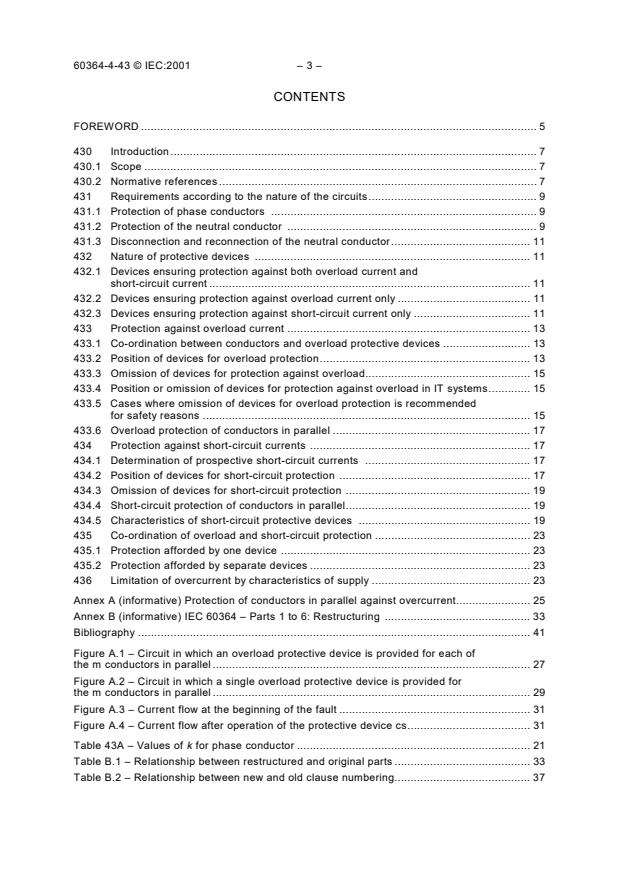
60364-4-43 © IEC:2001 – 3 –
CONTENTS
FOREWORD . 5
430 Introduction.7
430.1 Scope . 7
430.2 Normative references . 7
431 Requirements according to the nature of the circuits. 9
431.1 Protection of phase conductors . 9
431.2 Protection of the neutral conductor . 9
431.3 Disconnection and reconnection of the neutral conductor. 11
432 Nature of protective devices . 11
432.1 Devices ensuring protection against both overload current and
short-circuit current . 11
432.2 Devices ensuring protection against overload current only . 11
432.3 Devices ensuring protection against short-circuit current only . 11
433 Protection against overload current . 13
433.1 Co-ordination between conductors and overload protective devices . 13
433.2 Position of devices for overload protection. 13
433.3 Omission of devices for protection against overload. 15
433.4 Position or omission of devices for protection against overload in IT systems. 15
433.5 Cases where omission of devices for overload protection is recommended
for safety reasons . 15
433.6 Overload protection of conductors in parallel . 17
434 Protection against short-circuit currents . 17
434.1 Determination of prospective short-circuit currents . 17
434.2 Position of devices for short-circuit protection . 17
434.3 Omission of devices for short-circuit protection . 19
434.4 Short-circuit protection of conductors in parallel. 19
434.5 Characteristics of short-circuit protective devices . 19
435 Co-ordination of overload and short-circuit protection . 23
435.1 Protection afforded by one device . 23
435.2 Protection afforded by separate devices . 23
436 Limitation of overcurrent by characteristics of supply . 23
Annex A (informative) Protection of conductors in parallel against overcurrent. 25
Annex B (informative) IEC 60364 – Parts 1 to 6: Restructuring . 33
Bibliography . 41
Figure A.1 – Circuit in which an overload protective device is provided for each of
the m conductors in parallel . 27
Figure A.2 – Circuit in which a single overload protective device is provided for
the m conductors in parallel . 29
Figure A.3 – Current flow at the beginning of the fault . 31
Figure A.4 – Current flow after operation of the protective device cs. 31
Table 43A – Values of k for phase conductor . 21
Table B.1 – Relationship between restructured and original parts . 33
Table B.2 – Relationship between new and old clause numbering. 37
60364-4-43 © IEC:2001 – 5 –
INTERNATIONAL ELECTROTECHNICAL COMMISSION
____________
ELECTRICAL INSTALLATIONS OF BUILDINGS –
Part 4-43: Protection for safety –
Protection against overcurrent
FOREWORD
1) The IEC (International Electrotechnical Commission) is a worldwide organization for standardization comprising
all national electrotechnical committees (IEC National Committees). The object of the IEC is to promote
international co-operation on all questions concerning standardization in the electrical and electronic fields. To
this end and in addition to other activities, the IEC publishes International Standards. Their preparation is
entrusted to technical committees; any IEC National Committee interested in the subject dealt with may
participate in this preparatory work. International, governmental and non-governmental organizations liaising
with the IEC also participate in this preparation. The IEC collaborates closely with the International Organization
for Standardization (ISO) in accordance with conditions determined by agreement between the two
organizations.
2) The formal decisions or agreements of the IEC on technical matters express, as nearly as possible, an
international consensus of opinion on the relevant subjects since each technical committee has representation
from all interested National Committees.
3) The documents produced have the form of recommendations for international use and are published in the form
of standards, technical specifications, technical reports or guides and they are accepted by the National
Committees in that sense.
4) In order to promote international unification, IEC National Committees undertake to apply IEC International
Standards transparently to the maximum extent possible in their national and regional standards. Any
divergence between the IEC Standard and the corresponding national or regional standard shall be clearly
indicated in the latter.
5) The IEC provides no marking procedure to indicate its approval and cannot be rendered responsible for any
equipment declared to be in conformity with one of its standards.
6) Attention is drawn to the possibility that some of the elements of this International Standard may be the subject
of patent rights. The IEC shall not be held responsible for identifying any or all such patent rights.
International Standard IEC 60364-4-43 has been prepared by IEC technical committee 64:
Electrical installations and protection against electric shock.
The IEC 60364 series (parts 1 to 6), is currently being restructured, without any technical
changes, into a more simple form (see annex B).
According to a unanimous decision by the Committee of Action (CA/1720/RV (2000-03-21)),
the restructured parts of IEC 60364 have not been submitted to National Committees for
approval.
The text of this second edition of IEC 60364-4-43 is compiled from and replaces
– part 4-43, first edition (1977) and its amendment 1 (1997),
– part 4-473, first edition (1977) and its amendment 1 (1998).
This publication has been drafted, as close as possible, in accordance with the ISO/IEC
Directives, Part 3.
Annexes A and B are for information only.
The committee has decided that the contents of this publication will remain unchanged
until 2006. At this date, the publication will be
• reconfirmed;
• withdrawn;
• replaced by a revised edition, or
• amended.
The contents of the corrigendum of August 2002 have been included in this copy.
60364-4-43 © IEC:2001 – 7 –
ELECTRICAL INSTALLATIONS OF BUILDINGS –
Part 4-43: Protection for safety –
Protection against overcurrent
430 Introduction
430.1 (431) Scope
Part 4-43 of IEC 60364 describes how live conductors are protected by one or more devices for
automatic interruption of the supply in the event of overload (see clause 433) and short-circuits
(see clause 434) except in cases where the overcurrent is limited in accordance with
clause 436 or by the conditions described in 433.3, 433.5 or 434.3 are met. Further, protection
against overload and against short-circuits shall be co-ordinated in accordance with
clause 435.
NOTE 1 Live conductors protected against overload in accordance with clause 433 are considered to be protected
also against faults likely to cause overcurrents of a magnitude similar to overload currents.
NOTE 2 The requirements of this standard do not take account of external influences. For the application of
protective measures in relation to conditions of external influences, see 410.3.4 of IEC 60364-4-41 and clause 422
of IEC 60364-4-42.
NOTE 3 Protection of conductors according to this standard does not necessarily protect the equipment connected
to the conductors.
(433.1 and 434.1)
Protective devices shall be provided to break any overcurrent flowing in the circuit conductors
before such a current could cause a danger due to thermal and mechanical effects or a
temperature rise detrimental to insulation, joints, terminations, or surroundings of the conductors.
430.2 Normative references
The following normative documents contain provisions which, through reference in this text,
constitute provisions of this part of IEC 60364. For dated references, subsequent amendments
to, or revisions of, any of these publications do not apply. However, parties to agreements
based on this part of IEC 60364 are encouraged to investigate the possibility of applying the
most recent editions of the normative documents indicated below. For undated references, the
latest edition of the normative document referred to applies. Members of IEC and ISO maintain
registers of currently valid International Standards.
IEC 60269-1:1998, Low-voltage fuses – Part 1: General requirements
IEC 60269-2:1986, Low-voltage fuses – Part 2: Supplementary requirements for fuses for use
by authorized persons (fuses mainly for industrial application)
IEC 60269-3:1987, Low-voltage fuses – Part 3: Supplementary requirements for fuses used by
unskilled persons (fuses mainly for household and similar applications)
IEC 60364-4-41: Electrical installations of buildings – Part 4-41: Protection for safety –
Protection against electric shock
IEC 60364-5-52: Electrical installations of buildings – Part 5-52: Selection and erection of
electrical equipment – Wiring systems
________
In this standard, references in brackets refer to the previous numbering system.
60364-4-43 © IEC:2001 – 9 –
IEC 60724:1984, Guide to the short-circuit temperature limits of electric cables with a rated
voltage not exceeding 0,6/1,0 kV
IEC 60898:1995, Electrical accessories – Circuit-breakers for overcurrent protection for
household and similar installations
IEC 60947-1:1999, Low-voltage switchgear and controlgear – Part 1: General rules
IEC 60947-2:1995, Low-voltage switchgear and controlgear – Part 2: Circuit-breakers
IEC 60947-4-1:1990, Low-voltage switchgear and controlgear – Part 4-1: Contactors and
motor-starters – Electromechanical contactors and motor-starters
IEC 61009 (all parts), Residual current operated circuit-breakers with integral overcurrent
protection for household and similar uses (RCBOs)
431 (473.3) Requirements according to the nature of the circuits
431.1 (473.3.1) Protection of phase conductors
431.1.1 (473.3.1.1) Detection of overcurrent shall be provided for all phase conductors; it
shall cause the disconnection of the conductor in which the overcurrent is detected, but not
necessarily the disconnection of other live conductors, except where 431.1.2 applies.
431.1.2 (473.3.1.2) In TT systems, for circuits supplied between phases and in which the
neutral conductor is not distributed, overcurrent detection need not be provided for one of
the phase conductors, provided that the following conditions are simultaneously fulfilled:
a) there exists, in the same circuit or on the supply side, differential protection intended to
cause disconnection of all the phase conductors;
b) the neutral conductor is not distributed from an artificial neutral point of the circuits situated
on the load side of the differential protective device mentioned in a).
NOTE If disconnection of a single phase may cause danger, for example in the case of three-phase motors,
appropriate precautions should be taken.
431.2 (473.3.2) Protection of the neutral conductor
431.2.1 (473.3.2.1) TT or TN systems
Where the cross-sectional area of the neutral conductor is at least equal or equivalent to that
of the phase conductors, it is not necessary to provide overcurrent detection for the neutral
conductor or a disconnecting device for that conductor.
Where the cross-sectional area of the neutral conductor is less than that of the phase
conductors, it is necessary to provide overcurrent detection for the neutral conductor,
appropriate to the cross-sectional area of that conductor; this detection shall cause the
disconnection of the phase conductors, but not necessarily of the neutral conductor.
However, overcurrent detection need not be provided for the neutral conductor if the two
following conditions are simultaneously fulfilled:
• the neutral conductor is protected against short-circuit by the protective device for the
phase conductors of the circuit, and
• the maximum current likely to be carried by the neutral conductor is, in normal service,
clearly less than the value of the current-carrying capacity of that conductor.
NOTE This second condition is satisfied if the power carried is shared as evenly as possible between the different
phases, for example if the sum of the powers absorbed by current-using equipment supplied from each phase and
neutral (such as lighting and socket-outlets) is much less than the total power carried by the circuit concerned. The
cross-sectional area of the neutral conductor should be not less than the appropriate value prescribed in
IEC 60364-5-52.
60364-4-43 © IEC:2001 – 11 –
431.2.2 (473.3.2.2) IT systems
In IT systems it is strongly recommended that the neutral conductor should not be distributed.
However, where the neutral conductor is distributed, it is generally necessary to provide
overcurrent detection for the neutral conductor of every circuit, which will cause the
disconnection of all the live conductors of the corresponding circuit, including the neutral
conductor. This measure is not necessary if
• the particular neutral conductor is effectively protected against short-circuit by a protective
device placed on the supply side, for example at the origin of the installation, in accordance
with the rules stated in 434.5; or if
• the particular circuit is protected by a residual current-operated protective device with a
rated residual current not exceeding 0,15 times the current-carrying capacity of the
corresponding neutral conductor. This device shall disconnect all the live conductors of
the corresponding circuit, including the neutral conductor.
431.3 (473.3.3) Disconnection and reconnection of the neutral conductor
Where disconnection of the neutral conductor is required, disconnection and reconnection shall
be such that the neutral conductor shall not be disconnected before the phase conductors and
shall be reconnected at the same time as or before the phase conductors.
432 Nature of protective devices
The protective devices shall be of the appropriate types indicated by 432.1 to 432.3.
432.1 Devices ensuring protection against both overload current and
short-circuit current
These protective devices shall be capable of breaking any overcurrent up to and including the
prospective short-circuit current at the point where the device is installed. They shall satisfy
the requirements of clause 433 and 434.5.1. Such protective devices may be:
• circuit-breakers incorporating overload release complying with IEC 60898, IEC 60947-1,
IEC 60947-2 or IEC 61009;
• circuit-breakers in conjunction with fuses;
• fuses having fuse-links with gG characteristics complying with IEC 60269-1 and IEC 60269-2
or IEC 60269-3.
NOTE 1 The fuse comprises all the parts that form the complete protective device.
NOTE 2 The use of a protective device having a breaking capacity below the value of the prospective short-circuit
current at its place of installation is subject to the requirements of 434.5.1.
432.2 Devices ensuring protection against overload current only
These are generally inverse-time-lag protective devices whose interrupting capacity may be
below the value of the prospective short-circuit current at the point where the devices are
installed. They shall satisfy the requirements of clause 433.
432.3 Devices ensuring protection against short-circuit current only
These devices shall be installed where overload protection is achieved by other means or
where clause 433 allows overload protection to be dispensed with. The devices shall be
capable of breaking the short-circuit current up to and including the prospective short-circuit
current. They shall satisfy the requirements of clause 434.
60364-4-43 © IEC:2001 – 13 –
Such devices may be
• circuit-breakers with short-circuit release complying with IEC 60898, IEC 60947-1, IEC 60947-
2 or IEC 61009,
• fuses complying with IEC 60269-1 and IEC 60269-2 or IEC 60269-3.
433 Protection against overload current
433.1 (433.2) Co-ordination between conductors and overload protective devices
The operating characteristics of a device protecting a cable against overload shall satisfy the
two following conditions:
I ≤ I ≤ I (1)
B n z
I ≤ 1,45 × I (2)
2 z
where
I is the current for which the circuit is designed;
B
I is the continuous current-carrying capacity of the cable (see clause 523);
z
I is the nominal current of the protective device;
n
NOTE For adjustable protective devices, the nominal current I is the current setting selected.
n
I is the current ensuring effective operation in the conventional time of the protective device.
The current I ensuring effective operation of the protective device is given in the product
standard or may be provided by the manufacturer.
NOTE Protection in accordance with this clause does not ensure complete protection in certain cases, for example
against sustained overcurrent less than I , nor will it necessarily result in an economical solution. Therefore it is
assumed that the circuit is so designed that small overloads of long duration will not frequently occur.
433.2 (473.1.1) Position of devices for overload protection
433.2.1 (473.1.1.1) A device ensuring protection against overload shall be placed at the point
where a change, such as a change in cross-sectional area, nature, method of installation or in
constitution, causes a reduction in the value of current-carrying capacity of the conductors,
except where 433.2.2 and 433.3 apply.
433.2.2 (473.1.1.2) The device protecting the conductor against overload may be placed
along the run of that conductor if the part of the run between the point where a change occurs
(in cross-sectional area, nature, method of installation or constitution) and the position of the
protective device has neither branch circuits nor socket-outlets and fulfils one of the following
two conditions:
a) it is protected against short-circuit current in accordance with the requirements stated in
clause 434;
b) its length does not exceed 3 m, it is carried out in such a manner as to reduce the risk of
short-circuit to a minimum, and it is not placed near combustible material (see 434.2.1).
60364-4-43 © IEC:2001 – 15 –
433.3 (473.1.2) Omission of devices for protection against overload
The various cases stated in this subclause shall not be applied to installations situated in
locations presenting a fire risk or risk of explosion and where the requirements for special
installations and locations specify different conditions.
Devices for protection against overload need not be provided for
a) a conductor situated on the load side of a change in cross-sectional area, nature, method
of installation or in constitution, which is effectively protected against overload by a
protective device placed on the supply side,
b) a conductor which is not likely to carry overload current, provided that this conductor is
protected against short-circuit in accordance with the requirements of clause 434 and that it
has neither branch circuits nor socket-outlets,
c) installations for telecommunications, control, signalling and the like,
d) distribution circuits comprising cables laid in the ground or overhead lines where over-
loading of the circuits will not cause danger.
NOTE Conditions for overload protection for the installations mentioned in item c) are under consideration.
433.4 (473.1.3) Position or omission of devices for protection against overload
in IT systems
433.4.1 (473.1.3) The provisions in 433.2.2 and 433.3 for an alternative position or omission
of devices for protection against overload are not applicable to IT systems unless each circuit
not protected against overload is protected by one of the following means:
a) use of the protective measures described in 413.2 of IEC 60364-4-41,
b) protection of each circuit by a residual current protective device which will operate
immediately on the second fault,
c) use of an insulation monitoring device which either
• causes the disconnection of the circuit when the first fault occurs, or
• gives a signal indicating the presence of a fault. The fault shall be rectified according to
the operational requirements and recognizing the risk from a second fault.
433.4.2 (473.3.1.3) In IT systems without a neutral conductor the overload protective device
may be omitted in one of the phase conductors if a residual current protective device is
installed in each circuit.
433.5 (473.1.4) Cases where omission of devices for overload protection is
recommended for safety reasons
The omission of devices for protection against overload is recommended for circuits supplying
current-using equipment where unexpected opening of the circuit could cause danger.
Examples of such cases are
• exciter circuits of rotating machines,
• supply circuits of lifting magnets,
• secondary circuits of current transformers.
NOTE In such cases consideration should be given to the provision of an overload alarm.
60364-4-43 © IEC:2001 – 17 –
433.6 (473.1.5) Overload protection of conductors in parallel
Where a single protective device protects several conductors in parallel there shall be no
branch circuits or devices for isolation or switching in the parallel conductors.
This subclause does not preclude the use of ring circuits.
433.6.1 (473.1.5.1) Equal current sharing between parallel conductors
Where a single device protects conductors in parallel sharing currents equally, the value of I
z
to be used in 433.1 is the sum of the current-carrying capacities of the various conductors.
It is deemed that current sharing is equal if the requirements of the first indent of 523.7 a) of
IEC 60364-5-52 are satisfied.
433.6.2 (473.1.5.2) Unequal current sharing between parallel conductors
Where the use of a single conductor, per phase, is impractical and the currents in the parallel
conductors are unequal, the design current and requirements for overload protection for each
conductor shall be considered individually.
NOTE Currents in parallel conductors are considered to be unequal if the difference between any currents is more
than 10 % of the design current for each conductor. Guidance is given in annex A (see clause A.2).
434 Protection against short-circuit currents
434.1 (434.2) Determination of prospective short-circuit currents
The prospective short-circuit current at every relevant point of the installation shall be
determined. This may be done either by calculation or by measurement.
434.2 (473.2.1) Position of devices for short-circuit protection
A device ensuring protection against short-circuit shall be placed at the point where a reduction
in the cross-sectional area of t
...
SLOVENSKI SIST IEC 60364-4-43:2006
STANDARD
september 2006
Električne inštalacije zgradb – 4-43. del: Zaščitni ukrepi – Zaščita pred nadtoki
Electrical installations of buildings - Part 4-43: Protection for safety - Protection
against overcurrent
ICS 29.120.50; 91.140.50 Referenčna številka
© Standard je založil in izdal Slovenski inštitut za standardizacijo. Razmnoževanje ali kopiranje celote ali delov tega dokumenta ni dovoljeno
NORME CEI
INTERNATIONALE IEC
60364-4-43
INTERNATIONAL
Deuxième édition
STANDARD
Second edition
2001-08
Installations électriques des bâtiments –
Partie 4-43:
Protection pour assurer la sécurité –
Protection contre les surintensités
Electrical installations of buildings –
Part 4-43:
Protection for safety –
Protection against overcurrent
IEC 2001 Droits de reproduction réservés Copyright - all rights reserved
Aucune partie de cette publication ne peut être reproduite ni No part of this publication may be reproduced or utilized in
utilisée sous quelque forme que ce soit et par aucun procédé, any form or by any means, electronic or mechanical,
électronique ou mécanique, y compris la photocopie et les including photocopying and microfilm, without permission in
microfilms, sans l'accord écrit de l'éditeur. writing from the publisher.
International Electrotechnical Commission 3, rue de Varembé Geneva, Switzerland
Telefax: +41 22 919 0300 e-mail: inmail@iec.ch IEC web site http://www.iec.ch
CODE PRIX
Commission Electrotechnique Internationale
S
PRICE CODE
International Electrotechnical Commission
Pour prix, voir catalogue en vigueur
For price, see current catalogue
60364-4-43 © IEC:2001 – 3 –
CONTENTS
FOREWORD . 5
430 Introduction.7
430.1 Scope . 7
430.2 Normative references . 7
431 Requirements according to the nature of the circuits. 9
431.1 Protection of phase conductors . 9
431.2 Protection of the neutral conductor . 9
431.3 Disconnection and reconnection of the neutral conductor. 11
432 Nature of protective devices . 11
432.1 Devices ensuring protection against both overload current and
short-circuit current . 11
432.2 Devices ensuring protection against overload current only . 11
432.3 Devices ensuring protection against short-circuit current only . 11
433 Protection against overload current . 13
433.1 Co-ordination between conductors and overload protective devices . 13
433.2 Position of devices for overload protection. 13
433.3 Omission of devices for protection against overload. 15
433.4 Position or omission of devices for protection against overload in IT systems. 15
433.5 Cases where omission of devices for overload protection is recommended
for safety reasons . 15
433.6 Overload protection of conductors in parallel . 17
434 Protection against short-circuit currents . 17
434.1 Determination of prospective short-circuit currents . 17
434.2 Position of devices for short-circuit protection . 17
434.3 Omission of devices for short-circuit protection . 19
434.4 Short-circuit protection of conductors in parallel. 19
434.5 Characteristics of short-circuit protective devices . 19
435 Co-ordination of overload and short-circuit protection . 23
435.1 Protection afforded by one device . 23
435.2 Protection afforded by separate devices . 23
436 Limitation of overcurrent by characteristics of supply . 23
Annex A (informative) Protection of conductors in parallel against overcurrent. 25
Annex B (informative) IEC 60364 – Parts 1 to 6: Restructuring . 33
Bibliography . 41
Figure A.1 – Circuit in which an overload protective device is provided for each of
the m conductors in parallel . 27
Figure A.2 – Circuit in which a single overload protective device is provided for
the m conductors in parallel . 29
Figure A.3 – Current flow at the beginning of the fault . 31
Figure A.4 – Current flow after operation of the protective device cs. 31
Table 43A – Values of k for phase conductor . 21
Table B.1 – Relationship between restructured and original parts . 33
Table B.2 – Relationship between new and old clause numbering. 37
60364-4-43 © IEC:2001 – 5 –
INTERNATIONAL ELECTROTECHNICAL COMMISSION
____________
ELECTRICAL INSTALLATIONS OF BUILDINGS –
Part 4-43: Protection for safety –
Protection against overcurrent
FOREWORD
1) The IEC (International Electrotechnical Commission) is a worldwide organization for standardization comprising
all national electrotechnical committees (IEC National Committees). The object of the IEC is to promote
international co-operation on all questions concerning standardization in the electrical and electronic fields. To
this end and in addition to other activities, the IEC publishes International Standards. Their preparation is
entrusted to technical committees; any IEC National Committee interested in the subject dealt with may
participate in this preparatory work. International, governmental and non-governmental organizations liaising
with the IEC also participate in this preparation. The IEC collaborates closely with the International Organization
for Standardization (ISO) in accordance with conditions determined by agreement between the two
organizations.
2) The formal decisions or agreements of the IEC on technical matters express, as nearly as possible, an
international consensus of opinion on the relevant subjects since each technical committee has representation
from all interested National Committees.
3) The documents produced have the form of recommendations for international use and are published in the form
of standards, technical specifications, technical reports or guides and they are accepted by the National
Committees in that sense.
4) In order to promote international unification, IEC National Committees undertake to apply IEC International
Standards transparently to the maximum extent possible in their national and regional standards. Any
divergence between the IEC Standard and the corresponding national or regional standard shall be clearly
indicated in the latter.
5) The IEC provides no marking procedure to indicate its approval and cannot be rendered responsible for any
equipment declared to be in conformity with one of its standards.
6) Attention is drawn to the possibility that some of the elements of this International Standard may be the subject
of patent rights. The IEC shall not be held responsible for identifying any or all such patent rights.
International Standard IEC 60364-4-43 has been prepared by IEC technical committee 64:
Electrical installations and protection against electric shock.
The IEC 60364 series (parts 1 to 6), is currently being restructured, without any technical
changes, into a more simple form (see annex B).
According to a unanimous decision by the Committee of Action (CA/1720/RV (2000-03-21)),
the restructured parts of IEC 60364 have not been submitted to National Committees for
approval.
The text of this second edition of IEC 60364-4-43 is compiled from and replaces
– part 4-43, first edition (1977) and its amendment 1 (1997),
– part 4-473, first edition (1977) and its amendment 1 (1998).
This publication has been drafted, as close as possible, in accordance with the ISO/IEC
Directives, Part 3.
Annexes A and B are for information only.
The committee has decided that the contents of this publication will remain unchanged
until 2006. At this date, the publication will be
• reconfirmed;
• withdrawn;
• replaced by a revised edition, or
• amended.
The contents of the corrigendum of August 2002 have been included in this copy.
60364-4-43 © IEC:2001 – 7 –
ELECTRICAL INSTALLATIONS OF BUILDINGS –
Part 4-43: Protection for safety –
Protection against overcurrent
430 Introduction
430.1 (431) Scope
Part 4-43 of IEC 60364 describes how live conductors are protected by one or more devices for
automatic interruption of the supply in the event of overload (see clause 433) and short-circuits
(see clause 434) except in cases where the overcurrent is limited in accordance with
clause 436 or by the conditions described in 433.3, 433.5 or 434.3 are met. Further, protection
against overload and against short-circuits shall be co-ordinated in accordance with
clause 435.
NOTE 1 Live conductors protected against overload in accordance with clause 433 are considered to be protected
also against faults likely to cause overcurrents of a magnitude similar to overload currents.
NOTE 2 The requirements of this standard do not take account of external influences. For the application of
protective measures in relation to conditions of external influences, see 410.3.4 of IEC 60364-4-41 and clause 422
of IEC 60364-4-42.
NOTE 3 Protection of conductors according to this standard does not necessarily protect the equipment connected
to the conductors.
(433.1 and 434.1)
Protective devices shall be provided to break any overcurrent flowing in the circuit conductors
before such a current could cause a danger due to thermal and mechanical effects or a
temperature rise detrimental to insulation, joints, terminations, or surroundings of the conductors.
430.2 Normative references
The following normative documents contain provisions which, through reference in this text,
constitute provisions of this part of IEC 60364. For dated references, subsequent amendments
to, or revisions of, any of these publications do not apply. However, parties to agreements
based on this part of IEC 60364 are encouraged to investigate the possibility of applying the
most recent editions of the normative documents indicated below. For undated references, the
latest edition of the normative document referred to applies. Members of IEC and ISO maintain
registers of currently valid International Standards.
IEC 60269-1:1998, Low-voltage fuses – Part 1: General requirements
IEC 60269-2:1986, Low-voltage fuses – Part 2: Supplementary requirements for fuses for use
by authorized persons (fuses mainly for industrial application)
IEC 60269-3:1987, Low-voltage fuses – Part 3: Supplementary requirements for fuses used by
unskilled persons (fuses mainly for household and similar applications)
IEC 60364-4-41: Electrical installations of buildings – Part 4-41: Protection for safety –
Protection against electric shock
IEC 60364-5-52: Electrical installations of buildings – Part 5-52: Selection and erection of
electrical equipment – Wiring systems
________
In this standard, references in brackets refer to the previous numbering system.
60364-4-43 © IEC:2001 – 9 –
IEC 60724:1984, Guide to the short-circuit temperature limits of electric cables with a rated
voltage not exceeding 0,6/1,0 kV
IEC 60898:1995, Electrical accessories – Circuit-breakers for overcurrent protection for
household and similar installations
IEC 60947-1:1999, Low-voltage switchgear and controlgear – Part 1: General rules
IEC 60947-2:1995, Low-voltage switchgear and controlgear – Part 2: Circuit-breakers
IEC 60947-4-1:1990, Low-voltage switchgear and controlgear – Part 4-1: Contactors and
motor-starters – Electromechanical contactors and motor-starters
IEC 61009 (all parts), Residual current operated circuit-breakers with integral overcurrent
protection for household and similar uses (RCBOs)
431 (473.3) Requirements according to the nature of the circuits
431.1 (473.3.1) Protection of phase conductors
431.1.1 (473.3.1.1) Detection of overcurrent shall be provided for all phase conductors; it
shall cause the disconnection of the conductor in which the overcurrent is detected, but not
necessarily the disconnection of other live conductors, except where 431.1.2 applies.
431.1.2 (473.3.1.2) In TT systems, for circuits supplied between phases and in which the
neutral conductor is not distributed, overcurrent detection need not be provided for one of
the phase conductors, provided that the following conditions are simultaneously fulfilled:
a) there exists, in the same circuit or on the supply side, differential protection intended to
cause disconnection of all the phase conductors;
b) the neutral conductor is not distributed from an artificial neutral point of the circuits situated
on the load side of the differential protective device mentioned in a).
NOTE If disconnection of a single phase may cause danger, for example in the case of three-phase motors,
appropriate precautions should be taken.
431.2 (473.3.2) Protection of the neutral conductor
431.2.1 (473.3.2.1) TT or TN systems
Where the cross-sectional area of the neutral conductor is at least equal or equivalent to that
of the phase conductors, it is not necessary to provide overcurrent detection for the neutral
conductor or a disconnecting device for that conductor.
Where the cross-sectional area of the neutral conductor is less than that of the phase
conductors, it is necessary to provide overcurrent detection for the neutral conductor,
appropriate to the cross-sectional area of that conductor; this detection shall cause the
disconnection of the phase conductors, but not necessarily of the neutral conductor.
However, overcurrent detection need not be provided for the neutral conductor if the two
following conditions are simultaneously fulfilled:
• the neutral conductor is protected against short-circuit by the protective device for the
phase conductors of the circuit, and
• the maximum current likely to be carried by the neutral conductor is, in normal service,
clearly less than the value of the current-carrying capacity of that conductor.
NOTE This second condition is satisfied if the power carried is shared as evenly as possible between the different
phases, for example if the sum of the powers absorbed by current-using equipment supplied from each phase and
neutral (such as lighting and socket-outlets) is much less than the total power carried by the circuit concerned. The
cross-sectional area of the neutral conductor should be not less than the appropriate value prescribed in
IEC 60364-5-52.
60364-4-43 © IEC:2001 – 11 –
431.2.2 (473.3.2.2) IT systems
In IT systems it is strongly recommended that the neutral conductor should not be distributed.
However, where the neutral conductor is distributed, it is generally necessary to provide
overcurrent detection for the neutral conductor of every circuit, which will cause the
disconnection of all the live conductors of the corresponding circuit, including the neutral
conductor. This measure is not necessary if
• the particular neutral conductor is effectively protected against short-circuit by a protective
device placed on the supply side, for example at the origin of the installation, in accordance
with the rules stated in 434.5; or if
• the particular circuit is protected by a residual current-operated protective device with a
rated residual current not exceeding 0,15 times the current-carrying capacity of the
corresponding neutral conductor. This device shall disconnect all the live conductors of
the corresponding circuit, including the neutral conductor.
431.3 (473.3.3) Disconnection and reconnection of the neutral conductor
Where disconnection of the neutral conductor is required, disconnection and reconnection shall
be such that the neutral conductor shall not be disconnected before the phase conductors and
shall be reconnected at the same time as or before the phase conductors.
432 Nature of protective devices
The protective devices shall be of the appropriate types indicated by 432.1 to 432.3.
432.1 Devices ensuring protection against both overload current and
short-circuit current
These protective devices shall be capable of breaking any overcurrent up to and including the
prospective short-circuit current at the point where the device is installed. They shall satisfy
the requirements of clause 433 and 434.5.1. Such protective devices may be:
• circuit-breakers incorporating overload release complying with IEC 60898, IEC 60947-1,
IEC 60947-2 or IEC 61009;
• circuit-breakers in conjunction with fuses;
• fuses having fuse-links with gG characteristics complying with IEC 60269-1 and IEC 60269-2
or IEC 60269-3.
NOTE 1 The fuse comprises all the parts that form the complete protective device.
NOTE 2 The use of a protective device having a breaking capacity below the value of the prospective short-circuit
current at its place of installation is subject to the requirements of 434.5.1.
432.2 Devices ensuring protection against overload current only
These are generally inverse-time-lag protective devices whose interrupting capacity may be
below the value of the prospective short-circuit current at the point where the devices are
installed. They shall satisfy the requirements of clause 433.
432.3 Devices ensuring protection against short-circuit current only
These devices shall be installed where overload protection is achieved by other means or
where clause 433 allows overload protection to be dispensed with. The devices shall be
capable of breaking the short-circuit current up to and including the prospective short-circuit
current. They shall satisfy the requirements of clause 434.
60364-4-43 © IEC:2001 – 13 –
Such devices may be
• circuit-breakers with short-circuit release complying with IEC 60898, IEC 60947-1, IEC 60947-
2 or IEC 61009,
• fuses complying with IEC 60269-1 and IEC 60269-2 or IEC 60269-3.
433 Protection against overload current
433.1 (433.2) Co-ordination between conductors and overload protective devices
The operating characteristics of a device protecting a cable against overload shall satisfy the
two following conditions:
I ≤ I ≤ I (1)
B n z
I ≤ 1,45 × I (2)
2 z
where
I is the current for which the circuit is designed;
B
I is the continuous current-carrying capacity of the cable (see clause 523);
z
I is the nominal current of the protective device;
n
NOTE For adjustable protective devices, the nominal current I is the current setting selected.
n
I is the current ensuring effective operation in the conventional time of the protective device.
The current I ensuring effective operation of the protective device is given in the product
standard or may be provided by the manufacturer.
NOTE Protection in accordance with this clause does not ensure complete protection in certain cases, for example
against sustained overcurrent less than I , nor will it necessarily result in an economical solution. Therefore it is
assumed that the circuit is so designed that small overloads of long duration will not frequently occur.
433.2 (473.1.1) Position of devices for overload protection
433.2.1 (473.1.1.1) A device ensuring protection against overload shall be placed at the point
where a change, such as a change in cross-sectional area, nature, method of installation or in
constitution, causes a reduction in the value of current-carrying capacity of the conductors,
except where 433.2.2 and 433.3 apply.
433.2.2 (473.1.1.2) The device protecting the conductor against overload may be placed
along the run of that conductor if the part of the run between the point where a change occurs
(in cross-sectional area, nature, method of installation or constitution) and the position of the
protective device has neither branch circuits nor socket-outlets and fulfils one of the following
two conditions:
a) it is protected against short-circuit current in accordance with the requirements stated in
clause 434;
b) its length does not exceed 3 m, it is carried out in such a manner as to reduce the risk of
short-circuit to a minimum, and it is not placed near combustible material (see 434.2.1).
60364-4-43 © IEC:2001 – 15 –
433.3 (473.1.2) Omission of devices for protection against overload
The various cases stated in this subclause shall not be applied to installations situated in
locations presenting a fire risk or risk of explosion and where the requirements for special
installations and locations specify different conditions.
Devices for protection against overload need not be provided for
a) a conductor situated on the load side of a change in cross-sectional area, nature, method
of installation or in constitution, which is effectively protected against overload by a
protective device placed on the supply side,
b) a conductor which is not likely to carry overload current, provided that this conductor is
protected against short-circuit in accordance with the requirements of clause 434 and that it
has neither branch circuits nor socket-outlets,
c) installations for telecommunications, control, signalling and the like,
d) distribution circuits comprising cables laid in the ground or overhead lines where over-
loading of the circuits will not cause danger.
NOTE Conditions for overload protection for the installations mentioned in item c) are under consideration.
433.4 (473.1.3) Position or omission of devices for protection against overload
in IT systems
433.4.1 (473.1.3) The provisions in 433.2.2 and 433.3 for an alternative position or omission
of devices for protection against overload are not applicable to IT systems unless each circuit
not protected against overload is protected by one of the following means:
a) use of the protective measures described in 413.2 of IEC 60364-4-41,
b) protection of each circuit by a residual current protective device which will operate
immediately on the second fault,
c) use of an insulation monitoring device which either
• causes the disconnection of the circuit when the first fault occurs, or
• gives a signal indicating the presence of a fault. The fault shall be rectified according to
the operational requirements and recognizing the risk from a second fault.
433.4.2 (473.3.1.3) In IT systems without a neutral conductor the overload protective device
may be omitted in one of the phase conductors if a residual current protective device is
installed in each circuit.
433.5 (473.1.4) Cases where omission of devices for overload protection is
recommended for safety reasons
The omission of devices for protection against overload is recommended for circuits supplying
current-using equipment where unexpected opening of the circuit could cause danger.
Examples of such cases are
• exciter circuits of rotating machines,
• supply circuits of lifting magnets,
• secondary circuits of current transformers.
NOTE In such cases consideration should be given to the provision of an overload alarm.
60364-4-43 © IEC:2001 – 17 –
433.6 (473.1.5) Overload protection of conductors in parallel
Where a single protective device protects several conductors in parallel there shall be no
branch circuits or devices for isolation or switching in the parallel conductors.
This subclause does not preclude the use of ring circuits.
433.6.1 (473.1.5.1) Equal current sharing between parallel conductors
Where a single device protects conductors in parallel sharing currents equally, the value of I
z
to be used in 433.1 is the sum of the current-carrying capacities of the various conductors.
It is deemed that current sharing is equal if the requirements of the first indent of 523.7 a) of
IEC 60364-5-52 are satisfied.
433.6.2 (473.1.5.2) Unequal current sharing between parallel conductors
Where the use of a single conductor, per phase, is impractical and the currents in the parallel
conductors are unequal, the design current and requirements for overload protection for each
conductor shall be considered individually.
NOTE Currents in parallel conductors are considered to be unequal if the difference between any currents is more
than 10 % of the design current for each conductor. Guidance is given in annex A (see clause A.2).
434 Protection against short-circuit currents
434.1 (434.2) Determination of prospective short-circuit currents
The prospective short-circuit current at every relevant point of the installation shall be
d
...
Die Norm IEC 60364-4-43 befasst sich mit der Sicherheit von Niederspannungs-Installationen, insbesondere mit dem Schutz gegen Überstrom. Ihr Hauptaugenmerk liegt auf der Bereitstellung von Richtlinien, wie lebende Leiter durch automatische Unterbrechungsgeräte vor Überlast und Kurzschlüssen geschützt werden. Diese umfassende Norm regelt, dass der Schutz bei Überstrom durch eine Vielzahl von technischen Maßnahmen sichergestellt werden muss, was eine robuste Sicherheit in elektrischen Installationen gewährleistet. Ein hervorstechendes Merkmal dieser Norm ist die klare Strukturierung, die es Fachleuten ermöglicht, die notwendigen Schutzmaßnahmen in unterschiedlichen Szenarien nachzuvollziehen. Der umfassende Ansatz zur Koordinierung von Überlast- und Kurzschlussschutz (Kapitel 435) ermöglicht es, über verschiedene Schutzeinrichtungen hinweg eine effektive Reaktion auf Fehlerströme zu gewährleisten. Dies stellt sicher, dass körperliche Sicherheit und die Integrität des Systems gleichzeitig gewahrt bleiben. Darüber hinaus wird in den Anmerkungen der Norm darauf hingewiesen, dass Lebensleiter, die gemäß Absatz 433 gegen Überlast geschützt sind, auch gegen andere Fehler geschützt sind, die ähnliche Stromstärken wie Überlastströme hervorrufen können. Diese vielschichtige Betrachtungsweise erhöht die Relevanz der Norm im praktischen Einsatz, da sie eine zusätzliche Sicherheitsebene bietet. Es ist auch wichtig zu erwähnen, dass die Anforderungen dieser Norm nicht die Berücksichtigung äußerer Einflüsse beinhalten. Für die Implementierung von Schutzmaßnahmen in Bezug auf äußere Bedingungen müssen auf die spezifischen Abschnitte in den Normen 60364-4-41 und 60364-4-42 verwiesen werden. Diese Klarstellung ist entscheidend für Fachleute, die sicherstellen möchten, dass alle relevanten Umgebungsfaktoren für eine vollständige Sicherheit berücksichtigt werden. Insgesamt bietet die IEC 60364-4-43 eine solide Grundlage für den Schutz von Niederspannungsinstallationen gegen Überstrom, ergänzt durch koordinierte Schutzstrategien und klare Richtlinien. Dies macht die Norm zu einem unverzichtbaren Bestandteil für Fachleute, die sich mit der Installation und Wartung elektrischer Systeme befassen.
The document "SIST IEC 60364-4-43:2006," part of the IEC 60364 standard, provides essential guidelines for protecting low-voltage electrical installations against overcurrent, specifically addressing the mechanisms necessary for safeguarding live conductors. The standard outlines critical procedures and requirements for implementing devices that automatically interrupt electricity supply during instances of overload and short-circuit occurrences. One of the strengths of IEC 60364-4-43 is its comprehensive scope, which not only covers overload situations (as referenced in clause 433) and short-circuits (clause 434) but also includes provisions for scenarios where overcurrents can be limited under specified conditions as described in clause 436 and others. This layered approach to protective measures ensures a robust safety framework for electrical installations, reinforcing the need for coordinated protection systems as emphasized in clause 435. Additionally, the standard adeptly addresses the complexities involved in protecting against overcurrents by offering clear classifications and stipulations, such as the recognition that live conductors protected according to clause 433 inherently safeguard against potential faults akin to overload currents. This nuanced understanding is vital for achieving a higher level of safety within electrical infrastructure. Furthermore, the document acknowledges limitations regarding external influences on protective measures, thereby prompting users to reference additional standards (such as IEC 60364-4-41 and IEC 60364-4-42) for comprehensive protection strategies. This interconnectedness highlights the standard's relevance in the broader context of electrical safety and underscores the importance of not only overcurrent protection but also the interactions with other types of environmental factors. Overall, IEC 60364-4-43 stands out for its thorough attention to detail, systematic approach to safety protocols, and its significant contribution to the field of low-voltage electrical installations, making it an invaluable resource for professionals in electrical engineering and safety compliance.
IEC 60364-4-43は、低電圧電気設備の安全性に関する重要な標準であり、特に過電流からの保護に焦点を当てています。この標準は、過負荷や短絡が発生した際に、供給を自動的に中断するデバイスによってライブ導体を保護する方法を定義しています。特に、参照条項433と434では過電流(過負荷や短絡)に対する保護の詳細が述べられており、過電流が制限されている場合(条項436や433.3、433.5、434.3に基づく条件)を除き、標準の枠組み内でカバーされています。 この標準の強みは、過負荷と短絡に対する保護を調整する必要性を強調している点です。具体的には、条項435においては、これらの保護機能がどのように協調して機能すべきかが示されています。この協調性は、電気設備の信頼性と安全性を高めるための鍵です。 また、標準はライブ導体が過負荷に基づく保護を受ける際に、同時に類似の過電流を引き起こす可能性のある故障に対しても保護されることを明確に示しています。これは特に重要で、実際の運用において安全性を確保するための基盤となります。 ただし、この標準は外部からの影響に関しては考慮していないため、外部環境の条件に関連する保護措置については、他の関連標準(IEC 60364-4-41およびIEC 60364-4-42)を参照することが推奨されています。これにより、包括的な安全対策を講じることが可能となります。 最終的に、IEC 60364-4-43は、過電流に対する保護を体系的に規定し、関連する他の標準との相互協調を促進することで、安全な低電圧電気設備の設計と運用に不可欠な役割を果たしています。
SIST IEC 60364-4-43:2006 표준은 저전압 전기 설비의 안전을 위한 보호 장치에 대해 매우 중요한 지침을 제공합니다. 이 표준은 과전류로부터의 보호를 위한 자동 중단 장치의 설치 및 운영에 관한 명확한 프레임워크를 설정합니다. 특히, 과부하 및 단락 사고 발생 시 전선의 안전성을 보장하기 위해 필요한 조치를 규정하고 있어, 전기 설치의 안전성을 향상시키는 데 큰 강점을 가지고 있습니다. 이 표준의 주요 범위는 과부하 전류 및 단락 전류가 발생할 경우 전원 공급을 자동으로 차단하는 장치의 적용을 명확히 하며, 이를 통해 전기 설비의 신뢰성을 높이고 인명 및 재산 피해를 줄이는 데 기여합니다. 또한, 과부하 보호는 특정 조건이나 명시된 조항을 충족하는 경우에 한하여 적용되므로, 세부적인 설정이 가능하며 다양한 환경에서의 사용에 적합합니다. SIST IEC 60364-4-43의 강력한 점은 과부하 및 단락 보호 장치 간의 조화를 강조하는 것입니다. 이 조화로운 접근 방식은 안전성을 단순히 보장하는 것을 넘어, 시스템 전반의 효율성과 동작의 일관성을 개선합니다. 과부하가 발생할 가능성이 있는 상황에 대한 명확한 지침을 제공하고 있으므로, 이는 실제 전기 설치 시 유용하게 활용될 수 있습니다. 마지막으로, 본 표준은 외부 영향에 대한 보호 조치를 별도로 고려할 것을 요구하며, 이는 전기 설비의 안전성을 보다 체계적으로 강화하는 데 기여합니다. IEC 60364-4-41 및 IEC 60364-4-42의 관련 조항을 통해 외부 환경에 대한 보호 방법과 절차를 유기적으로 연결함으로써 전반적인 전기 안전 기준을 충족하도록 돕습니다. 따라서, SIST IEC 60364-4-43:2006 표준은 전기 안전성을 유지하고 개선하는 데 필수적인 지침을 제공하는 중요한 문서이며, 저전압 전기 설비의 설계 및 유지보수에 있어서 필수적으로 고려되어야 할 필수적인 것입니다.
La norme IEC 60364-4-43, intitulée "Installations électriques basse tension - Partie 4-43 : Protection pour la sécurité - Protection contre les surcharges", offre un cadre essentiel pour garantir la sécurité des installations électriques. Le champ d'application de cette norme se concentre sur la protection des conducteurs sous tension, qui doivent être protégés par un ou plusieurs dispositifs permettant l'interruption automatique de l'alimentation en cas de surcharge ou de court-circuit. Cette approche est cruciale pour prévenir les risques liés à la surcharge électrique et aux courts-circuits, qui sont des causes fréquentes d'incendie et de défaillance d'équipements. Un des points forts de cette norme est sa capacité à harmoniser la protection contre les surcharges et les courts-circuits, comme précisé dans la clause 435. Cela assure une coordination efficace entre les différents dispositifs de protection, augmentant ainsi la fiabilité des installations électriques. Cela est particulièrement pertinent lorsque l’on considère que les conducteurs protégés contre les surcharges sont également jugés protégés contre d'autres défauts susceptibles de provoquer des surintensités. De plus, il est important de noter que la norme ne prend pas en compte les influences externes lors de l'application des mesures de protection. Cela souligne la nécessité d'une évaluation appropriée des conditions environnementales qui pourraient affecter la sécurité des installations électriques, faisant référence aux clauses pertinentes dans d'autres sections de la norme IEC 60364. Finalement, bien que la IEC 60364-4-43 fournisse des directives claires pour la protection des conducteurs, elle souligne également que la protection de ces conducteurs ne garantit pas automatiquement la protection des équipements qui y sont connectés. Cela met en évidence l'importance d'une approche globale pour la sécurité électrique, intégrant à la fois la protection des circuits et celle des équipements en amont. En résumé, la norme SIST IEC 60364-4-43:2006 est d'une grande pertinence pour les professionnels de l'électricité. Elle établit des directives critiques qui contribuent à une installation électrique plus sûre, en offrant des solutions efficaces pour la protection contre les surintensités tout en intégrant des exigences de coordination pour une sécurité accrue.
IEC 60364-4-43は、低圧電気設備における安全性を確保するための重要な標準であり、過負荷および短絡に対する保護を定義しています。この標準の範囲は、ライブ導体が過負荷の場合に供給を自動的に中断するデバイスによって保護される方法を詳細に説明しており、特に433条および434条においてその要件が示されています。これによって、適切な保護措置を講じることができ、電気設備の安全性を大幅に向上させることが可能です。 この標準の強みは、過負荷保護と短絡保護の協調に関する指針を提供している点にあります。具体的には、435条に従って、これらの保護がどのように調整されるべきかを明確に示しており、ユーザーが正確に要求される保護レベルを理解し、適切な機器を選定する助けとなります。さらに、433条に基づく過負荷保護が、過負荷電流に近い規模の故障による過電流からも保護されることが確認されています。 また、この標準は、外部影響を考慮していないため、ユーザーはIEC 60364-4-41の410.3.4条やIEC 60364-4-42の422条を参照しながら、外部条件に対する適切な保護措置を選択する必要があります。このことにより、設計者やエンジニアはより包括的なアプローチでリスクを管理できるようになります。 全体として、IEC 60364-4-43は、低圧電気設置における過電流からの保護に特化しており、安全性の高い電気システムの設計と運用において不可欠なガイドラインを提供しています。標準の受容は、業界全体の安全基準を強化するための重要なステップであり、特に新しい技術や方法論が導入される中で、その関連性はさらに高まることでしょう。
IEC 60364-4-43 표준은 저전압 전기 설치 조건에서 안전성을 확보하기 위한 중요한 지침을 제공합니다. 이 문서는 과부하 및 단락으로부터의 보호를 위한 자동 차단 장치의 사용에 대한 명확한 규정을 포함하고 있으며, 특히 433항의 조항을 통해 과부하 상황에서의 전원 차단이 어떻게 이루어지는지를 상세히 설명하고 있습니다. 또한, 단락 사고와 관련하여 434항에서 제시한 바와 같이 이와 관련된 전선의 보호 방법을 규명합니다. 이 표준의 강점 중 하나는 과부하와 단락에 대한 보호가 조화롭게 이루어져야 한다는 점을 강조하는 435항의 규정입니다. 이는 시스템의 통합적 안전성을 높이는 데 기여하며, 장비나 기계가 필요할 경우 전류의 과부하에 대한 내성을 가지도록 하는 데 필요한 기준을 마련합니다. 또한, IEC 60364-4-43은 특정 조건에서 과전류가 제한될 수 있는 경우(436항 참조)와 관련된 조항을 통해 복잡한 전기 시스템에서 신뢰성을 높이는 데 도움을 줍니다. 과부하 전류와 유사한 규모의 전류로 인해 발생할 수 있는 고장 가능성에 대해 경고하는 규정을 포함하고 있어, 사용자에게 유용한 정보를 제공합니다. 마지막으로, 이 표준은 외부 힘의 영향을 고려하지 않으며, 외부 힘 조건과 관련된 보호 조치를 적용해야 할 경우에는 IEC 60364-4-41 및 4-42의 관련 조항을 참조해야 함을 명시합니다. 이러한 균형 잡힌 접근은 전기 시스템 설계와 설치 현실에서의 안전성을 크게 향상시킵니다. 전체적으로 IEC 60364-4-43 표준은 저전압 전기 설비의 안전성을 위한 필수적이며 포괄적인 기준을 제공하며, 법적 및 기술적 요건을 충족시키는 데 필요한 구체적인 지침을 제시합니다.
Die Norm IEC 60364-4-43 widmet sich dem Schutz von Niederspannungsanlagen und behandelt insbesondere den Schutz von Leitern vor Überstrom. Dieser Teil der Norm legt die Anforderungen und Methoden fest, die sicherstellen, dass elektrische Anlagen im Falle einer Überlastung oder eines Kurzschlusses zuverlässig abgeschaltet werden. Dies geschieht durch die Vorgabe, dass eine oder mehrere Vorrichtungen zur automatischen Unterbrechung der Stromversorgung eingesetzt werden müssen, um gefährliche Situationen zu vermeiden. Ein zentrales Merkmal der Norm ist die umfassende Koordination des Überlastschutzes und des Kurzschlussschutzes, was in Klausel 435 detailliert beschrieben wird. Dieser Aspekt stärkt die Sicherheit von elektrischen Installationen, da die verschiedenen Schutzmechanismen aufeinander abgestimmt sind und somit eine effektive und konsistente Reaktion auf Überstromereignisse gewährleisten. Die Norm berücksichtigt auch spezifische Ausnahmen, in denen Überstrom begrenzt ist, gemäß den Vorgaben in Klausel 436 sowie den Bedingungen in den Klauseln 433.3, 433.5 und 434.3. Es ist wichtig zu verstehen, dass elektrische Leiter, die entsprechend Klausel 433 gegen Überlastung geschützt sind, als auch gegen Fehler betrachtet werden, die übermäßige Ströme verursachen könnten. Dies ist ein wesentlicher Aspekt der Sicherheit, da es dazu beiträgt, das Risiko von Schäden an der gesamten elektrischen Installation zu mindern. Ein weiterer wichtiger Punkt ist, dass diese Norm keine externen Einflüsse berücksichtigt, was in den Anmerkungen klar herausgestellt wird. Für den Umgang mit externen Einflüssen ist daher auf andere Abschnitte von IEC 60364 verwiesen, etwa 410.3.4 in Teil 4-41 und Klausel 422 in Teil 4-42. Dies unterstreicht die Notwendigkeit, bei der Anwendung der Norm auch die potenziellen externen Gefahren und deren Auswirkungen auf die Sicherheit zu beachten. Zusammengefasst bietet die IEC 60364-4-43 eine solide Grundlage für die Sicherheit bei Niederspannungsinstallationen durch klare Richtlinien zum Schutz gegen Überstrom. Ihre Relevanz zeigt sich in der Gewährleistung, dass elektrische Anlagen effizient und sicher vor Überlastung und Kurzschlüssen geschützt sind, wodurch nicht nur Personen, sondern auch die verbundene Technik geschützt wird.
The standard IEC 60364-4-43 provides comprehensive guidelines on the protection for safety in low-voltage electrical installations, specifically focusing on overcurrent protection. The scope of this standard is critical as it delineates the method by which live conductors are safeguarded against potential dangers arising from overloads and short-circuits. It emphasizes the importance of automatic interruption devices for the supply, ensuring a proactive approach to electrical safety. One of the notable strengths of IEC 60364-4-43 is its detailed clauses addressing specific types of overcurrent scenarios. Clause 433 lays the groundwork for overload protection and provides essential guidance on how to implement effective protective measures, while clause 434 deals with short-circuit protection. Furthermore, the coordination of these protections as outlined in clause 435 ensures that protective devices operate harmoniously, enhancing the overall safety of electrical installations. The standard's relevance is underscored by its clear delineation of scenarios where overcurrent limits are imposed, either as per the conditions outlined in clause 436 or as detailed in other clauses pertaining to specific types of protections. This specificity aids professionals in compliance, enabling them to design and install systems that meet stringent safety requirements. The mention of external influences and the necessity for additional protective measures, as per other standards outlined (IEC 60364-4-41 and IEC 60364-4-42), brings a holistic view to the standard’s application. It highlights the need for consideration of environmental factors impacting electrical safety, thus reinforcing the importance of this standard in real-world scenarios. In summary, IEC 60364-4-43 stands out as a crucial document in the realm of low-voltage electrical installations, providing clear and actionable guidelines for protecting live conductors against overload and short-circuit risks. Its well-defined scope, combined with robust coordination procedures and attention to environmental influences, makes it an indispensable resource for professionals dedicated to maintaining safety in electrical systems.
La norme IEC 60364-4-43, intitulée « Installations électriques à basse tension - Partie 4-43 : Protection pour la sécurité - Protection contre les surintensités », offre un cadre exhaustif pour la protection des conducteurs sous tension par le biais de dispositifs d'interruption automatique de l'alimentation en cas de surcharge ou de court-circuit. Le champ d'application de cette norme est essentiel pour garantir la sécurité des installations électriques, en précisant les méthodes de protection appropriées selon les clauses 433 et 434. Parmi les points forts de la norme, on trouve sa capacité à définir clairement les critères de coordonnation entre la protection contre les surcharges et celle contre les courts-circuits, conformément à la clause 435. Cette approche favorise non seulement la sécurité des conducteurs mais aussi la protection des systèmes électriques dans leur intégralité. De plus, la norme prévoit des considérations spécifiques pour les conducteurs qui sont déjà protégés contre les surcharges, en notant qu’ils sont également protégés contre les défauts entraînant des surintensités similaires à celles des courants de surcharge, comme indiqué dans la note 1. Il est également important de souligner que la norme ne tient pas compte des influences externes, et pour ce faire, elle renvoie à d'autres parties de la norme IEC 60364 pour des applications concrètes. Cette approche garantit que les utilisateurs disposent des informations nécessaires pour appliquer correctement les mesures de protection, tout en restant attentifs aux conditions externes qui pourraient affecter la performance des installations. Enfin, la norme précise que la protection des conducteurs ne garantit pas nécessairement la sécurité des équipements connectés, ce qui souligne l'importance d'une approche intégrée en matière de sécurité électrique. En conclusion, la norme IEC 60364-4-43 représente une contribution significative aux pratiques de sécurité électrique, établissant des principes robustes pour la protection contre les surintensités, et reste pertinente dans le contexte des installations électriques modernes.


Questions, Comments and Discussion
Ask us and Technical Secretary will try to provide an answer. You can facilitate discussion about the standard in here.
Loading comments...