

IEC 61760-3:2010
(Main)Surface mounting technology - Part 3: Standard method for the specification of components for through hole reflow (THR) soldering
General Information
- Abstract
IEC 61760-3:2010 gives a reference set of requirements, process conditions and related test conditions to be used when compiling specifications of electronic components that are intended for usage in through hole reflow soldering technology. The object of this standard is to ensure that components with leads intended for through hole reflow and surface mounting components can be subjected to the same placement and mounting processes. Hereto, this standard defines test and requirements that need to be part of any component generic, sectional or detail specification, when through hole reflow soldering is intended. Further this standard provides component users and manufacturers with a reference set of typical process conditions used in through hole reflow soldering technology.
- Status
- Published
- Publication Date
- 15-Mar-2010
- Technical Committee
- TC 91 - Electronics assembly technology
- Drafting Committee
- WG 1 - TC 91/WG 1
- Current Stage
- DELPUB - Deleted Publication
- Start Date
- 03-Feb-2021
- Completion Date
- 28-Jun-2019
Overview
IEC 61760-3:2010 is an international standard published by the International Electrotechnical Commission (IEC) that defines a standard method for specifying electronic components designed for through hole reflow (THR) soldering. This standard is part 3 of the IEC 61760 series on surface mounting technology and focuses on ensuring uniformity and compatibility between through hole components and surface mount technology (SMT) components during placement and mounting processes.
The primary objective of IEC 61760-3:2010 is to establish a reference set of design requirements, process conditions, and test methods for components intended for THR soldering. By doing so, it facilitates the integration of components with leads into automated assembly lines utilizing the same reflow soldering techniques as surface mount components, improving assembly efficiency, consistency, and product reliability.
Key Topics
- Component Design Requirements: Specifications covering component outlines, terminal configurations, pick-up areas for automated handling, component height and weight, and mechanical stress tolerances.
- Packaging and Labeling: Standards for product packaging, handling, and clear labeling to ensure correct processing during automated assembly.
- Process Conditions: Detailed reference conditions for THR soldering including vapour phase and forced air convection reflow methods, solder paste printing, insertion, temperature/time profiles, and cleaning techniques.
- Testing and Reliability: Requirements for solderability, wettability, resistance to soldering heat, cleaning solvents, and moisture sensitivity levels (MSL) to ensure components withstand manufacturing stresses.
- Compatibility with Lead-Free Soldering: Additional criteria accommodating environmental and regulatory demands for lead-free assembly processes.
- Removal and Replacement Procedures: Guidelines for efficient removal or replacement of components post-assembly, ensuring maintainability.
Applications
IEC 61760-3:2010 is critical for various stakeholders in the electronics manufacturing sector:
- Component Manufacturers: To design and certify components that reliably withstand through hole reflow soldering processes, facilitating broader market acceptance and interoperability.
- Electronics Assembly Lines: To standardize the handling and soldering processes of through hole components alongside surface mount devices, improving throughput and reducing defects.
- Quality Assurance Teams: To implement uniform testing regimes for component solderability and robustness, enhancing product reliability.
- Design Engineers: To specify components that conform to recognized standards, thereby minimizing assembly issues and streamlining supply chain integration.
- Maintenance and Repair Services: To follow best practices for removing or replacing components soldered via THR processes without damaging assemblies.
Related Standards
IEC 61760-3:2010 is part of a broader family of surface mounting technology standards, including:
- IEC 61760-1 and IEC 61760-2: Covering specifications for surface mount components and solder joint reliability assessment.
- IPC standards: Provide complementary guidelines on PCB assembly, solder joint acceptance, and handling of electronic components.
- JEDEC moisture sensitivity standards: Defining storage and handling conditions impacting soldering reliability.
- ISO/IEC directives: Governing the harmonized preparation and application of international electrotechnical standards.
By aligning with IEC 61760-3:2010, manufacturers and users ensure optimized, consistent, and reliable use of through hole components in modern reflow soldering environments, supporting greater automation and product quality in electronic device assembly.
Keywords: IEC 61760-3, through hole reflow soldering, THR soldering standard, surface mounting technology, electronic component specification, reflow soldering process, solder paste printing, component packaging, lead-free soldering compatibility, electronic assembly standards, solderability testing.
Relations
- Effective Date
- 05-Sep-2023
Frequently Asked Questions
IEC 61760-3:2010 is a standard published by the International Electrotechnical Commission (IEC). Its full title is "Surface mounting technology - Part 3: Standard method for the specification of components for through hole reflow (THR) soldering". This standard covers: IEC 61760-3:2010 gives a reference set of requirements, process conditions and related test conditions to be used when compiling specifications of electronic components that are intended for usage in through hole reflow soldering technology. The object of this standard is to ensure that components with leads intended for through hole reflow and surface mounting components can be subjected to the same placement and mounting processes. Hereto, this standard defines test and requirements that need to be part of any component generic, sectional or detail specification, when through hole reflow soldering is intended. Further this standard provides component users and manufacturers with a reference set of typical process conditions used in through hole reflow soldering technology.
IEC 61760-3:2010 gives a reference set of requirements, process conditions and related test conditions to be used when compiling specifications of electronic components that are intended for usage in through hole reflow soldering technology. The object of this standard is to ensure that components with leads intended for through hole reflow and surface mounting components can be subjected to the same placement and mounting processes. Hereto, this standard defines test and requirements that need to be part of any component generic, sectional or detail specification, when through hole reflow soldering is intended. Further this standard provides component users and manufacturers with a reference set of typical process conditions used in through hole reflow soldering technology.
IEC 61760-3:2010 is classified under the following ICS (International Classification for Standards) categories: 31.190 - Electronic component assemblies. The ICS classification helps identify the subject area and facilitates finding related standards.
IEC 61760-3:2010 has the following relationships with other standards: It is inter standard links to IEC 61760-3:2021. Understanding these relationships helps ensure you are using the most current and applicable version of the standard.
IEC 61760-3:2010 is available in PDF format for immediate download after purchase. The document can be added to your cart and obtained through the secure checkout process. Digital delivery ensures instant access to the complete standard document.
Standards Content (Sample)
IEC 61760-3 ®
Edition 1.0 2010-03
INTERNATIONAL
STANDARD
NORME
INTERNATIONALE
colour
inside
Surface mounting technology –
Part 3: Standard method for the specification of components for through hole
reflow (THR) soldering
Technique du montage en surface –
Partie 3: Méthode normalisée relative à la spécification des composants pour
le brasage par refusion à trous traversants (THR, Through Hole Reflow)
All rights reserved. Unless otherwise specified, no part of this publication may be reproduced or utilized in any form or by
any means, electronic or mechanical, including photocopying and microfilm, without permission in writing from either IEC or
IEC's member National Committee in the country of the requester.
If you have any questions about IEC copyright or have an enquiry about obtaining additional rights to this publication,
please contact the address below or your local IEC member National Committee for further information.
Droits de reproduction réservés. Sauf indication contraire, aucune partie de cette publication ne peut être reproduite
ni utilisée sous quelque forme que ce soit et par aucun procédé, électronique ou mécanique, y compris la photocopie
et les microfilms, sans l'accord écrit de la CEI ou du Comité national de la CEI du pays du demandeur.
Si vous avez des questions sur le copyright de la CEI ou si vous désirez obtenir des droits supplémentaires sur cette
publication, utilisez les coordonnées ci-après ou contactez le Comité national de la CEI de votre pays de résidence.
IEC Central Office
3, rue de Varembé
CH-1211 Geneva 20
Switzerland
Email: inmail@iec.ch
Web: www.iec.ch
About the IEC
The International Electrotechnical Commission (IEC) is the leading global organization that prepares and publishes
International Standards for all electrical, electronic and related technologies.
About IEC publications
The technical content of IEC publications is kept under constant review by the IEC. Please make sure that you have the
latest edition, a corrigenda or an amendment might have been published.
ƒ Catalogue of IEC publications: www.iec.ch/searchpub
The IEC on-line Catalogue enables you to search by a variety of criteria (reference number, text, technical committee,…).
It also gives information on projects, withdrawn and replaced publications.
ƒ IEC Just Published: www.iec.ch/online_news/justpub
Stay up to date on all new IEC publications. Just Published details twice a month all new publications released. Available
on-line and also by email.
ƒ Electropedia: www.electropedia.org
The world's leading online dictionary of electronic and electrical terms containing more than 20 000 terms and definitions
in English and French, with equivalent terms in additional languages. Also known as the International Electrotechnical
Vocabulary online.
ƒ Customer Service Centre: www.iec.ch/webstore/custserv
If you wish to give us your feedback on this publication or need further assistance, please visit the Customer Service
Centre FAQ or contact us:
Email: csc@iec.ch
Tel.: +41 22 919 02 11
Fax: +41 22 919 03 00
A propos de la CEI
La Commission Electrotechnique Internationale (CEI) est la première organisation mondiale qui élabore et publie des
normes internationales pour tout ce qui a trait à l'électricité, à l'électronique et aux technologies apparentées.
A propos des publications CEI
Le contenu technique des publications de la CEI est constamment revu. Veuillez vous assurer que vous possédez
l’édition la plus récente, un corrigendum ou amendement peut avoir été publié.
ƒ Catalogue des publications de la CEI: www.iec.ch/searchpub/cur_fut-f.htm
Le Catalogue en-ligne de la CEI vous permet d’effectuer des recherches en utilisant différents critères (numéro de référence,
texte, comité d’études,…). Il donne aussi des informations sur les projets et les publications retirées ou remplacées.
ƒ Just Published CEI: www.iec.ch/online_news/justpub
Restez informé sur les nouvelles publications de la CEI. Just Published détaille deux fois par mois les nouvelles
publications parues. Disponible en-ligne et aussi par email.
ƒ Electropedia: www.electropedia.org
Le premier dictionnaire en ligne au monde de termes électroniques et électriques. Il contient plus de 20 000 termes et
définitions en anglais et en français, ainsi que les termes équivalents dans les langues additionnelles. Egalement appelé
Vocabulaire Electrotechnique International en ligne.
ƒ Service Clients: www.iec.ch/webstore/custserv/custserv_entry-f.htm
Si vous désirez nous donner des commentaires sur cette publication ou si vous avez des questions, visitez le FAQ du
Service clients ou contactez-nous:
Email: csc@iec.ch
Tél.: +41 22 919 02 11
Fax: +41 22 919 03 00
IEC 61760-3 ®
Edition 1.0 2010-03
INTERNATIONAL
STANDARD
NORME
INTERNATIONALE
colour
inside
Surface mounting technology –
Part 3: Standard method for the specification of components for through hole
reflow (THR) soldering
Technique du montage en surface –
Partie 3: Méthode normalisée relative à la spécification des composants pour
le brasage par refusion à trous traversants (THR, Through Hole Reflow)
INTERNATIONAL
ELECTROTECHNICAL
COMMISSION
COMMISSION
ELECTROTECHNIQUE
PRICE CODE
INTERNATIONALE
S
CODE PRIX
ICS 31.190 ISBN 978-2-88910-572-4
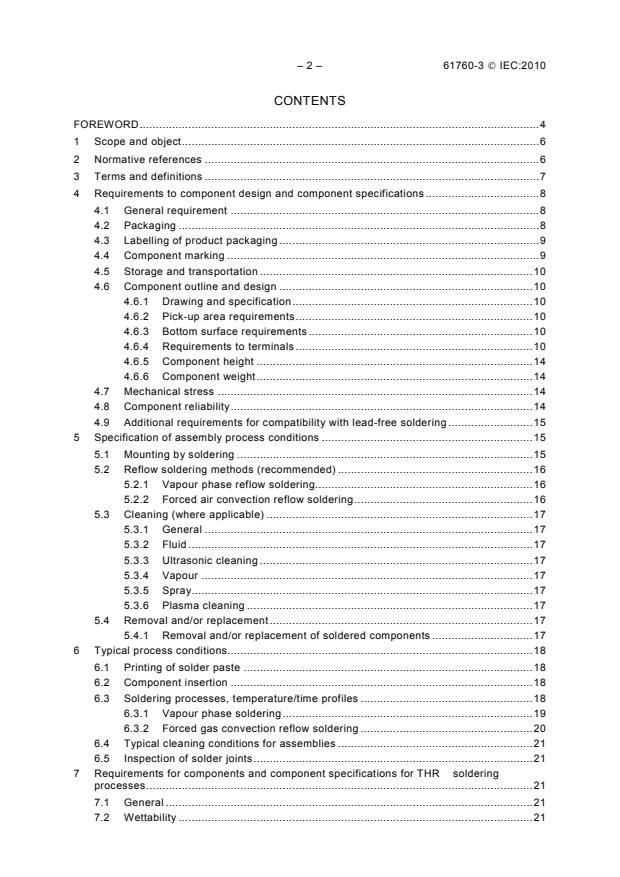
– 2 – 61760-3 © IEC:2010
CONTENTS
FOREWORD.4
1 Scope and object.6
2 Normative references .6
3 Terms and definitions .7
4 Requirements to component design and component specifications .8
4.1 General requirement .8
4.2 Packaging .8
4.3 Labelling of product packaging .9
4.4 Component marking .9
4.5 Storage and transportation .10
4.6 Component outline and design .10
4.6.1 Drawing and specification.10
4.6.2 Pick-up area requirements.10
4.6.3 Bottom surface requirements .10
4.6.4 Requirements to terminals.10
4.6.5 Component height .14
4.6.6 Component weight.14
4.7 Mechanical stress .14
4.8 Component reliability.14
4.9 Additional requirements for compatibility with lead-free soldering .15
5 Specification of assembly process conditions .15
5.1 Mounting by soldering .15
5.2 Reflow soldering methods (recommended) .16
5.2.1 Vapour phase reflow soldering.16
5.2.2 Forced air convection reflow soldering.16
5.3 Cleaning (where applicable) .17
5.3.1 General .17
5.3.2 Fluid .17
5.3.3 Ultrasonic cleaning .17
5.3.4 Vapour .17
5.3.5 Spray.17
5.3.6 Plasma cleaning .17
5.4 Removal and/or replacement.17
5.4.1 Removal and/or replacement of soldered components .17
6 Typical process conditions.18
6.1 Printing of solder paste .18
6.2 Component insertion .18
6.3 Soldering processes, temperature/time profiles .18
6.3.1 Vapour phase soldering.19
6.3.2 Forced gas convection reflow soldering .20
6.4 Typical cleaning conditions for assemblies .21
6.5 Inspection of solder joints.21
7 Requirements for components and component specifications for THR soldering
processes.21
7.1 General .21
7.2 Wettability .21
61760-3 © IEC:2010 – 3 –
7.3 Dewetting .22
7.4 Resistance to soldering heat .22
7.5 Resistance to cleaning solvent .22
7.5.1 Solvent resistance of component .22
7.5.2 Solvent resistance of marking.22
7.6 Soldering profiles .22
7.7 Moisture sensitivity level (MSL) .22
Figure 1 – Example of a component with marked specific orientation put in tape and tray.9
Figure 2 – Example of components in a tape.9
Figure 3 – Examples for clearances (stand-off) .10
Figure 4 – Examples for terminal shapes and position tolerances .12
Figure 5 – Schematic example of contrast of bottom surface – terminals underneath
component body .13
Figure 6 – Schematic example of contrast of bottom surface – terminals outside
component body .13
Figure 7 – Component weight / pipette suction strength .14
Figure 8 – Process steps for soldering .15
Figure 9 – Examples for printing of solder paste .18
Figure 10 – SnPb Vapour phase soldering – temperature/time profile (terminal
temperature) .19
Figure 11 – Lead-free SnAgCu Vapour phase soldering – temperature/time profile
(terminal temperature) .19
Figure 12 – Forced gas convection reflow soldering – temperature/time profile for
SnPb solders .20
Figure 13 – Forced gas convection reflow soldering – temperature/time profile for lead-
free SnAgCu solders.20
Table 1 – Basic cleaning processes .21
– 4 – 61760-3 © IEC:2010
INTERNATIONAL ELECTROTECHNICAL COMMISSION
____________
SURFACE MOUNTING TECHNOLOGY –
Part 3: Standard method for the specification of
components for through hole reflow (THR) soldering
FOREWORD
1) The International Electrotechnical Commission (IEC) is a worldwide organization for standardization comprising
all national electrotechnical committees (IEC National Committees). The object of IEC is to promote
international co-operation on all questions concerning standardization in the electrical and electronic fields. To
this end and in addition to other activities, IEC publishes International Standards, Technical Specifications,
Technical Reports, Publicly Available Specifications (PAS) and Guides (hereafter referred to as “IEC
Publication(s)”). Their preparation is entrusted to technical committees; any IEC National Committee interested
in the subject dealt with may participate in this preparatory work. International, governmental and non-
governmental organizations liaising with the IEC also participate in this preparation. IEC collaborates closely
with the International Organization for Standardization (ISO) in accordance with conditions determined by
agreement between the two organizations.
2) The formal decisions or agreements of IEC on technical matters express, as nearly as possible, an international
consensus of opinion on the relevant subjects since each technical committee has representation from all
interested IEC National Committees.
3) IEC Publications have the form of recommendations for international use and are accepted by IEC National
Committees in that sense. While all reasonable efforts are made to ensure that the technical content of IEC
Publications is accurate, IEC cannot be held responsible for the way in which they are used or for any
misinterpretation by any end user.
4) In order to promote international uniformity, IEC National Committees undertake to apply IEC Publications
transparently to the maximum extent possible in their national and regional publications. Any divergence
between any IEC Publication and the corresponding national or regional publication shall be clearly indicated in
the latter.
5) IEC itself does not provide any attestation of conformity. Independent certification bodies provide conformity
assessment services and, in some areas, access to IEC marks of conformity. IEC is not responsible for any
services carried out by independent certification bodies.
6) All users should ensure that they have the latest edition of this publication.
7) No liability shall attach to IEC or its directors, employees, servants or agents including individual experts and
members of its technical committees and IEC National Committees for any personal injury, property damage or
other damage of any nature whatsoever, whether direct or indirect, or for costs (including legal fees) and
expenses arising out of the publication, use of, or reliance upon, this IEC Publication or any other IEC
Publications.
8) Attention is drawn to the Normative references cited in this publication. Use of the referenced publications is
indispensable for the correct application of this publication.
9) Attention is drawn to the possibility that some of the elements of this IEC Publication may be the subject of
patent rights. IEC shall not be held responsible for identifying any or all such patent rights.
International Standard IEC 61760-3 has been prepared by IEC technical committee 91:
Electronics assembly technology.
The text of this standard is based on the following documents:
CDV Report on voting
91/856/CDV 91/898/RVC
Full information on the voting for the approval of this standard can be found in the report on
voting indicated in the above table.
This publication has been drafted in accordance with the ISO/IEC Directives, Part 2.
A list of all parts of the IEC 61760 series, under the general title Surface mounting technology
can be found on the IEC website.
61760-3 © IEC:2010 – 5 –
The committee has decided that the contents of this publication will remain unchanged until
the stability date indicated on the IEC web site under "http://webstore.iec.ch" in the data
related to the specific publication. At this date, the publication will be
• reconfirmed,
• withdrawn,
• replaced by a revised edition, or
• amended.
IMPORTANT – The 'colour inside' logo on the cover page of this publication indicates
that it contains colours which are considered to be useful for the correct
understanding of its contents. Users should therefore print this document using a
colour printer.
– 6 – 61760-3 © IEC:2010
SURFACE MOUNTING TECHNOLOGY –
Part 3: Standard method for the specification of
components for through hole reflow (THR) soldering
1 Scope and object
This part of IEC 61760 gives a reference set of requirements, process conditions and related
test conditions to be used when compiling specifications of electronic components that are
intended for usage in through hole reflow soldering technology.
The object of this standard is to ensure that components with leads intended for through hole
reflow and surface mounting components can be subjected to the same placement and
mounting processes. Hereto, this standard defines test and requirements that need to be part
of any component generic, sectional or detail specification, when through hole reflow
soldering is intended. Further this standard provides component users and manufacturers with
a reference set of typical process conditions used in through hole reflow soldering technology.
2 Normative references
The following referenced documents are indispensable for the application of this document.
For dated references, only the edition cited applies. For undated references, the latest edition
of the referenced document (including any amendments) applies.
IEC 60062, Marking codes for resistors and capacitors
IEC 60068 (all parts), Environmental testing
IEC 60068-2-20, Environmental testing – Part 2-20: Tests – Test T: Test methods for
solderability and resistance to soldering heat of devices with leads
IEC 60068-2-21, Environmental testing – Part 2-21: Tests – Test U: Robustness of
terminations and integral mounting devices
IEC 60068-2-45:1980, Basic environmental testing procedures – Part 2-45: Tests – Test XA
and guidance: Immersion in cleaning solvents
Amendment 1:1993
IEC 60068-2-58, Environmental testing – Part 2-58: Tests – Test Td: Test methods for
solderability resistance to dissolution of metallization and to soldering heat of surface
mounting devices (SMD)
IEC 60068-2-77, Environmental testing – Part 2-77: Tests – Body strength and impact shock
IEC 60068-2-82, Environmental testing – Part 2-82: Tests – Test XW : Whisker test methods
for electronic and electric components
IEC 60194, Printed board design, manufacture and assembly – Terms and definitions
IEC 60286 (all parts), Packaging of components for automatic handling
61760-3 © IEC:2010 – 7 –
IEC 60286-3, Packaging of components for automatic handling – Part 3: Packaging of surface
mount components on continuous tapes
IEC 60286-4, Packaging of components for automatic handling – Part 4: Stick magazines for
electronic components encapsulated in packages of form E and G
IEC 60286-5, Packaging of components for automatic handling – Part 5: Matrix trays
IEC 60749-20, Semiconductor devices – Mechanical and climatic test methods – Part 20:
Resistance of plastic encapsulated SMDs to the combined effect of moisture and soldering
heat
IEC 61760-2, Surface mounting technology – Part 2: Transportation and storage conditions of
surface mounting devices (SMD) – Application guide
IEC 62090, Product package labels for electronic components using bar code and two-
dimensional symbologies
ISO 8601, Data elements and interchange formats – Information interchange –
Representation of dates and times
3 Terms and definitions
For the purposes of this document, the terms and definitions given in IEC 60194 and the
following apply.
3.1
terminal pitch
distance between the terminals of the component, either uniformly distributed or specifically
defined
3.2
dewetting
condition that results when molten solder coats a surface and then recedes to leave
irregularly-shaped mounds of solder that are separated by areas that are covered with a thin
film of solder and with the basis metal not exposed
3.3
dissolution of metallization
process of dissolving metal or a plated metal alloy, usually by introduction of chemicals
NOTE For the purpose of this document standard, the dissolution of metallization also includes dissolution by
exposure to molten solder.
3.4
pick-up force
dynamic force exerted on the body of a component – generally from above – and its seating
plane during the pick-up of the component (e.g. from a tape or tray)
NOTE The maximum level is normally taken into account.
3.5
placement force
dynamic force exerted on the component body – generally from above – and its seating plane
occurring during the period between the component’s first contact with the substrate (or the
soldering paste or adhesive, etc.) and its coming to rest
NOTE The maximum level is normally taken into account.
– 8 – 61760-3 © IEC:2010
3.6
resistance to soldering heat
ability of a component to withstand the effects of the heat generated by the soldering process
3.7
seating plane
surface on which a component rests
3.8
solderability
ability of a metal to be wetted by molten solder
3.9
solder meniscus
contour of a solder shape that is the result of the surface tension forces that take place during
wetting
3.10
stand off
distance between the component side of the substrate and the bottom of the component body
3.11
substrate
basic material, forming the support structure of an electronic circuit
3.12
terminal
solder pins of a THR component to be soldered into the through holes of a printed circuit
board
3.13
wetting
physical phenomenon in which surface tension of a liquid, usually when in contact with solids,
is reduced to the point where the liquid diffuses and makes intimate contact with the entire
substrate surface in the form of a thin layer
4 Requirements to component design and component specifications
4.1 General requirement
A component specification for THR components shall, in addition to the requirements listed in
4.2 to 4.9 below, contain specifications of the relevant tests and requirements in Clause 7.
4.2 Packaging
Information about the packaging form including packaging dimensions, data on clearances
within the packaging shall be included in the component specification according to
IEC 60286-3, IEC 60286-4 and IEC 60286-5.
Packaging type and geometry shall be specified in such a way that mechanical stress on
component pins is avoided.
Moisture sensitive components need special packaging in line with IEC 60749-20.
Components with specific orientation or polarity shall be placed in the packaging with a fixed
orientation (see Figure 1 and Figure 2).
61760-3 © IEC:2010 – 9 –
PIN 1
PIN 1
IEC 490/10
Figure 1 – Example of a component with marked
specific orientation put in tape and tray
IEC 491/10
Figure 2 – Example of components in a tape
4.3 Labelling of product packaging
Labelling of the product packaging shall comply with IEC 62090.
According to IEC 62090 the product packaging shall include the following:
– item identification (e.g. customer part number or manufacturer part number or both);
– traceability identification (e.g. batch number or serial number);
– quantity.
Additional to the requirements of IEC 62090, this standard recommends that the product
packaging should include the following:
– moisture sensitivity level (MSL) according to IEC 60749-20;
– date code (ISO 8601 and IEC 60062);
– identification code for the manufacturer;
– description of the polarity of the component, if applicable.
4.4 Component marking
Information about marking shall be given by the relevant detail specification.
Direction
– 10 – 61760-3 © IEC:2010
4.5 Storage and transportation
Component specifications shall refer to storage and transportation conditions of IEC 61760-2.
The component specification shall contain information of the maximum period for storage.
Within this period the component shall comply with its specification.
4.6 Component outline and design
4.6.1 Drawing and specification
The drawing and specification shall contain all dimensions and tolerances relevant for the
THR process according to 4.6.2 to 4.6.6 as minimum information.
4.6.2 Pick-up area requirements
Design of the component shall be in such a way, that it is possible to grip the component by
suction or mechanical grippers and transport it to the exact placement position on the
substrate. It shall be possible to create a vacuum or mechanical force strong enough to fix the
component in its position under the pipette or gripper. During the total transport process,
which may include optical inspection, the component shall remain exactly in its position under
the pipette or gripper, until the component is placed.
The centre of the suction area shall match the centre of gravity (major requirement) and the
geometrical centre (minor requirement).
4.6.3 Bottom surface requirements
To avoid solder balls and bridging, the bottom surface of the component shall not be wettable
by solder.
4.6.4 Requirements to terminals
4.6.4.1 Clearances
Sufficient clearances have to be considered to avoid contact between component body and
solder paste and to ensure sufficient heat transfer to solder joints (see Figure 3).
Spacer(s) shall be arranged in a suitable way on the components bottom side to ensure
• a suitable stand-off (e.g. 0,5 mm) in the solder joint area and solder paste overprinting
area to avoid contact of the solder paste with the component body,
• a stable seating of the components on the printed circuit board surface,
• a coplanarity of the spacers better than 0,15 mm,
• a sufficient clearance to printed solder paste depot, and
• if possible, an inspection of the outer terminals solder joints.
IEC 492/10
NOTE Enough clearance to printed solder paste depot, good accessibility of heat to the solder pins
Figure 3 – Examples for clearances (stand-off)
61760-3 © IEC:2010 – 11 –
4.6.4.2 Terminal length
The terminal length shall enable the optical inspection of the solder joint at the bottom side of
the printed circuit board (visibility of the leads). The thickness of the printed circuit board, the
soldering process and solder material has to be taken into consideration.
Recommended terminal protrusion is 0,5 mm minimum. In case of terminals ending in the
printed circuit board the optical inspection has to be specified by the user (manufacturer of
the printed circuit board assembly).
4.6.4.3 Arrangement of terminals
Terminals shall be arranged
• in a suitable minimum distance to each other and to the spacer(s) to avoid solder shorts
and to make overprinting of solder paste possible, and
• preferably along the outer edges of the component (for optical inspection purposes).
The position tolerance of each pin tip should not be more than 0,4 mm in diameter, related to
the specified position, pin to pin and first to last pin of the component (see Figure 4).
– 12 – 61760-3 © IEC:2010
Dimensions in millimetres
Version A
Square pin
Hole in
gauge
0,4
0,2
DDiiagoagonnalal
of piof pin n
0,2
Version B
Rectangular pin
Hole in
gauge
0,4
Diagonal
0,2
of pin
0,2
Version C
Round pin
Hole in
gauge
0,4
0,2
Diameter
of pin
0,2 IEC 493/10
Figure 4 – Examples for terminal shapes and position tolerances
4.6.4.4 Relation between terminal diameter and through hole diameter in printed
circuit board
The minimum through hole diameter in the printed circuit board is typically 0,2 mm to 0,4 mm
larger than the diagonal or diameter of the terminal.
The minimum through hole diameter in the printed circuit board, that could be filled with
solder paste correctly as specified in 6.1, relates to the thickness of the board, the solder
paste and the manufacturers equipment and process. This shall be specified by the
manufacturer.
61760-3 © IEC:2010 – 13 –
NOTE At the time of writing this standard there seems to be a technical limit of 1,0 mm below which no
appropriate solder paste protrusion is possible using printed circuit boards of 1,5 mm thickness.
4.6.4.5 Optical recognition
The optical contrast between the terminal bottom surface and the component bottom surface
around the terminals shall be high enough (until assembling) to enable optical recognition of
the position of the terminals, seen from the bottom side. Preferably at the bottom side the
terminal pin at the final stages shall be reflecting (see Figure 5 and Figure 6).
NOTE Not applicable to right angle terminals outside the components body.
IEC 494/10
Figure 5 – Schematic example of contrast of bottom surface –
terminals underneath component body
IEC 495/10
Figure 6 – Schematic example of contrast of bottom surface –
terminals outside component body
4.6.4.6 Shape of the terminals
The preferred style is square or circular (if rectangular the aspect-ratio should be less than
2:1).
Preferably the tip of terminals should be chamfered.
4.6.4.7 Hardness of the terminals
The terminal shall be hard enough to ensure that its shape remains unchanged during
placement.
4.6.4.8 Wettable surface
The wettable surface of the terminals should allow that a visible solder fillet on component
side can be formed. Taking the stand-off of the component into consideration, at least 0,2 mm
of the terminal above the printed circuit board level on component side should be wettable.
– 14 – 61760-3 © IEC:2010
4.6.4.9 Material content
Details on composition, thickness, layer-structure of the surfaces to be soldered should be
given.
This information is needed (among others) to determine the suitable whisker test methods
from IEC 60068-2-82.
4.6.5 Component height
The component height is limited by the length of the pipette or gripper and the space
traversed between pick-up and placement. A proper clearance is required by the length of the
pipette or gripper and the component height for the traverse from pick-up to placement.
The component height and the component department of packing shall be matched to each
other to enable the pipette or gripper to safely pick up the component. If standardized
packaging complying with the IEC 60286 series of standards is used, the component height
shall relate to the packing dimensions specified therein.
The component height is also important to avoid over heating of component top surface
during forced gas convection reflow soldering.
4.6.6 Component weight
The net force (F ), resulting from the weight and the acceleration forces of the component
g
shall not exceed one third of the gripping force (F ) of the pipette (see Figure 7).
s
F
s
F
g
IEC 496/10
Figure 7 – Component weight / pipette suction strength
4.7 Mechanical stress
Components need to withstand the stresses applied by placement machinery and bending of
the substrate. In order to ensure this, component specifications shall comply with the
following test and test methods. Specification performance shall be specified in line with the
relevant sectional or generic specification.
• Pick-up / impact force IEC 60068-2-77
• Centring force IEC 60068-2-77
• Placement force IEC 60068-2-77
• Bending stress IEC 60068-2-21
Mechanical fixing aids (e.g. guide pins, detents) should be avoided as much as possible.
4.8 Component reliability
Requirements and related test methods that define the long term performance of a component
shall be part of the component specification. Test methods shall be applied that use
components mounted on a substrate. The test methods shall be preferably selected from
IEC 60068 series.
61760-3 © IEC:2010 – 15 –
The component specification shall state the operating temperature range. Derating may be
applied. The operating temperature range shall be in accordance with the long term
performance of the component.
Perpetuation of reliability of some components may require restrictions to the choice of
soldering process and its parameters. It has to be noted that components may experience up
to three consecutive reflow soldering processes. When the allowed parametric and
mechanical changes in the resistance to soldering heat test are determined, this multiple
soldering must be considered. The number of allowed reflow soldering steps shall be
specified in the detail specification.
4.9 Additional requirements for compatibility with lead-free soldering
In component specifications the compatibility of the terminations with the solder used shall be
defined. This is as important to lead-free terminations in connection with lead-free solders as
in connection with lead containing solders.
5 Specification of assembly process conditions
5.1 Mounting by soldering
The steps in a production process depend on the mounting method used. Figure 8 shows a
typical flow chart.
SMDs, THR
components and
printed boards
Applying of solder
paste
Placing of SMD and
THR components
Reflow
soldering
Cleaning
(where applicable)
Testing
IEC 497/10
Figure 8 – Process steps for soldering
– 16 – 61760-3 © IEC:2010
5.2 Reflow soldering methods (recommended)
5.2.1 Vapour phase reflow soldering
This involves soldering in saturated vapour and is also called condensation soldering. This
process can be used either as a batch system (with two vapour zones) or as a continuous
system with a single vapour zone. Both systems may also require preheating of the
assemblies to prevent thermal shock and other undesirable side-effects.
Typical temperature/time profiles for the full process are shown in Figure 10 for soldering with
lead containing SnPb solders and in Figure 11 for soldering with lead-free SnAgCu solder.
The specific equipment used has influence on the resulting profile, especially the type of
preheating and whether controlled vapour heating power is used or not.
NOTE Non hermetic components with cavities may not be suited for vapour phase soldering because of
condensation of the medium inside the component.
5.2.2 Forced air convection reflow soldering
This is the dominating reflow soldering method in which most of the energy for heating the
assembly is derived from gas (air or inert gas or a mixture of both). A small proportion of the
energy may be derived from direct infrared radiation. There is no contact with the assemblies
during heating.
The following parameters influence the temperature of the component, leading to temperature
differences between different components on a substrate and between parts of the
components (e.g. between terminal and top surface of the component):
• time and thermal power input;
• thermal capacity of the component;
• component size;
• substrate size;
• package density and shadowing;
• wavelength spectrum of radiation source;
• absorption coefficient of surfaces;
• ratio of radiation to convection energy.
NOTE 1 There is a tendency that small components warm up more than the large ones under the same process
conditions and this may lead to exceeding the resistance to soldering heat conditions.
Typical temperature/time profiles for the full process are shown in Figure 12 for soldering with
lead containing SnPb solders and in Figure 13 for soldering with lead-free SnAgCu solder.
The typical profile represents the terminal temperature of a mid size component. The coldest
terminal temperature on an assembled substrate shall be above the lower process limit line to
ensure good solder joints.
The maximum temperature, measured on the top surface of a component shall not exceed the
upper process limit to avoid component damage by heat exceeding the component resistance
to soldering heat specification. Depending on factors as indicated in the paragraph above the
maximum temperature measured at the top surface of each component is different. The upper
process limits indicated in Figure 12 and Figure 13 represent an upper limit for small sized
components.
The maximum allowable temperature on the top of the THR component and the MSL have to
be agreed between supplier and customer.
NOTE 2 The experience with SnAgCu soldering is rapidly increasing at the time of writing of this standard.
Therefore changes in this typical profile can be expected.
61760-3 © IEC:2010 – 17 –
5.3 Cleaning (where applicable)
5.3.1 General
The following cleaning methods may be used in cases where the substrates have to be
cleaned after soldering.
Cleaning materials prohibited by the Montreal Protocol shall be avoided.
NOTE 1 Non hermetic components with cavities may not be suited for cleaning with liquids because of penetration
of the medium into the component.
NOTE 2 Resonance due to ultrasonic waves may expose the components to excessively high stress levels.
5.3.2 Fluid
The substrate is immersed in a cleaning fluid. For details, see Table 1.
5.3.3 Ultrasonic cleaning
The substrate is immersed in a cleaning fluid and also subjected to ultrasonic oscillation. For
details, see Table 1. Refer to the relevant detail specifications for information on whether a
component is capable of withstanding ultrasonic cleaning procedures.
5.3.4 Vapour
A cleaning vapour condenses on the substrate. For details, see Table 1.
5.3.5 Spray
A cleaning fluid is sprayed on to the substrate. For details, see Table 1.
5.3.6 Plasma cleaning
The substrate with mounted components is cleaned by plasma (for example oxygen plasma)
in a vacuum chamber.
5.4 Removal and/or replacement
5.4.1 Removal and/or replacement of soldered components
This subclause defines procedures for removal and replacement of soldered THR
components.
The typical sequence is as follows:
• removal of conformal coating (if necessary);
• cleaning (if necessary);
• fluxing (and possibly application of solder);
• heating of the soldered joints with either a hot air jet or other suitable heat sources (like
solder bath);
• removal of the component;
• removal of solder in the holes;
• cleaning (if necessary);
• placing of the new component;
• fluxing;
• soldering (e.g. by soldering iron or selective soldering);
– 18 – 61760-3 © IEC:2010
• cleaning (if necessary);
• conformal coating (if necessary).
NOTE 1 Minimize mechanical force to avoid substrate damage during removing of soldered components.
NOTE 2 Removed components should not be reused without first ensuring that the removal process has not
impaired the reliability of the substrate and the component.
6 Typical process conditions
6.1 Printing of solder paste
The printing volume of the solder paste shall be such, that the amount of solder is sufficient to
fill the through hole and to create a solder meniscus (see Figure 9).
150 μm
0 mm to 1 mm
IEC 498/10
Figure 9 – Examples for printing of solder paste
6.2 Component insertion
Components need to be inserted by automatic inserters. The insertion speed has to be
selected appropriately. Optical recognition of component and printed circuit board position is
necessary.
6.3 Soldering processes, temperature/time profiles
The following diagrams are intended as an aid to THR users and component manufacturers in
determining typical process conditions to which components will be subjected in a specific
soldering process. Requirements for components and component specifications related to
suitability for usage in various mounting processes are given in Clause 7.
Figure 10 to Figure 13 show temperature/time profiles for four commonly used soldering
processes. As described in 5.2, time/temperature profiles for the surface of the component
usually differ from the time/temperature profile for the terminal of the product.
NOTE The unit Kelvin (K) is used in case of an interval or difference of temperatures.
61760-3 © IEC:2010 – 19 –
6.3.1 Vapour phase soldering
20 s . 40 s
210 °C
180 °C
ca. 60 s . 150 s
> 180 °C
Ramp down rate < 6 K/s
Ramp up rate < 3 K/s
0 20 40 60 80 100 120 140 160 180 200 220 240
Time (s)
IEC 499/10
NOTE The lines indicate upper and lower limits of typical processes.
Figure 10 – SnPb Vapour phase soldering –
temperature/time profile (terminal temperature)
20 s . 40 s
230 °C
217 °C
ca. 60 s . 130 s
> 217 °C
Ramp down rate < 6 K/s
Ramp up rate < 3 K/s
0 20 40 60 80 100 120 140 160 180 200 220 240
Time (s)
IEC 500/10
NOTE The lines indicate upper and lower limits of typical processes.
Figure 11 – Lead-free SnAgCu Vapour phase soldering –
temperature/time profile (terminal temperature)
Temperature (°C)
Temperature (°C)
– 20 – 61760-3 © IEC:2010
6.3.2 Forced gas convection reflow soldering
240 °C …… SnPb Reflow
230 °C .……….
215 °C .
180 °C
160 °C
150 °C
ca. 60 s > 180 °C
130 °C
Preheating Ramp down rate < 6 K/s
Typical Ramp up rate < 3 K/s
0 20 40 60 80 100 120 140 160 180 200 220 240
Time (s)
IEC 501/10
NOTE Continuous line: typical process (terminal temperature); dotted line: process limits; lower process limit
(terminal temperature); upper process limit (top surface temperature).
Figure 12 – Forced gas convection reflow soldering –
temperature/time profile for SnPb solders
...