

IEC 61969-3:2011
(Main)Mechanical structures for electronic equipment - Outdoor enclosures - Part 3: Environmental requirements, tests and safety aspects
General Information
- Abstract
IEC 61969-3:2011 specifies a set of basic environmental requirements and tests, as well as safety aspects for outdoor enclosures under conditions of non-weatherprotected locations above ground. The purpose of this standard is to define a minimum level of environmental performance in order to meet requirements of storage, transport and final installation. It is the intention to establish basic environmental performance criteria for outdoor enclosure compliance. This second edition cancels and replaces the first edition issued in 2001. It constitutes a technical revision. The main technical changes with regard to the previous edition are as follows. Table 1 and Table 6 have been extended with requirements and tests, relevant for outdoor conditions.
- Status
- Published
- Publication Date
- 16-Nov-2011
- Technical Committee
- SC 48D - Mechanical structures for electrical and electronic equipment
- Current Stage
- DELPUB - Deleted Publication
- Start Date
- 08-Jun-2020
- Completion Date
- 31-Aug-2017
Overview
IEC 61969-3:2011 is an international standard published by the International Electrotechnical Commission (IEC) that defines environmental requirements, testing protocols, and safety aspects for mechanical structures used as outdoor enclosures for electronic equipment. This part of the IEC 61969 series focuses on enclosures designed for non-weatherprotected outdoor locations above ground, ensuring they meet minimum environmental performance standards for storage, transport, and final installation.
The second edition, released in 2011, replaces the 2001 version and introduces updated environmental classification and testing methods relevant to outdoor conditions. It aims to provide manufacturers and users with clear compliance criteria to ensure outdoor enclosures withstand a variety of environmental stressors while maintaining safety and functionality.
Key Topics
Environmental Requirements & Classification
The standard specifies environmental classes based on climatic severity:- Class 1: Moderate climates with non-weatherprotected locations
- Class 2: Severe climates extending the environmental conditions to more challenging outdoor settings
These classifications guide the design and testing criteria for enclosures exposed to direct weather influences.
Test Methods
IEC 61969-3 outlines a comprehensive series of tests to validate compliance including:- Climatic tests (temperature, humidity, UV radiation)
- Biological resistance tests (fungi and insects)
- Resistance to chemically and mechanically active substances
- Mechanical tests such as dynamic, lifting, stiffness, vibration, and shock tests
- Safety-related tests including locking device functionality, vandalism resistance, and optional bullet resistance
- Seismic resistance for earthquake-prone areas
- Electromagnetic shielding to protect sensitive electronics from interference
- Thermal management assessments to address heat dissipation
- Noise emission constraints related to forced cooling solutions
Safety Aspects
The standard incorporates safety considerations to prevent unauthorized access, provide protection against vandalism, and ensure personnel safety during enclosure operation and maintenance.Updated Technical Criteria
This edition extends requirements and test conditions in Tables 1 and 6, reflecting recent advancements and stricter conditions for outdoor environments.
Applications
IEC 61969-3 is essential for manufacturers, designers, and users of outdoor electronic equipment enclosures used in sectors such as telecommunications, power distribution, industrial automation, and transport infrastructure. Its practical value includes:
- Ensuring enclosures can withstand environmental extremes during storage, transportation, and installation
- Guaranteeing mechanical robustness against impacts, vibrations, and seismic events
- Providing a framework for thermal management to avoid overheating in outdoor conditions
- Enhancing security aspects to protect critical equipment from tampering and environmental damage
- Supporting regulatory compliance by aligning product performance with international test standards
- Minimizing noise emissions, helping installations conform to local environmental regulations.
By adhering to IEC 61969-3:2011, businesses can deliver durable, safe, and reliable outdoor enclosure solutions that meet global industry expectations.
Related Standards
IEC 61969-3 complements and references several key international standards that cover related aspects of mechanical and environmental testing for electronic equipment enclosure systems:
- IEC 60068 - Environmental testing methods
- IEC 60529 - Degrees of protection by enclosures (IP code)
- IEC 62262 - Mechanical impact protection (IK code)
- IEC 62305-4 - Lightning protection for electrical and electronic systems
- IEC 60950 / IEC 61010 - Safety requirements for information technology and electrical measurement equipment
- IEC 61587 series - Mechanical testing for cabinets, racks, and subracks (climatic, mechanical, seismic, and electromagnetic tests)
- IEC 62194 - Thermal performance evaluation of enclosures
- ISO 2533 - Standard atmosphere conditions used in testing
- ETSI EN 300019-2-2 - Environmental test specifications for telecommunication equipment transportation
- ISO 3744 - Acoustic noise measurement techniques
These standards collectively establish a comprehensive framework ensuring that outdoor enclosures deliver optimal protection, safety, and performance under harsh environmental conditions.
Keywords: IEC 61969-3, outdoor enclosures, electronic equipment, environmental requirements, safety aspects, mechanical tests, climate testing, vandalism resistance, thermal management, electromagnetic shielding, IP code, IK code, international standards, electronic enclosure compliance, outdoor environments, equipment protection, IEC standards.
Relations
- Effective Date
- 05-Sep-2023
- Effective Date
- 05-Sep-2023
Frequently Asked Questions
IEC 61969-3:2011 is a standard published by the International Electrotechnical Commission (IEC). Its full title is "Mechanical structures for electronic equipment - Outdoor enclosures - Part 3: Environmental requirements, tests and safety aspects". This standard covers: IEC 61969-3:2011 specifies a set of basic environmental requirements and tests, as well as safety aspects for outdoor enclosures under conditions of non-weatherprotected locations above ground. The purpose of this standard is to define a minimum level of environmental performance in order to meet requirements of storage, transport and final installation. It is the intention to establish basic environmental performance criteria for outdoor enclosure compliance. This second edition cancels and replaces the first edition issued in 2001. It constitutes a technical revision. The main technical changes with regard to the previous edition are as follows. Table 1 and Table 6 have been extended with requirements and tests, relevant for outdoor conditions.
IEC 61969-3:2011 specifies a set of basic environmental requirements and tests, as well as safety aspects for outdoor enclosures under conditions of non-weatherprotected locations above ground. The purpose of this standard is to define a minimum level of environmental performance in order to meet requirements of storage, transport and final installation. It is the intention to establish basic environmental performance criteria for outdoor enclosure compliance. This second edition cancels and replaces the first edition issued in 2001. It constitutes a technical revision. The main technical changes with regard to the previous edition are as follows. Table 1 and Table 6 have been extended with requirements and tests, relevant for outdoor conditions.
IEC 61969-3:2011 is classified under the following ICS (International Classification for Standards) categories: 31.240 - Mechanical structures for electronic equipment. The ICS classification helps identify the subject area and facilitates finding related standards.
IEC 61969-3:2011 has the following relationships with other standards: It is inter standard links to IEC 61969-3:2020, IEC 61969-3:2001. Understanding these relationships helps ensure you are using the most current and applicable version of the standard.
IEC 61969-3:2011 is available in PDF format for immediate download after purchase. The document can be added to your cart and obtained through the secure checkout process. Digital delivery ensures instant access to the complete standard document.
Standards Content (Sample)
IEC 61969-3 ®
Edition 2.0 2011-11
INTERNATIONAL
STANDARD
NORME
INTERNATIONALE
Mechanical structures for electronic equipment – Outdoor enclosures –
Part 3: Environmental requirements, tests and safety aspects
Structures mécaniques pour équipement électronique – Enveloppes de
plein air –
Partie 3: Exigences environnementales, essais et aspects de la sécurité
All rights reserved. Unless otherwise specified, no part of this publication may be reproduced or utilized in any form or by
any means, electronic or mechanical, including photocopying and microfilm, without permission in writing from either IEC or
IEC's member National Committee in the country of the requester.
If you have any questions about IEC copyright or have an enquiry about obtaining additional rights to this publication,
please contact the address below or your local IEC member National Committee for further information.
Droits de reproduction réservés. Sauf indication contraire, aucune partie de cette publication ne peut être reproduite
ni utilisée sous quelque forme que ce soit et par aucun procédé, électronique ou mécanique, y compris la photocopie
et les microfilms, sans l'accord écrit de la CEI ou du Comité national de la CEI du pays du demandeur.
Si vous avez des questions sur le copyright de la CEI ou si vous désirez obtenir des droits supplémentaires sur cette
publication, utilisez les coordonnées ci-après ou contactez le Comité national de la CEI de votre pays de résidence.
IEC Central Office
3, rue de Varembé
CH-1211 Geneva 20
Switzerland
Email: inmail@iec.ch
Web: www.iec.ch
About the IEC
The International Electrotechnical Commission (IEC) is the leading global organization that prepares and publishes
International Standards for all electrical, electronic and related technologies.
About IEC publications
The technical content of IEC publications is kept under constant review by the IEC. Please make sure that you have the
latest edition, a corrigenda or an amendment might have been published.
Catalogue of IEC publications: www.iec.ch/searchpub
The IEC on-line Catalogue enables you to search by a variety of criteria (reference number, text, technical committee,…).
It also gives information on projects, withdrawn and replaced publications.
IEC Just Published: www.iec.ch/online_news/justpub
Stay up to date on all new IEC publications. Just Published details twice a month all new publications released. Available
on-line and also by email.
Electropedia: www.electropedia.org
The world's leading online dictionary of electronic and electrical terms containing more than 20 000 terms and definitions
in English and French, with equivalent terms in additional languages. Also known as the International Electrotechnical
Vocabulary online.
Customer Service Centre: www.iec.ch/webstore/custserv
If you wish to give us your feedback on this publication or need further assistance, please visit the Customer Service
Centre FAQ or contact us:
Email: csc@iec.ch
Tel.: +41 22 919 02 11
Fax: +41 22 919 03 00
A propos de la CEI
La Commission Electrotechnique Internationale (CEI) est la première organisation mondiale qui élabore et publie des
normes internationales pour tout ce qui a trait à l'électricité, à l'électronique et aux technologies apparentées.
A propos des publications CEI
Le contenu technique des publications de la CEI est constamment revu. Veuillez vous assurer que vous possédez
l’édition la plus récente, un corrigendum ou amendement peut avoir été publié.
Catalogue des publications de la CEI: www.iec.ch/searchpub/cur_fut-f.htm
Le Catalogue en-ligne de la CEI vous permet d’effectuer des recherches en utilisant différents critères (numéro de référence,
texte, comité d’études,…). Il donne aussi des informations sur les projets et les publications retirées ou remplacées.
Just Published CEI: www.iec.ch/online_news/justpub
Restez informé sur les nouvelles publications de la CEI. Just Published détaille deux fois par mois les nouvelles
publications parues. Disponible en-ligne et aussi par email.
Electropedia: www.electropedia.org
Le premier dictionnaire en ligne au monde de termes électroniques et électriques. Il contient plus de 20 000 termes et
définitions en anglais et en français, ainsi que les termes équivalents dans les langues additionnelles. Egalement appelé
Vocabulaire Electrotechnique International en ligne.
Service Clients: www.iec.ch/webstore/custserv/custserv_entry-f.htm
Si vous désirez nous donner des commentaires sur cette publication ou si vous avez des questions, visitez le FAQ du
Service clients ou contactez-nous:
Email: csc@iec.ch
Tél.: +41 22 919 02 11
Fax: +41 22 919 03 00
IEC 61969-3 ®
Edition 2.0 2011-11
INTERNATIONAL
STANDARD
NORME
INTERNATIONALE
Mechanical structures for electronic equipment – Outdoor enclosures –
Part 3: Environmental requirements, tests and safety aspects
Structures mécaniques pour équipement électronique – Enveloppes de
plein air –
Partie 3: Exigences environnementales, essais et aspects de la sécurité
INTERNATIONAL
ELECTROTECHNICAL
COMMISSION
COMMISSION
ELECTROTECHNIQUE
PRICE CODE
INTERNATIONALE
CODE PRIX M
ICS 31.240 ISBN 978-2-88912-761-0
– 2 – 61969-3 © IEC:2011
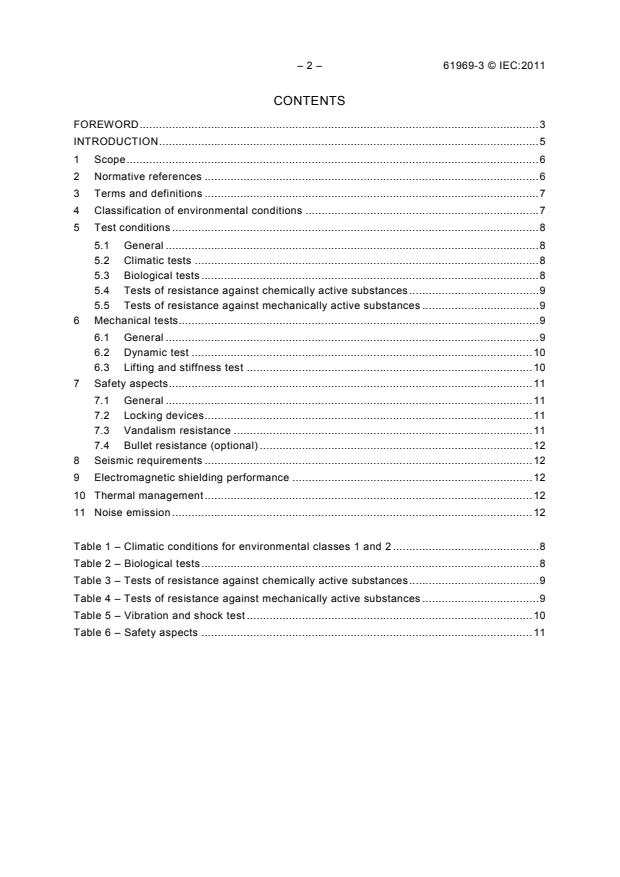
CONTENTS
FOREWORD . 3
INTRODUCTION . 5
1 Scope . 6
2 Normative references . 6
3 Terms and definitions . 7
4 Classification of environmental conditions . 7
5 Test conditions . 8
5.1 General . 8
5.2 Climatic tests . 8
5.3 Biological tests . 8
5.4 Tests of resistance against chemically active substances . 9
5.5 Tests of resistance against mechanically active substances . 9
6 Mechanical tests. 9
6.1 General . 9
6.2 Dynamic test . 10
6.3 Lifting and stiffness test . 10
7 Safety aspects . 11
7.1 General . 11
7.2 Locking devices . 11
7.3 Vandalism resistance . 11
7.4 Bullet resistance (optional) . 12
8 Seismic requirements . 12
9 Electromagnetic shielding performance . 12
10 Thermal management . 12
11 Noise emission . 12
Table 1 – Climatic conditions for environmental classes 1 and 2 . 8
Table 2 – Biological tests . 8
Table 3 – Tests of resistance against chemically active substances . 9
Table 4 – Tests of resistance against mechanically active substances . 9
Table 5 – Vibration and shock test . 10
Table 6 – Safety aspects . 11
61969-3 © IEC:2011 – 3 –
INTERNATIONAL ELECTROTECHNICAL COMMISSION
____________
MECHANICAL STRUCTURES FOR ELECTRONIC EQUIPMENT –
OUTDOOR ENCLOSURES –
Part 3: Environmental requirements, tests and safety aspects
FOREWORD
1) The International Electrotechnical Commission (IEC) is a worldwide organization for standardization comprising
all national electrotechnical committees (IEC National Committees). The object of IEC is to promote
international co-operation on all questions concerning standardization in the electrical and electronic fields. To
this end and in addition to other activities, IEC publishes International Standards, Technical Specifications,
Technical Reports, Publicly Available Specifications (PAS) and Guides (hereafter referred to as “IEC
Publication(s)”). Their preparation is entrusted to technical committees; any IEC National Committee interested
in the subject dealt with may participate in this preparatory work. International, governmental and non-
governmental organizations liaising with the IEC also participate in this preparation. IEC collaborates closely
with the International Organization for Standardization (ISO) in accordance with conditions determined by
agreement between the two organizations.
2) The formal decisions or agreements of IEC on technical matters express, as nearly as possible, an international
consensus of opinion on the relevant subjects since each technical committee has representation from all
interested IEC National Committees.
3) IEC Publications have the form of recommendations for international use and are accepted by IEC National
Committees in that sense. While all reasonable efforts are made to ensure that the technical content of IEC
Publications is accurate, IEC cannot be held responsible for the way in which they are used or for any
misinterpretation by any end user.
4) In order to promote international uniformity, IEC National Committees undertake to apply IEC Publications
transparently to the maximum extent possible in their national and regional publications. Any divergence
between any IEC Publication and the corresponding national or regional publication shall be clearly indicated in
the latter.
5) IEC itself does not provide any attestation of conformity. Independent certification bodies provide conformity
assessment services and, in some areas, access to IEC marks of conformity. IEC is not responsible for any
services carried out by independent certification bodies.
6) All users should ensure that they have the latest edition of this publication.
7) No liability shall attach to IEC or its directors, employees, servants or agents including individual experts and
members of its technical committees and IEC National Committees for any personal injury, property damage or
other damage of any nature whatsoever, whether direct or indirect, or for costs (including legal fees) and
expenses arising out of the publication, use of, or reliance upon, this IEC Publication or any other IEC
Publications.
8) Attention is drawn to the Normative references cited in this publication. Use of the referenced publications is
indispensable for the correct application of this publication.
9) Attention is drawn to the possibility that some of the elements of this IEC Publication may be the subject of
patent rights. IEC shall not be held responsible for identifying any or all such patent rights.
International Standard IEC 61969-3 has been prepared by subcommittee 48D: Mechanical
structures for electronic equipment, of IEC technical committee 48: Electromechanical
components and mechanical structures for electronic equipment.
This second edition cancels and replaces the first edition issued in 2001. It constitutes a
technical revision.
The main technical changes with regard to the previous edition are as follows.
Table 1 and Table 6 have been extended with requirements and tests, relevant for outdoor
conditions.
– 4 – 61969-3 © IEC:2011
The text of this standard is based on the following documents:
FDIS Report on voting
48D/483/FDIS 48D/497/RVD
Full information on the voting for the approval of this standard can be found in the report on
voting indicated in the above table.
A list of all parts of IEC 61969 series, under the general title Mechanical structures for
electronic equipment – Outdoor enclosures, can be found on the IEC website.
This publication has been drafted in accordance with the ISO/IEC Directives, Part 2.
The committee has decided that the contents of this publication will remain unchanged until
the stability date indicated on the IEC web site under "http://webstore.iec.ch" in the data
related to the specific publication. At this date, the publication will be
• reconfirmed,
• withdrawn,
• replaced by a revised edition, or
• amended.
61969-3 © IEC:2011 – 5 –
INTRODUCTION
IEC 61969-3 Ed.2.0 provides basic environmental test requirements to be used in the
absence of local regulatory or application specific environmental test requirements. This
provides manufacturers and users of generic outdoor enclosure solutions with minimum
performance compliance criteria; thermal solutions pending on the environment an outdoor
enclosure is subjected to. Since forced air heat dissipation and acoustic noise are closely
related, noise limitations are typically defined by local regulatory limitations.
Typically, it becomes the responsibility of the outdoor enclosure vendor to provide a solution
for thermal management within the local regulatory noise limitations.
– 6 – 61969-3 © IEC:2011
MECHANICAL STRUCTURES FOR ELECTRONIC EQUIPMENT –
OUTDOOR ENCLOSURES –
Part 3: Environmental requirements, tests and safety aspects
1 Scope
This part of IEC 61969 specifies a set of basic environmental requirements and tests, as well
as safety aspects for outdoor enclosures under conditions of non-weatherprotected locations
above ground.
The purpose of this standard is to define a minimum level of environmental performance in
order to meet requirements of storage, transport and final installation. It is the intention to
establish basic environmental performance criteria for outdoor enclosure compliance.
2 Normative references
The following referenced documents are indispensable for the application of this document.
For dated references, only the edition cited applies. For undated references, the latest edition
of the referenced document (including any amendments) applies.
IEC 60068 (all parts), Environmental testing
IEC 60417, Graphical symbols for use on equipment
IEC 60529, Degrees of protection provided by enclosures (IP code)
IEC 60695-11-10, Fire hazard testing – Part 11-10: Test flames – 50 W horizontal and vertical
flame test methods
IEC 60721-3-2, Classification of environmental conditions – Part 3: Classification of groups of
environmental parameters and their severities – Section 2: Transportation
IEC 60721-3-4, Classification of environmental conditions – Part 3: Classification of groups of
environmental parameters and their severities – Section 4: Stationary use at non-weather-
protected locations
IEC 60825-1, Safety of laser products – Part 1: Equipment specification and requirements
IEC 60950 (all parts), Information technology equipment – Safety
IEC 61010, Safety requirements for electrical equipment for measurement, control, and
laboratory use
IEC 61140 Protection against electric shock - Common aspects for installation and equipment
IEC 61439-5, Low-voltage switchgear and control gear assemblies – Part 5: Assemblies for
power distribution in public networks
IEC 61587-1, Mechanical structures for electronic equipment – Tests for IEC 60917 and
IEC 60297 – Part 1, Climatic, mechanical tests and safety aspects for cabinets, racks,
subracks and chassis
61969-3 © IEC:2011 – 7 –
IEC 61587-2, Mechanical structures for electronic equipment – Tests for IEC 60917 and
60297 – Part 2: Seismic tests for cabinets and racks
IEC 61587-3, Mechanical structures for electronic equipment – Tests for IEC 60917 and
IEC 60297 – Part 3: Electromagnetic shielding performance tests for cabinets, racks and
subracks
IEC 62194, Methods of evaluating the thermal performance of enclosures
IEC 62262, Degrees of protection provided by enclosures for electrical equipment against
external mechanical impacts (IK code)
IEC 62305-4, Protection against lightning – Part 4: Electrical and electronic systems within
structures
ISO 2533, Standard atmosphere
ISO 3744, Acoustics – Determination of sound power levels and sound energy levels of noise
sources using sound pressure – Engeneering methods for an essentially free field over a
reflecting plane
ISO 3864, Graphical symbols – Safety colours and safety signs
ISO 4892-2, Plastics – Methods of exposure to laboratory light sources – Part 2: Xenon-arc
lamps
ETSI EN 300019-2-2, Equipment Engineering (EE);Environmental conditions and
environmental tests for telecommunications equipment; Part 2-2: Specification of
environmental tests; Transportation
3 Terms and definitions
For the purposes of this document, the following terms and definitions apply.
3.1
outdoor enclosure
enclosure exposed to the outdoor environment, for stationary use at non-weatherprotected
locations, for the protection of electronic equipment installed inside against outdoor
environmental conditions
3.2
non-weatherprotected location
place with direct weather influence
4 Classification of environmental conditions
The environmental conditions are derived from IEC 60721-3-4, with the focus on empty
outdoor enclosures relevant requirements.
Class 1: Non-weatherprotected location: Covers all regions with a moderate climate.
Class 2: Non-weatherprotected locations, extended: Covers all regions with severe climate.
– 8 – 61969-3 © IEC:2011
The individual outdoor enclosure product solution tested to these basic environmental test
requirements my claim compliance to either Class 1 or Class 2 or a combination of
Class1/Class2.
5 Test conditions
5.1 General
The basic test conditions shown in Table 1; Table 2; Table 3 and Table 4 reflect typical
outdoor enclosure environments to be endured.
5.2 Climatic tests
Table 1 – Climatic conditions for environmental classes 1 and 2
Environmental parameters Test severity Duration IEC method
Class 1 Class 2
a Low air temperature -45 °C -65 °C 16 h 60068-2-1; A
b High air temperature 80 °C 90 °C 16 h 60068-2-2: B
c Damp heat 30 °C, 93 % 30 °C, 93 % 96 h 60068-2-78: Cb
d Rate of change of -50 °C to + 23 °C -50 °C to + 23 °C 2 cycles 60068-2-14: Nb
temperature
1 °C/min 1 °C/min
2 2
e Solar radiation 1 120 W/m 1 120 W/m 72 h/ 40 °C 60068-2-5 Sa
f Condensation 40 °C 40 °C 96 h 60068-2-30: Db
90 % to 100 % 90 % to 100 % RH
RH
g Precipitation (rain, snow, IP 54 IP 55 - 60529
hail, dust, etc.)
h Movement of the 50 m/s 60 m/s - -
surrounding air
i Formation of ice and frost Yes Yes - -
j Ultraviolet degradation test Yes Yes - ISO 4892-2
NOTE For comparable conditions the International Standard Air, in accordance to ISO 2533 (15 °C at 1 013,
25 hPa) shall be used.
Following the test, compliance is checked by visual inspection of the internal and external
parts; no rust, cracking or other deterioration shall be detected with impact to the required
function; no ingress of water. Hinges, locks and handles for example shall be in operating
condition. The test in accordance with Table 1, item i shall prove that access to the internal
equipment is possible without causing permanent degradation of protection levels.
5.3 Biological tests
Table 2 – Biological tests
Environmental Test severity Purpose IEC method
parameters
Class 1 Class 2
a Flora: Presence of mould, Yes Yes To check the 60068-2-10
fungus, etc. material for
resistance
b Fauna: Presence of Yes, but without Yes, but with
rodents and others harmful termites termites
to the equipment
61969-3 © IEC:2011 – 9 –
Following the test, compliance is checked by visual inspection.
5.4 Tests of resistance against chemically active substances
Table 3 – Tests of resistance against chemically active substances
(Similar to IEC 60721-3-4, Class 4C2)
Environmental parameters Test severity Duration IEC method
Class 1 Class 2
Mean value Maximum value
a Salts: Sea and road salt mist Yes, at 35 °C,5 % NaCl 4 days 60068-2-11; Ka
a
3 3
b Sulphur dioxide 0,3 mg/m 1,0 mg/m
3 3 3 3
0,11 cm /m 0,37 cm /m
a
3 3
c Hydrogen sulphide 0,1 mg/m 0,5 mg/m
3 3 3 3
0,071 cm /m 0,36 cm /m
a 3 3
d Chlorine 0,1 mg/m 0,3 mg/m 10 days 60068-2-60; Ke
3 3 3
0,034 cm /m 0,1 cm /m
a
3 3
e Nitrogen oxides 0,5 mg/m 1,0 mg/m
3 3 3 3
0,26 cm /m 0,52 cm /m
a
The tests may be performed by a four component mixture of these gases. Tests of Table 3 may be combined
with tests of Table 1.
Following the test, compliance is checked by visual inspection of the outside of the used
materials or coatings. Surface corrosion of the protective enclosure is allowed. The enclosure
design shall provide protection for electromagnetic gaskets and earthing contacts where no
corrosion is permitted.
5.5 Tests of resistance against mechanically active substances
Table 4 – Tests of resistance against mechanically active substances
Environmental parameters Test severity IEC method
Classes 1 and 2
a Sand
b Dust (suspension) IP 50 60529
(see note)
c Dust (sedimentation)
NOTE No measurable dust shall have entered the enclosure (this assessment is more severe than IEC 60529).
Following the test, compliance is checked by visual inspection.
6 Mechanical tests
6.1 General
The purpose of these mechanical tests is to ensure that the outdoor enclosure will withstand
handling, storage, transport and protect installed equipment from exposure to mechanical
stress. For seismic compliance see Clause 8. Installations in public areas typically require
compliance to more severe local regulatory laws. These and any additional application
– 10 – 61969-3 © IEC:2011
specific requirements need to be observed. Should the outdoor enclosure be installed in a
public place the power input requirements may have to be in compliance with IEC 61439-5.
6.2 Dynamic test
The dynamic tests of an outdoor enclosure shall be conducted under the intended transport
condition. Since outdoor enclosure dynamic transport stress is considerably more severe than
typical handling and storage stress no further dynamic tests are required. For the purpose of
this test no transport packing material is used. The outdoor enclosure shall be mounted to the
shock/vibration table by using the intended ground/floor mounting features. For the purpose of
the dynamic test the outdoor enclosure static load shall be agreed between the vendor and
user.
The chosen severity classes are similar to IEC 60721-3-2, class 2M1.
Table 5 – Vibration and shock test
Test severity
IEC method/
Environmental parameters
ETSI EN
Class 1 Class 2
(controlled transport (limited transport
condition) condition)
a Vibration, sinusoidal 2-9 Hz/3, 5 mm 5-9 Hz/3,5 mm
3 axes, 10 cycles displacement displacement
60068-2-6: Fc
2 2
9-200 Hz/10 m/s 9-200 Hz/10 m/s
acceleration acceleration
2 2
200-500 Hz/15 m/s 200-500 Hz/15 m/s
acceleration acceleration
1)
b Vibration, random - 5-20 Hz: 1 m /s4/Hz ETSI EN 300019-2-2
Class 2.3
20-200 Hz: -3 dB/oct
c Shock , / sine wave Peak acceleration Peak acceleration 60068-2-27: Ea
2 2
vertical axes only 100 m/s 100 m/s Shock response
No of shocks: 3 Time: 11 ms Time: 11 ms spectrum type I
d Free fall:
enclosure mass < 20 kg 0, 25 m 1, 25 m 60068-2-32: Ed
20 kg to 100 kg 0, 25 m 1, 00 m
0, 10 m 0, 25 m
> 100 kg
1)
Alternative test.
Following the test, no deformation or damage of parts that effect form, fit and function shall be
found.
6.3 Lifting and stiffness test
If lifting eyes are provided the performance test as per IEC 61587-1 shall be applied.
Following the test, no deformation or damage of parts that effect form, fit and function shall be
found.
61969-3 © IEC:2011 – 11 –
7 Safety aspects
7.1 General
General safety requirements: The outdoor enclosure shall consider adequate design
considerations to be of danger and hazard to people and prevent unauthorized access.
To protect authorized personnel (assembly, installation, test and maintenance) the outdoor
enclosure shall be free of defects such as sharp edges, burrs, etc. Compliance to IEC 60950
is required.
Regulatory safety requirements:
The outdoor enclosure shall comply with the local enforced regulatory safety requirements.
Table 6 – Safety aspects
Requirement Test specification
Earth bonding The responsibility of the vendor is
Using IEC 60950 and IEC 61439-5
to provide sufficient conductivity for equipped enclosure
between different parts of the
IEC 61010/60825
enclosure and means for the
earth bonding of equipment
IEC 61140
Lightning strike To be observed in the total “Earth IEC 62305-4
bonding” concept
Mechanical safety IK-Code according to IEC 62262 For testing IEC 60068-2-75
Vandalism Requirements shall be part of the Tests may be part of the vendor
vendor specification specification
Warning labels General warning, caution, risk of ISO 3864, B.3.1
danger
Caution, risk of life
ISO 3864, B.3.2
Caution, risk of electric shock
ISO 3864, B.3.6
Caution, hot surface
IEC 60417
Security, vandalism protection Requirements for the resistance of Tests may be part of the user
the enclosure and the locking specifications
devices against unauthorised
access
Flammability Material properties may be IEC 60695-11-10
specified by user
7.2 Locking devices
Outdoor enclosure access locking functions such as used on doors, covers, roofs, etc. are
application and/or regulatory specific. The outdoor enclosure shall have the capability to be
locked and unlocked only by authorized crafts people.
7.3 Vandalism resistance
Outdoor enclosure vandalism resistance required on any locking functions such as used with
doors, covers, roofs, etc. are application and/or regulatory specific. The outdoor enclosure
shall provide for heavy duty key locking and hinges hardware.
– 12 – 61969-3 © IEC:2011
Compliance check: The outdoor enclosure shall be resistant to unauthorized access by the
use of typical tools such as screw drivers, pliers, hammers, etc.
7.4 Bullet resistance (optional)
Outdoor enclosure bullet resistance is application and/or regulatory specific.
The outdoor enclosure shall be designed for withstanding a 12 gauge shotgun blast of
No. 7 ½ shot at a distance of 15 m without penetration of the enclosure wall by any pellets.
Test procedure:
The enclosure shall be positioned as in a typical installation and all unique vertical surfaces
shall be subjected to a blast from a 12 gauge shotgun with No. 7 ½ size shot fired at a
distance of 15 m. The load used shall be a high brass shell fired from an improved or modified
choke barrel.
Assessment following the test: The outer skin of the enclosure may be deformed but still
maintaining the protection, without any protrusions.
8 Seismic requirements
Outdoor enclosure seismic compliance is application and/or regulatory specific. If seismic
compliance is requested, tests shall be conducted in accordance with IEC 61587-2.
9 Electromagnetic shielding performance
This requirement is optional, dependent on the area where needed.
If electromagnetic shielding compliance is required, test should be conducted in accordance
with IEC 61587-3 unless otherwise specified.
10 Thermal management
For the operation of electronic equipment housed in outdoor enclosures passive and/or active
thermal management devices are used. Since the active heat management devices typically
include fans, noise emission may have to comply with local regulatory requirements.
Preferably, outdoor enclosure heat management should be based on convection air cooling
(passive). I
...