

IEC TS 62474-1:2022
(Main)Material declaration for products of and for the electrotechnical industry - Part 1: Guidance on the implementation of IEC 62474
General Information
- Abstract
IEC TS 62474-1:2022 is a guidance document to help organizations properly implement IEC 62474. These organizations can be the ones creating tools for material data exchange and those who submit and receive material declarations.
This document supports consistent implementation of IEC 62474, including how the procedures, content, and form relating to material declarations for products can be further specified. It also illustrates how to apply IEC 62474 to non-electrotechnical industries.
This document:
• illustrates the flexibility and functionality of the IEC 62474 standard including examples,
• illustrates how to achieve conformity with IEC 62474, including guidance on preparing a declaration for compliance and a composition declaration, including mandatory and optional declaration requirements,
• illustrates how IEC 62474 can be applied to non-electrotechnical industries by preparing material declarations using an alternate declarable substance list (DSL),
• supports organizations that create software to exchange substance and material data to implement IEC 62474 in their tools, and
• supports users that submit and receive material declarations.
Following the IEC 62474 standard scope, process chemicals, emissions during product use and product packaging material are not in the scope of this document.
IEC TS 62474-1:2022 cancels and replaces IEC TR 62474-1:2015.
This edition includes the following significant technical changes with respect to IEC TR 62474-1:2015:
a) IEC TR 62474-1:2015 was revised and converted to a Technical Specification in accordance with the requirements of the ISO/IEC Directives;
b) the introduction and scope have been updated to better align with the requirements of IEC 62474:2018;
c) by defining an authority, list identity and list version, the standard data exchange format can be used for lists other than the IEC 62474 database;
d) two types of material declarations, declaration for compliance and composition declaration, and their requirements are defined;
e) the material classes and exemption list capabilities have been improved;
f) guidance is provided on how to use data fields in the declaration of compliance and composition declaration to collect the information required for the European Chemical Agency (ECHA) Substances of Concern In articles, as such or in complex objects (Products) (SCIP) database;
g) six examples of material declaration are given to show how IEC 62474 meets various industry needs.
- Status
- Published
- Publication Date
- 15-Nov-2022
- Technical Committee
- TC 111 - Environmental standardization for electrical and electronic products and systems
- Drafting Committee
- WG 19 - TC 111/WG 19
- Current Stage
- PPUB - Publication issued
- Start Date
- 16-Nov-2022
- Completion Date
- 20-Dec-2022
Overview - IEC TS 62474-1:2022 (Material declaration guidance)
IEC TS 62474-1:2022 provides guidance on implementing IEC 62474, the international framework for material declarations in the electrotechnical industry. It helps organizations that create material-data exchange tools and those who submit or receive material declarations to consistently apply procedures, content and data formats. The Technical Specification replaces IEC TR 62474-1:2015 and includes updated alignment with IEC 62474:2018.
Key facts:
- Title: Material declaration for products of and for the electrotechnical industry - Part 1: Guidance on the implementation of IEC 62474
- Purpose: Practical implementation guidance, examples and data-exchange support
- Scope exclusions: process chemicals, emissions during product use, and product packaging materials are out of scope
- Contains six worked examples and XML/data-model guidance for software implementation
Key topics and technical requirements
- Declaration types: Defines two types - declaration for compliance and composition declaration - and specifies mandatory and optional data fields for each.
- Declarable Substance Lists (DSLs): Shows how to use the IEC 62474 database or alternate DSLs (list identity/version/authority) for non-electrotechnical industries.
- Data exchange format: Guidance on the standard data-exchange format, including identification of list authority, list identity and version to support lists beyond the IEC database.
- Material classes and exemptions: Improved material class handling and support for exemption lists in the IEC 62474 database.
- SCIP / ECHA mapping: Guidance and field mappings to support reporting to the EU ECHA SCIP database (Substances of Concern In articles, as such or in complex objects (Products)).
- Numeric reporting: Conversion guidance between ppm and mass percent and recommendations on reporting mass, mass percent and ranges.
- UVCB guidance: Annex guidance on declaring substances of unknown or variable composition, complex reaction products and biological materials.
- Software and XML examples: Data models, XML instances and six examples illustrating common industry needs and tool integration.
Applications - who uses IEC TS 62474-1:2022
- Manufacturers and suppliers preparing material declarations for products and components in the electrotechnical sector.
- Compliance and EHS teams mapping product data to regulatory systems (for example, preparing SCIP submissions).
- Software developers and data-exchange tool vendors implementing IEC 62474-compliant import/export, XML schemas and DSL management.
- Organizations outside electrotechnical fields that want to apply IEC 62474 using alternate DSLs for their materials and reporting needs.
Related standards and references
- IEC 62474:2018 (material declaration standard) - primary normative reference
- EU ECHA SCIP database requirements - for mapping IEC 62474 fields to SCIP reporting
- ISO/IEC Directives - context for conversion of TR to Technical Specification (TS)
This Technical Specification is essential for consistent, machine-readable material declarations and for integrating product material data into regulatory and supply-chain workflows. Keywords: IEC TS 62474-1:2022, material declaration, IEC 62474, DSL, SCIP, composition declaration, declaration for compliance, material class, data exchange.
Relations
- Effective Date
- 05-Sep-2023
Get Certified
Connect with accredited certification bodies for this standard

BSI Group
BSI (British Standards Institution) is the business standards company that helps organizations make excellence a habit.

Bureau Veritas
Bureau Veritas is a world leader in laboratory testing, inspection and certification services.

DNV
DNV is an independent assurance and risk management provider.
Sponsored listings
Frequently Asked Questions
IEC TS 62474-1:2022 is a technical specification published by the International Electrotechnical Commission (IEC). Its full title is "Material declaration for products of and for the electrotechnical industry - Part 1: Guidance on the implementation of IEC 62474". This standard covers: IEC TS 62474-1:2022 is a guidance document to help organizations properly implement IEC 62474. These organizations can be the ones creating tools for material data exchange and those who submit and receive material declarations. This document supports consistent implementation of IEC 62474, including how the procedures, content, and form relating to material declarations for products can be further specified. It also illustrates how to apply IEC 62474 to non-electrotechnical industries. This document: • illustrates the flexibility and functionality of the IEC 62474 standard including examples, • illustrates how to achieve conformity with IEC 62474, including guidance on preparing a declaration for compliance and a composition declaration, including mandatory and optional declaration requirements, • illustrates how IEC 62474 can be applied to non-electrotechnical industries by preparing material declarations using an alternate declarable substance list (DSL), • supports organizations that create software to exchange substance and material data to implement IEC 62474 in their tools, and • supports users that submit and receive material declarations. Following the IEC 62474 standard scope, process chemicals, emissions during product use and product packaging material are not in the scope of this document. IEC TS 62474-1:2022 cancels and replaces IEC TR 62474-1:2015. This edition includes the following significant technical changes with respect to IEC TR 62474-1:2015: a) IEC TR 62474-1:2015 was revised and converted to a Technical Specification in accordance with the requirements of the ISO/IEC Directives; b) the introduction and scope have been updated to better align with the requirements of IEC 62474:2018; c) by defining an authority, list identity and list version, the standard data exchange format can be used for lists other than the IEC 62474 database; d) two types of material declarations, declaration for compliance and composition declaration, and their requirements are defined; e) the material classes and exemption list capabilities have been improved; f) guidance is provided on how to use data fields in the declaration of compliance and composition declaration to collect the information required for the European Chemical Agency (ECHA) Substances of Concern In articles, as such or in complex objects (Products) (SCIP) database; g) six examples of material declaration are given to show how IEC 62474 meets various industry needs.
IEC TS 62474-1:2022 is a guidance document to help organizations properly implement IEC 62474. These organizations can be the ones creating tools for material data exchange and those who submit and receive material declarations. This document supports consistent implementation of IEC 62474, including how the procedures, content, and form relating to material declarations for products can be further specified. It also illustrates how to apply IEC 62474 to non-electrotechnical industries. This document: • illustrates the flexibility and functionality of the IEC 62474 standard including examples, • illustrates how to achieve conformity with IEC 62474, including guidance on preparing a declaration for compliance and a composition declaration, including mandatory and optional declaration requirements, • illustrates how IEC 62474 can be applied to non-electrotechnical industries by preparing material declarations using an alternate declarable substance list (DSL), • supports organizations that create software to exchange substance and material data to implement IEC 62474 in their tools, and • supports users that submit and receive material declarations. Following the IEC 62474 standard scope, process chemicals, emissions during product use and product packaging material are not in the scope of this document. IEC TS 62474-1:2022 cancels and replaces IEC TR 62474-1:2015. This edition includes the following significant technical changes with respect to IEC TR 62474-1:2015: a) IEC TR 62474-1:2015 was revised and converted to a Technical Specification in accordance with the requirements of the ISO/IEC Directives; b) the introduction and scope have been updated to better align with the requirements of IEC 62474:2018; c) by defining an authority, list identity and list version, the standard data exchange format can be used for lists other than the IEC 62474 database; d) two types of material declarations, declaration for compliance and composition declaration, and their requirements are defined; e) the material classes and exemption list capabilities have been improved; f) guidance is provided on how to use data fields in the declaration of compliance and composition declaration to collect the information required for the European Chemical Agency (ECHA) Substances of Concern In articles, as such or in complex objects (Products) (SCIP) database; g) six examples of material declaration are given to show how IEC 62474 meets various industry needs.
IEC TS 62474-1:2022 is classified under the following ICS (International Classification for Standards) categories: 01.110 - Technical product documentation; 13.020.01 - Environment and environmental protection in general; 29.100.01 - Components for electrical equipment in general. The ICS classification helps identify the subject area and facilitates finding related standards.
IEC TS 62474-1:2022 has the following relationships with other standards: It is inter standard links to IEC TR 62474-1:2015. Understanding these relationships helps ensure you are using the most current and applicable version of the standard.
IEC TS 62474-1:2022 is available in PDF format for immediate download after purchase. The document can be added to your cart and obtained through the secure checkout process. Digital delivery ensures instant access to the complete standard document.
Standards Content (Sample)
IEC TS 62474-1 ®
Edition 1.0 2022-11
TECHNICAL
SPECIFICATION
colour
inside
Material declaration for products of and for the electrotechnical industry –
Part 1: Guidance on the implementation of IEC 62474
All rights reserved. Unless otherwise specified, no part of this publication may be reproduced or utilized in any form
or by any means, electronic or mechanical, including photocopying and microfilm, without permission in writing from
either IEC or IEC's member National Committee in the country of the requester. If you have any questions about IEC
copyright or have an enquiry about obtaining additional rights to this publication, please contact the address below or
your local IEC member National Committee for further information.
IEC Secretariat Tel.: +41 22 919 02 11
3, rue de Varembé info@iec.ch
CH-1211 Geneva 20 www.iec.ch
Switzerland
About the IEC
The International Electrotechnical Commission (IEC) is the leading global organization that prepares and publishes
International Standards for all electrical, electronic and related technologies.
About IEC publications
The technical content of IEC publications is kept under constant review by the IEC. Please make sure that you have the
latest edition, a corrigendum or an amendment might have been published.
IEC publications search - webstore.iec.ch/advsearchform IEC Products & Services Portal - products.iec.ch
The advanced search enables to find IEC publications by a Discover our powerful search engine and read freely all the
variety of criteria (reference number, text, technical publications previews. With a subscription you will always
committee, …). It also gives information on projects, replaced have access to up to date content tailored to your needs.
and withdrawn publications.
Electropedia - www.electropedia.org
IEC Just Published - webstore.iec.ch/justpublished
The world's leading online dictionary on electrotechnology,
Stay up to date on all new IEC publications. Just Published
containing more than 22 300 terminological entries in English
details all new publications released. Available online and
and French, with equivalent terms in 19 additional languages.
once a month by email.
Also known as the International Electrotechnical Vocabulary
(IEV) online.
IEC Customer Service Centre - webstore.iec.ch/csc
If you wish to give us your feedback on this publication or
need further assistance, please contact the Customer Service
Centre: sales@iec.ch.
IEC TS 62474-1 ®
Edition 1.0 2022-11
TECHNICAL
SPECIFICATION
colour
inside
Material declaration for products of and for the electrotechnical industry –
Part 1: Guidance on the implementation of IEC 62474
INTERNATIONAL
ELECTROTECHNICAL
COMMISSION
ICS 01.110; 13.020.01; 29.100.01 ISBN 978-2-8322-6052-4
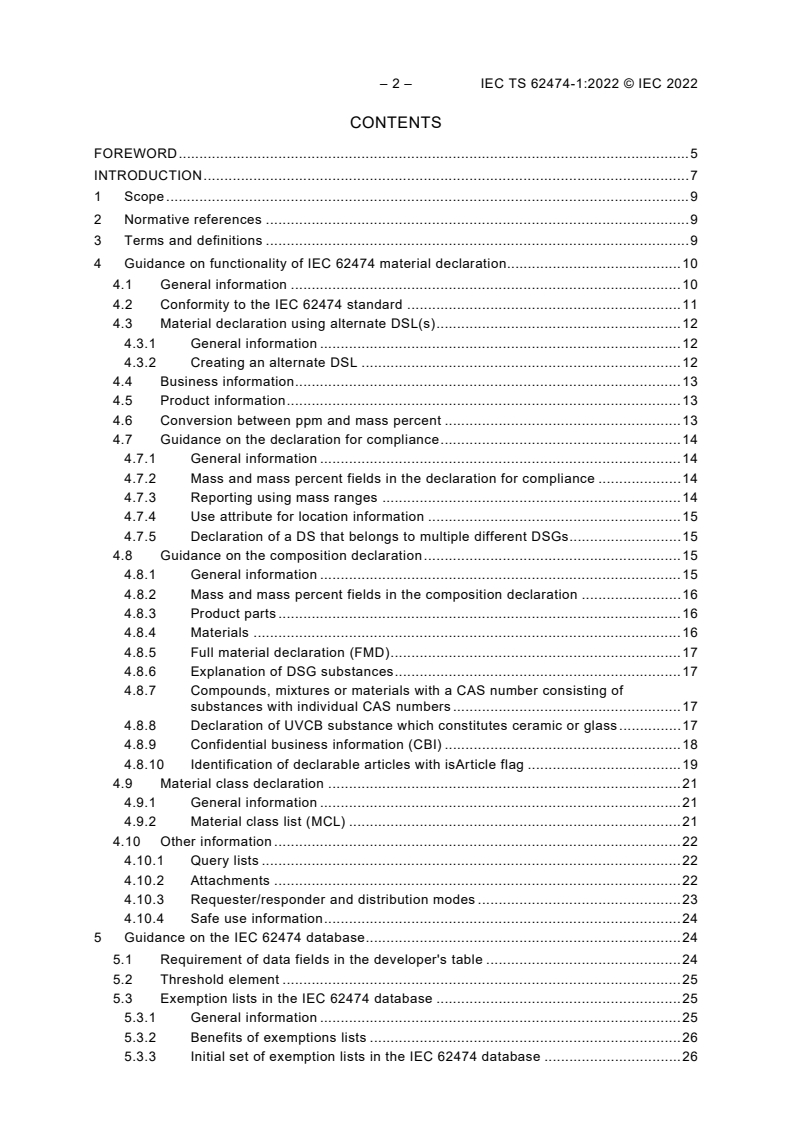
– 2 – IEC TS 62474-1:2022 © IEC 2022
CONTENTS
FOREWORD . 5
INTRODUCTION . 7
1 Scope . 9
2 Normative references . 9
3 Terms and definitions . 9
4 Guidance on functionality of IEC 62474 material declaration. 10
4.1 General information . 10
4.2 Conformity to the IEC 62474 standard . 11
4.3 Material declaration using alternate DSL(s) . 12
4.3.1 General information . 12
4.3.2 Creating an alternate DSL . 12
4.4 Business information . 13
4.5 Product information . 13
4.6 Conversion between ppm and mass percent . 13
4.7 Guidance on the declaration for compliance . 14
4.7.1 General information . 14
4.7.2 Mass and mass percent fields in the declaration for compliance . 14
4.7.3 Reporting using mass ranges . 14
4.7.4 Use attribute for location information . 15
4.7.5 Declaration of a DS that belongs to multiple different DSGs. 15
4.8 Guidance on the composition declaration . 15
4.8.1 General information . 15
4.8.2 Mass and mass percent fields in the composition declaration . 16
4.8.3 Product parts . 16
4.8.4 Materials . 16
4.8.5 Full material declaration (FMD) . 17
4.8.6 Explanation of DSG substances . 17
4.8.7 Compounds, mixtures or materials with a CAS number consisting of
substances with individual CAS numbers . 17
4.8.8 Declaration of UVCB substance which constitutes ceramic or glass . 17
4.8.9 Confidential business information (CBI) . 18
4.8.10 Identification of declarable articles with isArticle flag . 19
4.9 Material class declaration . 21
4.9.1 General information . 21
4.9.2 Material class list (MCL) . 21
4.10 Other information . 22
4.10.1 Query lists . 22
4.10.2 Attachments . 22
4.10.3 Requester/responder and distribution modes . 23
4.10.4 Safe use information . 24
5 Guidance on the IEC 62474 database . 24
5.1 Requirement of data fields in the developer's table . 24
5.2 Threshold element . 25
5.3 Exemption lists in the IEC 62474 database . 25
5.3.1 General information . 25
5.3.2 Benefits of exemptions lists . 26
5.3.3 Initial set of exemption lists in the IEC 62474 database . 26
5.3.4 Exemption lists in a material declaration . 26
6 Material declaration for EU SCIP database requirements . 27
6.1 Introduction to EU SCIP database . 27
6.2 IEC 62474 support for SCIP . 27
6.3 Product information for EU SCIP database . 28
6.4 Declaration for compliance for EU SCIP database . 29
6.4.1 Compliance element . 29
6.4.2 ProductPartInformation for declarable articles . 30
6.4.3 Data requirements considered as SCIP complete . 31
6.5 Composition declaration for EU SCIP database . 32
6.5.1 Declarable article reported as a product or product part . 32
6.5.2 Material element . 32
6.5.3 Material classification mapping to EU SCIP material categories . 33
6.5.4 Data requirements considered as SCIP complete . 34
7 Material declaration examples . 35
7.1 Overview. 35
7.2 General . 35
7.3 Examples . 36
7.3.1 General . 36
7.3.2 Example of business and product information . 37
7.3.3 Example of declaration for compliance . 41
7.3.4 Example of composition declaration . 46
7.3.5 Example of composition declaration including isFMD flag . 55
7.3.6 Example of material class declaration . 55
7.3.7 Example of declaration for compliance including the ECHA SCIP
information . 58
7.3.8 Example of composition declaration including the ECHA SCIP
information . 67
Annex A (informative) Guidance on how to declare substances of unknown or variable
composition, complex reaction products and biological materials (UVCBs). 78
Bibliography . 83
Figure 1 – IEC 62474 principles . 11
Figure 2 – Example of a product part that is an article . 19
Figure 3 – Example of a material that is an article . 19
Figure 4 – Example of a product containing more than one SVHC . 20
Figure 5 – SafeUse element . 24
Figure 6 – SCIP data fields in ProductID . 29
Figure 7 – Compliance element . 30
Figure 8 – ProductPartInformation element for the declarable articles . 31
Figure 9 – Material element supporting SCIP information . 33
Figure 10 – Excerpt from IEC 62474 material class to SCIP mapping table
(Version 1.0) . 34
Figure 11 – Material declaration capabilities . 35
Figure 12 – Product – Connector . 39
Figure 13 – Data model for a declaration for compliance . 43
Figure 14 – XML instance – Declaration for compliance requirements . 46
– 4 – IEC TS 62474-1:2022 © IEC 2022
Figure 15 – Data model for a composition declaration . 49
Figure 16 – XML instance of the composition declaration . 55
Figure 17 – Structure of the material class declaration . 56
Figure 18 – Material classes declaration – XML instance for 100 % of the product
composition . 58
Figure 19 – XML instance – Declaration for compliance including ECHA SCIP database
information . 67
Figure 20 – XML instance – Composition declaration with 'declarable article' including
the ECHA SCIP database information . 77
Table 1 – Conversion table from ppm to mass percent . 13
Table 2 – Use of query list . 22
Table 3 – Initial set of exemption lists in the IEC 62474 database . 26
Table 4 – Product level SCIP information . 28
Table 5 – Example of business information . 38
Table 6 – Configuration and main ingredient of a connector . 40
Table 7 – Example of product information . 41
Table 8 – Conformity assessment of the main ingredient of a connector . 42
Table 9 – Mapping between declaration for compliance requirements and DSs and
DSGs information . 44
Table 10 – Assessment of hierarchical structure and composition of connector . 47
Table 11 – Mapping between composition declaration requirements and DSs and
DSGs information . 50
Table 12 – Composition declaration – Material class information for 100 % of the
product composition . 56
Table 13 – Mapping between product information and the ECHA SCIP database . 58
Table 14 – Mapping between declaration for compliance requirements and the ECHA
SCIP database . 61
Table 15 – Mapping between composition declaration requirements including
'declarable article' and the ECHA SCIP database. 68
Table A.1 – Example of simple glass declaration by the JEITA method . 79
Table A.2 – Example of glass prepared with B2O3 by the JEITA method . 79
Table A.3 – Example of glass prepared with PbO by the JEITA method . 79
Table A.4 – Example of simple ceramic by the JEITA method . 80
Table A.5 – Example of ceramic containing PZT by the JEITA method . 80
Table A.6 – Example of simple glass by the IMDS method . 81
Table A.7 – Example of specific glass by the IMDS method . 81
Table A.8 – Example of glass containing lead by the IMDS method . 82
INTERNATIONAL ELECTROTECHNICAL COMMISSION
____________
MATERIAL DECLARATION FOR PRODUCTS OF AND
FOR THE ELECTROTECHNICAL INDUSTRY –
Part 1: Guidance on the implementation of IEC 62474
FOREWORD
1) The International Electrotechnical Commission (IEC) is a worldwide organization for standardization comprising
all national electrotechnical committees (IEC National Committees). The object of IEC is to promote international
co-operation on all questions concerning standardization in the electrical and electronic fields. To this end and
in addition to other activities, IEC publishes International Standards, Technical Specifications, Technical Reports,
Publicly Available Specifications (PAS) and Guides (hereafter referred to as “IEC Publication(s)”). Their
preparation is entrusted to technical committees; any IEC National Committee interested in the subject dealt with
may participate in this preparatory work. International, governmental and non-governmental organizations liaising
with the IEC also participate in this preparation. IEC collaborates closely with the International Organization for
Standardization (ISO) in accordance with conditions determined by agreement between the two organizations.
2) The formal decisions or agreements of IEC on technical matters express, as nearly as possible, an international
consensus of opinion on the relevant subjects since each technical committee has representation from all
interested IEC National Committees.
3) IEC Publications have the form of recommendations for international use and are accepted by IEC National
Committees in that sense. While all reasonable efforts are made to ensure that the technical content of IEC
Publications is accurate, IEC cannot be held responsible for the way in which they are used or for any
misinterpretation by any end user.
4) In order to promote international uniformity, IEC National Committees undertake to apply IEC Publications
transparently to the maximum extent possible in their national and regional publications. Any divergence between
any IEC Publication and the corresponding national or regional publication shall be clearly indicated in the latter.
5) IEC itself does not provide any attestation of conformity. Independent certification bodies provide conformity
assessment services and, in some areas, access to IEC marks of conformity. IEC is not responsible for any
services carried out by independent certification bodies.
6) All users should ensure that they have the latest edition of this publication.
7) No liability shall attach to IEC or its directors, employees, servants or agents including individual experts and
members of its technical committees and IEC National Committees for any personal injury, property damage or
other damage of any nature whatsoever, whether direct or indirect, or for costs (including legal fees) and
expenses arising out of the publication, use of, or reliance upon, this IEC Publication or any other IEC
Publications.
8) Attention is drawn to the Normative references cited in this publication. Use of the referenced publications is
indispensable for the correct application of this publication.
9) Attention is drawn to the possibility that some of the elements of this IEC Publication may be the subject of patent
rights. IEC shall not be held responsible for identifying any or all such patent rights.
IEC TS 62474-1 has been prepared by IEC technical committee 111: Environmental
standardization for electrical and electronic products and systems. It is a Technical
Specification.
This first edition of IEC TS 62474-1 cancels and replaces IEC TR 62474-1:2015.
This edition includes the following significant technical changes with respect to
IEC TR 62474-1:2015:
a) IEC TR 62474-1:2015 was revised and converted to a Technical Specification in
accordance with the requirements of the ISO/IEC Directives;
b) the introduction and scope have been updated to better align with the requirements of
IEC 62474:2018;
c) by defining an authority, list identity and list version, the standard data exchange format can
be used for lists other than the IEC 62474 database;
d) two types of material declarations, declaration for compliance and composition declaration,
and their requirements are defined;
– 6 – IEC TS 62474-1:2022 © IEC 2022
e) the material classes and exemption list capabilities have been improved;
f) guidance is provided on how to use data fields in the declaration of compliance and
composition declaration to collect the information required for the European Chemical
Agency (ECHA) Substances of Concern In articles, as such or in complex objects (Products)
(SCIP) database;
g) six examples of material declaration are given to show how IEC 62474 meets various
industry needs.
The text of this Technical Specification is based on the following documents:
Draft Report on voting
111/654/DTS 111/671/RVDTS
Full information on the voting for its approval can be found in the report on voting indicated in
the above table.
The language used for the development of this Technical Specification is English.
This document was drafted in accordance with ISO/IEC Directives, Part 2, and developed in
accordance with ISO/IEC Directives, Part 1 and ISO/IEC Directives, IEC Supplement, available
at www.iec.ch/members_experts/refdocs. The main document types developed by IEC are
described in greater detail at www.iec.ch/publications.
A list of all parts in the IEC 62474 series, published under the general title Material declaration
for products of and for the electrotechnical industry, can be found on the IEC website.
The committee has decided that the contents of this document will remain unchanged until the
stability date indicated on the IEC website under webstore.iec.ch in the data related to the
specific document. At this date, the document will be
• reconfirmed,
• withdrawn,
• replaced by a revised edition, or
• amended.
IMPORTANT – The "colour inside" logo on the cover page of this document indicates that it
contains colours which are considered to be useful for the correct understanding of its
contents. Users should therefore print this document using a colour printer.
INTRODUCTION
There are ever increasing legal regulations around the world along with supply chain
requirements that either restrict or require reporting or labeling the use of certain substances
in products. To determine a product compliance status, manufacturers need information about
the substances in the product that can be passed down the supply chain. This can include data
about materials as well as product parts used in products. This information can also be used
as one of the inputs in an environmentally conscious design process throughout the product life
cycles.
To make material declaration data readily available, the supply chain (including organizations
providing products to the electrotechnical industry) needs a standardized method to exchange
this type of data. The IEC 62474 standard is flexible for, not only identifying base requirements,
but also allowing all levels of additional reporting under defined rules, so that the data is
properly exchanged through the supply chain. The IEC 62474 standard uses a single format for
data exchange rather than relying on each customer's own format.
Broad implementation by electrotechnical industry and organizations can result in:
• material declaration data being available as part of the contract sales of products in the
electrotechnical industry,
• availability of material declaration data that is not dependent on an organization's size or
purchase volume,
• improvement of data quality, reduction of compliance costs and reduction of inefficiencies,
and
• faster assessments of products and materials compliance status.
Material declarations meeting the IEC 62474 standard provide data needed to make a
substance compliance assessment. They can also be used as part of the technical
documentation required to place products on the market in different regions. Examples are:
• the EU Restriction of Hazardous Substances (RoHS) Directive;
• the EU Registration, Evaluation, Authorisation and Restriction of Chemicals (REACH);
• the EU Eco-design Directive;
• the Administrative Measures for the Restriction of the Use of Hazardous Substances in
Electrical and Electronic Products (China RoHS 2).
Government authorities that issue substance restriction regulations need to have economic
methods to obtain substance data to conform to these requirements that allow for international
trade. IEC standards such as IEC 62474 are recognized by the World Trade Organization
(WTO). This means that government authorities can adopt IEC 62474 to provide an
economically feasible standard to its resident companies to get needed data from a supply chain
in order to achieve the substance restrictions and be assured that such rules facilitate
international trade and are in conformance with WTO standards.
Also, restricted substance regulations usually include exemptions for certain products based on
available technology or other issues. Exemptions are dynamic and often based on changes to
technology and products. This requires government resources to evaluate exemptions from
product suppliers and exemptions issued by other government authorities to determine
suitability. It is possible governments are not able to update exemptions based on a direct
referral to exemptions issued by other governments. This results in significant costs and time
lags to do analyses and grant updated exemptions, especially if government authorities lack
expertise or adequate funding to perform these tasks. If an exemption approved by a
government authority is not adopted in a timely manner, this can put the local economy at a
disadvantage because certain products cannot then be placed on the local market. In the case
of some product sectors, such as medical devices, this also can prevent access to life-saving
technologies.
– 8 – IEC TS 62474-1:2022 © IEC 2022
IEC 62474 now allows government authorities to adopt exemptions from other government
authorities by referencing the international IEC 62474 database. Since the IEC 62474 database
maintains current exemption lists, governments may rely on this database without additional
resources or time.
MATERIAL DECLARATION FOR PRODUCTS OF AND
FOR THE ELECTROTECHNICAL INDUSTRY –
Part 1: Guidance on the implementation of IEC 62474
1 Scope
This part of IEC 62474 is a guidance document to help organizations properly implement
IEC 62474. These organizations can be the ones creating tools for material data exchange and
those who submit and receive material declarations.
This document supports consistent implementation of IEC 62474, including how the procedures,
content, and form relating to material declarations for products can be further specified. It also
illustrates how to apply IEC 62474 to non-electrotechnical industries.
This document:
• illustrates the flexibility and functionality of the IEC 62474 standard including examples,
• illustrates how to achieve conformity with IEC 62474, including guidance on preparing a
declaration for compliance and a composition declaration, including mandatory and optional
declaration requirements,
• illustrates how IEC 62474 can be applied to non-electrotechnical industries by preparing
material declarations using an alternate declarable substance list (DSL),
• supports organizations that create software to exchange substance and material data to
implement IEC 62474 in their tools, and
• supports users that submit and receive material declarations.
Following the IEC 62474 standard scope, process chemicals, emissions during product use and
product packaging material are not in the scope of this document.
2 Normative references
The following documents are referred to in the text in such a way that some or all of their content
constitutes requirements of this document. For dated references, only the edition cited applies.
For undated references, the latest edition of the referenced document (including any
amendments) applies.
IEC 62474:2018, Material declaration for products of and for the electrotechnical industry
IEC 62474:2018/AMD1:2020
NOTE The requirements of IEC 62474:2018 were not changed substantially by IEC 62474:2018/AMD1:2020.
IEC 62474:2018/AMD1:2020 mainly explains certain requirements of IEC 62474:2018 more clearly and corrects
some editorial errors.
3 Terms and definitions
For the purposes of this document, the terms and definitions given in IEC 62474 and the
following apply.
– 10 – IEC TS 62474-1:2022 © IEC 2022
ISO and IEC maintain terminology databases for use in standardization at the following
addresses:
• IEC Electropedia: available at https://www.electropedia.org/
• ISO Online browsing platform: available at https://www.iso.org/obp
3.1
declarable article
article into which an instance of the substance of very high concern (SVHC) above 0,1 mass
percent was first incorporated
Note 1 to entry: The EU REACH regulation imposes requirements on product suppliers to identify SVHCs that are
present in their products above threshold. Following a European Court of Justice ruling, the European Chemical
Agency (ECHA) published a guidance document clarifying that the threshold level for reporting the SVHC is 0,1 % of
the first article in a product.
Note 2 to entry: The declarable article is sometimes referred to as the first article in the context of the EU REACH
regulation.
4 Guidance on functionality of IEC 62474 material declaration
4.1 General information
As shown in Figure 1, the IEC 62474 standard defines two types of material declarations and
their requirements:
1) The declaration for compliance provides the declaration at a product level in reference to
the list of declarable substances (DSs) and declarable substance groups (DSGs) within the
IEC 62474 DSL.
2) The composition declaration provides more detailed reporting of individual substances
contained within the IEC 62474 DSL. Reporting can be at material, product part or product
level as determined by regulatory requirements and contain very specific mass or mass
percent type of information.
IEC 62474 also provides the capability to declare a material class (such as stainless steel,
copper, gold, types of plastic), allow a higher level query to a set of questions (such as EU
REACH or EU RoHS compliance (true/false)), support exemptions used by a given product, and
include attachments for supporting documentation to a declaration or group of declarations.
At minimum either a declaration for compliance or a composition declaration shall be provided.
Both can be provided along with a material class declaration, a query list, an exemption list and
attachments. It is common for a query list to accompany a declaration for compliance or a
composition declaration. If exemptions are needed, they are used in conjunction with the
declaration for compliance and composition declaration. Both declarations can be
communicated either in the requester/responder mode or the distribution mode.
IEC 62474 specifies the use of a dedicated database (the IEC 62474 database) that lists
substances and substance groups requiring declaration. This provides certainty to suppliers
regarding what minimum data is required to report, regardless of a manufacturer's product or
customer location. The IEC 62474 database also includes a developer's table and XML schema
that specify data exchange format (hereinafter referred to as "IEC 62474 DXF") requirements,
material classes that may be used as an input to environmentally conscious design and
exemption lists that are specific to a single law or regulation. The IEC 62474 database is
maintained and regularly updated by global experts to meet changing legislation and broad
customer requirements. The database can be found at: http://std.iec.ch/IEC 62474.
Another important feature of IEC 62474 is the flexibility to use other lists than the IEC 62474
DSL. The same declaration format can now use lists from other industries.
Figure 1 – IEC 62474 principles
4.2 Conformity to the IEC 62474 standard
The IEC 62474 standard consists of several parts, including DXF, DSL, material class list (MCL)
and exemption lists (EL). A material declaration may utilize any or all of these parts. IEC 62474
states that a material declaration that is in full conformance with IEC 62474 would utilize, at a
minimum, the IEC 62474 DXL and the DSL. It also states that a material declaration may be in
conformance only with the IEC 62474 DXF or only with the IEC 62474 DSL, but if so, the
declaration can only declare conformance to the specific parts of the standard that is used.
Acceptable statements for declaring conformance are provided in IEC 62474.
The opportunity to declare conformance to just the IEC 62474 DXF enables the declaration
against other lists. If the material declaration meets the requirements of the IEC 62474 DXF but
utilizes an alternate DSL, the material declaration can be claimed to conform to the IEC 62474
DXF.
For a declaration to conform to the IEC 62474 DXF, it shall meet the declaration requirements
specified in IEC 62474:2018, Clause 4 and IEC 62474:2018/AMD1:2020, Clause 4, the format
requirements in the IEC 62474 XML schema and the additional requirements in the developer's
table.
IEC 62474 specifies that only substances that remain in the product are declared in the material
declaration. IEC 62474 also requires that process chemicals that react, form other chemicals,
or otherwise do not remain in the product shall not be included. For example, for a resin and a
hardener that are used to form epoxy in a product, the final epoxy substance should be declared
if it is a DS or as a voluntary declaration. The individual resin and hardener chemical can be
declared only if a residual amount of these chemicals remain in the product.
– 12 – IEC TS 62474-1:2022 © IEC 2022
4.3 Material declaration using alternate DSL(s)
4.3.1 General information
Today only a few sectors, such as automotive, aerospace and defence, electronics, have
developed a material declaration standard similar to IEC 62474. Owing to, on the one hand, the
increasing number of sectors being affected by specific or multi-sectoral policies and
legislations such as REACH and critical raw materials (CRMs), and on the other hand, suppliers
delivering the same goods to multiple sectors, the need for a generic DXF able to handle any
type of substance lists has never been greater.
IEC 62474:2018 has anticipated such need and included this requirement clearly in
IEC 62474:2018/AMD1:2020. IEC 62474:2018 allows for the handling of different substance
lists compared with the IEC 62474 DSL, provided that such lists have been prepared in
accordance with the IEC 62474 DSL format.
4.3.2 Creating an alternate DSL
When preparing an alternate DSL, an identifier (list authority, list identity, and list version) for
the DSL shall be available. Several fields in the list are mandatory, as follows:
• substance group;
• specific substance;
• CAS number;
• reportable application(s);
• reporting threshold level in product (unless otherwise specified);
• reporting level;
• reporting requirement.
Additionally, several fields in the list below should be populated, if applicable:
• common synonyms;
• substance clarification;
• typical applications or uses;
• basis for including;
• description of basis (specific regulatory citation or specific market demand);
• mass information requirements;
• first added;
• last revised;
• comments or footnotes.
Here below is a "hypothetical" example of an alternate DSL including authority, identity and
version information:
• authority: "CEN-CLC JTC10";
• identity: "CRM_DeclarableSubstances";
• version: "vD1.01;01-mar-2020".
4.4 Business information
Business information describes information of the enterprises that request and provide the
material declaration.
IEC 62474 allows the material declaration in local language as an option. In non-English-
speaking countries, when enterprises provide business information, the local language notation
can more accurately identify the names of the company and the person in charge. Therefore,
in addition to English, it is convenient to exchange business information in the local language.
4.5 Product information
Product information discloses specific details of the product(s) subject to the declaration,
including the product identification (e.g. model number, stock-keeping unit (SKU), part number)
and product mass.
To make a declaration for a product, one shall specify the unitType (for example, each, g, kg,
2 2 3 3
cm, m, cm , m , cm , l, m ) and provide the mass of 1 unitType of the product. For example,
the mass of 1 m of copper wire, the mass of 1 m of steel sheet, the mass of 1 litre of paint. For
discrete parts (e.g. resistors, capacitors, screws, housings), one should set the unitType to
'each'.
To make a declaration for a product family, one shall specify the identification and mass of each
product within the product family. If all products within the declaration have the same mass,
one mass entry for all products is sufficient.
Each product disclosed in the declaration shall be identified as an article (with the use of the
isArticle flag) if the product contains a DS or DSG substance(s) exceeding a reporting threshold
based on 'article'.
4.6 Conversion between ppm and mass percent
In the material declaration, either mass or mass percent for the substance, substance group,
material or product part can be used.
Many laboratories report concentrations in ppm. One ppm means 1 part in 1 000 000 like parts,
such as grams to gram basis. ppm is converted to mass percent for such cases by the formula
Mass percent = X ppm/10 000.
See Table 1 for conversion from ppm to mass percent.
Table 1 – Conversion table from ppm to mass percent
Mass percent ppm
% mg/kg
0,000 1 % 1
0,001 % 10
0,01 % 100
0,1 % 1 000
1,0 % 10 000
10,0 % 100 000
100,0 % 1 000 000
To convert from mass to mass percent, one divides the mass of DS or DSG by the mass of the
product, product part or material and then converts to percent.
– 14 – IEC TS 62474-1:2022 © IEC 2022
Mass percent = (mass of substance/mass of product, product part or material) × 100.
4.7 Guidance on the declaration for compliance
4.7.1 General information
The declaration for compliance provides a true/false statement to determine the product
compliance status. As a result of conformity assessment against each entry in a DSL, a
true/false statement indicates whether a DS or DSG is present at or above the reporting
threshold in the product. The DSL contains DSs and DSGs that require mandatory and optional
information provision. It is necessary to provide the information according to the DSL
descriptions and instructions. The declaration for compliance does not include information on
product build hierarchy, but contains sufficient information for the downstream manufacturer to
assess compliance against the regulations covered by the DSL.
Declaration for compliance is made at the product level. The material declarations collected
from the upstream of the supply chain are aggregated to determine the compliance for the
product. Information of compliance judgment is provided based on the mass percentage in
principle. However, some laws and regulations may also require total mass information of the
DS and DSG in the product.
4.7.2 Mass and mass percent fields in the declaration for compliance
In the declaration for compliance, if a DS or DSG with mandatory reporting requirements is
present in the product at or above the reporting threshold level for an applicable reportable
application, it is mandatory to declare mass percent information. The calculation of mass
percent is as follows:
1) Mass percent shall be calculated using the value specified as the threshold in the DSL as
the denominator. (In the IEC 62474 DSL, it is specified by MassInfoRequirements, for
example, mass percent of materials, mass percent of article, mass percent of product parts.)
2) The mass percent information can be passed along the supply chain. There is no need to
recalculate it unless the MassInfoRequirements applies to a different denominator.
3) If there are multiple occurrences of a DS or DSG present at or above the reporting threshold
within the product or product family, the occurrence with the highest mass percent shall be
declared. It can be necessary to indicate that there are multiple occurrences that are
equivalent and provide the location information.
4) If a DSG is a metal or metal compound, one can calculate the mass of the metal element
based on the metal compound molecular information (metal compound mass × metal
conversion factor) and declare the mass percent of metal. If a DSG is not a metal or metal
compound, one can declare the mass percent of the DSG substance as it is.
If the total mass information is required by MassInfoRequirements specified by the DSL, in
addition to the mass percent information, the total mass of the DS or DSG within the product
shall be declared. The total mass is required by some laws and regulations. Examples are:
• EU REACH;
• California Electronic Waste Recycling Act of 2003 (SB 20, Chapter 526, Statutes of 2003,
as amended by SB 50, Chapter 863, Statutes of 2004).
4.7.3 Reporting using mass ranges
An emerging trend in the reporting of certain DSs and DSGs is the need to report which of a
few specific mass ranges that a substance is present in instead of reporting the actual mass.
This is driven by regulations that focus on recycling of th
...