

IEC 60068-2-5:2010
(Main)Environmental testing - Part 2-5: Tests - Test Sa: Simulated solar radiation at ground level and guidance for solar radiation testing
General Information
- Abstract
IEC 60068-2-5:2010 provides guidance for testing equipment or components under solar radiation conditions. The purpose of testing is to investigate to what extent the equipment or components are affected by solar radiation. This second edition cancels and replaces the first edition of IEC 60068-2-5, published in 1975, and IEC 60068-2-9, published in 1975, and constitute a technical revision. The main changes with respect to the previous edition are listed below: This second edition of IEC 60068-2-5 will make the reading much easier, partly because it includes guidance for solar radiation testing, previously published in a separate publication, IEC 60068-2-9, and partly because it now allows the use of all lamps specified in CIE 85 and published in 1985 by the International commission on Illumination. The contents of the corrigendum of December 2010 have been included in this copy.
- Status
- Published
- Publication Date
- 26-Apr-2010
- Technical Committee
- TC 104 - Environmental conditions, classification and methods of test
- Drafting Committee
- MT 18 - TC 104/MT 18
- Current Stage
- DELPUB - Deleted Publication
- Start Date
- 06-Apr-2018
- Completion Date
- 28-Aug-2026
Overview
IEC 60068-2-5:2010 is an international standard published by the International Electrotechnical Commission (IEC) defining environmental testing procedures involving simulated solar radiation at ground level. The standard offers comprehensive guidance for testing how electrical and electronic equipment or components respond when exposed to solar radiation conditions. This testing helps determine the material durability, electrical performance, and mechanical stability under solar irradiance, simulating real-life exposure to sunlight.
This second edition of IEC 60068-2-5 updates and consolidates previous versions, including IEC 60068-2-9 from 1975, and allows the use of lamps specified in CIE 85 (1985) to simulate solar spectral irradiance more accurately. The standard provides test procedures, irradiance specifications, spectral energy distribution data, and recommended environmental conditions for reliable and repeatable solar radiation testing.
Key Topics
Scope and Purpose: IEC 60068-2-5 targets the evaluation of equipment sensitivity to solar radiation by simulating sunlight at the Earth's surface. It enables manufacturers and labs to assess material and component degradation due to ultraviolet (UV), visible, and infrared (IR) radiation.
Test Procedures: The standard describes several test cycles, including:
- Procedure A: 24-hour cycle with 8 hours irradiation and 16 hours darkness.
- Procedure B: 24-hour cycle with 20 hours irradiation and 4 hours darkness.
- Procedure C: Continuous irradiation as required.
Solar Irradiance and Spectral Distribution: The standard specifies using solar radiation levels based on a solar constant of 1367 W/m², adjusted for atmospheric attenuation and scattering. Spectral distribution definitions follow the International Commission on Illumination (CIE) 85 recommendations for realistic solar simulation.
Environmental Conditions: Tests incorporate parameters like temperature control, humidity, ozone presence, and surface contamination effects. Specimens must be mounted appropriately to ensure consistent exposure.
Measurement and Evaluation: Initial and final measurements are conducted to track electrical, mechanical, or physical changes in the tested components. Black standard or black panel temperature measurements are used to monitor specimen surface temperature during tests.
Applications
Durability Testing for Outdoor Equipment: IEC 60068-2-5 is widely used to evaluate solar radiation effects on photovoltaic panels, outdoor sensors, telecommunication devices, and other electrical components exposed to sunlight.
Material Stability Assessment: The standard helps in testing plastics, coatings, paints, and other materials subjected to UV and IR radiation to predict lifespan and failure modes.
Product Development and Quality Assurance: Manufacturers implement these tests during design stages and production to ensure product robustness, compliance with environmental resistance claims, and regulatory requirements.
Combined Environmental Simulations: The standard supports integration with other climatic tests like humidity (IEC 60068-2-78), dry heat (IEC 60068-2-2), and cold (IEC 60068-2-1), allowing versatile environmental stress screening.
Related Standards
- IEC 60068-1: General and guidance provisions for environmental testing methods.
- IEC 60068-2-1: Testing under cold conditions.
- IEC 60068-2-2: Dry heat tests.
- IEC 60068-2-78: Damp heat steady-state testing.
- CIE 20:1972: Recommendations for spectral distribution of simulated solar radiation.
- CIE 85:1985: Solar spectral irradiance definitions critical for lamp and irradiance calibration.
Practical Value
Following IEC 60068-2-5 enables precise solar radiation simulation crucial for verifying equipment resistance to sunlight exposure, a significant factor impacting reliability and safety in outdoor and high-exposure environments. This standard is essential for industries including renewable energy, automotive, aerospace, telecommunications, and consumer electronics that demand long-term durability against solar aging effects.
Adopting IEC 60068-2-5:2010 ensures adherence to internationally recognized testing protocols, facilitating global market acceptance and reducing product failures caused by solar radiation stress. It supports sustainable product engineering by helping to design components that withstand harsh solar environments over their operational lifetime.
Relations
- Replaces
IEC 60068-2-9:1975 - Environmental testing - Part 2: Tests. Guidance for solar radiation testing - Effective Date
- 05-Sep-2023
- Effective Date
- 25-Aug-2026
- Effective Date
- 25-Aug-2026
- Effective Date
- 05-Sep-2023
- Effective Date
- 05-Sep-2023
Get Certified
Connect with accredited certification bodies for this standard

IMP NDT d.o.o.
Non-destructive testing services. Radiography, ultrasonic, magnetic particle, penetrant, visual inspection.
Inštitut za kovinske materiale in tehnologije
Institute of Metals and Technology. Materials testing, metallurgical analysis, NDT.
Q Techna d.o.o.
NDT and quality assurance specialist. 30+ years experience. NDT personnel certification per ISO 9712, nuclear and thermal power plant inspections, QA/
Sponsored listings
Frequently Asked Questions
IEC 60068-2-5:2010 is a standard published by the International Electrotechnical Commission (IEC). Its full title is "Environmental testing - Part 2-5: Tests - Test Sa: Simulated solar radiation at ground level and guidance for solar radiation testing". This standard covers: IEC 60068-2-5:2010 provides guidance for testing equipment or components under solar radiation conditions. The purpose of testing is to investigate to what extent the equipment or components are affected by solar radiation. This second edition cancels and replaces the first edition of IEC 60068-2-5, published in 1975, and IEC 60068-2-9, published in 1975, and constitute a technical revision. The main changes with respect to the previous edition are listed below: This second edition of IEC 60068-2-5 will make the reading much easier, partly because it includes guidance for solar radiation testing, previously published in a separate publication, IEC 60068-2-9, and partly because it now allows the use of all lamps specified in CIE 85 and published in 1985 by the International commission on Illumination. The contents of the corrigendum of December 2010 have been included in this copy.
IEC 60068-2-5:2010 provides guidance for testing equipment or components under solar radiation conditions. The purpose of testing is to investigate to what extent the equipment or components are affected by solar radiation. This second edition cancels and replaces the first edition of IEC 60068-2-5, published in 1975, and IEC 60068-2-9, published in 1975, and constitute a technical revision. The main changes with respect to the previous edition are listed below: This second edition of IEC 60068-2-5 will make the reading much easier, partly because it includes guidance for solar radiation testing, previously published in a separate publication, IEC 60068-2-9, and partly because it now allows the use of all lamps specified in CIE 85 and published in 1985 by the International commission on Illumination. The contents of the corrigendum of December 2010 have been included in this copy.
IEC 60068-2-5:2010 is classified under the following ICS (International Classification for Standards) categories: 19.040 - Environmental testing. The ICS classification helps identify the subject area and facilitates finding related standards.
IEC 60068-2-5:2010 has the following relationships with other standards: It is inter standard links to IEC 60068-2-9:1975, EN ISO 10374:1997, EN 15859:2010, IEC 60068-2-5:2010/COR1:2010, IEC 60068-2-5:2018. Understanding these relationships helps ensure you are using the most current and applicable version of the standard.
IEC 60068-2-5:2010 is available in PDF format for immediate download after purchase. The document can be added to your cart and obtained through the secure checkout process. Digital delivery ensures instant access to the complete standard document.
Standards Content (Sample)
IEC 60068-2-5 ®
Edition 2.0 2010-04
INTERNATIONAL
STANDARD
NORME
INTERNATIONALE
Environmental testing –
Part 2-5: Tests – Test Sa: Simulated solar radiation at ground level and guidance
for solar radiation testing
Essais d’environnement –
Partie 2-5: Essais – Essai Sa: Rayonnement solaire simulé au niveau du sol et
guide pour les essais de rayonnement solaire
All rights reserved. Unless otherwise specified, no part of this publication may be reproduced or utilized in any form or by
any means, electronic or mechanical, including photocopying and microfilm, without permission in writing from either IEC or
IEC's member National Committee in the country of the requester.
If you have any questions about IEC copyright or have an enquiry about obtaining additional rights to this publication,
please contact the address below or your local IEC member National Committee for further information.
Droits de reproduction réservés. Sauf indication contraire, aucune partie de cette publication ne peut être reproduite
ni utilisée sous quelque forme que ce soit et par aucun procédé, électronique ou mécanique, y compris la photocopie
et les microfilms, sans l'accord écrit de la CEI ou du Comité national de la CEI du pays du demandeur.
Si vous avez des questions sur le copyright de la CEI ou si vous désirez obtenir des droits supplémentaires sur cette
publication, utilisez les coordonnées ci-après ou contactez le Comité national de la CEI de votre pays de résidence.
IEC Central Office
3, rue de Varembé
CH-1211 Geneva 20
Switzerland
Email: inmail@iec.ch
Web: www.iec.ch
About the IEC
The International Electrotechnical Commission (IEC) is the leading global organization that prepares and publishes
International Standards for all electrical, electronic and related technologies.
About IEC publications
The technical content of IEC publications is kept under constant review by the IEC. Please make sure that you have the
latest edition, a corrigenda or an amendment might have been published.
ƒ Catalogue of IEC publications: www.iec.ch/searchpub
The IEC on-line Catalogue enables you to search by a variety of criteria (reference number, text, technical committee,…).
It also gives information on projects, withdrawn and replaced publications.
ƒ IEC Just Published: www.iec.ch/online_news/justpub
Stay up to date on all new IEC publications. Just Published details twice a month all new publications released. Available
on-line and also by email.
ƒ Electropedia: www.electropedia.org
The world's leading online dictionary of electronic and electrical terms containing more than 20 000 terms and definitions
in English and French, with equivalent terms in additional languages. Also known as the International Electrotechnical
Vocabulary online.
ƒ Customer Service Centre: www.iec.ch/webstore/custserv
If you wish to give us your feedback on this publication or need further assistance, please visit the Customer Service
Centre FAQ or contact us:
Email: csc@iec.ch
Tel.: +41 22 919 02 11
Fax: +41 22 919 03 00
A propos de la CEI
La Commission Electrotechnique Internationale (CEI) est la première organisation mondiale qui élabore et publie des
normes internationales pour tout ce qui a trait à l'électricité, à l'électronique et aux technologies apparentées.
A propos des publications CEI
Le contenu technique des publications de la CEI est constamment revu. Veuillez vous assurer que vous possédez
l’édition la plus récente, un corrigendum ou amendement peut avoir été publié.
ƒ Catalogue des publications de la CEI: www.iec.ch/searchpub/cur_fut-f.htm
Le Catalogue en-ligne de la CEI vous permet d’effectuer des recherches en utilisant différents critères (numéro de référence,
texte, comité d’études,…). Il donne aussi des informations sur les projets et les publications retirées ou remplacées.
ƒ Just Published CEI: www.iec.ch/online_news/justpub
Restez informé sur les nouvelles publications de la CEI. Just Published détaille deux fois par mois les nouvelles
publications parues. Disponible en-ligne et aussi par email.
ƒ Electropedia: www.electropedia.org
Le premier dictionnaire en ligne au monde de termes électroniques et électriques. Il contient plus de 20 000 termes et
définitions en anglais et en français, ainsi que les termes équivalents dans les langues additionnelles. Egalement appelé
Vocabulaire Electrotechnique International en ligne.
ƒ Service Clients: www.iec.ch/webstore/custserv/custserv_entry-f.htm
Si vous désirez nous donner des commentaires sur cette publication ou si vous avez des questions, visitez le FAQ du
Service clients ou contactez-nous:
Email: csc@iec.ch
Tél.: +41 22 919 02 11
Fax: +41 22 919 03 00
IEC 60068-2-5 ®
Edition 2.0 2010-04
INTERNATIONAL
STANDARD
NORME
INTERNATIONALE
Environmental testing –
Part 2-5: Tests – Test Sa: Simulated solar radiation at ground level and guidance
for solar radiation testing
Essais d’environnement –
Partie 2-5: Essais – Essai Sa: Rayonnement solaire simulé au niveau du sol et
guide pour les essais de rayonnement solaire
INTERNATIONAL
ELECTROTECHNICAL
COMMISSION
COMMISSION
ELECTROTECHNIQUE
PRICE CODE
INTERNATIONALE
R
CODE PRIX
ICS 19.040 ISBN 978-2-88910-035-4
– 2 – 60068-2-5 Ó IEC:2010
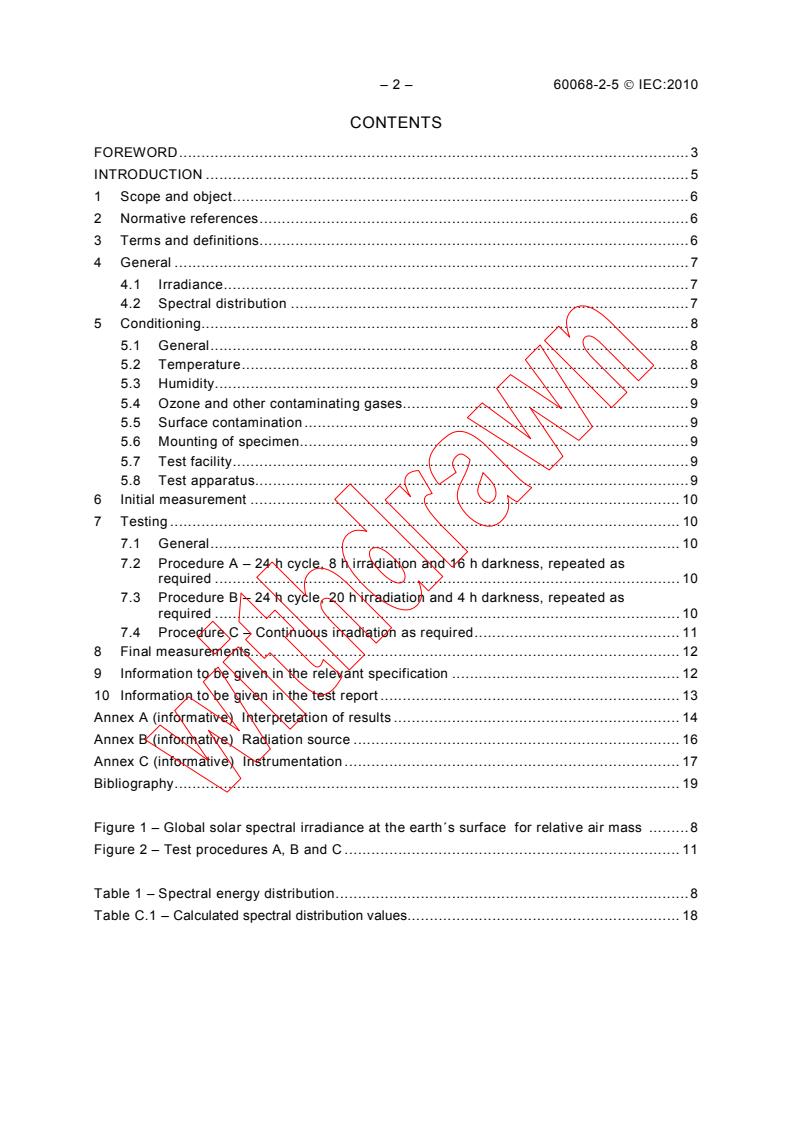
CONTENTS
FOREW ORD . 3
INTRODUCTION . 5
1 Scope and object . 6
2 Normative references . 6
3 Terms and definitions . 6
4 General . 7
4.1 Irradiance . 7
4.2 Spectral distribution . 7
5 C o n di t ioning . 8
5.1 Ge n eral . 8
5.2 Temperature . 8
5.3 H umidi t y . 9
5.4 Ozone and other contaminating gases . 9
5.5 Surface contamination . 9
5.6 Mounting of specimen . 9
5.7 Test facility . 9
5.8 Test apparatus . 9
6 Initial measurement . 10
7 Testing . 10
7.1 General . 10
7.2 Procedure A – 24 h cycle, 8 h irradiation and 16 h darkness, repeated as
required . 10
7.3 Procedure B – 24 h cycle, 20 h irradiation and 4 h darkness, repeated as
required . 10
7.4 Procedure C – Continuous irradiation as required . 11
8 Final measurements. 12
9 Information to be given in the relevant specification . 12
10 Information to be given in the test report . 13
Annex A (informative) Interpretation of results . 14
Annex B (informative) Radiation source . 16
Annex C (informative) Instrumentation . 17
Bibliography . 19
Figure 1 – Global solar spectral irradiance at the earth´s surface for relative air mass . 8
Figure 2 – Test procedures A, B and C . 11
Table 1 – Spectral energy distribution . 8
Table C.1 – Calculated spectral distribution values. 18
60068-2-5 Ó IEC:2010 – 3 –
INTERNATIONAL ELECTROTECHNICAL COMMISSION
____________
ENVIRONMENTAL TESTING –
Part 2-5: Tests – Test Sa: Simulated solar radiation at
ground level and guidance for solar radiation testing
FOREWORD
1) The International Electrotechnical Commission (IEC) is a worldwide organization for standardization comprising
all national electrotechnical committees (IEC National Committees). The object of IEC is to promote
international co-operation on all questions concerning standardization in the electrical and electronic fields. To
this end and in addition to other activities, IEC publishes International Standards, Technical Specifications,
Technical Reports, Publicly Available Specifications (PAS) and Guides (hereafter referred to as “IEC
Publication(s)”). Their preparation is entrusted to technical committees; any IEC National Committee interested
in the subject dealt with may participate in this preparatory work. International, governmental and non-
governmental organizations liaising with the IEC also participate in this preparation. IEC collaborates closely
with the International Organization for Standardization (ISO) in accordance with conditions determined by
agreement between the two organizations.
2) The formal decisions or agreements of IEC on technical matters express, as nearly as possible, an international
consensus of opinion on the relevant subjects since each technical committee has representation from all
interested IEC National Committees.
3) IEC Publications have the form of recommendations for international use and are accepted by IEC National
Committees in that sense. While all reasonable efforts are made to ensure that the technical content of IEC
Publications is accurate, IEC cannot be held responsible for the way in which they are used or for any
misinterpretation by any end user.
4) In order to promote international uniformity, IEC National Committees undertake to apply IEC Publications
transparently to the maximum extent possible in their national and regional publications. Any divergence
between any IEC Publication and the corresponding national or regional publication shall be clearly indicated in
the latter.
5) IEC itself does not provide any attestation of conformity. Independent certification bodies provide conformity
assessment services and, in some areas, access to IEC marks of conformity. IEC is not responsible for any
services carried out by independent certification bodies.
6) All users should ensure that they have the latest edition of this publication.
7) No liability shall attach to IEC or its directors, employees, servants or agents including individual experts and
members of its technical committees and IEC National Committees for any personal injury, property damage or
other damage of any nature whatsoever, whether direct or indirect, or for costs (including legal fees) and
expenses arising out of the publication, use of, or reliance upon, this IEC Publication or any other IEC
Publications.
8) Attention is drawn to the Normative references cited in this publication. Use of the referenced publications is
indispensable for the correct application of this publication.
9) Attention is drawn to the possibility that some of the elements of this IEC Publication may be the subject of
patent rights. IEC shall not be held responsible for identifying any or all such patent rights.
International Standard IEC 60068-2-5 has been prepared by IEC technical committee 104:
Environmental conditions, classification and methods of test.
This second edition cancels and replaces the first edition of IEC 60068-2-5, published in
1975, and IEC 60068-2-9, published in 1975, and constitutes a technical revision.
The main changes with respect to the previous edition are listed below:
This second edition of IEC 60068-2-5 will make the reading much easier, partly because it
includes guidance for solar radiation testing, previously published in a separate publication,
IEC 60068-2-9, and partly because it now allows the use of all lamps specified in CIE 85 and
published in 1985 by the International commission on Illumination.
– 4 – 60068-2-5 Ó IEC:2010
The text of this standard is based on the following documents:
FDIS Report on voting
104/500/FDIS 104/515/RVD
Full information on the voting for the approval of this standard can be found in the report on
voting indicated in the above table.
This publication has been drafted in accordance with the ISO/IEC Directives, Part 2.
A list of all the parts in the IEC 60068 series, under the general title Environmental testing,
can be found on the IEC website.
The committee has decided that the contents of this publication will remain unchanged until
the stability date indicated on the IEC web site under "http://webstore.iec.ch" in the data
related to the specific publication. At this date, the publication will be
reconfirmed,
withdrawn,
replaced by a revised edition, or
amended.
The contents of the corrigendum of December 2010 have been included in this copy.
60068-2-5 Ó IEC:2010 – 5 –
INTRODUCTION
This part of IEC 60068 describes methods of simulation designed to examine the effect of
solar radiation on equipment and components at the surface of the earth. The main
characteristics of the environment to be simulated are the spectral energy distribution of the
sun, as observed at the earth's surface, and the intensity of received energy, in combination
with controlled temperature conditions. However, it may be necessary to consider a
combination of solar radiation with other environments, e.g. temperature, humidity, air
velocity, etc.
– 6 – 60068-2-5 Ó IEC:2010
ENVIRONMENTAL TESTING –
Part 2-5: Tests – Test Sa: Simulated solar radiation at
ground level and guidance for solar radiation testing
1 Scope and object
This part of IEC 60068 provides guidance for testing equipment or components under solar
radiation conditions.
The purpose of testing is to investigate to what extent the equipment or components are
affected by solar radiation.
The method of combined tests detects electrical, mechanical or other physical variations.
2 Normative references
The following referenced documents are indispensable for the application of this document.
For dated references, only the edition cited applies. For undated references, the latest edition
of the referenced document (including any amendments) applies.
IEC 60068-1, Environmental testing – Part 1: General and guidance
IEC 60068-2-1, Environmental testing – Part 2-1: Tests – Test A: Cold
IEC 60068-2-2, Environmental testing – Part 2-2: Tests – Test B: Dry heat
IEC 60068-2-78, Environmental testing – Part 2-78: Tests – Test Cab: Damp heat, steady
state
CIE 20:1972, Recommendation for the integrated irradiance and the spectral distribution of
simulated solar radiation for testing purposes
CIE 85:1985, Solar spectral irradiance
3 Terms and definitions
For the purposes of this document, the terms and definitions given in IEC 60068-1, as well as
the following, apply.
3.1
air mass
path length that light from a celestial object takes through the earth’s atmosphere relative to
the length where air mass = 1
NOTE The air mass is 1/sin (gamma), where gamma is the elevation angle of the sun.
3.2
black standard temperature
BST
characteristic value of the specimen surface temperature
NOTE Black standard temperature as measured by a black standard thermometer (see ISO 4892-1).
60068-2-5 Ó IEC:2010 – 7 –
3.3
black panel temperature
characteristic value of the specimen surface temperature
NOTE Black panel temperature as measured by a black panel thermometer (see ISO 4892-1).
3.4
solar constant
rate at which solar energy, at all wavelengths, is received per unit area at the top level of
earth’s atmosphere
NOTE The value of the solar constant is E = 1 367 W/m .
3.5
optical depth
measure of how much light is absorbed in travelling through a medium
NOTE A completely transparent medium has an optical depth of zero.
4 General remarks
4.1 Overview
The effect of radiation on the specimen will depend on the level of irradiance, the spectral
distribution, the location, the time of day and the sensitivity of the material of the specimen.
4.2 Irradiance
The irradiance by the sun on a plane perpendicular to the incident radiation outside the
earth's atmosphere at the mean earth-sun distance is known as the solar constant E .
The irradiance at the surface of the earth is influenced by the solar constant and the
attenuation and scattering of radiation in the atmosphere. For test purposes, CIE 85 gives a
value of 1 090 W/m for the global radiation at the surface of the earth from sun at zenith;
value based on a solar constant E = 1 367 W/m .
4.3 Spectral distribution
The standard spectral distribution of the global radiation specified for this test, in accordance
with the recommendations of the CIE 85, is given in Figure 1 and in Table 1.
– 8 – 60068-2-5 Ó IEC:2010
2 000
1 600
1 200
0,3 0,7 1,1 1,5 1,9 2,3
Wavelength (mm)
IEC 640/10
NOTE Optical depth of aerosol extinction 0,1 (solid line) and 0,27 (dashes), respectively.
Figure 1 – Global solar spectral irradiance at the earth´s surface
for relative air mass 1
Table 1 – Spectral energy distribution
Spectral Total
*
Ultra-violet B Ultra-violet A Visible Infra-red
region radiation
Bandwidth 320 nm to 400 nm to 800 nm to
300 nm to 300 nm to
400 nm 800 nm 2 450 nm
320 nm 2 450 nm
2 2 2 2 2
Irradiance 4,06 W/m 70,5 W/m 604,2 W/m 411,2 W/m 1 090 W/m
Approximate 0,4 % 6,4 % 55,4 % 37,8 % 100 %
proportion of
total radiation
* Radiation shorter than 300 nm reaching the earth’s surface is insignificant.
If the source of radiation used for the test does not meet the standard spectral distribution
given in Table 1, the exact spectral absorption data of the material and the exact spectral
irradiance of the alternative radiation source in the range from 300 nm to about 3 000 nm and
for the solid angle of 2π sr above the specimen surface shall be known or measured.
5 Conditioning
5.1 General
During the entire test, the irradiation, the temperature within the chamber, the humidity and
any other specified environmental conditions shall be maintained at the levels appropriate to
the particular test procedure specified in the relevant specification. The relevant specification
shall state which preconditioning requirements are to be applied.
5.2 Temperature
The temperature within the chamber during irradiation and darkness periods shall be
controlled in accordance with the procedure (A, B or C) specified. During irradiation, the
–2 –1
Spectral irradiance (Wm mm )
60068-2-5 Ó IEC:2010 – 9 –
temperature within the chamber shall rise or fall by 1 K/min and be maintained at one of the
preferred values given in IEC 60068-2-1, IEC 60068-2-2 or the relevant specification.
NOTE Additionally, a black standard thermometer or a black panel thermometer can be used to measure the
maximum surface temperature. By ventilation, this temperature can be influenced.
5.3 Humidity
Different humidity conditions, particularly condensation, can markedly affect photochemical
degradation of materials, paints, plastics, etc. If required, the values of IEC 60068-2-78 shall
be preferred.
The relevant specification shall state the humidity and whether it is to be maintained during
a) the irradiation periods only;
b) the periods of darkness only;
c) the whole test duration.
5.4 Ozone and other contaminating gases
Ozone, generated by short wavelength ultra-violet of test sources, will normally be excluded
from the test chamber by the radiation filter(s) used to correct the spectral energy distribution.
As ozone and other contaminating gases can significantly affect the degradation processes of
certain materials, it is important to exclude these gases from the test chamber, unless
otherwise required by the relevant specification.
5.5 Surface contamination
Dust and other surface contamination may significantly change the absorption characteristics
of irradiated surfaces. Unless otherwise required, specimens should be tested in a clean
condition. However, if effects of surface contamination are to be assessed, the relevant
specification should include the necessary information on preparation of surfaces, etc.
5.6 Mounting of specimen
The specimen to be tested shall be placed either on raised support, on a turntable or a
specified substrate of known thermal conductivity and thermal capacity within the chamber as
stated in the relevant specification, and so spaced from other specimens as to avoid shielding
from the source of radiation or re-radiated heat. Temperature sensors should be attached to
specimen as required.
5.7 Test facility
It shall be ensured that the optical parts of the test facility, lamps, reflectors and filters, etc.
are clean.
The level of irradiation over the specified measurement plane shall be measured immediately
prior to each test.
Any ancillary environmental conditions, e.g. ambient temperature, humidity and other
parameters if specified, should be monitored continuously throughout the test.
5.8 Test apparatus
The chamber in which the tests are to be carried out shall be provided with means for
obtaining, over the prescribed irradiation measurement plane, an irradiance of 1 090 W/m
± 10 % with the spectral distribution given in Table 1. The value of 1 090 W/m shall include
any radiation reflected from the test chamber and received by the specimen under test. It
should not include long-wave infra-red radiation emitted by the test chamber.
– 10 – 60068-2-5 Ó IEC:2010
Means shall also be provided whereby the specified conditions of temperature, air flow and
humidity can be maintained within the chamber.
The temperature within the chamber shall be measured (with adequate shielding from
radiated heat) at a point or points in a horizontal plane 0 mm to 50 mm below the prescribed
irradiation measurement plane, at half the distance between the specimen under test and the
wall of the chamber, or at 1 m from the specimen, whichever is the lesser.
6 Initial measurement
The specimen shall be submitted to the visual, dimensional and functional checks prescribed
by the relevant specification.
7 Testing
7.1 General
During exposure, the temperature within the chamber shall rise or fall by 1 K/min and be
maintained at one of the preferred values given in IEC 60068-2-1 or IEC 60068-2-2 or the
relevant specification.
In procedure A, the temperature within the chamber shall start to rise 2 h before the
irradiation period starts.
During the darkness period in procedures A and B, the temperature within the chamber shall
fall approximately with 1 K/min and be maintained at +25 °C. If the required temperature is
lower than 25 °C, the temperature shall be maintained at the required temperature.
The requirements for irradiation, temperature and time relationships are given in Figure 2.
Throughout the specified test duration, the temperature within the chamber shall be
maintained within ±2 °C of that shown for the appropriate procedure.
The level of irradiance should be 1 090 W/m ± 10 % or specified in the relevant specification.
Acceleration of the test by increasing the irradiation above this level is not recommended. The
total daily irradiation approximating the most severe natural conditions is simulated by
procedure A with a duration of exposure to the standard irradiation conditions of 8 h per day.
Thus, exposure for periods in excess of 8 h will effect acceleration over natural conditions.
However, continuous exposure of 24 h per day, procedure C, might mask any degradation
effects of cyclic thermal stressing, and this procedure is therefore not generally recommended
in this instance.
The specimen shall be exposed, for the duration called for in the relevant specification, to one
of the following test procedures (see Figure 2).
7.2 Procedure A – 24 h cycle, 8 h irradiation and 16 h darkness, repeated as required
This gives a total irradiation of 8,96 kWh/m per diurnal cycle, which approximates to the most
severe natural conditions. Procedure A should be specified where the principal interest is in
thermal effects.
7.3 Procedure B – 24 h cycle, 20 h irradiation and 4 h darkness, repeated as required
This gives a total irradiation of 22,4 kWh/m per diurnal cycle and is applicable where the
principal interest is in degradation effects.
60068-2-5 Ó IEC:2010 – 11 –
7.4 Procedure C – Continuous irradiation as required
A simplified test, applicable where cyclic thermal stressing is unimportant and photochemical
effects only are to be assessed. Also for the assessment of heating effects on specimens with
low thermal capacity.
Procedure A
1 cycle
T
T
Irradiation
0 8 Time (h) 24
Procedure B
1 cycle
T
T
Irradiation
0 Time (h) 20 24
Procedure C
T
T
Continuous irradiation
Time (h)
Key
T lower temperature (25 °C if not otherwise specified)
T upper temperature (40 °C if not otherwise specified)
Figure 2 – Test procedures A, B and C
– 12 – 60068-2-5 Ó IEC:2010
8 Final measurements
The specimen shall be submitted to the visual, dimensional and functional checks prescribed
by the relevant specification.
9 Information to be given in the relevant specification
The relevant specification shall contain the following details as far as they are applicable:
a) exposure time to radiation;
b) black standard temperarure or black panel temperature;
c) power of radiation;
d) duration of the test;
e) state of operation;
f) preconditioning;
g) number of specimens;
h) humidity if relevant;
i) type and scope of initial measurement;
j) test procedure;
k) temperature during the test;
l) period of operation;
m) type and scope of intermediate measurement;
n) recovery;
o) type and scope of final measurement;
p) criteria for evaluation;
q) description of specimen support used for testing.
60068-2-5 Ó IEC:2010 – 13 –
10 Information to be given in the test report
When this test is included in the relevant specification, the following details shall be given,
where applicable:
a) Test laboratory (name and address and details of
accreditation – if any)
b) Test dates (dates when test was run)
c) Customer (name and address)
d) Type of test (procedure A, B, C)
e) Required values (temperature, humidity, radiation, etc.)
f) Purpose of test (development, qualification, etc.)
g) Test standard, edition (IEC 60068-2-5, edition used)
h) Relevant laboratory test procedure (code and issue)
i) Test specimen description (drawing, photo, quantity build status, etc.)
j) Test chamber (manufacturer, model number, unique id,
etc.)
k) Performance of test apparatus (set point temperature control, etc.)
l) Uncertainties of measurement system (uncertainties data)
m) Calibration data (last and next due date)
n) Initial, intermediate and final (Initial, intermediate and final measurements)
measurements
o) Required severities (from relevant specification)
p) Test severities (measuring points, data, etc.)
q) Performance of test specimens (results of functional tests, etc.)
r) Observations during testing and actions (any pertinent observations)
taken
s) Summary of test (test summary)
t) Distribution (distribution list)
– 14 – 60068-2-5 Ó IEC:2010
Annex A
(informative)
Interpretation of results
A.1 Compliance with specification
The relevant specification should indicate the permitted changes in the external condition
and/or performance of the specimen(s) under test after exposure to the required level of
irradiation for specified durations. In addition to such requirements, the following aspects of
interpretation may be considered.
A.2 Short-term effects
Primarily, heating effects are concerned. Short-term effects to be looked for will mainly be in
the nature of local overheating.
A.3 Long-term effects
The purpose of carrying out long-term tests is to determine the pattern of deterioration with
the two objectives of seeing whether there is an initial rapid change and of assessing the
useful life of the item under test.
A.4 Thermal effects
The maximum surface and internal temperatures attained by a specimen or equipment will
depend on
a) temperature of ambient air,
b) intensity of radiation,
c) air velocity,
d) duration of exposure,
e) the thermal properties of the object itself, e.g. surface reflectance, sizes and shape,
thermal conductance and specific heat.
Equipment can attain temperatures in excess of 80 °C if fully exposed to solar radiation in an
ambient temperature as low as 35 °C to 40 °C. The surface reflectance of an object affects its
temperature rise from solar heating to a major extent; changing the finish from, for example, a
dark colour to a gloss white, will effect a considerable reduction in temperature. Conversely, a
pristine finish designed to reduce temperature can be expected to deteriorate in time,
resulting in an increase in temperature.
Most materials are selective reflectors, i.e. their spectral reflectance factor changes with
wavelength. For instance, paints, in general, are poor infra-red reflectors although they may
be very efficient in the visible region. Furthermore, the spectral reflectance factor of many
materials change sharply once visible (producing a colour sensation to the human eye) and
when in the near infra-red zone. It is important, therefore, that the spectral energy distribution
of the radiation source(s) used in any simulated test should closely duplicate that of natural
solar radiation, or that appropriate adjustment of the irradiance is made so that the same
heating effect is obtained.
60068-2-5 Ó IEC:2010 – 15 –
A.5 Degradation of materials
The combined effects of solar radiation, atmospheric gases, temperature and humidity
changes, etc. are often collectively termed “weathering” and result in the “ageing” and
ultimate destruction of most organic materials (e.g. plastics, rubbers, paints, timber, etc.).
Many materials which give satisfactory service in temperate regions have been found to be
completely unsuitable for use under the more adverse conditions of the tropics. Typical
defects are the rapid deterioration and breakdown of paints, the cracking and disintegration of
cable sheathing and the fading of pigments.
The breakdown of a material under weathering usually results not from a single reaction, but
from several individual reactions of different types occurring simultaneously, often with
interacting effects. Although solar radiation, principally the ultra-violet – resulting in photo-
degradation – is often the major factor, its effects can seldom be separated in practice from
those of other weathering factors. An example is the effect of ultra-violet radiation on polyvinyl
chloride, where the apparent effects of ultra-violet radiation alone is small but its susceptibility
to thermal breakdown, in which oxygen probably plays a major role, is markedly increased.
Unfortunately, artificial tests occasionally produce abnormal defects which do not occur under
natural weathering. This can often be attributed to one or more of the following causes:
a) many laboratory sources of ultra-violet radiation differ considerably from natural solar
radiation in spectral energy distribution;
b) when the intensity of ultra-violet radiation, temperature, humidity, etc. are increased to
obtain an accelerated effect, the rates of the individual reactions which occur under
normal exposure conditions are not necessarily increased to the same extent;
c) the artificial tests, in general, do not simulate all the natural weathering factors.
– 16 – 60068-2-5 Ó IEC:2010
Annex B
(informative)
Radiation source
B.1 General
The radiation source may comprise one or more lamps and their associated optical
components, e.g. reflectors, filters, etc., to provide the required spectral distribution and
irradiance.
Depending on place, time, irradiance, spectral distribution and power of radiation, different
lamps with different filters can be used.
B.2 Filters
The choice of filters depends on the source, the equipment and spectral distribution. The
present preference is therefore for glass filters to be used, although fundamentally a glass is
not as accurately reproducible as a chemical solution. Some trial and error may be necessary
to compensate for different optical densities by using different plate thicknesses. Glass filters
are proprietary articles and manufacturers should be consulted concerning the choice of filters
suitable for particular purposes. The choice will depend on the source and its method of use.
Some glass infra-red filters may be prone to rapid changes in spectral characteristics when
exposed to excessive ultra-violet radiation. This deterioration may be largely prevented by
interposing the ultra-violet filter between the source and the infra-red filter. Interference type
filters, which function by reflecting instead of absorbing the unwanted radiation, thus resulting
in reduced heating of the glass, are generally more stable than absorption filters.
B.3 Uniformity of irradiance
Owing to the distance of the sun from the earth, solar radiation appears at the earth's surface
as an essentially parallel beam. Artificial sources are relatively close to the working surface
and means of directing and focusing the beam shall be provided with the aim of providing a
uniform irradiance at the measurement plane within specification limits (i.e. 1 090 W/m
± 10 %). Uniform irradiation is more readily achieved with a long-arc lamp mounted in a
parabolic “trough” type reflector. By employing very elaborate mounting techniques, it is
possible to irradiate, with some degree of uniformity, a large surface by a number of lamps. It
is also possible using a turntable.
It is generally advisable to locate radiation source(s) outside the test chamber. This avoids
possible degradation of the optical components, e.g. by high humidity conditions and
contamination of test specimens by ozone generated by some types of lamps. In this case,
the spectral transmittance of the window material shall be taken into account.
Precise collimation of the radiation beam is not normally necessary except for testing special
equipment such as solar cells, solar tracking devices, etc.
60068-2-5 Ó IEC:2010 – 17 –
Annex C
(informative)
Instrumentation
C.1 General
Test apparatus as described in the ISO 4892 series shall be used for the tests specified in
this part of IEC 60068.
C.2 Measurement of irradiance
The type of instrument considered most suitable for monitoring irradiance is a pyranometer as
used for measuring combined solar and sky radiation on a horizontal plane.
Two types are suitable for measuring radiation from a simulated solar source. Each depends
for its operation on thermo junctions.
The measurement instruments described in ISO 9370 are recommended for the purpose of
monitoring the irradiance from laboratory light sources.
Neither of these instruments is significantly affected by long-wave infra-red radiation emitted
by the specimen or the test chamber.
C.3 Measurement of spectral distribution
Total intensity checks are readily made, but detailed checks on spectral characteristics are
more difficult. Major spectral changes can be checked by inexpensive routine measurements,
using a pyranometer in conjunction with selective filters. For checking the detail distribution
characteristics of the facility, it would be necessary to employ sophisticated
spectroradiometric instrumentation.
Changes in the spectral characteristics of lamps, reflectors and filters may occur over a
period of time which could result in the spectral distribution being seriously outside the
permitted tolerances. Manufacturing tolerances may mean that lamp replacement could result
in unacceptable changes in the level of irradiation compared with that initially set up. Regular
monitoring is therefore essential, but monitoring of the detail spectral distribution within the
test facility may not be possible while a specimen is undergoing test.
C.4 Measurement of temperature
Because of the high level of radiation, it is essential that temperature sensors are adequately
shielded from radiant heating effects. This applies both to measuring air temperatures within
the test chamber and also to monitoring specimen/equipment temperatures.
When monitoring equipment temperatures, sensors, e.g. thermocouples, should be located on
the inside surface of the external case and not be attached to the outside surfaces.
Temperature-indicating paints and waxes are unsuitable for monitoring the temperature of
irradiated surfaces of specimens, as their absorption characteristics will not be the same as
those of the specimens.
The maximum temperature on the surface of the specimen is determined by a black standard
or black panel thermometer.
– 18 – 60068-2-5 Ó IEC:2010
Table C.1 – Calculated spectral distribution values
Spectral region Bandwidth Irradiance Irradiance
W/m %
mm
Ultra-violet
B* 0,28 to 0,32 5 0,4
Ultra-violet 0,32 to 0,36 27 2,4
A 0,36 to 0,40 36 3,2
0,40 to 0,44 56 5,0
0,44 to 0,48 73 6,5
0,48 to 0,52 71 6,4
Visible 0,52 to 0,56 65 5,8
0,56 to 0,64 121 10,8
0,64 to 0,68 55 4,9
0,68 to 0,72 52 4,6
0,72 to 0,78 67 6,0
0,78 to 1,0 176 15,7
1,0 to 1,2 108 9,7
1,2 to 1,4 65 5,8
1,4 to 1,6 44 3,9
Infra-red 1,6 to 1,8 29 2,6
1,8 to 2,0 20 1,8
2,0 to 2,5 35 3,1
2,5 to 3,0
15 1,4
––––– –––––
1 120 100,0
––––– –––––
NOTE Irradiation values stated in Table C.1 are based on CIE 20. These values differ from CIE 85.
* Radiation shorter than 0,30 mm reaching the earth’s surface is insignificant.
60068-2-5 Ó IEC:2010 – 19 –
Bibliography
ISO 4892-1, Plastics – Methods of exposure to laboratory light sources – Part 1: General
guidance
ISO 4892-2, Plastics – Methods of exposure to laboratory light sources – Part 2: Xenon-arc
lamps
ISO 4892-3, Plastics – Methods of exposure to laboratory light sources – Part 3: Fluorescent
UV lamps
ISO 4892-4, Plastics – Methods of exposure to laboratory light sources – Part 4: Open-flame
carbon-arc lamps
ISO 9370, Plastics – Instrumental determination of radiant exposure in weathering tests –
General guidance and basic test method
___________
– 20 – 60068-2-5 Ó CEI:2010
SOMMAIRE
AVANT-PROPOS . 21
INTRODUCTION . 23
1 Domaine d'application et objet . 24
2 Références normatives. 24
3 Termes et définitions . 24
4 Généralités . 25
4.1 Eclairement énergétique . 25
4.2 Distribution spectrale . 25
5 Conditionnement . 26
5.1 Généralités . 26
5.2 Température . 27
5.3 Humidité . 27
5.4 Ozone et autres gaz contaminants . 27
5.5 Contamination de surface . 27
5.6 Montage du spécimen. 27
5.7 Installation d’essai . 27
5.8 Appareillage d’essai . 28
6 Mesures initiales . 28
7 Essais . 28
7.1 Généralités . 28
7.2 Procédure A – Cycle de 24 h, 8 h d’irradiation et 16 h d’obscurité, répété
comme exigé . 29
7.3 Procédure B – C
...