

IEC TR 61850-90-1:2010
(Main)Communication networks and systems for power utility automation - Part 90-1: Use of IEC 61850 for the communication between substations
General Information
- Abstract
IEC/TR 61850-90-1:2010(E) provides a comprehensive overview on the different aspects that need to be considered while using IEC 61850 for information exchange between substations. In particular, this technical report defines use cases that:
- require an information exchange between substations;
- describes the communication requirements;
- gives guidelines for the communication services and communication architecture to be used;
- defines data as a prerequisite for interoperable applications;
-describes the usage and enhancements of the configuration language SCL.
- Status
- Published
- Publication Date
- 15-Mar-2010
- Technical Committee
- TC 57 - Power systems management and associated information exchange
- Drafting Committee
- WG 10 - TC 57/WG 10
- Current Stage
- PPUB - Publication issued
- Start Date
- 16-Mar-2010
- Completion Date
- 15-Apr-2010
Buy Documents
IEC TR 61850-90-1:2010 - Communication networks and systems for power utility automation - Part 90-1: Use of IEC 61850 for the communication between substations
IEC TR 61850-90-1:2010 - Communication networks and systems for power utility automation - Part 90-1: Use of IEC 61850 for the communication between substations Released:3/16/2010
Overview
IEC TR 61850-90-1:2010 - "Communication networks and systems for power utility automation - Part 90-1: Use of IEC 61850 for the communication between substations" - is a technical report that explains how to apply the IEC 61850 family for information exchange between substations. It defines practical use cases, communication requirements, recommended services and architectures, data prerequisites for interoperable applications, and enhancements to the Substation Configuration Language (SCL) for direct substation-to-substation (SS-to-SS) communication.
Key topics and technical requirements
- SS-to-SS use cases: Detailed protection and control scenarios such as distance protection (permissive overreach and blocking), directional comparison, transfer/direct tripping, interlocking, multi-phase auto-reclosing, current differential, phase comparison, fault locator, SIPS, real-time generator shedding, out-of-step detection, synchrophasors and RAS.
- Communication requirements: Definitions of message transfer time, response behavior, and message performance classes for protection, control, metering and power-quality data.
- Security & dependability: Discussion of threats and mitigations when using Ethernet/WANs for protection-grade traffic, including recommendations to avoid GOOSE flooding and guidance on reliability, security and bit error rate considerations.
- Networking & architecture: Guidance on communication architectures-direct links, tunnelling, proxy/gateway approaches-and when to use each for SS-to-SS traffic.
- Modeling & data: Logical node modelling (examples: ITPC, PSCH, RMXU), data object definitions and sampled value (SV) formats to enable interoperable protection applications across substations.
- Configuration & SCL: SCL enhancements and engineering process recommendations (SCD/SED file regions, IED states) for configuring SS-to-SS communication and exchanging engineering data.
Practical applications and intended users
This TR is practical for:
- Protection and control engineers designing teleprotection and inter-substation protection schemes.
- Substation automation vendors implementing IEC 61850 IED models, GOOSE/SV messaging and SCL support.
- System integrators and utilities planning wide-area protection, direct tripping, auto-reclosing and remedial action schemes (RAS).
- Telecommunications and network architects deploying Ethernet/WANs with the required latency, dependability and security characteristics for protection-grade communication.
Use cases drive real-world deployments: secure teleprotection over Ethernet, differential and distance protections across multiple terminals, synchrophasor exchange for situational awareness, and automated configuration exchange using enhanced SCL.
Related standards
- IEC 61850 series (core substation automation standards), including referenced parts such as IEC 61850-5 (transfer time and interface allocation) and other IEC 61850 parts for modeling, SCL, GOOSE and Sampled Values.
Keywords: IEC 61850, IEC TR 61850-90-1, substation-to-substation communication, teleprotection, SCL, GOOSE, sampled values, protection schemes, Ethernet WAN, message performance classes, substation automation.
Buy Documents
IEC TR 61850-90-1:2010 - Communication networks and systems for power utility automation - Part 90-1: Use of IEC 61850 for the communication between substations
IEC TR 61850-90-1:2010 - Communication networks and systems for power utility automation - Part 90-1: Use of IEC 61850 for the communication between substations Released:3/16/2010
Get Certified
Connect with accredited certification bodies for this standard

ANCE
Mexican certification and testing association.

Intertek Slovenia
Intertek testing, inspection, and certification services in Slovenia.

LNE (Laboratoire National de Métrologie et d'Essais)
French national laboratory for metrology and testing.
Sponsored listings
Frequently Asked Questions
IEC TR 61850-90-1:2010 is a technical report published by the International Electrotechnical Commission (IEC). Its full title is "Communication networks and systems for power utility automation - Part 90-1: Use of IEC 61850 for the communication between substations". This standard covers: IEC/TR 61850-90-1:2010(E) provides a comprehensive overview on the different aspects that need to be considered while using IEC 61850 for information exchange between substations. In particular, this technical report defines use cases that: - require an information exchange between substations; - describes the communication requirements; - gives guidelines for the communication services and communication architecture to be used; - defines data as a prerequisite for interoperable applications; -describes the usage and enhancements of the configuration language SCL.
IEC/TR 61850-90-1:2010(E) provides a comprehensive overview on the different aspects that need to be considered while using IEC 61850 for information exchange between substations. In particular, this technical report defines use cases that: - require an information exchange between substations; - describes the communication requirements; - gives guidelines for the communication services and communication architecture to be used; - defines data as a prerequisite for interoperable applications; -describes the usage and enhancements of the configuration language SCL.
IEC TR 61850-90-1:2010 is classified under the following ICS (International Classification for Standards) categories: 33.200 - Telecontrol. Telemetering. The ICS classification helps identify the subject area and facilitates finding related standards.
IEC TR 61850-90-1:2010 is available in PDF format for immediate download after purchase. The document can be added to your cart and obtained through the secure checkout process. Digital delivery ensures instant access to the complete standard document.
Standards Content (Sample)
IEC/TR 61850-90-1 ®
Edition 1.0 2010-03
TECHNICAL
REPORT
colour
inside
Communication networks and systems for power utility automation –
Part 90-1: Use of IEC 61850 for the communication between substations
IEC/TR 61850-90-1:2010(E)
All rights reserved. Unless otherwise specified, no part of this publication may be reproduced or utilized in any form or by
any means, electronic or mechanical, including photocopying and microfilm, without permission in writing from either IEC or
IEC's member National Committee in the country of the requester.
If you have any questions about IEC copyright or have an enquiry about obtaining additional rights to this publication,
please contact the address below or your local IEC member National Committee for further information.
Droits de reproduction réservés. Sauf indication contraire, aucune partie de cette publication ne peut être reproduite
ni utilisée sous quelque forme que ce soit et par aucun procédé, électronique ou mécanique, y compris la photocopie
et les microfilms, sans l'accord écrit de la CEI ou du Comité national de la CEI du pays du demandeur.
Si vous avez des questions sur le copyright de la CEI ou si vous désirez obtenir des droits supplémentaires sur cette
publication, utilisez les coordonnées ci-après ou contactez le Comité national de la CEI de votre pays de résidence.
IEC Central Office
3, rue de Varembé
CH-1211 Geneva 20
Switzerland
Email: inmail@iec.ch
Web: www.iec.ch
About IEC publications
The technical content of IEC publications is kept under constant review by the IEC. Please make sure that you have the
latest edition, a corrigenda or an amendment might have been published.
ƒ Catalogue of IEC publications: www.iec.ch/searchpub
The IEC on-line Catalogue enables you to search by a variety of criteria (reference number, text, technical committee,…).
It also gives information on projects, withdrawn and replaced publications.
ƒ IEC Just Published: www.iec.ch/online_news/justpub
Stay up to date on all new IEC publications. Just Published details twice a month all new publications released. Available
on-line and also by email.
ƒ Electropedia: www.electropedia.org
The world's leading online dictionary of electronic and electrical terms containing more than 20 000 terms and definitions
in English and French, with equivalent terms in additional languages. Also known as the International Electrotechnical
Vocabulary online.
ƒ Customer Service Centre: www.iec.ch/webstore/custserv
If you wish to give us your feedback on this publication or need further assistance, please visit the Customer Service
Centre FAQ or contact us:
Email: csc@iec.ch
Tel.: +41 22 919 02 11
Fax: +41 22 919 03 00
IEC/TR 61850-90-1 ®
Edition 1.0 2010-03
TECHNICAL
REPORT
colour
inside
Communication networks and systems for power utility automation –
Part 90-1: Use of IEC 61850 for the communication between substations
INTERNATIONAL
ELECTROTECHNICAL
COMMISSION
PRICE CODE
XC
ICS 33.200 ISBN 978-2-88910-580-9
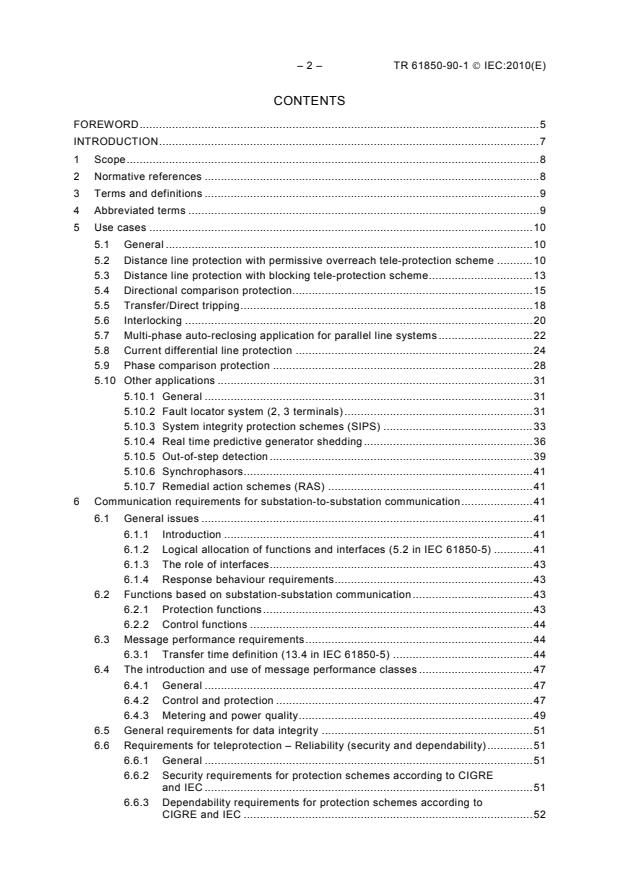
– 2 – TR 61850-90-1 © IEC:2010(E)
CONTENTS
FOREWORD.5
INTRODUCTION.7
1 Scope.8
2 Normative references .8
3 Terms and definitions .9
4 Abbreviated terms .9
5 Use cases .10
5.1 General .10
5.2 Distance line protection with permissive overreach tele-protection scheme .10
5.3 Distance line protection with blocking tele-protection scheme.13
5.4 Directional comparison protection.15
5.5 Transfer/Direct tripping.18
5.6 Interlocking .20
5.7 Multi-phase auto-reclosing application for parallel line systems .22
5.8 Current differential line protection .24
5.9 Phase comparison protection .28
5.10 Other applications .31
5.10.1 General .31
5.10.2 Fault locator system (2, 3 terminals).31
5.10.3 System integrity protection schemes (SIPS) .33
5.10.4 Real time predictive generator shedding.36
5.10.5 Out-of-step detection .39
5.10.6 Synchrophasors.41
5.10.7 Remedial action schemes (RAS) .41
6 Communication requirements for substation-to-substation communication.41
6.1 General issues .41
6.1.1 Introduction .41
6.1.2 Logical allocation of functions and interfaces (5.2 in IEC 61850-5) .41
6.1.3 The role of interfaces.43
6.1.4 Response behaviour requirements.43
6.2 Functions based on substation-substation communication.43
6.2.1 Protection functions.43
6.2.2 Control functions .44
6.3 Message performance requirements.44
6.3.1 Transfer time definition (13.4 in IEC 61850-5) .44
6.4 The introduction and use of message performance classes .47
6.4.1 General .47
6.4.2 Control and protection .47
6.4.3 Metering and power quality.49
6.5 General requirements for data integrity .51
6.6 Requirements for teleprotection – Reliability (security and dependability).51
6.6.1 General .51
6.6.2 Security requirements for protection schemes according to CIGRE
and IEC .51
6.6.3 Dependability requirements for protection schemes according to
CIGRE and IEC .52
TR 61850-90-1 © IEC:2010(E) – 3 –
7 Considerations on security and dependability issues when using Ethernet networks.52
7.1 General .52
7.2 Security of traffic .52
7.3 Dependability of traffic.53
7.4 Avoiding GOOSE packets flooding the WAN.53
7.5 Summary on recommendations for using Ethernet for communication
between substations.54
7.5.1 General .54
7.5.2 Example of packet delays .54
7.6 Useful features of some Ethernet telecommunications networks.55
8 Communication aspects.55
8.1 Services .55
8.2 Communication architecture .55
8.2.1 Preliminary notes and definitions .55
8.2.2 Tunnelling .56
8.2.3 Gateway .57
9 Modelling.58
9.1 General architecture.58
9.2 Communication interface ITPC .59
9.3 Communication-aided protection schemes and direct tripping.61
9.3.1 Proposed model .61
9.3.2 LN PSCH.62
9.4 Differential protection schemes .62
9.4.1 Proposed model .62
9.4.2 LN RMXU .65
9.4.3 SV format .65
10 Configuration aspects.66
10.1 General .66
10.2 Direct communication link.66
10.2.1 General .66
10.2.2 SCL enhancements .71
10.2.3 SCL example.71
10.3 Tele-protection equipment between substations .77
Bibliography.79
Figure 1 – Distance line protection with permissive overreach tele-protection scheme .10
Figure 2 – Distance line protection with blocking tele-protection scheme .13
Figure 3 – Directional comparison with permissive scheme.16
Figure 4 – Transfer/Direct tripping .18
Figure 5 – Interlocking – Interoperation.20
Figure 6 – Auto-reclosing.22
Figure 7 – Current differential line protection .25
Figure 8 – Phase comparison protection .28
Figure 9 – Principle to detect internal fault by phase comparison .28
Figure 10 – Fault locator system (2, 3 terminals) .31
Figure 11 – Example of a system integrity protection scheme .33
Figure 12 – Real time predictive type generator shedding system .36
– 4 – TR 61850-90-1 © IEC:2010(E)
Figure 13 – Out-of-step detection.39
Figure 14 – Logical interfaces between substation A and substation B.42
Figure 15 – Transfer time for binary and other signals over a serial connection .45
Figure 16 – Transfer time for binary signal with conventional output and input relays.45
Figure 17 – Definition of transfer time t for binary signals in case of line protection.46
Figure 18 – Definition of transfer time t over serial link in case of line protection.46
Figure 19 – Basic SS-to-SS communication structure .56
Figure 20 – SS-to-SS communication via tunnel .57
Figure 21 – SS-to-SS communication via proxy gateway.58
Figure 22 – Allocation of the LN ITPC representing the communication channel and the
LNs providing the data to be exchanged between substations.59
Figure 23 – Protection application example for permissive underreach distance
teleprotection scheme and appropriate logical node modelling.61
Figure 24 – Communication system based on current system .63
Figure 25 – Communication system based on future system .63
Figure 26 – Proposed 2-terminal current differential feeder protection relay model .64
Figure 27 – Proposed 3-terminal current differential feeder protection relay model .64
Figure 28 – SCD files and SED region for SS-to-SS communication .67
Figure 29 – Enhanced engineering process .68
Figure 30 – IED states when exchanging SED files.70
Figure 31 – Proxy gateway method (AA1F3, AA2F3 are Proxy gateways) .78
Table 1 – Grouping of protection and control interfaces .42
Table 2 – Protection functions using substation-substation communication .43
Table 3 – Control functions using substation-substation communication .44
Table 4 – Change of transfer time and synchronisation method .50
Table 5 – Performance classes for time tagging of events.50
Table 6 – Time performance classes for instrument transformer synchronisation .50
Table 7 – The bit error rate as indication for communication quality .51
Table 8 – Logical node ITPC.60
Table 9 – Logical node PSCH .62
Table 10 – Logical node RMXU.65
Table 11 – Sampled value (SV) format definition.66
Table 12 – IED engineering control types.69
TR 61850-90-1 © IEC:2010(E) – 5 –
INTERNATIONAL ELECTROTECHNICAL COMMISSION
____________
COMMUNICATION NETWORKS AND SYSTEMS
FOR POWER UTILITY AUTOMATION –
Part 90-1: Use of IEC 61850 for the communication
between substations
FOREWORD
1) The International Electrotechnical Commission (IEC) is a worldwide organization for standardization comprising
all national electrotechnical committees (IEC National Committees). The object of IEC is to promote
international co-operation on all questions concerning standardization in the electrical and electronic fields. To
this end and in addition to other activities, IEC publishes International Standards, Technical Specifications,
Technical Reports, Publicly Available Specifications (PAS) and Guides (hereafter referred to as “IEC
Publication(s)”). Their preparation is entrusted to technical committees; any IEC National Committee interested
in the subject dealt with may participate in this preparatory work. International, governmental and non-
governmental organizations liaising with the IEC also participate in this preparation. IEC collaborates closely
with the International Organization for Standardization (ISO) in accordance with conditions determined by
agreement between the two organizations.
2) The formal decisions or agreements of IEC on technical matters express, as nearly as possible, an international
consensus of opinion on the relevant subjects since each technical committee has representation from all
interested IEC National Committees.
3) IEC Publications have the form of recommendations for international use and are accepted by IEC National
Committees in that sense. While all reasonable efforts are made to ensure that the technical content of IEC
Publications is accurate, IEC cannot be held responsible for the way in which they are used or for any
misinterpretation by any end user.
4) In order to promote international uniformity, IEC National Committees undertake to apply IEC Publications
transparently to the maximum extent possible in their national and regional publications. Any divergence
between any IEC Publication and the corresponding national or regional publication shall be clearly indicated in
the latter.
5) IEC itself does not provide any attestation of conformity. Independent certification bodies provide conformity
assessment services and, in some areas, access to IEC marks of conformity. IEC is not responsible for any
services carried out by independent certification bodies.
6) All users should ensure that they have the latest edition of this publication.
7) No liability shall attach to IEC or its directors, employees, servants or agents including individual experts and
members of its technical committees and IEC National Committees for any personal injury, property damage or
other damage of any nature whatsoever, whether direct or indirect, or for costs (including legal fees) and
expenses arising out of the publication, use of, or reliance upon, this IEC Publication or any other IEC
Publications.
8) Attention is drawn to the Normative references cited in this publication. Use of the referenced publications is
indispensable for the correct application of this publication.
9) Attention is drawn to the possibility that some of the elements of this IEC Publication may be the subject of
patent rights. IEC shall not be held responsible for identifying any or all such patent rights.
The main task of IEC technical committees is to prepare International Standards. However, a
technical committee may propose the publication of a technical report when it has collected
data of a different kind from that which is normally published as an International Standard, for
example "state of the art".
IEC 61850-90-1, which is a technical report, has been prepared by IEC technical committee 57:
Power systems management and associated information exchange.
– 6 – TR 61850-90-1 © IEC:2010(E)
The text of this technical report is based on the following documents:
Enquiry draft Report on voting
57/992/DTR 57/1021/RVC
Full information on the voting for the approval of this technical report can be found in the
report on voting indicated in the above table.
This publication has been drafted in accordance with the ISO/IEC Directives, Part 2.
A list of all parts of the IEC 61850 series, under the general title: Communication networks
and systems for power utility automation, can be found on the IEC website.
The committee has decided that the contents of this amendment and the base publication will
remain unchanged until the stability date indicated on the IEC web site under
"http://webstore.iec.ch" in the data related to the specific publication. At this date, the
publication will be
• reconfirmed,
• withdrawn,
• replaced by a revised edition, or
• amended.
A bilingual version of this publication may be issued at a later date.
IMPORTANT – The 'colour inside' logo on the cover page of this publication indicates
that it contains colours which are considered to be useful for the correct
understanding of its contents. Users should therefore print this document using a
colour printer.
TR 61850-90-1 © IEC:2010(E) – 7 –
INTRODUCTION
When IEC 61850 was prepared, it was intended for use in information exchange between
devices of a substation automation system. In the mean time, the concepts are now used as
well in other application domains of the power utility system. Therefore, IEC 61850 is on the
way to becoming the foundation for a globally standardized utility communication network.
With existing and new applications in the field of power system operation and protection, the
requirement to exchange standardized information directly between substations is increasing.
IEC 61850 shall be the basis for this information exchange.
IEC 61850 provides the basic features to be used for that information exchange, however,
some extensions to IEC 61850 may be required. This technical report provides a
comprehensive overview of the different aspects that need to be considered when using
IEC 61850 for information exchange between substations. Areas that require extension of
specific parts of the existing IEC 61850 standard will later be incorporated in future editions of
the affected part of IEC 61850.
A similar report discussing the use of IEC 61850 for communication between substations and
1)
control centres is under preparation as IEC 61850-90-2 . Further, a similar report discussing
the use of IEC 61850 for wide-area RAS (remedial action schemes) is being contemplated;
1)
this will likely be IEC 61850-90-3 .
The scope of IEC 61850 is no longer limited to substations. This is reflected in the changed
title of the series. New domain specific parts have been added to the series. Working
Group 10 of Technical Committee 57 is currently preparing the second edition of the basic
parts of IEC 61850.
———————
1)
Under consideration.
– 8 – TR 61850-90-1 © IEC:2010(E)
COMMUNICATION NETWORKS AND SYSTEMS
FOR POWER UTILITY AUTOMATION –
Part 90-1: Use of IEC 61850 for the communication
between substations
1 Scope
This part of IEC 61850 provides a comprehensive overview on the different aspects that need
to be considered while using IEC 61850 for information exchange between substations. In
particular, this technical report
• defines use cases that require an information exchange between substations;
• describes the communication requirements;
• gives guidelines for the communication services and communication architecture to be
used;
• defines data as a prerequisite for interoperable applications;
• does not define implementations which guarantee interoperability between different IEDs;
• describes the usage and enhancements of the configuration language SCL.
2 Normative references
The following referenced documents are indispensable for the application of this document.
For dated references, only the edition cited applies. For undated references, the latest edition
of the referenced document (including any amendments) applies.
IEC 60044 (all parts), Instrument transformers
IEC 60834-1:1999, Teleprotection equipment of power systems – Performance and testing –
Part 1: Command systems
IEC 60834-2:1993, Performance and testing of teleprotection equipment of power systems –
Part 2: Analogue comparison systems
IEC 60870-4, Telecontrol equipment and systems – Part 4: performance requirements
IEC/TS 61850-2, Communication networks and systems in substations – Part 2: Glossary
IEC 61850 (all parts), Communication networks and systems for power utility automation
IEC 61850-3, Communication networks and systems in substations – Part 3: General
requirements
IEC 61850-5:2003, Communication networks and systems in substations – Part 5:
Communication requirements for functions and device models
IEC 61850-6:2009, Communication networks and systems for power utility automation –
Part 6: Configuration description language for communication in electrical substations related
to IEDs
TR 61850-90-1 © IEC:2010(E) – 9 –
IEC 61850-7-2:2010, Communication networks and systems for power utility automation –
Part 7-2: Basic communication structure – Abstract communication service interface (ACSI)
IEC 61850-7-4:2010, Communication networks and systems for power utility automation –
Part 7-4: Basic communication structure – Compatible logical node classes and data object
classes
IEC 61850-8-1,___ Communication networks and systems for power utility automation –
Part 8-1: Specific Communication Service Mapping (SCSM) - Mappings to MMS (ISO 9506-1
2)
and ISO 9506-2) and to ISO/IEC 8802-3
IEC 61850-9-2,___ Communication networks and systems in substations – Part 9-2:
2)
Specific Communication Service Mapping (SCSM) – Sampled values over ISO/IEC 8802-3
IEC 62053-22, Electricity metering equipment (a.c.) – Particular requirements – Part 22: Static
meters for active energy (classes 0,2 S and 0,5 S)
IEC/TS 62351-6, Power systems management and associated information exchange – Data
and communication security – Part 6: Security for IEC 61850
IEC 62439, High availability automation networks
ANSI/IEEE 1588, Standard for a Precision Clock Synchronization Protocol for Networked
Measurement and Control Systems / revision of ANSI/IEEE 1588-2002 / Approved 2008-09-10
IEEE 802.1Q, Local and metropolitan area networks – Virtual bridged local area networks
3 Terms and definitions
For the purposes of this document, the terms and definitions given in
IEC 61850-2 and IEC 61850-7-2 apply.
4 Abbreviated terms
BER Bit error ratio
Bkr Circuit breaker
C/S Client / Server
CE Central equipment
DCB Directional comparison blocking
DF Directional relay to detect forward faults
EHV Extreme high voltage
HV High voltage
IF, I/F Interface
I/F -R Interface to receive data
I/F -S Interface to send data
L2TP Layer 2 tunnelling protocol
MV Medium voltage
PDH Plesiochronous digital hierarchy
PMU Phasor measurement units
QA Circuit breaker
QB Line disconnector
QC Earthing switch
QinQ 802.1Q in 802.1Q (VLAN stacking)
RAS Remedial action schemes
———————
2)
To be published
– 10 – TR 61850-90-1 © IEC:2010(E)
RO Overreaching distance zone
RT Remote terminal
Rx Receiver
SDH Synchronous digital hierarchy
SIPS System integrity protection scheme
SONET Synchronous optical NETwork transport system
SS Substation
TPI Teleprotection interface
Tx Transmitter
VoIP Voice over IP (Internet protocol)
VPN Virtual private network
WAN Wide area network
NOTE Abbreviations used for the identification of the common data classes and as names of the attributes are
specified in the specific clauses of this document and are not repeated here.
5 Use cases
5.1 General
For the purpose of communication between substations, the following functions are
considered.
Conventional CTs and VTs are assumed for input to relays in the following use cases.
However, they could be replaced by newer technology, such as digital input based on process
bus, without any significant change in the descriptions.
5.2 Distance line protection with permissive overreach tele-protection scheme
Summary:
When a distance relay detects a forward fault in the overreach zone, it sends a
permissive signal to the remote end, see Figure 1. If that relay also receives a
permissive signal (from the remote end), the relay sends a trip signal to the local CB.
RO
RO
Bkr 1 Bkr 2
Protected line
Teleprotection equipment
Duplex communication link
TX TX
RO RO
RX RX
&
&
TRIP Bkr 1 TRIP Bkr 2
Protection equipment
RO Overreaching trip function, must be set to reach beyond remote end teminal
IEC 503/10
Figure 1 – Distance line protection with permissive overreach
3)
tele-protection scheme [1]
———————
3)
Figures in square brackets refer to the Bibliography.
TR 61850-90-1 © IEC:2010(E) – 11 –
Constraints / Assumptions / Design considerations:
z The permissive signal needs a minimum of 1 bit. If it is a phase segregated signal, it
needs 3 bits. If it is a phase segregated, and phase-to-phase and phase-to-earth are
independent, the signal needs 6 bits. Directional earth fault detection may need
another 1 bit.
z Data is sent only when a forward fault is detected.
z For communication channel failure, alternative actions must be considered.
z For fast tripping, the propagation, delay shall be small (e.g.: less than 5 ms).
–6
z A high reliability is needed (e.g. BER less than 10 , alternative route, duplicated).
Use case diagram:
Distance line protection with
permissive tele-protection scheme
Data sampling
and filtering
V, I
Measuring
Sending
Data sending
equipment
data
Comm. I/F –S
(CT/VT)
Receiving
Data receiving
data
Comm. I/F –R
Trip
Relay decision
command
CB
Actor(s):
Name Role description
Measuring equipment Measures current and voltage from protected line
Comm. I/F –S Receives data from the local relay and sends the
data to the remote end
Comm. I/F –R Receives data from the remote end and gives the
data to the local relay
CB Disconnects the protected line from other system
(Circuit breaker)
Use case(s):
Name Services or information provided
Data sampling and filtering Samples current and voltage data from measuring
equipment and filters them
Data sending Calculates a distance to the fault using filtered data.
When a distance protection detects a forward fault,
the distance protection sends the permissive signal
to Comm. I/F –S (the remote end)
Data receiving Receives the permissive signal from Comm. I/F –R
(the remote end)
Relay decision When the distance protection detects the forward
faults and receives permissive signal from remote
end, the distance protection issues a trip command
to the CB
– 12 – TR 61850-90-1 © IEC:2010(E)
Basic flow:
Data sampling and filtering
Use case step Description
Step 1 Current and voltage are given to distance protection by
measuring equipment
Step 2 Distance protection samples an analogue value and converts it
to digital data
Step 3 Distance protection removes any unwanted frequency
components from the sampled data using a digital filter
Data sending
Use case step Description
Step 1 Distance protection stores the filtered instantaneous data
Step 2 Distance protection calculates a distance to the fault using
filtered data
Step 3 When a distance protection detects a forward fault to a pre-
determined distance, a distance protection sends the
permissive signal to Comm. I/F –S (in order to send the data to
a remote end relay)
Step 4 Comm. I/F –S send the information to remote end
Data receiving
Use case step Description
Step 1 Comm. I/F –R receives the data from the remote end
Step 2 Comm. I/F –R gives the received data to distance protection
Step 3 Distance protection receives the data
Relay decision
Use case step Description
Step 1 When the distance protection detects the forward faults in a
predetermined zone, and receives a permissive signal from the
remote end, the distance protection issues a trip command to
the CB
Exceptions / Alternate flow:
N.A.
Pre-conditions:
N.A.
Post-conditions:
N.A.
References:
[1] Protection Using Telecommunication
TR 61850-90-1 © IEC:2010(E) – 13 –
5.3 Distance line protection with blocking tele-protection scheme
Summary:
When a distance relay detects reverse faults, it sends a blocking signal to the remote
end. If the relay detects a forward fault and does not receive the blocking signal, the
relay sends a trip signal to the local CB, see Figure 2.
A variant involves the directional comparison blocking (DCB) using a non-directional
element to send a blocking signal for any fault (other wording: “starts the carrier”). The
operation of the forward element removes the blocking signal (“stops the carrier”) and
sends a trip signal to the local CB.
RO
B
B
RO
Bkr 1 Bkr 2
Protected line
Teleprotection equipment
TX TX
B B
Simplex or duplex
RX RX
RO RO
communication link
TL1 TL1
C
&
& C
TRIP Bkr 1 TRIP Bkr 2
0.0
0.0
Protection equipment
RO Overreaching trip function, must be set to reach beyond remote end of line
B Blocking function, must be set to reach beyond overreaching trip function at remote end of line
C Coordinating time, required to allow time for blocking signal to be received (set equal to
channel time plus propogation time plus margin)
IEC 504/10
Figure 2 – Distance line protection with blocking tele-protection scheme [1]
Constraints / Assumptions / Design considerations:
z The blocking signal is a minimum of 1 bit. If it is phase segregated signal, it needs
3 bits. If it is phase segregated, and phase-to-phase and phase-to-earth are
independent, the signal needs 6 bits. Directional earth fault detection may need
another 1 bit.
z Data is sent when a reverse fault is detected or as a variant, when any fault is
detected. In that variant, the blocking signal is removed when the fault direction is
detected as forward.
z For communication channel failure, the blocking signal is typically removed.
z For fast tripping, the propagation delay shall be small (e.g.: less than 5 ms).
–6
z A high reliability is needed (e.g. BER less than 10 , alternative route, duplicated).
– 14 – TR 61850-90-1 © IEC:2010(E)
Use case diagram:
Distance line protection with blocking
tele-protection scheme
Data sampling
and filtering
V, I
Measuring
Sending
Data sending
equipment
data
Comm. I/F –S
(CT/VT)
Receiving
Data receiving
data
Comm. I/F –R
Trip
Relay decision
command
CB
Actor(s):
Name Role description
Measuring equipment Measures current and voltage from the protected
line
Comm. I/F –S Receives data from the local relay and sends the
data to the remote end
Comm. I/F –R Receives data from the remote end and gives the
data to the local relay
CB Disconnects the protected line from the other
system (circuit breaker)
Use case(s):
Name Services or information provided
Data sampling and filtering Samples current and voltage data from the
measuring equipment and filters them
Data sending Calculates a distance to the fault using filtered data.
When a distance protection detects a reverse fault,
the distance protection sends the blocking signal to
Comm. I/F –S (the remote end)
Data receiving Receives the blocking signal from Comm. I/F –R
(the remote end)
Relay decision When the distance protection detects the forward
faults, and does not receive a blocking signal from
the remote end, the distance protection issues a trip
command to the CB
Basic flow:
Data sampling and filtering
Use case step Description
Step 1 Current and voltage are given to distance protection by the
measuring equipment
Step 2 Distance protection samples an analogue value, and converts
it to digital data
Step 3 Distance protection removes the unwanted frequency
component from the sampled data using a digital filter
TR 61850-90-1 © IEC:2010(E) – 15 –
Data sending
Use case step Description
Step 1 Distance protection stores the filtered instantaneous data
Step 2 Distance protection calculates a distance to the fault using
filtered data
Step 3 When a distance protection detects a reverse fault in a pre-
determined distance, it sends a blocking signal to
Comm. I/F –S (in order to send the data to a remote end relay)
Step 4 Comm. I/F –S sends the information to remote end
Data receiving
Relay decision
Use case step Description
Step 1 When the distance protection detects a forward fault in a
predetermined zone, and does not receive a blocking signal
from the remote end, the distance protection issues a trip
command to the CB
Exceptions / Alternate flow:
N.A.
Pre-conditions:
N.A.
Post-conditions:
N.A.
References:
[1] Protection Using Telecommunication
5.4 Directional comparison protection
Summary:
When a directional relay (typically a directional overcurrent relay) detects a forward fault,
the relay sends a permissive signal to the remote end. If the relay also receives a
permissive signal from the remote end, the relay sends a trip signal to the local CB. See
Figure 3.
– 16 – TR 61850-90-1 © IEC:2010(E)
DF
DF
Bkr 1 Bkr 2
Protected line
Teleprotection equipment
Duplex communication link
TX TX
DF
DF
RX RX
& &
TRIP Bkr 1 TRIP Bkr 2
Protection equipment
DF Directional relay to detect forward faults
IEC 505/10
Figure 3 – Directional comparison with permissive scheme [1]
Constraints / Assumptions / Design considerations:
z The permissive signal is a minimum of 1 bit. If it is phase segregated signal, it needs
3 bits. If it is phase segregated and phase-to-phase and phase-to-earth are
independent, the signal needs 6 bits. Directional earth fault detection may need
another 1 bit.
z Data is sent only when a forward fault is detected.
z For communication channel failure, alternative actions must be considered.
z For fast tripping, the propagation delay shall be small (e.g.: less than 5 ms).
–6
z A high reliability is needed (e.g. BER less than 10 , alternative route, duplicated).
Use case diagram:
Directional relay with permissive
scheme
Data sampling
and filtering
V, I
Measuring
Sending
Data sending
equipment
data
Comm. I/F –S
(CT/VT)
Receiving
Data receiving
data
Comm. I/F –R
Trip
Relay decision
command
CB
TR 61850-90-1 © IEC:2010(E) – 17 –
Actor(s):
Name Role description
Measuring equipment Measures current and voltage from a protected line
Comm. I/F –S Receives data from the local relay and sends the
data to the remote end
Comm. I/F –R Receives data from the remote end and gives the
data to the local relay
CB Disconnects the protected line from another system
(circuit breaker)
Use case(s):
Name Services or information provided
Data sampling and filtering Samples current and voltage data from the
measuring equipment, and filters them
Data sending Calculates the direction of the fault. When a
directional relay detects a forward fault, the relay
sends a permissive signal to Comm. I/F –S (the
remote end)
Data receiving Receives the permissive signal from Comm. I/F –R
(the remote end)
Relay decision When the directional relay detects a forward fault
and receives a permissive signal from remote end,
the directional relay issues a trip command to the
CB
Basic flow:
Data sampling and filtering
Use case step Description
Step 1 Current and voltage are given to directional relay by the
measuring equipment
Step 2 Directional relay samples an analogue value and converts it to
digital data
Step 3 Directional relay removes the unwanted frequency components
from the sampled data using a digital filter
Data sending
Use case step Description
Step 1 Directional relay stores the filtered instantaneous data
Step 2 Directional relay calculates a direction of the fault using filtered
data
Step 3 When a directional relay detects a forward fault, the relay
sends the permissive signal to Comm. I/F –S (in order to send
the data to the remote end relay)
Step 4 Comm. I/F –S sends the information to remote end
Data receiving
Use case step Description
Step 1 Comm. I/F –R receives the data from the remote end
Step 2 Comm. I/F –R gives the received data to the directional relay
Step 3 Directional relay receives the data
Relay decision
Use case step Description
Step 1 When the directional relay detects a forward fault and receives
a permissive signal from the remote end, the relay issues a trip
command to the CB
Exceptions / Alternate flow:
N.A.
– 18 – TR 61850-90-1 © IEC:2010(E)
Pre-conditions:
N.A.
Post-conditions:
N.A.
References:
[1] Protection Using Telecommunication
5.5 Transfer/Direct tripping
Summary:
Local equipment sends a trip command to the remote equipment. This function is
sometimes called inter-tripping as well. See Figure 4.
Trip signal
Trip
T.T
T.T T.T
Trip signal
Initiation
T.T
Trip signal
IEC 506/10
Figure 4 – Transfer/Direct tripping
Constraints / Assumptions / Design considerations:
z The trip signal is a minimum of 1 bit. If it is phase segregated signal it is 3 bits. If the
quantity of remote equipments is more than one, more bits may be needed for the
signal.
z Data is sent only if a trip command is issued.
z For communication channel failure, alternative actions must be considered.
z For fast tripping, the propagation delay shall be small (e.g.: less than 5 ms).
–6
z A high reliability is needed (e.g. BER less than 10 , alternative route, duplicated).
Use case diagram:
Transfer/direct tripping
Trip initiation
command
Commander
Sending
Data sending
data
Comm. I/F –S
Receiving
Data receiving
data
Comm I/F –R
Trip Tripping
command
CB
TR 61850-90-1 © IEC:2010(E) – 19 –
Actor(s):
Name Role description
Commander Requests local equipment to send a trip command
to the remote equipment
Comm. I/F –S Receives data from the local relay and sends the
data to the remote end
Comm. I/F –R Receives data from the remote end and gives the
data to the local relay
CB Disconnects the line from the other system (circuit
breaker)
Use case(s):
Name Services or information provided
Trip command issuing Issues a trip command to the local equip
...
IEC/TR 61850-90-1 ®
Edition 1.0 2010-03
TECHNICAL
REPORT
colour
inside
Communication networks and systems for power utility automation –
Part 90-1: Use of IEC 61850 for the communication between substations
IEC/TR 61850-90-1:2010(E)
All rights reserved. Unless otherwise specified, no part of this publication may be reproduced or utilized in any form or by
any means, electronic or mechanical, including photocopying and microfilm, without permission in writing from either IEC or
IEC's member National Committee in the country of the requester.
If you have any questions about IEC copyright or have an enquiry about obtaining additional rights to this publication,
please contact the address below or your local IEC member National Committee for further information.
Droits de reproduction réservés. Sauf indication contraire, aucune partie de cette publication ne peut être reproduite
ni utilisée sous quelque forme que ce soit et par aucun procédé, électronique ou mécanique, y compris la photocopie
et les microfilms, sans l'accord écrit de la CEI ou du Comité national de la CEI du pays du demandeur.
Si vous avez des questions sur le copyright de la CEI ou si vous désirez obtenir des droits supplémentaires sur cette
publication, utilisez les coordonnées ci-après ou contactez le Comité national de la CEI de votre pays de résidence.
IEC Central Office
3, rue de Varembé
CH-1211 Geneva 20
Switzerland
Email: inmail@iec.ch
Web: www.iec.ch
About IEC publications
The technical content of IEC publications is kept under constant review by the IEC. Please make sure that you have the
latest edition, a corrigenda or an amendment might have been published.
ƒ Catalogue of IEC publications: www.iec.ch/searchpub
The IEC on-line Catalogue enables you to search by a variety of criteria (reference number, text, technical committee,…).
It also gives information on projects, withdrawn and replaced publications.
ƒ IEC Just Published: www.iec.ch/online_news/justpub
Stay up to date on all new IEC publications. Just Published details twice a month all new publications released. Available
on-line and also by email.
ƒ Electropedia: www.electropedia.org
The world's leading online dictionary of electronic and electrical terms containing more than 20 000 terms and definitions
in English and French, with equivalent terms in additional languages. Also known as the International Electrotechnical
Vocabulary online.
ƒ Customer Service Centre: www.iec.ch/webstore/custserv
If you wish to give us your feedback on this publication or need further assistance, please visit the Customer Service
Centre FAQ or contact us:
Email: csc@iec.ch
Tel.: +41 22 919 02 11
Fax: +41 22 919 03 00
IEC/TR 61850-90-1 ®
Edition 1.0 2010-03
TECHNICAL
REPORT
colour
inside
Communication networks and systems for power utility automation –
Part 90-1: Use of IEC 61850 for the communication between substations
INTERNATIONAL
ELECTROTECHNICAL
COMMISSION
PRICE CODE
XC
ICS 33.200 ISBN 978-2-88910-580-9
– 2 – TR 61850-90-1 © IEC:2010(E)
CONTENTS
FOREWORD.5
INTRODUCTION.7
1 Scope.8
2 Normative references .8
3 Terms and definitions .9
4 Abbreviated terms .9
5 Use cases .10
5.1 General .10
5.2 Distance line protection with permissive overreach tele-protection scheme .10
5.3 Distance line protection with blocking tele-protection scheme.13
5.4 Directional comparison protection.15
5.5 Transfer/Direct tripping.18
5.6 Interlocking .20
5.7 Multi-phase auto-reclosing application for parallel line systems .22
5.8 Current differential line protection .24
5.9 Phase comparison protection .28
5.10 Other applications .31
5.10.1 General .31
5.10.2 Fault locator system (2, 3 terminals).31
5.10.3 System integrity protection schemes (SIPS) .33
5.10.4 Real time predictive generator shedding.36
5.10.5 Out-of-step detection .39
5.10.6 Synchrophasors.41
5.10.7 Remedial action schemes (RAS) .41
6 Communication requirements for substation-to-substation communication.41
6.1 General issues .41
6.1.1 Introduction .41
6.1.2 Logical allocation of functions and interfaces (5.2 in IEC 61850-5) .41
6.1.3 The role of interfaces.43
6.1.4 Response behaviour requirements.43
6.2 Functions based on substation-substation communication.43
6.2.1 Protection functions.43
6.2.2 Control functions .44
6.3 Message performance requirements.44
6.3.1 Transfer time definition (13.4 in IEC 61850-5) .44
6.4 The introduction and use of message performance classes .47
6.4.1 General .47
6.4.2 Control and protection .47
6.4.3 Metering and power quality.49
6.5 General requirements for data integrity .51
6.6 Requirements for teleprotection – Reliability (security and dependability).51
6.6.1 General .51
6.6.2 Security requirements for protection schemes according to CIGRE
and IEC .51
6.6.3 Dependability requirements for protection schemes according to
CIGRE and IEC .52
TR 61850-90-1 © IEC:2010(E) – 3 –
7 Considerations on security and dependability issues when using Ethernet networks.52
7.1 General .52
7.2 Security of traffic .52
7.3 Dependability of traffic.53
7.4 Avoiding GOOSE packets flooding the WAN.53
7.5 Summary on recommendations for using Ethernet for communication
between substations.54
7.5.1 General .54
7.5.2 Example of packet delays .54
7.6 Useful features of some Ethernet telecommunications networks.55
8 Communication aspects.55
8.1 Services .55
8.2 Communication architecture .55
8.2.1 Preliminary notes and definitions .55
8.2.2 Tunnelling .56
8.2.3 Gateway .57
9 Modelling.58
9.1 General architecture.58
9.2 Communication interface ITPC .59
9.3 Communication-aided protection schemes and direct tripping.61
9.3.1 Proposed model .61
9.3.2 LN PSCH.62
9.4 Differential protection schemes .62
9.4.1 Proposed model .62
9.4.2 LN RMXU .65
9.4.3 SV format .65
10 Configuration aspects.66
10.1 General .66
10.2 Direct communication link.66
10.2.1 General .66
10.2.2 SCL enhancements .71
10.2.3 SCL example.71
10.3 Tele-protection equipment between substations .77
Bibliography.79
Figure 1 – Distance line protection with permissive overreach tele-protection scheme .10
Figure 2 – Distance line protection with blocking tele-protection scheme .13
Figure 3 – Directional comparison with permissive scheme.16
Figure 4 – Transfer/Direct tripping .18
Figure 5 – Interlocking – Interoperation.20
Figure 6 – Auto-reclosing.22
Figure 7 – Current differential line protection .25
Figure 8 – Phase comparison protection .28
Figure 9 – Principle to detect internal fault by phase comparison .28
Figure 10 – Fault locator system (2, 3 terminals) .31
Figure 11 – Example of a system integrity protection scheme .33
Figure 12 – Real time predictive type generator shedding system .36
– 4 – TR 61850-90-1 © IEC:2010(E)
Figure 13 – Out-of-step detection.39
Figure 14 – Logical interfaces between substation A and substation B.42
Figure 15 – Transfer time for binary and other signals over a serial connection .45
Figure 16 – Transfer time for binary signal with conventional output and input relays.45
Figure 17 – Definition of transfer time t for binary signals in case of line protection.46
Figure 18 – Definition of transfer time t over serial link in case of line protection.46
Figure 19 – Basic SS-to-SS communication structure .56
Figure 20 – SS-to-SS communication via tunnel .57
Figure 21 – SS-to-SS communication via proxy gateway.58
Figure 22 – Allocation of the LN ITPC representing the communication channel and the
LNs providing the data to be exchanged between substations.59
Figure 23 – Protection application example for permissive underreach distance
teleprotection scheme and appropriate logical node modelling.61
Figure 24 – Communication system based on current system .63
Figure 25 – Communication system based on future system .63
Figure 26 – Proposed 2-terminal current differential feeder protection relay model .64
Figure 27 – Proposed 3-terminal current differential feeder protection relay model .64
Figure 28 – SCD files and SED region for SS-to-SS communication .67
Figure 29 – Enhanced engineering process .68
Figure 30 – IED states when exchanging SED files.70
Figure 31 – Proxy gateway method (AA1F3, AA2F3 are Proxy gateways) .78
Table 1 – Grouping of protection and control interfaces .42
Table 2 – Protection functions using substation-substation communication .43
Table 3 – Control functions using substation-substation communication .44
Table 4 – Change of transfer time and synchronisation method .50
Table 5 – Performance classes for time tagging of events.50
Table 6 – Time performance classes for instrument transformer synchronisation .50
Table 7 – The bit error rate as indication for communication quality .51
Table 8 – Logical node ITPC.60
Table 9 – Logical node PSCH .62
Table 10 – Logical node RMXU.65
Table 11 – Sampled value (SV) format definition.66
Table 12 – IED engineering control types.69
TR 61850-90-1 © IEC:2010(E) – 5 –
INTERNATIONAL ELECTROTECHNICAL COMMISSION
____________
COMMUNICATION NETWORKS AND SYSTEMS
FOR POWER UTILITY AUTOMATION –
Part 90-1: Use of IEC 61850 for the communication
between substations
FOREWORD
1) The International Electrotechnical Commission (IEC) is a worldwide organization for standardization comprising
all national electrotechnical committees (IEC National Committees). The object of IEC is to promote
international co-operation on all questions concerning standardization in the electrical and electronic fields. To
this end and in addition to other activities, IEC publishes International Standards, Technical Specifications,
Technical Reports, Publicly Available Specifications (PAS) and Guides (hereafter referred to as “IEC
Publication(s)”). Their preparation is entrusted to technical committees; any IEC National Committee interested
in the subject dealt with may participate in this preparatory work. International, governmental and non-
governmental organizations liaising with the IEC also participate in this preparation. IEC collaborates closely
with the International Organization for Standardization (ISO) in accordance with conditions determined by
agreement between the two organizations.
2) The formal decisions or agreements of IEC on technical matters express, as nearly as possible, an international
consensus of opinion on the relevant subjects since each technical committee has representation from all
interested IEC National Committees.
3) IEC Publications have the form of recommendations for international use and are accepted by IEC National
Committees in that sense. While all reasonable efforts are made to ensure that the technical content of IEC
Publications is accurate, IEC cannot be held responsible for the way in which they are used or for any
misinterpretation by any end user.
4) In order to promote international uniformity, IEC National Committees undertake to apply IEC Publications
transparently to the maximum extent possible in their national and regional publications. Any divergence
between any IEC Publication and the corresponding national or regional publication shall be clearly indicated in
the latter.
5) IEC itself does not provide any attestation of conformity. Independent certification bodies provide conformity
assessment services and, in some areas, access to IEC marks of conformity. IEC is not responsible for any
services carried out by independent certification bodies.
6) All users should ensure that they have the latest edition of this publication.
7) No liability shall attach to IEC or its directors, employees, servants or agents including individual experts and
members of its technical committees and IEC National Committees for any personal injury, property damage or
other damage of any nature whatsoever, whether direct or indirect, or for costs (including legal fees) and
expenses arising out of the publication, use of, or reliance upon, this IEC Publication or any other IEC
Publications.
8) Attention is drawn to the Normative references cited in this publication. Use of the referenced publications is
indispensable for the correct application of this publication.
9) Attention is drawn to the possibility that some of the elements of this IEC Publication may be the subject of
patent rights. IEC shall not be held responsible for identifying any or all such patent rights.
The main task of IEC technical committees is to prepare International Standards. However, a
technical committee may propose the publication of a technical report when it has collected
data of a different kind from that which is normally published as an International Standard, for
example "state of the art".
IEC 61850-90-1, which is a technical report, has been prepared by IEC technical committee 57:
Power systems management and associated information exchange.
– 6 – TR 61850-90-1 © IEC:2010(E)
The text of this technical report is based on the following documents:
Enquiry draft Report on voting
57/992/DTR 57/1021/RVC
Full information on the voting for the approval of this technical report can be found in the
report on voting indicated in the above table.
This publication has been drafted in accordance with the ISO/IEC Directives, Part 2.
A list of all parts of the IEC 61850 series, under the general title: Communication networks
and systems for power utility automation, can be found on the IEC website.
The committee has decided that the contents of this amendment and the base publication will
remain unchanged until the stability date indicated on the IEC web site under
"http://webstore.iec.ch" in the data related to the specific publication. At this date, the
publication will be
• reconfirmed,
• withdrawn,
• replaced by a revised edition, or
• amended.
A bilingual version of this publication may be issued at a later date.
IMPORTANT – The 'colour inside' logo on the cover page of this publication indicates
that it contains colours which are considered to be useful for the correct
understanding of its contents. Users should therefore print this document using a
colour printer.
TR 61850-90-1 © IEC:2010(E) – 7 –
INTRODUCTION
When IEC 61850 was prepared, it was intended for use in information exchange between
devices of a substation automation system. In the mean time, the concepts are now used as
well in other application domains of the power utility system. Therefore, IEC 61850 is on the
way to becoming the foundation for a globally standardized utility communication network.
With existing and new applications in the field of power system operation and protection, the
requirement to exchange standardized information directly between substations is increasing.
IEC 61850 shall be the basis for this information exchange.
IEC 61850 provides the basic features to be used for that information exchange, however,
some extensions to IEC 61850 may be required. This technical report provides a
comprehensive overview of the different aspects that need to be considered when using
IEC 61850 for information exchange between substations. Areas that require extension of
specific parts of the existing IEC 61850 standard will later be incorporated in future editions of
the affected part of IEC 61850.
A similar report discussing the use of IEC 61850 for communication between substations and
1)
control centres is under preparation as IEC 61850-90-2 . Further, a similar report discussing
the use of IEC 61850 for wide-area RAS (remedial action schemes) is being contemplated;
1)
this will likely be IEC 61850-90-3 .
The scope of IEC 61850 is no longer limited to substations. This is reflected in the changed
title of the series. New domain specific parts have been added to the series. Working
Group 10 of Technical Committee 57 is currently preparing the second edition of the basic
parts of IEC 61850.
———————
1)
Under consideration.
– 8 – TR 61850-90-1 © IEC:2010(E)
COMMUNICATION NETWORKS AND SYSTEMS
FOR POWER UTILITY AUTOMATION –
Part 90-1: Use of IEC 61850 for the communication
between substations
1 Scope
This part of IEC 61850 provides a comprehensive overview on the different aspects that need
to be considered while using IEC 61850 for information exchange between substations. In
particular, this technical report
• defines use cases that require an information exchange between substations;
• describes the communication requirements;
• gives guidelines for the communication services and communication architecture to be
used;
• defines data as a prerequisite for interoperable applications;
• does not define implementations which guarantee interoperability between different IEDs;
• describes the usage and enhancements of the configuration language SCL.
2 Normative references
The following referenced documents are indispensable for the application of this document.
For dated references, only the edition cited applies. For undated references, the latest edition
of the referenced document (including any amendments) applies.
IEC 60044 (all parts), Instrument transformers
IEC 60834-1:1999, Teleprotection equipment of power systems – Performance and testing –
Part 1: Command systems
IEC 60834-2:1993, Performance and testing of teleprotection equipment of power systems –
Part 2: Analogue comparison systems
IEC 60870-4, Telecontrol equipment and systems – Part 4: performance requirements
IEC/TS 61850-2, Communication networks and systems in substations – Part 2: Glossary
IEC 61850 (all parts), Communication networks and systems for power utility automation
IEC 61850-3, Communication networks and systems in substations – Part 3: General
requirements
IEC 61850-5:2003, Communication networks and systems in substations – Part 5:
Communication requirements for functions and device models
IEC 61850-6:2009, Communication networks and systems for power utility automation –
Part 6: Configuration description language for communication in electrical substations related
to IEDs
TR 61850-90-1 © IEC:2010(E) – 9 –
IEC 61850-7-2:2010, Communication networks and systems for power utility automation –
Part 7-2: Basic communication structure – Abstract communication service interface (ACSI)
IEC 61850-7-4:2010, Communication networks and systems for power utility automation –
Part 7-4: Basic communication structure – Compatible logical node classes and data object
classes
IEC 61850-8-1,___ Communication networks and systems for power utility automation –
Part 8-1: Specific Communication Service Mapping (SCSM) - Mappings to MMS (ISO 9506-1
2)
and ISO 9506-2) and to ISO/IEC 8802-3
IEC 61850-9-2,___ Communication networks and systems in substations – Part 9-2:
2)
Specific Communication Service Mapping (SCSM) – Sampled values over ISO/IEC 8802-3
IEC 62053-22, Electricity metering equipment (a.c.) – Particular requirements – Part 22: Static
meters for active energy (classes 0,2 S and 0,5 S)
IEC/TS 62351-6, Power systems management and associated information exchange – Data
and communication security – Part 6: Security for IEC 61850
IEC 62439, High availability automation networks
ANSI/IEEE 1588, Standard for a Precision Clock Synchronization Protocol for Networked
Measurement and Control Systems / revision of ANSI/IEEE 1588-2002 / Approved 2008-09-10
IEEE 802.1Q, Local and metropolitan area networks – Virtual bridged local area networks
3 Terms and definitions
For the purposes of this document, the terms and definitions given in
IEC 61850-2 and IEC 61850-7-2 apply.
4 Abbreviated terms
BER Bit error ratio
Bkr Circuit breaker
C/S Client / Server
CE Central equipment
DCB Directional comparison blocking
DF Directional relay to detect forward faults
EHV Extreme high voltage
HV High voltage
IF, I/F Interface
I/F -R Interface to receive data
I/F -S Interface to send data
L2TP Layer 2 tunnelling protocol
MV Medium voltage
PDH Plesiochronous digital hierarchy
PMU Phasor measurement units
QA Circuit breaker
QB Line disconnector
QC Earthing switch
QinQ 802.1Q in 802.1Q (VLAN stacking)
RAS Remedial action schemes
———————
2)
To be published
– 10 – TR 61850-90-1 © IEC:2010(E)
RO Overreaching distance zone
RT Remote terminal
Rx Receiver
SDH Synchronous digital hierarchy
SIPS System integrity protection scheme
SONET Synchronous optical NETwork transport system
SS Substation
TPI Teleprotection interface
Tx Transmitter
VoIP Voice over IP (Internet protocol)
VPN Virtual private network
WAN Wide area network
NOTE Abbreviations used for the identification of the common data classes and as names of the attributes are
specified in the specific clauses of this document and are not repeated here.
5 Use cases
5.1 General
For the purpose of communication between substations, the following functions are
considered.
Conventional CTs and VTs are assumed for input to relays in the following use cases.
However, they could be replaced by newer technology, such as digital input based on process
bus, without any significant change in the descriptions.
5.2 Distance line protection with permissive overreach tele-protection scheme
Summary:
When a distance relay detects a forward fault in the overreach zone, it sends a
permissive signal to the remote end, see Figure 1. If that relay also receives a
permissive signal (from the remote end), the relay sends a trip signal to the local CB.
RO
RO
Bkr 1 Bkr 2
Protected line
Teleprotection equipment
Duplex communication link
TX TX
RO RO
RX RX
&
&
TRIP Bkr 1 TRIP Bkr 2
Protection equipment
RO Overreaching trip function, must be set to reach beyond remote end teminal
IEC 503/10
Figure 1 – Distance line protection with permissive overreach
3)
tele-protection scheme [1]
———————
3)
Figures in square brackets refer to the Bibliography.
TR 61850-90-1 © IEC:2010(E) – 11 –
Constraints / Assumptions / Design considerations:
z The permissive signal needs a minimum of 1 bit. If it is a phase segregated signal, it
needs 3 bits. If it is a phase segregated, and phase-to-phase and phase-to-earth are
independent, the signal needs 6 bits. Directional earth fault detection may need
another 1 bit.
z Data is sent only when a forward fault is detected.
z For communication channel failure, alternative actions must be considered.
z For fast tripping, the propagation, delay shall be small (e.g.: less than 5 ms).
–6
z A high reliability is needed (e.g. BER less than 10 , alternative route, duplicated).
Use case diagram:
Distance line protection with
permissive tele-protection scheme
Data sampling
and filtering
V, I
Measuring
Sending
Data sending
equipment
data
Comm. I/F –S
(CT/VT)
Receiving
Data receiving
data
Comm. I/F –R
Trip
Relay decision
command
CB
Actor(s):
Name Role description
Measuring equipment Measures current and voltage from protected line
Comm. I/F –S Receives data from the local relay and sends the
data to the remote end
Comm. I/F –R Receives data from the remote end and gives the
data to the local relay
CB Disconnects the protected line from other system
(Circuit breaker)
Use case(s):
Name Services or information provided
Data sampling and filtering Samples current and voltage data from measuring
equipment and filters them
Data sending Calculates a distance to the fault using filtered data.
When a distance protection detects a forward fault,
the distance protection sends the permissive signal
to Comm. I/F –S (the remote end)
Data receiving Receives the permissive signal from Comm. I/F –R
(the remote end)
Relay decision When the distance protection detects the forward
faults and receives permissive signal from remote
end, the distance protection issues a trip command
to the CB
– 12 – TR 61850-90-1 © IEC:2010(E)
Basic flow:
Data sampling and filtering
Use case step Description
Step 1 Current and voltage are given to distance protection by
measuring equipment
Step 2 Distance protection samples an analogue value and converts it
to digital data
Step 3 Distance protection removes any unwanted frequency
components from the sampled data using a digital filter
Data sending
Use case step Description
Step 1 Distance protection stores the filtered instantaneous data
Step 2 Distance protection calculates a distance to the fault using
filtered data
Step 3 When a distance protection detects a forward fault to a pre-
determined distance, a distance protection sends the
permissive signal to Comm. I/F –S (in order to send the data to
a remote end relay)
Step 4 Comm. I/F –S send the information to remote end
Data receiving
Use case step Description
Step 1 Comm. I/F –R receives the data from the remote end
Step 2 Comm. I/F –R gives the received data to distance protection
Step 3 Distance protection receives the data
Relay decision
Use case step Description
Step 1 When the distance protection detects the forward faults in a
predetermined zone, and receives a permissive signal from the
remote end, the distance protection issues a trip command to
the CB
Exceptions / Alternate flow:
N.A.
Pre-conditions:
N.A.
Post-conditions:
N.A.
References:
[1] Protection Using Telecommunication
TR 61850-90-1 © IEC:2010(E) – 13 –
5.3 Distance line protection with blocking tele-protection scheme
Summary:
When a distance relay detects reverse faults, it sends a blocking signal to the remote
end. If the relay detects a forward fault and does not receive the blocking signal, the
relay sends a trip signal to the local CB, see Figure 2.
A variant involves the directional comparison blocking (DCB) using a non-directional
element to send a blocking signal for any fault (other wording: “starts the carrier”). The
operation of the forward element removes the blocking signal (“stops the carrier”) and
sends a trip signal to the local CB.
RO
B
B
RO
Bkr 1 Bkr 2
Protected line
Teleprotection equipment
TX TX
B B
Simplex or duplex
RX RX
RO RO
communication link
TL1 TL1
C
&
& C
TRIP Bkr 1 TRIP Bkr 2
0.0
0.0
Protection equipment
RO Overreaching trip function, must be set to reach beyond remote end of line
B Blocking function, must be set to reach beyond overreaching trip function at remote end of line
C Coordinating time, required to allow time for blocking signal to be received (set equal to
channel time plus propogation time plus margin)
IEC 504/10
Figure 2 – Distance line protection with blocking tele-protection scheme [1]
Constraints / Assumptions / Design considerations:
z The blocking signal is a minimum of 1 bit. If it is phase segregated signal, it needs
3 bits. If it is phase segregated, and phase-to-phase and phase-to-earth are
independent, the signal needs 6 bits. Directional earth fault detection may need
another 1 bit.
z Data is sent when a reverse fault is detected or as a variant, when any fault is
detected. In that variant, the blocking signal is removed when the fault direction is
detected as forward.
z For communication channel failure, the blocking signal is typically removed.
z For fast tripping, the propagation delay shall be small (e.g.: less than 5 ms).
–6
z A high reliability is needed (e.g. BER less than 10 , alternative route, duplicated).
– 14 – TR 61850-90-1 © IEC:2010(E)
Use case diagram:
Distance line protection with blocking
tele-protection scheme
Data sampling
and filtering
V, I
Measuring
Sending
Data sending
equipment
data
Comm. I/F –S
(CT/VT)
Receiving
Data receiving
data
Comm. I/F –R
Trip
Relay decision
command
CB
Actor(s):
Name Role description
Measuring equipment Measures current and voltage from the protected
line
Comm. I/F –S Receives data from the local relay and sends the
data to the remote end
Comm. I/F –R Receives data from the remote end and gives the
data to the local relay
CB Disconnects the protected line from the other
system (circuit breaker)
Use case(s):
Name Services or information provided
Data sampling and filtering Samples current and voltage data from the
measuring equipment and filters them
Data sending Calculates a distance to the fault using filtered data.
When a distance protection detects a reverse fault,
the distance protection sends the blocking signal to
Comm. I/F –S (the remote end)
Data receiving Receives the blocking signal from Comm. I/F –R
(the remote end)
Relay decision When the distance protection detects the forward
faults, and does not receive a blocking signal from
the remote end, the distance protection issues a trip
command to the CB
Basic flow:
Data sampling and filtering
Use case step Description
Step 1 Current and voltage are given to distance protection by the
measuring equipment
Step 2 Distance protection samples an analogue value, and converts
it to digital data
Step 3 Distance protection removes the unwanted frequency
component from the sampled data using a digital filter
TR 61850-90-1 © IEC:2010(E) – 15 –
Data sending
Use case step Description
Step 1 Distance protection stores the filtered instantaneous data
Step 2 Distance protection calculates a distance to the fault using
filtered data
Step 3 When a distance protection detects a reverse fault in a pre-
determined distance, it sends a blocking signal to
Comm. I/F –S (in order to send the data to a remote end relay)
Step 4 Comm. I/F –S sends the information to remote end
Data receiving
Relay decision
Use case step Description
Step 1 When the distance protection detects a forward fault in a
predetermined zone, and does not receive a blocking signal
from the remote end, the distance protection issues a trip
command to the CB
Exceptions / Alternate flow:
N.A.
Pre-conditions:
N.A.
Post-conditions:
N.A.
References:
[1] Protection Using Telecommunication
5.4 Directional comparison protection
Summary:
When a directional relay (typically a directional overcurrent relay) detects a forward fault,
the relay sends a permissive signal to the remote end. If the relay also receives a
permissive signal from the remote end, the relay sends a trip signal to the local CB. See
Figure 3.
– 16 – TR 61850-90-1 © IEC:2010(E)
DF
DF
Bkr 1 Bkr 2
Protected line
Teleprotection equipment
Duplex communication link
TX TX
DF
DF
RX RX
& &
TRIP Bkr 1 TRIP Bkr 2
Protection equipment
DF Directional relay to detect forward faults
IEC 505/10
Figure 3 – Directional comparison with permissive scheme [1]
Constraints / Assumptions / Design considerations:
z The permissive signal is a minimum of 1 bit. If it is phase segregated signal, it needs
3 bits. If it is phase segregated and phase-to-phase and phase-to-earth are
independent, the signal needs 6 bits. Directional earth fault detection may need
another 1 bit.
z Data is sent only when a forward fault is detected.
z For communication channel failure, alternative actions must be considered.
z For fast tripping, the propagation delay shall be small (e.g.: less than 5 ms).
–6
z A high reliability is needed (e.g. BER less than 10 , alternative route, duplicated).
Use case diagram:
Directional relay with permissive
scheme
Data sampling
and filtering
V, I
Measuring
Sending
Data sending
equipment
data
Comm. I/F –S
(CT/VT)
Receiving
Data receiving
data
Comm. I/F –R
Trip
Relay decision
command
CB
TR 61850-90-1 © IEC:2010(E) – 17 –
Actor(s):
Name Role description
Measuring equipment Measures current and voltage from a protected line
Comm. I/F –S Receives data from the local relay and sends the
data to the remote end
Comm. I/F –R Receives data from the remote end and gives the
data to the local relay
CB Disconnects the protected line from another system
(circuit breaker)
Use case(s):
Name Services or information provided
Data sampling and filtering Samples current and voltage data from the
measuring equipment, and filters them
Data sending Calculates the direction of the fault. When a
directional relay detects a forward fault, the relay
sends a permissive signal to Comm. I/F –S (the
remote end)
Data receiving Receives the permissive signal from Comm. I/F –R
(the remote end)
Relay decision When the directional relay detects a forward fault
and receives a permissive signal from remote end,
the directional relay issues a trip command to the
CB
Basic flow:
Data sampling and filtering
Use case step Description
Step 1 Current and voltage are given to directional relay by the
measuring equipment
Step 2 Directional relay samples an analogue value and converts it to
digital data
Step 3 Directional relay removes the unwanted frequency components
from the sampled data using a digital filter
Data sending
Use case step Description
Step 1 Directional relay stores the filtered instantaneous data
Step 2 Directional relay calculates a direction of the fault using filtered
data
Step 3 When a directional relay detects a forward fault, the relay
sends the permissive signal to Comm. I/F –S (in order to send
the data to the remote end relay)
Step 4 Comm. I/F –S sends the information to remote end
Data receiving
Use case step Description
Step 1 Comm. I/F –R receives the data from the remote end
Step 2 Comm. I/F –R gives the received data to the directional relay
Step 3 Directional relay receives the data
Relay decision
Use case step Description
Step 1 When the directional relay detects a forward fault and receives
a permissive signal from the remote end, the relay issues a trip
command to the CB
Exceptions / Alternate flow:
N.A.
– 18 – TR 61850-90-1 © IEC:2010(E)
Pre-conditions:
N.A.
Post-conditions:
N.A.
References:
[1] Protection Using Telecommunication
5.5 Transfer/Direct tripping
Summary:
Local equipment sends a trip command to the remote equipment. This function is
sometimes called inter-tripping as well. See Figure 4.
Trip signal
Trip
T.T
T.T T.T
Trip signal
Initiation
T.T
Trip signal
IEC 506/10
Figure 4 – Transfer/Direct tripping
Constraints / Assumptions / Design considerations:
z The trip signal is a minimum of 1 bit. If it is phase segregated signal it is 3 bits. If the
quantity of remote equipments is more than one, more bits may be needed for the
signal.
z Data is sent only if a trip command is issued.
z For communication channel failure, alternative actions must be considered.
z For fast tripping, the propagation delay shall be small (e.g.: less than 5 ms).
–6
z A high reliability is needed (e.g. BER less than 10 , alternative route, duplicated).
Use case diagram:
Transfer/direct tripping
Trip initiation
command
Commander
Sending
Data sending
data
Comm. I/F –S
Receiving
Data receiving
data
Comm I/F –R
Trip Tripping
command
CB
TR 61850-90-1 © IEC:2010(E) – 19 –
Actor(s):
Name Role description
Commander Requests local equipment to send a trip command
to the remote equipment
Comm. I/F –S Receives data from the local relay and sends the
data to the remote end
Comm. I/F –R Receives data from the remote end and gives the
data to the local relay
CB Disconnects the line from the other system (circuit
breaker)
Use case(s):
Name Services or information provided
Trip command issuing Issues a trip command to the local equip
...