

IEC TS 62818-2:2024
(Main)Conductors for overhead lines - Fiber reinforced composite core used as supporting member material - Part 2: Metallic matrix composite cores
General Information
- Abstract
IEC TS 62818-2:2024 establishes a system of fiber reinforced composite cores used as supporting member material in conductors for overhead lines which may be used as the basis for specifications. This document is applicable to fiber reinforced composite core, with a metallic matrix, used as supporting member material in conductors for overhead lines.
This document gives guidance on:
- defining the common terms used for fiber reinforced composite cores with a metallic matrix,
- prescribing common methods and recommendations to characterize the properties of fiber reinforced composite cores based on single or multi-wires, with MMC (Metallic Matrix Composite) used as a supporting member material in conductors,
- prescribing or recommending acceptance or failure criteria when applicable.
These tests, criteria and recommendations are intended to ensure a satisfactory use and quality under normal operating and environmental conditions.
This document does not prescribe performance or compliance criteria which may be required but indicative values could be given in Annexes for guidance.
- Status
- Published
- Publication Date
- 04-Dec-2024
- Technical Committee
- TC 7 - Overhead electrical conductors
- Drafting Committee
- PT 62818 - TC 7/PT 62818
- Current Stage
- PPUB - Publication issued
- Start Date
- 05-Dec-2024
- Completion Date
- 06-Dec-2024
Buy Documents
IEC TS 62818-2:2024 - Conductors for overhead lines - Fiber reinforced composite core used as supporting member material - Part 2: Metallic matrix composite cores Released:12/5/2024
Overview
IEC TS 62818-2:2024 is a Technical Specification from the IEC that standardizes test methods and characterization for fiber reinforced composite cores with a metallic matrix (MMC) used as the supporting member in conductors for overhead lines. It establishes a system of common terms, sampling and test procedures, and guidance on acceptance/failure criteria to help manufacturers, utilities and test laboratories determine core properties under normal operating and environmental conditions. This document is intended as a basis for specifications rather than prescribing final performance limits.
Key Topics
- Scope and terminology: Definitions for MMC-based fiber reinforced composite cores used in overhead conductors.
- Manufacturing, sampling and traceability: Guidance on production controls, sample selection, labeling and packaging.
- Thermal performance: Guidance on maximum continuous temperature (T_C,CORE) and temperature limits for peak loading (T_P,CORE).
- Characterization tests for single wires:
- Appearance, diameter and mass per unit length
- Coefficient of thermal expansion (CTE)
- Mechanical properties: tensile breaking load and flexural breaking load
- Isothermal and thermal ageing (including Arrhenius method)
- DC electrical resistance
- Characterization tests for multi-wire (stranded) cores:
- Appearance, diameter measurement, lay ratio and lay direction
- Mass per unit length and tensile breaking load for stranded cores
- Holding ability of retaining means (tape) and stranded-core CTE
- Optional/ancillary tests: twisting, crushing, salt fog (corrosion), fiber volume ratio, porosity and bending tests.
- Acceptance & reporting: Recommendations for reporting results; indicative values may be provided in annexes but the TS avoids mandatory performance thresholds.
Applications and Users
IEC TS 62818-2:2024 is useful for:
- Utilities and grid operators selecting conductor cores for new or upgraded overhead lines.
- Conductor and composite-core manufacturers establishing process controls and product data sheets.
- Independent test laboratories performing standardized mechanical, thermal and electrical tests on MMC cores.
- Procurement teams and spec writers creating contract specifications and acceptance criteria for composite-core conductors.
- R&D teams comparing MMC core variants and accelerating life-prediction studies (Arrhenius thermal aging).
Keywords: IEC TS 62818-2:2024, metallic matrix composite cores, MMC, fiber reinforced composite core, conductors for overhead lines, thermal ageing, tensile breaking load, coefficient of thermal expansion.
Related Standards
Normative references include:
- IEC 60068-2-11 (salt mist testing)
- IEC 60216-1 (thermal endurance / ageing evaluation)
- IEC 60468 (resistivity of metallic materials)
- IEC 63248 (related conductor standards)
This Technical Specification provides harmonized test procedures to improve comparability and confidence in MMC composite core data for overhead conductor applications.
Buy Documents
IEC TS 62818-2:2024 - Conductors for overhead lines - Fiber reinforced composite core used as supporting member material - Part 2: Metallic matrix composite cores Released:12/5/2024
Get Certified
Connect with accredited certification bodies for this standard

IMQ S.p.A. (Certification)
Italian electrical product certification.

SLG Prüf- und Zertifizierungs GmbH
German testing and certification body.

UL Solutions
Global safety science company with testing, inspection and certification.
Sponsored listings
Frequently Asked Questions
IEC TS 62818-2:2024 is a technical specification published by the International Electrotechnical Commission (IEC). Its full title is "Conductors for overhead lines - Fiber reinforced composite core used as supporting member material - Part 2: Metallic matrix composite cores". This standard covers: IEC TS 62818-2:2024 establishes a system of fiber reinforced composite cores used as supporting member material in conductors for overhead lines which may be used as the basis for specifications. This document is applicable to fiber reinforced composite core, with a metallic matrix, used as supporting member material in conductors for overhead lines. This document gives guidance on: - defining the common terms used for fiber reinforced composite cores with a metallic matrix, - prescribing common methods and recommendations to characterize the properties of fiber reinforced composite cores based on single or multi-wires, with MMC (Metallic Matrix Composite) used as a supporting member material in conductors, - prescribing or recommending acceptance or failure criteria when applicable. These tests, criteria and recommendations are intended to ensure a satisfactory use and quality under normal operating and environmental conditions. This document does not prescribe performance or compliance criteria which may be required but indicative values could be given in Annexes for guidance.
IEC TS 62818-2:2024 establishes a system of fiber reinforced composite cores used as supporting member material in conductors for overhead lines which may be used as the basis for specifications. This document is applicable to fiber reinforced composite core, with a metallic matrix, used as supporting member material in conductors for overhead lines. This document gives guidance on: - defining the common terms used for fiber reinforced composite cores with a metallic matrix, - prescribing common methods and recommendations to characterize the properties of fiber reinforced composite cores based on single or multi-wires, with MMC (Metallic Matrix Composite) used as a supporting member material in conductors, - prescribing or recommending acceptance or failure criteria when applicable. These tests, criteria and recommendations are intended to ensure a satisfactory use and quality under normal operating and environmental conditions. This document does not prescribe performance or compliance criteria which may be required but indicative values could be given in Annexes for guidance.
IEC TS 62818-2:2024 is classified under the following ICS (International Classification for Standards) categories: 29.240.20 - Power transmission and distribution lines. The ICS classification helps identify the subject area and facilitates finding related standards.
IEC TS 62818-2:2024 is available in PDF format for immediate download after purchase. The document can be added to your cart and obtained through the secure checkout process. Digital delivery ensures instant access to the complete standard document.
Standards Content (Sample)
IEC TS 62818-2 ®
Edition 1.0 2024-12
TECHNICAL
SPECIFICATION
colour
inside
Conductors for overhead lines – Fiber reinforced composite core used as
supporting member material –
Part 2: Metallic matrix composite cores
All rights reserved. Unless otherwise specified, no part of this publication may be reproduced or utilized in any form
or by any means, electronic or mechanical, including photocopying and microfilm, without permission in writing from
either IEC or IEC's member National Committee in the country of the requester. If you have any questions about IEC
copyright or have an enquiry about obtaining additional rights to this publication, please contact the address below or
your local IEC member National Committee for further information.
IEC Secretariat Tel.: +41 22 919 02 11
3, rue de Varembé info@iec.ch
CH-1211 Geneva 20 www.iec.ch
Switzerland
About the IEC
The International Electrotechnical Commission (IEC) is the leading global organization that prepares and publishes
International Standards for all electrical, electronic and related technologies.
About IEC publications
The technical content of IEC publications is kept under constant review by the IEC. Please make sure that you have the
latest edition, a corrigendum or an amendment might have been published.
IEC publications search - webstore.iec.ch/advsearchform IEC Products & Services Portal - products.iec.ch
The advanced search enables to find IEC publications by a Discover our powerful search engine and read freely all the
variety of criteria (reference number, text, technical publications previews, graphical symbols and the glossary.
committee, …). It also gives information on projects, replaced With a subscription you will always have access to up to date
and withdrawn publications. content tailored to your needs.
IEC Just Published - webstore.iec.ch/justpublished
Electropedia - www.electropedia.org
Stay up to date on all new IEC publications. Just Published
The world's leading online dictionary on electrotechnology,
details all new publications released. Available online and once
containing more than 22 500 terminological entries in English
a month by email.
and French, with equivalent terms in 25 additional languages.
Also known as the International Electrotechnical Vocabulary
IEC Customer Service Centre - webstore.iec.ch/csc
(IEV) online.
If you wish to give us your feedback on this publication or need
further assistance, please contact the Customer Service
Centre: sales@iec.ch.
IEC TS 62818-2 ®
Edition 1.0 2024-12
TECHNICAL
SPECIFICATION
colour
inside
Conductors for overhead lines – Fiber reinforced composite core used as
supporting member material –
Part 2: Metallic matrix composite cores
INTERNATIONAL
ELECTROTECHNICAL
COMMISSION
ICS 29.240.20 ISBN 978-2-8322-4949-9
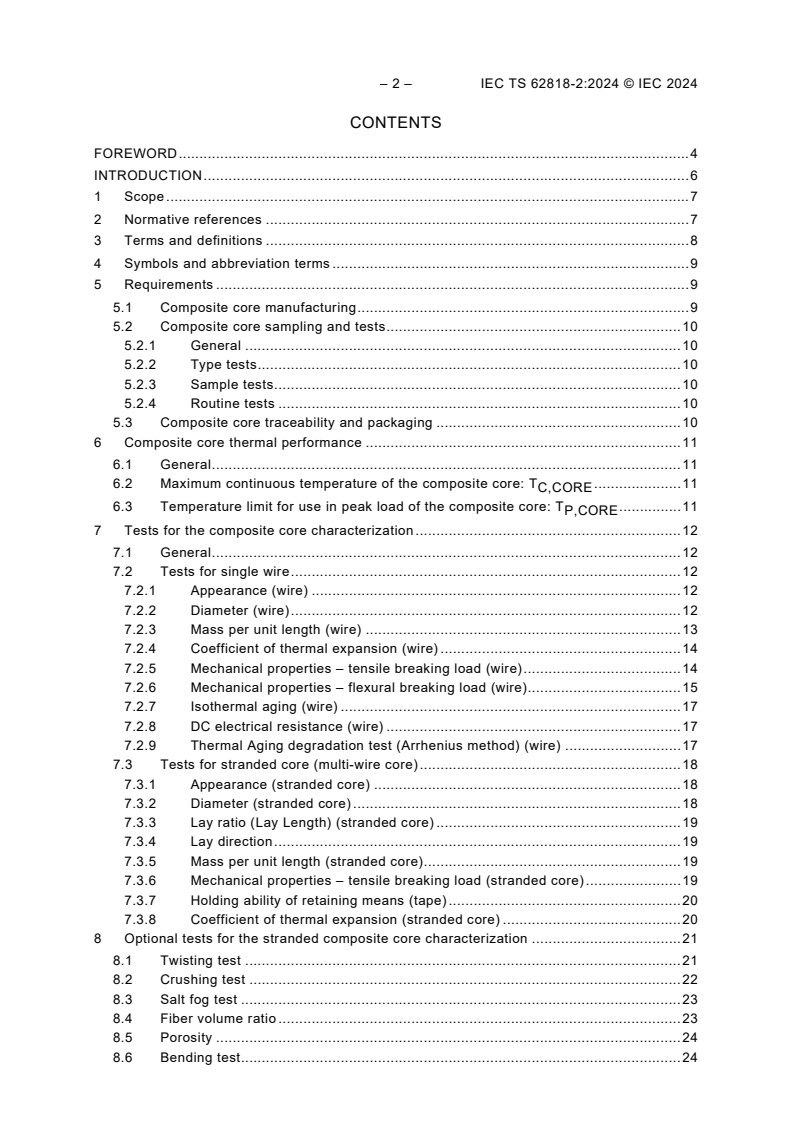
– 2 – IEC TS 62818-2:2024 © IEC 2024
CONTENTS
FOREWORD . 4
INTRODUCTION . 6
1 Scope . 7
2 Normative references . 7
3 Terms and definitions . 8
4 Symbols and abbreviation terms . 9
5 Requirements . 9
5.1 Composite core manufacturing . 9
5.2 Composite core sampling and tests . 10
5.2.1 General . 10
5.2.2 Type tests . 10
5.2.3 Sample tests . 10
5.2.4 Routine tests . 10
5.3 Composite core traceability and packaging . 10
6 Composite core thermal performance . 11
6.1 General . 11
6.2 Maximum continuous temperature of the composite core: T . 11
C,CORE
6.3 Temperature limit for use in peak load of the composite core: T . 11
P,CORE
7 Tests for the composite core characterization . 12
7.1 General . 12
7.2 Tests for single wire . 12
7.2.1 Appearance (wire) . 12
7.2.2 Diameter (wire) . 12
7.2.3 Mass per unit length (wire) . 13
7.2.4 Coefficient of thermal expansion (wire) . 14
7.2.5 Mechanical properties – tensile breaking load (wire) . 14
7.2.6 Mechanical properties – flexural breaking load (wire) . 15
7.2.7 Isothermal aging (wire) . 17
7.2.8 DC electrical resistance (wire) . 17
7.2.9 Thermal Aging degradation test (Arrhenius method) (wire) . 17
7.3 Tests for stranded core (multi-wire core) . 18
7.3.1 Appearance (stranded core) . 18
7.3.2 Diameter (stranded core) . 18
7.3.3 Lay ratio (Lay Length) (stranded core) . 19
7.3.4 Lay direction . 19
7.3.5 Mass per unit length (stranded core) . 19
7.3.6 Mechanical properties – tensile breaking load (stranded core) . 19
7.3.7 Holding ability of retaining means (tape) . 20
7.3.8 Coefficient of thermal expansion (stranded core) . 20
8 Optional tests for the stranded composite core characterization . 21
8.1 Twisting test . 21
8.2 Crushing test . 22
8.3 Salt fog test . 23
8.4 Fiber volume ratio . 23
8.5 Porosity . 24
8.6 Bending test . 24
Annex A (normative) Testing table . 26
Annex B (normative) Arrhenius thermal aging test . 27
B.1 General . 27
B.2 Aging temperatures, number of samples and sampling frequency . 27
B.2.1 Planning for temperature and time . 27
B.2.2 Selection . 27
B.3 Test method . 28
Figure 1 – Measurement of multi-wire core diameter . 18
Figure 2 – CTE test setup . 21
Figure 3 – Illustration of the twisting test . 22
Figure 4 – Schematic of the crushing test . 23
Figure 5 – Illustration of the mandrel test . 25
Figure B.1 – Example of decay curves . 29
Figure B.2 – Example of decay curves and identification of times to end-point
according to method A . 29
Figure B.3 – Example of decay curves and identification of times to end-point
according to method B . 30
Figure B.4 – Example of Arrhenius curve with the long-term extrapolation to 40 years . 31
Table A.1 – Tests on composite core . 26
– 4 – IEC TS 62818-2:2024 © IEC 2024
INTERNATIONAL ELECTROTECHNICAL COMMISSION
____________
CONDUCTORS FOR OVERHEAD LINES – FIBER REINFORCED
COMPOSITE CORE USED AS SUPPORTING MEMBER MATERIAL –
Part 2: Metallic matrix composite cores
FOREWORD
1) The International Electrotechnical Commission (IEC) is a worldwide organization for standardization comprising
all national electrotechnical committees (IEC National Committees). The object of IEC is to promote international
co-operation on all questions concerning standardization in the electrical and electronic fields. To this end and
in addition to other activities, IEC publishes International Standards, Technical Specifications, Technical Reports,
Publicly Available Specifications (PAS) and Guides (hereafter referred to as "IEC Publication(s)"). Their
preparation is entrusted to technical committees; any IEC National Committee interested in the subject dealt with
may participate in this preparatory work. International, governmental and non-governmental organizations liaising
with the IEC also participate in this preparation. IEC collaborates closely with the International Organization for
Standardization (ISO) in accordance with conditions determined by agreement between the two organizations.
2) The formal decisions or agreements of IEC on technical matters express, as nearly as possible, an international
consensus of opinion on the relevant subjects since each technical committee has representation from all
interested IEC National Committees.
3) IEC Publications have the form of recommendations for international use and are accepted by IEC National
Committees in that sense. While all reasonable efforts are made to ensure that the technical content of IEC
Publications is accurate, IEC cannot be held responsible for the way in which they are used or for any
misinterpretation by any end user.
4) In order to promote international uniformity, IEC National Committees undertake to apply IEC Publications
transparently to the maximum extent possible in their national and regional publications. Any divergence between
any IEC Publication and the corresponding national or regional publication shall be clearly indicated in the latter.
5) IEC itself does not provide any attestation of conformity. Independent certification bodies provide conformity
assessment services and, in some areas, access to IEC marks of conformity. IEC is not responsible for any
services carried out by independent certification bodies.
6) All users should ensure that they have the latest edition of this publication.
7) No liability shall attach to IEC or its directors, employees, servants or agents including individual experts and
members of its technical committees and IEC National Committees for any personal injury, property damage or
other damage of any nature whatsoever, whether direct or indirect, or for costs (including legal fees) and
expenses arising out of the publication, use of, or reliance upon, this IEC Publication or any other IEC
Publications.
8) Attention is drawn to the Normative references cited in this publication. Use of the referenced publications is
indispensable for the correct application of this publication.
9) IEC draws attention to the possibility that the implementation of this document may involve the use of (a)
patent(s). IEC takes no position concerning the evidence, validity or applicability of any claimed patent rights in
respect thereof. As of the date of publication of this document, IEC had not received notice of (a) patent(s), which
may be required to implement this document. However, implementers are cautioned that this may not represent
the latest information, which may be obtained from the patent database available at https://patents.iec.ch. IEC
shall not be held responsible for identifying any or all such patent rights.
IEC TS 62818-2 has been prepared by IEC technical committee 7: Overhead Electrical
Conductors. It is a Technical Specification.
The text of this Technical Specification is based on the following documents:
Draft Report on voting
7/753/DTS 7/755/RVDTS
Full information on the voting for its approval can be found in the report on voting indicated in
the above table.
The language used for the development of this Technical Specification is English.
A list of all parts in the IEC 62818 series, published under the general title Conductors for
overhead lines – Fiber reinforced composite core used as supporting member material, can be
found on the IEC website.
This document was drafted in accordance with ISO/IEC Directives, Part 2, and developed in
accordance with ISO/IEC Directives, Part 1 and ISO/IEC Directives, IEC Supplement, available
at www.iec.ch/members_experts/refdocs. The main document types developed by IEC are
described in greater detail at www.iec.ch/publications.
The committee has decided that the contents of this document will remain unchanged until the
stability date indicated on the IEC website under webstore.iec.ch in the data related to the
specific document. At this date, the document will be
• reconfirmed,
• withdrawn, or
• revised.
IMPORTANT – The "colour inside" logo on the cover page of this document indicates
that it contains colours which are considered to be useful for the correct understanding
of its contents. Users should therefore print this document using a colour printer.
– 6 – IEC TS 62818-2:2024 © IEC 2024
INTRODUCTION
The first conductors using a composite core were installed in the early 2000s. Since then, they
have been increasingly used by utilities worldwide. As a result, there is a need for an IEC
publication to agree on tests methods to qualify these cores.
Because of the potential variety of products possible for this purpose, this document does not
set minima or maxima (usually provided by the manufacturer, but rather standardizes testing
methods to ascertain the numerical values of the basic properties needed by the purchaser to
choose the right supporting member material according to the properties of the overhead line
conductors. Future discussion items for review may include: performance level and acceptance
criteria, other ageing tests and criteria or other relevant tests.
In a future document, tests on the complete conductor which include the composite core will be
covered in detail (for example salt fog, corrosion test, mechanical tests, etc.).
CONDUCTORS FOR OVERHEAD LINES – FIBER REINFORCED
COMPOSITE CORE USED AS SUPPORTING MEMBER MATERIAL –
Part 2: Metallic matrix composite cores
1 Scope
This part of IEC 62818, which is a Technical Specification, establishes a system of fiber
reinforced composite cores used as supporting member material in conductors for overhead
lines which may be used as the basis for specifications. This document is applicable to fiber
reinforced composite core, with a metallic matrix, used as supporting member material in
conductors for overhead lines.
This document gives guidance on:
– defining the common terms used for fiber reinforced composite cores with a metallic matrix,
– prescribing common methods and recommendations to characterize the properties of fiber
reinforced composite cores based on single or multi-wires, with MMC (Metallic Matrix
Composite) used as a supporting member material in conductors,
– prescribing or recommending acceptance or failure criteria when applicable.
These tests, criteria and recommendations are intended to ensure a satisfactory use and quality
under normal operating and environmental conditions.
This document does not prescribe performance or compliance criteria which may be required
but indicative values could be given in Annexes for guidance.
2 Normative references
The following documents are referred to in the text in such a way that some or all of their content
constitutes requirements of this document. For dated references, only the edition cited applies.
For undated references, the latest edition of the referenced document (including any
amendments) applies.
IEC 60068-2-11:2021, Environmental testing – Part 2-11: Tests – Test Ka: Salt mist
IEC 60216-1:2013, Electrical insulating materials – Thermal endurance properties – Part 1:
Ageing procedures and evaluation of test results
IEC 60468:1974, Method of measurement of resistivity of metallic materials
IEC 63248:2022, Conductors for overhead lines – Coated or cladded metallic wire for concentric
lay stranded conductors
ISO 527-5:2021, Plastics: Determination of tensile properties – Part 5: Test conditions for
unidirectional fiber-reinforced plastic composites
ISO 11359-1:2023, Plastics – Thermomechanical analysis (TMA) – Part 1: General principles
ISO 11359-2:2021, Plastics – Thermomechanical analysis (TMA) – Part 2: Determination of
coefficient of linear thermal expansion and glass transition temperature
– 8 – IEC TS 62818-2:2024 © IEC 2024
ISO 14125:1998, Fiber-reinforced plastic composites – Determination of flexural properties
3 Terms and definitions
For the purposes of this document, the following terms and definitions apply.
ISO and IEC maintain terminology databases for use in standardization at the following
addresses:
• IEC Electropedia: available at https://www.electropedia.org/
• ISO Online browsing platform: available at https://www.iso.org/obp
3.1
metallic matrix composite wire
MMC
assembly of continuous fibers (such as aluminum oxide, silicon carbide, or other ceramic fibers)
embedded longitudinally in a metal matrix (such as aluminium)
3.2
composite core
MMC single or multi-wires including additional protection (metallic or non-metallic) if existing in
the final application
3.3
external protective layer
outer layer made of a metal or alloy applied onto the MMC for the purpose of protecting it
against external aggressions (such as corrosion, oxidation, etc)
Note 1 to entry: In case of a core based on an assembly of composite wires, this protective layer could be applied
to:
- each individual wire,
- the assembly of wires.
Note 2 to entry: Individual wires could be protected with different materials. In this case, testing protocols shall be
adapted in relation to the specific material.
3.4
fiber reinforced
continuous fibers incorporated within a metallic matrix in order to increase its performance
Note 1 to entry: It is achieved through specific processes such as infiltration, casting, etc.
3.5
fiber
organic or inorganic bundle of filaments that is essentially continuous
3.6
metal
matrix component of the MMC
Note 1 to entry: Many metals and alloys are possible, but aluminium is commonly used
3.7
porosity
measurement of the void fraction in the material over the total volume
Note 1 to entry: It results from a lack of matrix infiltration or from solidification shrinkage. It distinguishes itself from
composite crack or fracture by that it is a lack of matrix but not a matrix mechanical fracture.
3.8
lot
group of production units of one type and size of wire, which was manufactured by the same
manufacturer during the same time period under similar conditions of production
Note 1 to entry: A lot may consist of part or all of a purchased quantity.
Note 2 to entry: If agreed between the purchaser and the manufacturer, for example for the Type tests, a Lot could
be composed of only one Production unit.
3.9
production unit
coil, reel, spool, or other package of individual composite core that represents a single usable
length
3.10
sample
specimen(s) removed from a production unit(s) which is considered to have properties
representative of a lot
3.11
specimen
length of composite core removed for test purposes
3.12
equivalent diameter
diameter of a circle which would have the same cross-sectional area as a given formed wire
4 Symbols and abbreviation terms
-1
CTE coefficient of thermal expansion (°C )
DC direct current (A)
F flexural load at break (N)
f
F tensile load at break (N)
t
RTS rated tensile strength (kN)
SEM scanning electron microscope
TMA thermo-mechanical analysis
T maximum continuous temperature (°C) of the composite core
C,CORE
T maximum peak-load temperature (°C) of the composite core
P,CORE
σ flexural stress at break (MPa)
f
5 Requirements
5.1 Composite core manufacturing
Composite cores shall be produced according to the dimensional, mechanical and thermal
properties agreed between purchaser and manufacturer, respecting the acceptance values and
tolerances. These properties shall be uniform along the lot and every production unit shall be
free of internal and external imperfections (e.g. high porosity, unwanted inclusions, scratches,
notches, cracks). Each composite wire shall be produced with a single assembly of continuous
fibers; no fiber end-to-end joint is allowed, unless clearly agreed between both parties.
– 10 – IEC TS 62818-2:2024 © IEC 2024
5.2 Composite core sampling and tests
5.2.1 General
Tests on composite core are described in Clause 7 and shall be classified as:
a) Type test (T),
b) Sample test (S),
c) Routine test (R).
In order to ensure satisfactory quality of the core and to properly characterize its properties, a
list of type tests, sample tests and routine tests is provided in Table A.1, with a suggested
sampling.
For a more detailed characterization of the core, additional/optional tests are also proposed in
the same table and described in Clause 8.
Laboratories and scheduling of tests shall be previously agreed between the purchaser and the
manufacturer. Since ageing tests can be very long, the manufacturer's laboratory may be used
under the supervision of an independent third party.
5.2.2 Type tests
Type tests are intended to establish design characteristics. They are normally made once on a
prototype and repeated only in case of a change of materials or design (for example fiber types,
matrix types, fiber volume ratio, or shape). The type tests performed for a given diameter may
qualify a range of diameters to be agreed between the purchaser and manufacturer. The results
of type tests are recorded as evidence of compliance with design requirements.
5.2.3 Sample tests
Sample tests are intended to verify the quality of materials and workmanship. They are
performed on samples taken from the produced drums of finished core in order to verify the
compliance with design specifications and type tests results.
The sampling of the sample tests is suggested in Table A.1.
5.2.4 Routine tests
Routine tests are intended to verify compliance and stability of core characteristics during the
production of a lot. Sampling for Routine tests depends on the characteristics and monitoring
systems for each production process.
5.3 Composite core traceability and packaging
In order to ensure composite core traceability, orders shall include at least the following
information:
a) lot identification number,
b) number of production units per lot,
c) core size (diameter in mm, if applicable number of wires, sizes of wires, lay length and
direction),
d) length of each type of core,
e) type and size of package and method of packing,
f) special package marking,
g) test report with quantitative results (if required).
The core shall be suitably protected against damage and deterioration which could occur in
ordinary handling, shipping and storage.
Package marking shall not be easily removable during ordinary handling.
The manufacturer shall have raw material traceability for production units and lots.
6 Composite core thermal performance
6.1 General
Composite materials can experience a change in their composition and a deterioration of their
mechanical performance after a long-term exposure to high temperatures. Thus, it is necessary
to experimentally assess their inner resistance to thermal degradation in order to define the
maximum temperature to be respected for a safe use of the complete conductor during the
lifetime of the overhead line.
The metal matrix composite core thermal performance is defined by the two temperatures below:
a) Maximum continuous temperature of the composite core: T
C,CORE
b) Temperature limit for use in peak load of the composite core: T
P,CORE
These temperatures are intended to be measured at the external surface of the composite core.
T and T shall be determined from the experimental result of the test described in
C,CORE P,CORE
7.2.7 and if needed 7.2.9.
A lower T and T value may be utilized if agreed upon between purchaser and
C,CORE P,CORE
manufacturer.
6.2 Maximum continuous temperature of the composite core: T
C,CORE
This temperature is the maximum continuous temperature at which the composite core can be
exposed, without deterioration according to Appendix B, for a duration equal to its lifetime. The
intended life expectancy of the core is typically 40 or 50 years.
Once the reference lifetime is defined, T shall be determined by an extrapolation of the
C, CORE
experimental results of the thermal aging test, as described in 7.2.9.
6.3 Temperature limit for use in peak load of the composite core: T
P,CORE
This temperature is the maximum peak load temperature at which the composite core can be
exposed, without deterioration according to Annex B, for a maximum cumulative time during its
lifespan.
The duration of this maximum time of exposure at high temperature is typically 400 to 1 000
hours cumulative during the life expectancy of the core.
As this temperature is related to the final use of the conductor for which the core will be used,
a longer time can be specified by the purchaser, if needed.
– 12 – IEC TS 62818-2:2024 © IEC 2024
7 Tests for the composite core characterization
7.1 General
Subclauses 7.1 to 7.3 describe the test methods for the assessment of the composite core
properties at their initial state. The tests are separated into two groups. One group applies to
individual (single) wires, and a second group to multiple wires that are stranded into a multi-
wire core (typically a 7-, 19-, or 37-wire core). The tests are:
a) Single Wire
1) Appearance (7.2.1)
2) Diameter (7.2.2)
3) Mass per unit length (7.2.3)
4) Coefficient of thermal expansion (CTE) (7.2.4)
5) Mechanical – Tensile Breaking Load (7.2.5)
6) Mechanical – Flexural test (7.2.6)
7) Isothermal aging (7.2.7)
8) DC electrical resistivity (conductivity) (7.2.8)
9) Thermal aging degradation test (Arrhenius method) (7.2.9)
b) Stranded Core (multi-wire)
1) Appearance (7.3.1)
2) Diameter (7.3.2)
3) Lay ratio (lay length) (7.3.3)
4) Lay direction (7.3.4)
5) Mass per unit length (7.3.5)
6) Mechanical – Tensile breaking load (7.3.6)
7) Holding ability of external tape (if present) (7.3.7)
8) Coefficient of thermal expansion (CTE) (7.3.8)
7.2 Tests for single wire
7.2.1 Appearance (wire)
The wire (including any protective layer) shall be free from any defects (scratch, scrape, notch,
hole, or crack) not consistent with good commercial practice. This only covers defects
significantly visible to the unaided eye (normal corrective lenses accepted). A representative
photograph may be attached to the official test report at the request of the purchaser.
7.2.2 Diameter (wire)
The diameter of the single wire (including any protective layer) shall be measured with a device
with an accuracy of at least 0,01 mm. Diameter(s) shall be expressed in millimeters to two
decimals places.
Diameter(s) shall be measured by one of the following methods:
a) a continuous/in-line process measurement (in-line measurement), performed using a 2-axis
or 3-axis caliper (laser or mechanical) with equal phase shifts in the same straight section.
In addition, a rotating head device may be used where the diameter is continuously scanned
during the rotation. The average value of the diameter should be reported.
b) a direct/manual measurement, performed using micrometers or callipers. The diameter shall
be measured at a single point, but with two readings taken 90° from each other. The average
value of the two readings shall represent the average diameter of the wire. If measurements
are taken during a continuous production run, at least 2 diameter measurements shall be
taken, one at the start and one at the end of the production unit. If samples are cut for the
purpose of a direct/manual diameter measurement, one sample should cut be cut from either
the start or end of the production unit, and the sample shall be at least 1 m long, and shall
be measured in the middle. Minimum, maximum and average values of diameter shall be
reported for each sample.
c) derive the cross-sectional area by Formula (1):
Am /(l×ρ) (1)
where
A is the cross-sectional area, expressed in square millimeters (mm );
m is the mass, expressed in grams (g);
l is the total length, expressed in meters (mm);
ρ is the density of a wire, expressed in grams per cubic millimetre (g/mm )
Then the equivalent diameter is computed by Formula (2):
d= 4/A π (2)
( )
where
d is the equivalent diameter, expressed in millimetres (mm)
A is the cross-sectional area, expressed in square millimetres (mm )
This method is referenced in IEC 63248:2022, 7.4.2.3.
Cut a 1 m length of wire (accuracy of ± 0,1 % in length). Weigh the sample to determine the
mass. The weighing apparatus should have an accuracy of ±0,1 %. Use the known wire
density (provided by the manufacturer).
This method can be used for shaped or non-circular wires and the result reported as an
equivalent diameter.
d) use a metallographic method, in which the wire shall be cut, mounted for metallographic
preparation, and polished to verify the compliance of the shape of the cross section with the
designed shape. The measurements shall be performed with an optical or mechanical device
with an accuracy of 0,01 mm. The computation or template used for deriving the diameter
should be provided.
The manufacturer shall provide a specification for the required wire diameter (d) and the
permitted tolerance (t).
7.2.3 Mass per unit length (wire)
Mass per unit length shall be tested using an apparatus capable of measuring the mass (m)
with an accuracy of ±0,1 %.
The value of mass per unit length shall be taken on a minimum number of one (1). The length
(l) of each tested sample shall be at least 1 meter.
The report shall include the mean value of mass per unit length (in g/m).
=
– 14 – IEC TS 62818-2:2024 © IEC 2024
The manufacturer shall provide a specification for the required mass per unit length (m/l) and
the permitted tolerance.
7.2.4 Coefficient of thermal expansion (wire)
The coefficient of thermal expansion (CTE) of the core (including any external protective layer)
can be measured using the following procedure. The CTE of the stranded core may also be
measured (7.3.8), but it is suggested that only one of the measurements, the wire or the
stranded core needs to be measured. This may be decided by agreement between the
purchaser and manufacturer.
For an individual wire, the (CTE) can be measured using Thermo-Mechanical Analysis (TMA)
in accordance with ISO 11359-1:2023 and ISO 11359-2:2021. At least 2 samples (repeatability)
shall be randomly chosen and tested. The expansion shall be measured in the fiber direction
(axial) between ambient temperature and T with a slope of 3 °C/min. The report shall
P,CORE
-1
present the TMA curves with the measured values of CTE in °C and list the average value
represented by each curve. The maximum CTE of the obtained averages values, shall be the
final result.
Consideration should be given to the accuracy and precision of the TMA method. It is critically
important that care is taken to ensure that the recorded temperature is that of the test sample
and not of the enclosure, which can be a major source of error.
The manufacturer shall provide a specification for the required CTE (α) and the permitted
tolerance (t).
7.2.5 Mechanical properties – tensile breaking load (wire)
A tensile breaking load test shall be performed, in accordance with ISO 527-5:2021, to define
the mechanical characteristic of a composite core wire. Only the breaking load value need be
measured and reported. For type testing only, the tensile elastic modulus shall also be
measured, in accordance with ISO 527-5:2021, and the tensile modulus shall be calculated
from the slope of the load-elongation curve.
Clamping jaws and associated fixtures for the end of the sample used in the tensile test shall
be correctly designed to transfer load without creating local stress concentrations, especially
within and at the end of the clamping region. This may include such combinations as:
a) pneumatic grips with a very long gripping length (for example 30 cm),
b) wire adhesively bonded into long steel tubes with a short length of the tube having no wire,
where the shorter gripping jaws can apply high pressure,
c) bolted grips with a long gripping region (for example 20 to 30 cm) with the end of the bolted
section having no wire and a hole to receive a pin for attachment into the tensile test
equipment.
A well-performing clamping jaw / end fixture assembly should produce a high proportion of
fractures within the wire gauge length and not at the end fixture.
The gripping jaws of the tensile test frame should be well aligned relative to each other (for
both translation and tilt), especially if shorter sample gauge lengths (less than 15 cm) are used.
Poor alignment can lead to frequent fracture at the exit of the gripping jaw due to stress
concentration, causing the measurement of artificially low loads.
It is suggested to use a minimum gauge length of 60 cm for standard size laboratory test frames;
thus, the cut sample needs to be longer to account for the gripping region. Longer gauge lengths
are permitted as some production test equipment is built to sample long lengths (for example
8 m).
In sample tests, only one test per production wire is required, although other sampling rates are
permitted by agreement between the purchaser and manufacturer. In type testing, at least 5
samples of composite core wire shall be tested to have a reliable mean value.
If type-testing a finished stranded core or full-conductor, the individual core wires may be
removed from the sample and tested. Thus a 7-strand core would yield 7 tensile tests, or a
19-strand core would yield 19 tensile tests, etc.
A load shall be introduced into the sample by control of the test frame crosshead speed. A
strain rate of 0,02/min is recommended. This will typically load to failure in 30 to 60 s.
The breaking load of the sample, "F ", shall be reported.
t
If a failure occurs at the end fixture or within the gripping region, or slip occurs, then if desired,
the test may be repeated with a new sample. If the breaking load is above the minimum
specification, then it may be acceptable to just use this value, knowing that the actual breaking
load in the absence of a stress concentration from the fixture could be higher.
All wires shall have a tensile breaking load greater than the minimum specification provided by
the manufacturer.
7.2.6 Mechanical properties – flexural breaking load (wire)
The flexural properties of composite wires shall be measured in accordance with the general
set-up of ISO 14125:1998. The shape of test specimen shall be defined by the laboratory, in
agreement with purchaser and manufacturer, using a 4-point bending device. If round wires are
produced, it is recommended to use the round wires in the test.
For type testing, five specimens shall be tested.
Typically for a metal matrix composite it is suitable to just use the round as-manufactured wire,
but this will require the adjustment of the peak-stress formula to account for the round wire.
Another consideration is to ensure the failure occurs in either tension or compression, but not
in shear. The span-width to sample-thickness ratio controls this behaviour. Using a span-to-
thickness ratio of 16 is recommended, although values 12 to 32 are permitted and may be
needed to avoid shear failures. Note this requires a 4-point bend fixture (or additional fixtures)
where the span width can be changed to accommodate different wire diameters.
The report shall describe the test design and include the flexural test curves with the mean
values of:
– flexural load F at break (in N),
f
– flexural stress at break σ (in MPa).
f
The stress shall be calculated using the diameter values obtained in 7.2.2.
Photographs of the composite wire fracture behaviour shall be attached to the report, showing
the type of fracture (tensile or compression).
The manufacturer shall provide a specification for the minimum flexural stress.
All wires shall have a breaking stress greater than the minimum specification provided by the
manufacturer.
A 4-point bending formula is provided, using a fixture that has an inner span 1/3 of the outer
span. This is a common choice, but sometimes there can be other configurations.
– 16 – IEC TS 62818-2:2024 © IEC 2024
For this geometry, the governing equation for bending stress (σ ) work is Formula (3):
M× c
σ=
(3)
I
xx
where
M is the bending moment, expressed in Newton metres (N × m);
c is the distance from the neutral axis, expressed in metres (m);
I is the moment of inertia, expressed in kilogram metre squared (kg × m ).
xx
Formula (4) describes the governing equation for bending moment (M)
L PL
P
out out
M
(4)
23 6
where
P is the force, expressed in Newtons (N);
L is the outer span length, expressed in metres (m).
out
The term L/3 results from the geometry (inner span is 1/3 of outer span) and is the span length
between the inner and outer contact points. Note if the inner span was ¼ of the outer span
length, then the L/3 term would change to 3L/8).
Formula (5) expresses the distance from the neutral axis.
d
wire
c= (5)
where
d is the diameter of the wire, expressed in metres (m).
wire
Formula (6) describes the governing equation for moment of Inertia (I ).
xx
πd
πr
wire
(6)
I
xx
4 64
where
r is the radius of a round wire, expressed in metres (m);
Thus, the final formula for bending stress becomes Formula (7):
PL d π d 16 PL
out wire wire out
σ /
(7)
6 2 64
3 πd
wire
==
==
==
All wires shall have a breaking bending stress greater than the minimum specification provided
by the manufacturer.
7.2.7 Isothermal aging (wire)
An isothermal aging test shall be performed at the maximum (peak) intended use temperature.
In this case, that would be at T . The duration of the test shall be chosen to reflect the
P,CORE
intended maximum time of exposure to this temperature.
Twenty (20) test samples shall be taken from the same length of wire, and each sample shall
have a length suitable for performing the subsequent tensile test in 7.2.5 and flexure test in
7.2.6. Five (5) of the test samples will be tested according to 7.2.5 without any heat exposure.
Five (5) more of the test samples will be tested according to 7.2.6 without any heat exposure.
Ten (10) test samples shall be placed in an oven, set at a temperature of T , and held for
P,CORE
400 hours. A different aging time may be used on agreement between purchaser and
manufacturer (for example, 1 000 hours is another common time duration used for the highest
temperature rating).
Test procedures and equipment shall be compliant to IEC 60216-4, where temperature
tolerances and ventilation rates of air exchange of the natural air flow testing ovens are defined.
Specimens shall be placed parallel to the bottom of the oven and as close as possible to the
thermocouple, avoiding the contact with the internal oven walls. As natural stratification of the
air inside the oven can introduce a significant vertical gradient in temperature, it is
recommended not to arrange the specimens of the same set of samples on different shelves.
After completion of the 400-hour heating, the samples may be removed from the oven and
allowed to cool to room temperature. Once cool, five (5) samples are tested according to 7.2.5,
and five (5) samples are tested according to 7.2.6.
The average breaking load for each condition is calculated (no aging, high temperature aging,
tensile, flexure).
The type of fracture (tensile or compression), that occurs in flexure should be noted with the
use of photographs.
7.2.8 DC electrical resistance (wire)
DC electrical resistance shall be measured
...