

IEC 61158-2:2023
(Main)Industrial communication networks - Fieldbus specifications - Part 2: Physical layer specification and service definition
General Information
- Abstract
IEC 61158-2:2023 is one of a series produced to facilitate the interconnection of automation system components. It is related to other standards in the set as defined by the "three-layer" fieldbus reference model described in IEC 61158‑1.
- Status
- Published
- Publication Date
- 08-Mar-2023
- Technical Committee
- SC 65C - Industrial networks
- Drafting Committee
- WG 9 - TC 65/SC 65C/WG 9
- Current Stage
- PPUB - Publication issued
- Start Date
- 09-Mar-2023
- Completion Date
- 31-Mar-2023
Overview
IEC 61158-2:2023 is an internationally recognized standard published by the International Electrotechnical Commission (IEC) that defines the physical layer specification and service definition for industrial communication networks, specifically fieldbus systems. As part of the IEC 61158 series, this standard plays a crucial role in facilitating the interconnection of automation system components by specifying the requirements for the physical layer - the foundational hardware and signal transmission layer in fieldbus communication.
This seventh edition emphasizes various types of media and physical layers classified under a "three-layer" fieldbus reference model as detailed in IEC 61158-1. The standard supports a broad range of media types including wire media, optical media, coaxial cables, twisted-pair wires, and powered media configurations, ensuring adaptability and interoperability across diverse industrial environments.
Key Topics
IEC 61158-2:2023 comprehensively covers:
- Physical Layer Variations: Detailed specifications for multiple physical media types, including:
- Type 1: Wire and optical media
- Type 2: Coaxial wire and optical media
- Type 3 & Type 8: Twisted-pair wire and optical media
- Types 4, 12, 16, 18, 20, 24, and 28: Various wire and optical media and powered media configurations
- Service Definitions: Descriptions of the primitives and services offered by the physical layer to the data link layer, facilitating smooth data transmission and reception.
- Symbols and Terminology: Standardized definitions and abbreviations to create a common vocabulary for professionals working with fieldbus physical layers.
- Interfacing Requirements: Guidelines for the interface between the physical layer and the data link layer (DLL), including transmission requests, status indications, and error handling mechanisms.
- Patent Declarations: Notification concerning the intellectual property related to certain technologies within the scope of the standard.
Applications
IEC 61158-2:2023 is vital for engineers, system integrators, and manufacturers involved in designing and deploying industrial automation communication networks. Its physical layer specifications are widely applied in:
- Factory Automation: Enabling reliable and high-performance communication between sensors, actuators, and control devices over fieldbus networks.
- Process Control: Supporting secure data transmission in chemical, oil, gas, and pharmaceutical industries requiring robust fieldbus setups.
- Industrial Ethernet and Fieldbus Devices: Providing detailed physical layer guidelines that ensure device interoperability and network stability.
- System Integration Projects: Allowing the integration of components from different vendors by adhering to unified communication protocols and electrical standards.
- Network Infrastructure Design: Assisting in the selection and installation of appropriate media types such as twisted-pair cables, optical fibers, or coaxial cables based on environmental and operational needs.
By complying with IEC 61158-2, organizations benefit from improved network interoperability, reliable physical communication, and standardized service provisions, resulting in reduced downtime and better system scalability.
Related Standards
IEC 61158-2:2023 is part of the broader IEC 61158 family dedicated to fieldbus communications. Related standards include:
- IEC 61158-1: Fieldbus reference model – This provides the conceptual framework for the physical, data link, and application layers.
- IEC 61158-3 to 11: Covering data link layer services, application layer specifications, and communication profiles for various fieldbus types.
- IEC 61784: Profiles for industrial communication networks, specifying the protocols and configurations that complement physical layer definitions.
- IEC 61850: Communication networks and systems in substations, which sometimes integrate fieldbus standards for automation tasks.
- ISO/IEC 11801: Generic cabling for customer premises, which can complement physical media specifications in industrial settings.
Following IEC 61158-2:2023 supports adherence to a comprehensive suite of international standards, promoting interoperable and future-proof industrial communication systems.
Keywords: IEC 61158-2:2023, industrial communication networks, fieldbus specifications, physical layer, automation systems, fieldbus physical layer, industrial Ethernet, physical layer services, twisted-pair media, optical media, IEC standards, automation network standards, industrial automation protocols, fieldbus interface, data link layer, fieldbus network design.
Relations
- Effective Date
- 05-Sep-2023
Get Certified
Connect with accredited certification bodies for this standard

BSI Group
BSI (British Standards Institution) is the business standards company that helps organizations make excellence a habit.

DVS-ZERT GmbH
German welding certification society.
CARES (UK Certification Authority for Reinforcing Steels)
UK certification for reinforcing steels and construction.
Sponsored listings
Frequently Asked Questions
IEC 61158-2:2023 is a standard published by the International Electrotechnical Commission (IEC). Its full title is "Industrial communication networks - Fieldbus specifications - Part 2: Physical layer specification and service definition". This standard covers: IEC 61158-2:2023 is one of a series produced to facilitate the interconnection of automation system components. It is related to other standards in the set as defined by the "three-layer" fieldbus reference model described in IEC 61158‑1.
IEC 61158-2:2023 is one of a series produced to facilitate the interconnection of automation system components. It is related to other standards in the set as defined by the "three-layer" fieldbus reference model described in IEC 61158‑1.
IEC 61158-2:2023 is classified under the following ICS (International Classification for Standards) categories: 25.040.40 - Industrial process measurement and control; 35.100.20 - Data link layer; 35.240.50 - IT applications in industry. The ICS classification helps identify the subject area and facilitates finding related standards.
IEC 61158-2:2023 has the following relationships with other standards: It is inter standard links to IEC 61158-2:2014. Understanding these relationships helps ensure you are using the most current and applicable version of the standard.
IEC 61158-2:2023 is available in PDF format for immediate download after purchase. The document can be added to your cart and obtained through the secure checkout process. Digital delivery ensures instant access to the complete standard document.
Standards Content (Sample)
IEC 61158-2 ®
Edition 7.0 2023-03
INTERNATIONAL
STANDARD
NORME
INTERNATIONALE
colour
inside
Industrial communication networks – Fieldbus specifications –
Part 2: Physical layer specification and service definition
Réseaux de communication industriels – Spécifications des bus de terrain –
Partie 2: Spécification et définition des services de la couche physique
All rights reserved. Unless otherwise specified, no part of this publication may be reproduced or utilized in any form
or by any means, electronic or mechanical, including photocopying and microfilm, without permission in writing from
either IEC or IEC's member National Committee in the country of the requester. If you have any questions about IEC
copyright or have an enquiry about obtaining additional rights to this publication, please contact the address below or
your local IEC member National Committee for further information.
Droits de reproduction réservés. Sauf indication contraire, aucune partie de cette publication ne peut être reproduite ni
utilisée sous quelque forme que ce soit et par aucun procédé, électronique ou mécanique, y compris la photocopie et
les microfilms, sans l'accord écrit de l'IEC ou du Comité national de l'IEC du pays du demandeur. Si vous avez des
questions sur le copyright de l'IEC ou si vous désirez obtenir des droits supplémentaires sur cette publication, utilisez
les coordonnées ci-après ou contactez le Comité national de l'IEC de votre pays de résidence.
IEC Secretariat Tel.: +41 22 919 02 11
3, rue de Varembé info@iec.ch
CH-1211 Geneva 20 www.iec.ch
Switzerland
About the IEC
The International Electrotechnical Commission (IEC) is the leading global organization that prepares and publishes
International Standards for all electrical, electronic and related technologies.
About IEC publications
The technical content of IEC publications is kept under constant review by the IEC. Please make sure that you have the
latest edition, a corrigendum or an amendment might have been published.
IEC publications search - webstore.iec.ch/advsearchform IEC Products & Services Portal - products.iec.ch
The advanced search enables to find IEC publications by a Discover our powerful search engine and read freely all the
variety of criteria (reference number, text, technical publications previews. With a subscription you will always have
committee, …). It also gives information on projects, replaced access to up to date content tailored to your needs.
and withdrawn publications.
Electropedia - www.electropedia.org
IEC Just Published - webstore.iec.ch/justpublished
The world's leading online dictionary on electrotechnology,
Stay up to date on all new IEC publications. Just Published
containing more than 22 300 terminological entries in English
details all new publications released. Available online and once
and French, with equivalent terms in 19 additional languages.
a month by email.
Also known as the International Electrotechnical Vocabulary
(IEV) online.
IEC Customer Service Centre - webstore.iec.ch/csc
If you wish to give us your feedback on this publication or need
further assistance, please contact the Customer Service
Centre: sales@iec.ch.
A propos de l'IEC
La Commission Electrotechnique Internationale (IEC) est la première organisation mondiale qui élabore et publie des
Normes internationales pour tout ce qui a trait à l'électricité, à l'électronique et aux technologies apparentées.
A propos des publications IEC
Le contenu technique des publications IEC est constamment revu. Veuillez vous assurer que vous possédez l’édition la
plus récente, un corrigendum ou amendement peut avoir été publié.
Recherche de publications IEC - Découvrez notre puissant moteur de recherche et consultez
webstore.iec.ch/advsearchform gratuitement tous les aperçus des publications. Avec un
La recherche avancée permet de trouver des publications IEC abonnement, vous aurez toujours accès à un contenu à jour
en utilisant différents critères (numéro de référence, texte, adapté à vos besoins.
comité d’études, …). Elle donne aussi des informations sur les
projets et les publications remplacées ou retirées. Electropedia - www.electropedia.org
Le premier dictionnaire d'électrotechnologie en ligne au monde,
IEC Just Published - webstore.iec.ch/justpublished
avec plus de 22 300 articles terminologiques en anglais et en
Restez informé sur les nouvelles publications IEC. Just
français, ainsi que les termes équivalents dans 19 langues
Published détaille les nouvelles publications parues.
additionnelles. Egalement appelé Vocabulaire
Disponible en ligne et une fois par mois par email.
Electrotechnique International (IEV) en ligne.
Service Clients - webstore.iec.ch/csc
Si vous désirez nous donner des commentaires sur cette
publication ou si vous avez des questions contactez-nous:
sales@iec.ch.
IEC Products & Services Portal - products.iec.ch
IEC 61158-2 ®
Edition 7.0 2023-03
INTERNATIONAL
STANDARD
NORME
INTERNATIONALE
colour
inside
Industrial communication networks – Fieldbus specifications –
Part 2: Physical layer specification and service definition
Réseaux de communication industriels – Spécifications des bus de terrain –
Partie 2: Spécification et définition des services de la couche physique
INTERNATIONAL
ELECTROTECHNICAL
COMMISSION
COMMISSION
ELECTROTECHNIQUE
INTERNATIONALE
ICS 25.040.40; 35.100.20; 35.240.50 ISBN 978-2-8322-6552-9
– 2 – IEC 61158-2:2023 © IEC:2023
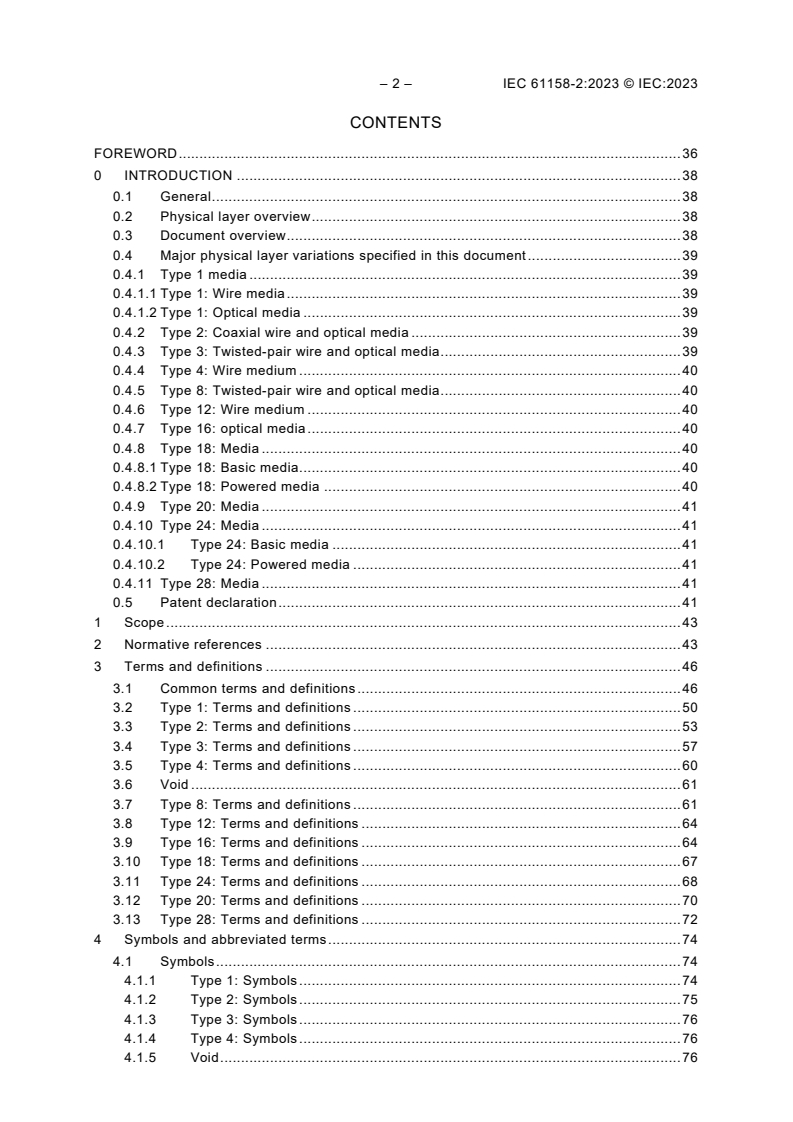
CONTENTS
FOREWORD . 36
0 INTRODUCTION . 38
0.1 General . 38
0.2 Physical layer overview . 38
0.3 Document overview . 38
0.4 Major physical layer variations specified in this document . 39
0.4.1 Type 1 media . 39
0.4.1.1 Type 1: Wire media . 39
0.4.1.2 Type 1: Optical media . 39
0.4.2 Type 2: Coaxial wire and optical media . 39
0.4.3 Type 3: Twisted-pair wire and optical media . 39
0.4.4 Type 4: Wire medium . 40
0.4.5 Type 8: Twisted-pair wire and optical media . 40
0.4.6 Type 12: Wire medium . 40
0.4.7 Type 16: optical media . 40
0.4.8 Type 18: Media . 40
0.4.8.1 Type 18: Basic media. 40
0.4.8.2 Type 18: Powered media . 40
0.4.9 Type 20: Media . 41
0.4.10 Type 24: Media . 41
0.4.10.1 Type 24: Basic media . 41
0.4.10.2 Type 24: Powered media . 41
0.4.11 Type 28: Media . 41
0.5 Patent declaration . 41
1 Scope . 43
2 Normative references . 43
3 Terms and definitions . 46
3.1 Common terms and definitions . 46
3.2 Type 1: Terms and definitions . 50
3.3 Type 2: Terms and definitions . 53
3.4 Type 3: Terms and definitions . 57
3.5 Type 4: Terms and definitions . 60
3.6 Void . 61
3.7 Type 8: Terms and definitions . 61
3.8 Type 12: Terms and definitions . 64
3.9 Type 16: Terms and definitions . 64
3.10 Type 18: Terms and definitions . 67
3.11 Type 24: Terms and definitions . 68
3.12 Type 20: Terms and definitions . 70
3.13 Type 28: Terms and definitions . 72
4 Symbols and abbreviated terms . 74
4.1 Symbols . 74
4.1.1 Type 1: Symbols . 74
4.1.2 Type 2: Symbols . 75
4.1.3 Type 3: Symbols . 76
4.1.4 Type 4: Symbols . 76
4.1.5 Void . 76
4.1.6 Type 8: Symbols . 76
4.1.7 Type 12: Symbols . 77
4.1.8 Type 16: Symbols . 77
4.1.9 Type 18: Symbols . 77
4.1.10 Type 24: Symbols . 78
4.1.11 Type 20: Symbols . 78
4.1.12 Type 28: Symbols . 78
4.2 Abbreviated terms . 79
4.2.1 Type 1: Abbreviations . 79
4.2.2 Type 2: Abbreviations . 80
4.2.3 Type 3: Abbreviations . 80
4.2.4 Type 4: Abbreviations . 82
4.2.5 Void . 82
4.2.6 Type 8: Abbreviations . 82
4.2.7 Type 12: Abbreviations . 84
4.2.8 Type 16: Abbreviations . 84
4.2.9 Type 18: Abbreviations . 84
4.2.10 Type 24: Abbreviations . 85
4.2.11 Type 20: Abbreviations . 85
4.2.12 Type 28: Abbreviations . 85
5 DLL – PhL interface . 86
5.1 General . 86
5.2 Type 1: Required services . 87
5.2.1 Primitives of the PhS . 87
5.2.2 Notification of PhS characteristics . 88
5.2.3 Transmission of Ph-user-data . 89
5.2.4 Reception of Ph-user-data . 89
5.3 Type 2: Required services . 89
5.3.1 General . 89
5.3.2 M_symbols . 89
5.3.3 PH-LOCK indication . 90
5.3.4 PH-FRAME indication . 90
5.3.5 PH-CARRIER indication . 90
5.3.6 PH-DATA indication . 90
5.3.7 PH-STATUS indication . 90
5.3.8 PH-DATA request . 91
5.3.9 PH-FRAME request . 91
5.3.10 PH-JABBER indication . 91
5.3.11 Ph-JABBER-CLEAR request . 91
5.3.12 Ph-JABBER-TYPE request . 91
5.4 Type 3: Required services . 92
5.4.1 Synchronous transmission . 92
5.4.2 Asynchronous transmission . 92
5.5 Type 4: Required services . 93
5.5.1 General . 93
5.5.2 Primitives of the PhS . 93
5.5.3 Transmission of Ph-user data . 94
5.6 Void . 94
5.7 Type 8: Required services . 95
– 4 – IEC 61158-2:2023 © IEC:2023
5.7.1 General . 95
5.7.2 Primitives of the PhS . 95
5.7.3 Overview of the Interactions . 96
5.8 Type 12: Required services . 102
5.9 Type 16: Required services . 103
5.9.1 Primitives of the PhS . 103
5.9.2 Transmission of Ph-user-data . 103
5.9.3 Reception of Ph-user-data . 104
5.10 Type 18: Required services . 104
5.10.1 General . 104
5.10.2 Primitives of the PhS . 104
5.10.3 Transmission of Ph-user-data . 105
5.10.4 Reception of Ph-user-data . 105
5.11 Type 24: Required services . 105
5.11.1 General . 105
5.11.2 DL_Symbols . 106
5.11.3 PLS_CARRIER indication . 106
5.11.4 PLS_SIGNAL indication . 106
5.11.5 PLS_DATA_VALID indication . 106
5.11.6 PLS_DATA indication . 106
5.11.7 PLS_DATA request . 106
5.12 Type 20: Required services . 106
5.12.1 Facilities of the physical layer services . 106
5.12.2 Sequence of primitives . 107
5.12.3 PH-START service . 107
5.12.4 PH-DATA service . 108
5.12.5 PH-END service . 108
5.13 Type 28: Required services . 109
5.13.1 General . 109
5.13.2 Ph-Param (para, value). 109
5.13.3 Ph-Data (length, data, status) . 110
5.13.4 Ph-Clock-Sync (command, data, ofdmtiming) . 111
6 Systems management – PhL interface . 112
6.1 General . 112
6.2 Type 1: Systems management – PhL interface . 112
6.2.1 Required services . 112
6.2.2 Service primitive requirements . 112
6.3 Type 3: Systems management – PhL interface . 114
6.3.1 Synchronous transmission . 114
6.3.2 Asynchronous transmission . 114
6.4 Type 4: Systems management – PhL interface . 119
6.4.1 Required Services . 119
6.4.2 Service primitive requirements . 120
6.5 Void . 120
6.6 Type 8: Systems management – PhL interface . 120
6.6.1 Functionality of the PhL Management . 120
6.6.2 PhL-PNM1 Interface . 120
6.7 Type 12: Systems management – PhL interface . 125
6.8 Type 18: Systems management – PhL interface . 125
6.8.1 General . 125
6.8.2 Required services . 125
6.8.3 Service primitive requirements . 125
6.9 Type 24: Systems management – PhL interface . 126
6.10 Type 28: Systems management – PhL interface . 126
6.10.1 General . 126
6.10.2 PhL related management information table . 126
6.10.3 Service primitive . 132
7 DCE independent sublayer (DIS) . 135
7.1 General . 135
7.2 Type 1: DIS . 136
7.3 Type 3: DIS . 136
7.3.1 Synchronous transmission . 136
7.3.2 Asynchronous transmission . 136
7.4 Void . 136
7.5 Type 8: DIS . 136
7.5.1 General . 136
7.5.2 Function . 136
7.5.3 Serial transmission . 136
7.5.4 MDS coupling . 137
7.6 Type 12: DIS . 138
7.7 Type 28: DIS . 138
8 DTE – DCE interface and MIS-specific functions . 138
8.1 General . 138
8.2 Type 1: DTE – DCE interface . 139
8.2.1 Services . 139
8.2.2 Signaling interfaces . 140
8.3 Type 3: DTE – DCE interface . 149
8.3.1 Synchronous transmission . 149
8.3.2 Asynchronous transmission . 149
8.4 Type 8: MIS – MDS interface . 150
8.4.1 General . 150
8.4.2 Services . 150
8.4.3 Interface signals . 151
8.4.4 Converting the services to the interface signals . 152
8.5 Type 12: DTE – DCE interface . 159
8.6 Type 28: DTE – DCE interface and MIS Specific function . 159
8.6.1 General . 159
8.6.2 MIS Specific function . 159
8.6.3 DTE – DCE interface . 166
9 Medium dependent sublayer (MDS) . 168
9.1 General . 168
9.2 Type 1: MDS: Wire and optical media . 168
9.2.1 PhPDU . 168
9.2.2 Encoding and decoding . 168
9.2.3 Polarity detection . 170
9.2.4 Start of frame delimiter . 170
9.2.5 End of frame delimiter . 170
9.2.6 Preamble . 170
– 6 – IEC 61158-2:2023 © IEC:2023
9.2.7 Synchronization . 171
9.2.8 Post-transmission gap . 171
9.2.9 Inter-channel signal skew . 171
9.3 Void . 171
9.4 Type 2: MDS: Wire and optical media . 172
9.4.1 General . 172
9.4.2 Clock accuracy . 172
9.4.3 Data recovery . 172
9.4.4 Data encoding rules . 172
9.5 Type 3: MDS: Wire and optical media . 173
9.5.1 Synchronous transmission . 173
9.5.2 Asynchronous transmission . 173
9.6 Type 4: MDS: Wire medium . 173
9.6.1 Half-duplex . 173
9.6.2 Full-duplex . 175
9.6.3 Full-duplex UDP . 177
9.7 Void . 178
9.8 Type 8: MDS: Wire and optical media . 178
9.8.1 Function . 178
9.8.2 PhPDU formats . 179
9.8.3 Idle states . 183
9.8.4 Reset PhPDU . 183
9.8.5 MAU coupling . 184
9.9 Type 12: MDS: Wire media . 185
9.10 Type 16: MDS: Optical media . 185
9.10.1 Data encoding rules . 185
9.10.2 Telegrams and fill characters . 186
9.11 Type 18: MDS: Wire media . 186
9.11.1 Overview . 186
9.11.2 Transmission . 187
9.11.3 Reception . 187
9.12 Type 24: MDS: Twisted-pair wire . 187
9.12.1 General . 187
9.12.2 Clock accuracy . 187
9.12.3 Data recovery . 188
9.12.4 Data encoding rules . 188
9.13 Type 28: MDS: Twisted-pair wire and coaxial media . 189
9.13.1 General . 189
9.13.2 MDS specification . 189
10 MDS – MAU interface . 196
10.1 General . 196
10.2 Type 1: MDS – MAU interface: Wire and optical media . 197
10.2.1 Services . 197
10.2.2 Service specifications . 197
10.2.3 Signal characteristics. 197
10.2.4 Communication mode . 198
10.2.5 Timing characteristics . 198
10.3 Void . 198
10.4 Type 2: MDS – MAU interface: Wire and optical media . 198
10.4.1 MDS – MAU interface: general . 198
10.4.2 MDS – MAU interface: 5 Mbit/s, voltage-mode, coaxial wire . 199
10.4.3 MDS – MAU interface 5 Mbit/s, optical medium . 199
10.4.4 MDS – MAU interface Network Access Port (NAP) . 200
10.5 Type 3: MDS – MAU interface: Wire and optical media . 200
10.5.1 Synchronous transmission . 200
10.5.2 Asynchronous transmission . 201
10.6 Type 8: MDS – MAU interface: Wire and optical media . 201
10.6.1 Overview of the services . 201
10.6.2 Description of the services . 201
10.6.3 Time response . 202
10.6.4 Transmission mode . 202
10.7 Type 18: MDS – MAU interface: Wire media . 203
10.7.1 General . 203
10.7.2 Services . 203
10.7.3 Service specifications . 203
10.7.4 Signal characteristics. 203
10.7.5 Communication mode . 204
10.7.6 Timing characteristics . 204
10.8 Type 24: MDS – MAU interface: Twisted-pair wire medium . 204
10.8.1 Overview of service . 204
10.8.2 Description of the services . 204
10.9 Type 28: MDS – MAU interface: Twisted-pair wire and coaxial media . 205
10.9.1 General . 205
10.9.2 Services . 205
10.9.3 Service process . 206
10.9.4 Service specifications . 206
10.9.5 Transmit specifications . 207
11 Types 1 and 7: Medium attachment unit: voltage mode, linear-bus-topology 150 Ω
twisted-pair wire medium . 208
11.1 General . 208
11.2 Bit-rate-dependent quantities . 208
11.3 Network specifications . 209
11.3.1 Components . 209
11.3.2 Topologies . 209
11.3.3 Network configuration rules . 210
11.3.4 Power distribution rules for network configuration . 211
11.4 MAU transmit circuit specification . 211
11.4.1 Summary . 211
11.4.2 MAU test configuration . 212
11.4.3 MAU output level requirements . 213
11.4.4 MAU output timing requirements . 214
11.4.5 Signal polarity . 215
11.5 MAU receive circuit specification. 216
11.5.1 Summary . 216
11.5.2 Input impedance . 216
11.5.3 Receiver sensitivity and noise rejection . 217
11.5.4 Received bit cell jitter . 217
11.5.5 Interference susceptibility and error rates . 217
– 8 – IEC 61158-2:2023 © IEC:2023
11.6 Jabber inhibit . 218
11.7 Power distribution . 218
11.7.1 Overview . 218
11.7.2 Supply voltage . 219
11.7.3 Powered via signal conductors . 219
11.7.4 Powered separately from signal conductors . 220
11.7.5 Electrical isolation . 220
11.8 Medium specifications . 221
11.8.1 Connector . 221
11.8.2 Standard test cable . 221
11.8.3 Coupler. 222
11.8.4 Splices . 222
11.8.5 Terminator . 222
11.8.6 Shielding rules . 222
11.8.7 Grounding (earthing) rules . 223
11.8.8 Color coding of cables . 223
12 Types 1 and 3: Medium attachment unit: 31,25 kbit/s, voltage-mode with low-
power option, bus- and tree-topology, 100 Ω wire medium . 223
12.1 General . 223
12.2 Transmitted bit rate . 224
12.3 Network specifications . 224
12.3.1 Components . 224
12.3.2 Topologies . 224
12.3.3 Network configuration rules . 225
12.3.4 Power distribution rules for network configuration . 226
12.4 MAU transmit circuit specification . 227
12.4.1 Summary . 227
12.4.2 MAU test configuration . 227
12.4.3 MAU output level requirements . 227
12.4.4 Output timing requirements . 228
12.4.5 Signal polarity . 229
12.4.6 Transition from receive to transmit . 229
12.5 M
...