

IEC 63118-1:2024
(Main)12 V lithium-ion secondary batteries for automotive starting, lighting, ignition (SLI) applications and auxiliary purposes – Part 1: General requirements and methods of test
General Information
- Abstract
IEC 63118-1:2024 specifies the general tests and requirements for the performance of lithium secondary batteries with a nominal voltage of 12 V permanently installed in road vehicles not for propulsion. The replacement of secondary batteries permanently installed in road vehicles not for propulsion is covered by this document.
The following are typical applications that utilize the batteries under the scope of this document: power source for the starting of internal combustion engines, lighting, stop and start function, on-board auxiliary equipment and energy absorption for regeneration from braking.
This document includes:
- electrical characteristics tests methods and requirements;
- a life duration tests method.
- Status
- Published
- Publication Date
- 20-Feb-2024
- Technical Committee
- SC 21A - Secondary cells and batteries containing alkaline or other non-acid electrolytes
- Drafting Committee
- WG 2 - TC 21/WG 2
- Current Stage
- PPUB - Publication issued
- Start Date
- 21-Feb-2024
- Completion Date
- 23-Feb-2024
Buy Documents
IEC 63118-1:2024 - 12 V lithium-ion secondary batteries for automotive starting, lighting, ignition (SLI) applications and auxiliary purposes – Part 1: General requirements and methods of test Released:2/21/2024
Overview
IEC 63118-1:2024 is an international standard established by the International Electrotechnical Commission (IEC) that defines general requirements and test methods for 12 V lithium-ion secondary batteries used in automotive applications. These batteries are specifically designed for starting, lighting, and ignition (SLI) functions as well as auxiliary purposes in road vehicles, excluding propulsion systems like those in electric vehicles (EVs), hybrid electric vehicles (HEVs), or plug-in hybrids (PHEVs). The standard ensures consistent performance and reliability of lithium-ion batteries that are permanently installed in vehicles for essential non-propulsion functions.
This crucial document focuses on evaluation through electrical characteristic tests and life duration tests to certify battery performance under operating conditions relevant to automotive SLI and auxiliary use cases.
Key Topics
Scope and Application
The standard applies to 12 V lithium-ion secondary batteries installed in vehicles to power internal combustion engine starting, lighting, stop/start functions, on-board auxiliary equipment, and energy regeneration systems. Batteries for electric propulsion are excluded.Performance and Testing Requirements
The document prescribes:- Testing procedures for evaluating key electrical characteristics such as capacity, charge retention, discharge performance at low temperatures, and charge performance at cold temperatures.
- Life duration assessments including cycle endurance and floating-calendar life tests to determine battery longevity in automotive settings.
Battery Management System (BMS) Integration
Definitions and provisions related to the BMS ensure proper battery protection against overcharge, overcurrent, overheating, and under-discharge. The standard clarifies the BMS role whether embedded within the battery or implemented in the vehicle.Marking and Designation
Standardized requirements for battery marking and designation facilitate clear identification of battery chemistry types and specifications for quality assurance.Normative References
The standard relies on key referenced documents including IEC 60050-482 for terminology, IEC 62902 for chemistry marking symbols, and ISO/IEC Guide 51 for safety considerations.
Applications
Automotive Starting Systems
Compliant lithium-ion batteries provide reliable power for starting internal combustion engines, ensuring robust ignition performance in diverse conditions.Lighting and Auxiliary Equipment
These batteries deliver consistent electrical supply for vehicle lighting systems and auxiliary functions such as infotainment, sensors, and braking energy recuperation.Stop-Start Functionality
Batteries meeting IEC 63118-1 standards support stop-start technology by enabling rapid engine re-starts and energy efficiency improvements in modern vehicles.Energy Absorption in Regenerative Braking
The standard accommodates batteries used in capturing and storing braking energy to improve fuel economy and reduce emissions in hybrid systems.Replacement Batteries
The document also governs the requirements for replacement batteries installed in vehicles, assuring compatibility and performance equivalence to original equipment.
Related Standards
IEC 63057: Covers safety aspects specifically related to lithium-ion batteries in automotive applications, complementing performance requirements in IEC 63118-1.
IEC 60050-482: Provides fundamental electrotechnical vocabulary essential for clear communication of terms and definitions related to secondary cells and batteries.
IEC 62902: Establishes marking and identification symbols for battery chemistries, supporting standardized labeling practices.
ISO/IEC Guide 51: Offers guidelines on safety aspects necessary for inclusion in standards, ensuring holistic coverage of battery safety protocols.
Practical Value
IEC 63118-1:2024 enables automotive manufacturers, battery producers, and testing laboratories to adopt a harmonized approach to specify, evaluate, and certify 12 V lithium-ion batteries for non-propulsion applications. Compliance with this standard supports product reliability, improves vehicle safety, and enhances consumer confidence. It provides a framework for:
- Designing batteries tailored to automotive electrical demands
- Assessing battery performance in temperature extremes relevant to vehicle operation
- Guaranteeing battery longevity through well-defined endurance testing
- Ensuring proper system integration via battery management requirements
- Facilitating market acceptance through standardized testing and marking
Overall, IEC 63118-1 advances the adoption of lithium-ion technology in automotive electrical systems by defining robust testing methodologies and general specifications critical for performance, durability, and standardized communication across the automotive supply chain.
Buy Documents
IEC 63118-1:2024 - 12 V lithium-ion secondary batteries for automotive starting, lighting, ignition (SLI) applications and auxiliary purposes – Part 1: General requirements and methods of test Released:2/21/2024
Get Certified
Connect with accredited certification bodies for this standard

IMQ S.p.A. (Certification)
Italian electrical product certification.

SLG Prüf- und Zertifizierungs GmbH
German testing and certification body.

UL Solutions
Global safety science company with testing, inspection and certification.
Sponsored listings
Frequently Asked Questions
IEC 63118-1:2024 is a standard published by the International Electrotechnical Commission (IEC). Its full title is "12 V lithium-ion secondary batteries for automotive starting, lighting, ignition (SLI) applications and auxiliary purposes – Part 1: General requirements and methods of test". This standard covers: IEC 63118-1:2024 specifies the general tests and requirements for the performance of lithium secondary batteries with a nominal voltage of 12 V permanently installed in road vehicles not for propulsion. The replacement of secondary batteries permanently installed in road vehicles not for propulsion is covered by this document. The following are typical applications that utilize the batteries under the scope of this document: power source for the starting of internal combustion engines, lighting, stop and start function, on-board auxiliary equipment and energy absorption for regeneration from braking. This document includes: - electrical characteristics tests methods and requirements; - a life duration tests method.
IEC 63118-1:2024 specifies the general tests and requirements for the performance of lithium secondary batteries with a nominal voltage of 12 V permanently installed in road vehicles not for propulsion. The replacement of secondary batteries permanently installed in road vehicles not for propulsion is covered by this document. The following are typical applications that utilize the batteries under the scope of this document: power source for the starting of internal combustion engines, lighting, stop and start function, on-board auxiliary equipment and energy absorption for regeneration from braking. This document includes: - electrical characteristics tests methods and requirements; - a life duration tests method.
IEC 63118-1:2024 is classified under the following ICS (International Classification for Standards) categories: 29.220.30 - Alkaline secondary cells and batteries. The ICS classification helps identify the subject area and facilitates finding related standards.
IEC 63118-1:2024 is available in PDF format for immediate download after purchase. The document can be added to your cart and obtained through the secure checkout process. Digital delivery ensures instant access to the complete standard document.
Standards Content (Sample)
IEC 63118-1 ®
Edition 1.0 2024-02
INTERNATIONAL
STANDARD
NORME
INTERNATIONALE
12 V lithium-ion secondary batteries for automotive starting, lighting, ignition
(SLI) applications and auxiliary purposes –
Part 1: General requirements and methods of test
Accumulateur ion-lithium 12 V pour les applications de démarrage, d'éclairage,
d'allumage (SLI) et les utilisations auxiliaires des véhicules automobiles –
Partie 1 : Exigences et méthodes d’essai générales
All rights reserved. Unless otherwise specified, no part of this publication may be reproduced or utilized in any form
or by any means, electronic or mechanical, including photocopying and microfilm, without permission in writing from
either IEC or IEC's member National Committee in the country of the requester. If you have any questions about IEC
copyright or have an enquiry about obtaining additional rights to this publication, please contact the address below or
your local IEC member National Committee for further information.
Droits de reproduction réservés. Sauf indication contraire, aucune partie de cette publication ne peut être reproduite ni
utilisée sous quelque forme que ce soit et par aucun procédé, électronique ou mécanique, y compris la photocopie et
les microfilms, sans l'accord écrit de l'IEC ou du Comité national de l'IEC du pays du demandeur. Si vous avez des
questions sur le copyright de l'IEC ou si vous désirez obtenir des droits supplémentaires sur cette publication, utilisez
les coordonnées ci-après ou contactez le Comité national de l'IEC de votre pays de résidence.
IEC Secretariat Tel.: +41 22 919 02 11
3, rue de Varembé info@iec.ch
CH-1211 Geneva 20 www.iec.ch
Switzerland
About the IEC
The International Electrotechnical Commission (IEC) is the leading global organization that prepares and publishes
International Standards for all electrical, electronic and related technologies.
About IEC publications
The technical content of IEC publications is kept under constant review by the IEC. Please make sure that you have the
latest edition, a corrigendum or an amendment might have been published.
IEC publications search - webstore.iec.ch/advsearchform IEC Products & Services Portal - products.iec.ch
The advanced search enables to find IEC publications by a Discover our powerful search engine and read freely all the
variety of criteria (reference number, text, technical publications previews, graphical symbols and the glossary.
committee, …). It also gives information on projects, replaced With a subscription you will always have access to up to date
and withdrawn publications. content tailored to your needs.
IEC Just Published - webstore.iec.ch/justpublished
Electropedia - www.electropedia.org
Stay up to date on all new IEC publications. Just Published
The world's leading online dictionary on electrotechnology,
details all new publications released. Available online and once
containing more than 22 500 terminological entries in English
a month by email.
and French, with equivalent terms in 25 additional languages.
Also known as the International Electrotechnical Vocabulary
IEC Customer Service Centre - webstore.iec.ch/csc
(IEV) online.
If you wish to give us your feedback on this publication or need
further assistance, please contact the Customer Service
Centre: sales@iec.ch.
A propos de l'IEC
La Commission Electrotechnique Internationale (IEC) est la première organisation mondiale qui élabore et publie des
Normes internationales pour tout ce qui a trait à l'électricité, à l'électronique et aux technologies apparentées.
A propos des publications IEC
Le contenu technique des publications IEC est constamment revu. Veuillez vous assurer que vous possédez l’édition la
plus récente, un corrigendum ou amendement peut avoir été publié.
Recherche de publications IEC - IEC Products & Services Portal - products.iec.ch
webstore.iec.ch/advsearchform Découvrez notre puissant moteur de recherche et consultez
La recherche avancée permet de trouver des publications IEC gratuitement tous les aperçus des publications, symboles
en utilisant différents critères (numéro de référence, texte, graphiques et le glossaire. Avec un abonnement, vous aurez
comité d’études, …). Elle donne aussi des informations sur les toujours accès à un contenu à jour adapté à vos besoins.
projets et les publications remplacées ou retirées.
Electropedia - www.electropedia.org
IEC Just Published - webstore.iec.ch/justpublished
Le premier dictionnaire d'électrotechnologie en ligne au monde,
Restez informé sur les nouvelles publications IEC. Just
avec plus de 22 500 articles terminologiques en anglais et en
Published détaille les nouvelles publications parues.
français, ainsi que les termes équivalents dans 25 langues
Disponible en ligne et une fois par mois par email.
additionnelles. Egalement appelé Vocabulaire
Electrotechnique International (IEV) en ligne.
Service Clients - webstore.iec.ch/csc
Si vous désirez nous donner des commentaires sur cette
publication ou si vous avez des questions contactez-nous:
sales@iec.ch.
IEC 63118-1 ®
Edition 1.0 2024-02
INTERNATIONAL
STANDARD
NORME
INTERNATIONALE
12 V lithium-ion secondary batteries for automotive starting, lighting, ignition
(SLI) applications and auxiliary purposes –
Part 1: General requirements and methods of test
Accumulateur ion-lithium 12 V pour les applications de démarrage, d'éclairage,
d'allumage (SLI) et les utilisations auxiliaires des véhicules automobiles –
Partie 1 : Exigences et méthodes d’essai générales
INTERNATIONAL
ELECTROTECHNICAL
COMMISSION
COMMISSION
ELECTROTECHNIQUE
INTERNATIONALE
ICS 29.220.30 ISBN 978-2-8322-8162-8
– 2 – IEC 63118-1:2024 © IEC 2024
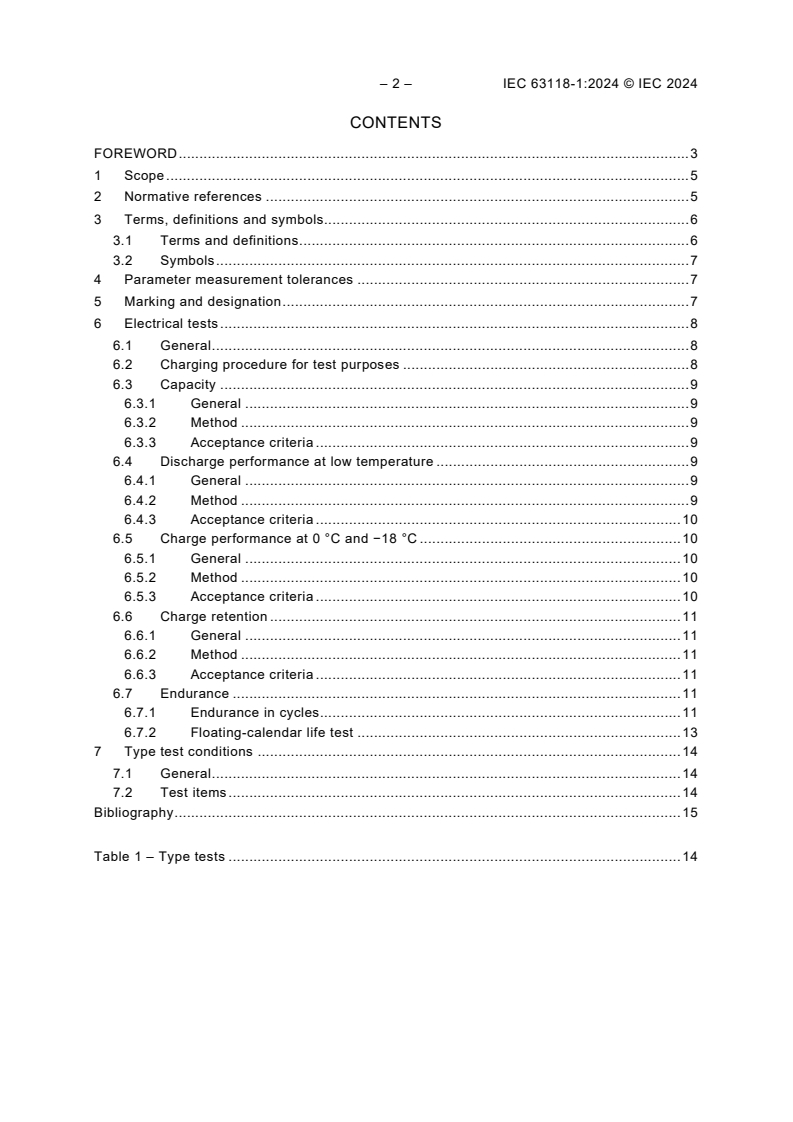
CONTENTS
FOREWORD . 3
1 Scope . 5
2 Normative references . 5
3 Terms, definitions and symbols. 6
3.1 Terms and definitions . 6
3.2 Symbols . 7
4 Parameter measurement tolerances . 7
5 Marking and designation . 7
6 Electrical tests . 8
6.1 General . 8
6.2 Charging procedure for test purposes . 8
6.3 Capacity . 9
6.3.1 General . 9
6.3.2 Method . 9
6.3.3 Acceptance criteria . 9
6.4 Discharge performance at low temperature . 9
6.4.1 General . 9
6.4.2 Method . 9
6.4.3 Acceptance criteria . 10
6.5 Charge performance at 0 °C and −18 °C . 10
6.5.1 General . 10
6.5.2 Method . 10
6.5.3 Acceptance criteria . 10
6.6 Charge retention . 11
6.6.1 General . 11
6.6.2 Method . 11
6.6.3 Acceptance criteria . 11
6.7 Endurance . 11
6.7.1 Endurance in cycles. 11
6.7.2 Floating-calendar life test . 13
7 Type test conditions . 14
7.1 General . 14
7.2 Test items . 14
Bibliography . 15
Table 1 – Type tests . 14
INTERNATIONAL ELECTROTECHNICAL COMMISSION
____________
12 V LITHIUM-ION SECONDARY BATTERIES FOR
AUTOMOTIVE STARTING, LIGHTING, IGNITION (SLI)
APPLICATIONS AND AUXILIARY PURPOSES –
Part 1: General requirements and methods of test
FOREWORD
1) The International Electrotechnical Commission (IEC) is a worldwide organization for standardization comprising
all national electrotechnical committees (IEC National Committees). The object of IEC is to promote international
co-operation on all questions concerning standardization in the electrical and electronic fields. To this end and
in addition to other activities, IEC publishes International Standards, Technical Specifications, Technical Reports,
Publicly Available Specifications (PAS) and Guides (hereafter referred to as “IEC Publication(s)”). Their
preparation is entrusted to technical committees; any IEC National Committee interested in the subject dealt with
may participate in this preparatory work. International, governmental and non-governmental organizations liaising
with the IEC also participate in this preparation. IEC collaborates closely with the International Organization for
Standardization (ISO) in accordance with conditions determined by agreement between the two organizations.
2) The formal decisions or agreements of IEC on technical matters express, as nearly as possible, an international
consensus of opinion on the relevant subjects since each technical committee has representation from all
interested IEC National Committees.
3) IEC Publications have the form of recommendations for international use and are accepted by IEC National
Committees in that sense. While all reasonable efforts are made to ensure that the technical content of IEC
Publications is accurate, IEC cannot be held responsible for the way in which they are used or for any
misinterpretation by any end user.
4) In order to promote international uniformity, IEC National Committees undertake to apply IEC Publications
transparently to the maximum extent possible in their national and regional publications. Any divergence between
any IEC Publication and the corresponding national or regional publication shall be clearly indicated in the latter.
5) IEC itself does not provide any attestation of conformity. Independent certification bodies provide conformity
assessment services and, in some areas, access to IEC marks of conformity. IEC is not responsible for any
services carried out by independent certification bodies.
6) All users should ensure that they have the latest edition of this publication.
7) No liability shall attach to IEC or its directors, employees, servants or agents including individual experts and
members of its technical committees and IEC National Committees for any personal injury, property damage or
other damage of any nature whatsoever, whether direct or indirect, or for costs (including legal fees) and
expenses arising out of the publication, use of, or reliance upon, this IEC Publication or any other IEC
Publications.
8) Attention is drawn to the Normative references cited in this publication. Use of the referenced publications is
indispensable for the correct application of this publication.
9) IEC draws attention to the possibility that the implementation of this document may involve the use of (a)
patent(s). IEC takes no position concerning the evidence, validity or applicability of any claimed patent rights in
respect thereof. As of the date of publication of this document, IEC had not received notice of (a) patent(s), which
may be required to implement this document. However, implementers are cautioned that this may not represent
the latest information, which may be obtained from the patent database available at https://patents.iec.ch. IEC
shall not be held responsible for identifying any or all such patent rights.
IEC 63118-1 has been prepared by IEC technical committee 21: Secondary cells and batteries.
It is an International Standard.
The text of this International Standard is based on the following documents:
Draft Report on voting
21/1177/FDIS 21/1185/RVD
Full information on the voting for its approval can be found in the report on voting indicated in
the above table.
– 4 – IEC 63118-1:2024 © IEC 2024
The language used for the development of this International Standard is English.
This document was drafted in accordance with ISO/IEC Directives, Part 2, and developed in
accordance with ISO/IEC Directives, Part 1 and ISO/IEC Directives, IEC Supplement, available
at www.iec.ch/members_experts/refdocs. The main document types developed by IEC are
described in greater detail at www.iec.ch/publications.
A list of all parts in the IEC 63118 series, published under the general title 12 V lithium-ion
secondary batteries for automotive starting, lighting, ignition (SLI) applications and auxiliary
purposes, can be found on the IEC website.
The committee has decided that the contents of this document will remain unchanged until the
stability date indicated on the IEC website under webstore.iec.ch in the data related to the
specific document. At this date, the document will be
• reconfirmed,
• withdrawn, or
• revised.
12 V LITHIUM-ION SECONDARY BATTERIES FOR
AUTOMOTIVE STARTING, LIGHTING, IGNITION (SLI)
APPLICATIONS AND AUXILIARY PURPOSES –
Part 1: General requirements and methods of test
1 Scope
This part of IEC 63118 specifies the general tests and requirements for the performance of
lithium secondary batteries with a nominal voltage of 12 V permanently installed in road vehicles
not for propulsion. The replacement of secondary batteries permanently installed in road
vehicles not for propulsion is covered by this document.
The following are typical applications that utilize the batteries under the scope of this document:
power source for the starting of internal combustion engines, lighting, stop and start function,
on-board auxiliary equipment and energy absorption for regeneration from braking.
The batteries primarily used for propulsion of electric vehicles (EV) including battery electric
vehicles (BEV), hybrid electric vehicles (HEV), and plug-in hybrid electric vehicles (PHEV) are
not covered by this document.
This document includes:
• electrical characteristics tests methods and requirements;
• a life duration tests method.
This document does not include:
• dimensions;
• the system communication protocol;
• safety aspects.
NOTE The safety aspects of the batteries are covered by IEC 63057.
2 Normative references
The following documents are referred to in the text in such a way that some or all of their content
constitutes requirements of this document. For dated references, only the edition cited applies.
For undated references, the latest edition of the referenced document (including any
amendments) applies.
IEC 60050-482, International Electrotechnical Vocabulary (IEV) – Part 482: Primary and
secondary cells and batteries, available at http://www.electropedia.org
IEC 62902, Secondary cells and batteries – Marking symbols for identification of their chemistry
ISO/IEC Guide 51, Safety aspects – Guidelines for their inclusion in standards
– 6 – IEC 63118-1:2024 © IEC 2024
3 Terms, definitions and symbols
3.1 Terms and definitions
For the purposes of this document, the terms and definitions given in IEC 60050-482 and
ISO/IEC Guide 51, and the following apply.
ISO and IEC maintain terminology databases for use in standardization at the following
addresses:
• IEC Electropedia: available at https://www.electropedia.org/
• ISO Online browsing platform: available at https://www.iso.org/obp
3.1.1
battery
unit comprising one or more cells, modules and a battery management system
3.1.2
battery management system
BMS
set of protection functions associated with a battery to prevent overcharge, overcurrent, over
temperature, under temperature and if applicable overdischarge
Note 1 to entry: The function of the BMS can be assigned to the battery or to the vehicle that uses the battery. See
IEC 63057:2020, Figure 1.
Note 2 to entry: The BMS can be divided, and it can be found partially in the battery and partially on the equipment
that uses the battery. See IEC 63057:2020, Figure 1.
Note 3 to entry: The BMS is sometimes also referred to as a battery management unit (BMU).
Note 4 to entry: The electrical tests specified in Clause 6 can be verified without a BMS by setting the upper and
lower limit range set by the manufacturer.
3.1.3
cell
secondary cell
basic functional unit where the electrical energy is derived from the insertion or extraction
reactions of lithium ions or the oxidation-reduction reaction of lithium between the negative
electrode and the positive electrode
Note 1 to entry: The cell typically has an electrolyte that consists of a lithium salt and organic solvent compound in
liquid, gel or solid form and has a metal or a laminate film casing. It is not ready for use in an application because it
is not yet fitted with its final housing, terminal arrangement and electronic control device.
3.1.4
final voltage
specified closed circuit voltage at which the discharge of a battery is terminated
Note 1 to entry: The final voltage should be declared by the battery manufacturer.
3.1.5
module
group of cells connected together in a series or parallel configuration, or both, with or without
protective device (e.g. fuse or positive temperature coefficient device) and monitoring circuitry
3.1.6
nominal charge current
charge current used to designate or identify the charge performance of a battery
Note 1 to entry: The nominal charge current is declared by the battery manufacturer.
3.1.7
nominal cranking current
discharge current used to designate or identify the cranking performance of a battery
Note 1 to entry: The nominal cranking current is declared by the battery manufacturer.
Note 2 to entry: The nominal cranking current shall not exceed the operating range specified by the battery
manufacturer.
3.1.8
nominal voltage
suitable approximate value of the voltage used to designate or identify a battery
Note 1 to entry: The scope of this document is applicable to a battery with a nominal voltage of 12 V.
3.1.9
rated capacity
capacity value of a battery determined under specified conditions and declared by the battery
manufacturer
Note 1 to entry: The rated capacity is the quantity of electricity declared by the battery manufacturer which a battery
can deliver during an n h period when charging, storing and discharging under the conditions specified in 6.3.
3.2 Symbols
The following symbols are used to denote various numerical values associated with the
corresponding quantities:
I numerical value of the charge current, expressed in amperes (A);
ca
I numerical value of the cranking current, expressed in amperes (A);
cc
C numerical value of the rated capacity, expressed in ampere-hours (Ah).
n
4 Parameter measurement tolerances
The overall accuracy of controlled or measured values, relative to the specified or actual values,
shall be within the following tolerances:
a) ±0,5 % for voltage;
b) ±1 % for current;
c) ±5 °C for temperature;
d) ±0,1 % for time.
These tolerances comprise the combined accuracy of the measuring instruments, the
measurement techniques used, and all other sources of error in the test procedure.
The details of the instrumentation used shall be provided in any report of results.
5 Marking and designation
Each battery that is installed or maintained shall carry clear and durable markings giving the
following information. Details are defined by national regulations:
• "secondary (rechargeable) Li" or "Li-ion";
• polarity;
• name or identification of battery manufacturer or battery supplier;
• rated capacity in 1 h;
– 8 – IEC 63118-1:2024 © IEC 2024
• nominal voltage: 12 V;
• nominal cranking current;
• appropriate caution statement;
• identification of chemistry with reference to IEC 62902.
The model name and manufacturing traceability shall be marked on the battery surface. The
other items listed above can be marked on the smallest package or supplied with the battery.
The following information shall be marked on or supplied with the battery in document form
such as a specification sheet, an instruction manual, or similar documents:
• disposal instructions;
• final voltage;
• nominal charge current;
• recommended charge instructions;
• operating temperature;
• storage temperature.
6 Electrical tests
6.1 General
Electrical tests are applied to batteries.
The charge and discharge currents for the tests shall be based on the value of the rated capacity
C Ah. These currents are expressed as a multiple of I A:
n t
I A = C Ah/1 h
t n
where
I is the numerical value of the reference test current, expressed in amperes (A);
t
C is the numerical value of the rated capacity, expressed in ampere-hours (Ah);
n
n is the numerical value of the time base, expressed in hours (h), for which the rated capacity
is declared.
6.2 Charging procedure for test purposes
The battery shall be stored at an ambient temperature of 25 °C for more than 4 h.
Prior to charging, the battery shall be discharged at 25 °C at a constant current of 1,0 I A, down
t
to the final voltage specified by the battery manufacturer.
Batteries shall be charged at an ambient temperature of 25 °C, using the method specified by
the battery manufacturer, unless otherwise stated in this document.
The battery manufacturer shall propose a nominal charge profile at 25 °C including: charge
current, constant voltage value and cut-off charge current.
6.3 Capacity
6.3.1 General
This test verifies the rated capacity of a battery.
6.3.2 Method
Step 1 – The battery shall be fully charged in accordance with 6.2.
Step 2 – The battery shall be stored at an ambient temperature of 25 °C ± 2 °C, for not less
than 1 h and not more than 24 h. The stored time should be set to stabilize the battery
temperature.
Step 3 – The battery shall then be discharged at the same ambient temperature at 1,0 I A to
t
the final voltage specified by the battery manufacturer.
6.3.3 Acceptance criteria
The capacity (Ah), delivered during step 3 of 6.3.2, shall not be less than the rated capacity.
6.4 Discharge performance at low temperature
6.4.1 General
This test verifies the discharge performance of the battery at low temperatures.
6.4.2 Method
a) Discharge performance at −18 °C
Step 1 – The battery shall be fully charged in accordance with 6.2.
Step 2 – The battery shall be stored at a temperature of −18 °C ± 1 °C, for not less than 16 h
and not more than 24 h.
Step 3 – The battery shall then be discharged, either within or outside the cooling chamber
within 2 min after the end of the cooling period with a nominal cranking current I A at an
cc
ambient temperature of −18 °C ± 1 °C.
Step 4 – After a 10 s discharge, the terminal voltage U shall be recorded and the current
f10s
shall be cut off.
b) Discharge performance at −29 °C
Step 5 – The battery shall be fully charged in accordance with 6.2.
Step 6 – The battery shall be stored at an ambient temperature of 25 °C, for not less than 1 h
and not more than 24 h. The stored time should be set to stabilize the battery temperature.
Step 7 – The battery is discharged using a current of 1,0 I A during 30 min.
t
Step 8 – The battery shall be stored at a temperature of −29 °C ± 1 °C, for not less than 16 h
and not more than 24 h.
Step 9 – The battery shall then be discharged, either within or outside the cooling chamber
within 2 min after the end of the cooling period with a nominal cranking current of 0,6 I A at
cc
an ambient temperature of −29 °C ± 1 °C.
– 10 – IEC 63118-1:2024 © IEC 2024
Step 10 – After a 10 s discharge, the terminal voltage U shall be recorded.
f10s
6.4.3 Acceptance criteria
a) Acceptance criteria of discharge performance at −18 °C
The voltage (U ), delivered during step 4 of 6.4.2, shall not be less than 7,5 V.
f10s
b) Acceptance criteria of discharge performance at −29 °C
The voltage (U ), delivered during step 10 of 6.4.2, shall not be less than 7,5 V.
f10s
6.5 Charge performance at 0 °C and −18 °C
6.5.1 General
This test verifies the charge acceptability of the battery.
6.5.2 Method
a) Charge performance at 0 °C
Step 1 – The battery shall be fully charged in accordance with 6.2.
Step 2 – The battery shall be stored at an ambient temperature of 25 °C for not less than 1 h
and not more than 24 h. The stored time should be set to stabilize the battery temperature.
Step 3 – The battery shall then be discharged at the same ambient temperature at 1,0 I A for
t
30 min.
Step 4 – The battery shall be stored at a temperature of 0 °C ± 1 °C, for not less than 16 h and
not more than 24 h.
Step 5 – The battery shall then be charged at the maximum charge current and maximum charge
voltage specified by the battery manufacturer at an ambient temperature of 0 °C ± 1 °C.
Step 6 – After 10 s, the charging current I A shall be recorded.
10s
b) Charge performance at −18 °C
Step 7 – The battery shall be fully charged in accordance with 6.2.
Step 8 – The battery shall be stored at an ambient temperature of 25 °C, for not less than 1 h
and not more than 24 h. The stored time should be set to stabilize the battery temperature.
Step 9 – The battery is discharged using a current of 1,0 I A during 30 min.
t
Step 10 – The battery shall be stored at a temperature of −18 °C ± 1 °C, for not less than 16 h
and not more than 24 h.
Step 11 – The battery shall then be charged at the maximum charge current and maximum
charge voltage specified by the battery manufacturer at an ambient temperature of –18 °C
± 1 °C.
Step 12 – After 10 s, the charging current I A shall be recorded.
10s
6.5.3 Acceptance criteria
a) Acceptance criteria of charge performance at 0 °C
The current (I A), measured during step 6 of 6.5.2, shall be not less than I A.
10s ca
b) Acceptance criteria of charge performance at −18 °C
The current (I A), measured during step 12 of 6.5.2, shall be not less than 0,7 I A.
10s ca
6.6 Charge retention
6.6.1 General
This test verifies the self-consumption (self-discharge and BMS) of the battery after long-term
shipping.
6.6.2 Method
Step 1 – The battery shall be fully charged in accordance with 6.2.
Step 2 – The battery shall be stored at an ambient temperature of 40 °C, for 90 days.
Step 3 – The battery shall be stored at a temperature of 25 °C, for not less than 16 h and not
more than 24 h.
The battery shall then be discharged at the same ambient temperature at 1,0 I A to the final
t
voltage specified by the battery manufacturer.
6.6.3 Acceptance criteria
The passing criteria shall be based on the agreement between the battery manufacturer and
the customer.
6.7 Endurance
6.7.1 Endurance in cycles
6.7.1.1 General
This test verifies the capacity and the discharge performance at low temperature of the battery
in cycling.
6.7.1.2 Method
Step 1 – The battery shall be fully charged in accordance with 6.2.
Step 2 – The battery shall be stored at a temperature of 40 °C, for not less than 16 h and not
more than 24 h.
Step 3 – The battery shall then be discharged at the same ambient temperature at 1,0 I A
t
during 30 min.
Step 4 – 10 min rest period (adjustable rest period).
Step 5 – The battery shall be fully charged, at an ambient temperature of 40 °C, using the
method specified by the battery manufacturer.
Step 6 – 10 min rest period (adjustable rest period).
The step 3 to step 6 sequence represents one cycle.
– 12 – IEC 63118-1:2024 © IEC 2024
One unit represents 500 cycles.
The rest period duration in step 4 and step 6 of 6.7.1.2 shall be adjusted in order to obtain an
average battery temperature of 45 °C after stabilization.
The check-up sequence is performed before the first unit and after each unit.
The battery shall perform for at least three units corresponding to 1 500 cycles.
6.7.1.3 Check-up sequence
6.7.1.3.1 General
The check-up sequence is composed of a capacity and a discharge performance measurement
at low temperature.
6.7.1.3.2 Capacity measurement
The battery shall be stored at an ambient temperature of 25 °C, for not less than 16 h and not
more than 24 h.
The battery shall be fully charged in accordance with 6.2.
The battery shall be stored at an ambient temperature of 25 °C ± 2 °C, for not less than 1 h and
not more than 24 h. The stored time should be set to stabilize the battery temperature.
A to the final
The battery shall then be discharged at the same ambient temperature at 1,0 I
t
voltage specified by the battery manufacturer. The capacity is recorded.
6.7.1.3.3 Discharge performance measurement at low temperature
The battery shall be fully charged in accordance with 6.2.
After a 1 h rest period at 25 °C, the battery is discharged using a current of 1,0 I A during
t
30 min.
The battery shall be stored at a temperature of –18 °C ± 1°C, for not less than 16 h and not
more than 24 h.
The battery shall then be discharged, with the nominal cranking current of I A at an ambient
cc
temperature of –18 °C ± 1 °C.
The terminal voltage U after a 1 s discharge and U before discharge shall be recorded and
f1s f0s
compared.
The battery shall be stored at a temperature of 25 °C, for not less than 16 h and not more than
24 h.
The battery shall be fully charged in accordance with 6.2.
And then a new unit is launched.
6.7.1.3.4 Acceptance criteria
The passing criteria shall be based on the agreement between the battery manufacturer and
the customer.
6.7.2 Floating-calendar life test
6.7.2.1 General
This test verifies the capacity and the discharge performance at charge and storage of the
battery.
6.7.2.2 Method
Step 1 – The battery shall be fully charged in accordance with 6.2.
Step 2 – The sample is charged according to the standard charge method and put in a climatic
chamber where the ambient temperature is adjusted to 55 °C ± 2 °C.
Step 3 – The battery shall be connected to a device where it undergoes the continuous series
of cycles, each cycle consisting of:
• charge period: 13 days in charge at maximum charge current and maximum charge voltage
specified by the battery manufacturer;
• rest period: 13 days in open circuit conditions.
These charge and rest periods at 55 °C ± 2 °C represent one unit.
The check-up sequence is performed before the first unit and after each unit.
The test shall be performed until eight units are completed.
6.7.2.3 Check-up sequence
6.7.2.3.1 General
The check-up sequence is composed of a capacity and a discharge performance measurement
at low temperature.
6.7.2.3.2 Capacity measurement
The battery shall be stored at an ambient temperature of 25 °C, for not less than 16 h and not
more than 24 h.
The battery shall be fully charged in accordance with 6.2.
The battery shall be stored at an ambient temperature of 25 °C ± 2 °C, for not less than 1 h and
not more than 24 h. The stored time should be set to stabilize the battery temperature.
The battery shall then be discharged at the same ambient temperature at 1,0 I A to the final
t
voltage specified by the battery manufacturer. The capacity is recorded.
6.7.2.3.3 Discharge performance measurement at low temperature
The battery shall be fully charged in accordance with 6.2.
After a 1 h rest period at 25 °C, the battery is discharged using a current of 1,0 I A during
t
30 min.
The battery shall be stored at a temperature of −18 °C ± 1 °C, for not less than 16 h and not
more than 24 h.
– 14 – IEC 63118-1:2024 © IEC 2024
The battery shall then be discharged, with the nominal cranking current of I A at an ambient
cc
temperature of −18 °C ± 1 °C.
The terminal voltage U after a 1 s discharge and U before discharge shall be recorded and
f1s f0s
compared.
The battery shall be stored at a temperature of 25 °C, for not less than 16 h and not more than
24 h.
The battery shall be fully charged in accordance with 6.2.
And then a new unit is launched.
6.7.2.3.4 Acceptance criteria
The passing criteria shall be based on the agreement between the battery manufacturer and
the customer.
7 Type test conditions
7.1 General
The type test conditions and protocol should be agreed between the battery manufacturer and
the customer. When this is not the case, the type test conditions of 7.2 shall apply.
7.2 Test items
Tests are made with the number of batteries specified in Table 1, using batteries that are stored
under the conditions specified by the manufacturer and that are not more than six months old.
The tests are carried out at an ambient temperature of 25 °C ± 5 °C, unless otherwise specified.
NOTE The test conditions are for type tests only. The limit of six months is introduced for consistency and does not
imply that the battery performance is reduced after six months.
Table 1 – Type tests
a
Test Subclause
Battery
Capacity 6.3 Y
Discharge performance at low temperature 6.4 Y
Charge performance at 0 °C and −18 °C 6.5 Y
Charge retention 6.6 Y
Endurance in cycles 6.7.1 Y
Floating-calendar life test 6.7.2 Y
a
"Y" indicates that the test is required: the sample number is at least one.
Bibliography
IEC 61434:1996, Secondary cells and batteries containing alkaline or other non-acid
electrolytes – Guide to designation of current in alkaline secondary cell and battery standards
IEC 63057:2020, Secondary cells and batteries containing alkaline or other non-acid
electrolytes – Safety requirements for secondary lithium batteries for use in road vehicles not
for the propulsion
___________
– 16 – IEC 63118-1:2024 © IEC 2024
SOMMAIRE
AVANT-PROPOS . 17
1 Domaine d'application . 19
2 Références normatives . 19
3 Termes, définitions et symboles . 20
3.1 Termes et définitions . 20
3.2 Symboles . 21
4 Tolérances de mesure relatives aux paramètres . 21
5 Marquage et désignation . 22
6 Essais électriques . 22
6.1 Généralités . 22
6.2 Procédures de charge à des fins d’essai . 23
6.3 Capacité . 23
6.3.1 Généralités . 23
6.3.2 Méthode . 23
6.3.3 Critères d'acceptation . 23
6.4 Performances de décharge à basse température . 23
6.4.1 Généralités . 23
6.4.2 Méthode . 23
6.4.3 Critères d'acceptation . 24
6.5 Performances de charge à 0 °C et −18 °C . 24
6.5.1 Généralités . 24
6.5.2 Méthode . 24
6.5.3 Critères d'acceptation . 25
6.6 Conservation de charge . 25
6.6.1 Généralités . 25
6.6.2 Méthode . 25
6.6.3 Critères d'acceptation . 25
6.7 Endurance . 25
6.7.1 Endurance en cycles . 25
6.7.2 Essai de durée de vie à calendrier flottant . 27
7 Conditions d’essai de type . 28
7.1 Généralités . 28
7.2 Éléments soumis à l’essai . 28
Bibliographie . 30
Tableau 1 – Essais de type . 29
COMMISSION ÉLECTROTECHNIQUE INTERNATIONALE
____________
ACCUMULATEURS ION-LITHIUM 12 V POUR
LES APPLICATIONS DE DÉMARRAGE, D’ÉCLAIRAGE, D’ALLUMAGE (SLI)
ET LES UTILISATIONS AUXILIAIRES DES VÉHICULES AUTOMOBILES –
Partie 1: Exigences et méthodes d’essai générales
AVANT-PROPOS
1) La Commission Electrotechnique Internationale (IEC) est une organisation mondiale de normalisation composée
de l'ensemble des comités électrotechniques nationaux (Comités nationaux de l’IEC). L’IEC a pour objet de
favoriser la coopération internationale pour toutes les questions de normalisation dans les domaines de
l'électricité et de l'électronique. À cet effet, l’IEC – entre autres activités – publie des Normes internationales,
des Spécifications techniques, des Rapports techniques, des Spécifications accessibles au public (PAS) et des
Guides (ci-après dénommés "Publication(s) de l’IEC"). Leur élaboration est confiée à des comités d'études, aux
travaux desquels tout Comité national intéressé par le sujet traité peut participer. Les organisations
internationales, gouvernementales et non gouvernementales, en liaison avec l’IEC, participent également aux
travaux. L’IEC collabore étroitement avec l'Organisation Internationale de Normalisation (ISO), selon des
conditions fixées par accord entre les deux organisations.
2) Les décisions ou accords officiels de l’IEC concernant les questions techniques représentent, dans la mesure du
possible, un accord international sur les sujets étudiés, étant donné que les Comités nationaux de l’IEC intéressés
sont représentés dans chaque comité d’études.
3) Les Publications de l’IEC se présentent sous la forme de recommandations internationales et sont agréées
comme telles par les Comités nationaux de l’IEC. Tous les efforts raisonnables sont entrepris afin que l’IEC
s'assure de l'exactitude du contenu technique de ses publications; l’IEC ne peut pas être tenue responsable de
l'éventuelle mauvaise utilisation ou interprétation qui en est faite par un quelconque utilisateur final.
4) Dans le but d'encourager l'uniformité internationale, les Comités nationaux de l’IEC s'engagent, dans toute la
mesure possible, à appliquer de façon transparente les Publications de l’IEC dans leurs publications nationales
et régionales. Toutes divergences entre toutes Publications de l’IEC et toutes publications nationales ou
régionales correspondantes doivent être indiquées en termes clairs dans ces dernières.
5) L’IEC elle-même ne fournit aucune attestation de conformité. Des organismes de certification indépendants
fournissent des services d'évaluation de conformité et, dans certains secteurs, accèdent aux marques de
conformité de l’IEC. L’IEC n'est responsable d'au
...