

IEC 61643-21:2025
(Main)Low voltage surge protective devices - Part 21: Surge protective devices connected to telecommunications and signalling networks - Requirements and test methods
General Information
- Abstract
IEC 61643-21:2025 is applicable to devices for surge protection against indirect and direct effects of lightning or other transient overvoltages.
These devices are intended to be connected to telecommunications and signalling networks, and equipment rated up to 1 000 V RMS and 1 500 V DC.
These telecommunications and signalling networks can also provide power on the same line, e.g. Power over Ethernet (PoE).
Performance and safety requirements, tests and ratings are specified in this document. These devices contain at least one voltage-limiting component (clamping or switching) and are intended to limit surge voltages and divert surge currents.
This second edition cancels and replaces the first edition published in 2000, Amendment1:2008 and Amendment 2:2012. This edition constitutes a technical revision.
This edition includes the following significant technical changes with respect to the previous edition:
a) New structure of IEC 61643-21 based on IEC 61643-01:2024;
b) Several safety requirements based on IEC 61643-01:2024 have been added.
This International Standard is to be used in conjunction with IEC 61643-01:2024.
- Status
- Published
- Publication Date
- 19-Oct-2025
- Technical Committee
- SC 37A - Low-voltage surge protective devices
- Drafting Committee
- WG 4 - TC 37/SC 37A/WG 4
- Current Stage
- PPUB - Publication issued
- Start Date
- 20-Oct-2025
- Completion Date
- 17-Oct-2025
Buy Documents
IEC 61643-21:2025 - Low voltage surge protective devices - Part 21: Surge protective devices connected to telecommunications and signalling networks - Requirements and test methods Released:10/20/2025
IEC 61643-21:2025 - Parafoudres basse tension - Partie 21: Parafoudres connectés aux réseaux de signaux et de télécommunications - Exigences et méthodes d’essai Released:10/20/2025
IEC 61643-21:2025 - Low voltage surge protective devices - Part 21: Surge protective devices connected to telecommunications and signalling networks - Requirements and test methods Released:10/20/2025
Overview
IEC 61643-21:2025 - "Low voltage surge protective devices - Part 21" specifies requirements and test methods for surge protective devices (SPDs) connected to telecommunications and signalling networks. It covers SPDs intended to protect equipment rated up to 1 000 V RMS and 1 500 V DC, including circuits that also carry power (e.g., Power over Ethernet / PoE). Devices covered contain at least one voltage‑limiting component (clamping or switching) and are designed to limit surge voltages and divert surge currents. This second edition is a technical revision aligned with IEC 61643-01:2024 and adds new structure and safety requirements.
Key topics and technical requirements
- Scope & classification: Definitions, SPD types, mounting methods, end‑of‑life modes and configurations (single‑port, two‑port, multimode).
- Electrical requirements: Protection against electric shock, continuous current handling, measured limiting voltage, operating duty, insulation resistance, dielectric withstand, behaviour under temporary overvoltages (TOV), impulse durability and reset behaviour.
- Current‑limiting and safety: Tests and performance for current‑limiting SPDs, overstress/fault modes, short‑circuit protection for end‑of‑life.
- Transmission & signal integrity: Requirements and test methods for insertion loss, return loss, near‑end crosstalk (NEXT), longitudinal balance and Bit Error Ratio (BER) for LAN/telecom links.
- Mechanical, environmental & material tests: Mechanical strength, connections, creapage/clearance, heat resistance, tracking resistance, damp‑heat ageing.
- Type testing & test procedures: Impulse tests (8/20 current, 1,2/50 voltage, combination wave), impulse durability, impulse reset, AC durability, total discharge current, and reduced test procedures. Annexes provide example test circuits, threat parameters and application guidance.
- Marking & documentation: Manufacturer information requirements and data necessary for type testing and product labelling.
Practical applications
- Protecting telecom and signalling equipment (switches, routers, PoE devices, signalling controllers) from indirect and direct lightning transients and other transient overvoltages.
- Ensuring SPDs meet both safety and signal‑integrity requirements when installed in LANs, industrial control networks, railway signalling and telecom infrastructures.
- Supporting product design, independent type testing, certification, procurement and compliance verification for low‑voltage telecom surge protection.
Who should use this standard
- SPD manufacturers and designers (product development and compliance teams)
- Test laboratories and certification bodies performing type testing
- Network and telecom equipment manufacturers integrating surge protection
- System integrators, installers and asset owners specifying surge protection for PoE, LAN and signalling systems
- Procurement and regulatory compliance professionals
Related standards
- IEC 61643-01:2024 (general requirements for low voltage SPDs) - IEC 61643-21:2025 is intended to be used in conjunction with IEC 61643-01:2024.
Keywords: IEC 61643-21, surge protective devices, telecommunications surge protection, PoE protection, low voltage SPD test methods, IEC surge protection standard.
Relations
- Effective Date
- 05-Sep-2023
- Effective Date
- 05-Sep-2023
- Effective Date
- 05-Sep-2023
- Effective Date
- 05-Sep-2023
Buy Documents
IEC 61643-21:2025 - Low voltage surge protective devices - Part 21: Surge protective devices connected to telecommunications and signalling networks - Requirements and test methods Released:10/20/2025
IEC 61643-21:2025 - Parafoudres basse tension - Partie 21: Parafoudres connectés aux réseaux de signaux et de télécommunications - Exigences et méthodes d’essai Released:10/20/2025
IEC 61643-21:2025 - Low voltage surge protective devices - Part 21: Surge protective devices connected to telecommunications and signalling networks - Requirements and test methods Released:10/20/2025
Get Certified
Connect with accredited certification bodies for this standard

IMQ S.p.A. (Certification)
Italian electrical product certification.

SLG Prüf- und Zertifizierungs GmbH
German testing and certification body.

UL Solutions
Global safety science company with testing, inspection and certification.
Sponsored listings
Frequently Asked Questions
IEC 61643-21:2025 is a standard published by the International Electrotechnical Commission (IEC). Its full title is "Low voltage surge protective devices - Part 21: Surge protective devices connected to telecommunications and signalling networks - Requirements and test methods". This standard covers: IEC 61643-21:2025 is applicable to devices for surge protection against indirect and direct effects of lightning or other transient overvoltages. These devices are intended to be connected to telecommunications and signalling networks, and equipment rated up to 1 000 V RMS and 1 500 V DC. These telecommunications and signalling networks can also provide power on the same line, e.g. Power over Ethernet (PoE). Performance and safety requirements, tests and ratings are specified in this document. These devices contain at least one voltage-limiting component (clamping or switching) and are intended to limit surge voltages and divert surge currents. This second edition cancels and replaces the first edition published in 2000, Amendment1:2008 and Amendment 2:2012. This edition constitutes a technical revision. This edition includes the following significant technical changes with respect to the previous edition: a) New structure of IEC 61643-21 based on IEC 61643-01:2024; b) Several safety requirements based on IEC 61643-01:2024 have been added. This International Standard is to be used in conjunction with IEC 61643-01:2024.
IEC 61643-21:2025 is applicable to devices for surge protection against indirect and direct effects of lightning or other transient overvoltages. These devices are intended to be connected to telecommunications and signalling networks, and equipment rated up to 1 000 V RMS and 1 500 V DC. These telecommunications and signalling networks can also provide power on the same line, e.g. Power over Ethernet (PoE). Performance and safety requirements, tests and ratings are specified in this document. These devices contain at least one voltage-limiting component (clamping or switching) and are intended to limit surge voltages and divert surge currents. This second edition cancels and replaces the first edition published in 2000, Amendment1:2008 and Amendment 2:2012. This edition constitutes a technical revision. This edition includes the following significant technical changes with respect to the previous edition: a) New structure of IEC 61643-21 based on IEC 61643-01:2024; b) Several safety requirements based on IEC 61643-01:2024 have been added. This International Standard is to be used in conjunction with IEC 61643-01:2024.
IEC 61643-21:2025 is classified under the following ICS (International Classification for Standards) categories: 29.240.10 - Substations. Surge arresters. The ICS classification helps identify the subject area and facilitates finding related standards.
IEC 61643-21:2025 has the following relationships with other standards: It is inter standard links to IEC 61643-21:2000/AMD2:2012, IEC 61643-21:2000/COR1:2001, IEC 61643-21:2000/AMD1:2008, IEC 61643-21:2000. Understanding these relationships helps ensure you are using the most current and applicable version of the standard.
IEC 61643-21:2025 is available in PDF format for immediate download after purchase. The document can be added to your cart and obtained through the secure checkout process. Digital delivery ensures instant access to the complete standard document.
Standards Content (Sample)
IEC 61643-21 ®
Edition 2.0 2025-10
INTERNATIONAL
STANDARD
Low voltage surge protective devices -
Part 21: Surge protective devices connected to telecommunications and
signalling networks - Requirements and test methods
ICS 29.240.10 ISBN 978-2-8327-0741-8
All rights reserved. Unless otherwise specified, no part of this publication may be reproduced or utilized in any form or
by any means, electronic or mechanical, including photocopying and microfilm, without permission in writing from either
IEC or IEC's member National Committee in the country of the requester. If you have any questions about IEC copyright
or have an enquiry about obtaining additional rights to this publication, please contact the address below or your local
IEC member National Committee for further information.
IEC Secretariat Tel.: +41 22 919 02 11
3, rue de Varembé info@iec.ch
CH-1211 Geneva 20 www.iec.ch
Switzerland
About the IEC
The International Electrotechnical Commission (IEC) is the leading global organization that prepares and publishes
International Standards for all electrical, electronic and related technologies.
About IEC publications
The technical content of IEC publications is kept under constant review by the IEC. Please make sure that you have the
latest edition, a corrigendum or an amendment might have been published.
IEC publications search - IEC Products & Services Portal - products.iec.ch
webstore.iec.ch/advsearchform Discover our powerful search engine and read freely all the
The advanced search enables to find IEC publications by a
publications previews, graphical symbols and the glossary.
variety of criteria (reference number, text, technical With a subscription you will always have access to up to date
committee, …). It also gives information on projects, content tailored to your needs.
replaced and withdrawn publications.
Electropedia - www.electropedia.org
IEC Just Published - webstore.iec.ch/justpublished The world's leading online dictionary on electrotechnology,
Stay up to date on all new IEC publications. Just Published containing more than 22 500 terminological entries in English
details all new publications released. Available online and and French, with equivalent terms in 25 additional languages.
once a month by email. Also known as the International Electrotechnical Vocabulary
(IEV) online.
IEC Customer Service Centre - webstore.iec.ch/csc
If you wish to give us your feedback on this publication or
need further assistance, please contact the Customer
Service Centre: sales@iec.ch.
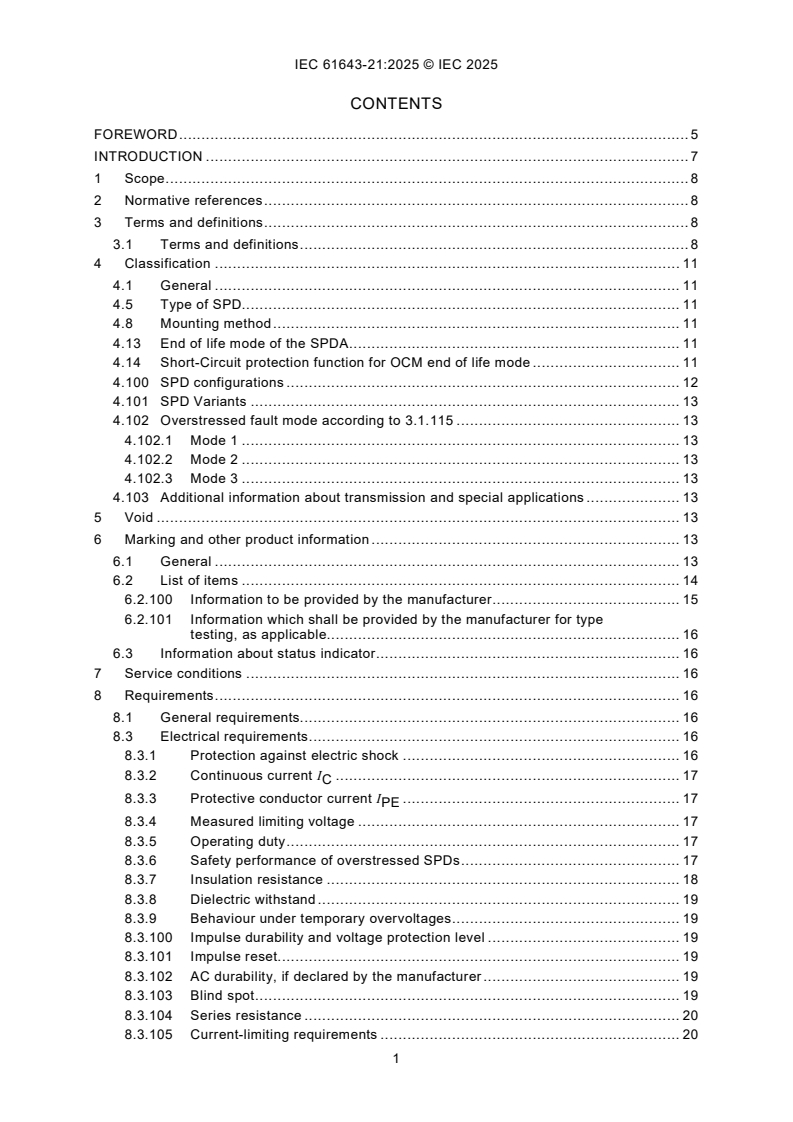
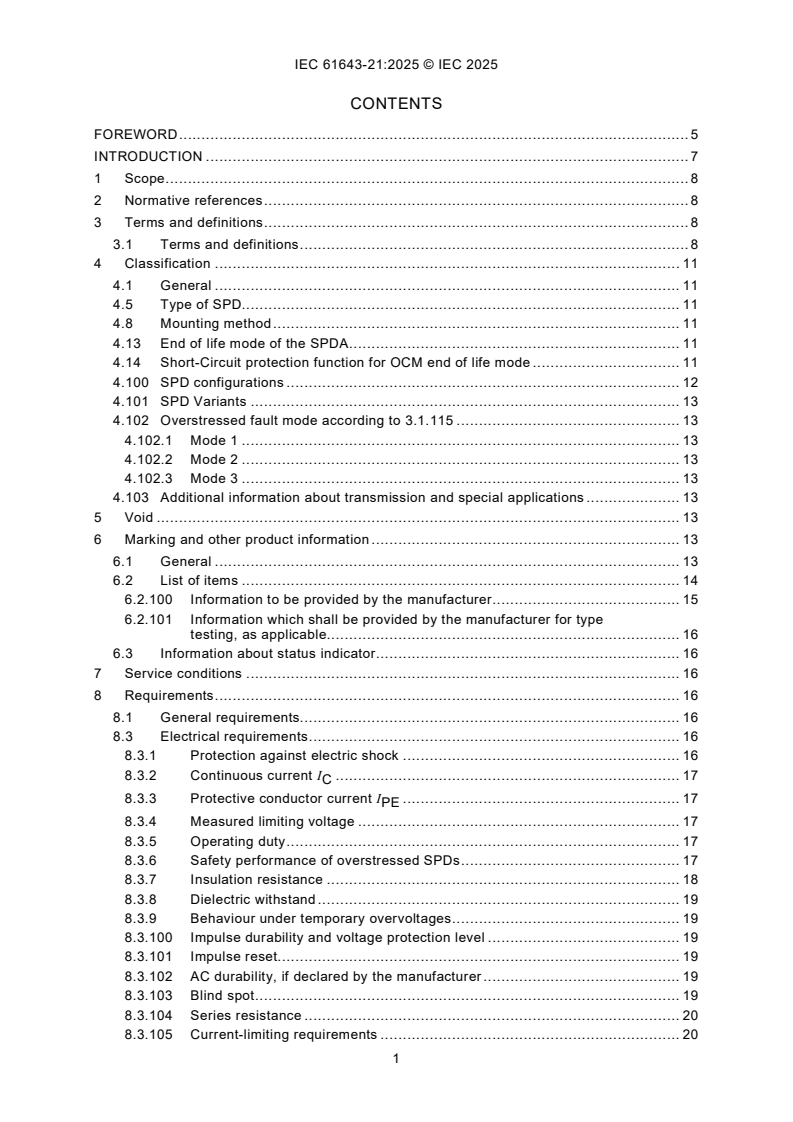
CONTENTS
FOREWORD . 5
INTRODUCTION . 7
1 Scope . 8
2 Normative references . 8
3 Terms and definitions . 8
3.1 Terms and definitions . 8
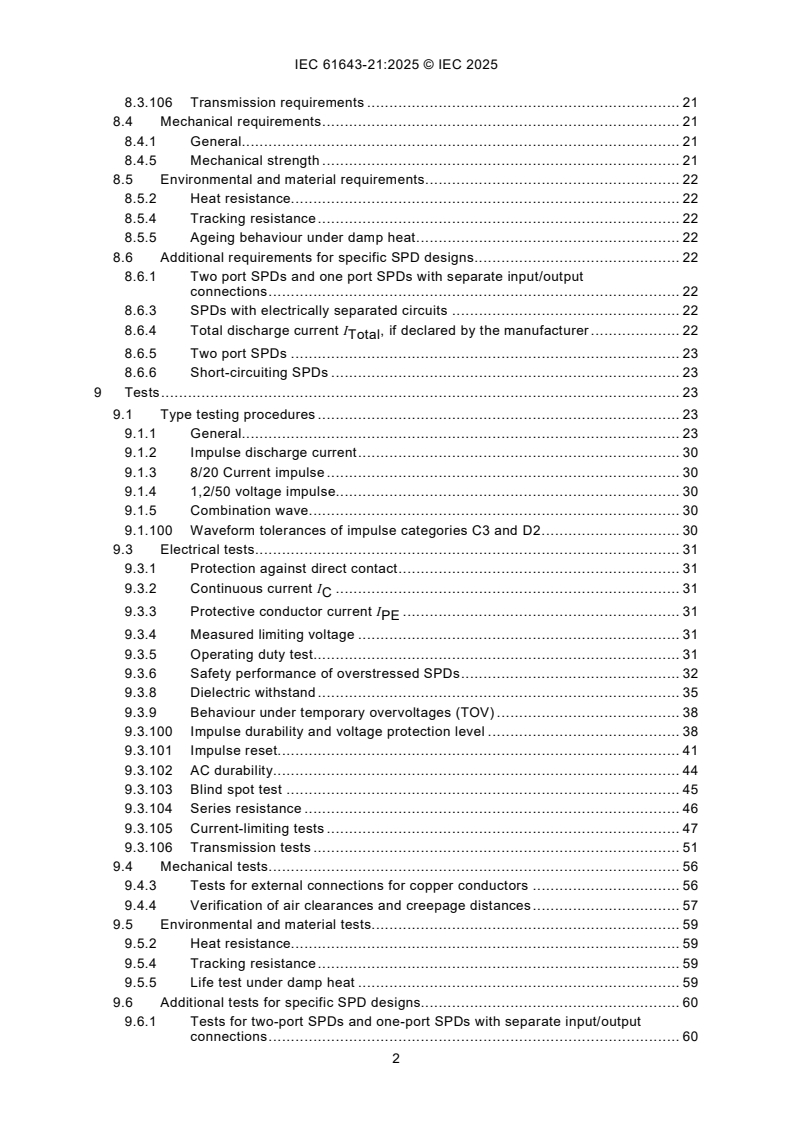
4 Classification . 11
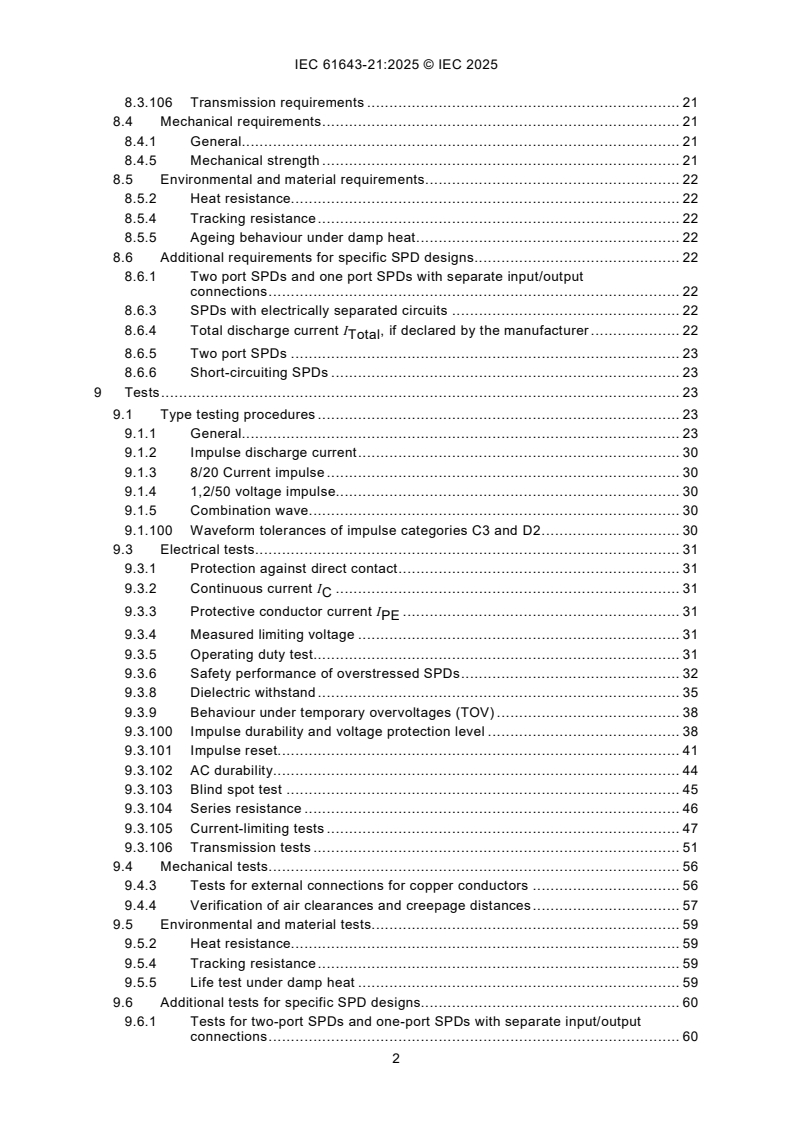
4.1 General . 11
4.5 Type of SPD. 11
4.8 Mounting method . 11
4.13 End of life mode of the SPDA . 11
4.14 Short-Circuit protection function for OCM end of life mode . 11
4.100 SPD configurations . 12
4.101 SPD Variants . 13
4.102 Overstressed fault mode according to 3.1.115 . 13
4.102.1 Mode 1 . 13
4.102.2 Mode 2 . 13
4.102.3 Mode 3 . 13
4.103 Additional information about transmission and special applications . 13
5 Void . 13
6 Marking and other product information . 13
6.1 General . 13
6.2 List of items . 14
6.2.100 Information to be provided by the manufacturer . 15
6.2.101 Information which shall be provided by the manufacturer for type
testing, as applicable. 16
6.3 Information about status indicator . 16
7 Service conditions . 16
8 Requirements . 16
8.1 General requirements. 16
8.3 Electrical requirements . 16
8.3.1 Protection against electric shock . 16
8.3.2 Continuous current I . 17
C
8.3.3 Protective conductor current I . 17
PE
8.3.4 Measured limiting voltage . 17
8.3.5 Operating duty . 17
8.3.6 Safety performance of overstressed SPDs . 17
8.3.7 Insulation resistance . 18
8.3.8 Dielectric withstand . 19
8.3.9 Behaviour under temporary overvoltages . 19
8.3.100 Impulse durability and voltage protection level . 19
8.3.101 Impulse reset. 19
8.3.102 AC durability, if declared by the manufacturer . 19
8.3.103 Blind spot . 19
8.3.104 Series resistance . 20
8.3.105 Current-limiting requirements . 20
8.3.106 Transmission requirements . 21
8.4 Mechanical requirements . 21
8.4.1 General. 21
8.4.5 Mechanical strength . 21
8.5 Environmental and material requirements . 22
8.5.2 Heat resistance. 22
8.5.4 Tracking resistance . 22
8.5.5 Ageing behaviour under damp heat . 22
8.6 Additional requirements for specific SPD designs . 22
8.6.1 Two port SPDs and one port SPDs with separate input/output
connections . 22
8.6.3 SPDs with electrically separated circuits . 22
8.6.4 Total discharge current I , if declared by the manufacturer . 22
Total
8.6.5 Two port SPDs . 23
8.6.6 Short-circuiting SPDs . 23
9 Tests . 23
9.1 Type testing procedures . 23
9.1.1 General. 23
9.1.2 Impulse discharge current . 30
9.1.3 8/20 Current impulse . 30
9.1.4 1,2/50 voltage impulse. 30
9.1.5 Combination wave . 30
9.1.100 Waveform tolerances of impulse categories C3 and D2 . 30
9.3 Electrical tests . 31
9.3.1 Protection against direct contact . 31
9.3.2 Continuous current I . 31
C
9.3.3 Protective conductor current I . 31
PE
9.3.4 Measured limiting voltage . 31
9.3.5 Operating duty test. 31
9.3.6 Safety performance of overstressed SPDs . 32
9.3.8 Dielectric withstand . 35
9.3.9 Behaviour under temporary overvoltages (TOV) . 38
9.3.100 Impulse durability and voltage protection level . 38
9.3.101 Impulse reset. 41
9.3.102 AC durability. 44
9.3.103 Blind spot test . 45
9.3.104 Series resistance . 46
9.3.105 Current-limiting tests . 47
9.3.106 Transmission tests . 51
9.4 Mechanical tests . 56
9.4.3 Tests for external connections for copper conductors . 56
9.4.4 Verification of air clearances and creepage distances . 57
9.5 Environmental and material tests. 59
9.5.2 Heat resistance. 59
9.5.4 Tracking resistance . 59
9.5.5 Life test under damp heat . 59
9.6 Additional tests for specific SPD designs. 60
9.6.1 Tests for two-port SPDs and one-port SPDs with separate input/output
connections . 60
9.6.4 Total discharge current test for multimode SPDs . 62
9.6.5 Tests for two port SPDs only . 64
Annex AA (normative) Application of annexes from IEC 61643-01 . 65
Annex BB (informative) Example configurations for measuring U . 66
P
Annex CC (informative) Special resistibility in telecommunication systems . 68
Annex DD (informative) Bit error ratio (BER) . 69
Annex EE (informative) Example of transmission test methods for SPDs connected to
LAN . 71
EE.1 General . 71
EE.2 Abbreviated terms. 71
EE.3 Requirements . 71
EE.4 Test methods . 72
EE.4.1 Measurement circuit . 72
EE.4.2 Insertion loss . 72
EE.4.3 NEXT, power sum NEXT . 72
EE.4.4 Return loss . 73
Annex FF (informative) Typical threat parameters for SPDs . 74
Annex GG (informative) Examples of source voltages and currents for impulse reset
test . 75
Annex HH (informative) Test circuit examples for testing more than one mode of
protection simultaneously . 76
HH.1 General . 76
HH.2 Impulse durability and voltage protection level . 76
HH.3 Impulse reset time . 77
HH.4 AC durability . 78
HH.5 AC durability for current-limiting function . 79
HH.6 Impulse durability for current-limiting function . 81
Annex II (normative) Reduced test procedures . 82
Bibliography . 84
Figure 100 – SPD configurations . 12
Figure 101 – Example of U-I diagram providing three value pairs of voltage and current
for impulse reset test (U /I , U /I and U /I ) with U = U and e.g. I = I . 14
1 1 2 2 3 3 1 C 3 L
Figure 102 – Procedure for sample preparation for dedicated overstress test . 34
Figure 103 – Test circuits for impulse durability and voltage- protection level . 40
Figure 104 – Test circuits for impulse reset time . 43
Figure 105 – Test circuits for AC durability . 45
Figure 106 – Test circuits for series resistance, current response time, current reset
time, maximum interrupting voltage and operating duty test . 47
Figure 107 – Test circuits for AC durability of the current-limiting component
(e.g. X1-Y1) . 50
Figure 108 – Test circuits for impulse durability of the current-limiting component
(e.g. X1-Y1) . 51
Figure 109 – Test circuits for insertion loss . 52
Figure 110 – Test circuit for return loss . 53
Figure 111 – Test circuits for longitudinal balance. 54
Figure 112 – Test circuit for near-end crosstalk . 56
Figure 113 – Examples for a test arrangement of the rated load current test I . 61
L
Figure 114 – Test circuits for total discharge current . 63
Figure 115 – Examples of multimode SPDs with a common voltage-limiting component . 64
Figure BB.1 – Differential Mode U measurement of Figure 100 SPDs . 66
p
Figure BB.2 – ITU-T test setup for SPD Common Mode U measurement to C
p
connection . 67
Figure DD.1 – Test circuit for bit error ratio test . 70
Figure EE.1 – Measurement circuit of a channel link with up to two SPDs . 72
Figure HH.1 – Test circuits for impulse durability and voltage-limiting tests . 77
Figure HH.2 – Test circuit for impulse reset time testing two modes of protection
(common mode, X1 – C and X2 – C) simultaneously of SPDs with voltage-limiting
component or voltage-limiting and current-limiting component . 78
Figure HH.3 – Test circuit for AC durability testing two modes of protection (common
mode, X1 – C and X2 – C) simultaneously of SPDs with voltage-limiting component or
voltage-limiting and current-limiting component . 79
Figure HH.4 – Test circuits for AC durability of the current-limiting component . 80
Figure HH.5 – Test circuits for impulse durability of the current-limiting component . 81
Table 100 – Type test requirements . 25
Table 3 – Pass criteria for type tests . 29
Table 101 – Waveform tolerances combination wave . 30
Table 102 – Waveform tolerances impulse categories C3 and D2 . 31
Table 7 – Dielectric impulse withstand test voltages for SPD main circuits. 35
Table 9 – Dielectric AC test voltages for SPD main circuits . 36
Table 10 – Dielectric impulse withstand test voltages for separated circuits . 37
Table 12 – Dielectric AC test voltages for separated circuits . 38
Table 103 – Categories and minimum requirements for impulse durability . 41
Table 104 – Test currents for response time . 48
Table 105 – Typical parameters for Figure 110 . 52
Table 106 – Typical impedance values for longitudinal balance test . 55
Table 16 – Cross-sections of copper conductors for screw-type or screwless terminals . 57
Table 107 – Altitude correction factors for calculating the air clearances . 58
Table 108 – Rated impulse withstand voltages for air clearances for SPDs . 58
Table 21 – Air clearances for SPD main circuit(s) . 59
Table 109 – I current distribution . 63
Total
Table AA.1 – Application of annexes from IEC 61643-01 . 65
Table DD.1 – Test times for BER test . 69
Table EE.1 – List of abbreviated terms . 71
Table EE.2 – Typical Tests for an SPD . 71
Table FF.1 – SPDs parameter for typical threats . 74
Table GG.1 – Source voltages and currents for impulse reset test . 75
Table II.1 – Reduced test procedure for SPDs complying with IEC 61643-21:2012 . 82
INTERNATIONAL ELECTROTECHNICAL COMMISSION
____________
Low-voltage surge protective devices -
Part 21: Surge protective devices connected to telecommunications
and signalling networks - Requirements and test methods
FOREWORD
1) The International Electrotechnical Commission (IEC) is a worldwide organization for standardization comprising
all national electrotechnical committees (IEC National Committees). The object of IEC is to promote international
co-operation on all questions concerning standardization in the electrical and electronic fields. To this end and
in addition to other activities, IEC publishes International Standards, Technical Specifications, Technical Reports,
Publicly Available Specifications (PAS) and Guides (hereafter referred to as "IEC Publication(s)”). Their
preparation is entrusted to technical committees; any IEC National Committee interested in the subject dealt with
may participate in this preparatory work. International, governmental and non-governmental organizations liaising
with the IEC also participate in this preparation. IEC collaborates closely with the International Organization for
Standardization (ISO) in accordance with conditions determined by agreement between the two organizations.
2) The formal decisions or agreements of IEC on technical matters express, as nearly as possible, an international
consensus of opinion on the relevant subjects since each technical committee has representation from all
interested IEC National Committees.
3) IEC Publications have the form of recommendations for international use and are accepted by IEC National
Committees in that sense. While all reasonable efforts are made to ensure that the technical content of IEC
Publications is accurate, IEC cannot be held responsible for the way in which they are used or for any
misinterpretation by any end user.
4) In order to promote international uniformity, IEC National Committees undertake to apply IEC Publications
transparently to the maximum extent possible in their national and regional publications. Any divergence between
any IEC Publication and the corresponding national or regional publication shall be clearly indicated in the latter.
5) IEC itself does not provide any attestation of conformity. Independent certification bodies provide conformity
assessment services and, in some areas, access to IEC marks of conformity. IEC is not responsible for any
services carried out by independent certification bodies.
6) All users should ensure that they have the latest edition of this publication.
7) No liability shall attach to IEC or its directors, employees, servants or agents including individual experts and
members of its technical committees and IEC National Committees for any personal injury, property damage or
other damage of any nature whatsoever, whether direct or indirect, or for costs (including legal fees) and
expenses arising out of the publication, use of, or reliance upon, this IEC Publication or any other IEC
Publications.
8) Attention is drawn to the Normative references cited in this publication. Use of the referenced publications is
indispensable for the correct application of this publication.
9) IEC draws attention to the possibility that the implementation of this document may involve the use of (a)
patent(s). IEC takes no position concerning the evidence, validity or applicability of any claimed patent rights in
respect thereof. As of the date of publication of this document, IEC had not received notice of (a) patent(s), which
may be required to implement this document. However, implementers are cautioned that this may not represent
the latest information, which may be obtained from the patent database available at https://patents.iec.ch. IEC
shall not be held responsible for identifying any or all such patent rights.
IEC 61643-21 has been prepared by subcommittee 37A: Low-voltage surge protective devices,
of IEC technical committee 37: Surge arresters. It is an International Standard.
This second edition cancels and replaces the first edition published in 2000, Amendment1:2008
and Amendment 2:2012. This edition constitutes a technical revision.
This edition includes the following significant technical changes with respect to the previous
edition:
a) New structure of IEC 61643-21 based on IEC 61643-01:2024;
b) Several safety requirements based on IEC 61643-01:2024 have been added.
This International Standard is to be used in conjunction with IEC 61643-01:2024.
The requirements of this part of IEC 61643 supplement, modify or replace certain of the general
requirements contained in IEC 61643-01 and are to be read and applied together with
IEC 61643-01:2024.
Numbering of clauses follows the numbering of IEC 61643-01, but, dependent on the application
of clauses from part 01, does not necessarily follow sequentially.
If a clause in IEC 61643-01 is not explicitly called up or referred to in this document, then this
clause does not apply to SPDs covered by this document. Any instructions in this document
calling up clauses from IEC 61643-01 are written in Italic type.
NOTE In other words, if e.g. Clause 4 is called up in this document all subclauses of Clause 4 of IEC 61643-01 are
applied without modification. But, if e.g. some modifications are required on subclauses of Clause 9 of IEC 61643-
01, then the relevant second level subclauses of IEC 61643-01 (e.g. 9.3, 9.5 etc.) are called up separately and it is
indicated how they are applied.
The numbering of additional subclauses, figures and tables to IEC 61643-01 in this document
starts with the number 100 in the last section of the subclauses added (e.g. 4.100 or 6.2.100).
The numbering of additional tables and figures to IEC 61643-01 in this document starts with the
number 100.
The text of this International Standard is based on the following documents:
Draft Report on voting
37A/432/FDIS 37A/445/RVD
Full information on the voting for its approval can be found in the report on voting indicated in
the above table.
The language used for the development of this International Standard is English.
This document was drafted in accordance with ISO/IEC Directives, Part 2, and developed in
accordance with ISO/IEC Directives, Part 1 and ISO/IEC Directives, IEC Supplement, available
at www.iec.ch/members_experts/refdocs. The main document types developed by IEC are
described in greater detail at www.iec.ch/publications.
A list of all parts in the IEC 61643 series, published under the general title Low-voltage surge
protective devices, can be found on the IEC website.
The committee has decided that the contents of this document will remain unchanged until the
stability date indicated on the IEC website under webstore.iec.ch in the data related to the
specific document. At this date, the document will be
– reconfirmed,
– withdrawn, or
– revised.
INTRODUCTION
It has been assumed in the drafting of this International Standard that the execution of its
provisions is entrusted to appropriately qualified and experienced persons.
This document recognizes the internationally accepted level of protection against hazards such
as electrical, mechanical, thermal, fire and radiation of SPDs when operated as in normal use
taking into account the manufacturer's instructions.
The purpose of this document is to identify the requirements for Surge Protective Devices
(SPDs) used in protecting telecommunications and signalling networks, for example, low-
voltage data, voice, and alarm circuits.
If the intended applications of an SPD are covered by different parts of the IEC 61643-X1 series,
all relevant parts are applied.
This part of the IEC 61643 series addresses safety and performance tests for surge protective
devices (SPDs) for telecommunications and signalling networks in conjunction with
IEC 61643-01:2024.
This document addresses SPDs containing voltage-limiting components only, or a combination
of voltage-limiting components and current-limiting components. Protection devices containing
current-limiting components only are not within the coverage of this document.
This document covers a wide range of testing conditions and requirements; the use of some of
these is at the discretion of the user. How the requirements of this document relate to the
different types of SPD is described in Table 100.
Selection and application principles are covered in IEC 61643-22.
1 Scope
This document, together with IEC 61643-01:2024, is applicable to devices for surge protection
against indirect and direct effects of lightning or other transient overvoltages.
These devices are intended to be connected to telecommunications and signalling networks,
and equipment rated up to 1 000 V RMS and 1 500 V DC.
These telecommunications and signalling networks can also provide power on the same line,
e.g. Power over Ethernet (PoE).
Performance and safety requirements, tests and ratings are specified in this document. These
devices contain at least one voltage-limiting component (clamping or switching) and are
intended to limit surge voltages and divert surge currents.
2 Normative references
The following documents are referred to in the text in such a way that some or all of their content
constitutes requirements of this document. For dated references, only the edition cited applies.
For undated references, the latest edition of the referenced document (including any
amendments) applies.
IEC 61643-01:2024, Low-voltage surge protective devices - Part 01: General requirements and
test methods
3 Terms and definitions
Clause 3 of IEC 61643-01:2024 applies with the following additions, modifications and
replacements:
3.1 Terms and definitions
Subclause 3.1 of IEC 61643-01:2024 applies with the following additions, modifications and
replacements:
3.1.8
continuous current
I
C
Subclause 3.1.8 of IEC 61643-01:2024 applies with the following replacement:
Replace U by U .
test C
3.1.25
means for short- circuiting the SPD
SC-means
Subclause 3.1.25 of IEC 61643-01:2024 applies with the following replacement:
Replace short-circuit current rating I by n times I .
SCCR L
3.1.28
mode of protection
Subclause 3.1.28 of IEC 61643-01:2024 applies with the following addition:
Add in Note 2 the examples "line to earth and shield to earth".
3.1.64
test voltage
U
test
Subclause 3.1.64 of IEC 61643-01:2024 does not apply.
3.1.100
AC durability
characteristic of an SPD which allows it to conduct alternating current of a specific magnitude
and duration for a specified number of times
3.1.101
blind spot
situation where voltages above the maximum continuous operating voltage U cause
C
incomplete operation of the multi-stage SPD
Note 1 to entry: Incomplete operation of the SPD means not all current paths in a multi-stage SPD have operated
during the impulse test.
3.1.102
Current-limiting
action of an SPD, containing at least one non-linear current-limiting component, that causes
currents exceeding a predetermined value to be restricted
3.1.103
current reset time
time required for a self-resetting current-limiting component to revert to its normal or quiescent
state
3.1.104
current response time
time required for a current-limiting component to operate at a specified current and a specified
temperature
3.1.105
impulse durability
characteristic of an SPD which allows it to conduct impulse current of a specified waveform and
peak value for a specified number of times
3.1.106
insertion loss
loss resulting from the insertion of an SPD into a transmission system
Note 1 to entry: It is the ratio of the power delivered to that part of the system following the SPD, before insertion
of the SPD, to the power delivered to that same part after insertion of the SPD. The insertion loss is generally
expressed in decibels.
[SOURCE: IEC 60050-726:1982, 726-06-07, modified – "network" replaced by "SPD", second
part of definition converted to note to entry]
3.1.107
insulation resistance based on the continuous current
resistance between designated connections of an SPD when U is applied to those connections
C
3.1.108
longitudinal balance (analogue voice frequency circuits)
electrical symmetry of the two wires comprising a pair with respect to ground
3.1.109
longitudinal balance (communication and control cables)
ratio of the disturbing common mode (longitudinal) RMS voltage (V ) to ground and the resulting
s
differential mode (metallic) RMS voltage (V ) of the SPD, expressed in decibels (dB)
m
Note 1 to entry: The longitudinal balance in dB is given by the formula: 20 log10 V /V where V and V are
s m s m
measured at the same frequency.
3.1.110
longitudinal balance (data transmission)
measure of the similarity of impedance to ground (or common) for the two or more conductors
of a balanced circuit
Note 1 to entry: This term is used to express the degree of susceptibility to common mode interference.
3.1.111
longitudinal balance (telecommunications)
ratio of the disturbing common mode (longitudinal) voltage V and the resulting differential mode
s
(metallic) voltage V of the SPD, expressed in decibels (dB)
m
3.1.112
maximum interrupting voltage
maximum voltage (DC or RMS) that can be applied to the current-limiting components of an
SPD without degradation of the SPD
3.1.113
multi-stage SPD
SPD which has more than one parallel current path of voltage-limiting component
Note 1 to entry: These voltage-limiting components may or may not be electrically separated by a series component.
The voltage-limiting components may be either switching or clamping types.
3.1.114
near-end crosstalk (NEXT)
crosstalk that is propagated in a disturbed channel in the direction opposite to the direction of
propagation of the current in the disturbing channel
Note 1 to entry: The terminal of the disturbed channel at which the near-end crosstalk is present is ordinarily near
to, or coincides with, the energized terminal of the disturbing channel.
3.1.115
overstressed fault mode
3.1.115.1
mode 1
condition wherein the voltage-limiting part of the SPD has been disconnected
Note 1 to entry: The voltage-limiting function is no longer present, but the line is still operable.
3.1.115.2
mode 2
condition wherein the voltage-limiting part of the SPD has been short-circuited by a very low
impedance within the SPD
Note 1 to entry: The line is inoperable, but the equipment is still protected by a short circuit.
3.1.115.3
mode 3
situation wherein the SPD has undergone an internal open-circuit in the line, or an external
disconnector has operated, if any
Note 1 to entry: The line is inoperable, but the equipment is still protected by an open line.
3.1.116
resettable current-limiting
action of an SPD that limits current and can be manually reset after operating
3.1.117
return loss
modulus of the reciprocal of the reflection factor, generally expressed in decibels (dB)
Note 1 to entry: When impedances can be defined, the return loss in dB is given by the formula:
20 log MOD [(Z +Z )/(Z –Z )]
10 1 2 1 2
where Z is the characteristic impedance of the transmission line ahead of the discontinuity, or the impedance of the
source, and Z is the impedance after the discontinuity or load impedance seen from the junction between the source
and the load.
[SOURCE: IEC 60050-702:1992, 702-07-25, modified – modification of formula]
3.1.118
self-resetting current-limiting
action of an SPD that limits current and will self-reset after the disturbing current is removed
4 Classification
Clause 4 of IEC 61643-01:2024 applies with the following additions and modifications:
4.1 General
Subclause 4.1 of IEC 61643-01:2024 applies with the following replacement:
In this document, the term "voltage clamping” replaces the term "voltage limiting” from
IEC 61643-01.
4.5 Type of SPD
Subclause 4.5 of IEC 61643-01:2024 does not apply.
4.8 Mounting method
Subclause 4.8 of IEC 61643-01:2024 does not apply.
4.13 End-of-life mode of the SPDA
Subclause 4.13 of IEC 61643-01:2024 does not apply.
4.14 Short-circuit protection function for OCM end-of-life mode
Subclause 4.14 of IEC 61643-01:2024 does not apply.
4.100 SPD configurations
The SPD configurations described in this document are shown in Figure 100. Each SPD
configuration is composed of one or more voltage-limiting components and may include current-
limiting components.
a) Two- connection SPD
b) Three- connection SPD c) Three- connection SPD
d) Four- connection SPD e) Five- connection SPD
a
The common connection C may not exist.
f) Multi- connection SPD
Key
V voltage-limiting component
V, I voltage-limiting component or combination of voltage-limiting component and current-limiting
component
X1, X2, X unprotected line connections
n
Y1, Y2, Y protected line connections
n
Figure 100 – SPD configurations
4.101 SPD Variants
This document considers two basic variants of SPD.
The first variant of SPD contains at least one voltage-limiting component and no current-limiting
component(s) in a housing. All the SPD configurations of Figure 100 can be of this variant.
These SPDs shall satisfy the requirements listed in Table 100.
The SPDs shown in b), d), e), and f) of Figure 100 may contain a linear component between
the line terminal and the corresponding protected line terminal. These SPDs shall also satisfy
the applicable requirements of 8.3.105.
The second variant of SPD contains both voltage-limiting and current-limiting components in a
housing. SPD configurations shown in b), d), e), and f) of Figure 100 are applicable for SPDs
with both voltage-limiting and current-limiting components. This variant of SPD shall satisfy the
requirements listed in Table 100.
Additional requirements to the transmission parameter of the SPD depending on the application
and declared by the manufacturer are described in 8.3.106.
Table 100 provides the applicable transmission tests.
Subclause 8.3.106 provides transmission tests that SPDs may need to conform to, depending
on their communication and signalling application. Selection of the applicable transmission tests
from 9.3.106 shall be made, based on the intended application of the SPDs. Table 100 provides
general guidance on how to select the applicable transmission tests.
4.102 Overstressed fault mode according to 3.1.115
4.102.1 Mode 1
4.102.2 Mode 2
4.102.3 Mode 3
4.103 Additional information about transmission and special applications
Information about transmission and special applications are listed in Annex CC, Annex DD and
Annex EE.
5 Void
6 Marking and other product information
Clause 6 of IEC 61643-01:2024 applies with the following additions, modifications and
replacements:
6.1 General
Subclause 6.1 of IEC 61643-01:2024 is replaced by the following new text:
The required markings to be placed on the SPD, are items 1), 4), 7) and 100) of 6.2 of
IEC 61643-01:2024. Other required markings shall appear in the installation instructions or on
the packaging, or included in the product documentation (e.g. Web). Details are listed in
6.2.100.
Where space does not allow all the required markings to be placed, at least the markings
according to items 1) and 7) (if connections are not interchangeable) of 6.2 of
IEC 61643-01:2024, are sufficient on the SPD. The other required markings for which there is
not enough space shall appear in the installation instructions.
If the SPD or the abovementioned marking is located under a cover, only item 1) of 6.2 of
IEC 61643-01:2024 shall be easily accessible by an ordinary person. Any notes for special
handling shall be included in the documentation or on the packaging.
Compliance is checked by visual inspection.
6.2 List of items
Subclause 6.2 of IEC 61643-01:2024 applies with the following additions:
4) 4) of 6.2 of IEC 61643-01:2024 applies with the following addition:
NOTE 1 U is not valid for RF SPDs with quarterwave technology.
C
11) 11) of 6.2 of IEC 61643-01:2024 applies with the following addition:
Each U , if more than one impulse durability of category C is declared, see 101).
P
Further U for other categories, e.g. A, B, D and E are optional.
P
31) 31) of 6.2 of IEC 61643-01:2024 applies with the following replacement:
Replace respective SPD type, except for T3 SPDs by impulse durability category.
100) Information that enables the manufacturer to trace the date of manufacture.
101) Impulse durability category and its parameters (e.g. C2: 2 kV / 1 kA).
102) Impulse reset time and corresponding value pair(s) of voltage and current for voltage
switching mode(s) of protection and combination mode(s) of protection o
...
IEC 61643-21 ®
Edition 2.0 2025-10
NORME
INTERNATIONALE
Parafoudres basse tension -
Partie 21: Parafoudres connectés aux réseaux de signaux et de
télécommunications - Exigences et méthodes d’essai
ICS 29.240.10 ISBN 978-2-8327-0741-8
Droits de reproduction réservés. Sauf indication contraire, aucune partie de cette publication ne peut être reproduite ni
utilisée sous quelque forme que ce soit et par aucun procédé, électronique ou mécanique, y compris la photocopie et
les microfilms, sans l'accord écrit de l'IEC ou du Comité national de l'IEC du pays du demandeur. Si vous avez des
questions sur le copyright de l'IEC ou si vous désirez obtenir des droits supplémentaires sur cette publication, utilisez
les coordonnées ci-après ou contactez le Comité national de l'IEC de votre pays de résidence.
IEC Secretariat Tel.: +41 22 919 02 11
3, rue de Varembé info@iec.ch
CH-1211 Geneva 20 www.iec.ch
Switzerland
A propos de l'IEC
La Commission Electrotechnique Internationale (IEC) est la première organisation mondiale qui élabore et publie des
Normes internationales pour tout ce qui a trait à l'électricité, à l'électronique et aux technologies apparentées.
A propos des publications IEC
Le contenu technique des publications IEC est constamment revu. Veuillez vous assurer que vous possédez l’édition la
plus récente, un corrigendum ou amendement peut avoir été publié.
Recherche de publications IEC - IEC Products & Services Portal - products.iec.ch
webstore.iec.ch/advsearchform Découvrez notre puissant moteur de recherche et consultez
La recherche avancée permet de trouver des publications gratuitement tous les aperçus des publications, symboles
IEC en utilisant différents critères (numéro de référence, graphiques et le glossaire. Avec un abonnement, vous aurez
texte, comité d’études, …). Elle donne aussi des toujours accès à un contenu à jour adapté à vos besoins.
informations sur les projets et les publications remplacées
ou retirées. Electropedia - www.electropedia.org
Le premier dictionnaire d'électrotechnologie en ligne au
IEC Just Published - webstore.iec.ch/justpublished monde, avec plus de 22 500 articles terminologiques en
Restez informé sur les nouvelles publications IEC. Just anglais et en français, ainsi que les termes équivalents
Published détaille les nouvelles publications parues. dans 25 langues additionnelles. Egalement appelé
Disponible en ligne et une fois par mois par email. Vocabulaire Electrotechnique International (IEV) en ligne.
Service Clients - webstore.iec.ch/csc
Si vous désirez nous donner des commentaires sur cette
publication ou si vous avez des questions contactez-
nous: sales@iec.ch.
SOMMAIRE
AVANT-PROPOS . 6
INTRODUCTION . 8
1 Domaine d’application . 9
2 Références normatives . 9
3 Termes et définitions. 9
3.1 Termes et définitions. 9
4 Classification . 12
4.1 Généralités . 12
4.5 Types de parafoudre . 12
4.8 Méthode d’installation . 12
4.13 Mode de fin de vie du parafoudre . 13
4.14 Fonction de protection contre les courts-circuits pour le mode de fin de vie
MCO . 13
4.100 Configurations de parafoudre . 13
4.101 Variantes de parafoudres . 14
4.102 Mode de défaut de surcharge conformément à 3.1.115 . 15
4.102.1 Mode 1 . 15
4.102.2 Mode 2 . 15
4.102.3 Mode 3 . 15
4.103 Informations supplémentaires sur la transmission et les applications
spéciales . 15
5 Vide . 15
6 Marquage et autres informations sur le produit . 15
6.1 Généralités . 15
6.2 Liste d’éléments . 16
6.2.100 Informations à fournir par le fabricant . 17
6.2.101 Informations devant être fournies par le fabricant pour les essais de
type, le cas échéant . 18
6.3 Informations relatives à l’indicateur d’état. 18
7 Conditions de service . 18
8 Exigences . 18
8.1 Exigences générales . 18
8.3 Exigences électriques . 18
8.3.1 Protection contre les chocs électriques . 18
8.3.2 Courant permanent I . 19
C
8.3.3 Courant dans le conducteur de protection I . 19
PE
8.3.4 Tension de limitation mesurée . 19
8.3.5 Régime de fonctionnement. 19
8.3.6 Performances de sécurité des parafoudres soumis à des surcharges . 19
8.3.7 Résistance d’isolement . 21
8.3.8 Tenue diélectrique . 21
8.3.9 Comportement vis-à-vis des surtensions temporaires . 21
8.3.100 Durabilité aux chocs et niveau de protection en tension . 21
8.3.101 Retour de choc . 21
8.3.102 Durabilité en courant alternatif, si déclarée par le fabricant . 22
8.3.103 Angle mort . 22
8.3.104 Résistance série . 22
8.3.105 Exigences de limitation de courant . 22
8.3.106 Exigences de transmission . 23
8.4 Exigences mécaniques . 24
8.4.1 Généralités . 24
8.4.5 Résistance mécanique . 24
8.5 Exigences relatives à l’environnement et aux matériaux . 24
8.5.2 Résistance à la chaleur . 24
8.5.4 Résistance au cheminement . 24
8.5.5 Comportement de vieillissement à la chaleur humide . 24
8.6 Exigences supplémentaires pour des conceptions de parafoudres
spécifiques . 24
8.6.1 Parafoudres à deux ports et parafoudres à un port avec connexions
d’entrée/sortie séparées . 25
8.6.3 Parafoudres à circuits électriquement séparés . 25
8.6.4 Courant total de décharge I , si déclaré par le fabricant . 25
Total
8.6.5 Parafoudres à deux ports . 25
8.6.6 Parafoudres court-circuitants . 25
9 Essais . 26
9.1 Procédures d’essais de type . 26
9.1.1 Généralités . 26
9.1.2 Courant de choc de décharge. 35
9.1.3 Courant de choc 8/20 . 35
9.1.4 Tension de choc 1,2/50 . 35
9.1.5 Forme d’onde combinée . 35
9.1.100 Tolérances de forme d’onde des catégories de choc C3 et D2 . 35
9.3 Essais électriques. 36
9.3.1 Protection contre les contacts directs . 36
9.3.2 Courant permanent I . 36
C
9.3.3 Courant dans le conducteur de protection I . 36
PE
9.3.4 Tension de limitation mesurée . 36
9.3.5 Essai de fonctionnement . 36
9.3.6 Performances de sécurité des parafoudres soumis à des surcharges . 37
9.3.8 Tenue diélectrique . 40
9.3.9 Comportement vis-à-vis des surtensions temporaires (TOV) . 43
9.3.100 Durabilité aux chocs et niveau de protection en tension . 43
9.3.101 Retour de choc . 46
9.3.102 Durabilité en courant alternatif . 49
9.3.103 Essai des angles morts . 50
9.3.104 Résistance série . 51
9.3.105 Essais de limitation de courant . 52
9.3.106 Essais de transmission . 56
9.4 Essais mécaniques . 61
9.4.3 Essais pour les connexions externes des conducteurs en cuivre . 61
9.4.4 Vérification des distances dans l’air et des lignes de fuite . 62
9.5 Essais d’environnement et essais des matériaux. 65
9.5.2 Résistance à la chaleur . 65
9.5.4 Résistance au cheminement . 65
9.5.5 Essai de durée de vie à la chaleur humide . 65
9.6 Essais supplémentaires pour des conceptions de parafoudres spécifiques . 65
9.6.1 Essais des parafoudres à deux ports et à un port avec connexions
d’entrée/sortie séparées . 65
9.6.4 Essai de courant total de décharge pour des parafoudres multimodes . 68
9.6.5 Essais pour les parafoudres à deux ports seulement . 70
Annexe AA (normative) Application des annexes de l’IEC 61643-01. 71
Annexe BB (informative) Exemples de configurations pour mesurer U . 72
P
Annexe CC (informative) Résistibilité particulière dans les systèmes de
télécommunications . 74
Annexe DD (informative) Taux d’erreurs binaires (BER) . 75
Annexe EE (informative) Exemple de méthodes d’essai en émission pour les
parafoudres connectés à un LAN . 77
EE.1 Généralités . 77
EE.2 Abréviations . 77
EE.3 Exigences . 77
EE.4 Méthodes d’essai . 78
EE.4.1 Circuit de mesure . 78
EE.4.2 Perte d’insertion . 78
EE.4.3 Paradiaphonie, puissance cumulée NEXT . 78
EE.4.4 Affaiblissement de réflexion . 79
Annexe FF (informative) Paramètres de menace types pour les parafoudres . 80
Annexe GG (informative) Exemples de tensions et de courants de source pour l’essai
de retour de choc . 81
Annexe HH (informative) Exemples de circuits d’essai permettant de soumettre à
essai simultanément plusieurs modes de protection . 82
HH.1 Généralités . 82
HH.2 Durabilité aux chocs et niveau de protection en tension . 82
HH.3 Temps de retour de choc . 83
HH.4 Durabilité en courant alternatif . 84
HH.5 Durabilité en courant alternatif pour la fonction de limitation de courant . 85
HH.6 Durabilité aux chocs pour la fonction de limitation de courant . 87
Annexe II (normative) Procédures d’essai réduites . 88
Bibliographie . 91
Figure 100 – Configurations de parafoudre. 14
Figure 101 – Exemple de diagramme U-I fournissant trois paires de valeurs de tension
et de courant pour l’essai de retour de choc (U /I , U /I et U /I ) avec U = U et
1 1 2 2 3 3 1 C
par exemple I = I . 16
3 L
Figure 102 – Procédure de préparation des échantillons pour l’essai de surcharge
spécifique . 39
Figure 103 – Circuits d’essai pour la durabilité aux chocs et le niveau de protection en
tension . 45
Figure 104 – Circuits d’essai pour le temps de retour de choc . 48
Figure 105 – Circuits d’essai pour la durabilité en courant continu . 50
Figure 106 – Circuits d’essai pour essais de résistance série, temps de réponse du
courant, temps de retour du courant, tension maximale de coupure et essai de service . 52
Figure 107 – Circuits d’essai pour la durabilité en courant alternatif du composant de
limitation de courant (par exemple X1-Y1) . 55
Figure 108 – Circuits d’essai pour la durabilité aux chocs du composant de limitation
de courant (par exemple X1-Y1). 56
Figure 109 – Circuit d’essai pour la perte d’insertion . 57
Figure 110 – Circuit d’essai pour l’affaiblissement de réflexion . 58
Figure 111 – Circuits d’essai pour l’équilibre longitudinal . 59
Figure 112 – Circuit d’essai pour la paradiaphonie . 61
Figure 113 – Exemples de montage d’essai du courant de charge assigné I . 67
L
Figure 114 – Circuits d’essai pour le courant total de décharge . 69
Figure 115 – Exemples de parafoudres multimodes avec un composant de protection
commun . 70
Figure BB.1 – Mesure de la tension U de mode différentiel des parafoudres de la
p
Figure 100 . 72
Figure BB.2 – Montage d’essai de l’UIT-T pour la mesure de la tension U de mode
p
commun des parafoudres, sur connexion C . 73
Figure DD.1 – Circuit d’essai pour l’essai du taux d’erreurs binaires . 76
Figure EE.1 – Circuit de mesure d’un élément de liaison de canal avec jusqu’à deux
parafoudres . 78
Figure HH.1 – Circuits d’essai pour les essais de durabilité aux chocs et de limitation
de tension. 83
Figure HH.2 – Circuit d’essai pour soumettre à essai de temps de retour de choc
simultanément deux modes de protection (mode commun, X1-C et X2-C) des
parafoudres avec composant de limitation de tension ou composant de limitation de
tension et de courant . 84
Figure HH.3 – Circuit d’essai pour soumettre à essai de durabilité en courant alternatif
simultanément deux modes de protection (mode commun, X1-C et X2-C) des
parafoudres avec composant de limitation de tension ou composant de limitation de
tension et de courant . 85
Figure HH.4 – Circuits d’essai pour la durabilité en courant alternatif du composant de
limitation de courant . 86
Figure HH.5 – Circuits d’essai pour la durabilité aux chocs du composant de limitation
de courant . 87
Tableau 100 – Exigences d’essai de type. 28
Tableau 3 – Critères d’acceptation pour les essais de type . 34
Tableau 101 – Tolérance de formes d’onde combinées . 35
Tableau 102 – Tolérances de forme d’onde des catégories de choc C3 et D2 . 36
Tableau 7 – Tensions d’essai de tenue aux chocs diélectriques pour les circuits
principaux du parafoudre . 41
Tableau 9 – Tensions d’essai diélectrique en courant alternatif pour les circuits
principaux du parafoudre . 41
Tableau 10 – Tensions d’essai de tenue aux chocs diélectriques pour les circuits
séparés . 42
Tableau 12 – Tensions d’essai diélectrique en courant alternatif pour les circuits
séparés . 43
Tableau 103 – Catégories et exigences minimales pour la durabilité aux chocs . 46
Tableau 104 – Courants d’essai pour le temps de réponse . 53
Tableau 105 – Paramètres types pour la Figure 110 . 57
Tableau 106 – Valeurs d’impédance types pour l’essai d’équilibre longitudinal . 60
Tableau 16 – Sections des conducteurs en cuivre pour bornes à vis ou sans vis . 62
Tableau 107 – Facteurs de correction d’altitude pour le calcul des distances dans l’air . 63
Tableau 108 – Tensions assignées de tenue aux chocs pour les distances dans l’air
des parafoudres . 64
Tableau 21 – Distances dans l’air pour le ou les circuits principaux du parafoudre . 64
Tableau 109 – Distribution de courant I . 69
Total
Tableau AA.1 – Application des annexes de l’IEC 61643-01 . 71
Tableau DD.1 – Durées d’essai pour l’essai de BER . 75
Tableau EE.1 – Liste des abréviations . 77
Tableau EE.2 – Essais typiques pour un parafoudre . 77
Tableau FF.1 – Paramètre des parafoudres pour des menaces types. 80
Tableau GG.1 – Tensions et courants de source pour l’essai de retour de choc . 81
Tableau II.1 – Procédure d’essai réduite pour les parafoudres conformes à
l’IEC 61643-21:2012 . 88
COMMISSION ÉLECTROTECHNIQUE INTERNATIONALE
____________
Parafoudres basse tension -
Partie 21: Parafoudres connectés aux réseaux de signaux et
de télécommunications - Exigences et méthodes d’essai
AVANT-PROPOS
1) La Commission Électrotechnique Internationale (IEC) est une organisation mondiale de normalisation composée
de l’ensemble des comités électrotechniques nationaux (Comités nationaux de l’IEC). L’IEC a pour objet de
favoriser la coopération internationale pour toutes les questions de normalisation dans les domaines de
l’électricité et de l’électronique. À cet effet, l’IEC – entre autres activités – publie des Normes internationales,
des Spécifications techniques, des Rapports techniques, des Spécifications accessibles au public (PAS) et des
Guides (ci-après dénommés "Publication(s) de l’IEC"). Leur élaboration est confiée à des comités d’études,
aux travaux desquels tout Comité national intéressé par le sujet traité peut participer. Les organisations
internationales, gouvernementales et non gouvernementales, en liaison avec l’IEC, participent également aux
travaux. L’IEC collabore étroitement avec l’Organisation Internationale de Normalisation (ISO), selon des
conditions fixées par accord entre les deux organisations.
2) Les décisions ou accords officiels de l’IEC concernant les questions techniques représentent, dans la mesure du
possible, un accord international sur les sujets étudiés, étant donné que les Comités nationaux de l’IEC intéressés
sont représentés dans chaque comité d’études.
3) Les Publications de l’IEC se présentent sous la forme de recommandations internationales et sont agréées
comme telles par les Comités nationaux de l’IEC. Tous les efforts raisonnables sont entrepris afin que l’IEC
s’assure de l’exactitude du contenu technique de ses publications; l’IEC ne peut pas être tenue responsable de
l’éventuelle mauvaise utilisation ou interprétation qui en est faite par un quelconque utilisateur final.
4) Dans le but d’encourager l’uniformité internationale, les Comités nationaux de l’IEC s’engagent, dans toute la
mesure possible, à appliquer de façon transparente les Publications de l’IEC dans leurs publications nationales
et régionales. Toutes divergences entre toutes Publications de l’IEC et toutes publications nationales ou
régionales correspondantes doivent être indiquées en termes clairs dans ces dernières.
5) L’IEC elle-même ne fournit aucune attestation de conformité. Des organismes de certification indépendants
fournissent des services d’évaluation de conformité et, dans certains secteurs, accèdent aux marques de
conformité de l’IEC. L’IEC n’est responsable d’aucun des services effectués par les organismes de certification
indépendants.
6) Tous les utilisateurs doivent s’assurer qu’ils sont en possession de la dernière édition de cette publication.
7) Aucune responsabilité ne doit être imputée à l’IEC, à ses administrateurs, employés, auxiliaires ou mandataires,
y compris ses experts particuliers et les membres de ses comités d’études et des Comités nationaux de l’IEC,
pour tout préjudice causé en cas de dommages corporels et matériels, ou de tout autre dommage de quelque
nature que ce soit, directe ou indirecte, ou pour supporter les coûts (y compris les frais de justice) et les dépenses
découlant de la publication ou de l’utilisation de cette Publication de l’IEC ou de toute autre Publication de l’IEC,
ou au crédit qui lui est accordé.
8) L’attention est attirée sur les références normatives citées dans cette publication. L’utilisation de publications
référencées est obligatoire pour une application correcte de la présente publication.
9) L’IEC attire l’attention sur le fait que la mise en application du présent document peut entraîner l’utilisation d’un
ou de plusieurs brevets. L’IEC ne prend pas position quant à la preuve, à la validité et à l’applicabilité de tout
droit de brevet revendiqué à cet égard. À la date de publication du présent document, l’IEC n’avait pas reçu
notification qu’un ou plusieurs brevets pouvaient être nécessaires à sa mise en application. Toutefois, il y a lieu
d’avertir les responsables de la mise en application du présent document que des informations plus récentes
sont susceptibles de figurer dans la base de données de brevets, disponible à l’adresse https://patents.iec.ch.
L’IEC ne saurait être tenue pour responsable de ne pas avoir identifié de tels droits de brevet.
L’IEC 61643-21 a été établie par le sous-comité 37A: Dispositifs de protection basse tension
contre les surtensions, du comité d’études 37 de l’IEC: Parafoudres. Il s’agit d’une
Norme internationale.
Cette seconde édition annule et remplace la première édition parue en 2000,
l’Amendement 1:2008 et l’Amendement 2:2012. Cette édition constitue une révision technique.
Cette édition inclut les modifications techniques majeures suivantes par rapport à l’édition
précédente:
a) nouvelle structure de l’IEC 61643-21, basée sur l’IEC 61643-01:2024;
b) plusieurs exigences de sécurité basées sur l’IEC 61643-01:2024 ont été ajoutées.
La présente Norme internationale est à utiliser conjointement avec l’IEC 61643-01:2024.
Les exigences de la présente partie de l’IEC 61643 complètent, modifient ou remplacent
certaines des exigences générales contenues dans l’IEC 61643-01. Elles doivent être lues et
appliquées conjointement avec l’IEC 61643-01:2024.
La numérotation des articles et paragraphes suit celle de l’IEC 61643-01 mais, en fonction de
l’application des articles et paragraphes de la Partie 01, elle ne suit pas nécessairement l’ordre
séquentiel.
Si un article ou paragraphe dans l’IEC 61643-01, n’est pas explicitement cité ou mentionné
dans le présent document, alors il ne s’applique pas aux parafoudres couverts par le présent
document. Toutes instructions du présent document qui renvoient à des articles ou paragraphes
de l’IEC 61643-01 sont écrites en italiques.
NOTE En d’autres termes, si, par exemple, l’Article 4 est mentionné dans le présent document, tous les
paragraphes de l’Article 4 de l’IEC 61643-01 s’appliquent sans modification. En revanche, si, par exemple,
des modifications sont exigées dans des paragraphes de l’Article 9 de l’IEC 61643-01, les paragraphes de deuxième
niveau concernés de l’IEC 61643-01 (par exemple 9.3, 9.5, etc.) sont mentionnés séparément et la manière dont ils
s’appliquent est indiquée.
Dans le présent document, des paragraphes, figures et tableaux supplémentaires n’existant
pas dans l’IEC 61643-01 sont ajoutés dans la dernière section des paragraphes.
Leur numérotation commence par le nombre 100 (voir par exemple 4.100 ou 6.2.100). Dans le
présent document, la numérotation des tables et figures supplémentaires n’existant pas dans
l’IEC 61643-01 commence par le nombre 100.
Le texte de cette Norme internationale est issu des documents suivants:
Projet Rapport de vote
37A/432/FDIS 37A/445/RVD
Le rapport de vote indiqué dans le tableau ci-dessus donne toute information sur le vote ayant
abouti à son approbation.
La langue employée pour l’élaboration de cette Norme internationale est l’anglais.
Ce document a été rédigé selon les Directives ISO/IEC, Partie 2, il a été développé selon les
Directives ISO/IEC, Partie 1 et les Directives ISO/IEC, Supplément IEC, disponibles sous
www.iec.ch/members_experts/refdocs. Les principaux types de documents développés par
l’IEC sont décrits plus en détail sous www.iec.ch/publications.
Une liste de toutes les parties de la série IEC 61643, publiées sous le titre général
Parafoudres basse tension, se trouve sur le site Web de l’IEC.
Le comité a décidé que le contenu de ce document ne sera pas modifié avant la date de stabilité
indiquée sur le site web de l’IEC sous webstore.iec.ch dans les données relatives au document
recherché. À cette date, le document sera
– reconduit,
– supprimé, ou
– révisé.
INTRODUCTION
Lors de la rédaction de la présente Norme internationale, il a été présumé que l’exécution de
ses dispositions serait confiée à des personnes dûment qualifiées et expérimentées.
Le présent document reconnaît le niveau de protection accepté au niveau international contre
les dangers électriques, mécaniques, thermiques, liés au feu et au rayonnement des
parafoudres lorsqu’ils sont utilisés normalement en tenant compte des instructions du fabricant.
L’objet du présent document est d’identifier les exigences relatives aux parafoudres utilisés
pour la protection des réseaux de télécommunications et de signalisation, par exemple les
circuits de données basse tension, de voix et d’alarme.
Si les applications prévues d’un parafoudre sont couvertes par différentes parties de la
série IEC 61643-X1, toutes les parties pertinentes s’appliquent.
La présente partie de la série IEC 61643 traite des essais de sécurité et de performance des
parafoudres destinés aux réseaux de télécommunications et de signalisation conjointement
avec l’IEC 61643-01:2024.
Le présent document traite des parafoudres qui ne contiennent que des composant de limitation
de tension, ou une combinaison de composant de limitation de tension et de composants de
limitation de courant. Les dispositifs de protection contenant uniquement des composants de
limitation de courant ne relèvent pas du domaine d’application du présent document.
Le présent document couvre un large éventail de conditions et d’exigences d’essai; l’utilisation
de certaines d’entre elles est laissée à la discrétion de l’utilisateur. Le lien entre les exigences
du présent document et les différents types de parafoudres est décrit dans le Tableau 100.
Les principes de choix et d’application sont couverts par l’IEC 61643-22.
1 Domaine d’application
Le présent document, conjointement avec l’IEC 61643-01:2024, s’applique aux dispositifs de
protection contre les effets indirects et directs de la foudre ou contre les surtensions
transitoires.
Ces dispositifs sont destinés à être connectés à des réseaux de télécommunications et de
signalisation, ainsi qu’à des équipements de tension assignée inférieure ou égale à 1 000 V en
valeur efficace et à 1 500 V en courant continu.
Ces réseaux de télécommunications et de signalisation peuvent également fournir de l’énergie
sur une même ligne, par exemple Power over Ethernet (PoE).
Les exigences de performance et de sécurité, les essais et les valeurs assignées sont spécifiés
dans le présent document. Ces dispositifs comportent au moins un composant de limitation de
tension (de blocage ou de coupure) et sont destinés à limiter les surtensions et écouler les
courants de foudre.
2 Références normatives
Les documents suivants sont cités dans le texte de sorte qu’ils constituent, pour tout ou partie
de leur contenu, des exigences du présent document. Pour les références datées,
seule l’édition citée s’applique. Pour les références non datées, la dernière édition du document
de référence s’applique (y compris les éventuels amendements).
IEC 61643-01:2024, Parafoudres basse tension - Partie 01: Exigences générales et méthodes
d’essai
3 Termes et définitions
L’Article 3 de l’IEC 61643-01:2024 s’applique, avec les ajouts, modifications et remplacements
suivants:
3.1 Termes et définitions
Le paragraphe 3.1 de l’IEC 61643-01:2024 s’applique, avec les ajouts, modifications et
remplacements suivants:
3.1.8
courant permanent
I
C
Le paragraphe 3.1.8 de l’IEC 61643-01:2024 s’applique, avec le remplacement suivant:
Remplacer U par U .
test C
3.1.25
moyen de court-circuiter le parafoudre
moyen de court-circuitage
Le paragraphe 3.1.25 de l’IEC 61643-01:2024 s’applique, avec le remplacement suivant:
Remplacer le courant de court-circuit assigné I par n fois I .
SCCR L
3.1.28
mode de protection
Le paragraphe 3.1.28 de l’IEC 61643-01:2024 s’applique, avec l’ajout suivant:
Ajouter dans la Note 2 les exemples "phase à la terre et blindage à la terre".
3.1.64
tension d’essai
U
test
Le paragraphe 3.1.64 de l’IEC 61643-01:2024 ne s’applique pas.
3.1.100
Durabilité en courant alternatif
caractéristique d’un parafoudre qui lui permet de conduire un courant alternatif d’une amplitude
et d’une durée spécifiques pendant un nombre spécifié de fois
3.1.101
angle mort
situation dans laquelle des tensions supérieures à la tension maximale de régime permanent
U entraînent un fonctionnement incomplet du parafoudre à étages multiples
C
Note 1 à l’article: Un fonctionnement incomplet du parafoudre signifie que tous les chemins de courant d’un
parafoudre à étages multiples n’ont pas fonctionné pendant l’essai de tenue à la tension de choc.
3.1.102
limitation de courant
action d’un parafoudre contenant au moins un composant non linéaire de limitation de courant,
provoquant la limitation de courants dépassant une valeur prédéterminée
3.1.103
temps de retour de courant
temps exigé pour qu’un composant de limitation de courant à réinitialisation automatique
revienne à son état normal ou de repos
3.1.104
temps de réponse de courant
temps exigé pour qu’un composant de limitation de courant fonctionne à un courant spécifié et
à une température spécifiée
3.1.105
durabilité aux chocs
caractéristique d’un parafoudre qui lui permet de conduire un courant de choc d’une forme
d’onde et d’une valeur de crête spécifiées pendant un nombre de fois spécifié
3.1.106
perte d’insertion
perte résultant de l’insertion d’un parafoudre dans un système de transmission
Note 1 à l’article: Il s’agit du rapport de la puissance fournie à la partie du système après le parafoudre,
avant l’insertion du parafoudre, à la puissance fournie à cette même partie après l’insertion du parafoudre. La perte
d’insertion s’exprime généralement en décibels.
[SOURCE: IEC 60050-726:1982, 726-06-07, modifié – "réseau" a été remplacé par
"parafoudre", la deuxième partie de la définition a été transformée en note à l’article.]
3.1.107
résistance d’isolement basée sur le courant permanent
résistance entre les connexions désignées d’un parafoudre lorsque U est appliquée à ces
C
connexions
3.1.108
équilibre longitudinal (circuits analogiques de fréquence vocale)
symétrie électrique des deux fils comportant une paire par rapport à la masse
3.1.109
équilibre longitudinal (câbles de communication et de commande)
rapport de la tension efficace en mode commun (longitudinale) perturbatrice (V )) à la masse
s
et de la tension efficace en mode différentiel (métallique) résultante (V ) du parafoudre,
m
exprimé en décibels (dB)
Note 1 à l’article: L’équilibre longitudinal en dB est donné par la formule: 20 log10 V /V , où V et V sont mesurées
s m s m
à la même fréquence.
3.1.110
équilibre longitudinal (transmission de données)
mesure de la similarité de l’impédance à la masse (ou commune) pour deux conducteurs ou
plus d’un circuit équilibré
Note 1 à l’article: Ce terme est utilisé pour exprimer le degré de susceptibilité aux interférences en mode commun.
3.1.111
équilibre longitudinal (télécommunications)
rapport de la tension en mode commun (longitudinale) perturbatrice V et de la tension en mode
s
différentiel (métallique) résultante V du parafoudre, exprimée en décibels (dB)
m
3.1.112
tension d’interruption maximale
tension maximale (continue ou efficace) pouvant être appliquée aux composants de limitation
de courant d’un parafoudre sans dégradation de celui-ci
3.1.113
parafoudre à plusieurs étages
parafoudre ayant plus d’un chemin de courant parallèle de composant de limitation de tension
Note 1 à l’article: Ces composants de limitation de tension peuvent ou non être électriquement séparés par un
composant en série. Les composants de limitation de tension peuvent être de type à coupure ou à blocage.
3.1.114
paradiaphonie (NEXT)
diaphonie qui se propage dans un canal perturbé dans la direction opposée à la direction de
propagation du courant dans le canal perturbateur
Note 1 à l’article: La borne du canal perturbé au niveau de laquelle la paradiaphonie est présente est normalement
proche de la borne excitée du canal perturbateur ou coïncide avec celle-ci.
3.1.115
mode de défaut de surcharge
3.1.115.1
mode 1
condition dans laquelle la partie de limitation de tension du parafoudre a été déconnectée
Note 1 à l’article: La fonction de limitation de tension n’est plus présente, mais la ligne fonctionne toujours.
3.1.115.2
mode 2
condition dans laquelle la partie de limitation de tension du parafoudre a été mise en
court-circuit par une très faible impédance dans le parafoudre
Note 1 à l’article: La ligne est inexploitable, mais l’équipement est toujours protégé par un court-circuit.
3.1.115.3
mode 3
situation dans laquelle le parafoudre a subi un circuit ouvert interne dans la ligne, ou un
déconnecteur externe a fonctionné, le cas échéant
Note 1 à l’article: La ligne est inexploitable, mais l’équipement est toujours protégé par une ligne ouverte.
3.1.116
limitation de courant réinitialisable
action d’un parafoudre qui limite le courant et peut être réinitialisé manuellement après
manœuvre
3.1.117
affaiblissement de réflexion
module de l’inverse du facteur de réflexion complexe, généralement exprimé en décibels (dB)
Note 1 à l’article: Si des impédances peuvent être définies, l’affaiblissement de réflexion est donné par la formule:
20 log MOD [(Z +Z )/(Z –Z )]
10 1 2 1 2
où Z est l’impédance caractéristique d’une ligne de transmission avant la discontinuité ou l’impédance de la source,
et Z est l’impédance après la discontinuité ou l’impédance de la charge vue de l’accès commun à la source et à la
charge.
[SOURCE: IEC 60050-702:1992, 702-07-25, modifié – La formule a été modifiée.]
3.1.118
limitation de courant à réinitialisation automatique
action d’un parafoudre qui limite le courant et se réinitialise automatiquement après
suppression du courant perturbateur
4 Classification
L’Article 4 de l’IEC 61643-01:2024 s’applique, avec les ajouts et modifications suivants:
4.1 Généralités
Le paragraphe 4.1 de l’IEC 61643-01:2024 s’applique, avec le remplacement suivant:
Dans le présent document, le terme "blocage de tension" remplace le terme "limitation de
tension" de l’IEC 61643-01.
4.5 Types de parafoudre
Le paragraphe 4.5 de l’IEC 61643-01:2024 ne s’applique pas.
4.8 Méthode d’installation
Le paragraphe 4.8 de l’IEC 61643-01:2024 ne s’applique pas.
4.13 Mode de fin de vie du parafoudre
Le paragraphe 4.13 de l’IEC 61643-01:2024 ne s’applique pas.
4.14 Fonction de protection contre les courts-circuits pour le mode de fin de vie MCO
Le paragraphe 4.14 de l’IEC 61643-01:2024 ne s’applique pas.
4.100 Configurations de parafoudre
Les configurations de parafoudre décrites dans le présent document sont présentées à la
Figure 100. Chaque configuration de parafoudre est composée d’un ou plusieurs composants
de limitation de tension et peut inclure des composants de limitation de courant.
a) Parafoudre à deux connexions
b) Parafoudre à trois connexions c) Parafoudre à trois connexions
d
...
IEC 61643-21 ®
Edition 2.0 2025-10
INTERNATIONAL
STANDARD
NORME
INTERNATIONALE
Low voltage surge protective devices -
Part 21: Surge protective devices connected to telecommunications and
signalling networks - Requirements and test methods
Parafoudres basse tension -
Partie 21: Parafoudres connectés aux réseaux de signaux et de
télécommunications - Exigences et méthodes d’essai
ICS 29.240.10 ISBN 978-2-8327-0741-8
All rights reserved. Unless otherwise specified, no part of this publication may be reproduced or utilized in any form or
by any means, electronic or mechanical, including photocopying and microfilm, without permission in writing from either
IEC or IEC's member National Committee in the country of the requester. If you have any questions about IEC copyright
or have an enquiry about obtaining additional rights to this publication, please contact the address below or your local
IEC member National Committee for further information.
Droits de reproduction réservés. Sauf indication contraire, aucune partie de cette publication ne peut être reproduite ni
utilisée sous quelque forme que ce soit et par aucun procédé, électronique ou mécanique, y compris la photocopie et
les microfilms, sans l'accord écrit de l'IEC ou du Comité national de l'IEC du pays du demandeur. Si vous avez des
questions sur le copyright de l'IEC ou si vous désirez obtenir des droits supplémentaires sur cette publication, utilisez
les coordonnées ci-après ou contactez le Comité national de l'IEC de votre pays de résidence.
IEC Secretariat Tel.: +41 22 919 02 11
3, rue de Varembé info@iec.ch
CH-1211 Geneva 20 www.iec.ch
Switzerland
About the IEC
The International Electrotechnical Commission (IEC) is the leading global organization that prepares and publishes
International Standards for all electrical, electronic and related technologies.
About IEC publications
The technical content of IEC publications is kept under constant review by the IEC. Please make sure that you have the
latest edition, a corrigendum or an amendment might have been published.
IEC publications search - IEC Products & Services Portal - products.iec.ch
webstore.iec.ch/advsearchform Discover our powerful search engine and read freely all the
The advanced search enables to find IEC publications by a publications previews, graphical symbols and the glossary.
variety of criteria (reference number, text, technical With a subscription you will always have access to up to date
committee, …). It also gives information on projects, content tailored to your needs.
replaced and withdrawn publications.
Electropedia - www.electropedia.org
IEC Just Published - webstore.iec.ch/justpublished The world's leading online dictionary on electrotechnology,
Stay up to date on all new IEC publications. Just Published containing more than 22 500 terminological entries in English
details all new publications released. Available online and and French, with equivalent terms in 25 additional languages.
once a month by email. Also known as the International Electrotechnical Vocabulary
(IEV) online.
IEC Customer Service Centre - webstore.iec.ch/csc
If you wish to give us your feedback on this publication or
need further assistance, please contact the Customer
Service Centre: sales@iec.ch.
A propos de l'IEC
La Commission Electrotechnique Internationale (IEC) est la première organisation mondiale qui élabore et publie des
Normes internationales pour tout ce qui a trait à l'électricité, à l'électronique et aux technologies apparentées.
A propos des publications IEC
Le contenu technique des publications IEC est constamment revu. Veuillez vous assurer que vous possédez l’édition la
plus récente, un corrigendum ou amendement peut avoir été publié.
Recherche de publications IEC - IEC Products & Services Portal - products.iec.ch
webstore.iec.ch/advsearchform Découvrez notre puissant moteur de recherche et consultez
La recherche avancée permet de trouver des publications gratuitement tous les aperçus des publications, symboles
IEC en utilisant différents critères (numéro de référence, graphiques et le glossaire. Avec un abonnement, vous aurez
texte, comité d’études, …). Elle donne aussi des toujours accès à un contenu à jour adapté à vos besoins.
informations sur les projets et les publications remplacées
ou retirées. Electropedia - www.electropedia.org
Le premier dictionnaire d'électrotechnologie en ligne au
IEC Just Published - webstore.iec.ch/justpublished monde, avec plus de 22 500 articles terminologiques en
Restez informé sur les nouvelles publications IEC. Just anglais et en français, ainsi que les termes équivalents
Published détaille les nouvelles publications parues. dans 25 langues additionnelles. Egalement appelé
Disponible en ligne et une fois par mois par email. Vocabulaire Electrotechnique International (IEV) en ligne.
Service Clients - webstore.iec.ch/csc
Si vous désirez nous donner des commentaires sur cette
publication ou si vous avez des questions contactez-
nous: sales@iec.ch.
CONTENTS
FOREWORD . 5
INTRODUCTION . 7
1 Scope . 8
2 Normative references . 8
3 Terms and definitions . 8
3.1 Terms and definitions . 8
4 Classification . 11
4.1 General . 11
4.5 Type of SPD. 11
4.8 Mounting method . 11
4.13 End of life mode of the SPDA . 11
4.14 Short-Circuit protection function for OCM end of life mode . 11
4.100 SPD configurations . 12
4.101 SPD Variants . 13
4.102 Overstressed fault mode according to 3.1.115 . 13
4.102.1 Mode 1 . 13
4.102.2 Mode 2 . 13
4.102.3 Mode 3 . 13
4.103 Additional information about transmission and special applications . 13
5 Void . 13
6 Marking and other product information . 13
6.1 General . 13
6.2 List of items . 14
6.2.100 Information to be provided by the manufacturer . 15
6.2.101 Information which shall be provided by the manufacturer for type
testing, as applicable. 16
6.3 Information about status indicator . 16
7 Service conditions . 16
8 Requirements . 16
8.1 General requirements. 16
8.3 Electrical requirements . 16
8.3.1 Protection against electric shock . 16
8.3.2 Continuous current I . 17
C
8.3.3 Protective conductor current I . 17
PE
8.3.4 Measured limiting voltage . 17
8.3.5 Operating duty . 17
8.3.6 Safety performance of overstressed SPDs . 17
8.3.7 Insulation resistance . 18
8.3.8 Dielectric withstand . 19
8.3.9 Behaviour under temporary overvoltages . 19
8.3.100 Impulse durability and voltage protection level . 19
8.3.101 Impulse reset. 19
8.3.102 AC durability, if declared by the manufacturer . 19
8.3.103 Blind spot . 19
8.3.104 Series resistance . 20
8.3.105 Current-limiting requirements . 20
8.3.106 Transmission requirements . 21
8.4 Mechanical requirements . 21
8.4.1 General. 21
8.4.5 Mechanical strength . 21
8.5 Environmental and material requirements . 22
8.5.2 Heat resistance. 22
8.5.4 Tracking resistance . 22
8.5.5 Ageing behaviour under damp heat . 22
8.6 Additional requirements for specific SPD designs . 22
8.6.1 Two port SPDs and one port SPDs with separate input/output
connections . 22
8.6.3 SPDs with electrically separated circuits . 22
8.6.4 Total discharge current I , if declared by the manufacturer . 22
Total
8.6.5 Two port SPDs . 23
8.6.6 Short-circuiting SPDs . 23
9 Tests . 23
9.1 Type testing procedures . 23
9.1.1 General. 23
9.1.2 Impulse discharge current . 30
9.1.3 8/20 Current impulse . 30
9.1.4 1,2/50 voltage impulse. 30
9.1.5 Combination wave . 30
9.1.100 Waveform tolerances of impulse categories C3 and D2 . 30
9.3 Electrical tests . 31
9.3.1 Protection against direct contact . 31
9.3.2 Continuous current I . 31
C
9.3.3 Protective conductor current I . 31
PE
9.3.4 Measured limiting voltage . 31
9.3.5 Operating duty test. 31
9.3.6 Safety performance of overstressed SPDs . 32
9.3.8 Dielectric withstand . 35
9.3.9 Behaviour under temporary overvoltages (TOV) . 38
9.3.100 Impulse durability and voltage protection level . 38
9.3.101 Impulse reset. 41
9.3.102 AC durability. 44
9.3.103 Blind spot test . 45
9.3.104 Series resistance . 46
9.3.105 Current-limiting tests . 47
9.3.106 Transmission tests . 51
9.4 Mechanical tests . 56
9.4.3 Tests for external connections for copper conductors . 56
9.4.4 Verification of air clearances and creepage distances . 57
9.5 Environmental and material tests. 59
9.5.2 Heat resistance. 59
9.5.4 Tracking resistance . 59
9.5.5 Life test under damp heat . 59
9.6 Additional tests for specific SPD designs. 60
9.6.1 Tests for two-port SPDs and one-port SPDs with separate input/output
connections . 60
9.6.4 Total discharge current test for multimode SPDs . 62
9.6.5 Tests for two port SPDs only . 64
Annex AA (normative) Application of annexes from IEC 61643-01 . 65
Annex BB (informative) Example configurations for measuring U . 66
P
Annex CC (informative) Special resistibility in telecommunication systems . 68
Annex DD (informative) Bit error ratio (BER) . 69
Annex EE (informative) Example of transmission test methods for SPDs connected to
LAN . 71
EE.1 General . 71
EE.2 Abbreviated terms. 71
EE.3 Requirements . 71
EE.4 Test methods . 72
EE.4.1 Measurement circuit . 72
EE.4.2 Insertion loss . 72
EE.4.3 NEXT, power sum NEXT . 72
EE.4.4 Return loss . 73
Annex FF (informative) Typical threat parameters for SPDs . 74
Annex GG (informative) Examples of source voltages and currents for impulse reset
test . 75
Annex HH (informative) Test circuit examples for testing more than one mode of
protection simultaneously . 76
HH.1 General . 76
HH.2 Impulse durability and voltage protection level . 76
HH.3 Impulse reset time . 77
HH.4 AC durability . 78
HH.5 AC durability for current-limiting function . 79
HH.6 Impulse durability for current-limiting function . 81
Annex II (normative) Reduced test procedures . 82
Bibliography . 84
Figure 100 – SPD configurations . 12
Figure 101 – Example of U-I diagram providing three value pairs of voltage and current
for impulse reset test (U /I , U /I and U /I ) with U = U and e.g. I = I . 14
1 1 2 2 3 3 1 C 3 L
Figure 102 – Procedure for sample preparation for dedicated overstress test . 34
Figure 103 – Test circuits for impulse durability and voltage- protection level . 40
Figure 104 – Test circuits for impulse reset time . 43
Figure 105 – Test circuits for AC durability . 45
Figure 106 – Test circuits for series resistance, current response time, current reset
time, maximum interrupting voltage and operating duty test . 47
Figure 107 – Test circuits for AC durability of the current-limiting component
(e.g. X1-Y1) . 50
Figure 108 – Test circuits for impulse durability of the current-limiting component
(e.g. X1-Y1) . 51
Figure 109 – Test circuits for insertion loss . 52
Figure 110 – Test circuit for return loss . 53
Figure 111 – Test circuits for longitudinal balance. 54
Figure 112 – Test circuit for near-end crosstalk . 56
Figure 113 – Examples for a test arrangement of the rated load current test I . 61
L
Figure 114 – Test circuits for total discharge current . 63
Figure 115 – Examples of multimode SPDs with a common voltage-limiting component . 64
Figure BB.1 – Differential Mode U measurement of Figure 100 SPDs . 66
p
Figure BB.2 – ITU-T test setup for SPD Common Mode U measurement to C
p
connection . 67
Figure DD.1 – Test circuit for bit error ratio test . 70
Figure EE.1 – Measurement circuit of a channel link with up to two SPDs . 72
Figure HH.1 – Test circuits for impulse durability and voltage-limiting tests . 77
Figure HH.2 – Test circuit for impulse reset time testing two modes of protection
(common mode, X1 – C and X2 – C) simultaneously of SPDs with voltage-limiting
component or voltage-limiting and current-limiting component . 78
Figure HH.3 – Test circuit for AC durability testing two modes of protection (common
mode, X1 – C and X2 – C) simultaneously of SPDs with voltage-limiting component or
voltage-limiting and current-limiting component . 79
Figure HH.4 – Test circuits for AC durability of the current-limiting component . 80
Figure HH.5 – Test circuits for impulse durability of the current-limiting component . 81
Table 100 – Type test requirements . 25
Table 3 – Pass criteria for type tests . 29
Table 101 – Waveform tolerances combination wave . 30
Table 102 – Waveform tolerances impulse categories C3 and D2 . 31
Table 7 – Dielectric impulse withstand test voltages for SPD main circuits. 35
Table 9 – Dielectric AC test voltages for SPD main circuits . 36
Table 10 – Dielectric impulse withstand test voltages for separated circuits . 37
Table 12 – Dielectric AC test voltages for separated circuits . 38
Table 103 – Categories and minimum requirements for impulse durability . 41
Table 104 – Test currents for response time . 48
Table 105 – Typical parameters for Figure 110 . 52
Table 106 – Typical impedance values for longitudinal balance test . 55
Table 16 – Cross-sections of copper conductors for screw-type or screwless terminals . 57
Table 107 – Altitude correction factors for calculating the air clearances . 58
Table 108 – Rated impulse withstand voltages for air clearances for SPDs . 58
Table 21 – Air clearances for SPD main circuit(s) . 59
Table 109 – I current distribution . 63
Total
Table AA.1 – Application of annexes from IEC 61643-01 . 65
Table DD.1 – Test times for BER test . 69
Table EE.1 – List of abbreviated terms . 71
Table EE.2 – Typical Tests for an SPD . 71
Table FF.1 – SPDs parameter for typical threats . 74
Table GG.1 – Source voltages and currents for impulse reset test . 75
Table II.1 – Reduced test procedure for SPDs complying with IEC 61643-21:2012 . 82
INTERNATIONAL ELECTROTECHNICAL COMMISSION
____________
Low-voltage surge protective devices -
Part 21: Surge protective devices connected to telecommunications
and signalling networks - Requirements and test methods
FOREWORD
1) The International Electrotechnical Commission (IEC) is a worldwide organization for standardization comprising
all national electrotechnical committees (IEC National Committees). The object of IEC is to promote international
co-operation on all questions concerning standardization in the electrical and electronic fields. To this end and
in addition to other activities, IEC publishes International Standards, Technical Specifications, Technical Reports,
Publicly Available Specifications (PAS) and Guides (hereafter referred to as "IEC Publication(s)”). Their
preparation is entrusted to technical committees; any IEC National Committee interested in the subject dealt with
may participate in this preparatory work. International, governmental and non-governmental organizations liaising
with the IEC also participate in this preparation. IEC collaborates closely with the International Organization for
Standardization (ISO) in accordance with conditions determined by agreement between the two organizations.
2) The formal decisions or agreements of IEC on technical matters express, as nearly as possible, an international
consensus of opinion on the relevant subjects since each technical committee has representation from all
interested IEC National Committees.
3) IEC Publications have the form of recommendations for international use and are accepted by IEC National
Committees in that sense. While all reasonable efforts are made to ensure that the technical content of IEC
Publications is accurate, IEC cannot be held responsible for the way in which they are used or for any
misinterpretation by any end user.
4) In order to promote international uniformity, IEC National Committees undertake to apply IEC Publications
transparently to the maximum extent possible in their national and regional publications. Any divergence between
any IEC Publication and the corresponding national or regional publication shall be clearly indicated in the latter.
5) IEC itself does not provide any attestation of conformity. Independent certification bodies provide conformity
assessment services and, in some areas, access to IEC marks of conformity. IEC is not responsible for any
services carried out by independent certification bodies.
6) All users should ensure that they have the latest edition of this publication.
7) No liability shall attach to IEC or its directors, employees, servants or agents including individual experts and
members of its technical committees and IEC National Committees for any personal injury, property damage or
other damage of any nature whatsoever, whether direct or indirect, or for costs (including legal fees) and
expenses arising out of the publication, use of, or reliance upon, this IEC Publication or any other IEC
Publications.
8) Attention is drawn to the Normative references cited in this publication. Use of the referenced publications is
indispensable for the correct application of this publication.
9) IEC draws attention to the possibility that the implementation of this document may involve the use of (a)
patent(s). IEC takes no position concerning the evidence, validity or applicability of any claimed patent rights in
respect thereof. As of the date of publication of this document, IEC had not received notice of (a) patent(s), which
may be required to implement this document. However, implementers are cautioned that this may not represent
the latest information, which may be obtained from the patent database available at https://patents.iec.ch. IEC
shall not be held responsible for identifying any or all such patent rights.
IEC 61643-21 has been prepared by subcommittee 37A: Low-voltage surge protective devices,
of IEC technical committee 37: Surge arresters. It is an International Standard.
This second edition cancels and replaces the first edition published in 2000, Amendment1:2008
and Amendment 2:2012. This edition constitutes a technical revision.
This edition includes the following significant technical changes with respect to the previous
edition:
a) New structure of IEC 61643-21 based on IEC 61643-01:2024;
b) Several safety requirements based on IEC 61643-01:2024 have been added.
This International Standard is to be used in conjunction with IEC 61643-01:2024.
The requirements of this part of IEC 61643 supplement, modify or replace certain of the general
requirements contained in IEC 61643-01 and are to be read and applied together with
IEC 61643-01:2024.
Numbering of clauses follows the numbering of IEC 61643-01, but, dependent on the application
of clauses from part 01, does not necessarily follow sequentially.
If a clause in IEC 61643-01 is not explicitly called up or referred to in this document, then this
clause does not apply to SPDs covered by this document. Any instructions in this document
calling up clauses from IEC 61643-01 are written in Italic type.
NOTE In other words, if e.g. Clause 4 is called up in this document all subclauses of Clause 4 of IEC 61643-01 are
applied without modification. But, if e.g. some modifications are required on subclauses of Clause 9 of IEC 61643-
01, then the relevant second level subclauses of IEC 61643-01 (e.g. 9.3, 9.5 etc.) are called up separately and it is
indicated how they are applied.
The numbering of additional subclauses, figures and tables to IEC 61643-01 in this document
starts with the number 100 in the last section of the subclauses added (e.g. 4.100 or 6.2.100).
The numbering of additional tables and figures to IEC 61643-01 in this document starts with the
number 100.
The text of this International Standard is based on the following documents:
Draft Report on voting
37A/432/FDIS 37A/445/RVD
Full information on the voting for its approval can be found in the report on voting indicated in
the above table.
The language used for the development of this International Standard is English.
This document was drafted in accordance with ISO/IEC Directives, Part 2, and developed in
accordance with ISO/IEC Directives, Part 1 and ISO/IEC Directives, IEC Supplement, available
at www.iec.ch/members_experts/refdocs. The main document types developed by IEC are
described in greater detail at www.iec.ch/publications.
A list of all parts in the IEC 61643 series, published under the general title Low-voltage surge
protective devices, can be found on the IEC website.
The committee has decided that the contents of this document will remain unchanged until the
stability date indicated on the IEC website under webstore.iec.ch in the data related to the
specific document. At this date, the document will be
– reconfirmed,
– withdrawn, or
– revised.
INTRODUCTION
It has been assumed in the drafting of this International Standard that the execution of its
provisions is entrusted to appropriately qualified and experienced persons.
This document recognizes the internationally accepted level of protection against hazards such
as electrical, mechanical, thermal, fire and radiation of SPDs when operated as in normal use
taking into account the manufacturer's instructions.
The purpose of this document is to identify the requirements for Surge Protective Devices
(SPDs) used in protecting telecommunications and signalling networks, for example, low-
voltage data, voice, and alarm circuits.
If the intended applications of an SPD are covered by different parts of the IEC 61643-X1 series,
all relevant parts are applied.
This part of the IEC 61643 series addresses safety and performance tests for surge protective
devices (SPDs) for telecommunications and signalling networks in conjunction with
IEC 61643-01:2024.
This document addresses SPDs containing voltage-limiting components only, or a combination
of voltage-limiting components and current-limiting components. Protection devices containing
current-limiting components only are not within the coverage of this document.
This document covers a wide range of testing conditions and requirements; the use of some of
these is at the discretion of the user. How the requirements of this document relate to the
different types of SPD is described in Table 100.
Selection and application principles are covered in IEC 61643-22.
1 Scope
This document, together with IEC 61643-01:2024, is applicable to devices for surge protection
against indirect and direct effects of lightning or other transient overvoltages.
These devices are intended to be connected to telecommunications and signalling networks,
and equipment rated up to 1 000 V RMS and 1 500 V DC.
These telecommunications and signalling networks can also provide power on the same line,
e.g. Power over Ethernet (PoE).
Performance and safety requirements, tests and ratings are specified in this document. These
devices contain at least one voltage-limiting component (clamping or switching) and are
intended to limit surge voltages and divert surge currents.
2 Normative references
The following documents are referred to in the text in such a way that some or all of their content
constitutes requirements of this document. For dated references, only the edition cited applies.
For undated references, the latest edition of the referenced document (including any
amendments) applies.
IEC 61643-01:2024, Low-voltage surge protective devices - Part 01: General requirements and
test methods
3 Terms and definitions
Clause 3 of IEC 61643-01:2024 applies with the following additions, modifications and
replacements:
3.1 Terms and definitions
Subclause 3.1 of IEC 61643-01:2024 applies with the following additions, modifications and
replacements:
3.1.8
continuous current
I
C
Subclause 3.1.8 of IEC 61643-01:2024 applies with the following replacement:
Replace U by U .
test C
3.1.25
means for short- circuiting the SPD
SC-means
Subclause 3.1.25 of IEC 61643-01:2024 applies with the following replacement:
Replace short-circuit current rating I by n times I .
SCCR L
3.1.28
mode of protection
Subclause 3.1.28 of IEC 61643-01:2024 applies with the following addition:
Add in Note 2 the examples "line to earth and shield to earth".
3.1.64
test voltage
U
test
Subclause 3.1.64 of IEC 61643-01:2024 does not apply.
3.1.100
AC durability
characteristic of an SPD which allows it to conduct alternating current of a specific magnitude
and duration for a specified number of times
3.1.101
blind spot
situation where voltages above the maximum continuous operating voltage U cause
C
incomplete operation of the multi-stage SPD
Note 1 to entry: Incomplete operation of the SPD means not all current paths in a multi-stage SPD have operated
during the impulse test.
3.1.102
Current-limiting
action of an SPD, containing at least one non-linear current-limiting component, that causes
currents exceeding a predetermined value to be restricted
3.1.103
current reset time
time required for a self-resetting current-limiting component to revert to its normal or quiescent
state
3.1.104
current response time
time required for a current-limiting component to operate at a specified current and a specified
temperature
3.1.105
impulse durability
characteristic of an SPD which allows it to conduct impulse current of a specified waveform and
peak value for a specified number of times
3.1.106
insertion loss
loss resulting from the insertion of an SPD into a transmission system
Note 1 to entry: It is the ratio of the power delivered to that part of the system following the SPD, before insertion
of the SPD, to the power delivered to that same part after insertion of the SPD. The insertion loss is generally
expressed in decibels.
[SOURCE: IEC 60050-726:1982, 726-06-07, modified – "network" replaced by "SPD", second
part of definition converted to note to entry]
3.1.107
insulation resistance based on the continuous current
resistance between designated connections of an SPD when U is applied to those connections
C
3.1.108
longitudinal balance (analogue voice frequency circuits)
electrical symmetry of the two wires comprising a pair with respect to ground
3.1.109
longitudinal balance (communication and control cables)
ratio of the disturbing common mode (longitudinal) RMS voltage (V ) to ground and the resulting
s
differential mode (metallic) RMS voltage (V ) of the SPD, expressed in decibels (dB)
m
Note 1 to entry: The longitudinal balance in dB is given by the formula: 20 log10 V /V where V and V are
s m s m
measured at the same frequency.
3.1.110
longitudinal balance (data transmission)
measure of the similarity of impedance to ground (or common) for the two or more conductors
of a balanced circuit
Note 1 to entry: This term is used to express the degree of susceptibility to common mode interference.
3.1.111
longitudinal balance (telecommunications)
ratio of the disturbing common mode (longitudinal) voltage V and the resulting differential mode
s
(metallic) voltage V of the SPD, expressed in decibels (dB)
m
3.1.112
maximum interrupting voltage
maximum voltage (DC or RMS) that can be applied to the current-limiting components of an
SPD without degradation of the SPD
3.1.113
multi-stage SPD
SPD which has more than one parallel current path of voltage-limiting component
Note 1 to entry: These voltage-limiting components may or may not be electrically separated by a series component.
The voltage-limiting components may be either switching or clamping types.
3.1.114
near-end crosstalk (NEXT)
crosstalk that is propagated in a disturbed channel in the direction opposite to the direction of
propagation of the current in the disturbing channel
Note 1 to entry: The terminal of the disturbed channel at which the near-end crosstalk is present is ordinarily near
to, or coincides with, the energized terminal of the disturbing channel.
3.1.115
overstressed fault mode
3.1.115.1
mode 1
condition wherein the voltage-limiting part of the SPD has been disconnected
Note 1 to entry: The voltage-limiting function is no longer present, but the line is still operable.
3.1.115.2
mode 2
condition wherein the voltage-limiting part of the SPD has been short-circuited by a very low
impedance within the SPD
Note 1 to entry: The line is inoperable, but the equipment is still protected by a short circuit.
3.1.115.3
mode 3
situation wherein the SPD has undergone an internal open-circuit in the line, or an external
disconnector has operated, if any
Note 1 to entry: The line is inoperable, but the equipment is still protected by an open line.
3.1.116
resettable current-limiting
action of an SPD that limits current and can be manually reset after operating
3.1.117
return loss
modulus of the reciprocal of the reflection factor, generally expressed in decibels (dB)
Note 1 to entry: When impedances can be defined, the return loss in dB is given by the formula:
20 log MOD [(Z +Z )/(Z –Z )]
10 1 2 1 2
where Z is the characteristic impedance of the transmission line ahead of the discontinuity, or the impedance of the
source, and Z is the impedance after the discontinuity or load impedance seen from the junction between the source
and the load.
[SOURCE: IEC 60050-702:1992, 702-07-25, modified – modification of formula]
3.1.118
self-resetting current-limiting
action of an SPD that limits current and will self-reset after the disturbing current is removed
4 Classification
Clause 4 of IEC 61643-01:2024 applies with the following additions and modifications:
4.1 General
Subclause 4.1 of IEC 61643-01:2024 applies with the following replacement:
In this document, the term "voltage clamping” replaces the term "voltage limiting” from
IEC 61643-01.
4.5 Type of SPD
Subclause 4.5 of IEC 61643-01:2024 does not apply.
4.8 Mounting method
Subclause 4.8 of IEC 61643-01:2024 does not apply.
4.13 End-of-life mode of the SPDA
Subclause 4.13 of IEC 61643-01:2024 does not apply.
4.14 Short-circuit protection function for OCM end-of-life mode
Subclause 4.14 of IEC 61643-01:2024 does not apply.
4.100 SPD configurations
The SPD configurations described in this document are shown in Figure 100. Each SPD
configuration is composed of one or more voltage-limiting components and may include current-
limiting components.
a) Two- connection SPD
b) Three- connection SPD c) Three- connection SPD
d) Four- connection SPD e) Five- connection SPD
a
The common connection C may not exist.
f) Multi- connection SPD
Key
V voltage-limiting component
V, I voltage-limiting component or combination of voltage-limiting component and current-limiting
component
X1, X2, X unprotected line connections
n
Y1, Y2, Y protected line connections
n
Figure 100 – SPD configurations
4.101 SPD Variants
This document considers two basic variants of SPD.
The first variant of SPD contains at least one voltage-limiting component and no current-limiting
component(s) in a housing. All the SPD configurations of Figure 100 can be of this variant.
These SPDs shall satisfy the requirements listed in Table 100.
The SPDs shown in b), d), e), and f) of Figure 100 may contain a linear component between
the line terminal and the corresponding protected line terminal. These SPDs shall also satisfy
the applicable requirements of 8.3.105.
The second variant of SPD contains both voltage-limiting and current-limiting components in a
housing. SPD configurations shown in b), d), e), and f) of Figure 100 are applicable for SPDs
with both voltage-limiting and current-limiting components. This variant of SPD shall satisfy the
requirements listed in Table 100.
Additional requirements to the transmission parameter of the SPD depending on the application
and declared by the manufacturer are described in 8.3.106.
Table 100 provides the applicable transmission tests.
Subclause 8.3.106 provides transmission tests that SPDs may need to conform to, depending
on their communication and signalling application. Selection of the applicable transmission tests
from 9.3.106 sh
...