

IEC TS 62607-6-10:2021
(Main)Nanomanufacturing - Key control characteristics - Part 6-10: Graphene-based material - Sheet resistance: Terahertz time-domain spectroscopy
General Information
- Abstract
IEC TS 62607-6-10:2021(E) establishes a standardized method to determine the electrical key control characteristic
– sheet resistance (Rs)
for films of graphene-based materials by
– terahertz time domain spectroscopy (THz-TDS).
In this technique, a THz pulse is sent to the graphene-based material. The transmitted or reflected THz waveform is measured in the time domain and transformed to the frequency domain by the fast Fourier transform (FFT). Finally, the spectrum is fitted to the Drude model (or another comparable model) to obtain the sheet resistance.
• This non-contact inspection method is non-destructive, fast and robust for the mapping of large areas of graphene films, with no upper sample size limit.
• The method is applicable for statistical process control, comparison of graphene films produced by different vendors, or to obtain information about imperfections on the microscale such as grain boundaries and defects, etc.
• The method is applicable for graphene grown by chemical vapour deposition (CVD) or other methods on or transferred to dielectric substrates, including but not limited to quartz, silica (SiO2), silicon (Si), sapphire, silicon carbide (SiC) and polymers.
• The minimum spatial resolution is in the order of 300 µm (at 1 THz) given by the diffraction limited spot size of the THz pulse.
- Status
- Published
- Publication Date
- 13-Oct-2021
- Technical Committee
- TC 113 - Nanotechnology for electrotechnical products and systems
- Drafting Committee
- WG 8 - TC 113/WG 8
- Current Stage
- PPUB - Publication issued
- Start Date
- 14-Oct-2021
- Completion Date
- 03-Nov-2021
Buy Documents
IEC TS 62607-6-10:2021 - Nanomanufacturing - Key control characteristics - Part 6-10: Graphene-based material - Sheet resistance: Terahertz time-domain spectroscopy Released:10/14/2021
Overview
IEC TS 62607-6-10:2021 specifies a standardized, non-contact method to determine the sheet resistance (Rs) of films made from graphene-based materials using terahertz time‑domain spectroscopy (THz‑TDS). The technique records transmitted or reflected THz waveforms, converts them to the frequency domain (FFT), and fits the resulting spectrum (e.g., Drude model) to extract sheet resistance. The method is non-destructive, fast and robust, supports large‑area mapping with no upper sample size limit, and achieves a spatial resolution on the order of 300 µm (at 1 THz).
Key topics and technical requirements
- Measurement principle: Time‑domain THz pulse interrogation with FFT to obtain frequency spectra and model fitting (Drude or comparable) to derive Rs.
- Measurement modes: Transmission and reflection geometries are both covered.
- Equipment description: Principal components of a THz‑TDS system, recommended configurations and system calibration.
- Sample types and substrates: Applicable to graphene grown by CVD or other methods, transferred to or grown on dielectric/high‑resistivity substrates such as quartz, SiO2, Si, sapphire, SiC and polymers.
- Spatial resolution and mapping: Diffraction‑limited spot (~300 µm at 1 THz); mapping density limited by stage/actuator step size.
- Calibration and accuracy: Defined calibration standards, measurement conditions and procedures to support reproducibility and statistical process control.
- Data analysis & reporting: FFT processing, model fitting, result interpretation, and required reporting fields (measurement conditions, test protocol, results maps).
Applications and practical value
- Quality control & process monitoring: Large‑area mapping for statistical process control (SPC) during graphene manufacturing.
- Vendor comparison & acceptance testing: Non‑destructive comparison of graphene films from different suppliers.
- Failure analysis & R&D: Detecting microscale imperfections (grain boundaries, defects) and evaluating process modifications without damaging ultrathin films.
- Metrology labs & device development: Routine sheet resistance mapping for conductive thin films and other 2D materials in research and industrial environments.
Who should use this standard
- Nanomanufacturing engineers and QC specialists in graphene production
- Metrology and test laboratories offering THz‑TDS services
- R&D teams developing graphene‑based electronic/optoelectronic devices
- Standards bodies and procurement teams specifying acceptance criteria for graphene films
Related standards
- Other parts of the IEC TS 62607 series (Nanomanufacturing – Key control characteristics) for complementary characterization methods and traceability.
- Relevant metrology and surface‑electrical measurement standards where non‑contact THz mapping supplements techniques like four‑point probe, van der Pauw, Raman or KPFM.
Keywords: IEC TS 62607-6-10:2021, THz-TDS, terahertz time-domain spectroscopy, sheet resistance, graphene, CVD graphene, non-contact mapping, nanomanufacturing, electrical characterization.
Buy Documents
IEC TS 62607-6-10:2021 - Nanomanufacturing - Key control characteristics - Part 6-10: Graphene-based material - Sheet resistance: Terahertz time-domain spectroscopy Released:10/14/2021
Frequently Asked Questions
IEC TS 62607-6-10:2021 is a technical specification published by the International Electrotechnical Commission (IEC). Its full title is "Nanomanufacturing - Key control characteristics - Part 6-10: Graphene-based material - Sheet resistance: Terahertz time-domain spectroscopy". This standard covers: IEC TS 62607-6-10:2021(E) establishes a standardized method to determine the electrical key control characteristic – sheet resistance (Rs) for films of graphene-based materials by – terahertz time domain spectroscopy (THz-TDS). In this technique, a THz pulse is sent to the graphene-based material. The transmitted or reflected THz waveform is measured in the time domain and transformed to the frequency domain by the fast Fourier transform (FFT). Finally, the spectrum is fitted to the Drude model (or another comparable model) to obtain the sheet resistance. • This non-contact inspection method is non-destructive, fast and robust for the mapping of large areas of graphene films, with no upper sample size limit. • The method is applicable for statistical process control, comparison of graphene films produced by different vendors, or to obtain information about imperfections on the microscale such as grain boundaries and defects, etc. • The method is applicable for graphene grown by chemical vapour deposition (CVD) or other methods on or transferred to dielectric substrates, including but not limited to quartz, silica (SiO2), silicon (Si), sapphire, silicon carbide (SiC) and polymers. • The minimum spatial resolution is in the order of 300 µm (at 1 THz) given by the diffraction limited spot size of the THz pulse.
IEC TS 62607-6-10:2021(E) establishes a standardized method to determine the electrical key control characteristic – sheet resistance (Rs) for films of graphene-based materials by – terahertz time domain spectroscopy (THz-TDS). In this technique, a THz pulse is sent to the graphene-based material. The transmitted or reflected THz waveform is measured in the time domain and transformed to the frequency domain by the fast Fourier transform (FFT). Finally, the spectrum is fitted to the Drude model (or another comparable model) to obtain the sheet resistance. • This non-contact inspection method is non-destructive, fast and robust for the mapping of large areas of graphene films, with no upper sample size limit. • The method is applicable for statistical process control, comparison of graphene films produced by different vendors, or to obtain information about imperfections on the microscale such as grain boundaries and defects, etc. • The method is applicable for graphene grown by chemical vapour deposition (CVD) or other methods on or transferred to dielectric substrates, including but not limited to quartz, silica (SiO2), silicon (Si), sapphire, silicon carbide (SiC) and polymers. • The minimum spatial resolution is in the order of 300 µm (at 1 THz) given by the diffraction limited spot size of the THz pulse.
IEC TS 62607-6-10:2021 is classified under the following ICS (International Classification for Standards) categories: 07.120 - Nanotechnologies. The ICS classification helps identify the subject area and facilitates finding related standards.
IEC TS 62607-6-10:2021 is available in PDF format for immediate download after purchase. The document can be added to your cart and obtained through the secure checkout process. Digital delivery ensures instant access to the complete standard document.
Standards Content (Sample)
IEC TS 62607-6-10 ®
Edition 1.0 2021-10
TECHNICAL
SPECIFICATION
colour
inside
Nanomanufacturing – Key control characteristics –
Part 6-10: Graphene-based material – Sheet resistance: Terahertz time-domain
spectroscopy
All rights reserved. Unless otherwise specified, no part of this publication may be reproduced or utilized in any form
or by any means, electronic or mechanical, including photocopying and microfilm, without permission in writing from
either IEC or IEC's member National Committee in the country of the requester. If you have any questions about IEC
copyright or have an enquiry about obtaining additional rights to this publication, please contact the address below or
your local IEC member National Committee for further information.
IEC Central Office Tel.: +41 22 919 02 11
3, rue de Varembé info@iec.ch
CH-1211 Geneva 20 www.iec.ch
Switzerland
About the IEC
The International Electrotechnical Commission (IEC) is the leading global organization that prepares and publishes
International Standards for all electrical, electronic and related technologies.
About IEC publications
The technical content of IEC publications is kept under constant review by the IEC. Please make sure that you have the
latest edition, a corrigendum or an amendment might have been published.
IEC publications search - webstore.iec.ch/advsearchform IEC online collection - oc.iec.ch
The advanced search enables to find IEC publications by a Discover our powerful search engine and read freely all the
variety of criteria (reference number, text, technical publications previews. With a subscription you will always have
committee, …). It also gives information on projects, replaced access to up to date content tailored to your needs.
and withdrawn publications.
Electropedia - www.electropedia.org
IEC Just Published - webstore.iec.ch/justpublished
The world's leading online dictionary on electrotechnology,
Stay up to date on all new IEC publications. Just Published
containing more than 22 000 terminological entries in English
details all new publications released. Available online and once
and French, with equivalent terms in 18 additional languages.
a month by email.
Also known as the International Electrotechnical Vocabulary
(IEV) online.
IEC Customer Service Centre - webstore.iec.ch/csc
If you wish to give us your feedback on this publication or need
further assistance, please contact the Customer Service
Centre: sales@iec.ch.
IEC TS 62607-6-10 ®
Edition 1.0 2021-10
TECHNICAL
SPECIFICATION
colour
inside
Nanomanufacturing – Key control characteristics –
Part 6-10: Graphene-based material – Sheet resistance: Terahertz time-domain
spectroscopy
INTERNATIONAL
ELECTROTECHNICAL
COMMISSION
ICS 07.120 ISBN 978-2-8322-1033-3
– 2 – IEC TS 62607-6-10:2021 © IEC 2021
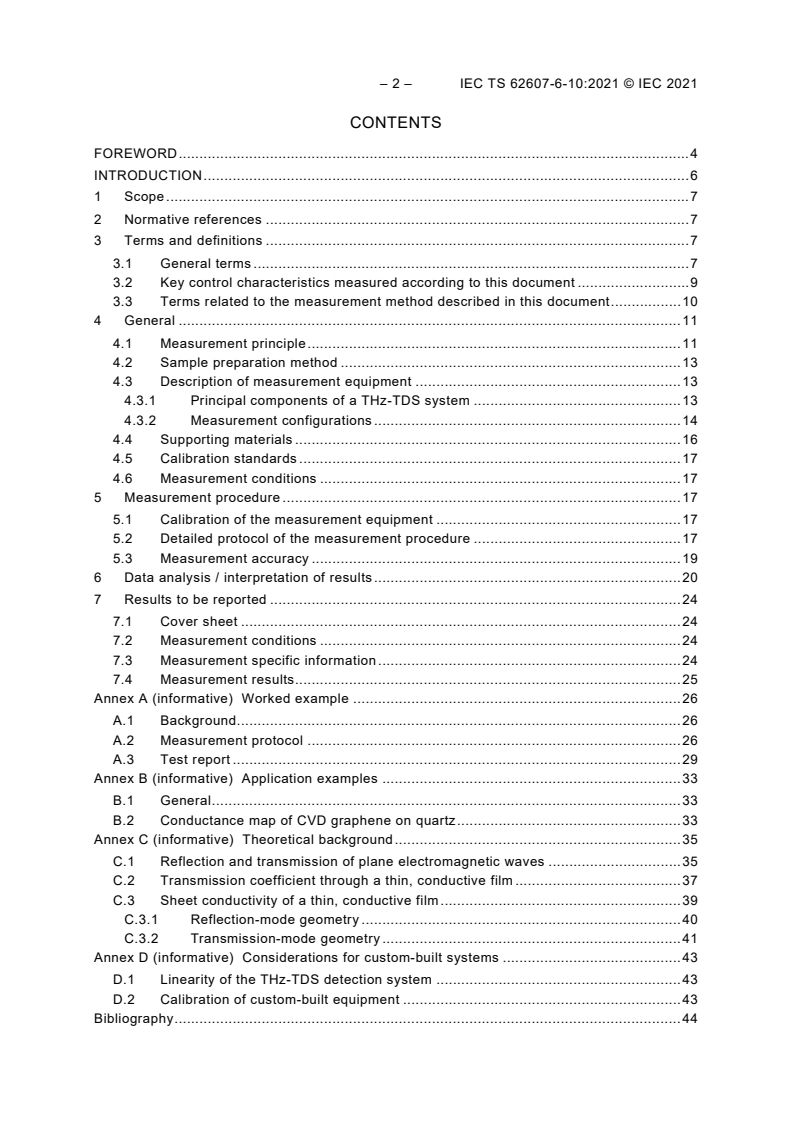
CONTENTS
FOREWORD . 4
INTRODUCTION . 6
1 Scope . 7
2 Normative references . 7
3 Terms and definitions . 7
3.1 General terms . 7
3.2 Key control characteristics measured according to this document . 9
3.3 Terms related to the measurement method described in this document . 10
4 General . 11
4.1 Measurement principle . 11
4.2 Sample preparation method . 13
4.3 Description of measurement equipment . 13
4.3.1 Principal components of a THz-TDS system . 13
4.3.2 Measurement configurations . 14
4.4 Supporting materials . 16
4.5 Calibration standards . 17
4.6 Measurement conditions . 17
5 Measurement procedure . 17
5.1 Calibration of the measurement equipment . 17
5.2 Detailed protocol of the measurement procedure . 17
5.3 Measurement accuracy . 19
6 Data analysis / interpretation of results . 20
7 Results to be reported . 24
7.1 Cover sheet . 24
7.2 Measurement conditions . 24
7.3 Measurement specific information . 24
7.4 Measurement results . 25
Annex A (informative) Worked example . 26
A.1 Background. 26
A.2 Measurement protocol . 26
A.3 Test report . 29
Annex B (informative) Application examples . 33
B.1 General . 33
B.2 Conductance map of CVD graphene on quartz . 33
Annex C (informative) Theoretical background . 35
C.1 Reflection and transmission of plane electromagnetic waves . 35
C.2 Transmission coefficient through a thin, conductive film . 37
C.3 Sheet conductivity of a thin, conductive film . 39
C.3.1 Reflection-mode geometry . 40
C.3.2 Transmission-mode geometry . 41
Annex D (informative) Considerations for custom-built systems . 43
D.1 Linearity of the THz-TDS detection system . 43
D.2 Calibration of custom-built equipment . 43
Bibliography . 44
Figure 1 – Time trace of a typical THz waveform. . 12
Figure 2 – Sample scheme comprised of a thin film of graphene on a dielectric
substrate. . 12
Figure 3 – Principal components of a classical THz-TDS system. 14
Figure 4 – Comparison of different transmission geometries. . 15
Figure 5 – Comparison of different reflection geometries . 16
Figure 6 – Photograph of a CVD monolayer of graphene on PET substrate . 21
Figure 7 – THz-TDS conductance and resistance maps of the sample . 21
Figure 8 – Analysis of high conductive areas in the conductivity map . 22
Figure 9 – Analysis of low conductive areas in the conductivity map . 22
Figure 10 – Analysis of low resistance areas in the resistance map . 23
Figure 11 – Analysis of high resistance areas in the resistance map . 23
Figure 12 – Conductance maps at two different frequencies: 0,5 THz and 0,75 THz . 24
Figure A.1 – Colour map of sheet resistance results at the selected frequency. Sheet
resistance map of the wafer at 0.5 THz, with step size 1 mm. . 32
Figure B.1 – Photograph of a graphene film on a 100 mm quartz wafer and related
conductivity map . 33
Figure B.2 – Detailed view of subsections . 34
Figure C.1 – Reflection and transmission for a thin film on a substrate . 35
Figure C.2 – Reflection and transmission for a thin film on a substrate. . 40
Table A.1 – Illustration of measurement protocol . 26
Table A.2 – Product identification . 30
Table A.3 – General material description . 30
Table A.4 – Sampling plan . 31
Table A.5 – Measurement related information . 31
Table A.6 – Measurement results: Sheet resistance at the selected frequency . 32
– 4 – IEC TS 62607-6-10:2021 © IEC 2021
INTERNATIONAL ELECTROTECHNICAL COMMISSION
____________
NANOMANUFACTURING – KEY CONTROL CHARACTERISTICS –
Part 6-10: Graphene-based material – Sheet resistance:
Terahertz time-domain spectroscopy
FOREWORD
1) The International Electrotechnical Commission (IEC) is a worldwide organization for standardization comprising
all national electrotechnical committees (IEC National Committees). The object of IEC is to promote international
co-operation on all questions concerning standardization in the electrical and electronic fields. To this end and
in addition to other activities, IEC publishes International Standards, Technical Specifications, Technical Reports,
Publicly Available Specifications (PAS) and Guides (hereafter referred to as "IEC Publication(s)"). Their
preparation is entrusted to technical committees; any IEC National Committee interested in the subject dealt with
may participate in this preparatory work. International, governmental and non-governmental organizations liaising
with the IEC also participate in this preparation. IEC collaborates closely with the International Organization for
Standardization (ISO) in accordance with conditions determined by agreement between the two organizations.
2) The formal decisions or agreements of IEC on technical matters express, as nearly as possible, an international
consensus of opinion on the relevant subjects since each technical committee has representation from all
interested IEC National Committees.
3) IEC Publications have the form of recommendations for international use and are accepted by IEC National
Committees in that sense. While all reasonable efforts are made to ensure that the technical content of IEC
Publications is accurate, IEC cannot be held responsible for the way in which they are used or for any
misinterpretation by any end user.
4) In order to promote international uniformity, IEC National Committees undertake to apply IEC Publications
transparently to the maximum extent possible in their national and regional publications. Any divergence between
any IEC Publication and the corresponding national or regional publication shall be clearly indicated in the latter.
5) IEC itself does not provide any attestation of conformity. Independent certification bodies provide conformity
assessment services and, in some areas, access to IEC marks of conformity. IEC is not responsible for any
services carried out by independent certification bodies.
6) All users should ensure that they have the latest edition of this publication.
7) No liability shall attach to IEC or its directors, employees, servants or agents including individual experts and
members of its technical committees and IEC National Committees for any personal injury, property damage or
other damage of any nature whatsoever, whether direct or indirect, or for costs (including legal fees) and
expenses arising out of the publication, use of, or reliance upon, this IEC Publication or any other IEC
Publications.
8) Attention is drawn to the Normative references cited in this publication. Use of the referenced publications is
indispensable for the correct application of this publication.
9) Attention is drawn to the possibility that some of the elements of this IEC Publication may be the subject of patent
rights. IEC shall not be held responsible for identifying any or all such patent rights.
IEC TS 62607-6-10 has been prepared by IEC technical committee 113: Nanotechnology for
electrotechnical products and systems. It is a Technical Specification.
The text of this Technical Specification is based on the following documents:
Draft Report on voting
113/568/DTS 113/604/RVDTS
Full information on the voting for its approval can be found in the report on voting indicated in
the above table.
The language used for the development of this Technical Specification is English.
This document was drafted in accordance with ISO/IEC Directives, Part 2, and developed in
accordance with ISO/IEC Directives, Part 1 and ISO/IEC Directives, IEC Supplement, available
at www.iec.ch/members_experts/refdocs. The main document types developed by IEC are
described in greater detail at www.iec.ch/standardsdev/publications.
A list of all parts of the IEC TS 62607 series, published under the general title
Nanomanufacturing – Key control characteristics, can be found on the IEC website.
The committee has decided that the contents of this document will remain unchanged until the
stability date indicated on the IEC website under webstore.iec.ch in the data related to the
specific document. At this date, the document will be
• reconfirmed,
• withdrawn,
• replaced by a revised edition, or
• amended.
IMPORTANT – The "colour inside" logo on the cover page of this document indicates that it
contains colours which are considered to be useful for the correct understanding of its
contents. Users should therefore print this document using a colour printer.
– 6 – IEC TS 62607-6-10:2021 © IEC 2021
INTRODUCTION
Graphene is an important nanomaterial in R&D and industry due to its outstanding electrical
properties. It is already present in multiple commercial products, and furthermore, it is a strong
candidate as an electrical material in numerous new application areas. However, no established
method to characterize its local electrical performance and quality across large areas exists
yet. The four-point probe method, either as single point or mapping (scanning) technique, is an
industry standard for silicon wafers and conventional thin films, but unavoidably leads to
damage, due to the physical contact between the tip and the one atom thin graphene film. The
microwave resonant cavity method has been demonstrated as a mapping technique for
graphene, but with spatial and sample resolution limited by the cavity size: no attempt has been
made to scale this technique to industrially relevant sample sizes. Other methods for providing
spatial information relating in some way to electrical quality include optical, Raman and
scanning electron microscopies. These ones give local information that only indirectly relates
to the electrical properties of interest.
The focus of this document is to provide a method to characterize the electrical performance,
quality and uniformity of large-area graphene films with terahertz time-domain spectroscopy
(THz-TDS). THz-TDS allows for large-area mapping of graphene films in a non-destructive, fast
and robust mode, without contact and with no sample preparation at all. This method has no
upper limitations in the size of the graphene film to be analysed. It is applicable for statistical
process control, comparison of graphene films produced by different vendors, obtaining
information about imperfections on the microscale such as grain boundaries and defects, and
uniquely allows process modifications and development to be analysed step by step due to its
non-destructive property and ability to access buried conductive layers. THz-TDS has been
tested against other methods such as van der Pauw (vdP), electrical resistance tomography
.
and calibrated Kelvin probe force microscopy with good matching of results [1] [2]
THz-TDS method provides direct measurements of the sheet resistance, both in transmission
and reflection modes [3]. The spatial resolution is related with the diffraction limited THz beam
spot size, reaching about 300 µm at 1 THz, and the maximum surface density of measurements
is determined by the minimum step-size of the actuator moving the sensor or the sample.
The default sample in this document is monolayer graphene grown by chemical vapour
deposition (CVD) on or transferred to a quartz substrate. Nevertheless, the methodology can
be extended to graphene on silicon carbide (epitaxial graphene), multilayer graphene, and thin
conductors generally, including other 2D materials, on several other dielectric and high resistive
substrates including sapphire, silicon coated with silicon dioxide, silicon carbide, polymers and
III-V semiconductors, among others. It is noted that for the reflection-mode THz-TDS, the
technique tolerates less THz-transparent substrates (e.g. medium to highly doped silicon) than
the transmission-mode THz-TDS.
—————————
Numbers in square brackets refer to the Bibliography.
NANOMANUFACTURING – KEY CONTROL CHARACTERISTICS –
Part 6-10: Graphene-based material – Sheet resistance:
Terahertz time-domain spectroscopy
1 Scope
This part of IEC TS 62607 establishes a standardized method to determine the electrical key
control characteristic
– sheet resistance (R )
s
for films of graphene-based materials by
– terahertz time-domain spectroscopy (THz-TDS).
In this technique, a THz pulse is sent to the graphene-based material. The transmitted or
reflected THz waveform is measured in the time domain and transformed to the frequency
domain by the fast Fourier transform (FFT). Finally, the spectrum is fitted to the Drude model
(or another comparable model) to obtain the sheet resistance.
• This non-contact inspection method is non-destructive, fast and robust for the mapping of
large areas of graphene films, with no upper sample size limit.
• The method is applicable for statistical process control, comparison of graphene films
produced by different vendors, or to obtain information about imperfections on the
microscale such as grain boundaries and defects, etc.
• The method is applicable for graphene grown by chemical vapour deposition (CVD) or other
methods on or transferred to dielectric substrates, including but not limited to quartz, silica
(SiO ), silicon (Si), sapphire, silicon carbide (SiC) and polymers.
• The minimum spatial resolution is in the order of 300 µm (at 1 THz) given by the
diffraction limited spot size of the THz pulse.
2 Normative references
There are no normative references in this document.
3 Terms and definitions
For the purposes of this document, the following terms and definitions apply.
ISO and IEC maintain terminological databases for use in standardization at the following
addresses:
• IEC Electropedia: available at http://www.electropedia.org/
• ISO Online browsing platform: available at http://www.iso.org/obp
3.1 General terms
3.1.1
graphene
graphene layer
single-layer graphene
monolayer graphene
1LG
single layer of carbon atoms with each atom bound to three neighbours in a honeycomb
structure
– 8 – IEC TS 62607-6-10:2021 © IEC 2021
Note 1 to entry: It is an important building block of many carbon nano-objects.
Note 2 to entry: As graphene is a single layer, it is also sometimes called "monolayer graphene" or "single-layer
graphene" and abbreviated as "1LG" to distinguish it from bilayer graphene (2LG) and few-layer graphene (FLG).
Note 3 to entry: Graphene has edges and can have defects and grain boundaries where the bonding is disrupted.
[SOURCE: ISO/TS 80004-3:2020, 3.1.13]
3.1.2
graphene-based material
GBM
graphene material
grouping of carbon-based 2D materials that include one or more of graphene, bilayer graphene,
few-layer graphene, graphene nanoplate and functionalized variations thereof as well as
graphene oxide and reduced graphene oxide
Note 1 to entry: "Graphene material" is a short name for graphene-based material.
3.1.3
thin film
conductive, resistive or dielectric material, usually less than 50 000 Å in thickness, that is
deposited onto a substrate by vacuum evaporation, sputtering, or other means
[SOURCE: IEC 60748-23-2:2002, 3.64]
3.1.4
two-dimensional material
2D material
material, consisting of one or several layers with the atoms in each layer strongly bonded to
neighbouring atoms in the same layer, which has one dimension, its thickness, in the nanoscale
or smaller and the other two dimensions generally at larger scales
Note 1 to entry: The number of layers when a two-dimensional material becomes a bulk material varies depending
on both the material being measured and its properties. In the case of graphene layers, it is a two-dimensional
material up to 10 layers thick for electrical measurements, beyond which the electrical properties of the material are
not distinct from those for the bulk (also known as graphite).
Note 2 to entry: Interlayer bonding is distinct from and weaker than intralayer bonding.
Note 3 to entry: Each layer may contain more than one element.
Note 4 to entry: A two-dimensional material can be a nanoplate.
[SOURCE: ISO/TS 80004-13:2017, 3.1.1.1]
3.1.5
diffusive conductor
conductor where the dimensions in which electron transport takes place are significantly larger
than the mean free path
3.1.6
mean free path
product of the momentum relaxation time and the Fermi velocity
Note 1 to entry: Mean free path can be estimated from the Drude-Boltzmann transport theory:
μh N
L =
mfp
2e μ
where h is the Planck’s constant, e is the electron charge, μ is the carrier mobility and N is the carrier density.
Note 2 to entry: CVD graphene on SiO has mean free paths in the range 1 nm to 200 nm at room temperature for
12 −2 2 2
a doping level of 10 cm (corresponding to carrier mobility being in the μ = 100 cm /Vs to 20 000 cm /Vs range)
while CVD graphene encapsulated in hexagonal boron nitride can have mean free paths up to 1 µm to 2 µm at room
6 2 6 2
temperature (corresponding to the μ = 1 × 10 cm /Vs to 2 × 10 cm /Vs range)
Note 3 to entry: The relationship between sheet conductivity σ , carrier density N and carrier mobility μ is given by:
s
σ =Neμ .
s
3.2 Key control characteristics measured according to this document
3.2.1
key control characteristic
KCC
key performance indicator
material property or intermediate product characteristic which can affect safety or compliance
with regulations, fit, function, performance, quality, reliability or subsequent processing of the
final product
Note 1 to entry: The measurement of a key control characteristic is described in a standardized measurement
procedure with known accuracy and precision.
Note 2 to entry: It is possible to define more than one measurement method for a key control characteristic if the
correlation of the results is well-defined and known.
3.2.2
sheet resistance
R
s
measure of resistance of thin films that are nominally uniform in thickness
Note 1 to entry: Two-dimensional (x-y) sheet resistance (Rs) can be determined for electrically uniform thin films.
In rectangular geometry R = R/(L/w), where R is the measured resistance, R = V/I, L is the distance between parallel
s
electrodes, between which the voltage drop (V) is measured, and w is the length of these electrodes. The electrical
current (I) must flow along the plane of the sheet, not perpendicular to it (see Figure 4). The ratio L/w represents the
number of squares of the film specimen.
Note 2 to entry: Sheet resistance is expressed in ohms (Ω). However, for the purpose of this procedure, Ω
represents the unit ohm/square (Ω/sq).
3.2.3
resistivity
ρ
resistance per unit length of a material of unit cross-sectional area
Note 1 to entry: For a uniform conductor with a uniform cross-section, the relationship between resistivity and
l
resistance is given by: R=ρ
A
where
A is the cross-sectional area of the conductor;
l is the length of the conductor
The unit of resistivity is the ohm metre (Ω⋅m).
Note 2 to entry: For a non-uniform conductor, there is in general no simple relationship between resistivity and
resistance.
[SOURCE: ISO 15091:2019, 3.2, modified – Note 1 to entry has been slightly reformulated.
Note 2 has been added.]
3.2.4
sheet conductance
G
s
inverse of sheet resistance
GR= 1/
ss
3.2.5
electrical conductivity
σ
reciprocal of the resistivity
1 1 l
Note 1 to entry: Electrical conductivity is given by × . The unit of electrical conductivity is the siemens
ρ RA
−1
reciprocal metre (S·m ).
Note 2 to entry: The reciprocity is only valid for conductors without directional dependence of the conductivity.
=
– 10 – IEC TS 62607-6-10:2021 © IEC 2021
[SOURCE: ISO 15091:2019, 3.4, modified – The symbol γ has been replaced by σ . Note 2 to
entry has been added.]
3.2.6
mobility
drift mobility
μ
quantity equal to the ratio of the modulus of the mean velocity of the
charge carriers in the direction of an electric field by the modulus of the field strength
[SOURCE: IEC 60050-521:2002, 521-02-58]
3.2.7
charge carrier density
N
density of mobile electrons and/or holes in a material
−3
Note 1 to entry: Expressed in cm .
[SOURCE: IEC 62341-1-2:2014, 2.3.1]
3.3 Terms related to the measurement method described in this document
3.3.1
terahertz time-domain spectroscopy
THz-TDS
method to measure the complex-valued dielectric function or conductivity of a material in the
terahertz (THz) frequency range (typically 0,1 THz to 5 THz) by the measurement of the
temporal shape of an electromagnetic pulse with a duration in the range of picosecond, either
reflected from or transmitted through the sample
Note 1 to entry: The amplitude and phase of the frequency components of the signal are compared to those of a
reference signal, and can be related to the complex refractive index, permittivity or conductivity of the sample.
3.3.2
signal-to-noise ratio
SNR
ratio of the amplitude of the time trace of the terahertz (THz) electric field signal to the root-
mean-square of the noise time trace (measured with the THz beam path blocked)
Note 1 to entry: SNR may be expressed as a level difference in decibels.
Note 2 to entry: SNR can be used to estimate the usable bandwidth of the spectrometer.
3.3.3
dynamic range
DNR
ratio of the amplitude of the frequency trace of the terahertz (THz) electric field signal to the
amplitude of the noise frequency trace (measured with the THz beam path blocked)
Note 1 to entry: DNR may be expressed as a level difference in decibels.
Note 2 to entry: DNR can be used to estimate the usable bandwidth of the spectrometer.
3.3.4
spot size
size of the terahertz beam spot on the sample
Note 1 to entry: The terahertz (THz) pulse contains a broad band of frequencies typically ranging from GHz up to
several THz depending on the pulse duration. Therefore, the spot size of a THz beam can either be measured at a
specific frequency within its bandwidth, or as an average value by a superposition of spot sizes at all frequencies,
weighted by their spectral amplitude. The spot size is typically given as FWHM (full width at half maximum) of the
spatial field distribution.
Note 2 to entry: The effective THz beam spot is typically measured using the knife-edge method. In this method, a
knife-edge is introduced in the area illuminated by the THz beam. The size of the THz spot is measured when the
power is half-reduced and it corresponds to the length of the knife-edge introduced.
Note 3 to entry: The effective THz beam spot can be measured with a THz camera.
3.3.5
Rayleigh range
distance from the focal plane of a Gaussian optical beam where the beam radius has increased
by a factor of 1,41 (square root of 2)
Zw=π /λ
Note 1 to entry: The Rayleigh range is computed as , where w is the beam radius in the focal plane
R0 0
and λ is the wavelength.
3.3.6
four point probe method
method to measure electrical sheet resistance of thin films that uses separate pairs of
current-carrying and voltage-sensing electrodes
Note 1 to entry: The method is fast, repositionable and local, compared to using fixed electrodes.
Note 2 to entry: The method requires the probes making direct contact to the sample, as opposed to four-terminal
measurements done via lithographically defined electrodes, i.e. in cloverleaf or Hall bar design.
[SOURCE: ISO/TS 80004-13:2017, 3.3.3.1, modified – In the definition, ", impedance or
conductivity" has been deleted. Note 1 has been changed and Note 2 has been added.]
3.3.7
microwave resonant cavity method
method to measure surface conductance or equivalently sheet resistance by resonant cavity
that involves monitoring the resonant frequency shift and change in the quality factor before
and after insertion of the specimen into the cavity in a quantitative correlation with the specimen
surface area
Note 1 to entry: The method is fast and non-contacting.
[SOURCE: ISO/TS 80004-13:2017, 3.3.3.7, modified – The term "non-contact microwave
method" is replaced with "microwave resonant cavity method". In the definition, "cavity involves"
is replaced with "cavity that involves".]
3.3.8
electrical resistance tomography
method to obtain maps of electrical conductivity of the interior of a two- or three-dimensional
sample from a set of four-terminal resistance measurements performed at its boundary
4 General
4.1 Measurement principle
The method to measure the intrinsic resistivity and sheet resistance of a thin conducting film as
described in this document is based on terahertz time-domain spectroscopy (THz-TDS). In this
technique, an electromagnetic pulse with a typical duration of one picosecond (i.e. the terahertz
pulse) is generated and its electric field amplitude and temporal shape is measured in the time
domain, as the so-called THz waveform. Figure 1 shows the time trace of a typical THz
waveform. The Fourier transform of the time-domain THz waveform provides access to the
frequency components of the pulse, which typically spans from 0,1 THz up to 5 THz.
– 12 – IEC TS 62607-6-10:2021 © IEC 2021
Figure 1 – Time trace of a typical THz waveform
To perform a measurement, the above-mentioned THz pulse is focused on a sample, defined
in this document as a thin film of a conducting material (graphene) supported onto a dielectric
substrate (see Figure 2). The interaction of the incident THz pulse with the conducting film
modifies the amplitude and phase of the transmitted and reflected THz waveforms according to
the complex refractive index of the material. The complex refractive index is related to the
intrinsic complex resistivity of the material and, in turn, to the sheet resistance. Assuming that
the frequency-dependent resistivity is Drude-like [4] or follows another comparable model, the
measured resistivity spectrum can be fitted by the given model, and the best-fit values of
parameters of the model can be determined.
Figure 2 – Sample scheme comprised of a thin film of
graphene on a dielectric substrate.
The sheet resistance ( R ) is an extrinsic, generally non-local property of a device and the result
s
of an electrical measurement. The sheet resistivity (ρ ) is an intrinsic, local property of a
s
material, and is the 2D equivalent of 3D resistivity. For an electrically uniform thin film material,
the sheet resistance and sheet resistivity are identical. While for many bulk 3D materials, such
as pure metals with uniform conducting properties, a consistent value for the resistivity can be
given, this is not generally the case for 2D materials, as these are more vulnerable to
environmental conditions, in contact with foreign objects and surfaces, and very frequently
contain tears, holes, gaps, cracks and other flaws that leads to a non-uniform current flow.
Therefore, the electrical mapping of 2D materials/thin films and following assessment of the
uniformity is essential for their correct characterization and THz-TDS provides a suitable
method.
THz-TDS technique allows measuring the following electrical parameters:
• sheet resistance ( );
R
s
• sheet resistivity ( );
ρ
s
• sheet conductance ( );
GR= 1/
ss
• sheet conductivity (σρ= 1/ );
ss
• charge carrier mobility (μ );
• charge carrier density (N );
• substrate refractive index ( n ).
sub
It is important to highlight that the sheet resistance, sheet resistivity and charge carrier mobility
can be only defined for diffusive conductors, such as graphene and other 2D materials.
Due to the 300 µm spot size (at 1 THz), THz-TDS measures an average of the local sheet
conductivity across the spot, or more precisely, the average sheet conductivity weighted by the
spot point spread function, or intensity distribution, of the beam spot.
There are two THz-TDS measurement modes: single-point mode and imaging mode.
– Single-point mode refers to a basic THz-TDS measurement where the THz beam is pointed
at a relevant position on the sample. The sample signal is compared to a reference
measurement to obtain the resistivity at that point with a resolution determined by the spot
size.
– Imaging or mapping mode refers to raster scanning the beam over the sample in the focal
plane. The signals are recorded as function of the position (x, y) in the sample and compared
to one or several reference measurements. The result is a spatial resistivity or conductivity
map [1], [2], [5], [6] .
For graphene or other 2D materials, mapping is required to study the distribution of their
electrical parameters (ρ, σ, , Nμ) along the surface. The statistical distributions of these
ss
parameters are primary descriptors of the sample electrical uniformity and give information
about flaws or grain boundaries in the sample. In contrast to electrical measurements, the
THz-TDS method is measuring the intrinsic (local) sheet resistivity ρ averaged over an area
s
corresponding to the THz spot size, weighted by the Gaussian beam spot intensity. THz-TDS
can be performed in two measurement configurations: transmission and reflection, described in
detail in 4.3.2.
Further information of the theoretical background and the measurement principle of the sheet
resistance and conductance can be found in Annex C.
4.2 Sample preparation method
THz-TDS method requires no sample preparation, nor specific sample handling or storage. It
can be advantageous for the measurement accuracy if a part of the sample surface is bare
substrate (see Figure 2).
4.3 Description of measurement equipment
4.3.1 Principal components of a THz-TDS system
The principal components of a classical THz-TDS system are listed below and schematized in
Figure 3, where the dotted area can be substituted by configurations shown in Figure 4 and
Figure 5.
– Femtosecond laser (fs LASER): emits an optical femtosecond pulse.
– Beam splitter (BS): splits the laser output into beams used for THz generation and
THz detection.
– Time delay stage: one of the arms of the beam splitter contains an optical delay line for the
time scan of the THz transient.
– THz emitter (Tx): generates ultrashort THz pulses when excited by the femtosecond laser,
typically in the form of a photoconductive antenna (PCA) or a nonlinear electro-optical
crystal (EOX).
– THz detector (Rx): gated by the second part of the laser beam for time-resolved detection
of the THz transient, typically another PCA or EOX. The detection signal (photocurrent from
the PCA or phase retardation of a probe laser beam through the EOX) is detected by, for
example, lock-in techniques and recorded as a function of the position of the optical time
delay.
– 14 – IEC TS 62607-6-10:2021 © IEC 2021
Other THz sources different from femtosecond laser-based sources can be also used in a
THz-TDS system, such as electronic generation by microwave up-mixing. THz-TDS systems
rely on ultrashort, broadband THz pulses, so the methodology is not compatible with the use of
continuous-wave, narrowband THz sources and detectors. Complete THz-TDS systems are
available from several commercial suppliers.
NOTE The dotted area can be substituted by any of the configurations shown in Figure 4 and Figure 5.
Figure 3 – Principal components of a classical THz-TDS system
Considerations regarding linearity of custom-made detection systems are described in Annex D,
Clause D.1.
4.3.2 Measurement configurations
Two different measurement configurations are possible: transmission and reflection. The
method does not require both reflection and transmission measurements to obtain resistance
values, just one of them is enough. However, if both measurements are available, then the
measurement error might get smaller.
– Transmission geometry. Emitter (Tx) and receiver (Rx) are placed in front of each other
along the same optical axis. The sample is placed between them. The THz beam can be
either collimated or focused by refractive optics (lenses; Figure 4a,b) or reflective optics
(parabolic or elliptical mirrors; Figure 4c,d).
– Standard mathematical analysis of the signals recorded in the experiment assumes plane-
wave excitation of the sample, so it is of importance that the sample is thin compared to the
Rayleigh range Z in order to meet this approximation. In this context, thin substrates fulfil
R
nd Z , where n is the refractive index of the substrate and d is the thickness of the
R
substrate.
NOTE Collimated (a) and focused (b) geometry with refractive optical elements. Collimated (c) and focused (d)
geometry with reflective optical elements.
Figure 4 – Comparison of different transmission geometries
– Reflection geometry. Tx and Rx are placed on the same side of the sample. There are two
possible reflection geometries: shallow angle (or pitch-catch) and normal-incidence
reflection (Figure 5). In pitch-catch, the THz beam illuminates the sample at an oblique angle
and the specular reflection is captured and measured by the detector (Figure 5a). In normal-
incidence reflection, the THz beam illuminates the sample perpendicular to the surface; the
incident and reflected beams are separated by a beam splitter (Figure 5b).
– The advantages of normal incidence compared to pitch-catch are a tighter focal spot
(allowing better spatial resolution) and better beam quality. However, the beam splitter
introduces a minimum loss of 6 dB.
– In pitch-catch geometry, the spot size on the sample is enlarged by the factor 1/cosθ, where
θ is the incidence angle. Pitch-catch geometry offers a higher signal because losses are
minimal, but due to the larger focal spot, spatial resolution is worse than in normal reflection.
Both geometries are similar from the parameter extraction point of view.
– 16 – IEC TS 62607-6-10:2021 © IEC 2021
a) Pitch-catch geometry b) Normal-incidence geometry
Figure 5 – Comparison of different reflection geometries
Systems with a focused THz beam are much more sensitive to the exact positioning of the
sample with respect to the focal plane. When working with focused beams, it is important to
place the sample exactly in the focal plane of the THz beam.
The procedure to extract the parameters is more complex in reflection than in transmission
geometry. On the other side, the reflection measurements are less sensitive to the precise
thickness of the substrate than transmission measurements and this removes the requirement
of a specialized THz-transparent substrate to measure the conductivity [5].
4.4 Supporting materials
Supporting materials are necessary to obtain reference signals, essential to calculate the sheet
resistance of the sample. The selection of supporting materials depends on the measurement
configuration.
– For transmission measurements, reference signals can be measured:
• through the bare substrate of the sample to be measured, i.e. at a position on the sample
without graphene (see Figure 2). The bare substrate shall be transmissive to THz
radiation and the substrate thickness shall be constant along the whole sample surface
(see 5.3 for accuracy dependence on substrate thickness);
• through the air, without any sample in the beam path.
– For reflection measurements, reference signals can be measured on:
• the bare substrate of the sample to be measured, i.e. at a position on the sample without
graphene (see Figure 2). The substrate thickness shall be constant along the whole
sample surface (see 5.3 for accuracy dependence on substrate thickness);
• a reference material, such as a perfect reflector surface (e.g. a mirror or an optically
polished metal).
The frequency-dependent index of refraction and the absorption coefficient of the substrate
shall b
...