

IEC 62561-1:2023
(Main)Lightning protection system components (LPSC) - Part 1: Requirements for connection components
General Information
- Abstract
IEC 62561-1:2023 specifies the requirements and tests for metallic connection components that form part of a lightning protection system (LPS). Typically, these can be connectors, clamps, bonding and bridging components, expansion pieces and test joints. This third edition cancels and replaces the second edition published in 2017. This edition constitutes a technical revision. This edition includes the following significant technical changes with respect to the previous edition:
a) definitions of connection types mentioned in the scope have been added;
b) location classification has been expanded in detail;
c) the document has been updated in line with the new edition of ISO 22479:2019 on humid sulphurous atmosphere treatment;
d) a new normative Annex E for reduced test procedures has been introduced.
- Status
- Published
- Publication Date
- 29-Mar-2023
- Technical Committee
- TC 81 - Lightning protection
- Drafting Committee
- MT 14 - TC 81/MT 14
- Current Stage
- PPUB - Publication issued
- Start Date
- 30-Mar-2023
- Completion Date
- 21-Apr-2023
Buy Documents
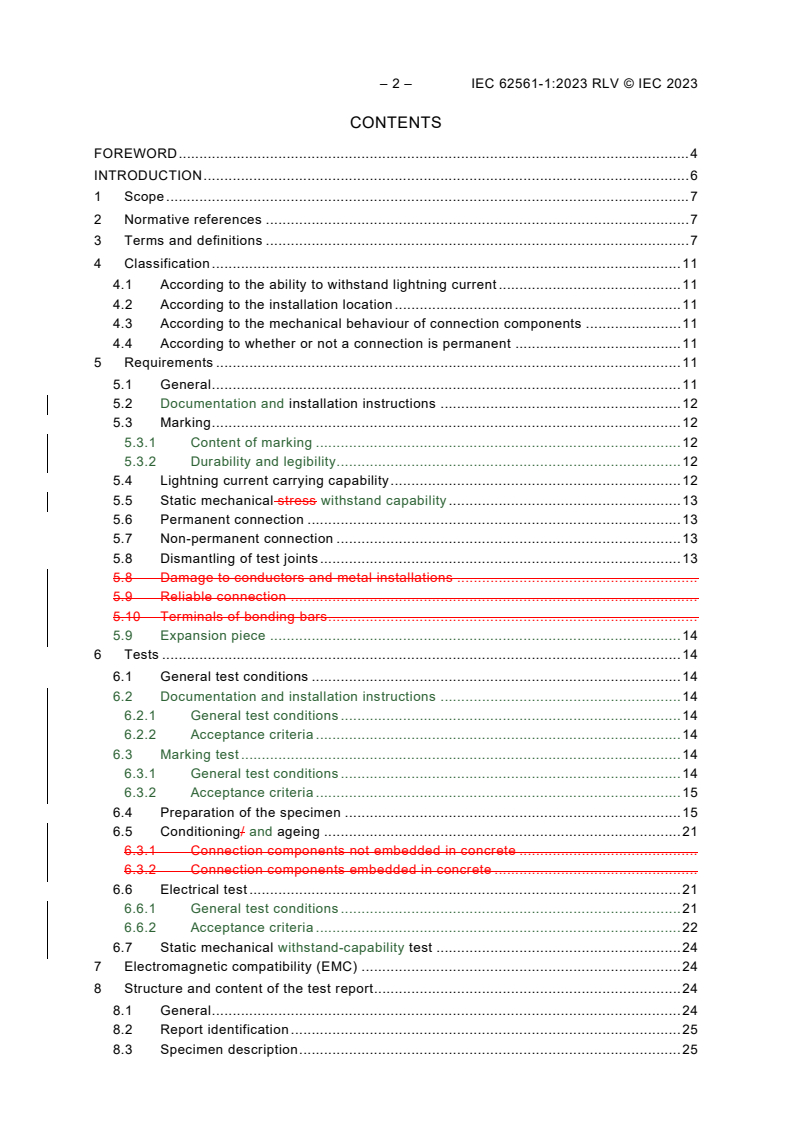
IEC 62561-1:2023 RLV - Lightning protection system components (LPSC) - Part 1: Requirements for connection components Released:3/30/2023
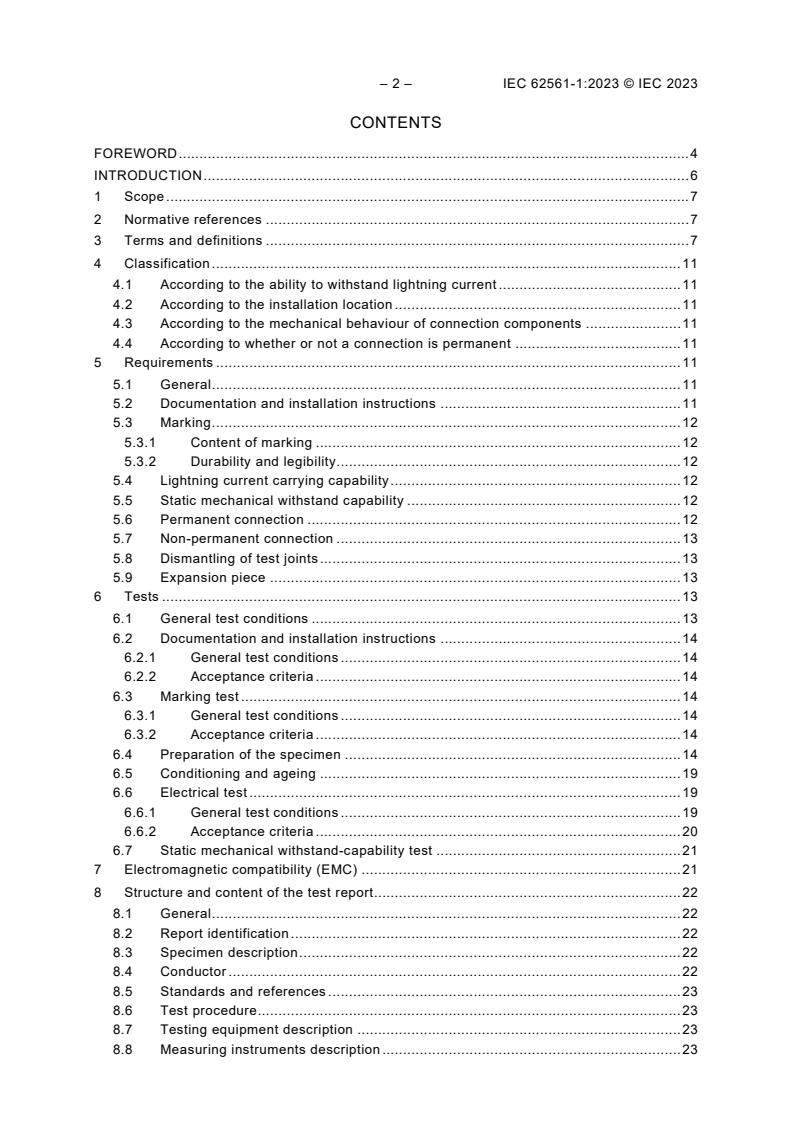
IEC 62561-1:2023 - Lightning protection system components (LPSC) - Part 1: Requirements for connection components Released:3/30/2023
Overview
IEC 62561-1:2023 - Lightning protection system components (LPSC) Part 1 specifies requirements and test methods for metallic connection components used in a lightning protection system (LPS). Typical components covered include connectors, clamps, bonding and bridging components, expansion pieces and test joints. This third edition (2023) replaces the 2017 edition and introduces technical updates such as added connection-type definitions, expanded location classification, alignment with ISO 22479:2019 (humid sulphurous atmosphere treatment), and a new normative Annex E for reduced test procedures.
Keywords: IEC 62561-1:2023, lightning protection, LPSC, connection components, lightning protection system components.
Key topics and technical requirements
- Scope and classification
- Classification by lightning-current withstand ability, installation location, mechanical behaviour, and permanence of connection.
- Design and documentation
- Requirements for product documentation, installation instructions and durable marking.
- Electrical performance
- Tests for lightning current carrying capability and electrical continuity under specified impulse conditions.
- Mechanical performance
- Static mechanical stress/withstand capability and requirements for permanent vs non‑permanent connections.
- Durability and ageing
- Conditioning/ageing tests including salt mist, humid sulphurous and ammonia atmosphere procedures (aligned with ISO 22479:2019 where applicable).
- Special procedures
- Test-joint dismantling, prevention of conductor damage, and requirements for reliable connections and expansion pieces.
- Testing and reporting
- Detailed test methods, EMC considerations and structure/content for test reports. Annexes provide test flowcharts and conditioning details; Annex E specifies reduced test procedures for certain cases.
Keywords: tests for connection components, marking, mechanical stress, conditioning, humid sulphurous atmosphere.
Practical applications - who uses this standard
- Manufacturers of clamps, connectors and bonding components - for product design, type testing and certification.
- Independent test laboratories - to conduct electrical, mechanical and environmental tests and produce compliant test reports.
- Specifiers, consultants and designers - to select appropriate LPSC for buildings and infrastructure in line with IEC 62305 LPS design.
- Installers and maintenance teams - for correct installation, marking and inspection references.
- Certification bodies and procurement - to set acceptance criteria and ensure compliance during procurement and conformity assessment.
Keywords: product testing, LPS installation, IEC 62305 compliance, procurement specification.
Related standards
- IEC 62561 series (other parts covering conductors, arresters, etc.)
- IEC 62305 (risk management and LPS design)
- ISO 22479:2019 (humid sulphurous atmosphere treatment) - referenced/aligned
Using IEC 62561-1:2023 ensures metallic connection components meet robust electrical, mechanical and environmental tests required for reliable lightning protection system performance.
Relations
- Effective Date
- 05-Sep-2023
Buy Documents
IEC 62561-1:2023 RLV - Lightning protection system components (LPSC) - Part 1: Requirements for connection components Released:3/30/2023
IEC 62561-1:2023 - Lightning protection system components (LPSC) - Part 1: Requirements for connection components Released:3/30/2023
Get Certified
Connect with accredited certification bodies for this standard

DIBt (Deutsches Institut für Bautechnik)
German Institute for Building Technology.
DIN CERTCO
DIN Group product certification.

IMQ S.p.A. (Certification)
Italian electrical product certification.
Sponsored listings
Frequently Asked Questions
IEC 62561-1:2023 is a standard published by the International Electrotechnical Commission (IEC). Its full title is "Lightning protection system components (LPSC) - Part 1: Requirements for connection components". This standard covers: IEC 62561-1:2023 specifies the requirements and tests for metallic connection components that form part of a lightning protection system (LPS). Typically, these can be connectors, clamps, bonding and bridging components, expansion pieces and test joints. This third edition cancels and replaces the second edition published in 2017. This edition constitutes a technical revision. This edition includes the following significant technical changes with respect to the previous edition: a) definitions of connection types mentioned in the scope have been added; b) location classification has been expanded in detail; c) the document has been updated in line with the new edition of ISO 22479:2019 on humid sulphurous atmosphere treatment; d) a new normative Annex E for reduced test procedures has been introduced.
IEC 62561-1:2023 specifies the requirements and tests for metallic connection components that form part of a lightning protection system (LPS). Typically, these can be connectors, clamps, bonding and bridging components, expansion pieces and test joints. This third edition cancels and replaces the second edition published in 2017. This edition constitutes a technical revision. This edition includes the following significant technical changes with respect to the previous edition: a) definitions of connection types mentioned in the scope have been added; b) location classification has been expanded in detail; c) the document has been updated in line with the new edition of ISO 22479:2019 on humid sulphurous atmosphere treatment; d) a new normative Annex E for reduced test procedures has been introduced.
IEC 62561-1:2023 is classified under the following ICS (International Classification for Standards) categories: 29.020 - Electrical engineering in general; 91.120.40 - Lightning protection. The ICS classification helps identify the subject area and facilitates finding related standards.
IEC 62561-1:2023 has the following relationships with other standards: It is inter standard links to IEC 62561-1:2017. Understanding these relationships helps ensure you are using the most current and applicable version of the standard.
IEC 62561-1:2023 is available in PDF format for immediate download after purchase. The document can be added to your cart and obtained through the secure checkout process. Digital delivery ensures instant access to the complete standard document.
Standards Content (Sample)
IEC 62561-1 ®
Edition 3.0 2023-03
REDLINE VERSION
INTERNATIONAL
STANDARD
colour
inside
Lightning protection system components (LPSC) –
Part 1: Requirements for connection components
All rights reserved. Unless otherwise specified, no part of this publication may be reproduced or utilized in any form
or by any means, electronic or mechanical, including photocopying and microfilm, without permission in writing from
either IEC or IEC's member National Committee in the country of the requester. If you have any questions about IEC
copyright or have an enquiry about obtaining additional rights to this publication, please contact the address below or
your local IEC member National Committee for further information.
IEC Secretariat Tel.: +41 22 919 02 11
3, rue de Varembé info@iec.ch
CH-1211 Geneva 20 www.iec.ch
Switzerland
About the IEC
The International Electrotechnical Commission (IEC) is the leading global organization that prepares and publishes
International Standards for all electrical, electronic and related technologies.
About IEC publications
The technical content of IEC publications is kept under constant review by the IEC. Please make sure that you have the
latest edition, a corrigendum or an amendment might have been published.
IEC publications search - webstore.iec.ch/advsearchform IEC Products & Services Portal - products.iec.ch
The advanced search enables to find IEC publications by a Discover our powerful search engine and read freely all the
variety of criteria (reference number, text, technical publications previews. With a subscription you will always have
committee, …). It also gives information on projects, replaced access to up to date content tailored to your needs.
and withdrawn publications.
Electropedia - www.electropedia.org
IEC Just Published - webstore.iec.ch/justpublished
The world's leading online dictionary on electrotechnology,
Stay up to date on all new IEC publications. Just Published
containing more than 22 300 terminological entries in English
details all new publications released. Available online and once
and French, with equivalent terms in 19 additional languages.
a month by email.
Also known as the International Electrotechnical Vocabulary
(IEV) online.
IEC Customer Service Centre - webstore.iec.ch/csc
If you wish to give us your feedback on this publication or need
further assistance, please contact the Customer Service
Centre: sales@iec.ch.
IEC 62561-1 ®
Edition 3.0 2023-03
REDLINE VERSION
INTERNATIONAL
STANDARD
colour
inside
Lightning protection system components (LPSC) –
Part 1: Requirements for connection components
INTERNATIONAL
ELECTROTECHNICAL
COMMISSION
ICS 29.020; 91.120.40 ISBN 978-2-8322-6744-8
– 2 – IEC 62561-1:2023 RLV © IEC 2023
CONTENTS
FOREWORD . 4
INTRODUCTION . 6
1 Scope . 7
2 Normative references . 7
3 Terms and definitions . 7
4 Classification . 11
4.1 According to the ability to withstand lightning current . 11
4.2 According to the installation location . 11
4.3 According to the mechanical behaviour of connection components . 11
4.4 According to whether or not a connection is permanent . 11
5 Requirements . 11
5.1 General . 11
5.2 Documentation and installation instructions . 12
5.3 Marking . 12
5.3.1 Content of marking . 12
5.3.2 Durability and legibility . 12
5.4 Lightning current carrying capability . 12
5.5 Static mechanical stress withstand capability . 13
5.6 Permanent connection . 13
5.7 Non-permanent connection . 13
5.8 Dismantling of test joints . 13
5.8 Damage to conductors and metal installations .
5.9 Reliable connection .
5.10 Terminals of bonding bars .
5.9 Expansion piece . 14
6 Tests . 14
6.1 General test conditions . 14
6.2 Documentation and installation instructions . 14
6.2.1 General test conditions . 14
6.2.2 Acceptance criteria . 14
6.3 Marking test . 14
6.3.1 General test conditions . 14
6.3.2 Acceptance criteria . 15
6.4 Preparation of the specimen . 15
6.5 Conditioning/ and ageing . 21
6.3.1 Connection components not embedded in concrete .
6.3.2 Connection components embedded in concrete .
6.6 Electrical test . 21
6.6.1 General test conditions . 21
6.6.2 Acceptance criteria . 22
6.7 Static mechanical withstand-capability test . 24
7 Electromagnetic compatibility (EMC) . 24
8 Structure and content of the test report . 24
8.1 General . 24
8.2 Report identification . 25
8.3 Specimen description . 25
8.4 Conductor . 25
8.5 Standards and references . 25
8.6 Test procedure . 26
8.7 Testing equipment description . 26
8.8 Measuring instruments description . 26
8.9 Results and parameters recorded . 26
8.10 Statement of pass or fail . 26
Annex A (normative) Summary of the requirements and corresponding tests . 27
Annex B (informative) Typical connection configurations arrangements for various
LPSC . 28
Annex C (normative) Flowchart of tests for connection components . 29
Annex D (normative) Conditioning/ and ageing for connection components . 30
D.1 General . 30
D.2 Salt mist treatment . 30
D.3 Humid sulphurous atmosphere treatment . 30
D.4 Ammonia atmosphere treatment. 30
Annex E (normative) Reduced test procedures . 31
Bibliography . 32
Figure 1 – Basic arrangement of specimen with cross-connection component . 16
Figure 2 – Basic arrangement of specimen with parallel connection component . 17
Figure 3 – Basic arrangement of specimen with bridging component .
Figure 3 – Basic arrangement of specimen with expansion piece or bridging
component . 19
Figure 4 – Basic arrangement of specimen with equipotential bonding bar . 20
Figure 5 – Basic arrangement of specimen with clamped connection of reinforcing
rods . 20
Figure 6 – Basic arrangement of specimen with welded, brazed or exothermic
connections of reinforcing rods . 21
Figure 7 – Basic arrangement for contact measurement of expansion piece or bridging
component . 22
Figure 8 – Examples of sequence of loosening of bolts and screws . 23
Figure B.1 – Typical arrangements for various LPSC . 28
Figure C.1 – Flowchart of tests for connection components . 29
Table 1 – Lightning impulse current ( I ) parameters . 22
imp
Table A.1 – Requirements and corresponding tests . 27
Table E.1 – Reduced test procedures for connection components complying with
IEC 62561-1:2017 or IEC 62561-1:2012 . 31
– 4 – IEC 62561-1:2023 RLV © IEC 2023
INTERNATIONAL ELECTROTECHNICAL COMMISSION
____________
LIGHTNING PROTECTION SYSTEM COMPONENTS (LPSC) –
Part 1: Requirements for connection components
FOREWORD
1) The International Electrotechnical Commission (IEC) is a worldwide organization for standardization comprising
all national electrotechnical committees (IEC National Committees). The object of IEC is to promote
international co-operation on all questions concerning standardization in the electrical and electronic fields. To
this end and in addition to other activities, IEC publishes International Standards, Technical Specifications,
Technical Reports, Publicly Available Specifications (PAS) and Guides (hereafter referred to as “IEC
Publication(s)”). Their preparation is entrusted to technical committees; any IEC National Committee interested
in the subject dealt with may participate in this preparatory work. International, governmental and non-
governmental organizations liaising with the IEC also participate in this preparation. IEC collaborates closely
with the International Organization for Standardization (ISO) in accordance with conditions determined by
agreement between the two organizations.
2) The formal decisions or agreements of IEC on technical matters express, as nearly as possible, an international
consensus of opinion on the relevant subjects since each technical committee has representation from all
interested IEC National Committees.
3) IEC Publications have the form of recommendations for international use and are accepted by IEC National
Committees in that sense. While all reasonable efforts are made to ensure that the technical content of IEC
Publications is accurate, IEC cannot be held responsible for the way in which they are used or for any
misinterpretation by any end user.
4) In order to promote international uniformity, IEC National Committees undertake to apply IEC Publications
transparently to the maximum extent possible in their national and regional publications. Any divergence
between any IEC Publication and the corresponding national or regional publication shall be clearly indicated in
the latter.
5) IEC itself does not provide any attestation of conformity. Independent certification bodies provide conformity
assessment services and, in some areas, access to IEC marks of conformity. IEC is not responsible for any
services carried out by independent certification bodies.
6) All users should ensure that they have the latest edition of this publication.
7) No liability shall attach to IEC or its directors, employees, servants or agents including individual experts and
members of its technical committees and IEC National Committees for any personal injury, property damage or
other damage of any nature whatsoever, whether direct or indirect, or for costs (including legal fees) and
expenses arising out of the publication, use of, or reliance upon, this IEC Publication or any other IEC
Publications.
8) Attention is drawn to the Normative references cited in this publication. Use of the referenced publications is
indispensable for the correct application of this publication.
9) Attention is drawn to the possibility that some of the elements of this IEC Publication may be the subject of
patent rights. IEC shall not be held responsible for identifying any or all such patent rights.
This redline version of the official IEC Standard allows the user to identify the changes
made to the previous edition IEC 62561-1:2017. A vertical bar appears in the margin
wherever a change has been made. Additions are in green text, deletions are in
strikethrough red text.
IEC 62561-1 has been prepared by IEC technical committee 81: Lightning protection. It is an
International Standard.
This third edition cancels and replaces the second edition published in 2017. This edition
constitutes a technical revision.
This edition includes the following significant technical changes with respect to the previous
edition:
a) definitions of connection types mentioned in the scope have been added;
b) location classification has been expanded in detail;
c) the document has been updated in line with the new edition of ISO 22479:2019 on humid
sulphurous atmosphere treatment;
d) a new normative Annex E for reduced test procedures has been introduced.
The text of this International Standard is based on the following documents:
Draft Report on voting
81/721/FDIS 81/724/RVD
Full information on the voting for its approval can be found in the report on voting indicated in
the above table.
The language used for the development of this International Standard is English.
This document was drafted in accordance with ISO/IEC Directives, Part 2, and developed in
accordance with ISO/IEC Directives, Part 1 and ISO/IEC Directives, IEC Supplement,
available at www.iec.ch/members_experts/refdocs. The main document types developed by
IEC are described in greater detail at www.iec.ch/publications.
A list of all parts in the IEC 62561 series, published under the general title Lightning
protection system components (LPSC), can be found on the IEC website.
The committee has decided that the contents of this document will remain unchanged until the
stability date indicated on the IEC website under webstore.iec.ch in the data related to the
specific document. At this date, the document will be
• reconfirmed,
• withdrawn,
• replaced by a revised edition, or
• amended.
IMPORTANT – The "colour inside" logo on the cover page of this document indicates that it
contains colours which are considered to be useful for the correct understanding of its
contents. Users should therefore print this document using a colour printer.
– 6 – IEC 62561-1:2023 RLV © IEC 2023
INTRODUCTION
This part of IEC 62561 deals with the requirements and tests for lightning protection system
components (LPSC) used for the installation of a lightning protection system (LPS) designed
and implemented according to the IEC 62305 series.
LIGHTNING PROTECTION SYSTEM COMPONENTS (LPSC) –
Part 1: Requirements for connection components
1 Scope
This part of IEC 62561 specifies the requirements and tests for metallic connection
components that form part of a lightning protection system (LPS). Typically, these can be
connectors, clamps, bonding and bridging components, expansion pieces and test joints.
For the purposes of this document the following connection types are considered as
connection components: exothermic, brazing, welding, clamping, crimping, seaming, screwing
or bolting.
Testing of components for an explosive atmosphere is not covered by this document.
2 Normative references
The following documents are referred to in the text in such a way that some or all of their
content constitutes requirements of this document. For dated references, only the edition
cited applies. For undated references, the latest edition of the referenced document (including
any amendments) applies.
IEC 60068-2-52:19962017, Environmental testing – Part 2-52: Tests – Test Kb: Salt mist,
cyclic (sodium chloride solution)
IEC 62561-2, Lightning protection system components (LPSC) – Part 2: Requirements for
conductors and earth electrodes
ISO 6957:1988, Copper alloys – Ammonia test for stress corrosion resistance
ISO 6988:1985, Metallic and other non-organic coatings – Sulphur dioxide test with general
condensation of moisture
ISO 22479:2019, Corrosion of metals and alloys – Sulfur dioxide test in a humid atmosphere
(fixed gas method)
3 Terms and definitions
For the purposes of this document, the following terms and definitions apply.
ISO and IEC maintain terminology databases for use in standardization at the following
addresses:
• IEC Electropedia: available at http://www.electropedia.org/
• ISO Online browsing platform: available at http://www.iso.org/obp
3.1
connection component
part of an external LPS which is used for the connection of conductors to each other or to
metallic metal installations
– 8 – IEC 62561-1:2023 RLV © IEC 2023
Note 1 to entry: connection components include connectors, clamps, bridging components, expansion pieces and
test joints.
EXAMPLE Examples of connection components are given in Clause 1.
3.2
metal installation
extended metal items in the structure to be protected which may can form a path for lightning
current
EXAMPLE Pipes, staircases, elevator guide rails, ventilation, heating and air conditioning ducts, and
interconnected reinforcing steel.
3.3
conductor
element intended to carry electric current
Note 1 to entry: A metal installation is not intended to carry electrical current.
[SOURCE: IEC 60050-151:2001, 151-12-05, modified – The notes have been replaced with a
new Note 1 to entry.]
3.4
bridging component
connection component for the connection of metal installations
3.5
expansion piece
connection component designed to compensate for changes in length in conductors and/or
metal installations or both caused by temperature changes
3.6
connector
connection component to interconnect two or more conductors
3.7
clamp
connection component for the connection of conductors to metal installations
3.8
pipe clamp
clamp for the connection of conductors to metal pipes
3.9
test joint
joint connection component designed to facilitate electrical testing and measurement of LPS
components
3.10
connection range
minimum to maximum range for which a specific connection component is designed to be
used
3.11
bonding
technique for joining one object to another
[SOURCE: IEC 60050-523:2018, 523-06-01, modified – The example has been deleted.]
3.12
bonding bar
connection component such as a metal bar on which metal installations, external conductive
parts, electric power and telecommunication lines and other cables can be connected to an
LPS
3.13
type test
test required to be made before supplying a type of material covered by IEC 62561-1 on a
general commercial basis, in order to demonstrate satisfactory performance characteristics to
meet the intended application
Note 1 to entry: These tests are of such a nature that, after they have been made, they need not be repeated
unless changes are made to the accessory materials, design or type of manufacturing process which might change
the performance characteristics.
3.14
permanent connection
connection that cannot or is not intended to be dismantled
3.15
non-permanent connection
connection that can or is intended to be dismantled
3.16
exothermic connection
welding process that employs molten metal to permanently join the conductors
Note 1 to entry: The electrical connection suitability and electrical durability of the exothermic connection is
tested using a lightning current test.
3.17
brazed connection
metal-joining process in which two or more metal items are joined together by melting and
flowing a filler metal into the joint
Note 1 to entry: The electrical connection suitability and electrical durability of the brazed connection is tested
using a lightning current test.
3.18
welded connection
fabrication process that joins materials, usually metals
Note 1 to entry: The electrical connection suitability and electrical durability of the welded connection is tested
using a lightning current test.
3.19
force-locked connection
connection between two metal parts which does not allow any relative movement due to
thermal expansion and to environmental load, for example snow, ice, wind
EXAMPLE Connection by means of crimping, clamping, bolting or screwing.
Note 1 to entry: The electrical connection suitability and electrical durability of the force-locked connection is
tested using a lightning current test.
3.20
form-locked connection
connection between two metal parts which allows a small relative movement of metal parts due to thermal
expansion and to environmental load, for example snow, ice, wind
EXAMPLE Connection by means of seaming, overlapping and zipping, locked overlapping or hooking.
– 10 – IEC 62561-1:2023 RLV © IEC 2023
Note 1 to entry: The electrical connection suitability and electrical durability of the form-locked connection is
tested using a lightning current test.
3.21
clamped connection
force-locked connection, which can usually be disassembled, between two components
Note 1 to entry: The electrical connection suitability and electrical durability of the clamped connection is tested
using a lightning current test.
3.22
crimped connection
connection method of permanently attaching a termination to a conductor by pressure
deformation or by reshaping the barrel around the conductor to establish good electrical and
mechanical connection
Note 1 to entry: Crimping as a means of achieving a connection between two conductors may not always require
an additional component to achieve the final connection.
Note 2 to entry: The electrical connection suitability and electrical durability of the crimped connection is tested
using a lightning current test.
[SOURCE: IEC 60050-581:2008, 581-23-10, modified – The term "crimping" has been
replaced with "crimped connection", in the definition "method" has been replaced with
"connection method" and the notes to entry have been added.]
3.23
seamed connection
form-locked connection created by bending of the edges of two adjacent metal sheets
bringing them into intimate contact in a way that they cannot be separated by natural action
Note 1 to entry: The electrical connection suitability and electrical durability of the seamed connection is tested
using a lightning current test.
3.24
screwed connection
force-locked connection, which can be disassembled, between two components which have
threads of their own and can be bolted directly
Note 1 to entry: The electrical connection suitability and electrical durability of the screwed connection is tested
using a lightning current test.
3.25
bolted connection
force-locked connection, which can be disassembled, between two components which can be
bolted indirectly by means of third components (bolts and nuts)
Note 1 to entry: The electrical connection suitability and electrical durability of the bolted connection is tested
using a lightning current test.
3.26
stranded conductor
conductor consisting of a number of individual wires or strands all or some of which generally
have helical form
Note 1 to entry: The cross-section of a stranded conductor can be circular or otherwise shaped.
Note 2 to entry: The term "strand" is also used to designate a single wire.
[SOURCE: IEC 60050-461:2008, 461-01-07]
3.27
rope lay conductor
conductor composed of a central core surrounded by one or more layers of helically laid
groups of wires
3.28
smooth weave stranded conductor
conductor constructed of multi-strand soft drawn wire, interwoven in a basket weave
configuration so as to avoid fraying in application
4 Classification
4.1 According to the ability to withstand lightning current
a) class H for heavy duty;
b) class N for normal duty.
The selection of classes H and or N should be performed by the manufacturer in accordance
with the test parameters identified in Table 1.
4.2 According to the installation location
a) general use;
a) outdoors;
b) indoors;
c) buried in ground;
d) embedded in concrete;
e) embedded in materials with thermal insulation.
The manufacturer’s declaration of installation location shall determine whether it is necessary
to carry out the conditioning and ageing test as identified in 6.5.
4.3 According to the mechanical behaviour of connection components
a) intended to withstand a static mechanical load stress;
b) not intended to withstand a static mechanical load stress.
The manufacturer’s declaration of ability to withstand a static mechanical load shall determine
the need or otherwise whether it is necessary to carry out the static mechanical test as
identified in 6.7.
4.4 According to whether or not a connection is permanent
a) permanent connection such as exothermic process, brazing, welding, crimping, seaming;
b) non-permanent connection such as screwing or bolting.
5 Requirements
5.1 General
Connection components shall be designed in such a manner that, when they are installed in
accordance with the manufacturer’s instructions, their performance shall be reliable, stable
and safe to persons and surrounding equipment.
NOTE A summary of the requirements and their corresponding tests is given in Annex A.
– 12 – IEC 62561-1:2023 RLV © IEC 2023
5.2 Documentation and installation instructions
The manufacturer of the connection component shall provide adequate instructions in their
literature to ensure that the installer of the connection component can select and install the
components in a suitable and safe manner, containing at least the following information:
a) the classification of the component;
b) the recommended tightening torque;
a) classification and lightning current capability (I );
imp
b) classification according to the installation location;
c) classification according to the mechanical behaviour;
d) classification according to whether or not the connection is permanent;
e) the range of conductor sizes and materials;
f) the connection configuration;
g) assembly instructions for permanent or non-permanent connection components (e.g.
whether special tools are necessary, tightening torque, etc.).
Compliance is checked by inspection in accordance with 6.2.
5.3 Marking
5.3.1 Content of marking
The connection components shall be marked at least with the following:
a) the manufacturer’s or responsible vendor’s name or trademark;
b) identifying symbol (picture, product number, etc.);
c) classification, i.e. class N or H;
d) classification according to the installation location.
Compliance is checked by review in accordance with 6.3.1, a).
Where this proves to be impractical the marking in accordance with b), c) and d) may be given
on the smallest packing unit label or on the accompanying documentation.
NOTE 1 Marking can be applied for example by moulding, pressing, engraving, printing and environmental stress
adhesive labels.
NOTE 2 Marking can be applied by water slide transfers only for components classified as indoors.
5.3.2 Durability and legibility
The marking shall be durable and legible.
NOTE Marking can be applied for example by moulding, pressing, engraving, printing adhesive labels or water
slide transfers.
Compliance is checked by test in accordance with 6.3.1 b).
5.4 Lightning current carrying capability
Connection components shall have sufficient lightning current carrying capability.
Compliance is checked in accordance with 6.6 following the manufacturer’s declaration for the
class (H or N) of the connection components in accordance with 4.1.
5.5 Static mechanical stress withstand capability
Connection components classified according to 4.3 a) shall have a sufficient withstand
capability against static mechanical stresses.
Equipotential bonding bars and connections made by seaming are excluded from this
requirement.
Compliance is checked in accordance with 6.7.
5.6 Permanent connection
Where exothermic process, brazing, welding, crimping or seaming are used for connection,
the design shall be such that the conductor and/or the metal installation is always securely
bonded.
Compliance is checked by inspection and in accordance with 6.6.2 a), b) and g).
5.7 Non-permanent connection
Where screws and/or nuts are used as the clamping connection, the design shall be such that
the conductor and/or the metal installation is always securely fastened by the screw and/or
nut application.
Compliance is checked by inspection and in accordance with 6.6.2 a), b), d) and f).
Compliance of connection components classified according to 4.2 d) is checked by inspection
according to 6.6.2 a), d) and g).
5.8 Dismantling of test joints
It shall be possible to dismantle the test joints after lightning current stress.
Compliance is checked by inspection and in accordance with 6.6.2 a), b), d) and f).
5.8 Damage to conductors and metal installations
Connection components shall be so designed that they connect the conductors and/or the
metal installations without undue damage to the conductors, the metal installations and/or the
connection components.
Compliance is checked by inspection.
5.9 Reliable connection
Connection components shall guarantee safe connection within the connection range declared
by the manufacturer.
Compliance is checked by inspection and in accordance with 0.
5.10 Terminals of bonding bars
The input terminals of bonding bars used for lightning protection installations shall have a
diameter of connection equal to or greater than 6 mm.
Compliance is checked by inspection.
– 14 – IEC 62561-1:2023 RLV © IEC 2023
5.9 Expansion piece
In addition to the requirements of this document, the expansion piece (E of Figure 7) shall
fulfil the requirements of IEC 62561-2 for air termination conductors.
6 Tests
6.1 General test conditions
a) The tests in accordance with this document are type tests (see 3.13), performed in a
sequence according to Annex C. Type tests are of such a nature that, after they have
been made, unless changes are made to the accessory materials, design or type of
manufacturing process which can change the performance characteristics, repeated
testing is not required.
b) Unless otherwise specified, tests are carried out with the specimens assembled and
installed as in normal use according to the manufacturer's or supplier's installation
instructions with the recommended conductor materials, sizes and tightening torques. If
the connection component is suitable for various conductors’ materials, then it shall be
tested on each material combination.
c) All tests are carried out on new specimens.
d) Unless otherwise specified, three specimens are subjected to the tests and the
requirements are satisfied if all the tests are met.
e) If only one of the specimens does not satisfy a test due to an assembly or a manufacturing
fault, that test and any preceding one which may have influenced can influence the results
of the test shall be repeated and also the tests which follow shall be carried out in the
required sequence on another full set of specimens, all of which shall comply with the
requirements.
f) The electrical test shall be carried out in the order given, after conditioning/ and ageing of
the arrangement of the specimen in accordance with 6.5.
The applicant, when submitting the sets of specimens, may can also submit an additional set
of specimens which may can be necessary used, should one specimen fail. The testing
station laboratory will then, without further request, test the additional set of specimens and
will reject it only if a further failure occurs. If the additional set of specimens is not submitted
at the same time, the failure of one specimen will entail rejection.
For components already tested according to IEC 62561-1:2017, the reduced test procedure
according to Annex E can be applied.
For new components complete type tests and samples according to Clause 6 are required.
6.2 Documentation and installation instructions
6.2.1 General test conditions
The content of the installation instructions is checked as per its completeness by review.
6.2.2 Acceptance criteria
Documentation or installation instructions are deemed to be acceptable if they contain at least
the information specified in 5.2.
6.3 Marking test
6.3.1 General test conditions
The marking is checked:
a) as per its completeness in accordance with 5.3.1 by review and
b) as per its durability and legibility by rubbing it by hand for 15 s with a piece of cloth
soaked with water and again for 15 s with a piece of cloth soaked with white spirit or
mineral spirit.
Marking made by moulding, pressing or engraving is not subjected to this test.
6.3.2 Acceptance criteria
The specimen is deemed to have passed the test if:
a) the marking contains all the information of 5.3.1;
b) after the test according to 6.3.1, b) the marking remains durable and legible.
6.4 Preparation of the specimen
a) If not otherwise specified by the manufacturer, the conductors and the specimens shall be
cleaned by using a suitable degreasing agent followed by cleaning in demineralized water
and drying. They shall then be assembled in accordance with the manufacturer’s
instructions, for example with the recommended conductors and tightening torques.
b) The conductors and rods used for this test shall fulfil the requirements of IEC 62561-2.
c) The connection component shall be tested in all the connection configurations declared by
the manufacturer. Typical connection configurations for various LPSC are illustrated in
Annex B.
d) If the connection component is suitable for various conductors’ materials, then it shall be
tested on each material combination declared by the manufacturer.
e) Any connection components accommodating a range of conductors with a variation on any
dimension equal to or less than 2 mm shall be tested using the minimum conductor size
recommended. If the range of conductor sizes is greater than 2 mm, it shall be tested
using the minimum and maximum size of conductors recommended.
f) The basic arrangement of the specimen with cross-connection component, parallel
connection component, bridging component and equipotential bonding bar is shown in
Figure 1, Figure 2, Figure 3 and Figure 4, respectively. Terminals of bonding bars are only
tested if the connection size is equal to or greater than 16 mm . The test is carried out
using the smallest conductor size within the range of the terminal with a minimum of 16
mm conductor. Typical arrangements for various LPSC are shown in Annex B.
g) Prorated section of an installation to be embedded in concrete, including connection
components such as connectors, clamps, crimping connections, shall be arranged as
connections, shown in Figure 5 a) Figure 5 b), Figure 5 c), and shall be assembled
according to the manufacturer's instructions.
h) Prorated section of an installation to be embedded in concrete, including connection
components such as brazed, welded, exothermically welded, etc., shall be arranged as
shown in Figure 6 a), Figure 6 b), Figure 6 c) and shall be prepared according to the
designer’s or installer’s instructions and supervision of the installer.
– 16 – IEC 62561-1:2023 RLV © IEC 2023
Dimension in millimetres
Key
1 Cross-connection component
2 Plate made of insulating material
3 Rigid fastener
4 Conductor and/or metal installation in accordance with Annex C
Figure 1 – Basic arrangement of specimen with
cross-connection component
Dimension in millimetres
Key
1 Parallel connection component
2 Plate made of insulating material
3 Rigid fastener
4 Conductor and/or metal installation in accordance with Annex C
Figure 2 – Basic arrangement of specimen with parallel connection component
– 18 – IEC 62561-1:2023 RLV © IEC 2023
Dimension in millimetres
4 1
IEC
Key
1 Bridging component
2 Plate made of insulating material
3 Rigid fastener
4 Metal installation in accordance with Annex C
Figure 3 – Basic arrangement of specimen with bridging component
Flexible lead
Flexible lead
Dimension in millimetres
Key
1 Expansion piece or bridging component
2 Plate made of insulating material
3 Rigid fastener
4 Conductor or metal installation
X Distance indicating position of maximum allowable expansion as declared by the manufacturer. Only applicable
in case of expansion conductor or bridging component allowing for expansion
Figure 3 – Basic arrangement of specimen with
expansion piece or bridging component
– 20 – IEC 62561-1:2023 RLV © IEC 2023
Dimension in millimetres
Key
1 Equipotential bonding bar
2 Plate made of insulating material
3 Rigid fastener
4 Conductor
5 Fixing points of equipotential bonding bar
6 Connection to be tested
Figure 4 – Basic arrangement of specimen with equipotential bonding bar
a) In-line connection b) Cross connection c) "T" connection
Figure 5 – Basic arrangement of specimen with
clamped connection of reinforcing rods
a) In-line connection b) Cross connection c) "T" connection
Figure 6 – Basic arrangement of specimen with welded,
brazed or exothermic connections of reinforcing rods
6.5 Conditioning/ and ageing
6.3.1 Connection components not embedded in concrete
Following the manufacturer’s declaration in accordance with 4.2 but before the electrical tests
of 6.6, the arrangement of the specimen shall be subjected to a conditioning/ and ageing
treatment in accordance with Annex D.
The manufacturer shall provide proof of the copper content of any part of the assembly made
from an alloy having a copper content ≥ 80 %.
After the treatment, the arrangement is fixed on an insulated plate, taking care to avoid any
damage to the specimen due to during handling.
6.3.2 Connection components embedded in concrete
This treatment is not necessary for connection components designed to be completely
embedded in concrete.
This treatment is not necessary for connection components designed for installation locations:
a) indoors;
b) completely embedded in concrete.
Connection components designed to be partially embedded in concrete shall be subjected to
the conditioning/ and ageing test in accordance with 6.5.
Bonding bars designed for indoor applications only are tested without conditioning/ageing.
6.6 Electrical test
6.6.1 General test conditions
After 6.5 and without cleaning the arrangement, the specimen shall be stressed three times by
a test current as given in Table 1. The time interval between individual shots shall allow the
arrangement of the specimen to cool down to approximately ambient temperature.
– 22 – IEC 62561-1:2023 RLV © IEC 2023
The impulse discharge current passing through the device under test is defined by the crest
current peak value I , and the specific energy W/R. The impulse current shall s
...
IEC 62561-1 ®
Edition 3.0 2023-03
INTERNATIONAL
STANDARD
NORME
INTERNATIONALE
Lightning protection system components (LPSC) –
Part 1: Requirements for connection components
Composants des systèmes de protection contre la foudre (CSPF) –
Partie 1: Exigences pour les composants de connexion
All rights reserved. Unless otherwise specified, no part of this publication may be reproduced or utilized in any form
or by any means, electronic or mechanical, including photocopying and microfilm, without permission in writing from
either IEC or IEC's member National Committee in the country of the requester. If you have any questions about IEC
copyright or have an enquiry about obtaining additional rights to this publication, please contact the address below or
your local IEC member National Committee for further information.
Droits de reproduction réservés. Sauf indication contraire, aucune partie de cette publication ne peut être reproduite ni
utilisée sous quelque forme que ce soit et par aucun procédé, électronique ou mécanique, y compris la photocopie et
les microfilms, sans l'accord écrit de l'IEC ou du Comité national de l'IEC du pays du demandeur. Si vous avez des
questions sur le copyright de l'IEC ou si vous désirez obtenir des droits supplémentaires sur cette publication, utilisez
les coordonnées ci-après ou contactez le Comité national de l'IEC de votre pays de résidence.
IEC Secretariat Tel.: +41 22 919 02 11
3, rue de Varembé info@iec.ch
CH-1211 Geneva 20 www.iec.ch
Switzerland
About the IEC
The International Electrotechnical Commission (IEC) is the leading global organization that prepares and publishes
International Standards for all electrical, electronic and related technologies.
About IEC publications
The technical content of IEC publications is kept under constant review by the IEC. Please make sure that you have the
latest edition, a corrigendum or an amendment might have been published.
IEC publications search - webstore.iec.ch/advsearchform IEC Products & Services Portal - products.iec.ch
The advanced search enables to find IEC publications by a Discover our powerful search engine and read freely all the
variety of criteria (reference number, text, technical publications previews. With a subscription you will always have
committee, …). It also gives information on projects, replaced access to up to date content tailored to your needs.
and withdrawn publications.
Electropedia - www.electropedia.org
IEC Just Published - webstore.iec.ch/justpublished
The world's leading online dictionary on electrotechnology,
Stay up to date on all new IEC publications. Just Published
containing more than 22 300 terminological entries in English
details all new publications released. Available online and once
and French, with equivalent terms in 19 additional languages.
a month by email.
Also known as the International Electrotechnical Vocabulary
(IEV) online.
IEC Customer Service Centre - webstore.iec.ch/csc
If you wish to give us your feedback on this publication or need
further assistance, please contact the Customer Service
Centre: sales@iec.ch.
A propos de l'IEC
La Commission Electrotechnique Internationale (IEC) est la première organisation mondiale qui élabore et publie des
Normes internationales pour tout ce qui a trait à l'électricité, à l'électronique et aux technologies apparentées.
A propos des publications IEC
Le contenu technique des publications IEC est constamment revu. Veuillez vous assurer que vous possédez l’édition la
plus récente, un corrigendum ou amendement peut avoir été publié.
Recherche de publications IEC - Découvrez notre puissant moteur de recherche et consultez
webstore.iec.ch/advsearchform gratuitement tous les aperçus des publications. Avec un
La recherche avancée permet de trouver des publications IEC abonnement, vous aurez toujours accès à un contenu à jour
en utilisant différents critères (numéro de référence, texte, adapté à vos besoins.
comité d’études, …). Elle donne aussi des informations sur les
projets et les publications remplacées ou retirées. Electropedia - www.electropedia.org
Le premier dictionnaire d'électrotechnologie en ligne au monde,
IEC Just Published - webstore.iec.ch/justpublished
avec plus de 22 300 articles terminologiques en anglais et en
Restez informé sur les nouvelles publications IEC. Just
français, ainsi que les termes équivalents dans 19 langues
Published détaille les nouvelles publications parues.
additionnelles. Egalement appelé Vocabulaire
Disponible en ligne et une fois par mois par email.
Electrotechnique International (IEV) en ligne.
Service Clients - webstore.iec.ch/csc
Si vous désirez nous donner des commentaires sur cette
publication ou si vous avez des questions contactez-nous:
sales@iec.ch.
IEC Products & Services Portal - products.iec.ch
IEC 62561-1 ®
Edition 3.0 2023-03
INTERNATIONAL
STANDARD
NORME
INTERNATIONALE
Lightning protection system components (LPSC) –
Part 1: Requirements for connection components
Composants des systèmes de protection contre la foudre (CSPF) –
Partie 1: Exigences pour les composants de connexion
INTERNATIONAL
ELECTROTECHNICAL
COMMISSION
COMMISSION
ELECTROTECHNIQUE
INTERNATIONALE
ICS 29.020; 91.120.40 ISBN 978-2-8322-6650-2
– 2 – IEC 62561-1:2023 © IEC 2023
CONTENTS
FOREWORD . 4
INTRODUCTION . 6
1 Scope . 7
2 Normative references . 7
3 Terms and definitions . 7
4 Classification . 11
4.1 According to the ability to withstand lightning current . 11
4.2 According to the installation location . 11
4.3 According to the mechanical behaviour of connection components . 11
4.4 According to whether or not a connection is permanent . 11
5 Requirements . 11
5.1 General . 11
5.2 Documentation and installation instructions . 11
5.3 Marking . 12
5.3.1 Content of marking . 12
5.3.2 Durability and legibility . 12
5.4 Lightning current carrying capability . 12
5.5 Static mechanical withstand capability . 12
5.6 Permanent connection . 12
5.7 Non-permanent connection . 13
5.8 Dismantling of test joints . 13
5.9 Expansion piece . 13
6 Tests . 13
6.1 General test conditions . 13
6.2 Documentation and installation instructions . 14
6.2.1 General test conditions . 14
6.2.2 Acceptance criteria . 14
6.3 Marking test . 14
6.3.1 General test conditions . 14
6.3.2 Acceptance criteria . 14
6.4 Preparation of the specimen . 14
6.5 Conditioning and ageing . 19
6.6 Electrical test . 19
6.6.1 General test conditions . 19
6.6.2 Acceptance criteria . 20
6.7 Static mechanical withstand-capability test . 21
7 Electromagnetic compatibility (EMC) . 21
8 Structure and content of the test report . 22
8.1 General . 22
8.2 Report identification . 22
8.3 Specimen description . 22
8.4 Conductor . 22
8.5 Standards and references . 23
8.6 Test procedure . 23
8.7 Testing equipment description . 23
8.8 Measuring instruments description . 23
8.9 Results and parameters recorded . 23
8.10 Statement of pass or fail . 23
Annex A (normative) Summary of the requirements and corresponding tests . 24
Annex B (informative) Typical connection arrangements for various LPSC . 25
Annex C (normative) Flow chart of tests for connection components . 26
Annex D (normative) Conditioning and ageing for connection components . 27
D.1 General . 27
D.2 Salt mist treatment . 27
D.3 Humid sulphurous atmosphere treatment . 27
D.4 Ammonia atmosphere treatment. 27
Annex E (normative) Reduced test procedures . 28
Bibliography . 29
Figure 1 – Basic arrangement of specimen with cross-connection component . 15
Figure 2 – Basic arrangement of specimen with parallel connection component . 16
Figure 3 – Basic arrangement of specimen with expansion piece or bridging
component . 17
Figure 4 – Basic arrangement of specimen with equipotential bonding bar . 18
Figure 5 – Basic arrangement of specimen with clamped connection of reinforcing
rods . 18
Figure 6 – Basic arrangement of specimen with welded, brazed or exothermic
connections of reinforcing rods . 19
Figure 7 – Basic arrangement for contact measurement of expansion piece or bridging
component . 20
Figure 8 – Examples of sequence of loosening of bolts and screws . 21
Figure B.1 – Typical arrangements for various LPSC . 25
Figure C.1 – Flowchart of tests for connection components . 26
Table 1 – Lightning impulse current ( I ) parameters . 20
imp
Table A.1 – Requirements and corresponding tests . 24
Table E.1 – Reduced test procedures for connection components complying with
IEC 62561-1:2017 or IEC 62561-1:2012 . 28
– 4 – IEC 62561-1:2023 © IEC 2023
INTERNATIONAL ELECTROTECHNICAL COMMISSION
____________
LIGHTNING PROTECTION SYSTEM COMPONENTS (LPSC) –
Part 1: Requirements for connection components
FOREWORD
1) The International Electrotechnical Commission (IEC) is a worldwide organization for standardization comprising
all national electrotechnical committees (IEC National Committees). The object of IEC is to promote
international co-operation on all questions concerning standardization in the electrical and electronic fields. To
this end and in addition to other activities, IEC publishes International Standards, Technical Specifications,
Technical Reports, Publicly Available Specifications (PAS) and Guides (hereafter referred to as “IEC
Publication(s)”). Their preparation is entrusted to technical committees; any IEC National Committee interested
in the subject dealt with may participate in this preparatory work. International, governmental and non-
governmental organizations liaising with the IEC also participate in this preparation. IEC collaborates closely
with the International Organization for Standardization (ISO) in accordance with conditions determined by
agreement between the two organizations.
2) The formal decisions or agreements of IEC on technical matters express, as nearly as possible, an international
consensus of opinion on the relevant subjects since each technical committee has representation from all
interested IEC National Committees.
3) IEC Publications have the form of recommendations for international use and are accepted by IEC National
Committees in that sense. While all reasonable efforts are made to ensure that the technical content of IEC
Publications is accurate, IEC cannot be held responsible for the way in which they are used or for any
misinterpretation by any end user.
4) In order to promote international uniformity, IEC National Committees undertake to apply IEC Publications
transparently to the maximum extent possible in their national and regional publications. Any divergence
between any IEC Publication and the corresponding national or regional publication shall be clearly indicated in
the latter.
5) IEC itself does not provide any attestation of conformity. Independent certification bodies provide conformity
assessment services and, in some areas, access to IEC marks of conformity. IEC is not responsible for any
services carried out by independent certification bodies.
6) All users should ensure that they have the latest edition of this publication.
7) No liability shall attach to IEC or its directors, employees, servants or agents including individual experts and
members of its technical committees and IEC National Committees for any personal injury, property damage or
other damage of any nature whatsoever, whether direct or indirect, or for costs (including legal fees) and
expenses arising out of the publication, use of, or reliance upon, this IEC Publication or any other IEC
Publications.
8) Attention is drawn to the Normative references cited in this publication. Use of the referenced publications is
indispensable for the correct application of this publication.
9) Attention is drawn to the possibility that some of the elements of this IEC Publication may be the subject of
patent rights. IEC shall not be held responsible for identifying any or all such patent rights.
IEC 62561-1has been prepared by IEC technical committee 81: Lightning protection. It is an
International Standard.
This third edition cancels and replaces the second edition published in 2017. This edition
constitutes a technical revision.
This edition includes the following significant technical changes with respect to the previous
edition:
a) definitions of connection types mentioned in the scope have been added;
b) location classification has been expanded in detail;
c) the document has been updated in line with the new edition of ISO 22479:2019 on humid
sulphurous atmosphere treatment;
d) a new normative Annex E for reduced test procedures has been introduced.
The text of this International Standard is based on the following documents:
Draft Report on voting
81/721/FDIS 81/724/RVD
Full information on the voting for its approval can be found in the report on voting indicated in
the above table.
The language used for the development of this International Standard is English.
This document was drafted in accordance with ISO/IEC Directives, Part 2, and developed in
accordance with ISO/IEC Directives, Part 1 and ISO/IEC Directives, IEC Supplement,
available at www.iec.ch/members_experts/refdocs. The main document types developed by
IEC are described in greater detail at www.iec.ch/publications.
A list of all parts in the IEC 62561 series, published under the general title Lightning
protection system components (LPSC), can be found on the IEC website.
The committee has decided that the contents of this document will remain unchanged until the
stability date indicated on the IEC website under webstore.iec.ch in the data related to the
specific document. At this date, the document will be
• reconfirmed,
• withdrawn,
• replaced by a revised edition, or
• amended.
– 6 – IEC 62561-1:2023 © IEC 2023
INTRODUCTION
This part of IEC 62561 deals with the requirements and tests for lightning protection system
components (LPSC) used for the installation of a lightning protection system (LPS) designed
and implemented according to the IEC 62305 series.
LIGHTNING PROTECTION SYSTEM COMPONENTS (LPSC) –
Part 1: Requirements for connection components
1 Scope
This part of IEC 62561 specifies the requirements and tests for metallic connection
components that form part of a lightning protection system (LPS). Typically, these can be
connectors, clamps, bonding and bridging components, expansion pieces and test joints.
For the purposes of this document the following connection types are considered as
connection components: exothermic, brazing, welding, clamping, crimping, seaming, screwing
or bolting.
Testing of components for an explosive atmosphere is not covered by this document.
2 Normative references
The following documents are referred to in the text in such a way that some or all of their
content constitutes requirements of this document. For dated references, only the edition
cited applies. For undated references, the latest edition of the referenced document (including
any amendments) applies.
IEC 60068-2-52:2017, Environmental testing – Part 2-52: Tests – Test Kb: Salt mist, cyclic
(sodium chloride solution)
IEC 62561-2, Lightning protection system components (LPSC) – Part 2: Requirements for
conductors and earth electrodes
ISO 6957:1988, Copper alloys – Ammonia test for stress corrosion resistance
ISO 22479:2019, Corrosion of metals and alloys – Sulfur dioxide test in a humid atmosphere
(fixed gas method)
3 Terms and definitions
For the purposes of this document, the following terms and definitions apply.
ISO and IEC maintain terminology databases for use in standardization at the following
addresses:
• IEC Electropedia: available at http://www.electropedia.org/
• ISO Online browsing platform: available at http://www.iso.org/obp
3.1
connection component
part of an external LPS which is used for the connection of conductors to each other or to
metal installations
EXAMPLE Examples of connection components are given in Clause 1.
– 8 – IEC 62561-1:2023 © IEC 2023
3.2
metal installation
extended metal items in the structure to be protected which can form a path for lightning
current
EXAMPLE Pipes, staircases, elevator guide rails, ventilation, heating and air conditioning ducts, and
interconnected reinforcing steel.
3.3
conductor
element intended to carry electric current
Note 1 to entry: A metal installation is not intended to carry electrical current.
[SOURCE: IEC 60050-151:2001, 151-12-05, modified – The notes have been replaced with a
new Note 1 to entry.]
3.4
bridging component
connection component for the connection of metal installations
3.5
expansion piece
connection component designed to compensate for changes in length in conductors or metal
installations or both caused by temperature changes
3.6
connector
connection component to interconnect two or more conductors
3.7
clamp
connection component for the connection of conductors to metal installations
3.8
pipe clamp
clamp for the connection of conductors to metal pipes
3.9
test joint
connection component designed to facilitate electrical testing and measurement of LPS
components
3.10
connection range
minimum to maximum range for which a specific connection component is designed to be
used
3.11
bonding
technique for joining one object to another
[SOURCE: IEC 60050-523:2018, 523-06-01, modified – The example has been deleted.]
3.12
bonding bar
connection component such as a metal bar on which metal installations, external conductive
parts, electric power and telecommunication lines and other cables can be connected to an
LPS
3.13
type test
test made before supplying a type of material covered by IEC 62561-1 on a general
commercial basis, in order to demonstrate satisfactory performance characteristics to meet
the intended application
3.14
permanent connection
connection that cannot or is not intended to be dismantled
3.15
non-permanent connection
connection that can or is intended to be dismantled
3.16
exothermic connection
welding process that employs molten metal to permanently join the conductors
Note 1 to entry: The electrical connection suitability and electrical durability of the exothermic connection is
tested using a lightning current test.
3.17
brazed connection
metal-joining process in which two or more metal items are joined together by melting and
flowing a filler metal into the joint
Note 1 to entry: The electrical connection suitability and electrical durability of the brazed connection is tested
using a lightning current test.
3.18
welded connection
fabrication process that joins materials, usually metals
Note 1 to entry: The electrical connection suitability and electrical durability of the welded connection is tested
using a lightning current test.
3.19
force-locked connection
connection between two metal parts which does not allow any relative movement due to
thermal expansion and to environmental load, for example snow, ice, wind
EXAMPLE Connection by means of crimping, clamping, bolting or screwing.
Note 1 to entry: The electrical connection suitability and electrical durability of the force-locked connection is
tested using a lightning current test.
3.20
form-locked connection
connection between two metal parts which allows a small relative movement of metal parts due to thermal
expansion and to environmental load, for example snow, ice, wind
EXAMPLE Connection by means of seaming, overlapping and zipping, locked overlapping or hooking.
Note 1 to entry: The electrical connection suitability and electrical durability of the form-locked connection is
tested using a lightning current test.
– 10 – IEC 62561-1:2023 © IEC 2023
3.21
clamped connection
force-locked connection, which can usually be disassembled, between two components
Note 1 to entry: The electrical connection suitability and electrical durability of the clamped connection is tested
using a lightning current test.
3.22
crimped connection
connection method of permanently attaching a termination to a conductor by pressure
deformation or by reshaping the barrel around the conductor to establish good electrical and
mechanical connection
Note 1 to entry: Crimping as a means of achieving a connection between two conductors may not always require
an additional component to achieve the final connection.
Note 2 to entry: The electrical connection suitability and electrical durability of the crimped connection is tested
using a lightning current test.
[SOURCE: IEC 60050-581:2008, 581-23-10, modified – The term "crimping" has been
replaced with "crimped connection", in the definition "method" has been replaced with
"connection method" and the notes to entry have been added.]
3.23
seamed connection
form-locked connection created by bending of the edges of two adjacent metal sheets
bringing them into intimate contact in a way that they cannot be separated by natural action
Note 1 to entry: The electrical connection suitability and electrical durability of the seamed connection is tested
using a lightning current test.
3.24
screwed connection
force-locked connection, which can be disassembled, between two components which have
threads of their own and can be bolted directly
Note 1 to entry: The electrical connection suitability and electrical durability of the screwed connection is tested
using a lightning current test.
3.25
bolted connection
force-locked connection, which can be disassembled, between two components which can be
bolted indirectly by means of third components (bolts and nuts)
Note 1 to entry: The electrical connection suitability and electrical durability of the bolted connection is tested
using a lightning current test.
3.26
stranded conductor
conductor consisting of a number of individual wires or strands all or some of which generally
have helical form
Note 1 to entry: The cross-section of a stranded conductor can be circular or otherwise shaped.
Note 2 to entry: The term "strand" is also used to designate a single wire.
[SOURCE: IEC 60050-461:2008, 461-01-07]
3.27
rope lay conductor
conductor composed of a central core surrounded by one or more layers of helically laid
groups of wires
3.28
smooth weave stranded conductor
conductor constructed of multi-strand soft drawn wire, interwoven in a basket weave
configuration so as to avoid fraying in application
4 Classification
4.1 According to the ability to withstand lightning current
a) class H for heavy duty;
b) class N for normal duty.
The selection of classes H or N should be performed by the manufacturer in accordance with
the test parameters identified in Table 1.
4.2 According to the installation location
a) outdoors;
b) indoors;
c) buried in ground;
d) embedded in concrete;
e) embedded in materials with thermal insulation.
The manufacturer’s declaration of installation location shall determine whether it is necessary
to carry out the conditioning and ageing test as identified in 6.5.
4.3 According to the mechanical behaviour of connection components
a) intended to withstand a static mechanical stress;
b) not intended to withstand a static mechanical stress.
The manufacturer’s declaration of ability to withstand a static mechanical load shall determine
whether it is necessary to carry out the static mechanical test as identified in 6.7.
4.4 According to whether or not a connection is permanent
a) permanent connection such as exothermic process, brazing, welding, crimping, seaming;
b) non-permanent connection such as screwing or bolting.
5 Requirements
5.1 General
Connection components shall be designed in such a manner that, when they are installed in
accordance with the manufacturer’s instructions, their performance shall be reliable, stable
and safe to persons and surrounding equipment.
A summary of the requirements and their corresponding tests is given in Annex A.
5.2 Documentation and installation instructions
The manufacturer of the connection component shall provide adequate instructions in their
literature to ensure that the installer of the connection component can select and install the
components in a suitable and safe manner, containing at least the following information:
a) classification and lightning current capability (I );
imp
b) classification according to the installation location;
– 12 – IEC 62561-1:2023 © IEC 2023
c) classification according to the mechanical behaviour;
d) classification according to whether or not the connection is permanent;
e) the range of conductor sizes and materials;
f) the connection configuration;
g) assembly instructions for permanent or non-permanent connection components (e.g.
whether special tools are necessary, tightening torque, etc.).
Compliance is checked in accordance with 6.2.
5.3 Marking
5.3.1 Content of marking
The connection components shall be marked at least with the following:
a) the manufacturer’s or responsible vendor’s name or trademark;
b) identifying symbol (picture, product number, etc.);
c) classification, i.e. class N or H;
d) classification according to the installation location.
Compliance is checked by review in accordance with 6.3.1, a).
Where this proves to be impractical the marking in accordance with b), c) and d) may be given
on the smallest packing unit label or on the accompanying documentation.
NOTE 1 Marking can be applied for example by moulding, pressing, engraving, printing and environmental stress
adhesive labels.
NOTE 2 Marking can be applied by water slide transfers only for components classified as indoors.
5.3.2 Durability and legibility
The marking shall be durable and legible.
Compliance is checked by test in accordance with 6.3.1 b).
5.4 Lightning current carrying capability
Connection components shall have sufficient lightning current carrying capability.
Compliance is checked in accordance with 6.6 following the manufacturer’s declaration for the
class (H or N) of the connection components in accordance with 4.1.
5.5 Static mechanical withstand capability
Connection components classified according to 4.3 a) shall have a sufficient withstand
capability against static mechanical stresses.
Equipotential bonding bars and connections made by seaming are excluded from this
requirement.
Compliance is checked in accordance with 6.7.
5.6 Permanent connection
Where exothermic process, brazing, welding, crimping or seaming are used for connection,
the design shall be such that the conductor and the metal installation is always securely
bonded.
Compliance is checked by inspection and in accordance with 6.6.2 a), b) and g).
5.7 Non-permanent connection
Where screws or nuts are used as the clamping connection, the design shall be such that the
conductor and the metal installation is always securely fastened by the screw or nut
application.
Compliance is checked by inspection and in accordance with 6.6.2 a), b), d) and f).
Compliance of connection components classified according to 4.2 d) is checked by inspection
according to 6.6.2 a), d) and g).
5.8 Dismantling of test joints
It shall be possible to dismantle the test joints after lightning current stress.
Compliance is checked by inspection and in accordance with 6.6.2 a), b), d) and f).
5.9 Expansion piece
In addition to the requirements of this document, the expansion piece (E of Figure 7) shall
fulfil the requirements of IEC 62561-2 for air termination conductors.
6 Tests
6.1 General test conditions
a) The tests in accordance with this document are type tests (see 3.13), performed in a
sequence according to Annex C. Type tests are of such a nature that, after they have
been made, unless changes are made to the accessory materials, design or type of
manufacturing process which can change the performance characteristics, repeated
testing is not required.
b) Unless otherwise specified, tests are carried out with the specimens assembled and
installed as in normal use according to the manufacturer's or supplier's installation
instructions with the recommended conductor materials, sizes and tightening torques.
c) All tests are carried out on new specimens.
d) Unless otherwise specified, three specimens are subjected to the tests and the
requirements are satisfied if all the tests are met.
e) If only one of the specimens does not satisfy a test due to an assembly or a manufacturing
fault, that test and any preceding one which can influence the results of the test shall be
repeated and also the tests which follow shall be carried out in the required sequence on
another full set of specimens, all of which shall comply with the requirements.
f) The electrical test shall be carried out in the order given, after conditioning and ageing of
the arrangement of the specimen in accordance with 6.5.
The applicant, when submitting the sets of specimens, can also submit an additional set of
specimens which can be used, should one specimen fail. The laboratory will then, without
further request, test the additional set of specimens and will reject it only if a further failure
occurs. If the additional set of specimens is not submitted at the same time, the failure of one
specimen will entail rejection.
For components already tested according to IEC 62561-1:2017, the reduced test procedure
according to Annex E can be applied.
For new components complete type tests and samples according to Clause 6 are required.
– 14 – IEC 62561-1:2023 © IEC 2023
6.2 Documentation and installation instructions
6.2.1 General test conditions
The content of the installation instructions is checked as per its completeness by review.
6.2.2 Acceptance criteria
Documentation or installation instructions are deemed to be acceptable if they contain at least
the information specified in 5.2.
6.3 Marking test
6.3.1 General test conditions
The marking is checked:
a) as per its completeness in accordance with 5.3.1 by review and
b) as per its durability and legibility by rubbing it by hand for 15 s with a piece of cloth
soaked with water and again for 15 s with a piece of cloth soaked with white spirit or
mineral spirit.
Marking made by moulding, pressing or engraving is not subjected to this test.
6.3.2 Acceptance criteria
The specimen is deemed to have passed the test if:
a) the marking contains all the information of 5.3.1;
b) after the test according to 6.3.1, b) the marking remains durable and legible.
6.4 Preparation of the specimen
a) If not otherwise specified by the manufacturer, the conductors and the specimens shall be
cleaned by using a suitable degreasing agent followed by cleaning in demineralized water
and drying. They shall then be assembled in accordance with the manufacturer’s
instructions, for example with the recommended conductors and tightening torques.
b) The conductors and rods used for this test shall fulfil the requirements of IEC 62561-2.
c) The connection component shall be tested in all the connection configurations declared by
the manufacturer. Typical connection configurations for various LPSC are illustrated in
Annex B.
d) If the connection component is suitable for various conductors’ materials, then it shall be
tested on each material combination declared by the manufacturer.
e) Any connection components accommodating a range of conductors with a variation on any
dimension equal to or less than 2 mm shall be tested using the minimum conductor size
recommended. If the range of conductor sizes is greater than 2 mm, it shall be tested
using the minimum and maximum size of conductors recommended.
f) The basic arrangement of the specimen with cross-connection component, parallel
connection component, bridging component and equipotential bonding bar is shown in
Figure 1, Figure 2, Figure 3 and Figure 4, respectively. Terminals of bonding bars are only
tested if the connection size is equal to or greater than 16 mm . The test is carried out
using the smallest conductor size within the range of the terminal with a minimum of 16
mm conductor. Typical arrangements for various LPSC are shown in Annex B.
g) Prorated section of an installation to be embedded in concrete, including connection
components such as connectors, clamps, crimping connections, shall be arranged as
connections, shown in Figure 5 a) Figure 5 b), Figure 5 c), and shall be assembled
according to the manufacturer's instructions.
h) Prorated section of an installation to be embedded in concrete, including connection
components such as brazed, welded, exothermically welded, etc., shall be arranged as
shown in Figure 6 a), Figure 6 b), Figure 6 c) and shall be prepared according to the
designer’s or installer’s instructions and supervision of the installer.
Dimension in millimetres
Key
1 Cross-connection component
2 Plate made of insulating material
3 Rigid fastener
4 Conductor and metal installation
Figure 1 – Basic arrangement of specimen with
cross-connection component
– 16 – IEC 62561-1:2023 © IEC 2023
Dimension in millimetres
Key
1 Parallel connection component
2 Plate made of insulating material
3 Rigid fastener
4 Conductor and metal installation
Figure 2 – Basic arrangement of specimen with parallel connection component
Dimension in millimetres
Key
1 Expansion piece or bridging component
2 Plate made of insulating material
3 Rigid fastener
4 Conductor or metal installation
X Distance indicating position of maximum allowable expansion as declared by the manufacturer. Only applicable
in case of expansion conductor or bridging component allowing for expansion
Figure 3 – Basic arrangement of specimen with
expansion piece or bridging component
– 18 – IEC 62561-1:2023 © IEC 2023
Dimension in millimetres
Key
1 Equipotential bonding bar
2 Plate made of insulating material
3 Rigid fastener
4 Conductor
5 Fixing points of equipotential bonding bar
6 Connection to be tested
Figure 4 – Basic arrangement of specimen with equipotential bonding bar
a) In-line connection b) Cross connection c) "T" connection
Figure 5 – Basic arrangement of specimen with
clamped connection of reinforcing rods
a) In-line connection b) Cross connection c) "T" connection
Figure 6 – Basic arrangement of specimen with welded,
brazed or exothermic connections of reinforcing rods
6.5 Conditioning and ageing
Following the manufacturer’s declaration in accordance with 4.2 but before the electrical tests
of 6.6, the arrangement of the specimen shall be subjected to a conditioning and ageing
treatment in accordance with Annex D.
The manufacturer shall provide proof of the copper content of any part of the assembly made
from an alloy having a copper content ≥ 80 %.
After the treatment, the arrangement is fixed on an insulated plate, taking care to avoid any
damage to the specimen during handling.
This treatment is not necessary for connection components designed for installation locations:
a) indoors;
b) completely embedded in concrete.
Connection components designed to be partially embedded in concrete shall be subjected to
the conditioning and ageing test in accordance with 6.5.
6.6 Electrical test
6.6.1 General test conditions
After 6.5 and without cleaning the arrangement, the specimen shall be stressed three times by
a test current as given in Table 1. The time interval between individual shots shall allow the
arrangement of the specimen to cool down to approximately ambient temperature.
The impulse discharge current passing through the device under test is defined by the current
peak value I , and the specific energy W/R. The impulse current shall show no reversal and
imp
reach I within 50 µs. The transfer of the specific energy W/R shall be dissipated within
imp
5 ms.
– 20 – IEC 62561-1:2023 © IEC 2023
Table 1 – Lightning impulse current ( I ) parameters
Imp
Classification I W/R
imp
kJ/Ω
kA
+45
±10 %
%
−10
H 100 2 500
N 50 625
NOTE The parameters specified in this Table 1 can typically be achieved by an exponentially decaying
lightning impulse current having a time to half value in the range of 350 μs according to IEC 62305-1.
6.6.2 Acceptance criteria
The connection component is deemed to have passed the test if:
a) the contact resistance, measured with a source of at least 5 A as close as possible to the
connection component is equal to or less than 3 mΩ. The measurement of the contact
resistance of the expansion components (E) and the connected conductors (F) is
performed between the clamped ends A-B and C-D, as close as possible to the expansion
component (see Figure 7). Acceptance criteria for seaming are under consideration;
Key
A-B, C-D Measuring points to verify the clamp contact resistances
E Solid material or stranded material according to IEC 62561-2
F Conductor or metal installation
Figure 7 – Basic arrangement for contact measurement
of expansion piece or bridging
...