

IEC 61435:2013
(Main)Nuclear instrumentation - High-purity germanium crystals for radiation detectors - Measurement methods of basic characteristics
General Information
- Abstract
IEC 61435:2013(E) is applicable to high-purity germanium crystals used for radiation detectors for gamma-rays and X-rays. Such germanium is monocrystalline and has a net concentration of fewer than 1011 electrically active impurity centers per cm3. This International Standard specifies terminology and test methods for measurements of basic characteristics of high-purity germanium crystals. Test methods for completed assembled germanium detectors are given in IEC 60973 and IEC 60759. The main technical changes with regard to the previous edition are as follows:
- review the existing requirements;
- update the terminology and definitions.
- Status
- Published
- Publication Date
- 11-Aug-2013
- Technical Committee
- TC 45 - Nuclear instrumentation
- Drafting Committee
- WG 9 - TC 45/WG 9
- Current Stage
- PPUB - Publication issued
- Start Date
- 12-Aug-2013
- Completion Date
- 15-Sep-2013
Overview
IEC 61435:2013 - "Nuclear instrumentation - High-purity germanium crystals for radiation detectors - Measurement methods of basic characteristics" - defines terminology and standardized test methods for characterizing high-purity germanium (HPGe) crystals used in gamma‑ray and X‑ray detectors. The standard applies to monocrystalline HPGe with a net electrically active impurity concentration of fewer than 10^11 electrically active impurity centers per cm^3 and addresses methods to quantify the crystal properties that most affect detector performance.
Key topics and technical requirements
- Scope and terminology: Standardized definitions, symbols and units for HPGe crystal characterization to ensure consistent communication between suppliers and detector manufacturers.
- Net electrically active impurity concentration (N_A − N_D): Procedures to measure compensated impurity concentration, the primary parameter that determines detector depletion voltage and electric-field behavior.
- Van der Pauw transport measurements: Lamellar sample preparation and methods to measure resistivity and Hall coefficient (often performed at liquid nitrogen temperature) for computing (N_A − N_D) and carrier mobility.
- Deep Level Transient Spectroscopy (DLTS): Methods for identifying and quantifying deep-level impurity‑centre concentrations that can affect charge collection and leakage current.
- Crystallographic quality: Sampling, preferential etching, etch‑pit density, orientation, lineage and mosaic spread assessments to evaluate crystal integrity and suitability for detector fabrication.
- Reporting: Recommended data presentation and uncertainty considerations so manufacturers and end users can compare results reliably.
Practical applications and who uses this standard
IEC 61435 is intended for:
- HPGe crystal manufacturers - to control production, quality assurance and to specify crystal deliverables.
- Radiation detector manufacturers - to evaluate raw crystals and predict depletion behavior for gamma and X‑ray detectors.
- Metrology and test laboratories - to perform repeatable, traceable measurements (Van der Pauw, DLTS, crystallography).
- Procurement, R&D and quality managers - to define acceptance criteria and interpret crystal measurement data.
Practical benefits include improved detector yield, predictable depletion voltages, reduced rework, and consistent supplier comparison.
Related standards and references
- Test methods for completed, assembled germanium detectors: IEC 60973 and IEC 60759.
- Normative vocabulary references: IEC 60050 parts on nuclear instrumentation and semiconductor terminology.
- Use alongside laboratory best practices for low-temperature electrical measurements (e.g., liquid nitrogen conditioning) and standard DLTS procedures.
Keywords: IEC 61435, high-purity germanium, HPGe, radiation detectors, Van der Pauw, DLTS, impurity concentration, crystallographic quality, net electrically active impurity.
Relations
- Revises
IEC 61435:1996 - Nuclear instrumentation - High-purity germanium crystals for radiation detectors - Effective Date
- 05-Sep-2023
Get Certified
Connect with accredited certification bodies for this standard

DNV
DNV is an independent assurance and risk management provider.

Lloyd's Register
Lloyd's Register is a global professional services organisation specialising in engineering and technology.
DNV Energy Systems
Energy and renewable energy certification.
Sponsored listings
Frequently Asked Questions
IEC 61435:2013 is a standard published by the International Electrotechnical Commission (IEC). Its full title is "Nuclear instrumentation - High-purity germanium crystals for radiation detectors - Measurement methods of basic characteristics". This standard covers: IEC 61435:2013(E) is applicable to high-purity germanium crystals used for radiation detectors for gamma-rays and X-rays. Such germanium is monocrystalline and has a net concentration of fewer than 1011 electrically active impurity centers per cm3. This International Standard specifies terminology and test methods for measurements of basic characteristics of high-purity germanium crystals. Test methods for completed assembled germanium detectors are given in IEC 60973 and IEC 60759. The main technical changes with regard to the previous edition are as follows: - review the existing requirements; - update the terminology and definitions.
IEC 61435:2013(E) is applicable to high-purity germanium crystals used for radiation detectors for gamma-rays and X-rays. Such germanium is monocrystalline and has a net concentration of fewer than 1011 electrically active impurity centers per cm3. This International Standard specifies terminology and test methods for measurements of basic characteristics of high-purity germanium crystals. Test methods for completed assembled germanium detectors are given in IEC 60973 and IEC 60759. The main technical changes with regard to the previous edition are as follows: - review the existing requirements; - update the terminology and definitions.
IEC 61435:2013 is classified under the following ICS (International Classification for Standards) categories: 27.120.01 - Nuclear energy in general. The ICS classification helps identify the subject area and facilitates finding related standards.
IEC 61435:2013 has the following relationships with other standards: It is inter standard links to IEC 61435:1996. Understanding these relationships helps ensure you are using the most current and applicable version of the standard.
IEC 61435:2013 is available in PDF format for immediate download after purchase. The document can be added to your cart and obtained through the secure checkout process. Digital delivery ensures instant access to the complete standard document.
Standards Content (Sample)
IEC 61435 ®
Edition 2.0 2013-08
INTERNATIONAL
STANDARD
Nuclear instrumentation – High-purity germanium crystals for radiation
detectors – Measurement methods of basic characteristics
All rights reserved. Unless otherwise specified, no part of this publication may be reproduced or utilized in any form
or by any means, electronic or mechanical, including photocopying and microfilm, without permission in writing from
either IEC or IEC's member National Committee in the country of the requester.
If you have any questions about IEC copyright or have an enquiry about obtaining additional rights to this publication,
please contact the address below or your local IEC member National Committee for further information.
IEC Central Office Tel.: +41 22 919 02 11
3, rue de Varembé Fax: +41 22 919 03 00
CH-1211 Geneva 20 info@iec.ch
Switzerland www.iec.ch
About the IEC
The International Electrotechnical Commission (IEC) is the leading global organization that prepares and publishes
International Standards for all electrical, electronic and related technologies.
About IEC publications
The technical content of IEC publications is kept under constant review by the IEC. Please make sure that you have the
latest edition, a corrigenda or an amendment might have been published.
Useful links:
IEC publications search - www.iec.ch/searchpub Electropedia - www.electropedia.org
The advanced search enables you to find IEC publications The world's leading online dictionary of electronic and
by a variety of criteria (reference number, text, technical electrical terms containing more than 30 000 terms and
committee,…). definitions in English and French, with equivalent terms in
It also gives information on projects, replaced and additional languages. Also known as the International
withdrawn publications. Electrotechnical Vocabulary (IEV) on-line.
IEC Just Published - webstore.iec.ch/justpublished Customer Service Centre - webstore.iec.ch/csc
Stay up to date on all new IEC publications. Just Published If you wish to give us your feedback on this publication
details all new publications released. Available on-line and or need further assistance, please contact the
also once a month by email. Customer Service Centre: csc@iec.ch.
IEC 61435 ®
Edition 2.0 2013-08
INTERNATIONAL
STANDARD
Nuclear instrumentation – High-purity germanium crystals for radiation
detectors – Measurement methods of basic characteristics
INTERNATIONAL
ELECTROTECHNICAL
COMMISSION
PRICE CODE
V
ICS 27.120 ISBN 978-2-8322-1033-8
– 2 – 61435 © IEC:2013(E)
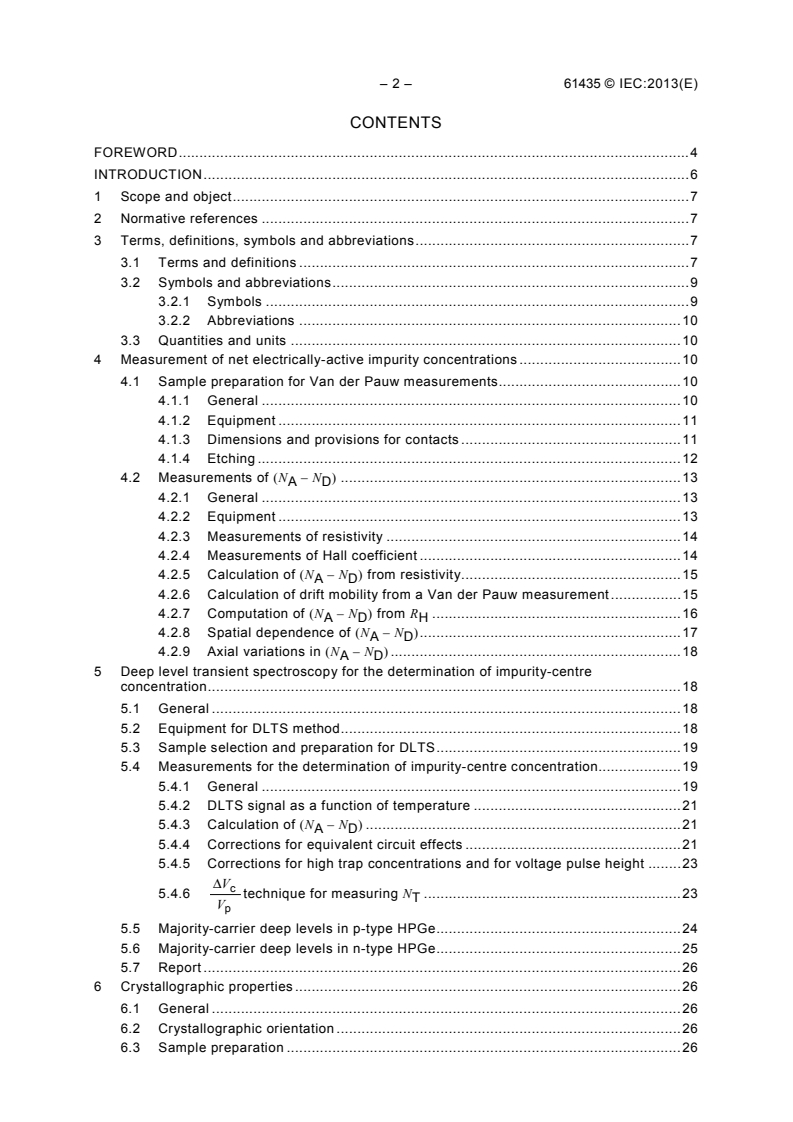
CONTENTS
FOREWORD . 4
INTRODUCTION . 6
1 Scope and object . 7
2 Normative references . 7
3 Terms, definitions, symbols and abbreviations . 7
3.1 Terms and definitions . 7
3.2 Symbols and abbreviations . 9
3.2.1 Symbols . 9
3.2.2 Abbreviations . 10
3.3 Quantities and units . 10
4 Measurement of net electrically-active impurity concentrations . 10
4.1 Sample preparation for Van der Pauw measurements. 10
4.1.1 General . 10
4.1.2 Equipment . 11
4.1.3 Dimensions and provisions for contacts . 11
4.1.4 Etching . 12
Measurements of (N – N ) . 13
4.2
A D
4.2.1 General . 13
4.2.2 Equipment . 13
4.2.3 Measurements of resistivity . 14
4.2.4 Measurements of Hall coefficient . 14
4.2.5 Calculation of (N – N ) from resistivity . 15
A D
4.2.6 Calculation of drift mobility from a Van der Pauw measurement . 15
4.2.7 Computation of (N – N ) from R . 16
A D H
4.2.8 Spatial dependence of (N – N ) . 17
A D
4.2.9 Axial variations in (N – N ) . 18
A D
5 Deep level transient spectroscopy for the determination of impurity-centre
concentration . 18
5.1 General . 18
5.2 Equipment for DLTS method . 18
5.3 Sample selection and preparation for DLTS . 19
5.4 Measurements for the determination of impurity-centre concentration. 19
5.4.1 General . 19
5.4.2 DLTS signal as a function of temperature . 21
5.4.3 Calculation of (N – N ) . 21
A D
5.4.4 Corrections for equivalent circuit effects . 21
5.4.5 Corrections for high trap concentrations and for voltage pulse height . 23
ΔV
c
5.4.6 technique for measuring N . 23
T
V
p
5.5 Majority-carrier deep levels in p-type HPGe . 24
5.6 Majority-carrier deep levels in n-type HPGe . 25
5.7 Report . 26
6 Crystallographic properties . 26
6.1 General . 26
6.2 Crystallographic orientation . 26
6.3 Sample preparation . 26
61435 © IEC:2013(E) – 3 –
6.3.1 General . 26
6.3.2 Preferential etching . 26
6.3.3 Etching methods . 27
6.3.4 Etch-pit density . 27
6.3.5 Lineage . 27
6.3.6 Mosaic . 27
6.4 Report . 27
Annex A (informative) The Hall factor for n-type and p-type HPGe . 28
R R
АВ,СD AB,CD
Annex B (informative) Function f versus . 30
R R
BC,DA BC,DA
Bibliography . 31
Figure 1 – Samples . 12
Figure 2 – Examples of sample shapes . 18
Figure 3 – DLTS waveforms and gate timing . 20
ΔV
c
Figure 4 – waveforms . 24
V
p
Figure A.1 – Hall factor for n-type HPGe . 28
Figure A.2 – Hall factor for p-type HPGe . 29
R R
AB,CD
АВ,СD
Figure B.1 – Function f versus [21] . 30
R R
BC,DA BC,DA
Table 1 – Majority-carrier deep levels in p-type HPGe . 25
– 4 – 61435 © IEC:2013(E)
INTERNATIONAL ELECTROTECHNICAL COMMISSION
____________
NUCLEAR INSTRUMENTATION –
HIGH-PURITY GERMANIUM CRYSTALS FOR RADIATION DETECTORS –
MEASUREMENT METHODS OF BASIC CHARACTERISTICS
FOREWORD
1) The International Electrotechnical Commission (IEC) is a worldwide organization for standardization comprising
all national electrotechnical committees (IEC National Committees). The object of IEC is to promote
international co-operation on all questions concerning standardization in the electrical and electronic fields. To
this end and in addition to other activities, IEC publishes International Standards, Technical Specifications,
Technical Reports, Publicly Available Specifications (PAS) and Guides (hereafter referred to as “IEC
Publication(s)”). Their preparation is entrusted to technical committees; any IEC National Committee interested
in the subject dealt with may participate in this preparatory work. International, governmental and non-
governmental organizations liaising with the IEC also participate in this preparation. IEC collaborates closely
with the International Organization for Standardization (ISO) in accordance with conditions determined by
agreement between the two organizations.
2) The formal decisions or agreements of IEC on technical matters express, as nearly as possible, an international
consensus of opinion on the relevant subjects since each technical committee has representation from all
interested IEC National Committees.
3) IEC Publications have the form of recommendations for international use and are accepted by IEC National
Committees in that sense. While all reasonable efforts are made to ensure that the technical content of IEC
Publications is accurate, IEC cannot be held responsible for the way in which they are used or for any
misinterpretation by any end user.
4) In order to promote international uniformity, IEC National Committees undertake to apply IEC Publications
transparently to the maximum extent possible in their national and regional publications. Any divergence
between any IEC Publication and the corresponding national or regional publication shall be clearly indicated in
the latter.
5) IEC itself does not provide any attestation of conformity. Independent certification bodies provide conformity
assessment services and, in some areas, access to IEC marks of conformity. IEC is not responsible for any
services carried out by independent certification bodies.
6) All users should ensure that they have the latest edition of this publication.
7) No liability shall attach to IEC or its directors, employees, servants or agents including individual experts and
members of its technical committees and IEC National Committees for any personal injury, property damage or
other damage of any nature whatsoever, whether direct or indirect, or for costs (including legal fees) and
expenses arising out of the publication, use of, or reliance upon, this IEC Publication or any other IEC
Publications.
8) Attention is drawn to the Normative references cited in this publication. Use of the referenced publications is
indispensable for the correct application of this publication.
9) Attention is drawn to the possibility that some of the elements of this IEC Publication may be the subject of
patent rights. IEC shall not be held responsible for identifying any or all such patent rights.
International Standard IEC 61435 has been prepared by IEC technical committee 45: Nuclear
instrumentation.
This second edition cancels and replaces the first edition published in 1996 and constitutes a
technical revision.
The main technical changes with regard to the previous edition are as follows:
– Review the existing requirements.
– Update the terminology and definitions.
The text of this standard is based on the following documents:
FDIS Report on voting
45/754/FDIS 45/760/RVD
61435 © IEC:2013(E) – 5 –
Full information on the voting for the approval of this standard can be found in the report on
voting indicated in the above table.
This publication has been drafted in accordance with the ISO/IEC Directives, Part 2.
The committee has decided that the contents of this publication will remain unchanged until
the stability date indicated on the IEC web site under "http://webstore.iec.ch" in the data
related to the specific publication. At this date, the publication will be
• reconfirmed,
• withdrawn,
• replaced by a revised edition, or
• amended.
A bilingual version of this publication may be issued at a later date.
– 6 – 61435 © IEC:2013(E)
INTRODUCTION
Detector manufacturers demand numerical data that can be used to predict the performance
of a detector having approximately coaxial geometry. However, because of the many
variations in the physical characteristics, the completed detector performance cannot be fully
predicted from measurements of the crystal manufacturer. This standard defines terminology
and test methods for determining basic crystal parameters such as net electrically active
impurity concentrations, deep-level impurity-centre concentration and crystallographic quality
of crystals.
Production of germanium crystals of the necessary size and defined purity for high-purity
germanium (HPGe) detectors for detection of ionizing radiation has special problems in
characterization resulting from the high resistivity of the material (~10 kΩ⋅cm at 77 K), from
the degree of impurity compensation, and from difficulties in suitably describing the impurity
distribution in the large volume that may form a single device. Existing standards do not cover
these problems.
One of the most important characteristics of HPGe is the net electrically active impurity
– N ) because it determines the depletion voltage required for an operating
concentration (N
A D
detector. The usual practice has been to determine (N – N ), with the sign indicating n-type
A D
or p-type, on the basis of transport measurements using the Van der Pauw method [1] on
lamellar samples immersed in liquid nitrogen (LN).
In this technique, (N – N ) can be computed either from the resistivity or from the Hall
A D
coefficient. These in turn are obtained from a series of electrical measurements made on the
sample.
___________
Numbers in square brackets refer to the Bibliography.
61435 © IEC:2013(E) – 7 –
NUCLEAR INSTRUMENTATION –
HIGH-PURITY GERMANIUM CRYSTALS FOR RADIATION DETECTORS –
MEASUREMENT METHODS OF BASIC CHARACTERISTICS
1 Scope and object
This International Standard is applicable to high-purity germanium crystals used for radiation
detectors for gamma-rays and X-rays. Such germanium is monocrystalline and has a net
11 3
concentration of fewer than 10 electrically active impurity centers per cm , usually of the
10 –3
order of 10 cm .
This International Standard specifies terminology and test methods for measurements of basic
characteristics of high-purity germanium crystals. These characteristics are net electrically
active impurity concentrations (hereinafter (N – N )), deep-level impurity-centre
A D
concentration and crystallographic quality of crystals.
These test methods are not mandatory but have found general use in the industry and provide
verifiable and desired information to the detector manufacturer.
Test methods for completed assembled germanium detectors are given in IEC 60973 and
IEC 60759.
2 Normative references
The following documents, in whole or in part, are normatively referenced in this document and
are indispensable for its application. For dated references, only the edition cited applies. For
undated references, the latest edition of the referenced document (including any
amendments) applies.
IEC 600050-393:2003, International Electrotechnical Vocabulary (IEV) – Part 393: Nuclear
instrumentation – Physical phenomena and basic concepts
IEC 60050-394:2007, International Electrotechnical Vocabulary (IEV) – Part 394: Nuclear
instrumentation – Instruments, systems, equipment, and detectors
IEC 60050-521:2002, International Electrotechnical Vocabulary (IEV) – Part 521:
Semiconductor devices and integrated circuits
3 Terms, definitions, symbols and abbreviations
3.1 Terms and definitions
For the purposes of this document, the following terms and definitions apply.
3.1.1
semiconductor
substance whose total conductivity due to charge carriers of both signs is normally in the
range between that of conductors and insulators and in which the charge carrier density can
be changed by external means
Note 1 to entry: The term semiconductor generally applies where the charge carriers are electrons or holes.
[SOURCE: IEC 60050-521:2002, 521-02-01]
– 8 – 61435 © IEC:2013(E)
[SOURCE: IEC 60050-394:2007, 394-28-33]
3.1.2
high purity semiconductor detector
semiconductor detector using a high purity (e.g. high resistivity) semiconductor material
[SOURCE: IEC 60050-394:2007, 394-28-14]
3.1.3
Hall effect
production in a conductor or in a semiconductor of an electric field strength proportional to the
vector product of the current density and the magnetic flux density
[SOURCE: IEC 60050-521:2002, 521-09-01]
3.1.4
Hall mobility
product of the Hall coefficient and the electric conductivity
[SOURCE: IEC 60050-521:2002, 521-09-02]
3.1.5
Hall coefficient
coefficient of proportionality R in the Hall effect quantitative relation:
H
E = R (J × B)
H H
E is the resulting transverse electric field strength;
H
J is the current density;
B is the magnetic flux density.
Note 1 to entry: The sign of the majority carrier charge can usually be inferred from the sign of the Hall
coefficient.
[SOURCE: IEC 60050-521:2002, 521-09-02]
3.1.6
mobility
drift mobility of a charge carrier
quantity equal to the quotient of the modulus of the mean velocity of a charge carrier in the
direction of an electric field by the modulus of the field strength
[SOURCE: IEC 60050-521:2002, 521-02-58]
3.1.7
impurity
foreign atoms or either an excess or a deficiency of atoms with respect to the stochiometric
composition of a compound semiconductor
[SOURCE: IEC 60050-521:2002, 521-02-04]
3.1.8
resistivity
inverse of the conductivity when this inverse exists
61435 © IEC:2013(E) – 9 –
[SOURCE: IEC 60050-121:1998, 121-12-04]
3.2 Symbols and abbreviations
3.2.1 Symbols
Frequently used symbols are defined below; infrequently used symbols are defined in the text.
A diode area, expressed in cm ;
B magnetic flux density, expressed in teslas (T);
C capacitance, expressed in farads (F);
C capacitance of the depleted region in a diode;
d
C initial capacitance;
i
C capacitance at voltage V ;
f r
C the capacitance of parallel equivalent circuit;
m
D the series circuit dissipation factor
s ;
D Sample thickness, expressed in centimetres (cm);
–19
e
electron charge, 1,60 × 10 coulombs (C);
–1
e carrier emission rate from a localized electronic level, expressed in s ;
r
E energy associated with an electronic level in the band gap;
F frequency, expressed in hertz (Hz);
R
AB,CD
is a factor dependent on ratio ;
f
R
BC,DA
–5 –1
K
Boltzmann constant, 8,617 × 10 eV·K ;
∗
(N – N ) net electrically active impurity concentration per cm ;
A D
N deep-level impurity-centre concentration per cm ;
T
N net concentration of all shallower levels;
B
m
–2 –2 –1
slope of the C (V )plot, in (pF) ⋅V ;
Q charge, expressed in coulombs (C);
r Hall factor;
H
R
resistance, expressed in ohms (Ω);
R
3 –1
H
Hall coefficient, expressed in cm ⋅C ;
R leakage resistance in parallel with the depleted region;
p
R the series resistance of the sample, which includes the resistance of the
s
undepleted region and of the contacts;
Ρ
resistivity, expressed in Ω⋅cm;
T temperature, expressed in kelvins (K);
T time, expressed in seconds (s);
emission time, expressed in seconds (s);
τ
the rate window at the peak temperature T ;
τ
max
max
___________
∗
The sign of the quantity indicates the type of carrier (n or p). Where only the magnitude is required, the
expression will appear as |N – N |.
A D
– 10 – 61435 © IEC:2013(E)
the relaxation time of a carrier;
τ
r
average square of relaxation time;
(τ )
r
2 –1 –1
drift mobility, expressed in cm V s ;
μ
2 –1 –1
Hall mobility, expressed in cm V s ;
μ
H
2 –1 –1
electron mobility in a semiconductor crystal, expressed in cm V s ;
μ
n
2 –1 –1
hole mobility in a semiconductor crystal, expressed in cm V s ;
μ
p
V voltage;
V built-in potential of the diode;
bi
V filling pulse, expressed in volts (V);
p
V quiescent reverse bias, expressed in volts (V);
r
W duration of the filling pulse, expressed in seconds (s);
p
( ) average value;
the capacitance transient amplitude;
Δ C
d
the increase the reverse bias V needed for rising minimal capacitance to
ΔV
r
c
the final value.
3.2.2 Abbreviations
DC direct current;
DLTS deep-level transient spectroscopy;
HPGe high-purity germanium;
LN liquid nitrogen.
3.3 Quantities and units
In the present standard, units of the International System (SI) are used. The definitions of
radiation quantities are given in IEC 60050-393,IEC 60050-394 and IEC 60050-521.
Nevertheless, the following non SI units may also be used:
– for energy: electron-volts (eV);
– for time: minutes (min);
– for volume: litres (l);
– for temperature: kelvins (K);
– for thickness: centimetres (cm), millimetres (mm).
Multiples and submultiples of SI units will be used, when practicable, according to the
SI system.
4 Measurement of net electrically-active impurity concentrations
4.1 Sample preparation for Van der Pauw measurements
4.1.1 General
– N ) is critically dependent on sample preparation,
Accuracy in the determination of (N
A D
which shall be carried out with great care.
61435 © IEC:2013(E) – 11 –
The size and shape of a sample upon which measurements will be made depends on the
exact purpose of the test, but some characteristics are common to all samples:
a) samples shall be lamellar, with the shortest linear dimension along a face being at least
three times greater than the thickness;
b) from the standpoint of measurement theory, samples may be square, rectangular, or
circular; geometric perfection is not required;
c) surface roughness and strains (such as those caused by lapping) shall be removed by
polish etching;
d) four contacts shall be attached, usually on the corners of square samples, or at 90°
spacing on circular samples.
With regard to etching, the surface type (n or p) and the surface stability usually are
determined by the details of the wet-chemical processing and depend on ambient conditions.
Surface type and uniformity may be affected by improper handling. Carriers that accumulate
at the surface may contribute to conduction; if the surface is inverted, depletion will reduce
the effective sample thickness. The purer the sample, the more important those effects
10 −3
become. For very pure material (impurity net concentration of approximately 10 cm ),
specialized etch and quench procedures may be required to achieve consistently satisfactory
results, particularly for n-type material.
4.1.2 Equipment
The equipment for sample preparation shall be:
a) a string saw or diamond-blade saw;
b) supplies of semiconductor-grade reagents and access to a vented laboratory hood and
sink;
c) the surfaces of the sample shall be etched in a way that ensures acid contact on all
surfaces; a beaker with a waffled bottom is useful for this purpose. The size of the beaker
is important because self-heating occurs during the etching process. If the beaker is too
large, the reaction will proceed too slowly and a wasteful amount of reagent will be
necessary; if too small, the reaction will proceed too violently. The optimum size is slightly
wider than the sample and deep enough to allow the etchant to extend 1 cm to 2 cm
above the surface of the sample.
4.1.3 Dimensions and provisions for contacts
Samples may be cut and fashioned with a string or diamond-blade saw. The minimum lateral
dimension of a sample used for determining (N – N ) shall exceed three times the sample
A D
thicknesses.
For small samples, the preferable forms are squares (or rectangles) with side from 1 cm to
2 cm. If contacts are made at the corners (that is preferred) the corners shall be beveled the
minimum amount necessary for stable physical contact (~1 mm bevels; see Figure 1a). For
circular samples, contacts should be made 90° apart around the perimeter, again minimizing
contact width. Nicks (indentations) may be cut into the slice at the points where the contacts
are to be made (see Figure 1b).
The samples shall be etched before applying contacts. Material comprising the contacts is
listed in the last step of each of the etching procedures.
– 12 – 61435 © IEC:2013(E)
Type
Δ(V –V )
C A
p
> 0
n
< 0
South
B
North
D
A A
D
C
B
B C
1 mm
IEC 1967/13 IEC 1968/13
Key
B magnetic field
Δ(V –V ) voltage difference between A and C
C A
Figure 1a – Square Figure 1b – Circular
Figure 1 – Samples
4.1.4 Etching
4.1.4.1 General
Three possible chemical procedures for sample preparation are listed below: A, B, and C.
Procedure A is preferred, but the use of procedure B avoids mixing acid with methanol and
presents fewer environmental problems. These procedures are used for the most accurate
prediction of the characteristics of completed detectors.
Semiconductor-grade reagents shall be used.
4.1.4.2 Procedure A
a) Clean the sample with methanol or deionized water to remove residual contact metal or
other impurities. Allow to dry.
b) Prepare chemical polish etch: three parts HNO (70 % by weight) to one part HF (49 % by
weight).
c) If the sample already has a polished surface, etch for 45 s while agitating lightly. The
etchant should change from clear to a light green colour and should exhibit light bubble
formation. If the sample has a sawed or lapped surface, etch for 3 min, agitating lightly or
until a vigorous boiling-like reaction begins.
d) Quench rapidly with semiconductor-grade methanol. Rinse rapidly and thoroughly in
methanol without exposing the sample to air long enough for it to dry. Residual methanol
should be thoroughly decanted from the beaker after the last rinse.
e) Handling only with clean tweezers, dry the sample with a stream of clean dry nitrogen gas.
f) At room temperature, apply four contacts with a eutectic mixture of either Ga-In or Hg-In.
The sample is now ready for measurement.
61435 © IEC:2013(E) – 13 –
4.1.4.3 Procedure B
a) Clean the sample with methanol or deionized water to remove residual contact metal or
other impurities. Allow to dry.
b) Prepare chemical polishing etch: two parts HNO (70 % by weight) to one part HF (49 %
by weight).
c) Etch for 30 s after the mixture begins to react vigorously (intense brown colour, large
bubbles, and brown nitric oxide fumes). The sample shall be agitated during the reaction
to ensure homogeneous etching.
d) Slowly quench the reaction with deionized water (1 l/min to 2,5 l/min) from 15 s to 30 s.
The sample shall not be exposed to air.
e) Thoroughly clean the sample by flushing with deionized water for 1 min.
f) Remove the sample with tweezers and immerse in methanol for 1 min.
g) Handling only with clean tweezers, dry the sample with filter paper or with a stream of
clean dry nitrogen gas.
h) At room temperature, apply four contacts with a eutectic mixture of either Ga-In or Hg-In.
The sample is now ready for measurement.
4.1.4.4 Procedure C
a) Clean the sample with methanol or deionized water to remove residual contact metal or
other impurities. Allow to dry.
b) Prepare a stock solution of chemical polishing etch: seven parts HNO (70 % by weight),
one part fuming HNO , two parts HF (49 % by weight). Let age for at least one day.
c) For already etched samples, tilt slowly back and forth for 1 min or for lapped samples tilt
for 2 min.
d) Quench the polishing solution with large quantities of fresh semiconductor-grade
methanol.
e) Rinse with methanol from a spray bottle.
f) Handling only with clean tweezers, dry the sample with a stream of clean dry nitrogen gas.
g) At room temperature, apply four contacts with a eutectic mixture of Ga-In.
The sample is now ready for measurement.
4.2 Measurements of (N – N )
A D
4.2.1 General
Measurements are carried out on a square sample with four contacts, A through D (see Figure
1a; note that the contacts are labeled in counterclockwise order). Measurements for
determination of resistivity (ρ) and Hall coefficient (R ) shall be made and recorded in one
H
continuous session. The measurements shall be repeated twice with reversed current and the
current increased by a factor of 10. The purpose of the reversals and current increase is to
uncover faults in the measuring instruments or in the preparation of the samples (see 4.2.3.2).
4.2.2 Equipment
The equipment for measurements of (N – N ) shall be:
A D
a) a suitable container for immersing the sample in LN during the measurement;
b) a DC source;
c) a voltmeter with an input resistance preferably more than 10 MΩ;
d) a calibrated, reversible magnetic field source with a magnetic flux density (B) ≥ 0,01 T and
uniformity to ± 5 % over the area of the sample;
– 14 – 61435 © IEC:2013(E)
e) appropriate electrical switching facilities.
4.2.3 Measurements of resistivity
4.2.3.1 Order of measurement
a) Immerse the sample in LN and wait for temperature equilibration before recording data.
b) Drive the current into contact A and out of B (I ) while measuring and recording the
AB
voltage difference (V ) and polarity between C and D. Define R as
CD AB,CD
V
CD
[R ] =
AB,CD
I
AB
c) Drive the current into contact B and out of C (I ) while measuring and recording the
BC
voltage difference and polarity between D and A (V ). Define R as
AD BC,DA
V
DA
[R ] =
BC,DA
I
BC
d) Repeat with the reversed current and with the current increased by a factor of 10.
4.2.3.2 Computation of resistivity
The resistivity ρ can be obtained from formula (1):
R + R
πd
AB,CD BC,DA
ρ = ⋅ f (1)
ln2 2
where
d is the sample thickness, expressed in cm;
V
CD
R is defined as [R ] = with the magnetic field
AB,CD B=0
AB,CD
I
AB
turned off (see Figure 1);
R R
АВ,СD AB,CD
f is a factor shown in function f versus (see Annex B).
R R
BC,DA BC,DA
The quantities R , R , and Δ R shall not have a variation more than ± 5 % upon
AB,CD BC,DA BD,AC
current reversal, magnetic field reversal, or increasing the current by a factor of 10 (the last
artifact may be caused by using a voltmeter with insufficiently high input resistance). Also, the
preceding quantities shall not have a variation more than ± 2 % over a 5 min period. If the
preceding conditions are not met, the sample shall be reconditioned (re-etched, new contacts
applied) and the measurements repeated.
4.2.4 Measurements of Hall coefficient
4.2.4.1 General
The procedure for obtaining the value of R is similar to the preceding one, but a different
H
sequence of contacts shall be used. Also, these values shall be obtained with and without a
magnetic field applied. The field, when applied, shall be perpendicular to the plane of the
sample and shall be monitored during the measurements to be sure that the variation is
± 2 %.
4.2.4.2 Order of measurement
a) with the magnetic field off, drive current into contact B and out of D while measuring and
recording the voltage difference between A and C ([R ] );
BD,AC B = 0
61435 © IEC:2013(E) – 15 –
b) repeat step a) but with the magnetic field on. Note value of [R ] ;
BD,AC B = B
c) repeat steps a) and b) with the reversed current, and again with the current increased by
a factor of 10.
4.2.4.3 Computation of the Hall coefficient
3 –1
The Hall coefficient R in units of cm ·C can be obtained from formula (2):
H
d
R = {[R ] −[R ] }
H BD,AC BD,AC
B=B B=0
B (2)
where
d is the sample thickness in cm;
B is magnetic flux density, expressed in teslas (T);
[R ] is the resistance R in Ω with the magnetic field turned on;
BD, AC B = B BD, AC
[R ] is the resistance R in Ω with the magnetic field turned off.
BD, AC B = 0 BD, AC
The required polarity of the magnetic field is shown in Figure 1a where R is positive in p-type
H
material and is negative for n-type material.
4.2.5 Calculation of (N – N ) from resistivity
A D
The quantity (N – N ) is obtained from:
A D
(N − N )= (3)
A D
ρ ⋅e⋅μ
(n or p)
where
ρ is the resistivity (see formula (1));
−19
e is the electron charge, 1,6 × 10 C;
μ is the drift mobility associated with the carrier type of the sample n or p according to
whether;
R is negative or positive, respectively where in this standard:
H
2 –1 –1
μ = 36 000 cm ·V ·s (4)
n
2 –1 –1
μ = 42 000 cm ·V ·s (5)
p
The preceding drift mobilities for HPGe at 77 K are not universally agreed upon.
If magnetic field reversal and current reversal do not produce a consistent sign for R , or if
H
the reversals produce values of R that differ by more than ± 25 %, a type shall not be
BD,AC
4 2 –1 –1
assigned using this technique. If μ ≤ 10 cm ·V ·s (as calculated in 4.2.6), the sign of the
Hall coefficient shall not be used for specifying type.
4.2.6 Calculation of drift mobility from a Van der Pauw measurement
The data necessary to calculate drift mobility (μ) independently for each sample can be
obtained from the Van der Pauw method [1]. The Hall mobility is defined by formula (6):
– 16 – 61435 © IEC:2013(E)
R
H
μ = (6)
H
ρ
where
3 –1
R is the absolute value of the Hall coefficient in cm ·C ;
H
ρ is the resistivity (obtained from formula (1)).
The Hall mobility is related to the drift mobility by formula (7):
μ
H
μ = (7)
r
H
where
μ is Hall mobility obtained from formula (6);
H
r is a Hall factor (~ 1) (see Annex A).
Н
Values of μ obtained from Van der Pauw data may be lower than true values for several
reasons:
a) poor contacts;
b) the effects of surface charge;
c) macroscopic non-uniformity;
d) microscopic inhomogeneities.
Low drift mobility caused by d) results from local shallow fluctuations in potential that impede
–1
carrier flow at electric fields less than 1 V·cm . Neutral impurity scattering may also reduce
mobility, but this is an unusual problem in HPGe.
Low drift mobilities do not forecast lower carrier velocity at the high fields used in detector
–1
operation (~1 kV· cm ), but they do present practical problems in determining (N – N ).
A D
2 –1 –1
Although this standard is restricted to material with μ > 25 000 cm ·V ·s at 77 K (see
4.2.8.4), it should not be inferred that material with lower μ is unsuitable for nuclear detectors.
For such material, determination of (N – N ) shall proceed along lines different from those
A D
specified herein.
NOTE Low values of mobility that persist through repeated etching and contacting of the sample may be taken as
an indication of sample inhomogeneity.
4.2.7 Computation of (N – N ) from R
A D H
The quantity (N – N ) can be obtained from formula (8):
A D
(N – N )= r /e·R (8)
A D H H
where
r is a Hall factor;
H
–19
e is the electron charge, 1,6 × 10 C;
R is the Hall coefficient.
H
NOTE The sign of (N – N ) is the same as the sign of R .
A D H
For germanium at 77 K, this limit can be achieved only at magnetic field strengths beyond
those conveniently available: B ≥ 10 T.
61435 © IEC:2013(E) – 17 –
At lower field strengths,
2 2
r = (τ )/(τ ) (9)
H r r
for an ideal semiconductor, where τ is the relaxation time of a carrier and ( ) indicates
r
averaging over occupied states, (τ ) is average square of relaxation time. In HPGe, τ
r r
depends on the details of the band structure of the carrier and on the scattering mechanisms.
Also, r is different for n-type and p-type HPGe (see Annex A).
H
4.2.8 – N )
Spatial dependence of (N
A D
4.2.8.1 General
If the volume of an HPGe detector is much bigger than the volume of the Van der Pauw
sample (as is usually the case), it is important to determine the axial and radial variations of
– N ). Nonplanar growth interfaces, radial irregularities in microscopic growth rate, and
(N
A D
diffusion from or towards the surface may cause Δ(N – N ). Axial variations are caused by
A D
the non-unity distribution coefficients of the residual impurities. There are also
inhomogeneities having sizes from 10 μm to 100 μm due to the microscopic growth rate
dependence of the effective distribution coefficient. These inhomogeneities or striations are
correlated with the rotation rate of the ingot during crystal growth or are induced by thermal
fluctuations during the growth period. The inhomogeneities may cause low measured
mobilities near p-n transitions in compensated samples.
4.2.8.2 Radial variations in (N – N )
A D
For the analysis presented herein, it is assumed that (N – N ) is a linear function of radius,
A D
and that the average (N – N ) of interest, designated herein as (N – N ), is the arithmetic
A D A D
mean of the measurements made at the centre and edge of a whole crystal. The radial
variation Δ(N – N ) in a slice of crystal is defined by formula (10):
A D rad
Δ(N – N ) = (N – N ) – (N – N ) (10)
A D rad A D edge A D centre
The following three techniques are acceptable for determining the radial variations.
4.2.8.3 Effective mobility technique
The effective mobility technique of crystal measurement is used when μ, given by formula (7),
is within ± 10 % of the theoretical values. The measured value of (N – N ), as given by
A D
formula (8), may be considered as the true value if the variation Δ(N – N ) is less than
A D
± 15 %.
4.2.8.4 Cloverleaf technique
Cloverleaf shape of sample may be used if the Van der Pauw measurement on a sample
2 –1 –1
produces a value of μ > 25 000 cm ·V ·s (see Annex A). Such samples may be machined
to produce notches between the contacts extending inward by at least half the radius of the
sample (an example of such a form is shown in Figure 2a. Then sample shall be re-etched
and re-measured (see 4.2.5). In the new geometry, only the central area significantly
contributes to the measurement result. In these instance formulas (11) and (12) apply:
((N – N )) = (N – N ) (11)
A D A D slice
Δ(N – N ) = 2[(N – N ) – (N – N ) ] (12)
A D rad A D slice A D cloverleaf
– 18 – 61435 © IEC:2013(E)
4.2.8.5 Dice technique
A slice also may be analyzed by taking small disks or squares from the edge and centre
(examples of such forms are shown in Figure 2 (b, c). The maximum lateral dimension of
th
those pieces shall be less than 1/4 the diameter of the sample. The edge sample should be
2· –1 –1
within 1 mm of the periphery. In this case, μ > 25 000 cm V ·s , formula (13) applies:
((N – N )) = ((N – N ) + (N – N ) )/2 (13)
A D A D edge A D centre
and Δ(N – N ) is given by formula (10). Note that the radial variation is positive for
A D rad
acceptor concentration increasing or donor concentration decreasing outward along a radius.
IEC 1969/13 IEC 1970/13 IEC 1971/13
Figure 2a Figure 2b Figure 2c
Figure 2 – Examples of sample shapes
4.2.9 Axial variations in (N – N )
A D
Axial variations are obtained by measuring (N – N ) on slices at different axial locations.
A D
With a slice intended for a planar detector (the diameter exceeds the length), (N – N ) is
A D
obtained from whole-slice measurements.
For a piece intended for a coaxial detector (the diameter approximately equals to the length),
measurements of (N – N ) and Δ(N – N ) shall be made on slices adjacent to each end of
A D A D
the crystal. For sections of an as-grown crystal which is long enough to produce several
coaxial detectors, interpolation is required from measurements made on slices from the two
ends.
5 Deep level transient spectroscopy for the determination of impurity-centre
concentration
5.1 General
When HPGe is fabricated into a nuclear radiation detector, electrically active defects may
occur at levels deep enough to prevent trapped carriers from being re-emitted in a relatively
short time compared with the shaping time of the linear amplifier. The effect may cause peak
broadening and tailing to occur in recorded spectra. In this standard, a deep level is one
6 –1
considered to have an emission rate less than 10 s at 77 K. Capacitance transient
measuring techniques, particularly DLTS or Lang’s method [2] have proved useful in
identifying and quantifying several harmful deep acceptor levels.
5.2 Equipment for DLTS method
The equipment for the Lang method shall be:
a) a capacitance meter capable of measuring from 1 pF to 100 pF with ± 2 % precision. A
three-terminal instrument is required to guard against the effects of stray capacitance from
the sample contacts to the surroundings. The instrument shall allow the application to the
61435 © IEC:2013(E) – 19 –
sample of a sustained DC bias of at least 10 V, and the instrument shall respond with a
rise time much less than the smallest emission time constant to be measured
...